
1 Introduction
Contemporary high-end drama series display the production values, scope and aesthetics that are the equivalent of feature films, transforming television stylistics. Luca Barra and Massimo Scaglioni argue that, from around 2008 onwards, the making, circulation and promotion of what they call ‘premium production models’ (‘European Quality TV’) constitutes a European Television Fiction Renaissance.1 They note that, responding to American innovations, European high-end television has become more writer-centred, often adopting a showrunner model to orchestrate the development of the series.2 This article focuses, for the first time, on one aspect of that television renaissance, co-commissioned high-end drama series in which one Public Service Broadcaster, the BBC, partners with streaming platforms. Although the BBC is singular, it is also representative, often regarded as paradigmatic for European PSBs as it has evolved a ‘mature’ digital strategy for each of its brands and advanced audience understanding, which makes the Corporation well positioned to co-operate strategically with streamers.3 This evolving set of relationships forms part of a European-wide phenomenon in which PSBs seek to adjust their production models, distribution and exhibition practices as they change gradually from national programme suppliers to digitally enabled international content providers, Public Service Media (PSM), working across a range of platforms. Jean Chalaby argues that this shift has become an ‘operational requirement in an industry that [now] works in a singular transnational space’, a global marketplace dominated by multinational streamers.4 The article contends that the co-commissioning of high-end drama series represents the most significant – and contentious – aspect of the relationship between PSM and streamers that allows a range of pressing issues to be highlighted and discussed as well as offering the possibilities of documenting and analysing the transformations of televisual texts that is the focus of this special issue. Using three case studies that examine co-commissions between the BBC, Netflix, Disney+ and Amazon Prime Video, my central argument is that these co-commissions amplify – enhancing and extending the scale and stylistic range – of established traditions in BBC drama productions but that its development has mixed outcomes and generates risks for the UK television ecology.
2 Methodology and Structure
The article draws upon existing discussions of high-end drama series. In a pioneering analysis John Thornton Caldwell used the term ‘televisuality’ to describe the development of a specific television poetics, an ‘aesthetic based on an extreme self-consciousness of style’, in which the writer, often a showrunner, and the director became crucial authorial figures.5 Trisha Dunleavy argues that this mode of ‘discriminating’ television – that is meant to stand out from run-of-the-mill series by its creative ambition and exceptional cost, and which anticipates and rewards attentive and sustained engagement – was pioneered by HBO in such series as The Sopranos (1999-2007).6 In a later article, Dunleavy provides a useful conspectus of complex serial drama’s central characteristics: aesthetically innovative; highly intricate storylines, often time-shifting, with multiple flashbacks; a sophisticated use of location, with detailed attention given to scripting, camerawork, visualisation and nuanced mise-en-scène; and protagonists who are often troubled, psychologically complex and transgressive in stories that probe their history and motivations.7 As I shall demonstrate, these series also attract high calibre actors whose performances are significant factors in their realisation. Dunleavy argues that the one season limited series in particular can afford to take significant risks with subject matter and experiment stylistically.8 These paradigms have been accelerated and extended in the multiplatform era, particularly by Netflix looking for series addressed to what Mareike Jenner terms a ‘quality demographic’: urban, well-educated audiences with higher levels of disposable income and cosmopolitan tastes that are commercially valuable for streamers especially as such series harbour the possibilities of critical acclaim, especially for strongly authored productions.9
The principal focus of existing accounts has been on American tv series and on the streaming platforms, but Barra and Scaglioni’s collection, cited above, attended to a range of European examples including two devoted to British television drama and James Chapman’s monograph discusses several recent high-end series.10 Gillian Doyle has provided a trenchant overview of the relationships between the UK’s PSM and the streamers but does not attempt any examination of particular drama series.11 My contribution to this discussion is to focus specifically on co-commissioned series between the BBC and the streamers, analysing in what ways they adopt, develop and refract these paradigms. The discussion combines critical media industry and textual studies, situating the chosen series within their particular production contexts, drawing on Political Economy with its emphasis on macro structures and power relations, and Production Studies that attends to the detailed scrutiny of production cultures and practices, including the roles of key personnel such as showrunners. However, such scrutiny is limited in this instance by the notorious opacity of the streamers and, unfortunately, of the BBC. A senior executive, unwilling to discuss any specific series, informed me oracularly: ‘The BBC does not have a co-commissioning template. Every deal is bespoke, based on the needs of the programme and the audience we’re reaching. All our partnerships, however, must comply with the BBC’s editorial standards to ensure that the programme is consistent with BBC values.’ Unfortunately, therefore, researchers have no direct access to what are admittedly commercially and culturally sensitive negotiations and relationships. I draw upon what material is available on the BBC Media Centre website, press reports, grey material and any existing academic discussions. My contextualisation pays particular attention to the inherent tension between the BBC’s historic role in providing indigenous drama that addresses the social and cultural concerns of the nation, and the streamers’ imperative to reach an international audience unbounded (though there are limits to availability) by territory.
The decision to treat the BBC’s co-commissions with Netflix, Disney+ and Amazon Prime Video separately was made because, as will be argued, these specific co-commissions arise from the significant differences between the streamers that have distinct business models and priorities, as well as the BBC’s own strategic aims in considering which one to partner with according to the specific nature of the drama series. My contention here is that it is important to attend to these significant differences rather than assume a, misleading, uniformity. A concluding section (5) reflects more generally on the nature of the amplifications of existing practices that each of the detailed analyses displays, and whether these partnerships reveal what Dunleavy terms ‘an emerging, perhaps unexpected, commonality of interests’ as they seek to ‘reconcile cultural specificity with international resonance’.12 I reflect on the instability and volatility of these partnerships, and their consequences for UK’s television ecology as a whole in which the Corporation continues to play a central role.
3 Living with Streamers
The streaming platforms, especially after becoming programme commissioners as well as distributors and exhibitors, have transformed the global television industry providing unprecedented levels of investment finance – total worldwide expenditure on television content increased from $128 to $243 billion in the period 2013-22.13 On an obvious level, streamers are PSMs’ direct rivals, competing for audiences, creative talent, programme ideas and production capacity.14 However, neither side is engaged in a fight to the finish and have sought ways to co-exist.15 The BBC’s ability to work with streamers draws upon decades of experience that have their origins in the creation of BBC Enterprises in 1960 and the establishment of BBC Worldwide in 1994 to sell programmes and formats abroad that included facilitating co-productions.16 The advent of the streamers has made this marketplace more complex and volatile.17 Since the 1990s, successive Labour and Conservative administrations have encouraged the BBC to become more deeply integrated into the international marketplace, in accordance with a neo-liberal belief in the virtues of entrepreneurialism and competition as incentives for creativity as well as economic growth.18 The key policy document, British Bold Creative (2015), emphasised that the Corporation should look ‘outwards to … the world’ because a globally excellent, entrepreneurial BBC would be ‘a powerhouse for creative and economic growth for the whole of the United Kingdom’ and ‘a platform for this country’s incredible talent’.19 In 2017 BBC Studios was established whose core business was to create long-form television, merging with BBC Worldwide in 2018 to form a single, commercially operated, production and distribution company, not funded by the licence fee, whose revenues are returned to the BBC Group to further its public service mission. BBC Studios has a flatter corporate structure that enables negotiations with streamers to be streamlined leading to swifter decision-making. There are four main types of relationship:
1) Seller/Purchaser: streamers have often bulk purchased existing BBC programmes (acquired rights), to host on their platforms. The principal purchaser has been Netflix, which, unlike Disney+ or Paramount+, does not have an existing library of titles. Between 2016–20, Netflix invested $440m in PSB-originated content and, for a period, was BBC Studios’ biggest customer.20 However, these purchases were almost exclusively high-end drama. In some cases, a drama series, for example Peaky Blinders (2013–22), was given renewed impetus when ‘discovered’ by Netflix subscribers.21 Occasionally, the streamers will take over the rights of already established series. This happened with Ripper Street (2012–16) in which Amazon Prime Video came in for the final three (of five) seasons.
2) Producer: BBC Studios accepts direct commissions from streamers as a ‘producer for hire’ as one executive termed it, an example being Baby Reindeer (2024) produced by one of BBC Studios’ wholly owned ‘labels’ (Clerkenwell Films) for Netflix.
3) Distributor or Co-Distributor: BBC Studios will distribute programmes made by streamers (e.g. The Pursuit of Love (2021) produced by Moonage Pictures and Amazon Studios), or co-partner over the distribution of a programme made by either Studios or ‘labels’, typically splitting the rights UK/worldwide. In a practice long used by American studios and in Europe by Studiocanal, the BBC will advance a sum of money to a producer to cover the difference between the licence fee paid by the commissioning broadcaster and the actual cost of making the series (deficit financing) in the expectation that selling the series in other markets will make more than the Corporation paid out to cover these costs and thus make a profit.22
4) Co-Commissioning: occasionally the BBC will co-commission with one of the streamers as both look to offset the risks and the huge costs in producing ‘big statement’ genres, principally high-end drama.23 Such series are necessary for the BBC to fulfil public purpose #3 of its charter: ‘to show the most creative, highest quality and distinctive output’ and in the process justify its cultural legitimacy and the licence fee.24 Co-commissioning with streamers is additionally attractive because their platforms provide a valuable long-term global showcase that might enhance a series’ reputation. For the streamers, co-commissioning with the BBC acts as a mark of status and quality as well as widening access to the important UK market.25 For both entities the scale, scope and ambition of high-end drama series make them stand out in the schedules/catalogues, attracting reviews in ‘quality’ newspapers that enhance their reputation. Although the streamers’ involvement may be financial rather than in the physical production process, they will usually have to agree on costs, casting, choice of writer and director and script development. As Michele Hilmes observes, in co-commissioning the BBC and the streamer form a creative partnership, not simply negotiate deals about financing or pre-sales of distribution rights, one in which there may be competing interests that must be resolved.26 However, as noted, researchers have limited access as to how such accommodations are forged. Developing Hilmes’s term ‘transnational co-production’, Trisha Dunleavy uses ‘cross-platform co-production’ to describe collaborations between national broadcasters and multi-national networks, drawing attention to their increasing complexity, diversity and frequency in the contemporary ‘multiplatform era’.
4 Producing ‘Quality Television’: the BBC and Netflix
Unsurprisingly, the BBC has partnered most frequently with Netflix, which has a far higher proportion of commissioned content than its rivals and has commissioned many more titles.27 It also is the most globally oriented streamer, a strategy that forms part of its ‘ongoing transition from a centrally-managed multinational corporation based mainly in Silicon Valley to a more decentralised transnational corporation with multiple interconnected headquarters worldwide’, which include London.28 There have been six drama co-commissions to date: one historical epic, Troy: Fall of a City (2018); one horror, Dracula (2020); and four crime thrillers: River (2015), Collateral (2018), Giri/Haji (Duty/Shame, 2019) and The Serpent (2021). However, this apparent genre preference is not a settled policy. Amanda Lotz contends that ‘Netflix doesn’t have a single content strategy. Mostly the service seeks titles subtly different from those typical of linear ad-supported services and titles in alignment with underserved taste clusters’.29 Netflix’s co-commissions (and its commissioning priorities generally) favour series that are more mature in theme and candour than US shows, with a European sensibility in terms of sexual frankness, with bolder, more edgy subject matter, making them distinctive.30 Chuck Tryon argues that Netflix’s strategy derives from HBO’s concept of ‘quality television’, offering ‘original, groundbreaking television that challenged the norms of traditional TV storytelling’, attracting critical acclaim, including winning awards, all of which generates highly desirable cultural capital.31
The four crime thrillers would all reward detailed attention – Giri/Haji set in Tokyo and London with dialogue in English and Japanese for instance deployed a range of stylistic innovations – but for reasons of space I concentrate on Dracula, an innovative, even audacious reworking of Bram Stoker’s original novel. It was co-written and executively produced by showrunners Steven Moffat and Mark Gatiss, the creators of Sherlock (4 seasons, 2010–17) that had been a major international hit for the BBC.32 Dracula was made by the same production company, Hartswood Films, in which Moffat is Creative Director, retaining several key creative staff. Questions of indigeneity were bypassed because the subject matter is an iconic, international property. This was not the first BBC adaptation of Stoker’s novel; the Corporation produced a version in 1977, starring Louis Jordan. What was new was the scale and ambition of the 2020 adaptation. Gatiss commented: ‘We pitched three Dracula movies that would stand alone and also make a very satisfying whole. It is still the novel in three parts’.33 Although no budget figures are available, this was the promise that Dracula would have the magnitude, production values and visual spectacle of a feature film, a significant amplification of Sherlock which, though high-end, is clearly a television series and with the narrative extent (270 minutes) to expand and enlarge the novel – the 1977 adaptation had been noted for its fidelity – without, as Gatiss notes, losing sight of the basic lineaments that would be familiar to audiences globally.
The adaptation becomes progressively more daring. Part 1 (‘The Rules of the Beast’) depicts the most familiar aspects of the story, Dracula’s castle in Transylvania. Part 2 (‘Blood Vessel’), was bolder, set aboard the Demeter, expanding a mere four pages in Stoker into an entire episode. Part 3 (‘The Dark Compass’), was the most adventurous, setting the action in the present, echoing Sherlock. The aesthetics of Part 1 reworks the expected high gothic iconography of Dracula’s castle, the unrevealed but clearly plentiful budget enabling some stunning exterior shots – of Orava Castle in Slovakia, as shown in Figure 1 – the choice both spectacular and an allusion to F. W. Murnau’s Nosferatu (1922).
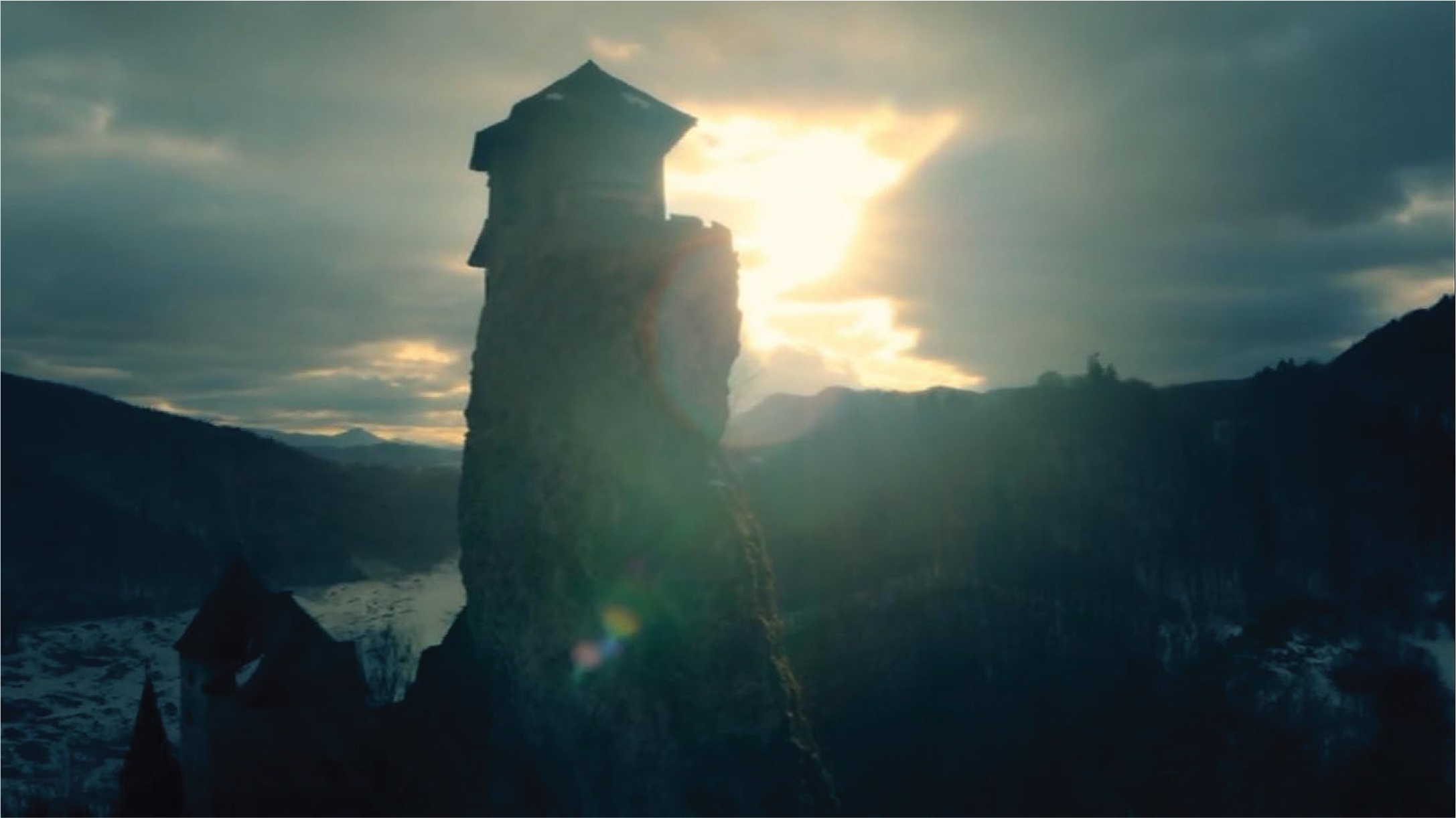
Figure 1
Dracula’s Castle as dawn breaks, shot on location at Orava Castle in Slovakia. Screenshot from the BBC Blu-ray release, ASIN: B082XVRDSN.
However, the main focus is on production designer Arwel Wyn Jones’s opulently labyrinthine sets, entirely lit by candlelight to create an intricate, unsettling interplay of light and shadows that Jones thought would ‘create a sense of unease in the viewer’.34 His design centres on a recreation of the Fibonacci spiral staircase in the Vatican Museum, which affords a vast and disorienting central space as shown in Figure 2.
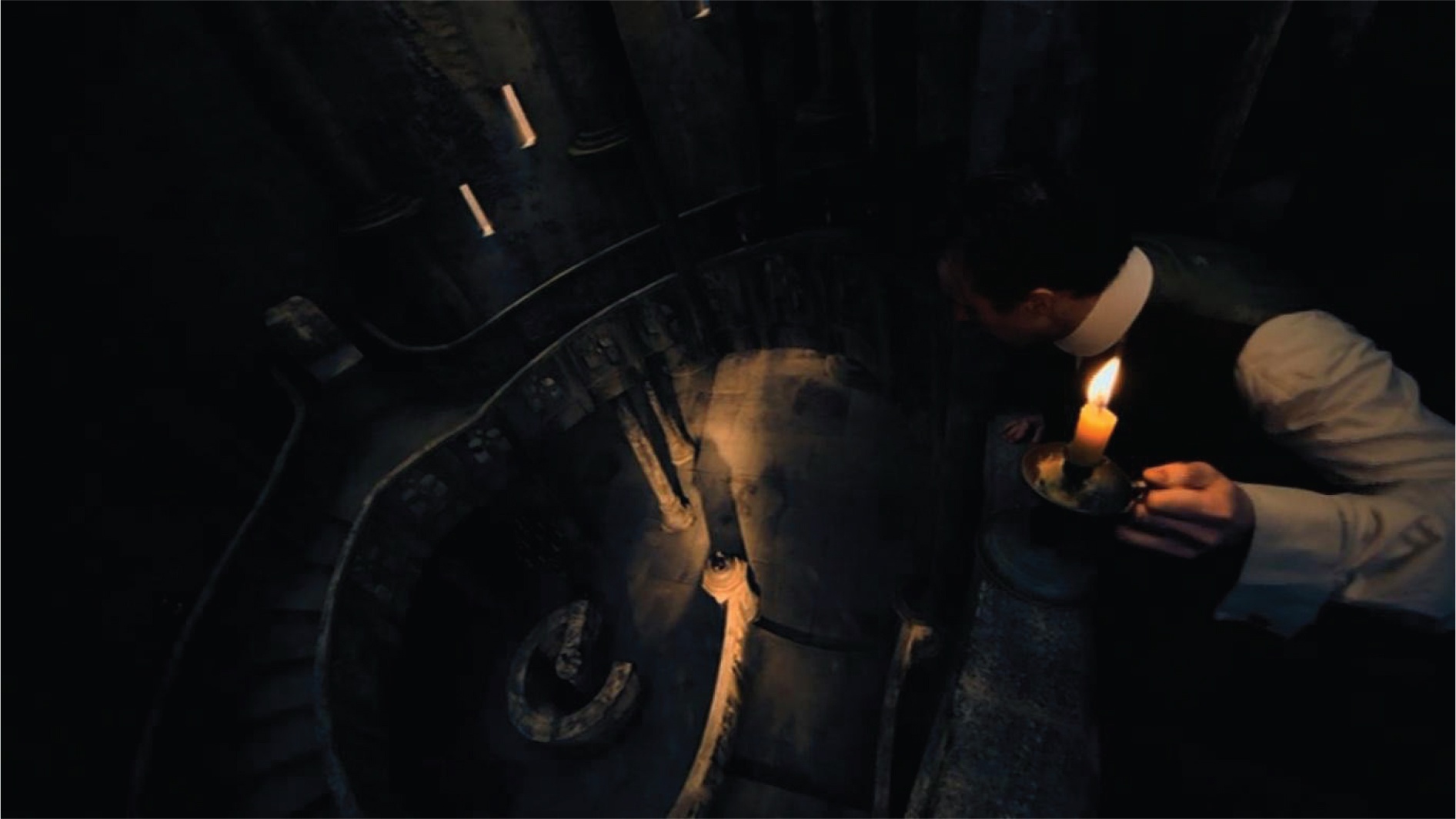
Figure 2
Spectacular interior design and lighting in Dracula based on the Fibonacci spiral staircase in the Vatican Museum. Screenshot from the BBC Blu-ray release, ASIN: B082XVRDSN.
The design for the Demeter in Part 2, deploys a similar aesthetic though deliberately less menacing because, as shown in Figure 3, the conceit is to have Dracula flaunting his presence, openly conversing with the passengers (his intended victims).
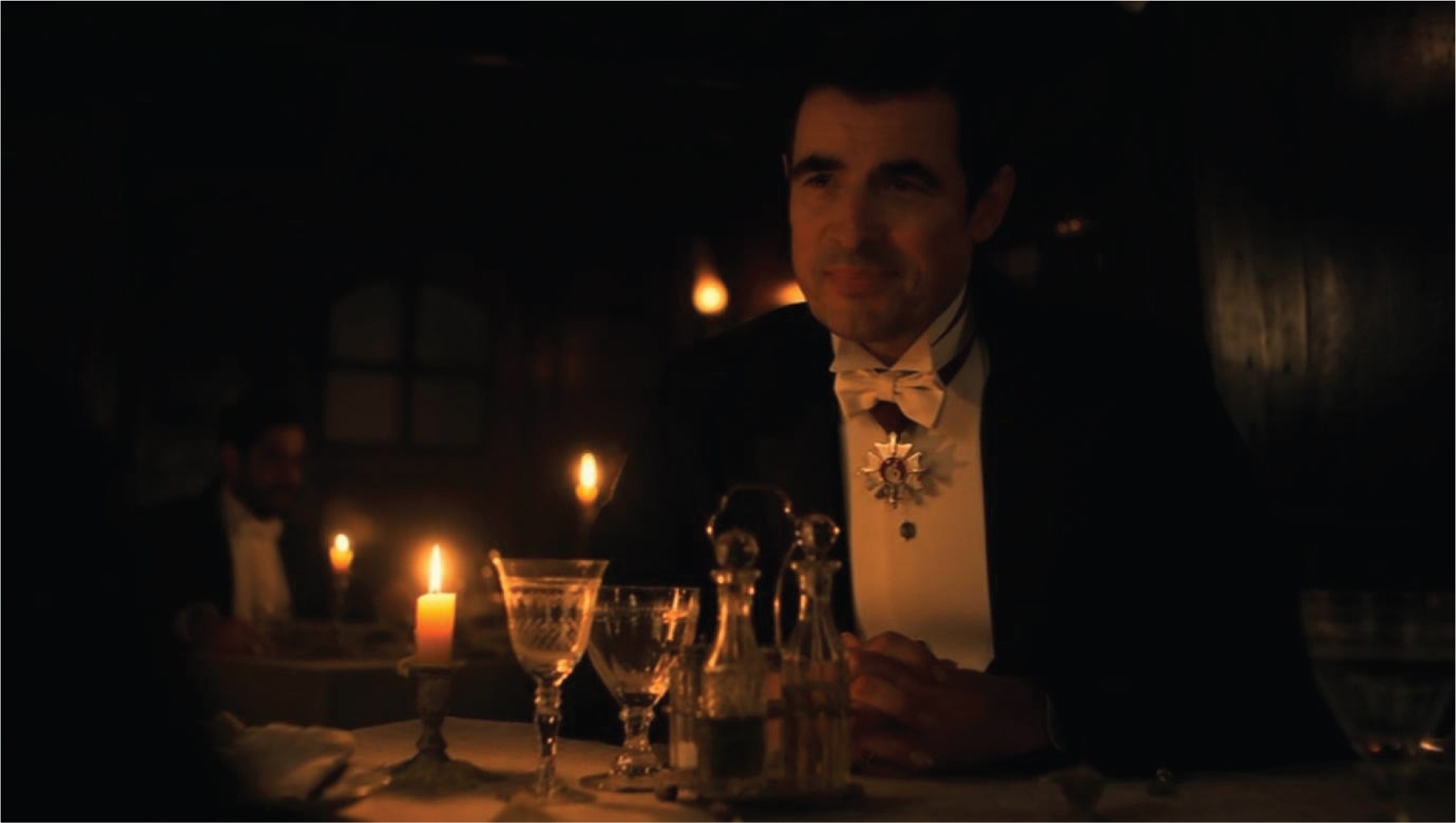
Figure 3
An urbane Count Dracula (Claes Bang) in conversation with one of his intended victims aboard the Demeter. Screenshot from the BBC Blu-ray release, ASIN: B082XVRDSN.
Part 3 is less spectacular, but notable for the artistry in the design of the high-tech laboratory in which Dracula is imprisoned.
Throughout, Dracula deploys Moffat and Gatiss’s characteristic acerbic wit and dense allusiveness, replete with numerous high and popular cultural references, including frequent invocations of previous adaptations. As with Sherlock, Dracula’s visceral camerawork uses varied, often unexpected angles, high overhead shots or extreme close-ups, abrupt, occasionally 360 degree movements as well as shock cuts, rapid montage and slow-motion sequences. However, the bravura style is not allowed to overwhelm the focus on a drastically reworked characterisation in which Dracula emerges as what Moffat described as ‘the non-heroic hero of his own story’, a complex, troubled character with a sardonic sense of humour, ‘a degree of self-awareness’ and vulnerability.35 Their conception was realised in a bravura performance by the Danish actor Claes Bang, who combines the necessary sexual allure and menace with a droll urbanity subtended by a growing recognition of the full horror of his fate. Upending the novel’s conventional sexual politics, Dracula’s nemesis is a female Van Helsing, Sister Agatha (Dolly Wells), who announces herself as ‘Your every nightmare at once. An educated woman with a crucifix.’ In the adaptation’s most audacious trope – though consistent with the post-millennial trend of humanising the vampire – Dracula dies not in screaming agony but, as shown in Figure 4, entangled in an agreed, mutually fatal love embrace with Agatha’s great grandniece Zoe Van Helsing, ‘experiencing an epiphanic vision of sunshine and eternal bliss’.36

Figure 4
Dracula and Zoe Van Helsing (Dolly Wells) locked in an epiphanic fatal embrace. Screenshot from the BBC Blu-ray release, ASIN: B082XVRDSN.
The BBC accorded this co-commission a prestigious showing on New Year’s Day at 9.00 pm, the second and third episodes following on consecutive days, a day later on Netflix. Dracula’s consolidated audience figures (linear broadcasts + iPlayer) of 7 million per episode matched those of Sherlock.37 Nearly all reviewers considered this version to be thought-provoking and engaging: ‘parodic, witty, adult and intelligent, irreverent but with a fundamental belief in the power and resonance of the myth’.38 Its combination of the familiar and the new, its witty allusiveness and sexual frankness appealed to Netflix’s cosmopolitan target audience and, to date, Dracula represents the high-water mark of BBC/Netflix co-commissioning.
However, there was an hiatus in further co-commissions after The Serpent in 2021 as Netflix’s production strategy became more selective and circumspect.39 Nevertheless, in October 2025 plans were announced for a further two 6 x 60-minute seasons of Peaky Blinders, following Netflix’s screening of the feature-length conclusion of the original six seasons (2013-22), Peaky Blinders: The Immortal Man in March 2026, which ended with the death of Tommy Shelby (Cillian Murphy). The new series continues the series’ historical trajectory with a ‘new generation of Shelbys’; creator-writer Steven Knight will continue to act as showrunner.40 As noted, Peaky Blinders has been a hit for both companies and the production has additional value for the BBC in being shot in Digbeth Studios, its revamped Birmingham production base, thereby qualifying as an out-of-London series that represents the Corporation’s commitment to screening the UK’s regional cultural diversity.41
5 Protecting British Culture: the BBC and Disney+
The BBC has only co-produced once with the Disney+, for the latest two seasons of the long-running science fiction series, Doctor Who.42 Launched in November 2019, the priorities of Disney+ reflect those of its parent company, which uses its interlocking franchises and brands – produced by Disney or its acquired labels Marvel, Pixar, Star Wars and National Geographic – to provide a dependable, long-term content that can be exploited in multiple ways.43 Because 89% of Disney+’s content is franchised programmes, it does not have the same imperative to seek original series as Netflix.44 The Doctor Who franchise was desirable because it represented another established brand that could be endlessly extended through each reincarnation of the central character, thereby incorporating the ‘Whoniverse’ into the ‘Disneyverse’.
The BBC’s ambitions were more specific. First broadcast by the Corporation on 23 November 1963, Doctor Who has become a cultural institution, considered to have a quintessential quirky Britishness symbolised by the Doctor’s time machine, the TARDIS, disguised as a London police box.45 Following its resurrection in 2005, after an absence of 16 years, by the influential Welsh writer and showrunner Russell T Davies, Doctor Who became an international success, considered so valuable that, when BBC Studios was established, the series was designated a ‘protected property’ that would continue to be made in-house by BBC Cymru Wales in Cardiff where it had become the core component of the Welsh capital’s production hub, part of the BBC commitment to the UK’s devolved nations.46 The attractions of partnering with Disney were to scale up the show’s production values and increase its international reach, extending the series into a fully global franchise. Davies, arguing that the cost of a higher-budgeted series should not come from the licence fee but from a partnership with a ‘bigger platform’, contended that the collaboration would enable the series to ‘reach a new generation of fans while keeping our traditional home firmly on the BBC in the UK’.47 The partnership was trumpeted in the press as an ‘unprecedented’ pact between ‘two giants of entertainment’, with an estimated budget of £6-8m per episode – triple those for the previous series – in a deal valued at £168m.48 However, reacting to an outcry by fans who feared the show would be Americanised, the BBC’s Chief Content officer, Charlotte Moore, issued a public reassurance that the content of this ‘very British show’ would not be threatened but that ‘[j]oining forces with Disney … will elevate the show to even greater heights’.49
The structure of the series, in which each episode is a self-contained adventure, remained unaltered, the principal changes were in production design and cinematography. The sets, including the interior of the TARDIS, are more expansive and spectacular; several episodes used virtual LED screens and in-studio drones to enhance the visual scale, like the Marvel and Star Wars franchises. As shown by the ballroom scene in Figure 5, the lavish sets and costumes for ‘Rogue’ (Series 1, episode 6), set in Regency Bath, rival those of the upmarket adaptation of Jane Austen’s Sanditon (3 series, 2019-23), as jokingly alluded to by the characters.
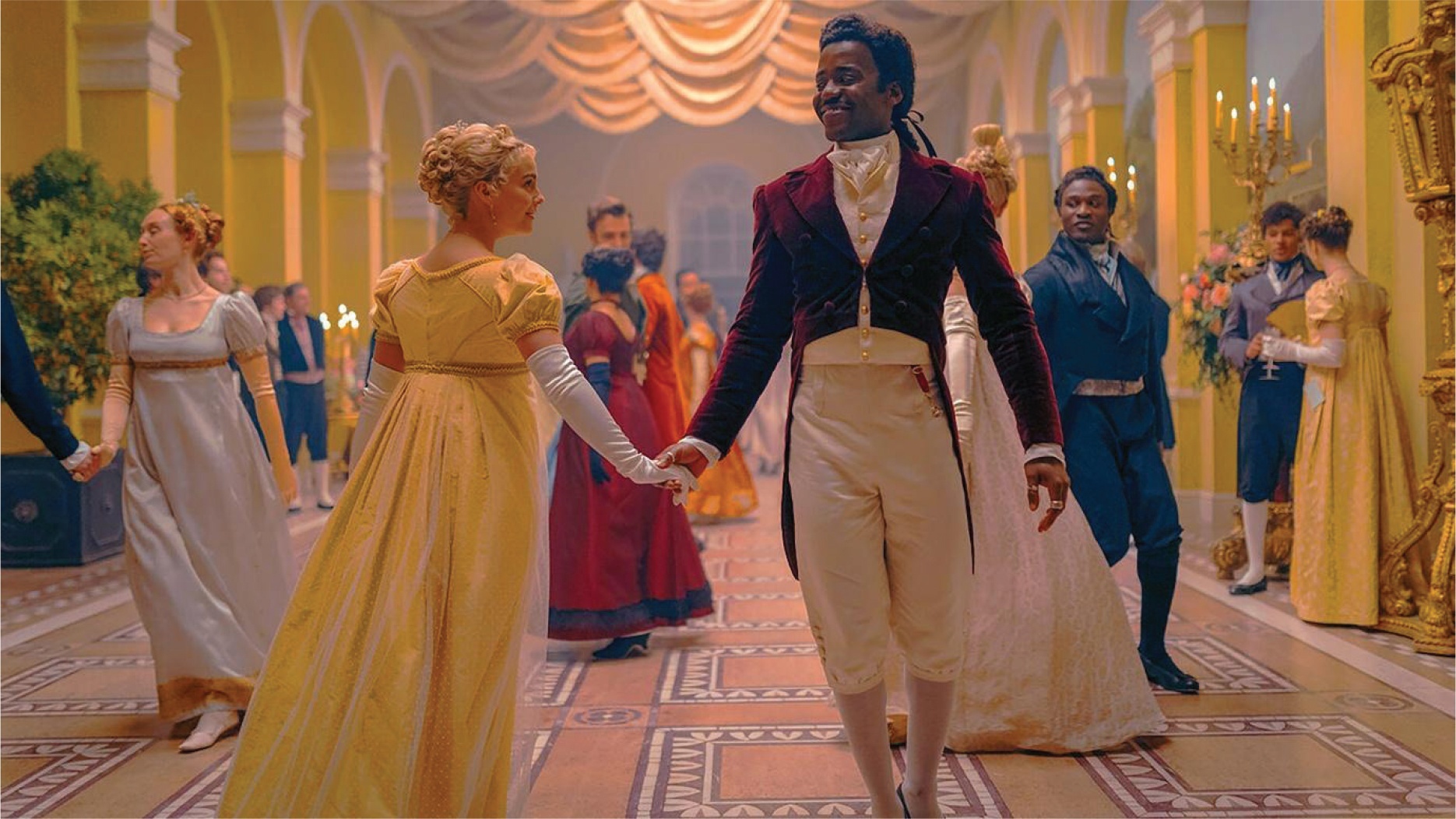
Figure 5
Doctor Who (Ncuti Gatwa) dancing with his companion Ruby Sunday (Millie Gibson) in the episode ‘Rogue’. Screenshot from the BBC iPlayer Library.
The capacious settings enhance the youthful dynamism of Ncuti Gatwa, the first black actor to play the Doctor. Davies wanted a more emotional actor who displayed his feelings openly, which allowed the series to expand its sexual politics. ‘Rogue’ contains an openly gay relationship between the Doctor and the bounty hunter Rogue (Jonathan Groff); figure 6 shows their mutual longing.
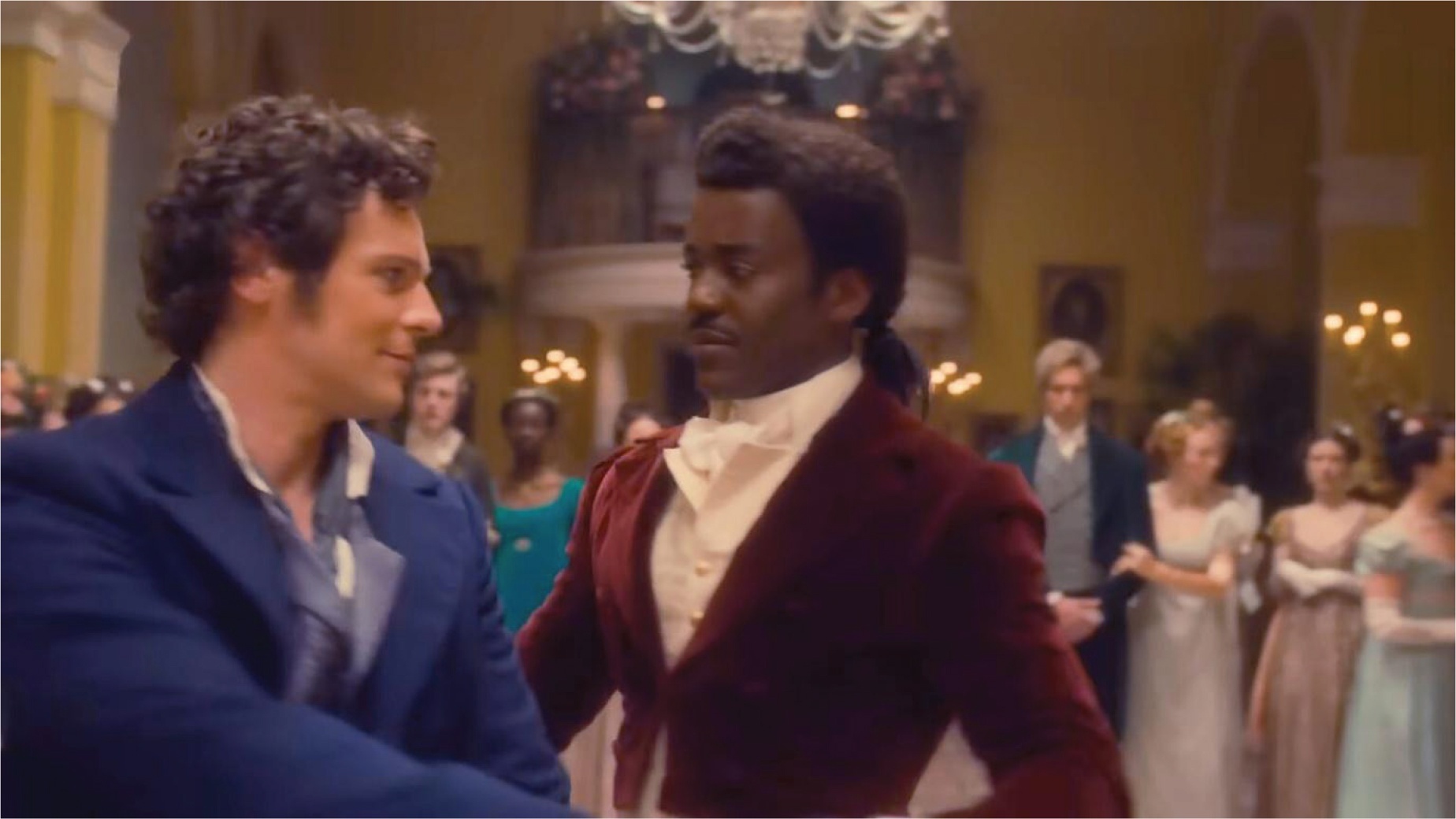
Figure 6
The mutual longing of The Doctor and the bounty hunter Rogue (Johnathan Groff) in the episode ‘Rogue’. Screenshot from the BBC iPlayer Library.
Davies also wanted the revamped series to be ‘madder, wilder and funnier’, with more light-hearted fun and an increased fantasy/supernatural element.50 However, the five-part spin-off, The War Between the Land and the Sea, also part of the deal with Disney – which had a cinematic scale, spectacular set designs and some stunning special effects – deployed its extended narrative to explore a more serious subject, part of Davies’s determination to use popular drama to further debate about the climate emergency.51
Despite being promoted by its cast in both London and New York before release in April/May 2024, the UK audience figures averaged 3.8m, well below the 5.2m of the previous Doctor incarnation (Jodie Whittaker).52 One Disney Executive described the American audience figures as ‘underwhelming’ alongside the show’s failure to break out of its established fan base, which appears to be the main reason why the corporation withdrew participation after the initial two-series deal ended in December 2025.53 The timing of the partnership – announced in October 2022 at the height of the ‘streaming wars’ with their unprecedented spending levels – was unfortunate as Bob Iger returned as Disney’s CEO shortly afterwards determined to scale back spending.54 Journalists Max Goldbart and Jake Kanter, surveying fans’ reactions, commented that many deemed the series was betwixt and between – the larger budgets obscuring the show’s familiar low-tech idiosyncrasies that many fans deemed essential but at the same time never matching those of the top-ranked Disney franchises; and both series were regarded as patchy, with occasional strong episodes but disappointing two-part finales.55
The resulting clamour after Disney’s withdrawal became known, forced another public intervention by the BBC. Lindsay Salt, the BBC’s Director of Drama, reassured British audiences that the Corporation ‘remains fully committed to Doctor Who, which continues to be one of our most loved dramas … We can assure fans, the Doctor is not going anywhere, and we will be announcing plans for the next series in due course, which will ensure the TARDIS remains at the heart of the BBC.’56 At the time of writing (April 2026), nothing definite has been announced, except that Davies will write the 2026 Christmas Special. Thus although Doctor Who is a global franchise, unlike Dracula, it has a particular, and highly sensitive, place within British sensibilities, and partnering with Disney triggered long-standing fears of American cultural colonisation.57 And, for UK fans, tripling the budget was counter-productive.
6 An Eclectic Heterogeneity: the BBC and Amazon Prime Video
The BBC’s co-commissions with Amazon Prime Video are heterogeneous: crime thriller, Ripper Street (2013-16); political drama, A Very English Scandal (2018); season two of Fleabag (2019), Phoebe Waller-Bridge’s comedy-drama; a comic fantasy, Good Omens (3 seasons 2019-26); Small Axe (2020), an interconnected series of five films about race relations in Britain 1960-80; and Outlaws (3 seasons 2021-24), a comedy-thriller featuring seven strangers from different social classes, forced together to complete their community service. Karen Petruska argues that this eclecticism derived from Roy Price, the head of the production arm, whose strategy was to commission offbeat shows that are enjoyed by small but passionate groups, attracting customers to the parent website to initiate or extend their relationship with Amazon’s array of products and services; Price commented ‘It’s less about following generic, general rules for creating television and more about finding a specific voice and a specific artist that people are going to be a fan of’.58 One can also note the streamer’s opportunism – only partnering for Ripper Street and Fleabag after they had become successful; and that most of the six-year-long development work on Small Axe had been completed before the streamer became involved.59
The BBC’s ‘bespoke’ strategy was sufficiently flexible to accommodate that eclecticism and its motivations for partnering may well have varied for each production. My focus here is on the most prestigious co-commission A Very English Scandal, a three-part (each episode 60 minutes) series that explored the events leading up to the sensational trial in 1979 when the Liberal Party Leader Jeremy Thorpe was accused of planning the murder of his lover Norman Scott. For all the singularity of its subject, the production exemplified the well-established tradition of BBC historical dramas designed for prime-time Sunday evening viewing and continued the long line of BBC ‘state-of-the-nation’ political dramas stretching back to Cathy Come Home in 1966. A Very English Scandal’s screenplay was by Russell T Davies, who conducted extensive research in order to inform his own understanding of the affair as a gay man rather than simply replicate the principal source by the journalist John Preston.60 In addition to a prestigious writer, A Very English Scandal had an accomplished director Stephen Frears – with a long history of moving between films and television and thus highly attuned to their respective merits – attracted precisely because of the possibilities afforded by complex television drama. Frears commented that the series’ precise delineation of social mores in this period (1960–79) ‘would have got lost in the cinema. On television it’s absolutely in the right place. It has to come home’.61 Frears’ remark alludes to the BBC’s cultural centrality as a showcase for political dramas in which the nation speaks to itself, in this case, offering an incisive critique of the Establishment. The production’s status was further enhanced by using star actors, Ben Wishaw as Scott and Hugh Grant as Thorpe. Producer Dominic Treadwell Collins opined that casting Grant, playing his first important television role in nearly 20 years, ‘took the whole show to another level. It made it an event.’62 Such stars are expensive and, in addition to sharing costs, co-commissioning with Amazon Prime Video offered the possibility of a global audience for this resonantly English subject.
A Very English Scandal has the typical narrative (and locational) complexity of long-form drama as it unfolds the vicissitudes of Scott and Thorpe’s relationship against the backdrop of a particularly volatile period of British politics, starting in media res with the beginnings of the plot against Scott before winding back four years to the time when he and Thorpe first met. Both are depicted as singular individuals but also the product of antithetical forces: the privileged, public-school elite Thorpe embodies and the working-class precarity of Scott, who becomes a counter-cultural figure through his temporary success as a male model. Their affair embodies a significant period in the struggle for gay rights in Britain; homosexual relationships were not de-criminalised until 1967. Although there are farcical scenes – notably the attempted murder of Scott on Exmoor – the series’ prime mode is witty, sharply delineated black comedy. It deploys the nuanced mise-en-scène that Dunleavy identifies as a key characteristic of complex serial drama in a meticulously recreated period milieu in which everything – including clothes, telephones, cigarette packets, and beer bottles – are authentic, anchoring a conspiracy that almost defies credibility. Figure 7 recreates the plush interior décor – leather sofas, heavy mahogany furniture and pot plants – of the exclusive, members-only Carlton Club in Mayfair. This gentrified world of unassailable privilege is the setting for Thorpe to invoke the solidarity of the English Establishment, which transcends party divisions, by persuading the Conservative Home Secretary, Reginald Maudling, to get Scotland Yard to drop its investigation of an affair that would end his political career.
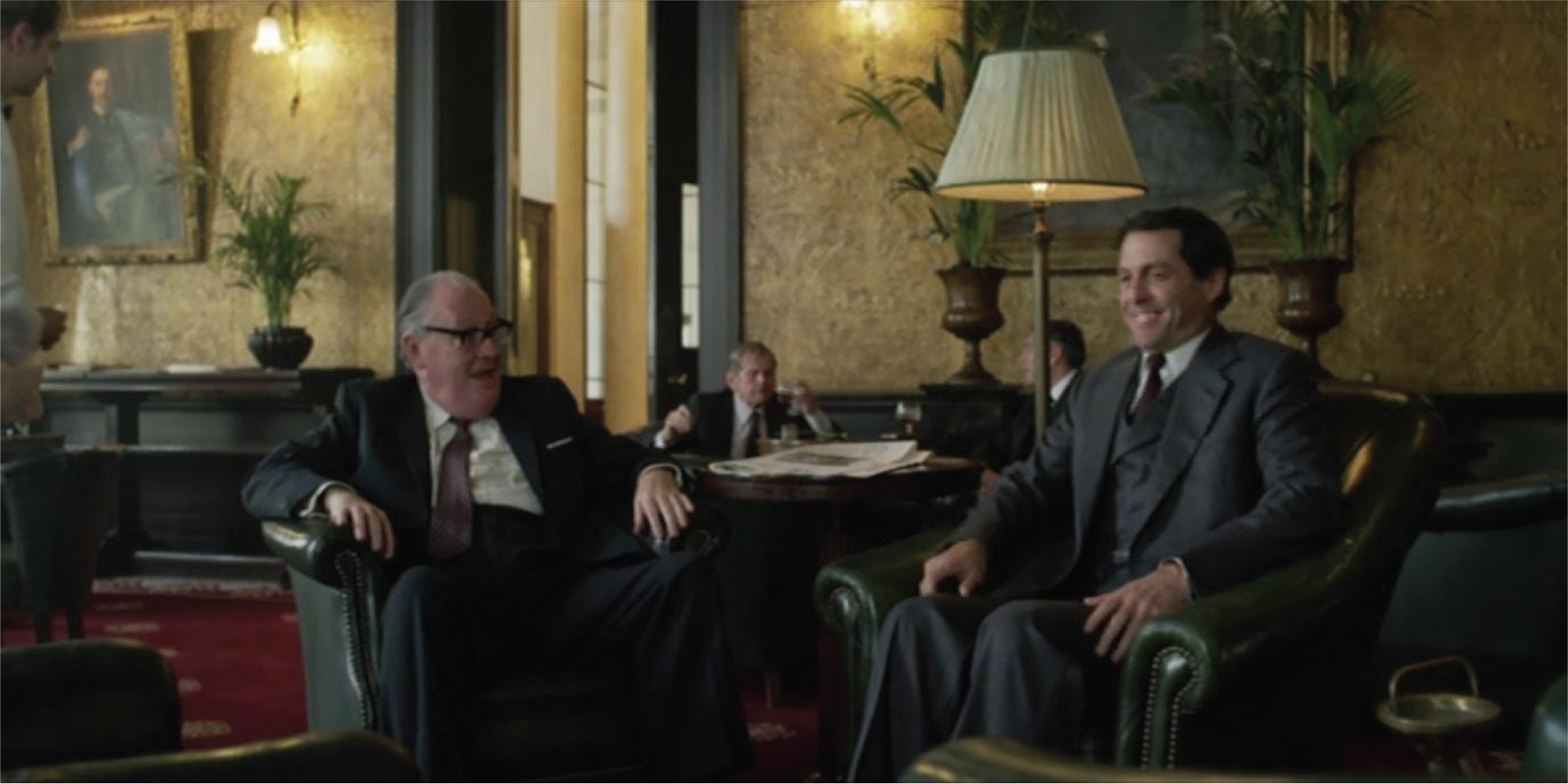
Figure 7
The English Upper-Class Establishment: Liberal Leader Jeremy Thorpe (Hugh Grant) and Conservative Home Secretary, Reginald Maudling (Michael Culkin) exchange pleasantries in The Carlton Club. Screenshot from the BBC DVD release, ASIN: B07D7N5YF9.
A Very English Scandal also exemplifies typically complex, troubled and transgressive protagonists. Scott, deftly rendered by Whishaw, is a quixotic combination of mental instability and vulnerability, and devious cunning, becoming, as events unfold, a class and sexual warrior determined, finally, to be himself and get heard. However, it is on Grant’s characterisation that the drama rests. Frears’ sympathetic direction draws out a nuanced performance of great subtlety and strength, one that succeeds in capturing Thorpe’s multifaceted mercurial charisma, charming, witty, sharply intelligent, confident and duplicitous. Without attempting to merely imitate Thorpe, Grant captures his voice and mannerisms, losing weight to attain the original’s gaunt, somewhat cadaverous look. Figure 8 shows Thorpe’s cunning and evasiveness as he feigns surprise at the mention of Norman Scott.
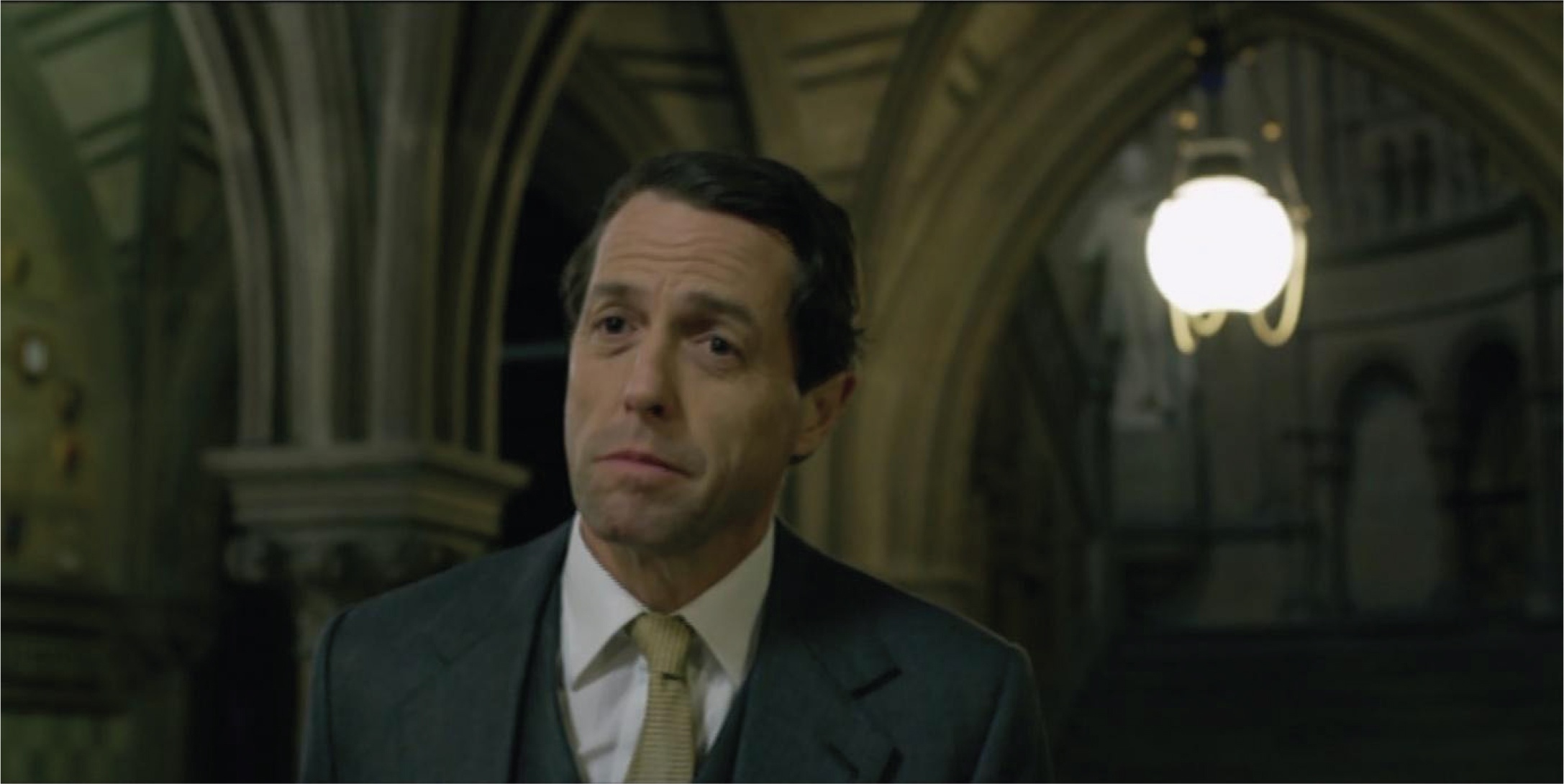
Figure 8
Thorpe feigns surprise at the mention of Scott’s name. Screenshot from the BBC’s DVD release, ASIN: B07D7N5YF9.
Grant is equally adept at portraying Thorpe’s Olympian sense of entitlement – able to discuss murdering Scott as if it were neither illegal nor immoral – and the haunted, tragic desperation lurking beneath. The early interactions between Thorpe and Scott – as in the delightful scene where they ride on a bus together – convey that theirs is a genuine love affair, which deepens the nature of the scandal and its presentation of a gay relationship.
A Very English Scandal garnered a high consolidated average of 6.6.m viewers when first broadcast on BBC One (May 2018) and was the second-most-viewed show the first week it was aired on Amazon Prime in the US, before winning Best Drama Series at the Broadcast awards.63 The performances of Wishaw and Grant were uniformly praised by reviewers and Grant’s Bafta nomination further enhanced the series’ cultural as well as economic capital. Co-commissioning had enabled an amplified, cinematic version of a political drama that was based on a major national event. However, after Price was replaced by Jennifer Salke in 2019, Amazon Prime Video’s commissioning became more conservative.64 Its latest co-commission with the BBC, The Night Manager, released in January 2026, extended the 2016 adaptation of John Le Carré’s original novel that had been one of the BBC’s most popular drama series, watched by 10 million viewers in the UK and sold in more than 180 countries.65 With the same screenwriter (David Farr) and stars (Tom Hiddleston and Hugh Laurie), The Night Manager is replete with the extensive location shooting (principally Colombia), explosions, stunts and special effects expected from a ‘high voltage’ contemporary international thriller. Although Farr claims the series is as much about characterisation and identity as action, a ‘glamorous thriller … [that is] fundamentally about fracturing selves’,66 it lacks the quirky distinctiveness of the earlier co-commissions.
7 Concluding Observations
The BBC’s high-end drama co-commissions with streamers, as shown by the three series discussed, exemplify the qualities in style and form that characterise the foregrounding – in Dracula’s case flaunting – of aesthetic qualities in design and cinematography that constitute ‘televisuality’ in the contemporary era of multiplatform transnationalism. They typify the characteristics Dunleavy and others have identified: sophisticated use of location, nuanced mise-en-scène, complex, time-shifting narratives and the depiction of multifaceted characters who are usually troubled – unsure of their identity, sexuality or destiny – and transgressive, challenging conventional norms. They form part of a wider European television fiction ‘renaissance’ as previously mentioned, which has seen unprecedented levels of quality productions that are able to circulate internationally. However, I have also shown that they have strong continuities with previous BBC drama series and therefore these co-commissions should be regarded as amplifications of existing strengths and traditions rather than a wholesale transformation. These drama co-commissions have mutual economic and cultural benefits and there is no necessary conflict, in terms of subject matter, between the national orientation of a PSM and the global perspective of the streamers. From the BBC’s perspective, these co-commissions enable BBC Studios to make a profit to be returned to the parent Group and to fulfil Public Purpose 3: to screen world-leading, distinctive, high-quality drama that provides the resources for British creative talent to showcase their qualities to a global audience. For the streamers they represent distinctive programming that stands out in their catalogues, thereby helping to expand their markets and increase their subscriber base. For both, these productions attract important cultural capital in the form of prestigious reviews and awards.
Although these are general characteristics, evidencing the ‘commonality of interests’ between PSM and streamers Dunleavy discerns, my analysis has also demonstrated the need to contextualise each specific production. The BBC’s co-commissioning decisions are not governed by a pre-determined template but on the possibilities provided by each streamer’s different priorities, determined by their production models. Disney+ was the only possibility for the Doctor Who franchise; the resoundingly national concerns of A Very English Scandal would only attract Amazon Prime Video’s heterogenous production slate; and Dracula’s allusive wit, sexual frankness and radical innovation of an iconic property appealed to Netflix’s ambitions to purvey ‘quality television’ to cosmopolitan subscribers. I have also demonstrated that there are tensions and instabilities in these partnerships. The fracturing of the partnership with Disney and the BBC’s desperate attempts to reassure audiences that this was neither cultural colonisation nor the demise of a national treasure, demonstrate that the rapprochement between national and global is precarious; the concerns of Doctor Who fans show that the cosmopolitan appeal of high-end drama does not erase national sensibilities. Indeed, in this case, amplification alienated a vocal fan base. Although the BBC’s relationship with Netflix and Amazon Prime Video continues, its nature has changed. Peaky Blinders and The Night Manager are both extensions of existing properties rather than new ones, eschewing the one season limited series that Dunleavy considers are able to take the most creative risks. This confirms the widely shared view that the streamers have become more circumspect, selective, risk-averse and conservative in their commissioning as they consolidate their finances now that the COVID-fuelled expansion of their subscriber bases has slowed.67 Not only does this diminish the creative possibilities afforded by co-commissions, the latest statistics show that co-commissioning itself is declining; in 2024 such productions represented less than 1 per cent of the total spend on UK HETV – half the 2023 figure.68
Although co-commissions have brought the benefits described above, significant concerns have been expressed in three recent high-profile publications which include analysis of the cultural and economic impact of high-end production on UK’s television ecology as a whole.69 The first concern is that the scale of resources committed to high-end series and the cost inflation has reduced commissioning of mid-range series of local stories for domestic consumption; the second is that high-end drama’s reliance on the participation of established, internationally marketable talent – which all three of the series analysed here illustrate – limits opportunities for unproven voices; the third is anxieties about the sustainability of a sector overwhelmingly dominated by overseas productions – 82% in 202470 – and the concomitant risk that UK television becomes a service industry. All these factors, as Gillian Doyle suggests – and successive BBC Director-Generals continually assert – strengthen the case for a well-supported, freely accessible public service television provision in the UK to ensure all levels of talent are nurtured and drama production reflects the full diversity of the UK’s regions and nations.71 Karen Donders argues that the relationship between PSM and streamers is a work in progress.72 As this article has shown that ‘progress’ is not necessarily incremental but ebbs and flows in relation to wider cultural and economic priorities forming one element in a complex, increasingly volatile global television industry in which there are few certainties.
Acknowledgements
The author wishes to thank Dr Christopher Meir for his advice and guidance on a draft of this article, and the journal’s two anonymous reviewers whose perceptive comments helped him to reshape and sharpen this revised version.
Notes
[1] Luca Barra and Massimo Scaglioni, “Introduction: the Many Steps and Factors of a European Renaissance”, in A European Television Fiction Renaissance: Premium Production Models and Transcultural Circulation, eds. Luca Barra and Massimo Scaglioni (London: Routledge 2021), 1–10.
[2] Luca Barra and Massimo Scaglioni, “The Grounds for a Renaissance in European Fiction: Transnational Writing, Production and Distribution Approaches, and Strategies”, in ibid., 17–21.
[3] Karen Donders, “Public Service Media Beyond the Digital Hype: Distribution Strategies in a Platform Era”, Media, Culture and Society 41, no. 7 (2019): 1015.
[4] Jean Chalaby, TV in the Streaming Era: The Global Shift (Cambridge: Cambridge University Press, 2023), 119.
[5] Televisuality: Style, Crisis and Authorship in American Television (New Brunswick, NJ.: Rutgers University Press), 4 and passim. See also Max Sexton and Dominic Lees, Seeing It on Television: Televisuality in Contemporary US ‘High End’ Series (New York: Bloomsbury Academic, 2021), especially 9–31.
[6] Trisha Dunleavy, Complex Serial Drama and Multiplatform Television (London: Routledge, 2018). See also Jason Mittell, Complex TV: The Poetics of Contemporary Storytelling (New York and London: New York University Press, 2015).
[7] Trisha Dunleavy, “Multiplatform TV, the Cultural Diversification of High-End Drama, and New Coproduction Strategies”, in TV Drama in the Multiplatform Era: Transnational Production and Cultural Specificity, eds. Trisha Dunleavy and Elke Weissman (Cham: Palgrave Macmillan, 2023), 1–33.
[9] Mareike Jenner, Netflix and the Reinvention of Television (Cham: Palgrave Macmillan, 2018), 161–70; see also Ramon Lobato, Netflix Nations: The Geography of Digital Distribution. New York: New York University Press, 2019, 52, 157.
[10] Philip Drake, “A 21st Century Gold Rush? Video on Demand and the Global Competition for UK Television”, in A European Television Renaissance, 71-85; Roberta Pearson “‘The Biggest Drama in British Television History’: Netflix, The Crown, and the UK Television Ecosystem”, ibid., 86-117; James Chapman, Contemporary British Television Drama (London: Bloomsbury Academic, 2020).
[11] Gillian Doyle, “SVoDs, New Norms and the Challenge for Public Service Media”, Journal of Digital Media and Policy, 14 no. 3 (2019): 287–302.
[12] Trisha Dunleavy, “Transnational Co-Production, Multiplatform Television and My Brilliant Friend”, Critical Studies in Television 15, no 4 (2020): 336–56.
[15] Krishna Jayakar and Euna Park, “Responses of Incumbent Media Companies to Streaming Video”, in Television Streaming Wars, eds. Arienne Ferchaud and Jennifer M. Proffitt (London: Routledge, 2023), 26–40.
[16] Jeanette Steemers, Selling Television: British Television in the Global Marketplace (London: BFI Publishing 2004), 82–90.
[17] Jeanette Steemers, “International Sales of U.K. Television Content: Change and Continuity in ‘the Space in Between’ Production and Consumption”, Television and New Media. 17 no. 6 (2016): 734–53.
[18] Alessandro D’Arma, “The Hollowing Out of Public Service Media: a Constructivist Institutionalist Analysis of the Commercialisation of BBC’s In-house Production”, Media, Culture & Society 40, no. 3 (2018): 437–38.
[19] BBC, British Bold Creative. BBC Studios: Strengthening the BBC’s Role in the Creative Industries (London: BBC, September, 2015), 4, 6.
[20] Tom Harrington, Julian Aquilina, Gareth Sutcliffe, Tom Standen-Jewel and Adam Dalrymple, Netflix: A Decade in the UK (London: Enders Analysis, 31 January, 2022), 10.
[22] Christopher Meir, Mass Producing European Cinema: Studiocanal and Its Works (New York and London: Bloomsbury Academic, 2019), 112–14.
[24] BBC Public Purposes, https://www.bbc.com/aboutthebbc/governance/mission.
[25] Alessandro D’Arma, Tim Raats and Jeanette Steemers, “Public service media in the age of SVoDs: A comparative study of PSM strategic responses in Flanders, Italy and the UK”, Media, Culture & Society 43, no. 4 (2021): 695–96.
[26] Michele Hilmes, “Transnational TV: What Do We Mean by Co-Production Anymore?”, Media Industries 1, no. 2 (2014): 12.
[27] Amanda D. Lotz, Netflix and Streaming Video: The Business of Subscriber-Funded Video on Demand (Cambridge: Polity Press, 2022), 140.
[28] Gary Edgerton, “Netflix, Spanish Television, and La casa de papel: Growing Global and Local TV Together in the Multiplatform Era”, Critical Studies in Television 18 no. 2 (2023): 129.
[31] Chuck Tryon, “TV Got Better: Netflix’s Original Programming Strategies and Binge Viewing”, Media Industries 2, no. 2 (2015): 110.
[33] Louisa Mellor, “BBC/Netflix Dracula’s Behind-the-Scenes Set Secrets,” Den of Geek, 5 October, 2020, https://www.denofgeek.com/tv/bbc-netflix-dracula-behind-the-scenes-set-secrets/#google_vignette.
[36] Magdalena Grabias, “Dracula and the Gothic Legacy: Mark Gatiss and Steven Moffat’s BBC Television Series”, Journal of Adaptation in Film & Performance 14, no. 3 (2021): 298.
[37] Jake Kanter, “‘Dracula: BBC & Netflix Show Gets Huge Ratings Boost With Catch-Up Viewing in the UK,” Deadline, 9 January, 2020, https://deadline.com/2020/01/dracula-ating-grows-audience-by-83-with-catch-up-viewing-1202825535/.
[39] See Tim Dams, “Commissioners Look for Safe Bets Amid TV Drama Downturn: ‘We All Have to Rework Budgets and Business Models,’” Deadline, 30 October 2025, https://www.screendaily.com/features/commissioners-look-for-safe-bets-amid-tv-drama-downturn/5209823.article.
[40] Jon Creamer, “BBC, Netflix bring Peaky Blinders back for two more,” Televisual, 2, October 2025, https://www.televisual.com/news/bbc-netflix-bring-peaky-blinders-back-for-two-more-series.
[41] For further discussion of the BBC’s regional responsibilities see Amy Genders and Andrew Spicer, ‘‘The BBC and the UK’s Nations and Regions: hierarchies, rivalries and contradictions”, in Andrew Spicer, Ruth Barton and Amy Genders (eds), The Politics of Place: Location in European Screen Industries (Cham: Palgrave Macmillan, 2026), 53–85.
[42] Although broadcast as Series 14 and 15 in the UK, they were renamed Series 1 and 2 when streamed on Disney+.
[43] Jason Scott, “Disney+ as a Platform for Franchise Expansion”, in The Cultural Legacy of Disney: A Century of Magic eds. Robyn Muir, Emily Aguiló-Pérez, Hannah Helm and Rebecca Rowe (Lanham MD: Lexington Books, 2024), 63–86.
[45] Danny Nicol, Doctor Who: A British Alien (Manchester: Manchester University Press, 2018); Graham Gibson, Doctor Who: A Cultural History (Lanham MD: Rowman and Littlefield, 2025).
[46] BBC, Doctor Who: The Economic Impact (2023), https://www.bbc.co.uk/mediacentre/documents/doctor-who-economic-impact-report-fin.pdf.
[48] Max Goldbart and Jake Kanter, “Why Disney Ditched ‘Doctor Who,’” Deadline, 30 October, 2025, https://deadline.com/2025/10/why-disney-ditched-doctor-bbc-1236601181/.
[50] Laura Harding, “Russell T Davies: New Doctor Who series is Madder, Wilder and Funnier”, Evening Standard (23 April, 2024), https://www.standard.co.uk/showbiz/russell-t-davies-ruby-ncuti-gatwa-bbc-breakfast-b1153232.html.
[52] Jake Kanter, ‘“Doctor Who” Ratings Dive, Supercharging Uncertainty About Future of Sci-Fi Series,”, Deadline, 22 May, 2025, https://deadline.com/2025/05/doctor-who-ratings-drop-speculation-future-1236409467/.
[54] Peter Hoskins, “Disney: Bob Iger Begins Major Shake-up After Returning to Firm,” BBC News, 22 November 2022, https://www.bbc.co.uk/news/business-63711818.
[56] Salt, quoted in Paul Glynn, “Doctor Who Christmas special confirmed for next year”, BBC, 28 October 2025, https://www.bbc.com/news/articles/c9wvy88eeeeo.
[57] Duncan Webster, Looka Yonder: The Imaginary America of Populist Culture (London: Comedia, 1988).
[58] Hollywood Reporter (30 July, 2014), quoted in Karen Petruska, “Amazon Prime Video: Where Information Is Entertainment”, in From Networks to Netflix, ed. Derek Johnson (London: Routledge, 2018), 362.
[59] Trisha Dunleavy, ‘“Black Lives Have Always Mattered’: Cultural Specificity and Transformative Representations in Small Axe”, Critical Studies in Television 18, no. 2 (2023): 185–205.
[60] A Very English Scandal: Sex, Lies and a Murder Plot at the Heart of the Establishment (London: Penguin Books, 2017 [2016]).
[62] Caroline Frost, “Politics on the Small Screen: The Inside Track on A Very English Scandal” (1 June 2018).
[64] Christopher Meir, “SVOD Original Film Commissioning Expanding the Boundaries of Commercial Film”, in Streaming Video: Storytelling Across Borders, eds. Amanda D. Lotz and Ramon Lobato (New York: New York University Press, 2023), 286.
[65] Cynthia Littleton, “IMG Boosts Presence and Flexes Indie Muscle at Mipcom”, Variety (15 October, 2017).
[66] Interview with Farr, Radio Times, 14 December, 2025, https://www.radiotimes.com/tv/drama/the-night-manager-season-2-david-farr-interview/.
[67] Peter Biskind, “How Streaming Ate Itself”, New Statesman, 13 October, 2023, https://www.newstatesman.com/culture/tv/2023/10/how-streaming-ate-itself.
[68] BFI, Film and High-End Television Production in the UK: Year Ending March 2025. (London: British Film Institute, 2025), bfi-film-hetv-programme-production-uk-january-march-2025-year-ending-march-2025.pdf.
[69] My arguments are drawn from: Oliver and Ohlbaum, Changing UK Content Production: What Could this Mean for the Health of the Production Sector? Report for Pact (December, 2024), https://www.pact.co.uk/resource/changing-uk-content-report-march-2025.html; Culture, Media and Sport Committee, British Film and High-End Television HC328 https://committees.parliament.uk/publications/47474/documents/246529/default/ (2025); Ofcom, Transmission Critical: the Future of Public Service Media. (London: Ofcom, July 2025); https://www.ofcom.org.uk/siteassets/resources/documents/public-service-broadcasting/public-service-media-review/transmission-critical-the-future-of-public-service-media.pdf?v=400631.