
1 Introduction: Merchandising, a Missing Dimension in Swiss Public Television Research
In the early 1980s,1 the Youth Department of the Schweizer Fernsehen DRS (DRS) developed a seven-minute stop-motion animated short film based on a proposal by two of its members, Erika Brüggemann and Guido Steiger.2 Directed by the German-born filmmaker Otmar Gutmann, the film was produced with plasticine penguins in Gutmann’s studio located then in the suburbs of Zurich (Switzerland). Completed in 1986 and retrospectively considered as the pilot of the Pingu series, it paved the way for a serial production that would soon evolve into a media and commercial phenomenon.
During the autumn of 1990, the release of the first episodes of the Pingu series on the various regional channels of Swiss television (SRG SSR) was accompanied by the commercialisation of numerous cultural and consumer products derived from the character of the young penguin. The Swiss population was confronted with an unprecedented proliferation of merchandising, encompassing books (Figure 1),3 audio tapes,4 puzzles (Figure 2),5 as well as ice creams, milk cartons, cereals, powdered iced teas, and chocolates all bearing the image of Pingu. In the following years, the phenomenon only grew in scope. For its initiators, the goal was to expand into diverse sectors, such as the video game industry in Japan,6 and to transform Pingu into a global icon by disseminating its image through a globalised merchandising strategy, notably underpinned by targeted promotional campaigns.
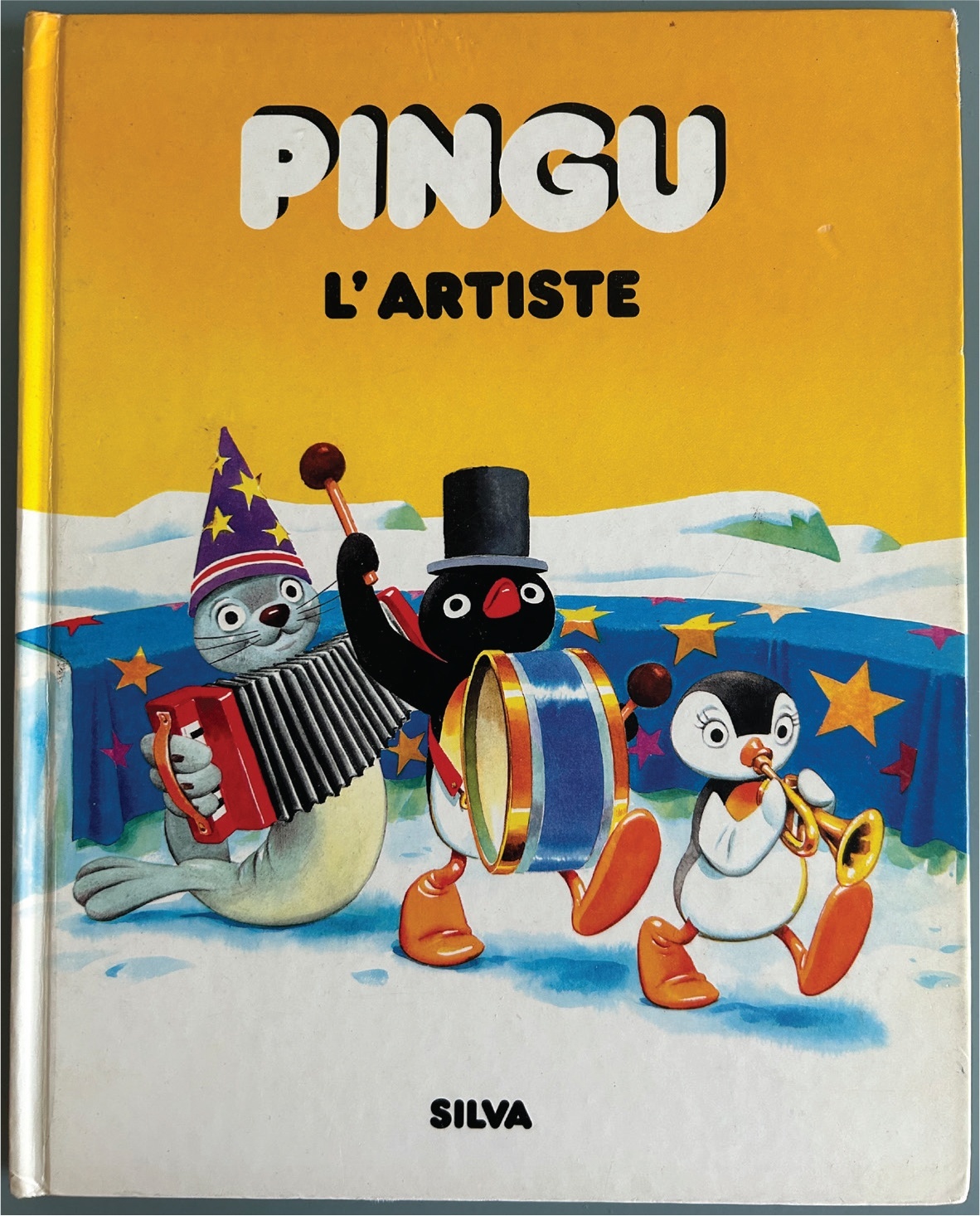
Figure 1
Sibylle von Flüe (text), Tony Wolf (ill.) and Madeleine de Couët (tans.), Pingu l’artiste [Pingu is an artist] (Zurich : Éditions Silva, 1991).
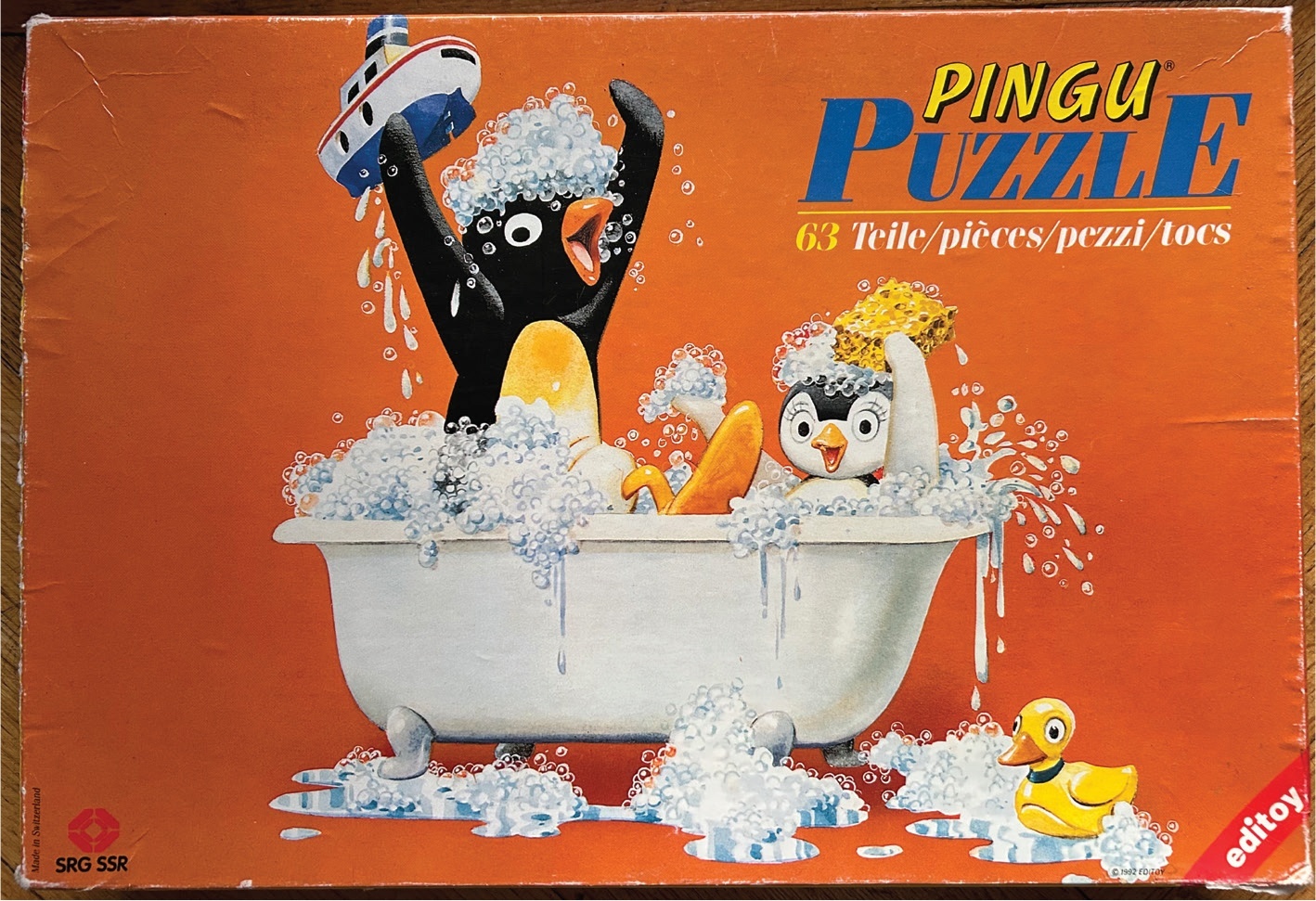
Figure 2
“Puzzle Pingu”, Editoy, SRG SSR, 1990.
This transposition of a cultural product (the series and the Pingu character) into a commercial venue was then a highly uncommon phenomenon in the Swiss context and must be repositioned within the broader transformation of the European television landscape, marked in the 1980s by the growing influence of neoliberal dynamics. In the case of Swiss television, the neoliberal shift was embodied by Leo Schürmann. Appointed Director General of the SRG SSR in 1981, after a position within the general management of the Swiss National Bank, Schürmann promoted a vision of the public service aligned with market principals.7 This new orientation encouraged a growing openness to commercial strategies within the SRG SSR, including the integration of merchandising practices.
In France, the emergence of television merchandising dates back to the early 1960s, with the series Thierry la Fronde (1963–1966) being among the first television productions to adopt such a promotional strategy.8 In the United States, the phenomenon experienced unprecedented growth in the 1980s, and by the 1990s ‘no television show [was] brought to television without at least one [merchandising] license associated with it’ as noted by Stephen Kline.9 Over the same period, European broadcasters gradually adopted this new model, particularly for children’s television programming, which ‘increasingly function[ed] as a motor for the promotion of media-related products.’10
While some studies have investigated the stakes of merchandising within British and American,11 Japanese,12 and Norwegian13 contexts – most often through the lens of franchises for whom merchandising plays a central role in the commercial strategies of the studios responsible for their production – this practice remains largely ignored in research focused on the Swiss context. The numerous and fruitful studies devoted to the history of the SRG SSR, particularly developed at the University of Lausanne since the early 2000s, have all, in fact, almost entirely overlook this issue, with the exception of Nelly Valsangiacomo’s article “Stiamo lavorando per voi: l’aziendalizzazione della SSR” [“We are Working for you: the Managerial Transformation of the SSR”] which very briefly mentions it.14 This relative silence holds particular significance when considered alongside the work of Blaise Rostan, La publicité, enjeu du financement mixte de l’audiovisuel en Suisse [Advertising, a Key Issue in the Mixed Funding of Audiovisual Media in Switzerland], one of the few book-length study dedicated to the mechanisms of financing Swiss television through advertising. In this text, Rostan examines the topic of sponsorship but fails to mention the commercialisation of merchandise from regional television productions,15 a practice that, as we shall see, was directly meant to contribute to the funding of SRG SSR programs and could be seen as an indirect form of advertising for public-service programs.
This article contributes to the study of these neglected aspects by revisiting the actors and dynamics that contributed to the rise of the Pingu series and its multiple derivative products, both in Switzerland and abroad, drawing on research conducted on the history of Swiss television, as well as press articles and previously unexplored materials from the SRG SSR archives.
Situated at the confluence of Swiss television history, children’s animation, and commercial practices of the cultural industries, this case study thus aims to examine the concrete modalities of an attempted strategic repositioning of Swiss television (its outcomes, as we shall see, were somewhat mixed) in order to align with market-oriented logics.
2 Pingu, an In-House Production of the DRS Youth Department
2.1 Animation: A New Strategic Lever for Swiss Television
The Youth Department within which Pingu was created belonged to the DRS’s Family and Continuing Education Department,16 headed, from 1980s onwards, by Verena Doelker-Tobler. At the beginning of that decade, its programming was defined by a strong educational dimension whose aim was to foster both autonomy and critical thinking among young viewers.17 As such, the content it broadcast daily to German-speaking young audiences was highly heterogeneous and composed of documentaries, games, fairy tales narrated by puppets, sports reports, magazines, music shows, and animated films. The latter category was itself composed both of lightly animated stories produced in-house by graphic designers and artists, as well as programs purchased abroad in order to enrich and complement the DRS’s programs.18
In 1980, animated productions represented approximately 3% of children’s programming. By 1990, they accounted for 32% of its weekly schedule, a shift that demonstrates a clear intention to build audience loyalty among younger viewers by prioritising a genre considered particularly attractive to them, as noted by Sara Signer Widmer.19 This increase also signals a reconfiguration of the institutional status of animation, marking one of the milestones in a broader transformation of the relationship between television and animated content in Switzerland. By investing more substantially in animation during the 1980s, the SRG SSR not only enhanced its visibility but also contributed to its legitimation as a significant component of the Swiss visual landscape. At the same time, it can be assumed that it helped structure the sector by encouraging the formation of international networks of professionals, within which Swiss television sought to position itself as a privileged partner for large-scale co-productions.
It was within this framework that Pingu emerged in collaboration with a filmmaker specialising in stop-motion animation. In the 1980s, Otmar Gutmann was one of the few filmmakers in Switzerland to employ clay in animation production. He produced several short films using this material, including a thirty-second film that featured a young penguin named Hugo playing with a Thomy mayonnaise tube. While the circumstances surrounding the initial contact between Gutmann and DRS members remain unknown, it is likely that it was one of these stop-motion productions which caught the attention of the Swiss German-language channel’s Family and Continuing Education Department team. Following the commission entrusted to Gutmann for the production of a short film featuring plasticine penguins, graphic designer Harald Mücke refined Hugo’s design in order to establish the appearance and characteristics of the young protagonist for the film commissioned by DRS,20 thereby giving birth to the character of Pingu.21
As its original title indicates – Pingu: eine Geschichte für Kinder im Vorschulalter [Pingu: A Story for Preschool Children] – this short film was specifically intended for preschool audiences. According to one of its creators, Erika Brüggemann, the young penguin was conceived as a replacement for Tobi, the emblematic puppet from DRS children’s programming.22 Though the small team dedicated to developing the new Pingu project thus appeared to have had a clear editorial strategy when they began working, the project was, for a reason that remains currently unknown,23 put on hold after the completion of the pilot in 1986.24
In March 1987, however, Gutmann submitted Pingu: eine Geschichte für Kinder im Vorschulalter to the children’s section of the 1987 Berlinale, thereby giving the character a second chance. The mention awarded by the children’s jury functioned as a catalyst, attracting the attention of Ulrich Kündig, then director of Swiss German television DRS. According to Brüggemann, the public recognition garnered in Berlin allowed production on the series to resume in autumn 1987.25 However, the project’s realisation quickly faced a series of problems arising from the budgetary limitations of the funds typically allocated by Swiss television channels to children’s productions. Indeed, the cost of developing a stop-motion series of 26 five-minute episodes considerably exceeded that of the youth productions at the time. This can easily be explained by the chosen technique, stop-motion, which was, and remains to this day, a particularly expensive one.26 Mentions can be found of sums ranging from CHF 1.1 million in the early 1990s,27 CHF 2.6 million in 1994,28 and up to CHF 3.2 million in 1997.29 For comparison, in 1985, a 2D animated series project entitled Contes de la mythologie indienne [Tales of Indian Mythology] received favourable preliminary financing approval from SRG SSR on the basis of a CHF 500,000 budget, CHF 130,000 of which were drawn from SRG SSR1986 national budget and CHF 70,000 from that of Swiss Italian Television (TSI),30 with the remaining CHF 300,000 to be secured through external partners.
2.2 International Co-productions And Private Partnership
The scale of the funds required to produce Pingu led the DRS to partner with Zweites Deutsches Fernsehen (ZDF), the second public television channel in Germany, which contributed CHF 700,000 to the project,31 as well as with Telepool (Zurich), a private company whose role from 1987 onwards was to buy and sell content in Europe on behalf of DRS.32 This pooling of resources remained nonetheless insufficient to cover the full cost of the series,33 budgeted at CHF 1,170,000 according to the production contract concluded between Gutmann and the SRG SSR in 1987.34 These limitations prompted the channels to seek a private investor to complete their financing arrangement and a partnership was established in 1988 with the company Editoy AG, based in Bertschikon, Canton of Zurich.
Founded on December 1, 1984, by Guido Weber – who had previously worked in purchasing, production, logistics, and sales at Carlit,35 a Zurich-based game and book publisher that was purchased by the German company Ravensburger in 1977 – Editoy was a Swiss company specialising in board game publishing. Having presumably recognised the commercial potential of the character Pingu, Weber decided to invest CHF 275,000 into the project, a sum which enabled the completion of the series’ first season. In exchange for this contribution, the Zurich-based company acquired the exclusive rights to Pingu’s image outside of the television context. This would allow it to use the images of the young penguin and his family for commercial purposes through sublicences to any third parties of its choosing. Though it granted Editoy the rights to any non-televisual exploitation of its own creation, the contract concluded between Weber and the Swiss public broadcaster in 1988 did, however, stipulate that Editoy would share with SRG SSR the net profits from the commercial exploitation of the Pingu character beyond a threshold of CHF 300,000 and after a flat-rate deduction of 25% for operating costs.36 In the event of commercial success, in addition to the positive impact on its image with the family audience it sought to attract, the Swiss television could therefore expect to receive a substantial share of the profits generated by the sale of the young penguin’s merchandise.
Although the television channels were initially the sole contractual producers of the series, the contract for the second season of Pingu introduced several notable changes in the co-production arrangement that significantly increased Editoy’s influence. In 1991, the Zurich-based company obtained co-producer status alongside the Swiss German channel, increasing its investment to CHF 700,000, a sum almost on par with the CHF 938,000 contributed by the Swiss broadcaster. From being a ‘mere’ licensee, it thus became a co-producer, expanding its role to creative content input, as the contract granted it oversight over the themes and stories of the 26 episodes of the young penguin’s new adventures.37
Another significant change to the original contract concerns the rights for broadcasting outside Europe. Under the 1988 licensing agreement, SRG SSR held the worldwide television rights for the episodes of the first season of Pingu. However, the 1991 contract stipulated that SRG SSR maintained only the rights to Europeans broadcasting whereas all non-European broadcasting rights were then in the hands of Editoy.38 This revision of the contract terms had obvious notable consequences for SRG SSR, as it deprived the broadcaster of a substantial additional revenue, given that the series was sold, among other markets, to Australia and Japan in 1992-1993.39
In addition, it also had creative and organisational repercussions. Shortly after the end of the first season, Erika Brüggemann decided to leave the project, stating in 2017 that her departure was due to the new direction it had taken.40 It is likely that the presence of the new co-producer, with different objectives from those of the DRS Family and Continuing Education Department’s team, considerably reduced Brüggemann’s influence over the series, shifting the decision-making centre towards Weber.
This reconfiguration of the balance of power between public and private actors, along with the gradual consolidation rights over the character of Pingu took a decisive turn following the death of Otmar Gutmann on 13 October 1993, in the middle of the production of the show’s second season. According to the framework agreement signed with Sonja Gutmann, the director’s widow, in December 1993, all production and exploitation rights of the series previously held by Gutmann were transferred to Editoy.41 Weber’s company thus assumed the responsibility for the entire production of Pingu’s second season as of 1 January 1994.42 It hired new directors and operated Gutmann’s studio under a lease.43 Following the completion of the second season, this takeover of the production process itself effectively ended SRG SSR’s involvement in the series’ production, reducing the broadcaster’s role to that of a ‘mere’ distributor in Switzerland for all subsequent seasons of the show.
3 The Pingu Strategy: A Swiss Response to Rising International Competition
The choices made by SRG SSR regarding Pingu must be examined in light of the neoliberal turn that took place in European television in the 1980s. The mixed financing model (public and private) adopted for the first two seasons of the series is indeed emblematic of the trials and strategic adjustments implemented by the Swiss public service in a context characterised by the liberalisation of European television markets. As François Vallotton points out, while SRG SSR enjoyed a monopoly until 1983, the opening up of the Swiss market led to increased competition for the Swiss public service broadcaster from local and foreign television stations.44 This competition has concrete implications for the development of all SRG SSR programmes, including those aimed at children, as Swiss television seeks to maintain its dominant position in the new local television landscape by adapting the content of its schedules. In this context, partnerships with private investors offered SRG SSR the opportunity to produce an ambitious animation series it hoped would rival that offered by foreign programming.
3.1 A Series Conceived for Global Distribution
As Verena Doelker-Tobler later recalled, in-house youth productions were during the 1980s deliberately conceived with a view to potential co-productions with foreign partners, allowing the development of more ambitious content through the pooling of financial resources between broadcasters.45 A series of strategic decisions were therefore made during the development of Pingu. First, the choice of ‘Penguinese’, an invented language, freed the series from any linguistic constraints. Moreover, unlike Tobi, a string puppet designed to serve as a linking figure between segments within a children’s program, Pingu was the animated protagonist of its own series. Like the adoption of a universal language, this narrative autonomy facilitated the program’s distribution in international markets. In addition, the characters were made of plasticine, at a time when the stop-motion productions (music clips, short feature films, advertisements, etc.) of British directors Peter Lord and David Sproxton (founders of Aardman Studios) were enjoining significant success both in the UK and abroad.46 The choice of plasticine for Pingu can thus be interpreted as a means of positioning the DRS series within an emerging aesthetic landscape capable of appealing to a broad audience.
Furthermore, the production of an original children’s series is part of a broader economic strategy aimed at diversifying the revenue streams of Swiss channels through various means. One such means is the sale of broadcasting rights to foreign television stations. In theory, this was meant to allow DRS to ‘recoup’ part of its investments through the revenues generated by the purchase of its own in-house productions. In the case of Pingu, this approach appears to have been successful. Indeed, in its 1990 annual report Telepool records an amount of DM 293,375 – approximately CHF 243,000 – corresponding to the acquisition of the European broadcasting rights for the first season of Pingu alone.47
3.2 Merchandising at the SRG SSR: An Economic and Promotional Initiative
Various sources from the first half of 1985 indicate the SRG SSR’s intention to introduce new commercial practices, including the exploitation of merchandise derived from its channel’s programs. In this perspective regulatory measures were implanted. These developments, which marked the official integration of merchandising into the institutional strategy of Swiss television, reflected the broadcaster’s neoliberal turn and the emerging conceptualisation of the public service as a form of private company expected to generate income.
In April 1985, eight officers (one for each regional radio and television channel, plus two for the SRG SSR) were appointed within the institution to ensure the coordination and contractual management of all future merchandising operations, which could be carried out in collaboration with the program directors of the different public service channels.48 From January 1986 onwards, a memorandum concerning merchandising circulated within the SRG SSR. This document, signed by Antonio Riva, Director of Programming Services, provided guidelines on how the commercialisation of merchandise could be conducted within the public broadcaster. It specified, for instance, that merchandising was to be managed by third parties through licensing agreements with SRG SSR, a model that was subsequently adopted in 1988 in the contract signed with Editoy. It also highlighted a tripartite strategy based on enhancing the value of programs, strengthening the institution’s visibility, and generating revenue.49
An obvious source of direct revenues, merchandising was thus also considered a ‘public relations measure’, aimed both at increasing awareness of SRG SSR’s own programming, and at ‘enhancing the institution’s visibility’.50 This dual and externally oriented objective reveals an awareness by SRG SSR of the necessity for the institution to promote its own image in order to attract and retain viewership. This imperative can be understood in light of the abolition of the monopoly, a shift that, over the course of the 1980s, greatly increased the importance of audience, which, as Raphaëlle Ruppen Coutaz observed, became ‘a major challenge’ for Swiss television.51
Turned into a promotional tool, merchandising became for the Swiss public service a new means of asserting its presence beyond the television set. By occupying public space through other types of media and formats, it sought to consolidate its own visibility and thereby promote its image more broadly. It was within this framework that both the launch of the series and the commercialisation of the Pingu image in Switzerland began in 1990, following a model already well established abroad.
4 Pingu Merchandise: From Promising Investment to Setback for SRG SSR
4.1 The Emergence of Merchandising
The merchandising strategy developed by the Swiss television and Editoy aligned with a long-established international model, initially developed within the film industry. In the United States, from the late 1920s, Disney studios signed agreements for the commercialisation of products featuring Mickey Mouse. The red-shorted, white-gloved mouse thus appeared on a range of items, from writing notebooks to Cartier diamond bracelets.52 Such wide licensing operations remained relatively isolated in the United States until the 1970s, when they accelerated with the launch of merchandise linked to live-action productions such as Star Wars (1977) and E.T. (1982).53 These two cases mark the beginning of the broader adoption of these practices and further illustrate their extension beyond the realm of animation alone.
Though initiated within the film industry, these types of operations quickly expanded into the television sector. In Japan, character merchandising emerged in the 1960s already alongside the broadcast of the anime Tetsuwan Atomu [Astro Boy] (1963–1966).54 In the United States again, and as Stephen Kline outlines, ‘by late 1980s, 70 per cent of gross toy sales consisted of ‘promotional toys’ – those plastic replicas of television characters with which children simulate the contours of the universe ‘as seen on television’.’55 While the case of Pingu therefore fits within a globalised tradition of merchandising derived from film and television universes, it also has its roots within Swiss commercial practices, albeit with a somewhat different logic. In 1932, the Advertising Department of the department store Globus created, on the occasion of the company’s 25th anniversary and in response to a financial emergency, the character Globi, a blue parrot wearing a black beret and chequered trousers.56 In the interwar period, during the depths of the economic crisis, this new mascot was intended to boost sales at Globus stores and ‘to capture new customer segments.’57
4.2 Children: An Audience with Strong Consumer Potential
This strategy of diversifying consumers and targeting children in particular through the use of a friendly animal figure foreshadowed a broader social transformation in Western societies that would begin in the 1960s and see the child consumer emerge as a new source of potential revenue, a legacy to which Pingu is in obvious lineage. Indeed, as Joël Brée emphasises, from the 1960s in France, ‘the reduction in the number of children, combined with an explosive growth in purchasing power, led to a refocusing of family concerns in their favour and to an increase in the marginal role of each child’.58 Similarly, in the United States, during the 1980s, children were recognised as a direct category of consumers, exerting ‘a significant influence on the purchasing decisions of others in the household’, according to David Buckingham.59 Consequently, American (and French) children became the target of new marketing strategies and advertising expenditures aimed at children have since experienced exponential growth.60
In the absence of Swiss data, a French study conducted by the Institute for Childhood and Development (IED) in 1988, two years prior to Pingu’s debut on DRS, estimated the purchasing power of French children to amount to approximately ‘400 billion francs, largely due to their direct or indirect influence on around 43% of household purchases.’61 The marketing strategy surrounding Pingu must therefore be understood in a context where children were increasingly seen as a significant ‘financial potential’. In this regard, the project carried out by DRS and ZDF in partnership with Editoy crystallises, at the national level, a new global logic of large-scale economic valorisation of local cultural figures for children, aimed at an audience whose consumer potential was already well established.
4.3 A Carefully Orchestrated National Release Strategy
Aware of this significant commercial potential, Guido Weber designed a brochure aimed at attracting potential business partners. Mentioned in the press, this brochure provides insight into Guido Weber’s ambitions. The document indeed refers to a ‘Pingu boom’,62 reflecting the founder’s intention to capture a wide commercial market by generating rapid enthusiasm around the young penguin character. To achieve this goal, the Zurich-based company and the public broadcaster implemented, for the series’ first season, a three-phase rollout strategy targeting the German-speaking region of Switzerland. Three episodes of Pingu were broadcast in January 1990 on DRS, followed by four additional episodes in March of the same year.63 This initial airing allowed young viewers to become acquainted with Pingu and his family and friends. The pause in broadcasting that followed marked the transition to the second phase of the campaign, which saw the release, in the summer of 1990, of a single tie-in product: an ice cream served in a plastic Pingu head-shaped black container and sold by the Lusso/Eldorado brand. The choice of a product particularly popular with children, as well as its timing – summer, when children are on school holidays and more likely to visit swimming pools, key sites for ice cream consumption, than to sit at home watching cartoons – was carefully thought out and designed to continue embedding Pingu into the daily lives and immediate environment of young Swiss audiences ahead of the resumption of the series’ broadcast and the release of a new and broader range of consumer products in September 1990.
The broadcast of the series resumed on Sunday September 16, 1990, on DRS, followed a few days later by airings on Télévision suisse romande (TSR) as part of the program ‘Planquez les nounours’ [‘Hide Your Teddies!’] and on TSI.64 The launch coincided with a commercial campaign that featured the publication of a full-page advertisement for plush toys, card games, board games, and puzzles sold by Migros, one of Switzerland’s largest supermarket chains, in the September 19 issue of Construire, the store’s own magazine (Figure 3).65
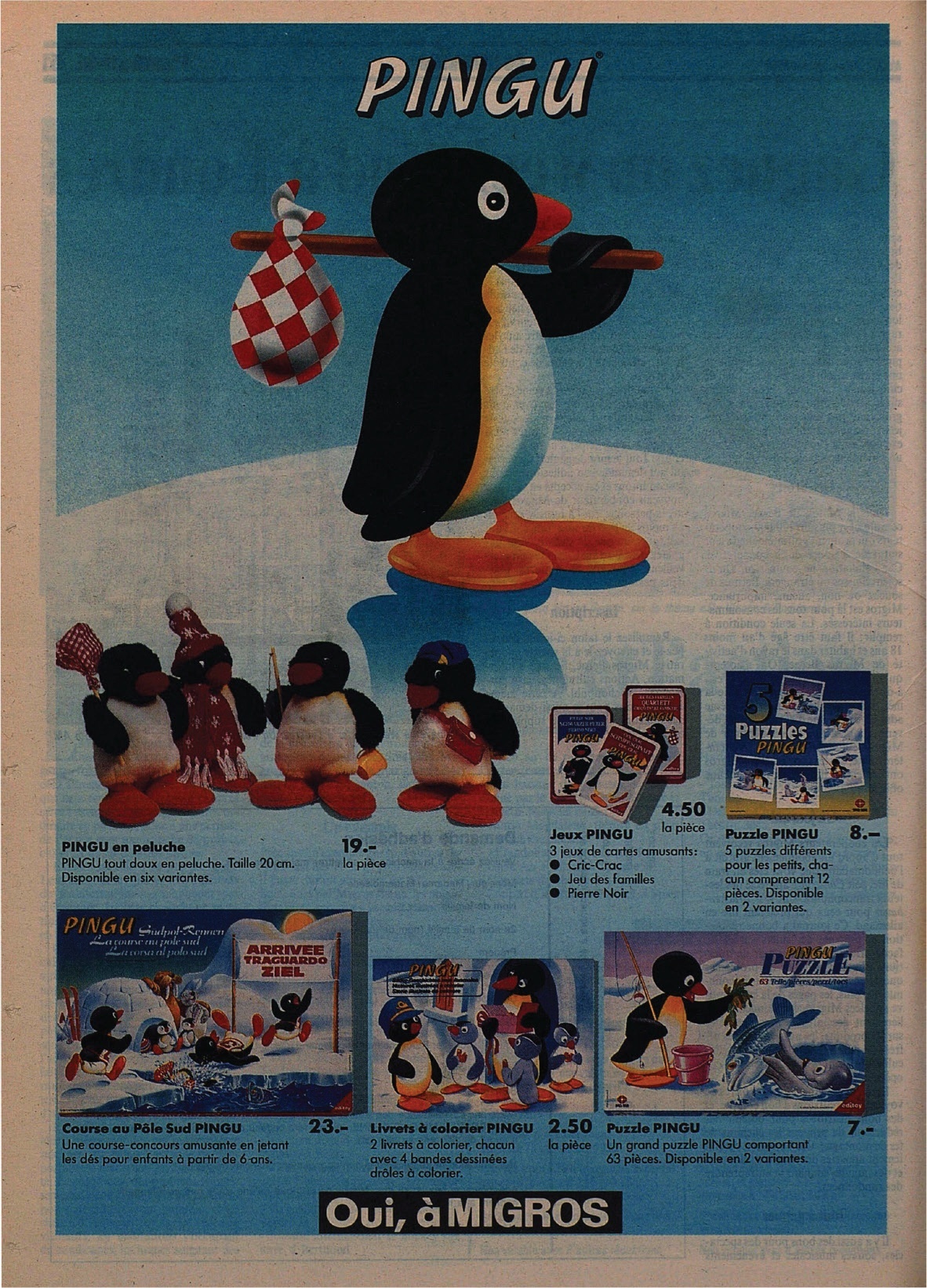
Figure 3
Construire 38, September 19, 1990, 52 (available: here).
In addition to Migros, the companies Pfister, Fareast Knitwear Sales, Franz Carl Weber, Modum Textile, Mischke & Moser Chocolate, Reta Cheese, Swissair (Figure 4),66 Silva Verlag, and Toni Milk Products entered into commercial agreements with Editoy.67 The diversity of these companies’ sectors – ranging from textiles to typically Swiss food products – as well as the agreements concluded with both local businesses and national and international companies, demonstrate a clear intention to reach the entire Swiss market by exploiting different segments likely to appeal to families.
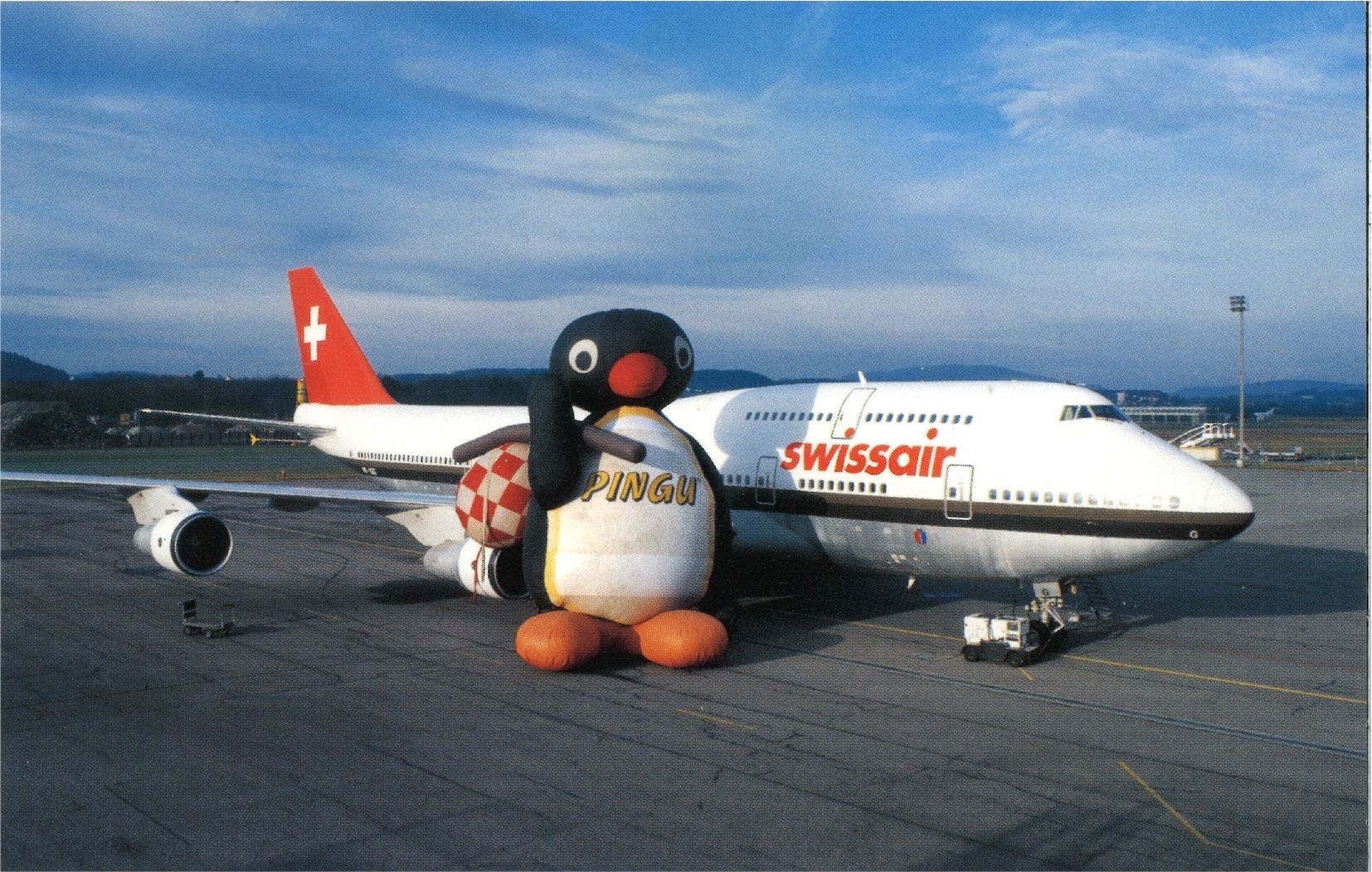
Figure 4
Post card “Pingu fliegt Swissair”, Editoy, SRG SSR, 1993.
The substantial sums invested by these business partners can be explained by the circumvention of one of the regulations of the Federal Department of Transport, Communication and Energy (DFTCE), which constituted one of Editoy’s key points of leverage. According to the “Instruction for Television Advertising” issued on February 15, 1984, by the Swiss Federal Council, advertising on Swiss channels was prohibited on Sundays, and advertising content targeting children was subject to particularly strict regulation.68 Yet, the episodes of the first season of Pingu, broadcast on Sundays shortly before 6 p.m. on DRS, were described in one of Editoy’s prospectus as ‘a genuine television commercial in prime time’.69 These episodes thus emerged as powerful indirect promotional tools, granting companies that had acquired the rights to use Pingu’s image privileged access to Swiss households through their television sets. This circumvention, which reflects a reconfiguration of the role of children’s content in the early 1990s, ultimately enabled Pingu to serve as a significant platform for consumer products despite the restrictive regulation on advertising on Swiss television.
4.4 Transnational Circulation
Leveraging its success in Switzerland, the series was subsequently marketed internationally. By the mid-1990s, the different seasons of Pingu were being broadcast on more than 2,200 television channels across over 140 countries.70 Alongside this wide-ranging international distribution, Editoy’s merchandising campaign also extended abroad, unfolding through ambitious promotional initiatives. Photographs from the 1990s, for instance, show giant inflatable figures of Pingu installed in front of cultural landmarks on different continents, such as an Egyptian pyramid, a Japanese temple, and the Brandenburg Gate in Berlin (Figures 5 to 7). The monumental scale of these inflatables was meant to establish a direct visual parallel between the character and the historic sites against which he was displayed and to anchor Pingu durably within the collective imagination by endowing him with a symbolic legitimacy equivalent to that of the heritage monuments he was associated with.71 Crossing national and cultural boundaries, Pingu was intended to become an internationally recognised and recognisable figure with universal transhistorical appeal.

Figure 5
Michael Jakob, Pingu: Meine Welt. Ein Pingu-Buch für die grossen Pingu-Fans [Pingu: My World. A Pingu Book for the Big Pingu Fans] (Aarau/Frankfurt am Main/Salzburg: Verlag Sauerländer, 1995, 13 (available: here).
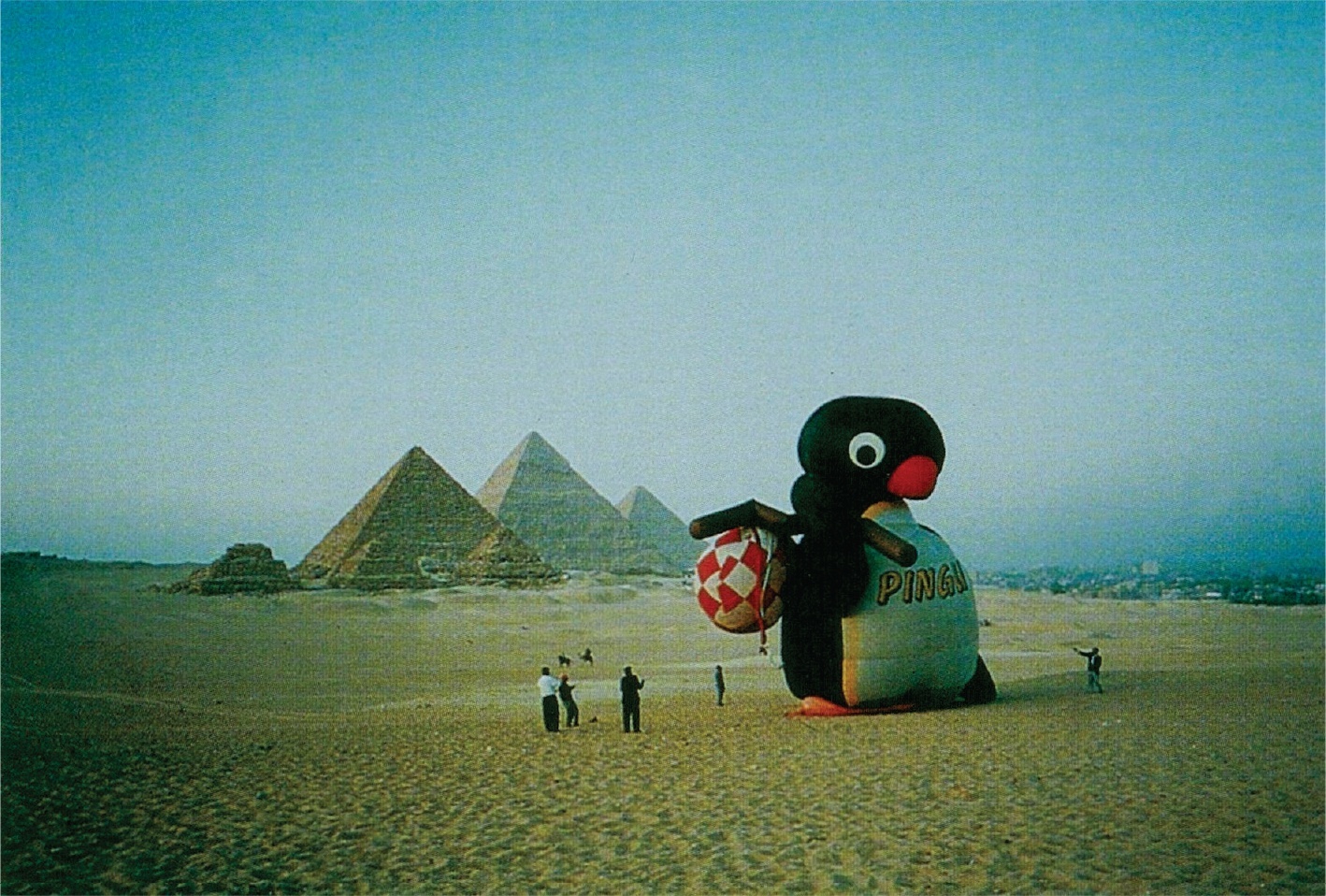
Figure 6
Michael Jakob, Pingu: Meine Welt. Ein Pingu-Buch für die grossen Pingu-Fans [Pingu: My World. A Pingu Book for the Big Pingu Fans] (Aarau/Frankfurt am Main/Salzburg: Verlag Sauerländer, 1995, 14 (available: here).
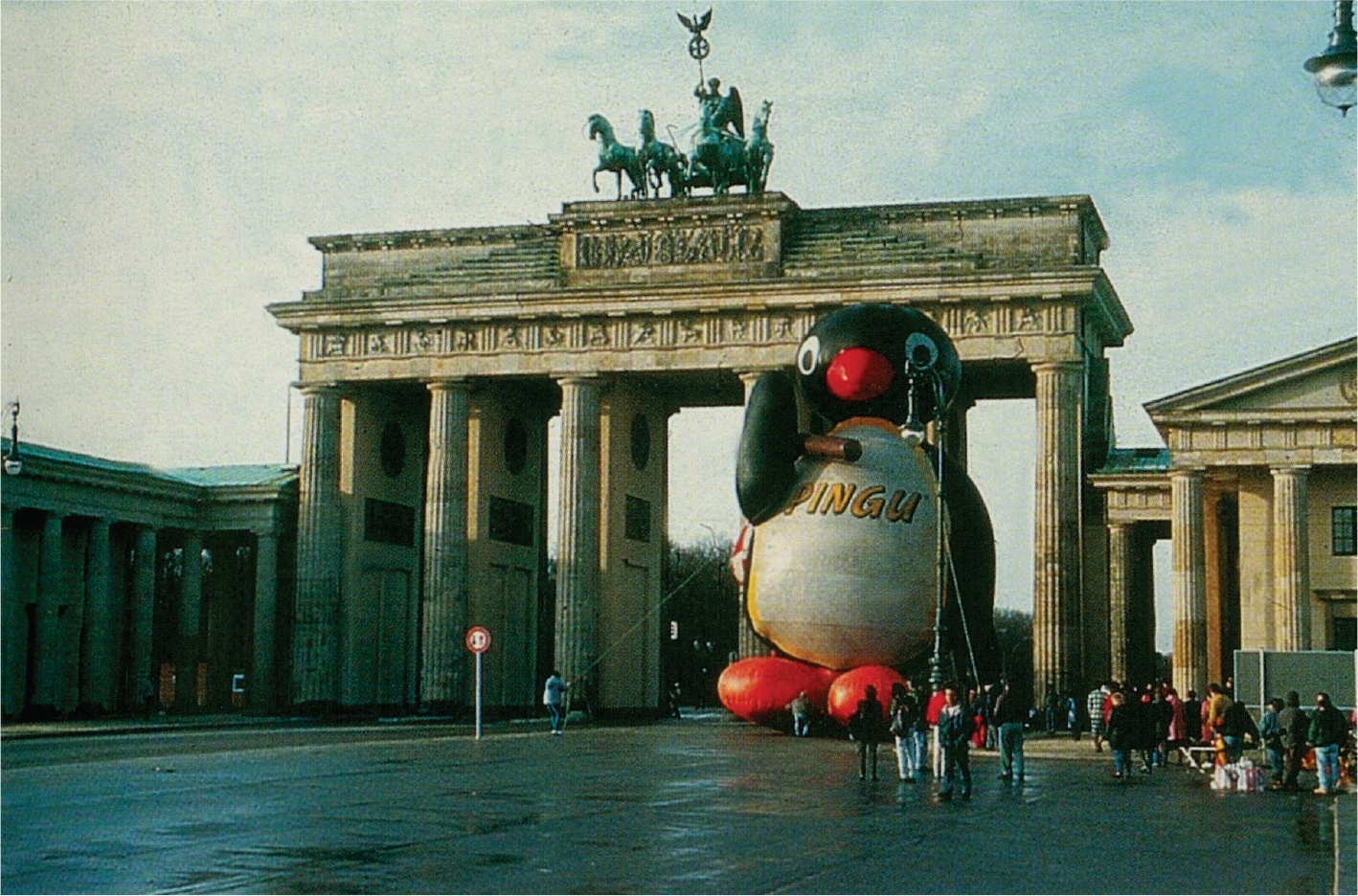
Figure 7
Michael Jakob, Pingu: Meine Welt. Ein Pingu-Buch für die grossen Pingu-Fans [Pingu: My World. A Pingu Book for the Big Pingu Fans] (Aarau/Frankfurt am Main/Salzburg: Verlag Sauerländer, 1995, 14 (available: here).
This strategy culminated in a major media event involving the German-born American television star David Hasselhoff. On the evening of 4 December 1993, DRS broadcast the song ‘Pingu Dance’, performed on the set of the TV show ‘Benissimo’ by the actor. On this occasion, Hasselhoff, seated on a papier-mâché block of ice, lip-synced the song accompanied by four children and surrounded by eight dancers dressed as Pingu, the whole thing set against a polar-themed background bathed in bluish lighting. The involvement of an American celebrity – then widely known for his hit Looking for Freedom, which had achieved enormous success in 1989, particularly in Switzerland, as well as his roles in the television series Knight Rider (1982-1986) and Baywatch (1989-2001) – was intended to capture the American market. Indeed, the release of the ‘Pingu Dance’ CD (Figure 8) was planned to coincide with the series’ launch in the United States.72
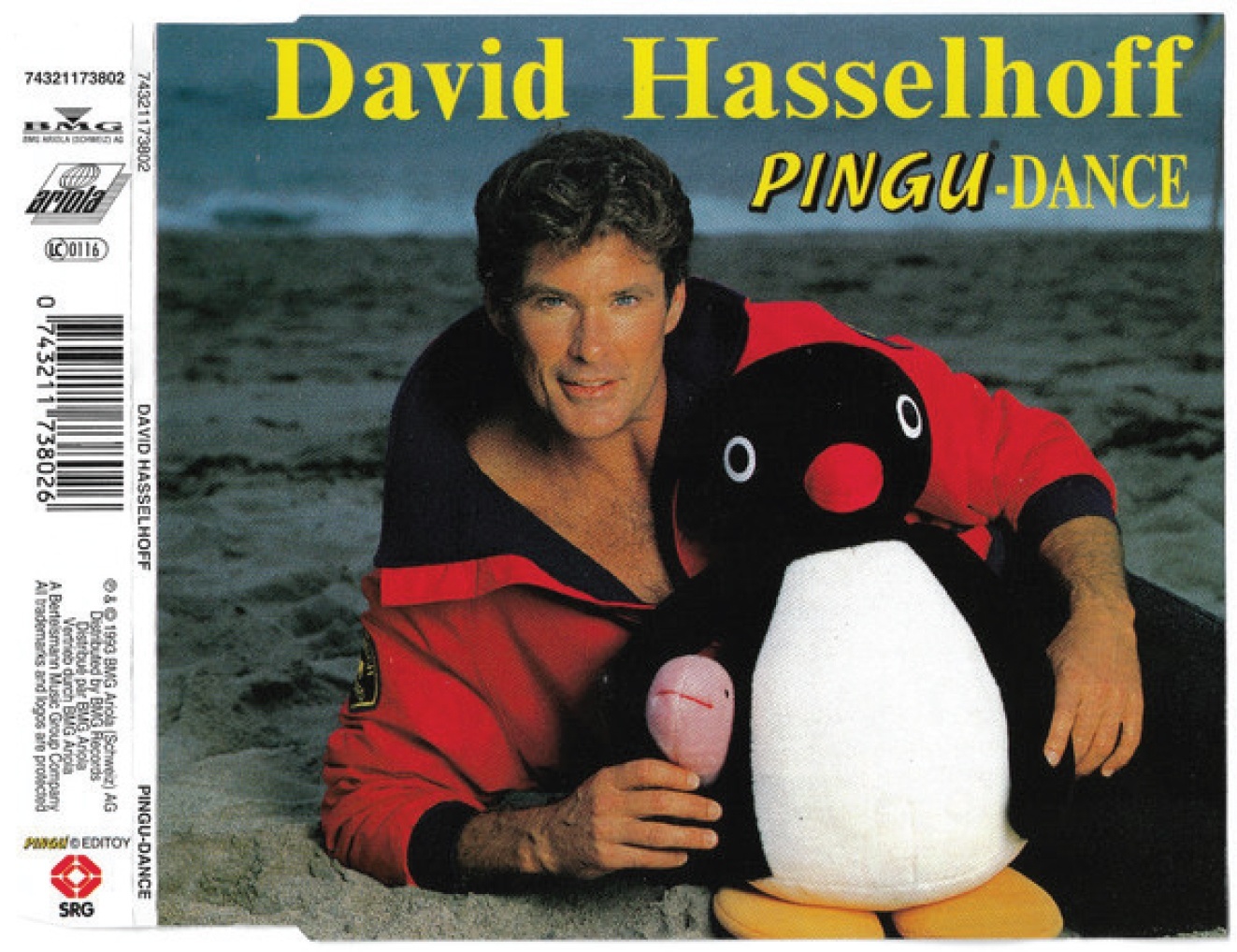
Figure 8
David Hasseloff, “Pingu Dance”, BMG Ariola, 1993 (available: here).
Like in Switzerland, these promotional efforts were generally accompanied by the release of a large number of tie-in products. In 1994, a press article reported that nearly 800 products were being marketed worldwide and that Sony Japan was producing the series’ merchandise by the millions.73 In the same year, Pingu’s revenue in the Japanese archipelago was estimated at approximately 10 billion yen (around CHF 135,000,000), rendering the small penguin locally a more lucrative character than Mickey Mouse.74
4.5 Public Investment for Private Benefits
Since the contracts that Editoy concluded with the companies mentioned above remain unavailable, only contemporary press reports allow us to gauge how much the Zurich-based company’s commercial partners invested in such licensing agreements. Several press articles mention that these partners often agreed to pay ‘six-figure sums’ simply to use the image of the young penguin.75 Beyond these guaranteed revenues, Editoy reportedly received ‘five to ten per cent of the wholesale price for each item sold’.76 Between 1994 and 1996, Migros sold ‘123 tons of iced tea powder […], 1.5 million jars of mustards […], and 384 tons of Pingu chocolate’.77 Although we could have further extended the list of Pingu-branded products (Figure 9), these few figures alone already reveal the extent of the revenues generated by the show’s by-products. Considering Editoy struck similar deals with dozens of different commercial partners, these sales figures, reflecting a single partner’s performance on a few products only, provide a revealing insight into the vast fortune that Weber’s company started amassing on the back of its agreement with SRG SSR from 1990 onwards.
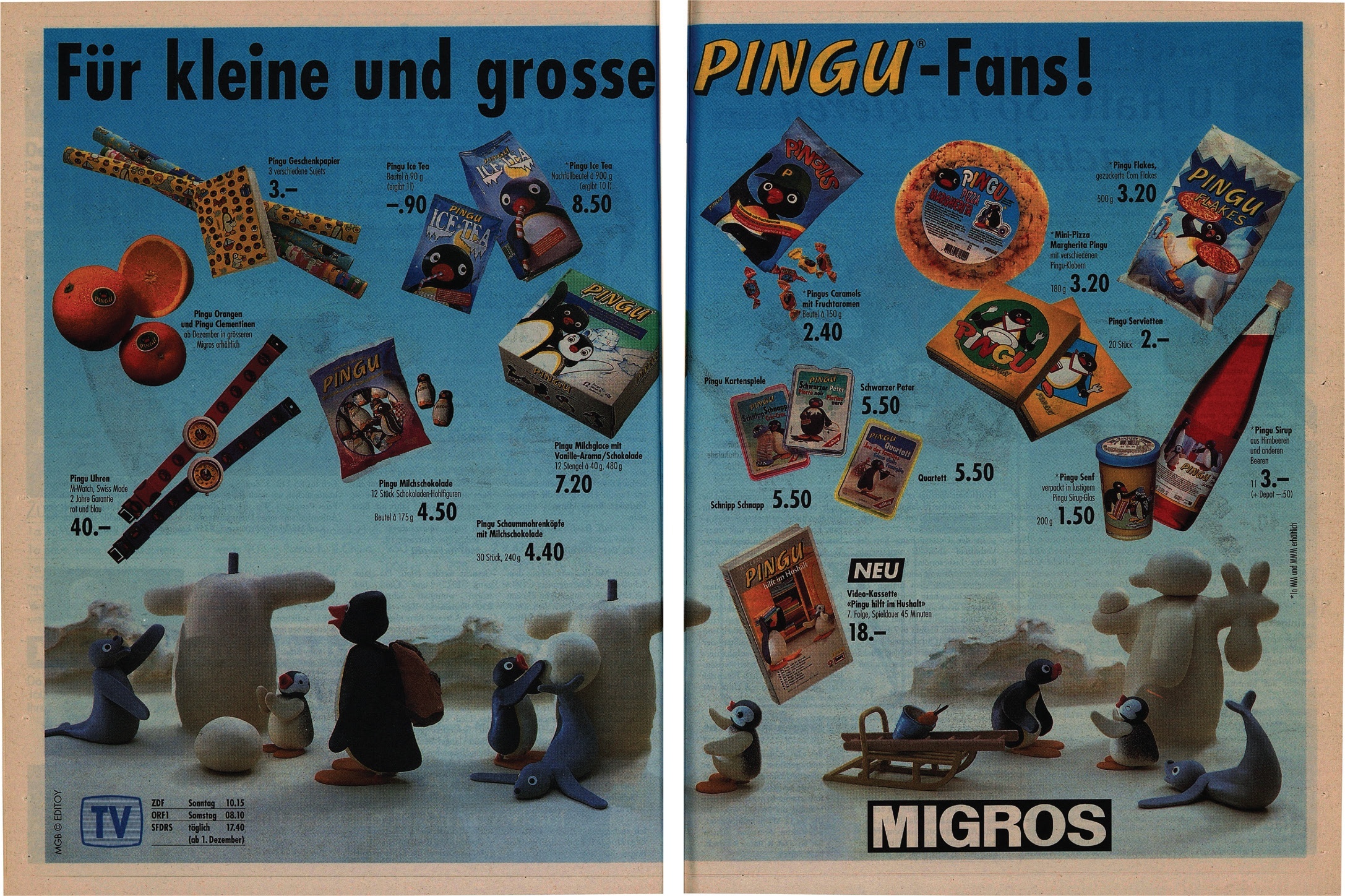
Figure 9
Brückenbauer 47, November 22, 1995, 66–67 (available: here).
Of potentially millions of dollars of revenues generated by the little penguin it contributed to create, the SRG SSR would unfortunately see very little. Indeed, despite the substantial financial windfall its own show created for Editoy, which, lest we forget, the latter was meant to share with the public broadcaster according to the terms outlined in their contract, the SRG SSR did not benefit from the profits generated by the commercialisation of Pingu’s image. According to Walter Bachmann, head of fees, licensing and sponsorship of DRS from 1989 to 1994 and current Secretary General of SRG SSR, Weber circumvented his contractual obligations ‘through creative means’. To minimise SRG SSR’s share of the revenues from Pingu merchandise, Editoy allegedly sublicensed the rights to multiple companies, thereby avoiding its obligations to remit a portion of its profits to the Swiss broadcaster.78 Editoy, which relocated to Amsterdam and was renamed Pingu BV around 1994, appears to have provided no equitable compensation to the public broadcasters that had originally initiated the project. During the 1990s, while the SRG SSR faced a financial crisis,79 the young penguin character, whose creation had been initially funded largely by public funds, benefited almost exclusively a private investor.80
In 2001, after the completion of the fourth season, Editoy sold the series for 16 million pounds (approximately 25,6 million euros) to HiT Entertainment, a British company known for its children’s productions. The Gutmann studio in Zurich was closed, the local directors, animators, and modellers involved in the project were dismissed, and the creative materials of the series (scripts, storyboards, plasticine figures, etc.) were acquired by Sony Japan and transferred to Japan, where Pingu became a cultural and commercial icon during the 1990s.81
While these decisions marked the end of Pingu’s Swiss adventure, which began fifteen years earlier with a handful of employees from the DRS’s Family and Continuing Education Department, they did not put an end to the series, as Hit Entertainment produced a fifth and sixth seasons, which were shot in Great Britain in the early 2000s.82 In 2011, a new phase in the character’s exploitation began when Mattel acquired the intellectual property rights to the young penguin following its purchase of HiT Entertainment.83 The transnational trajectory of Pingu, a small Swiss production initially made in a traditional artisanal way, echoes that of other iconic figures in European children’s culture – Bob the Builder, Peppa Pig and the Teletubbies – who crossed the Atlantic to be integrated into large North American conglomerates in order to serve a globalised franchise logic.
5 Conclusion
Beyond the specificities of the Pingu case, this article provides a first detailed exploration of the emergence of merchandising strategies that Swiss television sought to develop from the mid-1980s, based on an original animated production for children. The partnership with Editoy in 1988 and the development of a merchandising strategy discussed in this study can be regarded as an experiment led by the Swiss public service broadcaster in the hope of diversifying its revenue streams, attract young audiences, become part of a European network, and promote its own public image more widely.
The issues surrounding the commercialisation of the character Pingu examined in this article also raise a more general question about the project’s impact on the institution’s strategy in the decades following its failure. From a broader perspective, it is relevant to investigate the various factors that appear to have limited the development of a proper merchandising policy within SRG SSR over the past forty years. Indeed, while ‘BBC Worldwide has become one of the largest companies within this business activity and was ranked [in 2008] the world’s 27th largest licensing company, with $1.3 billion in retail sales’,84 the reasons why Swiss television has not pursued a comparable strategy remain poorly documented and could be a fascinating subject for further studies.
Finally, alongside these historical issues, it would be worthwhile to conduct analyses of the ongoing dynamics underlying the contemporary actualisations of the Pingu series. In the mid-2010s, Mattel Creations co-produced two new seasons with Polygon Pictures, entitled Pingu in the City. Entirely computer-generated – a choice that, as one might assume, reflects an adaptation to the tastes and expectations of their target audience – these seasons were primarily designed for the Japanese market and broadcast by the Japanese channel NHK between 2018 and 2019.
In October 2024, Mattel and British animation studio Aardman, known for its claymation productions, announced the development of a new stop-motion television series devoted to the adventures of Pingu. This updating using traditional animation techniques is an example of the contemporary valorisation of an existing franchise; and it can be assumed to be part of a strategy to exploit feelings of nostalgia, which, as various recent studies in the field of marketing have shown, plays a decisive role in consumers’ choices (Pichierri85; Weingarten and Wei86). Like many 1990s animated television series that are currently being reconfigured – among them Teenage Mutant Ninja Turtles with the feature-length film Teenage Mutant Ninja Turtles (2023, Jeff Rowe) and the new season of Pokémon, scheduled for release in 2027 – Pingu exemplifies a broader dynamic of updating television content aimed at offspring of adults who grew up in the 1990. It is plausible that these parents, particularly receptive to characters from their own childhood, are seen by companies as Mattel as a means of capturing a new generation of viewers and consumers, while themselves constituting an audience likely to engage with these productions. In this context, the recent and forthcoming updates of Pingu provide a compelling entry point for analysing how nostalgia and commercial logics intersect within the contemporary media landscape.
Acknowledgements
The author warmly thanks the editors and peer reviewers of VIEW Journal, as well as her colleagues and interlocutors whose insightful comments and suggestions have enriched this article, in particular Mathieu Donner, Loïc Valceschini, François Vallotton and Anne-Katrin Weber. She also wishes to express her deep gratitude to the archivists, members of the Pingu production team, and all those who generously shared their time, knowledge, and testimonies, and who kindly answered her questions throughout the course of this research.
Funding Information Statement
Research for this article was undertaken with support from the Swiss National Science Foundation (SNSF).
Notes
[1] Some sources trace the development of this project back to 1982-1983 (Michael Jakob, Pingu: Meine Welt. Ein Pingu-Buch für die grossen Pingu-Fans [Pingu: My World. A Pingu Book for the Big Pingu Fans] (Aarau/Frankfurt am Main/Salzburg: Verlag Sauerländer, 1995), 10), while others cite 1984 as the year in which the film was initiated within DRS (Erika Brüggemann, “Von der Geburt des Pingu” [“From the Birth of Pingu”], SRG Insider, May 5, 2017, https://www.srginsider.ch/a/2017/05/05/von-der-geburt-des-pingu/).
[2] The exact role played by Erika Brüggemann and Guido Steiger in the development of this film has yet to be determined.
[3] From 1990 onwards, illustrated comic-strip albums were regularly published in German, French, and Italian by Silva Editions (Zurich). Each volume collected and adapted three episodes of the series sharing a common theme – family, friends, sports, etc. – and was written by Sibylle von Flüe and illustrated by Tony Wolf. Their international publication was entrusted to the Italian publisher Dami Editore, which managed their distribution in certain foreign markets.
[4] Audio cassettes and CDs in Swiss German, compiling several episodes performed by actors from the Reisetheater of Zurich, were produced by BG Ariola, a German label. Some of these tapes have been digitized and can be listened to at the various listening stations of the Swiss National Sound Archives, https://www.fonoteca.ch/index_fr.htm.
[5] Between 1990 and 1994, the Swiss company Editoy published around twenty board games, card games and puzzles. To facilitate their distribution on the domestic market, all were made available in a trilingual edition – German, French, and Italian. Some of these items are preserved by the Swiss Museum of Games (MSJ) in La Tour-de-Peilz.
[6] The Game Boy game “Pingu: The Most Cheerful Penguin in the World”, developed by Nintendo, was released exclusively in Japan in 1993. “Pingu: The Most Cheerful Penguin in the World”, Pingu.Fandom.com, https://pingu.fandom.com/wiki/Pingu:_The_Most_Cheerful_Penguin_in_the_World.
[7] Theo Mäusli, Andreas Steigmeier, François Vallotton, eds., La radio et la télévision en Suisse. Histoire de la Société de radiodiffusion et télévision SSR de 1983 à 2011 [Radio and Television in Switzerland: History of the Swiss Broadcasting Corporation (SSR) from 1983 to 2011] (Baden : hier+jetzt, 2012).
[8] The broadcast of this series on RTF Television between 1963 and 1966 was accompanied by the publication of books, albums, and magazines dedicated to the adventures of the Robin Hood-inspired character. See Christophe Lenoir, “Télévision et produits dérivéés. L’importance du merchandising dans les strategies des chaînes” [“Television and Merchandise: The Importance of Merchandising in Broadcasters’ Strategies”], paper presented at the seminar “Stratégies des entreprises dans les secteurs cinématographiques et audiovisuels” [“Business Strategies in the Film and Audiovisual Sectors”], Ircav – Université Paris III, 1998, http://chr.l.free.fr/merchandising.htm.
[9] Stephen Kline cited by Ole J. Mjøs, “The symbiosis of children’s television and merchandising: comparative perspectives on the Norwegian children’s television channel NRK Super and the global Disney Channel”, Media, Culture & Society 32, no. 6 (2010) : 1031–1032, https://journals.sagepub.com/doi/abs/10.1177/0163443710380313.
[11] See Derek Johnson, Media Franchising: Creative License and Collaboration in the Culture Industries (New-York: NYU Press, 2013).
[12] See Marc Steinberg, Anime’s Media Mix. Franchising Toys and Characters in Japan (Minneapolis/London: University of Minnesota Press, 2012).
[14] Nelly Valsangiacomo, “Stiamo lavorando per voi: l’aziendalizzazione della SSR” [“We are working for you: the managerial transformation of the SSR”] in La radio et la télévision en Suisse. Histoire de la Société de radiodiffusion et télévision SSR de 1983 à 2011, Mäusli, Steigmeier, Vallotton, eds., 184.
[15] Blaise Rostan, La publicité, enjeu du financement mixte de l’audiovisuel en Suisse [Advertising, a Key Issue in the Mixed Funding of Audiovisual Media in Switzerland], (Genève: Éditions Slatkine, 2017).
[16] This department was successively called “Familie und Erziehung” [“Family and Upbringing”] (1964–1979), “Familie und Fortbildung” [“Familie and Continuing Education”] (1980–1987) and “Familie und Bildung” [“Family and Education”] (1988–1993). It also encompassed the sectors “Family” and “School and Continuing Education”. Sara Signer Widmer, Qualität im Kinderfernsehen. Beurteilung von Programmqualität am Beispiel des Schweizer Kinderfernsehens [Quality in Children’s Television: Assessing Program Quality Using the Example of Swiss Children’s TV] (Wiesbaden: Springer Fachmedien, 2013), 109–110.
[21] Joël Guillet, “Parti de Suisse, Pingu émeut la planète tout entire” [“Originating from Switzerland, Pingu has touched audiences across the globe”], Construire 47, November 22, 1995, 4, https://www.e-newspaperarchives.ch/?a=d&d=MIG19951122-01.2.8.1.
[22] Brüggemann, “Von der Geburt des Pingu”. Keyword searches in the SRF database made it possible to establish that Tobi appeared in the program “Kinderstunde” [“Children’s Hour”] on October 25, 1984. However, the results do not allow for more precise assessment of the frequency of its appearances in this program or in other broadcasts on the channel.
[23] Erika Brüggemann explains that the Tobi puppet would have been replaced because its strings had broken. However, it seems unlikely that a puppet considered “emblematic” of youth programming would not have been repaired. One can therefore assume that Tobi no longer met the expectations of young viewers and that the creation of an animated character such as Pingu fully corresponded more closely to the new type of content that the channel sought to develop at the time. Brüggemann, “Von der Geburt des Pingu”.
[24] It can be assumed that the film was broadcast on DRS airwaves in “Das Spielhaus” [“The Playhouse”], a DRS children’s program featuring animated sequences and to which Brüggemann contributed. As evidenced by an article published in Le Nouvelliste, the short film was broadcast on TSR on Sunday, May 31, 1987, at 10 a.m., in a program entitled “Spécial Annecy” and composed of eight animated short films selected at the Annecy International Animation Film Festival that year. Author unknown, “Sauce cartoon. Spécial Annecy”, Le Nouvelliste, May 30, 1987, 7, https://www.e-newspaperarchives.ch/?a=d&d=NVE19870530-01.2.35.
[26] The scale of this investment can be appreciated through a secondary source, in which the authors note that “even the television channels of major countries are not able to finance such an amount on their own for just over two hours of children’s programming”. Arnold Fröhlich, Kurt Schöbi, Gabrielle Spring, eds., Pingu: Unterrichtsideen für den Kindergarten und die Unterstufe [Pingu: Teaching Ideas for Kindergarten and Lower Primary School] (Zurich: sabe - Verlagsinstitut für Lehrmittel, 1997), 64.
[27] Dorothe Schnyder, “Ein Pinguin, der die Kleinen das Konsumieren lehrt” [“A Penguin Who Teaches Young Children How to Consume”], Bieler Tagblatt, March 31, 1990, 7, https://www.e-newspaperarchives.ch/?a=d&d=BTB19900331-01.2.19.4. The estimate prepared for Peter Wild of the DRS Department “Family and Continuing Education” by Otmar Gutmann on July 22, 1987, indicates a total of 1,170,000 CHF. Document transmitted by e-mail on 19 May 2025 by the SRF Archives Department.
[28] Author unknown, “Pérennité assurée pour Pingu” [“Pingu’s Longevity Secured”], L’Express, January 28, 1994, 7, https://www.e-newspaperarchives.ch/?a=d&d=EXR19940128-01.2.42.
[30] Minutes of the national meeting of the Departments of Family/Education/Society, March 1, 1985, 7. Central Archives of the SRG SSR General Management: A 106.07.
[32] In 1987, the DRS signed an exclusivity agreement with Telepool for the commercial exploitation of its productions. Framework agreement between DRS and Telepool, 1987, E 000.115, Central Archives of the SRG SSR General Management.
[33] In 1987, the DRS had approximately 170 million CHF available for its operations. However, it is not known how much of this budget was allocated specifically to children’s productions. Graph 7, “Aufwand des Fernsehens in den Sprachregionen in Mio. Franken” [“Television Expenditure in the Language Regions in Million Swiss Francs”], Edzard Schade, “Programmgestaltung in einem kommerzialisierten Umfeld” [“Program Planning in a Commercialized Environment”] in La radio et la télévision en Suisse. Histoire de la Société de radiodiffusion et télévision SSR de 1983 à 2011, Mäusli, Steigmeier, Vallotton, eds., 278.
[34] Production contract between SRG SSR and Otmar Gutmann, 1988, Ue 11.08.28, Central Archives of the SRG SSR General Management.
[35] Letter from May 22, 1987, from Guido Weber to Jochen Corts, member of the jury for the Spiel des Jahres. Transmitted by e-mail by Jochen Corts on May 21, 2025.
[36] License contract between SRG SSR and Editoy, 1988, Ue 11.08.28, Central Archives of the SRG SSR General Management.
[37] Production contract between SRG SSR and Otmar Gutmann, circa 1991, Ue 11.08.28, Central Archives of the SRG SSR General Management.
[39] At this stage of our research, the circumstances that led to this agreement – evidently less favourable to DRS than the initial one – remain unknown.
[41] Framework agreement between Sonja Gutmann and Editoy, 1993, Ue 11.08.28, Central Archives of the SRG SSR General Management.
[42] Author unknown, “Pingu héros des gosses. Nouvelles aventures” [“Pingu, a Kids’ Hero: New Adventures”], Journal du Jura, January 28, 1994, 19, https://www.e-newspaperarchives.ch/?a=d&d=JDJ19940128-01.2.36.9.
[43] Framework agreement between Sonja Gutmann and Editoy, 1993, Ue 11.08.28, Central Archives of the SRG SSR General Management.
[44] François Vallotton, “La radiodiffusion de service public face aux défis de la globalisation” [“Public Service Broadcasting Confronted with the Challenges of Globalization”], in La radio et la télévision en Suisse. Histoire de la Société de radiodiffusion et télévision SSR de 1983 à 2011, Mäusli, Steigmeier, Vallotton, eds., 23–30.
[46] Creature Comforts (1989) won the Academy Award for Best Animated Short Film in 1991. For an overview of Aardman Studios’ history during the 1980s and 1990s, see Xavier Kawa-Topor and Philippe Moins, Stop-motion, un autre cinéma d’animation [Stop-Motion: Another Form of Animated Cinema] ([Nantes]: Capprici, 2020), 281–294.
[47] Telepool’s Annual Report for the period from January 1 to December 31, 1990, 21, E 000.115, Central Archives of the SRG SSR General Management.
[48] Letter titled “Einheitliche Politik in den Beziehungen mit Drittfirmen im Programmbereich” [“Unified Policy in Relations with Third-Party Companies in the Programming Sector”], January 28, 1986, B002.205.01.3, Central Archives of the SRG SSR General Management.
[49] Information Sheet about merchandising, January 7, 1986, B002.205.01.3, Central Archives of the SRG SSR General Management.
[51] Raphaëlle Ruppen Coutaz, “Les ripostes de la SSR à la libéralisation du marché de l’audiovisuel: vers une redéfinition de son mandat de service public” [“The SSR’s response to the liberalisation of the audiovisual market: towards a redefinition of its public service mandate”], in La radio et la télévision en Suisse. Histoire de la Société de radiodiffusion et télévision SSR de 1983 à 2011, Mäusli, Steigmeier, Vallotton, eds., 90.
[52] Janet Wasko, How Hollywood Works (London/Thousand Oaks/New Delhi: SAGE Publications, 2003), 161.
[55] Stephen Kline, Out of the Garden: Toys TV and Children’s Culture in the Age of Marketing (London/New-York: Verso, 1993), 147.
[56] Waltraut Bellwald, Globi, ein Freund fürs Leben. Die Erfolgsgeschichte einer Reklamefigur [Globi, a Friend for Life: The Success Story of an Advertising Character] (Zürich: Orell Füssli Verlag, 2003), 13.
[57] Anna Wälli, “Le club Globi” [“The Globi Club”], Swiss National Museum, https://blog.nationalmuseum.ch/fr/2018/07/le-club-globi/.
[58] Joël Brée, “Les enfants et la consommation. Un tour d’horizon des recherches” [“Children and Consumption: An Overview of Research”], Recherche et Applications en Marketing [Research and Applications in Marketing] 5, no. 1 (1990), 43, https://www.researchgate.net/publication/270683481_Les_enfants_et_la_consommation_Un_tour_d’horizon_des_recherches?utm_source=chatgpt.com.
[59] David Buckingham, After the Death of Childhood. Growing Up in the Age of Electronic Media (Cambridge /Malden: Polity Press/Blackwell Publishers Inc., 2000), 147.
[63] March 7, 1990: “Pingas Geburt” [“Pinga’s Birth”], March 9, 1990: “Pingu Fischen” [“Pingu Goes Fishing”], March 14, 1990: “Pingu Lawinenunglück” [“Pingu and the Avalanche”], March 16, 1990: “Pingu Schneeballschlacht” [“Pingu’s Snowball Fight”]. TV schedule for March 1990 on https://www.e-newspaperarchives.ch.
[64] “Programme TV”, Le Nouvelliste, September 22, 1990, 21, https://www.e-newspaperarchives.ch/?a=d&d=NVE19900922-01.2.41.2.
[65] Construire 38, September 19, 1990, 52, https://www.e-newspaperarchives.ch/?a=d&d=MIG19900919-01.2.83.1.
[66] In the case of Swissair, the airline declared itself the “official carrier of Pingu” and announced plans “to open ‘special family’ check-in counters under its name in 1994” (Jean-Blaise Besançon, “Le pingouin suisse qui a conquis le monde” [“The Swiss Penguin That Conquered the World,”] L’Illustré, February 16, 1994, 34–37). Whether this plan was ever realized remains uncertain. This announcement came at a time when Swissair was facing economic difficulties linked to the liberalization of the aviation market and the emergence of low-cost carriers (Benedikt Meyer, “The Rise and Fall of Swissair, 1931–2002,” The Journal of Transport History 38, no. 1 (2017), 97–100, https://journals.sagepub.com/doi/pdf/10.1177/0022526616684664). In this context, it can be assumed that the use of the Pingu character was part of a strategy implemented by the Swiss airline to attract or retain a family clientele by offering personalized services that its direct competitors did not provide.
[67] The names of these companies appear in the end credits of a promotional film about the behind-the-scenes of the Pingu campaign, which was presumably produced around 1993-1994. “Pingu – A Cartoon Character Conquers The World”, Archive.org, https://archive.org/details/PinguACartoonCharacterConquersTheWorld.
[68] “Instruction for Television Advertising”, version of February 15, 1984, 2. Document provided by the Federal Office of Communication (OFCOM) on June 2, 2025.
[69] Ulla Grob-Menges, “Schlauer Pinguin – total vermarket” [“Clever Penguin – Fully Marketed”], Tages Anzeiger, March 9, 1990, page unknown, 01.98.06.10.07.03, Central Archives of the SRG SSR General Management.
[70] Reto Baer, “Trickfilm: Ein Pinguin erobert die Welt” [“Animated Film: A Penguin Conquers the World”], Brückenbauer, November 27, 1996, 43, https://www.e-newspaperarchives.ch/?a=d&d=MIM19961127-01.2.76.2.
[71] For photographs of Pingu placed alongside historical monuments, see Michael Jakob, Pingu: Meine Welt, page unknown.
[72] However, it appears that the CD was never released in the United States, whereas the series’ episodes were reportedly not broadcast on Cartoon Network until 1996, highlighting the challenges associated with introducing a stop-motion European production into a highly competitive television market such as that of the United States.
[74] “Teletex”, L’Express, December 6, 1994, 7, https://www.e-newspaperarchives.ch/?a=d&d=EXR19941206-01.2.48. https://archive.org/details/PinguGoesToTheStudio. In the mid-1990s, a Japanese television channel produced a short documentary on the making of Pingu, which shows both the studio and the team at work, https://archive.org/details/PinguGoesToTheStudio.
[79] Ina Boesch and Ruth Hungerbühler, “Culture de qualité et culture de masse: le grand écart de la SSR”, in La radio et la télévision en Suisse. Histoire de la Société de radiodiffusion et télévision SSR de 1983 à 2011, Mäusli, Steigmeier, Vallotton, eds., 266.
[80] This type of mechanism has been discussed in studies on political economy and innovation, notably by Mariana Mazzucato. In her book The Entrepreneurial State: Debunking Public vs. Private Sector Myths (London: Anthem Press, 2013), Mazzucato demonstrates how by investing in fundamental research, the state often acts as a risk-reducing agent, while the private actors largely benefit from the financial spin-offs by privatising innovations that were initially developed with public funds. In 2010, the program ‘Glanz & Gloria’, which focused on prominent figures from the world of show business, illustrated, with a certain irony, the consequences of the appropriation of public resources through the appropriation of a creative work, by showing Weber giving a journalist from Schweizer Radio Fernsegen (SRF) a tour of his luxury yacht moored in a Maltese harbor. Author unknown, “Auf der Yacht von Guido Weber” [“On Guido Weber’s Yacht”], Glanz & Gloria, October 19, 2010, https://www.srf.ch/play/tv/glanz--gloria/video/auf-der-yacht-von-guido-weber?urn=urn:srf:video:0dccc4b8-81ca-463e-836f-701b9fe00b0b.
[81] Email dated June 10, 2025, from Javier Garcia, co-director of Pingu between 1995 and 1999. These documents were likely displayed during the “40th Anniversary Pingu Exhibition”, held in various Japanese cities in 2021. Some of these materials can be seen at the beginning of the video produced by Sony Creative Products for this occasion, https://www.youtube.com/watch?v=ceYs9uFYBng.
[82] John Cassy, “HIT p..p..p picks up a penguin”, The Guardian, October 30, 2001, https://www.theguardian.com/business/2001/oct/30/5#:~:text=up%20a%20penguin-,This%20article%20is%20more%20than%2023%20years%20old,12%20Oct%202006.
[83] Robert Buckland, “Mattel draws on Aardman’s creativity to bring loveable penguin Pingu back to our TV screens”, October 25, 2024, https://www.bristol-business.net/mattel-draws-on-aardman-animations-creativity-to-bring-loveable-penguin-pingu-back-to-our-tvs/.
[85] Marco Pichierri, Nostalgia Marketing. Rekindling the Past to Influence Consumer Choices (Cham: Palgrave Macmillan, 2023).
[86] Evan Weingarten and Ziwei Wei, “Nostalgia and consumer behavior”, Current opinion in psychology, n°49, 2023, https://www.sciencedirect.com/science/article/abs/pii/S2352250X22002767?via%3Dihub.