
1 Introduction
In recent years, the growing accessibility of archival video material (especially home videos), has expanded the possibilities for documentary filmmakers to rework historical imagery in innovative and politically charged ways. In many cases, these artists interrogate and recontextualise fragments of the past in order to tell stories that might otherwise remain invisible. In this way, the process of archival filmmaking can serve as both a historical method and a creative intervention, that is, a hybrid form where fact and affect, memory and montage, intertwine, and where the archive itself is activated as a site of contestation rather than simply a repository.
However, approaching archival footage as documentation implicates filmmakers in a complex ethical and historiographical process. What is recorded, what is omitted, and what is included in a film? This article examines these tensions through the Italian documentary Un mito antropologico televisivo (2011), which reworks footage from a local television station to explore the story of a specific region in Italy in the early 1990s. Specifically, I will unpack this film through the lenses of what Efrén Cuevas calls microhistorical documentary, an approach that, I argue, help us understand the crucial role of local television archives in reconstructing a visual story of a place.
By examining how Un mito antropologico televisivo (henceforth, Un mito) assembles these fragmented visual records, I propose that we can gain invaluable insights into the daily lives, concerns, and social fabric of a specific community at a particular historical juncture, demonstrating the profound potential of archival filmmaking to illuminate the micro-histories that constitute the broader sweep of the past. Overall, I underscore here how archival filmmaking must navigate, rather than resolve, these inherent contradictions.
2 Un Mito Antropologico Televisivo
Un mito antropologico televisivo (An Anthropological Television Myth) is a 2011 Italian documentary film directed by Alessandro Gagliardo, Maria Helene Bertino, and Dario Castelli. The film is assembled in its entirety from archival footage shot by local television stations in and around Catania, Sicily, between 1991 and 1994.1 These images capture significant moments of news value, such as Mafia killings, a local housing crisis, and public protests, highlighting the poverty, devastation, and civil unrest experienced by members of the public in light of the flooding corruption of local authorities.
In terms of the documentary’s archival work, it is worth noting that Un mito does not deal with the images as presented on TV. On the contrary, the documentary’s fabric is assembled with the master tapes. The film’s central premise is to use television news archives as anthropological material, exploring how the televised record shapes and mythologises collective memory and identity. As we will see, in assembling these fragments, the film reflects on the role of (local) television in constructing, mediating, and sometimes distorting the history and character of a place and its people.
The fragility of local stations, which operated with minimal funding, improvised technical equipment, and little to no archival policy, was not merely a Sicilian anomaly but a structural feature of the Italian local television landscape. As Flavia Barca’s study of local media ownership demonstrates, the majority of local TV company owners were local businessmen or politicians whose primary motive was not profit but promotion and political influence. These owners ‘run other commercial activities usually unrelated to this sector’2 and could afford to sustain losing broadcasting ventures because the return was not economic but strategic: ‘by means of a broadcasting station, a local businessman not only advertises his own company, but creates or strengthens political alliances which may prove to be of extreme importance for the future of his business’.3 This created a system where journalism was often secondary to the owner’s commercial or political interests.
This chaotic local system operated within a permissive national framework. The Mammì Law4 of 1990, rather than bringing order, ‘had the function of recognising and legalising the status quo’,5 formalising a state-private duopoly and leaving the local broadcasting market in ‘total chaos’ due to weak regulation and ineffective controlling bodies. In this environment, defined by what Danilo Zolo termed a ‘telecratic compromise’, local stations had to compete with or emulate the entertainment-driven content of national networks.6 The result was a media ecology with little incentive to invest in robust journalism or archival preservation, directly shaping the technical infrastructure that characterised the stations whose footage fills Un mito.
For context, the mid-1990s saw a radical shift with Silvio Berlusconi’s rise to power. His government established ‘compulsory control over the management of both public and private national televisions’, leading to the replacement of educational programs with reality shows and infotainment that promoted ‘cults of personality [and] explicitly populist representations of Italian society’.7 Thus, Berlusconi’s Mediaset and the state-owned RAI (Radiotelevisione italiana) operated as an ‘informal commercial cartel’.8 However, as Barca reminds us, the 1990s also saw a sudden outburst of local broadcasting with too many companies and too few resources, leading to informal networks and political influence.9
In the academic context, television archives, especially when it comes to local networks, have served as vital repositories of grassroots experiences, usually countering dominant and often national historical narratives by foregrounding witness-based, community-level experiences. For instance, Rüdiger Steinmetz and Judith Kretzschmar (2022) highlight how analogue broadcasts from Saxony between 1990 and 1995 provided a ‘view from below’ during German reunification.10 Similarly, Jill A. Edy and Jasmine T. Austin (2022) further reveal how reactivated news footage from the 1992 Los Angeles riots shifts narratives from institutional authority to lived testimony.11 Kate Adlena Cronin (2021) explores the logistical and creative challenges of sustaining community television audiovisual archives in Chile.12 Meanwhile, in a more practice-based project, Rich Newberg (2021) digitised analogue Buffalo’s local TV news for educational and social justice to amplify marginalised African American voices.13 One important research in the Italian case is ATLas (Atlas of Local Televisions), a multi-university digital project that maps and reconstructs the history of some of Italy’s privately owned local TV channels (1976–1990).14
My point for this review is to show the capacity of local television archives, or community television archives, to disrupt standardised historical accounts through narrative transformations. This means that while still addressing issues from a professional point of view (that is, a local television network), they reconfigure power dynamics in historical discourse, especially within the national-local hierarchy.
Indeed, I argue that in interrogating of how media constructs collective memory and myth, Un mito’s methodological underpinning very much resonates with what Efrén Cuevas has theorised as microhistorical documentary.15 Cuevas’s notion is an audiovisual revision of microhistory (or microistoria), a method developed by a group of Italian historians in the 1970s primarily through the work of Carlo Ginzburg and Giovanni Levi.16 Broadly speaking, microhistory is an experimental methodology that seeks to provide a more nuanced understanding of historical events by examining the experiences of individuals and groups in a given context.
For Levi, the change of scale of observation to explore historical events is the driving force of microhistory, what is often regarded as the ‘small’. Focusing on the granular, thus, allows neglected elements to emerge. Indeed, Levi argues that ‘[p]henomena previously considered to be sufficiently described and understood assume completely new meanings by altering the scale of observation’.17 This microscopic analysis can reveal what grand historical narratives often ignore or overlook, that is, a breadth of information about the social, cultural, and economic context of the lives of regular people, as well as the particular challenges and opportunities they faced. Unlike traditional historical approaches that concentrate on the macro-level, the micro-level microhistory examines, as Ginzburg and Carlo Poni specify, what could be ‘a village community, a group of families, even an individual person’.18 This focus on the ‘small’ has permitted researchers to gain insight into communities and anonymous people, predominantly overlooked in the writing of history.
What Un mito demonstrates, however, is that such insights emerge not only from intentional documentation (as with court records or parish registers), but also from accidental preservation, or moments caught on videotape simply because a local reporter happened to be present. In this regard, (moving) images can provide visual approximations of an event that occurred in the past. Indeed, Efrén Cuevas has championed the correspondence between microhistory and documentary cinema, arguing that the fragmentary and contingent nature of the audiovisual archive makes it especially apt for microhistorical work. Un mito, with its reliance on unedited and degraded television tapes, epitomises this potential.
In the following, I will explore Un mito as an intervention into the audiovisual archive, examining how it constructs a polyvocal microhistory through its engagement with everyday life, how its use of degraded videotape reimagines the local television archive as a palimpsestic and material object, and finally, the ethical challenges and responsibilities inherent in reactivating such fragile historical footage.
3 A Polyvocal Microhistory
Rather than offering a linear or centralised narrative, Un mito (2011) constructs a polyvocal account of everyday life, foregrounding a range of voices (residents, protesters, officials) whose testimonies and actions reveal deeper social patterns. In doing so, the film resonates with the microhistorical view that ‘people who lived in the past are not merely puppets on the hands of great underlying forces of history, but they are regarded as active individuals, conscious actors’.19 Of course, as we will see here, this polyphony is not harmonious. Silences, contradiction, and fragmentation frequently interrupt coherence.
One of the clearest intersections between the micro and the macro comes through a local housing crisis, which unfolds across several sequences. In one scene, a journalist navigates a construction site where buildings stand half-completed. Interviewing a passerby, the camera captures a telling comment: the man laments the cost and unsuitability of the housing, preferring instead to build his own home on agricultural land. ‘Am I supposed to take my animals on the lift?’20 he asks, exposing the absurdity of urban planning divorced from rural life (Figure 1). This moment, while anecdotal, encapsulates larger structural failures. Urban planning policies clashing with rural traditions, and the neglect of ordinary needs in favour of ill-conceived development projects.
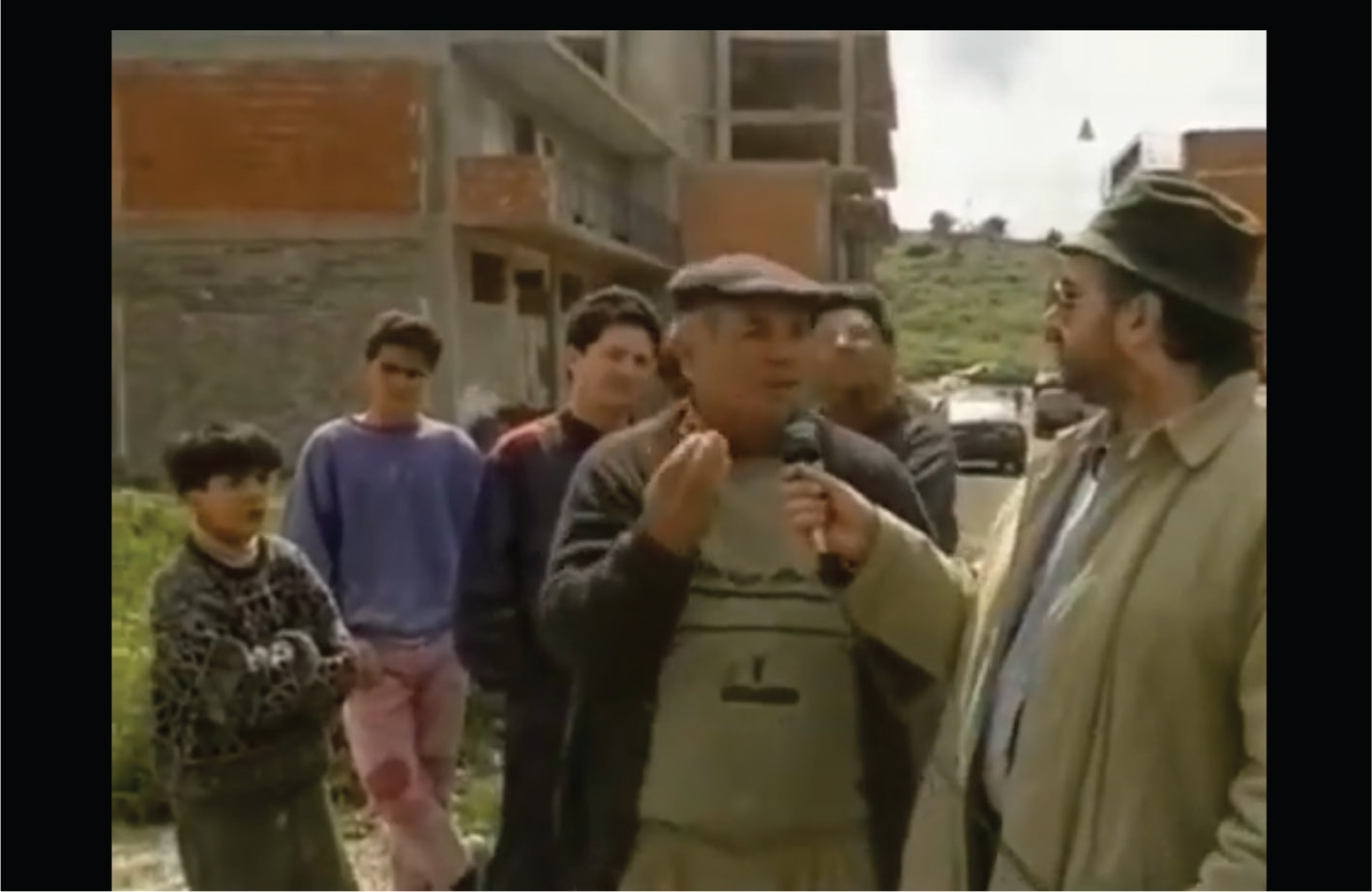
Figure 1
Man defending rural life against new housing developments.
Later in the film, we witness a mass demonstration, filling entire city blocks. Protesters chant explicitly against the housing crisis, and the camera, again handheld and embedded in the crowd, underscores the collective dimension of what initially seemed like individual complaints. While scaling from the singular to the collective without losing sight of lived experience, perhaps the most poignant moment regarding the housing crisis comes in a sequence toward the end of the film, where a journalist visits a family home. The mother offers a tour of their one-room home, subdivided by curtains and furniture, with a slow pan across a moldy sink and boxes scattered on the floor visually conveys the material poverty of this domestic space.
The woman blames the mayor and the local council for her family’s condition. In a way, her words move beyond personal frustration to articulate a structural critique. Indeed, the woman’s teenage daughters add another layer, one confessing her shame about their living conditions (Figure 2). This intergenerational view underscores how political failures are experienced in different ways, shaping both identity and future expectations. Shame becomes a social symptom, not just a personal feeling.

Figure 2
One of the teenagers ashamed of living in poverty.
The issue of the housing crisis connects to another mass protest, seen from an elevated viewpoint. The banners read ‘commune ladro’ (‘thieving municipality’), helping connect private misery to public outrage (Figure 3). Within this protest, a group of women speak to a journalist. They explain they are protesting against the regulatory plan that expropriated their land and compensated them inadequately. One mentions that many of their relatives have migrated to Germany, echoing a refrain that recurs across the film. Emigration, especially due to unemployment in Italy21, emerges as an ambient reality, a symptom of systemic decay. The recurrence of migration stories links local grievances in Catania to broader European labour flows, reminding us that microhistory can reveal connections across scales when fragments are read relationally.
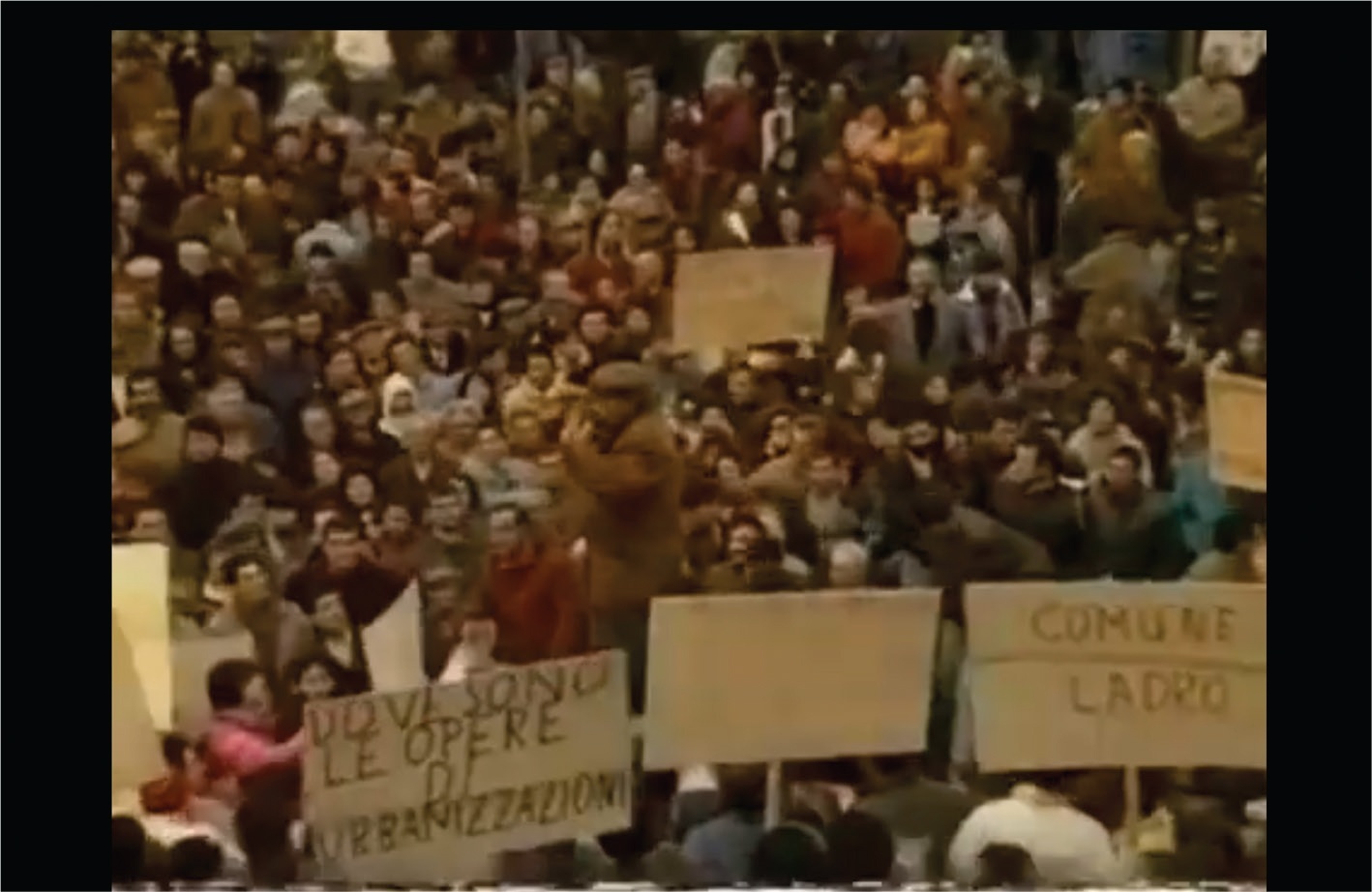
Figure 3
A demonstration against the housing crisis.
Beyond demonstrations, the focus on members of the public is brought up constantly, especially in street interviews. In various scenes, journalists approach people to ask for their opinions on current events (such as elections, corruption scandals, or police operations). These voices may not be politically articulate. Yet collectively, they form a chorus of disillusionment. As Gustavo Procopio Furtado explains in the case of documentaries dealing with archives on ordinary people, they ‘develop an audiovisual version of history from below’.22 The microhistorical aspect of Un mito emerges most prominently, I argue, in this relationship between individuals and the major historical/social events they live (and how they navigate these conditions).
In one revealing sequence, a man sitting in a car reacts to a journalist’s question about the arrest of a local crime figure, Pulvirenti (from a scene placed earlier, in which we have seen his capture). The man in the car stays silent, using only facial gestures to express discomfort or fear (Figure 4). The next person interviewed, however, is unambiguous. He says all politicians should be jailed and accuses them of collusion with the mafia. His explosion of speech, placed between silences and evasions, gains symbolic power placed between testimonies. This, because right after, one younger man claims that Pulvirenti is just a worker like everyone else. Un mito’s editing here constructs a grammar of complicity and fear, revealing as much in what is left unsaid as in what is spoken, foregrounding ambiguity.
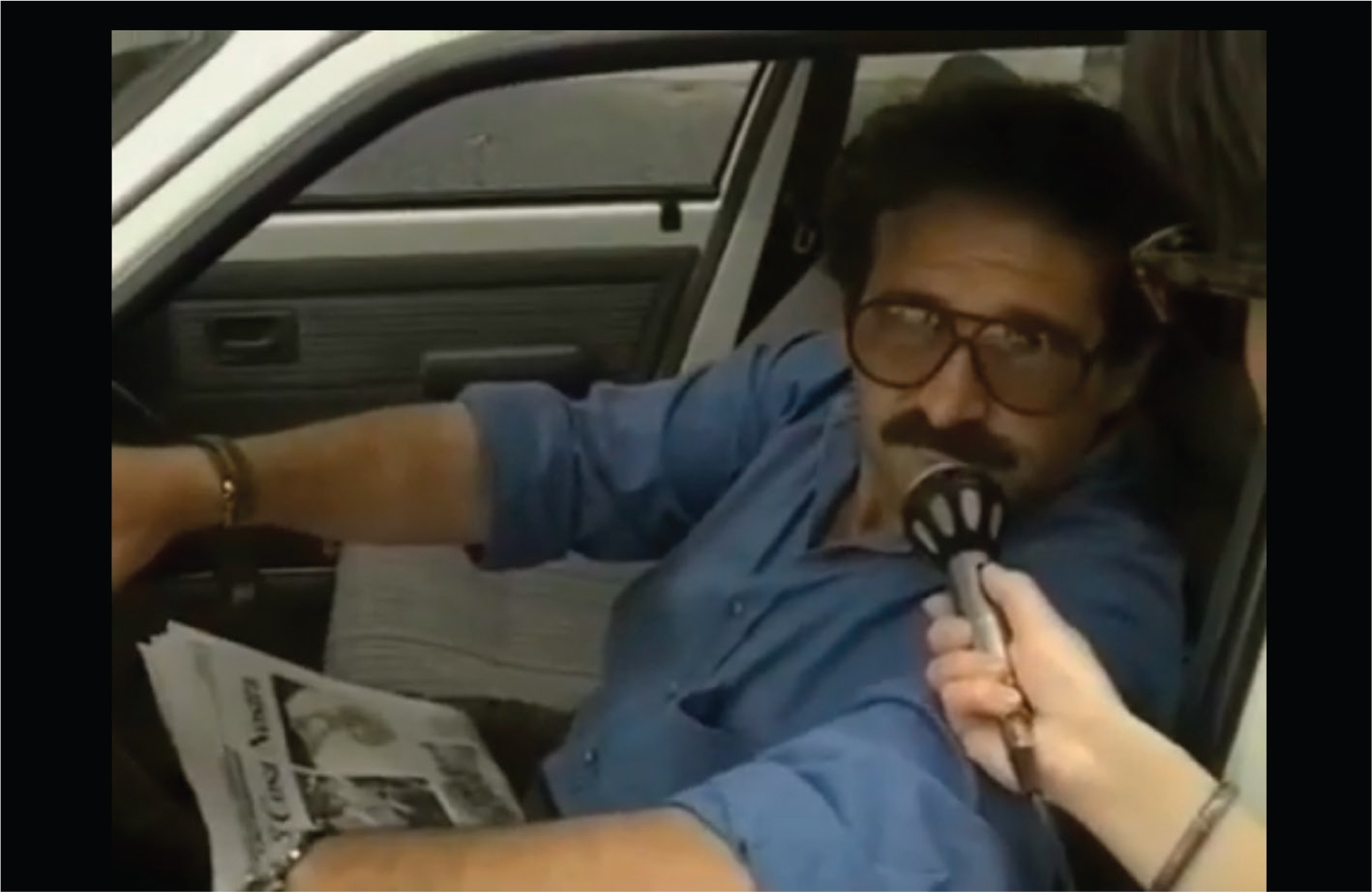
Figure 4
Man refuses to answer to the journalist.
Violence, too, is presented not as an exception, but as a normalised presence in everyday life. Indeed, Un mito opens with a religious procession that slowly reveals itself to be a funeral. Caskets are pulled by mourners, and widows cry openly in the street. Cemeteries and funeral rites recur throughout the film, anchoring death as a consistent motif. In a later sequence, a large public funeral is held for what appears to be a political assassination. The camera lingers on the crowd and an orator delivering a eulogy, drawing attention not only to the loss but to the ritualised public performance of mourning. Thus, rather than treating funerals as isolated tragedies, the film uses them to expose a culture where political violence has become woven into daily rituals of memory and grief.
The film deepens this idea in a stark sequence near the end. Journalists gather outside a police precinct where a shootout has occurred, resulting in the deaths of several officers. A female police officer is interviewed first; she speaks with visible emotion about her fallen colleague. Then a male officer follows, offering a direct critique of the government’s failure to equip and protect the police force. He states plainly that they are understaffed, underprepared, and under-resourced, a situation he links directly to political corruption. Public servants are left vulnerable, just as ordinary citizens are. By juxtaposing images of mourning with critique, shows how structural corruption and institutional neglect produce conditions of death, not metaphorically, but literally.
Housing, unemployment, emigration, political disillusionment, corruption, and violence are not treated as separate topics. Instead, through the cumulative effect of its montage-based structure, Un mito critiques the logic of mainstream news reporting, which often decontextualises events, presenting scandals, crimes, or protests as isolated headlines. Instead, Un mito situates events within a broader social and temporal continuum, revealing patterns and relationships that are otherwise obscured. As Levi argues, ‘all social action is seen to be the result of an individual’s constant negotiation, manipulation, choices and decisions in the face of a normative reality which, though pervasive, nevertheless offers many possibilities for personal interpretations and freedoms’.23
As mentioned earlier, what emerges in Un mito is a multiplicity of voices that do not necessarily harmonise. As John Brewer notes regarding Roberto Rossellini’s Paisà, a seminal work of what he defines as Italian microhistory in cinema, it depicted ‘a world that was fragmentary, sometimes capricious and arbitrary, full of conflict, skewed by partial knowledge and different levels of consciousness, marked by different temporalities’, to later continue, ‘It was a world inhabited by every sort of person, speaking in every sort of voice’.24 Unlike Paisà, the small, the local, and the personal in Un mito exemplifies this ambivalence by privileging what José van Dijck calls ‘mediated memories’, that magnify the intersections between personal and collective, past and future.25 In this sense, the film insists on the instability of memory and the multiplicity of lived truths as defining features of the historical record.
4 The Palimpsestic Archive: Videotape, and the Materiality of the Poor Image
One striking contribution of Un mito in terms or archival filmmaking is its reimagining of the local television archive not merely as a depository of historical footage, but as a fragile, layered, and dynamic material object. It actively transforms fragments of local television into microhistorical stories, moving them from what Aleida Assmann terms ‘storage memory’, or a dead memory confined to an archive, to ‘functional memory’, or a living memory.26 This process of remediation and re-circulation is central to the film’s archival intervention.
Ginzburg’s methodological stance, one that values the conjectural and the peripheral,27 finds a visual equivalent in Un mito, where degraded videotape snippets, often dismissed as irrelevant ‘filler’, are repurposed as historical clues. Whether we see a group of boys playing football, a passing car, or a woman pausing at a shop window (Figure 5), these seemingly banal moments offer microclues to the social texture of the time and place. In a way, they make it to the film’s fabric not for their significance, but for their ordinariness. In this sense, the degraded and accidental archive reminds us that what survives is often not what was intended to be remembered, but what escaped erasure.
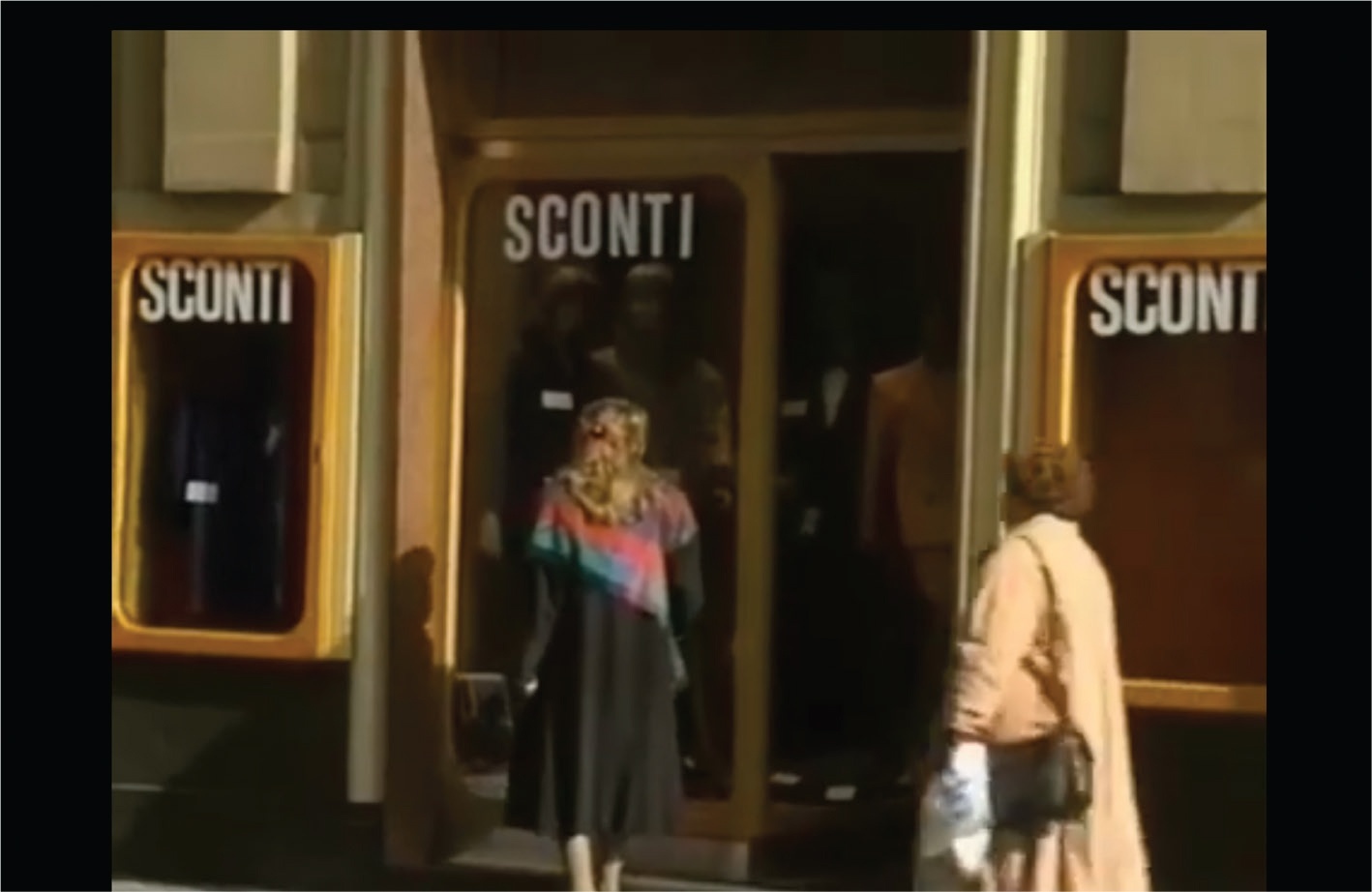
Figure 5
Woman stopping by a shop window.
Here, Hito Steyerl’s notion of the ‘poor image’ becomes particularly salient. While Steyerl refers to the degraded digital image circulating across peer-to-peer networks, her insights are remarkably applicable to the analog context of video technology. Steyerl characterises the poor image as ‘a visual idea in its very becoming’, shaped by circulation, degradation, and lack of institutional legitimacy.28 The poor quality of the video fragments here does not diminish their historical value; rather, it underscores the material conditions of their production, circulation, and neglect. By engaging with these ‘poor images’, Un mito actively re-mediates and revitalises them, transforming inert historical data into a dynamic, ongoing conversation about the past, a key aspect of making memory ‘functional’, in Assmann terms.
Indeed, as Giovanna Fossati notes, videotape is a ‘poor preservation carrier’, far more perishable than film, and ‘there is not much that can be done to slow down its decay’.29 This decay translates into the technical imperfections of the footage (grainy textures, discoloured frames, tape warps) which become both traces of past recording practices but also of economic constraints.
This neglect was systemic. As mentioned previously, Italy’s media landscape during the late 1980s and early 1990s was increasingly dominated by commercial broadcasters, most notably Silvio Berlusconi’s Mediaset empire.30 As Paolo Rossi notes, ‘[i]n the absence of a national archive, Italian television groups manage the cataloguing, preservation, and digitisation of their content directly’, a process that is ‘imperfect, disorganised, and discontinuous’31 even for large networks and was utterly unfeasible for underfunded local outlets. For a local station owned by a businessman for whom it was a promotional tool, preserving raw news footage for posterity would have been an unthinkable expense. The practice of reusing tapes was thus a financial necessity, not an archival choice, resulting in the accidental visual palimpsests that Un mito so powerfully centers. Thus, the instability of the material archive is inseparable from the instability of the local television industry itself, where economic marginality directly shaped what could be preserved.
Much of the footage included in Un mito bears visible signs of having been taped over-ghost images appearing beneath the surface, horizontal noise bands suggesting overwrite, or partial remnants of unrelated programs. Rather than editing around these flaws, Un mito turns what might once have been technical failure into a visual argument: memory is fragile, political struggle is recorded on unstable media, and history lives in a state of partial erasure (Figure 6).
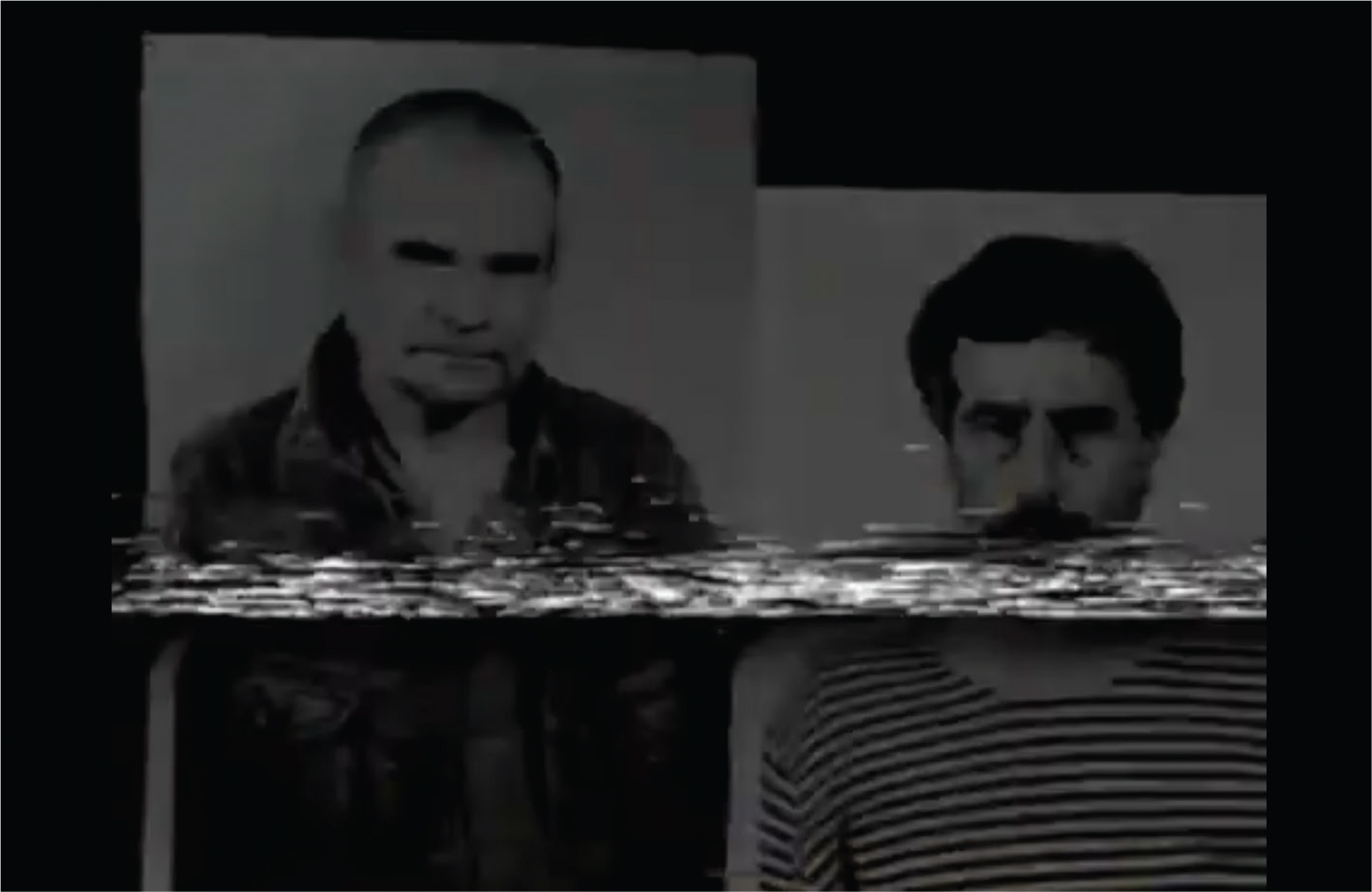
Figure 6
Horizontal distortion in the footage, which repeats many times.
In a way, Un mito practices what we might call archival humility: a mode of historical engagement that acknowledges the limits of what can be known, the fragility of evidence, and the conjectural nature of any narrative built from incomplete materials. I take this notion from Jessica Tai’s notion of cultural humility as applied to museums. She argues that this approach ‘prompts archivists to acknowledge that they will never have all the answers, therefore opening space for other voices’, especially advocating for and facilitating the representation of marginalised communities.32 In Un mito, this humility is reflected in the film’s editing style. There is no omniscient voiceover, no authoritative narrator explaining the significance of the images. Rather, we need to piece together meaning from juxtaposition, texture, and tone. This refusal of closure resists the conventional historiographical desire for narrative coherence, keeping the archive open to multiple, even conflicting, readings.
In this context, archival survival is arbitrary. In this sense, Un mito draws attention to the limits of what can be recovered. Indeed, many sequences cut off mid-scene. Others display tracking errors, audio dropouts, or abrupt shifts in lighting and sound. These gaps are not edited out but highlighted, insisting on showing the archival process in its brokenness, and revealing the ethical stakes of documentary work that relies on such fragile media.
5 Reframing the Past: Ethical Issues in Activating Old Archives
The archival turn in contemporary documentary practice, especially on the use of television archive, has been marked by a growing recognition of the ethical stakes involved in reusing historical footage. As Stella Bruzzi writes, ‘[d]ocumentary has always implicitly acknowledged that the “document” at its heart is open to reassessment, reappropriation and even manipulation’.33 In Un mito, this reuse becomes a space of ethical tension, one where questions of consent, original intent, and recontextualization collide. As I will discuss here, the documentary offers a few segments in which ethical issues arise.
Indeed, Jaimie Baron’s notion of ‘misuse’ is particularly helpful in this context. For Baron, the archival document is misused when it is employed in a new context unanticipated by its original creators: ‘misuse in the sense that [the source’s] new use was not intended or at least not anticipated by its original producer’.34 This does not automatically equate to unethical conduct; however, it raises key concerns about contextual displacement and ethical responsibility. When filmmakers appropriate old footage for new purposes, they do not merely inherit the image. Instead, they reinterpret and reshape its meaning.
Emma Cocker offers a partial rejoinder to Baron by introducing the concept of ‘ethical possession’, as a form of archival appropriation grounded in recuperation and resistance. In this model, filmmakers may activate forgotten or marginalised images in the service of political or historical correction. Yet, Cocker also insists that such acts of borrowing carry with them an obligation: to remain sensitive to the conditions under which the original footage was produced and to avoid overriding the agency of the individuals captured within it.35
A compelling and ethically fraught example in Un mito occurs during a covertly recorded conversation with a local informant, who describes a widespread urban planning corruption scandal, something that explains many of the issues faced by the local population addressed earlier in the documentary. This sequence is visually and aurally distinctive: the footage is very stark, shot from the backseat of a car, angled in such a way that the informant’s face is never clearly visible. Within the logic of the documentary, this scene connects local political decisions (specifically around land use and housing developments) to broader patterns of exploitation and dispossession.
However, the ethical implications of this scene are profound. The man clearly believed he was speaking with a journalist in confidence, with the assurance that his testimony would not be identifiable (Figure 7). The subsequent use of this footage in a public documentary, years after the issue and under different narrative premises, is problematic at least. While the exposure of corruption may serve the public good, this act also risks instrumentalising an individual in a vulnerable position, turning their testimony into a piece of narrative evidence detached from its original affective and ethical context. This raises questions of responsibility: what happens when the very act of salvaging history reproduces the exploitation of those whose testimony it seeks to amplify?
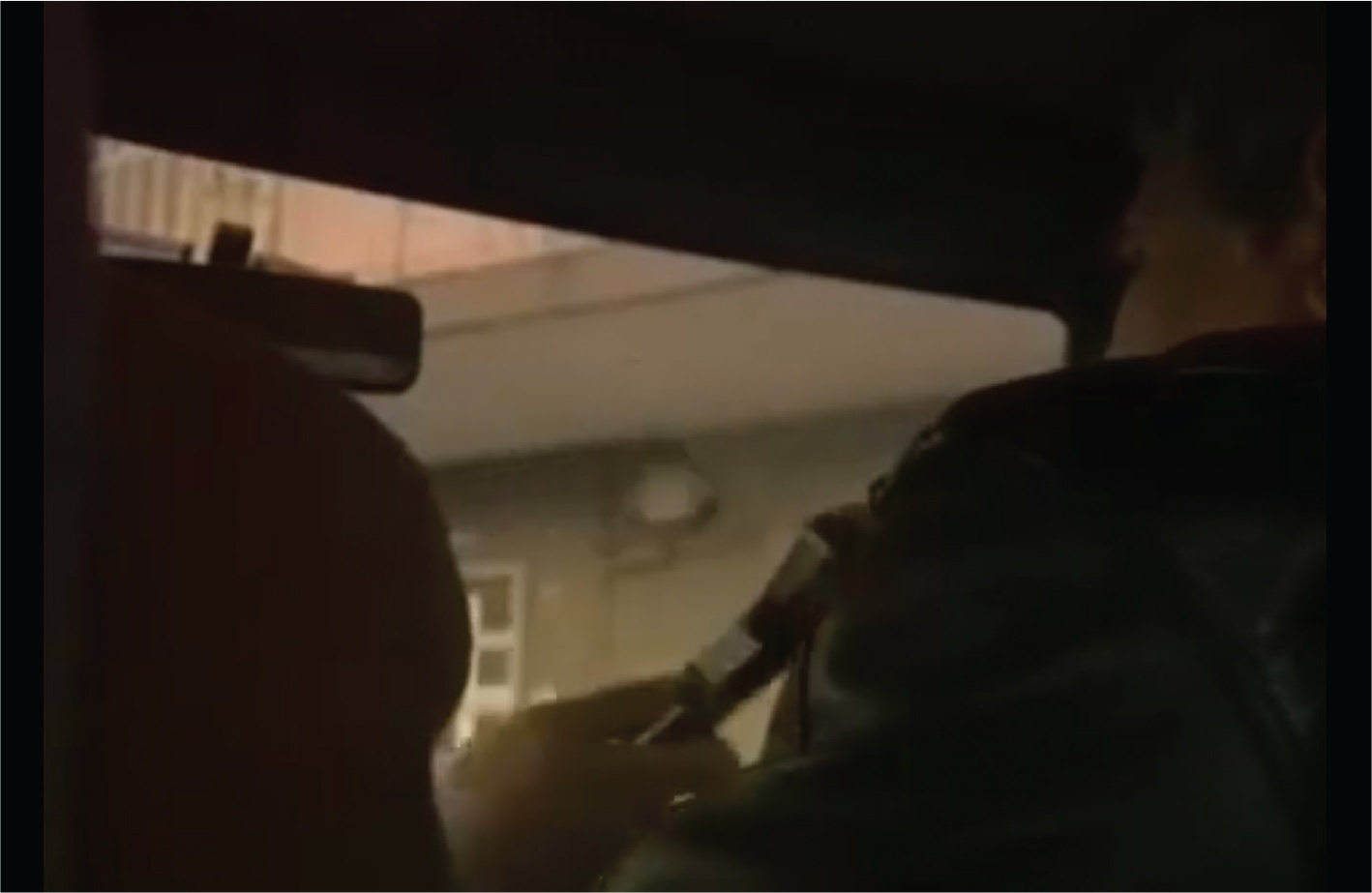
Figure 7
Whistle-blower during a secret interview.
Equally troubling is a fleeting reference to a possible death, though as with plenty of the film’s footage is not always clear whether such footage made it into the final cut or if it was excluded due to concerns about taste, relevance, or consent (Figure 8). In one ambiguous case, the footage appears to show a dead man covered in blood, raising further ethical questions about the limits of what can or should be shown in an archival documentary. Here, the ethical dilemma lies not only in consent but also in representation. That is, how does one balance the historical importance of showing violence with the risk of sensationalising or re-traumatising?
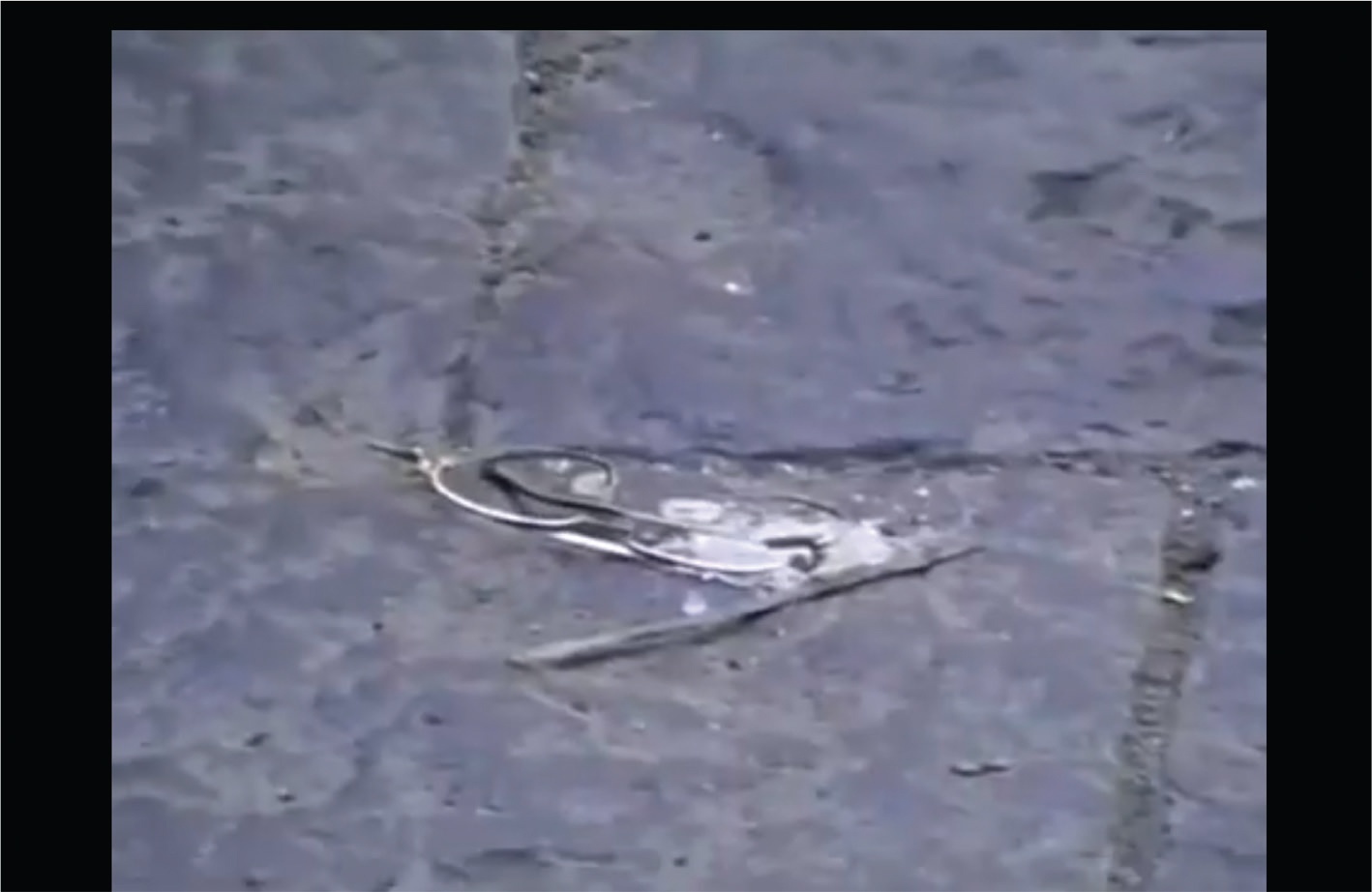
Figure 8
Glasses of the deceased person.
In this regard, Cocker’s optimism about ethical possession needs to be tempered with Baron’s caution. What is gained in narrative clarity or historical critique may come at the cost of personal dignity, autonomy, or safety. Indeed, ethical possession also demands that we acknowledge the asymmetry of power involved in such projects. The filmmakers have the tools of editing, framing, and narration; the original subjects do not. Even when used in service of political critique, the act of appropriation risks reproducing the very dynamics of exclusion it seeks to redress. Brad Gregory reminds us that microhistorians ‘affirm the human agency of past men and women at every level of society, but always within a specific, concrete network of social relationships’.36 So, the question here, in microhistorical terms, is if turning someone’s moment of grief, confession, or protest into a symbolic node in a broader narrative is to displace their agency, even if the intent is recuperative. In this way, Un mito demonstrates that the ethics of archival reuse cannot be separated from the epistemology of microhistory itself: both rest on fragile human traces whose activation risks distorting the very lives they aim to illuminate.
6 Conclusion
Un mito exemplifies the potential and the challenges of using archival footage as a vehicle for microhistorical inquiry. Its fragmented, degraded images not only reveal everyday struggles with housing, migration, corruption, and violence, but also foreground the fragile conditions under which these histories were preserved in the first place. The result is less a seamless retelling of the past than an exploration of how memory itself survives, that is, through broken, contingent, and often accidental traces.
At the same time, the film highlights the limits of treating archival reactivation as an inherently emancipatory practice. The voices we hear (of protesters, residents, informants, and mourners) do not cohere into a single counter-narrative, nor should they. They instead expose the instability of ‘history from below’. However, as Dagmar Brunow warns, ‘history from below’ is not emancipatory per se, nor does the use of oral history or testimonial witnesses automatically imply a polyphony of voices, allowing different (and differing) experiences to be represented’.37 Visibility does not guarantee empowerment, and the reuse of footage can, in some cases, reproduce the very dynamics of vulnerability it seeks to contest.
For this reason, Un mito should be read not simply as a work of counter-history but as a reminder of the ethical and epistemological stakes of archival filmmaking. It does not resolve contradictions nor speak for the marginalised, but holds open a space where different experiences, perspectives, and absences can coexist. The lesson of Un mito is not that history from below provides a straightforward corrective to dominant accounts, but that it offers a more tentative, ethically charged form of engagement. One that foregrounds both the promise and the risks of reanimating fragile voices from the past.
Notes
[2] Flavia Barca. “The local television broadcasting system in Italy: too few resources for too many companies?”, Media, Culture & Society 21, no. 1 (1999): 114.
[4] As Danilo Zolo explains, The Mammì Law of 1990, named after its sponsor, the Italian Minister of Posts and Telecommunications Oscar Mammì, legally sanctioned the duopoly of public broadcaster RAI and Silvio Berlusconi’s private media empire, effectively structuring political communication around television (1999: 730–731).
[5] Danilo Zolo. “From ‘historic compromise’ to ‘telecratic compromise’: notes for a history of political communication in Italy between the First and Second Republic”, Media, Culture & Society 21, no. 6 (1999): 731.
[7] Salvatore Giusto. “Through the Looking Glass: Televised Politics in Contemporary Populist Italy”, PoLAR: Political and Legal Anthropology Review 43, no. 1 (2020): 94.
[9] Flavia Barca. “The local television broadcasting system in Italy: too few resources for too many companies?”, Media, Culture & Society 21, no. 1 (1999): 112–117.
[10] Rüdiger Steinmetz, and Judith Kretzschmar. “The Great Transformation in Germany of 1989/90 from the View of Local Television (1990-1995).” VIEW. Journal of European Television History and Culture 11, no. 20 (2022): 36–48.
[11] Jill A. Edy, and Jasmine T. Austin. “Generating more inclusive media memory: the limits and possibilities of news archives”, Media, Culture & Society 44, no. 4 (2022): 802–819.
[12] Kate Adlena Cronin. “‘Communication in Service of the People’: Activating Audiovisual Human Rights Collections in Chile”, The Moving Image: The Journal of the Association of Moving Image Archivists 21, no. 1-2 (2021): 100–117.
[13] Rich Newberg. “Local TV News Archives and the Pursuit of Social Justice”, The Moving Image 20, no. 1 (2020): 226–227.
[14] See: https://site.unibo.it/atlas/en.
[15] Efrén Cuevas, Filming History from Below: Microhistorical Documentaries (New York: Columbia University Press, 2022).
[16] Ginzburg, Carlo, Clues, Myths, and the Historical Method (Baltimore: Johns Hopkins University Press, 1989).
[17] Giovanni Levi, “On Microhistory”, in New Perspectives on Historical Writing, Peter Burke, ed. (Cambridge: Polity Press, 1991). 201.
[18] Carlo Ginzburg, and Carlo Poni, “The Name and the Game: Unequal Exchange and the Historiographic Marketplace”, in Sex and Gender in Historical Perspective, Edward Muir and Guido Ruggiero, eds. (Baltimore, MD: The Johns Hopkins University Press, 1991), 1–10.
[19] Sigurður Gylfi Magnússon, and István M. Szijártó, What Is Microhistory?: Theory and Practice (London: Routledge, 2013), 5.
[21] Guido Tintori and Michele Colucci. “From Manpower Export to Brain Drain? Emigration and Italy, between Past and Present”, in Routledge Handbook of Contemporary Italy: History, Politics, and Society, Anthony Mammone, Ercole Giap Parini, and Giuseppe A. Veltri, eds. (London: Routledge, 2015), 43.
[22] Gustavo Procopio Furtado, Documentary Filmmaking in Contemporary Brazil: Cinematic Archives of the Present (New York: Oxford University Press, 2019), 147.
[23] Giovanni Levi, “On Microhistory”, in New Perspectives on Historical Writing, Peter Burke, ed. (Cambridge: Polity Press, 1991), 96.
[24] John Brewer, “Microhistory and the Histories of Everyday Life”, Cultural and Social History, 7, no 1 (2010), 87–109.
[25] José van Dijck, Mediated Memories in the Digital Age (Stanford, CA: Stanford University Press, 2007).
[26] Aleida Assmann, “Canon and archive”, Cultural memory studies: An international and interdisciplinary handbook, Astrid Erll and Ansgar Nünning, eds. (Berlin and New York: Walter de Gruyter, 2008), 97–108.
[27] Ginzburg, Carlo, Clues, Myths, and the Historical Method (Baltimore: Johns Hopkins University Press, 1989).
[29] Giovanna Fossati, From Grain to Pixel: The Archival Life of Film in Transition (Amsterdam: Amsterdam University Press, 2009), 68.
[30] Gianfranco Baldini, and Sofia Ventura, “The many political legacies of Silvio Berlusconi”, Contemporary Italian Politics 16, no. 2 (2024): 122–137.
[31] Emiliano Rossi, “Beyond the Flow, from Tape to Digital: Insights from Mediaset’s Archives”, VIEW Journal of European Television History and Culture 13, no. 26 (2024): 2.
[32] Jessica Tai, “Cultural Humility as a Framework for Anti-Oppressive Archival Description”, in Reinventing the Museum: Relevance, Inclusion, and Global Responsibilities, Gail Anderson, ed. (Lanham, MD: Rowman & Littlefield, 2023), 3.
[34] Jaimie Baron, Reuse, Misuse, Abuse: The Ethics of Audiovisual Appropriation in the Digital Era (New Brunswick: Rutgers University Press, 2020), 9.
[35] Emma Cocker, “Ethical Possession: Borrowing from the Archives”, in Cultural Borrowings: Appropriation, Reworking, Transformation, Ian Robert Smith, ed. (Nottingham: Scope, 2009), 92–110.