
Focusing on the archival and public engagement project Whose Voice? Whose Story? BBC radio news and the language of race in post-WWII Britain, this article explores the opportunities and challenges of working with a digitised archive of about 160,000 radio news scripts for the BBC Home Service/Radio Four. The project’s key aims have been to:
explore the evolution of language used to report on Black and Black-British migration and experience in BBC radio news from 1945 to the early 1990s;
produce a series of podcasts whereby different generations of the public from African and Caribbean backgrounds speak back to the BBC’s reporting;
reflect on the BBC’s impact on ideas of identity and belonging.
The outputs of the project will be publicly accessible via a website that aims not only to facilitate access to parts of this major archival resource, but also to offer a multi-faceted, dialogic, and collaborative approach to engaging a wider public with broadcast archives. The article is structured around the following three themes which make up the project’s three distinctive phases:
The role of digitisation in facilitating research into broadcast archives: we will discuss the temporal and spatial dimensions of doing research with this digital archive, while thinking through the implications of such research for decolonising methodologies and frameworks.
Knowledge exchange and public engagement: we will discuss the process of producing the podcasts, considering ethics of care and sensitive data, as well as questions of ownership and re-creation of archival memory and broadcasting history.
Digital outputs: how does the project’s website support a radical engagement with broadcast archives? We will discuss the collaborative process involved in building the website and the role of decolonising methods for rethinking digital humanities and the curation of broadcast archives online.
1 Key Objectives, Methodologies and Frameworks
Digital access to this invaluable historical resource has facilitated our focus and motivation behind this project: that is, to think through and apply decolonising methodologies to how we research, interpret and make this archive widely available. Digital access perfectly lends itself to collaboration and partnership building, which is critical if we are to bring different voices and perspectives to write and record a different, radical history of the BBC, from the bottom up. This is because digitisation ‘frees the archive from the shackles tying it to a place’, as information experts have aptly put it.1 The digitised segments of news bulletins can be easily passed on to be read and debated with participants in the project wherever they are, at a community centre in Newham in London, in the comfort of a participant’s home, or at a school in Liverpool. The material is rich too because the amount of data is vast, offering us various entries into historical themes, periods and questions and allowing us to engage a range of audiences with different experiences, interests and perspectives. The digitised archive and its outputs can also be more easily brought into dialogue with other digitised archival collections. Via the website, we aim to link our work with similar databases, digital projects and archives to help build a multi-faceted, dialogic, and collaborative approach to accessing and using broadcast and media archives.
The digitised news scripts also allow us to engage in what we see as a critical, decolonial exercise of ‘collage-making’. Collage has been used as a qualitative research method in visual arts, education and psychology but it has also been adopted and developed by scholars in Indigenous and Decolonial studies to build alternative governance forms, re-claim and re-occupy spaces and homelands.2 Collage as a method and a theory is at the heart of this project, which collates themes around the UK race debate through the BBC radio news scripts, and puts the scripts in dialogue with the public through a series of conversational podcasts. Both approaches require a process of breaking up, re-ordering and re-arranging the archive in order to create new meanings and access alternative voices. The conversational podcasts, in particular, offer an encounter with the archive, where individuals of African and Caribbean background speak back to it. ‘Speaking back’ is in the same tradition of ‘writing back’ or ‘clapping back’, that characterises much of the postcolonial or anti-colonial literature, first articulated by Gayatri Chakravorty Spivak in her seminal essay ‘Can the subaltern Speak?’ (1988).3 In this project, the act of ‘clapping back’ is about recovering and amplifying diverse experiences and missing voices.
Our approach to engaging with the BBC archive aligns with work done elsewhere on the intersections between archival practice and activism. In other words, our ‘clapping back’ podcasts have become a ‘living archive’ of its own, turning the BBC news scripts archive, we initially worked with, into ‘a participatory common ground’ rather than a ‘temple; an ‘agent of political representation’ rather than merely a ‘historical repository’.4 More fundamentally, we approach the question of decolonising the BBC archive as an ongoing and lived process, attentive to opening up discussion and effecting change, rather than offering definite, fixed answers. This ethos underpins all our work on this project but it has been met with challenges, namely the BBC’s institutional silence and inertia; lack of support and funding within academia, and its reliance on outdated technologies, as this article will go on to explain.
Ultimately, our aim is to develop a digital, community-orientated archive and resource to document and address questions of historical and ongoing impacts of racial discrimination and anti-racist struggles, to inspire further debate and reflection, and to promote future change in relation to more inclusive media policies and representation. Although this project focuses on radio, our methodological and theoretical frameworks can be applied to television archives, too, and more specifically non-fiction collections (ie. news, current affairs).
2 Phase 1: The Digitised Radio Archive – Challenges and Opportunities
2.1 Approaches to Researching Broadcast Archives Online
The collection we have been researching consists of about 160,000 news scripts. They represent a portion of the vast BBC news output but they still offer useful insights into radio broadcasting, its segmentation and editorial choices. In fact, the digitised version of this archive foregrounds the segmentation of broadcasting. This is because the search of one single event produces the list of bulletins on the same event that were inserted into the schedule several times during the day and evening. Comparing the different versions of those bulletins as they were updated during the day gives us an almost hour by hour record of how the BBC responded to events as they unfolded. The searchable archival database can help us compile this dense temporal record much more easily than ever before.
While these radio segments are invaluable for our research, we also recognise that they are only fragments of our knowledge of the BBC news/current affairs output and discourse; there were, and still are, several other current affairs programmes, such as Today, The World at One, Analysis and The World Tonight, which complement BBC’s news output and run parallel to the news bulletins. This is an important reminder that the conclusions we come to are based only on one section of this news output, which is part of a larger ‘flow’ of BBC news and current affairs.
Another temporal research dimension this digital collection facilitates is the study of broadcasting history at a macro level. In our project, one of the key objectives is to explore the evolution of the language of race, that is, when and why certain terms and discourses appear, or disappear, or which ones remain largely unchanged during a period of four decades after WWII. Access to this large collection also allows us to evaluate data from a quantitative perspective; for example, there is extensive news coverage on certain topics (e.g riots/uprisings, police and crime related stories, issues of education), while our searches of what we consider to be seminal figures and events in Black British history often yielded very little, or nothing – these are the gaps, or what we call the ‘radio silences’ in our project, as the Mangrove Nine example discussed below suggests. Sadly, this imbalance in news coverage may be unsurprising, and yet, what should surprise most of us is how these imbalances persist to this day.
Researching this news collection online also redefines the spatial connection between the researcher and the archive. Physically visiting an archive and encountering the materiality of archival sources usually involves a process of expected or unexpected discovery, or frustration at not finding what one is looking for. This is particularly relevant for broadcast history research where a lot of early material does not survive. This process gives the researcher an understanding of where the archive begins and where it ends, where its physical and material borders lie. With a digitised collection these borders become porous, as the search tools we are offered operate on unifying principles that can easily bring different data together. The searches we do may not always be successful but we can easily change the search terms and move on from there without giving further thought to what we cannot find. The database is generous enough to move us along, to our next search and our next finding. In that sense, we kept interrogating our search terms, noting, where necessary, what is missing either from the database, or the BBC news coverage itself, in an effort not to be seduced by the instant access and numerous options that databases can afford researchers at the click of a button.
The debate on the physical and digital qualities of research is certainly not new anymore; in a special 2014 edition on literary archives, materiality and the digital, Maryanne Dever and Linda Morra explore how digitised and digital-born collections have brought a new intensity to reflections on the materially embodied status of traditional archival collections.5 With reference to the Danish Broadcasting Corporation (DR) archives, Erik G Jensen reminds us that the digitisation of state-owned audio-visual archives remains a contested area due not only to existing copyright laws but to aspects of historical contextualisation as well.6 Both these aspects have been critical in our research; without the BBC’s permission to use this database, this project would not have been possible, and specific permissions have also been given to allow us to publish about 200 news scripts on our website. The question of historical contextualisation rests on us and it is pivotal in our thinking of how we present and curate our findings, as well as how we engage the wider public with some topics of a very sensitive nature.
2.2 Key Findings
Working in partnership with the BBC’s Archive editorial team, we were given access to the radio news scripts database to conduct our primary research. The database can be searched by date, relevance and place and we employed historical and discourse analysis to explore BBC’s coverage of specific events, historical figures and broader themes and terms (e.g. terms such as ‘colour bar’, ‘racism’, ‘anti-racism’, ‘Black Power’). We read over 200 news scripts, identified patterns and specific usage of language around the African and Caribbean experience in the UK, and we classified our findings into the following categories:
British Empire and its relations with colonies;
Arrivals and departures;
Racial discrimination;
Anti-racism and resistance;
Riots/Uprising;
Relations with the Police;
Education;
Arts;
Sports;
Historical figures.
Wherever necessary, we cross-referenced data, using BBC’s own news guidelines, as well as contemporary newsreels and newspaper databases.
Our research revealed that aspects such as, whose perspective the news covers (government, authorities, the people affected), the order of news and the association between different stories this order assumes, as well as giving context for why/how an event has come about, are all significant in deconstructing structures of BBC thinking and re-orientating our thinking around the language of race and its uses. We also asked the question of when words such as racism, or anti-racism are mentioned on BBC radio news for the first time during this period, and in relation to which stories. What we discovered offered us insights into the ways the BBC, for a long time, located the ‘race problem’ outside the UK, and in countries such as the USA and South Africa. Another key finding is what we did not find, i.e. the absences from the news coverage of certain events, figures and themes. Such silences are equally revealing of the BBC’s editorial choices and approach. For example, we found no Radio 4 coverage of what’s been known as the Mangrove Nine trial, a piece of British history which only recently has been given visibility thanks to Steve McQueen’s episode ‘Mangrove’ in his acclaimed TV series Small Axe (BBC1, 2020). At the time of the trial in 1971, news media very much associated Black identities with ‘mugging’, crime, violence and unrest. The nine Black British activists, who successfully represented themselves in court, defied all odds, with a win that marked the first judicial acknowledgement of racial prejudice in the Metropolitan police. Their win would have defied racial bias in media too, and so the BBC seem to have conveniently ignored it.
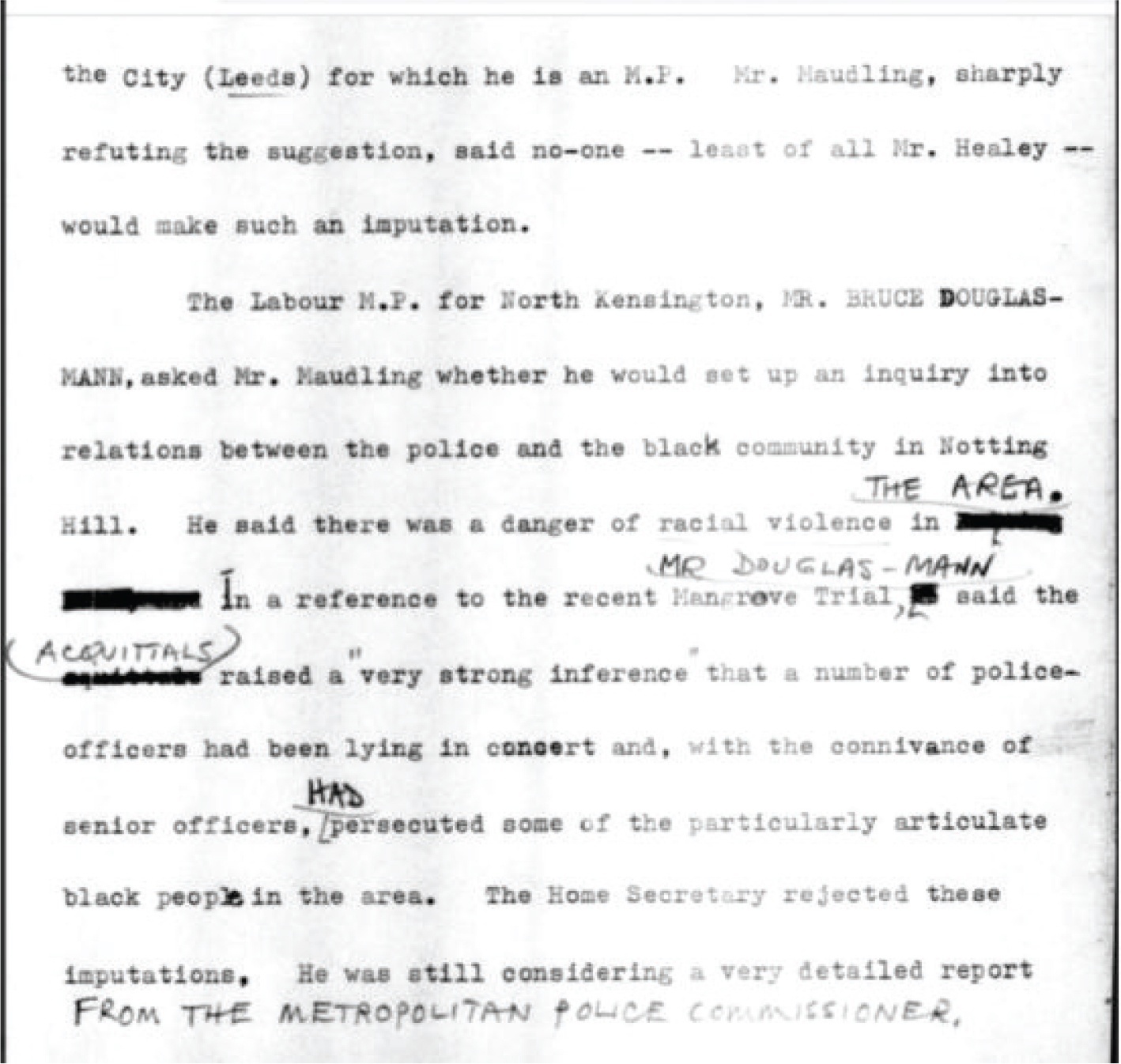
Figure 1
The only R4 news reference to the Mangrove Nine Trial (28/1/1972).
These research questions and findings are only the tip of the iceberg of what is a complex and multifaceted history, but they offer key starting points to uncovering a BBC news’ lexicon of race and the Black British experience.
3 Phase 2: Knowledge Exchange and Public Engagement
Whilst creating our ‘living archive’, we had a clear vision: to invite Black communities across the UK to encounter, respond to, and speak back to the colonial legacies embedded in the archive. The aim was not merely to make history audible, but to open up new ways of relating to it. Through community listening and recording sessions, participants were invited to become co-creators in a process of historical re-interpretation. We hosted six recording sessions at Birkbeck, where contributors engaged directly with selected BBC Home Service scripts, which in 1967 became Radio 4. Groups were made up of 5 participants, including a researcher. Participants read scripts aloud, often for the first time, responding by bringing their own lived experiences into dialogue with official media narratives. Our community engagement also extended to Liverpool, where we facilitated a workshop with teenage students at King’s Academy and held a recording session at the African and Caribbean Centre. These were not neutral listening exercises; they were conversations held in spaces deliberately shaped by care, openness, and shared vulnerability which provided a safe space for testimony and reflection. Throughout, the goal was to foreground voices historically marginalised in British media archives, actively resisting what often emerges as an extraction of stories without meaningful interactions. The emerging podcasts became a form of counter-archiving - re-sounding the past through present-day storytelling and critique.
3.1 Access and the Ethics of Promise
At the beginning of the two-year project, there was a real sense of joy among us as a team. We were excited about the idea that this digitised BBC radio archive would be made accessible to the public. That access felt meaningful. We knew it would allow people, especially those from Black communities and other groups historically spoken about rather than spoken with, to engage directly with material that had, for so long, been unavailable. It felt like a step in the right direction.
From a decolonial perspective, this kind of access matters because the archive holds decades of scripts and audio from the BBC’s coverage of former colonies and Commonwealth nations. We saw it as a chance to open up a system, to hear how Britain once spoke about its relationship to the rest of the world, and to make that history available for public reflection and critique. It also felt like an opportunity for the BBC as a public service broadcaster that prides itself on its remit to ‘inform, educate and entertain’ (BBC) to stand by that promise, particularly at a time when institutions are being asked to reckon with their histories.
We shared this vision with everyone involved in the project. Contributors, community members, and our advisory panel were told that the archive would be open. And that mattered. People gave their time and shared their reflections with the understanding that this material would not just stay within the university or the BBC, but would be something they, too, could return to. Whilst the news scripts that we used for our community engagement will remain accessible, as the project went on, the wider promise changed.
Quietly, and without open discussion, we were informed that the full archive that we had been granted access to would no longer be made freely available. Instead, it would sit behind a licensed paywall. Any news scripts that we have had access to, we will be able to use on our upcoming website output publicly, and the everyone that engaged with the clap back sessions were sent copies of them, but it does mean that there is a gatekeeper for any future research, be it community-led, solo curiosity or academia-related.
This project remained safe, but the ‘closure’ of the archive is not just frustrating - it raises serious ethical questions. How do you ask people to engage, to share personal stories and experiences in response to scripts, knowing that they may never be able to access supplementary material to it? What does public engagement mean if access is conditional? The shift felt like something bigger than a policy decision. For those of us working on the project - and for the people who saw this project as the first step to the BBC’s Home Service/Radio 4 archives - it felt like a withdrawal of care and accountability.
Michel-Rolph Trouillot reminds us that history is not just about what’s remembered, but about who gets to remember and under what conditions. In Silencing the Past (1995), he talks about how power shapes what becomes history, and how silence is often part of that process.7 What we saw here was a new kind of silencing - not through omission, but through control. The material still exists, but now behind a gate that not everyone can pass through. That raises questions about ownership, about whose stories are preserved, and who has the right to access them. It’s important to hold this alongside the historical context. Colonialism is often framed as something that ended long ago, but that doesn’t reflect the lived reality for many of the communities we engaged with. Ghana gained independence in 1957, Jamaica in 1962, and Zimbabwe not until 1980. These dates are not far removed – they sit within the lifetimes of our parents and grandparents. The BBC scripts in this archive were being produced at a time when the empire was slowly unravelling. And yet, in the way they were written and broadcast, that colonial perspective often remained intact.
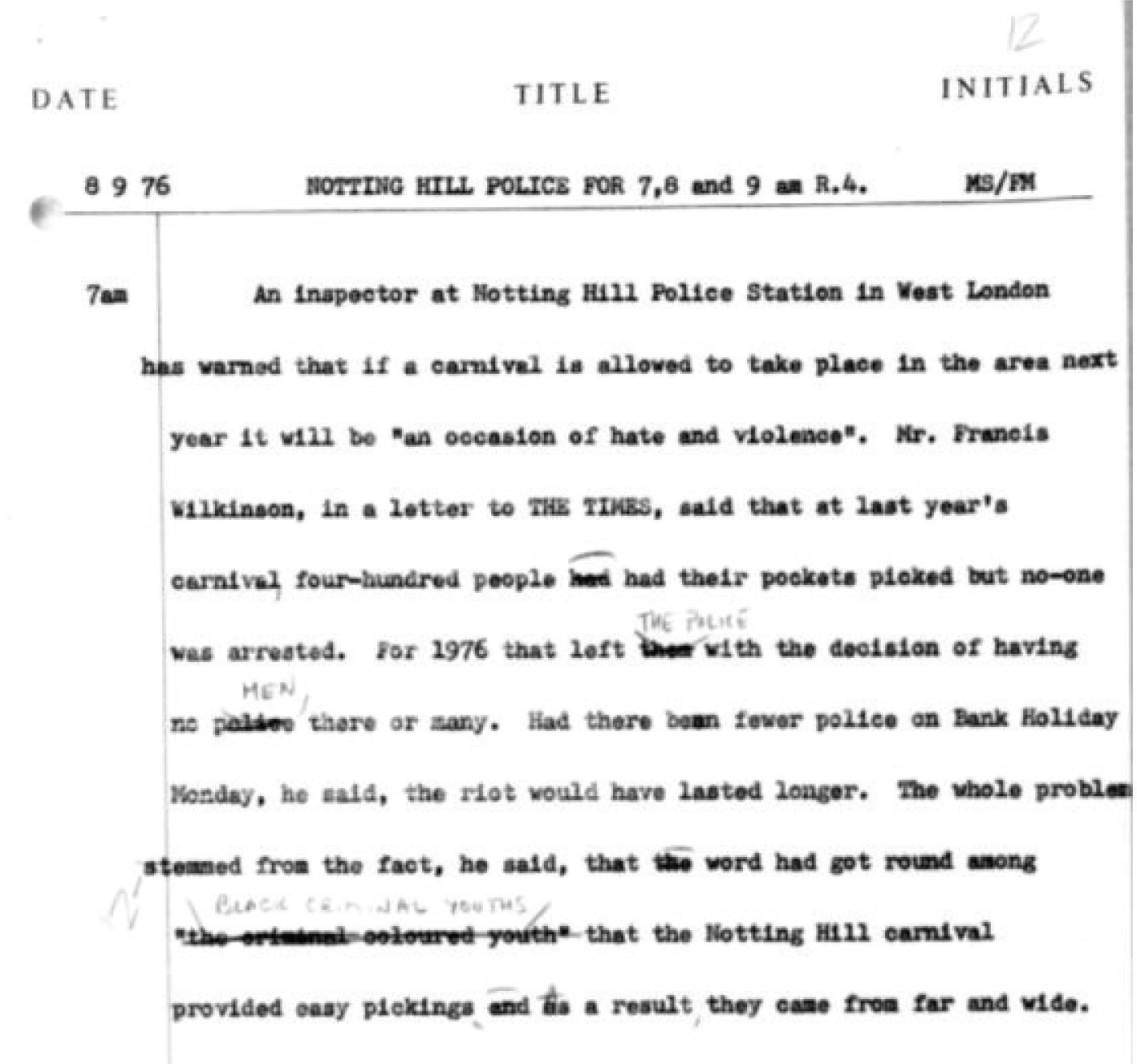
Figure 2
R4 news script reporting on the Notting Hill Carnival (8/9/1976).
Stuart Hall’s work on representation helps us to understand why this matters. He argued that media does not just reflect reality – it plays a central role in constructing it.8 These scripts aren’t just historical documents; they are part of the machinery that shaped how Black communities were imagined, both abroad and within the UK. For many of our contributors, reading them out loud was emotional. There was anger, surprise, laughter, and recognition. Some of the language used felt familiar, still present in the ways mainstream media talks about us today. This was abundantly evident when it came to the reporting of Notting Hill Carnival, one of the biggest carnivals in the world and Europe’s largest street festival.9 Mention of ‘drugs’, ‘crime’, and ‘trouble’ has been consistent in reportage from the 1970s onwards. And more recent articles by the BBC that appear as well-intentioned have consistently integrated the police and the number of arrests into them.10
Paul Gilroy’s idea of ‘postcolonial melancholi’ also helps us frame this moment.11 Britain hasn’t fully processed the realities of empire, and the refusal to confront its ongoing legacies often plays out through nostalgia and silence. The archive, in this case, became a battleground between institutional memory and community storytelling. And when access was taken away, it felt like another instance of those imperial logics, of control, withholding, and managed narratives, resurfacing in the present and causing a contradiction. For me and many others involved, this shift challenged the very terms of our work. It forced us to ask what kind of public we were really making this for and who gets to speak back to the archive if access is not guaranteed.
3.2 Clapping Back as a Legitimate Tool
The phrase ‘clapping back’ has deep cultural roots, grounded in African American and Caribbean vernacular speech, and the act is defined by Collins Dictionary as a ‘response sharply or angrily to a critical remark.’ 12 But it’s not simply a comeback or response; it’s a form of correction, of rhetorical power. Geneva Smitherman’s seminal work Talkin and Testifyin (originally published in 1977) reminds us that Black speech has always been a site of cultural resistance - creative, performative, and strategic.13 In the context of our project, we saw this vividly. Participants weren’t just engaging with the scripts; they were re-voicing them, reclaiming them, and asserting their right to be heard on their own terms. This was evident when teenagers in Liverpool put lines through the news scripts and recorded what they felt was more accurate. A story from the 1940s that led with the arrival of West Indians to the UK that focused on their unemployment was swiftly changed. These changes acknowledged that they were British citizens and put more emphasis on the fact that they had either been ex-servicemen or worked in the UK during the war.
Framing this process through a decolonial lens, we see ‘clapping back’ not as a reactive gesture, but as an intentional practice of knowledge-making. Decolonisation is often discussed at the level of institutions or curriculum change, but it is also a lived process – a commitment to unsettling dominant narratives and enabling counter-narratives to emerge. In these workshops, we witnessed how participants took up the space of the archive and refused its terms. They did so through voice, memory, interjection, humour, and critique. They also did so by speaking to the silences in the scripts - what was not said, who was not present, and how those absences continue to shape public discourse today.
3.3 The Making of the Podcasts
One of the most powerful aspects of the project was watching strangers connect through their responses to the scripts. These were not passive sessions – they were live, reactive spaces marked by laughter, critique, anger, and deep emotion. Again and again, people clapped back at the archive, challenging assumptions, questioning language, and reframing content through personal experience. In doing so, they reclaimed agency over histories that had spoken about them, not to or with them.
The workshops and recordings were intentionally structured to hold space for this. We co-created with Black communities in London and Liverpool, exploring selected BBC radio news scripts. Participants read them aloud – often stumbling over outdated or problematic language – and offered reflections that were personal, political, and often rooted in lived experience. Many added context to the events described, having lived through them. The Toxteth Uprisings, in particular, revealed a stark contrast between the archived narrative and participants’ realities. Though recorded for the podcast, these sessions also became moments of live resistance – interrogating what truth really means.
Crucially, the podcast series does not try to resolve these tensions. It holds them. Episodes are layered, messy, and non-linear – blending original scripts, participant reflections, and thematic conversations. Education emerged as a recurring theme, with participants linking news stories to personal memories of schooling. These moments revealed what a decolonial archive might look like: one that speaks with, not about; one that listens as much as it documents; one shaped by the communities it seeks to serve.
3.4 Ethical Care and Ownership
Care shaped our community engagement from the outset. It informed how we invited participation, facilitated dialogue, and made editorial decisions. Care was not a by-product, it was central to the methodology. Research with historically marginalised communities must prioritise relationships as much as outcomes.
This strand was led by a Black British researcher, Sylvie, whose lived experience informed the tone and depth of the sessions. Her presence fostered mutuality. She shared her own reflections, creating space for contributors to do the same. This informed the care extended to participants and reflected an intentional anti-colonial stance, in line with scholars like Linda Tuhiwai Smith, who argue that research must be accountable to those it represents, and Edward Said, who exposed how media and scholarship often reproduce harmful narratives shaped by power.14 Participants were not treated as subjects, but co-thinkers. This trust was deeply felt.
Podcasting supported this care. It captured not just voices but atmospheres – intonation, pause, laughter, pain. We allowed time for retakes and off-mic conversations. We emphasised participant control over what was recorded or edited. It is not just the output that needed to be different, the way that we created the sessions had to be different, being aware that ‘what has been decolonised has the potential to produce colonising effect.’15 As a result of that, one episode was withdrawn after a participant expressed concern about its impact on a new job. Though the recording will not be made public, the session was deeply healing. Sometimes, that is enough. This was not just about ethical protocol and the podcast output; it was about making space for people to feel genuinely seen and heard.
Geneva Smitherman reminds us that Black speech is not just communicative, but political.16 In asking participants to speak into the archive, we were also asking them to revisit pain, reclaim narratives, and critique silence.
4 Phase 3: Building and Designing the Project’s Website
The final stage of the project saw the creation of a website to host the transcripts and podcasts collected during the research phase by Eleni and Sylvie. The website was envisioned as a way for users to access a previously hidden archive, reframed through a new lens. Due to the BBC’s decision to commercialise the archive, this website would also serve as the only free-access platform for viewing these scripts without encountering a paywall.
Matt Green joined the project in September 2023 as part of his Final Project for a Master’s in Digital Media Design. The involvement of Birkbeck students allowed for a practical application of the skills gained during their studies through project-based learning. Matt, who previously studied History, was particularly interested in the methodological and political aspects of decolonisation. He was also excited by the creative challenges presented by decolonisation, especially in visual design, UX design, and front-end development – considering how one might visually represent these complex questions in practice.
The initial brief for the website was intentionally broad. The aim was to share and represent the archive’s findings in a way that reflected decolonial thinking while combining innovative design with accessibility. Central to the brief was the desire to facilitate a dialogue between past and present voices. We specifically wanted to avoid a simplistic linear timeline that overwhelmed users with information. Instead, the goal was to create a design that encouraged exploration, contemplation, and reflection – employing information architecture, visual design, and UI strategies to engage with the material in dynamic and thoughtful ways. In practice, the design of the website was a collective conversation in which each of the three team members contributed their expertise. An example of this can be seen in the example of information architecture. In the research stage, Eleni and Sylvie had identified clear themes elucidated within the research. In conversation with Matt, these themes then formed the basis of the website.
Due to the open brief, with neither the technologies nor the design specified, a significant part of the project’s time was spent exploring technology and visual design. During the design phase, we drew inspiration from interactive timelines that offered richer and more compelling representations of historical events, as opposed to linear timelines that recall historical events with text and image. One example was created using Tiki-Toki – a proprietary software platform that supports both 2D and 3D timelines, along with various multimedia elements, including video, images, and text. One specific Tiki-Toki timeline that we drew inspiration from was titled Deaths at the Border Belgium France UK. This interactive timeline used a three-dimensional design to encourage greater contemplation of the harrowing effects of borders and the contemporary border crisis. It achieved this through the site’s novel use of animation and image movement. As the user scrolls through the timeline, the images of the deceased increase in size from small to large and then decrease before disappearing, creating the appearance of moving past them. Some of the images include photos – though most do not – of those who died at the border crossing. This timeline highlighted how animation and visual design can be very affecting, especially when linearity is disrupted. Other examples of timelines we explored included the JFK timeline. This timeline was much simpler and linear. To explore it, users scroll down the page, and boxes appear that can be clicked to open modal windows with details about a given topic.
What ultimately informed our initial design decisions were sustainability and cost. Like many digital humanities projects, we had to carefully balance budget constraints with the need to develop a sustainable, long-lasting solution. Prior to prototyping or building the site, we devoted considerable time to researching best practices for sustainable web development – a prescient and growing concern within the digital humanities field. Academics have increasingly highlighted the unique sustainability challenges in digital humanities projects. For instance, the 2011 Digital Humanities Manifesto emphasized the importance of developing databases, software, and platforms using open-source tools with clear documentation. Open-source technologies are preferred in the digital humanities community due to their transparency, community support, and adaptability. Barats, Fickers, and Schafer recently reiterated these points, further drawing attention to the specific issues faced when developing digital artefacts within higher education – namely, lack of institutional support, short-term funding, and reliance on outdated technologies.17 These all contribute to the common fate of digital humanities projects falling into disrepair and eventually becoming inaccessible, resulting in the dreaded 404 error.
For our project, this meant evaluating whether Tiki-Toki would be a feasible and sustainable solution. Tiki-Toki’s proprietary nature meant limited adaptability, and a Silver Subscription – which would have enabled more features – was not feasible for our project as we were funded by a time-limited grant. Furthermore, an essential part of this project was that we wanted the transcripts and podcasts to be in dialogue with one another, allowing users to richly engage with the materials and ‘clap back’ to the archives. However, this did not seem feasible with Tiki-Toki’s limited design choices. We also needed to ensure that the project was built for longevity, so we made decisions that minimised reliance on proprietary software, opting instead for an open-source approach to development. In practice, this meant developing a website from scratch using HTML, CSS, and JavaScript, along with JavaScript libraries, as opposed to using technologies such as Tiki-Toki, which charge for their services. Recently, this is a trend that has been supported by other digital humanities practitioners. For example, at the University of Idaho they have argued that ‘static websites’ can offer a sustainable solution for time limited funding projects, due to static websites not requiring subscriptions to third party venders.
Nevertheless, whilst adopting a less complex approach, choosing an open-source approach brings many challenges. First, we needed to find a sustainable hosting solution. Birkbeck’s IT department does not offer website hosting services and was reluctant to take on an additional hosting requirement. As such, we decided to host the website through GitHub Pages. However, GitHub Pages has a maximum file storage of 1GB. Our site was to include podcasts and hundreds of transcript files as JPEGs, which would significantly exceed the 1GB limit. As such, we needed to find alternative workarounds to support the media. We decided to host the media in Birkbeck’s research repository and link to these files.
Using open-source materials significantly increased the workload and lengthened the development process. As stressed within the literature, open-source, or static website approaches may offer the possibility of greater sustainability, but they also require greater technical knowledge and significantly more work. Wikle and Williamson have argued that a static website approach shifts the technical knowledge from private third party venders to digital humanities researchers, upskilling those within the digital humanities in the processing.18 In our case, this meant a greater number of development stages compared to using tools like Tiki-Toki or hosting the project within a WordPress site. Matt, for example, researched alternative timelines and data visualisations, created low-fidelity prototypes in Figma, iterated on these designs, and explored how to convert them into code. As this was his largest and most complex project to date, it required a significant amount of time to learn how to develop the different areas of the site. Recent publications in digital humanities have begun to highlight the hidden labour involved in these projects, which often extend beyond the funded timeframe. This was certainly the case with our project. Though exciting, the work required far exceeded that typically expected of a final project. Thus, it reveals that digital humanities projects can rapidly exceed the work expected.
Nevertheless, deciding to design and develop the website from scratch gave us, as a team, greater freedom to explore ideas of decoloniality in design. From the outset, our aim was to challenge traditional timeline representations. Traditional timelines often situate the historian as the expert who constructs and delivers a narrative of the past to non-experts. Similarly, one might argue that the designer of a public-facing website can reproduce these dynamics by following conventional historical narratives. However, the goal of this project was not to reconstruct a historical narrative privileging the historian’s view. Rather, it was to give voice and “clap back” to the archive, as well as to highlight the silences within it. In other words, the archive becomes something the user is encouraged to critique and respond to. By developing the site from scratch, we were able to explore how decolonial epistemologies could be expressed visually, which would otherwise be limited within proprietary software solutions.
One way we attempted to represent the archive as a contested arena was by placing the podcasts – which ‘clap back’ at the archive – directly alongside the transcripts of the events in question, highlighting the living nature of the archive. In many cases, this challenged how events were represented in the radio archives by offering the voices of individuals who were actually at the events. One such example is the Brent Education radio script, which portrayed Black children in a Brent school as misbehaving. Visually adjacent to the script, we placed a podcast featuring teachers from the school, which challenges and critiques the racialised portrayal of these children.
Another way we attempted to disrupt typical power relationships between the user and the archive was through the use of questions that probe and challenge the ideas presented within the transcripts, rather than accepting them as neutral representations of the past. In the research stage of the project, the transcripts were initially sorted into collections (linked events, such as the New Cross Fire) and then into themes such as police, sport, and migration. We used this as the basis for the creation of our timelines, an idea inspired by the JFK timeline. In each thematic timeline, a short introduction was included to that particular theme. Within certain collections of transcripts, open questions were asked that trouble representations. For example, within a transcript exploring the reporting of Malcolm X, we ask the open questions as to why certain language was used, encouraging users to reflect on the racialisation of language. These questions serve as less means to an answer, but a way to open discussion and recentre dialogue. The questions exist to inspire the user to trouble and critique the racialisation within archival representations.
As well as attempting to embed principles of decolonisation and liberation within the design of the interface, the design of the website was also informed by methodologies of design justice. Design Justice was initially coined by Sasha Costanza-Chock. It offers a useful framework for thinking and reflecting upon designs, building upon black feminist literature to highlight the way in which technology is both formed by a ‘matrix of domination’, borrowing the concept from Patricia Hill Collins.19 In a similar manner, it also stresses the importance of designers being cognisant of their biases in the creation of the technology. As such, it stresses the importance of reflection, evaluation and empowering the users within the design process. Building on Norman’s conception of affordances, design justice also stresses that the way we create designs can empower or disempower individuals.20 Being a designer within this framework stresses the importance of self-reflection and facilitation of the design process, enabling the users and members of the wider community.
In practice, this meant actively listening and engaging to members of the community. After the revealing of the first prototype to the user base, a productive discussion was enabled with the users and those that had contributed to the creation and development of the materials in the site. An important discussion was occasioned on the centrality of the voices of those clapping back to the transcripts. Some participants wanted their names and voices to be centred in the archive, others were less keen. Interface design inherently lends itself to standardisation and systemisation through the creation of a design system, yet in the evaluation of the first prototype, it revealed the importance of plurality within a design system. In doing so, we adjusted the design of the clapping back section to reflect those that wanted to be anonymous and those who wanted their voices to be amplified. In further iterations of this site, we would like to increase elements of community participation, empowering stakeholders to take greater decisions within aspects of visual design and user experience.
This project offered in many ways an exciting opportunity to explore ideas of decolonisation and design within the context of the digital humanities. In particular, it applied theories of decolonisation to visual design and user experience, exploring how visual design can encourage the user of the site to critique and trouble archival materials. Simultaneously, the project elucidated the difficulty of development of digital humanities resources in the contemporary higher education and technical landscape.21 Whilst there is a drive to digitally transform the humanities, funders, university infrastructure employees and project managers must understand the hidden labour required of digital humanities researchers and developers, especially when developing high fidelity products. Furthermore, it must also be reiterated that without significant and proper long-term funding for digital humanities projects, they are likely to be unsustainable and fade away. That being said, the project also highlighted the power of community and willingness of individuals to explore and contribute to the remaking of history.
5 Concluding Remarks
Over the course of this project, we were reminded again and again that decolonisation is not a static goal but a continual process of reckoning. It cannot be achieved simply through the digitisation of archives or the inclusion of community voices, important as those gestures may be. Without attention to structural accountability, these acts risk becoming symbolic rather than transformative. Podcasting offered us a tool to resist this. In its form and function, it allowed for a different kind of engagement, one that foregrounded emotion, memory, tone and conversation. It allowed people to speak back to dominant narratives, to locate themselves in history, and to name what had previously gone unspoken. What might otherwise be framed as ‘participation’ became co-creation; what might have been content became testimony. It is why when we mention the 1981 incident in Toxteth, Liverpool, we say Uprising instead of the reported Riots. And why when former Colonies of Britain feature in the news scripts, we also include important context about the history and ongoing exploitation of those countries.
Yet even this work could not be shielded from the broader institutional contradictions we encountered. The decision to place the digitised archive behind a paywall – despite early assurances of public access – undermined the very ethos the project claimed to support. It sent a clear message about whose knowledge is valued and who can afford to access it. It also revealed the limitations of decolonial work that is housed within institutions still shaped by colonial logics. Paul Gilroy has written powerfully about the role of media in shaping racialised subjectivities and national memory.22 Gilroy’s work reminds us that the past is never just the past – it lives on in the infrastructures, silences and omissions of the present. To decolonise an archive is not just to digitise its contents, but to question who it serves, who speaks through it, and who benefits from its circulation.
For us, decolonial work meant asking uncomfortable questions – not just about what was in the archive, but how or if it would be accessible in the future, and to whom. It meant holding space for contributors to speak on their own terms. It meant centring care in every part of the process. And it meant acknowledging that sometimes, despite our best efforts, the promises of decolonisation can be undone by the very structures within which we work. Still, the podcast episodes produced through this project remain. They carry stories, voices, and truths that resist erasure. They remind us that even within constrained systems, meaningful acts of reclamation are possible. As long as we continue to document, to listen, and to challenge, the work of decolonisation lives on - not in policy, but in practice. A practice that we have brought to life through the creation of a digital space online.
Acknowledgments
The project was completed between 2022-2024 and the project website is due to be published in early 2026.
We would like to thank the British Academy who funded part of this project, as well as members of the BBC Archive Editorial Team for facilitating access to the radio news scripts. The project has hugely benefited from advice and guidance by several individuals, organisations and colleagues who so generously gave us their time and shared their expertise.
The podcast participants are truly the beating heart of this project and we cannot thank them enough for their contributions. This project belongs to them.
Notes
[1] J. Rimmer et al., “An examination of the physical and digital qualities of humanities research”, Information Processing and Management, 44 (2008): 1377.
[2] L. Tuhiwai Smith, Decolonising Methodologies: Research and Indigenous peoples (London: Zed Books, 2021), xviii.
[3] G. C. Spivak, “Can the Subaltern Speak?”, in Marxism and the Interpretation of Culture, eds. C Nelson and L. Grossberg, (London: Macmillan, 1988).
[4] A. Flinn and B. Alexander, “Humanising an inevitably political craft: Introduction to the special issue archiving activism and activist archiving”, Archival Science 15 (2015): 331–333.
[5] M. Dever and L. Morra, “Literary Archives, materiality and the digital”, Archives and Manuscripts 42, no. 3 (2014): 223.
[6] E. G. Jensen, “Access and history: The digitisation of the Danish broadcasting archives and its cultural heritage”, International Journal of Media and Cultural Politics, 8, no. 2/3 (2012): 305–316.
[7] M. R. Trouillot, Silencing the past: Power and the production of history (Boston: Beacon Press, 1995).
[8] S. Hall, Representation: Cultural Representations and Signifying Practices (London: Sage, 1997).
[9] J. Campbell, “Road to 2024 Notting Hill Carnival begins”, Voice Online, 2024, https://www.voice-online.co.uk/entertainment/2024/07/12/road-to-2024-notting-hill-carnival-begins/ (accessed May 1, 2025).
[10] “Notting Hill Carnival 2018: Rain, rum and reggae”, BBC News, August 27, 2018, https://www.bbc.com/news/uk-england-london-45296808 (accessed May 1, 2025).
[12] CLAP BACK definition and meaning | Collins English Dictionary (2025). Available at: https://www.collinsdictionary.com/dictionary/english/clap-back (accessed April 21, 2025).
[13] G. Smitherman, Talkin and testifyin: the language of Black America (Detroit: Wayne State University Press, 1986), 51.
[14] Smith L. Tuhiwai, Decolonising Methodologies: Research and Indigenous peoples; E.W. Said, Orientalism (New York: Pantheon Books, 1978).
[15] L. Le Grange and G. Parker, “The Curriculum Case for Decolonisation”, in Decolonisation in Universities: The politics of knowledge, ed. J. D. Jansen (Johannesburg: Wits University Press), 31.
[17] F. Clavert, C. Muller, and V. Schafer, “Fading Away… The Challenge of Sustainability in Digital Studies”, Digital Humanities Quarterly 14, no. 3 (2020).
[18] O. Wikle and E.P. Williamson, “Static Web Methodology as a Sustainable Approach to Digital Humanities Projects”, Code4Lib Journal 60, no. 14 (April 2025).
[19] S. Costanza-Chock, Design Justice: Towards an Intersectional Feminist Framework for Design Theory and Practice (Cambridge, Massachusetts: MIT Press, 2017), 21.