
Television arrived in Northern Ireland in 1953 – ahead of the Queen’s coronation that year and 17 years behind the BBC’s first regular service. For another six years, the BBC was the only broadcaster in the region. This was until ITV, which had launched in England in 1955, expanded its operations with the development of a regional franchise in Northern Ireland. Named Ulster Television (UTV), that service began broadcasting on 31st October, 1959, with an address by the renowned Shakespearean and Hollywood actor, Sir Lawrence Olivier. UTV had set out its stall as a purveyor of light entertainment, and an alternative to the BBC.
Fast-forward almost a decade, and Northern Ireland’s media begins to experience a seismic shift, initiated by the onset of what is often referred to as ‘the Troubles’.
This 30-year, violent, political and sectarian conflict would go on to dominate the media landscape in Northern Ireland, making it a site of almost continuous coverage for global broadcasters. Locally, and more broadly, this would almost completely eclipse the output of the broadcasters before 1968.
Despite many challenges, such as the importance of retaining footage of the period of conflict, the perception of light entertainment TV as less valuable than hard news, and a lack of infinite shelf-space, a pre-1968 UTV archive does exist. Having been initially created and safeguarded by former UTV staff, it is now physically housed in the Public Records Office of Northern Ireland (PRONI). In digital form, it is maintained and promoted by Northern Ireland Screen’s Digital Film Archive, who oversee the reuse and exhibition of the material.
This article will explore the exhibition of existing UTV archive material from the 1960s with reference to three curated public events – two screenings and an installation – that took place during 2022 and were produced in my capacity as Programmer at the Belfast Film Festival. The three events each focus on different aspects of the archive material and reflect both UTV’s role as local broadcaster at the time the material was made, and the significance of that same material as part of a larger archive available to audiences today.
1 Screening the Archive: The Festival Context
The exploration of the significance of curating the UTV archive has come out of my PhD research1 into the first decade of Ulster Television, 1959-1969, and my work as programmer of the Belfast Film Festival. There is a long and strong tradition of programming both fiction and documentary archive television at the festival, primarily made in or about Northern Ireland. Former programmer, Stephen Hackett devised the TV Eye strand (see Figure 1) of the festival for this purpose, and developed the Northern Irish archive as an integral part of the festival programme.
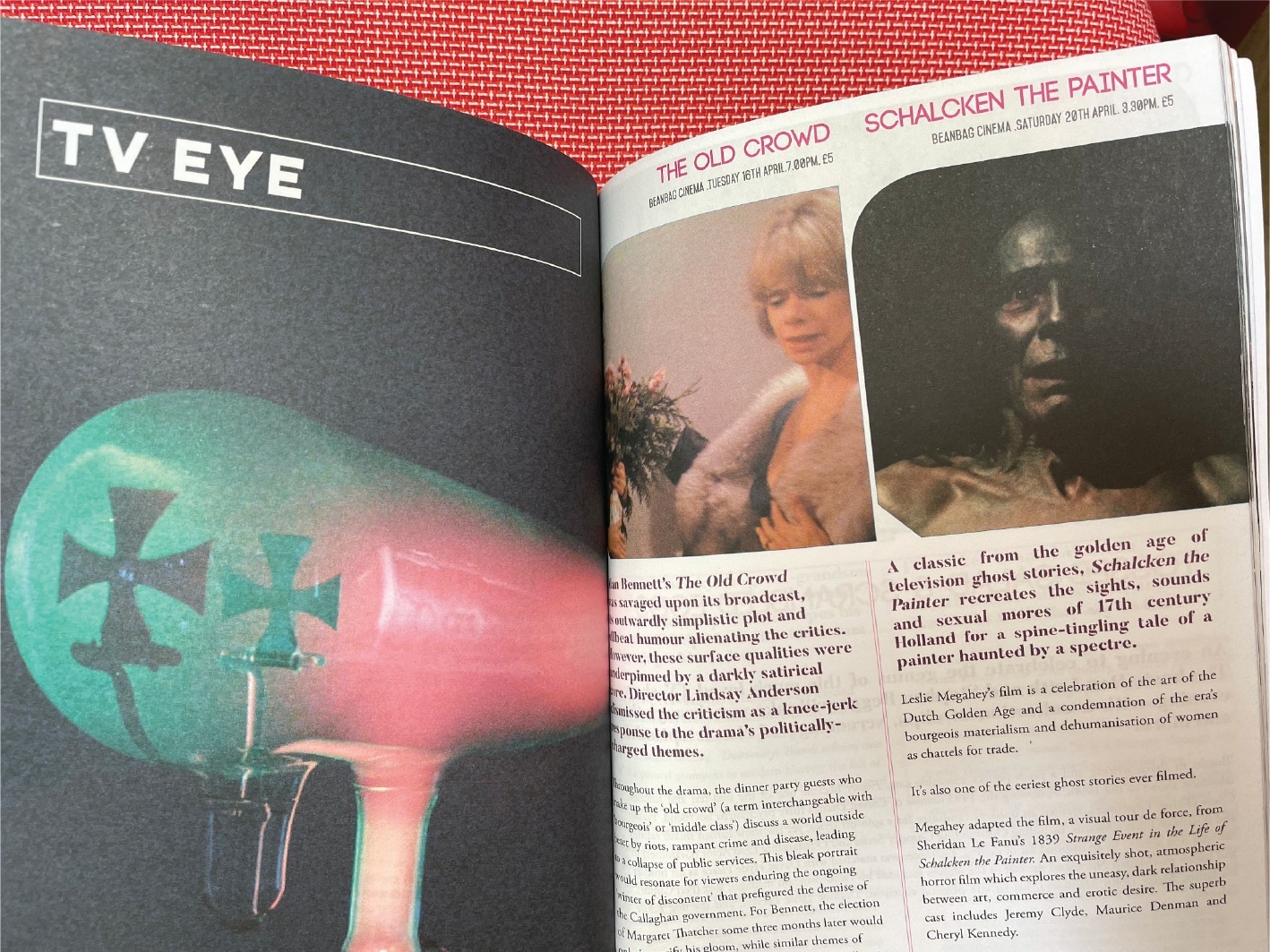
Figure 1
Pages of the TV Eye section of the Belfast Film Festival programme. Photo: author’s own.
Over the years, Hackett took suggestions for screenings from journalists and academics such as Professor John Hill, who added context and insight with introductions to screenings. This allowed space for discussion and reflection on the simultaneous factors of the unique media history of Northern Ireland, the artistry at play within the work and the historical and often difficult events the material represented. From a purely critical point of view, Hackett would remark in conversation2 that, in his opinion, TV drama, based on or set within the context of the Troubles, was often of a much higher standard and more challenging in terms of form and nuanced political messaging than feature films made in the same period.
TV Eye programming often highlighted a particular filmmaker’s television work. For example, compact programming in 2016 of Northern Ireland focused work of Alan Clarke (see Figure 2). Clarke is particularly known for a film included in the programme, the stark and innovative 1989 Northern Ireland drama, Elephant, which explored the bleakness and baldness of everyday violence of the time. The programme continued with a 1981 Clarke-directed edition of the BBC’s long-running and seminal series of self-contained pieces, Play for Today. Titled Psy-Warriors, it depicted a fictionalised account of methods of psychological warfare in which writer David Leland posed ‘the moral dilemma of how far we can torture and degrade prisoners in the name of democracy and freedom.’3 1985’s Control, a drama about a squad of British soldiers stationed in Northern Ireland, completed the line-up and the screenings were accompanied by an introduction from Clarke’s biographer, Richard T Kelly.
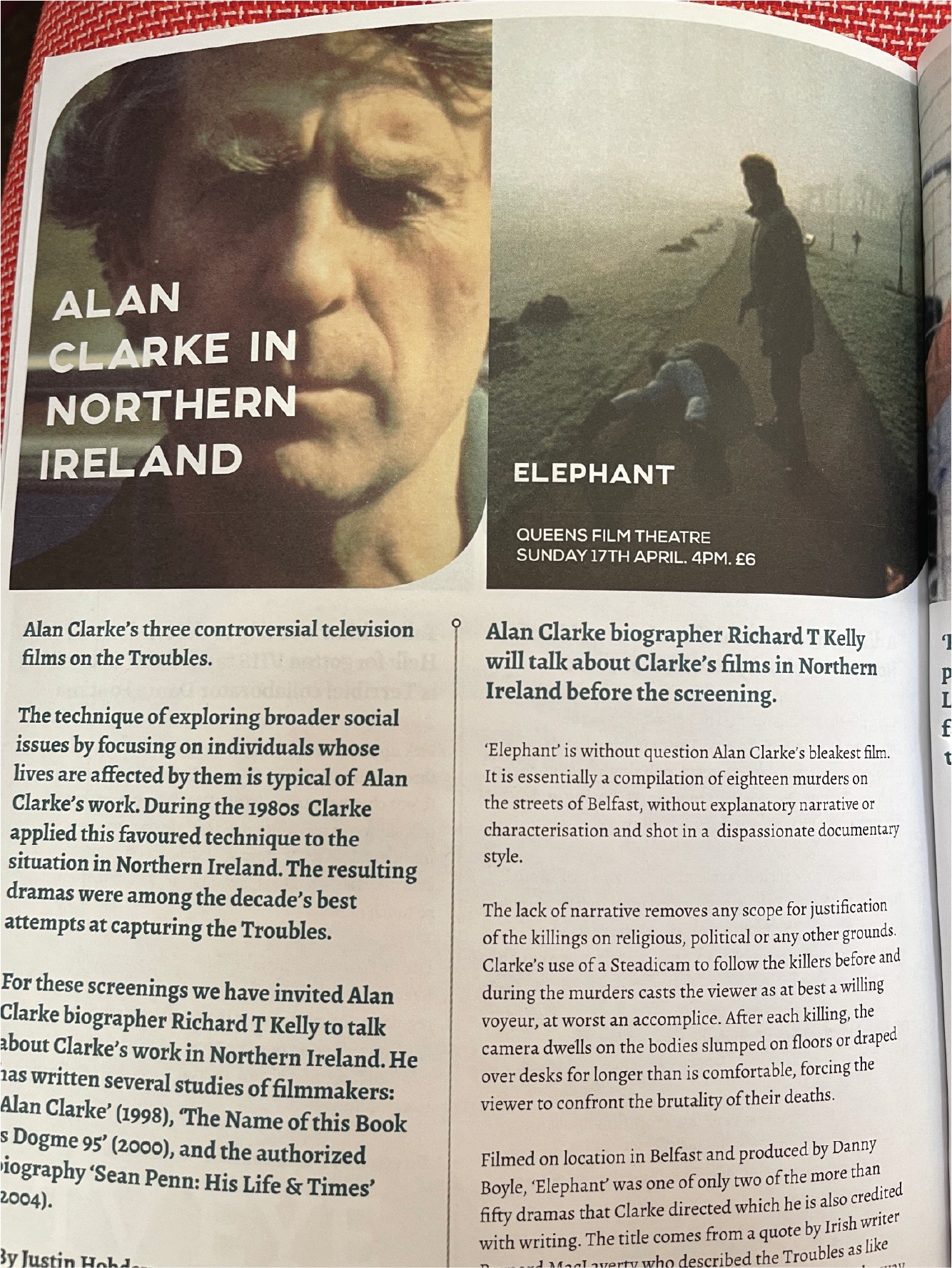
Figure 2
Pages showing a programme of Alan Clarke’s Northern Ireland work in TV Eye. Photo: author’s own.
This small but comprehensive programme reinforced not only Clarke’s work as that of a leading British filmmaker, but his Northern Ireland work as being of particular import, both for addressing the topic head-on for a mainstream British television audience, but also for its use of artistic and experimental forms using this medium. Television paradoxically had, and perhaps has always, seemed a less experimental and artistic medium than other forms of entertainment. This, due to its mass viewership, mass appeal, associations with advertising and its seemingly disposable and ephemeral format with many programmes being shown only once, perhaps never to be repeated.
Of course precisely this re-analysis of televised material from the last century is another aspect of the TV Eye programme as a whole and as a continuing series year on year. It also served to introduce television as a place for experimentation in form, for political expression, and a training ground for filmmakers more readily known for their work in cinema.
For example, Ken Loach’s television documentary work was the subject of a 2018 programme, with a central element his 1966 drama, Cathy Come Home. A work made with Loach’s signature social realism that depicts the impending homelessness of a young mother, it was part of the BBC’s The Wednesday Play strand.
These bodies of television work are one aspect of the TV Eye strand, but it also reinforced this sense of the auteur with more occasional television work from other well-known figures from cinema such as Jonathan Demme, Peter Weir, Pawel Pawlikowski, Jacques Tati, Lindsay Anderson and Chantal Akerman. The strand also infused rarities made in Northern Ireland, like Belfast Reel,4 a musical film made in 1970s Belfast about music as a soundscape to the city, screened alongside The Chance of the Eucharist, a short film made in Belfast in 1975, ‘an impressionistic depiction of the city.’5
2 Archival Explorations
TV Eye was placed in the festival programme booklet alongside Hackett’s experimental strand, Twisted Cornea. Even the juxtaposition of television archive and often very strange and challenging experimental film gives a sense of how television is being perceived, presented and positioned: as a valid form of artistic expression.
The local audience’s relationship with television is also playfully explored in the Twisted Cornea strand. Hackett’s co-devised Ulster Film Office (with the wry acronym UFO), curated a festival event, entitled Ulster Television and the Singularity, that used archive footage to satirically explore this corner of the media landscape since the end of the Troubles.
This kind of ‘in-house’ festival produced film event, using local television archive material, would eventually progress with the advent of a particular funding stream from the BFI through Film Hub North entitled Changing Times, which allowed for large-scale events based on local archive collections. As the opening of the funding stream coincided with the 2021 centenary of Northern Ireland, Hackett devised an event entitled Northern Ireland: 100 Years of Happiness (Figure 3), which used BBCNI and UTV archive material from the last century to depict the people of Northern Ireland at play.
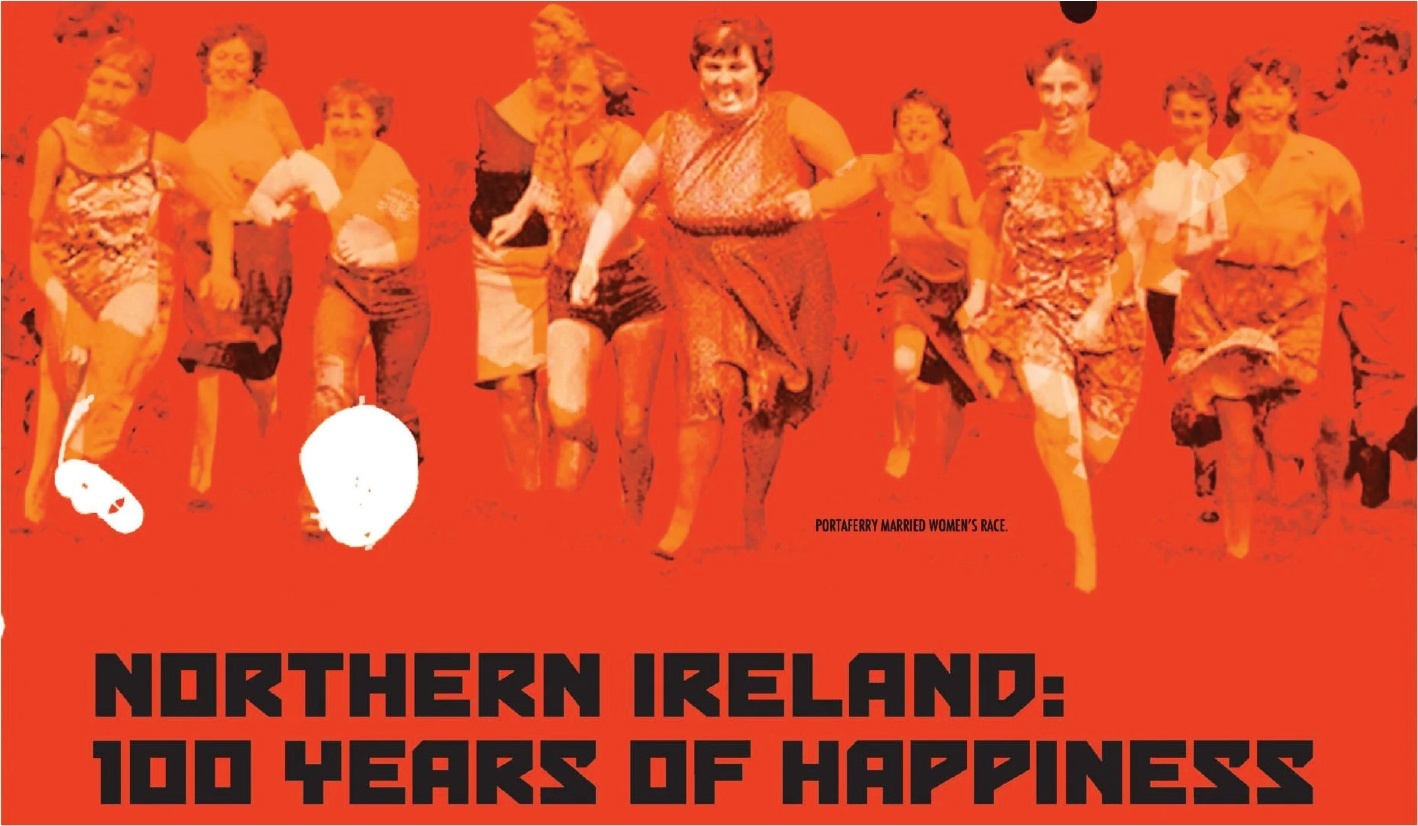
Figure 3
Promotional artwork for Northern Ireland: 100 Years of Happiness by Stephen Hackett.
Clips were selected by a team of researchers, edited by Stuart Sloan and screened with the backdrop of a live score from electro-funk band, the Organauts.
The ironic humour of the title and concept would not be lost on a Belfast audience that readily understands the implications in a place that has suffered a violent sectarian conflict, but it also plays on the fact that Northern Ireland frequently ranks as the ‘happiest place’ in the United Kingdom.6 It is this kind of local knowledge, familiarity and sense of humour that an audience brings to the archive material being viewed, that makes this kind of event possible. The particularities of a Northern Irish audience and what it brings to archive material will be discussed later in this paper. It is also the sustained building of an audience through many years of programming experimental television, local documentary and other specialist events at the film festival that creates a space for events like this to exist, and the three screenings being discussed here as case studies follow on from this curatorial tradition. They are Northern Ireland and the Swinging Sixties (2022), screened at Dublin’s Irish Film Institute; Vox Populi: The voice of the people (2022), a temporary installation within the disused Bank of Ireland on Royal Avenue, Belfast; and The Weird & the Eerie (2022),7 an experimental montage piece screened with a live score in St Joseph’s, a deconsecrated church in Sailortown, Belfast. What is interesting about these three screenings is that they each represent a different aspect of the rich and multi-faceted archive of which they are made, and they deliberately provoke different reactions and meanings for the audience. Ulster Television in the 1960s, like the place where and for which it was made, was not just one thing, and these screenings collectively offer a broader perspective on the broadcaster while individually analysing key ideas around what made UTV what it was at that time: modernity, aspiration, an emerging and evolving youth and celebrity culture, local interest stories and the shifting socio-political landscape unique to Northern Ireland.
3 Watching the Archive: Northern Ireland in the Swinging Sixties
The first of these three screenings, Northern Ireland in the Swinging Sixties, was screened in partnership with the Irish Film Institute as part of their ongoing exploration into Irish archive film. Regular programming, for example, includes strands such as the Archive at Lunchtime series, which gives audiences a chance to dip into curated selections from the RTE archive free of charge. Northern Ireland in the Swinging Sixties, however, was a slight departure from this kind of regular programming, having an entry fee and being screened on a mid-week early evening. But the footage being screened was sufficiently different from the usual Archive at Lunchtime fare, being of northern, Ulster Television production, and being made up mostly of celebrity interviews and appearances, giving it an added sense of occasion and of the unusual.
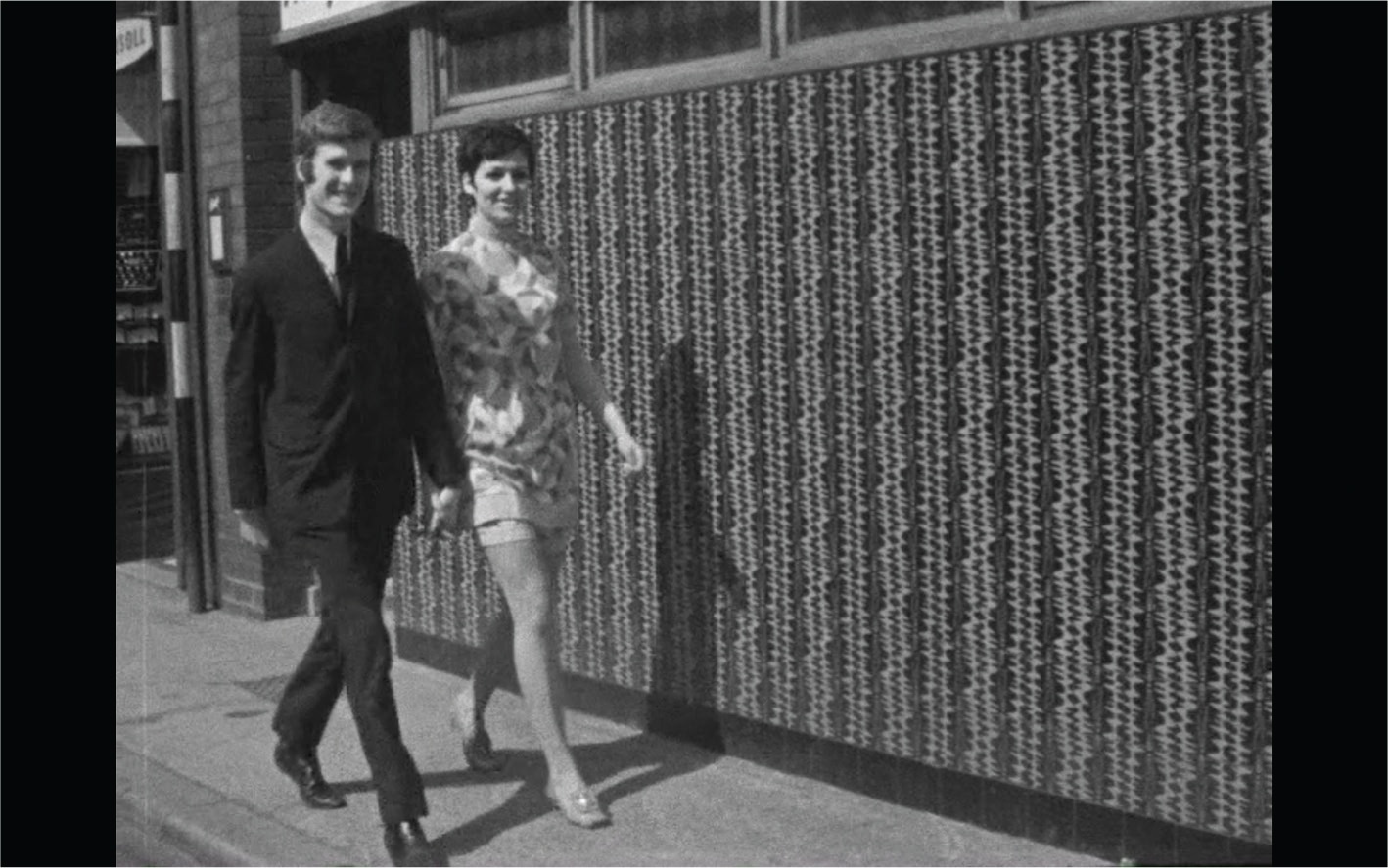
Figure 4
A still from Northern Ireland in the Swinging Sixties, courtesy Northern Ireland Screen’s Digital Film Archive.
Part of the reason behind selecting clips of famous people, including Bing Crosby, Ella Fitzgerald, the Rolling Stones, Roger Moore, the Kinks, Tom Jones and Louis Armstrong, was to challenge common interpretations of what Northern Ireland was like before the Troubles. The title, Northern Ireland in the Swinging Sixties, was meant to address the misconception that the Global ‘swinging’ Sixties bypassed Northern Ireland, which was merely a place of poverty and religious discrimination. Of course these things did exist in 1960s Northern Ireland, and the purpose of the screening was not to whitewash reality, but instead to introduce a Dublin audience to a more nuanced appreciation of what was going on in Ulster at the time, and perhaps elucidate why the onset of the Troubles was such a momentous shift. The clips selected for this screening deliberately avoided the political, but also any sense of normal, everyday drudgery. Instead, the focus was on how UTV represented pop culture and its icons of the day, and how it reflected changes in culture and society through the coverage of such events as the opening of a new department store and the exploration of new domestic technologies such as vacuum cleaners and ice making machines at a large expo for the food and hospitality industry. It might seem incongruous to juxtapose such things - what has Mick Jagger got to do with domestic appliances? - but the inclusion of an item on Belfast’s then-new boutique clothing stores brings together the idea of a larger pop culture, in the form of glamorous stars visiting Belfast, and of young people emulating the fashion worn by their idols, recreating the kinds of shops seen in London on the King’s Road and Carnaby Street. Shop-owner and clothes designer, Tony Jourdan, is interviewed in his men’s shop, Mark Anthony, where he explains this very ambition, having spent time in London thinking how the young people of Belfast could be better served. So, the selected clips add to each other, coming together as a programme suggesting a side of 1960s Northern Ireland rarely seen by the outside world, with UTV depicting a place with a sense of post-war progress, of youthfulness and novelty, of adaptability and aspiration.
UTV’s relationship to its subject comes through in the material, primarily through its presenters and how they approach interviewing both famous figures and everyday people. What is most immediately obvious is their often stilted way of speaking, almost with a kind of affected, Northern Irish version of received pronunciation, which brings to mind the classic BBC accent of English presenters. This way of speaking is definitely of its time, with few Northern Irish UTV or BBC presenters today adopting an anglicised lilt, and reflects the classist, wider pressure on all regions of the United Kingdom to adopt such a way of speaking during the earlier days of broadcasting. Despite this, the presenters do have Northern Irish accents, something that in itself distinguishes them from the celebrities they interview. It also adds a sympathetic connection with the interviewer, given the fame of some of the interviewees, that perhaps UTV is exceeding expectations as a fledgling broadcaster with seemingly inexperienced presenters. But they hold their own, and the clips reveal how many confident and professional women were interviewing stars of the day.
This is in keeping with UTV’s approach from the beginning, as it launched with prominent female presenters. One of them, Anne Gregg, appears almost totally off-screen in Northern Ireland and the Swinging Sixties separately interviewing Bing Crosby and Bob Hope. Her disembodied voice reacts calmly and steers the conversation back on track as an ageing Hope makes suggestive comments played for the audible laughs from invisible bystanders. An uncomfortable interview, it reveals the acceptability of sexism and sexual harassment and the additional skills required of female presenters.
In later interviews there is no such overt innuendo, and interviewer Maggie Gilchrist appears on a par with her interview subjects, singer Tom Jones and rock band, the Kinks. Like Gregg, Gilchrist is a young woman, but she is much closer in age to her guests. Here, most likely as part of the Pop Around segment of UTV’s magazine show Round About, she offers informed questions with a manner that meets her interviewees on their level, often making explicitly clear that even though she’s asking questions of a sensationalist topic, that it’s part of the job and not necessarily her own view. For example, in a good natured exchange with Tom Jones, she posits, ‘There’s been a lot of controversy about whether your act is obscene or not. I do not personally think it is, but what do you think?’ Unsurprisingly, he agrees with her view. It’s interesting that she distances herself from the question, as it could be seen that she is distancing herself from the mainstream media position, and therefore from the position of UTV. As an interview technique, this is very skilled, as not only does it bring closer the person being interviewed, but also the viewers. Pop Around was aimed at a younger demographic who assumedly felt there was nothing extreme with Tom Jones’s act, or if it was at all controversial, it was still within the boundaries of the acceptable. So here the interviewer is speaking as herself, but also as the viewers. In addition, it’s impossible to extract this from whatever perceived position UTV adopts, as the interview is on and of UTV, so the interviewer is both rejecting a mainstream position and at the same time adapting the mainstream position to suit a younger audience.
Not all UTV presenters were as accommodating. When jazz singer Ella Fitzgerald is interviewed in 1964, her reluctance to answer some questions is met with further probing, and although she is known as being a shy woman and the interview develops into an easier rapport, the dynamic of a woman of colour being pushed for answers by a white man with a microphone does not sit well with a present-day audience.
In one of the most well-known clips from the UTV archive, UTV’s Maurice Smyth interviews the Rolling Stones complete with founding member Brian Jones. It’s 1965 and from the perspective of the present-day the band look fresh-faced and full of youth, and they are charming, confident and articulate. Interviewer Smyth is around the same age as the band members, he could even be younger, and yet his interview style very much adopts a sceptical, parental tone. As well as slightly more interesting questions about how they got together and what they were doing before joining the band, he asks them questions like, ‘How much do you earn a year?’ and says, ‘It’s obvious that you do not get your hair cut, but do you get it trimmed from time to time?’ Taking the opposite approach to Maggie Gilchrist, Smyth is performing the role of the disapproving establishment, questioning those who go against the status quo of the previous generation. This interview mirrors contemporary network television and BBC interviews of the Rolling Stones, the Beatles and other bands of the time in the UK and in the United States.
These bands did not come to Belfast straight away, so it’s entirely possible Smyth was influenced by previous interviews already broadcast by other stations, meaning of course that UTV did not exist in a vacuum, but was part of and influenced by a media landscape with broadly instilled conventions. Although clearly there are differences between them in terms of tone and very likely in terms of the audience segments they were intended for, these clips show UTV as a modern broadcaster, which, if not exactly neutral to cultural change, still acted as commentator, documenting it all the same and recognising an emerging youth culture as a source of entertainment that spanned the generations.
The Rolling Stones interview is a good example of the photography used by UTV and includes some beautifully framed and focused close-ups (see Figure 5), which were standard practice by the camera operators, who used 16mm black and white film. The aspect ratio of the time was of course the standard 4:3, and the image was deliberately framed to fit the television screen, which was at that time relatively small, to maximise the space and make it easier to see. But, decades later, the resulting effect on a cinema screen is quite striking, as the quality of the image is evident even in an enlarged size. There are many implications around extracting material from a previous age and format and screening it in a completely different context, and these are discussed in the ‘Context and Ethics’ section of this article, but the technological aspects of the UTV archive have a particular effect on the viewer, one which is possibly unique to the material being screened in Northern Ireland and will be discussed in relation to the second case study screening, Vox Populi: the voice of the people.
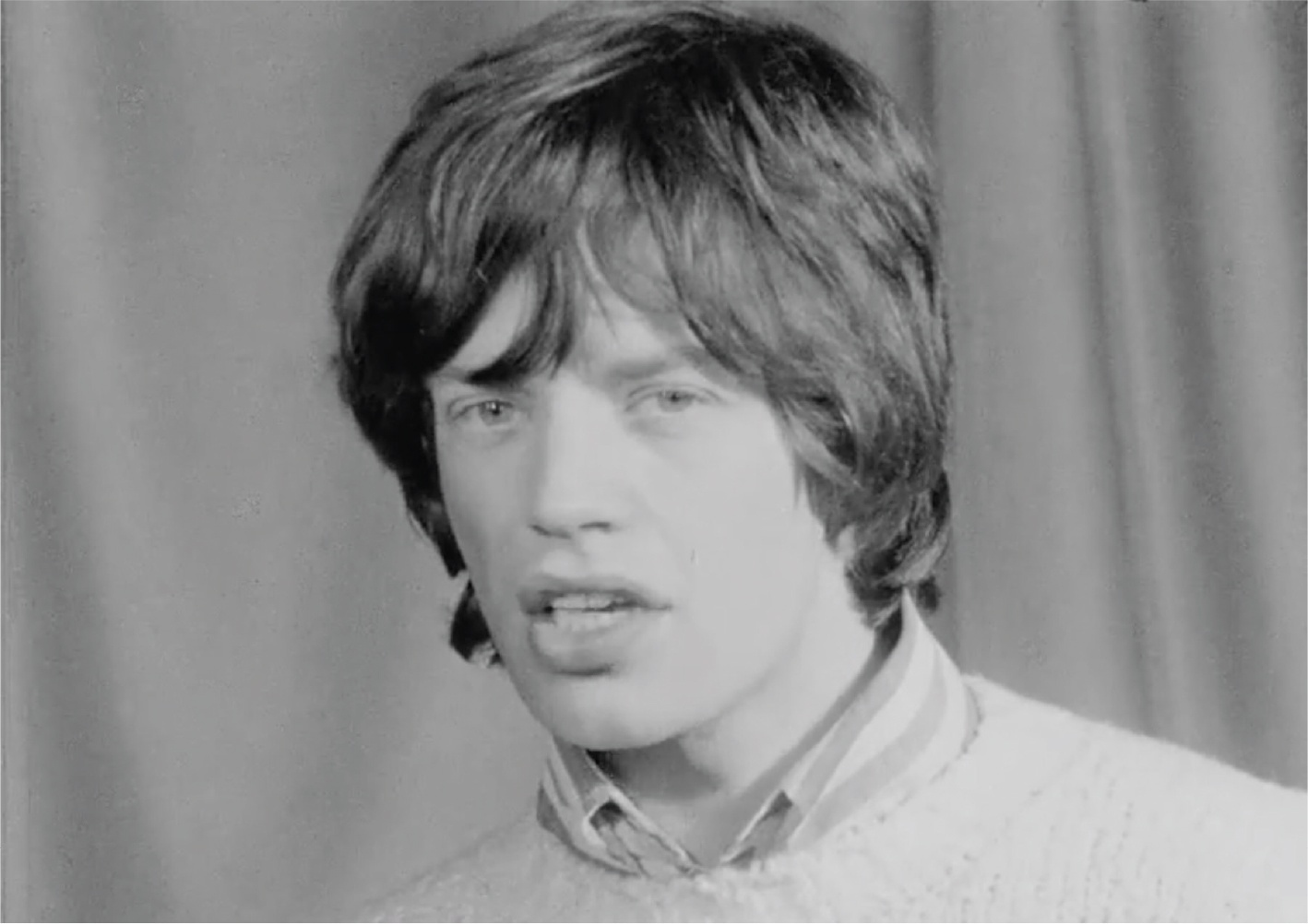
Figure 5
A still of Mick Jagger from Northern Ireland in the Swinging Sixties, courtesy Northern Ireland Screen’s Digital Film Archive.
4 An Uneasy Nostalgia: Vox Populi - The Voice of the People
There is a unique quality of spontaneity to footage that was made with the intention for it to be part of a broadcast news bulletin, or a topical current affairs light entertainment programme, something which keeps it imbued with the fleeting immediacy of the present moment. The rough-cut elements of the clips, where second and third takes, cutaways and reverse shots are juxtaposed in shooting order also add the suggestion of the unpolished and impromptu. It is because of this spirit with which the footage was created that the UTV archive feels alive when rewatched. Of course, there are distinct aspects that make it clear to the viewer that the footage is from another time period: the technology used, though seen in digital form, retains the sometimes imperfectly captured sound and image along with the evidence of its state of degradation at the time of digitisation, giving the material a feeling of mechanical ageing as well as the distance of time over the individuals, subject matter and settings. These also act as indicators that the footage is from the past, and it is immediately clear to the audience that they are watching a moment in history, one that they could possibly date to the decade by the clothes people are wearing, the topics being discussed, and for Belfast viewers the captured condition of the buildings, streets and other details in the background. The streets of Northern Ireland are integral to the collection of clips collected and screened as part of Vox Populi: the voice of the people. An installation over four floors of the disused Bank of Ireland building on Belfast’s large, city centre shopping street, Royal Avenue, it was intended to have the feeling of connecting with the activity outside on the main street, as the sound of pedestrians, buses and other city sounds bled through the stripped walls and single pane, copper-framed, art deco windows. UTV in the 1960s often used the streets as a backdrop for two reasons. One was a practical concern, in that a news studio was not immediately available in the early years of the broadcaster, so much of the reporting and news gathering as well as filmed segments for magazine and lifestyle programming were filmed outdoors or within spaces external to UTV, wherever events or press conferences were taking place. Local personalities and notaries were often interviewed at home, for example. The other reason UTV used streets as a common backdrop was their own self-imposed remit, as we have seen in previous chapters, to speak to ‘the man in the street’. Conveniently, as they did not have the capability to interview in-house, they would often send a reporter and crew to the streets of Belfast, and other towns and cities in Northern Ireland, and approach people passing by to ask them what they thought of the issues of the day. These issues were dominated by the news agenda and the topics discussed with people in the street were often on amusing and innocuous subjects such as local football, Mother’s Day and the fog’s effect on traffic that particular day. But of course there were more serious issues to talk about with everyday people and UTV covered topics such as the timing of a bus strike, whether women should become ministers (all the men interviewed said yes and all the women said no), and the reaction to the placement of a contraception machine in a ballroom in Portrush.8 Therefore, the streets and the vox pop format were very important to the early days of UTV and would have been a significant part of the channel’s local output in terms of both their content and familiar aesthetic.
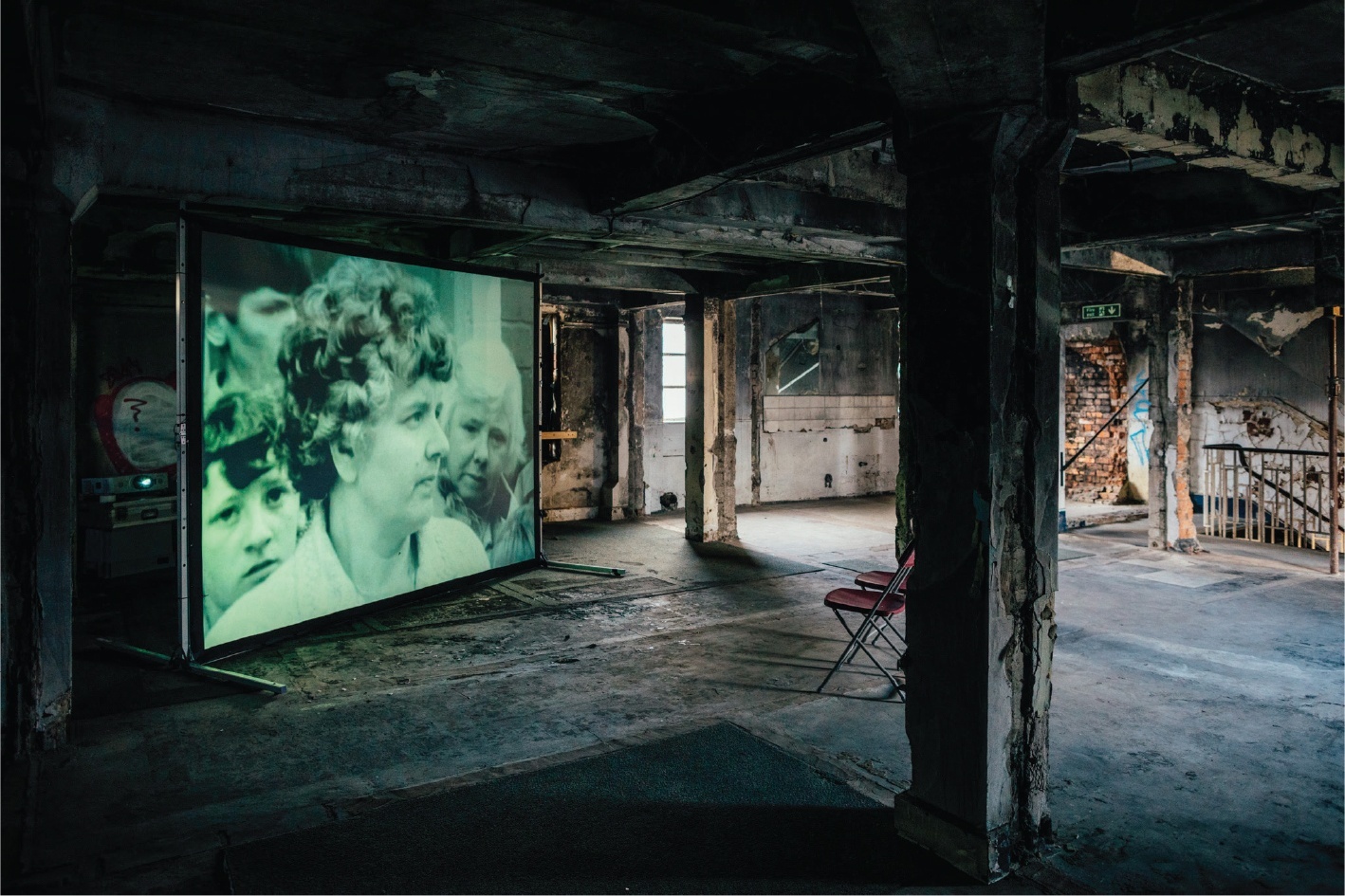
Figure 6
Documentation of the Vox Populi: the Voice of the People installation, courtesy Belfast Film Festival.
The format of the Vox Populi installation was of a chronological journey through the decade of the 1960s while walking upwards through the floors of the Bank of Ireland building. Visitors were invited to view two screens on each floor. The screens were programmed to play alternating clips. While one screen displayed a vox pop interview, the opposite screen displayed filler shots of street scenes shot in Belfast during the decade. These were edited and timed so that visitors’ focus would turn from one screen to the other, allowing the whole floor to be viewed and the space to be used for moving around, even allowing for looking out the windows while listening if preferred. The chronology of the installation’s clips was important as it allowed for the decade to unfold slowly through the seemingly everyday topics. In the selected clips, often attitudes do not seem so far away from present-day concerns, such as how the local team is playing. There are overtly funny moments played for laughs even at the time, for instance the segment where passers-by are quizzed on rumours of swinger parties in Ballymena. And distinctly Northern Irish phenomenon, such as a peaceful protest against playgrounds being locked up on Sundays on religious grounds. It is during this clip that the man behind the protest, George Huxley, states he does not attend church as in Northern Ireland church attendance could be viewed as a political act. Moving through the years, clips go on to reveal some defining features of the 1960s as the length of mini-skirts and men’s hair become part of the conversation. These segments are jovial and light in tone; young women model skirts and the group of bashful young men being approached by the female UTV reporter are laughing, offering good natured responses to her questions about whether their girlfriends like their hair. The Global Sixties have arrived in Northern Ireland. On the third floor of four, there is a tonal shift, and the topic of religious discrimination is introduced with a clip about a common tactic of sectarian Protestant employers who ask what school the applicant went to as a way of discerning who not to employ. A Catholic woman describes being delayed by her manager so she could be attacked and beaten by her Protestant co-workers. On the final, top floor of the building and projected on one large screen, doorstep interviews are shown with people who have been burnt out of their homes, segregated to their respective communities, and sectarianism begins to take hold. The people interviewed in the clips have no idea what will happen next, they are merely reacting in real time to unfolding events, living in disbelief and shock. Although there were elements of the blurring of religion and politics in earlier clips, such as the playground protest, this is a stark departure from the almost quaintness of that time.
Video 1
Vox Populi, floor one.
However, for present-day viewers it is extremely difficult, if not impossible, not to project a sense of determinism onto the events unfolding within the archive material. At every point there is a sense that during and shortly after these scenes were filmed the fragile socio-political conditions of Northern Ireland were tested, failed the test, and deteriorated rapidly into a violent conflict that would last for the next 30 years. At the same time, the material depicts a society like any other, with UTV often displaying a sense of optimistic modernity. The archive frozen in time on the cusp of this momentous paradigm shift reveals a glimpse of what might have been: a future that never happened. This has unique implications for the connection between the material and the present-day viewer. Mark Fisher, in his book, Ghosts of My Life: writings on depression, hauntology and lost futures, writes:
Referring back to Hagglund’s distinction between the no longer and the not yet, we can provisionally distinguish two directions in hauntology. The first refers to that which is (in actuality is) no longer, but which remains effective as a virtuality (the traumatic ‘compulsion to repeat’, a fatal pattern). The second sense of hauntology refers to that which (in actuality) has not yet happened, but which is already effective in the virtual (an attractor, an anticipation shaping current behaviour).9
Fisher here speaks of two directions in hauntology which co-exist simultaneously within the UTV archive, at once within the material and within the viewer. The material depicts a world which is no longer, but of course for the viewer there exists the prospect of history repeating itself; a present-day society traumatised and the ever-present possibility of a return to conflict. Within the same material is the simultaneous sense of what at that time has not yet happened (the Troubles), but which is already at play - at that time, but also within the viewer - and the footage is imbued with something known and unknown at the same time.
Video 2
Vox Populi, fourth floor.
5 Context and Ethics: The Weird & the Eerie
There are many ethical considerations around screening this kind of material. Ciara Chambers, in her 2020 essay Ethics and the archive: Access, appropriation, exhibition9, writes of a possible unexpected encounter between an installation spectator and their own childhood self on-screen in the material presented as part of an exhibition. When screening Northern Irish archive material in the place where it was originally filmed, the prospect of an audience member recognising themselves or a close family member or even a neighbour or old classmate is not just a possibility, but highly probable, considering the close-knit fabric of the community. There are, of course, reasons why this chance diminishes over time. As the years pass, the people in the images and those that knew them die, and their links with the generations that come afterward are weakened, lessening the chances that individuals, especially those of the general public, will be easily recognisable or recognised at all in a random encounter. Because the period of research here is over 50 years ago at the earliest, it is less likely that an audience member will recognise a loved one than in later footage. But this is no reason to be complacent as it remains a constant possibility. Further to this, the conflict in Northern Ireland was a traumatising experience for many who lived through it, and even footage from prior to the generally regarded breakout of the conflict itself, describing religious discrimination, sectarian violence and even simply voiced attitudes, can be affecting to those who view it. Such things can be triggering even for people who are visiting tourists who may have no direct link or emotional connection with the material, but who have perhaps experienced discrimination of another form, or violence of another form. In the world of connecting filmed material with audiences, anything is possible, and any response is legitimate.
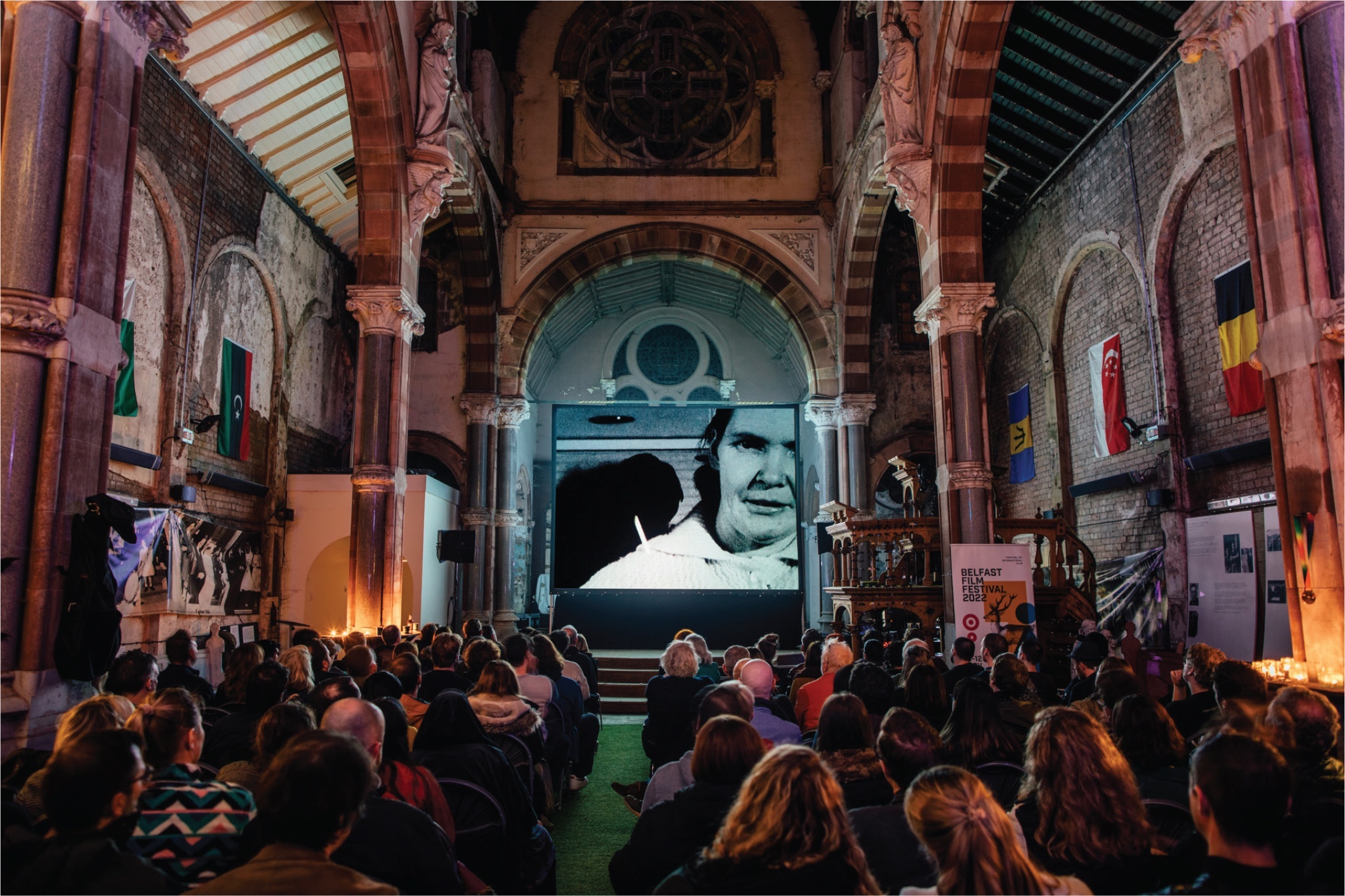
Figure 7
Documentation of The Weird & the Eerie screening, St Joseph’s Church, Belfast, courtesy Belfast Film Festival.
And there are other considerations. Chambers (2020) discusses how technological advances have distanced the material from its original intentions of production, saying:
As Walter Benjamin (1935) notes ‘technical reproduction can put the copy of the original into situations which would be out of reach for the original itself’.11
This is particularly pertinent to the movement of the amateur film from the domestic sphere of the home to the public sphere of broadcast or cinematic exhibition.12
The UTV archive material was made with the intention that it would be broadcast on television and it’s fair to assume the participants willingly took part with this knowledge whether they were formally interviewed as part of an official press conference or in a studio setting, or if they were approached by a reporter and cameraman in the street. However, the framework it existed in at the time has shifted dramatically and could now put it on a par with the ‘amateur film from the domestic sphere’ that Chambers (2020) mentions. Digitised material freely available online means it is permanently accessible, potentially by a vastly larger audience of people not just in Ulster but around the world. Originally, participants entered into the arrangement knowing the material would be seen, but by a much smaller audience and very likely broadcast only once. So the goalposts have been moved, even in the case of televised material.
Although it can be assumed the interviewees at the time understood they would likely appear on television, another important aspect of much of the existing archive material is the discernibility of whether it was actually broadcast at all. Many of the dope sheets compiled by cameramen at the time and found inside the existing N-cans reveal sections of film marked SCRAP but the listed clips still remain and have been digitised along with clips marked KEEP. There is no record of which clips or indeed which topical subjects were ultimately deemed appropriate for broadcast, leaving questions over which of the items were broadcast at all. It implies that screening at least some of this footage to a live audience may be the first time it has been seen in a collective setting.
The third film being discussed is The Weird and the Eerie, which is a montage of clips from the UTV and BBC Northern Ireland archives. In particular it uses the more macabre and miscellaneous clips from both archives that have broad appeal but would not necessarily fit into neat categories. For example, news reports of UFO sightings, local ghost stories, and a woman who trained a crow to smoke a cigarette. It was screened as part of the Belfast Film Festival in November 2022, using the late autumn season as the backdrop for an intentionally pseudo-spooky event in the deconsecrated St Joseph’s church in Sailortown, Belfast.
Chambers (2020) also raises points about ‘trusting the filmmaker’ and ‘trusting the audience.’ Interestingly, both of these elements are at play within a screening like The Weird & the Eerie. As shown, the Belfast Film Festival has a history of screening such events, and works with archivists within both the Digital Film Archive at Northern Ireland Screen, which houses the UTV digitised collection, and BBC Northern Ireland, which promotes its archive through public exhibition under the umbrella of the BBC Rewind platform. Because the festival has forged these links with trusted sources, because it now has a substantial history of exhibiting Northern Irish television archive, and simply because the film festival has itself grown a reputation as the leading film festival in Northern Ireland, it’s fair to assume there is a pre-existing amount of ‘trusting the filmmaker’ of behalf of the audience, the filmmaker being in this case the festival as these are in-house curated events by festival staff. At the same time, and from the position of being one of the festival team who constructs these works, I would argue there is a substantial amount of ‘trusting the audience,’ in that as the construction of the films and presentation of the events deliberately decontextualise the footage, putting it together thematically as a montage as opposed to chronologically or historically, the only way to achieve the ironic intentions of the experience is if the audience bring with them prior knowledge of Northern Ireland, its places, people, and most importantly, history. The Weird & the Eerie only truly works as an amusing, pseudo-spooky look at the more surreal curiosities in the archive if you already know Northern Ireland’s history is genuinely scary.
Admittedly, trusting the audience in this way has various pitfalls. Although these kinds of events attract a certain kind of audience subsection that have a prior interest in history, media and Northern Ireland, not everyone in the audience is going to have such prior knowledge or even be from Northern Ireland. The festival is a city festival and these often attract tourists or other visitors who have stumbled upon an event, perhaps even hoping to learn more about the history of the place in the media exhibited or the unusual location of the screening.
6 Conclusion
These three curated programmes together give an overview of UTV’s broadcasting at the time. Although they act separately as they were made for a range of purposes, attracted different audiences and were screening in very different venues, they come together as a whole to test theories around screening archive material, the ethics involved, and to analyse Ulster Television’s output at the time, what they were covering and why. Each film addresses a separate aspect of UTV’s reportage, from the lighter, fun and glamorous side of UTV as light entertainment broadcaster in Northern Ireland in the Swinging Sixties; to their development in reporting local news and the views of local people in their trademark and literal ‘man on the street’ approach of vox pop interviews. They reflect the archive in its current state in the present day as more than simply a collection of seemingly random clips, and through curation adding a new context but acknowledging the complexities involved, of material created at a particular time in political and social history, and the standpoint of the present-day viewer in a post-conflict Northern Ireland, who may bring with them a particularly nuanced, prior knowledge and context themselves.
The exhibition of the UTV archive allows for the exploration of such discussions and of filmmaking and exhibition ethics. This research has shown the complexities of both and serves as a jumping off point for further analysis, digitisation of the remaining physical archive, and additional screenings.
Notes
[1] Rose Baker, “Look Here: Ulster Television in the 1960s” (PhD Diss., Royal Holloway University of London, 2024).
[3] Rose Baker, “Look Here: Ulster Television in the 1960s” (PhD Diss., Royal Holloway University of London, 2024).
[4] Dir. Kathleen Dowdy. The film’s date of production is unclear but it was mentioned in the Washington Post in 1977.
[7] The Weird & the Eerie contained clips from BBC Northern Ireland, used by permission from BBC Rewind.
[8] The clip from Portrush did not make it into the final version of Vox Populi as even though it was a very interesting discussion that revealed a lot about the attitudes of the people of Portrush, it was not sufficiently urban to be in keeping with the rest of the programme.
[9] Mark Fisher, Ghosts of My Life: Writings on Depression, Hauntology and Lost Futures (Winchester: Zero Books, 2014), 19.