
1 Breaking News
Just after 7pm on Wednesday 21st December 1988 transatlantic flight Pan Am 103, travelling from Frankfurt to Detroit via London Heathrow and JFK New York, exploded over the small Scottish town of Lockerbie killing all 259 passengers and crew onboard and 11 local residents on the ground. The first television pictures of the bombing were screened that night on the ITV News at Ten programme which opened with veteran presenter Sandy Gall reading the headlines:
Unknown casualties as Pan Am jet crashes on a Scottish village. Eyewitnesses describe an explosion and a 300 foot fireball.1
His voice over continued over footage of burning houses, the flashing blue lights of ambulances and other emergency services, and groups of fire fighters silhouetted in front of a conflagration.2 These were the earliest television images of what would prove to be the worst terrorist attack ever seen in the UK, in every way a major international news story, however at that time it was not possible for the type of continuous ‘live’ rolling coverage that audiences would expect now. Television news gathering in 1988 was very different from today, smart phone cameras and the instant communication of the internet and social media had not been developed so there were no pictures recorded by witnesses at the precise time of the explosion or in the immediate aftermath.
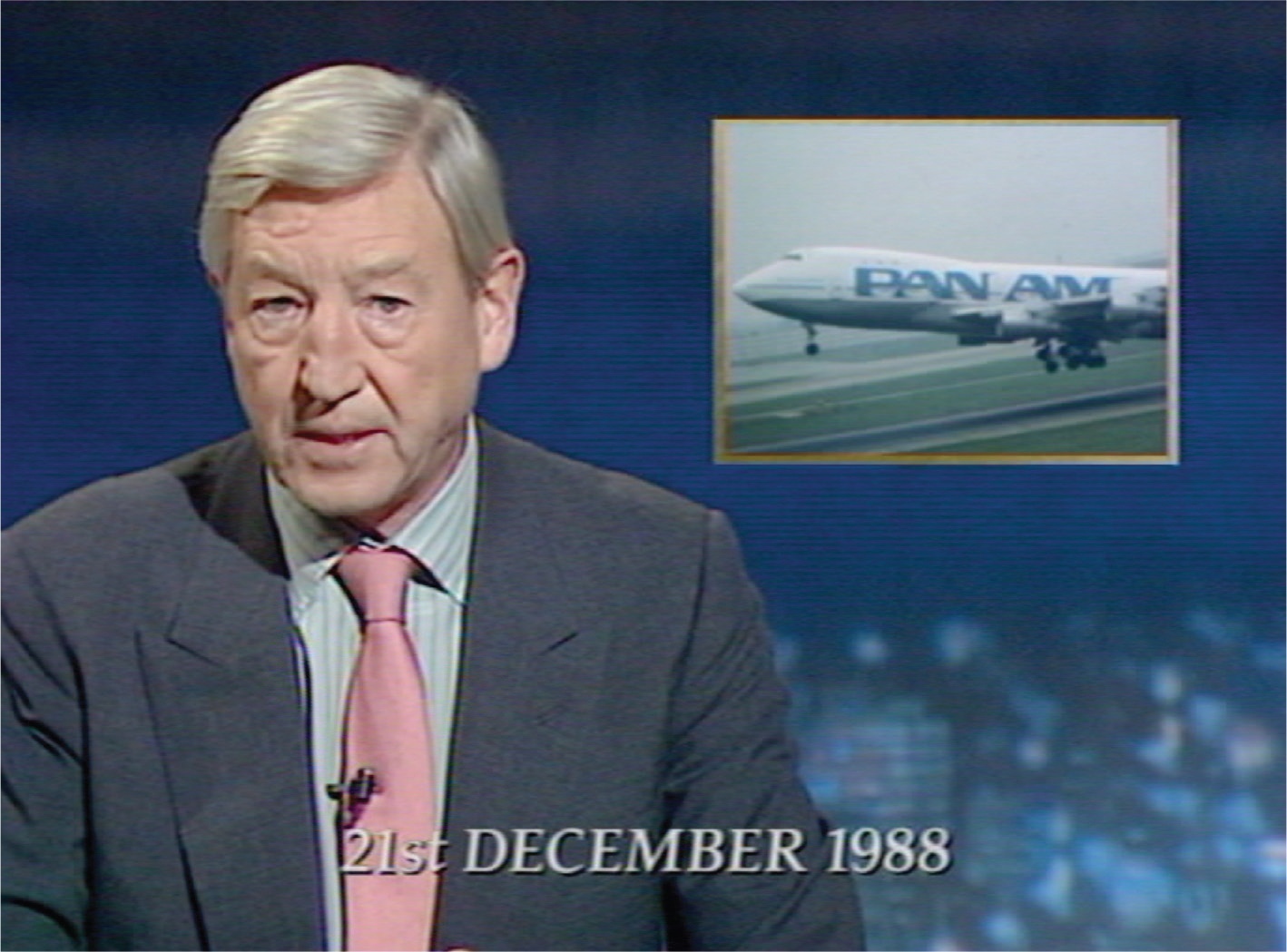
Figure 1
ITN News at Ten, 21 December, 1988. Headlines read by Sandy Gall.
Earlier television bulletins that evening on Channel 4 News, and newsflashes on the BBC and ITV, had alerted the audience to the disaster but without any footage. On the BBC Nine O’Clock News Michael Buerk had spoken live on air by telephone to one Lockerbie resident whose testimony described how ‘It’s raining fire’. The powerful images on News at Ten were transmitted on national television because a local cameraman had scrambled to get to the scene sometime after 7.30pm when local residents began to report the catastrophe. After filming the chaotic scenes in Lockerbie the videotape was taken by car to the headquarters of Border Television twenty five miles away in Carlisle. From the Border TV newsroom the tape was transferred and fed into the ITN (Independent Television News) system.3
More camera crews continued to arrive during the night to gather footage in the darkness. Although in 1988 24 hour news channels were not yet part of the UK’s broadcasting landscape, (Sky News was launched a few months later in February 1989), an unscheduled BBC Late News bulletin presented by Michael Buerk went on air around 11.45pm and by that time the BBC also had footage of the terrible scenes in Lockerbie and their programme included a piece to camera at the scene by a local reporter, Ian Proniewicz. Soon after transmission in the UK these were the same images that led the early evening NBC News in the USA when anchor, Tom Brokaw, described how an American passenger plane had crashed in the south of Scotland. In the Scottish Television newsroom duty editor John Kean worked overnight dealing with requests to transfer footage from their news crews to TV stations across the USA.4
By the time it began to get light the following morning there were numerous journalists, cameras, and outside broadcast satellite cars in and around Lockerbie, reporting for breakfast television news programmes on both main UK channels and documenting the horrific scale of destruction, the crashed plane fuselage, the destroyed houses and cars, and the broken bodies of the passengers who had fallen to earth. Cameramen in helicopters circled the town and filmed images that captured the catastrophic devastation of the disaster, showing how the wreckage of the plane, a Boeing 747 Jumbo jet the Clipper Maid of the Seas, was spread over several sites in and around the town. The image of the nose cone front cockpit, which had fallen three miles east of the town, near Tundergarth Church, would become an emblematic icon of Britain’s deadliest terrorist atrocity. This article will track the re-use of these images from news coverage over the next four decades.
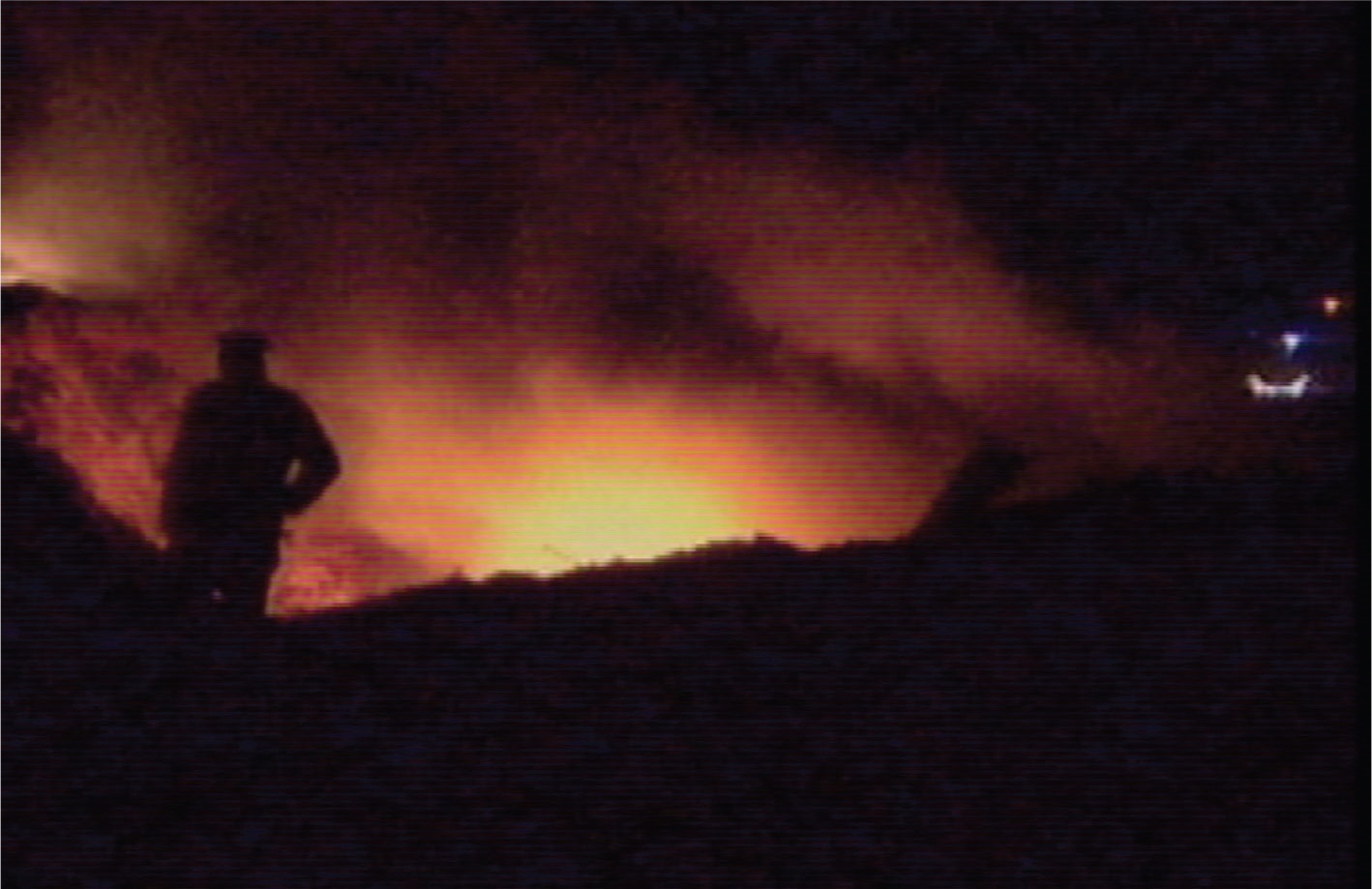
Figure 2
Scottish TV News footage, 21 December, 1988 Fire from crashed fuselage.
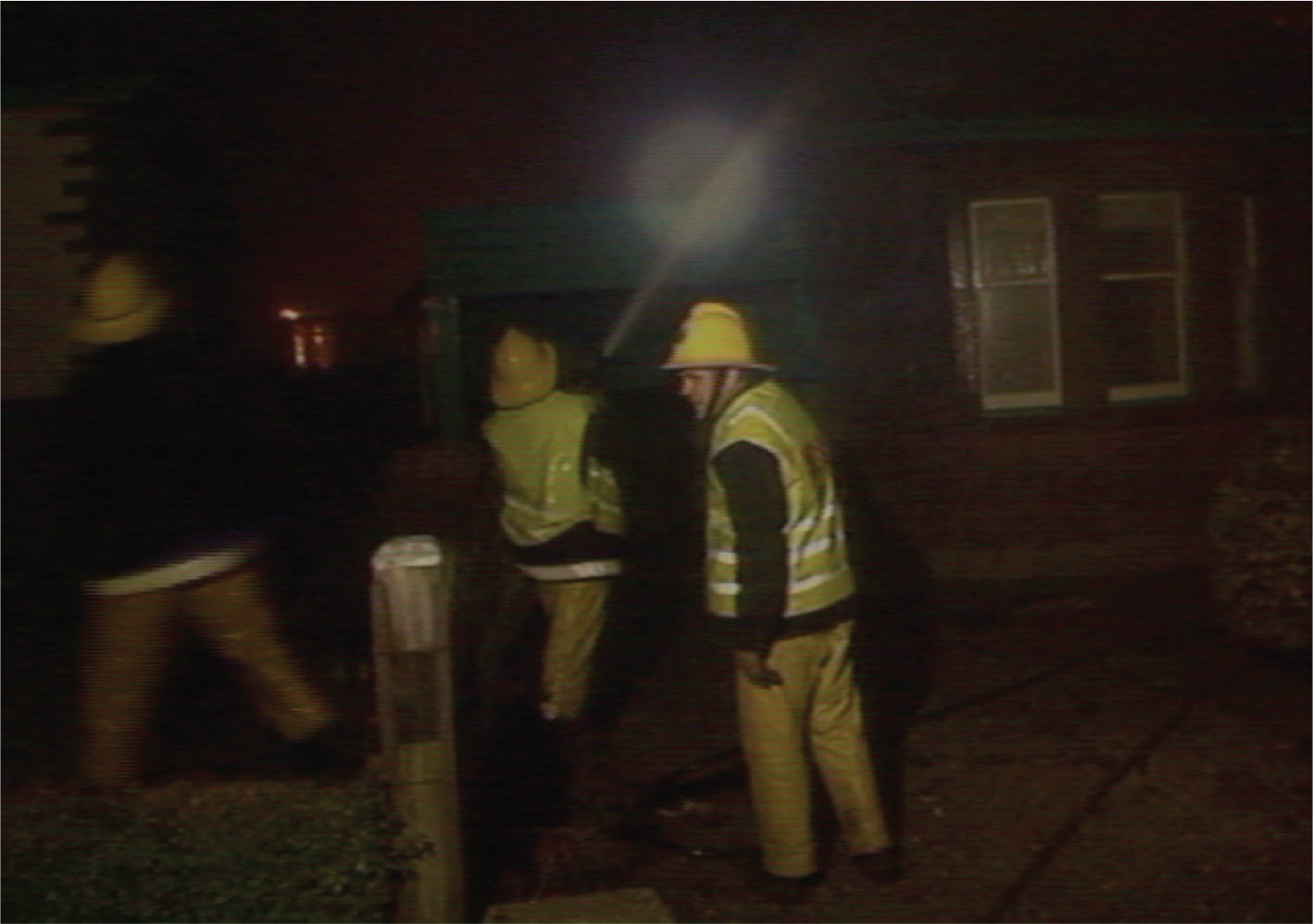
Figure 3
Scottish TV News footage, 21 December, 1988 Fire fighters in Lockerbie.
The footage gathered over the following few days, just before Christmas 1988, established a record of an attack that continues to attract controversy today. This was always described as an attack on the USA.5 Abu Agila Masud, one of the alleged Libyan bombers, has been extradited to the United States and is in prison waiting to go to trial. One hundred and ninety of the victims were American citizens including thirty-five students from Syracuse University, New York, who had been returning home for Christmas on Pan Am 103 after a semester abroad, had lost their lives. In a research project in the aftermath of the disaster a team from the Syracuse Communication Department undertook a comprehensive investigation of the media coverage in the UK, in the USA and internationally. Joan Deppa and her team documented and interviewed journalists and camera crews, Lockerbie residents, and families of the victims, to bring together an overview of how the event was reported. ‘Pan Am 103 marked a turning point in global media coverage, one that cannot be reversed’.6 The study revealed ethical challenges for journalistic practice and questioned the empathy of some reporters particularly from the UK tabloid press. This article will examine the changing ways in which the original broadcast television news footage, with major contributions from local companies such as Border TV, Scottish Television, and BBC Scotland, was later incorporated into other types of programmes. The article will reflect on these evolving types of usage drawing on the concepts outlined in ‘Archiveology’ which explores the creative practice of ‘re-use, recycling, appropriation and borrowing of archival material’.7 The aim of this article is to investigate the stages of the re-use of the early news footage, gathered from the fragmented raw immediacy of the contemporaneous coverage of this event, with images that were repeated numerous times as details of the bombing spread around the world transmitted by international broadcasters.
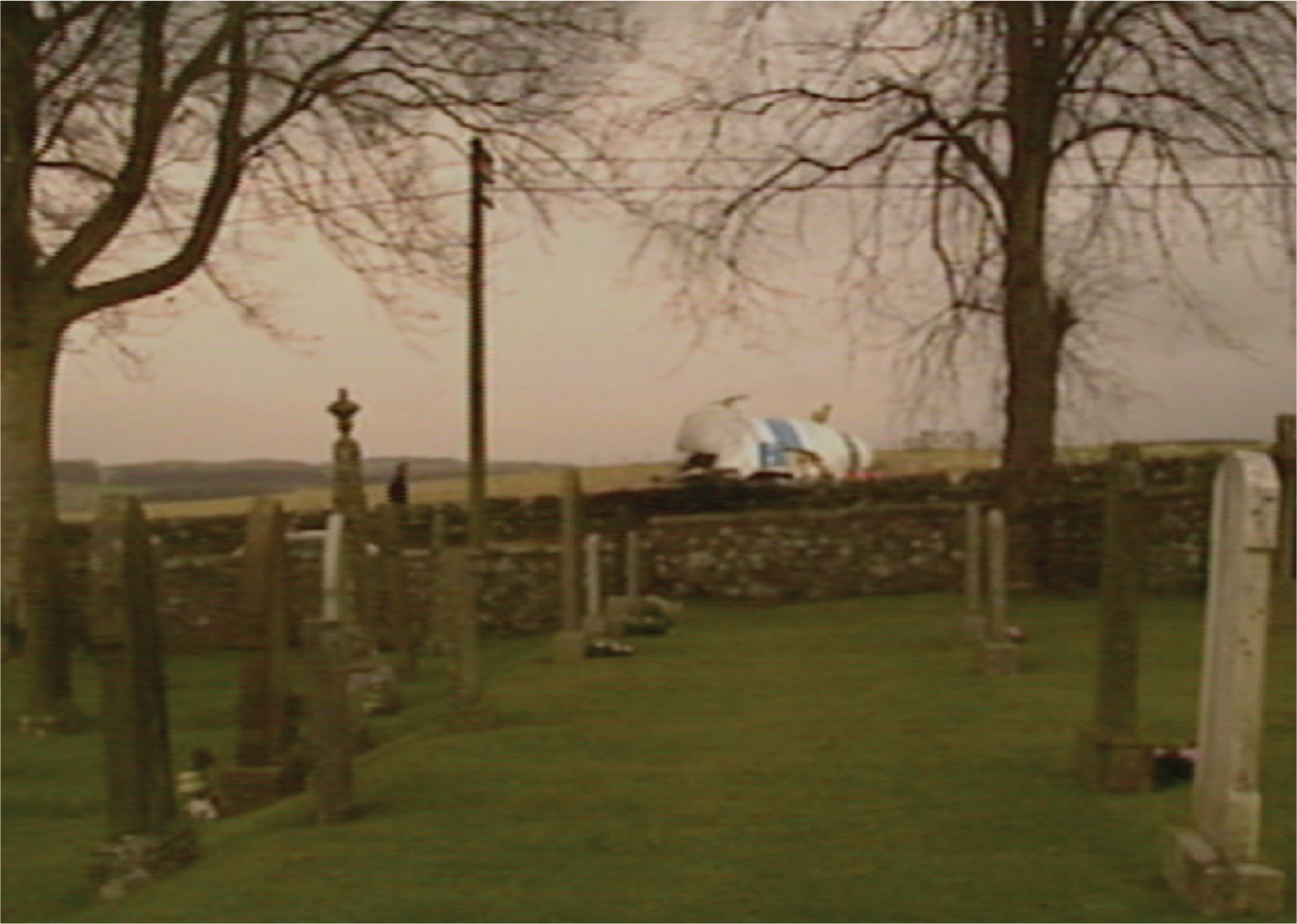
Figure 4
Scottish TV News footage, 22 December 1988. Nose cone of Pan Am 103, Tundergarth Churchyard.
The article tracks how in later years the footage shifted from its original status as news to progress through different stages of archival use: closely examined and cited as evidence in multiple investigative current affairs documentary films in which journalists attempted to uncover the truth about the attack and identify the perpetrators; revisited as documentary history in television programmes that presented the wider contexts of this event; incorporated into creative memorials in cultural films that commemorated and celebrated the lives of the victims; then after decades passed supporting witness testimony in films in which people who had experienced the disaster, including first responders, local residents, news reporters, and families of the victims, looked back at these events with hindsight and gave personal reflections of the long-term impact of experiencing this event. The most recent new type of use is the inclusion (and sometimes the re-staging) of the archive footage in scripted dramatisations to tell the story of the bomb, the victims, their families, and the investigation and trials of the alleged bombers. The research methodology involved conducting a survey of British and international television productions that have focused on the Lockerbie bombing8 and reviewing analysing the use of archive in key examples of five stages of usage that followed on from its original status as news. The video footage from December 1988 captured the horror and tragedy of the disaster, for all the subsequent programmes that have re-used these images the original footage has provided a primary source, a badge of authenticity. In this way the archival re-use has created many interconnected layers of collective memory and public understanding of what happened over Lockerbie that night.
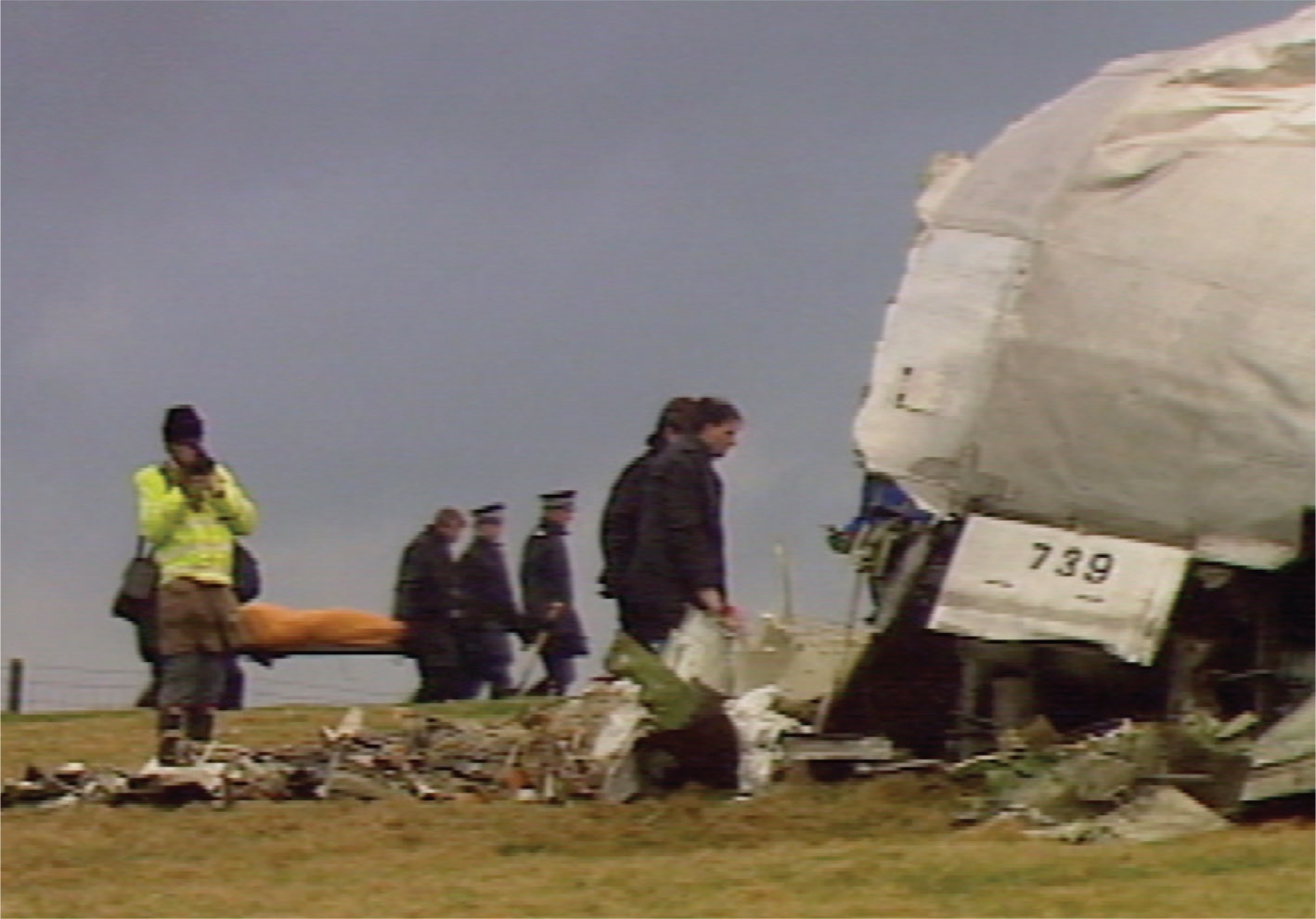
Figure 5
Scottish TV News footage, 22 December 1988, Tundergarth Farm.
2 Incomplete Shifting Perspectives and the Long Shadow of the Archive
The Lockerbie bomb was a terrorist attack with long-lasting personal, national, and global consequences. It led to universal new surveillance and security protocols for all passenger air travel.9 The ways in which the early news footage has been re-used provides a case study of the complex ways the television archive can interact with and relate to memory and history, re-examining the event in different programme genres, and demonstrating how the same archive television images can bring shifting perspectives.10 With cumulative re-iterations this archive footage has become an audiovisual palimpsest where the traces of the original images provide a way to authenticate a connection with the event. In this way the original footage has moved forward from being a simple fragmentary record to become a way to bring together the full story and suggest compelling versions of the ‘truth’ of what happened on that December night. The shifting perspectives supported by these same images provide a way to examine the conceptual frameworks suggested by the creative practice of ‘archiveology’. Russell analyses the use of archive to investigate how the ‘Archive has been transformed, expanded and rethought as an ‘image bank’ from which collective memories can be retrieved’.11 She argues that the archive offers a unique means of displaying and accessing historical memory with significant implications for the ways we imagine cultural history. Her focus is the remediation of audiovisual material for experimental film and poetic video essays but acknowledges that this creative practice extends beyond these works with other film and television genres re-using and adapting the archive to produce new types of compilation programmes. Russell looks at the archive through the prism of Walter Benjamin’s theoretical writing. She argues that Benjamin’s contribution is his recognition of the role of images in the layered construction of media history. In this way archival images function as a mode of transmission, activating history in the form of traces that may need to be repeatedly returned to until they ‘yield their secrets’.12 Catherine Russell and Jaimie Baron have both examined how the philosophers Foucault and Derrida outline concepts relevant to working with archival material. Rather than accepting that ‘the archive’ is a repository of unmediated evidence about the past Foucault argued that it revealed the hierarchy of a structure of power in which documents are kept in a particular order delimiting the possibilities of what may or may not be said. Derrida asserted that ‘the archive’ creates the past rather than simply preserving it.13 They highlight how there are different ways of reading texts, stressing the incomplete nature of the archive and emphasising the possibility of ambiguity whenever originary ‘commencement texts’ are re-examined. The interpretation of indexical images always depends on how the images are explained and contextualised. In the case of Lockerbie all the coverage starts after the explosion and subsequent crash, and so this footage points to earlier events – the conspiracy to make the bomb, the explosion in mid-air, the impact of the crash – inevitably this archive is incomplete with the potential for ambiguity. Nevertheless, the original news coverage now provides the traces to establish an external form of collective memory which has been used to support different perspectives on an event that was not filmed, the bombing of Pan Am 103.
3 The Repetition and Amplification of Images
The television news from the days after 21 December 1988 charted the rush after the disaster to establish the facts of what happened, identify the victims, and to elicit the reaction from political leaders. On BBC Breakfast Kirsty Wark reported ‘live’ from Lockerbie commenting on the traumatic shock felt by local residents on a ‘sombre and dismal’ morning with bodies of victims being taken to a makeshift mortuary in the Town Hall. On TV AM Lorraine Kelly spoke directly to camera conveying to the audience the scale of the devastation suffered by this small Scottish market town. By the time of that evening’s BBC News Michael Buerk, having travelled north overnight, presented an extended news package documenting the main locations that had been damaged including the crater where a wing had crashed on the site of Sherwood Crescent, the burned-out houses at Rosebank Crescent, the debris in the Beechgrove neighbourhood, and the nose cone cockpit at Tundergarth Farm. The pictures which accompanied the voice overs conveyed the full impact of the disaster revealing the truism that ‘television news is a visual medium’.14 The impact of the images was amplified with repetition across broadcasters in the USA and around the world. Cameras followed the visiting politicians Prime Minister, Margaret Thatcher, accompanied by the US Ambassador, the Secretary of State for Scotland, Malcolm Rifkind, and the Chief Constable of Dumfries and Galloway Police. Surrounded by her entourage Mrs Thatcher commented: ‘It’s even worse in daylight..you see the full enormity. Unlike anything in anyone’s experience’. The impact was even more evident from the short vox pop statements from local residents recorded in the streets and on doorsteps. The faces of these interviewees reflected the immensity of the traumatic shock felt by all – ‘It was like a war zone’, ‘I turned to run but there was nowhere to run to’.
These television pictures presented the spectacle of destruction that the bomb had caused. Although because the coverage had been filmed after the event the footage did not capture a sensational spectacular moment unlike the later terrorist attack on 11 September 2001 when film footage captured the planes crashing into the Twin Towers of the World Trade Centre in New York. In the UK and USA the pictures that were transmitted did not sensationalise the tragedy in Lockerbie and in so doing did not show the full picture of the aftermath of the crash. All the witnesses commented on how they felt most traumatised by the sight of the many bodies of the victims who had fallen from the sky scattered in various locations around the town. Out of respect to those victims and not wishing to intrude on the grief of their families, taking an ethical position about what is acceptable to show the audience on grounds of taste and decency, there are very few images of the bodies of the victims. There are some long lens shots of police and soldiers respectfully carrying stretchers and body bags in the distance. Scholars writing about later cases of media coverage of terror attacks and reporting on war discuss this as the ‘body paradox’. There is debate about whether cameras should reveal the full horror of these situations by filming graphic scenes of the dead and dying in order avoid any sanitisation of coverage, and to convey fully to the audience experience of traumatic proximity to the tragic event.15 There was distress from relatives and Lockerbie residents that bulletins in some parts of the world did show the dead bodies and body parts raising the moral question of the need to preserve the dignity of those who had lost their lives.16
The ethics of intruding into private grief was also relevant to cameras filming the relatives waiting for news about the crash. The news coverage in both the USA and in Britain included shots of the families of those who were travelling on the flight who gathered anxiously at JFK Airport alongside the scenes from Lockerbie. The pictures caught the anguish of these relatives as the news was announced that there were no survivors. Their screams of grief continue to echo when repeated in the many later re-uses of the original coverage.
4 Impact Over Four Decades
There was controversy about what had happened to Pan 103 from the start and footage from Lockerbie continued to dominate all the news bulletins over the following weeks. Soon it was evident that there were no survivors from the plane and after a few hours the numbers of dead were confirmed. For the first few hours there was a focus on air accident investigators to give their explanation of what had happened to the plane, however, very quickly sabotage was accepted as the most likely cause. The Scottish police declared the incident as a crime scene and began to gather the debris as evidence at the start of a long meticulous investigation into Scotland’s biggest ever murder enquiry. The BBC Nine O’Clock News on 22nd December also revealed information that there had been previous warnings of threats to a transatlantic flight leaving from Frankfurt just a couple of weeks before Pan Am 103. There was information of an anonymous phone call to the US Embassy in Helsinki, Finland, on 5th December 1988. The warning had been passed on to governments and airlines but had been assumed to be a hoax and no warning was passed on to passengers.17 The Lockerbie Bomb has remained a complex international news story for nearly four decades with television news and current affairs coverage following the different phases.18 The focus of attention has included: the funerals of victims in early 1989; the extended investigations by air accident investigators, and by Scottish Police and FBI 1989-91; calls for an independent public inquiry by families of the victims; claims of conspiracy and cover-up; the conclusion of the criminal enquiry in 1991 and the call to extradite two Libyan suspects, Abdelbasset Al-Megrahi and Al Alim Khalifa Fhimah; an unprecedented trial held under Scottish law at Camp Zeist in the Netherlands in 2001 and a verdict of guilty verdict for Al-Megrahi; an unsuccessful appeal followed by Al-Megrahi’s imprisonment in Scotland; the submission to the Scottish Criminal Cases Review Commission for a second appeal approved in 2007; Al-Megrahi’s release on compassionate grounds suffering from terminal cancer in 2009 abandoning the second appeal; his death in in 2012;19 and further investigation leading to the prosecution of a new Libyan suspect, Abu Masud, now awaiting trial in the USA. At every phase the explosion over Lockerbie has continued to have international repercussions and there have been numerous television programmes covering all the tortuous stages through which the investigation and criminal prosecution have progressed. By referring to some of these films it is possible to demonstrate the changing uses of the original archive material.
5 Gathering Conflicting Evidence
After the news coverage the next stage was the production of investigative documentary films which gathered and questioned evidence. In these programmes the footage from Lockerbie on 21st and 22nd December 1988 would accompany the opening headline or title sequence reinforcing the public memory of these images. The early film documentaries sought to investigate the cause of the explosion and explore conflicting theories about who had organised the bomb. One theory was that the government of Iran had commissioned the terrorist attack as revenge for the accidental missile attack by the USS Vincennes on an Iranian airliner in July 1988 in which all 290 passengers had been killed. Some reporters linked the attack to a terrorist cell of the Syrian supported Popular Front for the Liberation of Palestine General Command (PFLP-GC) which had been uncovered in Germany in October 1988 in an operation given the name ‘Autumn Leaves’. In connection with this group journalists sought information about which organisation had made the warning phone call to the US Embassy in Helsinki on 5th December and why it had not been taken more seriously. There were also accusations of various conspiracies. A controversial film was produced by American filmmaker, Allan Francovitch, who had a background of exposing undercover operations by the CIA in Latin America. His film The Maltese Double Cross (1994) tracked down former agents from the US Drug Enforcement Agency and intercut footage of Lockerbie with interviews by informants alleging that the bomb was planted by PFLP-GC and was linked to a drug trafficking plot with involvement by American agents. Some conspiracy theorists linked this to claims that FBI/CIA agents had arrived by helicopter and been seen going through passenger luggage at Tundergarth soon after the plane crashed on 21st December.20 The claims in Francovitch’s film were strongly denied by both US and UK governments. In May 1995 a shortened version of the film excluding the most contentious claims was shown on Channel 4 followed by a panel discussion. There were also documentaries that investigated the evidence about the attack and considered the impact on the families of victims and their pursuit of answers and justice. The UK and US government were still seeking to bring to trial the two Libyans who had been indicted as a result of the investigation. It was believed that Colonel Muammar Gaddafi had ordered the bombing in revenge for a US attack on Tripoli in June 1986. At the time of the tenth anniversary Scottish Television produced After Lockerbie (STV 1998), a BAFTA winning programme that traced the families of victims and intercut footage from the disaster and aftermath with interviews in which they talked of their memories of the loved ones who had died. They also voiced their frustration with delays in the criminal proceedings and the fact that the killers had not faced trial. One of those featured was Dr Jim Swire whose twenty-four-year-old daughter, Flora, had been killed on the plane. Swire was a GP from Bromsgrove who was a prominent voice in the UK Families’ campaign for an independent inquiry. In these programmes the original footage shifted from being news footage to form part of evidence for the investigation into who was responsible.
6 Documenting History
With documentaries about Lockerbie taking different types of approach the footage would evolve to provide a documentary history record. In Lockerbie: A Night Remembered (1998), documentary filmmaker Michael Grigsby, focused on events in the town during the aftermath of the disaster, exploring the ongoing ways the trauma and loss impacted on local people, and also the ways people responded positively; how local people welcomed relatives of victims who wanted to visit where their loved ones had died. The film documented how women in the town set up a ‘laundry project’ to wash and iron all the items of clothing that had been found in the debris of the plane and identify who it had belonged to and then returned these items to the families. Later this documentary history approach would mean placing Pan Am 103 in the wider contexts of 9/11 and the ‘War on Terror’ and assessing the way in which the Lockerbie Bombing was an example of the conflict between the west and Islamic extremism. One example was an episode for the BBC 2 series Days That Shook the World…Lockerbie (2004). Analysis of media coverage of terrorism since 9/11 and the 2003 Iraq War has revealed the ways that public attitudes and collective memory about terrorist attacks has become dependent upon media coverage. In more recent years there has also been increasing use of mass media by terrorists to communicate and spread fear with the growth of fake news and misinformation.21 In The Conspiracy Files (BBC2 2008) the reporter’s commentary outlined the intertwining global context linking fast-cutting montage added sound of the Lockerbie footage of Pan Am 103 with a plot that linked the Libyan terrorists to events in Malta, Frankfurt, and London. In Megrahi – The Legacy of Lockerbie (BBC 2012) the programme reflected on how events had unfolded from the night of the explosion to the release of Al-Megrahi on compassionate grounds by the Scottish Government allowing him to return to his family to die. In a different approach to this genre of television documentary in Did Gaddafi Kill My Daughter (ITV, 2012) the Tonight current affairs programme followed Dr Jim Swire, who had been a close observer of the trial at Camp Zeist and later controversially had met Al-Megrahi in prison.22 Now with Gaddafi’s government overturned he travelled to Libya to meet him to seek confirmation of what had really happened. With the original archive footage of the crashed plane opening the film a small crew follow Swire travelling to Tripoli in the aftermath of the Libyan war and the downfall of Gaddafi as he visits the home of Al-Megrahi now dying of prostate cancer. In all these programmes the original footage reinforces the emotion and the enormity of the loss that has been suffered.
7 Commemoration and Memorials
Another type of use of the original archive material has been its incorporation within commemorations in programmes celebrating the lives of the victims. This began with the live transmission of a special Memorial Service in Dryfesdale Church, Lockerbie, on 4th January 1989, attended by families of the victims, Lockerbie residents, emergency workers, alongside politicians and dignitaries, and led by the Moderator of the Church of Scotland. Another early example of this featured Dr Jim Swire and his family in a programme for Central TV transmitted on Good Friday 1989 in which Canon Eric James in Westminster Abbey reads a letter written by Flora Swire and posted on the day she died in the bombing.23 There is a clear intention in these programmes to re-use the original archive of the aftermath of the crash to prompt the collective memory of the enormity of the tragedy. In this way the audience can empathise with the loss suffered by the families with the hope they are supported in processing their grief and beginning a process of healing. These memorial services have continued each anniversary of the disaster with full coverage by the broadcasters. As well as religious memorials the footage has been used within arts and cultural programmes such as Songs For the Falling Angel: A Requiem for Lockerbie (STV 1991) screened by ITV to mark that year’s anniversary. This was an arts programme, documenting an Edinburgh International Festival performance. It was directed by the author of this article and has prompted my lasting awareness of the original footage from December 1988. This programme brought together a painter, a poet, and a composer. Inspired by painter Keith McIntyre’s paintings of the motif of an Angel’s winged head, and poet Douglas Lipton’s sequence of 12 poems drawing on the 7th century myth of a fiery cross that fell from the sky. From this came a new choral work composed by Karen Wimhurst, with soloists and choir accompanied by saxophone and harp. The programme interwove performance with the original archive news footage and adapted it with extended picture mixes, montage sequences, and slow motion to complement the music and the text of the libretto. The film also included scenes at Lockerbie’s Memorial Garden and the book of remembrance at Tundergarth Church. In this way the archive was incorporated into a new creative cultural work that sought to give emotional catharsis and release. The impact of this type of cultural commemoration on wider collective memory has been evaluated after other terrorist attacks as an important step towards giving recognition and solace to victims, survivors and the wider community.24
Other art forms have reinterpreted the events of Pan Am 103 including memoirs, poetry, novels and plays.25 In The Boy Who Fell Out of the Sky (2006) Ken Dornstein wrote about the impact of losing his older brother who died on the plane. Perhaps the most well-known play The Women of Lockerbie by Deborah Brevoort was commissioned by the Kennedy Arts Centre, Washington D.C. in 2003. Brevoort was inspired to re-imagine this story as a Greek tragedy with a chorus of women after she watched the 1998 documentary directed by Michael Grigsby that told the story of the Lockerbie ‘laundry project’ when a group of local women had undertaken the massive task of washing and ironing the clothes and other effects of the victims to be returned to the families.26 Most recently Small Acts of Love written by Fiona Poet with music by Ricky Ross is a new play commissioned by the National Theatre of Scotland for the re-opening of Glasgow Citizens Theatre in September 2025. The play is based on interviews with families of the victims and Lockerbie residents and, using their words, tells the stories of healing commemoration.
8 Witness Testimony
The Lockerbie disaster has had a lasting impact on all who were involved. With the passage of time the archive footage has been used to support the memories of some first-hand witnesses who have taken part in personal testimonial films in which they reflect on the events in hindsight and reflect on the lasting trauma that it caused. These films establish the context with opening montages using the archive from 21st and 22nd December 1988 and then throughout the programmes intercut the original archive footage with interviews filmed long after the night of the crash. In It Happened in…Lockerbie (2009 Al Jazeera English) the witnesses taking part are Father Patrick Keegans, who lived in the only house not destroyed in Sherwood Crescent; George Stubbs and Alan Pace, retired policemen who had been on duty; Ellen Ramsden, who survived without injury although her house was badly damaged. The film featured these witnesses returning to the key sites and cutting between footage from December 1988 and their interviews. In addition to the video images this documentary included press stills which did show the dead bodies as interviews spoke about the shock of finding the victims. The programme makers made the judgement that at after this time it was no longer an intrusion but was necessary to show the full horror of what had been experienced. They sourced shots of the contributors in footage from when the disaster happened to give a longitudinal view of how they had changed. Father Keegans commented on his feelings as someone who had known all the victims who had died on the ground and on and concluded that still all these years later there could be ‘No closure without truth’. Numerous other programmes have been based upon this type of witness testimony commenting with hindsight on the impact of Pan Am 103 and using archive to reinforce memories. These include: Living with Lockerbie (BBC Scotland 2013) on the 25th anniversary; in Lockerbie: My Brother’s Bomber: Storyville (PBS/BBC 2015) a personal film dossier building on his memoir by filmmaker Ken Dornstein; Lockerbie – 30 Years on (Scottish Television 2018); Lockerbie: The Unheard Voices (Channel 5, 2019); After the Sky Fell on Lockerbie (Apple TV+ 2023). The Lockerbie Legacy (BBC Scotland 2018) featured Lockerbie residents Marjory Macqueen, Peter Giesecke, Colin Dorrance, George Stobbs, Mary Boyle, David Wilson with archive footage that featured the contributors juxtaposed with their interviews thirty years later. In Return to Lockerbie with Lorraine Kelly (ITV 2023) the celebrity UK broadcaster returned to the town and talked with contributors she had met on the morning of 22nd December and shared reflections with them about the post-traumatic stress that many had experienced. All of these programmes included shots of the original archive shaping the tone of their narratives by constructing sequences with added music and overlapping voice overs to enhance the atmosphere of the film. This creative practice in film montage illustrates how the re-use of Lockerbie bomb news footage adapts within the conceptual framework of ‘archiveology’.
9 Using the Archive in a Drama
The most recent use of the Pan 103 archive footage is as scripted dramatisation, incorporated in two major new international television series from global media companies. Lockerbie: A Search for Truth (Carnival Productions for Sky, 2025) is a five-part series starring Colin Firth, as Dr Jim Swire. The screenwriter, David Harrower based the series on the book Lockerbie: A Father’s Search for Truth (2021) written by Swire with Peter Biddulph, telling the story through his eyes and relating the impact on him and his family following the death of his daughter, Flora, a passenger on the flight. In the months after the crash Swire became a leading voice for the UK Families of Pan Am 103, and his close involvement with journalists and the investigation has often led to him holding controversial views such as his sustained belief that Al-Megrahi was innocent. In the book he makes the case that both the UK and US governments have withheld evidence and that the Libyan bombers were framed.27 Another high budget drama mini-series entitled The Bombing of Pan Am 103 was funded by the BBC and Netflix, and produced by World Productions. This six-part series was first screened in May 2025 and tells the story with a focus on the investigation, trial and appeals.
The ways in which the original archive is used in these film dramas poses questions about how an audience can judge the true authenticity of the footage. Each of the five episodes of Lockerbie: A Search for Truth starts with a caption declaring that the drama is based upon Swire’s book and research and that ‘Some names, characters and scene have been changed or fictionalised for dramatic purposes’. These films are not the first dramas to condense and dramatize recent historic events and cast actors as ‘real people’ but given the long-lasting repercussions of this terrorist attack and declaration in the title of seeking ‘truth’ it is relevant to examine how, and when, the archive has been manipulated and altered. This is particularly the case in the first thirty minutes of episode one which dramatizes the events of 21st and 22nd December 1989. The focus is the perspective of the Swire family’s experiences on the day of the crash. The film recreates imagined scenes at Heathrow airport and of Christmas songs in the plane in the air after take-off. There are also re-imagined scenes of Lockerbie town centre with a shop window with decorations that feature in the news footage. After recreating the crash, with extensive special effects familiar from the ‘disaster movie’ genre, the film re-stages the arrival of first responders and emergency services with scenes that echo the actual news images. Then in a scene in the Swire home we see the actors playing the family watching the real clip of ITN News at Ten with Sandy Gall and the actual footage from Lockerbie. The episode proceeds to capture the enormity of the Pan Am 103 disaster by intercutting a staged recreation of the crashed plane alongside real footage from 22nd December, with the helicopter shots of the nose cone of the crashed plane at Tundergarth juxtaposed with a massive model built as an exterior set outside the town of Bathgate. Throughout all five episodes there are montage sequences of real news footage which punctuate the drama to give the sense of time passing and to convey information about the progress of the investigation. In many instances the shots featuring actors playing real people, treated to look like the archive, are added to the real news footage to link the actual events such as the STV footage of the Lord Advocate’s announcement of the indictment of the suspected Libyan bombers. At the start of episode three the real news archive is used to introduce the start of the trial at Camp Zeist and also in the scenes that depict the release of Al-Megrahi and his return to Libya. In a film that is focused on a search for truth it is problematic that the way in which the archive is incorporated does not clearly distinguish the scenes that were reality from those scenes that are re-staged. The audience is left to make their own assessment of what is genuine archive footage and scenes that have been re-staged without the contextualisation that would clearly signpost how to assess authenticity.
10 Conclusion
The Lockerbie bombing has been investigated and re-told over many hours of television and continues to be presented to audiences as a terrorist attack with many unanswered questions - about the perpetrators, about how the bomb was placed on the plane, about the motives behind the operation. The news footage that captured the immediate aftermath has created iconic imagery of a terrible tragedy. As with other key events such as assassinations, terrorist attacks and natural disasters, captured on newsreel or video news footage, in the years after the event this archive has been re-used in multiple ways. Archiveology has previously concentrated on examining how found footage and other anonymous audio-visual imagery can be re-used and re-appropriated to trigger and build interconnected layers of memory.28 The ways that news coverage from key events of historic significance evolve and create collective memory of these incidents and can be examined as a type of media archaeology with a similar analytical approach. The numerous television programmes telling the story of Lockerbie reveal the evolving stages outlined in this article, from the original news coverage through to scripted dramas. Each new programme seeks to re-tell the narrative to construct a coherent story. Returning Russell’s commentary on Walter Benjamin’s insights into the archive this re-use of the archive is a way of activating history in the form of traces that may need to be repeatedly returned to until they ‘yield their secrets’,29 although it seems unlikely that it will ever be possible to confirm the perpetrators, their motivation and the truth behind the bombing of Pan Am 103.
Notes
[1] John Ryley, “Let’s go live to the scene”, Today’s rolling news has access to social media, amateur video and online data. It used to take much longer to cover a breaking story, British Journalism Review 34, no. 1 (March 2023).
[2] Jim Swire and Peter Biddulph, Lockerbie: A Father’s Search for Justice (Edinburgh: Birlinn, 2021), 4.
[7] Catherine Russell, Archiveology: Walter Benjamin and Archival Film Practices (Durham and London: Duke University Press, 2018).
[10] Andrew Hoskins, “Media Memory, Metaphor and the Connective Turn”, Parallax 17, no. 4 (2011): 19–31.
[13] Jaimie Baron, The Archive Effect: Found Footage and the Audiovisual Experience of History (London: Routledge, 2014), 4.
[15] Andrew Hoskins and Ben O’Loughlin, Television and Terror: Conflicting Times and the Crisis of News Discourse (Basingstoke: Palgrave Macmillan, 2007).
[16] Joan Deppa, “Media Coverage: Help or Hindrance?”, Syracuse Journal of International Law and Commerce 22 (1996): 25–30.
[21] Hoskins and O’Loughlin, Television and Terror: Conflicting Times and the Crisis of News Discourse.