
For Valérie Wilson (195?-2011), ‘Model, Actress, Cabaret Dancer, Exquisite Friend’
1 Introduction
In recent years, many trans people from the past have been newly appreciated by younger generations of scholars, community historians, and artists – whether through rediscovery or remembrance, but usually facilitated by visual archival sources such as press clippings, photos and film clips uploaded onto the internet and shared on social media. Valérie Wilson, you who were a performer and actress appearing in a few French films of the 1970s, have not been one of them. Perhaps it is because so little is known about you – you were only visible for such a brief moment, a potential star in the making, but disappearing too quickly. The famous people you knew have deemed you too insignificant to ever talk about you publicly, and the ones who loved you seem to all be gone, taking their memories of you with them. So is it up to us now to remember you, to be ‘custodian[s] of memory’?2 We who have such little connection to you, who have only encountered your ghost in the archive, who don’t even share your identity, but feel you are ‘something like me’?3 We do not intend to try to simply speak about you, Valérie, but instead ‘speculate toward and into, for, and with’ you.4 This is a love letter to you – and to all the trans women from the Parisian cabaret subculture about whom we know nothing or very little.5 Inspired by approaches such as Eliza Steinbock’s ‘Trans for trans adoration’ in the archive,6 KJ Cerankowski’s trans-centred ‘fabulation as a worldmaking tactic of counternarrative’,7 and Gigi Otálvaro-Hormillosa’s writing on ethnography and visual performance archives of trans women, we too reach out across space and time to find a connection to you, Valérie, to bring (some of) you to life, and to hopefully inspire others to look for you.
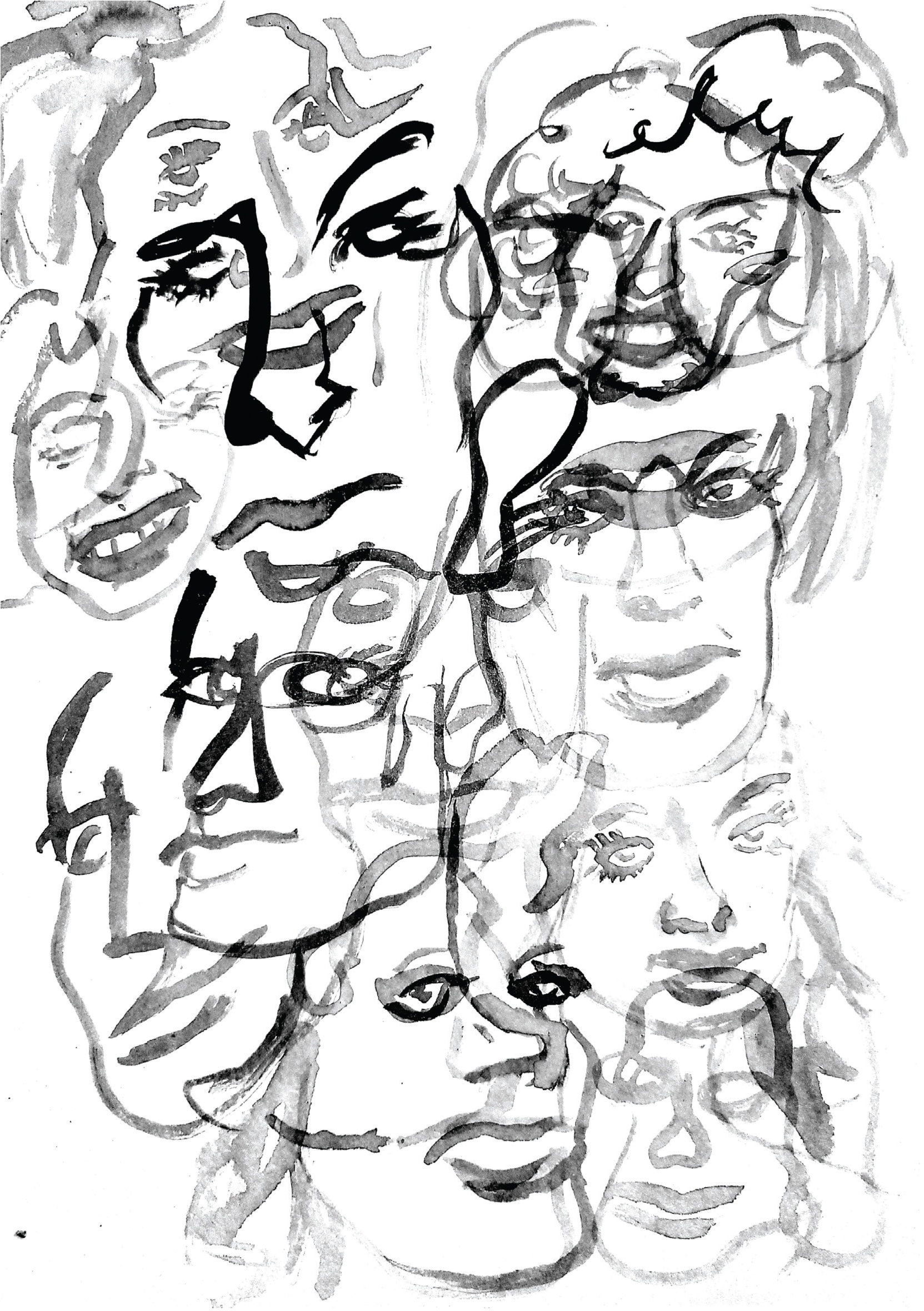
Figure 1
Valérie was a visual artist: being a performer, her body was her medium. I wanted to avoid the exploitation of trans bodies, especially those of transfemme people. So I focused on drawing her face. Because of that lack of reference material available, there was an absence of Valérie to converse with. So I tried to imagine how she would want to be portrayed. I looked at the small collection of images over and over again, and I drew them over and over again.
– Jesse Blanchard.
2 Fabulation, Visibility, and the Trans Archive
Our understanding of fabulation is one of creating connections, conversations and relationships with other trans people that exist outside ‘the confines of the archive’s purported order’.8 We want to establish a narrative that does not rely on the medicalisation and objectification of our bodies, but instead honours and values the liberation of our existence. Traditionally trans people within archives and research have been limited to pathology, and mere visibility can also be problematic because it supplies a visual language to locate us, through which we become available for scrutiny and objectification. Our bodies are the only point of reference, and the pathology of our engagement with the medical systems renders us objects to be experimented on. In the past the only power many trans people (especially trans women) were granted, was as bodies to be sexualised and objectified.9 At the same time, visibility also creates a model for younger trans people to reference, and a productive space to reclaim our own narratives. So it is important for trans people to be able to own these narratives, to create the conversations that we have with the past. Often-times trans elders like Valérie slip away into obscurity, are murdered or experience violence before they can tell their own stories. Either way, trans people’s pasts and by extension their futures become invisible. It is this invisibility that we aim to combat with this fabulation on your life, Valérie – a fabulation that remains grounded in the few facts and images we have of you, a ‘forensic practice’ as Hal Foster describes it, that ‘point[s] to an absented’ reality.10
3 Valérie Wilson and French Trans Histories
Valérie, you appeared in at least four films – La Michetonneuse (1972), Un Flic (1972), Un Ange au Paradis (1973) and Change Pas de Main (1975) – and those handful of performances from the early to mid-1970s constitute the vast majority of information about you. Your life remains almost a complete mystery – you only come to us through the film and audiovisual archives. You were first seen in the sex comedy La Michetonneuse by Francis Leroi – initially called Trouble, it was filmed in 1969/1970, but not released until 1972. You played a transvestite, also named Valérie, who befriends the lead character Justine. The press kit for La Michetonneuse claims that you were 19 years old during filming and that your mother had to sign the film contract for you.11 Clearly you lived as a woman from a very young age, similar to many trans women working in France at the time.12 The same press kit for La Michetonneuse also details that you worked as a model and striptease dancer. In Paris, like in other cities such as San Francisco, there was ‘close proximity’ between cabarets and their ‘female impersonation’ shows and the somewhat seedier strip clubs.13 Like the famous Coccinelle, whose father had to give permission when she started working at Madame Arthur’s as a minor in 1946,14 you seem to have found ways to live as a woman through stage work. Such entertainment, including striptease and ‘female impersonation’, was a way for many transfeminine people to earn a living, a step up from street-based sex work, but often still precarious. Only a few, like Coccinelle and Bambi, managed to become self-sufficient through their work, as well as material support from rich admirers. As long as they passed for cisgender women, modelling and acting were also options to earn money for trans women, especially during the 1970s.15 An anonymous comment on the French film website AlloCiné mentions that you, Valérie, were a ‘great figure of the cabaret world, like Coccinelle’.16 It is unclear which of the Paris clubs you might have worked at,17 but a scene of La Michetonneuse was set at L’Alcazar, one of the most famous cabarets where transvestites and transsexuals appeared in stage shows.18 As mentioned, these places provided a rare chance of stable income as well as some recognition. L’Alcazar, which opened in 1968, was a place which became more popular in the 1970s, attracting some already-famous performers like Romy Haag who switched over from the established cabarets like Le Carrousel and Madame Arthur’s at the offering from Jean-Marie Rivière, manager-owner of L’Alcazar, who himself became a well-known figure in the Paris entertainment world, also with his later venture Paradis Latin. However, there was a strict hierarchy in this world: only the most famous, most glamorous transfeminine performers were able to work at places like Le Carrousel and L’Alcazar. Others were relegated to lesser nightclubs or, even lower in status, had to survive by relying on sex work in places like the Bois de Boulogne.19
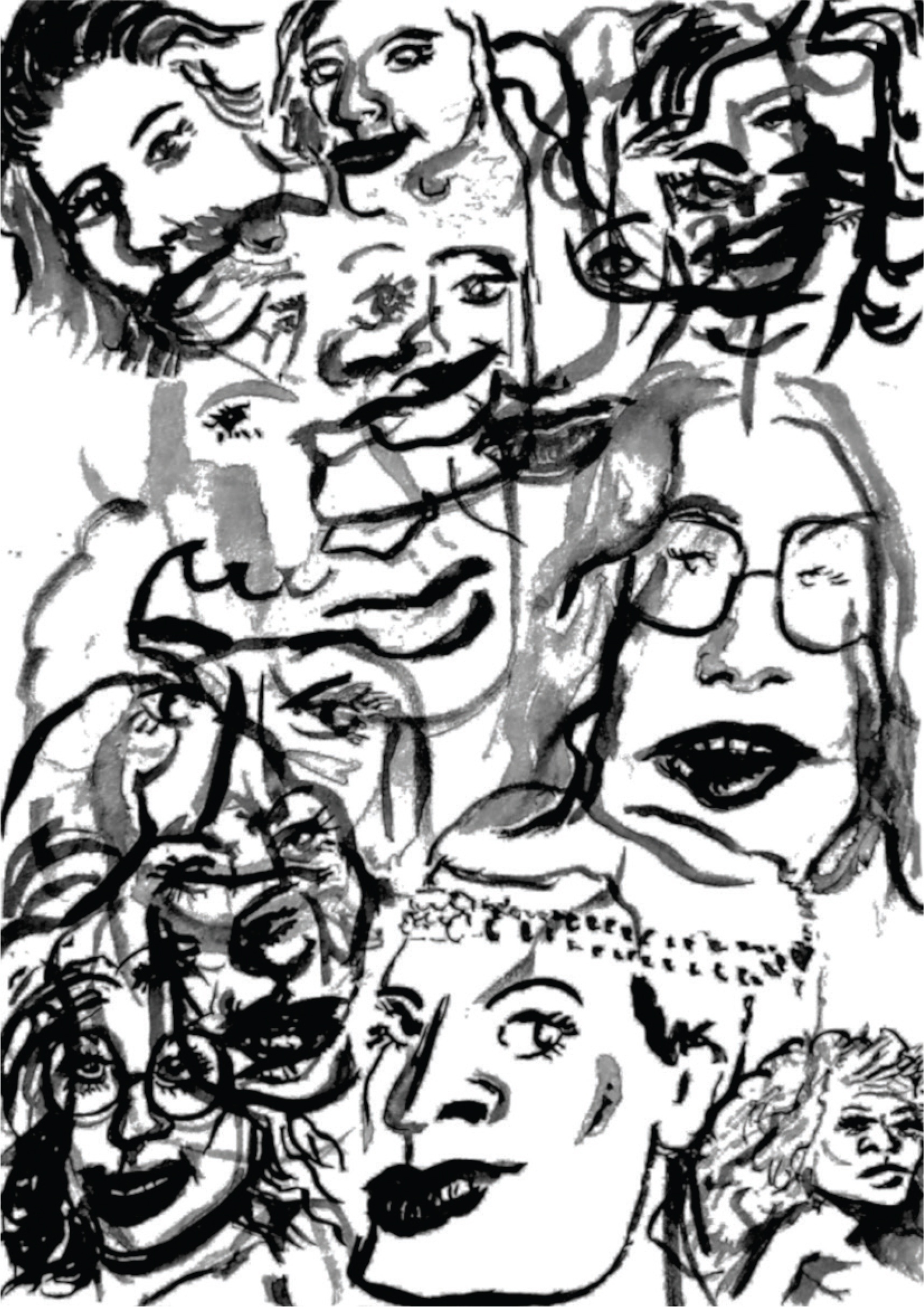
Figure 2
I imagined us laughing together, sharing cigarettes and sipping the champagne like in the image of her birthday party. It felt like a religious communion, like I was able to reach into the past and see a trans person thriving, and that, inspired me to thrive.
– Jesse Blanchard
Valérie, if you worked at clubs as a minor, you likely took feminising hormones early on. Did you get them from the other girls in the entertainment business? Or did you go to AMAHO, an organisation which facilitated hormone access for trans women?20 Maybe you even found a way to travel to Casablanca at some point, where so many received gender-affirming surgery in Georges Burou’s Clinique du Parc.21 The strength of the subcultural networks surrounding the cabarets and the friendships forged despite some stage rivalries were what allowed for the sharing of such resources and the ability for many of these women to medically transition at a time when this was almost impossible.22 You appeared in a time where things were already changing, where the cabaret scene ‘started losing its fame’23 and transsexuals from all over the world had started to arrive in Paris. Still, you stood out.
4 Obscuration of Trans Identity in the Audiovisual Archive
It is made clear in the press kit of La Michetonneuse that you, Valérie, impressed the film-makers so much with your acting skills that they expanded your originally small role to a more substantial part. Notably some of the promo material for the film only features you, not the main actress Christine Leuk!24 Despite the fetishisation of your body by the film-makers, you clearly had the charisma, beauty and the willingness to achieve a career as an actress. Variety’s Gene Moskowitz highlighted you, calling you ‘extraordinary’ in his review of the film,25 but overall it received a mixed response. Regardless, it played in Paris cinemas for several months in a row, including some porn theatres.26
Your breakout role in your first film may well explain how you then landed your next acting gig, Valérie. You appeared opposite Alain Delon as a nameless transvestite27 in Jean-Pierre Melville’s last film Un Flic (1972, filmed in 1971). Your character is an informer for Delon’s inspector Coleman, and is also in love with him. Coleman at first treats her kindly until he suspects that she lied to him, and then becomes violent, kicking her out of the police precinct and threatening her with jail for cross-dressing. A sexual or romantic history between them is implied.28 Although only in the film for a few minutes, your luminous apparition and nuanced acting leaves a lasting impression, and critics have since noted your chemistry with Delon.29 Curiously enough, some books and articles about Un Flic claim that you are a cisgender woman.30 Is that something you encouraged, Valérie? Did you just want to live as a woman, unbothered, non-stigmatised? At the time, transsexuals were heavily encouraged to assimilate into society, and to never speak of their transition history to anyone. Many of the former Paris stage entertainers later disappeared without a trace, even famous stars like Capucine.31
After Un Flic, you went on to have a supporting role in Un Ange au Paradis (1973),32 a black comedy where you played a ‘travesti’ sex worker named Marie-Ange whose client falls in love with her. You were interviewed about your role in a segment for Chutes on tourne, a French TV program on the public channel 3ème chaîne which discussed newly released films. This is the only interview with you that’s known of.33 The interview, broadcast in October 1973 and archived in the online repository of the Institut national de l’audiovisuel (INA), is at the centre of this attempted encounter between us, Valérie, where we try to reach back in time to you, trying to meet you on your own terms. It’s the only time you were able to speak for yourself, in your own words. But the broadcast is fairly inaccessible to anyone who isn’t in France and can’t go to an INA centre, or is not an academic researcher, and that means that you as yourself stay stuck in the archive.34 Trans presence in institutional archives often remains invisible unless already marked as an ‘archival other’35, and it is only because we already knew of your existence and your role in Un Ange that we could find you in the INA database. Both the creatives involved with producing the Chutes on tourne episode, and the current repository managers of it within INA, end up functioning as ‘authorities that would cordon off [trans] bodies and scenes from being worthy of being looked at, or looked in on, without the proper credentials’.36 This cordoning off happens in multiple ways: systemic issues with library cataloguing that omits or misidentifies trans people37, cultural dominance of the cisgender point of view that either dismisses the relevance of trans people or, if they are deemed important enough to be asked questions, curates their speaking position,38 as well as the type of institutional gate-keeping that overprotects the access to archival materials through measures like demanding academic affiliation.39
Having seen this broadcast with you despite all of these barriers, having experienced you as the real you, we immediately fell in love with you, Valérie. But you’re a ghost; and so all that we can put to words and images remains a ‘partial re-memberance, a speculative and spectral desire’.40 In the interview, you had fiery red hair then (probably dyed for the film role, since you were usually blonde), you wore lots of nice jewellery and a beautiful high-end fashion dress, and you smoked cigarettes, like almost everyone did back then, surrounded by the bustle of a metropolitan café. You spoke French with a Parisian accent.41 You mainly discussed the making of Un Ange au Paradis, though (of course!) the interviewer François Ruggieri also asked you about yourself and being a ‘travesti’, throwing words like ‘imitation’ at you. You deflected and shrugged off these questions, saying at first you didn’t know what he meant, but then you also hinted that there was little understanding of you. You said that ‘it’s usually not a very nice reaction [when someone finds out]. They lack imagination’, you offered, with a smile that didn’t reach your eyes. Did you wish to ‘not only to seduce, but to educate and be understood?’42 Or would you rather have been left alone? The program features a scene from the film where your character Marie-Ange talks about going to Australia, saying ‘it’s far, that’s why I want to go, because it’s far, and nobody knows me over there. (…) I’ll leave and I will not come back’. Did this wish to be anonymous ultimately win out for you, too? Are we doing you a disservice by publicising the traces of your life and career, even though our trans for trans adoration ‘refuses the violent gestures of taking one person as a part that represents a whole community’43 and instead tries to give you back an ‘assembled resemblance of a life lived’?44
Your role in Un Ange seems to have been relatively small, but the TV segment still used ample footage of you, including for the credits section, which roll as the camera watches you get up and then follows you out into the streets of Paris. The fascination and fetishisation the camera has with any gender-transgressive person did not spare you, Valérie. You looked stressed as the camera stayed on you, watching you cross a busy intersection, looking at jewellery from a street vendor’s stall. Were you annoyed with the scrutiny, of being put up as a ‘spectacle of ‘can you believe it’ femininity’?45 Did that feel like too much of a price to pay to be a working actress? In the Chutes broadcast, the director of Un Ange, Jean-Pierre Blanc, labelled your character the titular ‘angel’ of the film (reflected also in the name, Marie-Ange), saying that she46 was the only ‘honest’ character. He also stated that he had deliberately cast a ‘real travesti’ and that being one ‘is not all bad’. Did he say those things to your face, too? You seemed to have had a good experience making the film, so maybe ignorant but well-meaning comments were already a best-case scenario for you. You mentioned you had been living abroad and ‘in the country’ before taking on your previous film roles, but now wanted to continue acting. But this visibility for you (and others) always came with heavy strings attached, and seemingly never went beyond a surface attempt of understanding and appreciating you as a full human being.47
Your last film role was that of Mylène, a nightclub dancer, in Change Pas de Main (1974/75), a thriller by Paul Vecchiali that also features hardcore porn scenes. You only appear in the first twenty minutes of the film and you have barely any lines. Your only words spoken are ‘Madame, I need to rest. I was hired for dancing, not all of this death business’. With this, you leave the scene and the film. We read these lines as a refusal to be associated with film work that gave you nothing to do as an actress. Since this was your last film appearance, you may well have decided to give up acting, very possibly not finding any satisfying parts. Change Pas de Main also features the transphobic film stereotype of a transvestite rapist/killer – which has nothing to do with your role (your character is implicitly cisgender), but it may also have turned you off from any further acting.48 In an issue of the French erotic film magazine Sex Stars System, the actor and co-writer of the film, Noël Simsolo, states that he counts you as one of the actresses who ‘hooked me the most’ in cinema.49 Simsolo probably met you during filming, but given the film’s nature, it’s also possible he was making a cruel transphobic joke.
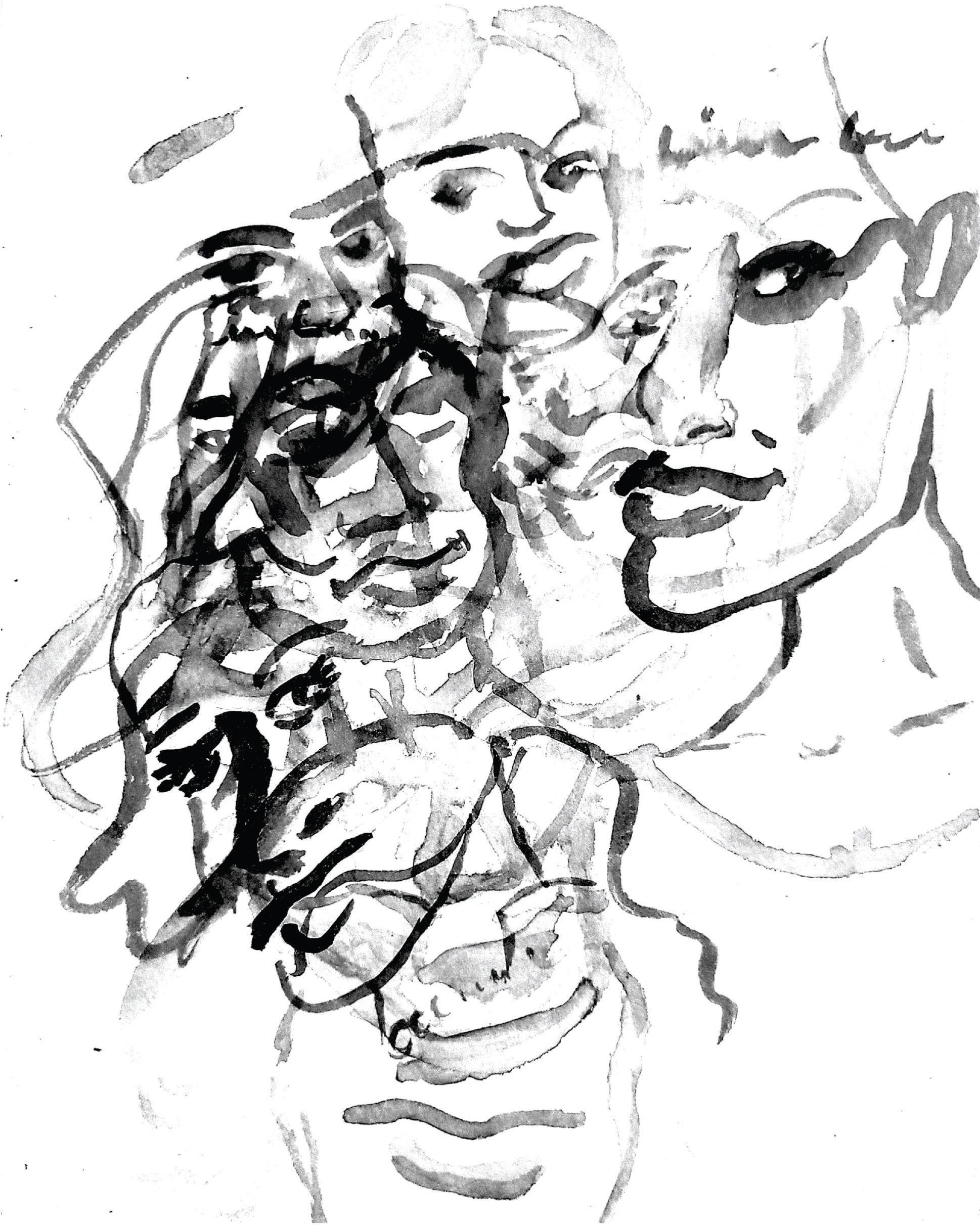
Figure 3
I created layers from those images to imagine a rich and plentiful archive of her life. I tried to imagine what conversations we would have. What questions I would ask her. What questions she would ask me. What would it be like to sit with her while I drew her portrait?
– Jesse Blanchard
5 Conclusion
It was difficult for most trans women in the 1970s to find work outside of stage entertainment and sex work. That was true even for stars like Coccinelle, who also appeared in a few films, mostly as herself. Later-in-life photos of you, Valérie, show you only in private settings, so it’s unclear what you did after your brief film career. However, these snapshots bring you alive as a person in a way that your films cannot. They come from your friend Diane Peggy Guex, who immortalised you on her website, and shared with the world the news of your death. The website (archived through the Wayback Machine) is the only record of your later life, with multiple photos of you as an older woman, the most recent ones from 2008. While these photos were only posted after your death, forming an online memorial, they also show us a view outside the pathologisation which framed your movie career. These photos depict you celebrating holidays, or in fabulous snapshots wearing fur coats, looking very regal. The radiance in those photos is palpable, a quiet happiness that seldom came across in your film work. You positively glow, Valérie. And the most important thing we take from these photos is that you lived. You thrived. That alone is incredible to know, considering the necropolitics that continue to surround the lives of many trans women.50
You passed away on October 20, 2011.51 There seems to have been no news obituary published about you. Only the ‘generational transfer of care and preservation’52 enacted by Peggy Guex saved the knowledge of the joy and love that also was your life. But it also points to the ephemerality of trans existence, such as yours, Valérie. Guex’ original website is now gone, as are most traces of her own life – she apparently instructed friends to destroy her entire private archive of herself and other trans women, including of you, Valérie, after her death.53 It shows the ultimate irrecoverability of most trans people who existed throughout history, to the questionability of the ‘we have always been here’ slogan of claiming visibility for all. Guex may have wished to give you, Valérie, and herself, some privacy by being mostly forgotten, being free of our gaze: as we seek to ‘uncover unspoken and unacknowledged secrets of the past’,54 we face nothing but ghosts.
We do not have a way of knowing how you saw yourself, Valérie. But we do know you lived as a woman for almost all your life. We know you wanted to be an actress. Your short appearance in French cinema is on par with how trans people, especially trans women, were seen and represented at the time. It exemplifies that beyond small, stereotypical roles, there was little interest from mainstream culture to record the details of trans existence. Only a handful of trans people achieved celebrity status, and even they had to fight for the agency to define and preserve their own history. You, Valérie, could or would not do that. It remains to be seen if more research (especially within France) will tell us more about you. We hope so – we hope you can be more than a ghost one day. Like your friend Peggy said, ‘I won’t forget you! You’ll always stay in my heart’.55
Notes
[1] Diane Peggy (= Peggy Guex), “Diane et le sexe des anges: Valérie Wilson [Diane and the Sex of Angels: Valérie Wilson],” n.d., https://web.archive.org/web/20161114091745/http://www.dianeetlesexedesanges.ch/3colset008/_page_valerie_wilson.htm. The website was created by Peggy Guex, also known as Diana Santiago, a close friend of Valérie Wilson. Guex passed away in 2023. Many thanks to Nikki Wyte from the Instagram account @carrouselmadamearthur for sharing Guex’s website and the information about her, as well as for multiple conversations about Valérie. Wyte’s personal collections constitute one of the most comprehensive visual archives of Paris transfeminine cultures. All primary source quotes in the article are translated from French.
[2] Gigi Otálvaro-Hormillosa, “Metamorphic and Sensuous Brown Bodies: Queer Latina/x Visual and Performance Cultures in San Francisco Strip Clubs, 1960s–1970s”, Latin American and Latinx Visual Culture 1, no. 2 (April 2, 2019): 59.
[3] Eliza Steinbock, “T4t: Archival Legacies of Trans for Trans Adoration”, in Re_Visioning Bodies, ed. Daniel Neugebauer (Leipzig: Spector Books, 2021), 11. We identify both as trans men. It is impossible to know how Valérie viewed herself, but she lived as a woman most of her life, so we’re identifying her as such, including using she/her pronouns. ‘Travesti’, ‘transvestite’ and ‘transsexuelle’ were labels that were used by others to describe her, but there is no clear indication Valérie would have agreed with any of these descriptions. When we speak generally of the subculture surrounding the Paris cabarets, we use ‘trans women’ or ‘transfeminine people’, which mean to encompass a variety of identities and expressions by people assigned male at birth who aligned themselves with femininity.
[4] KJ Cerankowski, “My Autobiography of Reed Erickson, or, How to Re-Member a Ghost”, Memory Studies 16, no. 1 (February 2023): 128. Emphasis in original.
[5] The most well-known documentation of this subculture is Christer Strömholm’s 1983 book Les Amies de Place Blanche. The book acknowledges that it’s unknown what happened to most of the people Strömholm photographed in the 1950s and 1960s.
[10] “Tragedy and Farce: Interview with Hal Foster”, Verso Books, October 23, 2020, https://www.versobooks.com/en-ca/blogs/news/4889-tragedy-and-farce-interview-with-hal-foster
[11] Press kit for Francis Leroi’s TROUBLE (L’histoire d’une michetonneuse), n.d, FRL-40769, TIFF Film Reference Library, Toronto, Canada. Thank you to TIFF for providing a copy of the relevant section of the file. The website elcinema.com states that Valérie was born in 1953 in Paris. “Valérie Wilson – Actor Filmography, photos, Video”, n.d., https://elcinema.com/en/person/2169258/.
[12] Romy Haag, a transsexual entertainer, states in her autobiography that she started working at Madame Arthur’s and other Paris cabarets as a minor in the 1960s. She explains that being underage and from the Netherlands (as well as being assigned male at birth but dressing in female clothes), she could have been arrested and deported any time, and therefore avoided police to the point of once fleeing a car crash her taxicab was involved in. Romy Haag, Eine Frau und mehr [A Woman and more] (Berlin: Quadriga, 1999), 86.
[14] Maxime Foerster, “On the History of Transsexuals in France”, in Transgender Experience: Place, Ethnicity, and Visibility, ed. Chantal J. Zabus and David Coad (New York; London: Routledge, Taylor & Francis Group, 2014), 20.
[15] Pascale, a well-known transsexual woman from South America who worked at the cabaret L’Alcazar, also did modelling and played the lead role in the 1980 melodrama Comme une Femme.
[16] “Valerie Wilson – AlloCiné”, n.d., https://www.allocine.fr/personne/fichepersonne_gen_cpersonne=83474.html.
[17] Other cabaret performers like Bambi, Romy Haag or Ronny Rolls have stated they do not know or remember Valérie. Given the large number of performers in these clubs from the 1940s to at least the 1980s, this is not entirely surprising. Said Rolls, ‘I worked in 18 different cabarets, impossible to remember everyone.’ Ronny Rolls, Instagram message to author, August 15, 2024.
[20] AMAHO was founded in 1965 by Marie André Schwindhammer, and is considered the eldest association for transsexuals in France. Foerster, “On the History of Transsexuals in France”, 20.
[24] Such as a promotional flier that shows Valérie topless. The cover for the official film soundtrack by Pierre Fanen also only shows Valérie (in drag).
[25] Mosk (= Gene Moskowitz), “La Michetonneuse (The Swinger)”, August 30, 1972, in Variety’s Film Reviews, vol. 13: 1971–1974 (New York: Bowker), 18.
[26] François Jouffa and Tony Crawley, L’âge d’or du Cinéma Érotique et Pornographique: 1973-1976 [The Golden Age of Erotic and Pornographic Cinema] (Paris: Ramsay, 2003), 9. La Michetonneuse has now been digitised and streams on Canal+, but is only accessible to a France-based audience.
[27] The character is not addressed by name in the film. IMDB lists her as ‘Gaby’, but at least in the streaming version available, the credits of the film simply state that Valérie was part of the cast without naming her role. Un Flic, directed by Jean-Pierre Melville (Troy, MI: Anchor Bay Entertainment, 1972).
[28] See Willow Catelyn Maclay, “Musings on Transgender Cinema: ‘The Strange Movie within a Movie in Jean-Pierre Melville’s ‘Un Flic’”, Patreon, January 17, 2021, https://www.patreon.com/posts/musings-on-movie-46328709.
[29] See Jean-Marc Parisis, Un problème avec la beauté, Delon dans les yeux: Récit littéraire [A Problem with Beauty, Delon in the Eyes: Literary Narrative] (France: Fayard, 2018).
[30] Ginette Vincendeau seems to be the first to have made this claim in her 2003 book Jean-Pierre Melville: An American in Paris (London: BFI Pub.). Without attribution, the claim is then repeated by Thomas Lequeu in his article on the film. He even mentions that contemporary reviews of Un Flic used male pronouns for the character, seemingly not realising that this would have been the (transphobic) practice of the press back then. Thomas Lequeu, “La seringue et la gâchette: Les genres au rendez-vous de la violence dans Un flic de Jean-Pierre Melville [The Syringe and the Trigger: Genres at the rendezvous of violence in Jean-Pierre Melville’s A Cop]”, Les Cahiers de l’École du Louvre 15: 6.
[31] “Capucine (193?–) performer”, A Gender Variance Who’s Who, February 16, 2016, https://zagria.blogspot.com/2016/02/capucine-193-performer.html. In the recent documentary Enigma, Bambi briefly talks about Capucine and the dissolution of their friendship because Bambi wrote about Capucine in one of her books; implicitly confirming Capucine is still alive but unwilling to be known publicly. Bambi herself worked as a school teacher for twenty years after her stage career, no one in her environment knowing about her earlier life or transition history. Zackary Drucker, Enigma (HBO Documentary Films: 2025).
[32] The film is currently not available to watch digitally or on DVD/VHS, having only been released on Betamax in 1978.
[33] Jean Pierre Manquillet, Chutes on tourne, October 29, 1973. Thank you to INA for giving temporary access to their online archives to watch the programme, without which this article would not have been possible.
[34] As per communication from INA, “an alternative and exceptional solution for people living far from a consultation centre who are conducting research in a university or academic setting” is to receive a free, one-month temporary access to the INA database. INAthèque, email message to author, August 19, 2024. However, this stipulation excludes non-academics such as community historians or other interested persons.
[37] See for example Melissa Adler, “The Trouble with Access / Toward Reparative Taxonomies”, in Cruising the Library: Perversities in the Organization of Knowledge (New York: Fordham University Press, 2017), 144–64. If you search the INA catalogue for ‘transsexuel’, many items about prominent trans women such as Coccinelle are shown, however, the Chutes on tourne episode with Valérie is not part of the results. In fact, the database entry for the episode is not labelled with any descriptors except ‘cinéma’ and ‘film (chute)’.
[38] See e.g. Natacha Kennedy, “Cultural cisgenderism: Consequences of the imperceptible”, Psychology of Women Section Review 15, no. 2 (2013): 3–11.
[39] See also Eva Pensis,“If Visibility Is a Trap, Then What Is Trans Studies?”, GLQ: A Journal of Lesbian and Gay Studies 31, no. 1 (2025): 167–171.
[41] Huge thanks to Scott Smart for this insight and for translating the Chutes on tourne interview from French to English. It should be noted that parts of the original interview are difficult to understand because of background noise, so even a French speaker would sometimes have trouble making out what’s being said exactly.
[46] Blanc used male pronouns for the character Marie-Ange, but seemed to avoid pronouns for Valérie.
[47] Romy Haag mentions in her autobiography that she was often cast as an exotic add-on in her acting gigs, and discusses multiple male film-makers’ obsession with displaying her (naked) body on camera. Haag, Eine Frau und mehr, 220; Christopher Wolff, “Archival Traces: Trans Women in European Film”, Senses of Cinema 106 (August 2023), https://www.sensesofcinema.com/2023/pride-on-the-margins/archival-traces-trans-women-in-european-film/.
[48] Perhaps tellingly, the film is not included in Valérie’s filmography provided on her friend Peggy’s website.
[50] Valérie was white, and had passing privilege, but trans women, especially of her time, still faced violence, often murderous, and were generally depicted as disposable in the media. Indeed, passing trans women are often more endangered because of the cis-cultural trope of ‘deception’ trans people are subjected to. Jules Gill-Peterson, A Short History of Trans Misogyny (London; New York: Verso, 2024), 19.