
1 Introduction: Harvested From Bin Cuts
My film From the Culch (Mulraney, 2023) is crafted from the bin cuts of a 1975 BBC documentary about Cornwall’s Fal River Oyster Fishery, where native shellfish have been dredged in the same sustainable manner for hundreds of years. After the BBC documentary was broadcast, a can of randomly spliced together, silent 16mm offcuts was given to oysterman Dennis Laity. Sadly, the gift was made in memory of Dennis’s brother Paul Laity, the film’s lead subject, who died tragically shortly after the shoot had wrapped.
The can of film lay unseen in a cupboard for almost 50 years – 16mm projectors are hard to find in small rural fishing communities. During this time attempts by the family to find the original broadcast film within the BBC archives had failed. Memories were hazy about who shot it, what programme it aired on, or even what year it was broadcast. Searches on BBC Genome and calls to the archive team came back with no results. Memory loss makes metadata search redundant, regardless of whether it occurs at a human, or a systemic level. And so, the can of unused footage – 1000 feet of ins and outs, GVs, B-Roll, and technically faulty shots - was believed to be the only moving image record of a brother and a father, the last traces of a film of historical, cultural, and deep personal significance.
In 2021 Dennis, now 82 years old, passed the film can to his neighbour, me, with the question ‘You work in film don’t you Paul, can you do anything with this?’ After unspooling a few feet it became clear that the film had real aesthetic and cultural value. However, it was on hearing Dennis’s description of the tragedy contained within the film that I sensed the project offered more than an opportunity to conserve some lovely historic footage and, moved by the human story trapped within this old reel, I sent the film off for chemical restoration and scanning.
The 4k scan revealed the silent beauty captured in the celluloid, a beauty that – for me - was further heightened by the grain, the hair in the gate, the focus pulls and camera resets, by the degradation of the stock due to time and cupboard and glue, and by the long takes that settle on their subjects and seem to patiently, simply, look.
Initially there was no narrative to be found in this haphazardly cut 30-minute glimpse into the lost past of my community. It was, as the card inserted into the can by Dennis read ‘not in a strict sense a film’ at all. The footage seemed more like a dream, reason was destroyed in its randomness. It evoked Deleuze’s ‘dream image’, going beyond a simple hazy, lazy recollection of this unique and magical place, to weave its magic in the here and now: ‘The dream itself may resemble the everyday world more or less, the everyday reality of the awake character; yet it will have a certain uncanniness, it will be somehow impossible’2 (Figure 1).
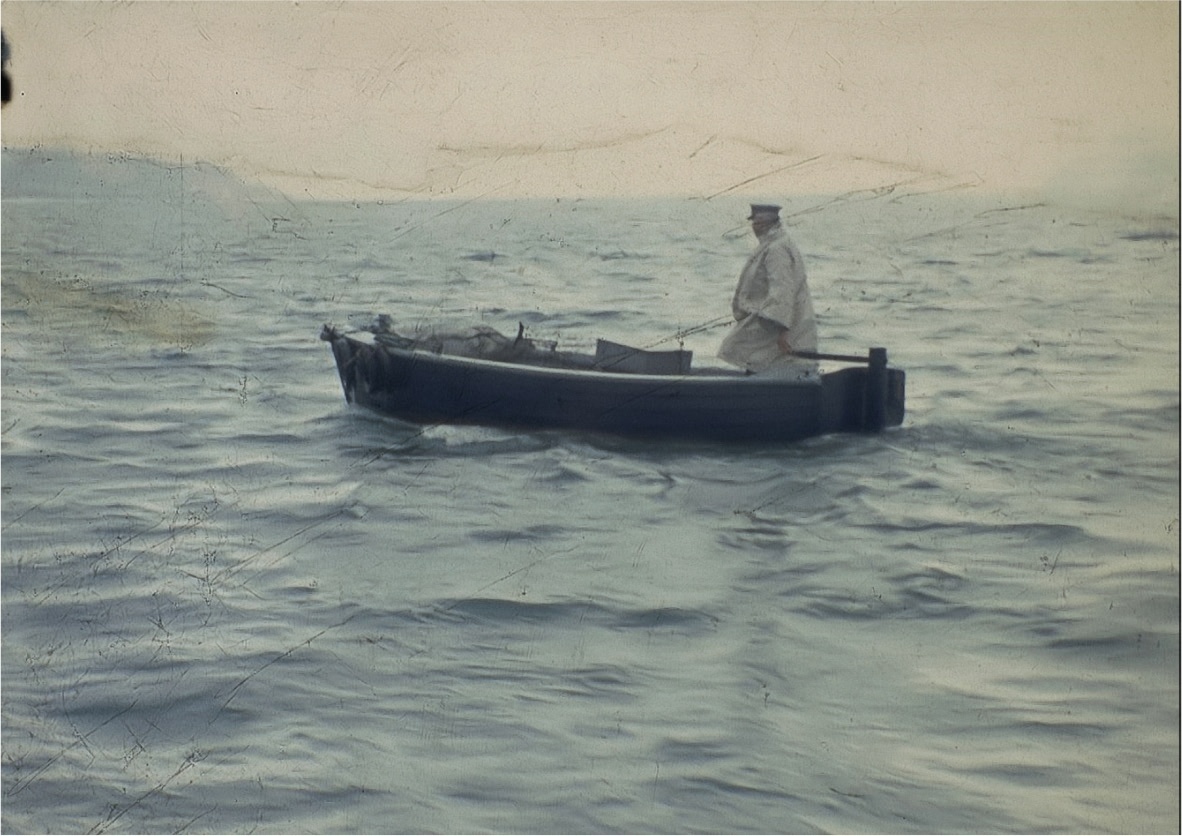
Figure 1
The oyster bailiff. From the Culch (dir. Paul Mulraney), Seamonster Media, 2023.
In her book Death 24x a Second, Laura Mulvey evokes Eric Hobsbawm’s ‘twilight zone’ in describing the uncanniness of celluloid, the long unedited takes of the From the Culch bin cuts perfectly capture the point at which ‘personal memory disappears into history… On celluloid, personal and collective memories are prolonged and preserved, extending and expanding the “twilight zone”, merging individual memory with recorded history’.3
This ‘twilight zone’ of temporal shift shares much with Deleuze’s ‘uncanny’, the affect is rooted in the indexicality of the celluloid frame, and is further heightened by the subject matter, deeply engaged as it is with memory, loss and passing:
The index can now be valued in its relation to time and as a record of a fragment of inscribed reality that may be meaningless or indecipherable. As a trace of the past that persists into present, and one in which, in the case of the cinema, appears to animate the inanimate human body, the photographic index reaches out towards the uncanny as an effect of confusion between living and dead.4
Of course, the footage is also nostalgic, but only to a degree, for any sentimentality is undercut by the fact that the oyster dredger’s methods are the same today as they were in 1975. Under the laws by which the fishery operates – by sail, with a standardised dredge, and a system for hand sorting the shellfish - if you visit the Carrick Roads today the mise-en-scène (on the surface at least) appears to be identical.
In this light the need to honour the 16mm raw material was paramount, driven not only by the desire to retain the aesthetic quality of the archival film and its random, hard cut assembly, but also by the need to develop an ethical approach to the editorial process. Because Dennis was right, it wasn’t in a strict sense a film at all. For him and his family, for Paul’s daughters who lost their father at a young age, it was something far more important, a memory of inestimable value and deep personal meaning.
In his essay The Ethics of Archive in Documentary Filmmaking Louis Franklin McLaughlin notes that:
…although it is easy to change the meaning of an indexical image; a photographic image, a video frame; even a short video clip; it is harder to change the meaning of an archive, as an archive has been built to maintain a structure of meaning which hopes to be as immutable as the shifting rules of the truth of a society will allow it.5
This seems to be equally true when an archive is disordered, distributed within a community, rooted in emotion, in illogic. Found outside of the institutional structures imposed by metadata, tagging and categorisation, their contents untouched by the narrative, qualitative norms of televisual broadcast, vernacular archives maintain their own structures that more closely resemble memory – they are faded, misfiled, categorised by emotion, not by intellect, valued according to a different definition of quality.
There is a power in this alternative sort of structure. A power that I was to discover could also be felt within the vast institutional archives of the BBC. For it was precisely these qualities – community memory, the foregrounding of emotion over intellect, the acceptance of different qualitative markers in filmic and televisual material - that resulted in the original ‘lost’ documentary being found, as we’ll later discuss.
During the production of From the Culch, the tension between the desire to maintain the dreamlike aesthetic and the need to find some form of narrative order drove the creative decision making. For while my primary audience for the film was Dennis Laity and his family, the secondary audience was the tight knit village community in which I live, many of whom would see their own relatives, boats, and stories, portrayed on film. As John Berger, the great documenter of village life, notes in Landscapes ‘What distinguishes the life of a village is that it is also a living portrait of itself: a communal portrait, in that everybody is portrayed and everybody portrays’.6 Working communally creates its own pressures, as the accuracy of the portrait - the straightness of the story - is immediately open to insightful criticism.
Further, an ambitious filmmaker must recognise and to some degree serve the needs of a wider, tertiary audience. Here, the moral hazard of portraying grief, of making a deeply private matter public, was offset by the belief that deep catharsis could be the result, if only an ethical approach could be found.
This paper will reflect on this process of enquiry, while the film itself stands as the ultimate record of its successes and its failures (Video 1).
Video 1
From the Culch (dir. Paul Mulraney), Seamonster Media, 2023.
2 Loss in the Archives
My practice aligns with what filmmaker and academic Clarke Mackay describes as ‘vernacular’ filmmaking. It is a methodology where:
Relationships are more important than objects. Tradition and improvisation play equally central roles. Meanings and metaphors may be opaque to those outside the community of origin but deeply resonant to those within.7
As described by philosopher Ivan Illich the term vernacular is derived from ‘a legal term from ancient Roman law, vernaculum, that designated anything that was not a commodity’.8 A vernacular production finds its material close to home, in existent places and people, existing stories and situations, or - as in the case of From the Culch – existing footage, creating no-to-low-budget, independent cinema that can withstand the commercial imperative. Working in this manner my films seek to explore meanings and metaphors that gain their resonance from a depth of engagement with the community in which I live. However, it is my hope that through finding themes that are universally present in all communities, the meanings and metaphors within the work might lose the opacity of Mackey’s definition to speak clearly to audiences beyond the confines of the community in which they arise.
In the case of From the Culch, the central meaning of the film is that all life will pass, and if we are not careful, a way of life will follow. The film acts as a memento mori, as a remembrance and a recognition of death. The passing of the individual acts as a metaphor for the passing of a community, for the environment that sustains that community, and finally for the original film itself – the surviving bin-cuts are no replacement for the lost BBC synch-sound film. And so the act of making the film was akin to writing four eulogies: a film with four funerals, and no weddings. A lost film that speaks to the subject of loss.
The first and most private of the film’s four eulogies was that given by Dennis to his brother Paul Laity. This will be discussed in more detail in the next section on posthumous filmmaking practice. Crucially, the sadness that this one death contained lent a visceral quality to the other, more metaphorical deaths that are present within the film (Figure 2).
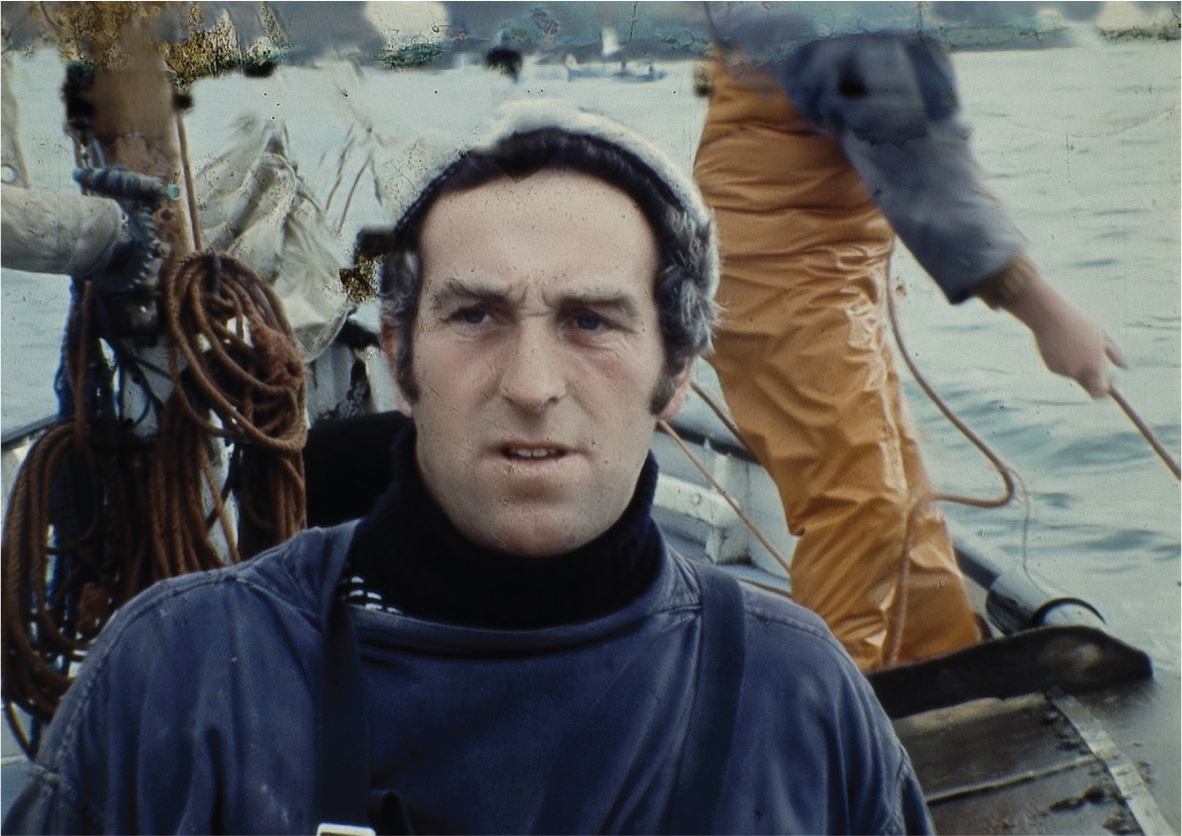
Figure 2
Paul and Dennis Laity. From the Culch (dir. Paul Mulraney), Seamonster Media, 2023.
The second eulogy is for the fishing community that is portrayed in the film. It is under threat of extinction, entwined as it is with the deteriorating environmental health of the river and the economic health of the fishery. The downturn in its fortunes has been caused by factors far beyond its control: the bleak undercurrents of Brexit have caused the margins on shellfish exports to plummet, restricting access to the European markets that are crucial to the wholesale oyster industry.9 Meanwhile, environmental degradation has stained the waters of the Fal estuary, causing purification costs to skyrocket, and shellfish stocks to fall.10
If follows that the film’s third eulogy is for a time when the waters were turquoise and the dredges were full. The size of the catch documented in the film was a source of amazement and deep concern to the remaining oystermen who have seen the film (Figure 3).
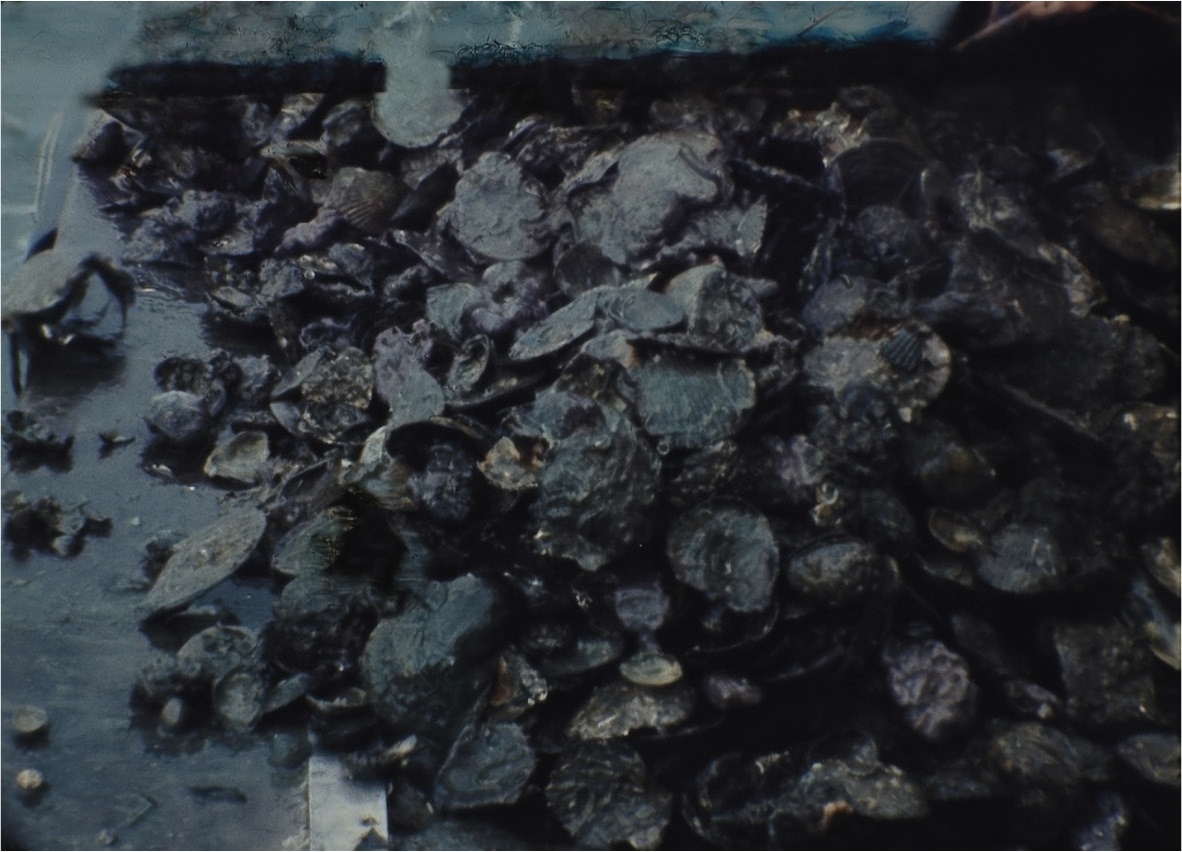
Figure 3
An oyster harvest from 1975. From the Culch (dir. Paul Mulraney), Seamonster Media, 2023.
Narrator Dennis Laity’s ability to connect to contemporary audiences through his humour, wisdom and candour, opens the film to an environmental reading that is sited in ecologist Callum Roberts’s ‘shifting baseline syndrome’, explaining how each generation normalises the deteriorating condition of their environment:
Younger generations are often dismissive of the tales of old-timers, rejecting their stories in favour of things they have experienced themselves. The result is a phenomenon known as ‘shifting baseline syndrome’, as we take for granted things that two generations ago would have seemed inconceivable.11
If modern audiences can feel the change wrought by two generations worth of environmental degradation, then perhaps their baselines can be reset. The ability of a film to move beyond story to generate first-hand experience is tied to its emotive power:
In the short term, the function of emotion and affect is to make film viewing powerful, rather than merely an intellectual exercise. In the long term, such experiences may burn themselves into the memories of audiences and may become templates for thinking and behavior.12
Behind From the Culch’s conveyance of feeling lies - in part - the film’s materiality. The sense that celluloid film itself is rare, in need of conservation, adds a layer of meaning to the footage that transcends its original conception as a simple record of Fal River fishing practices, quickly shot by a small BBC crew on the most economical and practical film stock of the day: ‘Film’s ageing process and its critical, but benevolent, collision with new technologies combine to give the representation of time, always present in and on film, new significance’.13
The desire to retain as much as possible of the celluloid’s aesthetic – ‘the hair in the gate’ – foregrounds the evocation of feeling, in order to achieve what Keith Marley describes as ‘pleasurable learning’:
By encouraging an audience to see and hear the lyrical potential of documentary, a film can operate more on the level of evocation via the filmmaker’s focus on the aesthetic, as opposed to the expositional potential of documentary film. As such, the filmmaker can elevate the audience to a more active and informed reader of audio-visual texts. It is through the particular formal qualities of a documentary film, that one can achieve pleasurable learning.14
A recognition of the ‘lyrical potential’ that inheres to 16mm celluloid can be seen in the films of its contemporary advocates, including my colleague the Cornish filmmaker Mark Jenkin, through whose work 16mm is undergoing some serious conservation. While his films sit within experimental and narrative modes of practice, he too recognises and manipulates the quality of grief that Mulvey finds locked within the materiality of celluloid,15 to be released through the individualised methods with which he develops it for the screen (Figure 4).
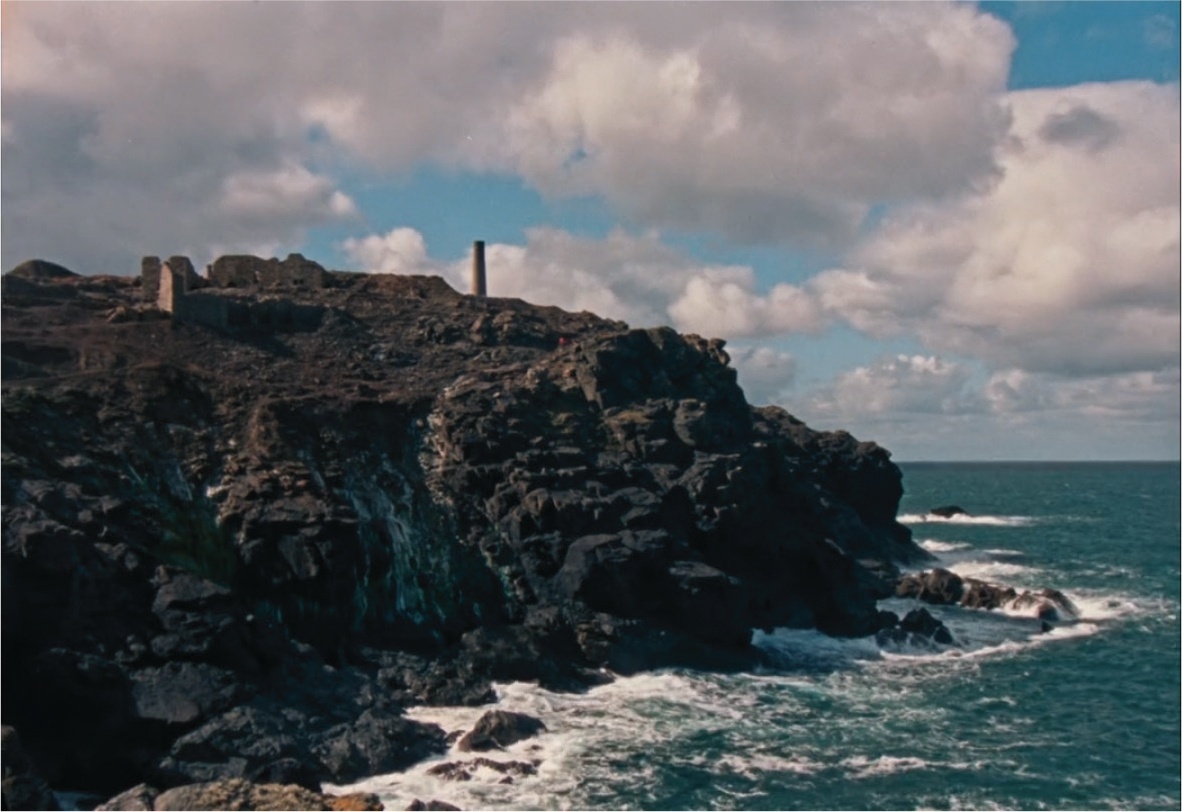
Figure 4
A Celtic form of mono no aware. Enys Men (dir. Mark Jenkin), Bosena Productions, 2022.
Speaking of his film Enys Men, Jenkin recognises:
I think it probably is about grief, but it sometimes takes an audience, or a critic, to point that out and tell you... when we think about time, it’s always linked to grief. When you look at a sunset, and it’s beautiful, why is there a sadness attached to that? You take it in quietly, then the moment has gone, and you’re grieving for it. It’s the Japanese theory of Mono No Aware. The gentle sadness at the passing of time.16
In the silent traces of the original film that became From the Culch, there is a palpable sense of loss – for the people, for the community, for the time. But there can also be felt the loss of the original BBC film, of the voices of the men who speak and cannot be heard, of the meaning that is lost in the randomness of the bin-cuts’ assembly. And so, the film’s fourth and final passing is the original documentary itself, which - at the time of From the Culch’s production - was considered to be a death in the archive.
3 Posthumous Archival Practice
Mount Eerie’s Real Death warns that: ‘Death is real/ Someone’s there and then they’re not/ And it’s not for singing about/ It’s not for making into art’.17 The irony of this lyric is keenly felt by anyone engaging in an art practice that is grounded by a real death. In such cases it is best to consult practitioners with an engagement deep enough to go beyond the artful. Nick Hector, Canadian academic and prolific documentary editor, cut the film Sharkwater Extinction, working post-mortem from the archive that constituted shark conservationist Rob Stewart’s life work:
When I was approached by Rob’s estate, by his parents, about working on the project, I didn’t even have to think about it. Within 30 seconds it was just obvious to me that you have to make Rob’s film. The idea of making it my film, or any filmmaker trying to do their take on it, was absurd, it would be an extraordinary dishonour to a brave young man just trying to do something with his life, and trying to help us.18
He goes on, ‘I certainly felt the pressure. When I took it on I knew that it was more than a film.... The stakes are rarely higher on a film’.19 To work with high stakes we must tread lightly, as Hector counsels ‘Pull the pieces away and reveal the heart of the film... It was not a top-down imposition of an intellectual idea. It was in the footage. That’s where the footage took us’.20 This heightened awareness of the responsibility that is incumbent upon posthumous editorial practice echoes Louis Francis McLaughlin’s advice for the ethically mindful archive documentarian:
[…] let the footage speak for itself, and see what is happening within the footage without preconceived notions. Without accepting this principle as a starting point, a documentarist is not working with an archive, but plundering an archive for raw material or to serve a premeditated purpose. Perhaps this can be done as cinematic art, but certainly it breaches what we might term ethical mediation.21
Writing about Herzog’s treatment of Timothy Treadwell’s personal archive in Grizzly Man, McLaughlin continues that ‘Herzog situates Treadwell and his life within the realm of subjectivity, requiring the viewer to draw their own judgements. In this way, Herzog elevates Treadwell’s archive, exhibiting a keen awareness of his own duty of care to Treadwell’s legacy’.22 This recognition of a ‘duty of care’ to the deceased, rooted in an understanding of the role of archive as legacy, is a fundamental ethical concern when working with posthumous film. But, what does this duty of care look like in practice, what methods might we find to enact a production methodology that is grounded in ethics, in an awareness of the heightened stakes for ourselves and our participants?
For my part, I worked my way into the edit gently, personally. I felt the most fitting way to deal with so many layers of sadness was simply to make the film for my 82-year old neighbour, to start at the beginning of the film’s four passings, to try to reconstitute the film through his memory, barely considering how it would read to a wider audience. To do this, I placed a small, unobtrusive microphone in Dennis’s lounge, and I asked him to talk about what he remembered. I pressed play on the digital transfer of the 30-minute silent film and, aware that my presence would influence Dennis’s response to the footage, I left. I returned half an hour later to collect the recorder (Figure 5).
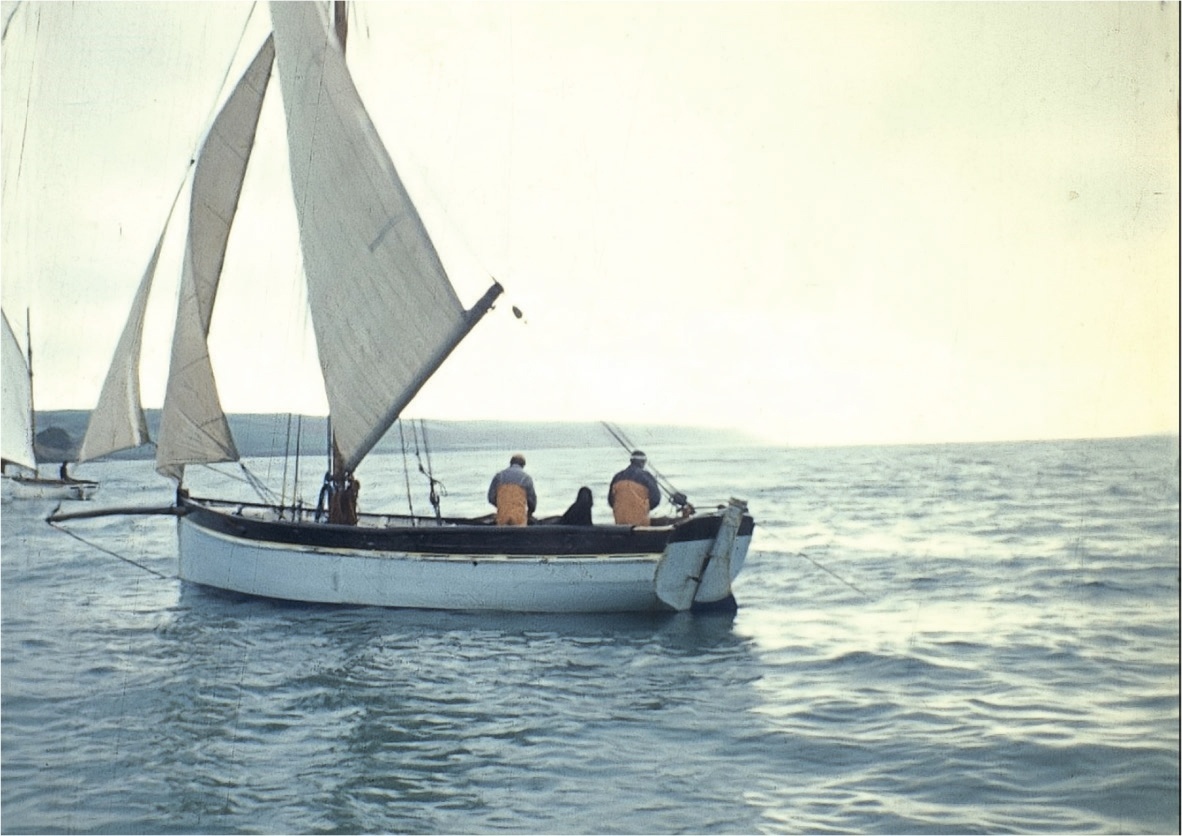
Figure 5
Carefully sorting the catch, carefully sorting the footage. From the Culch (dir. Paul Mulraney), Seamonster Media, 2023.
This open line of questioning – ‘remember’ – resulted in a recording that contained great humanity, but also a real sense of authority. Dennis had naturally fallen into a delivery that echoed Plantinga’s ‘formal voice’, his memory was in the main incredibly sharp, his voice ‘makes sense of its subject and passes on that sense to the spectator’,23 stepping into a mode of narration that was clearly informed by his familiarity with the expository documentary form, and the performative role that he was enacting. However - and here the recording takes on a wonderful human quality - this formality eventually gives way to Plantinga’s ‘open voice’, as the pathos of memory grown hazy, and the weight of newly awakened grief, erodes the certainty of the memories shared, giving way to a voice that ‘is more hesitant in its epistemological position, and at times opposes the dissemination of knowledge within a clear-cut conventional framework’.24
I synched the resultant recording to the footage and a story slowly emerged. Of love and loss, of time and memory, of dog biscuits and sideburns. The discarded outtakes started to grow, or rather to fit, into something that steered a little closer to a conventional framework. The 30-minute runtime distilled down to the 15 minutes of footage that held meaning for Dennis, and the random bin cuts started to coalesce into three defined acts that spoke to the needs of structure – firstly an establishment of time and place, followed by an emotional centre where the personal story of grief moves to the fore, and a final act that coaxes us back to the bigger picture reminding us what the fishery – and by extension what we - have lost.
During the editing process the film found its title. I learned that ‘the culch’ is the bed on which oysters grow. Composed of discarded shells, stones and grit thrown overboard once the dredge has been sifted for marketable oysters, culch is the fertile ground on which future harvests rely.
I also learned that bin cuts are the bed on which a film can grow. Composed of discarded shots, retakes and tails, thrown on the cutting room floor once the edit has been sifted for marketable material, bin cuts are the fertile ground on which archival documentaries can flourish.
The cutting room floor was my culch. The film was my harvest (Figure 6). This method, of harvesting discarded or unwanted footage, recalls one of the techniques deployed by documentarian Adam Curtis. When Curtis trawls the BBC archive for outtakes and offcuts, he reconstitutes the past as something new, as something unexpected, to make us feel a truth that hides beneath the carefully edited construction that is history. ‘If you live in a world, a time, an age, when feelings are the most important things ... then a history of that time has got to incorporate a history of those feelings’.25 The potential of the archive footage lies in its fragmentary nature, Curtis’s films recognise the editor’s ability to harness the incomplete history locked in incomplete footage, in order to speak to the now:
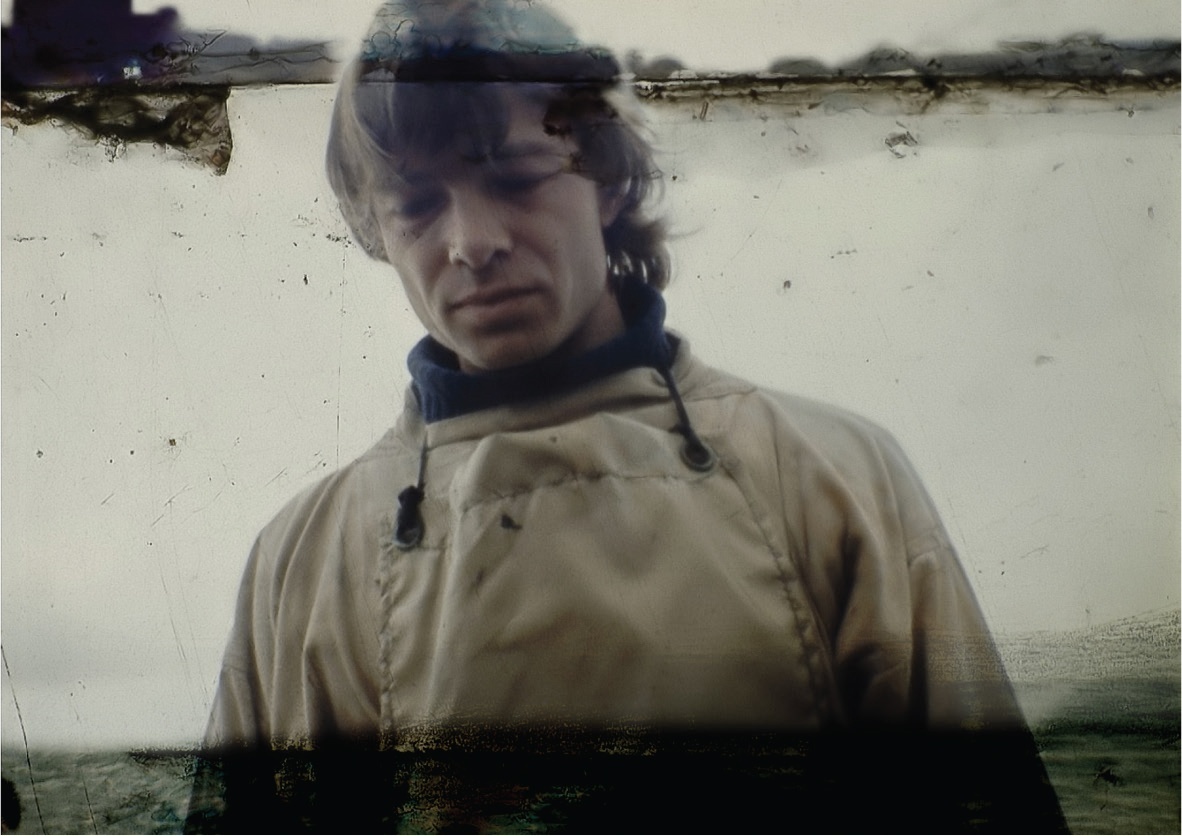
Figure 6
A slow cinematic portrait, left on the cutting room floor. From the Culch, Seamonster Media, 2023.
We have a record that is seriously just fragments, and out of those fragments we stitch together stories about the past. And what I do is go back and re-stitch those fragments together in other ways and say well, have you thought about looking not just at then, but also at now, in a new way.26
I searched my piece of lost, fragmentary BBC archive film, hunting through the discarded moments of aesthetically and narratively undesirable footage. But instead of finding something new and unexpected, I found something old, something reassuring – a container for emotion and memory far more fitting to the themes of loss and grief than the carefully staged, framed and edited footage that is common to televisual documentary and (as I could only anticipate at the time) to the original, lost documentary. Here, in this lost and found footage, I had found a way to tell a story about loss. At the heart of this lay an approach to filmmaking rooted in a vernacular methodology.
4 A Vernacular Methodology for Archival Production
As a practice-based researcher I work within a dialectical mode that draws on the anthropological tradition, where the researcher finds ‘methods and methodological stances linked with ethnography…such as insider perspectives, participant observation and interviews’.27 Dialectical practice-based research encompasses ‘forms of inquiry whereby the artist-researcher explores the uniquely human process of making meaning through experiences that are felt, lived, reconstructed and reinterpreted’.28
This dialectical mode – foregrounding as it does such intangible assets as feelings, experiences, memory and subjective interpretation - aligns well with Mackey’s definition of what constitutes a work of vernacular culture, offering a methodology with which we can make films that are rooted in a set of ethics that are strong enough to withstand a filmmaking process that is carried out in even the tightest of communities:
Relationships are more important than objects. Tradition and improvisation play equally central roles. Meanings and metaphors may be opaque to those outside the community of origin but deeply resonant to those within.29
Filmmaking is a practical as well as an intellectual exercise, and the filmmaking process can actively deploy methods that maintain (perhaps even strengthen) relationships and traditions, that encourage improvisation and embrace the emergence of meaning that may not have a popular, or wide commercial, appeal.
In this way my relationship with my neighbour Dennis took precedence over the outcome of the final film: my consideration for his family’s grief could have clashed with my expressed desire to show, and narrativize, that grief in front of an audience. However, through a process of co-creation that far outreached the meagre criteria of the Stirling Media Research Institute’s Consenting Adults report - which baselines ‘informed consent’30 as a participant’s knowledge of programme format, the usage and consequence of their contribution - consent here was not shaped simply by a pro forma, but through a long ongoing discussion of shared values, shared goals, and shared history. In this way we found an approach where the film became, to as large an extent as possible, his story, not my own. In such a way, the pride and catharsis that we shared in constructing the film around such a difficult, personal theme as grief became a part of the filmic material itself.
The impact that this ceding of narrative control has on free expression and authorship can be viewed as detrimental to the documentary process. Brian Winston suggests that the outcome is ‘a fundamental renegotiation of the relationship reducing the filmmaker to an advocacy/enabler role’,31 documentary as a form of ‘Civic’ journalism:
This means, in effect, journalists must engage with the communities in which they live; abandon objectivity, at least in the sense of disengagement; and no longer privilege truth, at least in the sense of self-censoring stories in the name of social responsibility if publication would prove divisive or have negative effects on the community in other ways.32
Community engagement is positioned here as a reduction of the documentarian’s role. It says much about the hegemony of objectivist documentary in the modern age that disengagement is perceived as an elevation, valued above a community-centred, socially responsible approach.
Is it possible that community engagement can lead to an elevation of the documentary form? Tim Plester, one half of the production team Fifth Column Films, has made a number of successful documentaries that are rooted in archival practice and that work within the vernacular mode. Here there is also a narrativization of community archives, and a careful handling of community feeling. Of the footage that is used in Way of the Morris (also shot in 1975, Figure 7), Plester notes that:
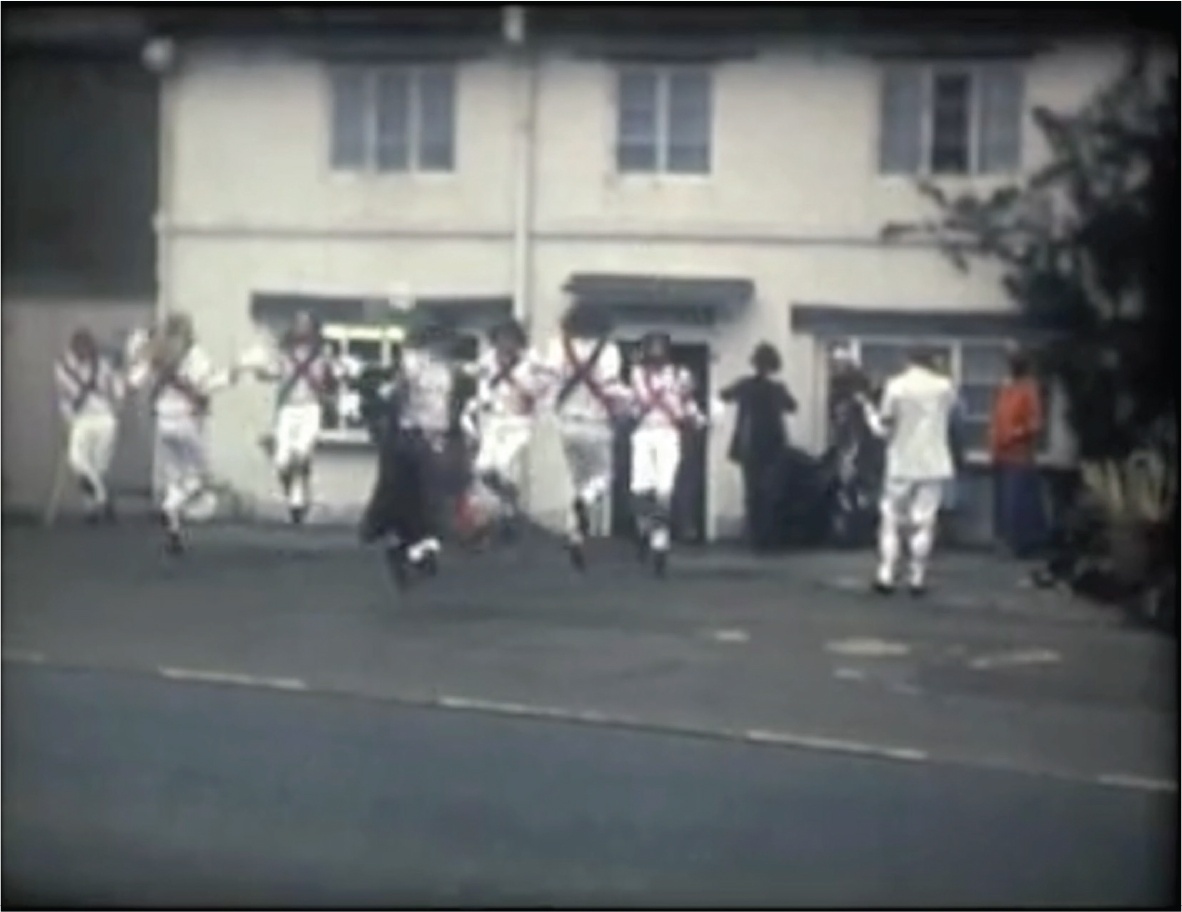
Figure 7
Morris men take flight in 1975. Way of the Morris (dir. Tim Plester & Rob Curry), Fifth Column Films, 2010.
This mode of working doesn’t exclude narrativization, it is communities telling each other and telling themselves stories. Film doesn’t impose through narrative. In fact, I think, if you had given them those hundreds of hours of footage, they never would have watched them. But now you’ve wrapped them in a story, even if that story is something that they might disagree with or feel disappointed about, the fact that it is a story is what carries the day.33
Here Bill Nichols’s call to action for an ethical documentary practice becomes ingrained in the documentary process: ‘Documentary film seeks to evoke feelings, alter or strengthen commitments, and propose actions that are propelled by shared beliefs’.34 Here is a recognition of the role of community building in any ethical approach to the documentary form, and so it is logical that the foregrounding of ethics is sharpened when working with commitments that are pre-existent, and post-existent, to the film at hand. Certainly, in all of my decisions I sought, primarily, to honour the material from which the film was constructed (celluloid, offcut, memory, grief) as an act of commitment to my neighbour, by extension to my community, and finally to an ethical documentary practice itself.
Perhaps we’re simply speaking of authenticity, honesty and a search for emotional truth - or of a filmmaking sensibility that aspires to these. Or perhaps, simpler still, of a filmmaker who is left without a choice – small communities, and large fishermen, tend to be good at weeding out dishonourable intentions.
Ultimately, in the search for a methodology befitting the story at hand, it is crucial that an ethical position is established, because it is only then that fitting production methods can be identified and implemented.
In the case of From the Culch, in interview technique, to encourage improvisation, to discourage performance. In writing and structure, to respect the rhythm and poetry of the language, to find the meaning, but not let the meaning break the dream. In editing, to find flow in the fragmentary nature of the archival film, to celebrate the grain, the focus pull, and the glue. In the sound design and recording, to leave a sonic hair in the gate, to not crowd the mix or attempt to add too much. And through Kingsley Marshall’s evocative Eno-inspired score, to avoid the hurdy gurdy and the shanty, to create a soundtrack as timeless as the fishery, with the aim of removing anything that will date the film, so that its central theme – that grief, at least, has no shifting baseline – can speak clearly to a contemporary audience.
5 Found in the Archives
Early community screenings of From the Culch were highly informative. Collective memory retrieved the name of the interviewer who is seen briefly in the offcuts: John Stapleton. A member of the audience also remembered the name of the show: it was an episode of Nationwide, made for BBC Southwest, and the date it aired: 1975. Details emerged that would become clues in the renewed search for the lost film.
From the Culch went on to screen in academic contexts, and it was through academic dissemination - a paper that I delivered at the 2023 BFI Southbank FIAT/IFTA seminar (Figure 8) - that the original 1975 sound documentary would eventually be found, restoring Paul Laity’s voice, unheard for 50 years, to the Laity family.
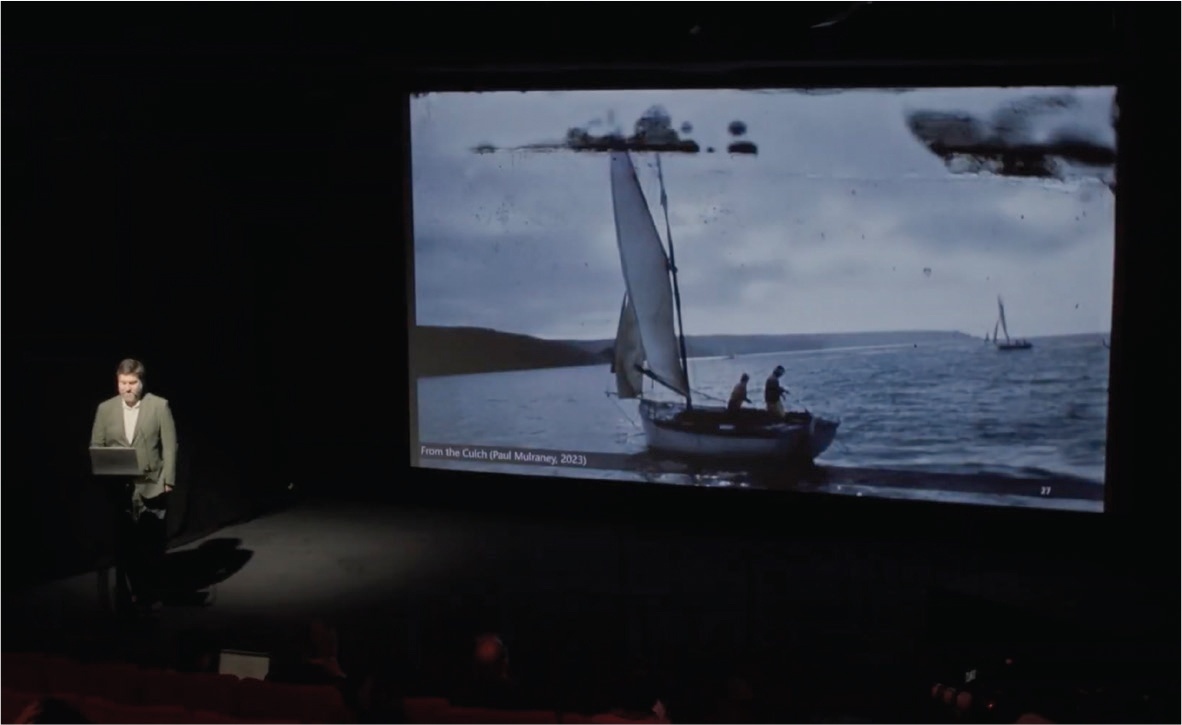
Figure 8
The author, developing communities of practice at the FIAT/IFTA Media Studies Seminar, BFI Southbank, 2023.
Tom Cox-Porter, Archive Technical Operator at the BBC, was in the audience at the BFI Southbank that day. Moved by the story behind From the Culch’s development, he offered to help to find the original film:
Even though you’d spoken to somebody in the archives before, there are so many different nuances, and people work for specific reasons. Some people are better at finding things than other people. I guess that’s where I became intrinsically connected to this whole journey.35
Drawn by the personability of the project, and feeling a resonance with the material, Cox-Porter set about the task of tracing the film. The information garnered during From the Culch’s public screenings – the presenter’s name, a rough broadcast date and programme title – helped to narrow down the search. As BBC Genome yielded no results, a deeper dive into the BBC’s tape-based INFAX legacy system was necessary (Figure 9).
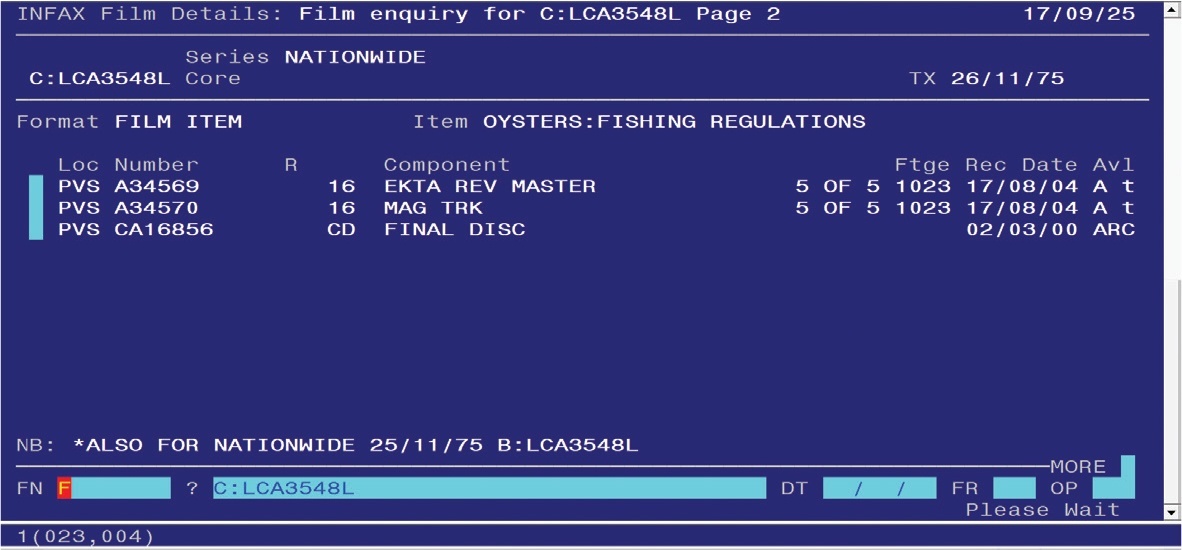
Figure 9
The original documentary, found on the BBC INFAX archive system. Image courtesy of the BBC, 2025.
The challenge of finding the film was compounded by both the sheer number of results returned, and an absence of metadata with which to identify the holding: ‘Nationwide is one of the biggest programmes that’s ever been made in this country, it ran for 50 years, every single week, five days a week, in different places’. The regional nature of the show led to further challenges:
You can see from the state that some of the assets are in that there was less money given to the nations 40 or 50 years ago. I think once you understand that it’s not a London programme, it’s a regional programme, and you understand the constraints in terms of time and money that are put on the nations, you can then look for that overarching programme number, which within the legacy system search will then pull you back a lot of different things.
This disparity between the quality of data held on London versus regional programming also extended to the way in which the programme was numbered, further compounding the difficulty of the search:
With it being Nationwide, to stop there being endless programme numbers they would follow a format. So, the programme number for the original episode of Nationwide was LCA3548L, but they would reuse this for an entire week, so Monday would have been A, Tuesday B, et cetera. As this was Wednesday’s edition, its programme number was C:LCA3548L.
This information – passed on by a senior archivist who’d been involved in the breaking down of the BBC’s Television Centre in the early 2000s, during which time the original broadcast’s digitisation and archiving took place – allowed Tom Cox-Porter to work in the absence of detailed metadata:
As it was a regional programme, some of the functions and mechanisms and searches to find these things, unless they are passed through people, they’re completely lost to the world.
Sometimes one person holds the lock and the key to Pandora’s box. It absolutely opens everything up. Without those personal relationships, without somebody showing you these things, there’s no way you would get there, because the other search functions that we have may not be fit for certain purposes. If you don’t keep up that knowledge, or people don’t pass that on to each other, things get lost.
The importance of archivists themselves in the functioning of a healthy archive cannot of course be overstated, but this foregrounding of relationships - interpersonal communication over systemic search, living memory over metadata – holds a mirror to the vernacular filmmaking process itself, suggesting that beneath (or above) the tasks of acquisition, categorisation and distribution, an archive also operates on a level where holdings are not just a commodity, but a means of connection between disparate communities of makers, archivists, and the general public.
Asked whether he felt the BBC recognised the term ‘vernacular’ or ‘people’s archive’, and the immense community value that this kind of material has, Cox-Porter replied:
I think your use of ‘vernacular’ enforces a long-standing need to establish a common link between archives and the public, but I think we are yet to really find the means to do so, and I think as technology has evolved this will only become a harder gap to bridge. Having said that, our conversation is a perfect example of effective discourse in the digital age that succeeded in its goal (…) You’ve made the film because of a personal reason. And I’ve then resonated with that. I don’t worry about technology taking over because we are having this conversation right now.
After Cox-Porter tracked the Nationwide film down, I screened it for the Laity family. It contained an interview with Paul Laity (Figure 9). It was the first time that I had ever heard his voice. For the family it was the first time in 50 years. For his youngest daughter, an infant when he passed, it was the first time in her memory. The deep personal impact that his work had on Dennis and his family was not lost on Cox-Porter:
You know what, I actually did cry. It fully did bring a tear to my eye. I think that’s maybe the reason that we do things like this, why we go the extra mile. I’ve recently lost my granddad, and there’s not a day goes by since it happened that I don’t think how nice it would be to hear his voice one more time, just to say goodbye. And if I can give that to another person? That’s why I do what I do. I find it thoroughly rewarding, but hugely emotionally taxing. I couldn’t be more happy that I was able to help you, and also his family. There’s no price that you can put on that.
6 Conclusion
The Nationwide film itself was very much of its time: the A-Roll broadcast footage was selected for clarity and quality; the framing standardized; the camera movement smooth and professional; the edit clipped and jolly. The shrill 1970s orchestral score and the presenter’s diction gave the piece a cosy, historical feel. Its optimistic, inquisitive tone suspects nothing of the grief and hardship that is about to befall these people, and this place (Figure 10).
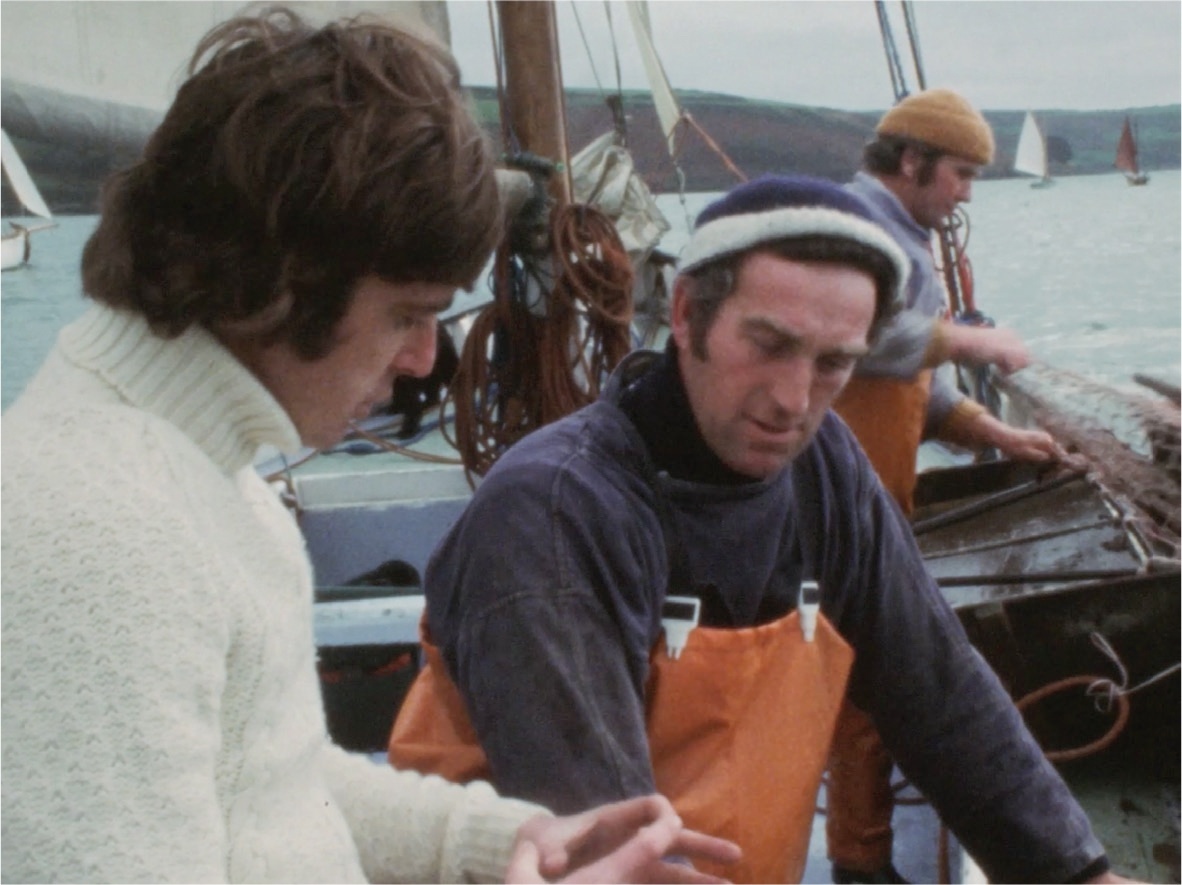
Figure 10
John Stapleton interviews Paul Laity, Dennis Laity hard at work behind. Nationwide, BBC, 1975.
Louis Franklin McLaughlin in his essay The Ethics of Archive in Documentary Filmmaking advises that:
A visual artist or filmmaker working with archive footage must begin to consider the archive itself as a subject or participant, with all the connotations that entails… an archive contains the memories of its past as well as its fantasies of its future.36
To think of the archive itself as an active participant in creative process - complete with its own sense of loss and hope, of memory and imagination - is to anthropomorphise a data storage system, with all the connotations that that entails. But if we consider the role that archivists themselves play in awakening an emotional capacity within the archive, in encoding and responding to human need, perhaps then we can view the system as a participating member of an ongoing community of practice, not as a place where practice is reified.
In his book Communities of Practice, Etienne Wenger describes the role that participatory communities - brought together by a shared passion - play in developing knowledge, and the ways in which this can foster systemic change: ‘reification must be reappropriated into a local process in order to become meaningful’.37 For if there is a vernacular within the institutional archive it is there as a result of the people who are local to it and who recognise the local value within it – its traditions, its improvisations, its meanings and its metaphors.
By working closely with the BBC archive team, a practice-based research project that began as an exploration of loss ended as a celebration of what it means to find, providing insight into our national archives’ ability to engage on a personal level with the persons who have been filed (and misfiled) within their ever-growing, ever reifying systems, shining a light on the potential for communities, filmmakers and archivists working within (and without) these systems to create bridges between the personal and the public, between memory and history, between that which has passed away and that which is present.
Not long after I screened the Nationwide film for the Laity family Dennis passed away. During the funeral a section of the eulogy was dedicated to the journey we took together in making From the Culch, it was one of the proudest, most emotional events of my professional life. The film is now a document of another passing.
Notes
[1] Paul Mulraney, From the Culch, November 2023, https://vimeo.com/792259305.
[2] David Deamer, “Dream-Images (Third Mental-Image)”, in Deleuze’s Cinema Books: Three Introductions to the Taxonomy of Images (Edinburgh: Edinburgh University Press, 2016),122.
[3] Laura Mulvey, Death24x a Second: Stillness and the Moving Image (London: Reaktion Books, 2006), 25.
[5] Louis Francis McLaughlin, “The ethics of archive in documentary filmmaking”, Media Practice and Education 25, no. 4 (2024): 367.
[7] Clarke Mackey, Random Acts of Culture: Reclaiming Art and Culture in the 21st Century (Toronto: Between the Lines, 2010), 244.
[9] Elena Ares, Matthew Ward, and Nikki Sutherland, “Shellfish Aquaculture Debate Pack”, March 15, 2023, https://researchbriefings.files.parliament.uk/documents/CDP-2023-0066/CDP-2023-0066.pdf.
[10] Leana Hosea and Rachel Salvidge, “Sewage spills blamed as E coli forces Cornish shellfish sites to close”, The Guardian, May 26, 2023, https://www.theguardian.com/environment/2023/may/26/sewage-spills-blamed-e-coli-forces-cornish-shellfish-sites-to-close.
[12] Carl Plantinga, Moving Viewers: American Film and the Spectator’s Experience (Berkeley: University of California Press, 2009), 6.
[13] Laura Mulvey, Death 24x a Second: Stillness and the Moving Image (London: Reaktion Books, 2006), 191.
[15] Laura Mulvey, Death24x a Second: Stillness and the Moving Image (Reaktion Books, London, 2006), 31.
[16] Mark Jenkin, interview with Bob Fischer, May 1, 2023, https://hauntedgeneration.co.uk/2023/05/01/mark-jenkin-enys-men-and-the-merry-maidens/.
[19] Nick Hector, interview with POV Magazine, October 17, 2021, https://povmagazine.com/interview-nick-hector-on-editing-sharkwater-extinction/.
[21] Louis Francis McLaughlin, “The ethics of archive in documentary filmmaking”, Media Practice and Education 25, no. 4 (2024): 373.
[23] Carl Plantinga, Rhetoric and Representation in Non-Fiction Film (Cambridge University Press, 1997), 115.
[25] Adam Curtis, interview with Simon Mayo and Mark Kermode, January 29, 2021, https://www.bbc.co.uk/programmes/p095jgz3.
[26] Adam Curtis, interview with Mark Blacklock, September 29, 2011, https://markblacklock.com/2011/09/29/adam-curtis-interview-19072011-unedited-transcript/.
[27] Marsha Berry, “Ethnography and Screen Production Research”, in Screen Production Research, Craig Batty and Susan Kerrigan, eds. (Cham: Palgrave Macmillan, 2018), 104.
[28] Graeme Sullivan, “Making Space: The Purpose and Place of Practice-led Research”, in Research-led Practice in the Creative Arts, Hazel Smith and Roger T. Dean, eds. (Edinburgh: Edinburgh University Press, 2009), 50.
[29] Clarke Mackey, Random Acts of Culture: Reclaiming Art and Culture in the 21st Century (Toronto: Between the Lines, 2010), 244.
[34] Bill Nichols, Speaking Truths with Film: Evidence, Ethics, Politics in Documentary (Berkeley, CA: University of California Press, 2016), 161.