
1 Introduction
Video 1
Do Sheep Dream of Electric Ruins? (2025), Director: Matt Parker
This article introduces Do Sheep Dream of Electric Ruins?, a short film I directed in 2024, shot in the region of Connemara on the west coast of Ireland. The film is an experimental, speculative documentary about the past, present, and future of spectral and electromagnetic infrastructures, meditating on the landscape of the Derrigimlagh bog. Derrigimlagh is a peatland on the west coast of Ireland and the former location of the first commercial transatlantic wireless telegraph station. The site was paired with a partner station constructed 3,591 kilometres west across the Atlantic Ocean in Glace Bay, Nova Scotia. It served as the foundation for global wireless telecommunications between its activation in 1907 and its closure in 1922.1
The ethereal dimensions and immense scale of long-range transmissions that the station produced are an alluring subject that the film and essay attempt to avoid. Instead, this article remains committed to the surfaces and sites of this pioneering media infrastructure, its prehistory, its operational history, and its presence in Ireland’s environment and heritage economy today.
The film and this essay also invite speculation about the future of contemporary media infrastructures. From the ground up, I extend upon the argument made by the philosopher Jacques Rancière, that the ‘logic of stories’ goes together with how historical narratives are created. I argue further that the ‘traces’ left behind within one historical narrative can form the foundations for stories of the past and of the future.2 The remnants of Derrigimlagh, including the Marconi ruins, serve as trace materials that highlight the area’s environmental characteristics, such as heavy squalls of wind and rain. Additionally, encounters with nonhuman elements, like sheep and turf, contribute to this landscape. The production of media artefacts – including sound and video recordings and archival documents – forms the basis for understanding both the electromagnetic ruins of the past and those of the future.
The film and essay are informed by on-site fieldwork at Derrigimlagh – including walking, filming, performance, and field recording – as well as extensive archival research. This includes work with “The Marconi Archives” at the Bodleian Library, University of Oxford. My approach is further grounded in biographical research, combining familial accounts of Guglielmo Marconi’s life with critical and institutional histories that situate his wireless experiments within broader technological and geopolitical currents.3
By looking at today’s ruins of the Transatlantic Marconi Wireless Station as a space to reflect on the material and immaterial remains of electromagnetic infrastructures and what it means to memorialise sites of telecommunication innovation, this paper and short film argue that these ruins are not only remnants of technological obsolescence but also sites of sonic and narrative persistence. Following what geographer John Wylie describes as ‘spectral geographies,’ the electromagnetic past lingers in the visible traces of decayed infrastructure and in the echoes of transmissions, the acoustic memory of the land, and the rhythms of its nonhuman inhabitants.4 Further, the spectral presence of these signals – both material and imagined – demonstrates how the ruins of one historical narrative can serve as the foundations for future media histories, inviting a reconsideration of how we listen to and narrate the afterlives of communication infrastructures.
2 Historical Context: The Development of Transatlantic Wireless Communication
The invention of transoceanic telegraphy in the mid-19th century revolutionised global connectivity, enabling near-instantaneous communication between continents for the first time. Submarine cables became the arteries of empire, supporting the political and economic coordination of colonial powers. Requiring extraordinary volumes of resources such as copper from the mines of Cornwall and Anglesey and gutta-percha from the Malay Peninsula, the cables became the ultimate colonial project of extractivism, with widespread environmental consequences. The fragility of cable infrastructure is highlighted by its various vulnerabilities to damage, whether from undersea currents, erosion, ship anchors, sabotage, or war. An alternative system that could transcend the physical barriers of geography was needed.5
Building on the discoveries of Jagadish Chandra Bose, Heinrich Hertz, James Clerk Maxwell, Augusto Righi, and others, Guglielmo Marconi (1874–1937) developed a system capable of transmitting electromagnetic signals across vast distances without a continuous physical connection. Early experiments and public demonstrations of his wireless system in the 1890s – particularly those targeting influential figures in the postal, military, and naval fields – established Marconi as a central figure in the Western cultural imaginary. His work quickly drew the attention and opposition of incumbent telegraph monopolies, who viewed wireless as a direct threat to their control over global communication infrastructure.6
Marconi claimed in 1901 to have successfully transmitted and received the first transatlantic wireless telegraphic message between Poldhu in Cornwall and Signal Hill in Newfoundland. It was a symbolic achievement that demonstrated the potential of wireless to compete with and eventually supersede cable systems. Shortly after the announcement, his company commenced plans to construct a commercial transatlantic wireless system, first, an experimental site between Poldhu and a site acquired at South Wellfleet on Cape Cod, Massachusetts, followed by a second, commercial site, linking Glace Bay in Nova Scotia with Clifden in Ireland.7
The Marconi Wireless Telegraph Company’s decision to establish a network of transatlantic wireless stations was a technological, economic, and geopolitical strategy. Wireless communication offered unparalleled flexibility by circumventing the physical vulnerabilities of undersea cables, yet still required land bases to house the massive, high-powered transmitters and receivers necessary for long-distance transmission. These sites were carefully chosen based on their geographic location, land affordability, landowners’ willingness to sell, access to natural resources, and remoteness.8 Under British colonial rule, the Derrigimlagh bog, just south of the small town of Clifden in Connemara, Ireland, was chosen as the preferred site for the initial Eastern Atlantic station. The site was acquired in 1905, and the company started commercial operations in 1907. Its relative isolation and abundant peat reserves enabled the facility to become a crucial node in the transatlantic network, linking Ireland with Canada and solidifying Marconi’s dominance in the nascent wireless industry.9
3 Clifden, Ireland
3.1 Clifden Before Marconi
The period of operation for the Marconi station in Clifden is detailed by Irish historian Kathleen Villiers-Tuthill in Beyond Twelve Bens: History of Clifden and District, 1860-1923 (1997). In this account, Villiers-Tuthill provides a wider socio-political and economic history of the region, essential for understanding the conditions under which the Marconi company selected the Derrigimlagh bog for its transatlantic wireless station. In 1804, John D’Arcy (1785–1839), a member of a prominent Galway merchant family, inherited the Connemara estates, an area thinly populated by fishermen and mountain farmers on the East Coast of Ireland. The region’s terrain, primarily mountain, rock and bog, offered little opportunity for income generation by its occupants and their new landlord. D’Arcy decided to establish the town of Clifden, with the ambition of transforming it into a site of leisure and tourism.10
Upon his death, Hyacinth D’Arcy (1806–1874) inherited both the estate and its debts. The town’s growth was hit dramatically following the 1845 potato crop failure, which led to an Gorta Mór (the Great Hunger). By 1848, the region had been cleared by mass emigration. Many of the landlords in Connemara were forced to declare bankruptcy and place their estates on sale in the Encumbered Estates Court, a mechanism established by the colonial rulers in the British Parliament to distribute Irish land into the ownership of British speculators.11
With a population around one-tenth of its pre-famine period, Thomas and Charles Eyre from Bath purchased most of the region’s land from D’Arcy in 1850, and gifted it to Charles’ son, John Joseph Eyre of London, in 1864.12 Londoners were picking up the bargain deals of land in Ireland, profiting from the disaster of an avoidable famine that had left the region in tatters. Landlords such as Eyre offered incentives to tenant farmers to emigrate and began introducing mass livestock farming of cattle and sheep in their place.13 By the early 20th century, the region remained sparsely populated, and its residents were largely reliant on subsistence farming, fishing, and peat cutting for economic survival.
3.2 Constructing the Marconi Station
With its primary research site in Poldhu, Cornwall, Marconi’s Wireless Telegraph Company’s management was initially reluctant to build a second East Atlantic station. In a letter addressed to Guglielmo Marconi dated September 1904, Managing Director Henry Cuthbert Hall (1867-1938) reluctantly conceded that it would be more expensive to rehaul the Poldhu station than to build an entirely new one in Ireland. Money was a prevalent issue for the company at this time, and much of its funding came from subsidies from the Post Office and Naval Admiralty, which had conflicting priorities. The Admiralty would only subsidise construction in Ireland, though Cuthbert Hall expressed concern that ‘labour would be expensive and difficult to obtain,’ reflecting broader colonial anxieties about the Irish workforce and infrastructure.14 These managerial attitudes were mirrored in the correspondence of George Kemp, a senior engineer on Marconi’s team, who requested the recruitment of ‘Widnes men’ from England to handle the technical construction, citing doubts about the skills of the local labour force.15 By contrast, when Marconi sought permission to construct the partner facility in Nova Scotia, the company was contractually obliged to exclusively hire locally.16 This divergence in policy suggests a pattern of distrust that was not merely economic, but rooted in the colonial dynamics between British management and Irish labour.
Derrigimlagh was considered a ‘bleak, desolate bogland, devoid of vegetation’ and identified by Henry Jameson Davis (1854-1936), the first Managing Director of The Wireless Telegraph & Signal Company, as ideal land for constructing a transatlantic wireless facility.17 325 acres of land were leased at six pounds per acre, half the going rate for land in Ireland, from the England-based landowner James Timothy Morris. Construction commenced in 1905. The land offered a direct line of sight towards the Atlantic West. There was an abundance of peat that could be used to power a generator and an abundance of water from the bog lakes, which could heat the boilers. Its rural location was sufficiently distant from major population centres to avoid prying eyes.18
The company had a cut-price deal at half the standard rate for their acquired land. Then, it proceeded to commence construction for a project where they were not confident about local staff and where the local area lacked appropriate infrastructure and resources for its building. By July 1906, significant concerns were being expressed that Clifden had insufficient infrastructure to deal with the influx of the Marconi project. A letter composed by the Poor Law Office in Clifden requested support from the government for improvements to their pier following six weeks where large steamers with material for the Marconi project ‘were obliged to anchor in the bay and unload their Cargo into Smaller vessels, thereby resulting in much damage, great delay, and vast expense.’19 Most equipment for the site was shipped via steamer from the manufacturing plant in Chelmsford, UK. As a result, the government was asked to support and renovate the port at their own expense, and the existing infrastructure and personnel had to bear the cost of accommodating the project.20
Upon its completion in 1907, the Derrigimlagh station was an extraordinary feat of engineering. The facility included a condenser house, a power station, and eight towering steel masts supported by aerial wires. Marconi’s engineers constructed a narrow-gauge railway to transport the occasional passenger and to move peat turf cut from the bog to the on-site power station. The steam-powered generator supplied voltage to the condenser house’s electromagnetic system.
The station’s operations transformed Derrigimlagh into a hub of activity. Local workers were employed to cut and stack peat, while British engineers and technicians managed the station’s daily operations. This created a complex social dynamic, with Clifden’s residents benefiting economically while grappling with the cultural and power asymmetries introduced by the station’s presence.21
However, the Derrigimlagh station’s prominence was relatively short-lived. By the early 1920s, advances in wireless technology and geopolitical changes, including the Irish War of Independence (1919-1921), rendered the site obsolete. Then, in July of the Irish Civil War (1922-1923), the station was attacked and partially destroyed by Republican forces, marking the end of its operations. The Marconi company, whose finances were deeply intertwined with the interests of the British Postal Service and Naval Admiralty, decided to cut their losses. The company put the property up for sale. No buyer came forward, but the remaining contents and equipment were sold to a Sheffield-based scrap merchant, Thos. W. Ward in 1925. The space was then abandoned.22
4 Ruins of Electromagnetic Infrastructure
Derrigimlagh is both a ruin and a thriving, biodiverse ecological site today. It has been repurposed as a heritage destination, drawing visitors to explore its history and reflect on its cultural and environmental significance. It remains a testament to the ambitions and contradictions of early wireless communication.
Historian Bart Lee has raised an important question about the history of wireless telegraphy infrastructures, namely, ‘What’s left?’23 The systems required stations to transmit, which comprised buildings and antennas that left traces and remains. Lee has called for a ‘radio archaeology’ that could supply valuable reference points for the social change created by radio-based infrastructure. An archaeology of technological frameworks surrounding the production system of wireless telegraphy uncovers a complex relationship between the cultural importance of the emerging transmission industry, the perceived etheric intangibility of electromagnetic waves, the material record of industrial-scale machinery, including generators, power plants, alternators, intricate antenna arrays, the facilities that housed them, and the individuals who directly and indirectly worked diligently to power and propagate the functionality of these emerging critical sites.
Relatively untouched for many decades, the site was featured in the BBC series Coast in 2010, during which a small-scale replica of the original transmitter was constructed.24 During the episode, a superimposed image of the wireless antenna infrastructure demonstrates the scale of what would have been seen at the site during its operational heyday. In contrast to the spectacle of the superimposed image, the bog today has begun to reclaim its space. Where the land was once privately owned, protected and guarded by Marconi security staff, then during World War 1 by the British Military, it is now a flock of sheep that monitor the land. Local farmers allow them to graze and roam freely across what is now common ground [fig 1].
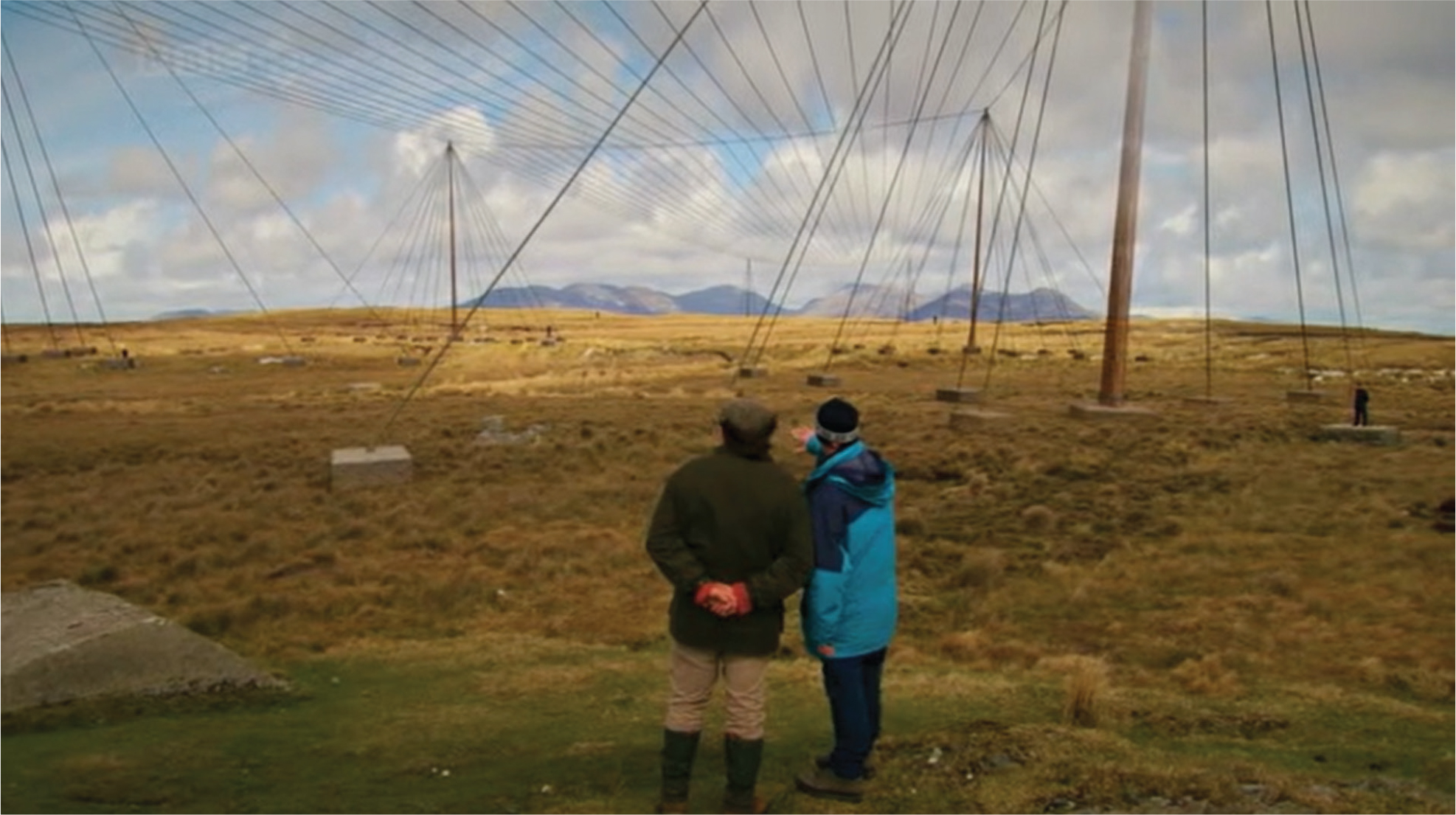
Figure 1
Still from Coast (2010), which includes a special effects transposition of an antenna array onto the Marconi site at Derrigimlagh.
Over a century after the closure of the Derrigimlagh transatlantic wireless site, the foundations and brickwork rubble of the ancillary buildings and military barracks remain. While the landscape quietly absorbs the remnants of the past, recent heritage efforts have sought to surface its buried histories, inviting more structured forms of remembrance and encounter. In May 2016, following a substantial investment from the local authority of Clifden, the Derrigimlagh Signature Discovery Point was formally opened. A considerable information and design experience heritage trail was commissioned and built by the artist duo of Anne Cleary and Denis Connolly. The pair produced a series of educational information boards that follow a gravel path with sections of wooden boardwalk forming a circular loop around the site. Remains of the site and points of interest are now situated alongside a collection of wind-up audio players and experimental artworks, including a large wind chime and a parabolic dish. There are also a series of photoscopes – static viewfinders containing glass etchings of archive photographs of the site taken from the Bodleian Library archive and the National Library of Ireland. Visitors can position themselves behind one of the aluminium photoscope sculptures and see a glass-etched photograph overlaid on the landscape, offering a spectral gaze into the vibrant past of the otherwise derelict terrain of Derrigimlagh bog today. The artists activate the site through their sculptures and information boards, providing engaging stoppage points and temporary shelters around the trail loop.
In his Geology of Media (2015), Jussi Parikka describes how ‘memory is always a remediated material event,’ that is, ‘always a monument and inscription.’25 Peter van Wyck further argues that the terrain of ruins may be read as a ‘territorial archive,’ where shaping and marking landscapes through human intervention effectively transforms terrain into a repository of historical, cultural, and environmental narratives.26 The wireless station’s foundations in Derrigimlagh bog – slowly reclaimed by peat, water, and vegetation – embody precisely this archival function. As the concrete foundations gradually sink and become buried, they form subtle mounds and contours, inscribing past technological endeavours directly into the terrain, materially transforming Derrigimlagh into an archive of electromagnetic history, colonial presence, and ecological reclamation.
Cultural geographer Tim Edensor similarly describes industrial ruins as spaces of indeterminacy and affect, in which the passage of time becomes visible and other-than-human agencies – fungi, moss, rust – play active roles in reshaping abandoned technologies.27 These remnants interact with ongoing ecological processes and cultural memory practices, from the grazing patterns of sheep to the etched glass viewfinders that reinsert the past into the present. Viewed as a territorial archive, Derrigimlagh is a site of memory and a medium that registers the shifting conditions of power, environment, and imagination.
This starkly contrasts with other post-industrial sites that have been reabsorbed into the circuits of digital capital. The former paper mill in Hamina, Finland, now repurposed as a Google data centre, or the reimagining of Seattle’s South Lake Union as a tech hub, are examples of how industrial spaces are often redeveloped to maintain infrastructural continuity.28 In these cases, industrial ruins are not left to decay but are actively folded into the demands of data economies. Derrigimlagh resists this logic. Upon the arrival of Marconi, this peat bogland facing the Atlantic Ocean was rapidly transformed into one of the most advanced technological sites of its time. Its sudden closure and abandonment, the reintroduction of non-native blackface sheep grazing among the ruins, and the continued harvesting of peat have arrested any return to a prior ecological or industrial state. Yet, unlike Hamina or South Lake Union, Derrigimlagh’s material and geological conditions do not lend themselves to reindustrialisation. Instead, Derrigimlagh offers an alternative trajectory for thinking about media infrastructures – one where infrastructures decay slowly through weather, soil, moss, and sheep, rather than through circuits of planned obsolescence and upgrade.
The sheep who roam the bogland, chewing at the grass and scratching their coats upon the sharp-edged information plaques, are the bog’s most frequent visitors, and their presence becomes a central figure in the film Do Sheep Dream of Electric Ruins?, which I will now turn this article’s attention to.
5 Soundtracking the Ruin
5.1 Listening to Derrigimlagh
Geographer Michael Gallagher has described how ‘audio geography’, the use of audio media in researching the place of ruins, can amplify the haunted qualities of ruins.29 I visited the Derrigimlagh peatland with a collection of microphones to listen to and record the sounds I encountered across the Marconi ruins. During several sound-based field recording walks around Derrigimlagh, I noticed how the site was sonically punctuated by five key sound sources: sheep, rainfall, wind rustling, water trickling, and my physical presence (clothing rustling, breathing, sniffing, and talking). Occasionally, in the distance, I could hear the rumble of car traffic or a faint resonance of a church bell. Very occasionally, another human visitor would walk by.
My experience of the sonic landscape of Derrigimlagh was in stark contrast to journalistic accounts of the site written just over a century earlier. With the wireless station in operation, the bucolic sounds of peatland and sheep were engulfed by the high-voltage spark transmitters that emitted blinding flashes of light followed by, what observers described as a ‘wearing, tearing boom like the deep bass of some gigantic organ.’30 Environmental sound recordings are an ideal way to amplify the ‘spectral geographies,’ trace materials and continued haunting qualities embedded within the architectures of technological ruins, even after they are silenced through obsolescence.31
During one scene in the film, a field recording is used as a dramatic soundtrack for a sequence where, holding a large field recording microphone, I am seen walking across the foundations of the site’s power house, toward the lake. The sound recording, taken at that location, picks up the whistling drones from a collection of temporary fence posts abandoned from a previous iteration of the site’s maintenance. The metal pipes resonated powerfully with the wind to create a landscaped Aeolian instrument across the ruined foundation of what was once the throbbing site of the facility’s energy production.
Listening to this sound during production reminded me of the sounds of ship rigging resonating in heavy winds. During especially turbulent days, the tensioned, tall-guyed masts, which held up the Marconi station’s giant antenna array, like ship rigging, would have whistled an equally ghostly howl. Listening within the ruined space today displaced these sounds, rendering them estranged, dislocated and uncanny. As Gallagher suggests, environmental audio could be considered as a kind of ruin, ‘an evocative physical trace that hints at what the recorded space might have been like but is always obviously partial.’32
Juxtaposing the filmed footage of the site with the haunting audio-sensory material, the expectation of the film is ruptured. The ocular material typically delivers the primary information of audiovisual work. Creating and representing moments of embodied listening in the film affords a deviation from the ocular. As film theorist Michel Chion argues, sound in film provides ‘added value’ that cannot be derived from images alone. Sound and image together create a perceptual whole that is both ‘immediate’ and ‘remembered’, and richer than their sum.33 The film’s soundtrack, in this way, activates a form of multi-temporal audio-vision: sound extends and animates the visual ruins, bridging past and present through acoustic memory, and encouraging viewers to listen across time.
5.2 Scoring the Film
At the turn of the 20th century, Guglielmo Marconi’s technological and commercial work, reputation, wealth, and relative youth had made him a celebrity. European and North American newspapers frequently discussed his professional and private life. The Marconi Company kept extensive press clippings for wherever Marconi – the individual or the company – was found in print.34 The Marconi brand, its ‘Marconigram’ wireless telegraphic service, and its association with its lead inventor meant that wireless telegraphy was thought of through the identity of Marconi himself. For example, Charles H. Taylor (1859–1907), a topical lyricist writing pantomimes in the West End of London, was enamoured by the evocative idea that Marconi was listening to him through the ether and wrote the song Over the Sea for a performance of Dick Whittington at the London Hippodrome.35 During a research fellowship at the Huntington Library in Los Angeles, I found the score in an archive, batched with over a dozen other scores written as celebration pieces for the 1858 transatlantic telegraph cable laid by the Atlantic Telegraph Company. To find this solitary score about wireless in a pile of scores celebrating the transatlantic cable echoes how the imperial project of the transatlantic cable was met with great fanfare and celebration. In contrast, the commercial endeavour of the transatlantic wireless station received ‘little ceremony’ due to the need to keep the site’s design secret from potential competitors in both the cable and emerging wireless industries.36
By commissioning a contemporary musician, Gary Salomon, to perform and record Over the Sea for the film, I aimed to reinsert this obscure fragment of wireless cultural history into the present soundscape of Derrigimlagh. The song operates as a historical counterpoint to my site-based field recordings, bridging media histories across time and medium. It highlights how popular imagination and media celebrity briefly transformed wireless into a cultural artefact, even as its material infrastructure remained shrouded in silence and secrecy. Juxtaposing this expressive, lyrical trace with the stark, wind-struck remains of the site today invites reflection on the uneven ways in which communication infrastructures are remembered, or forgotten.
6 Speculative Futures of Digital Infrastructures in Ruin
History concerns the narratives of humans and their lives. A ground-up approach to the electromagnetic landscape of Derrigimlagh prompts questions not only about the historical resonances of electromagnetic infrastructures and their traces upon the ruins embedded into the peatlands on the West Coast of Ireland, but also brings into question what the future might hold for the media infrastructures of today. In addition to human historical interrelations, a ground-down approach to this landscape, one that probes the media archaeological remains of wireless infrastructures, prompts questions about the deep temporal record of technology. Concepts such as Parikka’s ‘geology of media,’ Siegfried Zielinski’s ‘deep time of the media,’ and the notion of ‘technofossils’ advanced by Jan Zalasiewicz and others, point toward the temporal inscriptions of discarded media infrastructures, whose material residues persist in the geological archive.37 In her book Deep Mapping the Media City (2015), media scholar Shannon Mattern speculates on how the ‘archaeologies of tomorrow’ will include the excavation of ‘today’s wireless technologies… fibre-optic cables, massive data centres, and piles of e-waste.’38 Studying the degradation of fossil matter from the past in Derrigimlagh’s communication infrastructure prompts the question of what will remain buried in the earth and what will be memorialised. What kind of histories and geologies will our future stories tell?
In my previous film series, The People’s Cloud (2017-2020), where I interviewed prominent engineers within the media infrastructure industry, a core concern that repeatedly emerged was how the industry would provide sufficient capacity for the increasing demand for ultra-high definition (UHD) video content and blockchain applications.39 In the years that have passed, data centres have continued to be a significant growth area in media infrastructure construction. The current focus for the industry is now on designing and building dedicated facilities for large language models (LLMs) that fall under the subcategory of generative AI. The dramatic increase in energy requirements for generative AI models, especially LLMs, has created an entirely new set of pressures on the energy economies of big data.40 The research collective ANNEX, whose critical research project Entanglement (2021) addressed the environmental, cultural, and human impact of data through the prism of Ireland at the 17th Venice Architecture Biennale, has stated that ‘Ireland has historically emerged as a strategic node for technological infrastructure… [and] Dublin now hosts over 25% of Europe’s European Server Space.’41 Considering Ireland’s role as a critical node of contemporary electromagnetic territories – the site, throughput, and destination of global signal traffic – the film Do Sheep Dream of Electric Ruins? imagines how contemporary media infrastructures in Ireland might be overwhelmed by the capacious demands of Artificial Intelligence systems. The film speculates on how today’s infrastructures will also become spaces of a technological past, left in ruin.
Mattern’s comments on the future archaeology of wireless infrastructures also reminds me of the opening scene of the documentary Welcome to Sodom (2018), directed by Florian Weigensamer and Christian Krönes.42 A sensory ethnography of – at the time of production – the world’s most significant e-waste dumping ground in Agbogbloshie, Ghana, the film opens with a panoramic view of a landscape littered with Waste Electrical and Electronic Equipment (WEEE). Amongst the literal ruins of global media consumption are numerous sheep, loudly bleating and chewing on discarded detritus. There is a striking, if uneasy, poetic parallel with the sheep that wander the ruins of Derrigimlagh. While both sites register the afterlives of electromagnetic technologies, the consequences borne by each landscape, and more crucially, by their surrounding communities, are dramatically different. The site of Agbogbloshie became a highly toxic zone shaped by systemic environmental injustice and global inequality, with disproportionate harm to local populations who received comparatively little benefit in return. By contrast, Derrigimlagh’s ruination is situated within a rural European context where the human and environmental consequences are not of the same scale. In Do Sheep Dream of Electric Ruins? I build on this motif by working through footage produced during my earlier film project, The People’s Cloud (2017-2020), where I filmed several large media infrastructure sites, including internet exchanges, subsea cable landing stations, and data centres. I explore this layered resonance not to conflate these unequal sites, but to hold them together briefly, framing them as spectral residues in the long, uneven arc of media infrastructure.
Using Text-to-Image and Image-to-Video generative AI applications, I generated new video content, building on the existing media infrastructure film footage from The People’s Cloud. The AI applications generated short video sequences based on the images I had provided. They were modified to look like they had fallen into a state of ruin, where sheep roamed and grazed, much like my physical encounter with the sheep amongst the ruins of Derrigimlagh bog. In this way, I ask the generative AI applications to predict, render, and visualise their demise.
7 Conclusion
In an interview with an environmental surveyor and activist campaigning against the construction of a data centre on the West Coast of Ireland, I was told that the reclamation of land for a hyperscale data centre would be incredibly challenging due to the complexity of the underground infrastructures, fibre optics, power lines, and water channels that would be buried into concrete foundations as part of the site’s core infrastructure.43 Designed only to last 15–20 years, the average data centre has a very short lifecycle compared to other buildings. Engineering consultants in the field anticipate that the cost of updating what would have become out-of-date mechanical and electrical hardware at that stage would far outweigh the cost of simply decommissioning the facility.44 Marconi’s Derrigimlagh wireless station went online in 1907 and was closed by July 1922. Its closure was hastened by damage sustained during an attack on the facility by the Irish Republican forces during the Irish Civil War. However, the Marconi Wireless Telegraph Company had already brought its Caernarvon, Wales, facility online, which would render the Derrigimlagh station obsolete. The land and its contents were decommissioned and sold as scrap. Today, that land is scarred by the concrete pillars, foundations, and piles of bricks that were never reclaimed. They are slowly being folded back into the bog as sheep continue to graze the bare surfaces of the landscape.
As we face the challenges of building resilient, equitable, and sustainable media systems in the 21st century, Derrigimlagh’s legacy demands our attention. Its ruins are not just relics of a bygone era; they are active participants in what Steven Jackson describes as ‘broken world thinking’, a framework for attending to the fragility, failure, and afterlives of technological systems.45 Revisiting the history of sites like Derrigimlagh allows us to better understand the deep entanglements between technology, environment, and society – and perhaps begin to imagine new ways of building infrastructures that honour these connections rather than exploit them. As Inger Birkeland has argued, valuing industrial heritage in the Anthropocene requires more than preservation; it demands recognition of the site’s evolving ecological and cultural functions over time. She emphasises that heritagisation ‘is related not only to the past but also to the future’ through active modes of participation in ‘future-making activities.’46
Through its focus on Derrigimlagh, Do Sheep Dream of Electric Ruins? invites viewers to rethink the relationship between media infrastructures, landscapes, and time. Adopting a ground-up approach – attuned to the land’s materiality, labour histories, and nonhuman inhabitants – the film moves beyond the dominant narratives of innovation and progress. Instead, it asks: What is left behind when infrastructures decay? Who or what remains to witness their disappearance?
Ultimately, the answer is not the spectral ghosts of Marconi’s signals nor the ambitions of digital capitalism but the quiet persistence of sheep.
Submission Notes
Ethics Approval for the interview material included in this article was provided by the University of Arts London Ethics Board under the approval number MP060716.
Notes
[1] The commercial station was the only one of its kind until Marconi opened up a new commercial site in Caernarfon, Wales, in 1914. The Marconi Archive at the Bodleian Library, Oxford, includes a collection of materials concerning the Clifden station which reveal the critical role the site had for emerging wireless technologies. See “Correspondence and Papers on Clifden and Letterfrack Stations 1904-22”, Oxford, Bodleian Libraries, The Marconi Archive, MSS. Marconi 193.
[2] Jacques Rancière, The Politics of Aesthetics: The Distribution of the Sensible (London UK; New York: Continuum Intl Pub Group, 2004), 38–39.
[3] For biographical perspectives on Guglielmo Marconi that inform this project’s engagement with the Derrigimlagh site, I draw on Maria Cristina Marconi’s Marconi My Beloved (Boston: Dante University of America Press, 2001) and Degna Marconi’s My Father, Marconi (New York: McGraw-Hill, 1962), which offer intimate family insights into Marconi’s character, personal life, and travels to Ireland. Marc Raboy’s Marconi: The Man Who Networked the World (Oxford: Oxford University Press, 2016) provides one of the most comprehensive critical biographies to date, situating Marconi’s work within broader technological, geopolitical, and media-historical frameworks.
[4] John Wylie, “The Spectral Geographies of W.G. Sebald”, Cultural Geographies 14, no. 2 (2007): 171–88.
[5] For detailed accounts of the technological, cultural, and geopolitical implications of transoceanic telegraphy, see Simone Müller, Wiring the World: The Social and Cultural Creation of Global Telegraph Networks (New York: Columbia University Press, 2016), which analyses the global diffusion and sociopolitical entanglements of the telegraph; Tom Standage, The Victorian Internet: The Remarkable Story of the Telegraph and the Nineteenth Century’s On-Line Pioneers (New York: Bloomsbury, 1998), a popular history that traces early parallels with the internet; and John Steele Gordon, A Thread Across the Ocean: The Heroic Story of the Transatlantic Cable (New York: Simon & Schuster, 2002), which narrates the first successful cable crossing. For further analysis of the cable’s role as an instrument of empire, see Nicole Starosielski, “Circuitous Routes: From Topology to Topography”, in The Undersea Network (Durham: Duke University Press, 2015), 34. On the environmental toll of critical material extraction – especially gutta-percha and copper – see John Tully, “A Victorian Ecological Disaster: Imperialism, the Telegraph, and Gutta-Percha”, Journal of World History 20, no. 4 (2009): 559–79; and Helen Godfrey, Submarine Telegraphy and the Hunt for Gutta Percha: Challenge and Opportunity in a Global Trade (Leiden: Brill, 2018). The vulnerability of early cable infrastructure – whether to war, erosion, or natural forces such as icebergs – was often cited as justification for developing wireless alternatives; see Marc Raboy, Marconi, 179.
[6] Guglielmo Marconi, “The First Transatlantic Radio: Senator Marconi Recalls the Great Feat of Thirty Years Ago Today When a Signal Was Heard in Newfoundland”, New York Times, December 12, 1931, 18. For a comprehensive historical account of the legal and commercial tensions between Marconi and established cable interests, see Marc Raboy, Marconi: The Man Who Networked the World (Oxford: Oxford University Press, 2016), especially chapter 9.
[8] For an in-depth examination of the geographical, environmental, and socio-political conditions that shaped the siting and operation of the Clifden wireless station – particularly the role of colonial land policy, energy resources like peat, and rural labor practices – see Patrick Bresnihan and Patrick Brodie, “Energetic Mediation at Marconi’s Connemara Station”, Heliotrope (March 2022), https://www.heliotropejournal.net/helio/energetic-mediation.
[9] As the only commercial transatlantic wireless operator, Marconi monopolised the service. The company reports confirm they were operating with a constant upward trajectory. See “Analysis of wireless traffic between Clifden and Glace Bay, 1907-8”, Oxford, Bodleian Libraries, The Marconi Archive, MS. Marconi 193.
[10] Kathleen Villiers-Tuthill, Beyond the Twelve Bens: History of Clifden and District, 1860-1923, (Clifden: Connemara Girl Publications, 1997), 11–15.
[12] “Eyre (Clifden)”, Landed Estates, University of Galway, accessed June 10, 2025, https://landedestates.ie/estate/770.
[14] Henry Cuthbert Hall, “Letter to Marconi from Cuthbert Hall”, Letter, September 1, 1904, Oxford, Bodleian Library, MS. Marconi, 193.
[15] George Kemp, “Expanded extracts from diaries, 1910-12”, September 20, 1911, fold. 33–36, Oxford, Bodleian Library, MS. Marconi 101.
[16] “Agreements with the Canadian Government relating to wireless telegraph services, 1902, 1911, 1915” Oxford, Bodleian Library, MS. Marconi, 192.
[17] Henry Jameson Davis, “Letter addressed to Cuthbert Hall”, Letter, August 5, 1905, Bodleian Library, MS. Marconi, 193.
[19] “Letter to Government from the Poor Law Office, Clifden”, Letter, July 17, 1906, Oxford, Bodleian Library Ms Marconi, Box 193.
[21] For example, Bresnihan and Brodie in “Energetic Mediation at Marconi’s Connemara Station”, note how the Marconi station was fully serviced by its electrical generator while the surrounding area, including Clifden, didn’t receive electricity until 1927.
[23] Bart Lee, “Radio Archaeology: A Call to Action” (PDF Slides, The Antique Wireless Association Annual Meeting, San Francisco, CA, 2013), https://californiahistoricalradio.com/wp-content/uploads//2013/09/Radio-Archeology-v2.1.pdf.
[24] “Galway to Arranmore Island”, TV Broadcast, Coast (UK: BBC, August 11, 2010), https://www.dailymotion.com/video/x2z1fbd.
[27] Tim Edensor, Industrial Ruins: Space, Aesthetics and Materiality, Illustrated edition (Oxford: Berg Publishers, 2005), 113–14.
[28] On the transformation of the Hamina paper mill into a Google data center, see Jouni Salonen, “Cool, Calm and Connected: Why Companies Are Placing Their Data Centers in Finland”, Business Finland, January 20, 2025, https://www.businessfinland.com/news/2025/cool-calm-and-connected-why-companies-are-placing-their-data-centers-in-finland/. For critical perspectives on urban tech redevelopment and infrastructural continuity in the Pacific Northwest, see Anthony M. Levenda and Dillon Mahmoudi, “Silicon Forest and Server Farms: The (Urban) Nature of Digital Capitalism in the Pacific Northwest”, Culture Machine 18 (2019), https://culturemachine.net/vol-18-the-nature-of-data-centers/silicon-forest-and-server-farms/; and Dillon Mahmoudi, Anthony Levenda, and Alicia Sabatino, “The Urban-Tech Feedback Loop: A Surveillance and Development Data-Walk in South Lake Union”, Digital Geography and Society 7 (2024): 100106.
[29] Michael Gallagher, “Sounding Ruins: Reflections on the Production of an ‘Audio Drift’”, Cultural Geographies 22, no. 3 (2014): 467–85.
[30] “Marconi Signal Station”, Wagga Wagga Advertiser, November 23, 1907, http://nla.gov.au/nla.news-article145073841.
[33] Michel Chion, Audio-Vision: Sound on Screen, trans. Claudia Gorbman (New York: Columbia University Press, 1994), 221.
[34] Of particular relevance to the nascent period of the Marconi company, and Marconi’s personal growth as celebrity and public figure the press cuttings in “Volumes of press cuttings, 1897-1913”, Oxford, Bodleian Library, MSS. Marconi 1434–1497.
[37] Parikka, “A Geology of Media”; Siegfried Zielinski, Deep Time of the Media: Toward an Archaeology of Hearing and Seeing by Technical Means (Cambridge, MIT Press, 2008); Jan Zalasiewicz et al., “The Technofossil Record of Humans”, The Anthropocene Review 1, no. 1 (April 1, 2014): 34–43; Shannon Mattern, “Deep Time of Media Infrastructure”, in Signal Traffic: Critical Studies of Media Infrastructures, by Lisa Parks and Nicole Starosielski (Chicago: University of Illinois Press, 2015), 94–114; Jarad Farmer, “Technofossil”, in Future Remains: A Cabinet of Curiosities for the Anthropocene, ed. Gregg Mitman, Marco Armiero, and Robert Emmett (Chicago: University of Chicago Press, 2018), 191–99.
[38] Shannon Mattern, Deep Mapping the Media City (Minneapolis: University Of Minnesota Press, 2015), 9–10.
[39] Watch Matt Parker, “The People’s Cloud”, The People’s Cloud, 2017, http://www.thepeoplescloud.org/; and for a supplementary essay on this project see Matt Parker, “The People’s Cloud: A Sonospheric Investigation”, in Silver Linings: Clouds in Art and Science, by Dolly Jørgensen and Finn Arne Jørgensen, ed. Dolly Jørgensen and Finn Arne Jørgensen (Trondheim: Museumsforlaget AS, 2020), 226–31.
[40] For two recent studies into the hidden environmental costs of LLM data infrastructure, see Pengfei Li et al., “Making AI Less “Thirsty”: Uncovering and Addressing the Secret Water Footprint of AI Models” (arXiv, January 15, 2025); and Mél Hogan, “The Fumes of AI”, Critical AI 2, no. 1 (2024).
[41] Sven Anderson et al., States of Entanglement: Data in the Irish Landscape (New York City: Actar, 2021), 10–11.
[43] Allan Daly, Interview in Derrydonnell Forest, interview by Matt Parker, Mono audio recording and transcription, 2017.
[44] Peter Judge, “The Data Center Life Story: Data Centers and Born, They Get Old, and Some Day They Die”, July 21, 2017, https://www.datacenterdynamics.com/en/analysis/the-data-center-life-story/.