
1 Introduction: The Life of Images in Social life
How can we study the life of images? In a research program originating in the last century, Ferdinand de Saussure proposed semiotics as a method for investigating ‘the life of signs within social life’.1 Since then, numerous theorists have endeavored to link signs to their contexts,2 particularly within the audiovisual realm. Currently, 34 million videos are uploaded to TikTok every day, and 500 hours of video are shared every minute on YouTube.3 While textual content remains omnipresent in media environments, visual representations have invaded the space of the visible. Cartographies of the audiovisual domain are frequently proposed according to various genres. Computational methods are being employed to analyze television and the web;4 however, the temporal dimension of audiovisual media − specifically, its circulation − demands adequate understanding.
While interest in the context of the images is unquestionable today, it is the ‘life of images’ in its diachronic dimension that necessitates further investigation. Media images are perpetually repeated, and much of this content is a rehash of pre-existing material. Can we now study the evolution and transformation of images within social life? What methodologies can we employ to approach the temporality of their meanings, recognizing that the significance of images may vary across different contexts and temporal frameworks?
If an image depends on its context, how can we effectively analyze images that appear in multiple contexts and environments? The significance of this multiplicity becomes particularly pronounced in the case of video documents representing specific historical events. This phenomenon is exemplified by Andrew Hoskins’ concept of flashbulb memories.5 The case of September 11 is particularly noteworthy: those who witnessed the event live cannot forget its immediate visual impact. Subsequently, these images were reproduced countless times across a wide range of media. The images of September 11 possess an independent existence, generating a memory that cannot be reduced to a singular event or snapshot; instead, they traverse various contexts that reinterpret and, in turn, modify their meanings. While images are repeated, this repetition should be understood as a process of differentiation − the ‘in itself of repetition’, as articulated by Gilles Deleuze − not merely as generic recurrence but as redundancy that exists within the framework of temporality.6
The ANR Crossing Borders Archives project seeks to understand how and why certain images become more prominently featured than others, examining the underlying logics that facilitate their dissemination and reusability across various contexts to signify differing content. Thus, what constitutes the life of images: the trajectories they undertake, the ways in which they are repurposed, and the environments that re-present them and grant access to them? This inquiry necessitates, at least in part, an approach that could be characterized as materialist. Peter Szendy7 has advocated for an examination of iconomy, which involves the study of the administration of images and the frameworks that govern the visible. This would entail understanding the often technical factors that regulate circulation, including archival, documentary, and institutional constraints.8 To transition from the cartography of the visible to the study of images in their life, it appears necessary to adopt a perspective of digital materialism,9 seeking to position the meanings of images within the material conditions of their deployment. Scholars in media studies, semiotics, and art history, often referencing Warburg’s Atlas Mnémosyné, have proposed digital approaches to the genealogies of images.10 Such an exploration could yield significant insights within the audiovisual sector.
2 Analytical Paradigm: the Image as Archival Material
How can this perspective be operationalized? How can we comprehend the pathways that shape the space of the visible and, consequently, influence our visual memory? The interpretative framework we have adopted is that of treating images as archival materials. From this standpoint, the archive serves as an analytical paradigm, a prism that highlights specific elements relevant for analysis and consideration. It can be posited that all media images function as archival files; they are produced for the purposes of reuse, and to facilitate this reuse, they must be stored, indexed, and documented. There exists a distinctive logic of preservation and retransmission that characterizes the media industry. When we refer to archives, we are not discussing a specific sector − a confined aspect of the audiovisual realm associated with memory − but rather the foundational system upon which media infrastructure operates. Given that technical reproducibility has established the archival dimension of media content as a structuring principle, the media would not exist without archives. Every visual representation we encounter consists of images that have been previously stored and reused; when this is not the case, images are still designed to be repurposed as expediently as possible. Therefore, archiving practices for audiovisual content are essential.
Recording is inherently linked to the digital environment: every broadcast is generated by accessing a file that has been previously downloaded and saved, even when engaging with a live broadcast, as Wolfgang Ernst11 reminds us. The logic of archival preservation is, of course, a characteristic frequently underscored within the digital context.12 However, conservation for retransmission was already a foundational principle from the inception of television broadcasts; in the television economy, nothing is discarded to ensure the possibility of retransmitting previously aired content. Digital technology merely modernizes a trend that has existed since the era of mechanical reproducibility.
Analyzing media content as archival material entails investigating the life of images under their conditions of production − specifically, the meanings associated with archiving, preservation, and retransmission. This necessitates an inquiry into the terrain of archives within their material (economic, technical, social) conditions of circulation. It translates into an analysis of how images are indexed, documented, and processed according to the logics of management and transmission. While digital media have often been characterized as vast repositories of content,13 this prism can be applied to the content that circulates within them. Thus, the archive is not merely a metaphor, but rather an empirical framework for examining these contents.14
3 The Reprise and the Fragment
Studying images as archival content invokes two epistemological implications: first, it necessitates a focus on the concept of reprise; second, it requires a fragmentation of the traditional audiovisual unit − the program − into smaller minimal units, specifically the sequence or shot.
In the ANR CROBORA project15, we collected video sequences previously documented as ‘reshoots’, defined as the reuse of pre-existing images, to create a representative sample of the reshoot phenomenon within an audiovisual context. According to data from the legal deposit of French television, between 2009 and 2019, among a dozen 24-hour channels, at least two-thirds of the content broadcast consisted of repetitions of prior materials.16 However, these data are partial and do not adequately reflect the broader phenomenon of redundancy. For instance, producers at Mediaset, Italy’s leading private broadcaster, report that between 75% and 100% of Mediaset News content comprises the reuse of pre-existing images sourced from news agencies, archives, other channels, and similar repositories. Consequently, the project utilized the concept of reuse to gather data from French and Italian television news.
The second implication of applying the archival lens and emphasizing the notion of reprise is the fragmentation of the audiovisual flow into minimal units − specifically, reused sequences. In the etymological sense of analyzing, this entails deconstructing audiovisual programs into their constituent images. Indeed, in the television economy − unlike in cinema or fiction − programs are often a bricolage of visual content acquired from various sources, including news agencies, other channels, and online platforms. Our examination of television content and a portion of the Web aimed to dismantle the closed form of programs and isolate the sequences that constitute them.
4 Collected Data
The scope of the research encompassed the evening news in France and Italy from 2001 to 2020, focusing on six national channels (Raiuno, Raidue, Canale 5, France 2, TF1, Arte) and a selection of YouTube accounts. The original archives from which these sequences were sourced include the Institut national de l’audiovisuel (which houses the TV national Deposit of France), Rai Teche (the archive of the Italian public broadcasting service), and Mediaset (the principal Italian private broadcaster managing Canale 5). Additional research was conducted within the French Legal Deposit of the Web. The objective was to investigate how the mediatization of visual memories contributes to altering representations of the past according to various parameters, including temporal factors (as memories may evolve over time) and contextual elements (such as differing media, channels, or countries). This framework is also thematic, addressing the media coverage of the European Union in news reporting. Existing literature on the mediatization of Europe has yet to exploit audiovisual data on such a scale, effectively combining private, public, and binational broadcasters, particularly through the lens of reused archival materials. Approximately 35,000 archive images were collected, along with around 3,600 archive images from selected YouTube accounts related to European history. Notably, between 50% and 100% of each news item consisted of archival footage.
5 A Digital Bilderatlas Mnemosyne
The methods employed to collect, process, and analyze this extensive corpus of images encompassed a variety of approaches, ranging from traditional visual semiotics to digital methodologies and artificial intelligence for video detection. The reused sequences were documented through a newly developed documentary layer, consistent across the three source institutions of the examined archives.17 This novel documentary layer enables the annotation of the fundamental unit considered: the reused video sequence. Furthermore, it establishes a documentary filter among the various archives. We implemented a controlled methodology to minimize errors, incorporating keywords to categorize four classes of figures present in the images: personalities, places, events, and other illustrations. Screenshots were also captured to provide visual context for the collected sequences. Textualization annotation serves as a form of interpretation that directs the types of searches executable within the database. The still image, or screenshot, acts as an additional interpreter, aiding navigation within a multimodal framework of annotation. A visualization platform was developed to facilitate the comparison of distinct corpora and image genealogies through ready-to-use visualizations18 (TreeMaps, co-occurrence analysis, diachronic visualization, visual gallery).19 A differential approach was thus adopted to compare various periods and contexts surrounding the use of archival images. Consequently, we have produced a digital platform that supports comparative methodologies akin to Warburg’s Bilderatlas.20
6 A Case Study: The Schuman Declaration
To illustrate how this analytical paradigm can foster new inquiries and research pathways, we can examine a series of symbolic videos frequently utilized by the media to highlight issues related to the European Union. In a separate study, we elucidated the genealogy of a generic image that the European media employed symbolically to represent Brexit.21 Within the framework of flashbulb memories, we can identify specific sequences from the past that encapsulate the history of European integration; among these, the Schuman Declaration occupies a prominent position. Proclaimed on May 9, 1950, by French Foreign Minister Robert Schuman, this declaration is regarded as a seminal moment in the establishment of European institutions, which is why May 9 is now commemorated as Europe Day. The CVCE notes that the declaration was not originally filmed; the circulating archive is merely a re-enactment conducted a few days later to create an audiovisual record for dissemination.22
In the CROBORA dataset, the sequence has been utilized 51 times over a span of 20 years. In this context, identifying the sequence is a relatively straightforward task. Given that the personality of Robert Schuman predominantly manifests in the Schuman Declaration within the corpus, a manual search for ‘Robert Schuman’ allows for ease in visually distinguishing between occurrences of the sequence where the declaration is explicitly referenced and those instances in which Schuman is mentioned in an alternative context (see Figure 1). The signing of the 1957 Treaty of Rome serves as a pertinent example in this regard.
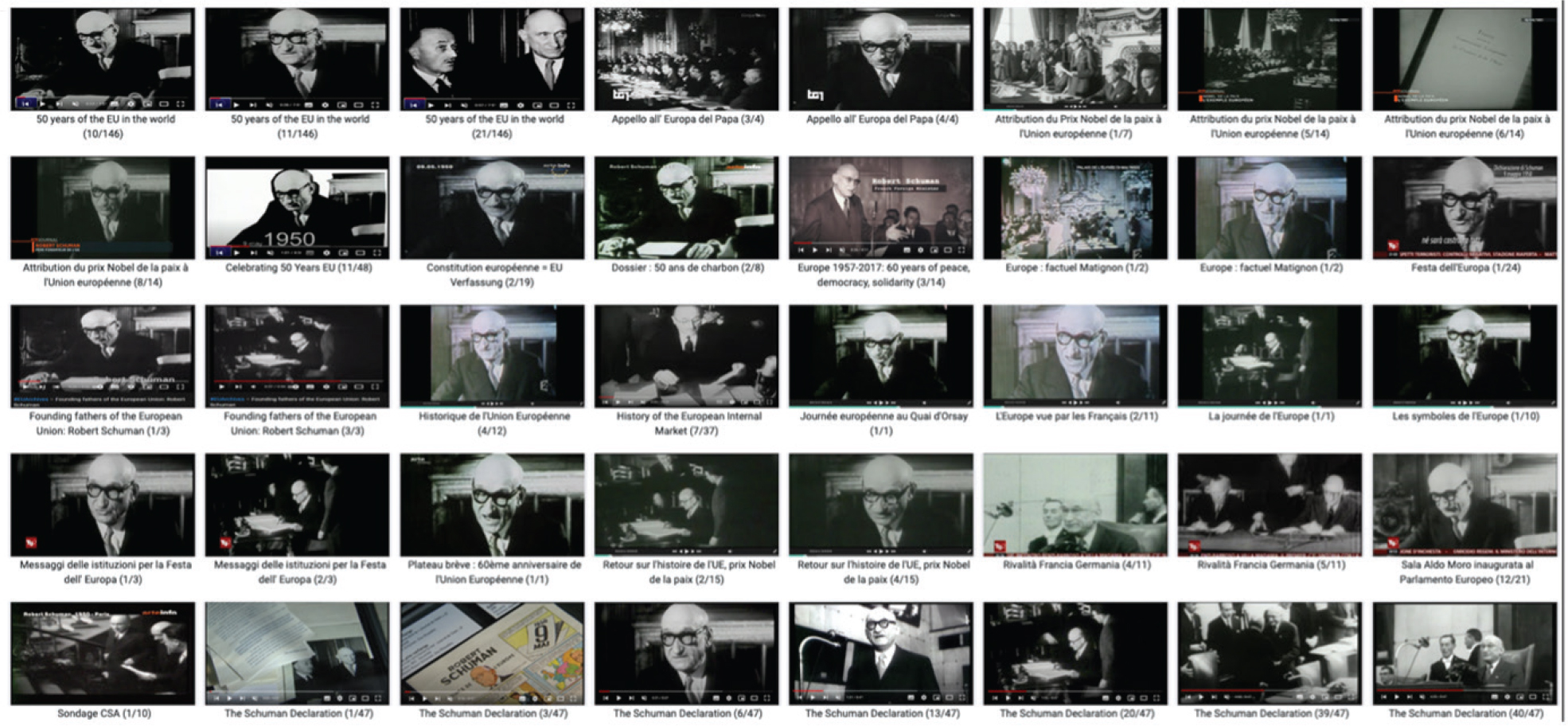
Figure 1
The gallery, which displays screenshots of the reused sequence.
The Muvin tool, developed by the I3S team,23 facilitates the visualization of the temporal distribution of the sequence across various broadcasters. This tool provides an initial framework for the genealogy of the sequence, enabling the observation of a discernible lifecycle of the image, characterized by periods of heightened usage and intervals of reduced visibility. Notable spikes in usage are evident in 2005 and 2012, corresponding to the French referendum on the European Constitutional Treaty (which was ultimately rejected) and the awarding of the Nobel Peace Prize to the European Union in 2012, respectively. Intriguingly, the sequence appears to be underrepresented in 2010, despite this year marking the 60th anniversary of the declaration, which could have constituted a significant occasion for ritual celebration. Up until 2012, a degree of consistency in usage is observable among French channels: Arte does not seem to employ the sequence more extensively than TF1 or France 2, for instance. This sample of the representation of Europe on television indicates that national channels appear to influence one another, likely adhering to a trajectory dictated by institutional agendas.
In the Italian corpus under consideration, the sequence begins to emerge in 2012, contemporaneously with its decline in French news coverage. The portrayal of the event in Italian channels exhibits similarities, characterized by a formal representation that seems to adhere to a pre-established narrative.
A closer analysis of the positioning of the Declaration within the timeline of various news reports appears to support this ‘institutional’ perspective: news subjects primarily recount the history of European integration, often featuring archival footage deemed significant in representing this process. The Schuman Declaration is typically among the initial clips in these videos, frequently accompanied by other iconic sequences, such as the signing of the Treaty of Rome (15 instances), depictions of World War II (7 instances), the fall of the Berlin Wall, and the handshake between Kohl and Mitterrand (4 instances), the latter symbolizing Franco-German reconciliation. In contrast, the institution of the single currency, the Euro, is mentioned only three times. This indicates that one of the most concrete outcomes of European integration is only timidly acknowledged, at least visually, in order to preserve the celebratory narrative. Similarly, the Schengen Treaty, characterized by imagery of borders and barriers at the periphery of the Union, as well as representations of migrants, is nearly absent from the commemoration of this milestone in the construction of the institution. In contrast, news coverage prominently features images of migrants alongside the EU’s external and internal borders, making it the most prevalent theme in the CROBORA corpus following economic subjects. This suggests that the narrative surrounding Europe is articulated within a specific institutional framework, separate from the unsettling contemporary issues.
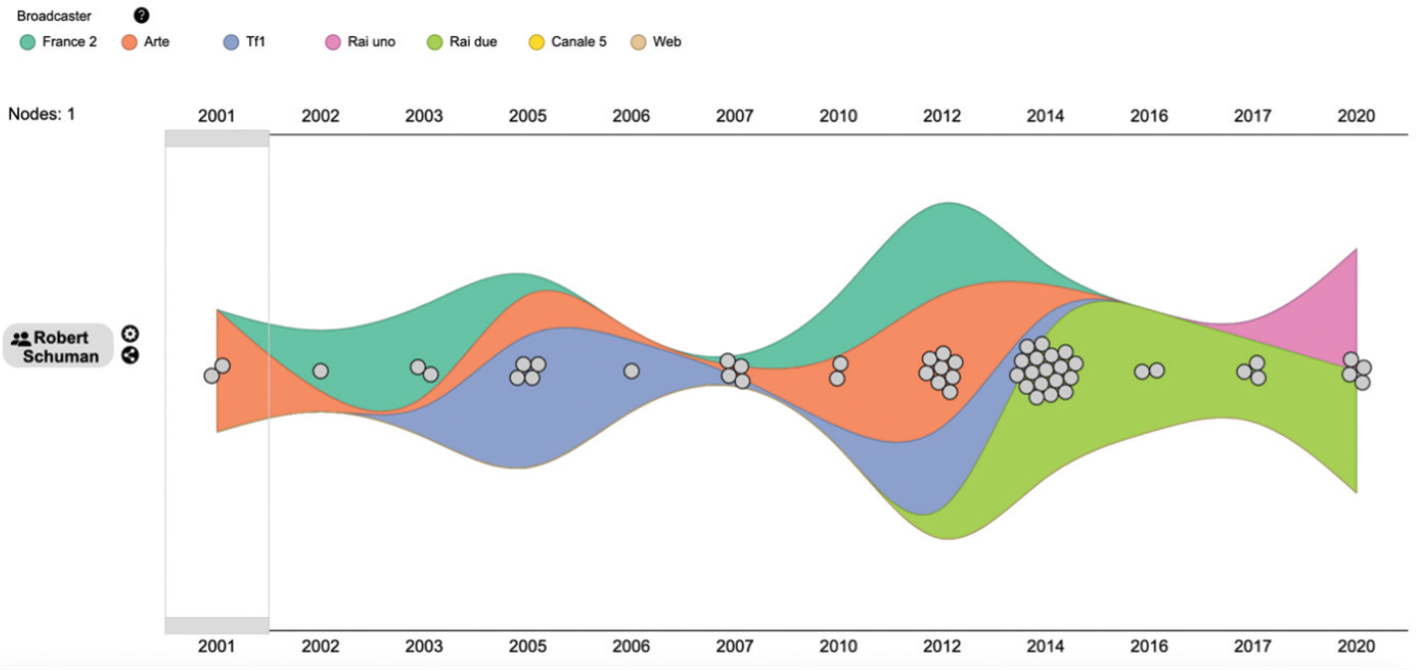
Figure 2
The Muvin visualization tool enables the examination of the temporal distribution of sequences across different media channels.
This preliminary investigation implies that the findings may not be solely attributed to the content of the sequence itself. Notably, TG5, the news program of Canale 5 − a private channel frequently regarded as eurosceptic − does not feature this sequence at all. The stock shot is highlighted as one of the ‘milestones’ in European history by the audiovisual service of the European Union, which serves as a repository for filmed resources for journalists.
It is evident that this repository also seeks to regulate the type of imagery concerning Europe and its construction that circulates in the media. It remains unclear whether the utilization of the sequence in Italian and French news was sourced from EU archives or from the internal archives of other broadcasters. Nonetheless, the prevalence of many other ‘milestone’ images related to European construction suggests that the Schuman Declaration forms part of a pre-established package of thematic visuals frequently employed in narratives about the EU. A cursory investigation at Ina corroborates this hypothesis; the institution’s documentalists assemble pre-organized packages for anniversaries or celebrations, resulting in journalists selecting from a limited array of visuals that, consequently, tend to be repetitive. This redundancy appears to transcend the boundaries between public and private sectors, as well as between France and Italy, with its notable presence on Raidue.
An extension of the search utilizing a video detection tool developed by Ina facilitated the identification of additional occurrences on France 3, which notably was not included within the CROBORA perimeter. The tool, designated as Snoop,24 employs visual recognition AI and has been applied to the CROBORA Dataset as well as a secondary corpus of 56,000 videos sourced from the French Web’s Legal Repository, following a thematically targeted inquiry concerning Europe. The majority of web videos contained within this archival web collection consist of footage uploaded to platforms such as YouTube or Dailymotion by television channels, including France 3.
An instance of the Schuman Declaration can be observed in a TF1 news broadcast dated July 22, 2007, which features a sequence of historical imagery representative of the evolution of European integration. This sequence encompasses footage of the bombings during the Second World War, Schuman’s address, a falling billboard during a public demonstration, and the Campidoglio hall in Rome, where the Treaty of Rome was ratified. Notably, an identical sequence was subsequently aired by France 3 in its 19-20 segment on July 24, 2007. Moreover, the same sequence was identified five years prior during a France 2 news program broadcast on December 14, 2002.
This evidence indicates the presence of a montage of archival images that has been utilized across various channels, both private and public, suggesting that such material was likely prepared by an entity external to the channels themselves. In this instance, the replication concerns not merely a singular sequence, but rather a complex assemblage of multiple audiovisual archives. This circulation over several years across both private and public channels implies that compilations of archival images were probably pre-assembled for subsequent use.
7 Conclusions
The data collected during the CROBORA project enables an analysis of media coverage in Europe through the lens of archival image retakes. Although this may initially appear to be a highly specific lens, it is important to emphasize that it constitutes a fundamental element within the industrial infrastructure of audiovisual media. While computational methods for the collection and analysis of images present significant perspectives on cultural data, it is crucial to acknowledge that these findings represent only a preliminary step, necessitating further field investigations into the companies that utilize, manufacture, document, and archive these images. To fully comprehend the circulatory logics that shape our visual representations, meticulous investigations that integrate ethnography, visual semiotics, cultural history, and media analysis utilizing remote viewing methods are essential.
The analyses conducted within the CROBORA framework suggest that, although there are often discernible and intentional editorial lines operating within European news media, certain modes of representation are sometimes influenced by factors that exist independently of the news content and its creators. These structural factors appear to be connected to the availability of specific images, their annotations, or their prior usage. More precisely, it is necessary to isolate the infrastructural factors within media industries that dictate certain forms of circulation by traversing various terrains, genres, themes, and periods to identify and understand how these variables function. The complexity inherent in the media landscape necessitates multifaceted analyses that account for this complexity.
Such analyses are imperative for a comprehensive understanding of how media infrastructure impacts our imaginations, independent of individual intentions.
Notes
[1] ‘On peut donc concevoir une science qui étudie la vie des signes au sein de la vie sociale’; see Ferdinand de Saussure, Cours de linguistique générale (Paris: Payot Rivages, 1967), 33.
[2] Pelle Snickars, “If Content is King, Context is its Crown”, VIEW. Journal of European Television History and Culture, 1 (2012): 34-39; Roger Odin, Spaces of Communication: Elements of SemioPragmatics (Amsterdam University Press, 2022).
[3] CISCO, VNI Forecast (2018), https://www.ieee802.org/3/ad_hoc/bwa2/public/calls/19_0624/nowell_bwa_01_190624.pdf
[5] Andrew Hoskins, “Flashbulb Memories, Psychology and Media Studies: Fertile Ground for Interdisciplinarity?” Memory Studies, 2 (2009): 147‑150.
[7] Peter Szendy, The Supermarket of the Visible: Toward a General Economy of Images (New York: Fordham University Press, 2019).
[9] Nathalie Casemajor, “Matérialisme numérique et trajectoires d’objets. Les artefacts numériques en circulation”, French Journal for Media Research 1 (2017): 1–18; Milad Doueihi, and Frédéric Louzeau, “Du matérialisme numérique”, in L’humain au défi du numérique, ed. Le Collège des Bernardins (Paris, Hermann, 2017).
[10] Lev Manovich, Cultural Analytics (Cambridge, Massachusetts: The MIT Press, 2020); Maria Giulia Dondero, The Language of Images. The Forms and the Forces (New York: Springer, 2020); Béatrice Joyeux-Prunel, ed., L’art et la mesure: histoire de l’art et méthodes quantitatives (Paris, Éditions Rue d’Ulm, 2010).
[11] Wolfgang Ernst, “The Delayed Present: Media-Induced Tempor(e)alities and Techno-Traumatic Irritations of ‘the Contemporary’”, in The Contemporary Condition, ed. Wolfgang Ernst (BerlIn: Sternberg Press, 2017).
[12] Eivind Røssaak, ed., The Archive in Motion: New Conceptions of the Archive in Contemporary Thought and New Media Practices (Oslo: National Library of Norway, 2010); Sonja de Leeuw, “European Television History Online: History and Challenges”, VIEW. Journal of European Television History and Culture 1 (2012): 3-11; Maurizio Ferraris, Documentality: Why it is Necessary to Leave Traces (New York: Fordham University Press, 2017).
[13] Lev Manovich, The Language of New Media (Cambridge, Massachusetts: The MIT Press, 2001); Geert Lovink and Sabine Niederer, Video Vortex Reader: Responses to YouTube (Amsterdam: Institute of Network Cultures - INC Readers 4, 2008).
[14] ‘We no longer watch films; we watch databases’, stated Geert Lovink in 2008 (p. 9), based on the notion of ‘database logic’ from Manovich’s seminal work; see Lev Manovich, The Language of New Media (Cambridge, Massachusetts: The MIT Press, 2001), 218.
[15] The CROBORA project was funded by the Agence Nationale de la Recherche and was led by the Sic.Lab laboratory at the Université Côte d’Azur, in partnership with the universities of Lille, Sorbonne, Nanterre, and Luxembourg, as well as Mediaset, Rai RadioTelevisione Italiana, and the Institut national de l’audiovisuel.
[16] Qui Bingqing, Content-based Inference of Structural Grammar for Recurrent TV Programs from a Collection of Episodes. Formal Languages and Automata Theory [cs.FL] (Rennes: Université de Rennes, 2015); Jean-Hugues Chenot and Gilles Daigneault, “A Large-Scale Audio and Video Fingerprints-Generated Database of TV Repeated Contents”, paper presented at the 12th International Workshop on Content-Based Multimedia Indexing (CBMI2014), Klagenfurt, June 2014.
[17] Shiming Shen, Matteo Treleani, Dario Compagno, and Marco Winckler, “From Stock Shots to Ghost Data: Tracking Audiovisual Archives about the European Union”, VIEW. Journal of European Television History and Culture 12 (2023): 4-23.
[18] Aline Menin et al., “Incremental and Multimodal Visualization of Discographies: Exploring the WASABI Music Knowledge Base”, paper presented at the Web Audio Conference 2022, Klagenfurt, Cannes, June 28 2022.
[19] The platform is accessible at the following address: https://crobora.huma-num.fr/ (most of its data are restricted due to rights issues).
[21] Matteo Treleani and Dario Compagno, “A Premediation of Brexit: Genesis, Circulation and Naturalization of an Emblem”, International Journal of Design, Science and Technology, 25 (2019) and Matteo Treleani, Shiming Shen, Marco Winckler, and Aline Menin, “Répétition et circulation des images de stock”, Les Cahiers du numérique, 2023, 1 (19).
[22] ‘Le discours de Schuman n’ayant pas pu être enregistré le 9 mai 1950, le ministre devra ultérieurement se prêter à une reconstitution pour la postérité’; see: https://www.cvce.eu/recherche/unit-content/-/unit/5cc6b004-33b7-4e44-b6db-f5f9e6c01023/a777197e-0585-43d6-9354-8171c3c76c5c/Resources#d27938ef-7d39-4d32-b340-07fe7268e3c3_fr&overlay
[23] Aline Menin et al., “Incremental and Multimodal Visualization of Discographies: Exploring the WASABI Music Knowledge Base”, paper presented at the Web Audio Conference 2022, Klagenfurt, Cannes, June 28 2022.
[24] Olivier Buisson, Jean-Christophe Lombardo, and Alexis Joly, “Snoop” (2019), https://hal.science/hal-02096036.