
Prologue1
In our Society one can invent and perfect discoveries that still have to conquer their market and justify their existence; in other words, discoveries that have not been called for. Thus, there was a moment when technology was advanced enough to produce the radio and society was not yet advanced enough to accept it.2
According to Bertolt Brecht, radio as a broadcasting medium took society by surprise. If wireless communication in its earliest uses, as radiotelegraphy and then as radiotelephony, had been a radical innovation, its use in the public sphere, as ‘radio’ par excellence, was even more so, a game changer in mass media. Hardly anyone had foreseen its arrival before it was introduced, becoming, within a few years, one of the most popular technologies and forms of communication. On the contrary, television – or, better said, distance viewing and tele-viewing – was the subject of a variety of fantasies, prophecies, and even dreams for many years before being imagined as a medium in the proper sense. Journalists, academics, technicians, and cartoonists considered themselves ‘advanced’ enough to not only ‘accept’ but to prefigure it, to make it the subject of a variety of fictions in the literal sense of the word – that is, imaginary prefigurations.
In this essay, we will analyse this variety of prefigurations of distant vision technologies during the interwar years. We will refer to them as prefigurations of ‘tele-viewing’ to avoid binding them to any historically specific materialisation of the medium of television. What we are interested in analysing is how these social accounts struggled to prefigure a social practice more than a technical object. The context of Italy between the 1920s and 1940s (before the introduction of a regular national television service) provides an interesting case study. Besides being the birthplace of Guglielmo Marconi – by then already internationally acclaimed as the father of wireless communications – Italy had been regulating the use of wireless telegraphy since the early years of the century. To prevent amateurs from eavesdropping – even unintentionally – on private and military messages, a 1910 national legislation had placed under state monopoly not only telegraphy but also any other possible use of electricity to produce remote effects without the use of wires. As has been noted, this effort to predict and prevent future developments of a still-emerging technology led to interpreting wireless transmissions as a public, centrally administered good, thus facilitating the transition from the ‘one-to-one’ to the ‘one-to-many’ communicational model and laying the ground for broadcasting.3 The monopolisation of the airwaves would eventually prove important for the later development of radio broadcasting and for its political use by the Fascist power. In the early years of the regime, radio developed quite slowly. Even though the Communication Minister, Costanzo Ciano, imposed a monopolistic regime under the formally private but substantially state-controlled company URI (Unione Radiofonica Italiana, later re-named as ‘EIAR - Ente Audizioni Radiofoniche’) as early as 1924, it was not until the mid-1930s that the government began a powerful campaign to increase the reach of broadcasting in public places. By 1939, EIAR had around 1.2 million paying subscribers. Popular discourses and technical experiments on television paralleled this period of consolidation of radio as a mass medium, enabling speculation on the tele-viewing practices as a predictable continuation of radio and other existing applications of wireless.4
Another reason to move our attention to the Italian case is the lack of dedicated studies in the otherwise burgeoning scholarship on the archaeology of what Anne-Katrin Weber has already defined as ‘television before TV’. This absence can certainly be explained by the fact that Italy was not a major player in early image-transmission experimentations. Albeit having its own research laboratories operating under the national broadcaster Ente Italiano Audizioni Radiofoniche (EIAR), the country remained significantly less advanced than other nations such as the UK, the USA and the closer Germany.6 For this reason, the public opinion often received only ‘vague and imprecise news, coming from distant countries’ that were ‘immediately bent to the wishes of [newspaper and magazine] editors, who perhaps “tele-viewed” more than they should.’7 This is precisely what matters for the purposes of our analysis: because of this distance from the areas where the major technical progress was taking place, the press ended up unfolding an alternative history ‘parallel to the scientific one of experimentation and field research […] in which dream, desire (technological and ideological) propaganda and vision mixed with the early laboratory experiments.’8 (Video 1–2). What emerges from these prophecies is a tentative portrait of the future media practice of distant vision as seen from a distance both in space and time. This portrait does not matter so much in terms of how accurately it guessed what the medium would look like in the future, as for the way it described what contemporaries thought it could – or even should – become.
Video 1
First steps of Television in London, Luce Newsreel, 08/09/1938, code: B137101. The newsreel segment shows the latest developments in experimental television transmission carried out in UK. Credits to Archivio Storico Istituto Luce – Cinecittà spa.
Video 2
The first television shooting, Luce Newsreel, 14/04/1937, code: B107504. The newsreel segments shows the latest developments in experimental image transmission carried out in the USA. Credits to: Archivio Storico Istituto Luce – Cinecittà spa.
Starting from these premises, we will explore speculations about tele-viewing at a time when, at least for most people, it was possible only on a discursive level. We will do so by adopting different perspectives. The first one (section 1) is concerned with the various currents of thought that converged in the growing field of (technological) forecasting. By looking at the work of authors and thinkers of the modern era, we aim to distinguish different types – or even genres – of predictions, based on an observational or an inventive approach, or both. The second perspective (section 2) locates fantasies of tele-viewing within a strand of public discourse we will refer to as ‘wireless imagination’. In short, we will argue that discursive manifestations of the televisual intersected a broader rhetorical tendency to magnify the potential of wireless transmission of electricity: tele-viewing was presented as one of the possible uses of Hertz’s waves – from wireless telegraphy to radio broadcasting, from point-to-point transmission to the new methods of radio detection and ranging, soon to be known as radar. Going far beyond the technical possibility of transmitting and receiving images through the ether, the popular press of the time (newspapers, radio, film journals) were eager to discuss the uses and effects of tele-viewing as a future social practice. The third section of the article will reconstruct how columnists and commentators anticipated the impact of tele-viewing on existing media forms and industries, public services and domestic life, and military strategies at the war front. A close encounter with an actual television apparatus during the 1933 National Radio Exhibition in Milan would eventually reshape the most imaginative side of their expectation about the new medium and reveal the hitherto overlooked difficulties in wireless transmission. As we will argue, in conclusion, these prophecies, whether fulfilled or not, may help us to locate some rhetorical tropes that can be applied to different contexts, as well as to other forms of wireless communication.
1 A Pleasure and a Need. Predicting the Future Between Invention and Observation
At the very beginning of the Modern age, the thinker who first conceived of the essay as a literary form, Michel de Montaigne, wrote and published in 1580, ‘Of Prognostications’, in which he observed as a starting point, ‘the frenzied curiosity of our nature, which wastes its time in anticipating future things, as if it did not have enough to do to digest the present.’9 Under his pen, predicting the future was transformed from a divine faculty, a sacred gift for the chosen few, into a simple (and somewhat idle) pleasure, but a ‘natural’ one, the fruit of a human inclination. Francis Bacon’s essay ‘On Prophecies,’ written in 1625 under the clear influence of Montaigne, also spoke of ‘the nature of man, which coveteth divination’ that ‘thinks it no peril to foretell that which indeed they do but collect.’10 Both texts seek to demonstrate the futility of predicting the world as it is, the actual impossibility of predicting the future. At the same time, they emphasise its ‘natural’ character, describing it as both a human need and a human pleasure. When examining how the social imagination works in prefiguring future developments, we should bear in mind that it often oscillates between the pure, somewhat idle pleasure of ‘seeing’ an environment that is possible but not actual, and the urge to prepare ourselves and successive generations for the world about to come.
In this essay, however, we are discussing a specific type of prediction – that concerning future technologies. The need to understand the direction of technical development, which was in its early stages in Bacon’s time, eventually became more urgent centuries later. Therefore, we hope that readers will not find it too incongruous to jump from two classical thinkers to a science-fiction writer such as Isaac Asimov, who helps us to understand contemporary technical prophecies. ‘[With the Industrial Revolution] people get the idea […] that it is advances in science and technology (or at least changes in them) that are bound to make the future different from the present and the past, and that thereby hangs a tale.’11 The tendency to predict the future, which had been characterised as being anthropologically rooted at the beginning of the modern era, is described here as being historically situated. It was precisely in the wake of the Second Industrial Revolution, between the late 19th and early 20th centuries, that a new spectrum of ways of imagining the future gradually emerged. Predicting the future became focused on technological progress, which was often viewed in a rather deterministic way as the driving force of change. On the one hand, there were science fiction pioneers such as Jules Verne, Albert Robida, and H. G. Wells, who invented ‘the shape of things to come’;12 on the other hand, there were more scientifically oriented efforts that based their predictions on objective observations – or so they claimed – to satisfy political, economic, and military demands. Forecasting was established as both a narrative and entertaining pleasure and a response to social need. However, in public discourse, the distinction between fictional invention and scientific observation is not always clear-cut. In an attempt to entertain and inform their readers, newspaper and magazine articles, as well as other media outlets, occupied the space between the two. The same was true of the speculative reflections of thinkers and essayists, who used their visions of the future to better understand the present or anticipate the direction of progress.
Both the ‘fictional/inventive’ and the ‘scientific/observational’ modes played a role in shaping prophecies about tele-viewing in the early 20th century. Although they were based on (or at least loosely inspired by) ongoing technological developments and addressed social as well as economic needs, they often indulged in the pleasure of anticipating what future society would look like when distant vision technologies finally came into play. So, as an unnamed author admitted in 1928, at a time when the knowledge of television was still ‘a butterfly with iridescent wings: it has a bit of fantastic and of magnetic science.’ Nevertheless, the urgent pleasure of foreseeing its applications in everyday life was already making headway, raising questions such as ‘how will we explain ourselves immediately when this discovery gains a more practical and general value?’13
2 Wireless Imagination and Predictions of Tele-Viewing
We will now move on to consider the concentration of prophecies and speculations on tele-viewing in the Italian press between the 1920s and the 1940s as a manifestation of a wider ‘wireless imagination’ that permeated public discourse. Unlike the ‘wireless imagination’ famously analysed in Gregory Whitehead and Douglas Kahn’s anthology,14 and in turn inspired by Filippo Tommaso Marinetti, our understanding of wireless imagination doesn’t refer exclusively to the practices and aesthetics of the early avant-gardes.15 If it is true that the Futuristi acted as the interpreters of the sensory changes and space-time horizons introduced by the modern means of transport and communication in industrial society, it is also true that the scientific-technological research of the time already contained the promise of new ways of perceiving and inhabiting the world. An imaginative, ‘inventive’ component is already present in the discourses introducing new technological experiments and in those of the public opinion that welcomes them.
In the considered period, the possibility of seeing at a distance through technical means did exist also in Italy, although only accessible to a few radio amateurs. Experimental, short-wave transmissions from the stations in Berlin or London were regularly published on the official periodical of the state broadcaster, Radiorario. Manufacturers and engineers published handbooks to instruct radio amateurs on how to build a televisual apparatus out of their radio set in order to pick up those experimental transmissions. [Fig. 1, 2]. As a (quite literal) extension of radio, television – or ‘radiovision’, as it was often called – was teleologically conceived as the latest stage in the progress of wireless technology. Commentators and columnists in the newspapers or the film and radio trade press assumed an actual technical possibility as a starting point for speculating about tele-viewing: a social practice that did not yet exist but was already perceived as imminent and inevitable. It is to close the gaps between the existing technical conditions (and constraints) and their future impact on society that wireless imagination comes into play, as a prosaic counterpart of the literary concept first theorised by Marinetti. As ‘imagination’, it stimulates going beyond the present conditions, enhancing the functions and capabilities of existing media and projecting them in an indefinite future.16 As ‘wireless’, it indicates a historically specific manifestation of what William Uricchio, although in reference to an earlier period, defined as ‘the project of the televisual […] of connecting a subject in real time with a (contiguous) visual field.’17 Being generally aware of the technical differences with the previous attempts of image transmissions through electrical wires (as late 19th century photo-telegraphy) commentators and journalists emphasised the novelty of the forthcoming medium through primarily spatial metaphors, evoking its capability to cross physical distances and territories, an almost Promethean ability to bend environmental elements to human will. Imagining wireless tele-viewing can be considered as an offshoot of what David Nye, among others, has famously defined the ‘technological sublime’: a rhetorical tendency to elevate technology in general (and electricity as a medium) as an expression of human dominance over nature.18 In this case, the ‘absence of wires’ sublimates the merely technical dimension and often comes to symbolise a broader promise of communication without constraints, the ultimate dream of a media experience without mediation. In Italy, as elsewhere, this public imagination played an affirmative role in shaping the making of the medium and in addressing the expectations of the audience. However, differently from what happened in liberal democracies such as the U.S., predictive discourses about tele-viewing in a totalitarian regime did not only convey the precepts of corporate liberalism or address the public tele-viewers as future consumers. Imagining a boundless communicational space and an interconnected world could – more or less inadvertently – reflect governmental fantasies of controlling territories and populations from afar.
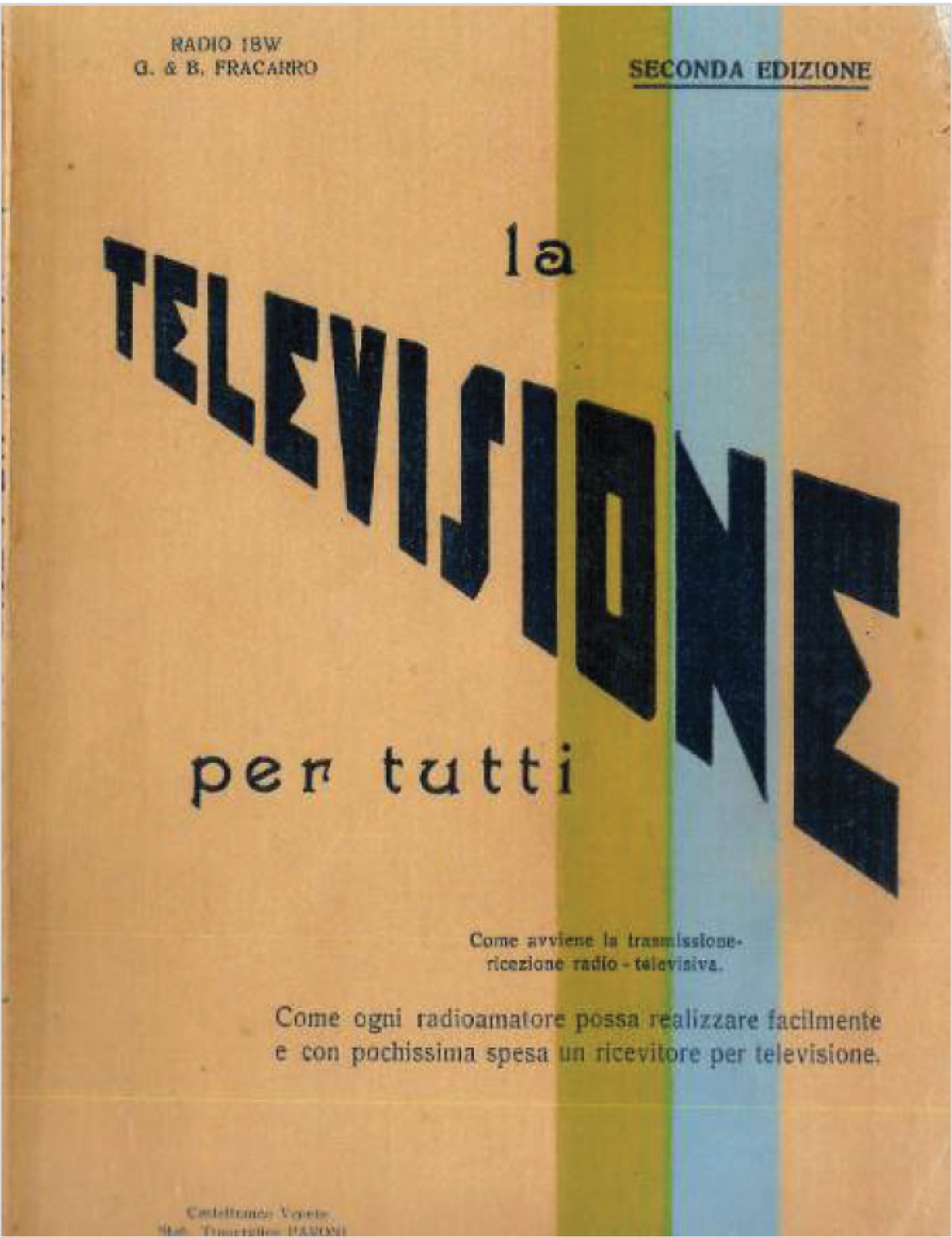
Figure 1
Cover of “La televisione per tutti”, Television for all, a handbook to instruct radio-amateurs on how to build a television receiver published by Giovanni and Bruno Fraccaro’s manufacturing company (1930).
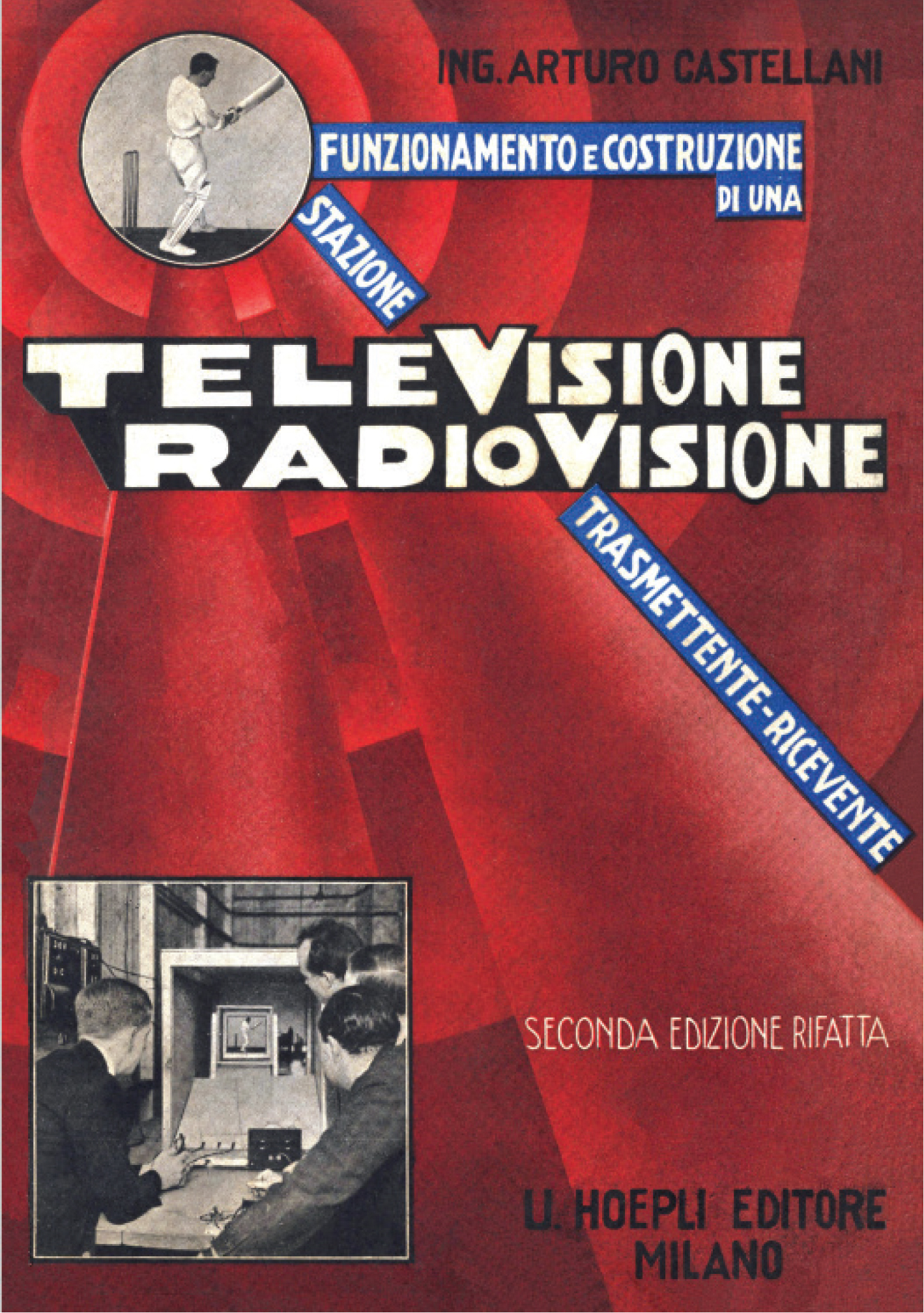
Figure 2
Cover of “Televisione and radiovisione. Funzionamento e costruzione di una stazione emittente-ricevente”, Television and radiovision. The operation and construction of a sending and receiving station, a technical handbook authored by EIAR engineer Arturo Castellani (Hoepli, Milan 1933).
In what follows, we will try to sketch the contours of the wireless imagination that permeates public discourse, drawing mainly on specialist journals. In addition to the official house organ of the EIAR public broadcaster, called Radiorario and then renamed Radiocorriere, aimed at the public of state broadcasting subscribers, we will consider one of the most widespread daily newspapers (Corriere della Sera) and some of the major film magazines of the period, such as Cinema Illustrazione or Cinema. The latter – respectively, a popular weekly magazine founded in 1926 and a bi-monthly one launched in 1936 with direct support by state institutions – explored the advent of television from the point of view of the film industry, criticism, and audience. Although in-depth technical articles, often authored by engineers working in the radio and film industry, were not uncommon, most articles on tele-viewing were aimed at a much more layered audience – listeners and spectators, more than technically equipped hobbyists and amateurs. In these contexts, discursive accounts of tele-viewing usually rely on a general knowledge of how wireless telegraphy and broadcasting worked, but only to venture into speculations on how distant seeing would eventually transform society. The televisual principle of seeing and hearing across distance is reconsidered from time to time in relation to different media, to predict – or prevent – its impact on existing industries and the condition of the future user – or ‘tele-viewer’ – constantly intertwining inventive and observational modes of forecasting. The following paragraphs outline some of the most frequent conceptualisations of wireless tele-viewing, referring respectively to the relations with other media, the cultural and entertainment industries, and the possible military applications. Based on a common ideal conception of signal transmission through the ether, they delineate different and specular functions and social effects for as many profiles of the future tele-viewer.
3.1 Tele-Viewing at Home. Prophecies of an Electric Delivery Service
The period we are considering is roughly the same that witnessed, in Italy and elsewhere, the consolidation of radio as a mass medium and the simultaneous transition of cinema to synchronised sound. It is then not surprising that the first prophecies about television were linked to the transformations that were taking place in the rest of the media system: in the light of the pioneering experiments with television in Britain and the USA, it was almost taken for granted that ‘just as cinema added sound to the image, radio will add image to sound,’19 or that ‘cinema [was] about to take a new step forward.’20 In line with this idea of television as a synthesis of pre-existing communication forms, several commentators rushed to bet on the imminent marriage of radio and the moving image, and the equally imminent disappearance of movie theatres.21
To be fair, some of the most astute observers resisted the temptation to see the future medium as a mere extension or replacement of the existing ones, focusing instead on their complementarity. Future film director Michelangelo Antonioni and theorist Rudolph Arnheim, in their correspondence with the Cinema periodical, countered the most apocalyptic fears of the imminent death of cinema and radio with some thoughtful reflections on the elements that would differentiate them from the emerging technology. While the former denied television any possibility of providing material for artistic elaboration precisely because of its inherently ephemeral and synchronic character22, the latter envisaged differences in the modes and contexts of consumption. ‘Whether films will remain on the screen in public cinemas or whether they will move entirely to the home screen of the subscriber is another question that will be answered in the near future.’23 Whereas Antonioni, in some way, anticipated a widespread distrust within art cinema toward television as a form of consumption, Arnheim tried to predict the condition of consumption itself. The connotation of direct, real-time transmission as the first media specificity of the new technology and its location in the domestic context are recurring discursive features. What can be considered a prescient prediction was, in other respects, a safe bet24. Probably aware of the demonstrations of John L. Baird, who has been developing equipment for the domestic reception of the BBC’s experimental broadcasts since the 1920s, these chroniclers could base their expectations on the fate that was already befalling radio, which was becoming increasingly familiar in the homes of the Italian upper middle class.25
Setting aside the genealogical lineages from older media to the emerging one, this tendency to conceive tele-viewing as a ‘home delivery service’ can also be read in relation to a process of electrification that preceded and disregarded individual technological forms and magnified the possibility of transforming the environment into an energy conductor. On several occasions, journalists, writers, and scientists agreed to present the possibility of distant viewing as the latest achievement of the so-called ‘electrical revolution,’ a product of the modern ability to bend the atmosphere for signal transmission. In an outburst of literary imagination, a commentator writing under the pseudonym Ing. De Florentiis and the playwright Mario Vugliano predicted that the day when ‘we will have learnt to make use of atmospheric electricity, using this fabulous energy that we don’t know how to harness today,’ and will even manage to ‘bottle lightning.’26 it will be finally possible to distribute the gift of tele-viewing, as well as light and heat, via electromagnetic waves: ‘Shops, workshops, streets will be simultaneously illuminated in less than a second. And heated or cooled […] because heat and frost will also be transmitted via the airwaves.’27 Tele-viewing is evoked here as an inherent part of an electrical progress that includes all kinds of services that could be home-delivered via electromagnetic waves, with no need for wires or networks of any kind. Marconi himself said he was convinced of the future advent of television, when ‘the slightest vibration will have its unmistakable way in the ether, as if enclosed in a lead pipe.’28 During a speech welcoming his appointment as President of the Italian Academy in Trento in 1930 – where he was hailed as the ‘conqueror of space’29 – he foresaw a near future in which ‘images could be transmitted, as sound and speech, across the continents […] Every isolation could be broken, and every village could live in contact with the city, hearing and seeing all that is beautiful and interesting in the world.’30 The electrical revolution, upon which the possibility of television depends, implied a firm human mastery of the atmospheric environment, both as a conduit for energy and a channel for signal transmission. It is this expectation that encouraged (pre-) visions of boundless communicative spaces, a state of almost global interconnectedness that transcends physical distances and even redraws the boundaries between public and private, central and peripheral spaces.
Informed by this imaginary spatiality, the prophecies of tele-viewing bring to the surface certain metaphorical tropes, those of the ‘window on the world’ and the ‘electronic hearth’, which will remain associated with television even during its consolidation as a mass medium after World War II. In a broader sense, the hope of decentralising the industrialisation process through the distribution of electricity is a rhetorical stance of the ‘electric sublime’ which had already appeared in some programmatic speeches of the previous century.31 In Italy, the aim of establishing a wireless service distribution of electricity instead of expensive cable networks was also crucial in the early century legislation of wireless and in the shift to the ‘one-to-many’ communicational model. Two decades later, when it was revived under Fascism’s control of broadcasting, it met with further political implications.32 From the second half of the 1920s until the end of the 1930s, Mussolini’s regime had in fact pursued an anti-urbanist policy, counteracting migration to the cities – seen as the cause of demographic decline and of corruption of customs.33 After the first measures to curb rural exodus, Radiorario highlighted how telecommunications could contribute to the cause. Of particular interest is the distinction made on this occasion between mechanical and electrical progress. Whereas the former was mainly concentrated in urban centres, the new electrical means would bring information and entertainment to the public where they were physically located. As summarised by an anonymous Radiorario columnist: ‘A profound change in the tastes and habits of human societies is truly in the making, a change that television will complete in a unique way, and the home will regain its traditional sacred dignity as the time of family and domestic love.’34 Beyond the reflections modelled after the present of radio broadcasting and the (more or less easy) bets on the fate of home cinema, imagining tele-viewing as a distributed electrical service and a predominantly domestic activity also meant exploring its governmental potential. It is the absence of physical obstacles and infrastructural contingencies (the imaginary sublimation of ‘wireless condition’) that encourages a vision of the future medium as a tool for pervasive and capillary control of the spaces and communities that inhabit them – even before it could convey any propagandistic content.
3.2 Tele-viewing as Remote Controlling. Envisioning Military Applications
Humour about the effects of television started even before the advent of television itself. Two cartoons published in 1926 and in 1930 in Radiorario, respectively entitled ‘The Dangers of Television’ and ‘The Tragedy of Television’,35 depict a woman in front of an unidentified domestic screen while surprising her husband in sweet company, drinking at a bar or attending a theatrical play [Fig. 3–4]. Besides confirming the domestic context as the site of choice for tele-viewing and weirdly anticipating the housewife as the primary recipient of the new technology36, these male-biased, sexist caricatures also shed light on a conceptual aspect that has not yet emerged from the speculative accounts we discussed so far. Both the cartoons assume that the technical apparatus allows the protagonist to see (at a distance), but without being seen in return. In the light of this characterisation of tele-viewing as a unidirectional communicational practice, the state of global interconnectedness that we have identified before reveals here its obscure counterpart: the immanent possibility for everyone to be controlled and (video) surveilled, at any time and in any place in the world.
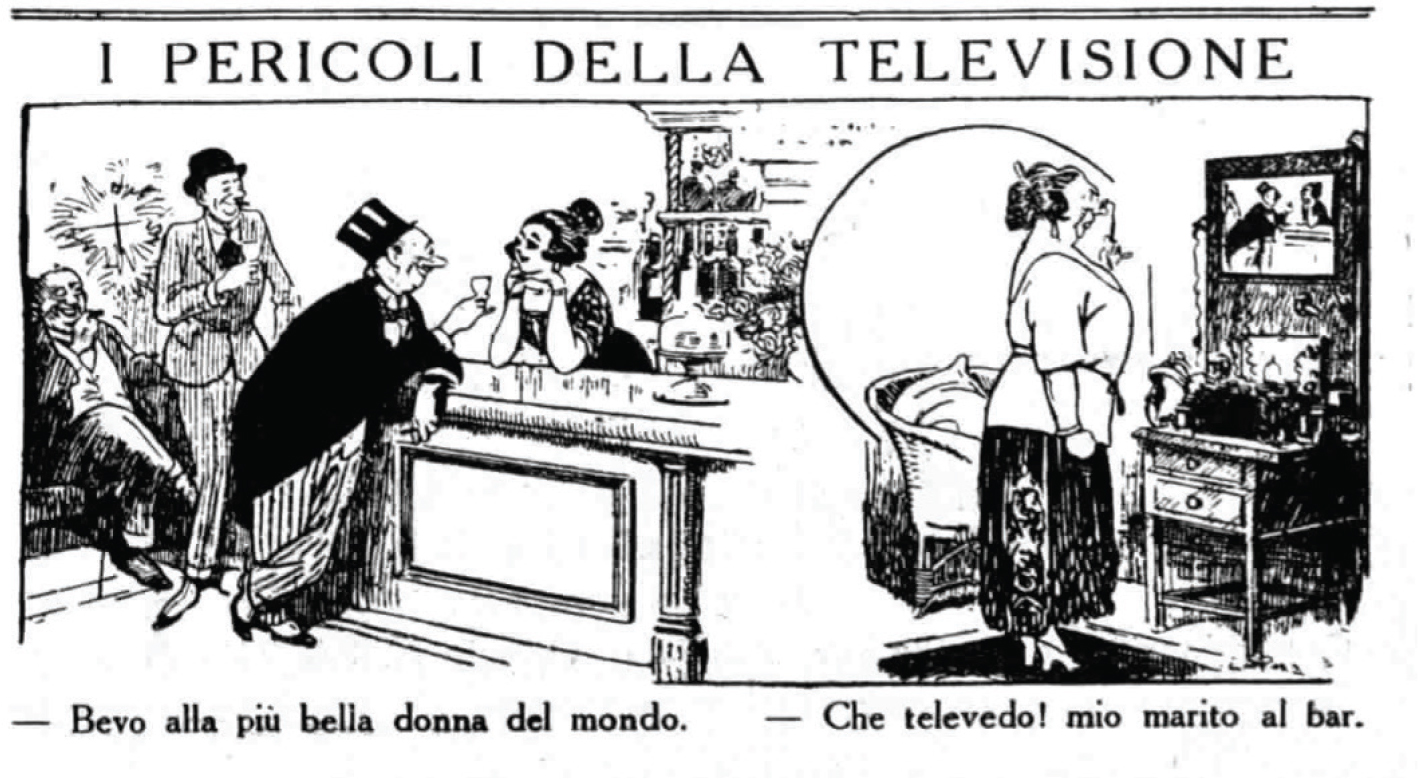
Figure 3
“I Pericoli della televisione” [The Dangers of Television] published on Radiorario 2, no. 44 (October - November 1926), 7. The caption reads: “What do I tele-view? My husband at the bar!”. Credits to: Rai Teche.
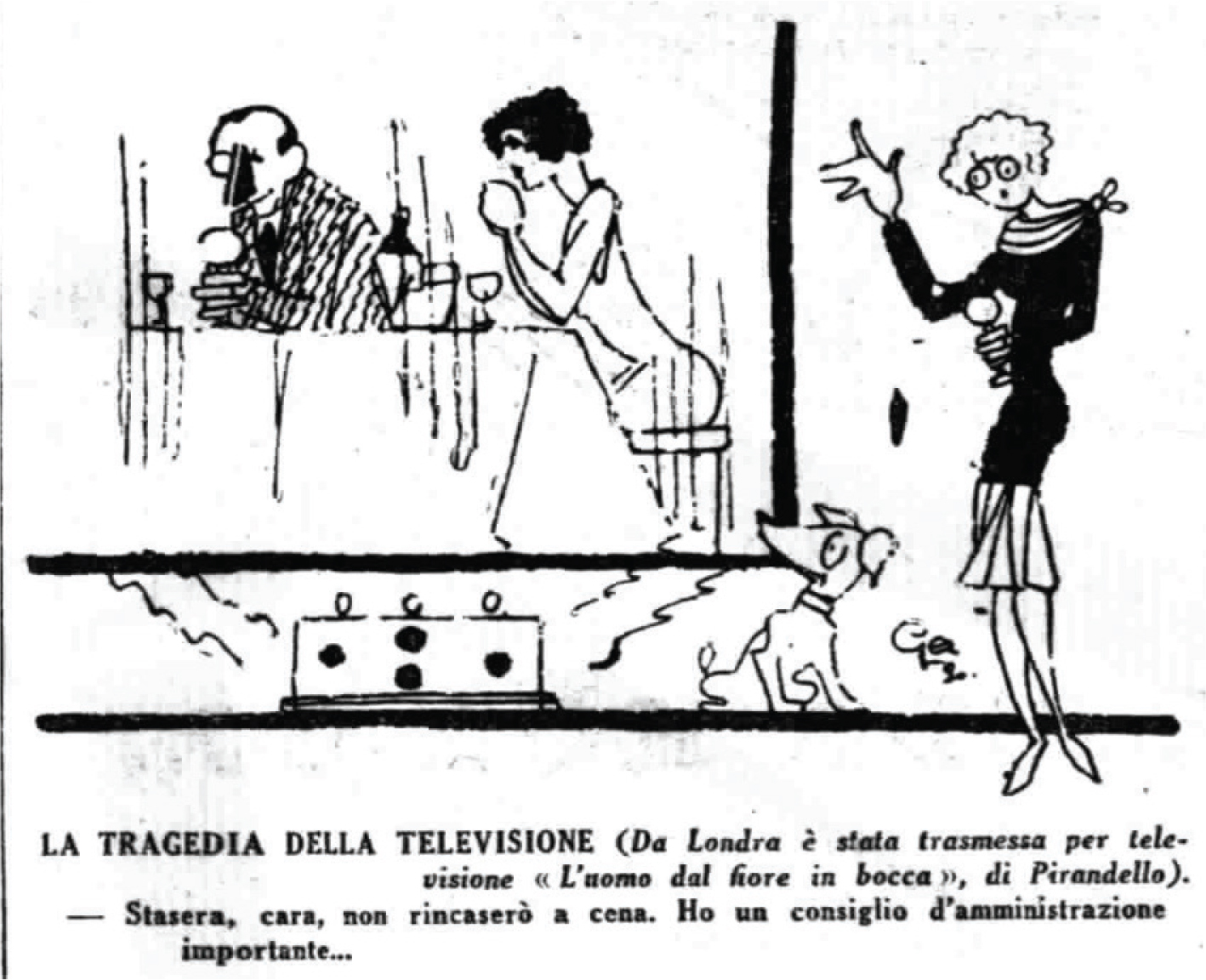
Figure 4
“La tragedia della televisione” [The Tragedy of Television] published on Radiocorriere 6, no. 31 (August 1930): 17. The caption reads: “The Tragedy of Television. ‘From London we’ve tele-transmitted Luigi Pirandello’s play ‘The Man with the Flower in his Mouth’”. “Darling, I won’t get back home tonight, I will be in an important meeting with the boards of directors…”. Credits to: Rai Teche.
This speculation implies other uses and social effects of tele-viewing, and that takes on a far more substantial form when considered in more dramatic contexts than the ones evoked by the two cartoons. Marconi is also credited with remarks on the effect of television on international conflicts: ‘There will no longer be an invisible enemy: he will be seen at any distance by means of television. Therefore, it will no longer be difficult to anticipate and repel his attacks. It will be the end of submarines, the end of wars.’37 Although this prophecy was about to be soundly disproved by the outbreak of World War II just 15 years later, it lent substance to a widespread hope in the early post-war period and counted the future tele-viewing as military surveillance among the useful instruments for a deterrence strategy. Other commentators were more cautious and simply explored the potential applications of the future medium by aligning it with other innovations in military technology brought by the ‘electrical progress’. The news that an automatic model of aeroplanes, remotely controlled by Hertzian waves, was being tested in an aviation camp in England and France, obtained wide media coverage by the press and the newsreel, providing a pretext for fantasising about the future of military aviation. In this view, radio transmission will collaborate and ‘replaces the presence of the man on board the airplane, signalling at a distance of thousands of kms every visual, acoustic, meteorological, thermal, tactile and chromatic perception. Television is too advanced for us to doubt its imminent apotheosis.’38 The hope of having a ‘steel pilot’ to replace flesh-and-blood ones in air operations was fuelled by the advanced technical possibilities of transmitting sensory stimuli through the air. The ‘apotheosis’ of television would thus coincide with its service to the techniques of warfare, introducing tele-viewing into the new techniques of tele-command.
When shifting the focus from the culture industry to the military one, prophecies about tele-viewing sketch out the contours of a hypothetical ‘industrial-military complex’ of remote controlling, emphasising future goals and ideally overcoming any infrastructural or physical limitation. Like the seemingly more innocuous prophecies of tele-viewing as a home service, these forecasts presuppose a condition free of any material constraints, an atmospheric environment entirely viable for signal transmission. In this respect, it is significant that the prophecies focus on possible applications in the field of aviation, as if to pose a direct challenge to the sky, where no other communicational channels were possibly viable than those routed through the ether. Even this configuration of the wireless imagination ends up attributing govermental implications to the tele-viewing. Indeed, the figure of the future viewer often coincides with that of a high military rank, an army general who, ‘by means of television applied to aviation, he can see by himself. […] Without leaving his command post, he is transported in a few seconds to the place where the battle is being fought under his orders.’39
The remote-controlling gaze that the cartoons attributed to the housewife is here identified with the figure of the commander-in-chief of an army, but always with the effect of consolidating existing social and hierarchical roles. The military leaders, who would have followed the battles from a safe distance in any case, are now offered tele-viewing as a form of direct control, without material or human mediation, described almost as tele-kinetic exercise. Outside the domestic sphere, the tele-viewer is no longer a simple spectator, the recipient of an electrically distributed service, but gains a decisive margin of action over events taking place miles away.
3.3 Close Observations and Wireless Delusions
The conceptual declinations of tele-viewing we’ve been through so far could easily extend the list of televisual ‘presence machines’ first identified by Uricchio.40 More specifically, the image of the tele-viewing army general being transported to the scene of battle alludes to an ideal of media presence that Matthew Lombard and Theresa Ditton aptly defined as ‘You are there […] in which the user is transported to another place.’ It is a mirror conceptualisation of the ‘It is here’ ideal, evoked by the understanding of tele-viewing as a home service, which instead presupposes ‘a sense of presence that can bring the objects and people from another place into the media user’s environment.’41 In both cases, the temporal simultaneity remains, of course, a crucial feature in the desired media experience, but what contributes to making them apparently ‘immediate’ is a radical understanding of the wireless condition – the sublimated absence of conduits and infrastructural networks. ‘Direct’ sights and sounds are transmitted at the speed of light from one point on the globe to another. A promise of ubiquity and absolute synchronicity that seems to leave no room for mediation of any kind.
But the expectations nurtured by years of wireless imagination were about to be tempered by the first public experience of direct observation during the Fifth National Radio Exhibition, held during the Milan Trade Fair in 1933. The exhibition followed, somewhat belatedly, those already held at international trade fairs in North America and the rest of Europe since the mid-1920s. As Anne-Katrin Weber has extensively demonstrated, interwar public exhibitions were the places where the material and discursive identity of the future medium finally conflated and occasionally collided. The aforementioned promise of ubiquity, immediacy, and presence had to come to terms with the profoundly site-specific character of the exhibition setting, giving rise to different displaying strategies.42 In the case of the 1933 Italian radio exhibition an entire pavilion was devoted to the display of two different television and radiovision systems built by EIAR engineers, one for the remote transmission of pre-recorded films and the other for direct transmission on medium and ultra-short waves (Fig. 5). The transmitter was placed about ten metres above the ground, at the highest point of the Littoria Tower of the exhibition building.43 In praising the innovative character of the equipment built by Italian engineers and manufacturing companies, the reporters of the daily press were keen to specify how innovative such a solution was in the context of public demonstrations, where, as a rule, ‘…one gladly takes advantage, for greater convenience of transmission, of the aid of electric wires […] There is not, as some may have thought, an optical tube or any mechanical or electrical trick to connect them.’44 The absence of wires is here emphasised almost as if to suggest that there was no trickery or deception behind the magic of public tele-viewing: visitors could get the experience of looking through the ether. However, according to the chronicles of the exhibition, the visitors’ expectations clashed with the relatively small size and uncertain quality of the image received on the screen of the television model built by the Società Anonima Fabbricazione Apparecchi Radiofonici (SAFAR) manufacturing company. The horizontal lines that recompose the image through mechanical disc scanning were even mistaken for scratches on a damaged film, evoking (unfavourable) comparisons with one of the old media that television was supposed to replace. The risk of a general disappointment was felt so strongly by the reporters who had attended the exhibition that they explicitly admitted that ‘the echo of enthusiasm […] has raised expectations to such an extent that one fears a misjudgment of the progress made or a disillusionment by those who are not or cannot be fully aware of the difficulties.’45
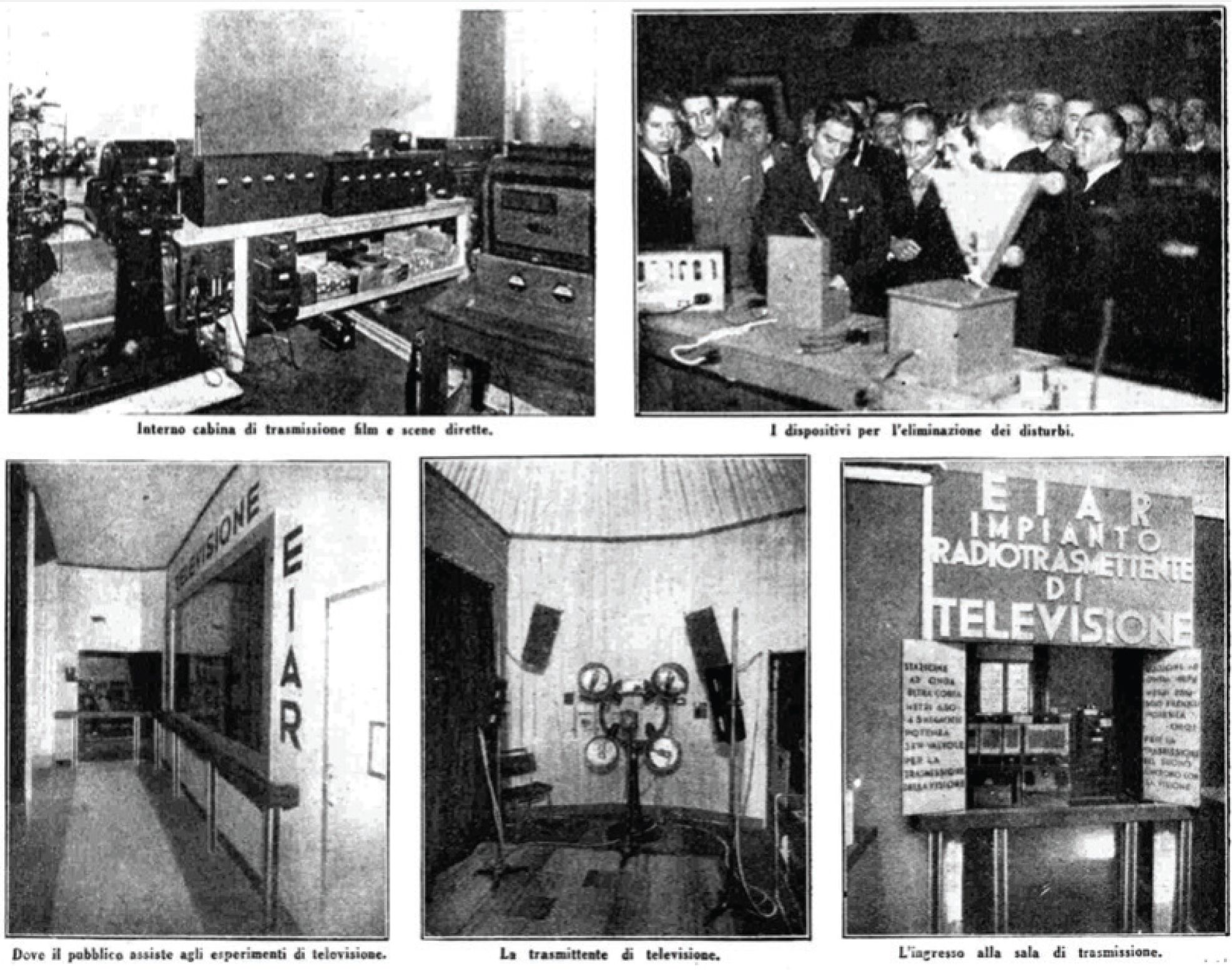
Figure 5
Details on the EIAR radiovision/television display during 5th National Radio Exhibition, Milan Trade Fair, published on Radiocorriere 9, no. 41 (October 1933), 10. Credits to: Rai Teche.
On this occasion, specialists, journalists, and industry insiders were forced to be less inventive and more cautious in their predictions, resorting to a highly technical lexicon to explain difficulties encountered during the exhibition. The once seemingly endless spaces traversed by the electric eye were now described as full of ‘capricious radio waves that do not spare us fading, silent zones, echoes, distortions’ and of ‘atmospheric and industrial disturbances.’46 With medium–waves, it would be possible to reach the other side of the Atlantic, were it not for ‘another serious problem, that of radio echoes, which cause double images with these waves.’47 The very tone of the discourse surrounding the future tele-viewing changed: without abandoning faith in technical progress, it became a matter for insiders only, apparently inaccessible to the layman: ‘Many people ask themselves: is this all there is? And they don’t think that what little they see is the result of decades of study by technicians all over the world.’48 At the same time, the commentators acknowledged the excesses of an inventive approach to forecasting that seemed to have moved too eagerly and without taking into account the slow pace required by scientific progress. Some commentators even acknowledged that the technology for viewing at a distance already existed ‘for the researcher, the enthusiastic engineer,’ but not yet ‘if by radiovision one means the ability to witness distant events at home, at the touch of a button.’49 While there was still little doubt that everyone would be able to tele-view one day, at that specific time this media practice was not accessible to all: the long-awaited and variously anticipated media practice suddenly found itself to be limited – both due to the inaccessibility of the required engineering expertise and the far more modest transmission capacity than the imagined state of global interconnection might had suggested. In the terms used by one of the engineers most involved in EIAR’s radio and television experiments, with the unravelling of transmission limitations and flaws, television ceased to be ‘the medium that allows one to see not only at a distance, but also without worrying about distance.’50 In this light, the observational approach to predicting the future served as a necessary counterbalance to the more extravagant speculative claims.
Epilogue
In the previous paragraphs, we maintained that the cultural practice of predicting the future is deeply rooted in the history of modern thought and became particularly relevant in the wake of the Second Industrial Revolution – when forecasting technological progress answered both a collective pleasure and a social need. During the early decades of the 20th century, the previous technologies of wireless telegraphy and radio broadcasting set a precedent for imagining future means for seeing at a distance through the ether. In the public discourse, speculations and prophecies of tele-viewing were not so much based on the current development of the new technology as on its future social impact. While trying to predict and prevent its repercussions on the media industries, film and radio trade magazines conceptualised tele-viewing either as a public, home-delivered entertainment service or as an instrument for remote-controlling. At least in the context of Fascist Italy, these speculative accounts were not without political implications, as they presented tele-viewing as a governmental instrument either for population control in rural areas or for commanding the troops on the war front. Both characterisations of tele-viewing sublimate wireless transmission by transforming it from a technical condition to a communicational space without physical constraints or mediations. A dream of ubiquity and universal domination shared by scientists and journalists alike, which was, however, doomed to be shattered by one of the first public occasions for closely observing tele-viewing apparatuses, as the one that occurred at the 1933 Radio Exhibition in Milan. In those circumstances, the wireless imagination that had dominated public discourse suddenly gave way to an ‘ethereal materiality’ hitherto known only to radio amateurs and engineers. Frequencies, echoes, distortions, and atmospheric disturbances finally entered public discourse as invisible and unexpected presences, revealing – at least temporarily – an unimagined material resistance of the environment to being traversed by the invisible ‘lead pipes’ evoked by Marconi.
The sublimation of the power of new media led to backgrounding their technical limitations by cultural expectations, as a side effect of the modern belief in technological progress. Another, equally paradoxical side effect can only be seen with hindsight. Despite being based on a shared linear and teleological conception of technological evolution, prophecies and pre-figurations of tele-viewing inadvertently outlined a map of a territory that could be explored through many different paths, indicating not one but several directions of development. Later, some of the intuitions we analysed throughout the article will in fact be developed into what would eventually be known as the mass medium and technical object of television: some turned into tools that will become part of the same history but in an unexpected way (e.g., remote control devices), others became technologies that we would not even remotely associate with television – such as the remotely-controlled ‘steel pilots’ that seemed to anticipate the contemporary unmanned aerial vehicles generally known as ‘drones’. Still other predictions anticipated developments that never happened and that remain, to this day, uncharted areas yet to be located on the map. It is true, to paraphrase Tom Gunning, that the utopian promises of radical transformation elicited by newly introduced technologies are doomed to fail whenever these technologies are reified in everyday objects.51 However, as the case of early tele-viewing demonstrates, some of the discursive stances that anticipate future technologies don’t simply cease to exist when these media materialise, but keep resonating through different historical contexts, bridging early 20th-century wireless imagination to today’s digital wirelessness.
Notes
[1] The article was conceived by the authors in close collaboration. In the draft stage, sections 1 and 2 were written by Peppino Ortoleva, while Simone Dotto authored the paragraphs in the third section. The Prologue and the Epilogue were written jointly.
[2] Bertolt Brecht, “The Radio as an Apparatus of Communication”, in Brecht on Theatre: The Development of an Aesthetic (original publication: 1938), ed. Jon Willett (New Delhi: Radha Krishna, 1978), 51.
[3] See: Gabriele Balbi and Simone Natale, “The Double Birth of Wireless: Italian Radio Amateurs and the Interpretative Flexibility of New Media”, Journal of Radio & Audio Media 22, no.1, 2015: 26–41.
[4] See: Peppino Ortoleva, Barbara Scaramucci, Enciclopedia della Radio (Milan: Garzanti, 2003). The pivotal role played by sound and audio-visual media in Fascist Italy should be considered against the social backdrop of the Italian media system, which was characterised by a concentration of media ownership, a lack of diversity and a strong influence from the government. Firstly, the influence of the printed press was seriously impaired by high levels of illiteracy. According to the data reported by the General Population Census led by the Italian Central Institute of Statistics in 1931, 21% of the population were completely illiterate (17% of men and 24% of women), and this figure rose dramatically in southern regions, reaching 50% in Sardinia. Many of those defined as ‘literate’ were unable to read a newspaper – in 1939, the total circulation of daily newspapers was under 4.5 million, or one copy for every ten inhabitants of the country. Moreover, Mussolini, who started his political career as a journalist, often expressed his mistrust of the most widely read newspapers, such as Milan’s Corriere della Sera and Turin’s La Stampa. These newspapers defined themselves as independent, but Mussolini believed that they were the voice of powerful industrial interests. Supporting (and controlling) broadcasting and cinema (‘the strongest weapon’) was therefore crucial for the Fascist government to reach a mass audience and to gain popular consensus.
[5] Anne-Katrin Weber, Television before TV. New Media and Exhibition Culture in Europe and the USA, 1928–1939 (Amsterdam: Amsterdam University Press, 2022). In addition to the texts already quoted elsewhere: Siegfried Zielinski, Audiovisions: Cinema and Television as Entr’actes in History (Amsterdam: Amsterdam University Press, 1999); Doron Galili, Seeing by Electricity: The Emergence of Television, 1878–1939 (Durham and London: Duke University Press, 2020). Among the few publications on the Italian case: Diego Verdegiglio, La tv di Mussolini. Sperimentazioni televisive nel ventennio fascista (Rome: Cooper & Castelvecchi, 2003); Romana De Angelis Bertolotti, Storia della nascente televisione italiana e dei suoi uomini dimenticati (Bologna: Odoya, 2017).
[6] For a historical account of early national televisions, see: William Uricchio, ed., “Introduction to the History of German Television”, in Historical Journal of Film, Radio and Television 10, no. 2 (1990); Philip W. Sewell, Television in the age of Radio. Modernity, Imagination and the Making of the Medium (New Brunswick, New Jersey and London: Rutgers, 2014); Jamie Medhurst, The Early Years of Television and the BBC (Edinburgh: Edinburgh University Press, 2022).
[9] Michel de Montaigne, “Of Prognostications”, (original publication: 1580) in The Complete Essays of Montaigne, (Stanford: Stanford University Press, 1958), 27.
[10] Francis Bacon, “Of Prophecies”, (original publication: 1625) in Francis Bacon’s Essays with Annotations, ed. Richard Whately (New York: C. S. Francis & Co., 1857), 355.
[11] Isaac Asimov, “The Prescientific Universe” (original publication: 1979), in Asimov on Science Fiction (Garden City, NY: Doubleday & Co., 1981), 99.
[12] This is the title of a novel published by H.G. Wells in 1933, which inspired the film Things to Come directed by William Cameron Menzies (1936).
[14] Douglas Kahn and Gregory Whitehead, eds, Wireless Imagination. Sound, Art and the Avantgarde (Cambridge and London: MIT Press, 1999).
[15] As demonstrated by Campbell, it is the ‘immaginazione senza fili’ first theorised in Futurism’s Technical Manifesto of 1912 that could be contextualised as a lyrical transfiguration of early 20th-century wireless telegraphy and the condition of its operators (the marconistas). See: Timothy C. Campbell, “Marinetti, Marconista: The Futurist Manifestos and the Emergence of Wireless Writing”, in Broadcasting Modernism, eds. Debra Rae Cohen, Michael Coyle, and Jane Lewty (Gainesville: Florida Scholarship, 2009), 51–67.
[16] Gabriele Balbi and Simone Natale, “Media and the Imaginary in History”, Media History 20, no. 2 (2014): 210.
[17] William Uricchio, “Phantasia and Technè at the Fin-de-siècle”, Intermediality. History and Theory of the Arts, Literature and Technologies, no. 6 (Fall 2005): 27–42.
[18] David E, Nye, The American Technological Sublime (Cambridge and London: MIT Press, 1994), 143–144.
[24] In Italy, the process of national domestication of television would not be completed until the late 1950s and early 1960s: Cecilia Penati, Il focolare elettronico. Televisione italiana delle origini e culture di visione (Milan: Vita e Pensiero, 2013).
[25] In the second half of the 1930s, the number of EIAR subscriptions grew from 500,000 in 1935 to the million set as a target by Mussolini in 1938. While not abandoning its characters a means of ‘public hearing’, radio was beginning to be consistently present in the homes of families in the urban bourgeoisie. See: Franco Monteleone, Storia della Radio e della Televisione (Venice: Marsilio, 2021): 149–206.
[29] This re-occurring definition of the ‘father of wireless’ also inspired an ‘oratorio’ radioplay directed by Ettore Giannini in 1938 – one year after Marconi’s death – entitled The Man Who Conquered Space.
[31] Particularly in the depiction of the future industrial village authored by the Russian anarchist theoretician Pëtr Kropotkin. For an overview, see James W. Carey and John J. Quirk. “The Mythos of the Electronic Revolution”, The American Scholar 39, no. 3 (Summer 1970): 395–424.
[33] See: Danilo Breschi, Mussolini e la Città. Il Fascismo tra Antiurbanesimo e Modernità (Milan: Lumi, 2018).
[34] N.a., “La radiofonia nella lotta contro l’urbanesimo. La radio ha ricostruito il focolare domestico”, Radiorario 4, no. 21 (May 1929): 5.
[35] N.a., “I Pericoli della Televisione”, Radiorario 2, no. 44 (October - November 1926), 7; N.a., “La tragedia della televisione”, Radiocorriere 6, no. 31 (August 1930): 17.
[36] As demonstrated by Lynn Spiegel among others, TV-set advertising and the programming of (commercial) networks would eventually play a role in targeting the stay-at-home-housewife as an ideal viewer and consumer. See: Lynn Spiegel, Make Room for TV. Television and the Family Ideal in Postwar America (London and Chicago: University of Chicago Press, 1992).
[41] Matthew Lombard and Theresa Ditton, “At the Heart of it All. The Concept of Presence”, Journal of Computer-Mediated Communication 3, no. 2 (September 1997), https://doi.org/10.1111/j.1083-6101.1997.tb00072.x.
[42] Anne-Katrin Weber, Television before TV: New Media and Exhibition Culture in Europe and the USA, 1928–1939 (Amsterdam: Amsterdam University Press, 2022). On the Italian exhibition, see: Simone Dotto, “Screening Radio or Broadcasting Cinema. How to Expose a Nameless Medium”, in A History of Cinema Without Names/3, eds. Diego Cavallotti, Simone Dotto, Leonardo Quaresima (Udine–Milan: Mimesis International, 2018), 299–317.
[44] N.a., “Gli affari conclusi sino a ieri nella Fiera superano quelli complessivi dell’anno scorso”, Corriere della Sera, (April 27 1933): 1.
[46] Carlo Rossi, “Sulla buona strada. La radiovisione e il suo avvenire”, Corriere della sera (October 20 1933): 5.
[49] Carlo Rossi, “Radiovisione d’oggi e di domani. In attesa di idee nuove”, Corriere della sera (February 26 1931): 3.