
1 Introduction: A Question of Liveness
On October 13, 1966, just four months after a military coup shook her home country of Argentina, the artist Marta Minujín launched messages from Buenos Aires into the air. In the complex, multi-part work titled Simultaneidad en simultaneidad (Simultaneity in Simultaneity), Minujín variously conducted and played back interviews with Argentine celebrities; printed a speech into a local newspaper; projected pre-recorded images of participants onto their bodies; and flooded hundreds of homes all over the city with feedback loops of audio and video. By exercising carefully orchestrated control over a spectrum of radio, television, telephone, Telex, and print media, these messages seemed to warp space and time until remoteness and presence became indistinguishable. ‘Now I, Marta Minujín, am invading you’, her televised visage declared at one point. ‘At this moment I am getting into your atmosphere by means of this dotted line’. The image on the screen changed to show the line in question, marked out connecting locations on a hand-drawn map of the Western hemisphere. ‘At the same time, I am communicating with Kaprow and Vostell in New York and Berlin by Telex and radio’.1 In the gallery, the real Minujín picked up the phone; after an uncomfortably long pause, an amplified man’s voice emerged from static, introducing himself as the American artist Allan Kaprow, calling from New York.
These communiqués were part of a transnational collaboration: Three Country Happening (1966), an eleven-minute-long event coordinated by Minujín in Buenos Aires, Kaprow in New York, and the German artist Wolf Vostell in Berlin that inaugurated a dream of fully mediated simultaneity. The Happening’s basic structure was depicted in the trilingual hemispheric map, which had been designed by Vostell in April 1966 to serve as the Happening’s flier [Figure 1]. Emanating from New York, Berlin, and Buenos Aires is a set of concentric circles that evoke pulsating energy fields, but also by the lines of a thick, dotted triangle labelled ‘phone’, flanked by two-way arrows; and second, by fainter lines labelled ‘TV’, which converge in the centre of the composition, somewhere in the North Atlantic. This midpoint is labelled ‘Early Bird Satelit’, [sic] and it, too, emanates circular ripples of energy into a space over the open ocean.2
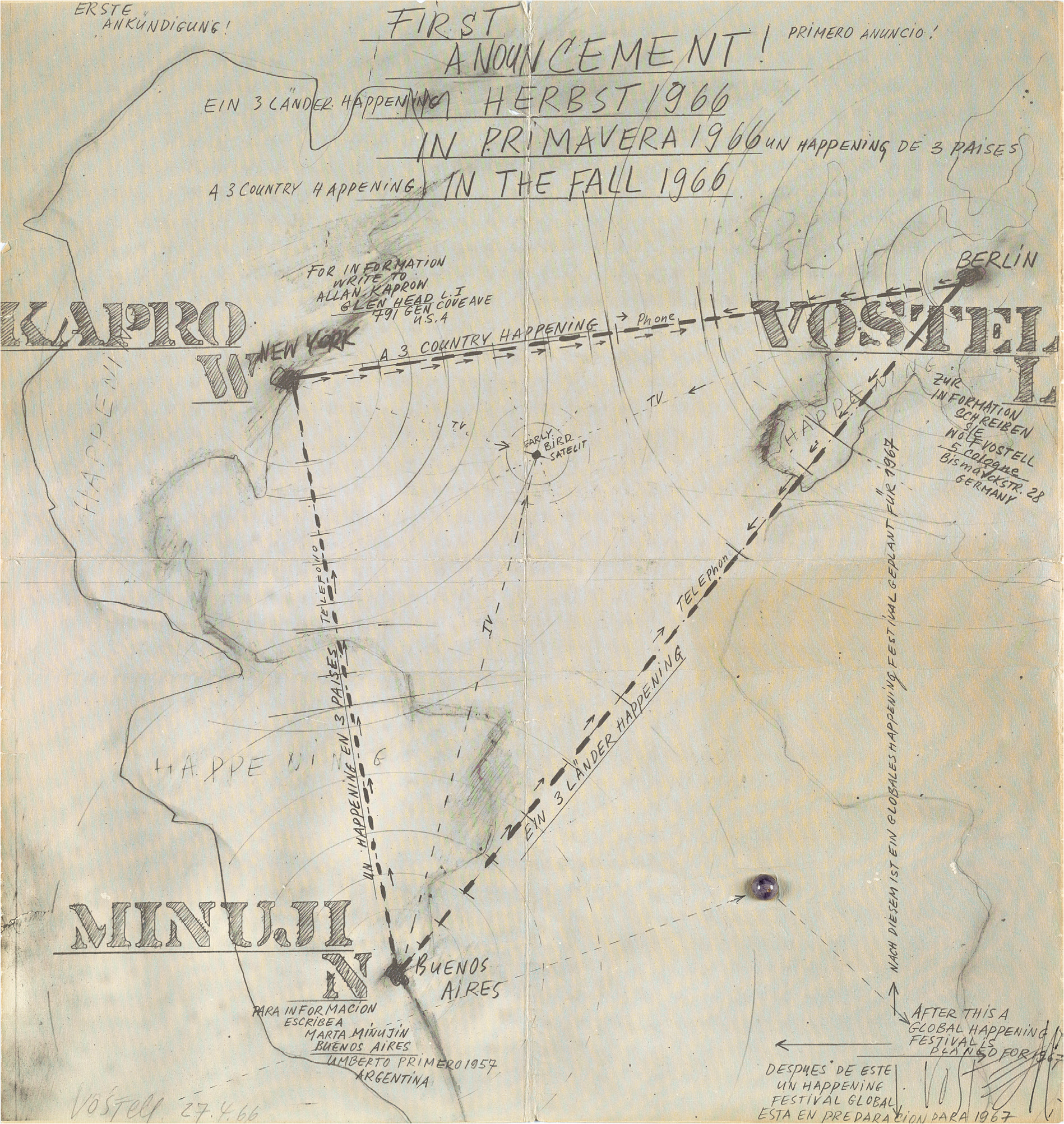
Figure 1
Wolf Vostell, Poster for 3 Country Happening, Spring, April 27, 1966. Allan Kaprow papers, ca. 1940–1997, Getty Research Institute, Los Angeles, (980063). Wolf Vostell / Artists Rights Society (ARS), New York / VG Bild-Kunst, Bonn.
Early Bird was the nickname of Intelsat I, a satellite launched in 1965. It was not the first communication satellite – Telstar was launched into low Earth orbit 1962 – but it was the first to be placed in geosynchronous orbit, rotating at the same rate as the planet below. Situated in a layer of the upper atmosphere known as the ionosphere, its signal could reach a much more capacious area than Telstar.3 Perhaps the most well-known use of Early Bird came in 1967 with Our World, organised by the European Broadcasting Union; two hours of music, art, and science transmitted from fourteen countries reached some 600 million viewers across the globe.4 Media scholar Lisa Parks describes the spectacle in terms of what she calls ‘global presence’, relying on a combination of televisual liveness and supposed transnational unity to transmit a triumphant, and specifically Western, vision of modernity.5 ‘Liveness’, writes Parks, ‘is one of television’s special effects, and commercial television carefully regulates the technological potential for liveness as a way of constantly reasserting its control and authority over the real’.6
The question of liveness in Three Country Happening – a continent-spanning media experiment staged one year before Our World – is complicated in a different way. The live satellite transmission never actually took place. By foregrounding ‘simultaneity’, the artists led their audiences to believe that the Happening was happening live; however, the segments were pre-taped. In his assessment of the work two years after the fact, writer Michael Kirby described what resulted as an ‘interesting juxtaposition of ‘truth’ and ‘falsity’ in art’.7 In other words, liveness was a special effect in this work as well. ‘The media’, Kirby quotes Minujín slyly acknowledging, ‘lied to me, too’.8 It may be more accurate, in fact, to call this manoeuvre a ‘myth’, which, as Roland Barthes describes, is ‘neither a lie nor a confession’, but ‘an inflexion’. Myth is a strategy of ‘glossing over’ an ideological concept by transforming ‘history into nature’.9 Three Country Happening fostered such ambiguity; liveness slipped between something ideological (a global telecommunications network) and something natural (a planet crisscrossed by electromagnetic signals). Moreover, in failing to live up to its stated ambitions, it also allows this myth to be seen as a myth, exposing historical contradictions in the satellite medium itself.
Grappling with global dis-connectivity is critical to reading the work in its fully transnational historical context in all its locations. In their study of Our World, Christine Evans and Lars Lundgren observe that the ‘geographies of liveness’ in the context of satellites are at once ‘global, but geographically and politically differentiated’.10 Taking this position seriously, this article attends both to the artists’ dream of a shared network and to their distinct vantage points from hyper-mediated New York, recently bifurcated Berlin, and newly censored Buenos Aires. What would it have meant for a group of artists – not a state- or corporate-sponsored organisation – to ‘geosynchronise’ live media art across cities variously under pressure from developmentalism, a repressive dictatorship, and the containment doctrine? What alternate vision of modernity, and what special effects, were at play in their attempt? This article traces the myth of liveness through the Happening as it destabilised notions of ‘the real’ in telecommunications and media art. It argues that in its aspirations and its limitations, the not-quite-use of satellites in Three Country Happening belied the supposed seamlessness of simultaneous global flows of information, power, and control.
2 Three Country Happening
Early Bird was launched in 1965 by Hughes Aircraft, a U.S. corporation. It was the first communications satellite of Intelsat, an international organisation chartered in 1964 at the initiative of the United States to oversee global broadcast services among member states. The Federal Republic of Germany was among the organisation’s eleven founding signatories, which were almost entirely from Western Europe. However, Latin America was close on its heels; Argentina gained membership in 1965.11 Just one year after the launch of Early Bird, Three Country Happening promised to tap into its capability to connect all three of these member states, each on a different continent; to do so, Kaprow, Vostell, and Minujín each planned a Happening in his or her city, each containing elements that would span all three locations.
The Happenings would all take place on October 24, 1966, in a whirlwind festival of sorts that ran in each city simultaneously from midnight to 12:11 a.m. Vostell’s action would take place first, from midnight to 12:04 a.m.: ‘Take a bottle of milk, write “FallEx” on it and put it on the next street corner. Fill out a telegram that says “milk”, and send the telegram with the names of the street corners that day to the White House in Washington, D.C., USA’. Kaprow’s would take place from 12:04 a.m. to 12:07 a.m.: ‘Smear your car with jam, then lick it off, then open the car doors and let people who are wrapped in metal paper or foil fall out of it’. Following this was Minujín’s contribution, and then, from 12:10 a.m. to 12:11 a.m, a final ‘Polaroid action’: ‘Polaroid photos are taken of every event. They are sent to the three cities by telephotography (radio image) and projected there without interruption for forty-eight hours’.12 In all three locations, all three artists are listed as performers, along with a general invitation extended to ‘anyone who wants’. Precision was charted down to the second: the entire Happening would take exactly eleven minutes and forty-eight seconds.
Minujín’s plans for the intervening minutes between Kaprow’s action and the Polaroid action were much less concise. Her event, Simultaneidad en simultaneidad (henceforth Simultaneidad), was the most robustly conceived. Far exceeding the narrow confines of the shared eleven-minute mark, it took place in two movements, spread over multiple days at locations across Buenos Aires. The first section, Simultaneidad envolvente (Enveloping Simultaneity), took place over two days at the Instituto Torcuato Di Tella (ITDT), an avant-garde art and media space in downtown Buenos Aires. Ahead of the performance, Minujín selected sixty local celebrities and luminaries: ‘radio and television personalities, journalists, critics, movie stars, psychoanalysis (several of whom are familiar in Buenos Aires through the mass media), politicians, athletes’, and so on.13 Eleven days in advance, they were brought in to the ITDT, where Minujín made tapes of them walking and offering their opinions about the media and their participation in her event.
On the day of the performance, thirty-five of them returned to the ITDT, dressed in the same clothing. As each name was called, that participant entered the space and was given a portable radio to take to their seat. Accompanying them on their walk was their own doppelgänger: walking ‘alongside’ them were projected slides with their pre-recorded moving image. As the group settled into their seats, another tape of the entire group was projected on the back wall. Their seats were arranged in rows, each with its own television set. At four minutes past midnight, the TVs started to play the eleven-minute program arranged by all three artists. Vostell’s segment played, showing one hundred milk bottles placed on corners in Berlin and Buenos Aires, and five women piercing a flank of beef with pins.14 ‘Vostell here. I am doing your happening’, said a narrator with a German accent, strongly implying the footage’s liveness. ‘Ladies, Gentlemen, switch on Radio Libertad’. Upon turning the channel, viewers saw an image of a Telex receiving a message, which Minujín read out loud to the room: ‘Kaprow’s cable is coming in, it says: Here, Allan Kaprow, New York TE30AB transmitting to Marta Minujín RTTYLIU, Buenos Aires’. Everyone was instructed to switch to Radio Municipal; after showing Kaprow’s segment – with the jam-covered car being licked, and the aluminium foil-wrapped people falling out – the instructions changed again. ‘Please switch back to Radio Libertad. This is simultaneity; this is happening right here in Buenos Aires’.15
Following this, the second piece, Instantaneous Invasion, began to play. Five hundred people had been preselected by the sociology department at the University of Buenos Aires based on their specific demographic information: they needed to live alone and own both a radio and a television. At the same, prescribed time, each of these participants sat down in front of their television sets and turned on a particular channel. Minujín’s face appeared in a recording, instructing them to turn on a different channel, but, as Minujín eagerly described to a reporter before the day of the event,
only to find me once again, telling him to turn off the television and turn on the radio and tune into this or that station; from there I send him to another station and then a third…Finally, he will get a phone call and as soon as he has stopped running from the television to the radio to answer to call, the doorbell rings. He abandons the telephone and a messenger appears before him with a small transistor television, which shows the participant answering the door. The messenger takes a picture with a Polaroid camera and quickly takes it to the television station to be broadcast along with photos of the other invadidos [invaded ones].16
In the ITDT, the participants were shown what purported to be footage of this invasion happening live:
Yes, sir, look at the invadidos, they are moving their radio controls, just like you are doing; they watch TV, they receive a phone call, they open the door, they get a telegram. Be simultaneous, yes. You are now one of the invadidos. You are listening to the signal. Reach your own conclusions.17
To complete the piece, Kaprow was supposed to call from New York over a satellite link to a telephone set up on the stage of the ITDT theatre. The call was delayed; participants, by this time quite disoriented, began to leave. Eventually, the call seemed to come through, and a man’s static-soaked American accent was amplified to the entire room. Yet it was not Kaprow on the phone after all; a friend of Minujín’s altered his own voice to mimic Kaprow’s. Further, instead of ‘enveloping’ participants with actual simultaneity, Minujín incorporated pre-recorded tapes of Kaprow’s and Vostell’s performances, presented as live transnational communications [Figure 2].18 Such deception added layers of irony and complication to the call for audience members, invaded by media, to reach their ‘own conclusions’ about the information that would eagerly control them.
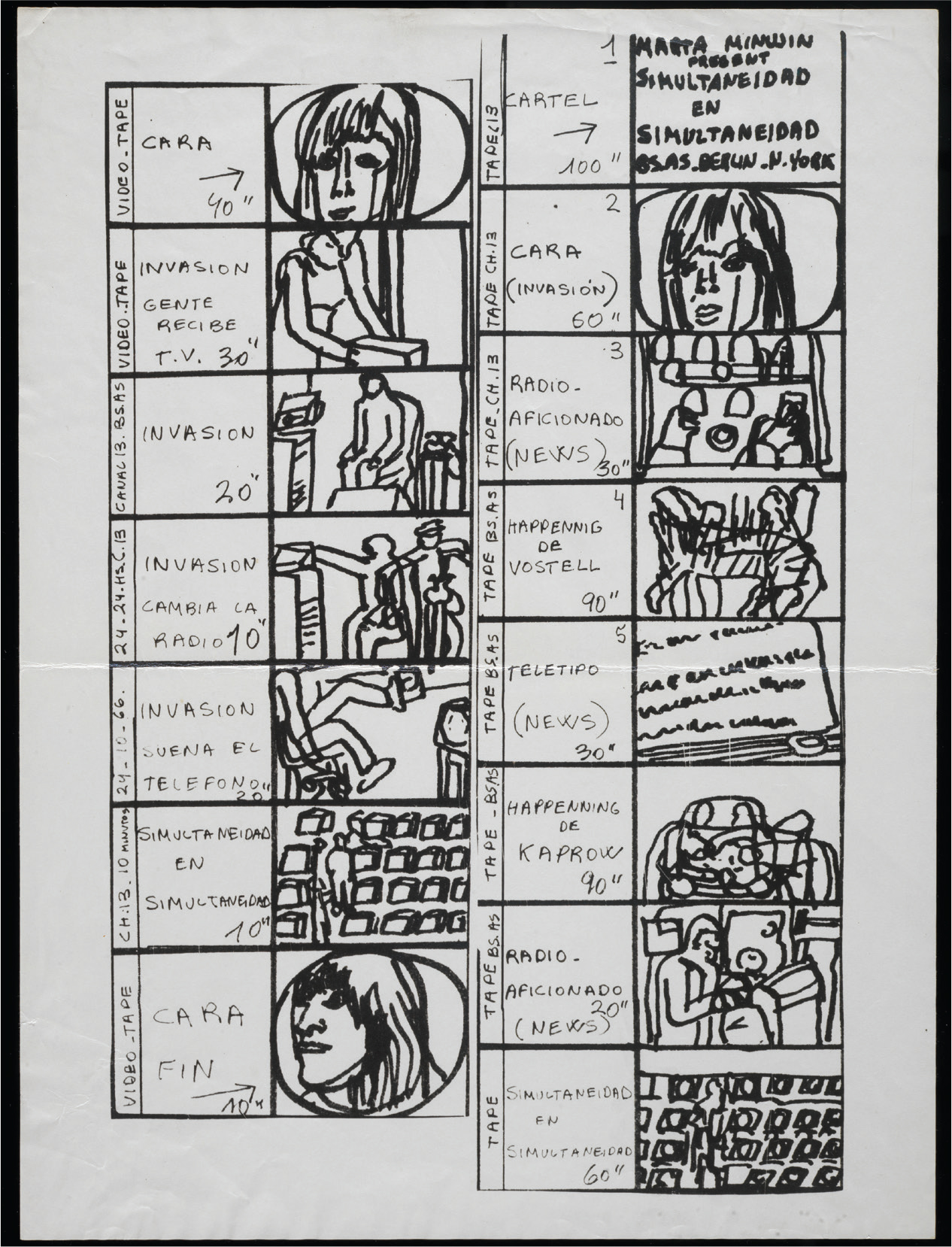
Figure 2
Marta Minujín, Simultaneidad en Simultaneidad storyboard, October 24, 1966. Marker on paper, 12 x 16 in. Allan Kaprow papers, ca. 1940-1997, Getty Research Institute, Los Angeles (980063).
Minujín maintained the supposed reality of the Happening’s satellite link for decades, telling La Nación as late as 2002 that the work was ‘a joint transmission, mediated through the Early Bird satellite.’19 Yet it remains an open question at what point the three artists realised that some amount of deception would be required to pull off the event. Indeed, the three artists certainly at least began with an earnest intention to use satellites. Kaprow described their plans in an interview from earlier in 1966:
Now some of my colleagues—in South America and Germany and elsewhere—are very interested in the possibility of what would be a world-wide Happening…We will each prepare one activity, a copy of which will be sent to the other two; so that each of us will perform three activities by clockwork. Hopefully, we’ll be joined by Telstar and other such media so that we can be at once in touch with one another.20
He swiftly acknowledges, ‘So far, I haven’t convinced Telstar to cooperate’.21 As it happens, there would have been no way to carry out the satellite plan either way; Argentina would not even have its own earth station from which to receive or broadcast information until 1969, when footage of the Apollo 11 moon landing would be transmitted throughout the country from Intelsat II.22 Yet some of the Happening’s attendees claimed to believe it in the moment; Argentine writer Bernardo Verbitsky recounted the event, perhaps somewhat sardonically, as ‘a good opportunity to announce your new novel, and they would have heard about it in New York and Berlin, connected to Buenos Aires by the Telstar satellite’.23 (The frequent slippage between Telstar and Early Bird, two quite distinct technological systems, might reasonably draw suspicion in itself.) Other accounts were more sceptical. The Buenos Aires newsweekly Primera Plana reported that Minujín, Kaprow, and Vostell ‘were trying at that point in time to surround the world with a single crown of shared delusions’.24 Could the world be connected by a myth?
3 Global Control Systems
Catalysing an image of the planet as a single, shared information network, satellites offered themselves as the medium of the moment. ‘Instead of novels’, Minujín reminisced years later, ‘we should receive enduring information by satellite’.25 This idea was most popularly articulated by Canadian media theorist Marshall McLuhan, who was influential on all three collaborators in the Happening. Across his writings from the 1960s, McLuhan extolled the new medium’s ability to shrink timescales and collapse distances. ‘The simultaneity of electric communication, also characteristic of our nervous system, makes each of us present and accessible to every other person in the world’, McLuhan wrote in Understanding Media.26 If simultaneity was a question of artistic mediation, it was a deeply political one, altering the fundamental structure of society by creating – or toppling – structures of power. McLuhan compared satellite transmission to earlier forms of imperial organisation. Referring to an age-old civilisational struggle for ‘equilibrium’ (which he also names in more explicitly cybernetic terms ‘homeostasis’), he argues that empires brought ‘order to distant areas of turbulence and anarchy’ through the spread of technologies such as the wheel, road, and alphabetic writing. Tellingly, he calls these media ‘foreign aid’ transmitted from the centre to the ‘barbarian margins’, in turn consolidating power back inward into the seat of empire.27
However, McLuhan did not see this situation as immutable: communication satellites, a technology that changes space and time alike, would disrupt homeostasis through both space and time: a ‘new intensity of proximity’ and ‘new patterns’ in ‘speed and power’. If satellites could ‘release’ television from the ‘burden of centralism’, it would also relieve the burden of linear history itself, ushering the world into an era of pluralistic networks. Here was a ‘geosynchronized’ world – much like the one represented in the Happening flier, in which cities with equally sized energy fields were connected by lines of media that were equally strong at all points. Yet art and media critic Gene Youngblood, in a 1970 Studio International essay, predicts satellites’ possible effects on art. “There are simply no parameters for human activity in this kind of environment,” he marvelled. He astutely dubbed the new condition “the open empire of the cybernetic age.”28 In this scenario, power was not organised vertically, according to political or military might, but horizontally, along the flows of media.
In reality, control may never have been entirely horizontal, but it did resemble an empire. The Communications Satellite Act of 1962, approved by President John F. Kennedy, had ‘authorised the creation of a private corporation…to establish, as expeditiously as possible, a global commercial communications satellite system’.29 To manage the United States’ satellite affairs within the international consortium, the federal government created a private corporation called COMSAT; AT&T and Hughes Aircraft were put in charge of its technical development and maintenance. This arrangement was deeply controversial; many preferred that the system remain publicly owned and operated and felt that a profit-seeking satellite system played into Soviet propaganda. Yet as historian Hugh Slotten has shown, COMSAT’s hybrid model was the result of a political calculation: to show those unaligned nations who might choose to link up to it that ‘the economic system of free competitive enterprise can itself compete favourably with the Communist system of controlled monopoly’.30 Contemporaneous commentators were concerned that profit motives would prevent the corporations from expanding into poorer parts of the world – the very same regions that Intelsat was supposed to reach.31 Complicating things further, the U.S. corporate entity maintained majority control over the global Intelsat system itself; despite the system being nominally global, COMSAT retained 61% of all the voting rights.32
This was strategic. The United States would be more closely connected with its allies as well as with the developing world, prompting a host of utopian satellite narratives. A 1962 article in The Military Engineer introduced its readership to the capabilities of and reasoning behind the brand-new technology:
In an era when trouble at remote spots requires instant attention to avert global involvement, reliable communications links of high quality are vital necessities. Satellites will make possible a global communications network, and by providing another method of transmission, will help ensure reliability. With such a global network, it will be possible instantly to talk to Timbuktu or any other city on earth. By “keeping in touch” it may be possible to “keep the peace.”33
This article concretises what social anthropologist Ruben Andersson has called ‘Timbuktu syndrome’: the persistent remnants of colonial fantasies that projected blended impulses – ‘desire and danger, domination and fear, science and fantasy’ – onto a site considered the ‘epitome of remoteness’.34 Yet this latent undercurrent of colonialism was never too far from the surface; Intelsat promised recently independent nations’ freedom from their colonial relationships with Europe, which were concretised in the bottlenecks of undersea cables. As an influential 1967 Fortune magazine feature reported, ‘Through satellites the nations of Africa, Asia, and Latin America will have easy access to the advanced nations—and to each other […which] otherwise would have been utterly impossible.’ The ‘old empires’ of Britain and France, which exerted power over colonies by controlling communications ‘transit points’, could no longer suppress broader interconnectivity.35 This rearrangement of global power was part of a move to consolidate global communications into what communications historian James Schwoch has called an ‘electrotechnical fortress for North America’ during the Cold War.36
As early as 1966, media theorist Herbert Schiller recognised that despite the proclamations of global participation, COMSAT evinced an ‘aggressive nationalism’ on the part of the United States, which was scrambling to take the mantle of power once held by the communications monopoly of the British Empire.37 This was clear in the organisational structure of Intelsat itself; COMSAT retained the majority of controlling shares, and ‘developing nations were excluded entirely’ from any official decision-making roles.38 ‘There is…a very good prospect that a multi-purpose system, under the thumb of one, powerful private corporation [AT&T], will almost automatically maintain social communications in their present unrepresentative and concentrated form’, Schiller warned.39 Slotten goes as far as to argue that the communications satellite program was first and foremost a tool of American foreign policy. Though less flashy than the moon landing, satellites – not least Sputnik – were a critical staging ground for what President Dwight Eisenhower once called the ‘total Cold War’, as the ideological conflict over controlling global telecommunications spilled from so-called ‘satellite’ locations in the Global South and into ‘satellite space’ itself.40 Geographer Barney Warf concurs, describing a satellite-enabled ‘discourse of “one Earth” [as] effectively embraced and encompassed by one nation, the United States’.41
4 Local Control Conditions
The vision of a single, interconnected planet proved compelling. By the end of the 1960s, Kaprow was musing about a network of ‘TV Arcades’ for ‘simultaneously transmitting and receiving’ information from around the world. ‘The world could make up its own social relations as it went along,’ he exclaimed.42 Despite any stated global aspiration, however, Kaprow seemed to interpret his own, ostensibly transnational work, to be thoroughly rooted in the United States.43 The ‘time that is involved in getting from one place to another (that we don’t seem to pay any attention to), and the sense of vast scale, to me, is a very American experience,’ he explained in a 1966 interview with Richard Kostelanetz. Because of this, though he acknowledged that Minujín and Vostell were the first to pitch the idea for the Happening, Kaprow was ‘almost positive that the idea was stimulated here [in the United States].’44 Kostelanetz likewise observed that Kaprow’s Happenings required ‘an unfettered exploration of space and time’ in which ‘both are open rather than closed’, or in other words, a characteristically U.S. American frontier mentality.45 It was perhaps with this reality in mind that one review of Simultaneidad accused Minujín’s Happening of ‘resembl[ing] a Geniol [painkiller] dissolved in Coca Cola’: a fizzy, U.S.-flavoured treat that anaesthetises its own consumers.46 Global interconnectivity toggled between forming a utopia of cosmic consciousness and a dystopia of new media imperialism.
However, satellites were in fact neither the totalising system their supporters nor their detractors purported them to be. Scholar of communications law Monroe E. Price has articulated that, although satellites promise the ‘obsolescence of boundaries’ and seem ‘virtually impervious to purposive planning or political and legal intervention’, the networks they create are always partial.47 ‘Satellite patterns are trade routes that have their own agonising histories and their own differentiated impacts,’ Price writes. Against grand narratives, the failures of Three Country Happening underscore a simple material reality, as true when Price was writing in 2002 as it was in the 1960s: ‘satellites are not ubiquitous’.48 Instead of resulting in universal harmony or total subjugation, the unrealised suggestion of satellite connectivity in Three Country Happening exposed the reality of bridging multiple, often incommensurate, local conditions.
4.1 Containment and Connectivity in Berlin
In 1964, Vostell began showing at the Fluxus-affiliated Galerie René Block in West Berlin, one of the city’s first art spaces to engage the international avant-garde after World War II. Yet, the city itself was premised on divisions and disconnections. The West Berlin Vostell lived in was contained and isolated from the rest of the city as well as from the surrounding East Germany: first by a blockade and then by the Berlin Wall. However, as architectural historian Alfredo Thiermann Riesco has observed, this containment was porous to one material: electromagnetic signals. The Wall ‘broke the continuity of roads and streets, telephone cables, trains tracks, and subway lines, and even cut straight through buildings,’ he writes. ‘Only the invisible transmission of music, sounds, and information disseminated via electromagnetic waves lay outside its control’. As it crossed blockades both material and political, electromagnetic signals became an arguably liberatory marker of ‘transgression’. 49
However, at that very moment, these same signals also transmitted information as a weapon. Information surveillance became part of the urban fabric of Berlin. Beginning in 1963, the GDR reported that the U.S. National Security Agency (NSA) was running a listening station on Teufelsberg, an artificial hill in West Berlin, specifically to monitor long-range transmissions coming from the East and ‘record radio communications all the way until the territory of the USSR, as well as the satellites and troposcatter connections of the member states of the Warsaw Pact, around the clock’.50 Put simply, the fact that these signals could cross boundaries also meant that they could be intercepted across boundaries. The freedom of electromagnetism, notably including satellite communications, was simultaneously a form of vulnerability, rendering ‘the city as a contested territory of rival signals and noise’.51
Vostell’s instructions to write ‘fallex’ on milk bottles were set against this contradictory backdrop. ‘Fallex’ was a shortening of ‘Fall Exercise’, the name of a series of NATO war simulations. A particularly notorious edition took place in 1962. As the West German news magazine Der Spiegel reported, Fallex 62 was ‘based on the assumption that the third world war would start with an all-out attack on Europe’ using long-range hydrogen bombs. The simulation revealed that all the tools Europe had to manage a remote-control war were dangerously inadequate. ‘Even the long-distance warning system was out of action within a very short time’, it was discovered.52 Yet spreading information about this conclusion was taboo: the Der Spiegel article led to the arrest of the publication’s senior staff, who were put on trial for treason.53 The label ‘Fallex’ would have thus been firmly associated for the public with paranoia and systemic failure, media censorship, United States technological control, and European self-destruction.
Such events would also have been top on the mind of many in Europe, as Fallex 66 took place in Bonn in October 1966, the very same month as Three Country Happening; Vostell and his local audience would no doubt have been aware of it in near-real time, as it was being reported on in the press.54 To set milk bottles on global street corners – Vostell’s contribution to the Happening – was in some ways a performance of the Fallex simulations’ paranoid logic seeping out. Combined with the ‘milk’ telegrams sent to the White House, they also became an act of long-range disinformation. Whether the milk was meant to subvert the substance’s nourishing, maternal properties or reference growing scientific reports of deadly radioactive milk (or both), the bottles on the corners became imaginary props from an apocalyptic war game in which a threat lurked in every object.55 Perhaps the NATO defences would be unprepared for such unpredictable weapons, too.
Though Vostell desired exchange among a network of Fluxus and Happenings artists around the world, he also saw and lived through the ironies in the United States’ technological promises to connect the world. Invoking NATO via satellite transmission would be, by proxy, a barb at the containment doctrine, itself the inverse of global connectivity. Taken together, Vostell’s contribution was built from paradoxes: remote cooperation and political containment, communicative technological transcendence and contaminated milk. Vostell addressed the importance of ‘contradictions, questions and chaotic situations’ to dé-coll/age in a 1965 statement: ‘The contents and the intentions must be made orderly by each participant and observer. But even when the events cannot be made orderly, they lead to the recognition that these things cannot be organised’.56
4.2 Communication and Censorship in Buenos Aires
Minujín’s work, too, was premised on paradoxes and illogical organisation. It was also importantly informed by her specific context in Buenos Aires, especially in a moment where, as art historian Elize Mazadiego contextualises, ‘art practices sought to resolve their formal limitations in order to integrate more fully into Argentina’s social spheres’.57 By the mid-1960s, the country was governed by President Arturo Frondizi, whose administration supported ‘desarrollismo’ (developmentalism).58 His administration was closely aligned with American institutions and foreign policy.59 The resulting ‘boom years’ were rich with consumer and cultural consumption.60 Communications technology was seen as a tool to further such economic and cultural development; after the launch of Early Bird, intellectuals in Argentina saw great promise in satellites as a channel for global cultural and scientific exchange.61
The Instituto Torcuato Di Tella (ITDT), where Simultaneidad took place, encapsulated the cultural moment.62 Its mandate (‘to participate and collaborate in the cultural and scientific life of the country, complementing the work already carried out by official and private entities alike’) was overtly aligned with developmentalism.63 Its activities comprised two complementary organisations: the Center for Economic Research, to adapt ‘modern theories of economic development’ to an Argentine context, and the Center for Visual Arts (CAV), which had the task of ‘cultural dissemination’ of art and music from within and beyond Argentina. In 1965, the ITDT expanded into a Center for Audiovisual Experimentation, which offered ‘state-of-the-art recording equipment’ for artists to use.64 This became a base for the Grupo Arte de los Medios, a cohort of artists organised by the writer and psychoanalyst Oscar Masotta. This group, which included Minujín, was interested in art that ‘dematerialised’ into the same media channels through which other types of information flowed; this procedure, they believed, would make visible the structure of those channels themselves.65
This came at a time when, as art historian Daniel Quiles articulates, ‘media awareness was a political act’.66 On June 28, 1966, a coup d’état resulted in the installation of the right-wing military dictator Juan Carlos Onganía.67 The months following this so-called ‘Revolución Argentina’, resulted in an uneasy transitional period, in which competing ideologies – modernism and Catholic conservatism – jockeyed for control over the spread of information.68 Buenos Aires was plunged into a paradox that historian Marysa Navarro has described as ‘political repression [and] cultural vibrancy’.69 Even as avant-garde art, psychoanalysis, and counterculture were flourishing, the new regime immediately began to quell dissent by throttling the popular spread of information. Onganía banned political parties, labour unions, and all independent publications, and shuttered, at times by violent force, both research and student organising at national universities.70 He saw the avant-garde, including the ITDT, as evidence of an external, corrupting influence on the country’s youth and national culture. To enforce his vision of Catholic modesty, the government censored sex scenes in imported films and removed offending books from libraries.71 Nevertheless, the coup was heralded in the mainstream Buenos Aires press as economic salvation after years of mismanagement.72
Staged just months into the new regime, it would be impossible not to see Simultaneidad – and its ambitions to communicate culture quite literally from outside the borders of the country – as a response to these charges. Minujín understood that the media did not always tell the transparent truth, but rather set the stage for public understanding of reality. Informed by reading the latest critical, literary, and psychoanalytic theory, the Grupo Arte de los Medios sought out, in the words of art historian Jaime Vindel-Gamonal, ‘new forms of intervention in the media landscape in which the question of myth, addressed in detail by [Roland] Barthes, would occupy a central place’.73 The group engaged in what they referred to as ‘mythifying myth’, staging events that would never take place outside of the coverage they planted about them in the local media. Art historian Karen Benezra has called such interventions ‘counterinformational’ tactics, aimed to ‘reveal how the mass media occluded the repressive political atmosphere during the dictatorship of Juan Carlos Onganía’.74
There may well have been a real attempt – or at least aspiration – to access Early Bird in the planning of Three Country Happening. At the same time, Minujín’s contribution, seen in its historical context, becomes legible as a form of counterinformation, shaking the population of Buenos Aires into sudden awareness of the mechanism by which mass media normalised repression and misinformation. This would be done by scrambling media beyond logical recognition. Reactions from participants validated this strategy. One disoriented reviewer made explicit that this experience could indeed serve as a ‘new form of therapy’ only ‘if [people] aren’t plunged into total schizophrenia before it’s over’.75 Therapy was the right word; befitting the boom in psychoanalysis in Argentina, among Minujín’s selected guests was Enrique Pichon-Rivière, the Swiss-Argentine analyst known for ‘taking psychoanalysis from the couch to the streets’, and who was associated with avant-garde circles in Buenos Aires.76 This state of disorientation in time and space activated what we might understand as a psychological glitch: short-circuiting the meaning-making machine of mass media to disrupt its monolithic message, and in doing so, ‘mythifying’ the myth of the satellite network.
5 Conclusion: Algo Bárbaro
Communications satellites were born of the same developmentalist ideology that had fostered the Di Tella Institute, with its U.S. ties and bountiful television sets, and the containment logic that had encircled West Berlin. But the glitch lays these paradoxes bare. Rather than a failed attempt at coalescing a shared time and space, the project’s inability to connect was a constitutive and ultimately critical part of the work, making visible hierarchies of power hidden within seemingly horizontal exchange. Global telecommunications was not the totalising force it claimed to be, nor would technological innovation alone be capable of transcending local political frictions into a globally ‘shared’ present. Instead, satellite transmissions in these early years were quite fractured, full of fabulation, missed connections, and uneven development.
To connect to Early Bird would be to rely on the flows of U.S.-controlled globalisation; to fail to connect to Early Bird was to expose its reality as a partial system, with persistent margins as well as centres, despite McLuhan’s optimism to the contrary. In this way, the ‘open empire’ did not stray far from older forms of imperial control. Yet in a frenzied moment after her performance, Minujín had the last word, exclaiming to a reporter: ‘La simultaneidad es algo bárbaro, no?’77 The expression could be taken colloquially to mean simultaneity was something wild, even marvellous. But the term is multivalent: barbarism, in its ancient Roman sense, referred to something beyond the bounds of empire. In Three Country Happening, mediated simultaneity did not consolidate control, but rather unbounded it.
Liveness in telecommunications in this period formed a warped feedback loop that both reflected and generated a form of reality. If, to return to Lisa Parks, commercial television touted liveness as a kind of ‘special effect’, these artists played with its artifice as a material. Art critic Harold Rosenberg observed of television in 1973, ‘On television, POW’s [Prisoners of War] returning from Hanoi were shown passing the time watching POW’s returning from Hanoi on television’.78 Commenting on Rosenberg’s observation the following year, Kaprow reflected, ‘Art, which copies society copying itself, is not simply the mirror of life. Both are made up. Nature is an echo system’.79 In claiming to tap into a simultaneous communication system that was in reality inaccessible to them, Minujín, Kaprow, and Vostell – each in their own ways, from their distinct political and spatial vantages – presented the truth value of mediated liveness as a confidence trick. At the same time, given the institutional history of the satellite system and the state of mediation in the various locations of this Happening, the reality of Intelsat’s global liveness was itself in many ways also a special effect. To use Kaprow’s terms, both were made up. Ultimately, then, Three Country Happening constructed less a mirror of real technological liveness than a mise-en-abyme that connected the globe into a complex ‘echo system’ of satellite myths.
Acknowledgements
The author extends deepest gratitude to the editors and peer reviewers of VIEW Journal and to the many mentors, colleagues, and interlocutors whose insightful feedback and transformative suggestions made this article possible, most notably Caroline A. Jones, Mark Jarzombek, Magdalena Grüner, Zsofi Valyi-Nagy, Leonard Folgarait, and Andrew Perchuk. Special thanks to the 2023–2024 cohort of Getty Scholars for feedback on this project in its lecture form, and to Getty Research Institute and Getty Scholars Program staff for facilitating sustained archival research and lively communal engagement with art and technology.
Funding Information Statement
Research for this article was undertaken with support from the Getty Research Institute and the Massachusetts Institute of Technology.
Notes
[1] Storyboard for Simultaneidad videotape, n.d., Box 69, Folder 4, Allan Kaprow papers, Getty Research Institute Special Collections, Los Angeles.
[2] ‘Satelit’ is a misspelling of the German word ‘satellit’. Three Country Happening First Announcement flier, n.d., Box 9, Folder 8, Allan Kaprow papers, Getty Research Institute Special Collections, Los Angeles.
[3] See: David Whalen, The Rise and Fall of COMSAT: Technology, Business, and Government in Satellite Communications (London: Palgrave Macmillan UK, 2014).
[4] Tom Huntington, “The Whole World’s Watching”, Air and Space Magazine 10 (April/May 1996): 55–60.
[5] Lisa Parks, Cultures in Orbit: Satellites and the Televisual (Durham, NC: Duke University Press, 2005).
[6] Lisa Parks, “Orbital Performers and Satellite Translators: Media Art in the Age of Ionospheric Exchange”, Quarterly Review of Film and Video 24 (2007): 208.
[7] Michael Kirby, “Marta Minujin’s ‘Simultaneity in Simultaneity’”, The Drama Review: TDR 12, no. 3 (Spring 1968): 148.
[9] Roland Barthes, “Myth Today”, Mythologies, trans. Annette Lavers (New York: Farrar, Straus & Giroux, 1972), 128.
[10] Christine E. Evans and Lars Lundgren, “Geographies of Liveness: Time, Space, and Satellite Networks as Infrastructures of Live Television in the Our World Broadcast”, International Journal of Communication 10 (2016): 5363.
[12] Three Country Happening planning document, n.d., Box 9, Folder 8, Allan Kaprow papers, Getty Research Institute Special Collections, Los Angeles. Translation from German my own.
[14] ‘Five girls [walked] slowly around half a slaughtered cow and ritualistically [stuck] pins into it’, Ibid., 150.
[15] Simultaneidad en simultaneidad script, 1966, Box 69, Folder 4, Allan Kaprow papers, Getty Research Institute Special Collections, Los Angeles.
[16] Marta Minujín, ‘Revista Confirmation’, September 19, 1966, reprinted in Marta Minujín: Happenings y performances (Ciudad Autónoma de Buenos Aires: Ministerio de Cultura del Gobierno de la Ciudad Autónoma de Buenos Aires, 2015). Translation from Spanish my own.
[18] Simultaneidad en simultaneidad storyboard, n.d., Box 9, Folder 8, Allan Kaprow papers, Getty Research Institute Special Collections, Los Angeles.
[19] Marta Minujín, “La Nación, 04/02/2002”, reprinted in Marta Minujín: Happenings y performances (Ciudad Autónoma de Buenos Aires: Ministerio de Cultura del Gobierno de la Ciudad Autónoma de Buenos Aires, 2015). Translation from Spanish my own.
[20] Allan Kaprow, quoted in Richard Kostelanetz, “Conversations: Allan Kaprow”, in The Theatre of Mixed Means: An Introduction to Happenings, Kinetic Environments, and Other Mixed-Means Performances (London: Pitman, 1970), 131.
[22] See: Mirta Varela, “Media History in a ‘Peripheric Modernity’: Television in Argentina 1951-1969”, Westminster Papers in Communication and Culture 4, no. 4 (2007): 84–102.
[23] “Un espectáculo revolucionario”, Confirmado, November 3, 1966, 53. Translation from Spanish my own.
[24] “Happenings: y llego el gran día”, Primera Plana, November 10, 1966, 71. Translation from Spanish my own.
[25] Marta Minujín, “Nota del archivo personal de Marta Minujíin, May 1994”, reprinted in Marta Minujín: Happenings y performances. Translation from Spanish my own.
[26] Marshall McLuhan, Understanding Media: The Extensions of Man (New York: Signet Books, 1966), 333.
[29] Communications Satellite Act of 1962, quoted in Allen E. Throop, “Some Legal Aspects of Satellite Communication”, Proceedings of the American Bar Association, Section of International and Comparative Law (August 7–12, 1964): 61.
[30] Hugh R. Slotten, “Satellite Communications, Globalization, and the Cold War”, Technology and Culture 43, no. 2 (April 2002): 340.
[31] See, for example: Thomas P. Murphy, “Technology and Political Change: The Public Interest Impact of COMSAT”, The Review of Politics 33, no. 3 (July 1971): 405-424.
[32] Hugh R. Slotten, “International Governance, Organizational Standards, and the First Global Satellite Communication System”. Journal of Policy History 27, no. 3 (2015): 521-549.
[33] Claude M. Blair, “Talking to Timbuktu: Project TELSTAR”, The Military Engineer 54, no. 361 (September-October 1962): 334.
[35] Charles E. Silberman, “The Little Bird That Casts a Big Shadow”, Fortune 75, no. 2 (February 1967): 108.
[36] James Schwoch, Global TV: New Media and the Cold War, 1946-69 (Urbana: University of Illinois Press, 2009), 86.
[37] Herbert Schiller, Mass Communications and American Empire [1966] (New York: Augustus M. Kelley, 1969), 146.
[41] Barney Warf, “Dethroning the View from Above: Toward a Critical Social Analysis of Satellite Ocularcentrism”, Down to Earth: Satellite Technologies, Industries, and Cultures, eds. Lisa Parks and James Schwoch (New Brunswick, NJ: Rutgers University Press, 2012), 49.
[42] Allan Kaprow, “The Education of the Un-Artist, Part I” [1969/1971], in Essays on the Blurring of Life, ed. Jeff Kelley (Berkeley, CA: University of California Press, 1993), 106–107.
[43] When Kostelanetz asked Kaprow to define the ‘American stream of the movement’, Kaprow called his Happenings ‘free-wheeling, like hot-rod races’. Kaprow, interviewed in Richard Kostelanetz, The Theatre of Mixed Means: An Introduction to Happenings, Kinetic Environments, and Other Mixed-Means Performances (London: Pitman, 1970), 131–132.
[46] Bernardo Verbitsky, “Un espectáculo revolucionario”, Confirmado, November 3, 1966, 53. Translation from Spanish my own.
[47] Monroe E. Price, Media and Sovereignty: The Global Information Revolution and Its Challenge to State Power (Cambridge, MA: The MIT Press, 2002), 70.
[49] Alfredo Thiermann Riesco, Radio-Activities: Architecture and Broadcasting in Cold War Berlin (Cambridge, MA: The MIT Press, 2024), 10–11.
[50] “Analyse der Struktur und Tätigkeit der US Army Field Station Berlin (USAFSB) Teufelsberg”, 1985, in Bundesbeauftrage für die Unterlagen des Staatssicherheitsdienstes der ehemaligen Deutschen Demokratischen Republik (BStU), MfS, HV A, Nr. 883, Bl. 1–68, here 4. Quoted in Thiermann, Radio-Activities, 106. Translation from German by Alfredo Thiermann Riesco.
[52] “Fallex 62”, Der Spiegel, October 10, 1962, quoted in “Fallex 62”, Survival 5, no. 1 (1963): 19–22.
[53] Arthur J. Olsen, “The Man Who Holds the Mirror to Germany”, New York Times, February 7, 1965, SM30. When documents pertaining to Fallex 62 were leaked in London, protestors were labelled ‘anti-bomb zealots’. See “British ‘Secrets’ Seized on March”, New York Times, April 12, 1963, 1.
[54] See “Document No. 43: East German Analysis of the NATO ‘Fallex 66’ Exercise, 1967”, in Cardboard Castle?: An Inside History of the Warsaw Pact, eds. Vojtech Mastny and Malcolm Byrne (Budapest: Central European University Press, 2005), 242–44. The only way to stop a Soviet invasion, Fallex 66 suggested, was to cordon off the region using radioactive rubble – rubble sourced from the wreckage of West Germany dropping nuclear bombs on itself. Of course, any use of nuclear weapons would have to receive approval from Washington, requiring West Germany to ask for the United States’s permission to destroy itself. Geopolitics scholar Ian Klinke has described this perverse situation as West Germany engaging in the ‘forbidden and obscene enjoyment of self-annihilation’. Ian Klinke, “Self-Annihilation, Nuclear Play and West Germany’s Compulsion to Repeat”, Transactions of the Institute of British Geographers 41, no. 2 (2016): 110.
[55] See J. Nosek and V. Santholzer, “Strontium-90 In Milk 1957 To 1960 and Its Relation To Radioactive Fallout In Central Europe” (1961).
[56] Wolf Vostell, “Statement”, September 11, 1965, Box 70, Folder 3, Allan Kaprow papers, Getty Research Institute Special Collections, Los Angeles.
[57] Elize Mazadiego, Dematerialization and the Social Materiality of Art: Experimental Forms in Argentina, 1955-1968 (Leiden & Boston: Brill/Rodopi, 2021), 10.
[58] Robert A. Potash, “Argentina’s Quest for Stability”, Current History 42, no. 246 (February 1962): 72.
[59] See C. A. MacDonald, “The Politics of Intervention: The United States and Argentina, 1941–1946”, Journal of Latin American Studies 12, no. 2 (1980): 365–96.
[60] John King, “El Di Tella and Argentine Cultural Development in the 1960s”, Bulletin of Latin American Research 1, no. 1 (October 1981): 107.
[61] Aldo Armando Cocca, “Benefits of World Exchanges” [1965], Communication in the Space Age: The Use of Satellites by the Mass Media (Paris and Amsterdam: UNESCO, 1968), 80.
[62] See Andrea Giunta, Avant-Garde, Internationalism and Politics: Argentine Art in the Sixties (Durham, NC: Duke University Press, 2007).
[64] Daniel R. Quiles, “Double Binds: Technology and Communication in Argentine Art, 1965-1977”, Latin American Modernisms and Technology, ed. Maria Fernández (Trenton: Africa World Press, 2018), 239.
[65] Oscar Masotta, “Después del pop: Nosotros desmaterializamos”, Conciencia y estructura (Buenos Aires: Corregidor, 1990), 235–64. Quoted in Karen Benezra, “Media Art in Argentina: Ideology and Critique ‘Después del Pop’”, ARTMargins 1, no. 2–3 (2012): 159.
[66] Daniel R. Quiles, “Mediate Media: Buenos Aires Conceptualism”, Transmissions: Art in Eastern Europe and Latin America, 1960-1980, exh. cat. (New York: Museum of Modern Art, 2015), 2.
[67] See: Daniel G. Kressel, “The ‘Argentine Franco’? The Regime of Juan Carlos Onganía and Its Ideological Dialogue with Francoist Spain (1966-1970)”, The Americas 78, no. 1 (January 2021): 89-117.
[68] “Cosmopolitanismo” was Onganía’s term for the cultural elements he disdained. See Juan Carlos Onganía interview, in John King, El Di Tella (Buenos Aires: Ediciones Gaglianone, 1985), 309. Quoted in Fernando García, El Di Tella: Historia íntima de un fenómeno cultural (Buenos Aires: Paídos, 2021), 121.
[69] Marysa Navarro, “The Sixties in Argentina: Political Repression, Cultural Vibrancy”, Revista: Harvard Review of Latin America (Winter 2009): 49.
[70] Elinor Langer, “Seizure of Universities Leaves Intellectual Casualties”, Science 153, no. 3742 (September 16, 1966): 1362–1364.
[71] The Di Tella Institute itself would shut down by 1970, though accounts differ on the proportion of economic and political pressure behind the closure. See King, 110.
[73] Jaime Vindel-Gamonal, “Por un arte semiológico: ‘deshabituación’ y ‘discontinuidad’ en el arte argentino de los años sesenta”, Arte, Individuo y Sociedad 26, no. 3 (2014): 523. Translation from Spanish my own.
[75] Ana Maria Del Valle, “Marta Minujín reunion personalidades en un inquietante ‘happening’”, Gente (October 29, 1966): 38-39. Translation from Spanish my own.
[76] Hugo Vezzetti, “From the Psychiatric Hospital to the Street: Enrique Pichon-Rivière and the Diffusion of Psychoanalysis in Argentina”, in Argentina on the Couch: Psychiatry, State, and Society, 1880 to the Present, ed. Mariano Plotkin (Albuquerque: University of New Mexico Press, 2003), 142.