
1 Writing Transnational Histories
In 2014 I began researching the transnational history of the American children’s television program Sesame Street. The project has located the transfer of the show to Europe in a global framework, demonstrating how the worldwide sales in the 1970s influenced the reception and rejection around the world. The book which became the main result of the project also contains in-depth case studies of the reception and rejection of the show in Britain, West Germany, and Scandinavia.1 In sum, it is an example of a highly border-crossing project about broadcasting history and ideally, it would be able to speak to the ways in which the archival infrastructures and digitization strategies of European broadcasting have made possible this kind of research. However, this was not the case: the digitization strategies of audio-visual material employed by European broadcasting archives were not geared towards the kind of transnational research I have been undertaking.
In this article, I reflect on the challenges broadcasting archives presented in terms of writing a truly transnational history of European preschool television in the 1960s and 1970s. I consider why it is that printed material became the main source group for a historical broadcasting project supposedly taking place in the age of abundance.2 I end by demonstrating how assembling my own archive of ‘self-digitized’ (published and unpublished) sources became the foundation for the project and underpinned its border-crossing aims.
As in any other historical inquiry, the question of archival preservation, curation, access policies, and practices is key in writing border-crossing, transnational history of broadcasting.3 Broadcasting archives, like most archives from public or semi-public institutions, pose a particular challenge to studies that do not take the nation-state as the starting point, as the establishment of public archives and their role in historical inquiries has been closely bound to the identities of modern nation-states.4 The link between early broadcasting and national monopolies means that the national focus on archival governance and infrastructure has influenced the conceptual design of many broadcasting archives. Archives of European public service broadcasters are rooted in nationally focused traditions, the result being that their infrastructure provides a particular challenge to studies of historical transfer, entanglement, and global connections, as documents linked to border crossing issues have had lower priority to those creating and persevering archives than those firmly rooted in national infrastructures and policies. It is not an impossible barrier to overcome, as exciting new entangled media histories show, but it is nonetheless a substantial barrier that needs to be raveled with when undertaking transnational research.5
Throughout the article, I use my personal experiences in writing about the transnational history of Sesame Street to point toward ways forward for researchers interested in investigating entangled European broadcasting histories. I consider what the lack of available audiovisual material has meant and contrast it with the possibilities provided by the vast amount of print material in which I found European interconnections. I also explain how a specific content-management software (Tropy) can be used to ‘hack’ the national boundaries encoded in the archival collections—making personal collections that focus on transnational events and cut across the original national structure of the various archival collections. Finally, I suggest that perhaps it is not audiovisual material broadcasting archives first and foremost need to make available in digital formats if we want to further boundary-crossing television history; instead, I believe that the possibility of sharing self-digitized printed material should be a particular focus going forward.
As much as broadcasting history, the history of Sesame Street has largely been confined to particular national contexts.6 It is heavily dominated by studies of its domestic roots in the United States, but there are also some accounts of the show’s transfer to other parts of the world, e.g. Western Europe, Iran, Nigeria, and Latin America.7 However, what has been lacking are histories that address the combined efforts of Sesame Street’s producers, the Children’s Television Workshop, to make the show a worldwide established brand for educational television—including the effect of the global sales strategies on local adaptations. This shortcoming has meant that the existing literature obscures the history of how the Workshop’s efforts to conquer the world market were key to its operations because of its unsustainable, domestic funding model.8
Scholarship on global history has long debated how histories that only compare transfer from one country to another fail to address the wider global structures and their local implications.9 The same can be said for the dynamics that underpin international transfer in broadcasting markets. International festivals, fairs, sales companies, conferences, and organizations like the European Broadcasting Union or the Nordic Broadcasting Union are seldom included in nationally focused media histories even if important to the formation of local broadcasting policies, programs, and culture—just as I found in the case of Sesame Street’s history.
As I began the transnational Sesame Street project, it became clear that to understand both the positive reception as well as the rejection of the program on a global and local level, I would need sources that could help establish broad, contextual frameworks. I needed to know what the broadcasting landscape, production milieus, programs, policies, and regulatory measures looked like in terms of programs for young children but also more broadly in all the countries I was interested in—as well as the make-up of the pan-European and other supra-national fora that influence them. Sources and historiography needed to be collected in a variety of formats and from national and international communities to write a history encompassing everything from broadcasting policies and production to ideas about preschool education and childhood on a global scale (albeit with Western Europe as a critical focus).
I needed to know what Sesame Street looked like in its American version, but also in the versions that were sold and co-produced. However, to understand the transfer and its challenges I also needed to know what existing and competing preschool offers looked like in the countries where Sesame Street was sold, co-produced, and rejected. Without knowing what existing offers looked like, it would be impossible to understand what the starting point was for the potential European buyers of the American program. Understanding the ideas of childhood and education that went into the productions already being on offer in Europe was key to assessing what Sesame Street would be measured against. Consequently, I looked for places where I might find Sesame Street in its American and foreign versions, as well as European-produced preschool television between 1965 and 1975. First, I looked online, and eventually, I moved into brick-and-mortar broadcasting archives.
As one might imagine, it was lots of fun watching old Sesame Street episodes with Bert and Ernie sketches, beautiful animations, and seeing Big Bird making jokes with Maria, the kids on the street, and Mr. Hooper. Old episodes of Sesame Street are easily accessible on DVDs, YouTube, HBO’s platforms in the United States (until recently) and elsewhere. The written archives of the Children’s Television Workshop (CTW, now Sesame Workshop), which produced the show, also contain much material that can be used to write the show’s international history, even if the foreign part is much less well curated than the archival series about its domestic production.
What has been a more trying experience has been investigating Sesame Street’s transnational history from an outside perspective. The history of potential and actual buyers, the European communities where the show was discussed and marketed, and the sales agents based in France and the United Kingdom, are not only absent from most of the Sesame Street historiography but the potentially useful sources are also organized in ways that make them harder to explore for traces of the program’s international history. Not only are the audiovisual sources almost non-existent or non-accessible, but the national orientation of most written archives has also meant that limited material on international interactions such as sales, festival activities, and committee work with European Broadcasting Union had to be dug out of archival infrastructures vigorously screwed towards national issues.
Online I found close to no audiovisual sources on preschool television in the late 1960s and early 1970s. The portal EUscreen offers almost no children’s programs at all, and, in addition, its limited technical documentation and metadata make it hard to use for the systematic selection of sources as needed for historical research.10 YouTube does offer some possibilities, but the lack of both metadata and the possibilities of verifying information makes it equally unfit for anything but confirming findings that have been done elsewhere, e.g. matching a program described in a printed source to a specific audiovisual expression. DR, SVT, and NRK all have a few episodes of old children’s television in their online archives, but I had to travel to Denmark, Sweden, and Norway to see them because of the geo-location restrictions.
Brick-and-mortar archives of broadcasters turned out to be a way to access some episodes of television for a young audience. In the archives of NDR in Hamburg, I got to see old episodes of Sesamstrasse. BBC had some old episodes of Play School, and at RAI Teche in Rome, I watched the Italian version of the Sesame Street spin-off Open Sesame, Sesamo Apriti. However, considering the 2010s promises of how digitization and online availability via European platforms would revolutionize the study of television history, the results of my efforts were disappointing.11 The online availability of European broadcasting heritage is underwhelming when it comes to children’s television in the 1960s and 1970s. One issue is of course the fact that many programs were never taped or were taped over because of the price of raw tapes. However, many programs do exist in the vaults of European broadcasters, but they are inaccessible to researchers. The archival turn that would revolutionize the field of broadcasting history as foretold in VIEW’s first issue, never reached the area of children’s programming.12
The audiovisual sources available to me in a digitized format, online and offline, did not make writing transnational history possible as they were limited in number and availability. It was the paper archives and libraries of print material from US and European broadcasters which made my research feasible. In fact, the mismatch between the promise of a revolution because of digitization stated in the existing literature and my difficulties eventually led me to write an article on my experience of doing media history in a digital age in 2015, in which I considered the change and continuity in historiographical practices.13 The article discussed the clash between the expectation that more readily available audiovisual material would lead to research breakthroughs and the realities of historical research. It argued that for the most part is not driven by the availability of data, but by researchers’ scholarly interests, and it is only when the available data fits the historical problems researchers find interesting they lead to new results. The different epistemological nature of data-driven and problem-oriented research cannot be solved solely with the existence of more available data if it is not the kind researchers are looking for both in terms of content and quality (including the quality of its metadata).
Now, eight years later, I have finished my book. It is a truly transnational history of Sesame Street, and it includes case studies from Scandinavia, West Germany, the UK as well as France, and Italy. It is built on archival research in eleven different archives in seven different countries, but it does not include many references to audiovisual sources; the mismatch between the promises of the European digitization projects and experience using them still exists.
2 Differences in Preservation Practices and National Historiographies
What has made the book a rich study in border-crossing, transnational, and entangled media history, has been the availability of (physical) written archives and (some) digitized print materials available online. But the variation of national and institutional preservation practices and curation policies in different archives, as well as different historiographical traditions, have certainly made it challenging to make a balanced study of the differences in the European reception of Sesame Street.
Researching historiography in different languages is a hard job on its own. However, even if accessible, it does not exist in equal measure. French, Italian, and Spanish television historians have been much less interested in children’s television than Dutch, German, Scandinavian, and British, meaning that the starting point for the investigation is already much less informed in the former countries than in the latter. Furthermore, unpublished archival material was not available in Italy, the southern European country where I did the most thorough investigations for the book. Because of this shortcoming, I decided to concentrate on cases placed in Northwestern Europe and instead get at the inter-European history by looking at fora such as the European Broadcasting Union and Prix Jeunesse, where archival material was more accessible and the historiography more prosperous.
In Germany, Scandinavia (Denmark, Sweden, and Norway), and the United Kingdom, written archives of national public service broadcasters are available to researchers. I visited the archives of NDR (the institution’s own archive and its collections held in the State Archives), DR (collections at the National Archives), SVT (collections kept at the institution’s internal archive), NRK (the institution’s own archive and its collections held at the National Archives), and BBC (the institution’s own archive). In Germany, I also visited the Prix Jeunesse Foundation, which has both the institution’s written and audiovisual archives. Except for the Prix Jeunesse archive, all the collections have a domestic focus, with a vast part of the material focusing on domestic productions and policies. This was great for getting a sense of what preschool production looked like prior to Sesame Street’s introduction to the European market, but also to see how it affected them to a higher or lower degree throughout the 1970s.
3 European Entanglements in Print
It was in the minor and less curated parts of national collections I found the most elaborate sources on international connections. Both the NRK and DR collections at the national archives in Norway and Denmark, respectively, have sub-series on the collaboration in the European Broadcasting Union’s subcommittee for children and youth programs, and so do the BBC’s written archives. These subseries are not well-curated, described, or organized, but they have rich material from the decades I was interested in. Sesame Street and television for young children, as produced in Europe at the time, was much discussed in the EBU subcommittee, and the vast material preserved, particularly in the Scandinavian archives, enabled me to read about its many activities. Especially lucky was the fact that one such activity in the subcommittee was a workshop in 1972 for all EBUs members focusing on preschool television and their different takes on the genre.14 Reading the publication from this workshop, but also notes and other auxiliary material preserved in the Scandinavian broadcaster’s archives, provided invaluable insight into the European broadcasting landscape for young children at the time.
In the SVT archives, as well as those of DR and NRK, I also found many documents from the collaboration in the Nordic broadcasting union, Nordvision, providing yet another level of entanglement. The Nordvision partners tried to co-produce a Nordic version of Sesame Street (and failed miserably in their collaboration with the CTW). Again, the preservation of this material seems to have been coincidental rather than planned—probably only kept because the experiences of trying to make Nordic Sesame were later used in a specific domestic production in Sweden, providing a distinct ‘national’ reason to preserve the material. Nevertheless, they were key to understanding the effects of regional policies and programming experiments on a national level.
The Prix Jeunesse’s archives and library, with its global rather than national outlook, turned out to be a treasure trove of material for my book’s global framework. It was at the Prix Jeunesse festival in 1970 that Sesame Street was screened for the first time for a global audience, and two years prior, the concept for Sesame Street had been introduced to the Prix Jenusesses foundation’s multi-lingual magazine Television und Bildung (an entire year before the show aired in 1969).15 This meant that the concept was already known to many of the participants at Prix Jeunesse festival in 1970, an event that brought together more than 200 people from broadcasters on four continents.
The material from Prix Jeunesse showed both how an international audience received and discussed Sesame Street when it was first shown, but also how television for preschool children was discussed more widely at the time. Usually, the Prix Jeunesse Foundation funded comparative global research on the prize winning programs, having research teams from 6-7 countries making investigations of national audiences’ reception of the program. As Sesame Street won a prize in 1970, the program would typically have been part of this research. However, as the people behind Sesame Street declined to participate, the research done in the wake of its win of the 1970 prize for young children’s programs investigated questions related to the production of young children’s programs more broadly. As a result, the research presented at the festival in 1972 was centered on preschool programs generally—meaning that the sources preserved from this event were able to provide me with an overview of the world market at the time, which I had not been able to gather elsewhere.
In sum, less systematically collected and little-curated files preserved from the EBU and Nordvision meetings and workshops, together with the files from Prix Jeunesse, provided an excellent basis for understanding the overall global and European landscape for children’s television at the time. Digitizing the written material from such transfer hubs might provide a more fruitful way forward for underpinning border-crossing transnational research in broadcasting history than what is currently done in terms of creating audiovisual archives. Especially as the EBU itself has closed off access to researchers.16
4 Hacking Archival Structures with a Digital CMS Tool
A simple but immensely effective digital tool, Tropy, has made a real difference to my transnational research, letting me combine sources on related transnational processes from different archival collections into one collection. Tropy is a digital content management system that allows researchers to organize the many pictures they have taken on trips to brick-and-mortar archives in their own personal archive of ‘self-digitized’ sources—a now very common practice amongst most historians.17 Using Tropy researchers are presented with an opportunity to, in an organized manner, rearrange whatever sources are collected into a personal system where the focus is on supporting the topic of interest of the individual. In my case, I was able to combine material from eleven archives across seven countries into one project, which then contained the majority of the written sources I collected for the project (see Figure 1).
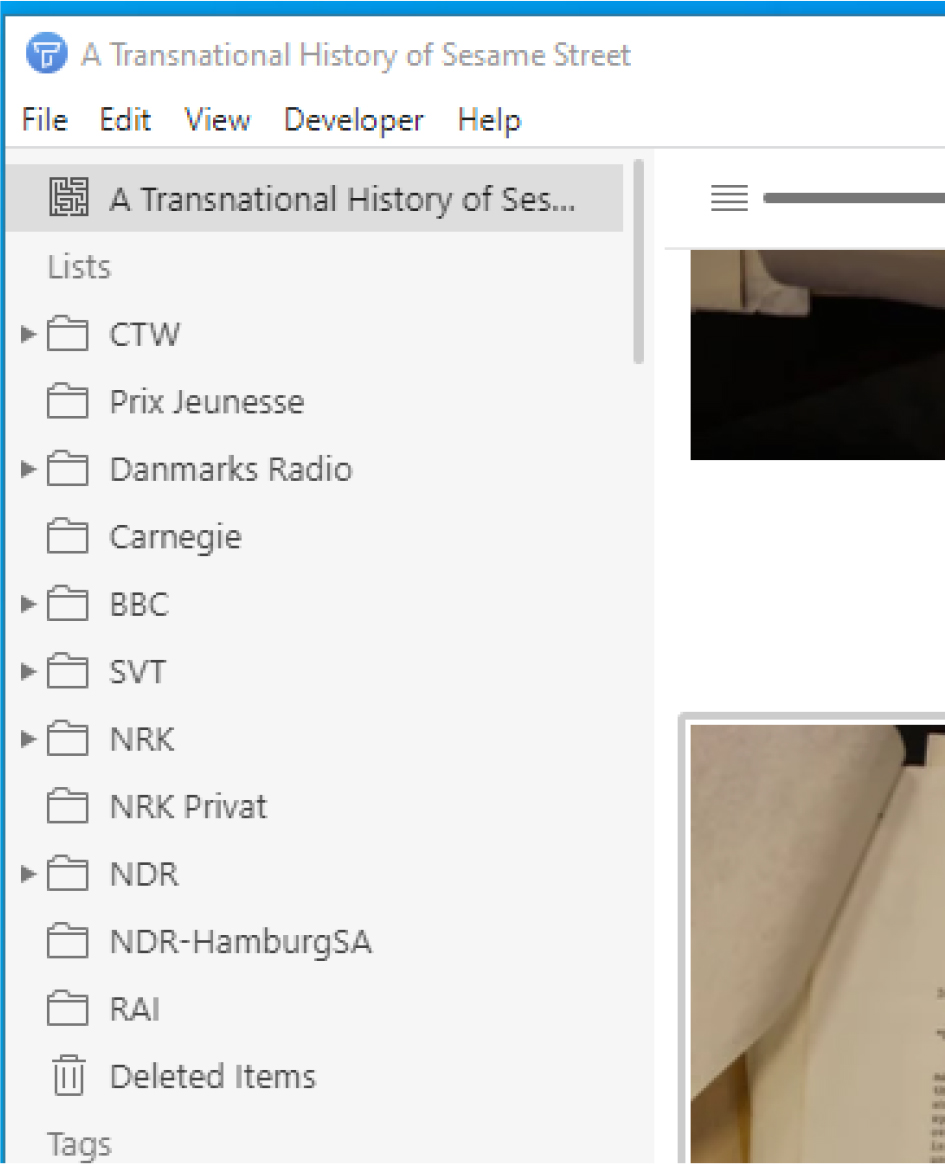
Figure 1
Tropy lists.
In Tropy, all items can be registered with metadata from the original archives, as seen in Figure 2. The example in Figure 2 is a letter from the head of BBC’s children’s department, Monica Sims, to the executive producer of Sesame Street, David Connell, from August 17, 1970, in which Sims tell Connell that the BBC is very interested in buying some sequences from Sesame Street featuring Muppets. Because the original metadata is registered, I was able to know the letter’s provenance in the original archival structure when I later decide to combine it with other items from other archives in my own ‘transnationally’ focused collections. Tropy supports different metadata schemes, different metadata schemes, and users can also make their own. The system also allows users to make notes (that are then searchable together with the metadata).
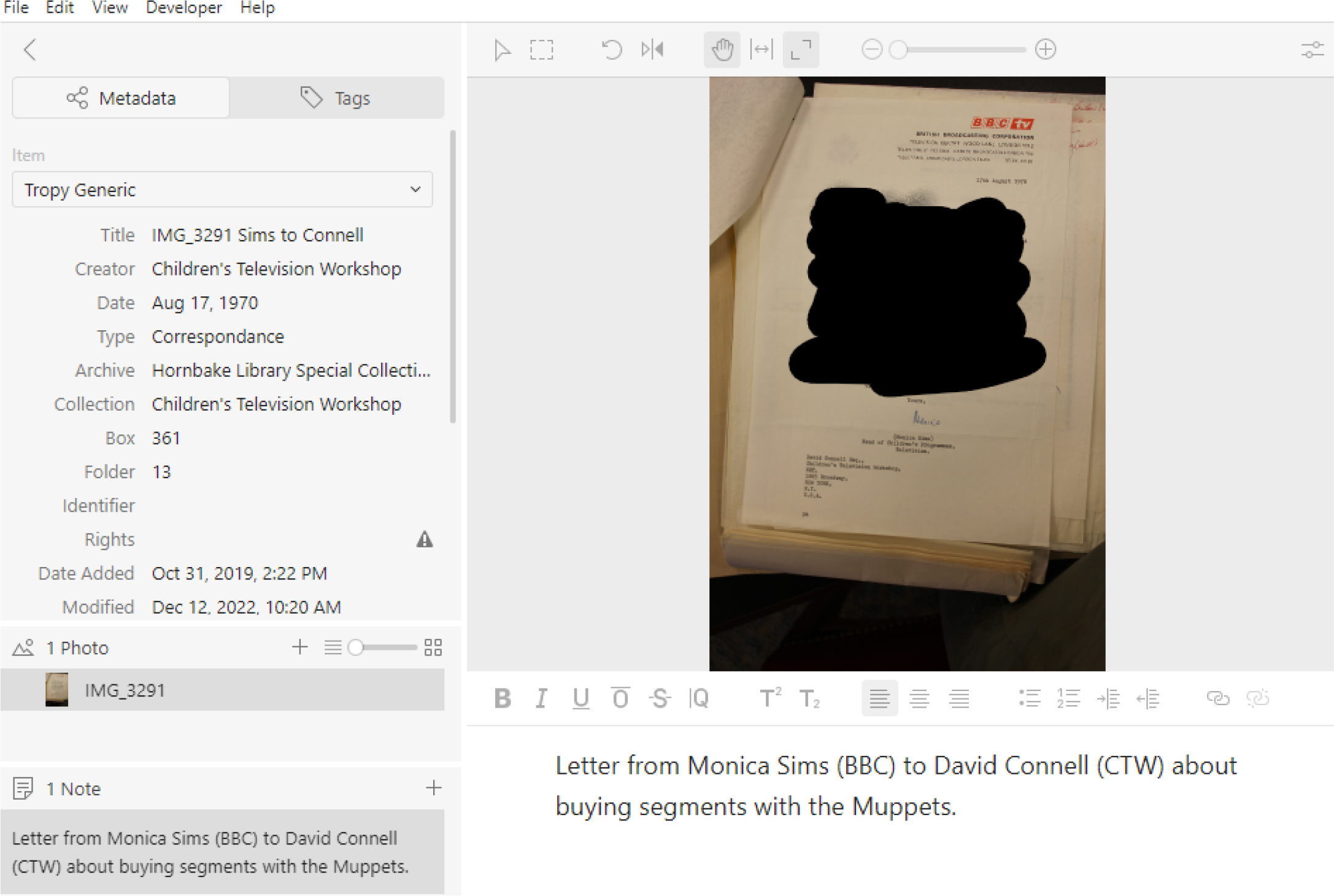
Figure 2
Detailed view of Tropy entry.
The reason why Tropy is particularly useful for transnational research is the ways in which items can be tagged and made part of lists. The items collected in nationally focused archives can thus be combined into new collections whose conceptual framework is geared towards issues of transfer, border crossing, and entanglement. Below, I’ll demonstrate this in two ways.
One of the many occasions where it became extremely useful to combine material from different archives was because of a conflict between the BBC and the Workshop, which I was interested in. In 1971, the two broadcasters got into a great discussion about how the BBC’s rejection of buying the entire Sesame Street concept would affect the European market and whether the BBC had tried to turn broadcasters on the European continent against Sesame Street and the Workshop on purpose. Documents that were part of this conflict can be found in both the BBC written archives and the archives of the Workshop, as well as material from the Prix Jeunesse. I needed to bring these documents together to get an overview of the conflict and how it progressed. Because I had tagged all items related to the conflict in my personal archive, I could bring them together and even make a timeline, as seen in Figure 3. The different parts of the conflict are thus brought together, making it easier to study this case of entanglement. Had I been so lucky as to find documents from the other European broadcasters that commented on or contributed to the conflict, these could have been tagged as well and become part of this subcollection too.
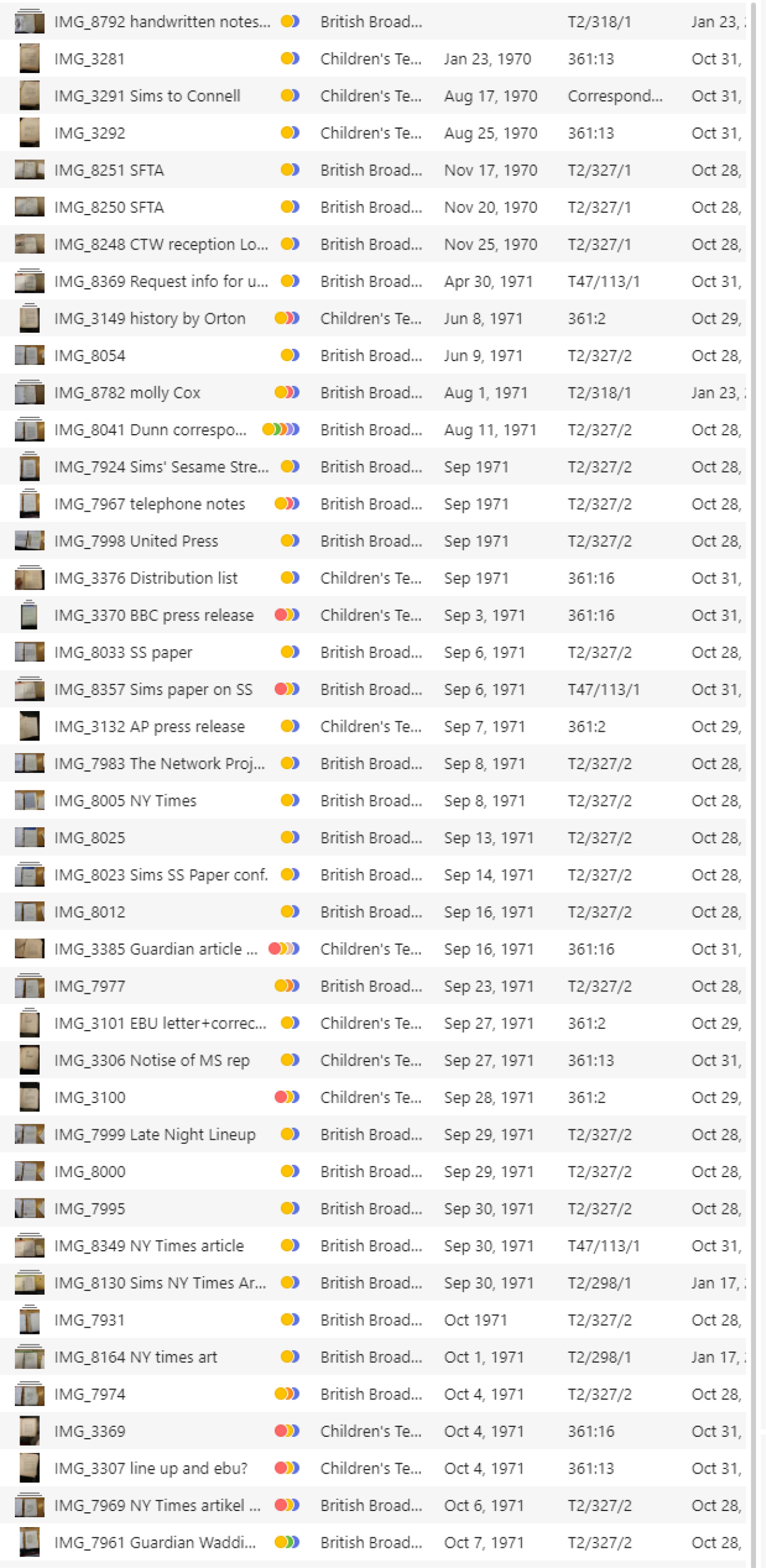
Figure 3
Timeline of entries made by tagging and sorting in Tropy.
Similarly, I have tagged all the documents I’ve collected about the spin-off project Open Sesame which was developed first for France in 1972-73 and later sold in many European countries. Being able to pull together documents about Open Sesame across all the archives enabled an investigation of how the CTW, in the span of a couple of years, developed a sales strategy with a diverse offer of products in different prize categories—and how this was tied in with merchandise sales.
5 Conclusion
The possibility my Tropy archive has provided to follow events, people, and topics that cut across existing archival logic has been highly beneficial to the analysis of transnational flows and influences. Rather than being bound by the conceptual framework which informs the curation of national-oriented collections and archival catalogs, it has been the transnational connections I have focused on when building my own collection. I have purposefully created a structure that is biased toward border crossing: by people, by ideas, and by broadcasting products. In creating tags and collections that bring together documents around issues, people, and events that are usually contained in national structures in existing archival collections, it has been possible to write about networks and connections that can be somewhat impenetrable because of preservation and curation strategies geared towards national interests and perspectives.
What is unfortunate about building collections in Tropy and enriching items with new metadata is that it is not shareable. The constraints that exist when using material from the various archives make it impossible to share the material unless other researchers have obtained the exact same permissions from the exact same archives (in my case 11 different archives). However, if the archives made their written material available in a digital format, e.g. by using the images that scholars have already produced for their own use, this problem would be solved. Making it possible for users to upload the metadata they have registered, the transcriptions they have made and the tags they have applied would be a leap forward for building collections with border-crossing potential. Especially if that digitized material focused on transfer hubs and arenas for international exchange like the European Broadcasting Union, festivals, international seminars and workshops, and the like.
Notes
[1] Helle Strandgaard Jensen, Sesame Street: A Transnational History (New York: Oxford University Press, 2023).
[2] Andreas Fickers, “Towards a new digital historicism? Doing history in the age of abundance,” VIEW Journal of European Television History and Culture 1, no. 1 (2012): 19-26.
[3] Lara Putnam, “The Transnational and the Text-Searchable: Digitized Sources and the Shadows They Cast,” American Historical Review, 121(2), 2016: 377-402, https://doi.org/10.1093/ahr/121.2.377.
[4] Terry Cook, “The Achive(s) Is a Foreign Country: Historians, Archivists, and the Changing Archival Landscape,” The American Archivist, no. 74 (2011): 600-632, https://doi.org/10.17723/aarc.74.2.xm04573740262424; Terry Cook and Joan M. Schwartz, “Archives, Records and Power: The Making of Modern Memory,” Archival Science 2 (2002): 1-19.
[5] Marie Cronqvist, and Christoph Hilgert, “Entangled media histories: The value of transnational and transmedial approaches in media historiography,” Media History 23, no. 1 (2017): 130-141.
[6] See e.g. Michael Davis, Street Gang: The Complete History of Sesame Street (New York: Viking, 2008); Shalom M. Fisch and Rosemarie T. Truglio, eds., G Is for Growing: Thirty Years of Research on Children and Sesame Street (Hoboken: Taylor and Francis, 2000); David Kamp, Sunny Days: The Children’s Television Revolution That Changed America. (New York: Simon & Schuster, 2020); Robert Morrow, Sesame Street and the Reform of Children’s Television (Baltimore: Johns Hopkins University Press, 2006).
[7] See e.g. Naomi Sakr, “‘Smarter, Stronger, Kinder’,” Middle East Journal of Culture and Communication 11, no. 1 (March 19, 2018): 9–28, https://doi.org/10.1163/18739865-01101002; Naomi A. Moland, Can Big Bird Fight Terrorism?: Children’s Television and Globalized Multicultural Education (New York: Oxford University Press, 2019); Heather Hendershot, “Sesame Street: Cognition and Communications Imperialism,” in Kid’s Media Culture, ed. Marsha Kinder (Durham: Duke University Press, 1999), 139–76; David Buckingham, “Bridging the Gaps? Sesame Street, ‘Race’ and Educational Disadvantage”, https://davidbuckingham.net/growing-up-modern (accessed March 15, 2021) and https://ddbuckingham.files.wordpress.com/2019/12/sesame-street.pdf; Helle Strandgaard Jensen and Katalin Lustyik, “Negotiating ‘Non-Profit’: The Survival Strategies of the Sesame Workshop,” Media International Australia Incorporating Culture & Policy 163, no. 1 (2017): 97–106, https://doi.org/10.1177/1329878X17693930; Barbara Selznick, Global Television: Co-Producing Culture (Philadelphia: Temple University Press, 2008), 132-146.
[8] Helle Strandgaard Jensen, Sesame Street. A Transnational History (New York: Oxford University Press, 2023), Chapter 1 “Domestic Origins.”
[9] Sebastian Conrad, What Is Global History? (Princeton: Princeton University Press, 2016); Lynn Hunt, Writing History in the Global Era (New York: W. W. Norton & Company, 2015).
[10] Jennifer Schaffner, The metadata is the interface: better description for better discovery of archives and special collections, synthesized from user studies (Dublin, Ohio: OCLC Programs and Research, 2009), https://library.oclc.org/digital/collection/p267701coll27/id/444/; Helle Strandgaard Jensen, “Digital archival literacy for (all) historians,” Media History 27, no. 2 (2021): 251-265; Astrid Ølgaard Christensen Schriver and Helle Strandgaard Jensen, “Arkivets digitalisering: En ny udfordring til historisk metode,” TEMP-Tidsskrift for historie 12, no. 25 (2022): u.p.
[11] Andreas Fickers, “Towards a new digital historicism? Doing history in the age of abundance,” VIEW Journal of European Television History and Culture 1, no. 1 (2012): 19-26; Berber Hagedoorn, “Television as a hybrid repertoire of memory: new dynamic practices of cultural memory in the multi-platform era,” VIEW Journal of European Television History and Culture 2, no. 3 (2013): 52-64; Erwin Verbruggen, Johan Oomen, and Eggo Müller, “Bringing Europe’s audiovisual heritage online: EUscreenXL,” IASA journal 42 (2014): 54-60.
[12] Alexander Badenoch, Jasmijn van Gorp, Berber Hagedoorn, Judith Keilbach, Eggo Müller, and Dana Mustata, “2018. Old Stories and New Developments: Engaging with Audiovisual Heritage Online,” VIEW Journal of European Television History and Culture, 7(13): 1-5, https://doi.org/10.18146/2213-0969.2018.jethc137.
[13] Helle Strandgaard Jensen, “Doing Media History In a Digital Age: Change and Continuity In Historiographical Practices,” Media, Culture & Society 38, no. 1 (2016): 119-128.
[14] Helle Strandgaard Jensen, “Sharing Practices, Building Knowledge: On collective knowledge formation in European children’s television, 1968–1972,” in Knowledge Actors. Revisiting Agency in the History of Knowledge, eds. Johan Östling, David Larsson Heidenblad, and Anna Nilsson Hammar (Lund: Nordic Academic Press, 2023).
[15] Joan Ganz Cooney, “Der Children’s Television Workshop,” Fernsehen Und Bildung 2, no. 3/4 (1968): 156–58.