
1 Introduction
The digitization and increasing online accessibility of heritage and archival materials - including audiovisual sources - has facilitated the work of media scholars and historians pursuing a transnational angle in their work and has brought into focus fascinating new cross-border topics. While in the past two decades, in the words of Lara Putnam, ‘digital search has become the unacknowledged handmaiden of transnational history’, Putnam also points at the pressing need for contextualization and scholarly source criticism while working with digitized archival collections.1 The first requires a thorough and specific knowledge of what was going on in particular times and in particular places to avert superficiality and blind spots in research, as well as an overemphasis on transnational connections and circulations. The second foregrounds the necessity of critical evaluation and of the acknowledgement that digital archives are always the product of selection - first of what was recorded, and second of what was digitized and made available through online portals - and thus reflect administrative or financial priorities, political interests and power relations, and often national perspectives. This paper explores the possibilities and limitations of nationally aggregated, digitized media sources for studying transnational entanglements, by shifting the focus to the newspapers and audio collections that are available in the Dutch digital humanities platform CLARIAH Media Suite and their significance for studying cross-border propaganda-battles during the Second World War.2 In doing so, it highlights some findings of the project ‘MediaOorlog’ (‘Media War’) that pioneers a new approach in the historiography of Dutch language-media during the Nazi occupation of the Netherlands (1940-1945).3
In transnational research, wars have been largely understudied events. The reasons for this are two-fold. First, scholars adopting a transnational approach have been mainly interested in the creation, processes and consequences of links and flows that cut across national boundaries, rather than in the elimination or erosion of international connections. Second, the normative assumption that ‘transnational’ equals ‘liberal’ and ‘anti-national’, and that therefore international exchange should inevitably have a ‘de-nationalizing’ or even a ‘positive’ effect, has obscured the ‘dark history’ of transnational entanglements, such as the cross-border cooperation of slave traders or fascists, or the transnational dimensions of wars, conflicts and catastrophes.4 This bias has also had an impact on the study of war propaganda. While propaganda has primarily been analyzed as the outcome of political decisions on a national level and top-down institutional processes, researchers have often overlooked its transnational features.
War propaganda is not a one-way road, but a discursive phenomenon which also takes shape in response to enemy propaganda.5 In their insightful model of the process of propaganda, Garth Jowett and Victoria O’Donnell have stressed the interactive and cyclical nature of the flow of propaganda from institution to public. Although their model includes ‘counter-propaganda’ as one of the many factors informing the complex process of propagandistic communication, they do not pay specific attention to its causes nor to its effects, but rather focus on other segments which feed into or are fed by the flow of propaganda such as the propaganda institution and agents, media methods, the role of social networks and the predispositions and various responses of the public.6 Also in studies on Nazi propaganda, this interactive, transnational aspect has often been overlooked. David Welch, in his classic work The Third Reich. Politics and Propaganda (1993), for example, hardly pays any attention to how the content of Goebbels’ media manipulation impacted on and was impacted by the propaganda of his Allied adversaries.7 In other words: the question of how during the Second World War, foreign examples and media references were used rhetorically both to legitimize the correctness and relevance of one’s own propaganda narrative, as well as to deconstruct and counter the propaganda narratives of the enemy, is still largely under-researched.
This particularly holds true for the propaganda battle in Dutch language media during 1940-1945. This Dutch war of words between, on the one hand, Nazified radio and newspapers and, on the other hand, resistance newspapers and Radio Oranje in London (the broadcasts of the Dutch government-in-exile via BBC transmitters) was far more complex than a simple ping-pong between these opposing parties, as radio broadcasts and newspaper articles of foreign Allied countries, German-occupied territories, or neutral nations were also instrumentalized for propagandistic purposes. Moreover, some aspects of enemy propaganda were consciously neglected. As this paper will demonstrate, large-scale digitized media collections are valuable for analyzing this intricate transnational dynamism, as they allow researchers to gain a better understanding of the interactions between these opposing propaganda-narratives in their temporal and geographical contexts.
For the project MediaOorlog, historians from various universities in the Netherlands collaborated with data engineers from the online research application CLARIAH Media Suite to explore thousands of audio files and millions of newspaper articles. This material has been made available by Dutch archival institutions to enable researchers to study various sources together in one location. As such the Media Suite must not be seen as an archival institution, but rather as a portal to access and analyze large amounts of historical material.8 Moreover, the Media Suite is constantly evolving as new datasets and tools are added. The Second World War collections used for the project constitute just a small part of the total amount of the data that is available through the Media Suite. We have used two of the 91 available datasets that the platform currently provides access to. Moreover, in these two digitized collections (i.e.: newspapers from the Delpher repository and audio from the audiovisual archive of The Netherlands Institute for Sound & Vision), material from the Second World War forms a relatively small part. To select this material for further analysis, the Media Suite contains a search tool which enables users to save so-called queries in their own online workspace - these are personalized datasets limited by metadata fields and, if possible, keyword searches. In addition, the platform contains a comparison tool which makes it possible to visualize semantic patterns in the data.
The Media Suite can be situated in the field of Digital Humanities that has developed over the last twenty years. Technological developments have created new possibilities for researchers to access large data sets online and analyze them by using computers to generate quantitative insights in semantic patterns over time. As such Digital Humanities has made it possible for historians to pose new questions. At the same time, it is good to realize that this is still an experimental field and there are technical constraints. Reflecting on digitized newspaper-research, Huub Wijfjes has argued that to come to answers to history-specific questions researchers need to combine computational quantitative methods (distant reading) with more traditional qualitative methods (close reading).9 Working along these lines the researchers of the project MediaOorlog have experimented with distant reading to generate semantic patterns to identify certain moments in time to use for a close reading. In this working method they encountered certain restraints that limited the possibilities for distant reading, particularly of audio files. During the research phase of the project the Media Suite did not yet contain options for Automatic Speech Recognition (ASR), which meant that the audio could be played by historians, but could not be searched.10 In contrast it was possible to perform keyword searches in the newspaper material, using Optical Character Recognition (OCR) - which enabled distant reading approaches in this part of the corpus. This form of research constitutes a break from earlier historiography: considering the bulk of newspapers from the Second World War authors using analogue methods came to the conclusion that plowing through the paper incarnation of this corpus was physically impossible.11
As will become apparent on the following pages another difference between digitized newspaper and audio sources lies in the quantity of the corpus. Whereas the digital archive includes almost seven million newspaper articles, there are 2040 audio-fragments from that period that have been digitized. To understand this quantitative difference, we have to go back to the Second World War itself as the material circumstances shaped the collections that were digitized in the first decade of the twenty-first century. In the 1940s newspapers were printed in multiple editions and as a result after the war archival collections could be made complete by gradually adding material. In the years after 1945, the predecessor of the NIOD Instititute for War Holocaust and Genocide Studies actively collected wartime newspapers, explicitly asking Dutch citizens to donate issues that they kept. These individual objects were systematically categorized by specialized staff-members of the institute (some of whom had been active as journalists for the illegal press). In the 1950s they published a volume on the illegal newspapers between 1940 and 1945 that listed more than 1100 titles.12
Radio broadcasting is a more ephemeral medium that can be captured when recorded, but this is a costly process and during the war the situation did not allow this to be done structurally. As a result, the audio archive from the Second World War is fragmented and limited, as only a small amount of the daily Radio Oranje broadcasts as well as of the transmissions of the two Nazified Hilversum radio stations, have been recorded. However, the radio archive is much larger than this limited collection of audio recordings. The two most prominent Dutch wartime radio organizations - based in London (Radio Oranje of the government-in-exile) and Hilversum (of the occupation regime) - left bulky paper archives consisting of radio transcripts (texts that were read out on air). This was also a direct result of the wartime context as authorities, both British and German, wanted to control the content of broadcasting and checked all texts before they were read out. Another valuable set of paper radio sources are the daily monitoring reports about the pro-Nazi broadcasts from Hilversum that were made by the government-in-exile’s ‘listening service’ in London. Although the NIOD did collect large collections of radio transcripts, as well as monitoring reports, the management of the institute did not prioritize this source material on the research agenda.13 The first studies about the history of wartime radio broadcasting were undertaken by external researchers, decades after the foundation of the institute.14 The lack of historiographical attention might have been one of the reasons why the bulky paper radio transcript collections were overlooked in the large digitization efforts by the Royal Library (newspapers) and Sound & Vision (audio) in the 2000s. As a consequence, audio and paper sources within the Dutch war radio archive have been separated.
As becomes clear from the above, there is a difference between the digitized newspapers and the radio materials from the Second World War that are currently available in the CLARIAH Media Suite, which affects the way researchers in the twenty-first century can access and analyze it. Therefore, we have chosen to structure our contribution in two sections. In the first part of our article, we will discuss how the newspaper corpus can be employed to investigate how the public sphere in the Netherlands served as a battleground of the propaganda campaigns of the Axis and Allied Powers. We will explore distant reading methods, including the comparison tool in the CLARIAH Media Suite and Named Entity Recognition (NER). In the second part, we will subsequently address some of the promises and challenges we encountered in studying the fragmented digital Dutch audio collection from the Second World War and look into the added value of paper archives of broadcasting organizations and monitoring services. Whereas the digital archive contains interesting audio objects that prove there were transnational interactions via the radio waves, the written sources provide more opportunities to flesh out the true scale and nature of this aspect of wartime propaganda.
2 Digitized Newspapers
The bulk of the digital archive of media in the Netherlands during the Second World War is formed by newspapers that were digitized by Dutch heritage institutions and added to the freely accessible online repository Delpher that is hosted by the Royal Library (Koninklijke Bibliotheek) in The Hague. This collection contains newspapers from the Netherlands, both titles that were published locally and nationally, and Dutch-language newspapers from other parts of the world, such as the former colonies. In addition to its geographical reach, the collection spans a huge period, from the first published newspapers in 1618 to 1995, after which digital versions of newspapers are available in other repositories.15 In Delpher the era of the Second World War is particularly well covered as a result of the project ‘Heritage of War’ (Erfgoed van de Oorlog), which enabled the large-scale digitization of ‘war papers’.16 For the purposes of the project MediaOorlog only newspapers that were published in the Netherlands during the official start and end of hostilities with Nazi Germany (10 May 1940 until 5 May 1945) are relevant, so we have limited ourselves to these parameters in time and space. Nonetheless, this is a large corpus of around 133.000 newspapers, that are segmented in almost 7 million articles.
The metadata model of Delpher does not contain fields to help researchers identify political-ideological categories. This is, however, a useful way for historians to work with the big data collection of wartime newspapers. Therefore, the researchers of MediaOorlog have divided the available titles in separate categories to indicate their position in the media-landscape of the Second World War. The two main categories are formed by ‘Nazified’ newspapers that were under the control of the occupying regime and ‘Anti-Nazi’ newspapers who were opposed to the regime. In addition, two sub-categories were added. The ‘Nazified’ papers can be divided in ‘censored’ (gelijkgeschakeld, i.e., papers that existed before 1940 and were put under censorship) and ‘Nazi-party’ (i.e., papers that were published by fascist organizations). The ‘Anti-Nazi’ category is divided in the ‘illegal’ press (i.e., clandestine newspapers made by resistance groups) and ‘liberated territory’, a category which consists of newspapers that were published from September 1944 onwards in the liberated parts of the Netherlands.
Table 1
Categories Dutch wartime newspapers
| Nazified | Anti-Nazi |
|---|---|
| Censored (118 titles) | Illegal press (955 titles) |
| Nazi-party (21 titles) | Liberated territory (157 titles) |
On the basis of these categories queries have been made in the CLARIAH Media Suite which enable researchers to compare keywords searches.17
Looking at the available data in the CLARIAH Media Suite there are significant quantitative differences between the categories.
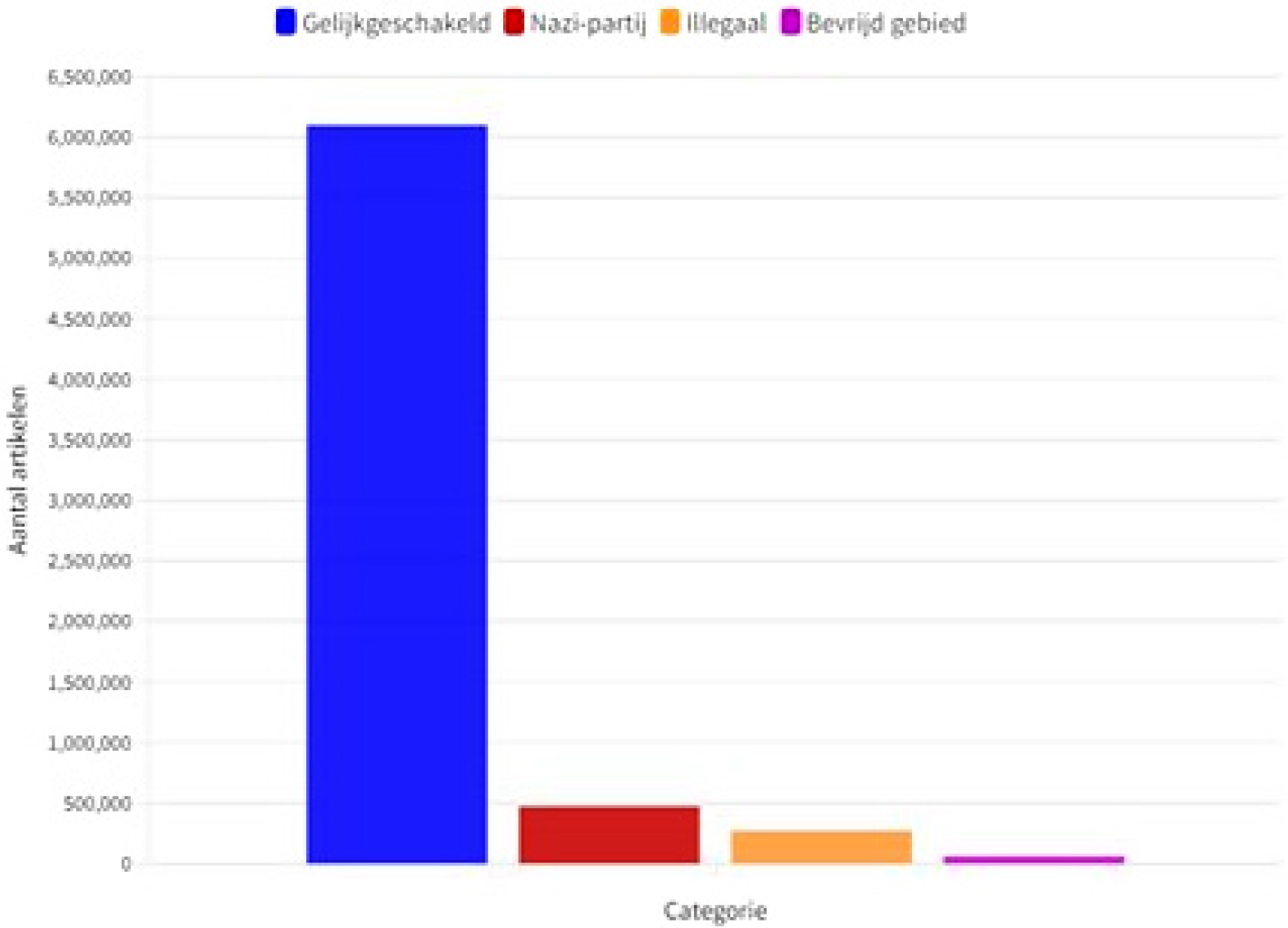
Figure 1
Distribution of items (articles) over subcategories.
The censored newspapers contain the most articles by far, followed by the Nazi-party press. This imbalance can be explained by the great power inequalities in the Dutch media landscape during the Second World War that were a result of the German occupation. The media policies of the occupying regime in the Netherlands were directly influenced by Berlin. Both the German Ministry of Propaganda and the Ministry of Foreign Affairs had representatives in The Hague who, aided by Dutch collaborators, organized daily press meetings in which they issued ‘confidential communications’ (vertrouwelijke mededeelingen) about what to print and what not. These ukases, which were accompanied by the words ‘not for publication’, were monitored and newspapers who did not heed to them risked being shut down.18 In other cases the Nazi authorities directly intervened in the editorial staff and replaced journalists whom they considered to be too critical for people with more open sympathies for their regime.19 The consequences for people working for illegal newspapers were even more dire, and the Nazi authorities actively hunted them – not only journalists, but also those printing and distributing the papers. Many of these people were executed or murdered in concentration camps: the list of those who died because of their work for the illegal press counts 777 names.20 Considering these circumstances it is not surprising that the category ‘illegal press’ contains relatively few articles while it counts many titles as most of the publications were made by small local groups that operated separately in order to avoid detection.
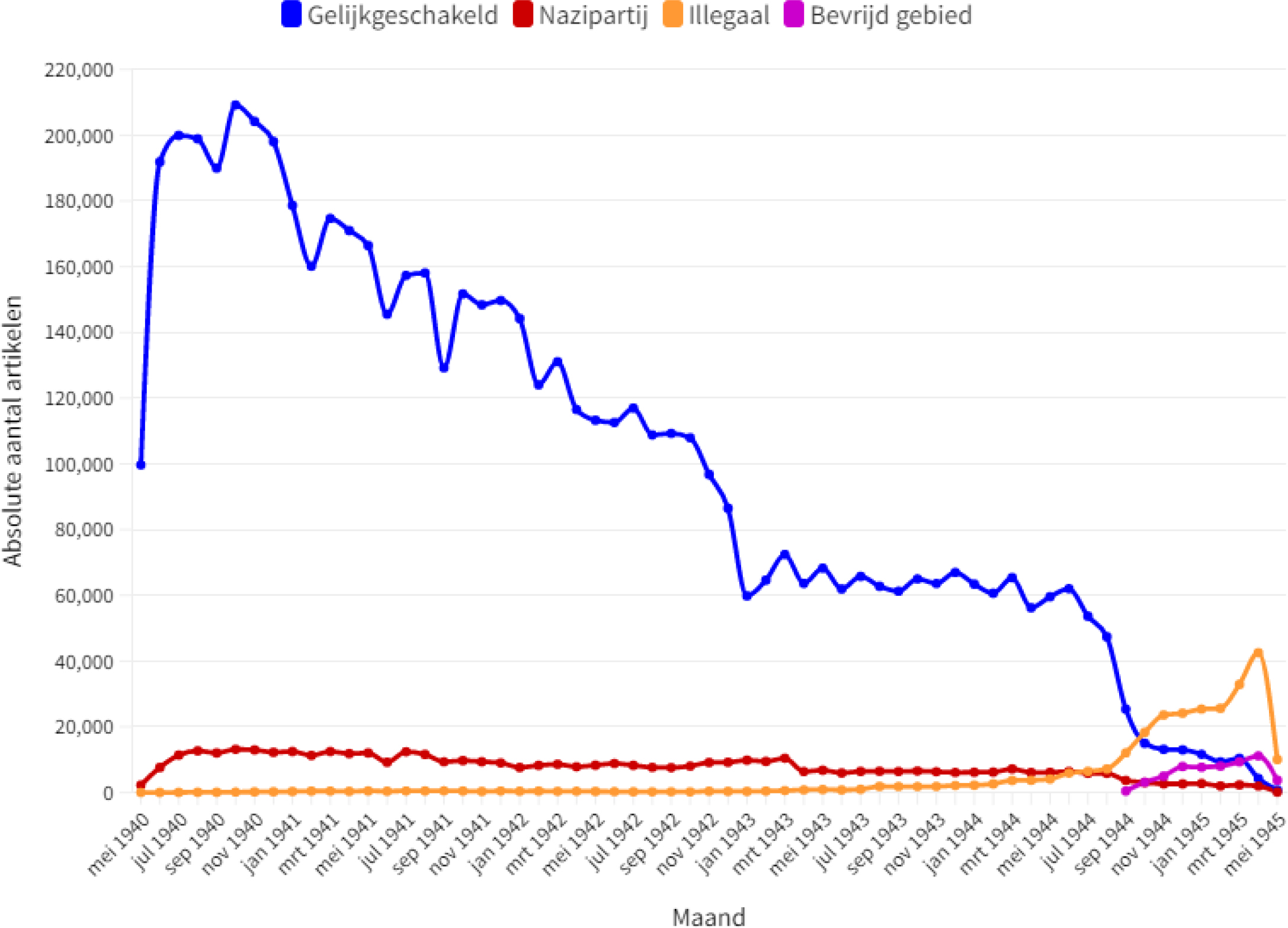
Figure 2
Comparison of articles in the categories, development over time.
However, over the course of the war the imbalances in the data shifted. Looking at the category of the ‘censored press’ there is a downward trend from the beginning of 1941 onwards. This is partly explained by the ban on newspapers that were deemed too critical by the occupation regime. Another factor in the downturn of the number of published articles is the fact that paper became ever more scarce as the war dragged on. The material shortage of the legal newspapers became more pressing by the fact that resistance groups became ever more successful in stealing paper supplies. On the other hand, the paper raids in part explain the quantitative growth in ‘illegal’ newspapers from May 1943 onwards, which became the biggest section of the press in the last six months of the occupation.21 Another factor in this upward trend was the fact that the German authorities in that month banned the possession of radio receiving sets, in order to prevent people from listening to radio stations that broadcasted from London. The radio ban resulted in a spur of new resistance newspapers that published transcripts of the London broadcasts to spread this information.22 This intermedial practice was illustrated by the titles of some of these publications, for example: Hier is London! (This is London) and B.B.C. Nieuws (BBC News). Moreover, these titles underline the transnational nature of the newspaper-landscape in Nazi-occupied Netherlands, which was both influenced by the government in Berlin and radio stations in London.
An exploration of the content of the newspapers also highlights the transnational perspective in the media-archive of the Second World War. To show this, we have run a Named Entity Recognition (NER) analysis of all the front pages from the Second World War to identify geographical terms.23 Looking at the total corpus (including all categories) ‘England’ (Engeland) and ‘Germany’ (Duitsland) rank the two first places, and Berlin and London rank fifth and sixth. This highlights the fact that printed media in the Netherlands were important for the propaganda of the two main powers fighting in Northwestern Europe. In the Nazi-party press and censored newspapers until, respectively, the end of 1941, beginning of 1942 ‘Engeland’ was the most frequently mentioned geographical term. This indicates the propagandistic importance of Great Britain as Nazi Germany’s ‘Other’ in the first stage of the war. In this period, the Nazi’s promoted a new German-led European order that would bring peace, prosperity and social security, and was presented as the opposite of the outdated, imperialist and capitalist order of Great Britain which allegedly had plunged Europe into chaos during the interwar era. The NER-analysis over time shows a peak in January 1941, after this moment the number of references to ‘Engeland’ slowly declines. That this anti-British propaganda narrative of a new European order led by Germany now lost its appeal can be explained by Nazi Germany’s losses in the Battle of Britain, as well as the war participation of the Soviet Union (in June 1941) and the United States (in December 1941).
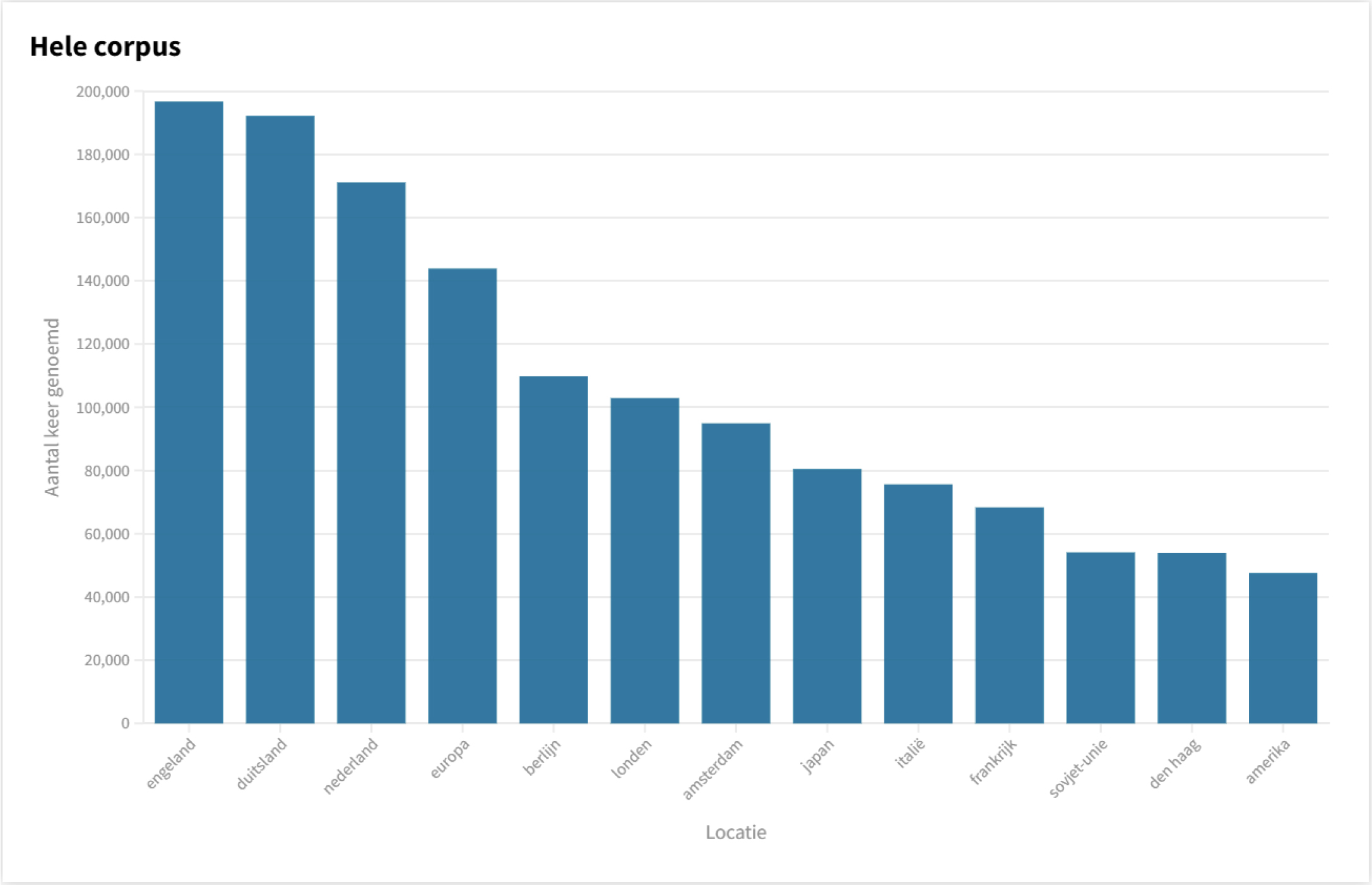
Figure 3
NER analysis of geographical terms on front-pages of Dutch newspapers in the Second World War.
In the NER-analysis, ‘The Netherlands’ (Nederland) ranks third, and looking at the results of individual categories, ranks first in both the categories ‘illegal’ and ‘liberated territory’. This can be explained by the fact that in these categories, which were dominant in the last stages of the war, authors made plans for their country after the end of Nazi-occupation.24 This focus of the illegal press on national issues and a future national reconstruction is for example reflected in the manifesto that was issued by the nation-wide resistance newspapers Het Parool and Vrij Nederland on 15 April 1944 in 60.000 copies. The first eight aims for the future in this manifesto concerned the domestic situation of the Netherlands as well as its relationship with its colonies, while only the last point was devoted to the country’s foreign policy.25
A remarkable outcome of our NER-analysis is that ‘Europe’ (Europa) was the most frequently used geographical term on the front pages of Nazi-Party newspapers. Although Hitler solely cared about the interests of the German Reich, for the Nazis ‘Europe’ was an important propagandistic construct, in particular for the propaganda targeted at the occupied countries - a topic which has been relatively well-studied by historians in recent decades.26 While also in the Netherlands the occupying authorities time and again invoked the idea of a common European struggle for Europe’s civilization or the prospect of a new European order to be established after a Nazi victory, not much research has been done on the Nazi Europe-propaganda and its reception among Dutch audiences.27 The propagandistic relevance of the concept of ‘Europe’ for the occupying authorities to promote the National-Socialist war aims and visions of the future not only becomes clear from our NER-analysis but is also confirmed by our qualitative analysis of the primary source materials. Our research of both newspapers and radio broadcasts has proved that during 1940-1945 the Nazified media had the initiative in the propaganda battle for ‘Europe’. For anti-Nazi media, the concept of ‘Europe’ or the ideal of a ‘European unity’ had less propagandistic value to promote the war aims of the Allies.28 However, Dutch resistance newspapers and Radio Oranje waged a rigorous counter-campaign aimed at opposing and deconstructing the National Socialist Europe propaganda.29
3 Radio: Audio and Paper Sources
As is often mentioned in the existing literature about the history of the medium, radio broadcasting is an inherently transnational medium.30 In part this is the consequence of the technology itself: radio waves do not know boundaries. Radio broadcasting pioneers that operated in the wake of the First World War were aware of this quality, as is illustrated by the story of the first Dutch broadcast on 6 November 1919. After Hanso Idzerda broadcasted his first programme from his home annex office in The Hague, he received letters from enthusiastic radio amateurs in London who had picked up the signal.31 In the following decades, radio broadcasters actively reached out to international audiences and developed special formats to do this effectively. In the 1930s the regimes in the Axis-powers actively started to make propaganda abroad, Nazi Germany with the transmitter at Zeesen and Fascist Italy with the transmitter in Bari.32 In response, the BBC expanded its foreign broadcasts, initiating an Arabic programme for the Middle East and a Spanish programme for Latin America, which were the main target areas for the Axis-powers.33 This radio war escalated after the start of the Second World War. During the Blitzkrieg the Nazis expanded their broadcasting power, adding many transmitters in occupied countries in Europe, including the Netherlands where the existing broadcasting corporations were centralized in the Rijksradio Nederlandsche Omroep.34 The BBC greatly increased its broadcasting efforts to the occupied territories in order to mobilize the people there against the Nazi regime. As a number of people from these countries had fled to London, the British could tap into a pool of native speakers to extend the number of broadcasting languages.35 Some governments-in-exile in London received airtime in BBC transmitters to make their own broadcasts – the first one being the Dutch government who inaugurated its daily transmission Radio Oranje (Radio Orange) on 28 July 1940.
In Dutch digital media archives, we can find traces of the radio war between the Axis powers and the Allies during the occupation between May 1940 and May 1945. According to the metadata in the CLARIAH Media Suite, 2040 digitized audio clips are accessible from that period. Compared to the number of newspapers, this is a noticeably smaller corpus. This makes it more difficult to make quantitative analyses using distant reading methods. In addition, there are limitations with close reading (or listening) of audio files. The audio collection is probably less representative than the bulky newspaper collection as these clips constitute a small part of the total amount of broadcasting hours. Moreover, the audio files mostly contain fragments and not total radio broadcasts. In contrast, the newspapers in the digital repositories are complete, which makes it possible for researchers to contextualize articles by looking at the whole issue in which they were published.
Another limitation to the audio collection is that the preserved recordings come from various sources and are haphazard, as they were not collected to form a systematic archive of wartime radio broadcasting. Indicative are the sources made by Dutch radio amateurs, who made clandestine recordings of radio in an effort to preserve a soundscape of the Second World War. As this activity was very hazardous, they made these recordings on an ad hoc basis, capturing different stations on record rather than reflecting on their programming strategies. Such collections were often kept in private collections for decades, before being donated to the Netherlands Institute for Sound & Vision in the 2000s, where they were digitized, such as the collection of Gerrit Bouwhuis from Tiel.36 Other important sets of digitized wartime radio-audio come from the production archives of Radio Oranje and the Nederlandsche Omroep, which initially were kept by the NIOD, but were transferred to Sound & Vision in the 2000s as well. These collections mainly consist of broadcasts that were recorded before being transmitted, such as radio cabaret and important speeches. These recordings also give a limited view on the total broadcasting schedules. Taking Radio Oranje as an example, it is noticeable that the two voices that were recorded the most were female: Jetty Pearl who sang anti-Nazi cabaret songs and Queen Wilhelmina who gave more than thirty speeches. In the decades after the war, these voices have been reproduced many times and as such became emblematic in the historical imagination of wartime recordings. In fact, during the vast majority of Radio Oranje broadcasts listeners would hear only male voices as the complete editorial staff of the station consisted of men.37
Although they do not provide a representative overview of the broadcasting strategies, the available audio does contain evidence that shows radio was a medium that provided audiences in the Netherlands with information from across the world. In the first year of its existence, Radio Oranje recorded and relayed a weekly broadcast from the Dutch East Indies in which the journalist G.A. van Bovene gave an overview of the situation in the main colony. In these ‘mail letters’ (mailbrieven) he drew a rosy picture in which he emphasized the loyalty of all the inhabitants, including Indonesians, to the government-in-exile (and particularly Queen Wilhelmina) and the resolve to liberate the home country from Nazi occupation. Such broadcasts were relayed until the Japanese conquest of the Indonesian archipelago.38
Audio clip 1
The Nederlandsche Omroep also broadcasted items that were meant to inform people in the Netherlands about events in far-away countries. One set of gramophones that has been preserved contains recordings of Dutch SS-soldiers who fought at the Eastern Front against the Soviet Union, from 1943. They recorded ‘radio letters’ which were transported to the Netherlands by the German Propaganda Kompanie (PK) to be transmitted. These records were meant to support the Nazi propaganda narratives, boasting about supposed successes on the battlefield, while in fact the Red Army was on the advance by that time.39
Audio clip 2
While such digital audio-clips are useful to historians interested in transnational media, they offer a too limited scope to reflect on their place in the total programming strategies.
To get a more complete overview of the history of wartime radio broadcasting, historians can turn to the bulky paper archives that have been left by broadcasting organizations, both in London and in Hilversum. The main staple of these collections are transcripts of various broadcasts that provide a rich source to understand the way radio was used for propaganda purposes. In this article we focus on the collection of Radio Oranje, which holds two complete sets of transcripts. One set contains the monitoring reports that officials of the Dutch government-in-exile made about broadcasts of Radio Hilversum, between the Summer of 1940 and the Autumn of 1945. Every day they published a report with summaries and sometimes verbatim transcripts of noticeable broadcasts, more than 20,000 entries in total. The editors of Radio Oranje and the Dutch service of the BBC used these reports to calibrate their own broadcasts in order to provide effective counter-narratives against Nazi propaganda. Apart from enhancing the listener’s confidence in an Allied liberation of the Netherlands, a second important task of Radio Oranje was to oppose and debunk German propaganda.40 The monitoring reports show that Dutch officials in London had a particular interest in certain Nazi broadcasters, whose propaganda they deemed to be dangerous.41 These monitoring reports themselves are a testament to the transnational interaction between radio-propagandists at both sides of the North Sea, who kept a close ear on the transmissions of their adversaries.
This interaction is also apparent in the collections of transcripts of Radio Oranje broadcasts, which are held by the NIOD Institute for War, Holocaust and Genocide Studies. These documents were archived due to the fact that all texts had to be approved before transmission by the Dutch government-in-exile as well as by British military censors in order to prevent strategic sensitive information from being made public.42 The Radio Oranje transcripts and monitoring reports constitute an indispensable source for research into the complexities and versatility of the propaganda battle across the English Channel, as they provide information on the topics, propaganda narratives and particular media moments that were at stake in this transnational war of words. Moreover, they also allow researchers to map the strategies that were employed by Radio Oranje to debunk enemy propaganda, as well as the broader international framework that informed the interaction between Nazified and Anti-Nazi Dutch language media.
From our exploration of the transcripts and monitoring reports it has become apparent that propaganda officials in the service of the Dutch government-in-exile carefully kept track of enemy propaganda in Nazified Dutch language media, as well as in Nazi media outside of the Netherlands, in order to adequately respond to what they considered to be important Nazi propaganda events and speeches. For example, Goebbels’ famous Sportpalast speech of 18 February 1943, in which he shortly after Germany’s defeat at Stalingrad called for a ‘total war’ as the only means to overcome the imminent danger of Bolshevism, was discussed at length at Radio Oranje. On the 19th of February, broadcaster Lou de Jong affirmed that the German Propaganda Minister’s speech undeniably proved the Nazis were losing the war.43 A few days later, the well-known Dutch Nazi-propagandist Max Blokzijl repeated Goebbels’ message in his bi-weekly talk for Radio Hilversum and warned that a collapse of the mighty army of the Axis powers would inevitably result in a ‘Soviet-Netherlands, Soviet-Belgium, Soviet-France’.44 The next day, Radio Oranje also countered Blokzijl’s message. The director of Radio Oranje, Henk van den Broek, assured the listeners in the occupied Netherlands that the Soviets had no intention whatsoever of conquering their home country after Germany’s defeat. Also, a Bolshevik coup in the Netherlands was highly unlikely. In Van den Broek’s view, Goebbels as well as the collaborationist ‘parrots’ who were paid by the occupying authorities to repeat the Propaganda Minister’s message had the intention to divide the Allies. Moreover, their notion of an immediate Bolshevist threat only served as pretext to further exploit and terrorize the German-occupied countries.45
In its broadcasts, Radio Oranje regularly integrated and commented upon extracts of speeches of high-ranking Nazis and collaborators to prove the incorrectness and inefficacy of the National Socialist propaganda efforts. Often, these extracts were read aloud by Radio Oranje broadcasters using monitoring reports of Dutch or British listening services. In other cases, parts of speeches were recorded and relayed. On 15 December 1941, the London programme for instance criticized and ridiculed the Dutch National Socialist Movement at the occasion of its tenth anniversary, relaying a recording of its leader’s anniversary speech that had been aired by Radio Hilversum the previous day.46 Radio Oranje also regularly discussed important addresses of Allied leaders, which occasionally were relayed as well. These Allied speeches were not only welcomed and used to highlight British and American support for the Dutch cause or the Allied successes on the battlefield, but also to debunk German propaganda. When discussing Churchill’s address to the House of Commons in February 1943, De Jong for example contrasted the realistic, matter-of-factual and calm tone of the British prime minister with Hitler’s hysterical lies.47 Radio Oranje also mocked Goebbels’ heated response to Roosevelt’s Navy Day Address, which he delivered on 27 October 1941, about six weeks before the US would enter the war on the side of the Allies. According to the broadcaster, Goebbels’ cursing tirade was clearly prompted by a sense of fear caused by Roosevelt’s important announcement to increase arms supplies.48
Although Radio Hilversum was the main target of Radio Oranje, the programme also frequently used examples from Nazified newspapers in the Netherlands – which were sent to London via neutral Portugal, Switzerland or Sweden and arrived 10 to 21 days after publication.49 Moreover, it also regularly referred to media outlets in Nazi Germany, as well as in Allied countries and neutral nations.50 To underline that the war had reached a turning point and that Germany’s defeat was just a matter of time, Radio Oranje for example in December 1942 discussed an article in the neutral - and therefore ‘objective’ - Svenska Morgenbladet about the hopeless situation of the German army in the Soviet Union.51 In October 1941, Radio Oranje announcer Meyer Sluyser mentioned specific articles in the Völkische Beobachter, National Zeitung and Deutsche Allgemeine Zeitung to demonstrate that the German press had started a campaign to prepare German public opinion for an annexation of the Netherlands.52 In order to counter the false Nazi promise that Hitler wished to preserve Dutch national sovereignty, Radio Oranje also referred to radio broadcasts in the occupied Netherlands, Germany and Great Britain. On 14 November 1941, Radio Oranje for instance drew attention to a BBC-item on the announcement of Friedrich Lützow on the Deutschlandsender, in which the head of the propaganda department of the Kriegsmarine had pointed at the importance for Nazi Germany of annexing the small nations at the Rhine estuary.53 A few days later, De Jong quoted Radio Hilversum that according to the Reich commissioner for the German-occupied Netherlands, Arthur Seyss-Inquart, the Netherlands could not fully retain its ‘independence and autonomy in its traditional meaning’.54
In its broadcasts Radio Oranje constantly emphasized that no one in the Netherlands believed the transparent Nazi lies. Moreover, it also strove to unmask and explain the Nazi propaganda methods.55 This more ‘rational strategy’ was manifest in Radio Oranje’s continuous efforts to expose and clarify the ‘true motives’ behind the propaganda of its adversaries, as well as in broadcasts which discussed the Nazi propaganda techniques. De Jong for example quoted at length from the instructions that the occupying authorities had sent to the Nazified regional press in May 1941, while Van den Broek in great detail discussed how Radio Hilversum tried to manipulate Dutch seafarers abroad.56 According to Van den Broek, Radio Hilversum had introduced a column with messages of family members for their loved ones at sea, to convince the seafarers to return to the Netherlands so they could be forced to enlist in the Kriegsmarine instead of helping the Allies.57 In various broadcasts, he explained how Radio Hilversum used unfair arguments which appealed to the seafarers’ emotions, and regularly had to interrupt its column, presumably because a family member had said something which could displease the occupying authorities. At the same time, Van den Broek himself also appealed to the emotions of his listeners, as he for instance called upon the seafarers to regularly send letters to their family at home because they missed them so much.58 More research is needed to enhance our understanding of the rational as well as emotional propaganda techniques that Radio Oranje employed to counter Nazi-propaganda. Such research, based on a structural analysis of the written transcripts and monitoring reports in combination with the available audio, can enhance our understanding of the transnational interactions of the media war between the Third Reich and its enemies.
At various occasions, Radio Oranje stressed that now the media in Nazi-occupied Netherlands had been gagged, it was the only representative of the Dutch free press, and as such had the task to reveal the truth about the situation in Nazi-occupied Europe.59
Audio clip 3
As this included deconstructing Nazi propaganda, Radio Oranje broadcasters explained they had taken on the task to closely monitor news about the Netherlands in Nazified Dutch and German newspapers, and to listen to Radio Hilversum. In De Jong’s view: ‘the unpleasant part of our job’.60 The versatile Radio Oranje efforts to counter and debunk Nazi propaganda, logically led to transnational entanglements and references to pro-Nazi newspaper articles and radio broadcasts in occupied-Netherlands and Germany. However, Radio Oranje also used examples from Nazified media across the English Channel as a contrast to emphasize that their own broadcasts were not propaganda.
4 Conclusion
The availability of digitized Dutch war media sources in the CLARIAH Media Suite has allowed the project team of MediaOorlog to explore transnational entanglements in Second World War propaganda using both quantitative and qualitative methods. In doing so, the team has put online sources into dialogue with the existing historiography. In particular, the large body of digitized newspapers (from the Delpher repository) allows for data-visualizations of semantic patterns and AI-driven research, such as a NER-analysis of geographical terms on frontpages. This research has suggested that news about events outside the borders of the European part of the Kingdom of the Netherlands featured prominently in the war time media. Moreover, it has shown that the transnational geographical concept of ‘Europe’ dominated in the propaganda of Dutch Nazis. Pundits of the Dutch government-in-exile in London and makers of resistance newspapers took notice of this Nazi Europe propaganda and strove to debunk it.
The digitized audio archive also contains items that provide insights in the transnational war of words between Pro-Nazi and Pro-Allied Dutch Media during 1940-1945. These items show that recordings from various parts of the world were relayed to listeners in the Netherlands. However, as the audio archive is fragmented and limited, it is difficult to establish the full scope of interactions between Nazi-propagandists and their adversaries via the airwaves. Therefore, the team of MediaOorlog also made use of paper sources to uncover this part of the propaganda war. Particularly important for their research has been the Radio Oranje collection that has been passed down almost in its entirety and kept by the NIOD. Monitoring reports in this collection, which were produced by the government-in-exile’s listening service, show that radio makers in London carefully listened to the broadcasts of Radio Hilversum in order to gather information about the situation in the occupied Netherlands and the propaganda strategies of the Nazi regime. The transcripts of broadcasts prove that these insights were, subsequently, used by the Radio Oranje editorial staff to shape their own communication strategies, not in the least to openly attack their adversaries and to counter Radio Hilversum propaganda.
With our contribution, we ask for more attention for this valuable, but previously overlooked, part of the Dutch radio archive, and call to scan this as well as other collections that represent ‘audio on paper’ and to include this in the Dutch digital humanities platform CLARIAH Media Suite. At the moment the bulky Radio Oranje collection, which counts tens of thousands of pages, is hard to research as it is difficult to pin down when certain topics were addressed. Digitizing these source materials would enable a similar approach that has proven fruitful for the wartime newspapers: using keyword searches and visualizing semantic patterns to track down specific media moments. Additionally, digitization would also allow researchers to use other digital humanities tools, such as an analysis of word clusters or Named Entity Recognition of important geographical terms, persons, or events. Such research would greatly enhance our knowledge of the transnational dynamics of the radio war between London and Hilversum, including the important role that the overseas colonies played in the broadcasts of the Dutch government-in-exile and its Nazi opponents.61
Moreover, digitizing paper radio sources, such as the Radio Oranje transcripts and listening service reports, is key to complementing the small and fragmented collection of Dutch wartime audio. As this paper has tried to point out, both the limited amount of radio recordings of the years 1940-1945, as well as the exceptionally large amount of the paper radio sources, can be explained by the very specific wartime circumstances. In other words: the current imbalance within the radio archive and the separation of audio and paper sources should be understood in its historical context. In addition, the war radio archive is currently scattered over various institutions, such as the NIOD and Sound & Vision, and this situation complicates the study of propaganda broadcasts. Reuniting digitized audio and paper sources will allow historians and media scholars to overcome these obstacles.
This paper has demonstrated that in order to use nationally aggregated media sources from one single country for studying transnational entanglements, historians and media scholars need to ask new research questions and to reflect on the formation, as well as the pitfalls and limitations of these national archival collections. The digitized war newspapers and audio available in the CLARIAH Media Suite, as well as the large Radio Oranje collection, have allowed the MediaOorlog researchers to analyze various themes, strategies, and important moments of the war of words between pro-Nazi and pro-Allied Dutch language media. However, to enhance our understanding of the broader context of this propaganda battle across borders, international, archival projects are needed. Such collaborations should aim at digitizing, aggregating and curating various national radio collections. This, for example, would allow researchers to gain insight into the broader propaganda dynamics between on the one hand Nazi broadcasts in occupied Europe and on the other hand the foreign language services of the BBC, and the broadcasts of the French, Dutch, Polish, Belgian, Greek and Czecho-Slovak governments in exile. Or, considering the global context, such a project would make it possible to address the interaction between the Allied and Axis radio propaganda targeted at the Arab World or at European colonies in Asia, Africa and the Caribbean. For a further exploration of transnational interactions in Second World War propaganda, therefore, bringing together audio and paper sources through digitization should go hand in hand with overcoming national as well as international archival borders.
Notes
[1] Lara Putnam, “The Transnational and the Text-Searchable: Digitized Sources and the Shadows They Cast,” The American Historical Review 121, no. 2 (April 2016): 377–402, there 377, 400-401.
[2] The authors wish to thank Mari Wigham and Rana Klein of the Netherlands Institute for Sound and Vision for their valuable contributions in analyzing the big data collection of wartime newspapers.
[3] The project MediaOorlog was funded by the Mondriaan Fonds and ran between November 2020 and August 2023. The main outcome was a special issue of the open access Dutch-language Tijdschrift voor Geschiedenis 135, no. 2/3 (2022). See: https://www.aup-online.com/content/journals/00407518/135/2/3. The project also resulted in an exhibition on ‘Media als Wapen: propaganda in WOII en nu’ [Media as a weapon: propaganda in WWII and today] that ran between 4 May and 16 July 2023 in Beeld & Geluid Den Haag. See: https://beeldengeluid.nl/bezoek/agenda/media-als-wapen.
[4] Jan Rüger, “OXO: Or, the Challenges of Transnational History,” European History Quarterly 40, no.4 (2010): 656–668, there 661; Kiran Klaus Patel, ‘Transnational History,’ European History Online, December 3, 2010, http://www.ieg-ego.eu/patelk-2010-en.
[5] For a reflection on the literature on international radio as an instrument for propaganda see: Vincent Kuitenbrouwer, “Radio Wars: Histories of Cross-Border Radio Propaganda,” in The Wireless World. Global Histories of International Radio Broadcasting, eds. Simon Potter, David Clayton, Friederike Kind-Kovacs, Vincent Kuitenbrouwer, Nelson Ribeiro, Rebecca Scales, and Andrea Stanton (Oxford: Oxford University Press, 2022), 104-107.
[6] Garth Jowett and Victoria O’Donnell, Propaganda & Persuasion (Thousand Oaks, CA: Sage, sixth edition, 2015), 389-396.
[8] More info on the CLARIAH Media Suite: https://mediasuite.clariah.nl/documentation/faq/what-is-it.
[9] Huub Wijfjes, “Digital Humanities and Media History: A Challenge for Historical Newspaper Research,” TMG Journal for Media History 20, no. 1 (2017): 4-24.
[10] Since the Spring of 2023 the Media Suite contains ASR-tools that make it possible to transcribe all audio-visual material.
[11] René Vos, Niet voor publicatie. De legale Nederlandse pers tijdens de Tweede Wereldoorlog [Not for publication. The legal Dutch press during the Second World War] (Amsterdam: Sijthoff, 1988), 14.
[12] Lydia Winkel, ed., Het woord als wapen. Keur uit de Nederlandse ondergrondse pers 1940-1945 [The word as a weapon. A selection of the Dutch underground press 1940-1945] (The Hague: M. Nijhoff, 1952).
[13] Vincent Kuitenbrouwer, “The Traces of a Media War: Archives of Dutch Broadcasts from London during the Second World War,” TMG Journal for Media History 25, no. 1 (2022): 1-23.
[14] Dick Verkijk, Radio Hilversum 1940-1945. De omroep in de oorlog [Radio Hilversum 1940-1945. Broadcaster during the war] (Amsterdam: De Arbeiderspers, 1974); Onno Sinke, Verzet vanuit de verte. De behoedzame koers van Radio Oranje [Resistance at a distance. The cautious policy of Radio Orange] (Amsterdam and Antwerp: Uitgeverij Augustus, 2009).
[17] See also: Vincent Kuitenbrouwer, Marjet Brolsma, Mari Wigham and Rana Klein, ‘Onderzoek naar gedigitaliseerde kranten uit de Tweede Wereldoorlog,’ Media Suite Data Stories, March 13, 2023, https://mediasuitedatastories.clariah.nl/mediaoorlog/.
[20] Huub Wijfjes, “Erelijst van gevallenen,” [Honory list of those who fell] in Het vrije woord. De illegale pers in Nederland [The free word. The illegal press in the Netherlands], eds. Hans van den Heuvel and Gerard Mulder (The Hague: SDU, 1990), 196-261.
[21] L. de Jong, Het Koninkrijk der Nederlanden in de Tweede Wereldoorlog, 1939-1945. [The Kingdom of the Netherlands in the Second World War], Volume 7, (The Hague: M. Nijhoff, 1976), 848.
[23] See also: Kuitenbrouwer et al., “Onderzoek naar gedigitaliseerde kranten uit de Tweede Wereldoorlog”.
[24] Nele Beyens, Overgangspolitiek de strijd om de macht in Nederland en Frankrijk na de Tweede Wereldoorlog [Transitional politics. The struggle for power in the Netherlands and France after the Second World War] (Amsterdam: Wereldbibliotheek, 2009), 85.
[26] An overview of the (predominantly German-language) historiography of the Nazi Europe propaganda In: Raimund Bauer, A ‘New Order’. National Socialist Notions of Europe and their Implementation during the Second World War (PhD dissertation Loughborough University, 2015), section 1.1.
[27] Important exceptions are: Johannes Kohl, “From Greater German Reich to Greater German Reich. Arthur Seyss-Inquart and the Racial Reshaping of Europe,” in A New Nationalist Europe Under Hitler. Concepts of Europe and Transnational Networks in the National Socialist Sphere of Influence, 1933–1945, eds. Johannes Dafinger and Dieter Pohl (London and New York: Routledge, 2019), 57-70; Rames Oomen, “Jeugd van het ‘nieuwe Europa’. Transnationale connecties van de Nationale Jeugdstorm bij het Europees Jeugdverbond,” Tijdschrift voor Geschiedenis 130, no. 4 (2017): 593-623; Robin de Bruin, Elastisch Europa. De integratie van Europa in de Nederlandse politiek (Amsterdam: Wereldbibliotheek, 2014), chapter 2.
[28] Stefanie Seul, “Europa im Wettstreit der Propagandisten: Entwürfe für ein besseres Nachkriegseuropa in der britischen Deutschlandpropaganda als Antwort auf Hitlers ‘Neuordnung Europas’ 1940-1941,” Jahrbuch für Kommunikationsgeschichte 8 (2006): 108-161, there 147-149.
[29] More on this topic In: Marjet Brolsma, “Propagandaslag om Europa. Wisselwerkingen tussen de Nederlandse genazificeerde en antinazistische pers na Operatie Barbarossa,” [Propaganda battle for Europe. Interactions between the Dutch pro-Nazi and pro-Allied press after Operation Barbarossa] Tijdschrift voor Geschiedenis 135, no. 2/3 (2022): 216-236.
[30] Golo Föllmer and Alec W. Badenoch, eds., Transnationalizing Radio Research: New Approaches to an Old Medium (Bielefeld: Transcript, 2018).
[31] Vincent Kuitenbrouwer, “‘Band met Nederland’: Radio voor Nederlanders in het buitenland,” [A connection with the Netherlands: Radio for Dutch people abroad] in De radio: een cultuurgeschiedenis [The radio: a cultural history], ed. H. Wijfjes (Amsterdam: Boom, 2019), 280-311, 281.
[32] For Nazi international broadcasting from Germany: Ansgar Diller, Rundfunkpolitik im Dritten Reich [Broadcasting politics in the Third Reich] (München: Deutscher Taschenbuch-Verlag, 1980), 179-84; Horst Bergmeier and Rainer Lotz, Hitler’s Airwaves: The Inside Story of Nazi Broadcasting and Propaganda Swing (New Haven, Conn: Yale University Press, 1997), chapter. 6. For Fascist international broadcasting from Italy: Arturo Marzano, Onde fasciste: La propaganda araba di Radio Bari, 1934-1943 [Fascist waves: Radio Bari’s Arabic propaganda, 1934-1943] (Rome: Carocci, 2015); Mamnuela Williams, ‘Mussolini’s War of Words: Italian Propaganda and Subversion in Egypt and Palestine, 1934-1939,’ Eunomia, 1, no. 2 (2012), 49-78.
[33] Simon J. Potter, Wireless Internationalism and Distant Listening. Britain, Propaganda, and the Invention of Global Radio, 1920-1939 (Oxford: Oxford University Press, 2020), 111-131; Simon J. Potter, This is the BBC. Entertaining the Nation, Speaking for Britain? 1922-2022 (Oxford: Oxford University Press, 2022), 71-110.
[35] See the special issue edited by Nelson Ribeiro and Stephanie Seul, “Revisiting Transnational Broadcasting. The BBC’s foreign-language services during the Second World War,” Media History 21, no. 4 (2015).
[36] The Dutch radio programme OVT broadcasted a compilation of the Bouwhuis collection: “Het Spoor terug: Ongehoorde stemmen uit de Tielse wereldoorlog,” OVT, May 1, 2005, https://www.vpro.nl/programmas/ovt/speel~POMS_VPRO_207849~fragment-ovt-1-mei-2005-uur-2-53-min-het-spoor-terug-ongehoorde-stemmen-uit-de-tielse-wereldoorlog~.html
[39] Gerard Groeneveld, Kriegsberichter. Nederlandse SS-oorlogsverslaggevers 1941-1945 [Kriegsberichter. Dutch SS reporters 1941-1945] (Nijmegen: Van Tilt, 2004), 143-165.
[41] Vincent Kuitenbrouwer, “The Battle for Neutrality: The Listening Service of the Dutch Government in Exile During the Second World War,” Media History 25, no.4 (2019): 400-413.
[43] Radio Oranje, L. de Jong, “Politiek weekoverzicht”, 19 February 1943, 206B, NIOD. See also: Radio Oranje, H.J. van den Broek, “Goebbels met de olijftak”, 21 February 1943, NIOD 206B.
[44] Nederlandse Regeerings Voorlichtingsdienst. Radio Oranje luisterdienst, bericht 1358A, 206A, NIOD. The Listening Service of the Dutch Government in exile paid special attention to the radio-talks of Blokzijl who was considered to be a particularly dangerous propagandist, see: Kuitenbrouwer, “The battle for Neutrality”.
[50] While the vast majority of the broadcasts were written and produced by Dutch journalists in London exile, every once in a while BBC radio-items were translated into Dutch and aired, see for example: Radio Oranje, ‘De vrijheid marcheert!’, Tekst: BBC – vertaling: L. de Jong, 25 November 1941, 206B, NIOD.
[57] Radio Oranje, H. van den Broek, “Groeten uit Hilversum”, 16 November and 9 and 21 December 1942, 206B, NIOD.
[58] Radio Oranje, H. van den Broek, “Groeten uit Hilversum”, 8 February and 25 January 1943, 206B, NIOD.
[59] Radio Oranje, M. Sluyser, “NSB-regeering”, 29 October 1941, 206B, NIOD; L. de Jong, “De nieuwe orde II (Denen en Noren)”, 9 January 1941
[60] Radio Oranje, L. de Jong, “Nederlanders vechten in Rusland’” 23 oktober 1941; M. Sluyser, “Volksstemming in Nederland”, 7 November 1941, 206B, NIOD.
[61] While a pioneering study has been published on the debate about the future of the ‘Dutch East Indies’ in the illegal press - i.e.: Jennifer Foray, Visions of Empire in the Nazi-Occupied Netherlands (Cambridge: Cambridge University Press, 2012) - until now not much research has been done on the role of the colonies and representations of Dutch colonialism in WWII propaganda over the air waves, with the exception of: Vincent Kuitenbrouwer, “VOC-mentaliteiten tijdens de Tweede Wereldoorlog. Propaganda over de koloniën in Nederlandstalige media, 1940-1945,” [VOC mentalities during the Second World War. Colonial propaganda in Dutch-language media, 1940-1945] Tijdschrift voor Geschiedenis 135, no. 2/3 (2022): 237-260.