
1 Introduction
In 2012, Professor Sonja de Leeuw wrote the article “Het Archief als Netwerk: Perspectieven op de Studie van Online Televisie-erfgoed” (“The Archive as Network: Perspectives on the Study of Online Television Heritage”) in TMG Journal for Media History.1 In this article, she recalls going to the Dutch television archives in a time when none of the programmes and archives were digitised yet. She discusses the ‘Archival Turn’: the notion that in many European countries the media archives were being digitised around the same time, and the effects this process has on academic research. In the Netherlands for instance, the media archives were for a large part digitised during the Beelden voor de Toekomst (Images for the Future) project between 2007 and 2014.2 Writing the article two years before the project ended, De Leeuw published how she expected this Archival Turn to change media historical research:
Where television research used to centre around the history of institutions, based on written sources, the archival turn will make it possible to answer research questions of a completely different nature. Researching programme content, or collecting programme data will give us answers on economical, political, cultural and technological questions. An example De Leeuw mentions is researching the televisual representation of migrants.
Research on, and presentation of, television heritage will ask new questions on the ontology of television, especially with the arrival of digital television.
The archive will become more than an archive: it will become a network of connections. This ‘connectivity’ (Andrew Hoskins) will change research as well as curatorial practices into an intersection of memories. Archives, blogs, websites, podcasts etc will connect into a network, a construction that forms the ‘digital fabric of society’ (John MacKenzie Owen).
Digitising national television archives throughout Europe will not only diversify national television histories, but will also make it possible to do comparative historical research on a transnational or European level. This would allow us to cross borders and answer larger societal, political and cultural questions that involve more than one country.
Now, roughly 10 years after the article was published, is a good time to see how far on this journey we currently are.3 Can we indeed see an increase in societal and ontological research topics due to the availability of digitised archive material? Have archives developed towards networks of connections? And lastly: can we see an increase in research that crosses European borders, as well as language and technological borders between 2012 and now, and what hurdles still need to be cleared in that aspect?
To form an answer to these questions, I used two separate approaches. For the first part of this article, I examined the research topics and methods that are currently used in research, by categorising the papers presented at the conference Television Histories in Development that was held in October 2021 at the Netherlands Institute for Sound and Vision. As a recent conference that welcomed international and diverse topics, this conference gives a good insight into the current issues in television historiography. I categorised the nearly 60 abstracts of the presented papers into literature research, research on documentation, research on program content and research on streaming. I cross-referenced these results with the article archives of the Dutch peer reviewed journal TMG Journal for Media History (TMG) and the British peer reviewed journal Historical Journal of Film, Radio and Television (HJFRT), to get a general idea of how these research methods have shifted over the last 10 years. Again, I examined abstracts to determine the topics and categorise them into the same four categories.4
For the second part of this article, to determine the level of ‘European-ness’ (with which I mean the extent to which national borders are crossed) of current research, I will map out the development of VIEW Journal of European Television History & Culture and look into some European projects.5 I looked at the abstracts and editorials of all issues of VIEW, and categorised the issues into research on national histories, individual countries on European subjects, research on European television projects (e.g. Eurovision), research on programs that have for instance been broadcast in several countries, transnational or European research and meta research on archival practices or theory. This way, I can identify a possible development towards transnational research.
This international focus of research was discussed at the conference Television Histories in Development with several members of the global network of broadcast archives FIAT/IFTA, and this conversation will be the basis of the last part of this article, to discuss the bottlenecks that still remain in doing research on a transnational or European level. These mainly concern funding, language barriers and access issues. The discussion will also show how collaborative research can improve the conditions for transnational and European research.
2 Societal and Ontological Research Questions
It is clear from the journals and the entries for the conference Television Histories in Development that digital archives have increasingly become a part of research over the last ten years. Using 1998 as a baseline, the articles in TMG and HJFRT show barely any articles based on programme content or programme data.6 Even case studies are very few, as for instance the HJFRT article “Copyright, Education and Social Responsibilities” by Richard A. Etlin, or TMG article ‘“Grote jukebox’ of een ‘hogergrijpend programma’? De (omroep)politieke strijd over een derde radiozender” (“‘Large Jukebox’ or ‘Higher Reaching Program’? The (Broadcast) Political Conflict over a Third Radio Network”) by Rutger Vahl shows.7 Both journals show an increase of research on programme content and programme data towards 2017, which I used as the final sample. In 2017, all four peer-reviewed articles of TMG’s first issue, and 9 out of 13 HJFRT articles in 2017, used digitised archives in some form (Figure 1).8 For instance, professor Huub Wijfjes uses in Digital Humanities and Media History: A Challenge for Historical Newspaper Research “extensive digital collections of historical newspapers to discuss the promising, yet challenging relationship between digital humanities and historical research”.9 The sample for HJFRT shows archive based case studies such as “Uncovering Forgotten, Unseen and Contested Representations of ‘Black Britain’: Gloo Joo (1979) and Meadowlark (1982)”, written by Sally Shaw, who used the Channel 4 archives.10
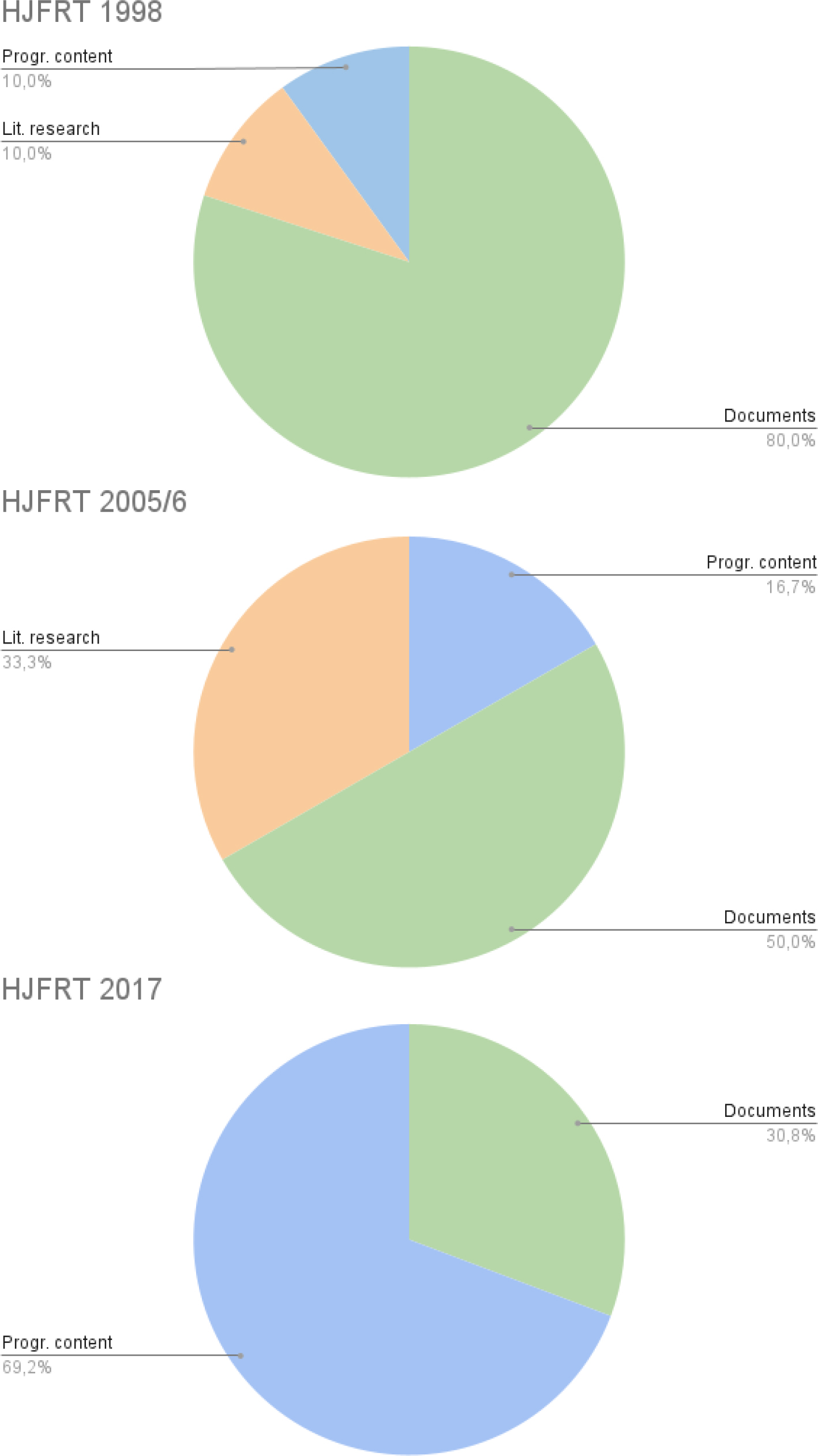
Figures 1–3
The development of types of research in HJFRT from 1998 to 2017. Lit. research = research on historical or theoretical literature. Documents = research on viewers, oral history, documents, press or programming practice. Progr. content = research on case studies, large numbers of programs or quantitative research on program data.
The papers for the conference Television Histories in Development, which is the largest, most recent and most international sample here, shows an estimation of around 60% use of digitised television archives from all over the world (Figure 4).11 Some examples are: Harm Kaal, “Interaction Between Citizens and Politicians on TV in West-Germany and the Netherlands in the Sixties and Seventies”, Quratulain Malik, “Democracy versus Dictatorship: Influence on Gender Representation in Pakistani TV Drama”, and Willemien Sanders, “Every Picture Tells a Story. Interrogating Gender in Media Research”. The latter research makes use of the CLARIAH Media Suite tool for data search and analysis.12
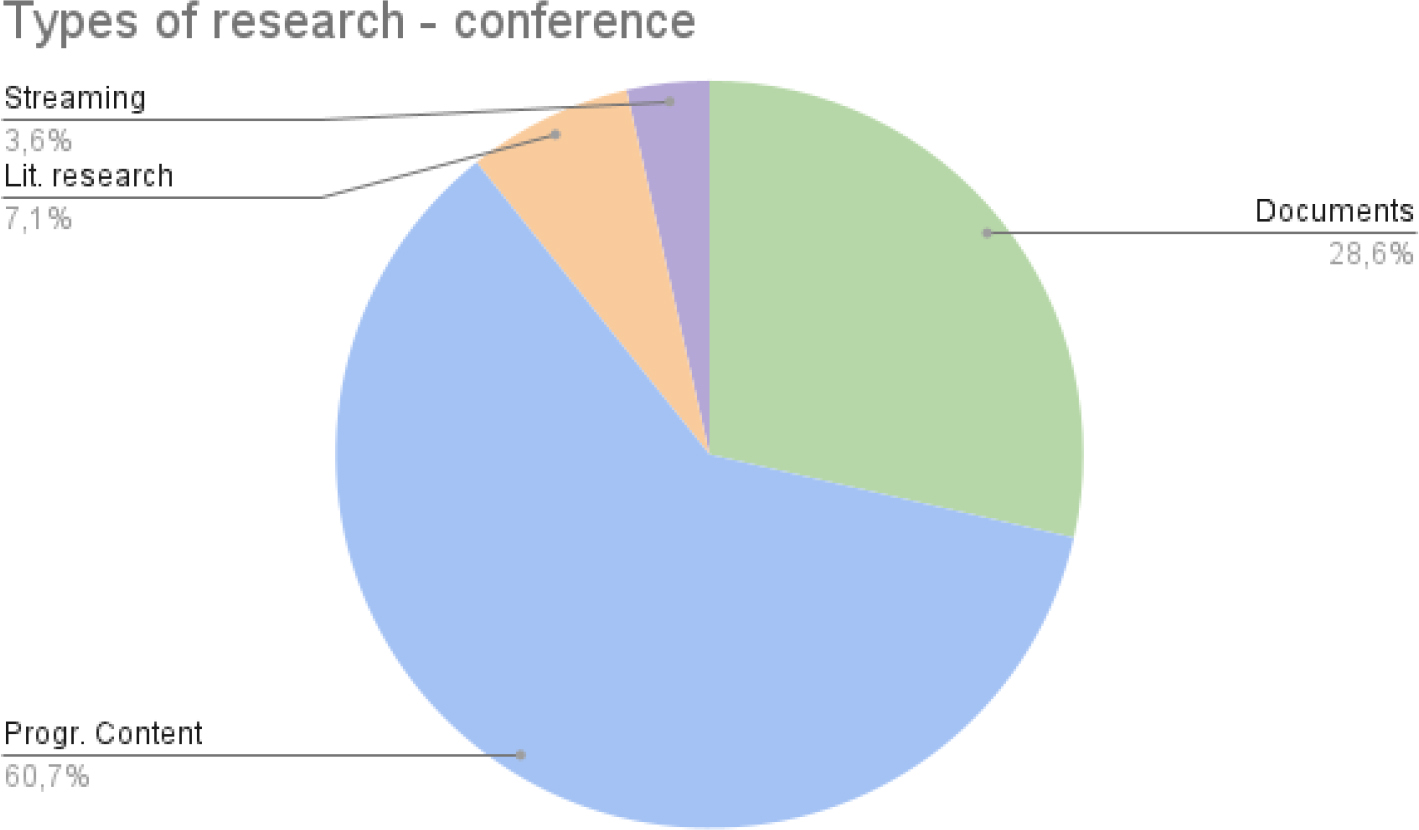
Figure 4
Types of research done for the conference Television Histories in Development (2011). Lit. research = research on historical or theoretical literature. Documents = research on viewers, oral history, documents, press or programming practice. Progr. content = research on case studies, large numbers of programs or quantitative research on program data. Streaming = research on streaming.
Sonja de Leeuw stated that with the archival turn, more research questions will focus on societal issues, although Strandgaard Jensen adds nuance, stating that digitisation alone is not enough: contextual sources need to be available as well.13 The aforementioned conference did show a wide variety of social and societal subjects. This is illustrated by panel titles such as “Women’s Stories from the Television Industry’”, “Sitcom, Soap and Queer Aesthetics” and “Television and National Identity”. Some other researches, that do not (seem to) make use of archival material, lean towards the societal relevance of their topics more as well. An interest in digital television and streaming as well as other topics that explore the ontology of television was also visible at the conference. These articles are sometimes, but not necessarily of a comparative nature, showing the similarities and differences between streaming and broadcast television, thereby revealing the traits that are essential to television. Two panels focused on this topic: “Broadcast vs. Streaming Television” and “Competition with/within Streaming”. But the ontology of television can also be implicitly shown, for instance in the paper “From Dikkie Dik to Alfred J. Kwak: What Non-Animated Dutch Youth Television Programs Can Tell Us About Animating for Television”, on movement as a medium specific characteristic of television.14 To summarise, the conference convincingly shows a strong focus on societal and ontological research topics.
3 Network of Connections
Returning to the point Strandgaard Jensen made on the necessity of contextual sources, the articles and papers such as the ones presented at the conference show that researchers cross reference their archival data with other material or literature. In the Netherlands, Delpher is an online accessible database with many national and regional newspapers and magazines. Delpher is therefore used a lot to cross reference data from the media archive. The Netherlands Institute for Sound and Vision actively builds connections as well, with other archives, press, educational institutes and creative industries among others, just as De Leeuw mentioned. To realise projects that are based on this ‘connectivity’: the institute intersects certain aspects of media and society to create the ‘digital fabric of society’.15 One example is the linked data project CLARIAH Media Suite: a European funded project that connects universities and archives to be able to share and use collections and combine and connect them for research.16
Another way television archives connect is of course with television itself: most archives within FIAT/IFTA are connected to a television network.17 This means that when this television network expands, for instance to digital or streaming, the question arises whether the archive has to change the way it collects and preserves programs, and become a multimedial archive instead of a linear medium archive. The archive of Sound and Vision is different in that respect, since it collects programs of all Dutch public broadcasting networks. It continuously expands its collection areas, for instance in preserving a selection of web video’s and media related websites.
4 Transnational and European Research
Lastly, De Leeuw expressed an expectation or wish to conduct more research on a transnational or European level. Helle Strandgaard Jensen defines ‘transnational history’ as: “a broad term that, in recent years, has come to signify comparative history and entangled history”.18 We have already seen that a network of connections can broaden horizons and look over national borders, yet the conference and journals that are researched for this article do not show an increase of transnational research: in fact they do not show any transnational research at all. However, European projects, some of which De Leeuw mentioned in her article as well, such as Europeana and EUscreen, show that a start has been made to stimulate transnational research. EUscreen for instance is a network of European broadcasters and audiovisual archives, media scholars, and technical experts. So far, not many research projects from or on initiatives like EUscreen have made their way to the regular peer reviewed journals, even though a connection between archives and academics is established.19
A networked association for funding can, for instance, be found in Humanities in the European Research Area (HERA), a network in which 26 national funding agencies collaborate to fund transnational and European research projects. Another funding body comes from the FIAT/IFTA Media Studies Commission, which aims to stimulate academic research on archives in an international setting, among others by showcasing and valorising archival material and setting up the Media Studies Grant.20 This grant was set up in 2014, and aims to “enhance collaboration between research and archive communities and ensure the valorization of academic knowledge for archival practice as well as to promote research of holdings of member television archives”.21 Research papers that have been funded by this grant are predominantly on archival history and archival practices all over the world, in among others Australia, Latin America and Europe. A few papers, among which “The Forgotten Channel: Europa TV and The Governance of Cultural Memory through Audiovisual Broadcast Archives”, show a transnational perspective.22
National funding bodies such as the NWO (Dutch Research Council), also show an increased interest in funding transnational research, as for instance the research program Internationalisation in the Humanities (2005-now) shows. This program has funded 121 transnational research projects so far, among which several in media or television history, such as Television Histories in (Post)Socialist Europe (2013-2016) and Digital Memory of the Shoah (2017-2018).23 Looking at the output of projects like these, we do see that most of these research projects result in several peer reviewed articles.24
Transnational research is reflected more in VIEW, a journal created for the purpose of stimulating Europe-based research. The journal shows several angles of approach: most of the issues are thematic, and show a collection of articles that are all from different countries, as an international collection of national research papers. Most issues since its advent in 2012 are on archival practices, historiography or European television.25 Some issues show what I call ‘crossovers’, which are for instance productions that are broadcast in several countries (Video 1). There aren’t many articles in VIEW yet that cross borders the way De Leeuw hoped for: researching societal issues in media archives of several countries to answer a transnational research question (Figure 5).
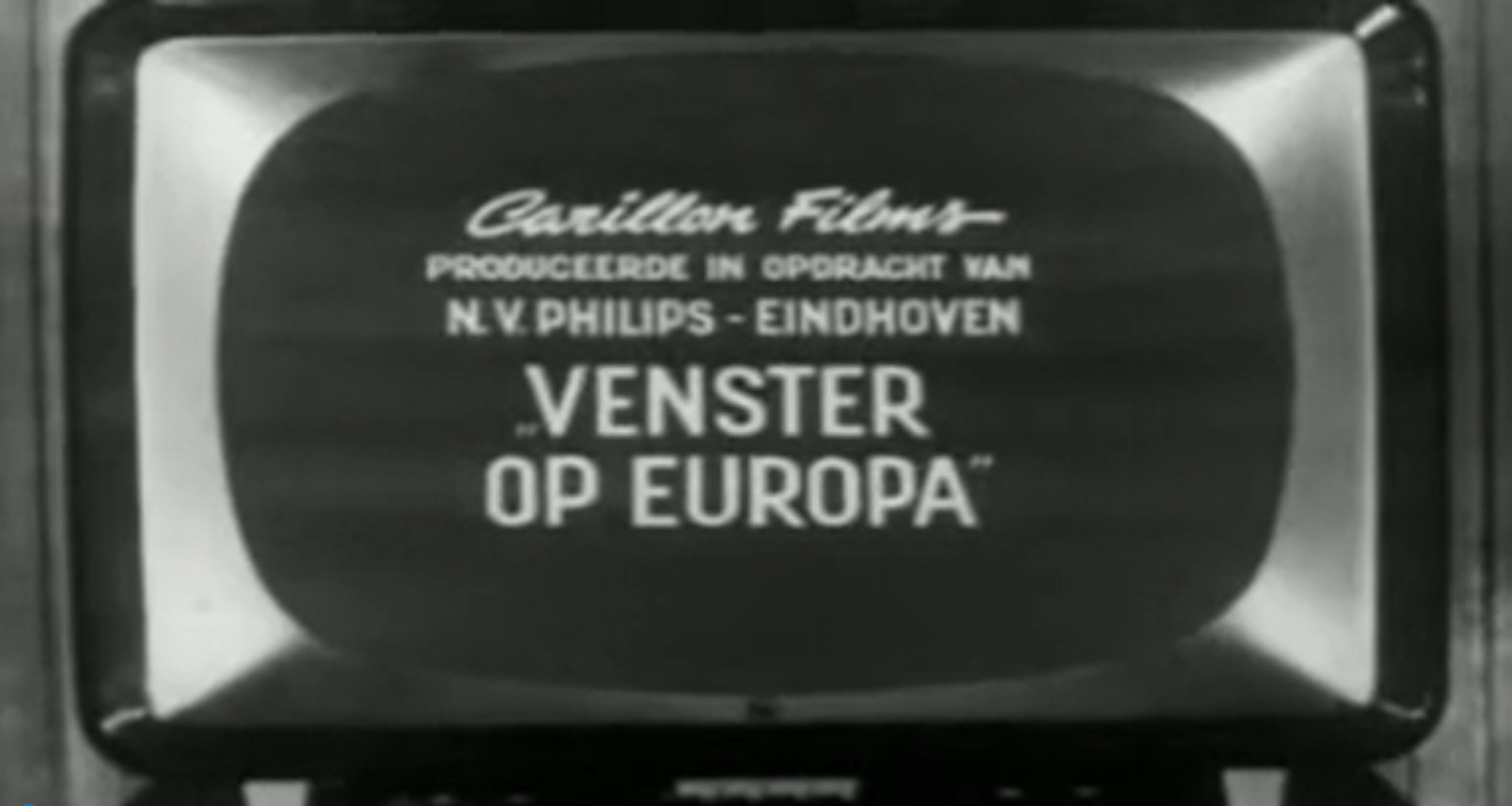
Video 1
An example of a transnational broadcast: View on Europe (Venster op Europa), Ted de Wit, Carillon Films, N.V. Philips, 1960. Watch the full video here.
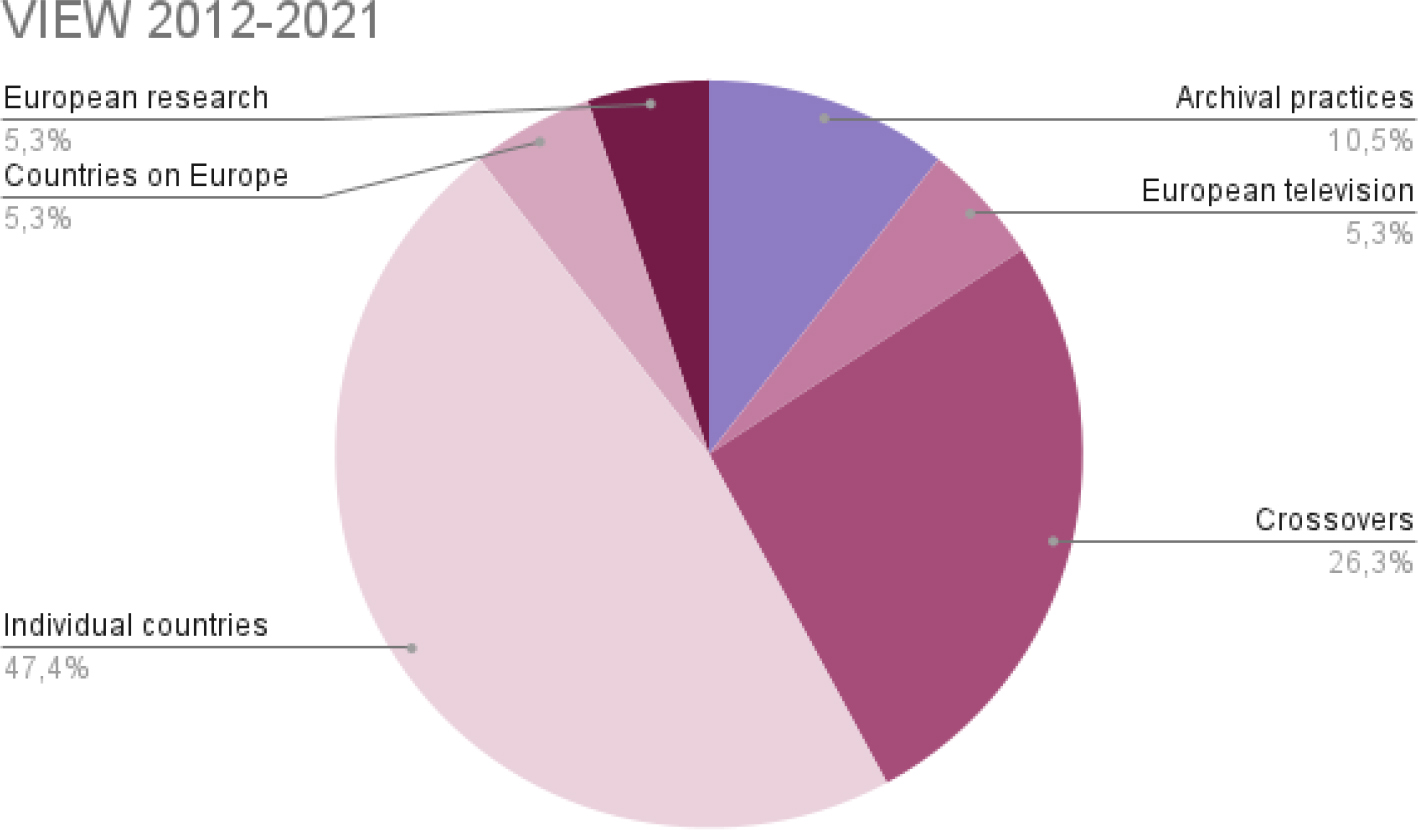
Figure 5
The European-ness of issues of VIEW Journal between 2012 and 2021. Individual countries = national histories. Countries on Europe = individual countries on European subjects. European television = research on European television projects (e.g. Eurovision). Crossovers = research on programs that have for instance been broadcast in several countries. European research = transnational or European research. Archival practices = meta research on archival practices or theory.
To understand the reasons for the lack of European research papers, we need to look at the conditions that are needed for European research. Sonja de Leeuw mentioned a couple of conditions in her 2012 article, the most notable one being the ‘technical divide’: a vast and well described archive is useless if there is no good ‘entrance’: researchers usually start with catalogues and databases, and what they find determines the possibilities.26 Accessibility is key. The aforementioned round table discussion with FIAT/IFTA members showed some valuable insights into the reason why transnational and European research is still nearly invisible in peer reviewed journals.
4.1 Condition 1: Research Funding
In the round table discussion at the conference Television Histories in Development, a point was raised by Herbert Hayduck, Head of ORF Archive Austria and chairman of FIAT/IFTA Media Studies Commission. Hayduck shared the dilemma of commercialisation that has become an issue since the digitization period. Archival data has become more available and accessible, as he put it: “(…) now we opened up the treasure trove (…), but the entrance door is only open very narrowly.” Besides the natural coalition between academia and broadcasters, public libraries and archives, he states that one of the current dilemmas is how much commerciality to accept in providing access. Can we guarantee non-commercial access to public content in the future?
4.2 Condition 2: Language
Bríd Dooley, Head of archives of the RTÉ in Ireland, mentions the language barrier as a practical issue that complicates transnational and even national research. She notes that the Irish language alone has four dialects that already differ so much from each other, that automatic speech to text tool will only be interesting to those who speak that particular dialect. This will naturally be a small group. There is some funding from the United States at the moment on the discussion for digitising Irish language archives, but for the long run metadata and speech-to-text should be written by locals. For now, the main language for searching through the metadata is English, which makes access to Irish language content more difficult. Einion Gruffudd, from the National Broadcast Archive of Wales agrees with Dooley, mentioning that the Welsh language has two different dialects. This makes accessibility to the archival data an issue at the Wales broadcast archive as well. Up to this point, the issue has not really been tackled yet.
The CLARIAH Media Suite struggles with the language problem as well. For instance: although Dutch public television has had a Turkish spoken broadcasting station (Turkse Omroep, TOS) since 2012, the search tool is not equipped for searching for Turkish spoken program content. One workaround that can be used is searching for written out Turkish numbers. The Frisian language, which is the second official language of the Netherlands, is also not supported yet by the Media Suite search tool and the speech to text function. An overview of collections on the website of CLARIAH Media Suite shows similar language difficulties with the Croatian Memories collection and the two Sobibor collections.27 It is clear that language is an issue difficult to bridge even within countries, so extending research to a transnational or European level might make the language barrier even more problematic.
4.3 Condition 3: the Technical Divide
Language is one aspect of accessibility, but there are more, such as the ‘technical divide’ that Sonja de Leeuw mentioned. Several issues that can be considered part of the technical divide were brought up in the round table discussion. When asked about how I, as a Ph.D. researcher, accessed the required archival collections at the Netherlands Institute for Sound and Vision, I initially answered that I was able to solely by knowing the curator of collections at Sound and Vision, Bas Agterberg. There is a research room that helps customers research digital audiovisual material, but it lacks the specific knowledge on physical collections that might be necessary for specific academic researchers. Agterberg added that it is not enough to grant academics access and give them all the data. It is important to understand what a researcher really needs or wants by coming into dialogue, because sometimes a researcher comes in with a question that can be answered with other kinds of documents than expected, so you need someone with an academic perspective who can help the researcher find their way in the archives.
Dana Mustata (Media Studies University of Groningen, editor-in-chief at VIEW, co-chair Media Studies commission at FIAT/IFTA) agrees using another example: the differences in the ‘languages’ of academics and archivists. Academics or media historians use a different language for certain moments in television history than archivists do and have different protocols and jargon, so academics need to get acquainted with the specific language of an archive to find their way around the archive and navigate, and to know what to look for in the archive. Mustata also mentions that it differs per country how much access is given to universities, and the extent to which access is provided on a national level is also a factor for European research.
4.4 Condition 4: Collaboration
Bríd Dooley points out that some archives, such as the RTÉ, are small, and might not have sufficient resources and funding for accessibility on top of the regular archival activities and digitisation. Collaboration with academia is an important way to receive funding, but then there is still the issue of finding the resources to make the archive accessible and build connections to set up large projects. There are some national sources for funding as well, but they want to keep their own identity when collaborating with for instance a national archive. Funding is an issue with setting up large scale international projects: even though they would like to, there is still a lot of money and resources needed that are difficult to find.
The approach that Sound and Vision takes is seeking partnerships in research projects rather than just providing access to the archives. For instance: the CLARIAH Media Suite is a digital resource that contains (among others) the full digitised archive of Sound and Vision. There is much more material in the collection of Sound and Vision that has not been digitised yet. Instead of just providing the data, Sound and Vision aims to collaborate on projects. Funding from international research projects is possible. This is very often Artificial Intelligence research in which Sound and Vision offers data or facilities, for instance in Digital Humanities projects such as Decolonizing Southeast Asian Sound Archives (DeCoSEAS), a transnational research project that aims to decolonise Southeast Asian heritage. Eighteen partners, among which audiovisual institutes and universities in Southeast Asia and Europe collaborate in this project.28
Collaborative projects like these form a network of connections, as De Leeuw put it, but this type of research is fairly new in the Humanities, since contrary to beta sciences in Dutch universities, the humanities do not have a history of doing collaborative research. Dana Mustata agrees that there is much international funding, but national too, as the example of the Dutch Research Council (NWO) mentioned above has shown with funding schemes based on collaboration. Mustata adds that academics usually only ask for access, and in the experiences Mustata has on working with archives, she tries to collaborate and think of ways to contribute to the archival institution. Mustata concludes that the interests of archives and academia are very much similar: they speak different professional languages, but they have shared aims.
5 Conclusion
Sonja de Leeuw concluded in 2012 that the study of television would change in several ways after finalising the digitisation process, and it is clear that the increased accessibility of media archives did broaden the possibilities for research in the last 10 years, as examination of the conference and the two journals show. More societal-based and ontological questions are researched, data from media archives are connected to and cross referenced with other media, and new partnerships help shape media archives into networks of connections, although we are still at the eve of these three developments.
Although there are more initiatives to encourage European and transnational research, this seems to need more time than expected to develop. Smaller archives struggle to find large funding opportunities to increase accessibility. Funding options are available, but archives struggle with the level of commercialisation in their activities and partnerships. Language barriers create difficulties in accessibility not only on an international, but also on a national level. The technical divide remains an accessibility issue as well: the different language that archivists and researchers speak, and the necessity for a personal introduction to the archive by someone with an academic perspective show that large scale research is difficult to set up. Collaboration, between archives and academia but also with other national and international partners, as for instance as the DeCoSEAS project shows, can be a good solution to cross borders. This creates the ‘networks of connections’ that Sonja de Leeuw described, helps archives gain funding and creates research possibilities for academia, which in turn can find their way to peer reviewed journals, not only on a national, but also on an international scale. In ten more years, peer reviewed journals might very possibly show even more archive based, collaborative research that focuses on societal and ontological subjects that cross national as well as technical borders. That would be a good time to take a new look at the European-ness of the articles that are being published, and to present the findings at a new conference to place them into perspective. This way we can see how far archival research will develop in this new phase in the Archival Turn.
Part of this article is written for and presented at the conference Television Histories in Development on 30 September 2021, as part of a fellowship at the Netherlands Institute for Sound and Vision. I am particularly grateful to curator Bas Agterberg for his suggestions and insights.
Notes
[1] Sonja de Leeuw, “Het Archief Als Netwerk: Perspectieven Op De Studie Van Online Televisie-erfgoed,” TMG Journal for Media History 14, no. 2 (2012): 10–28. DOI: http://doi.org/10.18146/tmg.134.
[2] “Images for the Future”, Sound and Vision, consulted 18-08-2021, https://www.beeldengeluid.nl/en/knowledge/projects/images-future. This digitisation project is sometimes also referred to as the Digital Turn, but in this response to Sonja de Leeuw I chose to stick with the same terminology as much as possible.
[3] It is worth noting that I am not the first to look critically at this subject matter, see for instance Helle Strandgaard Jensen, “Doing media history in a digital age: change and continuity in historiographical practices,” Media, Culture & Society 38, (1), (2016): 119–128.
[4] I read the abstracts of four years of both journals: 1998, 2005, 2006, 2017 to be able to see a development if there is one. I chose journals of two different countries to rule out some possible national differences. More research on other European countries would make the results more representative for Europe as a whole, but that said, the results show very clear similarities in development in the Netherlands and Britain.
[5] It is necessary to acknowledge there are more reasons for the digitisation of media archives than this paper focuses on, such as conservation of the content of the various types of media carriers. De Leeuw states that television content is not only artistic or cultural, but also national historical content, which is worth preserving not only because it tells us about television practice, but also about the society of the time that is researched. Television actively writes history. After conservation comes accessibility, which is the main focus of this paper.
[6] I chose 1998 as the baseline since it is the first publication year of TMG, and well before the start of digitisation projects. It is worth noting here that the sample of HJFRT is much larger than that of TMG, especially when looking only at television.
[7] Richard A. Etlin, “Copyright, education and social responsibilities,” Historical Journal of Film, Radio and Television, 18:1 (1998) 123-127, DOI: 10.1080/01439689800260061; Rutger Vahl, “‘grote Jukebox’ of Een ‘hogergrijpend Programma’? De (omroep)politieke Strijd over Een Derde Radiozender,” TMG Journal for Media History 1 (1), 1998: 78–92. DOI: http://doi.org/10.18146/tmg.51.
[8] For TMG I looked at all articles, and not only at television research, since the sample is too small to make significant statements on television research alone.
[9] Huub Wijfjes, “Digital Humanities and Media History: A Challenge for Historical Newspaper Research,” TMG Journal for Media History 20 (1) (2017): 4–24. DOI: http://doi.org/10.18146/2213-7653.2017.277.
[10] Sally Shaw, “Uncovering Forgotten, Unseen and Contested Representations of ‘Black Britain’: Gloo Joo (1979) and Meadowlark (1982),” Historical Journal of Film, Radio and Television 37 (1) (2017): 113–127. DOI: https://doi.org/10.1080/01439685.2016.1272809.
[11] While reading the abstracts, I plotted the different types of research methods, hereby focusing on the use of digitised archive material. I did the same with the two journals.
[12] Harm Kaal, “Interaction between citizens and politicians on TV in West-Germany and the Netherlands in the sixties and seventies”; Quratulain Malik, “Democracy versus Dictatorship: Influence on Gender representation in Pakistani TV Drama”; Willem Sanders, “Every picture tells a story. Interrogating gender in media research”, papers presented at the conference Television Histories in Development, Hilversum, September/October 2021.
[14] Grietje Hoogland, “From Dikkie Dik to Alfred J. Kwak: What non-animated Dutch youth television programs can tell us about animating for television”, paper presented at the conference Television Histories in Development, Hilversum, September/October 2021.
[15] “Projects”, Sound and Vision, consulted 04-11-2022, https://beeldengeluid.nl/en/knowledge/projects.
[16] CLARIAH Media Suite, consulted 04-11-2022, https://mediasuite.clariah.nl/.
[17] “Organisation”, FIAT/IFTA, Consulted 04-11-2022, https://fiatifta.org/index.php/about/organisation/.
[19] In no way does this research show a complete overview of European and transnational initiatives. Also, the focus here is on audiovisual archives with a broader scope than television.
[20] “Media Studies Commission”, FIAT/IFTA, Consulted 10-10-2022, https://fiatifta.org/index.php/about/organisation/media-studies-commission/.
[21] “Media Studies Grant”, FIAT/IFTA, Consulted 10-10-2022, https://fiatifta.org/index.php/media/fiatifta-publications/research-papers-of-the-fiat-ifta-media-studies-grant/.
[22] “Media Studies Grant”, FIAT/IFTA, Consulted 10-10-2022, https://fiatifta.org/index.php/media/fiatifta-publications/research-papers-of-the-fiat-ifta-media-studies-grant/.
[23] “Internationalisation in the Humanities”, NWO, Consulted 7-7-2023, https://www.nwo.nl/en/researchprogrammes/internationalisation-humanities.
[24] See for instance the page for “Television Histories in (Post)Socialist Europe”, NWO, Consulted 7-7-2023, https://www.nwo.nl/projecten/236-52-006-0.
[25] For more on archival practices see for instance: J. Noordegraaf, “Who knows television? Online access and the gatekeepers of knowledge,” Critical Studies in Television 5, (2), (2010): 1–19, or E. Ketelaar, “Tacit Narratives: The Meaning of Archives,” Archival Science (1), (2001): 132–141. This research paper will look predominantly at the types of research following these practices.
[27] “Overview International Collections”, CLARIAH Media Suite, Consulted 04-11-2022, https://mediasuite.clariah.nl/learn/main/overview-international-collections-in-the-media-suite.
[28] DeCoSEAS, consulted 15-11-2022, https://www.decoseas.org/.