
1 Introduction
Television, as Andreas Fickers and Catherine Johnson argue, has always been dynamic and active, preventing it from solely serving as a national or an international medium.1 Instead, it is characterised by transnational flows over national borders.2 The medium was introduced to specifically address national citizens and for “national, cultural or developmental policy objectives”.3 While this led to the introduction of multiple public service broadcasting systems, which centred around the nation state (and provided limited access to citizens outside of these national borders), television has simultaneously been defined by transnational production, circulation and the flow of knowledge and expertise across these borders. Transnational research thus explores where those borders can be found, and what flows between them. As Chiara De Cesari and Ann Rigney describe: “[the transnational] recognizes the significance of national frameworks alongside the potential of cultural production both to reinforce and to transcend them”4
Transnational flows are also present in the archives that preserve and open up television heritage. Traditionally, television archives are positioned within “political-legal” frameworks, centred around the nation-state.5 However, due to the large-scale digitisation of collections, many television archives can now be accessed online. As Lara Putnam describes, transnationally oriented research was also possible in the analogue age, but through ‘web-based digital search’, this has become more efficient and cost effective.6 Combined with the overall internationalisation of our societies, and thus universities, this results in an increasing group of international researchers that are finding their way to digital collections. Digital television archives therefore add an additional layer of transnational (re)circulation to the television content. In sum, neither the archives themselves, nor the television heritage they are persevering, nor the users that they are accommodating, can be defined solely as national, creating a discrepancy with the nation-centred approach towards heritage preservation.
In this article, we therefore set out to understand how the transnational aspects of television are visible and findable in digital television archives and how opportunities for more transnationally centred research can be created. By analysing our own experience as users, we develop a number of recommendations for curators of digital television heritage, as well as builders of archival interfaces. This will not only increase possibilities for research into the transnational flows of television, but the search strategies presented will simultaneously help the expanding group of international scholars find content they can understand. To make these recommendations, we focus on a piece of content that flowed transnationally when it was initially produced and was of enough historical significance to have been retained in different archives: a clip of Laika, the Soviet Dog that was launched into space. We focus here on how the clip appears in three different digital television archives. These three archives differ in their scale, targeted audiences as well as in their curation policy. By comparing how the same clip appears in each archive, we will gain valuable insight into how transnational content is framed, and what possibilities and limitations for users these frames represent.
First, we focus on EUscreen, an aggregated television archive with the specific goal of providing “unified access to representative collections’’ from all over Europe.7 The archive was set up in 2009 and was initially funded by the European Commission. It currently holds “more than 60.000 videos and related materials” and serves both researchers as well as regular users.8 Secondly, we analyse the Internet Archive, which contains a specific collection of ‘TV News’ that currently holds 2.4 million programmes. The archive’s democratic nature means it is directed at regular users (in opposition to researchers) who are simultaneously able to upload content in the archive from all over the world.9 As Alnoamany et al. write, it is one of the oldest and largest public web archives and has therefore become an important player in the field of cultural history.10 Lastly, we explore the Dutch CLARIAH Media Suite, an online research portal that connects digital tools with national audiovisual collections. Specifically, we will be navigating the television collection of the Netherlands Institute for Sound and Vision, which also hosts the Media Suite. This broadcasting archive, which is partly funded by the Dutch government, was established in its current form in 1997 and holds more than 25 petabytes of material.11 Each year, more than 8000 hours of television enter the archive. The Media Suite specifically provides “tools to search, visualise, enrich and analyse” the data in the collections.12 While EUscreen stands out through its inherent cross-European mission, the Internet Archive does so through the size of its collection and the Media Suite through its focus on research support. Together, these three archives will provide us with multiple implementations of how transnational flows can be made visible and findable.
In these three archives, we trace a clip of Laika. This small stray dog from Moscow was launched into space on November 3, 1957, making her the “first living being to orbit the Earth” - until re-entry killed her.13 While her involuntary journey took place in the midst of the Cold War, it proved to be an important milestone for space travel all around the world, and highlights the curious interdependence between Cold War adversaries in distributing each other’s media.14 The video footage that exists of her provides a fitting case study for us for two reasons. First, because the iconic clip of her being strapped into her shuttle was circulated around the world via news exchanges. The video therefore contains inherent transnational aspects and is now once again re-circulated transnationally through digital television archives. Secondly, because there is little variety in the visual imagery available of her. This limited footage means we are able to locate the same identical video in all three archives.
The clip of Laika thus serves as a searchlight for us to analyse which national borders we encounter around the heritage objects and the archives (in the form of language, copyright, or production countries for example), as well as how and where these can be crossed. Tracing the clip helps us understand how the transnational facets of television, both in this original clip as well as in its digital (re)circulation, are visible in the infrastructure of the three archives. We analyse our search for this video through a ‘digital ethnography’.15 This entails tracing Laika in the archives from our point-of-view, as television historians with a keen interest in transnational television. We are able to do so through deploying our own cross-national backgrounds, namely American-Dutch, Belgian-Dutch and Dutch-British. We are also codevelopers of one of the archives under scrutiny, the Media Suite. Indeed, this analysis was undertaken with the aim of better understanding and developing its potential for finding transnational content and enabling transnational users. However, we used a strict model of analysis for the three archives and paid attention to all three in a structured way.
From this position, we follow the standard research phases of media scholars as described by Marc Bron, Jasmijn van Gorp and Maarten de Rijke.16 While these phases are often non-linear in practice, we have structured our activities in the archives according to these steps to ensure a similar research process in all three. We start in the exploration phase, which entails a search for what data is available and how this can be retrieved. This stage also includes analysing activities like browsing through datasets, gaining an overall familiarity with the collections, and attempting different queries. Secondly, we analyse the contextualisation phase: what are we able to do once we have found Laika’s clip in the archives, or how can we ‘contextualise’ this data? This contains activities centred around fine-tuning research questions, searching for additional information and data as well as tracing and analysing this material. Regarding the last phase, the presentation or publication of research results, we primarily focus on possibilities for data re-use, and copyright limitations in place.
We categorise our findings, and subsequent recommendations, into two different, but not mutually exclusive, levels. Structuring our findings in this way will help us understand how the three digital archives support, steer and perhaps limit our search for, and understanding of, Laika’s clip. First, we discuss our findings on the level of the archives’ collections, meaning the national and transnational aspects of the content in the archives. This will be followed by the ways that we are guided by the interface of the archives, for example through possibilities for translation. This concerns how we are able to explore, navigate and retrieve the material. It is important to note that we discuss our own navigation on the platforms in both categories, meaning that our interaction with the interface and the Laika clip will cut across both levels. However, this specific categorisation is directed at our findings, the result of this navigation, and will serve as a guideline for potential recommendations for curators and developers.
In this article, we argue that to encourage research on the transnational facets of television, we must - paradoxically - demarcate explicitly the multitude of national borders that are present in digital television archives. This includes national borders in the form of language options and production countries, as well as metadata retrieval functionalities and visualisations, to name just a few. Research into the transnational flows of television does not ignore these borders but provides insight into how the medium has transcended them in the past, as well as how these flows are reconstructed through the digitisation of television heritage.17 Our findings will offer a point of reflection for media scholars, curators and developers, as well as for historians in general, on how digitisation changes these research practices. Transnational research is by no means new, but digitisation processes have made this considerably more accessible.18 Acknowledging clearly where national borders exist - and persist - in digital heritage spheres will better enable research to, between and over them. Similar to Laika’s journey, we attempt to record what happens when borders are crossed, and new spaces are explored.
2 Transnational Content
2.1 Finding Laika in the Collections
Our search starts with an analysis of how many search results we receive by simply searching for “Laika”. Initially, we assumed that this spelling was the only transliteration of her name from the Cyrillic to the Latin alphabet. Only in a later stage of our research did we become aware that other spellings are also used, like “Lajka/Łajka” in Slavic languages and Hungarian or “Laïka” in French for example.19 These other transliterations highlight that even a ‘straightforward’ search such as ours is more complicated than assumed, due to the original transnational circulation of the clip. While we are searching in the Media Suite, however, the “Laika’’ query does immediately result in the clip we are looking for (see image 1). This video shows Laika skittishly looking around in her capsule. The clip is not incorporated in a larger broadcast and the title tells us it originates from the Internationale Nieuwsuitwisseling [Eurovision News Exchange or EVN], an exchange connected to the European Broadcasting Union. More than 70 countries share their news reports in this exchange, which therefore exists only of the items themselves without any broadcasting context.20
We then go back to our search results, where we find Laika in two other programmes: the news show EenVandaag and a youth special called the Space Journaal. Additionally, the search for “Lajka” results in one documentary about cosmonauts called Dokwerk. These programmes are produced and broadcasted in the Netherlands and narrated in Dutch. At the same time, the EVN clip has no sound at all, a common feature of EVN material as this allows broadcasters to record their voice-overs in their own language during their distribution of the content. It is therefore the only item in our results that is not specifically in Dutch. This first exploration in the archive already presents us with the transnational characteristics of the Media Suite’s content: the presence of the EVN in the nationally oriented collection, the incorporation of this clip in the Dutch broadcasts as well as the spelling of her name as ‘Lajka’ in the Dokwerk documentary. As Rigney writes: “implicit in all of this is the recognition that mediated memories circulate transnationally as well as nationally, and that this provides them with the potential to reconfigure the borders between groups who have hitherto considered themselves unconnected”.21 While most of the content in the Media Suite’s collection was produced and broadcast in the Netherlands, the presence of the EVN as well as the presence of Laika in the other programmes and the Non-Dutch spelling of her name demonstrate this transnational circulation of memory. In other words, Laika also travels within and over the nation-centred borders of the Media Suite.
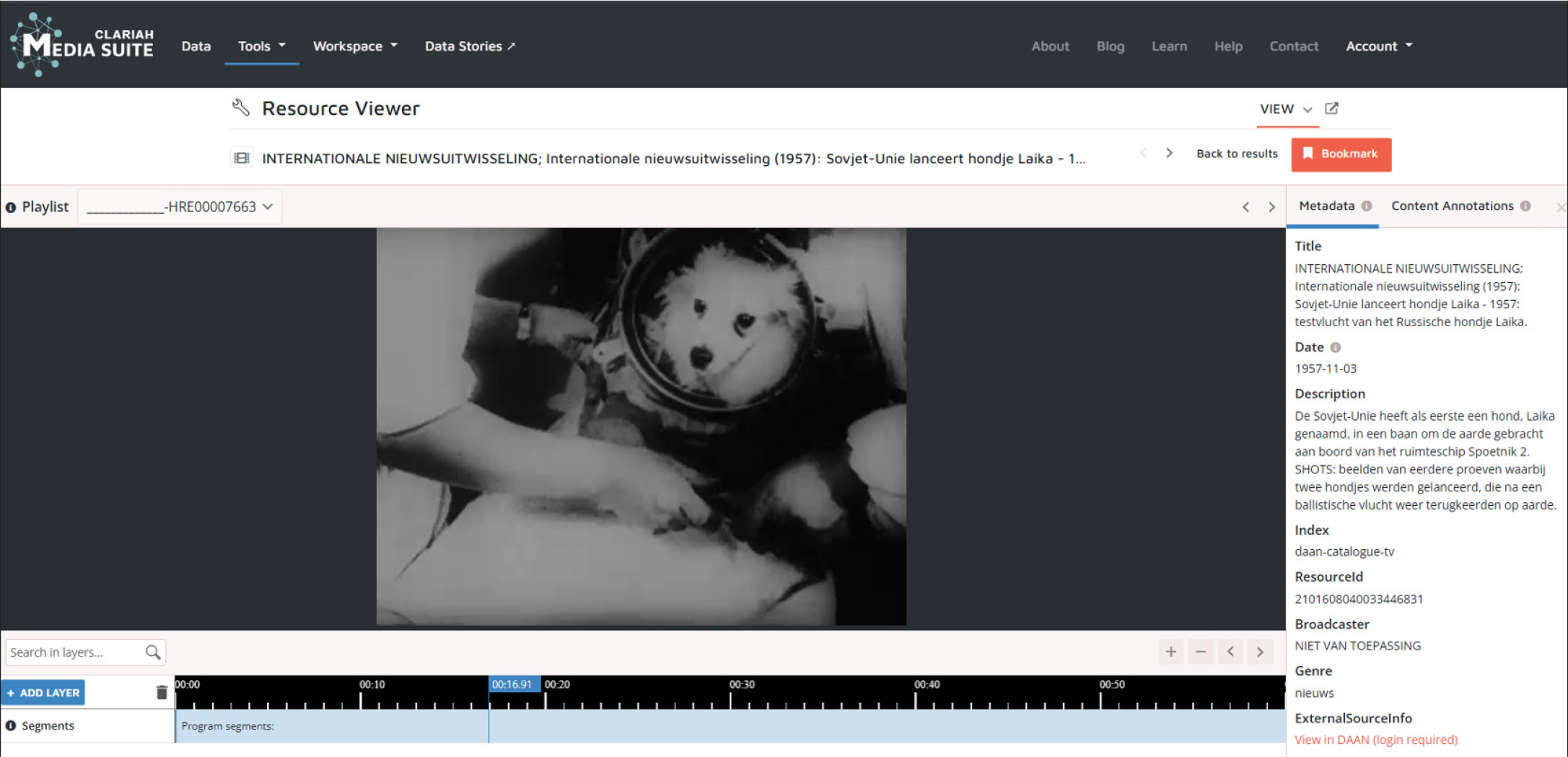
Image 1
When searching for “Laika” in the Media Suite, her iconic fragment is the first result and is derived from the EVN collection.
In the TV News collection of the Internet Archive, we have high hopes of finding a wide variety of content. While other variations of her name do not lead to any results, the query for “Laika” provides us with four videos that have our clip embedded. From the overall 74 videos in the result page, 73 were in English and one, not viewable, clip in another language (Spanish). Slightly confused by these monolingual results, we are forced to review our idea of the Internet Archive as inherently transnational due to its global ‘democratic’ nature. Further exploration of the collections shows that there is indeed a very prominent US focus in the collections, concealing the transnational aspects somewhat. This comes from the many North American institutional archives and libraries that the archive is related to, as well as its US-centred subcollections. As image 2 shows, three of these collections are centred around North American themes, and further exploration reveals the other two also consist of US-centred content. Even the TV News collection itself highlights this focus, as we realise that by searching here, we are automatically directed to a search of the US TV News speech transcripts. If we want to search the entire collection, we need to go back to the search bar and manually select that we want to search the metadata of all collections. Only then - to put it metaphorically - we are able to leave the US. While the national is always embedded in the transnational, as Rigney and De Cesari have argued, this precedence of one specific nation in the content is not immediately made explicit in the Internet Archive.22
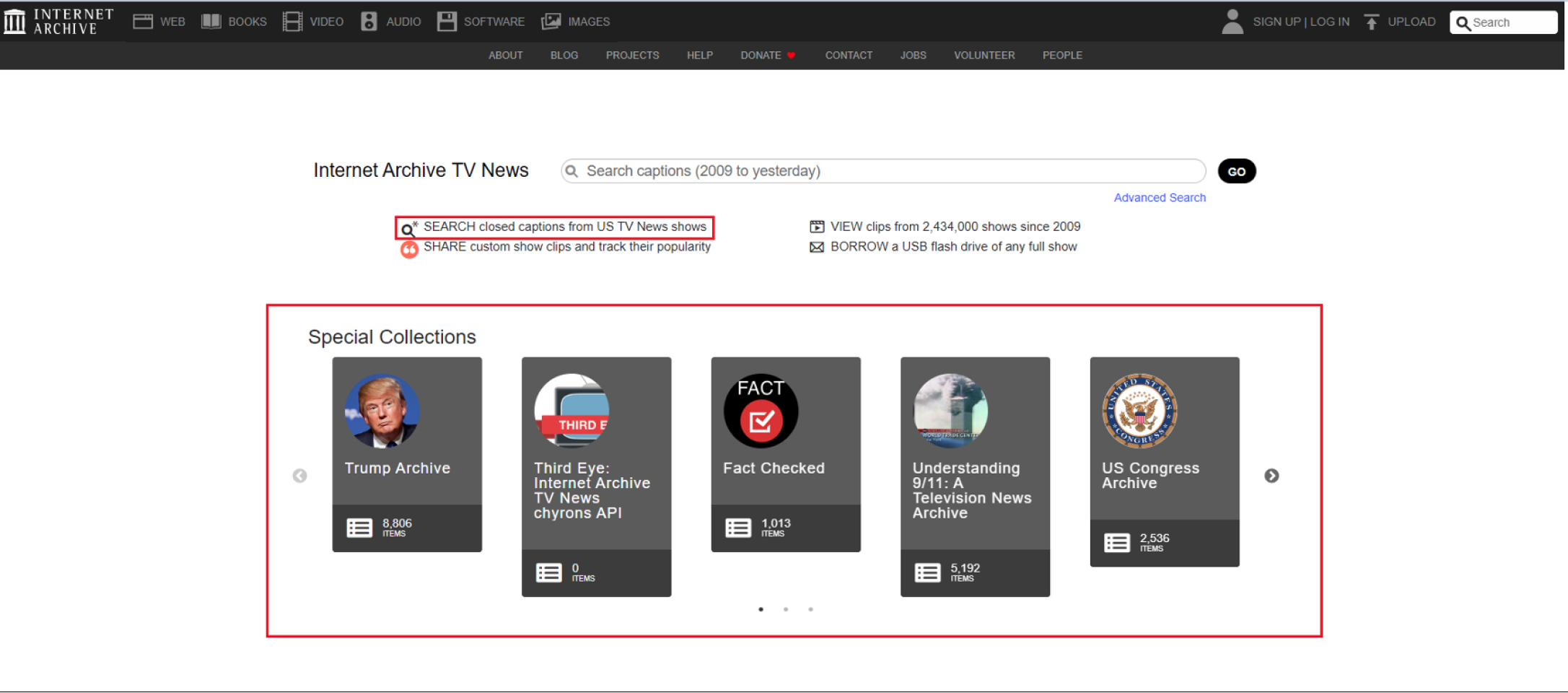
Image 2
The special collections within the Internet Archive all have a US focus.
source: https://archive.org/details/tv
In comparison, our search in EUscreen is more straightforward. Searching for “Laika” provides us with just one result. This is a Spanish historic documentary on the occasion of the 50th anniversary of the first Sputnik launch in 1957, which includes our clip of Laika (see video 1). Searching for “Lajka” in EUscreen results in a three-part Hungarian documentary on space travel. Laika’s clip is part of the opening sequence and thus appears in all three parts.
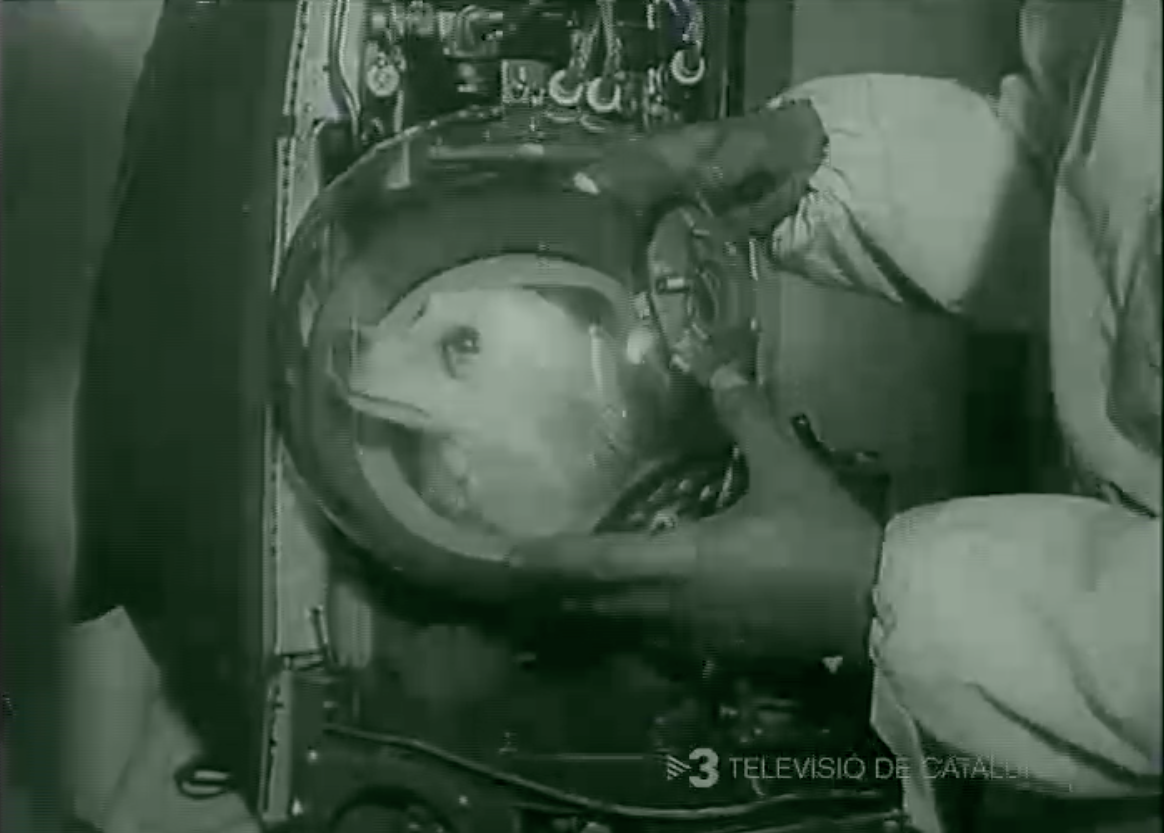
Video 1
Laika being strapped in her capsule, ready to take off on her journey.
“Space 50th Anniversary of the Soviet Union’s Sputnik Launch. History of the Space Race between the USSR and the US.” Watch the full video here.
Finding these non-anglophone clips is no surprise, as it is EUscreen’s primary aim to represent European television heritage, and therefore contains videos from more than 25 countries. The results are therefore topical but limited in quantity. EUscreen excels through their option to share content from the collections, which is impossible within the other two archives due to copyright restrictions. Regarding the presentation phase of research, EUscreen’s collection can therefore travel across different platforms, as is the very case here – embedded in this article (see video 1).
What is important to note here is that not all three platforms are fully accessible for all users. While the Internet Archive and EUscreen are openly accessible, the Media Suite is partially restricted to users from Dutch universities and research institutes, or employees from the related archives due to copyright agreements. Users outside of this demographic can access the available metadata but are not able to view most videos in the television collection and thus our Laika clip. They are only able to view the videos in the open access parts of the collections, like Open Images - Sound and Vision, Open Images - EYE or Open Images - Natuurbeelden.
As a step towards transnational interoperability of the Media Suite, however, researchers at CLARIN-universities in Europe can log in with a verified CLARIN-account.
2.2 Exploring the Collection’s Metadata
At the level of transnational collections, we next look into the collections’ metadata and their potential to filter and refine our search results in order to locate more transnational content. First, we use the language filter. While the predominantly Dutch results in the Media Suite did not surprise us due to the nation-centred focus of its collections, we can still filter the results based on language. The filter tells us there are more than 87 languages present in the archive. The majority of the results consist of Dutch programmes, but the language filter tells us more than 75% of the results are actually labelled ‘empty field’. The same goes for the “Lajka” query which, despite its Hungarian spelling of her name in the metadata, also results in ‘empty field’ filters. From the 25% that have received a label, one result is in English, one in Arabic and 37 results are in Dutch. Further exploration shows us that this metadata field does not help us with determining the production or broadcast country of the video, but that it only means that somewhere in the data, this language is spoken. These are still programmes produced and aired in the Netherlands, and do not contain our clip of Laika. This exemplifies the complexity of television’s transnational flows. While language cannot be used as a determinator of the national broadcast origin, it is one aspect of television that moves across borders and that can potentially be visible and findable in the archive. While it can thus enable research into transnational phenomena, it is necessary for these metadata fields to be accurate and complete.
To further explore how metadata and filters can be used to cross national borders in the archive, we turn our attention back towards EUscreen. Here, it is not only possible to filter on language, but also on other filters, i.e. “Country of Production” as well as “Provider”, with the latter meaning the archive that provided the content. The metadata underneath the video provides an additional category of “geographical coverage”, which appears to address the locations filmed or discussed. In the Spanish video we found of Laika, for example, ‘Spain’ applies to the first two categories, while the latter is labelled “USA and Russia”.23 We attempt to deploy a similar technique in the Media Suite. While the “Country of Production” filter is also present here, it is a lot harder to find as the labels of the Thesaurus IDs are used (see Image 3). Here as well, most of these fields are labelled as “Empty field”. The way we are able to use these filters in EUscreen, by contrast, shows their potential for research into transnational aspects of television. Precisely because the nation-specific information is differentiated to such an extent, it makes us aware of the borders that are in place around the data and, paradoxically, helps us cross them.
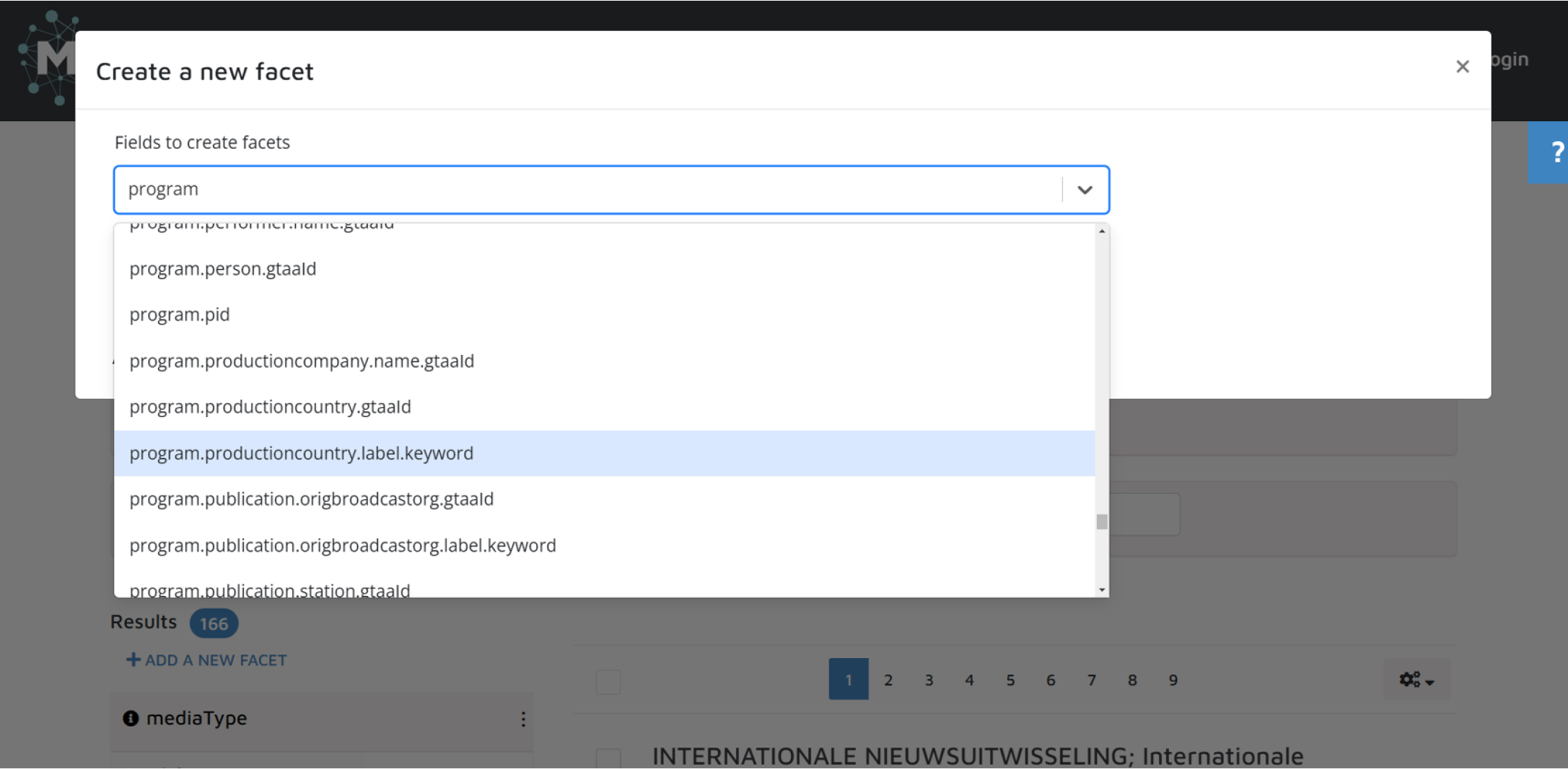
Image 3
Facets in the Media Suite.
source: https://mediasuite.clariah.nl/
The Internet Archive in its turn, does have a language filter but does not provide any nation specific metadata. While we are searching for Laika, we do encounter a ‘curated collection’ that, similar to the metadata filters, presents us with a transnationally oriented selection of data. This ‘library’, as the Internet Archive calls it, centres around the events of 9/11 in the form of a minute-to-minute timeline of both American as well as world-wide news broadcasts from that day. Image 4 shows how, through this library, we are immediately presented with a preview of the content that is present in the archive, and the countries this was broadcast in. We can, quite literally, cross the national borders set around the content in an explorative manner to get an overview of the crucial reports from that day. Similar to the metadata filters, a library like this provides users with an overview of the nations present. While limited to this specific topic, a curated selection like this enables, and even encourages, research into the transnational aspects of television. Additionally, this helps users find content they can understand.
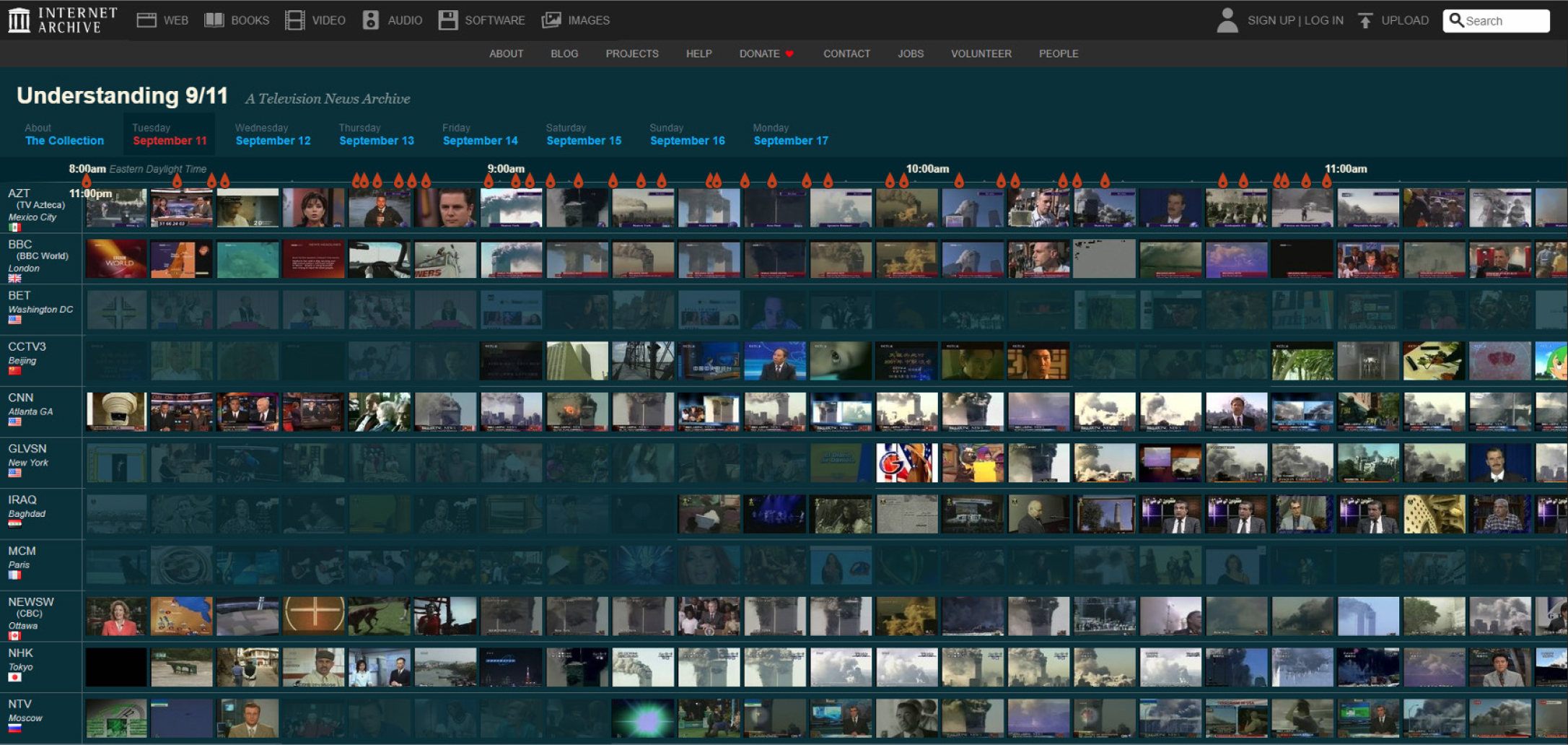
Image 4
The curated collection about the events of 9/11 that can be found in the Internet Archive. The collection shows broadcasts from all over the world from 08:00 a.m. to 10.00 p.m. (ET) on that day.
3 Transnational Interface
3.1 Transnational in/as Language
We now turn to how research into transnational facets of television is enabled in the interface of the three archives. This level encompasses all functionalities that both guide as well as restrict the user during their navigation of the collections. We therefore set out to understand how we can explore, navigate, and retrieve the content. First, when wanting to know how the transnational is visible in digital, online archives it is important to consider possible language barriers in the interface that users might come across. Especially as, during our search for Laika, we encounter different approaches to this issue within the three archives. As we start our exploration, we learn that all three use an English interface (homepage, menu, functionalities etc.), which makes some mastery of the language a prerequisite for all users who want to work with the collections. This is specifically remarkable for the Media Suite, as most of their data and metadata are in Dutch. We can therefore conclude that the ideal user of this archive is proficient in both languages.
When we direct our attention to the language of the available metadata descriptions accompanying the video, we see that in the Media Suite, even with the international EVN collection, all descriptions are in Dutch. The Internet Archive offers this data description in the original language of the video in question. While most of the Laika clips we encounter are in English, which is explained by the dominance of English in the archive, we also encounter Spanish, Latvian, and Greek data descriptions (see image 5). Only in some cases, users have decided to post both the original description as well as an English translation. In EUscreen, however, this is standard practice. While there are many languages present in the collection, all are accompanied by an English translation. By providing both options, as image 6 shows, EUscreen highlights the transnational aspects of the content, which simultaneously increases the accessibility for users from different backgrounds as they can retrieve content in multiple languages.
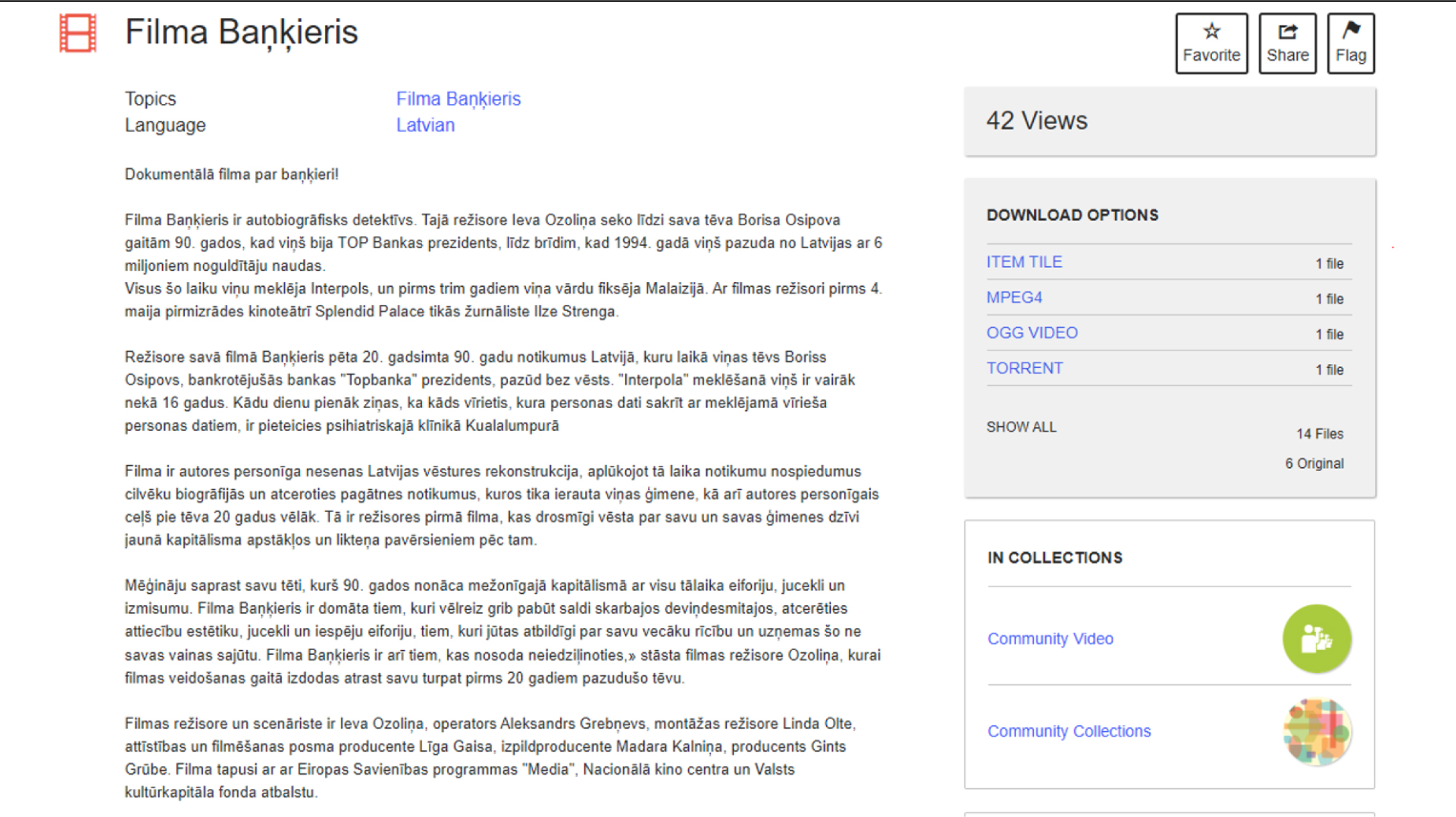
Image 5
Data description in Latvian in the Internet Archive.
Next, we look into the language of the speech transcripts available in the interface. The automatic speech recognition (ASR) in the Media Suite recognizes Dutch, so provides only Dutch transcripts of (mostly Dutch) videos. The Internet Archive predominantly has English speech transcripts, but the functionality also works for Spanish data. While these transcripts do not offer any translations, they do provide the ability to read along with the spoken text, which can create a better understanding for users who are less proficient in the language. Therefore, both the data description as well as the presence of speech transcripts can encourage transnational use in two ways. First, they create a better understanding of the data in question. Secondly, as these are also searched during queries, they help users retrieve this data. By including more languages in this metadata, as EUscreen does in their data description and the Internet Archive in their speech transcripts, exploration by international scholars, as well as transnational research into different languages in general, is encouraged.
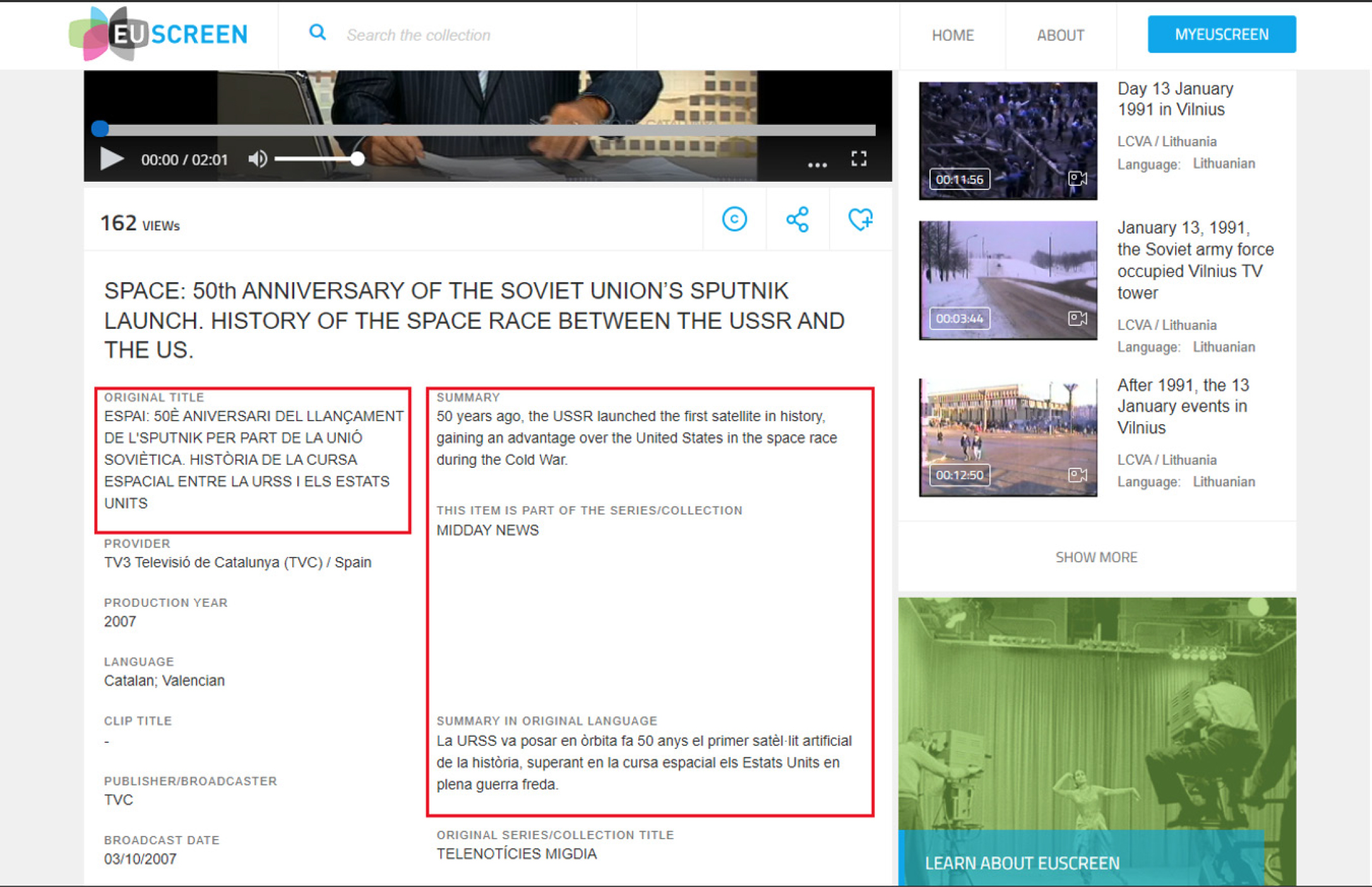
Image 6
EUscreen includes a data description as well as the title of the video in both the original language of the providing country, as well as its English translation.
source: https://euscreen.eu/item.html?id=EUS_C6486D12FC274F108F5DB5E81EA6AEC5
Lastly, it should be noted that these archives have the possibility to provide extra guidance to international users by including user tutorials. The Media Suite specifically offers a page with information on the ASR as well as this tutorial on translations. Here, international users are encouraged to use a Google Translate add-on but are also warned that this works best for translating data descriptions. This extension is less reliable for translating search queries, as it is missing the necessary nuance. This once again highlighted how using language as a search technique is complicated. Even if users are proficient in English or are using translation extensions, this does not mean that they are able to understand the same levels of nuance while searching in the Internet Archive, for example, as native English speakers are able to do. Tutorials like the one in the Media Suite provide users with extra tools to navigate the interface.
3.2 The Transnational in Visualisations
As we continue our exploration of the television collections, we encounter the importance of visualisations to bypass any possible language barriers. In The Internet Archive, video thumbnails in the results page make it easy to scan through and intuitively explore the results (see image 7). This allows us to identify the iconic imagery of Laika with one glance, making it easy for us to find her clip in the search results. EUscreen offers similar visualisations, but also has an insightful homepage, pictured in image 8, where different tabs all offer thumbnails in varied sizes. Thanks to this layout, with its lack of written text, we are motivated by the interface to click through these different videos and explore the data in the collections.24 The visualisation of the search results specifically, makes users less dependent on their language abilities.
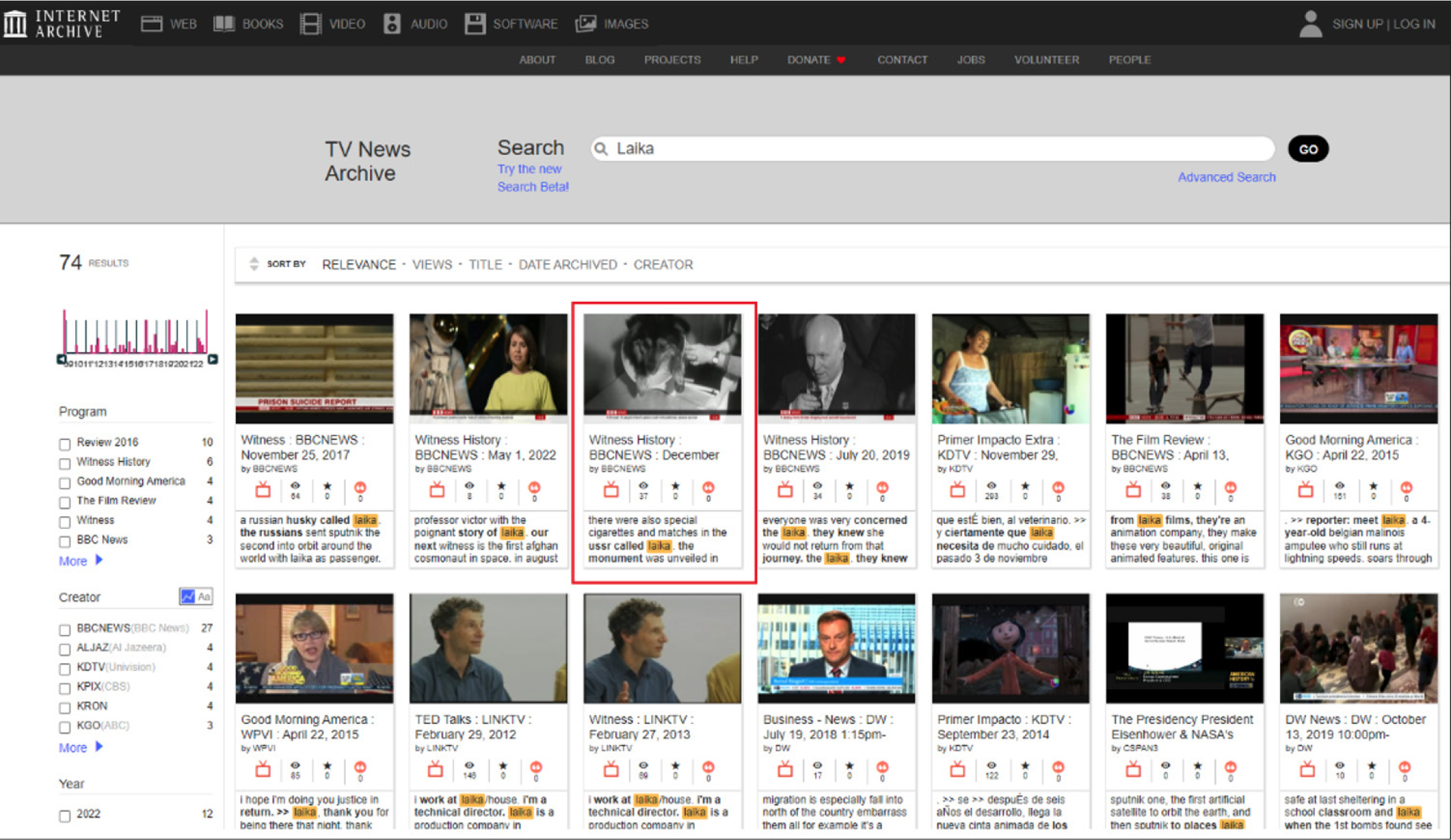
Image 7
When searching for Laika in the Internet Archive, we immediately see her in one of the still frames. The other results, like in the row below, are also easily identifiable as news broadcasts and talk shows due to their still frame.
In contrast, the Media Suite offers no visualisation of the search results, but a snippet of the Dutch metadata description showing where the search hits have occurred. This text-based interface (see image 9) makes language competency a prerequisite, even for exploration. Similar to the Internet Archive, however, the Media Suite provides a visualisation of date related metadata through the incorporation of interactive bar charts. This accessible and intuitive way to explore the metadata can also be found in the ‘About’ page of EUscreen (see image 10). Here, the archive presents an interactive, visual map where users can hover over a country they are interested in and find out how much material is present from that nation. Specifically, it offers which providers from that country have shared their collections, including a hyperlink to go to these collections. Through this visualisation which highlights the national borders of the participating archives, EUscreen encourages users to explore the collection from a transnational perspective.
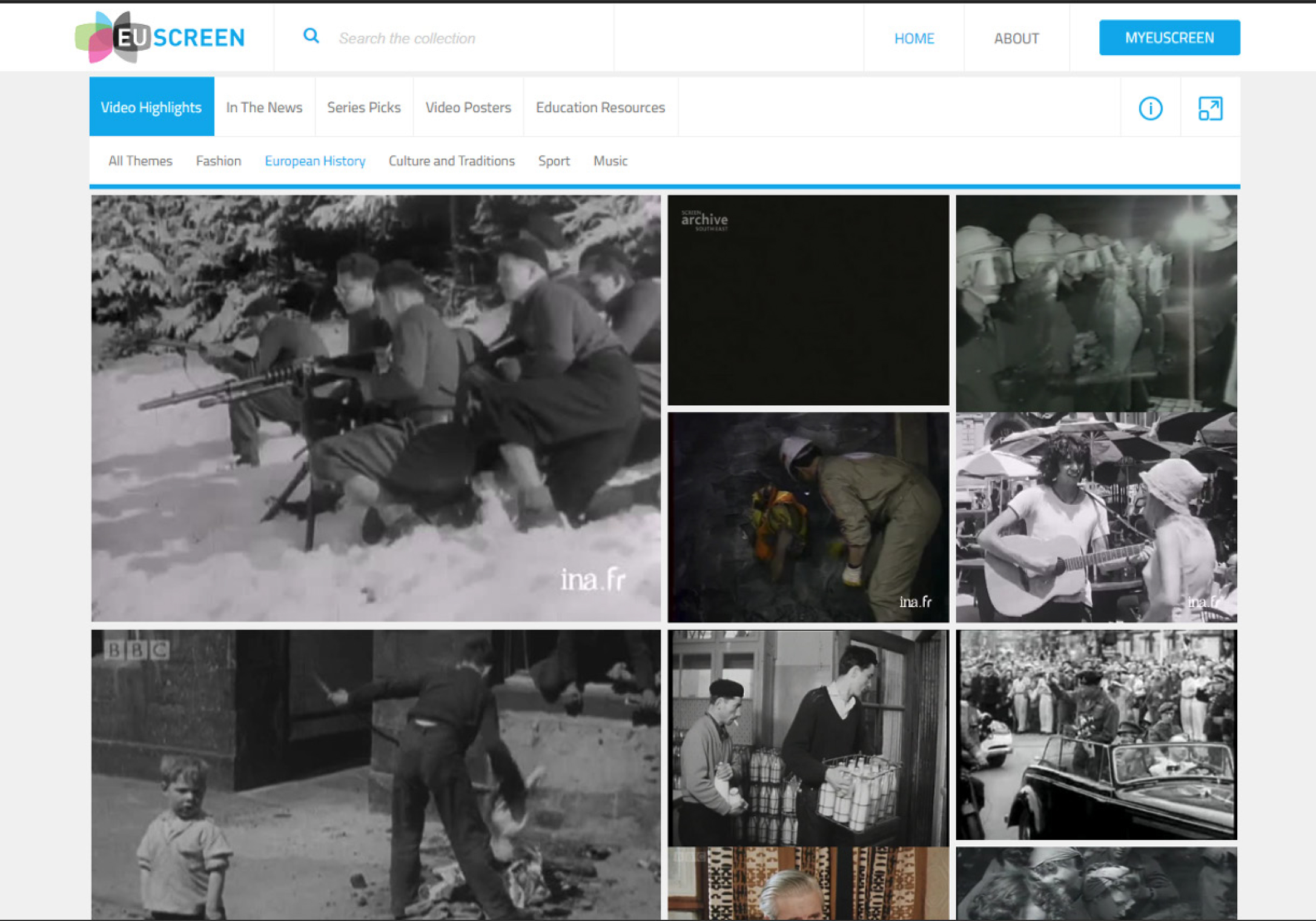
Image 8
An example of how EUscreen deploys visualisation through still frames. Here we see how users can explore a wide variety of data through scanning and clicking on the still frames, without the need of searching for a specific topic.
source: https://euscreen.eu/
3.3 Associative searching
The interface can additionally offer functionalities that encourage associative searches of the collection. This entails that a user can go from one video to another without re-entering specific queries, and therefore intuitively explore the collections. This is a functionality that is especially useful if users are less proficient in the interface language. Within the Media Suite, associative searching is possible through the “Linked Data” that is offered when viewing a video. As we are exploring one of the broadcasts that contains Laika, namely the show “Space Age afl. 6: Waar is de hemel voor? [Space Age, episode 6: What is the sky for?]” we can see a list of names on the right side of the resource viewer, where we can click on the name of presenter Wubbo Ockels. This provides us with his picture (see image 11) and a hyperlink to his page on Wikidata, where we learn that he is a Dutch physicist and astronaut. In theory, Linked Data would be a great way to direct the user to other spellings of their query, as this is information we missed at the start of our search. Unfortunately, the Linked Data in the Media Suite only works for people; dogs, it turns out, are not included in this feature.
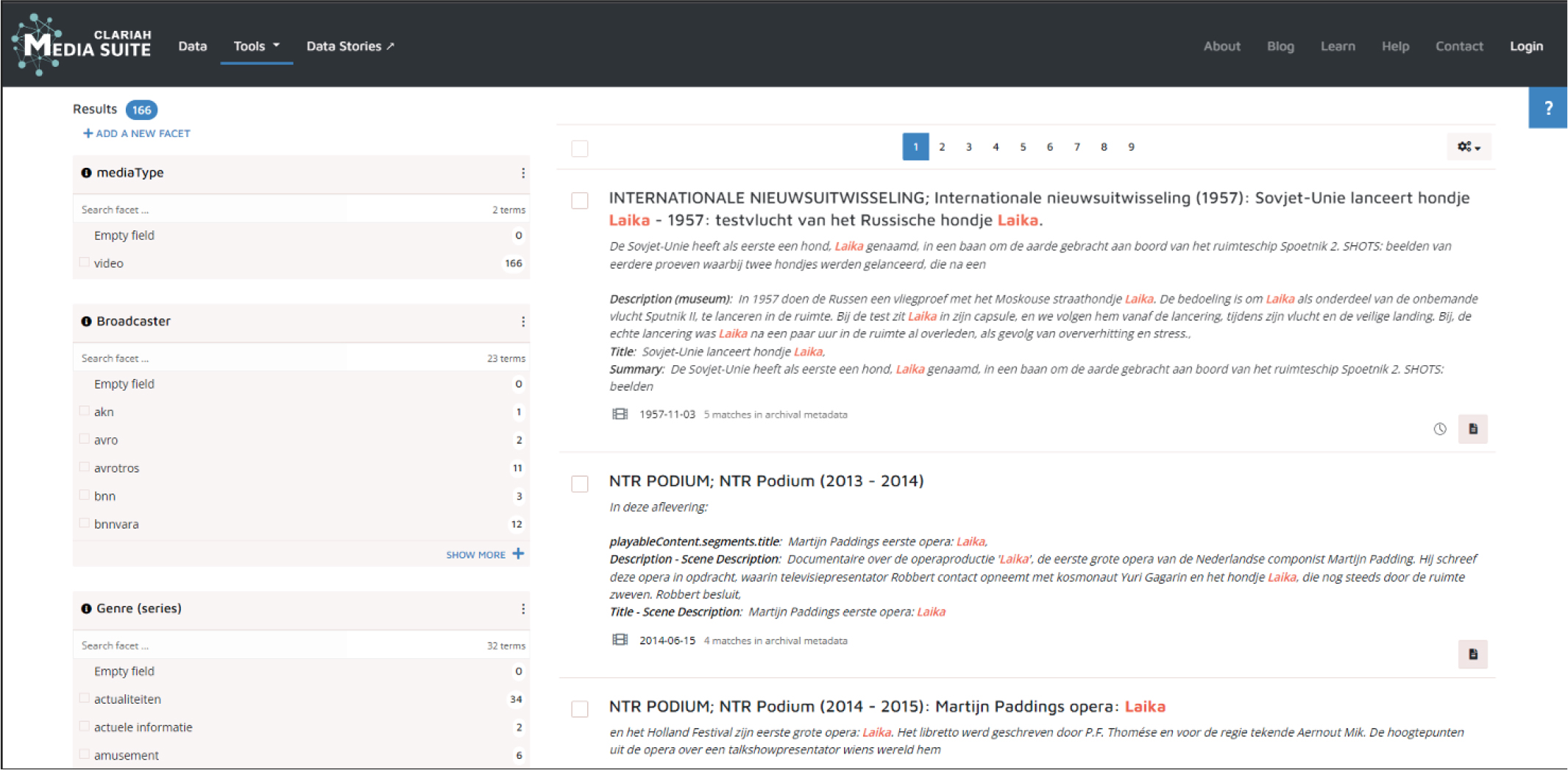
Image 9
The Media Suite has a very text-based interface, showing predominantly the data descriptions in the results page.
source: https://mediasuite.clariah.nl/
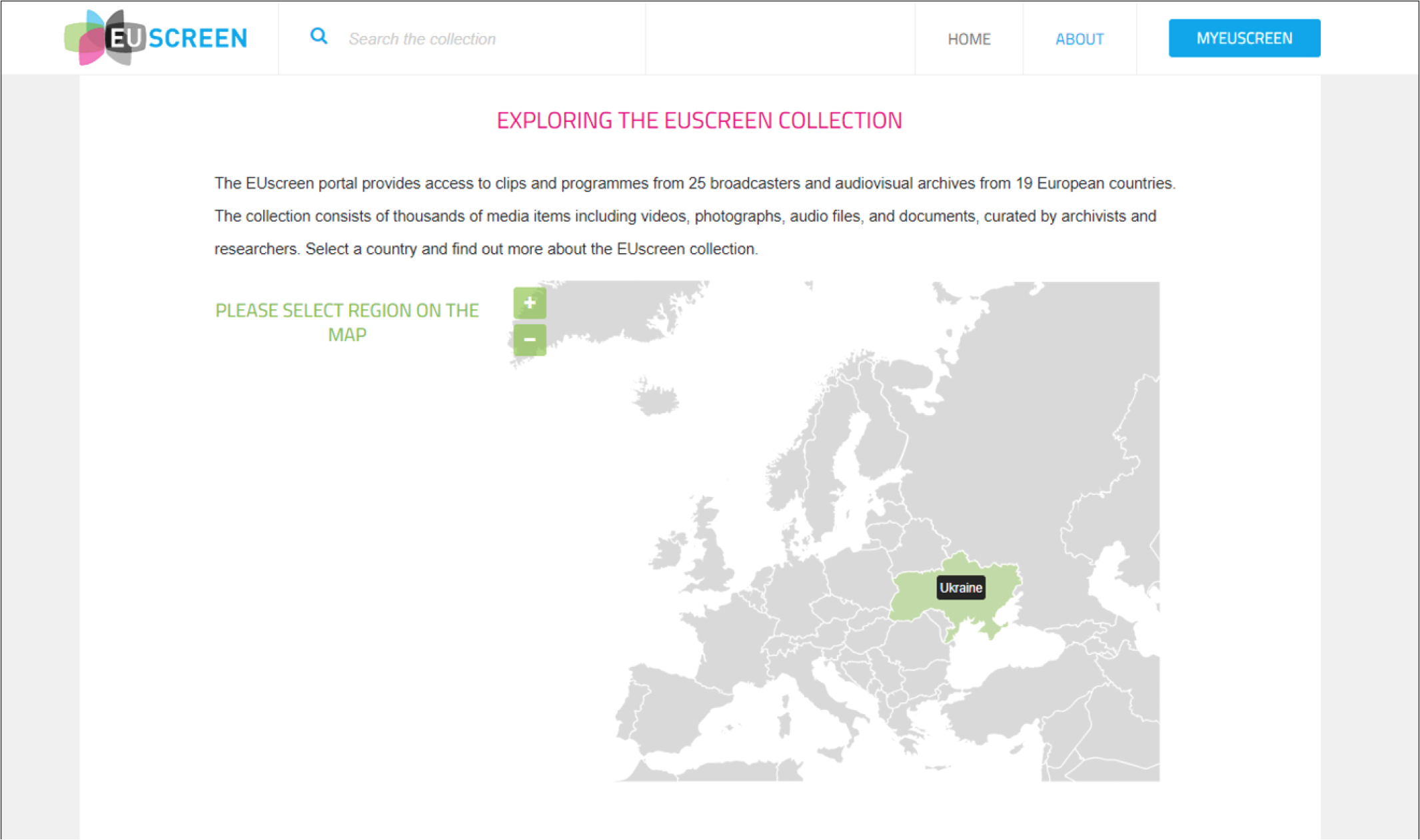
Image 10
The interactive map that can be found in EUscreen, providing an overview of all countries where archives have provided content.
source: https://euscreen.eu/about.html
Besides providing contextualising information, the Linked Data also includes a hyperlink to search for the presenter in the entire television collection, encouraging associative searching without the need for any other queries. This functionality can be used to find data in a specific language, as we can search for someone who we know only speaks that language. The data that will come up has this language embedded. This search strategy is thus a way to find non-Dutch content in the Media Suite. Fittingly, astronaut Ockels provides us with the opportunity to go beyond the borders of the collection into another sphere of information.
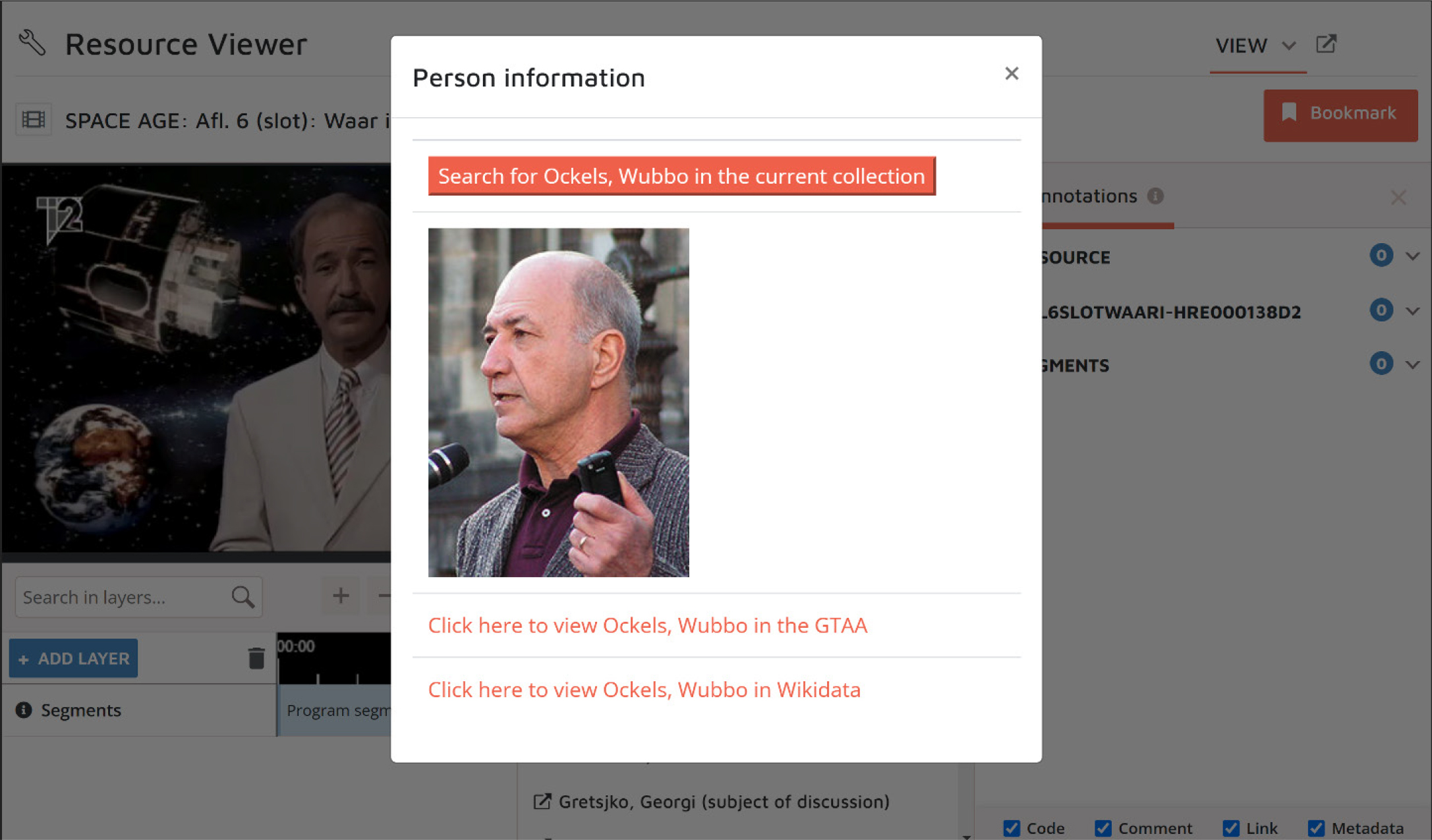
Image 11
An example of the Linked data connected to the video, providing information on the people involved. It is thereafter possible to click through to Wikidata and the GTAA. Picture is public domain, see https://commons.wikimedia.org/wiki/File:Wubbo_Ockels_2007.jpg?uselang=nl#Licentie.
Additionally, associative exploration can be encouraged by the archive through offering recommended videos. The Internet Archive does so in two different ways. First, at the end of the video, several related videos are presented (see image 12). If we scroll down the page, we see the same collection of videos, encouraging us to further explore this subject. EUscreen offers a similar format, where the videos are present on the right side of the screen. In the diverse collection of EUscreen, these recommendations help us explore similar content from other countries. At the same time, this exploration helps users to further define what it is exactly that they are looking for. Lastly, when these recommendations are made visual through the use of thumbnails, they make the user less dependent on specific search queries, and thus their language abilities, which stimulates intuitive searching. The presence of recommended videos in the interfaces therefore encourages transnationally oriented research in multiple ways.
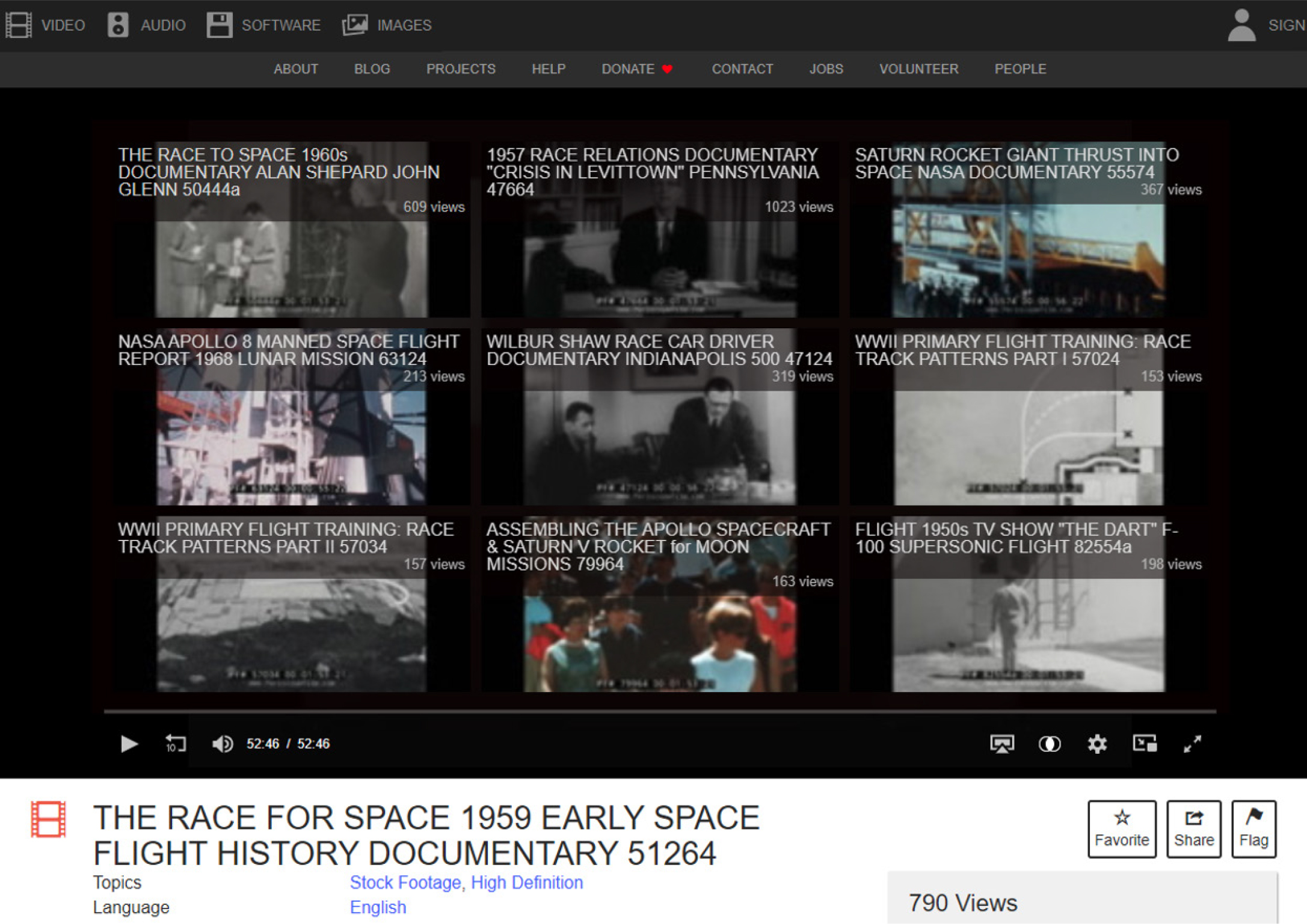
Image 12
One way in which recommended videos are offered to the viewer in the Internet Archive. Here, the videos are presented at the end of single clips.
Lastly, associative searching can potentially be done through exploring the accounts of other users in the archive and searching the content that they have uploaded. In opposition to institutional archives, this is specific to democratic digital archives like the Internet Archive. This environment may have less consistent metadata, but it does have user accounts that can potentially provide a form of national oriented subcollections. For example, as we are exploring the metadata of the Greek Laika broadcast in the Internet Archive, we can click on the user who uploaded the content. This hyperlink leads to their account, where we find 51 uploads, almost all in Greek. We thereafter carry out similar searches and even find user accounts dedicated to a specific countries’ television, like the account “NL_Archivist’’ who has more than 380.642 Dutch videos on their page. This shows us how users themselves can highlight national borders and how, in democratic archives, they can function as a search technique that makes the transnational aspects of television visible and findable. Together, these different functionalities all encourage associative exploration of the collections in some form. Instead of being dependent on specific, language-based, queries to find the right data, users can click through the videos and explore the borders that they come across.
4 A Plea for Transnational Archives
Through our tracing of Laika in the three digital television archives, we were able to reflect upon how the transnational aspects of television were visible and findable. This reflection has allowed us to distil several recommendations for curators and developers of digital television archives, as well as offer a point of reflection regarding digitisation for historians in general. Furthermore, these recommendations are useful for the users of these archives to develop search techniques to find content outside of their own national border.
First, we recommend that archives reflect upon the transnational aspects embedded in the content of their collections. This includes the different nations involved in the production, distribution, and preservation of this content, as well as a reflection on which users can understand this data and how this is made accessible to them. Paradoxically, our research showed that providing a detailed description of nation-centred information creates room to actually cross these borders and carry out transnational research. This can be done through metadata filters, especially through specified categories that differentiate between the different nationalities associated with the production, like production country, geographical location, or the languages present. If users are aware of this information, they can use it to filter their results and consciously take on a transnational perspective in their data selection.
Second, curators as well as developers of archival interfaces should review how transnational aspects are made visible and findable in the interface of the digital television archives. They should critically review which users are able to understand and navigate the interface language and offer possible translations or language support to make navigation and retrieval more accessible. This can be done through translations of data descriptions, incorporation of speech transcripts as well as through user tutorials. Developers should also consider the use of visualisations within the interface. Our research showed how this incorporation can promote intuitive searching without language dependency, but also how visualisation of the metadata through the incorporation of maps and graphics can highlight the transnational aspects in the archive. Finally, we encourage options for associative searching, as we encountered in the form of Linked Data, recommended videos or, in the case of democratic archives, other user profiles. Linked Data specifically, holds the potential to help cross language barriers by providing different transliterations of keywords. All these interface functionalities highlight the transnational aspects of the collections while simultaneously increasing accessibility for users from other countries.
In sum, our analysis showed the importance of reflection by curators and developers upon the national and transnational demarcations in the archives. Because these decisions are embedded in their design and therefore influence and steer the research being carried out. This requires acknowledging and demarcating the national borders present, if we want to allow users to be able to cross them.25 In our article, we make a plea for further integration and especially accessibility of television archives for all researchers, regardless of their nationality. This will allow researchers to trace heritage, like the clip of Laika, following the transnational nature of the medium of television. While we are aware of the copyright restrictions in place, we argue that we should keep reviewing the possibilities to open up this heritage. Similar to television itself, users do not solely transcend borders (the way analogue television signals do), they also undergo a series of negotiations and translations at borders, which can generate new interactions and perspectives on our audiovisual heritage.
As Caswell writes: “What the Soviets did first, and what other nations would do after, resides in the zenith of our curiosity, because to be human is to be curious, to be an explorer. We cannot help but look outward to the next horizon, to far-off and beyond to the distant and the fantastic. We cannot help but dream”.26 When Laika was placed in her shuttle, she not only crossed the borders of our atmosphere, but exemplified television’s potential for transnational circulation. Now, 65 years later, the digitisation of television heritage has initiated her journey across the world once again, through the possibilities of transnational recirculation that digital television archives offer. Laika’s travels were not just an ambitious step for the Soviet Union at the time, but provided information that would help world-wide space travel develop. Her journey back then, as well as the recirculation of her imagery today, can serve as a lesson for us to rethink the borders we set around our heritage. It offers us the opportunity to reflect upon what could happen when these sources of knowledge are shared with all.
Acknowledgements
We would like to thank the two reviewers for their constructive feedback. This research has been made possible by grants of the NWO infrastructure project CLARIAH-PLUS and the CLICK-NL project Re-Frame.
Notes
[1] Andreas Fickers and Catherine Johnson, “Transnational Television History: A Comparative Approach,” Media History 16, no. 1 (2010): 1-11.
[2] While many flows are arranged on an international basis (that is, between national systems), the basis of these exchanges are transnational processes, infrastructures, and cultures of production that cross borders.
[3] Graeme Turner, “Television and the nation: Does this matter any more?” in Television Studies After TV, ed. Graeme Turner and Jinna Tay (London: Taylor & Francis Group, 2009), 54.
[4] Chiara De Cesari and Ann Rigney, “Introduction,” in Transnational Memory: Circulation, Articulation, Scales, ed. Chiara Cesari and Ann Rigney (Boston: De Gruyter, 2014), 4.
[5] Nanna Bonde Thylstrup, “Cultural Memory in the Digital Age,” in Transnationalizing Radio Research: New approaches to an old medium, eds. Golo Föllmer and Alexander Badenoch (Bielefield: Transcript Verlag, 2018), 184.
[6] Lara Putnam, “The Transnational and the Text-Searchable: Digitized Sources and the Shadows They Cast,” The American Historical Review 121, no. 2 (2016): 383.
[7] Johan Oomen and Vassilis Tzouvaras, “Publishing Europe’s Television History on the Web: The EUscreen Project,” in Communications in Computer and Information Science vol. 247, ed. Costantino Grana and Rita Cucchiara (BerlIn: Springer, 2012), 1.
[8] “About,” EUscreen, accessed June 23, 2023, https://euscreen.eu/about.html.
[9] Karen Gracy, “Moving Image Preservation and Cultural Capital,” Library Trends 56, no. 1 (2007): 184.
[10] Yasmin AlNoamany, Ahmed AlSum, Michele Weigle and Michael Nelson, “Who and What Links to the Internet Archive,” International Journal on Digital Libraries 14, no. 3 (2013): 1.
[11] Nederlands Instituut voor Beeld en Geluid, Digitale Preservering Beeld En Geluid: Beleid, Standaarden En Procedures (2016): 15.
[12] Jasmijn van Gorp, Liliana Melgar Estrada and Julia Noordegraaf, “Involving Users in Infrastructure Development: Methodological Reflections from the Research Pilot Projects Using the CLARIAH Media Suite,” TMG Journal for Media History 25, no. 1-2 (2021): 2.
[13] Kurt Caswell, Laika’s Window: The Legacy of a Soviet Space Dog (San Antonio: Trinity University Press, 2018), 11.
[14] Christian Henrich-Franke and Regina Immel, “Making Holes in the Iron Curtain? The Television Programme Exchanges Across the Iron Curtain in the 1960s and 1970s,” in Airy Curtains in the European Ether: Broadcasting and the Cold War, eds. Alexander Badenoch, Andreas Fickers, and Christian Henrich-Franke (Baden-Baden: Nomos, 2013), 177–214.
[15] Larissa Hjorth, Heather Horst, Anna Galloway and Genevieve Bell, eds. The Routledge companion to digital ethnography (New York: Routledge, 2017).
[16] Marc Bron, Jasmijn Van Gorp and Maarten de Rijke, “Media Studies Research in the Data-Driven Age: How Research Questions Evolve,” Journal of the Association for Information Science and Technology 67, no. 7 (2016): 1535-1545.
[17] Alexander Badenoch and Golo Föllmer, “Introduction: Transnationalizing Radio Research: New Encounters with an Old Medium,” in Transnationalizing Radio Research, eds. Golo Föllmer and Alexander Badenoch (Bielefeld: Transcript Verlag, 2018): 13.
[19] We would like to thank Marek Jancovic for bringing to our attention that there are other transliterations of Laika’s name.
[20] See Ernest Eugster, Television Programming across National Boundaries: The EBU and OIRT Experience (Boston: Artech House, 1983); Akiba A. Cohen, Mark Levy, and Itzhak Roeh, Global Newsrooms, Local Audiences: A Study of the Eurovision News Exchange (Libbey, 1996).
[21] Ann Rigney, “Cultural memory studies: Mediation, narrative, and the aesthetic,” in Routledge International Handbook of Memory Studies, eds. Anna Lisa Tota and Trever Hagen (Abingdon, Oxon; New York: Routledge, 2016), 72.
[23] EUscreen thus makes use of contemporary national borders as labels in their metadata, as Russia was not a country during 1957.
[24] See also: Mitchell Whitelaw, “Generous Interfaces for Digital Cultural Collections,” Digital Humanities Quarterly 9, no. 1 (2015).