
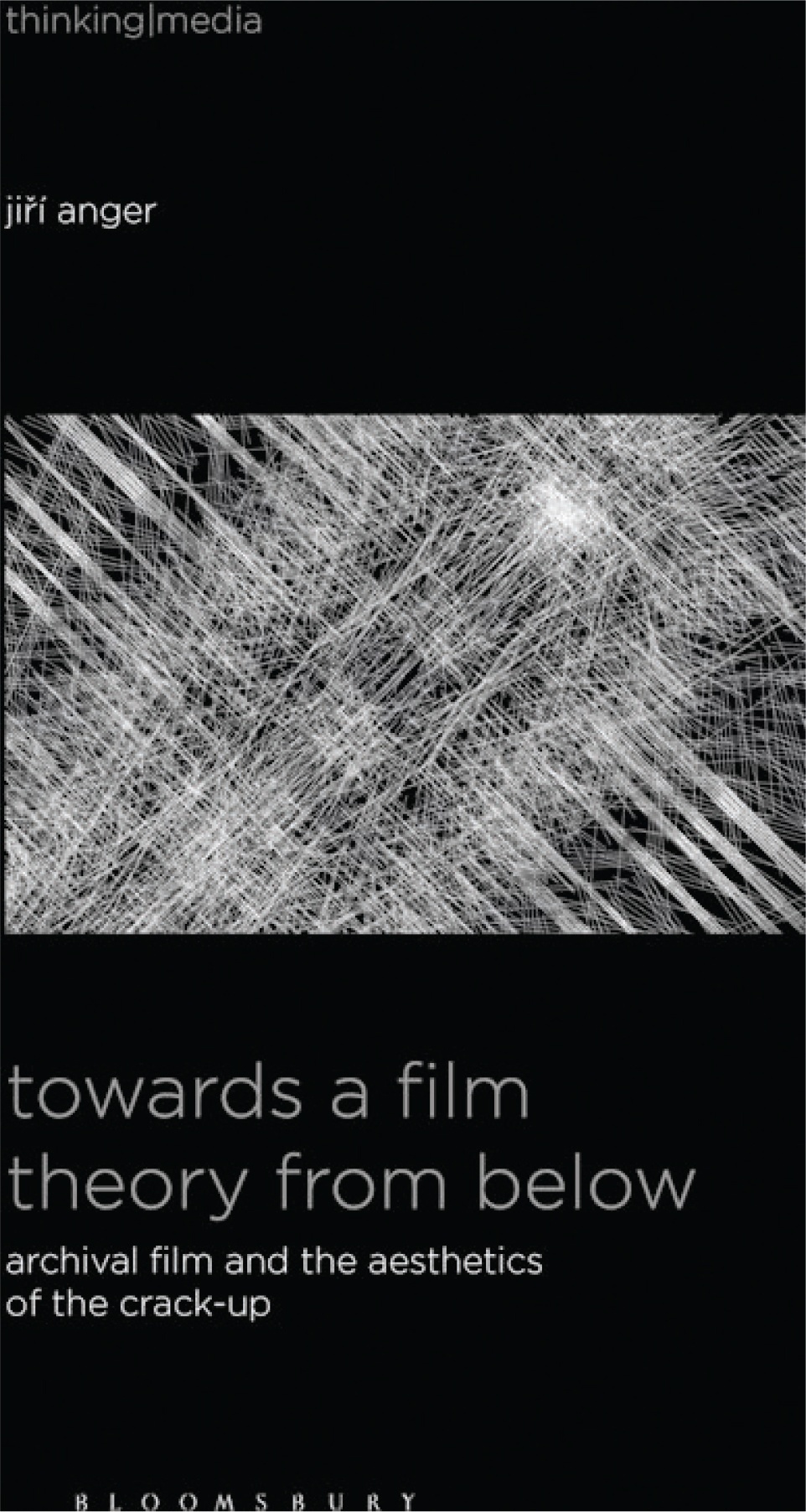
While film archives have traditionally been governed by an ideal of restorative order, Jiří Anger’s Towards a Film Theory from Below locates theoretical vibrancy in the material friction of archival films. Within the broader ‘material turn’ and the renewed focus in Media Studies on the physical substrates of the moving image, Anger’s monograph offers a distinctive contribution. Rather than imposing pre-determined conceptual tools, he develops a framework growing from archival artefacts themselves. This strategy involves a metaphorical ‘listening’ to the noise of the film strip, where technical accidents such as scratches, stains, and shakes are repositioned as agents of meaning.
Anger, as a scholar, curator, and videographic essayist, grounds his analysis in his experience with the Digital Kříženecký project at the Czech National Film Archive. Fundamental to this project was the ‘noninterventionist’ principle, which involved preserving the deformations found in Czech cinema pioneer Jan Kříženecký’s (1898–1911) nitrate prints in 4K scans rather than removing them.1 This approach allowed Anger to encounter ‘weird shapes,’ which are morphological anomalies that arise when the film’s material substrate interferes with its representational content.2 This tension between materiality and figuration serves as the book’s primary dialectic. To articulate this hybrid dynamic, Anger introduces the metaphor of the ‘crack-up,’ borrowed from F. Scott Fitzgerald and Gilles Deleuze, symbolising a fissure that both separates and connects these two layers.3 In this framework, material traces are understood not as external disruptions but as intrinsic ‘material actors’ that reveal the medium’s inherent fragility.4
The book explores these tensions through a series of case studies in which archival artefacts are paired with diverse theoretical lenses. A notable example appears in chapter two, which analyses the ‘electric horses,’ where lightning-like streaks of static electricity strike horses in Kříženecký’s The First Day of the Spring Races of Prague (1908). For Anger, this is not simply a technical flaw but an expanded logic of indexicality, where the medium’s physical spark and the animal’s figurative movement collide into a hybrid reality. Crucially, Anger extends theory rather than simply applying it. By reframing static discharge as an index of technological reality, he broadens André Bazin’s classical notion of indexicality to include the machine’s physical presence as integral to the cinematic record. This inductive approach further grounds Simondonian and Deleuzian concepts within the material and mechanical domain. The analysis culminates in discussions of the ‘scratched kiss’ and Frankensteinian spliced frames, demonstrating how textual analysis can evolve into a haptic engagement with the film’s physical vulnerabilities. This case-by-case modelling approach ensures that theory emerges directly from the material cracks in the film, rather than serving as a pre-existing framework.
Historiographically, Anger’s work is situated within the context of the archival turn, resonating with Giovanna Fossati’s advocacy for bridging academic inquiry and archival practice.5 While Fossati’s From Grain to Pixel established a framework for addressing the analogue-to-digital transition, Anger instead investigates the productive potential of material ‘fissures’ within the filmic object itself.6 This enables him to extend Katherine Groo’s ethical emphasis on archival absence toward a micro-aesthetic phenomenology, wherein the ‘bad’ film —the damaged or distorted— becomes a generative site of visibility rather than a mere historical void.7
I would argue that this focus becomes even more pronounced when read alongside Matthew Kirschenbaum’s distinction between ‘forensic materiality’ (discrete physical traces) and ‘formal materiality’ (logical protocols of the digital environment).8 The 4K Kříženecký scans function as a site where the film’s material ‘trauma’ is re-animated through the algorithmic precision of digital tools. This renewed emphasis on the artefact further encourages a productive dialogue with Science and Technology Studies, particularly the concept of infrastructural inversion. As Susan Leigh Star and Geoffrey Bowker observe, infrastructures typically remain invisible until they break down.9 Anger’s approach enacts a similar inversion: by refusing to filter out ‘weird shapes,’ he treats these breakdowns as epistemological opportunities, thereby granting cinema’s technological reality a philosophical significance often overlooked by film studies and conventional restoration ethics.
This analytical insight is operationalised through Anger’s engagement with found footage cinema and videographic criticism. He keenly identifies that while traditional cinema prioritises figuration and avant-garde practices often isolate materiality, found footage filmmaking is uniquely obsessed with their interplay.10 By contrasting Kříženecký’s remnants with found footage practices and his own videographic experiments, Anger thus effectively transforms preservation from a passive act into a creative scholarly intervention.11
For all its theoretical sophistication, the monograph nevertheless contends with several unsettled tensions. Foremost among these is the potential for ‘over-theorisation,’ specifically when the metaphysical implications of the Deleuzian ‘crack-up’ are applied to the minute surface of physical films. Although Anger justifies this speculative move as necessary, the resulting conceptual density leads to a secondary paradox regarding agency.12 While arguing for an object-oriented perspective that lets the filmic matter speak for itself, his analysis inevitably relies on a highly trained, ‘cinephiliac’ observer using digital tools to make these weird shapes visible. Anger admits this irony: material autonomy only becomes perceptible through significant human mediation.13 Beyond these internal dynamics, a broader historiographical friction persists between the specificity of the Czech archive and the universalising ‘Global North’ framework used to interpret it. This raises the question of whether a ‘theory from below’ can remain grounded when filtered through such dominant conceptual frameworks, or whether the theory itself is sufficiently transformed by this encounter.
Ultimately, these tensions testify to the book’s scholarly depth rather than diminishing its value. Towards a Film Theory from Below reimagines our encounter with archival media, shifting focus from ideal restoration to the generative potential of material flaws. By treating early cinematic artefacts not as fixed historical documents but as ‘malleable objects’ and ongoing processes, Anger champions the autonomous creativity of filmic matter.14 In an era of algorithmic enhancements designed to erase temporal traces, his work offers both theoretical and practical interventions. The book supplies essential methodological resources for archivists, media scholars, and artists, emphasising that the crack in the image is not merely a marker of decay, but the very threshold where new intellectual inquiry begins.
Notes
[1] Jiří Anger, Towards a Film Theory from Below: Archival Film and the Aesthetics of the Crack-Up (Bloomsbury, 2024), 3.
[5] Giovanna Fossati, From Grain to Pixel: The Archival Life of Film in Transition (Amsterdam University Press, 2018), 147.
[8] Matthew G. Kirschenbaum, Mechanisms: New Media and the Forensic Imagination (MIT Press, 2008), 9–12.
[9] Susan Leigh Star and Geoffrey C. Bowker, “How to Infrastructure,” in Handbook of New Media: Social Shaping and Social Consequences of ICTs, ed. Leah A. Lievrouw and Sonia Livingstone (SAGE, 2010), https://doi.org/10.4135/9781446211304.n13.
[11] Christian Gosvig Olesen similarly highlights this achievement, noting that Anger’s integration of film archiving, videographic experimentation, and theory makes a compelling case for ‘theorizing as an essentially creative act’. See Christian Gosvig Olesen, “Towards a Film Theory from Below: Archival Film and the Aesthetics of the Crack-Up,” review of Towards a Film Theory from Below: Archival Film and the Aesthetics of the Crack-Up,” by Jiří Anger, Journal of Film Preservation, no. 112 (2025): 176.
Biography
Chenyang Zhang is a PhD candidate in media heritage at Amsterdam School for Cultural Analysis, University of Amsterdam, with a specific focus on the history of information infrastructures within media archives.