
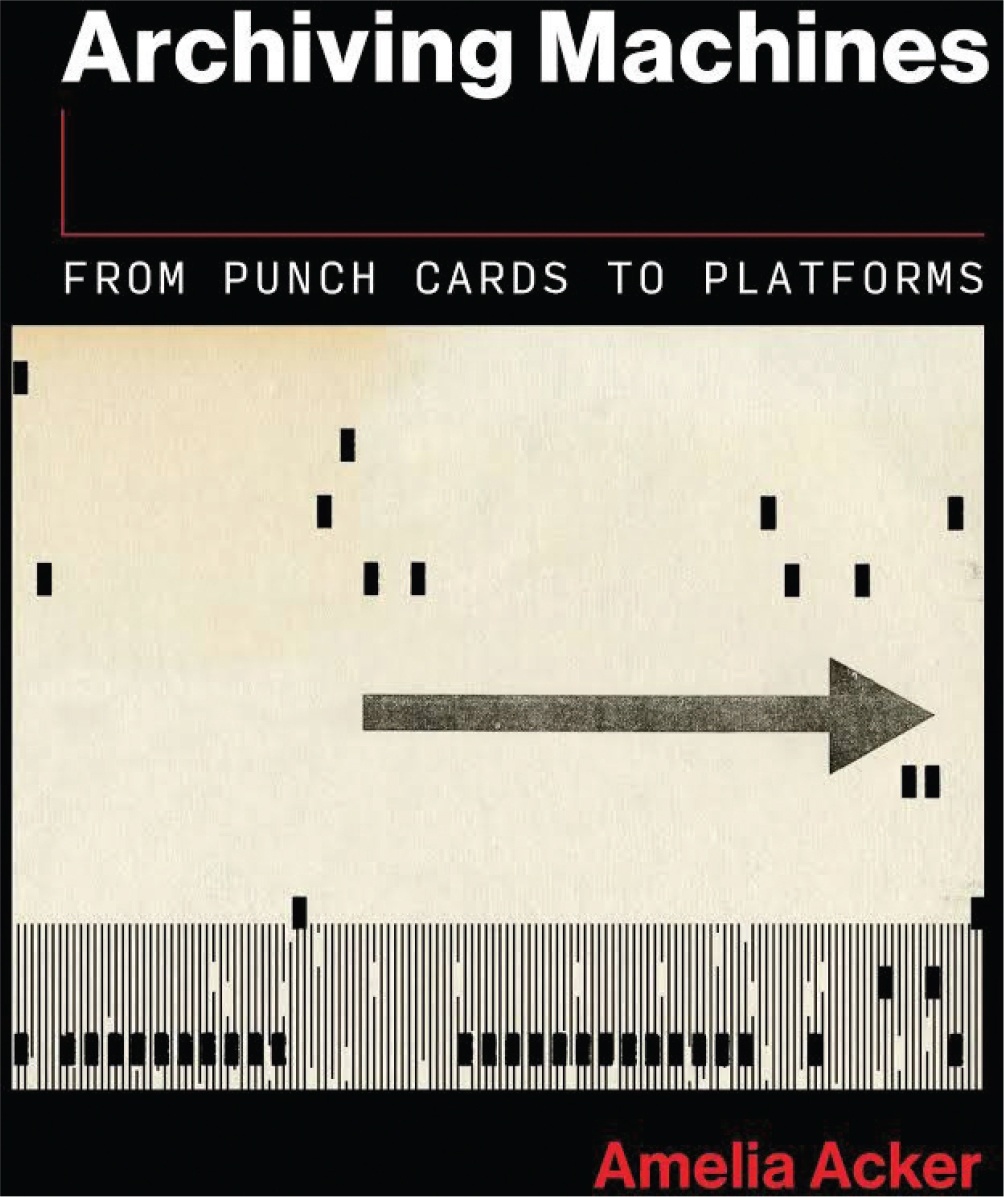
With Archiving Machines, Amelia Acker attempts go beyond archives as institutional enclosures by taking a historical perspective that centres on how information flows between and through archiving machines, shaping how we perceive data today. These archiving machines are computational technologies that change processes of data storage and sharing, resulting in data that is ‘born networked’. The birth of the World Wide Web in the 1990’s fundamentally changed how we handle data across different domains.1 However, in Archiving Machines, Acker argues that data practices changed before the rise of the public internet and traces this to how we engage with data today, where access is negotiated through platforms.
In three parts —1) centralising data, 2) sharing, storing and syncing personal data, and 3) accessing data today— she attends to the grammars of action in the Archiving Machines she distinguishes.2 Acker pays special attention to how these change the meaning of access to data. Throughout the chapters, she uses ‘vignettes of confrontation’ to describe negotiations among different groups over data access and power relations.3 This conceptual framing seeps through the entirety of Ackers’ publications, which range from qualitative to more historical approaches, and works interdisciplinary across many fields.4 With her first single-authored monograph, Ackers demonstrates that taking many directions in her previous work allows her to look at her subject, which, in my opinion, comes down to tracing how the meaning of access data has changed historically, from complementary perspectives.
The first two chapters following the introduction explore the ‘middle ages of computing’ describing the transition from punch cards to magnetic tape reels that resulted in machine-readable information and changing data landscapes.5 In chapter two, Acker does this by mapping out the failure of the establishment of the federally controlled National Data Center in the United States. The 1960s saw the introduction of ‘data scientists’ who wanted easier access to personal data collected from citizens. In this context, the National Data Center was proposed. However, during congressional hearings, the focus shifted to the assumptions that this ‘archiving machine’ could harm citizens by misusing their personal data. The public outcry became so bad that the National Data Center never saw the light of day. Unfortunately, what was overlooked were the organisations outside the government. This gap put our data in the hands of private companies, with consequences we are still facing today. In Europe, there are many calls to decouple ourselves from ‘Big Tech’s IV drip’, which is rather challenging given how deeply ingrained it is in our daily lives and institutions.
In chapter three, the author moves from an institutional to a material technical point of view through the introduction of the magnetic tape reel as an archiving machine. Acker shows how, compared to punch cards, where you could see the stored data with your own eyes, magnetic tape reels were both storage and memory. Computer ‘memory’ does not contain storage possibilities; instead, it is ‘the CPU technology that is used to store information for processing’.6 These conceptual clarifications are helpful and make this technical chapter readable for humanities scholars. Magnetic tape reels could be read ‘bi-directionally’, one side containing the memory, and the other storage. This chapter shows the relevance of this material approach to information. Still, as Acker herself also stresses, it becomes more difficult to engage with these technologies due to missing metadata, obsolete tape drives, and incompatible machines. She suggests focusing on oral histories and grey literature to capture these stories, which I agree with and would have also added a more socio-technical dimension to the chapter.
With chapter four, by far the longest chapter in the book and the only chapter making up the second part, the author moves into the 1990s with ‘personal digital assistants’ (PDA). This chapter maps how the externalisation of memory became smaller and began to fit in people’s pockets, bringing archiving machines into their hands, which led to the rise of personal information management. Again, Acker is paying close attention to how information flows to and from personal digital assistants, which affects how we engage with archiving personal data today. It is a continuation of the material perspective from the previous chapter, complemented by a more societal angle. Even though Acker mentions specifically that her book charts ‘a computing history in the United States from 1960 to the present’, this is the chapter where I began to miss more non-Western practices.7 PDA’s, personal information managers without wireless communication functions, could be seen as the forerunners of the smartphone. These PDAs were also marketed in Europe and Japan, among other countries, and expanding the scope to include these political-economic dimensions would have strengthened the chapter. This chapter, in general, could have benefited from a stronger scholarly grounding, though, admittedly, there is still much room for historical research and theorisation on PDAs.
The final two chapters, five and six, inch closer to our contemporary times, and this is where Acker began to incorporate a more Critical Data Studies approach. Where the previous chapters had a more descriptive undertone, these read more normatively and feature more critical scholarly work and conceptual reflections through ‘the stack’ and ‘gatekeeping’.8,9 She still traces specific archival machines. In chapter five, this is the CDR (call detail records), and in chapter six platforms, but it also carves a space for the societal, legal, and political impact of these archiving machines. These new discursive interpretations of personal data processing point to an archive that is resource-intensive. Data is ‘always on’; instead of putting it to rest, it is put to work. This interpretation introduces the ecological impact of these data archiving practices, but could have been fleshed out further in the final two chapters.10
Ackers’ Archiving Machines is a solid contribution to the interdisciplinary field of critical Archival Studies, human-computer interaction, and Media History, amongst others. It stands out among other works on digital memory and the archive for its meticulous technical descriptions of data archiving and processing technologies, while also being attentive to the socio-economic context. The focus on where ideologies and technologies intersect and fail is a productive angle that could have been extended across all chapters. Nevertheless, Archiving Machines manoeuvres delicately through the changing tensions between privacy and access.
Notes
[1] Christine L. Borgman, Big Data, Little Data, No Data: Scholarship in the Networked World (The MIT Press, 2016).
[2] Philip E. Agre, “Changing Places: Contexts of Awareness in Computing,” Human–Computer Interaction 16, nos. 2–4 (2001): 177–92, https://doi.org/10.1207/S15327051HCI16234_04.
[4] Amelia Acker and Jed R. Brubaker, “Death, Memorialization, and Social Media: A Platform Perspective for Personal Archives,” Archivaria, 2014; Daniel Carter and Amelia Acker, “To Oblivion and Beyond: Imagining Infrastructure after Collapse,” Environment and Planning D: Society and Space 38, no. 6 (2020): 1084–100, https://doi.org/10.1177/0263775820911940; Krishna Akhil Kumar Adavi and Amelia Acker, “What Is a File on a Phone? Personal Information Management Practices Amongst WhatsApp Users,” Proceedings of the ACM on Human-Computer Interaction 7, no. CSCW2 (2023): 1–28, https://doi.org/10.1145/3610221.
[5] For a second edition, the description in the introduction could be adjusted. Currently, the introduction refers first to the content of chapter 3 and then to the content in chapter 2. A chronological order makes more sense.
[10] Marije Miedema et al., “An Ecologically Just Future for Personal Digital Heritage: Three Guiding Statements,” Archival Science 25, no. 2 (2025): 14, https://doi.org/10.1007/s10502-025-09481-1.
Biography
Marije Miedema is a PhD candidate at the Centre for Media and Journalism Studies at the University of Groningen. Visual artist by training, she is currently researching the future of personal digital heritage in the context of the ecological crisis through participatory action research.