
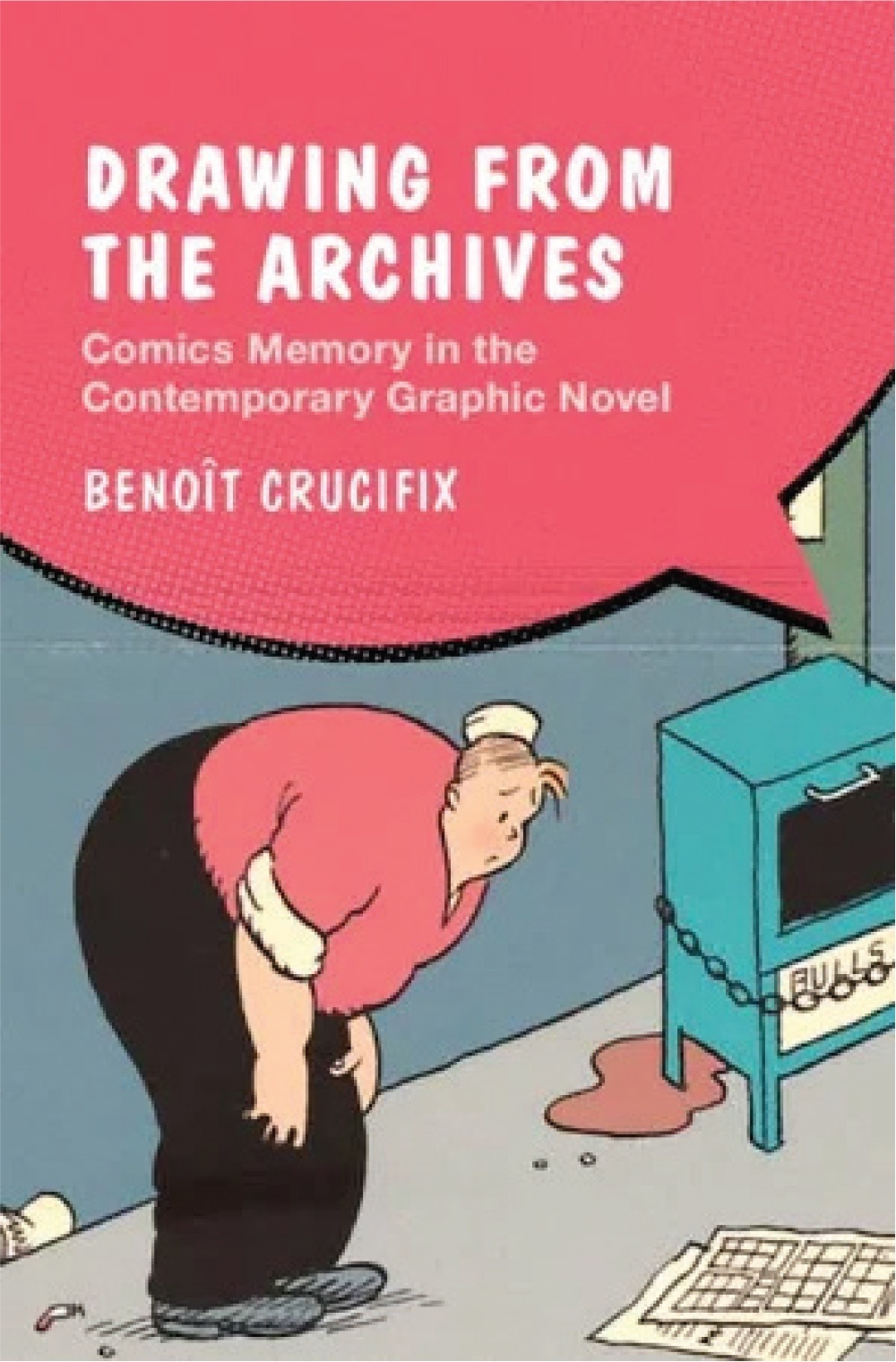
In its earlier stages, Comics Studies has been rather preoccupied with memory. The commercial and critical success of Art Spiegelman’s Maus not only made it possible for comics to be studied in academia, but it also shaped a mould through which some comics would become more visible to academia than others.1 All this focus on how comics were used to represent global, transnational, national, regional, and local (counter) memories, however, left a blind spot. This gap is where Benoît Crucifix’s Drawing from the Archives: Comics Memory in the Contemporary Graphic Novel nests itself. Besides contributing to broader memory culture, Crucifix shows that contemporary American comics have also been quite obsessed with the past(s) of their own medium. Taking for an epigraph Spiegelman’s truism that ‘[t]he future of comics is in the past,’ Crucifix aims to ‘look into the variety of contexts and settings, practices and gestures through which contemporary cartoonists participate in the construction of historical knowledge about their own medium and in the transmission of this graphic heritage.’2 In the subsequent chapters of the book, the broad variety that is pointed at is structured alongside ‘gestures of transmission,’ which divide the chapters up into collecting, curating, reprinting, forging, swiping, and undrawing.
The idea of gestures of transmission, which are defined as ‘embodied acts that recirculate specific historical objects and, in the process, transform and adapt them to their new contexts,’3 is a helpful contribution to the study of memory culture. While it runs the risk of collapsing into intertextuality in the broad sense, the focus on embodiment and the materiality of the gestures at objects does carve out a specific zone of interest that might also be travelled to other contexts fruitfully. Here, I am thinking not just of other comics cultures—manga comes to mind most urgently—but also of other cultural fields. This broader applicability, one which productively weds memory studies to media history, is what makes this book important even beyond the boundaries of comics studies.
The book’s epigraph turns out to be well-chosen. For if one thing characterises the cartoonists that Crucifix studies, it is that they insist on looking backwards, even as, or maybe because, they are driving at formal experimentation with the comics medium. Seen from this perspective, the rise of the graphic novel as a rebranding of comics in the 1990s and 2000s emerges as nostalgia-driven, rather than as a break from established traditions.
By charting the collecting, curating, reprinting, forging, swiping, and undrawing of contemporary American comics artists, moreover, Crucifix is also able to get at some of the tensions between different conceptions of comics history and memory. There is space between the formulation of a comics canon by academics and the canons created through the transmissive gestures of comics artists such as Spiegelman, Ware, or Seth. By sticking to the directions into which cartoonists turn, Drawing from the Archives also charts an alternative history of comics that is open to the retroactivity and multi-directionality of memory culture.
Of all the gestures of transmission, swiping seemed to me the most specific to comics culture. It is through swiping, ‘the common term used by makers, readers, and fans to refer to the long-standing practice of “stealing” or “borrowing” fragments from other comics to reuse in one’s own work,’4 that comics culture can be said to anticipate contemporary online visual culture. In his analysis of swiping in relation to comics memory, Crucifix shows how the idiosyncratic styles of graphic novel authors exist side-by-side with a practice of creative repetition that ‘is rarely something to get anxious about in comics culture, unless it comes to its legal liabilities.’5 While I am not sure if rarely is the most accurate adjective here, not framing swiping through a legalistic lens allows for a more comprehensive view of this widespread practice and brings into focus more fully how understanding swiping might teach us about the ways in which creativity and influence are co-constitutive rather than mutually exclusive.
Drawing from the Archives is an important addition not just to Comics Studies, but to the broader field of media and memory. As such, it points to many new avenues of research. With such books, sometimes the most urgently felt complaint is that the book does not fully fulfil the promise that is made by its original approach. At times, Crucifix too breaks the rules set in the initial chapter in order to chase down the insights that his perspective affords in different cultural contexts. For me, too, it felt as if there were more gestures to pursue more deeply in wider contexts, but this is a sign of success more than anything else.
Notes
[1] See: Rik Spanjers, Comics Realism and the Maus Event: Comics and the Dynamics of World War II Remembrance. PhD. Thesis (University of Amsterdam Press, 2019) and Bart Beaty and Benjamin Woo, The Greatest Comic Book of All Time: Symbolic Capital and the Field of American Comic Books (Palgrave, 2016).
Biography
Rik Spanjers is an Assistant Professor of cross-media and television culture at the University of Amsterdam, where he researches war representation in comics and animation.