
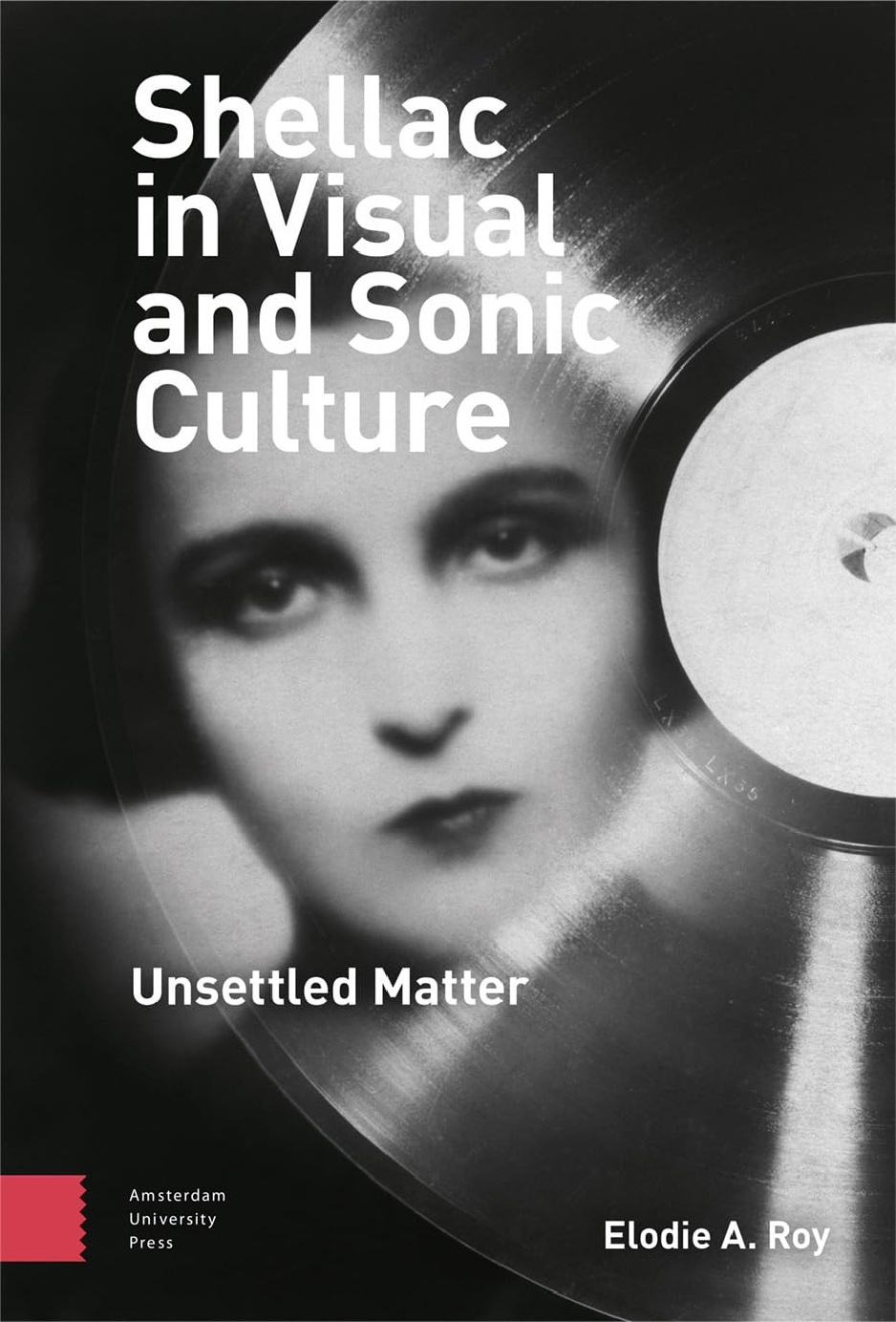
Elodie A. Roy is a historian and theorist of sound and material culture. Her research is focused on the socio-material and environmental history of phonography, sound and intermedia studies, and media objects in memory and heritage practices.
Shellac in Visual and Sonic Culture opens with a proposition: let us move from studying material culture to interrogating the materials of culture themselves. The book thus represents a timely contribution to a growing body of work on the chemical and industrial matter of media and the global extractive supply chains that undergird both art and popular media culture.
The introduction outlines a transdisciplinary framework that combines eco-materialist media theory with historical inquiry. Roy draws on media archaeology but rejects some of its anti-narrative forms, positioning shellac as a binding agent between sound, image, labour, and colonial extraction.
Chapter one traces shellac’s early circulation, from its insect origins in India and poetic, feminised presence in Sanskrit literature to its visual associations with mirrors and its role in European painting. Roy links shellac’s acoustic and visual brilliance to its later industrial uses–its adoption by the gramophone industry and transformation into a thermoplastic commodity. Chapter two focuses on shellac record manufacturing: chemical properties, labour conditions, and Emile Berliner’s contributions to sound reproduction. Roy critiques the erasure of labour, especially women’s work, in sound history and explores shellac’s materiality as both a medium of memorialisation and a site of extraction. Chapter three deals with shellac’s intersensory dimensions in interwar Europe. Through the metaphor of the mirror, Roy explores phono-fetishism, urban soundscapes, and avant-garde art, revealing how records became objects of introspection and aesthetic experimentation. Chapter four shifts to the two World Wars, tracing shellac’s use in munitions and its symbolic resonance in a world at war. Roy critiques both wartime practices of sonic extractivism (recordings of African and Indian soldiers held in German prisoner-of-war camps that later became the basis of a number of German sound archives) and nostalgic and hauntological framings of shellac, arguing instead for a media history cognisant of plasticity as toxicity and destruction. Chapter five turns to contemporary artistic engagements with shellac and waste, seeking out the embodied epistemological power of discarded materials. Here, shellac’s obsolescence is framed as a site of creative remediation. The conclusion insists on defamiliarisation, incompleteness and nonlinearity as a way of academic writing and sketches out an ontology of adhesive media materials.
This is a very erudite book; richer than its page count. It navigates an abundant archive of textual and visual sources: from colonial trade reports and technical patents to poems, literary texts, advertising images, packaging, and avant-garde art. Roy’s achievement lies in the way she moves from the granular (the chemical and material properties of shellac, its role in phonographic disc manufacture and the record industry) to the conceptual (plasticity, material narrativity) without losing sight of historical specificity. For instance, her discussion of shellac’s ‘mirror trope’ in interwar design skilfully connects Bauhaus aesthetics with the fetishist allure of gramophone records, showing how a resin could become a symbol of modernity. Roy’s reading of ‘fidelity’ and auditory experience as functions of chemistry and the gramophone record’s oscillation between contradictory visions of immediate, erotic communication and delayed machinic mediation is also fascinating.
In reference to Sean Cubitt, Roy intentionally embraces an anecdotal mode of storytelling as a historiographical heuristic tool. This ‘rhapsodic’ and ‘reparative’1 method is deliberately fragmentary, yet, for the most part, executed with elegance. It takes both a skilled writer and an assured historian to guide readers from discussions of supply chains to regional visions of femininity and the interlinkages between scientific discovery and religion in the span of a few paragraphs without them even noticing. But there are moments when this exercise works less organically, such as sections in the middle of both chapter two and three, which, occasionally, do read like a compendium of tales and titbits, moving rapidly between Lacan, Thomas Aquinas, Greek mythology, and eventually abandoning the subject of shellac records completely toward the end of chapter three. Some may find the competition between theoretical layering and historical detail exhilarating, others heavy. The author is clearly aware that industry anecdotes, poems, and fragments from travel diaries can be distilled into a convincing historical narrative only if they are mined in sufficient quantity. This, however, results in a dense book. All historical sections continuously serve a theoretical argument. These arguments – about plasticity, intersensoriality, toxicity, specularity – are rich and cogent, but so numerous that, at times, it feels like listening to multiple dizzying conversations in parallel. Roy is in dialogue with an entire congress of media theorists, art historians, sociologists, philosophers, psychoanalysts, writers, and artists, often within the same chapter, which can overwhelm readers seeking a more linear argument. Some of her interlocutors are familiar: Adorno, Barad, Benjamin, Cubitt, Deleuze, Derrida, Ernst, Krämer, Malabou, Parikka, and Serres. Others are fresh, unexpected, and intriguing. Roy’s most original contributions shine in her treatment of literature, poetry and art as theory. She shows how they can inspire different, viable modes of media historiography.
The book describes in detail the colonial trade infrastructure behind phonography and India’s role in shellac production, but most case studies and analyses remain centred around Europe and the United States. Non-Western uses of shellac and global sound cultures receive less sustained attention.
Nevertheless, that the author manages to marshal material of such great diversity into a structured, filigreed story about the life of the ‘arch-material of culture’2 and organise it into clear thematic foci is remarkable. The pace is always brisk, but the intellectual achievement and depth are undeniable. Although the writing is clear and should be accessible to most readers, the book is best read not in a single sitting, but with prolonged pauses for reflection. The structure allows for and even seems to encourage this. Each chapter is a largely self-contained, fulfilling serving, with a bibliography placed after every segment rather than at the end of the book.
Most eye-opening to me (though not an explicit subject of the book) are the uncanny parallels between shellac and other media materials, such as rubber or, most notably, celluloid – another substance often distinguished with the accolade ‘the first plastic’. It is astonishing how much Roy’s elaborate archaeology of shellac, the base medium of accessible reproduced sound, mirrors that of cinema’s sacred material base: its original function as a decorative or imitative material, its ties to explosives, varnishes and war technology, the extractive colonial history of its natural components and the speculative markets that developed around them, the frantic attempts to cultivate raw materials or find synthetic alternatives in the West, the non-standard of chemical recipes so frequently tied to a fetishized aesthetic telos of ‘resolution’ and ‘brilliance’, the eventual supersession by petroplastic carriers. The geographic, material and historical specificities differ, of course, but in its broad strokes, the story of shellac is clearly also a model for historiographies of other substrates of media culture. In this, Roy’s book has great value to readers interested in eco-materialist and elemental histories of media in general, not just shellac or analogue sound formats. Sound scholars, students of media culture, media technology, the early music industry or cultural history will all find something interesting in this fine example of how to write about materials and materiality.
Notes
Biography
Marek Jancovic is Assistant Professor of Media Studies at the Vrije Universiteit Amsterdam.