
Within the richly ramified field of digital humanities (DH), it has become a common practice for written research outputs to include reflections on the limitations and challenges of the computational tools employed. In particular, within strands of DH that depend on large-scale quantitative and empirical analysis of big data sets, there has been a growing urgency to point out risks of computational analysis: how it may distort source materials, follow algorithmic logics too rigidly, use tools that encode inappropriate methodological assumptions, or produce misleading interpretations through specific interface and design choices. The volume Digital History and Hermeneutics, edited by Andreas Fickers and Juliane Tatarinov, proposes a taxonomy of critical skills to address these risks: digital source criticism, algorithmic criticism, tool criticism, and interface and simulation criticism.1 What is called the ‘reflexive turn’ in digital humanities is, in many ways, a logical symptom of heightened ethical awareness in media studies and growing suspicion towards algorithms, tools, and software in an increasingly corporatised online environment.2,3
As useful and welcome as this focus on reflexivity may be, this paper asks whether there are other branches or adjacent subfields of DH where self-awareness towards digital tools might find more demonstrative and practical applications. The macro-level, big-data approach that guides much DH research sometimes benefits from reflexivity, either by exposing the imperfections of state-of-the-art technology or by encouraging the development of models that incorporate marginalised perspectives.4 However, in most cases, it still ends up doing what it does best – detecting broader patterns rather than highlighting idiosyncrasy and singularity. Eric Hoyt, very much a DH insider, warns about a ‘risk that we get so overwhelmed in the self-reflective analysis and criticism of sources, tools, and algorithms that we lose sight of the original research questions that animated our interests.’5 Taking this criticism to another level, is writing about the limits of digital tools enough without simultaneously writing with their limits, demonstrating and reflecting on them through an audiovisual practice?6 Reflexivity, in other words, is valuable but incomplete when confined to metacommentary. What if digital humanities could also draw upon, and be inspired by, digital methods whose qualitative, iconoclastic, and open-ended qualities more naturally lend themselves to reflexivity?
One field that, as we argue, may offer such inspiration is videographic scholarship (also called videographic criticism). Jennifer M. Bean defines it broadly as ‘a burgeoning area of research, inquiry and experimentation that repurposes sound and moving images to critically reflect on media comprised of sound and moving images.’7 Over the past fifteen years, videographic scholarship has gained legitimacy as a form of practice-based research within film and media studies. Despite that, it has received little attention in mainstream digital humanities circles. While pieces by videographic scholars such as Kevin L. Ferguson, Jason Mittell, and Jenny Oyallon-Koloski have appeared in the Debates in the Digital Humanities series and in the journal Digital Humanities Quarterly, their influence – while notable – has remained largely within the videographic field itself.8 This represents an unrealised opportunity, since many existing videographic essays and their accompanying written reflections explicitly or implicitly engage with digital humanities and integrate computational tools into their research. Their appropriation of DH methods, however, differs from large-scale approaches through its emphasis on experimentation, playfulness, speculation, and reflexivity. By marrying the affordances of digital tools for gathering and segmenting films with the poetic and self-questioning impulses of found-footage and essay film/video practices,9 DH-oriented videographic works defamiliarise their research objects, and thereby deconstruct and transform the procedures through which we make sense of audiovisual media.
That said, if this paper aims to present videographic scholarship as a self-reflexive and media-reflexive approach to computational analysis, it must also confront an often-overlooked issue: the historicity of the digital tools, interfaces, applications, and artefacts through which analysis is conducted.10 For understandable reasons, much of the current use of computational tools within videographic scholarship is pragmatic and present-oriented, concerned with what today’s editing software or cultural analytics programmes can do with films. Attending to tools and interfaces as historically formed (and formative) objects of inquiry – rather than primarily as instruments – opens a path towards understanding how present-day research practices are marked by earlier technological imaginaries and design paradigms. The article reorients focus to how videographic essays stage encounters between past and present technologies, either to highlight the layered and sedimented nature of today’s media environment or to show that software interfaces themselves have convoluted histories, blind spots, and unrealised possibilities.
This is where the special issue’s call to think digital humanities together with media archaeology proves particularly fruitful. Although media archaeology is rarely invoked directly in debates on videographic scholarship, we argue that it offers precisely the methodology needed to supplement DH-oriented videographic practices of play, hacking, tinkering, and breaking things with a more explicitly media-historical form of reflexivity. We emphasise in particular the connection to the practice-based strand known as ‘experimental media archaeology’, which Andreas Fickers and Annie van den Oever conceive as a hands-on extension of sense- and object-oriented media historiography.11 We suggest that this method, expanded to digital software, not only challenges dominant paradigms of presentism, seamlessness, optimisation, and dematerialisation operating within society, but also shifts our understanding of computational tools towards one that privileges user experience and exposes tensions between past and present software environments. We believe all of these features are firmly in line with what videographic scholarship seeks to achieve, only with a more explicitly stated focus on technological historicity. At the same time, this opens a chance for experimental media archaeology itself: still oriented primarily towards material artefacts in a tangible sense and only gradually finding its feet in a reality where the boundary between virtual and physical objects is becoming confusingly porous, grappling with distinctly computational tools may provoke it to expand its notions of what materiality, objecthood, and hands-on engagement might be.
The paper moves from a broad overview of these admittedly complex relations between digital humanities, videographic scholarship, and (experimental) media archaeology to a designation of specific principles through which videographic essays provide a self-reflexive, media-reflexive, and historically reflexive understanding of digitality. Here, we – Jiří Anger and Veronika Hanáková – build on our own videographic practice and pedagogy, which navigates the terrain across all three disciplines, to resuscitate forgotten or marginalised tools, artefacts, and interfaces and to make them interfere with the present media landscape. With the help of fellow videographic scholars whose essays carry a media-archaeological impulse (including Johannes Binotto, Occitane Lacurie, and Jessica McGoff), as well as work developed in our teaching (notably by Karin Spišáková and David Scharf), we propose a notion of videographic scholarship from below – an approach that grounds video-essay making within the materiality and historicity of tools and interfaces it employs and inhabits. It strives to marry the playful, reflexive drive for investigating film and audiovisual culture in the online age – long associated with video-essay practice – with a microhistorical attention to its means of analysis as objects of inquiry: how digital tools, and the technological playing field itself, have been established, and in what ways and why they might be shaped differently.
The perspective from below, which adapts and extends Anger’s Towards a Film Theory from Below: Archival Film and the Aesthetics of the Crack-Up to the scale of digital media, suggests a deliberate clumsiness: not unprofessionalism or low technological competence, but an approach that does not hesitate to dismantle – and at times ironically undermine – the most basic components of digital interfaces, down to their minutest, seemingly superfluous particles, and to rebuild them on the fly.12 The main case studies, based on our own and our students’ experiments with tacky editing transitions, proto-internet news services, and retro video-game interfaces, elucidate how this tandem of deconstruction and reconstruction can yield a broader awareness of how digital tools form us, and how we, as producers and users, might in turn form them. The article’s intervention is meant in a propositional and programmatic spirit, which does not pursue any authoritative reframing of videographic scholarship’s history through a media-archaeological lens; instead, it invites readers to think the methodologies of both fields together and to consider how their careful calibration might stir the waters of the vast pool that digital humanities currently is.
Videographic Encounters with Computational Tools
The tendency to reflect on the role of digital tools – both theoretically and in practice – has accompanied videographic scholarship since its infancy. Much of the pioneering work in the late 2000s and early 2010s was produced by critics and academics without traditional backgrounds in filmmaking. For them, the accessibility of editing programmes like Adobe Premiere, Final Cut, Windows Movie Maker, or iMovie and the dissemination possibilities offered by platforms such as YouTube and Vimeo became a source of fascination. Already in the mid-2000s, scholars like Laura Mulvey and Christian Keathley pondered how digital technologies changed the ways of studying film and audiovisual media.13 The ability to pause, rewind, replay, and freeze-frame encouraged a form of ‘digital cinephilia’ that shifted focus to moments, gestures, and details yet also fostered what Mulvey terms ‘pensive spectatorship’: a reflexive mode of viewing that, even with a simple media player, registers cinema beyond narrative flow and may locate fundamental spatial, temporal, and technological tensions inscribed within the medium of film, even in a single frame.14
One videographic scholar who has been particularly influential in translating these ideas into practice is Catherine Grant.15 Her poetic, affect-driven videos are often accompanied by reflections on the role of editing tools in shaping cinephiliac vision. In her commentary notes on Touching the Film Object? (2011), she describes how non-linear editing can create a sensation of haptic contact with moving images – an encounter that does not involve direct physical engagement with filmic matter, yet invites reflection on the proximity between a cinephile and ‘their’ object (see figure 1).16 This virtual ‘touch’ of a digital artefact through the editing interface need not reveal only intentional qualities: Grant notes how software ‘confronts the editor with graphic matter from the film (e.g. thumbnails) that s/he may not specifically have chosen to dwell on’.17 This non-instrumental looking points to the autonomous creativity of editing software, but, symptomatically for her approach, Grant accentuates how such machine vision often triggers profoundly personal associations. Reflecting on the essay The Vertigo of Anagnorisis (2012) – a split screen of two fall sequences from Vertigo and Star Wars Episode V: The Empire Strikes Back – she explains that it was only ‘after seeing thumbnail images from the chosen sequences juxtaposed in [her] video editor project library’ that she perceived not just the films’ ‘deeper similarities and inverted echoes,’ but also their unexpected link to a personal anagnorisis – the discovery that ‘the father who had raised [her] was not [her] biological parent.’18 The biographical information may not always be directly relatable, but what really matters is the shared sense among videographic makers and viewers that digital tools can bring out unconscious memories and associations and help materialise them.
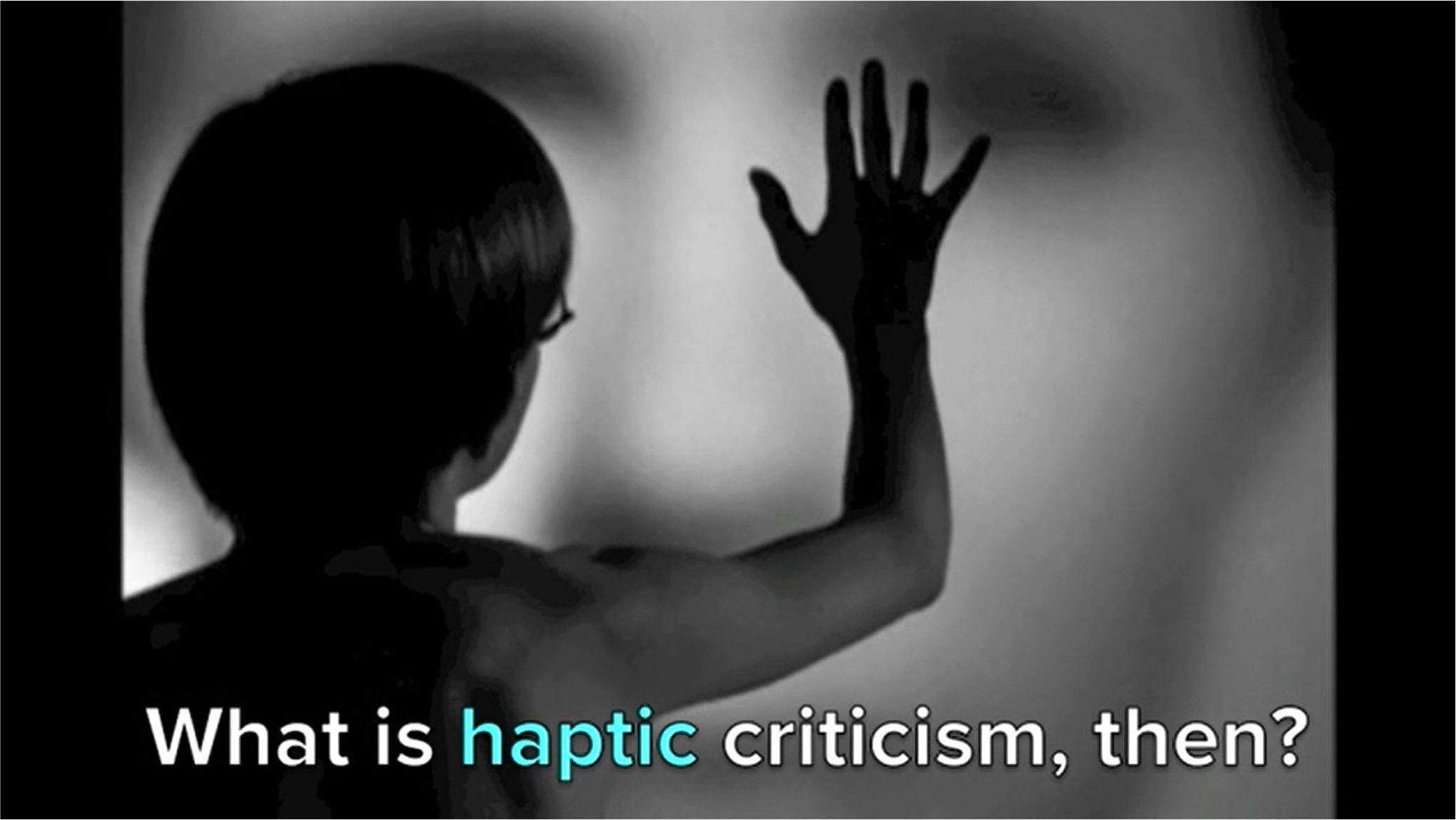
Figure 1
Touching the Film Object? (Catherine Grant, 2011)
By the mid-2010s, alongside affectively framed uses of computational tools, a strand of videographic work emerged that was more aligned with the language of the digital humanities, while often retaining the subjective and poetic inflexions visible in Grant’s reflections.19 Notably, DH-oriented accounts of videographic scholarship have always sought to distance themselves from the more positivist, ‘big data’ side of DH. In ‘The Slices of Cinema: Digital Surrealism as Research Strategy’ (2016), Kevin L. Ferguson advocates for ‘digital surrealism’ as a method that employs computational tools – such as the scientific image-analysis software ImageJ – ‘to imagine what aspects of media texts are literally impossible to see without special computer-assisted techniques.’20 What we see in Ferguson’s videographic essay Volumetric Cinema (2015) attests, on the one hand, to a treatment of images as datasets that digital software can assemble and reassemble at will, but on the other hand, instead of using these affordances to extract large-scale information about films – such as shot length or camera-angle distribution – the essay seeks to make films strange and open them to pensive spectatorship.21 Iconic scenes from films such as Vertigo, À bout de souffle, and The Searchers are not traditionally analysed but deformed and transformed into volumetric, three-dimensional sculptures: dense, stratified blocks in which successive frames are compressed, stretched, and folded into textured forms that make time and movement materially visible (see figure 2). Here, a programme designed for empirical analysis is defamiliarised to generate quasi-cinematic forms that reveal relationships between camera movement, mise-en-scène, and time that would be unimaginable without digital technology.
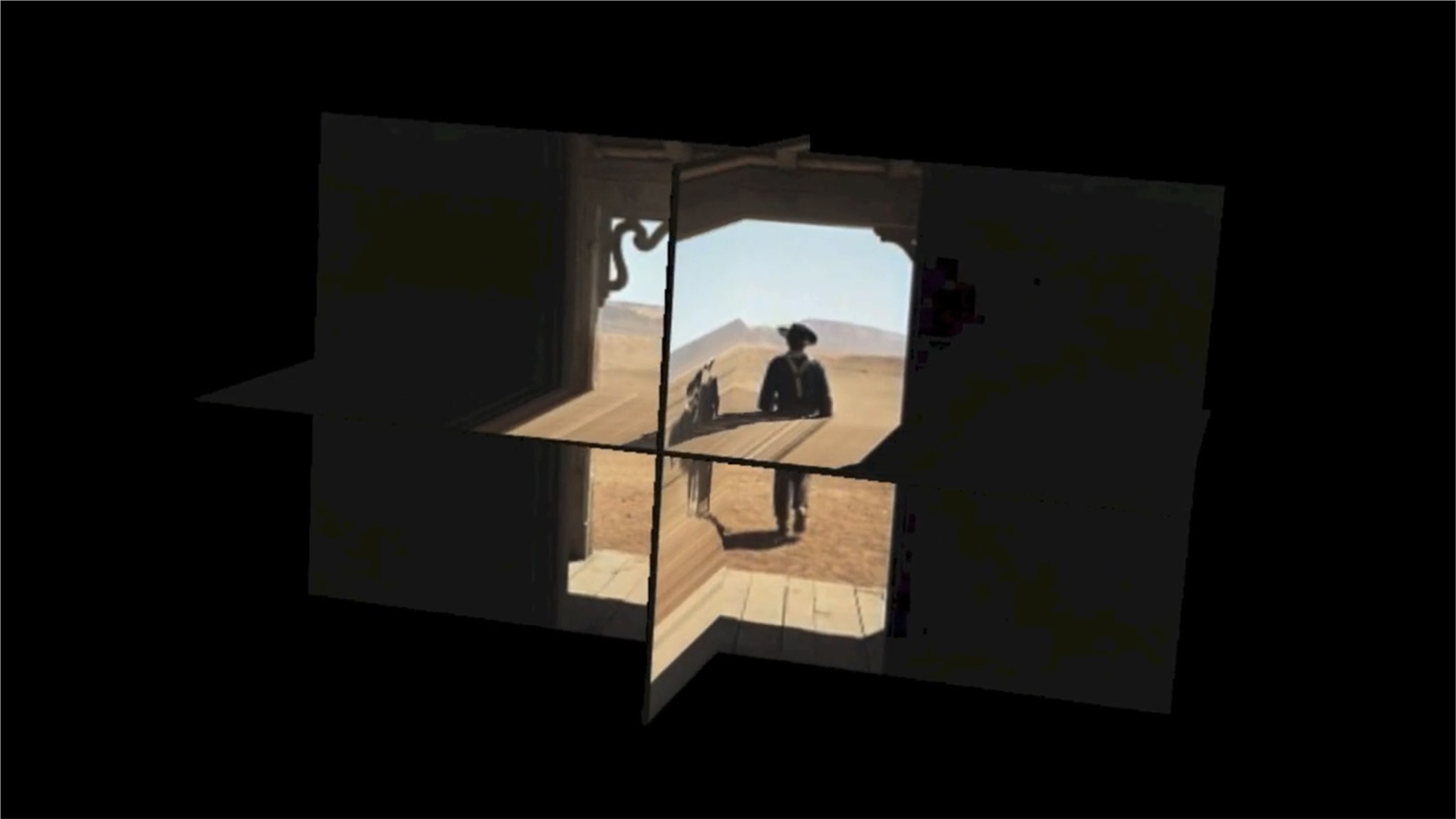
Figure 2
Volumetric Cinema (Kevin L. Ferguson, 2015)
Within the videographic community, works such as Volumetric Cinema have been linked to concepts like ‘deformative criticism’ (borrowed from literary studies) and ‘parametric criticism.’22 Whatever the term, the aim is similar: to use digital tools – from basic video editors to software for computational analysis, data visualisation, or even custom apps and interfaces – to ‘break’ film objects according to a chosen protocol or set of rules. In Volumetric Cinema, the parameter is the transformation of scenes into 3D objects. Elsewhere, it might be the pattern of a supercut (e.g., compilations organised by theme, visual motif, shot type, gesture, or sound), the reordering of sequences by length or colour palette, the rearrangement of shots into split-screen or multi-screen formats, or the erasure of selected figures or lines of dialogue.23 What unites these approaches is their experimental spirit: realising many ‘what if’ scenarios that were previously possible only in thought; embracing the unpredictability of results, which – because agency is partly handed over to algorithmic protocols and machinic operations – cannot be known in advance; and a championing of process over finitude. Videographic scholars often adopt the epistemological value of treating images as data. Jason Mittell’s oft-cited sentence from “Videographic Criticism as a Digital Humanities Method” (2019) – that ‘once a film is imported into video-editing software, it becomes something else: an archive of sounds and moving images’24 – speaks volumes, as it implicitly frames film as a repository of malleable units that can be combined and recombined at one’s discretion. At the same time, there is a strong impulse to debunk the supposed neutrality and objectivity implied by the term. Drawing on the work of Johanna Drucker, Alan O’Leary suggests that images and sounds on the editing timeline should be understood as ‘capta’ rather than ‘data.’ Instead of treating information as something already given, this perspective emphasises that it is ‘“taken” actively’ and ‘constituted relationally, between observer and observed phenomena,’ acknowledging ‘the critical decisions that have placed or combined them there.’25
Besides grasping how digital tools shape our subjective experience of films and the ways they can deform or transform film objects, videographic scholarship also investigates how subject-object relations are constituted within – and constitutive of – the datafied online environments we inhabit. The ‘desktop’ mode of videographic practice, aligned with what is called the ‘desktop documentary’26 and has been popular roughly since the mid-2010s, enables this sort of investigation in both a self-reflexive and media-reflexive manner.27 It may be described as ‘a form that simulates user experience in a digital environment through screen capturing in order to gain insight into how that environment operates – what possibilities and limitations it offers, and how we encounter audiovisual phenomena within it.’28 The use of screen-capturing technology to record one’s own computer or smartphone screen exemplifies the double-edged nature of digital reflexivity. On the one hand, it demonstrates how every click, swipe, and tap across programmes, windows, and apps can alter the way images and sounds appear to us and generate meaning. Lého Galibert-Laîné and Kevin B. Lee’s Reading // Binging // Benning (2018) stages what could be seen as a deformative experiment – asking what happens to James Benning’s glacially slow ambient films when placed within the frenzied, dispersed attention regime of the online space – through a continuous, self-questioning dialogue between the authors, conducted both in voice-over and through their performative gestures on screen (see figure 3).29 On the other hand, the screen-capturing process imposes its own ways of fixating the desktop experience: rendering the result smoother, more transparent, and more effortless – as if happening in real time – than it actually is, even when one prepares everything in advance.30 The gap between the sovereign performance the format seems to demand and the inherent instability of screen capture produces a peculiar anxiety, acknowledged by several videographic scholars.31 Grace Lee’s description of watching Reading // Binging // Benning – ‘It’s like, at any point, I’m expecting the internet connection to break down, or for things to start buffering or accidentally close down a tab you need and you have to navigate back to it’– goes double for the creative process.32 This is precisely why the desktop format is so effective for reflecting on our participation in the world-building of online environments: it reveals how we influence these environments through our use of digital software, yet it simultaneously exposes the volatility and uncertainty that both visible and hidden features of digital tools produce.
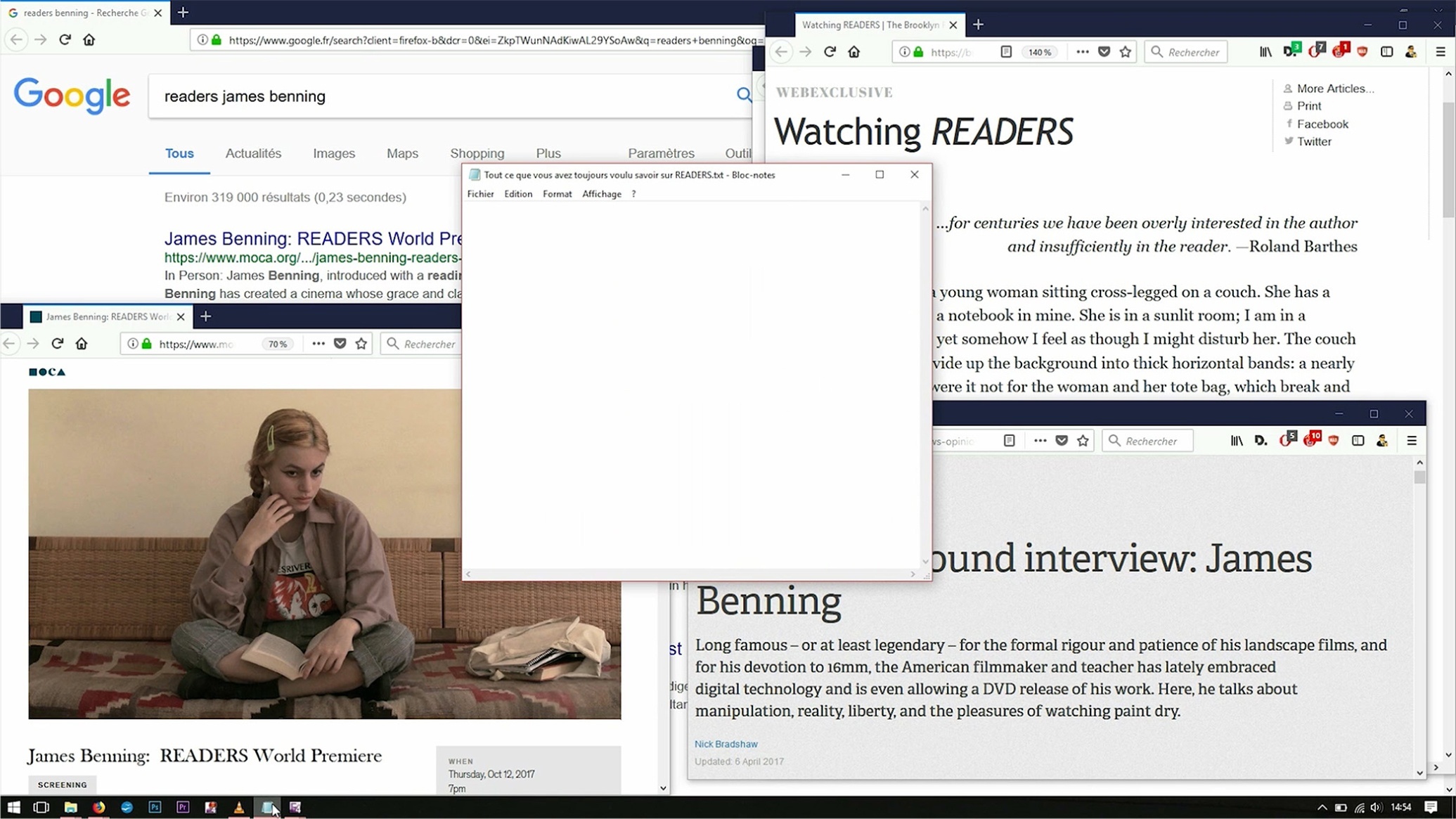
Figure 3
Reading // Binging // Benning (Lého Galibert-Laîné and Kevin B. Lee, 2018)
All these approaches have laid the groundwork for videographic essays in which a media-archaeological leaning is much more explicit, including our own. At the same time, the dominant modes of reflexivity within videographic scholarship exhibit specific tendencies, with distinctive advantages and limitations, which we need to interrogate before moving further.
Limits and Potentialities of Videographic Reflexivity
What the haptic approach, deformative criticism, and desktop documentary share is the view that digital tools are far more than neutral instruments. They actively mediate and structure how we create and experience moving images and sounds. When this mediation is brought into focus, it can be exploited to foreground the scholar’s subjective engagement, to unveil the possibilities of transforming the research object, or, in the case of the desktop mode, to mobilise subject-object relations in constructing a situated online world. Using the aforementioned taxonomy proposed by Fickers, Tatarinov, and Van der Heijden, these practices can be seen as performing several types of criticism in digital scholarship.33 They enact tool criticism by exposing the non-instrumental possibilities of editing software or specialised programmes like ImageJ; algorithmic criticism by testing how protocols and technological constraints may produce unexpected insights; and interface and simulation criticism by showing how data can be visualised in non-traditional, defamiliarising ways, or how our gestures with software interfaces and pop-up windows shape the online environment. Digital source criticism is less common, found mainly in videographic essays with an archival focus, which remain relatively niche.34 Overall, videographic scholarship consistently attempts to respond – explicitly or implicitly – to the challenges raised by the reflexive turn in digital humanities.
That being said, there remain gaps that could strengthen the reflexive insight videographic scholarship provides, particularly if we want to understand it in both technological and media-historical terms. The point is not to tick all the right boxes in any given categorisation, but to deepen both theoretical and practical awareness of the potentialities and limitations of computational tools, interfaces, and artefacts. One thing that can be said about the majority of outputs in the videographic modes examined so far is that their use of digital tools is present-oriented and, though in a different way than the more empirical strands of DH, pragmatic: concerned with how tools can open new ways of understanding film objects and our role in mediating and experiencing them, but less engaged with how the tools themselves have been constructed. For instance, many videographic essays unmask the operations of editing interfaces, yet few ask how those interfaces were historically shaped.35 Where does the timeline come from, and how does its representation of visual and sound layers affect creative practice and reception? What possibilities and constraints arise from placing two images side by side, or from treating the rectangular frame as the basic cinematic unit? Is non-linear editing always the most productive, or might older linear or real-time alternatives prove better suited for desktop or deformative experiments? Do the menus of effects and transitions reflect open creative choice, or rather the competing preferences of professional editors, computer engineers, and marketers embedded in software design? How have specific updates to video-editing software such as Adobe Premiere, Final Cut, iMovie, and DaVinci Resolve reframed the possibilities and terms of creative labour? Addressing such questions – both in theoretical and practical terms – would require a kind of software criticism already developed in writing by scholars such as Marc Furstenau, Adrian Mackenzie, Aylish Wood, and most recently Kartik Nair.36 Bringing this line of critique into videographic practice would help reflect on the boundaries and framings of the creative experimentation that videographic uses of computational tools pursue, while also opening space to imagine alternative tools, including those deemed marginal or obsolete.
More broadly, we might ask what would happen if videographic essays not only engaged with the technologies and interfaces they use today, but also juxtaposed them with their historical precedents, inspirations, parallels, or failed alternatives. For instance, Christian Gosvig Olesen has studied how visualisation techniques were used for doing film and media historiography long before the advent of digital technology, while Grazia Ingravalle has examined algorithm-based experiments with archival moving images and sounds in film museums for curatorial purposes.37 Taking such approaches seriously within deformative criticism could yield a more historically grounded understanding of experiments in this mode and potentially generate more surprising outcomes. As for the desktop mode, what are the origins of the computer or smartphone desktop that we see in desktop media? What might desktop videographic essays learn from the early days of ‘desktop publishing,’ which let users create and print visual documents (e.g., Apple’s The Print Shop and HyperCard), and ‘desktop video,’ which made it possible to edit moving images and sounds (e.g., the Video Toaster designed for the Amiga computer), in the 1980s and 1990s? What user assumptions were built into those early systems, and how do they continue to shape, or could reshape, today’s videographic practices? The histories of screen capturing are equally intriguing: in the 1990s, for instance, it was already used to record and preserve gameplay in first-person shooters like Doom and Quake.38
In cases like these, videographic scholarship could stage encounters between past and present digital tools, interfaces, and artefacts – encounters that might set productive frictions in motion, spark new imaginaries of software, and even lead to the invention of alternative tools. Some steps in this direction have already been taken; the methodological stakes, however, have yet to be clearly articulated and named.
Videographic Scholarship and/as Experimental Media Archaeology
This technologically-situated approach brings videographic scholarship remarkably close to media archaeology, and more specifically to its practice-based variant, ‘experimental media archaeology’.39 Andreas Fickers and Annie van den Oever introduced the term in their 2014 article “Experimental Media Archaeology: A Plea for New Directions’ to describe ways of ‘doing re-enactments with old media technologies’ in order to generate ‘new historical, ethnographic, and empirical knowledge about past user practices and media experiences.”40 Bolstered by the research project ‘Doing Experimental Media Archaeology: Practice & Theory’ (DEMA), which culminated in two book publications (2022), the approach evolved into an umbrella term for a range of practices, often carried out in media archaeology labs, aiming to ‘inform us about the “tacit knowledge” involved in the use of media technologies and thereby sensitise us to the role of our senses and our bodies in the human/machine interaction.’41 Another goal, particularly relevant to reflexive videographic work, is to expose the ‘“constructivist nature” of media-technology content, namely how films, photographs and audio recordings were produced and mediated by media technologies in the past.’42
Although very few videographic scholars reference media archaeology, let alone its experimental strand, recent years have seen echoes of its technology-oriented, constructivist, and hands-on approach. For example, Johannes Binotto’s series Practices of Viewing (2021–2023) retraces the histories of spectatorial habits such as looping, muting, dubbing, screenshotting, and pausing across different media, engaging both the interfaces of these media and his own bodily gestures.43 In Practices of Viewing: Pause (2021), he showcases (and performs) the act of halting moving images in analogue film, television, video, and social media, showing how a gesture now associated with control has also long been linked to anxiety (see figure 4). A series like Practices of Viewing could well sit alongside the few workshop-based examples of video essays conducted within the DEMA project cited in the monograph Doing Experimental Media Archaeology: Practice.44 What perhaps distinguishes Binotto’s work is that, despite its transmedia and transtemporal scope, it focuses primarily and effectively on broader spectatorial practices, rather than accentuating the historical specifics of particular technologies, devices, or tools.
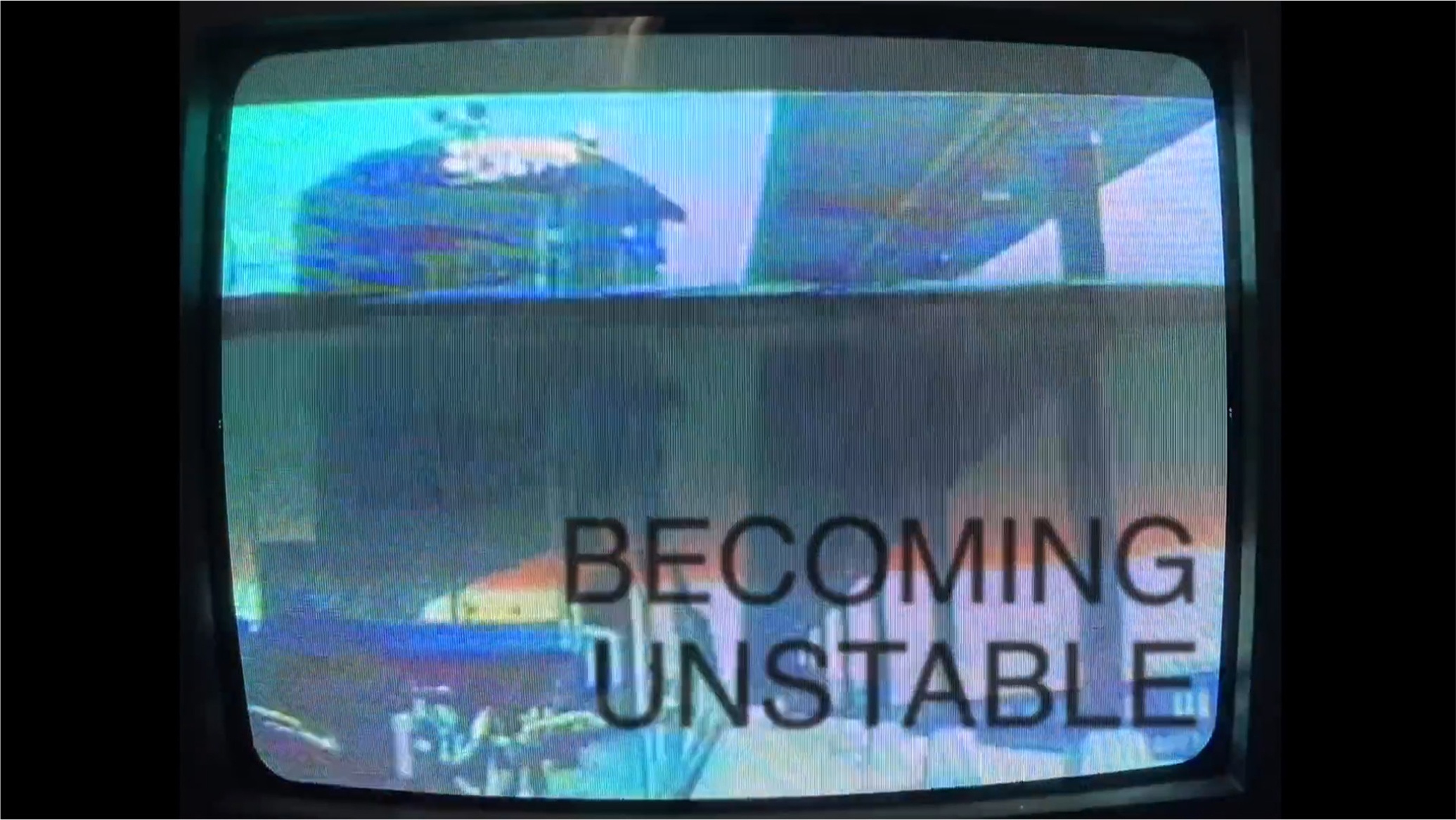
Figure 4
Practices of Viewing: Pause (Johannes Binotto, 2021)
The methodology outlined in both DEMA publications offers a lot of inspiration for videographic scholarship, yet it can be further developed through closer engagement with the videographic field’s methods. A recurring motif in the books and laboratory experiments is an object-centred and sense-centred perspective. The emphasis is placed on physical objects in their most tangible form: machines, apparatuses, tapes, reels, wires, records, cartridges, discs – in short, things that can be touched directly. Fickers and Van den Oever underline the importance of physical engagement with historical artefacts to ‘stimulate our imagination of the past: to reflect critically on the hidden or non-verbalised, sensorial, corporal, and tacit knowledge that informs our engagement with media technologies.’45 In the language of experimental media archaeology, touching a media artefact from the past amounts to a transformative act, an experience of ‘wonder’ that makes the object appear new again and re-sensitises the scholar, artist, or student to the ‘senso-perceptual dimensions of media use, as well as to the traces of media experiences in the source material.’46
This sense of awe is familiar to anyone who has watched, for instance, an old film projector come back to life. But how might we recreate such affect in relation to an obsolete editing programme or visualisation tool, whose material qualities are less immediately apparent? Some media archaeology labs – such as the Media Archaeology Lab in Boulder, Colorado – have increasingly turned their attention to computers, yet most of their experiments continue to privilege the traditional, hardware-oriented understanding of media-archaeological objects.47 In other words, what matters are monitors, keyboards, mice, hard disks, semiconductors, and transistors, rather than screen-capture tools, gameplay lags, compression artefacts, dated Macintosh fonts, or early Instagram filters. Champions of this radically materialist view of computers, such as Lori Emerson (the head of the aforementioned Colorado Lab) and Wolfgang Ernst, suggest that a media-archaeological enquiry should start with a screwdriver.48 As much as we commend the no-nonsense attitude of ‘screwdriver media archaeology,’ if we want to get closer to less tangible yet nonetheless material desktop phenomena, we ought to broaden the scope of hands-on activities and objecthood. Digital traces and interfaces also possess a distinctive thingness – a materiality and historicity whose sense of wonder has been embedded in the everyday practices of computer and smartphone users. If we want to reawaken that wonder, videographic methods may prove useful. By enabling reflexive and situated knowledge of computational tools – knowledge that, more than fifteen years into the development of videographic scholarship, has itself acquired archival value – such approaches can illuminate how these tools shape our encounters with media. From Grant’s haptic, shudder-inducing encounters with editing software to the click-based world-building of desktop documentaries, videographic scholarship has, consciously or not, worked to shape digital tools, interfaces, and artefacts into objects that are ‘epistemic’– objects of inquiry that generate new knowledge – and ‘technical’ – instruments through which such inquiry is carried out – at the same time.49
Occitane Lacurie’s essay Ordinatrices: About the Negative Spaces of Early Computing (2024) demonstrates how videographic methods can be mobilised for media-archaeological research on digitality. Intercutting scenes from the TV series Mad Men and the classical Hollywood film The Apartment with the desktop mode of investigation, the work traces the history of computer labour back to secretarial practices carried out by women – typing on typewriters, formatting documents, updating diaries, consulting Rolodexes, and more – thereby reviving the early but long-forgotten concept of the ‘ordinatrice’ (computress).50 Lacurie’s experiment gains a distinctly media-archaeological spin particularly through moments in which her keystrokes on a PC keyboard and a typewriter are overlaid in an uncanny X-ray effect (see figure 5). This gesture re-envisions desktop writing as a form of (gendered) labour sedimented in specific technological conditions, in which every click is already superimposed with the accumulated histories of numerous machines and media and already anticipates machines and media of the future. As a result, the essay manages not only to portray the marginalisation of female labour but also to make the haptic dimension of computer experience palpable at the threshold between the virtual and the physical.
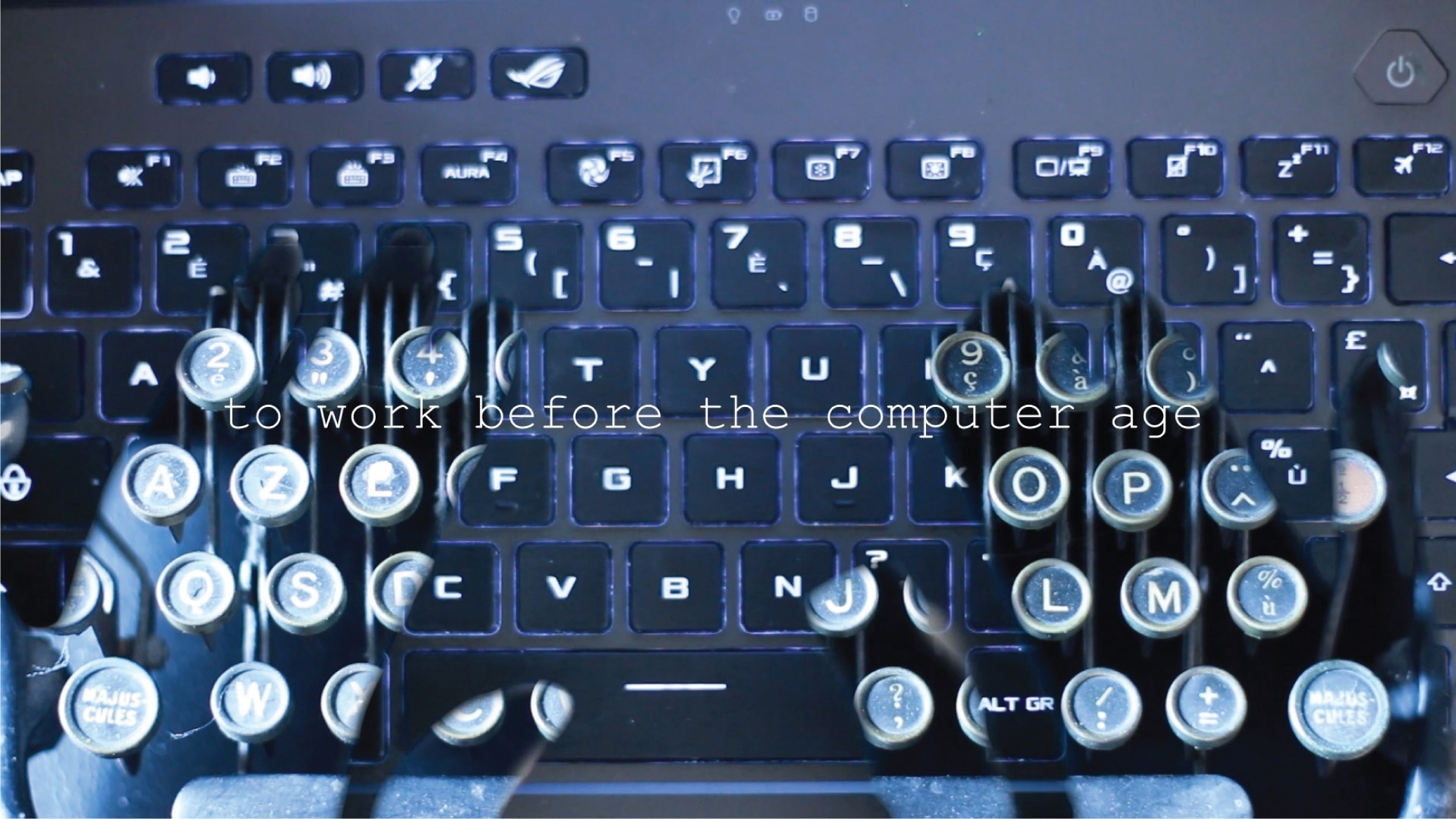
Figure 5
Ordinatrices: About the Negative Spaces of Early Computing (Occitane Lacurie, 2024)
We therefore argue that videographic scholarship can learn from experimental media archaeology, and vice versa. Through such mutual exchange, videographic practice may gain a more historically and materially grounded perspective on the computational tools it employs, whereas media archaeology can benefit from methods that situate engagements with past technologies within the everyday experience of digital media. In the following section, we introduce three principles on which this exchange rests, drawing mainly on our own videographic essays and our students’ works.
Three Proposals for Videographic Scholarship from Below
We have provisionally identified three pillars that illustrate how videographic scholarship and experimental media archaeology might be brought together in a shared pursuit of reflexivity in and through digital tools:
(Re)Enactment of Objects
Media Anachronism
DIY Constructivism
Through these principles, we want to develop videographic scholarship from below. The phrase from below may carry various associations, in historiography often tied to the lives of ordinary people, but in this context, it involves paying closer attention to the means through which videographic analysis is conducted, treating them as fully-fledged objects of inquiry.51 This way we can find out what videographic essays can gain from properly engaging with the distinctive objecthood of digital tools, interfaces, and artefacts – how their forms are assembled or disassembled at the level of their minutest particles. This entails acknowledging their digital or hybrid materiality, including its uncanny and accidental creativity, as articulated in Towards a Film Theory from Below; their circulation across diverse media, spaces, and time periods; and the environments in which we encounter and shape them in practice.52
1. (Re)Enactment of Objects
All the videographic modes introduced earlier share one key feature: their objects of study are never given in advance. A thumbnail on an editing timeline may trigger affects that shift what initially seemed important in a scene or spark unexpected connections with other moments and works. A film may become a visualised sum of its frames, a barcode of its colour spectrum, a geometrical abstraction, or a diagram of sound and music. A social media artefact may be updated, erased, or displaced, and the controlled chaos of the desktop mode may not be quick enough to react. Under these circumstances, can we still speak of ‘objects’?
Yuk Hui describes digital objects as ‘objects that take shape on a screen or hide in the back end of a computer program, composed of data and metadata regulated by structures or schemas.’53 Hui’s account is useful because it allows us to define the objecthood of digital tools, interfaces, and artefacts without reducing them to their physical substrate, but also because it conceives the digital object as something that comes into existence only through enactment and concretisation within a specific set of human-machine-world relations.54 A technical object such as the magic lantern – so central to many media-archaeological experiments – may also be defined by how, when, and by whom it is used, yet very few would question its status as an object.55 By contrast, in the case of a thumbnail with a scratched frame in an editing programme, a GIF set of dance numbers extracted from a Hollywood musical, or a neglected social media thread, objecthood is far more questionable and counterintuitive.
Equally disputable would be to consider such things as historical and theoretical objects. For film studies – which continue to ground the knowledge framework of videographic scholarship – and materialist media archaeology, these phenomena may be perceived as too niche, too recent, too ephemeral, too arbitrary, or not tangible enough. Certain strands of scholarship adjacent to media archaeology that are less strictly materialist and more attentive to software and internet histories – represented by figures such as Wendy Hui Kyong Chun, Matthew Kirschenbaum, or Laine Nooney – could nevertheless offer inspiration, though even they might remain unconvinced that such minor phenomena could themselves serve as speculatively generative objects.56 Yet if experimental media archaeology is to live up to its name, and if videographic scholarship is to historicise the tools with which it works, then what greater adventure could there be than examining media artefacts whose very objecthood remains to be claimed? Such experiments might even test whether the defining quality of a digital object – its need to be operatively enacted through the synchronisation of data and metadata, software and hardware, human and machine actions in order to exist – does not already find precedents in artefacts whose origins lie outside the digital.
Our recent videographic essay, The Return of the Star Wipe (2025), taps into this very dilemma. It centres on the star wipe editing transition, a device that joins two images through the shape of a star. Because of its semantic obviousness, violation of editing’s ‘golden rule’ of functionality, and overuse in ephemeral television formats, amateur video, and digital creativity, the star wipe has become an emblem of cheesiness and bad taste, and has gradually fallen out of favour. By the mid-2010s, it even disappeared from the libraries of two major editing programmes – Adobe Premiere and Final Cut.57 Nevertheless, the editing device refuses to submit to obsolescence, re-enacted in YouTube tutorials and DIY plug-ins and resurfacing in tributes on social media and popular culture. The essay traces the star wipe’s history across film, television, video art, games, amateur production, and online ephemera, uncovering its mysterious appeal – its childlike playfulness and non-instrumental excess, along with its place in cycles of innovation, obsolescence, and resurgence (see figure 6).58
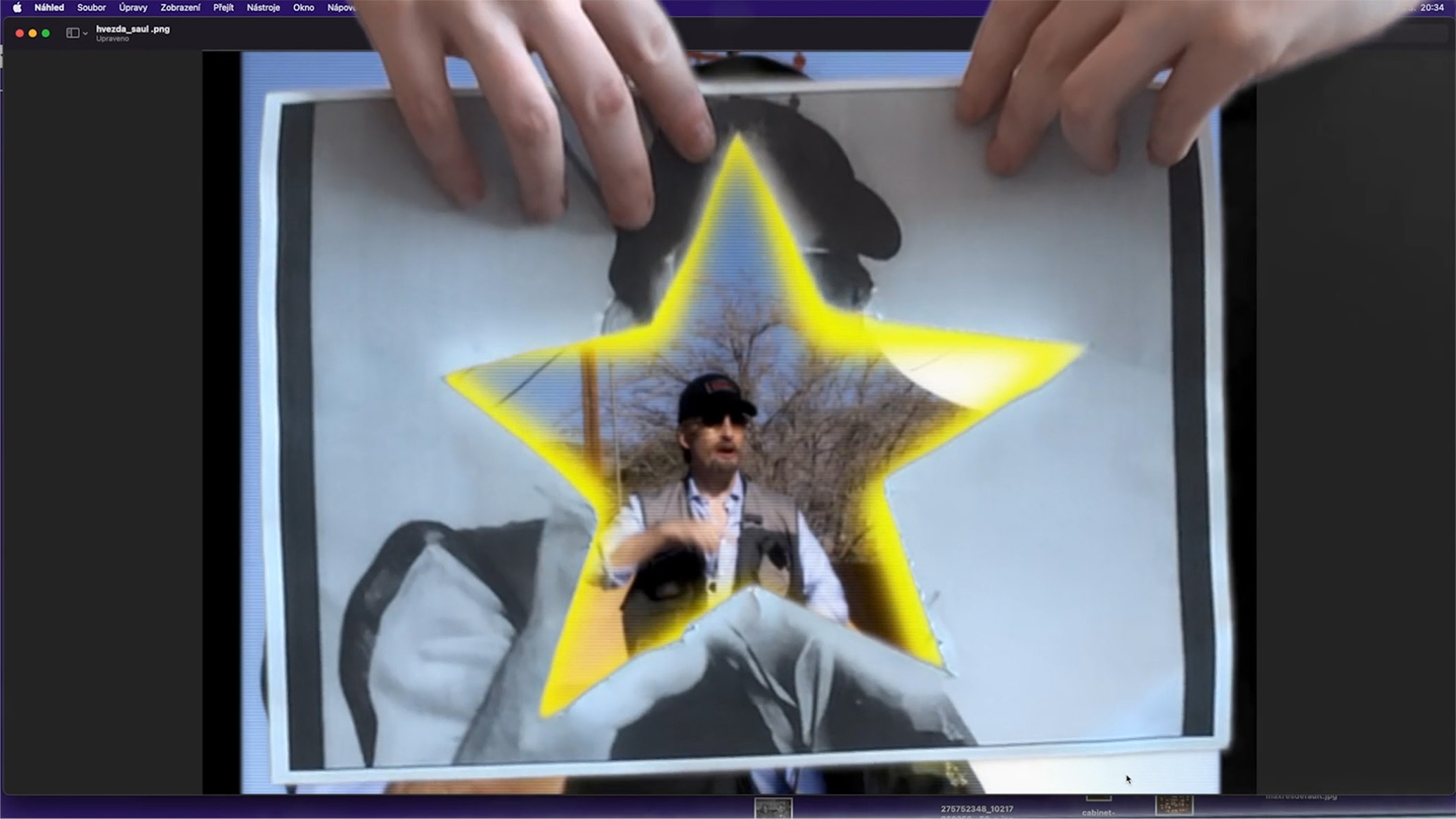
Figure 6
The Return of the Star Wipe (Jiří Anger and Veronika Hanáková, 2025)
Its media-archaeological impulse, to which we also subscribe in the accompanying statement,59 lies in foregrounding the operative logics that have enabled the transition across time: optical printers, video switchers, editing programmes, and desktop media – machines that organise forms in space and time, including the ‘interstitial’ forms that connect them. Each enactment of the star wipe – whether re-photographing shots through travelling mattes, pressing a button on a switcher, or clicking an icon in a software library – brings it temporarily into being, as something that exists only at the boundary between two images; yet its survival is precarious. Photochemical frames show only the individual steps of its emergence; video switchers operating in real time preserve it only if someone chooses to record; early editing programmes lacked sufficient storage capacity; and screen-capturing tools may miss it altogether. Even when preserved, it usually survives as a fleeting blip within larger works or in ephemeral formats – trailers, commercials, demo reels, game shows, sports broadcasts, children’s programmes, infomercials – that rarely enter cultural heritage collections. Our essay not only revives these forgotten instances of the star wipe but also makes the difficulty of sustaining the transition across different media and apparatuses sensorially present. It experiments with the star wipe’s spatial and temporal unfolding in digital interfaces and even attempts to ‘touch’ the artefact by printing a frame of the transition and carving out the star with a knife. Even the favoured tool of Lori Emerson and Wolfgang Ernst – the screwdriver – makes a comeback to demonstrate that, when faced with liminal artefacts such as the star wipe, the epitome of rough, physical labour remains relevant, though no longer the privileged instrument through which their materiality can be apprehended. In doing so, it materialises how the qualities Yuk Hui attributes to digital objects can also apply – through the use of digital and analogue tools – to other media artefacts whose objecthood has long been marginalised by aesthetic and preservation paradigms.60
The Return of the Star Wipe openly advocates for videographic scholarship’s potential for a more inclusive understanding of objects in the digital realm. The online environment abounds with born-analogue artefacts whose existence cannot be reduced to what Fiona R. Cameron terms ‘digital surrogates’.61 Enactment may be a fundamental condition of existence, yet an object can never be reduced to a single enactment or type of enactments. There is no definitive or original star wipe; even if there were, it could not circulate without memories, associations, and (mis)recognitions – including instances of mistaking it for another transition or effect, as the essay also demonstrates. The star wipe is better understood through the metaphor of the giant sticky ball in the video game Katamari Damacy (2004), which grows by accumulating objects smaller than itself. Like the Katamari, the wipe does not replace what it absorbs but incorporates heterogeneous elements – uses, memories, technical settings, and misrecognitions – into a continuously expanding composite whose identity is driven by accretion rather than origin. Here, those ‘objects’ are the enactments of the wipe, together with the technological configurations and tacit knowledges that sustain them. Provided we want to grasp its broader cultural and technological role, we should not flatten the differences between enactments into a homogeneous blob, but embrace their clumsiness: the awkward movement of incongruous objects carried together in mutual friction.
2. Media Anachronism
It is clear that to understand the meshed, scattershot temporality of online space, categories such as past, present, and future can no longer be distinguished in the same way as before. When a film by Andrei Tarkovsky, for example, is imported into an editing programme, when a fragment of it circulates as a TikTok reel, or when that same fragment is upscaled and reconstructed by an AI model, we might simply say that the past is remediated through the present. But things are more complicated than that. Each act of remediation acquires its own historicity: one that differs from that of the original film classic. A historicity that is far more fragile, since we lack access to the technological infrastructures that enabled such gestures – often owned by Big Tech – and still have relatively few means of preserving them, let alone deciding what is worth keeping for future generations and what is not. The star wipe, against all odds, survived in cultural imagination, but can the same be said of most Instagram filters? Other techniques persist in different guises, yet hover between novelty and historicization – for instance, the AI upscaling of early films, a hotly debated practice in the early 2020s that already appears dated from the perspective of 2026.62
This type of bifurcated historicity presents exactly what videographic scholarship from below could experiment with, through the mentioned capacity for enacting objects that remain to be claimed, but also through the digitally situated subject position made possible – most effectively – by the desktop mode. Software can be used in more reflexive ways than just mixing and re-mixing past and present media artefacts with each other – it may also serve to orchestrate situations where objects from the past perforate the present, opening spaces for what current attention regimes lack, or exposing the ‘non-simultaneity’ of the now and its constant orientation toward becoming-past.63 The term that best captures this endeavour is anachronism. As Stefano Baschiera and Elena Caoduro define it, an anachronism is ‘a thing belonging or appropriate to a period other than that in which it exists, especially a thing that is conspicuously old-fashioned’.64 Nevertheless, the wager of videographic scholarship from below is to prove that such non-belonging, though perceptually real, may not be absolute. Many older techniques and artefacts persist within the networked everyday, just not in the forms or places we would expect. The ambition, then, is to chart a path between contaminating the present with seemingly anachronistic devices and investigating the extent to which they are truly irreconcilable with this present.
The idea of media anachronism is materialised in Karin Spišáková and David Scharf’s videographic essay Teletext Revival (2023; version 2.0: 2024), first developed in a course we taught at Charles University in Prague.65 It revisits the not-quite-obsolete but certainly not-quite-up-to-date medium of teletext: a news service launched in the 1970s that displayed information on a TV screen by transmitting data as part of the broadcast signal.66 Often described as a precursor to the internet, teletext similarly allowed users to summon written information on screen.67 Due to its slowness, limited databank, and minimal interactivity, it is hardly surprising that it was eventually superseded by internet services. As Kevin Driscoll and Camille Paloque-Berges argue, ‘the teletext medium is difficult to collect and archive, and even more difficult to consult and analyse beyond an immediate live broadcast,’ and thus ‘tells the story of a failure, not the failure of the technology itself, but the failure of the conditions for explanation and value-creation in memory and history.’68
Nevertheless, Spišáková and Scharf, two East-Central European students (one Slovak, the other Czech), refused to accept the medium’s death and confronted its specific affordances with the present media environment. One of their most intriguing strategies was to reconstruct both Czech and Slovak teletext interfaces to host typical early-2020s online content, including memes, Tinder, and cryptocurrencies (see figure 7). A notable detail that multiplies the anachronisms within this interface is the inclusion of COVID-19 updates, since the first version of the video was produced during a seminar in late 2021, amid the pandemic. A key gesture is to pair this technological anachronism with an anachronism in user practices. Their appropriation thus goes beyond comic remediation or the mere revivification of ‘zombie media.’69 By reintroducing teletext’s trademark slowness and informational frugality, it points to qualities missing in today’s fast-paced, information-saturated audiovisual regime: the patience of waiting for content, concise information uncluttered by emotional overcharge, and greater user-friendliness for older generations.
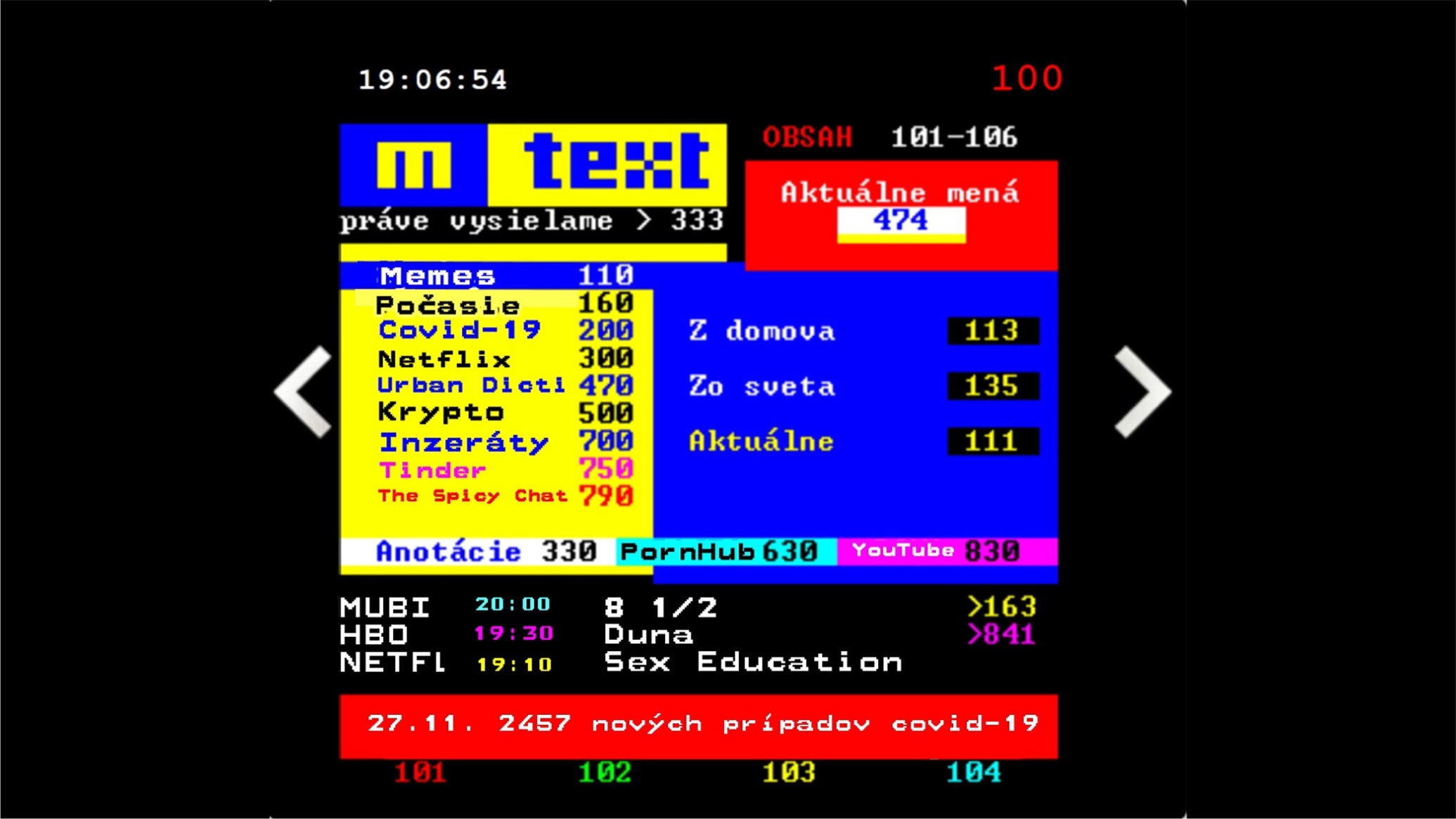
Figure 7
Teletext Revival 2.0 (Karin Spišáková and David Scharf, 2024)
This videographic anachronism, situated at the intersection of teletext, television, and online interfaces, brings to light both what is lacking in the present and what may yet be retrieved. The reasoning behind such media-archaeological exercises extends past nostalgia and tackles the imposed naturalness and inevitability of today’s media ecosystems. What they suggest is not a retreat from digital to analogue media, but an attentiveness to transitional forms such as teletext (and, in its own way, the star wipe), which testify that even the most doomsday visions of the online realm can be unsettled by recovering potentialities preserved in its analogue traces.
3. DIY Constructivism
Another point of convergence between videographic scholarship and experimental media archaeology lies in their constructivist orientation – though each enacts it differently. The hands-on, performative treatment of media devices advanced by Fickers, Van den Oever, Van der Heijden, and Kolkowski extends the constructivist understanding of media technologies: every medium comes with technological and epistemological affordances and constraints that shape the relation between user and object. A tactile encounter with a Ciné-Kodak 16mm film camera, for instance, foregrounds how limited recording time, manual operation, and the intimacy between cameraperson and subject constituted home movies as media products.70 In videographic scholarship, the cited projects highlight film experience as the outcome of often unpredictable cross-currents among creators, users, media artefacts, and the digital tools they employ. But what happens when handling something we already know does not suffice – when programmes, interfaces, and dispositifs begin to crumble, when they prove incapable of accommodating a plurality of voices and experiences, or even actively work to marginalise them?
Several videographic works channel this do-it-yourself constructivist impulse. Jessica McGoff’s essay Screening Room: On Digital Film Festivals (2021) toys with the idea of extending the desktop mode beyond the desktop.71 Now almost an archival document of the COVID-19 years, it reflects on the experience of attending film festivals from the spatial monoculture of her apartment. The essay captures the habitus of being glued to computer and smartphone screens, to the point of losing the distinction between the virtual and the physical, while still longing for the collective dimension that festival-going promises. At one point, McGoff fashions the dispositif for watching 2001: A Space Odyssey on her computer into a quasi-cinematic venue: constructed, in fact, out of paper (see figure 8). This gesture turns the limitations of the desktop – and of the pandemic – against the grain and, in the process, produces a new media experience.
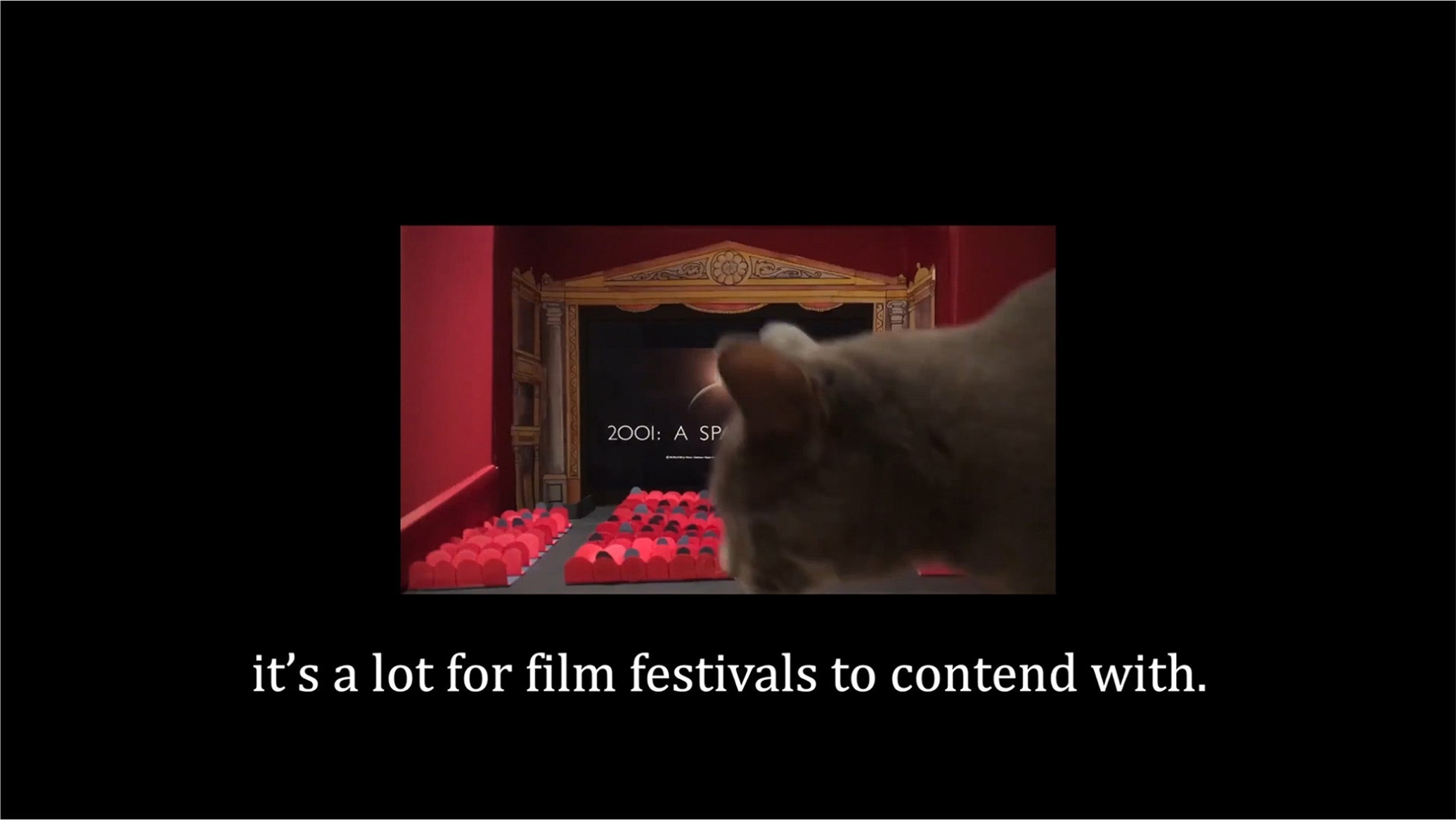
Figure 8
Screening Room: On Digital Film Festivals (Jessica McGoff, 2021)
This constructivist impulse is taken even further by scholars who invent their own tools and applications. In connection with the film|minutes book series, which advances a minute-by-minute method of close film analysis, Shane Denson developed the film|minutes video|graphic workstation (2025), a hybrid video player and text editor that loops video one minute at a time while enabling timestamped scholarly annotation.72 Watching and clicking through each minute in isolation while taking notes simultaneously invites users to a particularly attentive, detail-oriented mode of post-cinematic spectatorship – one that resists the common association between digital media and diminished concentration (see figure 9).
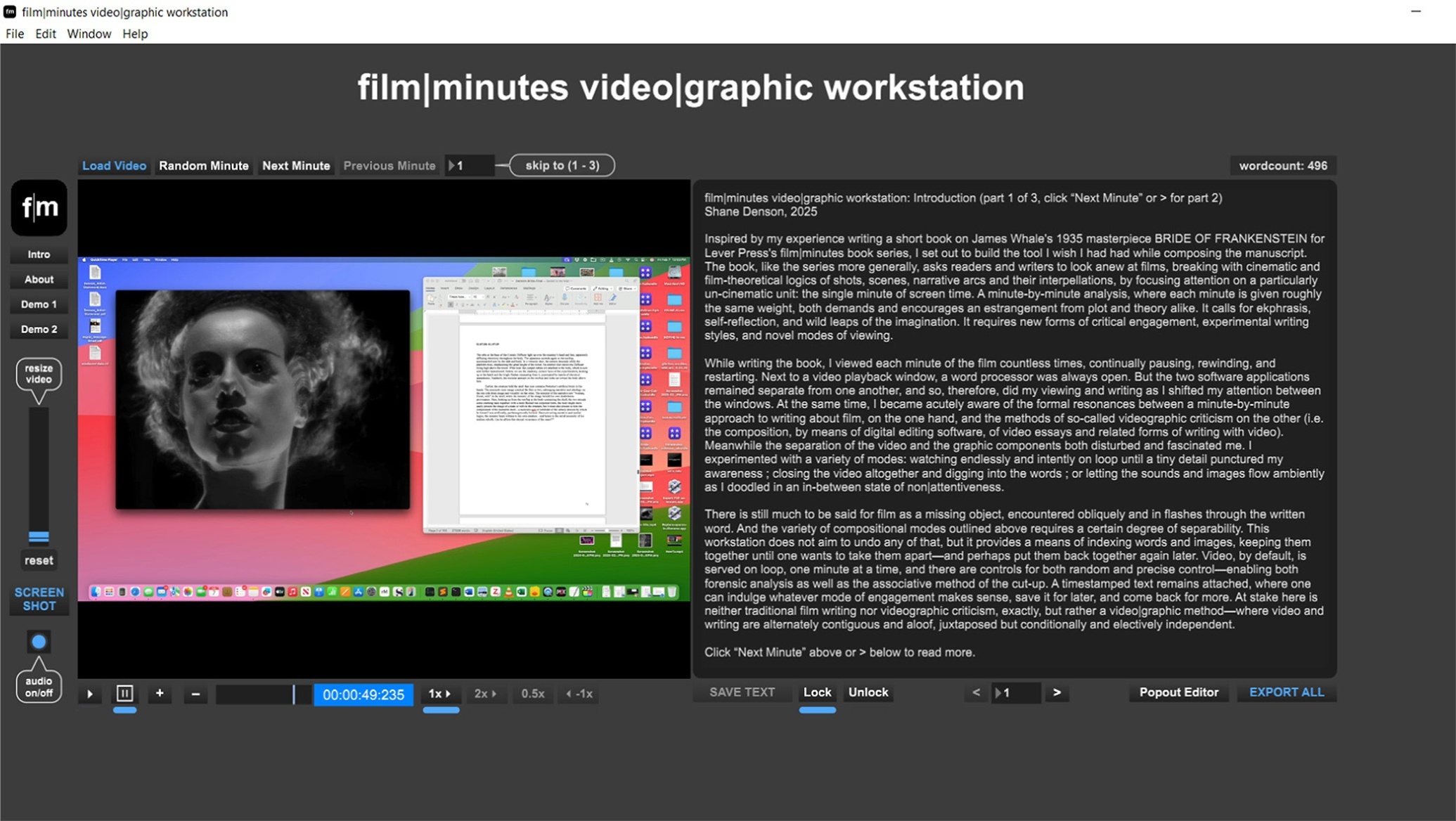
Figure 9
film|minutes video|graphic workstation (Shane Denson, 2025)
In both cases, the invention of a tool is also the invention of a perceptual mode. Each underscores how deeply our media experiences depend on technology – but also that apparatuses should never be taken for granted. The online world, which, particularly at this point in history, feels impenetrable and imposed from above, is in reality an unstable composition of myriad fragments that can shift dramatically when even a single component changes. This incompleteness and instability become especially acute when archiving and studying historical online ephemera. As Niels Brügger claims regarding websites, ‘the archived web has the following characteristics: an original is lacking, it is incomplete, it is a unique version and not a copy, and there is temporal and spatial inconsistency between the archived fragments.’73 Even a relatively extensive repository such as the Wayback Machine presents websites as patchworks of fragments from different moments in time, as updates, shifts, and erasures are so hardly traceable and predictable. How might videographic scholarship from below harness this bricolage-like character of the networked everyday to historicise and theorise digital tools, interfaces, and artefacts as belonging and simultaneously not-quite-belonging building blocks of contemporary media culture?
An example of an essay that constructs its interface from digital ‘bricks’ of disparate origins is Cycles of Labour: In the Metaverse, We Will Be Housewives (2023), on which we collaborated with sociologist Martin Tremčinský.74 This work examines how reproductive labour has evolved across stages of capitalism and contexts such as the domestic sphere, gaming, and social media. It demonstrates how the repetitive and exploitative character of women’s housework has been translated into the ways we now supply data to corporations that control the infrastructure of online life. To embody this idea – necessarily entangling multiple temporalities and user practices – the essay devises an interface that is a kind of Frankenstein’s monster, but one that holds together just enough to function. Using the symbol of cinematic domestic labour and its discontents – Chantal Akerman’s Jeanne Dielman, 23, quai du Commerce, 1080 Bruxelles – we transpose Jeanne into a game simulation, as if we could control her actions (see figure 10). The GUI resembles The Sims, a video game series based on managing mundane household activities and instrumental in shaping modern imagery of housework. Yet instead of being an emulator or a carbon copy, it is a deliberately clumsy, bricolage-like reimagining in which interface components – windows, buttons, icons, menus – look like cutouts rather than parts of a seamless system. For this, we employed Figma – traditionally a UX design tool – and used it, somewhat against its typical industry use, to visualise old interfaces and expose the ‘stitches’ that hold the fragments together. On top of this, the essay gradually layers elements of social media interactivity – likes, memes, reposts – and even references to Web 3.0, where Jeanne, along with us as internet users, becomes akin to an NPC (non-playable character): carrying out microtasks unsuited to algorithms and stuck in a loop of constant waiting and working for a piece-wage.
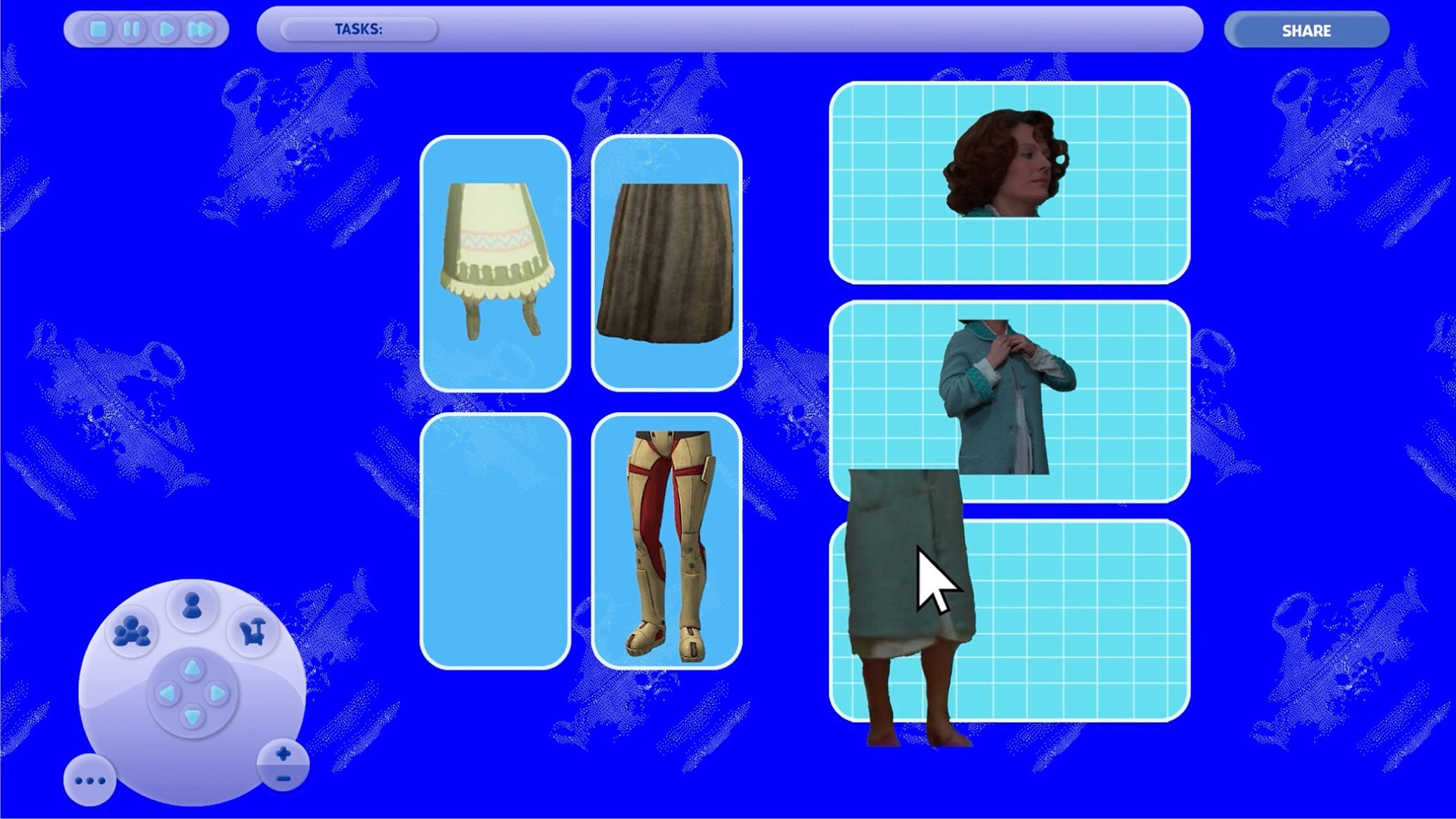
Figure 10
Cycles of Labour: In the Metaverse, We Will Be Housewives (Veronika Hanáková, Martin Tremčinský, and Jiří Anger, 2023)
Cycles of Labour can be thought of as an act of digital crafting – one that may, at first glance, feel like an attempt to emulate software, yet turns out to function more like a translation of zine-making practices into online culture.75 By highlighting the labour of moulding every small button and by embracing the imperfection and patchwork-like nature of the graphical user interface, the essay conveys not only the evolution but also the simultaneity of reproductive labour in its various forms, thereby provoking viewers to think them together, along with their material-technological underpinnings. Experiencing the clumsiness of the tools and the banality of user gestures resonates, in unexpected ways, with media-archaeological experiments. Above all, it reintroduces human agency – small and modest, always entangled with other human and non-human actors, yet still speaking to our capacity to shape online environments and the responsibility to cultivate that capacity for change.
Conclusion: Videographic Scholarship from Below in the Age of AI (Against the GrAIn?)
Digital hermeneutics – or broadly, critical reflection on tools, algorithms, interfaces, and digital sources within the digital humanities – is still relatively young, and debates over which methods will prove most effective will naturally crystallise over time. That said, our aim here has been to show that the field needs more than ‘obligatory’ ethics paragraphs in articles, books, and grant applications, and that it should draw inspiration from aligned practice-based disciplines. Two such disciplines have been introduced in this article: videographic scholarship and experimental media archaeology. The former offers several modes – haptic, deformative, desktop – that creatively and reflexively probe the possibilities of digital tools, interfaces, and artefacts through subversion, reverse engineering, and the reconfiguration of subject–object–world relations. The latter provides a historiographically oriented perspective, demonstrating how encounters with marginalised, forgotten, or obsolete media devices can illuminate the present media landscape.
When brought together and deployed specifically towards the study of computational tools as objects and agents of analytical inquiry, videographic scholarship and experimental media archaeology can enrich each other: one may gain a deeper historical grounding, while the latter may become more attuned to the materiality and hapticity of ephemeral digital phenomena. The result, which we have termed videographic scholarship from below, rests thus far on three principles: an emphasis on objects yet to be claimed and enacted; the staging and revealing of anachronisms that shape the online realm; and a constructivist, DIY engagement with the interfaces through which we inhabit today’s media landscape. This practice is tactical, improvisational, and deliberately clumsy, and, as demonstrated by the case studies of The Return of the Star Wipe, Teletext Revival, and Cycles of Labour, is willing to engage in humour and irony to underscore that no interface or artefact should be reified. Precisely in contrast to a field that seeks ever more perfect instruments for data analysis, and to an online regime that aspires to ever greater frictionlessness,76 such a counter-perspective can serve as a reminder of what is lost in the rush forward – and perhaps even displace the epistemological assumptions that guide it.
Given the looming and already underway changes in the online landscape, driven by the latest developments in artificial intelligence and large language models (LLMs), an emphasis on clumsiness may now be more fruitful than ever. Despite their relentless drive towards ‘perfection’, smoothness, and verisimilitude, the stitches remain visibly evident. The methodology introduced in this article can prove handy in opening and reopening these wounds and holding LLMs to account for their constraints, their contaminations from the past, and, crucially, their own historicity. The mentioned upscalings of early films around 2020, the outputs of DALL-E circa 2022, or the early ChatGPT ramblings from 2023 already seem dated; they can be studied as historically situated phenomena, or even approached through the tools themselves as methods of doing history. May videographic scholarship from below be one of the ways to continually challenge cutting-edge technology on its own terrain.
Acknowledgements
This research was supported by a British Academy Postdoctoral Fellowship (10.13039/501100000286), undertaken at the Department of Film, Queen Mary University of London.
Endnotes
[1] Andreas Fickers, Juliane Tatarinov, and Tim van der Heijden, “Digital History and Hermeneutics – Between Theory and Practice: An Introduction,” in Digital History and Hermeneutics, ed. Andreas Fickers and Juliane Tatarinov (De Gruyter, 2022), 1–20.
[2] See, for instance, Trevor Owens, After Disruption: A Future for Cultural Memory (University of Michigan Press, 2024).
[3] Fickers, Tatarinov, and Van der Heijden, “Digital History and Hermeneutics – Between Theory and Practice,” 9.
[4] The recent edited volume Doing Digital Film History is instructional in this manner. Sarah-Mai Dang, Tim van der Heijden, and Christian Gosvig Olesen, eds., Doing Digital Film History: Concepts, Tools, Practices (De Gruyter, 2024).
[5] Eric Hoyt, “Narration, Agency, and the Digital Film Historiography Group Chat,” in Doing Digital Film History: Concepts, Tools, Practices, ed. Sarah-Mai Dang, Tim van der Heijden, and Christian Gosvig Olesen (De Gruyter, 2024), 424.
[6] On the distinction between thinking about and thinking with art, see Bernd Herzogenrath, “Towards a Practical Aesthetics: Thinking with,” in Practical Aesthetics, ed. Bernd Herzogenrath (Bloomsbury Academic, 2020), 1–24.
[7] Jennifer M. Bean, “Introduction: Feeling Videographic Criticism,” Feminist Media Histories 9, no. 4 (2023): 2.
[8] For their contributions to Debates in Digital Humanities see: Kevin L. Ferguson, “Volumetric Cinema,” in Debates in the Digital Humanities 2019, ed. Matthew K. Gold and Lauren F. Klein (University of Minnesota Press, 2019); Jason Mittell, “Videographic Criticism as a Digital Humanities Method,” in Debates in the Digital Humanities 2019, ed. Matthew K. Gold and Lauren F. Klein (University of Minnesota Press, 2019); For their contributions to Digital Humanities Quarterly see: Kevin L. Ferguson, “Digital Surrealism: Visualizing Walt Disney Animation Studios,” Digital Humanities Quarterly 11, no. 1 (2017), accessed September 26, 2025, https://dhq.digitalhumanities.org/vol/11/1/000276/000276.html; Jason Mittell, “Deformin’ in the Rain: How (and Why) to Break a Classic Film,” Digital Humanities Quarterly 15, no. 1 (2021), accessed September 26, 2025, https://dhq.digitalhumanities.org/vol/15/1/000521/000521.html; Jenny Oyallon-Koloski, Dora Valkanova, Michael J. Junokas, Kayt MacMaster, and Sarah Marks Mininsohn, “Moving Cinematic History: Filmic Analysis through Performative Research,” Digital Humanities Quarterly 15, no. 1 (2021), accessed September 26, 2025, https://dhq.digitalhumanities.org/vol/15/1/000511/000511.html; One of the exceptions is Christian Gosvig Olesen’s work, which highlights the value of DH-oriented videographic essays for archival and historiographic research. Christian Gosvig Olesen, Visualizing Film History: Film Archives and Digital Scholarship (Indiana University Press, 2025), 198–228.
[9] See, for example, the central role accorded to reflexivity (or, in her terms, ‘reflectivity’) in Laura Rascaroli’s theorisation of the essay film. Laura Rascaroli, How the Essay Film Thinks (Oxford University Press, 2017).
[10] Christian Gosvig Olesen, “Timelines of Scholarly Video Annotation: For a Tool Critical History of Digital Film Historical Scholarship,” in Doing Digital Film History: Concepts, Tools, Practices, ed. Sarah-Mai Dang, Tim van der Heijden, and Christian Gosvig Olesen (De Gruyter, 2024), 223–38.
[11] Andreas Fickers and Annie van den Oever, Doing Experimental Media Archaeology: Theory (De Gruyter, 2022), 15.
[12] Jiří Anger, Towards a Film Theory from Below: Archival Film and the Aesthetics of the Crack-Up (Bloomsbury Academic, 2024).
[13] Laura Mulvey, Death 24x a Second: Stillness and the Moving Image (Reaktion Books, 2006); Christian Keathley, Cinephilia and History, or The Wind in the Trees (Indiana University Press, 2006).
[15] There were other pioneering scholars and critics exploring ideas of digital cinephilia in videographic form, such as Cristina Álvarez López and Adrian Martin. See their reflections in Cristina Álvarez López and Adrian Martin, “Introduction to the Audiovisual Essay: A Child of Two Mothers,” NECSUS_European Journal of Media Studies 3, no. 2 (2014): 81–7.
[16] Catherine Grant, “Touching the Film Object? Notes on the ‘Haptic’ in Videographical Film Studies,” filmanalytical, August 29, 2011, accessed September 26, 2025, https://filmanalytical.blogspot.com/2011/08/touching-film-object-notes-on-haptic-in.html. See also Catherine Grant, “The Shudder of a Cinephiliac Idea? Videographic Film Studies Practice as Material Thinking,” ANIKI: Portuguese Journal of the Moving Image 1, no. 1 (2014): 49–62.
[18] Catherine Grant, “Deja Viewing?: Videographic Experiments in Intertextual Film Studies,” Mediascape: UCLA’s Journal of Cinema and Media Studies, 2013, accessed September 26, 2025, https://hdl.handle.net/10779/uos.23389691.v1.
[19] Catherine Grant herself has produced videographic essays that can be positioned within the digital humanities–oriented debates on videographic scholarship. See, for example, Catherine Grant, “Dissolves of Passion: Materially Thinking through Editing in Videographic Compilation,” in The Videographic Essay: Practice and Pedagogy, ed. Christian Keathley, Jason Mittell, and Catherine Grant (2019), accessed September 26, 2025, http://videographicessay.org/works/videographic-essay/dissolves-of-passion-1.
[20] Kevin L. Ferguson, “The Slices of Cinema: Digital Surrealism as Research Strategy,” in The Arclight Guidebook to Media History and the Digital Humanities, ed. Charles R. Acland and Eric Hoyt (REFRAME Books, 2016), 271.
[21] Kevin L. Ferguson, “Volumetric Cinema,” [in]Transition: Journal of Videographic Film & Moving Image Studies 2, no. 1 (2015), accessed September 26, 2025, https://intransition.openlibhums.org/article/id/11331/.
[22] A key reference point in deformative criticism is the work of Lisa Samuels and Jerome McGann, “Deformance and Interpretation,” New Literary History 30, no. 1 (1999): 25–56; For more on deformative/parametric criticism in videographic scholarship, see Ferguson, “The Slices of Cinema”; Steve F. Anderson, “Videographic Scholarship and/as Digital Humanities,” The Cine-Files, no. 15 (2020), https://www.thecine-files.com/videographic-scholarship-and-as-digital-humanities/; Mittell, “Videographic Criticism as a Digital Humanities Method”; Alan O’Leary, “Workshop of Potential Scholarship: Manifesto for a Parametric Videographic Criticism,” NECSUS_European Journal of Media Studies 10, no. 1 (2021): 75–98; Cormac Donnelly, “Sound Before Picture: Towards a Sound Led Videographic Criticism” (PhD diss., Glasgow, University of Glasgow, 2025).
[23] Max Tohline, “A Supercut of Supercuts: Aesthetics, Histories, Databases,” Open Screens 4, no. 1 (2021), accessed September 26, 2025, http://doi.org/10.16995/os.45; Daniel Chávez Heras, “Creanalytics: Automating the Supercut as a Form of Critical Technical Practice,” Convergence: The International Journal of Research into New Media Technologies 30, no. 1 (2024): 264–84.
[26] Miklós Kiss, “Desktop Documentary: From Artefact to Artist(ic) Emotions,” NECSUS_European Journal of Media Studies 10, no. 1 (2021): 99–119.
[27] The term ‘desktop documentary’ is often attributed to Kevin B. Lee in relation to his videographic essay Transformers: The Premake (2014). Kevin B. Lee, “Transformers: The Premake,” alsolikelife, accessed September 26, 2025, https://www.alsolikelife.com/transformers-the-premake.
[28] Jiří Anger, “Desktop Montage: Ethics of Holocaust Footage in the Online Space,” Historical Journal of Film, Radio and Television 45, no. 4 (2025): 846.
[29] Lého Galibert-Laîné and Kevin B. Lee, “Reading // Binging // Benning,” accessed January 22, 2026, https://lehogalibertlaine.com/reading-binging-benning.
[31] Will DiGravio, “Episode 4. Grace Lee (What’s So Great About That?),” The Video Essay Podcast, 2019, accessed September 26, 2025, https://open.spotify.com/episode/6tVPE9yeUE0l1ZIMqEoUAV. Will DiGravio, “Episode 8. Chloé Galibert-Laîné,” The Video Essay Podcast, 2019, accessed September 26, 2025, https://open.spotify.com/episode/6CfrWdu9fL5agiB4NdJ2Z9.
[33] Fickers, Tatarinov, and Van der Heijden, “Digital History and Hermeneutics – Between Theory and Practice.”
[34] See, for instance, a recent dossier of Movie: A Journal of Film Criticism: John Gibbs, ed., “Audiovisual Approaches and the Archive,” Movie: A Journal of Film Criticism, no. 12 (2025), accessed September 26, 2025, https://warwick.ac.uk/fac/arts/scapvc/film/movie/.
[35] Recently, a similar question was asked by Jane M. Gaines: Jane M. Gaines, “Introduction to Special Issue on Audiovisual Criticism,” In Media Res, January 23, 2026, accessed January 24, 2026, https://mediacommons.org/imr/content/introduction-special-issue-audiovisual-criticism.
[36] Marc Furstenau and Adrian Mackenzie, “The Promise of ‘Makeability’: Digital Editing Software and the Structuring of Everyday Cinematic Life,” Visual Communication 8, no. 1 (2009): 5–22; Aylish Wood, Software, Animation and the Moving Image: What’s in the Box? (Palgrave Macmillan, 2015); Kartik Nair, “Specks of Time: Digital Editing and Verse Jumping in Everything Everywhere All at Once,” in Technics: Media in the Digital Age, ed. Nicholas Baer and Annie van den Oever (Amsterdam University Press, 2024), 277–94.
[37] Olesen, Visualizing Film History; Grazia Ingravalle, Archival Film Curatorship: Early and Silent Cinema from Analog to Digital (Amsterdam University Press, 2023).
[38] On the desktop video, see Jeremy Galbreath, “Educational Video Production: Welcome to the Desktop,” Educational Technology 32, no. 10 (1992): 28–31; For more information on how The Print Shop, software designed for Apple II, brought the idea of desktop publishing into practice, see Laine Nooney, The Apple II Age: How the Computer Became Personal (University of Chicago Press, 2023), 179–218; On the importance of the Hypercard software for Mac and its connection to desktop publishing, see Matthew Kirschenbaum, Bitstreams: The Future of Digital Literary Heritage (University of Pennsylvania Press, 2021), 39–73; See for screen capturing Henry Lowood, Replayed: Essential Writings on Software Preservation and Game Histories, ed. Raiford Guins (Johns Hopkins University Press, 2023), 112–31.
[39] For a recent overview of media archaeology, see Erkki Huhtamo and Doron Galili, “The Pasts and Prospects of Media Archaeology,” Early Popular Visual Culture 18, no. 4 (2020): 333–9.
[40] Andreas Fickers and Annie van den Oever, “Experimental Media Archaeology: A Plea for New Directions,” in Technē/Technology: Researching Cinema and Media Technologies – Their Development, Use, and Impact, ed. Annie van den Oever (Amsterdam University Press, 2014), 272–8.
[41] Fickers and Van den Oever, Doing Experimental Media Archaeology: Theory; Tim van der Heijden and Aleksander Kolkowski, Doing Experimental Media Archaeology: Practice (De Gruyter, 2022); Fickers and Van den Oever, Doing Experimental Media Archaeology: Theory, 29.
[43] Johannes Binotto, “Practices of Viewing,” Transferences, accessed September 26, 2025, https://transferences.org/videoessays/practices-of-viewing/.
[44] Van der Heijden and Kolkowski, Doing Experimental Media Archaeology: Practice. See also Aleksander Kolkowski and Tim van der Heijden, “Performing Media Archaeological Experiments (report),” Doing Experimental Media Archaeology, May 23, 2021, accessed September 26, 2025, https://dema.uni.lu/performing-media-archaeological-experiments-report/.
[47] Media Archaeology Lab, accessed September 26, 2025, https://www.mediaarchaeologylab.com/.
[48] Darren Wershler, Lori Emerson, and Jussi Parikka, The Lab Book: Situated Practices in Media Studies (University of Minnesota Press, 2022). In all fairness, even though Emerson has emphasised a physical viewpoint of computers, some of the case studies explored in her earlier book Reading Writing Interfaces can be thought of as compatible with the spirit of the case studies we examine in this article. Lori Emerson, Reading Writing Interfaces: From the Digital to the Bookbound (University of Minnesota Press, 2014); Wolfgang Ernst, Technológos in Being: Radical Media Archaeology & the Computational Machine (Bloomsbury Academic, 2021); Ernst famously starts many of his research seminars with a screwdriver in his hand for the study of hardware, much like Emerson approaches the collection of computers in her lab. Annie van den Oever, “On Teaching Media in the Apparatus Archive, Hands-On,” in Exposing the Film Apparatus: Global Laboratory Perspectives, ed. Giovanna Fossati and Annie van den Oever (Amsterdam University Press, 2025), 60.
[49] On the distinction between epistemic and technical objects, see Van der Heijden and Kolkowski, Doing Experimental Media Archaeology: Practice, 13.
[50] Occitane Lacurie, “Ordinatrices: About the Negative Spaces of Early Computing,” Iluminace 36, no. 2 (2024): 41–50.
[51] Efrén Cuevas, Filming History from Below: Microhistorical Documentaries (Columbia University Press, 2022).
[55] For an overview of the media archaeology of the magic lantern, see Nele Wynants, “Invisible Hands in the History of the Magic Lantern: Where Theatre Studies and Media Archaeology Meet,” Early Popular Visual Culture 18, no. 4 (2020): 422–47.
[56] See, for example, Wendy Hui Kyong Chun, “The Enduring Ephemeral, or The Future Is a Memory,” in Media Archaeology: Approaches, Applications, and Implications, ed. Erkki Huhtamo and Jussi Parikka (University of California Press, 2011), 184–203; Kirschenbaum, Bitstreams; Nooney, The Apple II Age.
[57] Curiously, in late 2025 the star wipe made something of a comeback in the latest version of Adobe Premiere Pro, via Adobe’s integration of the Film Impact library. Film Impact, “Star Wipe Impacts,” accessed January 22, 2026, https://www.filmimpact.com/premiere-pro-transitions/essentials-collection/star-wipe-impacts.
[58] Jiří Anger and Veronika Hanáková, “The Return of the Star Wipe,” [in]Transition: Journal of Videographic Film & Moving Image Studies 12, no. 2 (2025), accessed September 26, 2025, https://intransition.openlibhums.org/article/id/18269/.
[60] See Fiona R. Cameron, The Future of Digital Data, Heritage and Curation in a More-than-Human World (Routledge, 2021).
[62] Franziska Heller and Ulrich Ruedel, “Pursuing Film History with Digital Images: Towards Visual Literacy in the Age of AI and Social Media,” in Doing Digital Film History: Concepts, Tools, Practices, ed. Sarah-Mai Dang, Tim van der Heijden, and Christian Gosvig Olesen (De Gruyter, 2024), 271–98.
[63] See also Ernst Bloch’s term “non-simultaneity of the simultaneous” in Ernst Bloch, “Nonsynchronism and the Obligation to Its Dialectics,” New German Critique, no. 11 (1977): 22–38.
[64] Stefano Baschiera and Elena Caoduro, “The New Old: Archaisms and Anachronisms across Media,” Alphaville: Journal of Film and Screen Media, no. 12 (2017): 1–7.
[65] Karin Spišáková and David Scharf, “Teletext Revival 2.0,” Artyčok.TV, 2024, accessed September 26, 2025, https://artycok.tv/en/post/traces-of-media-histories.
[66] Hallvard Moe and Hilde van den Bulck, Teletext in Europe: From the Analog to the Digital Era (Nordicom, 2016).
[67] Michael Faatz, Zur Spezifik des Fernsehtextes: eine Untersuchung zu Inhalten, Präsentationsformen und Perspektiven; dargestellt anhand des MDR-Textes und des Sat.1-Textes (Teiresias, 2001).
[68] Kevin Driscoll and Camille Paloque-Berges, “Searching for Missing ‘Net Histories,” Internet Histories 1, no. 1–2 (2017): 52.
[69] On the term ‘zombie media’, see Garnet Hertz and Jussi Parikka, “Zombie Media: Circuit Bending Media Archaeology into an Art Method,” Leonardo 45, no. 5 (2012): 424–30.
[71] Jessica McGoff, “Screening Room: On Digital Film Festivals,” Vimeo, 2021, accessed September 26, 2025, https://vimeo.com/519527850.
[72] Shane Denson, “film|minutes video|graphic workstation,” Stanford Digital Repository, 2025, accessed August 29, 2025, https://doi.org/10.25740/xq320wq3449.
[74] Veronika Hanáková, Martin Tremčinský, and Jiří Anger, “Cycles of Labour: In the Metaverse, We Will Be Housewives,” NECSUS_European Journal of Media Studies 12, no. 2 (2023): 220–2.
Biographies
Jiří Anger is a British Academy Postdoctoral Fellow at Queen Mary University of London and a researcher at the National Film Archive in Prague, where he also edits the journal Iluminace. His research focuses on the intersections of media theory, videographic scholarship, and archival practice, with a current interest in the media archaeology of computer-based writing and video editing. He is the author of two monographs, four edited volumes and special issues, and numerous journal articles and video essays in Screen, NECSUS, [in]Transition, Film-Philosophy, and other venues. His 2024 book Towards a Film Theory from Below: Archival Film and the Aesthetics of the Crack-Up won a BAFTSS Runner-Up Prize. ORCID: 0000-0003-3096-5447
Veronika Hanáková is a PhD candidate in new media studies at Charles University in Prague. Her research examines the materiality, memory, and preservation of digital images, with a focus on DVD features and interfaces. She has published articles and video essays in NECSUS, [in]Transition, Iluminace, and Tecmerin, and guest-edited the 2024 special issue “Configuring Computer Labor in Film and Audiovisual Media” for Iluminace. With Jiří Anger and Martin Tremčinský, she co-authored Cycles of Labour: In the Metaverse, We Will Be Housewives (2023), which won the BAFTSS Award for Best Videographic Criticism. She also received the SCMS Graduate Student Video Essay Award in 2026 for The Red Shoes: A Desktop Fairy Tale. ORCID: 0009-0000-4242-714X