
At the outset of her career, Iranian filmmaker Farideh Fardjam made two documentaries in the Netherlands with labour migrants from Turkey. The films were produced in the early 1970s, a time when the topic of labour migration had not yet been addressed by mainstream or activist filmmaking. However, in spite of this groundbreaking work, Fardjam’s name as a prolific filmmaker remains largely unknown, as do these documentaries. Why have these films faded into obscurity despite their significance in Dutch documentary history? What insights can a rediscovery of Fardjam’s work offer about migration documentaries? To address these questions, this article situates Fardjam’s work within two interrelated frameworks: First, it interrogates the role of archives in sustaining the historical erasures and silences surrounding the legacies of diasporic, migrant, and displaced women documentarians. Second, drawing on a politics of aesthetics, it analyses the documentary strategies Fardjam developed to represent migration in its complexity by foregrounding relationality and intersectionality. In so doing, the article positions Fardjam’s work within a global history of women’s documentary filmmaking, reinscribing her work into these histories and calling for an archival activism for greater visibility and access.
Diasporic women filmmakers: Interrogating the archives
Recent scholarship has increasingly interrogated the role of archives in producing and sustaining historical silences concerning women’s role in film histories.1 In Stretching the Archives Toward a Global Women’s Film Heritage, Stefanie van de Peer observes that ‘the women are there in the archives (and outside of the archives too), even if we do not (yet) know about them (…). It is time these women are recognized.’2 Fardjam is one such filmmaker that I encountered in the archives. While the major audiovisual collections in the Netherlands—such as the Netherlands Institute for Sound and Vision (NISV), Eye Filmmuseum, and the International Institute for Social History (IISH)—contain various materials related to her oeuvre, even her major documentaries are not well known, and her name has largely faded into oblivion.
Addressing historical silences and loss requires mobilising knowledge production in, with, and sometimes against the archives.3 This involves not only writing women filmmakers back,4 but also revealing the epistemic violence inherent within archival and historiographical practices.5 With each rediscovery, therefore, transforming archival and historiographical practices also becomes necessary in order to counter the production of similar silences. This requires a reconsideration of the subject of archival preservation, and a transformation towards standpoint epistemology curation.6
Fardjam’s legacy is a case in point, as her work remains scattered, fragmented, and largely inaccessible across various collections. Through a methodology inspired by Giuliana Bruno—‘traversing a landscape of loss consisting of supressed knowledge’7—this article aims to spotlight Fardjam as a prolific documentary filmmaker throughout the 1970s and 1980s, positioning her work as a pioneer in documenting the challenges of migration, and labour migration specifically. In this endeavour, following Bruno’s methodological line, I have collected and consulted a myriad of materials within and outside institutional archives—ranging from newspapers, preproduction paperwork (i.e., treatments, scripts, and correspondences), and paper collections of distribution networks to unarchived materials from Fardjam’s personal collection.
Due to the limited accessibility of Fardjam’s documentaries, I choose here a methodological orientation towards close textual analysis. As the films remain dormant in the archives, it is important to describe and disclose them, to insist on their presence and to make a case for greater accessibility and recognition. As Bruno argues, such exposure ‘could account for the persistence of cultural memory and the female voice as well as their erasure.’8 From this standpoint, there is a close connection between the archival artefacts at the content level and their (marginalised) archival status. Archival invisibility, or loss, as Bruno reminds us, is inseparable from the broader discourses and practices of marginalisation.9
Film studies as a discipline has often downplayed the archival status of films, while archival studies has insufficiently addressed the particularities of film as archival record. Placing these disciplines in dialogue offers critical new perspectives for analysing cultural production that has been lost, forgotten, silenced, or left incomplete.10 Following Bruno’s methodological shift toward ‘a landscape of the margins and of marginalized social spaces,’ the archival lacuna emerges not merely as an absence but as a generative site of production and analysis.11 This perspective enables a critical reactivation of films that might otherwise remain unseen.
In this sense, this article functions as both analysis and manifesto: it calls for the reinsertion of Fardjam into documentary history, the systematic addressing of archival lacunae, and the expansion of accessibility to her work.12 In so doing, it seeks to stimulate further recognition of and knowledge production around her oeuvre within the broader histories of migrant women’s filmmaking and the documentary strategies employed to represent migration. In the current political climate, characterised by growing antiimmigrant sentiments in the Netherlands and across Europe, progressive representations of migration—those genuinely interested in lending an ear to the experiences of displacement and committed to countering dehumanising narratives—remain relevant and essential. In that sense, watching these documentaries today goes beyond excavating records of past. The documentary ethics underpinning these works carry the capacity to impact how migrants are viewed and portrayed today, thereby opening up constructive visions of a socially just present and future.
Centring the diaspora in feminist film historiography via intersectionality
While feminist film historiography has significantly expanded knowledge on previously overlooked women filmmakers in recent decades, diasporic filmmakers remain underrepresented.13 As such, next to a global perspective in the research on women’s film histories, an intersectional lens is crucial to rediscover the work of women of colour filmmakers.14 Specifically, migrant and displaced women filmmakers of colour are doubly disadvantaged in the national film industries where they try to exist; an intersectional lens thus allows for a critique of infrastructures that are ‘skewed along the lines of gender, race, class, age, and other forms of social difference.’15 In this paper, through such a critical intersectional lens,16 I examine the work of Fardjam (b. 1935), who, as an accomplished children’s author and playwright, fled from her home Iran in 1970 and after a short stay in Paris eventually settled in Amsterdam, where she studied filmmaking at the Netherlands Film Academy in the early 1970s.17 Fardjam’s work engages deeply with migration, understood here in a broad sense of being on-the-move, unsettled, and unrooted. Typically, in Fardjam’s work (spanning across documentary, shorts, and fiction, as well as unrealised projects), there is a prevalent intersectional perspective that interrogates the entanglements of class, race, gender, and age in experiences of cross-border mobility. Here I specifically focus on Fardjam’s documentary strategies when filming (with) labour migrants from Turkey in the 1970s. My aim is to analyse the ways in which Fardjam transposes the intersectional experiences of migration into her documentary strategies and aesthetics. Drawing on Bill Nichols’ framework of documentary modes18 and Édouard Glissant’s notion of relationality,19 I propose the relational mode as a concept to articulate Fardjam’s approach, which foregrounds migration as both a thematic and methodological concern in her filmmaking practice, through three distinctive traits.
First, the migrant is not depicted as a fixed identity rooted in one domain, but as a dynamic multiplicity formed en route (on-the-move) and in relation, reflecting Glissant’s idea that ‘identity is no longer completely within the root but also in relation.’20 Second, to reflect on the cross-border experiences as simultaneously a rupture (between here and there, between past and present) and a multiplicity, there is an emphasis on the coexistence of multiple languages. The characters in Fardjam’s documentaries navigate these multilingual worlds, which, at a metaphorical level are laden with connotations of the home that was left behind, and the home that was adopted. Sometimes, the domestic space becomes an in-between space where both worlds collide and coexist. This translingualism can be sensed through Glissant’s idea that the root is monolingual, but the relation is always multilingual.21 Third, the filmmaker operates in opacity: while there is a distinctive signature, Fardjam’s presence recedes where the migrant community’s presence begins. This is particularly evident in the role of the interviewer, who interweaves multiple spaces—the factory, the home, the screen, and the audience—serving as a connective figure. This can be sensed through Glissant’s idea that ‘relation informs not simply what is relayed, but also the relative and the related.’22 The two documentaries that I analyse below, through these pro-filmic and filmic aesthetic strategies that I describe as the relational mode, deserve special attention for their distinctive documentary mediations of labour migrants in the 1970s, when documentary filmmaking was undergoing a transformation at a national and global scale. Fardjam’s documentaries can be seen as part of this shift, yet they boldly seek new strategies attuned to the realities of labour migrants, avoiding the essentialist, objectifying, and exoticizing portrayals that often define migration narratives in that context.
Despite the considerable increase in scholarly work examining the intersections between media and migration, the emphasis has largely shifted toward digital media.23 The predigital mediations of migration, once extensively studied, have receded into neglect under the current state of the broader field. Specifically, from a film historiographical perspective, it is crucial to continue investigating—especially in the light of new archival finds and methodologies—how political filmmaking responded to the mass mobility of peoples across borders in the wake of growing industrialisation and postcolonial independence movements. How was political filmmaking influenced, informed, and shaped by cross-border mobilities in the 1960s and 1970s? How did radical film cultures and activist filmmaking of predigital, working primarily with small gauge formats such as 16mm, have devised novel strategies to represent new mobilities? Given the precarity of political film collectives, what is the current status of their archives? In the following section, I approach these questions through Fardjam’s two documentaries—Met een nieuwe naam: gastarbeider (With a New Name: Guest Worker, 1972) and Met hun zegenende handen (With Their Blessed Hands, 1975)24—adopting a strategic method to centre these marginalised objects.25 My aim is to engage with the absences in Dutch documentary history while also positioning Fardjam’s work within global networks of documentary filmmaking on migration.
Two absences in the documentary history of the Netherlands
Fardjam’s early documentaries can be seen as part of a broader political mobilisation and changing ideas about the role of film for social change. In the wake of liberation movements and growing industrialisation, the 1960s and 1970s saw an influx of migration to the Netherlands, with transnational labour recruitment programmes, postcolonial mobilities, and humanitarian arrivals.26 Within this activist momentum, many film collectives emerged across the Netherlands (e.g., Cineclub Vrijheidsfilms, Amsterdams Stadsjournaal, Kritiese Filmers, Rode Lantarn).27 However, the history of radical film cultures is largely silent about the roles and contributions of women filmmakers. Remarkably, a primary source on the history of Dutch documentary, Bert Hogenkamp’s book De Nederlandse Documentairefilm 1965-1990, published in 2015, overlooks women documentarians almost entirely. The sole exception is a subsection on the feminist film collective Cinemien, founded in 1974 in a landscape of expanding women’s films festivals and second-wave feminist activism.28 Although Fardjam was active in these years, making documentaries with migrants’ collectives and political organisations, her name is not mentioned by Hogenkamp.29 Crucially, however, Fardjam’s work had been picked up by some of the above-mentioned film collectives, such as Cineclub, Amsterdams Stadsjournaal (distributed by Fugitive Cinema Holland), and Cinemien.30 Centring Fardjam’s work therefore allows for a more comprehensive understanding of infrastructures operated by political film collectives, as well as their entanglements with migrants’ activisms in the 1970s, especially at the intersection of class, race, and gender.
This brings me to the second absence in Dutch documentary history. In the 1970s there was a major shift in documentary filmmaking, ushered in by the new technological possibilities of small gauge formats, primarily 16mm, enabling a move towards a more democratic use of the medium to address working-class issues. But in spite of this innovation, the realities of labour migrants were rarely represented.
As Hogenkamp writes, the 1970s saw a paradigm shift in the documentary filmmaking, combined with an interest in growing working-class and left-wing activism. A new generation of documentarians embraced a new style, developed a new vision of society, and made use of new technological possibilities.31 Among these, 16mm played a pivotal role, as did television producers such as VPRO (Vrijzinnig Protestanse Radio Omroep) and AVRO (Algemene Vereniging Radio Omroep). By commissioning documentaries these producers contributed to the development of a characteristic style, heavily influenced by the iterations of Direct Cinema in the United States and Canada. As documentary evolved from observational mode to integrate increasingly more participatory strategies, interviews played a major role in recounting the personal experiences of workers. Television thus began to be seen as an instrument for social change, to many emergent documentary filmmakers contributed.32
A pivotal moment in the emergence of this trend was the launch of the Van Onderen series, simultaneously on television and radio, on 1 May 1971.33 The programme focused on the lived experiences of working-class people. The interviews with the workers were conducted by sociologist Bram de Swaan, and the documentary aesthetics of the series was predominantly observational to allow observation and listening without any intervention. In terms of the visual style, there were two characteristic images of these television documentaries: the close-up of hands engaging in repeated action to show the monotony of work (recently coined as the ‘process genre’); and the extreme long-shot of the factory workshops to show the isolation, loneliness, and replaceability of the worker.34 Watching the series of Van Onderen, one notices the absence of migrant workers and women workers.
Fardjam’s labour migration documentaries mark a significant and overlooked intervention at this intersection. In fact, her 1972 documentary Met een nieuwe naam appears to be the earliest known documentary on the topic of labour migration in the Netherlands. Fardjam was enrolled in the Netherlands Film Academy in Amsterdam when documentary filmmaking was undergoing the transformation outlined above. Amid the prevailing tendency to adhere to the aesthetics and strategies of the observational mode, Fardjam developed distinctive documentary strategies attuned to the specific lived experiences of migrant workers. Fardjam’s work was pioneering in showing that serious engagement with the experiences of labour migrants, later to become a sub-genre of working-class documentaries, required not only technological advances but also new strategies of representation.35
In what she calls, the research phase, Fardjam engaged directly with migrant workers’ collectives and political organisations, working closely with the members of the community throughout the filmmaking process. This collaboration was a pivotal strategy that shaped not only the documentary ethics but also the documentary aesthetics. For example, rather than relying on a sociologist for interviews, Fardjam asked the communities to suggest a member to act as the interviewer. The questions that the interviewer asks are collaboratively decided between community, interviewer, and Fardjam. I call this tactic the use of the ‘intermediary interviewer,’ because they hold an intermediary position, being both partially maker and subject of the documentary. With the community, the interviewer shares the same experiences of migration. In turn, the interviewer taking on the participatory strategies allows Fardjam to recede to opacity in her directing: while her style is distinctive, her presence is not one of asserting her own perspective but channelling her own experiences of migration into a documentary ethics and aesthetics of collaboration, prioritising the self-representation of the communities she chooses to represent.36
Migratory aesthetics and relational tactics
Rather than merely documenting migration as an external event or process, Fardjam’s films engage in a more nuanced operation that can be described through Glissant’s notion of relationality, and its relatives, relaying and relating. Through a careful examination of the visual and narrative strategies employed in her two documentaries, I will show how in Fardjam’s work, relation is central to unsettling the traditional Western idea of identity as rooted in a singular, stable origin.37 My aim is not to engage in an abstract celebration of migration as an enriching encounter through media. Rather, I argue that an intersectional lens such as Fardjam’s, that is attuned to the specific lived experiences of cross-border mobilities and to the specific ways in which social categories of gender, class, and race shape these mobilities, is crucial for documentary imaginaries of migration, not only in the past, but also today.
A Glissant-inspired relationality as documentary strategy is also evoked by cultural theorist and artist Mieke Bal in relation to her own migration documentaries.38 Bal argues that modern documentary filmmaking differs from earlier representations of migration with its emphasis on emotional and relational dynamics between migrants, filmmakers, and viewers. Contemplating her own self-reflexive situatedness, Bal states that ‘the maker (…) is rather a facilitator.’39 The ‘what’ of the documentary is not the recording of an event (as it would be in observational grammar), but ‘the relationship itself.’40 The question of documentary is ‘no longer that of truth versus falsehood, spontaneity versus reenactment, reality versus fiction.’ Rather, ‘the question of documentary resides in the performance of the relationship between maker and subjects.’41
The term ‘migratory aesthetics’ is built on this mutual openness and movement towards the other by the filmmaker and the filmed. For Bal, this openness is an ethical obligation that eliminates any prescriptive content in the production phase and leaves the subjects to determine the way that they represent themselves. This openness is carried out into the filming phase, and ‘where possible, the editing.’42 As such, migratory aesthetics alludes to the documentary style that is premised on a movement, or a displacement if you like, of subjects at both ends of the camera: the filmmaker and the filmed engage in a movement towards the other. Bal extends this movement and displacement to the viewers’ encounter with the documentary. Whether one is (strictly speaking) a migrant or not, migratory aesthetics occur when the moving image sets subjectivities in motion: that of filmmaker, subject, and viewer—across spatial, temporal, cultural, and linguistic borders.
While Bal’s term ‘migratory aesthetics’ describes what she calls experimental documentaries concerning intercultural encounters,43 it cannot sufficiently explain the documentary practices and strategies employed by a diasporic filmmaker like Fardjam. First, although relationality is a shared premise in the documentary filmmaking of both filmmakers, the term migratory aesthetics remains strictly anchored in what Bal calls ‘auto-theory’ practice:
a reflexive modality which allows me to reconsider my own theoretical convictions in view of encounters with otherness to which I am myself a party. The term ‘auto-theory’ indicates a form of thinking that integrates my own practice of art making as a form of thinking, and reflecting on what I have made as a continuation of the making.44
As such, autotheory tends to recentre (the situatedness of) the filmmaker, in this case Bal herself.
Second, while foregrounding mobility as a shared experience of the (post)modern individual may serve as a strategy to stage a performative encounter between the ‘newcomer’ (who, in this equation, is the subject of the documentary) and the ‘host’ (presumably the viewer), it risks reducing the concrete realities of migration into an aesthetic experience. Crucially, Bal employs the term aesthetics here ‘as a term to refer, according to its Greek etymology, to a plural experience of sensate binding, a connectivity based on the senses.’45 From this standpoint, Bal asserts that ‘migratory refers to the traces, equally sensate, of the movements of migration that characterize contemporary culture. Both terms are programmatic: different aesthetic experiences are offered through the encounter with such traces.’46 An underlying assumption of ‘migratory aesthetics’ is thus the recentring of both the filmmaker and the viewer, thereby abstracting migration and displacement into any movement towards the other.
Addressing this characterisation of ‘modernity-as-exile’ (i.e., mobility as a shared experience of the postmodern individual)—an experience shaped as much by the disorienting disruptions of capitalism and nationalism as by the psychic dislocation and estrangement associated with traumatic unheimlichkeit, as theorised in Marxist and Freudian frameworks—T.J. Demos contrasts the intervention of Edward Said, whose ‘notion of migration identifies a counternarrative and the repressed figure of the last century’s otherwise celebrated glorious nationalisms, utopian political projects, and vaunted technological achievements; for it reveals their failures, their human wreckage, and the costs of their obscene audacity.’47 Rather than understanding modernity solely as a narrative of progress, a more critical examination reveals its overlooked human casualties—the displaced, the uprooted, and the exiled—who stand as testaments to the unreckoned price of modernity’s ambitions: specifically, that of colonial domination, imperialist expansion, industrialist capitalism, and nation-state formation. In light of this, it remains crucial to resist such abstractions of migration as mere enrichments resulting from an encounter. Crucially, the regimes of mobility that shape migration, displacement, and exile also inform such encounters, prompting the questions: Where do they take place? What forms of encounters are permitted? These inquiries inevitably return to Jacques Rancière’s conceptualisation of aesthetics as the ‘distribution of the sensible,’ highlighting the ways in which visibility, participation, and exclusion are structured within the sociopolitical order.48
The two documentaries that Fardjam made with labour migrants notably avoid such abstractions of migration, as well as the recentring of the (host) filmmaker’s own positionality. Rather than adopting a self-reflexive auto-theory approach, Fardjam’s filmmaking is characterised by a persistent emphasis on relationality itself—one that is akin to the Glissantian notion of relation and one that is different from Bal’s migratory aesthetics. This is particularly evident in Fardjam’s strategy of relaying the participatory role of the investigative filmmaker to one or multiple members of the community, thereby fostering a closer proximity to the documentary’s subjects and inhabiting their language worlds. In Met een nieuwe naam, the participatory role of the investigative filmmaker is relayed to a Turkish guest worker, who interviews fellow workers and provides his insights in voiceover in Turkish. Likewise, in Met hun zegenende handen, the participatory role is relayed to multiple women interviewers, who converse with women workers from the off-screen space. In both documentaries, Fardjam deliberately adopts opacity as the documentary filmmaker, as, in Glissantian terms, the intermediary interviewer adopts the key investigative position embodying the relationality between the filmmaker and the filmed.
The persistent emphasis on relationality finds expression, furthermore, in the way ‘the spaces of encounter’ are selected and portrayed on the screen. Both documentaries showcase a deliberate consideration of ‘where’ the encounters take place and ‘what kind of encounters are permitted.’ They are predominantly shot on location in factories, homes, and political spaces where labour migrants spend their time. In these spaces, the filmmaker and the subject do not engage as ‘others,’ but rather coexist within their shared experiences of cross-border mobilities. Both films include sequences filmed in Turkey, which not only function to depict a home, but also enact a mobility on the side of the filmmaker to experience the journey. The experiences of neither the filmmaker nor the filmed are reduced to mere cultural enrichment as a result of their encounter; rather, they preserve their specificities, complexities, and opacities.
Met een nieuwe naam: gastarbeider
In 1972, about ten years after the signing of the Recruitment Agreement between the Netherlands and the Turkish Republic, Fardjam made Met een nieuwe naam, centring on one guest worker. The nameless protagonist guides the viewer through everyday realities such as poor working and living conditions, predominantly through interviews with fellow guest workers. Occasionally, when he’s not breaking the fourth wall in direct address or engaging in a conversation, he provides commentary on the voiceover about the broader sociopolitical context of the Recruitment Agreement. This balance between macropolitics and micropolitics offers a compelling critique of the systemic exploitation of migrant labour, situating guest workers within the broader framework of transnational capitalism and its dependence on the commodification of human labour. Despite its deep insights into 1970s working-class activism in the Netherlands, the documentary remains largely unknown and seldom circulated.
The film begins with a vivid montage showcasing the diverse labour performed by guest workers. It highlights the gendered delineations of work, intercutting men’s labour such as shipbuilding, food canning, and metalwork, with women’s, including cleaning, cooking, and housekeeping. When it cuts from the mechanised pace of Dutch factories to agricultural landscapes in Turkey, the slower rhythm gives some breathing space, almost functioning as a lyrical counterpoint to industrial time. In the next scene, a young man appears in medium close-up, addressing the camera directly: ‘I am a worker. I come from Turkey.’
The title of the documentary, when considered together with this direct address, captures ‘naming’ as the outcome of crossing the border: a new name also means here a new legal status and socioeconomic category.49 Also consider the emphasis on ‘come’ as a verb, which captures mobility as a marker of identity, rather than a static root. This new name ‘guest worker’ is not only the result of a regulated act of border crossing, but one within the allowed flows of transnational capitalism. In other words, crossing the border from Turkey to the Netherlands in the scope of the Recruitment Agreement enacts a displacement, from the citizen status to a temporary worker status. Although the term ‘guest worker’ has largely been abandoned, it is worthwhile unpacking its connotations to underline, following Nadica Denić’s analytical perspective, ‘how migrants are bordered,’ that is, ‘compelled to inhabit the space of the border wherever they may go.’50 The documentary reveals many of these bordering mechanisms at play.
Davis et al. define ‘bordering’ as a principal ordering mechanism in constructing, maintaining, and controlling social and political order.51 This mechanism includes determining not only who is and who is not entitled to enter the country, but also whether those who do would be allowed to stay, work, and acquire civil, political, and social rights. Nation-state borders are but one of the technologies used to construct and maintain boundaries that enact ethnicisation and racialisation processes.52 As Henk van Houtum and van Naerssen have shown, all bordering processes are a combination of ‘ordering’ and ‘othering.’ Processes of bordering differentiate between ‘us’ and ‘them.’53 Touching the case of labour migrants briefly, the authors emphasise the many borderings at play: ‘Politically marked as a category of others, they are denoted as newcomers, allochthonous, or first, second or third-generation immigrants.’54 Here the authors not only point to ‘naming’ as a bordering process (one that differentiates between us and them), but also acknowledge the temporal aspect of bordering. Importantly, especially bordering processes that enact ethnicisation and racialisation are dispersed across not only spatially (for example political, sociocultural, and geographical), but also temporally. The nation-state borderings may become irrelevant with birth-righted citizenship status, yet citizens with immigrant parent(s) are temporally frozen in a state of ‘migrant’ness and continue being bordered at different levels.
The name ‘guest worker’ implies three distinct bordering processes: transience, hospitality, and socioeconomic class. ‘Guest’ implies temporariness, gratitude, and outsider status: a guest should not overstay, expect more than offered, or demand anything. The discourse of hospitality here functions as a (b)ordering mechanism: it obscures the boundary between the discourse of rights and the discourse of generosity; the language of social contracts and rights, and the language of excess and gift-giving.55 Finally, ‘worker’ enforces a rigid socioeconomic ordering that mediates the individual within the transnational capitalist frameworks of labour and profit. Fardjam’s documentary strategies in Met een nieuwe naam reveal and critique these bordering mechanisms at play. Importantly, the documentary is an attempt to map out multiple everyday borderings as well as the ways in which labour migrants navigate, and at times, contest them.
One important scene in the documentary showcases the recruitment and medical facilities set up in Ankara to select the workers fit for work. These facilities were sometimes established by the factories to determine the bodily capacities of the workers. The documentary contains rare footage from these medical examinations that, in a way, function as a border beyond the borders of the nation-state: The candidates first need travel to the capital city Ankara for medical examinations, with only the fittest permitted to migrate (‘En sağlamlarımız buraya gelebiliyorlar’). This selective process underscores the dehumanisation of the migrant workforce, whose vitality is extracted for European capitalist production (‘Bugüne kadarki gelişimimizden sağlığımızdan onlar sorumlu olmamasına rağmen’). It also showcases an external border, if you like, set up in the home country of the workers, to decide who is and isn’t allowed to move across the nation-state borders.
Labour migrants are also subjected to constant borderings, after relocating to the Netherlands. In the documentary, for example, when the crew attempts to film at Bruynzeel Factory’s housing, Woonoord Saenden, they are denied access to the facilities and they film across the fence (which functions as another border) in an open field, emphasising the workers’ sense of confinement (‘Mahkûm gibi bir şeyiz burada / We are like prisoners here’).56 The film highlights their experience with these borders, expressed in the powerful statement: ‘We are the modern slaves of the twentieth century (Biz yirminci yüzyılın modern köleleriyiz).’
Davis et al. emphasise the need for intersectional analysis when studying such everyday vernacular bordering situations. Fardjam’s documentary reflects this critical perspective, shaped by her own experiences with borders. A key technique illustrating this intersectional analysis is dialectical editing, particularly intercutting, to juxtapose the realities of guest workers with those of elite migrants. One powerful scene illustrates this contrast by juxtaposing the lives of a factory worker and a manager at Turkish Airlines. The worker, who plays the bağlama, shares the struggles he faces, such as being unable to afford bringing his family to the Netherlands due to housing shortages and financial challenges. In contrast, the Turkish Airlines manager, comfortably seated at his desk, recounts his smooth experience with housing, explaining that he encountered no difficulties and was able to bring his family over quickly. The contrast is stark when the manager reveals he simply stayed in a hotel for two months before securing a house through newspaper ads—an unimaginable privilege for an ordinary guest worker. His financial security and detachment from the broader migrant labour community emphasise the persistence of class distinctions.
The documentary’s editing emphasises this disparity by abruptly intercutting the airline manager’s economic and social privileges with an extreme close-up of the factory worker’s hand, striking a sharp note on his bağlama. This editing choice draws on Turkic folkloric minstrelsy, particularly the genre of ‘poetic duelling’—an improvisational performance of minstrels engaging in an artistic duel using satire, humour, and musical skills to outdo each other. In these performances, minstrels take turn and ‘attack’ each other with satire and humour on the spot. The scene alludes to this duel, highlighting the sharp divide between the two characters. This stark division is voiced in the following scene by the protagonist: ‘The difference between us: We are workers, he is not (Aramızdaki fark: Biz işçiyiz, o değil),’ underscoring the class struggle.
Going back to bordering, this scene clearly illustrates two different constructions of migrancy. The airline manager enjoys a different type of mobility both across borders and within socio-economic status. His privileges are tied to this social position, whereas the name ‘guest worker’ clearly indicates a different type of socioeconomic category, doubly marginalised on economic and racialised grounds. This is apparent when the protagonist speaks about the housing conditions of the migrant workers: ‘Because we are foreigners, we live under worse conditions than most (Biz yabancı olduğumuz için de genelden daha kötü şartlarda yaşıyoruz).’ The intersectional lens here highlights the ethnicisation and racialisation processes of bordering, emphasising the dynamics of othering at play.
In this Marxist view of class struggle, the workers interviewed articulate an internationalist working-class solidarity: ‘Regardless of nationality, all workers have shared interests against their employers. If all employers collaborate; why shouldn’t we? (Hangi milletten olursa olsun bütün işçilerin patronlar karşısındaki çıkarları aynı doğrultudadır. Bütün patronlar işbirliği halindedir, biz neden olmayalım?)’ As the workers organise for a strike, internationalism emerges as a key strategy to challenge the bordering mechanisms that divide the working class by transience and nationality. This solidarity is symbolised by a multilingual banner displaying the strike’s message in Dutch, Spanish, Portuguese, Turkish, and Arabic. For the labour migrants, internationalist working-class solidarity becomes a strategy to undermine bordering, ordering, and othering mechanisms to control and differentiate workers by origin. The strike also challenges the bordering mechanism of hospitality mentioned earlier. Encapsulated in the ‘guest worker’ formulation, the hospitality discourse obscures the boundary between a discourse of rights and a discourse of generosity. The protagonist rejects this notion, stating: ‘these demands are not alms, but our most natural rights. (Bu isteklerimiz birer sadaka değil, bizim en doğal haklarımızdır).’
One final form of contesting the bordering in the documentary is transnational activism. The film’s timeline culminates in the shadow of the March 12 Memorandum in Turkey, also known as the 1971 Military Coup, marking a significant political rupture. Here the documentary’s interest in the massive working-class mobilisation in Turkey is striking, as a strategy to undermine the ‘new name’ that migrants from Turkey have been bordered into. By expanding its scope to include the larger geopolitical context, the documentary seeks to deepen interest in labour migrants beyond the label they are assigned. In so doing, it challenges the homogeneous view of Turkish guest workers, drawing attention to their diverse social, political, and economic backgrounds. There are several instances that serve this purpose, such as when Fardjam’s camera focuses on tensions, diversions, and multiple voices within the group during the interviews, rather than presenting a unified, homogeneous view of migrants. Within the migrant community, there are disagreements, differences, and fractures.
A key scene that we should mention here is the concluding scene, the last time we see the protagonist speaking directly to the camera. He says, ‘We know that our real struggle is back home (Biz gerçek mücadelemizin kendi ülkemizde olduğunu biliyoruz).’ This moment is followed by the final shots of aerial footage showing large protests and mobilisations by left-wing parties and progressive unions in Turkey. This ending serves two key functions. First, it signals the possibility of political migration among ‘guest workers’ in a deteriorating political climate under the military regime. The reasons for migrating to Europe were not always purely economic, and at times, the distinction between political and economic motives was not always straightforward. Second, it reinforces the internationalism of the working-class movement by highlighting the continuity of working-class activism across borders, thereby spotlighting the ethos of transnational activism. Through these strategies, Fardjam’s documentary not only dismantles dominant narratives but also reconstructs the fragmented voices of migrant labour within a broader historical context.
This documentary also reveals the borders of archives, especially when it comes to categories such as ‘country of origin’ and ‘language.’57 Not only do the current copies of the film lack sufficient metadata, it is also ‘severed’ from many other relationalities.58 This archival fragmentation both obscures the film’s historical context and limits our understanding of its role within activist networks, community engagement, and transnational circulation.
A critical issue in the film’s archival record is the question of its connection to key activist film collectives, notably Cineclub Vrijheidsfilms. The preserved copy at the IISH appears to belong to the Cineclub collection, suggesting an important yet underexplored link between documentary and activist cinema in the Netherlands. Similarly, its potential connection with Amsterdams Stadsjournaal warrants further investigation.59 Recognising these affiliations could shed light on the networks that facilitated the film’s production, dissemination, and political impact.60
Moreover, the documentary’s relationality to migrant communities is a crucial but under-documented aspect of its history. The ending credits indicate that it was produced in collaboration with the Netherlands Centre for Foreigners (Nederland Centrum voor Buitenlanders), prompting important questions about its intended audience and distribution channels. For instance, did the film manage to reach migrant worker communities? Was it shown in factories or utilised in the context of labour actions? Exploring these questions would offer valuable insights into the intersections between political film cultures and migrant working-class activisms. Furthermore, the existence of a German-subtitled version raises inquiries regarding the film’s exhibition history beyond the Netherlands and its reception within broader European migrant communities.
The fragmented archival state of the documentary underscores the urgent need for a more comprehensive, community-led archival approach. By reconstructing its relationalities with activist collectives, community networks, and transnational screenings, scholars can better understand Met een nieuwe naam historical significance and the broader landscape of migrant-centred political filmmaking. This case illustrates the broader challenges in preserving activist media and the necessity of archival practices that recognise interconnected histories rather than isolating materials within rigid categorical frameworks.
Met hun zegenende handen
Following Met een nieuwe naam, Fardjam made another documentary, this time entirely dedicated to women from Turkey. In the wake of the Family Reunion Act of 1973, the demographics of women relocating to the Netherlands diversified. While there were already women workers preceding the Act, after 1973 it became easier for wives and children of workers to move to the Netherlands. In this context, women set up collectives to address a broad range of issues and difficulties experienced by newcoming women and children. As I elaborated elsewhere, these issues ranged from language, (women’s) health, and education to legal rights, economic independency, and consciousness raising.61 Met hun zegenende handen was made at the height of migrant women’s activism and provides a unique perspective into their diversity and multivocality. Produced by IKON for broadcast, the documentary is preserved at the NISV, and there is a 16mm copy at the Eye Filmmuseum.62
In many ways, this film contains similar documentary strategies to Fardjam’s first documentary: intermediary interviewer, translingualism, and intersectional lens. Still, Met hun zegenende handen is quite different, particularly in its engagement with feminist documentary aesthetics. Although Fardjam does not identify as a feminist filmmaker, the techniques employed in this film align with broader shifts in documentary filmmaking that emerged in the mid-1970s, a period marked by the increasing prominence of women’s documentary practices within the second wave.
As Ulfsdotter and Rogers state, women documentarians have taken a particularly progressive stance since the arrival of lightweight equipment, and the 1960s women’s movement further encouraged the documentation of women’s lives and female agency in documentary form.63 At the outset, the specific authorial agency of women documentarians remained unaddressed, primarily because the role of the filmmaker was confined solely to documenting reality, without questioning the broader implications of the documentary image or prescribing its function—particularly in the context of direct cinema and observational mode. Advocates who dismiss the relevance of authorship in documentary filmmaking do so on the premise that the practice is grounded in the objective and neutral observation of subjects. This assumption also informed Nichols’s foundational modes of documentary practice, which have long shaped the validation, classification, and pedagogical approaches to documentary filmmaking. However, women’s documentary filmmaking defies much of these foundational theories based on masculine histories and ideas of auteurship. With the expansion of women’s documentary production and experimentation with feminist representational strategies that defy male-dominant visual language, the field has been shifting and in need of new conceptual and theoretical formulations. Moreover, this shift has necessitated a critical inquiry into the relationship between women’s authorship and the documentary image.64
As a migrant woman filmmaker making documentaries in the 1970s, Fardjam’s documentary strategies and authorship must be positioned within this shift. Met hun zegenende handen places significant emphasis on women’s collectives as collaborative subjects in the making of the documentary. This focus aligns with the second wave feminist notion that collectives serve as vital spaces for activism, self-expression, and the dismantling of patriarchal structures, while simultaneously fostering new forms of sisterhood and subjectivity. Beyond shaping the documentary’s subject matter, the collective also plays a crucial role in informing its aesthetic and methodological choices. This influence is evident in several ways: first, through the incorporation of multiple intermediary interviewers, which reflect a polyphonic storytelling approach to relay as many experiences as possible from women migrant workers; second, by situating the filming process within the collective itself, ensuring that its presence is not merely represented but actively engaged; and third, by maintaining a close, dialogic relationship with the collective during the research phase, thereby integrating their perspectives and experiences into the film’s conceptual framework. These strategies underscore the documentary’s commitment to an ethics of collaboration, reinforcing the idea that both content and form can be shaped by collective agency.
The role of the intermediary interviewer in this film is akin to collaborative strategies employed in women’s documentary filmmaking, where the dynamic between the filmmaker and the subject is often collaborative, with both parties actively engaging in the making of the documentary. Women documentarians often use the medium to articulate an expanded and redefined understanding of women’s place in contemporary society. This perspective is conveyed not only through the subject’s personal narrative but also through nuanced aesthetic representation of the (infra)structures that determine their lived experiences.65
For migrant women workers, these infrastructures are particularly complex, as their experiences are shaped by multiple intersecting forms of marginalisation. As Maviye Karaman, a pioneering first-generation feminist activist, observes, migrant women workers occupy a ‘triple disadvantaged position.’66 Their struggles are often rendered invisible, yet, as Lesage notes, ‘It is no coincidence that films about working-class women show their subjects as the most confident and militant about their rights in the public sector, and their willingness to fight for those rights.’67 Met hun zegenende handen participates in this broader feminist endeavour to develop a documentary aesthetic that effectively conveys the experiences and agency of (migrant) working-class women.
Below I explore the recurring motif of the hand, considering its multifaceted significance. The hand operates not only as a symbol of manual labour in the documentary, but it also functions as a signifier of women’s agency and care. In this dual function, both in industrial and domestic settings, the hand embodies the continuum of women’s work across time and space. It thus functions as a kernel to unfold and shed light on the infrastructures that shape women’s lived experiences.
Although recent scholarship has highlighted hands as a critical site of analysis in screen media, women’s documentary remains largely absent from this discourse. Barry Monahan’s Hands on Film: Actants, Aesthetics, Affects and Screen’s special dossier on ‘Screening Hands’ demonstrate the analytical potential of hands, noting their importance yet persistent neglect in film studies.68 These works primarily address hands as a synecdoche for human labour, emphasising their historical prevalence in cinema. However, the role of hands in documentary—especially in relation to gender and migrant labour—remains underexplored.
In contrast, industrialist images of women’s hands are frequent in the history of the screen media, for example in Taylor’s and Gilbreth’s Time and Motion Studies in the early twentieth century.69 The framework of the ‘process genre,’ as conceptualised by Skvirsky, offers a valuable lens through which to analyse the function of hands in documentary images, particularly in industrial, educational, and ethnographic filmmaking.70 This genre foregrounds sequences of work and procedural actions, underscoring the tactile and embodied nature of labour. Fardjam’s sustained attention to women’s hands engaging in agricultural, industrial, and domestic work aligns with this tradition. However, it also simultaneously extends the documentary and scholarly engagements with hands, through centring migrant worker women’s labour. This intersectional lens remains crucial.
The title of the documentary, With Their Blessed Hands,71 derives from a poem by Nâzım Hikmet. Within the cultural heritage of the Turkish diaspora, Hikmet holds a significant place due to his adherence to Marxist political ideals, despite facing political prosecution, imprisonment, censorship, and exile. A significant excerpt from this poem is featured in the film’s opening sequence as a voiceover, situating the documentary’s themes within a broader historical and poetic discourse. The passage originates from Kurtuluş Savaşı Destanı (The Independence War Epic, penned across 1939-1941 and published only in 1965 after a ban on it was lifted), highlighting the role of women in the Turkish War of Independence. Hikmet’s portrayal of these women draws not only on the status of women in Ottoman rural communities but also on the myths of women’s heroism, one of the foundational narratives of the Turkish Republic. They are portrayed as uneducated and undervalued in rural patriarchal settings (‘inferior to oxen’), yet simultaneously heroic for clandestinely transporting weapons to the front lines during the war. The poem constructs a potent image of women as central agents in the founding of the Republic, presenting them as simultaneously playful and alluring in times of peace, yet resilient and formidable in times of conflict. The hand serves as a recurring motif, encapsulating both their agency and participation in armed struggle—symbolically taking matters into their own hands—and their role in caregiving and agricultural labour.
The documentary opens with a close-up portrait of a young girl gazing directly into the camera, set against a rural backdrop. As the camera zooms in, in the voiceover she begins recounting her experiences of working the land as a young girl, just like her mother, emphasising women’s structural role in agricultural labour. This image bridges the past (of her youth and homeland) with the present in her new adopted home, when she says, ‘That young girl in the picture is me.’ Through this speech act, she reclaims the agency to speak and represent her own story. From the first scene, the documentary adds a self-reflexive layer to images and image-making concerning the imaginations of migrant women.
Following this introduction, a montage sequence of photographs depicts women engaging in agricultural labour—carrying heavy wood, nurturing children in poverty, walking barefoot, picking cotton, and drying tobacco. These images unfold alongside a voiceover reading of Hikmet’s poem, delivered by Ruhi Su, a renowned folk musician and political voice in progressive circles. The film then transitions to factory spaces in the Netherlands, depicting women engaged in industrial labour, and here the editing underlines the continuity of gendered labour in agricultural and industrial societies. In a characteristic trait of working-class documentaries, the mechanical sounds of the factory permeate the soundtrack, emphasising the monotony, loneliness, and alienation of industrial work. In these scenes, the close-up images of hands doing repetitive work resonate with Time and Motion Studies, which used to be foundational for the rationalisation of industrial production.
This scene is intercut with an interview with a young woman. Having left Turkey alone, she details her struggles and eventual economic independence, even managing to remit money to her family—a role traditionally associated with male guest workers. This testimonial, interwoven with close-up shots of hands engaged in industrial labour, challenges the stereotypical representation of Turkish migrant women as passive, ignorant, or dependent on their husbands. Instead, the documentary foregrounds their agency, resilience, and economic contributions, reframing the dominant discourse on migration and gendered labour.
The technique of intercutting, used more frequently in this documentary, fulfils an ‘intervention’ and a ‘counter-narrative’ by women. Through intercutting extreme long shots of industrial workplaces with extreme close-up shots of women’s hands, and women’s testimonies, the documentary relays the ways in which Turkish migrant women navigate various intersecting infrastructures of capitalist heteropatriarchy (see figure 1).
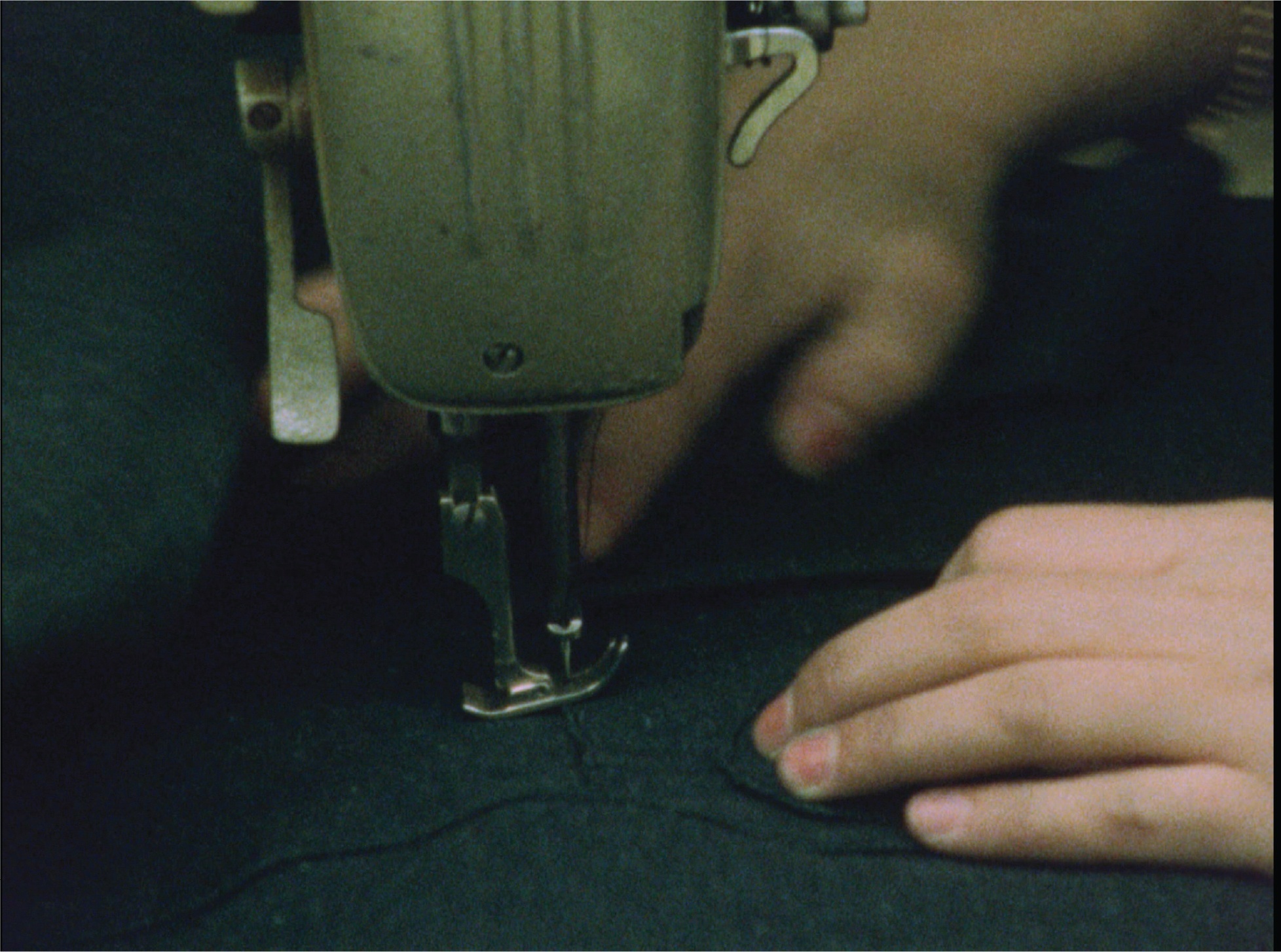
Figure 1
Still from Met hun zegenende handen. Courtesy Eye Filmmuseum
The experiences of women workers in factories reveal the systemic exploitation and lack of opportunities for professional growth. As one worker articulates, the labour performed is monotonous and devoid of skill-building potential: ‘Here we do the dumbest work. There is no possibility to grow or learn something new.’ The emphasis on speed and efficiency, dictated by factory management, creates a relentless cycle wherein workers are continuously challenged to increase productivity. One worker explains, ‘How fast you should work is defined by the factory. Once you get used to the pace, you can earn more by working faster. But as soon as you get there, you’re transferred to other machines that make it all difficult again.’ This system ensures that workers remain in a state of precarity, unable to gain stability or agency within their employment. It also reveals the structural mechanisms that keep migrant women in lower positions, limiting their professional and socioeconomic mobility.72
In response to such structural exploitations, migrant women in Europe engaged in collective organizing efforts to improve their socioeconomic and legal standing. The establishment of the European Federation of Women from Turkey in 1975 marked a significant moment in transnational feminist activism of migrant women. The documentary includes rare footage from the congress held in Frankfurt, and relays another aspect of the intersectional struggle of migrant women workers. The speaker in this scene feels the need to neatly explain that feminist struggle is not directed at husbands or male comrades, but against capitalist and patriarchal domination as a societal structure.73 In this scene, Fardjam’s camera captures migrant women worker’s efforts to establish new spaces for activist sororities.
It’s no coincidence that in the research process, Fardjam worked very closely with HTKB (Hollanda Türkiye Kadınlar Birliği, the Netherlands Federation of Women from Turkey) which, founded in 1974, has been quite an influential actor in migrant women’s activism, engaging in a wide array of social, cultural, and political campaigns at various levels to improve the position and the rights of migrant worker women.74 HTKB forged such new sisterly spaces to gather together as many women as possible from a wide array of backgrounds and to help them find their way and know their rights in their newly adopted home.
The intimate and relational dimensions of migrant women’s experiences are exemplified in the ‘letter scene,’ which features Maviye Karaman, a prominent activist of the first generation (see figure 2). In this scene, Maviye reads aloud a letter brought by another community member, who is unable to read or write. Penned by her immediate family, the letter conveys deeply personal details about their health, emotions, and everyday struggles. As Maviye lends her voice to these words, she becomes the echo of the woman’s family, and a sisterly bond between them is rendered almost tangible. This moment, characterised by shared intimacy and the relaying of personal details, offers insight into the affective dimensions of migration. Such acts of writing and reading together reflect the gendered constraints on education, as many women migrants were systematically denied access to formal learning. This scene underscores the ways in which limited literacy further marginalised and isolated women workers in the Netherlands. In this scene, hands play a significant role to relay the sisterly solidarity but also the tactility of the letter and handwriting relay the affective dimensions of diasporic longing.
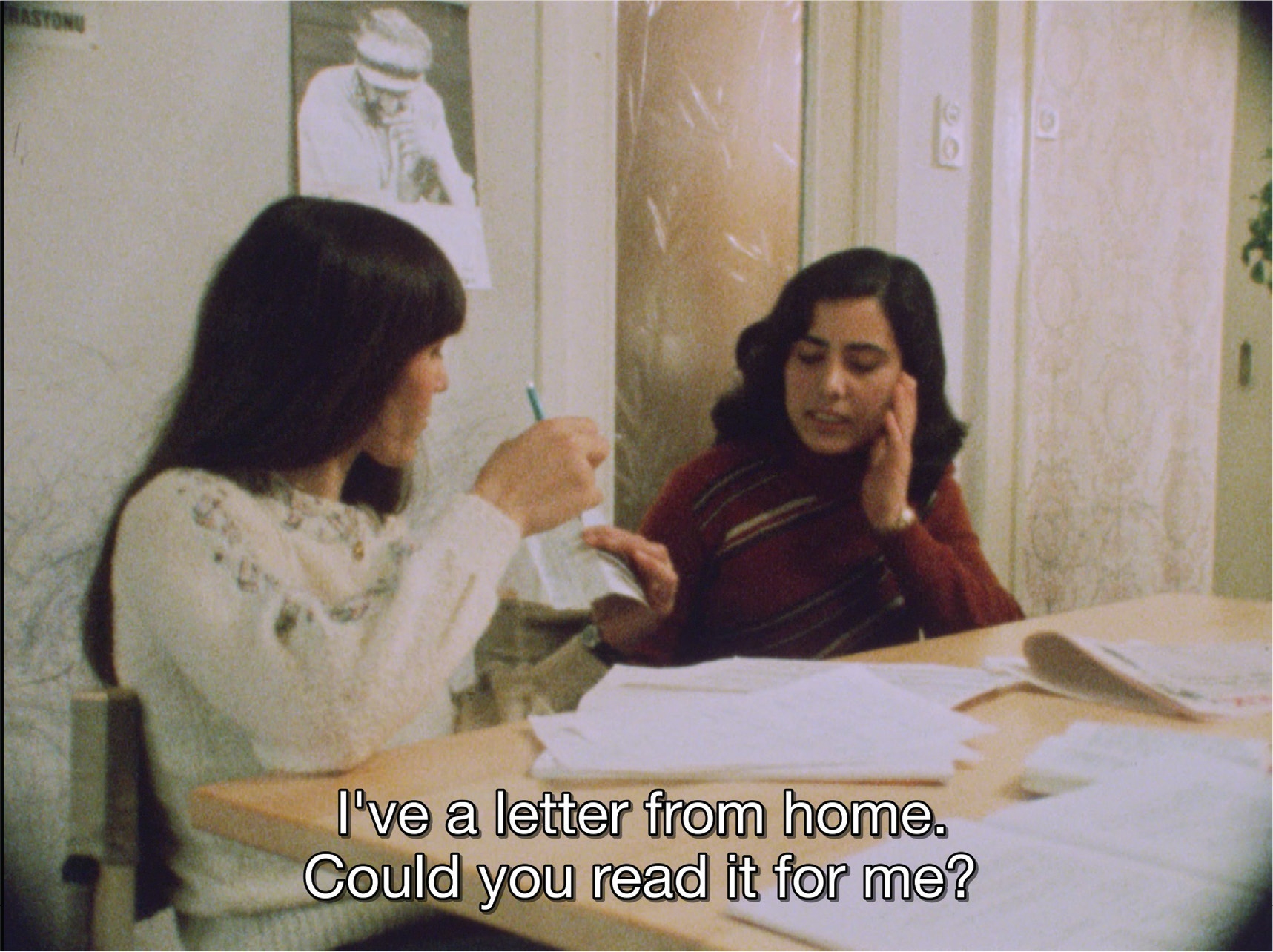
Figure 2
Still from Met hun zegenende handen. Courtesy Eye Filmmuseum
As a women’s collective, HTKB tackled such issues to empower migrant women through language classes, sewing courses, and information gatherings.75 The documentary vividly portrays these sisterly spaces, particularly culminating in a poignant scene filmed in a spacious room where women and children participate in a literacy class. The camera focuses closely on the hands of the women as they learn to write, a visual motif that functions as a synecdoche for the broader educational and vocational training that HTKB offers (see figure 3). This motif also operates metaphorically, symbolizing the process of women learning self-expression and the acquisition of a voice within the public sphere.
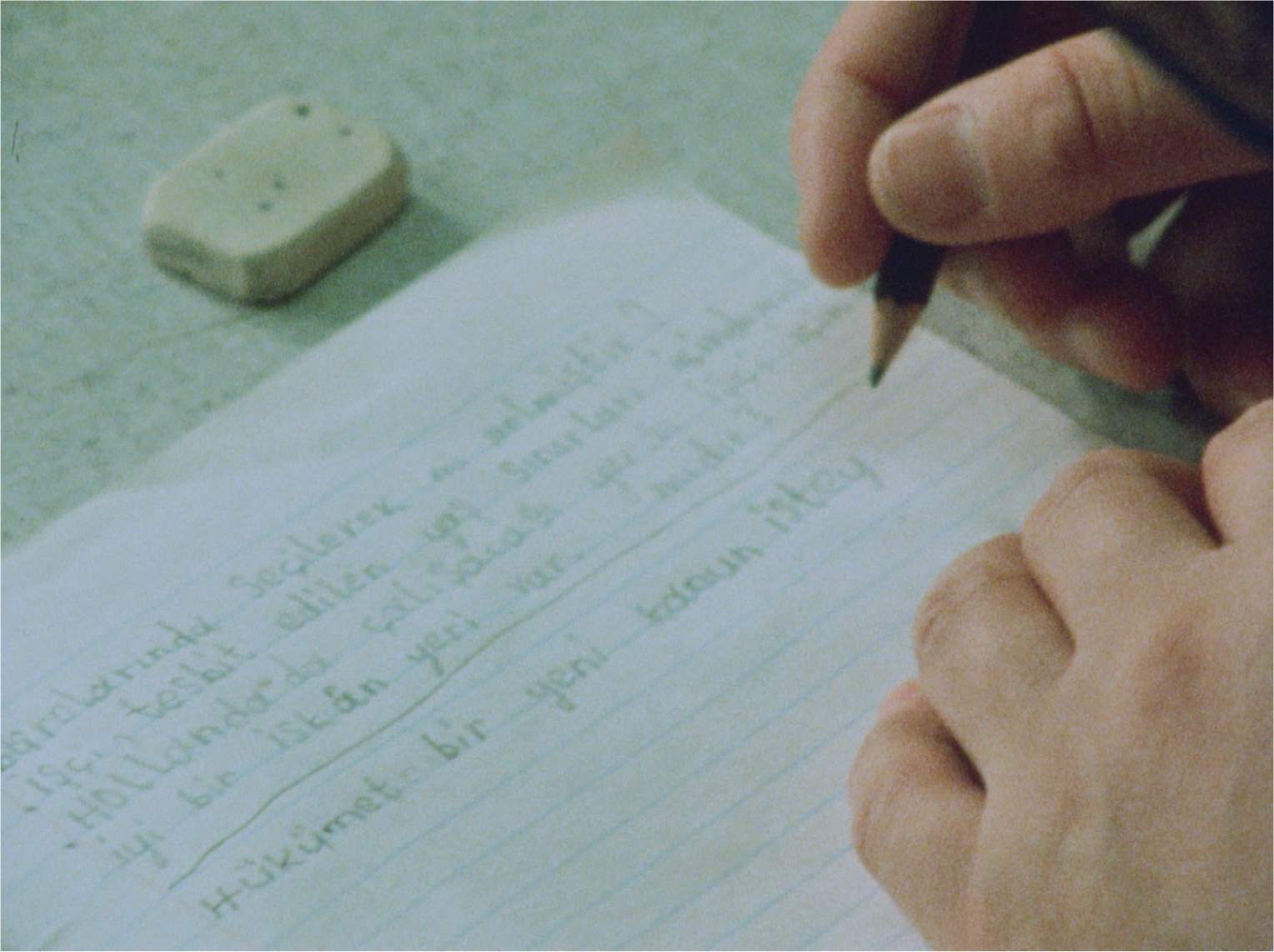
Figure 3
Still from Met hun zegenende handen. Courtesy Eye Filmmuseum
Notably, the documentary resists the simplistic equation of illiteracy with ignorance. Rather than portraying the women as passive recipients of knowledge, the film emphasises their active engagement in intellectual and political discourse. During a collective discussion scene, the women articulate progressive, insightful political views on how to improve the socioeconomic status of migrant women and young girls. The structure of this scene not only evokes a traditional classroom setting but also mirrors the dynamics of a support group, underscoring the collaborative and empowering nature of the collective. Through this, the documentary reflects a profound understanding of the intersection between education, empowerment, and political activism, portraying the women as active agents in shaping their futures—taking the matter into their own hands.
Although what we see on the screen is not a consciousness-raising group, as a reclaimed space for women’s empowerment it carries similarities. As Lesage has noted, feminist artistic expressions—particularly documentary filmmaking—parallel the efforts of consciousness-raising groups by striving to articulate women’s lived experiences in ways that transcend hegemonic interpretations.76 By the same logic, this film, much like the feminist working-class discussions it relays, serves as a means of reclaiming and redefining everyday realities through a distinctly intersectional lens, ensuring that migrant women workers’ voices and perspectives assert their rightful place in the historical narratives. As such, it not only portrays but actively fosters a ‘politicized conversation’ among women. The deliberate and reflective act of sharing one’s personal narrative as a woman—infused with both political awareness and personal depth—transforms conversation, a long-standing instrument of women’s subcultural resistance, into a potent force for social liberation.77
Another important strategy employed by Fardjam in this documentary is to move these politicised conversations from public spaces to the domestic sphere. This shift is notably exemplified in the final sequence of the film, where a lengthy dialogue unfolds in the kitchen. By situating the conversation within this domestic context, the filmmaker transforms the private realm into a site of political engagement, resonating with feminist ideologies that assert ‘the personal is political.’ The scene underscores the notion that domestic spaces are not insulated from the capitalist patriarchal structures of domination that pervade society at large.
The sequence, centred on the preparation of mantı—a labour-intensive dish in Turkish cuisine—serves as a potent metaphor for labour and resistance (see figure 4). Within this domestic setting, the interviewee shares her experiences of challenging her employer in various ways, from engaging in union activism to utilising legal avenues, and eventually resorting to civil disobedience. One of the most poignant moments in her narrative occurs when she recounts her refusal to perform cleaning tasks for which she was never hired. This act of resistance is vividly symbolised by her humming ‘The Internationale,’ a powerful anthem of class struggle, as a form of protest against her boss. Through this simple yet profound gesture, she communicates her class-based anger and asserts her agency within the broader context of labour exploitation. Reinscribing the kitchen as an ambivalent space for care and resistance at the same time, the sequence brings to mind Martha Rossler’s short film Semiotics of the Kitchen (1975) for its subversive reclamation of this feminine space.
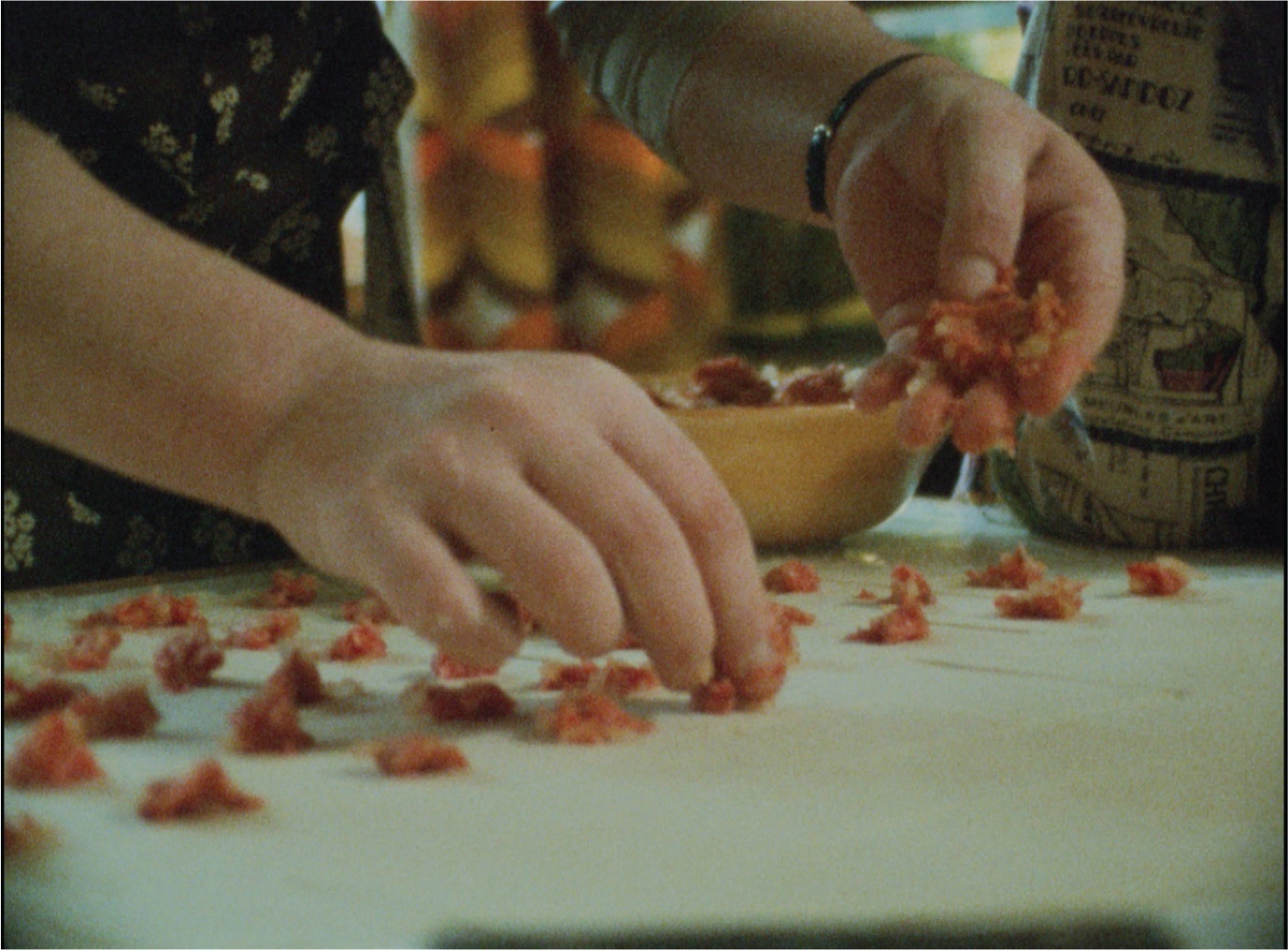
Figure 4
Still from Met hun zegenende handen. Courtesy Eye Filmmuseum
Within the patriarchal framework, the domestic space has traditionally been marginalised and seldom recognised for its political significance. Instead, it has often been framed as the domain of a seemingly powerless women’s subculture, as noted by Lesage. In the 1970s, with the exception of melodrama, film rarely depicted the domestic space as a site of political struggle. Feminist documentary filmmaking, however, has actively sought to challenge this oversight by articulating, expanding, and critically engaging with the private and domestic realms.78 One of the central aims of this genre has been to reframe the domestic sphere as an arena for political contestation and social critique.
In the documentary, the scene is structured in such a way that the intermediary interviewer casually engages in conversation with the character, subtly drawing the audience into an intimate yet politically charged dialogue. Through this seemingly simple interaction, the domestic space is redefined, no longer isolated from the public but presented as a continuous site of political engagement. This reframing reveals the interconnections between private and public spheres, emphasising how both are governed by the same political infrastructures that regulate the bodies and movements of migrant women. In these interconnections portrayed by the documentary, the recurring motif of the hand subtly encapsulates these continuities as well as the embodied aspects of women’s labour.
From this perspective, the boundaries between public and private spaces dissolve, as both are shown to be integral to the broader political dynamics at play. The scene demonstrates how the domestic sphere, far from being a passive or apolitical environment, is deeply entwined with the forces that shape the experiences of migrant women. In so doing, it highlights the potential of both spaces to serve as sites of intersectional activism, where issues of gender, class, race, and migration intersect, making both the public and private arenas crucial spaces for political action and resistance.
Observations on the Relational Mode
Earlier I introduced the relational mode as a practical concept to highlight the specific documentary strategies employed by Fardjam in her work with labour migrants from Turkey. Based on the discussion so far, it should now be clear how the relational mode differs from the six modes Nichols has identified—specifically, for taking a different approach to how reality is represented. Here, Glissant’s notion of relationality is crucial. Fardjam’s documentary style is enriched by a dynamic conception of identity to portray the complexities at play in diasporic contexts. It is evident that Fardjam’s own lived experiences of exile—at the intersection of gender and class—have influenced her documentary approach, giving it a nuanced perspective on the realities of Turkish labour migrants in the Netherlands.
According to Glissant, in diasporic contexts, identity is no longer rooted in a singular origin or fixed concept of the self; rather, it is understood through relationships and connections.79 This idea of relationality allows us to view identity not as a static, essentialised construct but as something continuously shaped by interaction with others and with the forces that govern these interactions. In Fardjam’s documentaries, this relational perspective is evident in her rejection of fixed or simplistic notions of identity. Instead, her work seeks to expose the intricate structures that inform identity, particularly in the context of labour migration. On the one hand, Fardjam’s films highlight the mechanisms of bordering that regulate the experiences of labour migrants—mechanisms that both order and other, subjecting individuals to processes of racialisation and ethnicisation. On the other hand, Fardjam’s documentaries also emphasise the solidarities and sororities that arise within migrant communities, reclaiming and forging new spaces to contest, challenge, and undermine these mechanisms. Relationality becomes a key strategy at this point, as I explained through an analysis of the two documentaries.
In both films there is a willingness to relate, with a deliberate focus on relation as a key tactic to expose, navigate, and subvert the structures of power at play.80 This emphasis on relation is notably reflected in the titles of the documentaries, which both use the proposition with (met) as a central motif. Met een nieuwe naam addresses how border crossing enacts an act of interpellation, to evoke Althusser’s notion. The documentary relates how labour migrants crossing borders are inscribed into new positionings, shaped by political, legal, and cultural systems. Similarly, Met hun zegenende handen signals the position of women’s work across public and private realms within the capitalist heteropatriarchal discourse. Particularly highlighting the interconnectedness of these realms, the latter documentary signals how exploitation of women’s material and (unpaid) affective labour is central to economic systems, ranging from agriculture to industrial and neoliberal capitalist. In their exploration of strategies that resist and contest these systems, both documentaries are characterised by an insistence on relationality and intersectionality—as documentary ethics and aesthetics.
This can be seen also in the preproduction phase, where Fardjam initiates contact with grassroots collectives and organisations. Fardjam collaborates closely with them during the writing process and works with a community member to conduct interviews—crucially, within the community’s own spaces and language. This figure, which I call the intermediary interviewer, embodies relationality in the most concrete way. They not only perform interviews, but they also interweave various spaces, including those of the community, with those of the spectators at both sides of the screen.
This necessitates that Fardjam as a filmmaker recedes to opacity. The opacity here is not the same as in observational mode, or in direct cinema. In these latter modes, the documentarian adopts a position of withdrawal, allowing the camera to assume a supposedly unmediated role as the sole purveyor of truth. In contrast, Fardjam’s opacity operates as a mechanism that conveys subjectivity and authorship, not solely through the filmmaker, but also through the intermediary interviewer and the community. This resonates with Glissantian notion that ‘relation informs not simply what is relayed, but also the relative and the related.’81 As explained earlier, this is different from Bal’s concept of ‘migratory aesthetics’ which, as an auto-theoretical method, ultimately recentres the filmmaker. In the relational mode, authorship is dispersed and co-constructed with the community, ensuring that the community remains the central focus of the narrative.
Finally, it is essential to emphasise the multilingual dimension inherent in the relational mode. As Glissant asserts, ‘Relation is spoken multilingually.’82 This translingual aesthetic is manifested in the capacity to navigate and blend multiple languages, a defining characteristic of migration and displacement. Such stylistic elements encompass not only the literal coexistence of diverse languages but also, on a more metaphorical plane, language as a strategic tool for reclaiming visibility, space, and opacity. As we have seen, by actively choosing to foreground the Turkish language in both documentaries, Fardjam’s representational strategies reclaim visibility and space for self-expression of the Turkish migrant community. At the same time, because the majority of the soundtrack is in spoken Turkish, a certain opacity emerges: the Dutch voiceover or subtitles cannot fully capture all that is said, leaving elements untranslatable and rendering some meanings legible only to the community itself.
To sum up the discerning characteristics of the relational mode based on Fardjam’s documentary filmmaking, the discussion thus far has clarified how this mode diverges from the six modes identified by Nichols, particularly in its approach to representing reality. Central here is Glissant’s notion of relationality, which shapes both the filmmaker’s engagement with and mediation of migration. Although the relational mode draws on techniques associated with each of Nichols’s modes, it is distinguished by this underlying orientation. While it bears similarities to the participatory mode, it departs from it in a crucial respect: the boundary between filmmaker and subject is destabilised, at times collapsing altogether. This is evident when participatory techniques are delegated to an intermediary interviewer—someone embedded in the community and fluent in its language. Such mediation introduces elements of performance and reflexivity downplayed in conventional participatory practice. The relational mode may also incorporate observational strategies, such as ‘fly-on-the-wall’ technique. Yet these moments are never neutral; they are inflected by a reflexive awareness of filmmaker’s positionality, i.e., who is watching/filming? Fardjam negotiates this through what can be described as an opaque self-positioning: her own diasporic and migrant experience informs the documentary’s representational strategies, but she resists foregrounding herself, allowing the filmed communities to remain at the centre of visibility. In this sense, her role is not simply observational but also mediating—relaying the community’s lived realities in a manner akin to Maviye’s act of lending her voice to another’s words, emotions, and affections when reading a letter.
Looking ahead: intersectional archival activisms
In Accidental Archivism, Strathaus and Hediger highlight the precarious nature of activist film repositories, which often emerge from the tension between informal opposition groups and established state apparatuses.83 These archives, housing a diverse range of materials from 16mm film and video to incomplete scripts, treatments, funding applications, and outtakes, reflect the instability and fragility of the contexts from which they arise. However, these issues are not limited to ‘activist film repositories’; they also pertain to the filmic and film-related material that are preserved in relatively more established institutions. To broaden the scope of such repositories towards a global women’s heritage, it is essential to centre the marginalised artifacts of displaced women of colour involved in radical filmmaking, especially in contexts of migration. When researching migrant, displaced, and diasporic women documentary filmmakers, it becomes evident that the archives are insufficient, and these limitations must be actively confronted and transcended.
An intersectional archival strategy is crucial in this effort. Such a strategy serves two purposes: first, to challenge historical silences, and second, to secure and preserve the work of diasporic women of colour filmmakers. This requires not only transforming archival processes but also imagining new ways of sustaining their contributions. Building on Caswell’s model of feminist standpoint appraisal, an intersectional approach calls for prioritizing heritage neglected by traditional archival institutions at all levels of archival practice, from preservation to presentation.
As Kate Eichhorn asserts, the goal should be to move beyond seeing women solely as objects to be archived and instead empower them as subjects of archiving.84 This can be achieved through stimulating greater participation and collaboration. For those engaged in the study of displaced, dispersed, and diasporic heritage, intersectional archival strategies can expand women’s film heritage substantially. Such a shift is not merely about interpreting the past but about transforming it,85 ensuring that the legacies of marginalised filmmakers such as Fardjam are not only preserved but also amplified within global histories of radical film cultures.
Notes
[1] * I wish to thank Gert Jan Harkema, Andrea Meuzelaar, Carrie Lou Hamilton and the anonymous reviewers for their invaluable feedback on the drafts of this article.
[2] See for example Maggie Hennefeld and Laura Horak, “Editors’ Introduction: Why We Curate Feminist Film Archives,” Feminist Media Histories 10, no. 2–3: 1–9; Lizelle Bisschoff et al., Stretching the Archives Toward a Global Women’s Heritage (Archive Books, 2024).
[5] For an in-depth discussion on ‘writing back’ as feminist historiographical method, and its limitations, see Jane M. Gaines, “Film History and the Two Presents of Feminist Film Theory,” Cinema Journal 44, no. 1 (2004): 113–19; Jane M. Gaines, Pink-Slipped: What Happened to Women in the Silent Film Industries? (University of Illinois Press, 2018).
[6] For a classical intervention and in-depth critique of male-dominant paradigms in art history, see Griselda Pollock, Vision and Difference: Feminism, Femininity and Histories of Art (Taylor and Francis, 2012[1988]); Pollock, Differencing the Canon: Feminist Desire and the Writing of Art’s Histories, (Routledge, 1999).
[7] Michelle Caswell, “Dusting for Fingerprints: Introducing Feminist Standpoint Appraisal,” Journal of Critical Library and Information Studies 3, no. 2 (2019), n.p.
[8] Giuliana Bruno, “Ruined Map, Relinked: A Postscript,” in Incomplete: The Feminist Possibilities of the Unfinished Film, ed. Alix Beeston and Stefan Solomon (University of California Press, 2023), 322–347.
[11] The interest in the systematic difficulties faced by women filmmakers in getting their film projects done, and the study of unfinished, abandoned, or incomplete film project has been growing in the scholarship. See Alix Beeston and Stefan Solomon, ed., Incomplete: The Feminist Possibilities of the Unfinished Film (University of California Press, 2023); Philip Widmann, ed. Film Undone: Elements of a Latent Cinema (Archive Books, 2024).
[13] At the time of writing, Eye Filmmuseum and HagheFilm are preparing a digital copy of Fardjam’s Met hun zegenende handen.
[14] See for example: Sheila Petty, Contact Zones: Memory, Origin, and Discourses in Black Diasporic Cinema (Wayne State University Press, 2008); Shilyh J. Warren, Subject to Reality: Women and Documentary Film (University of Illinois Press, 2020).
[15] In this article, I’m using intersectionality as a critical analytical tool: see Patricia Hill Collins and Sirma Bilge, Intersectionality (Polity, 2020). For uses of intersectionality in archival frameworks, see Verne Harris, Ghosts of Archive: Deconstructive Intersectionality and Praxis (Routledge, 2021).
[17] Intersectionality as a critical analytical lens moves from ‘what intersectionality is’ to ‘what intersectionality does,’ i.e., what it allows us to see that normally remains invisible in intersecting power relations. Collins and Bilge, Intersectionality, 5.
[18] Roel van Broekhoven, “Een vier jaar lang durende angstdroom,” De Volkskrant, February 24, 1979.
[24] Kevin Smets et al., ed., The SAGE Handbook of Media and Migration (SAGE Publications, 2025); Koen Leurs and Sandra Ponzanesi, ed., Doing Digital Migration Studies: Theories and Practices of the Everyday (Amsterdam University Press, 2024); Radha Sarma Hegde, ed., Mediating Migration: Global Media and Communication (Polity Press, 2016).
[25] The Dutch title literally translates as ‘With Their Blessing Hands,’ but the documentary circulated internationally as With Their Blessed Hands; this article follows the international title.
[26] bell hooks, “Choosing Margin as a Space of Radical Openness,” Framework: The Journal of Cinema and Media 36 (1989): 20; Stuart Hall, “Un-Settling ‘the Heritage’, Re-Imagining the Post-Nation: Whose Heritage?” Third Text 13, no.49 (1999): 3–13.
[27] Joanne van Selm, “Migration in the Netherlands: Rhetoric and Perceived Reality Challenge Dutch Tolerance,” Migration Information Source, Migration Policy Institute, May 2019, accessed March 29, 2025, https://www.migrationpolicy.org/article/migration-netherlands-rhetoric-and-perceived-reality-challenge-dutch-tolerance.
[28] Policial Film Archives Collective, “Archives for Change: Political Films and The City: The Case of Amsterdams Stadsjournaal (1974-1984),” Mediapolis: A Journal of Cities and Culture 2, no. 9 (2024): n. p., https://www.mediapolisjournal.com/2024/06/archives-for-change/. See also the 1973 NOS documentary Stroming: Video, de nieuwe bewustmaker by Wim Povel and Hans Verschoor on the emerging film clubs and collectives in the Netherlands.
[30] This silence is even more palpable given that Hogenkamp did highlight Fardjam’s work in an edited volume on cinemas of migration in 1979: Bert Hogenkamp, “En Hollande,” in Cinemas de L’Emigration, ed. Guy Hennebelle, special issue CinémAction: Revue Internationale Art et Politique 8 (1979): 178–179.
[31] Cinemien’s screening programme, entitled ‘As Women See It,’ bringing together seven documentaries by independent women filmmakers, included Fardjam’s film Kinderen toen en nu (1981), screened alongside Maria Barea’s Mujeres en el Planeta, Attiat El-Abnoudy’s Permissible Dreams, Helke Sander’s Der Begin Aller Schrecken ist Liebe, and Chantal Akerman’s Pina Bausch, highlighting its position within a broader feminist and transnational cinematic discourse. Cinemien catalogues can be consulted at ATRIA: Institute on Gender Equality and Women’s History and at Cinemien Archives at Eye Filmmuseum. For more information on the Cinemien collective, see Gerdien Smit, “The Women of the Dutch Feminist Film Collective Cinemien: A(n Oral) History,” Journal of Film Preservation 112 (April 2025): 33–39.
[33] Brian Groombridge, Television and its People: A Programme for Democratic Participation (Penguin, 1972), cited in Hogenkamp, De Nederlandse Documentairefilm, 39.
[34] Following the success of the documentary Een boterham met tevredenheid (1971), the series Van Onderen highlighted more working-class experiences; a companion volume of letters, interviews, and poems appeared as Van onderen (Amsterdam: Van Gennep, 1972).
[35] Salomé Aguilera Skvirsky, The Process Genre: Cinema and the Aesthetics of Labor (Duke University Press, 2020).
[36] For a comprehensive study, see Andrea Meuzelaar, Seeing through the Archival Prism: A History of the Representation of Muslims on Dutch Television (PhD diss., University of Amsterdam, 2014), which includes a section on the representation of ‘guest workers’. As Meuzelaar focuses primarily on the religion aspect, the internationalist working-class alliances and its political aesthetics within the documentary filmmaking from this era warrant further analysis and research.
[37] It is worthwhile tracing the influence of this style in the documentaries made with labour migrants in the later years. For example, Amsterdams Stadsjournaal No. 5 (1975) also focuses on Turkish guest workers and their internationalist working-class activism around the NDSM protest action, portraying HTIB as a political actor.
[39] Mieke Bal, “Documenting What? Auto-Theory and Migratory Aesthetics,” in A Companion to Contemporary Documentary Film, ed. Alexandra Juhasz and Alisa Lebow (Wiley, 2015), 124–144.
[48] T. J. Demos, The Migrant Image: The Art and Politics of Documentary during Global Crisis (Duke University Press, 2013), 2.
[49] Jacques Rancière and Gabriel Rockhill, The Politics of Aesthetics: The Distribution of the Sensible (Zed Books, 2013).
[50] For an in-depth discussion of the title and the opening sequence in terms of ‘naming’ and ‘self-naming,’ see Aslı Özgen, “Unsettling Borders of Archives: Activating the Audiovisual Heritage of the Turkish Community in the Netherlands,” VIEW Journal of European Television History and Culture 12, no. 24 (2023): 54–69.
[51] Nadica Denić, “Cinematic Ethics of Migration: First Person Voices in Contemporary Documentary” (PhD diss., University of Amsterdam, 2024); Martina Tazzioli and Nicholas De Genova, “Border Abolitionism: Analytics/Politics,” Social Text 41, no. 3 (2023): 4.
[54] Henk van Houtum and Ton van Naerssen, “Bordering, Ordering and Othering,” Tijdschrift voor Economische en Sociale Geografie 93, no. 2 (2002): 125–136.
[56] Mireille Rosello, Postcolonial Hospitality: The Immigrant as Guest (Stanford University Press, 2001), 9.
[57] More research into the Bruynzeel Factory’s archives, preserved in Gemeentearchief Zaanstad, may highlight more information on the housing conditions of labour migrants; https://hdl.handle.net/21.12112/02ABF19FF9FB480384DDC762B10A1973.
[59] Rolando Vázquez, “Aesthetic and Epistemic Restitution for the Joy of Life: Recalling Earth, Overcoming the Contemporary, Knowing Otherwise,” Errant Journal 5 (2023), 51–62.
[60] Credited as director’s assistant, Heleen de Wit also made Turkish Way of Democracy (1973, Amsterdams Stadsjournaal), filmed largely in Turkey and addressing human rights violations under the new military regime (preserved at Eye).
[61] Cineclub Vrijheidsfilms archives at the IISH also contain ‘viewer surveys’ from various screenings of this film at political contexts.
[62] For an in-depth study of HTKB’s media tactics and their archival status, see Aslı Özgen, “Screen Memories: The Audiovisual Heritage of Turkish Migrant Women in the Netherlands Across Political Film, Video, and Television,” TMG Journal for Media History 27, no. 1 (2024): 1–31.
[63] Interkerkelijke Omroep Nederland (IKON) was set up in 1976, so this must be an early project by the broadcast company. More research is needed into this context at the IKON archives.
[64] Boel Ulfsdotter and Anna Backman Rogers, ed., Female Authorship and the Documentary Image: Theory, Practice and Aesthetics (Edinburgh University Press, 2018), 2.
[66] Julia Lesage, “The Political Aesthetics of the Feminist Documentary Film,” Quarterly Review of Film Studies, 3(4): 507–523.
[69] Barry Monohan, Hands on Film: Actants, Aesthetics, Affects (Amsterdam University Press, 2022); Lucy Bollington and Michele White, “Screening Hands: Introduction,” Screen 65, no. 4 (2024): 554–563. See also Meuzelaar, Seeing through the Archival Prism, on Ze zien liever mijn handen dan mijn gezicht (1980), where hands signify labour, and the face identity in the context of Moroccan migrant youth in the Netherlands.
[70] Scott Curtis, “Images of Efficiency: The Films of Frank B. Gilbreth,” in Films That Work: Industrial Film and the Productivity of Media, ed. Vinzenz Hediger and Patrick Vonderau (Amsterdam University Press, 2009), 85–100.
[73] In fitting with its focus on systems of exploitation, the documentary was screened at the International Human Rights Festival in France (8–14 November).
[74] The strategic positioning of migrant worker women’s movement as ‘not against male comrades’ but against capitalist patriarchy as a system is also the key message of another film focusing on migrant women’s empowerment: Kara Kafa (1979), produced in Germany.
[80] Glissant, Poetics of Relation, 18. Glissant’s critique of the myth of identity rooted in a singular origin remains relevant in today’s antiimmigrant discourse.
[84] Stefanie Schulte Strathaus and Vinzenz Hediger, “Capillary, Migratory, Projective: Inventing Cinema’s Past So That It May Have a Future,” in Accidental Archivism, ed. Stefanie Schulte Strathaus and Vinzenz Hediger (meson press, 2023), 13–18.
Biography
Aslı Özgen is an assistant professor of media and culture at the University of Amsterdam. Rooted in intersectional feminist and decolonial praxis, her current research focuses on the audiovisual memory of contested pasts, as well as archival and activist practices concerning diasporic film heritages. Presently, she is working on a book about the audiovisual heritage of migration from Turkey to the Netherlands, with a particular emphasis on the political uses of film in (international and transnational) solidarity networks, as well as the archival status of this material.