
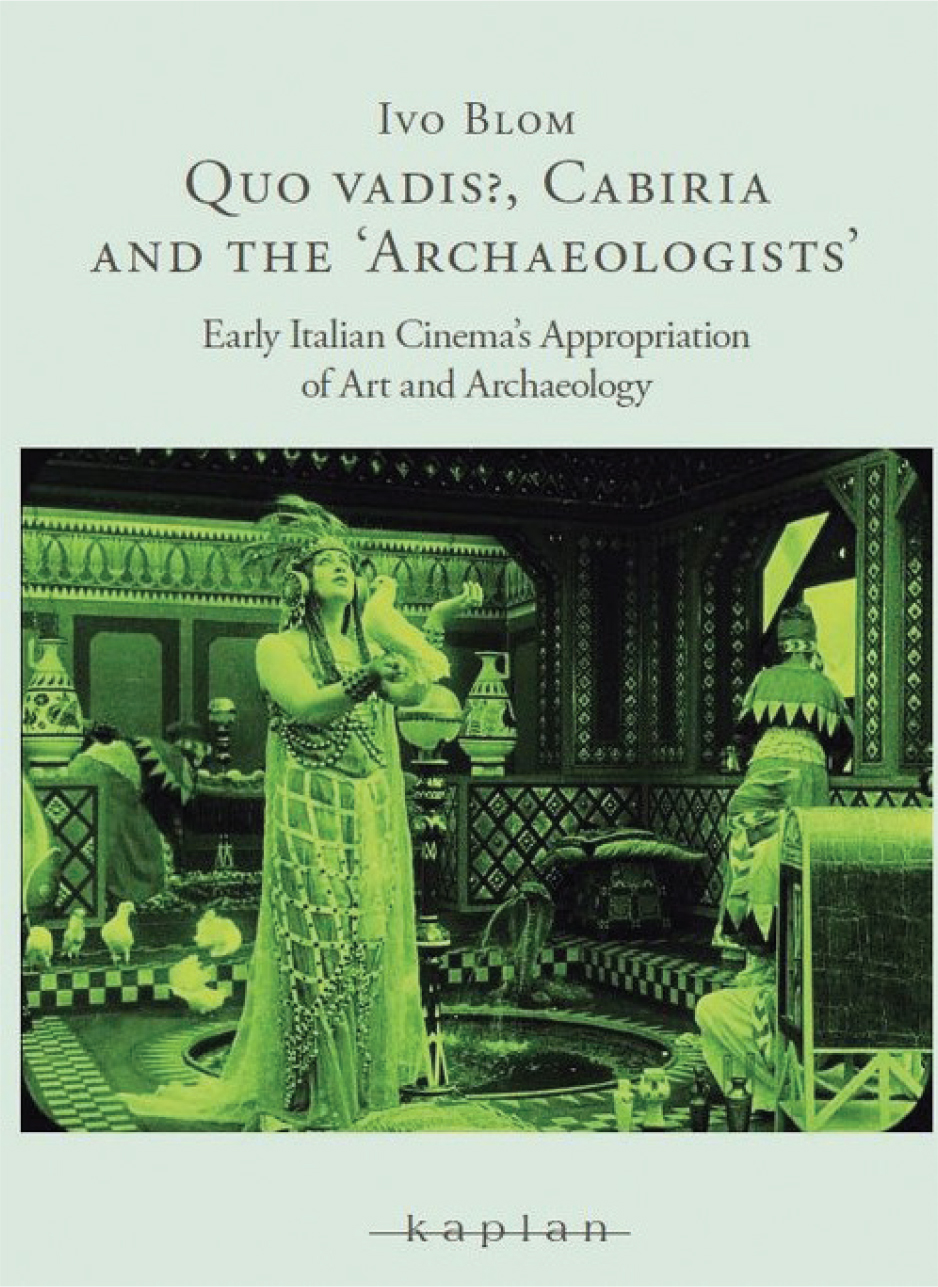
Ivo Blom’s extensive – given the films that he analyses, one is tempted to use the epithet ‘monumental’ – study discusses a group of Italian films made in the early 1910s and set in Roman antiquity. These were highly ambitious artistically and, for their times, impressively long and expensive cinematic works, produced for an international market. They were part of an ongoing process of ‘gentrifying’ cinema in order to attract middle class audiences and to accumulate cultural capital for the medium. Blom discusses in particular films based on the international bestsellers The Last Days of Pompeii by Edward Bulwer-Lytton (1834) and Quo vadis? by Henry Sienkiewicz (1895), as well as the epic picture Cabiria (1914) by Giovanni Pastrone, who had secured the collaboration of Gabriele D’Annunzio. The latter was highlighted as the ‘author’ of the film in the promotion campaign to emphasise the cultural status of the picture, with its action set during the Punic wars.
Blom focuses on the ways in which these productions aimed at creating an image of Roman and Punic antiquity that suggested historical authenticity by responding to the contemporaries’ ‘horizon of expectation’ (Hans Robert Jauss). These expectations had been shaped by a series of successful and much reproduced paintings that were discursively framed as ‘authentic’ representations, based on historical and archaeological research. Filmmakers then replicated ancient artefacts, some of which had been popularised by these paintings for their set design. What is important in Blom’s approach is that he looks at the films as being emmeshed in intermedial, transmedial, and transnational networks: he patiently reconstructs the circulation of visual elements within a large field of representations, including paintings and their various reproductions in popular imagery, illustrated novels, sets for stage productions of, for instance, operas set in Roman, but also Egyptian etc. antiquity, publicity materials, and others. Nineteenth-century historical paintings, in particular, have a prominent position in Blom’s study, but rather than looking at the relationship between painting and cinema in terms of ‘influences’, he takes his cue from art historian Michael Baxandall and speaks of ‘appropriations’. Despite having been connoted negatively in recent debates, ‘appropriation’ proves to be a productive concept to study the active selection, adaptation, and transformation of visual elements from a variety of origins by these Italian filmmakers in the 1910s.
In the first chapter, Blom follows the intricate pathways through which historical paintings, and especially Jean-Louis Gérôme’s Pollice verso (1873) and The Christian Martyr’s Last Prayer (1863-83), have found their way into films such as Enrico Guazzoni’s Quo vadis? (1913). Gérôme’s paintings, in a way, had set a standard for the representation of certain scenes from Roman life and were disseminated transnationally in a variety of forms. They thus became part of a visual repertoire that filmmakers, too, could draw from. In this context, Blom also offers a nuanced discussion of the claim that Gérôme’s paintings themselves were ‘pre-’ or ‘proto-cinematographic’, pointing out the pitfalls of such anachronistic observations, while emphasising that the cinematic afterlife of, for instance, Pollice verso, was not an accident.
The second chapter is dedicated to the Anglo-Dutch painter Lawrence Alma-Tadema, whose – largely Victorian – vision of the ancient world was said in 1968 to have inspired Hollywood. As Blom shows, elements from Alma-Tadema’s paintings were appropriated by, among others, Guazzoni, to authenticate his cinematic representation of certain scenes or locations. Blom points out that Alma-Tadema had been actively involved in stage design, among others for a production of Shakespeare’s Coriolanus. As in the case of Gérôme, Alma-Tadema’s work, too, circulated transnationally, which made it available for film directors. Certain elements, in particular pieces of furniture, were repeatedly used as props by filmmakers. Blom furthermore demonstrates that spatial compositions in Alma-Tadema’s paintings seemed to have served as models for cinematic scenes with staging in depth.
The third and fourth chapters discuss Giovanni Pastrone’s Cabiria, arguably the most ambitious Italian production of that time. Chapter three investigates the role of the imagined Carthage in Gustave Flaubert’s novel Salammbô (1862, Italian translation 1905), and visualised in an edition illustrated by Georges-Antoine Rochegrosse published in 1900. The same goes for the work by Gérôme’s student Henri-Paul Motte, whose depiction of Baal-Moloch was adopted, and adapted, by Pastrone. Once more, Blom patiently retraces the transmedial and transnational circulation of these iconographic materials. This is followed by a chapter in which the author delves deep into the actual archaeological knowledge about Carthage and Punic culture around 1900. He tries to reconstruct, necessarily with a certain degree of speculation, which artefacts Pastrone could have seen on display in the museum collections accessible to him at that time. Here, Blom unfolds once more the impressive range of his painstaking investigations, including the fruits of the many conversations he had with curators and other experts.
Ivo Blom’s book is the result of many years – actually several decades – of his engagement with this topic, and his profound knowledge is evident on each and every page. What makes this volume particularly interesting is the rich iconography that underpins the argument. Quite a number of the 138 illustrations come from the author’s own collection, which points to the fact that this research project has been conducted with intense passion. Blom’s book is undoubtedly a seminal contribution to the study of early Italian cinema.
Biography
Frank Kessler, emeritus professor of Media History, Utrecht University. f.e.kessler@uu.nl