
Introduction
‘Hip Hop music in the Netherlands has got so big because it was horizontal from the start, rather than vertical,’ Sherlock argued to me. He is the frontman of Zombi Squad, a crew founded in 1988. They hail from Groningen, the biggest city in the north of the Netherlands and far removed from the affluent West of the country. We were sitting in the office (that looked more like a small recording studio) of his newly opened Jiu-Jitsu dojo while we were having one of our many discussions. I came to understand that Sherlock used ‘vertical’ to describe a linear way of looking at Dutch Hip Hop history that describes the dissemination of culture from the United States to the country’s centre (megalopolis the Randstad), and then its peripheries like Groningen. Opposing this linear genesis, Sherlock argued that Hip Hop in the Netherlands developed horizontally, because people from all over the country were busy with Hip Hop culture around the same time. He referred to a time where rapping in English was the norm in the Dutch scene. These practitioners formed a network enacted through shared practice before there was a substantial commercial market to speak of. ‘Without that, it [Hip Hop] wouldn’t be here today,’ the veteran MC stated.
The ‘vertical’ narrative regarding Dutch Hip Hop history, can be observed in mainstream media representation in the Netherlands. The knowledge centre of public service broadcasting, NPO Kennis’ article called ‘How did Hip Hop end up in the Netherlands?’ is illustrative of this teleological origin story.1 They first mention the culture’s origin in the Bronx, and then briefly state that practitioners in the Netherlands used to rap in English without mentioning any names bar Extince. They then move on to extensively describing Osdorp Posse’s influence and rise, followed by Extince. NPO’s online public education platform, Schooltv, states: ‘It started with copying American Hip Hop. Then artists like Extince and Osdorp Posse start making Dutch-speaking Hip Hop.’2 3voor12, a multimodal platform for pop music, presents a similar genesis: ‘Most rappers in the Netherlands wrote English lyrics. The Amsterdam boys from Osdorp Posse were about the first, in 1990 (…) to start rapping in Dutch.’3
Accounts of Hip Hop history often start with a short paragraph about its origins in the Bronx, with a brief mention that people used to rap in English in the Netherlands. They then fast forward to Dutch-language Hip Hop artists Osdorp Posse and Extince as forefathers, and the genres subsequent commercial success.4 Since the nineties Dutch-language rap has risen to new commercial heights, becoming fully entrenched into Dutch popular culture at large.5 The linear narrative about the first few decades of Hip Hop history in the Netherlands, however, glosses over anglophone rap music in the Netherlands and makes it seem inconsequential. Furthermore, because Osdorp Posse is from Amsterdam, and Extince operated in an Amsterdam scene as well, this narrative implies that Hip Hop that was consequential to the genres development started in the country’s west and then spread out to its peripheries when rap music became more commercially popular.
But what do we potentially overlook in this version of events? In this paper I examine Zombi Squad’s career trajectory, being part of an anglophone scene, in the eighties and nineties to explore what Sherlock describes as Hip Hop’s ‘horizontal’ development. I analyse the CD’s they contributed to or released themselves as artefacts that display the social interactions taking place within a particular conjuncture. As a case study they provide an alternative vantage point into Dutch Hip Hop history as a perspective ‘from the margins,’ being from Groningen, a city in the country’s peripheral north.
To situate the Zombi Squad within the historical conjuncture of the eighties and nineties, I transpose Sherlock’s horizontal approach to one of rhizomatic thinking. As a concept, the rhizome focuses on connections between different points and finds its meaning in the relationship between them.6 It is contrary to an approach that focuses on origin and linear progressions as if sprung from a single root. As such, it breaks with the fixity of a linear development of culture because ‘the rhizome is anti-hierarchical and a-centered.’7 As an anti-essentialist approach, the rhizome shifts the focus to routes, detours, and contacts between (unlikely) places and individuals. Especially in a Black Atlantic context, a focus on the connection between various places and people is important to understand Hip Hop’s global emergence, given the essential participation and contribution of diasporic communities.8 Similar to Kirsty Lohman’s study on the Dutch Punk scene, I look at the Hip Hop scene of the eighties and nineties in the Netherlands as a rhizomatic network consisting of practitioners all over the country.9 Differing from Lohman, however, I apply the rhizome not only as an organisational principle but also how these routes, detours, and contacts affect identity formation in a sometimes-hostile country. As philosopher Édouard Glissant argues, ‘what becomes important is not so much each root’s claim to be an absolute… but the manner in which it enters into contact with other roots.’10 In the case of the early Dutch Hip Hop scene, I explore how identity formation, through these rhizomatic networks, is connected to the practice of the four elements (graffiti, DJing, breaking, and MCing). Thus, my research question is as follows: How did the rhizomatic character of the Dutch Hip Hop scene contribute to its overall development?
By analysing Zombi Squad’s trajectory and situating them in the larger Hip Hop scene rhizomatically, I heed the call of media historian Jesper Verhoef to pay more attention to eighties and nineties media histories as a pivotal precursor to understanding our current conjuncture.11 As such I also build on the insights of Hip Hop scholar J. Griffith Rollefson that ‘today’s Europe is most clearly defined (…) through the profound and ubiquitous resonances of Europe’s imperial histories on the global stage.’12 A rhizomatic focus on Hip Hop history and its media artefacts, I argue, brings into view how these ‘resonances’ are interconnected with the development of the Dutch scene. As I will argue in this paper, this decentring brings back into view the essential role of practitioners with a Surinamese and Dutch-Antillean background, as well as people from in the country’s peripheries, in the development of the Dutch Hip Hop scene.
Firstly, I examine Zombi Squad’s rise in the north and subsequently the rest of the Dutch national Hip Hop scene while paying attention to the rhizomatic nature of these interactions. Secondly, I examine how Hip Hop as a Black Atlantic expression relates to the postcolonial migration patterns to the Netherlands. Thirdly, by contextualising Zombi Squad socio-politically, I argue that Hip Hop was a creolizing culture that facilitated a common identity and community against the backdrop of racialised living in the Netherlands because of its rhizomatic interaction. Fourthly, I reflect on how these findings relate to Hip Hop’s canonization.
Methods
This paper is based on ethnographic fieldwork between late 2021 and 2022 that was part of my Anthropology Master’s research in Groningen and Amsterdam, and subsequently on ongoing ethnographic research done during my PhD from 2022 to 2024 in Groningen, Amsterdam and The Hague. Relevant to this case study, I conducted 14 semi-structured interviews with Zombi Squad members Sherlock, MC Shockwave, Illkid, and Mad Pat, supplemented by numerous informal conversations both in person and online. Additionally, I conducted both semi-structured interviews and had informal conversations with practitioners familiar with the Groningen Hip Hop scene as well as with practitioners in other parts of the country who have historical ties with Zombi Squad such as MistaSweet and Sugacane. The semi-structured interviews were recorded in various settings: from dojo’s, studio’s, and café’s, to parks, video calls (during the pandemic), or at my or their home. Informal conversations took place while frequenting relevant social or musical events, online via chat, calls, or during studio sessions. The continuing interaction with these practitioners and the oral histories that in some cases have not been previously documented allowed me to develop my own thoughts, situate events, musical releases, and cross-check for historical accuracy.13 They also underscore that for me, ‘ethnography is, by definition, collaborative.’14
I have analysed relevant academic sources as well as national newspapers, and online news and Hip Hop oriented websites. Thanks to Sherlock, I have also been able to access his private archive where he has documented everything related to Zombi Squad for the last 30+ years. This includes between 400 and 500 gigabytes of digital material: music, video footage, and images, as well as boxes (30x20x50cm) of flyers, newspaper articles, correspondence letters, notes, photo negatives, CD’s, vinyl pressings, cassette tapes, and more.
Zombi Squad
Zombi Squad’s formation emerges from the interaction between various Hip Hop crews in the province of Groningen. Its capital, also called Groningen, is the biggest city in the northern part of the country consisting of the provinces Friesland, Drenthe, and Groningen. Hip Hop culture, however, did not simply trickle into the villages and smaller cities via the provincial capital. By looking at Zombi Squad’s formation, I show how the emergence of a Hip Hop scene was a rhizomatic process facilitated through practice, in which Groningen was an important location.
The entry point into Hip Hop for many practitioners was not rapping and DJing but breaking and graffiti. While many of the early graffiti writers did not have any attachment to Hip Hop, graffiti eventually ended up under the umbrella of Hip Hop culture with the other elements MCing, DJing, and b-boying. And with that, it reached a new group of soon to be practitioners. Zombi Squad, in its formational phase in the eighties, was not a group of musicians. It was a group of young creatives who practiced all of Hip Hop’s traditional elements.
One of these crews was the Street Beat Boxers, or SBB for short. Their rivals at the time were Def RC Posse (see figure 1). The group consisted of beatmaker and DJ, D.R.C. (later Soeki), graffiti writer Mickey (then still rapping too), who would later receive international acclaim as Mick La Rock, rapper, and dancer Hellraiser, DJ, rapper, and dancer Mr. Nash, and turntablist and dancer Freez. The two rivalling crews had a battle where they competed with rapping, scratching, and beatboxing at the music venue Vera in Groningen in 1988. After that, the tension between the groups subsided and they started collaborating. Quicky after, rapper Sherlock, rapper and producer Mad Pat, and rapper MC Chain formed the Independent Rhyme Scientists. Together they were considerable in size. Over time others joined as well, from b-boys and b-girls, graffiti artists, to DJ’s, beat creators, and MCs. These practitioners collectively became Zombi Squad in 1988.
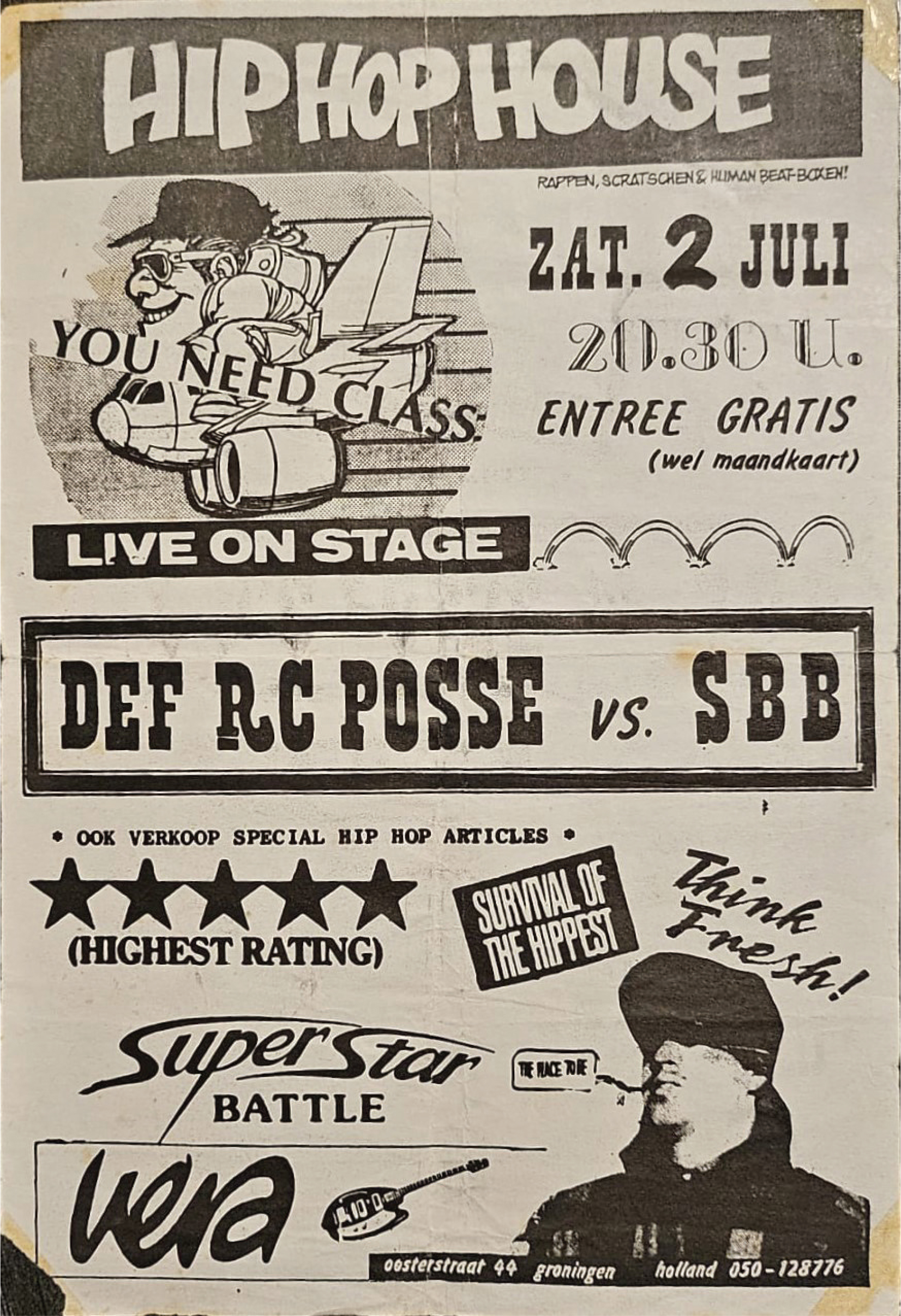
Figure 1
Flyer battle SBB vs Def RC Posse.
Because of their size, Hip Hop related activities started to revolve around Zombi Squad, and people looking for Hip Hop in the northern provinces automatically looked in their direction. Its wide array of members shows that although Groningen was the hotspot with the most opportunities and venues, the cultural influence from city to more rural areas went both ways. While most members resided in the city, not everyone did. Rapper E-Ryan was from Hoogezand, a town eastward of Groningen. Skoa Patrol duo Skine and Oane came from a tiny village in Groningen called Oldehove with a population of less than two thousand. DJ Freeze was from a neighbouring village Zuidhorn. Shockwave, one of the younger members, at first a dancer with Hellrazor in the dance crew Hellway Zone, and later one of the two main MCs lived in Hoogkerk, a town directly next to Groningen city. Through practicing Hip Hop’s elements, an informal infrastructure emerged that connected different regions in the province to each other like roots reaching out to one another. These practitioners connected with each other through practicing the four elements and contributed to an interconnected scene in the north of the Netherlands.
Cultural centre Simplon allowed Zombi Squad to practice and use one of their stages every Sunday in the late eighties. At the time, the centre was also important to the Punk scene in Groningen.15 While Zombi Squad practiced their live performance routine, over time more people came to dance, rap, or just hang out and see their friends. Slowly it became the de facto meeting point for practitioners in Groningen and practitioners from neighbouring province Friesland started coming too.
The interaction between Groningen and Friesland also went in the other direction. Zombi Squad often went to Leeuwarden, Friesland’s capital city, between 1988 and 1992. They went for the girls and parties, but also to meet other Hip Hop practitioners at the clubs, or the local youth centre ‘t Vliet.16 Equipped with an Atari ST computer, a Cubase midi sequencer, and an Akai S950 sampler, the youth centre was a treasure trove to many. Here they linked up with other crews like 2 Damn Dope, Bass Kingdom, and Frozen Land Black. In 1990 a rap contest took place in Leeuwarden, Friesland, organised by Stichting Friesland Pop. The winner would end up on the vinyl press of a promotional single (see figure 2). D.A.M.N., the seminal duo from Eindhoven, did not participate in the contest, but was scheduled to perform. Among others, the entire Zombi Squad showed up with twenty plus members and affiliates backstage and in the crowd. Their performance was a representation of what Zombi Squad had to offer, from dance routines, to turntablism, live graffiti, and rapping. Zombi Squad won the contest, which resulted in their first professional recording Dizzy on wax.17
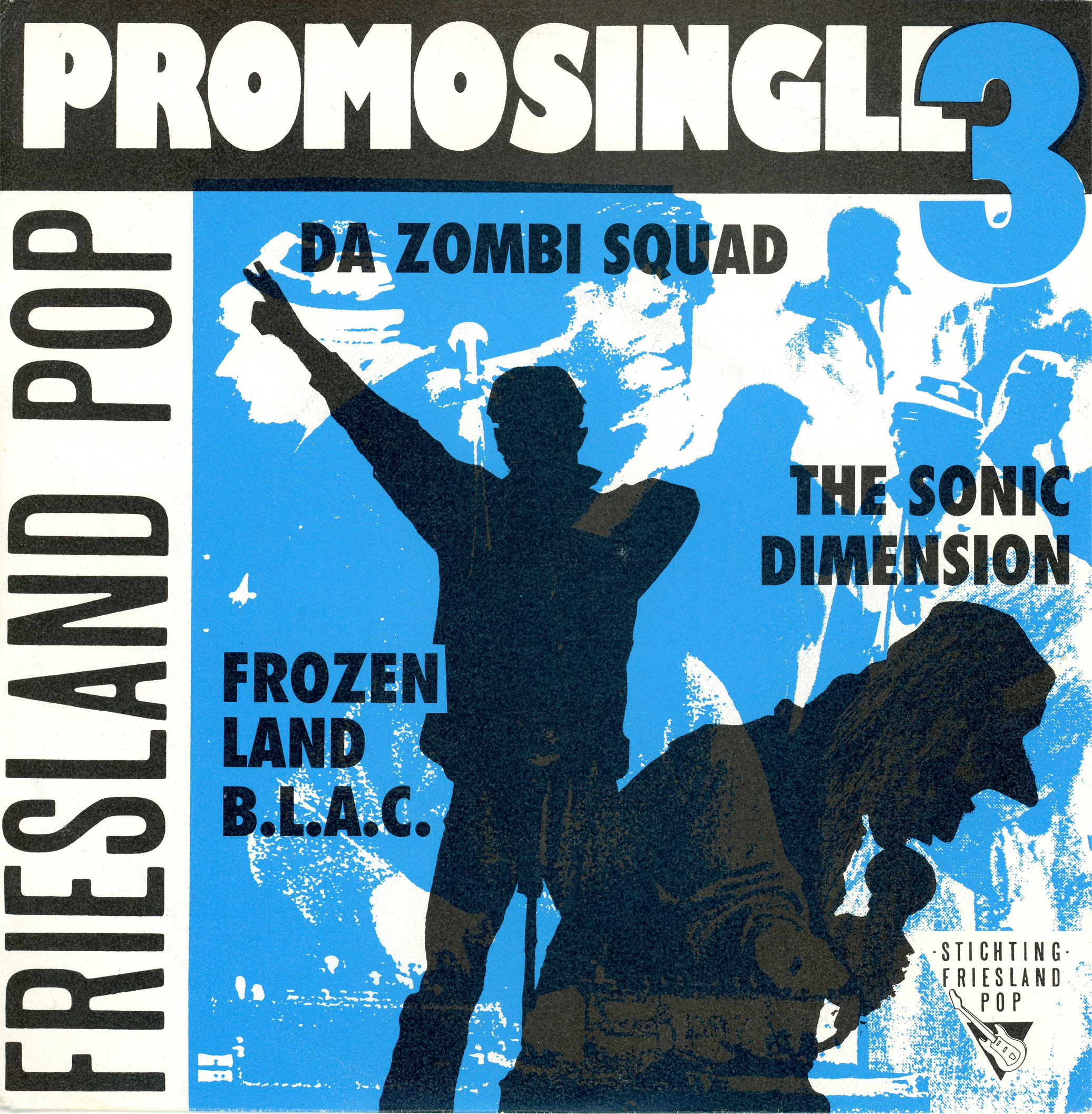
Figure 2
Friesland Pop promo single album cover.
Situating this demo paints a picture of the Dutch Hip Hop scene in the northern provinces in the latter half of the eighties and early nineties. Because Hip Hop was still a small subculture, practitioners travelled to find like-minded souls and perform their craft. The interaction between various groups and individuals connected different villages and regions rhizomatically as they affected one another’s trajectories and cultural practice. A place like youth centre ‘t Vliet, for example, was where MistaSweet, founder of the Haags Hip Hop Centrum in The Hague, first learned how to DJ. In its time, it was a central node in which creative exchange revolving around Hip Hop took place. These interactions engendered a creative cross-pollination that went beyond one’s hometown. Zombi Squad’s Dizzy is an artefact that shows the exchange that took place between practitioners in Friesland, Groningen, and beyond.
Zombi Squad’s perceived lack of recognition coming from de Randstad (Amsterdam in particular) gave them a chip on their shoulder. In 1992 Stichting Pop Muziek Nederland released a CD called Rhythm & Rhyme – A Rap Compilation vol. 2, a compilation of Dutch Hip Hop music.18 Just like its predecessor from 1988, it almost exclusively featured acts residing in Amsterdam. These compilation CDs, they felt, were not an accurate representation of all the talent in the Netherlands at the time.
As a response, Zombi Squad initiated a compilation CD aptly titled Exiles from da Neverlands with Ron Overbeek’s Groningen music label Future Music Dance Department in the same year (see figure 3).19 The title referred to feeling like outcasts from the forgotten parts of the Netherlands. Sherlock explained to me that they already were aware of the then upcoming Rhythm & Rhyme release because he was in touch with Stichting Pop Muziek: ‘We knew what was coming, and this was a reaction to that.’ Overbeek wrote in the liner notes that the album was ‘made to show that Hip Hop lives all over da lowlands.’ De Volkskrant, in a review, called it ‘the response from “the rest of the Netherlands”.’20
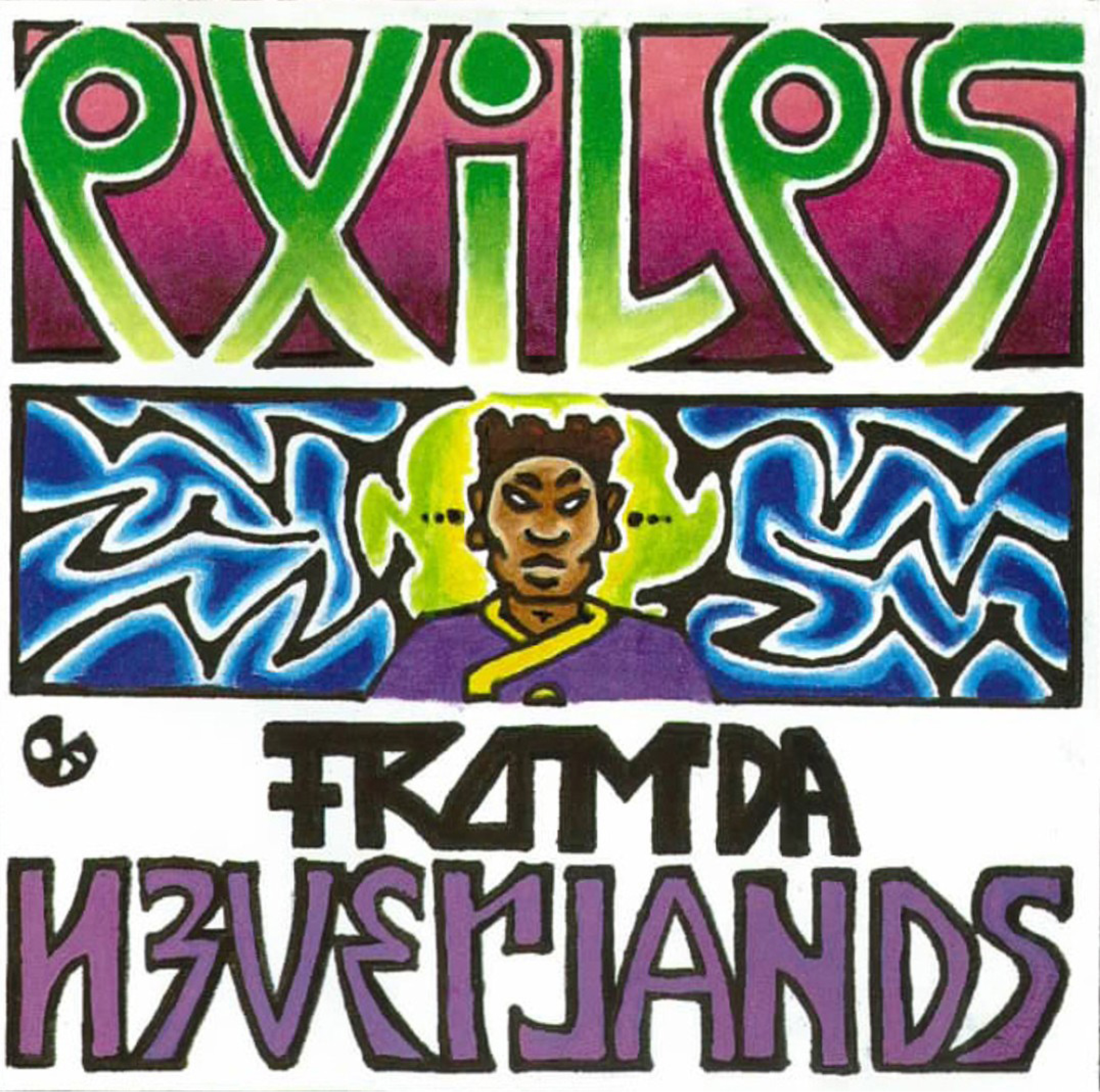
Figure 3
Exiles from da Neverlands album cover.
Although the existence of this CD is a testament to the sometimes-uneasy relationship between the country’s centre and its peripheries, it simultaneously displays how interwoven the Dutch Hip Hop scene was. Apart from Zombi Squad’s own contributions to Exiles, it featured artists from all over the country. Prominently featured on the CD was Graveyard Posse, a Hip Hop crew from Twente (Hengelo, Almelo, and Enschede), a region in the east of the Netherlands, and Utrecht (central Netherlands). Their producer, the Surinamese born LTH, was one of the pioneers in the Dutch Hip Hop scene and a direct cousin of Zombi Squad frontman Sherlock. Ultra Minded, Chill MT, and East Side Underground were also from the Twente region, in the eastern part of the Netherlands. Def Real, a crew that later became a Hip Hop band with live instruments, was from Den Bosch, a city in the south of the Netherlands. Mr. Solo was from Amsterdam.
Exiles also illustrates the interaction between Groningen and Rotterdam, with songs by Superzonic Cru (Def Rhymz, DJ Git Hyper) and Musical Messengers.21 These contributions were recorded, engineered, and mixed in Groningen by Zombi Squad’s Mad Pat. These groups were part of the Bad Boyz Posse, an initiative of Jazz DMX to create unity in the Hip Hop scene in Rotterdam halfway around the eighties. Among them were also, DCO (Alee Rock, Social X), the Moonrunners, Committee Gunmen (The Anonymous Mis, Shyrock, G-Boah, U-Niq, Sonny D, E-Life), and Asic & Bionic.22 This posse, rowdy and large in numbers, organised tour busses and travelled around the country for Hip Hop events, Groningen amongst these places. Rotterdam artists too, often felt excluded or overlooked by Amsterdam cultural power brokers. Musical Messenger’s Black Medallion, was re-recorded, mixed, and mastered in Groningen for the CD, but was already an underground classic in the Dutch scene. While Superzonic Cru’s Def Rhymz would later become famous for his party-oriented Dutch-language rap, he was already a respected MC in underground circles. DJ Git Hyper would become a well renowned producer and DJ, and co-owner of record store Demon Fuzz Records in Rotterdam. While only credited in the liner notes, the song also boasted contributions of two up-and-comers that would become important names. One of them was a young rapper from Amsterdam, Sugacane, who then still went by the name of Hurricane. He returned to Groningen a few years later to record Ain’t Nothing Here Yours, which would become an important steppingstone in his career.23 The other artist was Mistory (later known as The Anonymous Mis), who later became part of the successful Hip Hop reggae fusion group Postmen. It was their first official release.
Exiles illustrates that the Hip Hop scene in the North was connected to the rest of the country and did not develop in isolation. Most of these artists were musical acts that Zombi Squad knew personally through being active in the scene and traveling the country. Apart from the cultural cross-pollination that took place by engaging in this scene, Exiles shows how this network did more than just inspiring one another. Because the scene was interconnected, they were able to provide opportunities for each other, whether it be by organising Hip Hop events or by providing a platform to artists with an official CD release like Exiles during a time where this was still a special feat in an underground scene.
In 1994 Zombi Squad helped initiate a sequel called Blockbuster that once again boasted a diverse group of artists (see figure 4).24 The compilation CD displayed the same dynamics as its predecessor. Zombi Squad’s Mad Pat took on mixing and studio engineering duties again. Two Out of Millions’ DJ Mass came from Utrecht, a city in the middle of the country, and rapper LaQuaTel from Zwolle, a little more up north.25 It was their first official release as well.26 Sources of Specialment was a collaboration between Groningen and Arnhem, a city in the east of the country. Sources of Specialment’s DJ Syah was also a member of More Serious, a crew from Arnhem. Underground rapper Rowdy was Amsterdam’s representative. While he already had a reputation in the Hip Hop scene, this too became his first official solo release.
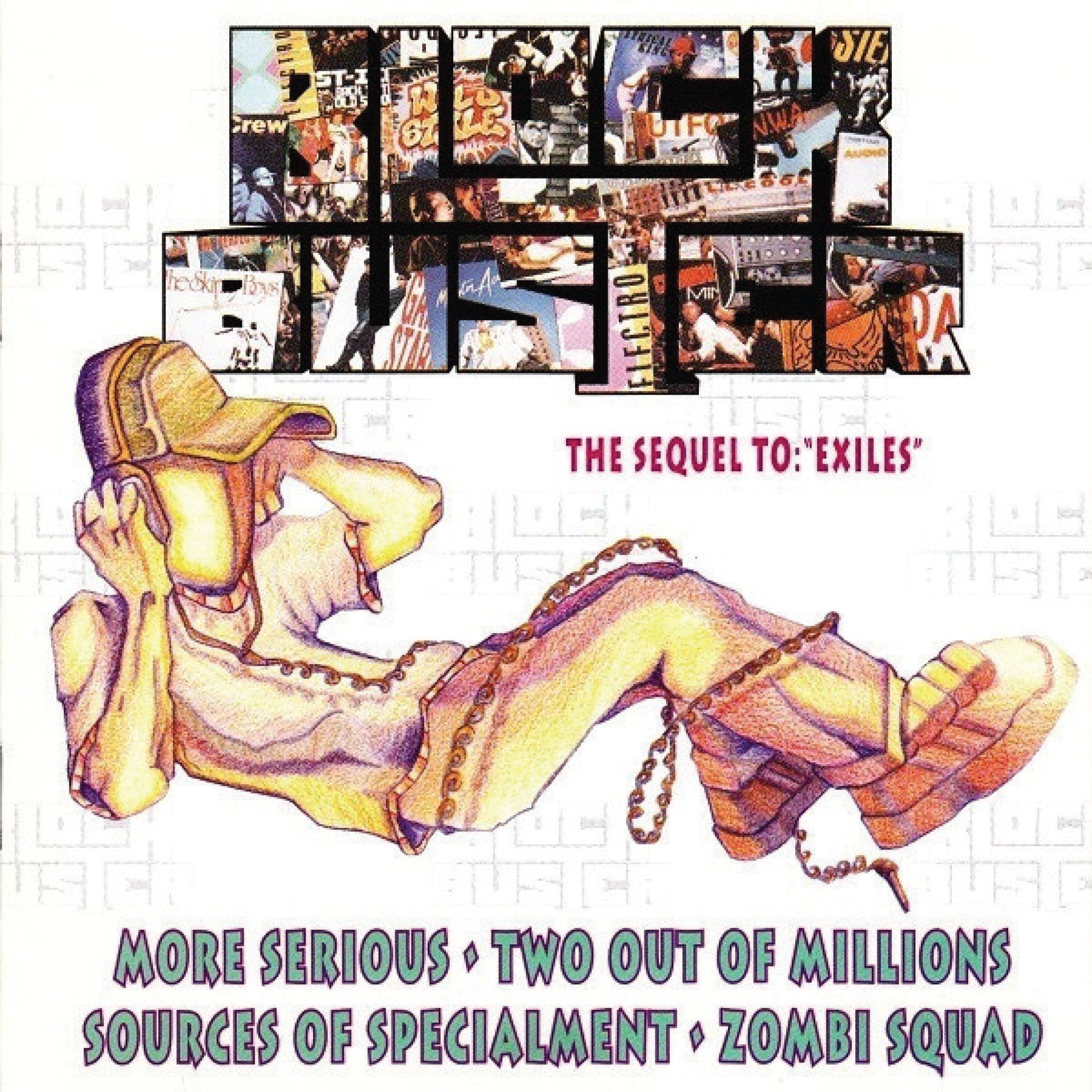
Figure 4
Blockbuster album cover.
The album also boasted a song by L-West Productions, a Hip Hop crews from the Frisian city Sneek. The city was also home to Nico’s Records, responsible for multiple Hip Hop releases, Blockbuster among them. It again underscored the interconnectedness between the Hip Hop scenes of Groningen and Friesland.27
A record called Dock’s Document of Hip Hop reggae fusion group Postman was also recorded in Groningen. The Anonymous Mis and G-Boah had travelled from Rotterdam to Zombi Squad’s home studio to record the song. The record was subsequently bought by the small Dutch label C.M.C. records, located in Haarlem. It became Postmen’s first single, after which they released Documents, the first Dutch Hip Hop album to go platinum in the Netherlands by selling 100.000 records. Both Exiles and Blockbuster reflect the interconnectedness of the Dutch Hip Hop scene. These CDs, initiated, organised, and brought to reality by Zombi Squad, show a network of practitioners spanning the entire country, with Groningen, because of its peripheral geographical location, as an unlikely driving force.
Blockbuster and Exiles offer a window into the relatively undocumented practice-oriented scene and the routes many of these practitioners travelled to engage with Hip Hop culture. Rather than each artist’s claim to individual excellence, this interconnectedness brings to the fore the ways in which practitioners interacted and how this affected the culture. These efforts of individuals attempting to unite, represent, or define Dutch Hip Hop can be understood as an open-ended practice of creating nodes in a rhizomatic network. Both compilation CDs exemplify how separate threads materialise in relation to one another, and how they create new pathways and possibilities.
Given Hip Hop’s fragmented nature in the Netherlands, especially in its early years, practitioners found each other through their shared appreciation for the culture, and often travelled between cities or villages, especially if they were from a place with limited opportunities. As such, following the routes practitioners traversed to practice their craft shows a rhizomatic network. This presents artists not as individual genius (a single root, unaffected by their circumstances), but in relation to others. Saul van Stapele’s Van Brooklyn Naar Breukelen, regarded as the source on the first twenty years of Hip Hop history in the Netherlands, is a case in point. It mentions Exiles and Blockbuster several times in relation to various artists.28 It does not, however, specify its origins or how it came about. Unfortunately, this obfuscates the nation-wide rhizomatic interaction that was part of the scene, in favour of a more geographically stable notion of cultural expression that locates artists within cities. These practitioners were neither solely a product of their environment, or individuals that stand outside of time and space. These two compilation CDs therefore offer a glimpse into an interconnected scene that was more than a sum of its parts.
Black Atlantic
But why did the scene develop rhizomatically? Part of Hip Hop’s horizontal spread can be attributed to the nationwide dissemination of mass media, particularly television, which was picked up on all over the country. Before rap music, breaking became a hype, inspired by movies like Wildstyle (1983) and Beat Street (1984).29 Graffiti too was on the rise but had its own cultural heritage that predated Hip Hop culture.30 Both were reflected in Dutch comic books Sjors en Sjimmie in the early eighties.31 In 1986, the Dutch VPRO documentary Big Fun in the Big Town, directed by Bram van Splunteren, was broadcasted on national television.32 It showed Belgian musician and presenter Marcel Vanthilt walking around the streets of New York to interview then upcoming artists as well as household names within the Hip Hop scene, from Run-D.M.C., LL Cool J, to Grandmaster Flash, Schoolly D, and Roxanne Shante. Many Dutch pioneering practitioners have credited this documentary as a substantial influence.33 For many, it also put the elements of breaking and graffiti in perspective within Hip Hop as a multi-faceted culture along with the music. Compared to its mainstream success today, however, the emergence of Hip Hop was still a marginal curiosity in mainstream media.
However, this is only part of the answer. As interdisciplinary scholar Imani Perry has argued, people of colour around the world have been drawn to Hip Hop culture ‘for its centralization of “the other”.’34 How the dominant presence of people of colour in the anglophone Hip Hop scene affected and shaped the national Dutch scene in practice, therefore, also warrants particular attention. Practitioners of Surinamese and Antillean descent, both having roots in former Dutch colonies, were especially influential. Dutch citizens belonging to various diasporic groups often had family members or family friends living around the country as well as globally. As Zombi Squad frontman Sherlock explained to me:
Even though we didn’t have social media, you were in touch with your cousins. In any case, the multicultural society… The Surinamese, Antillean, Cape Verdean, who lived outside of the Randstad, still visited their families there. Or vice versa. That cross-pollination happened very early.
Family connections made for entry points in otherwise unfamiliar territories. Interaction between cities and other locations was commonplace because Hip Hop was still a small subculture. These smaller conglomerates of communities, contributed to the interactions between different regions in the Netherlands. From a young age, Sherlock for example, would visit family members in Slotervaart (the western part of Amsterdam) and the Bijlmer (the southeastern part of Amsterdam, home to a large number of Surinamese-Dutch). With his cousin he would listen to electro music on local radio stations like Satellite Empire in the early eighties. This same cousin also happened to be a cousin of Amsterdam’s Sugacane who resided in the southern part of Amsterdam.
These interactions extended beyond the country’s borders, as family interaction was not limited to the Netherlands. Zombi Squad’s MC Shockwave explained how his experience of Hip Hop was transnational from the get-go. When he was around 14 years old, his cousin from Curaçao came to live with his family temporarily, which also became his entry into graffiti. Together they would go on nightly adventures with spray cans. He experienced breaking first-hand while visiting family relatives in Brooklyn with his mother when he was around six years old. There he saw Afro-Americans breaking on the streets, dancing in a way that was unlike anything he had ever seen before. He recalled to me with a smile: ‘I see guys on cardboard, doing whatever the fuck they were doing, and I was like: “Wow! I want that! What is that?” And that’s how it seeped into my consciousness.’ These transnational connections illustrate a network whose rhizomes reach out beyond the borders of the country.
Anthropologist Francio Guadeloupe sees the Netherlands as a Dutch Caribbean Island in relation to other smaller Caribbean isles in the Dutch Kingdom.35 He argues this does not detract from Dutch colonial history but helps to decentre the importance of The Netherlands’ continental borders and fixed identity being tied to a place.36 Rather, identity is constructed through interaction. Thinking of the Netherlands as rhizomatically related to other places, helps to see beyond the political constructedness of nation-state borders, and therefore fixed identities being tied to a single root. This rhizomatic approach does not hold that such political categories are irrelevant, but shifts the focus to routes, detours, and contact between places.
Looking beyond nation-state borders and seeing the Netherlands in relation to larger geopolitical processes broadens the scope of what is part of national history. The presence of people of Surinamese and Antillean descent in the Netherlands are no coincidence. Many practitioners in the formational period of the Dutch Hip Hop scene were either first- or second-generation migrants. Therefore, to understand Hip Hop’s rhizomatic rise we must look at it in connection to Dutch colonial history and its aftermath.
Both Surinam, and citizens of the former Dutch Antilles had full Dutch citizenship rights since 1892.37 Citizens with a Surinamese background accounted for 13.000 around 1960 in the Netherlands. In 1970 this had more than doubled to around 30.000. In 1975 Surinam gained their independence from the Netherlands. Because of economic prospects and political instability an exodus occurred. By 1981 165.000 people of Surinamese descent lived in the Netherlands, which almost doubled to 303.000 by the year 2000.38
The six islands (Curacao, Aruba, Bonaire, Sint Maarten, Saba, Sint Eustatius) formerly known as the Dutch Antilles had a different decolonisation process, and legally rejected full independence, which meant they retained citizenship rights (and thus easy access to the Netherlands). In 1960 there were 2500 people of Antillean descent in the Netherlands. Up to that point migration was mostly to study, and to a small extent for economic reasons. In 1976 Texas Instruments left the region, as well as Shell in 1985 which resulted in high unemployment numbers.39 Thus the increase in migration to the Netherlands that followed mostly had to do with economic decline and job prospects in the eighties. By 2000, 107.000 people of Antillean descent lived in the Netherlands.40
Additionally, around 300.000 people of mixed Indonesian Dutch descent had migrated to the Netherlands between 1945-1965 after Indonesia’s independence. With a shortage of labour, male guestworkers from Turkey and Morocco (followed by their families) in the seventies and eighties settled too, and in 1992 215.000 Turkish and 170.000 Moroccan nationals lived in the country. Most of these newcomers moved to the bigger cities around the country. The influx of newcomers significantly changed the demographics, with the total population of the Netherlands in 1990 being around fifteen million. The Surinamese, Antillean, Moroccan, and Turkish newcomers, among others, at different stages, also publicly stigmatised.41 For many Dutch inhabitants, the Netherlands’ colonial legacy of their country suddenly hit a lot closer to home.42 As novelist Caryl Phillips put it forcefully: ‘Europe is no longer white and never will be again.’43
Creolizing Europe
A quick glance at Zombi Squad’s line up reflects the migration patterns described above. They were a group consisting of members with Surinamese, Curaçaoan, Indigenous-Dutch, Indonesian, and later also Moroccan roots. In a predominantly white country with little representation in mainstream media, Hip Hop provided an alternative. As an identity it was unique but also left space to add one’s particular roots to the mixture, without being able to reduce it to those roots. Hip Hop was an example of what Glissant meant when he said that ‘the world is becoming creolized.’44 Creolization as a concept is not simply a fusion of cultures without consideration for power dynamics, nor hybridity where the cultures that make up the mix still retain their ‘original form’ like oil in a glass of water. As the sociologists Encarnación Gutiérrez Rodríguez and Shirley Anne Tate argue: ‘Creolization is an outcome of racialized living together which goes beyond racial coding through the contact of different affects, desires, energies and intensities that break the established normative order of the governance of diversity.’45
Conversely, Zombi Squad MC Shockwave explained to me, Hip Hop was the vehicle through which he could find belonging in a place where he felt like an outsider:
Young Black Americans, and us as Afro-Dutch, we missed that piece of identity. You grow up in a country where almost everyone around you is white. And you’re not white… I was born on Curacao, but I grew up in the Netherlands. Here you’re a foreigner, but you’re a foreigner there too. So Hip Hop was my home.
For Shockwave, Hip Hop was a way to express his experience of Blackness that was neither fully Curaçaoan or fully Dutch, it was both and neither. His dance partner Hellrazor of the Hellway Zone crew, was of indigenous-Dutch descent, but not less Hip Hop because of it.46 As a practice-oriented culture, it was your skillset that counted. For this reason, it was multicultural from the start, without detracting from Hip Hop as Black culture. Practicing Hip Hop, in any of its elements, was an activity around which Zombi Squad connected even though their cultural background spanned from east to west.
This creolizing Hip Hop community developed against a backdrop of xenophobia and colonially inherited ideas of race and belonging. Newcomers, postcolonial migrants and guest workers alike, were met with a lot of resistance in the Netherlands and had to deal with racism. This ranged from public discourse, political debates, to discrimination in the job market, colonially afflicted attitudes towards those with darker pigment, and bad housing conditions.47 Hip Hop spoke to them and provided them with an outlet to express themselves through an artform that was against the grain, raw, and had a unique aesthetic. It was distinctly different from Dutch mainstream media, where Rock and Pop music still set the tone. As a counterculture, it provided tiny spaces of home.
Zombi Squad came into their own during a politically unruly time. The increasing racism in the Netherlands did not happen in a vacuum. The Soviet Union fell apart and with it, communism as an ideological rival of the liberal-democracy prevalent in Western Europe.48 The Iron Curtain’s dissolvement was felt across Europe. The former spheres of influence of the Soviet Union underwent radical neoliberal restructuring. Governmental structures revolving around welfare spending were (partially) cut and widened the gap between the rich and the poor.49 The power vacuum left by the USSR played a part in the rise of a post-WWII populism that emphasised ethnonationalism. From this point of view, safeguarding a homogenous cultural identity was the answer to societal ills. The void of communism as the Other beyond the nation was replaced by the cultural Other within the nation. Extreme right-wing politics were on the rise again. Racist violence increased exponentially in Western Europe, especially in Germany, but to a lesser extent also in the Netherlands.50
At the time, the most radicalized expression of these developments in the Netherlands was neo-Nazi group Aktiefront Nationale Socialisten (ANS). With close ties to Germany, their headquarters in the Netherlands was in Groningen, while having places of correspondence in 18 places spread across country.51 Internationally they were connected to other nationalist extremists such as the Ku Klux Klan in the US, and the Grey Wolves, in Turkey.52 Their leader Eite Homan, lived in Beijum, the same neighbourhood as some of Zombi Squad’s members did. He blamed society’s ills on the waves of migration to the Netherlands. Homan wanted to return the Netherlands to a “purified” state and built his argument on people being rooted to land: ‘We are not racists, but every race has their own place, geographically speaking. And we think nationally. Now we deal with unemployment, there is a crisis. Isn’t it logical then to take measures to prioritize your own people.’53
Whereas their first release Dizzy was still playful, Zombi Squad’s music took a political turn in the early nineties. Simplon, the place they had made their homebase to practice on Sundays, amongst other places they frequented, was also home to an active Punk scene.54 Through this scene, Zombi Squad became more aware of the propaganda and violent activities of the neo-Nazi group ANS. To Zombi Squad, they became a symbol of an underlying problem in the Netherlands: structural racism. They started to make anti-nazi songs like Sons of Hitler and Hardcore (Aimin’ at Nazi’s). Their music became more militant, and they started performing with giant Styrofoam swastikas that they would smash to bits with baseball bats while wearing ski-masks. As a multicultural group, many Zombi Squad members or associates had to deal with racism and standing out in a space where mostly indigenous-Dutch lived. Hip Hop was their way of claiming their territory and making it their own, because they too claimed the right to exist. Their response to racism was not placing themselves outside of society but firmly within it with the message: ‘not on my watch.’ Or as Stuart Hall might say, it was the means through which ‘somehow, they too, in spite of everything, are centred, in place.’55
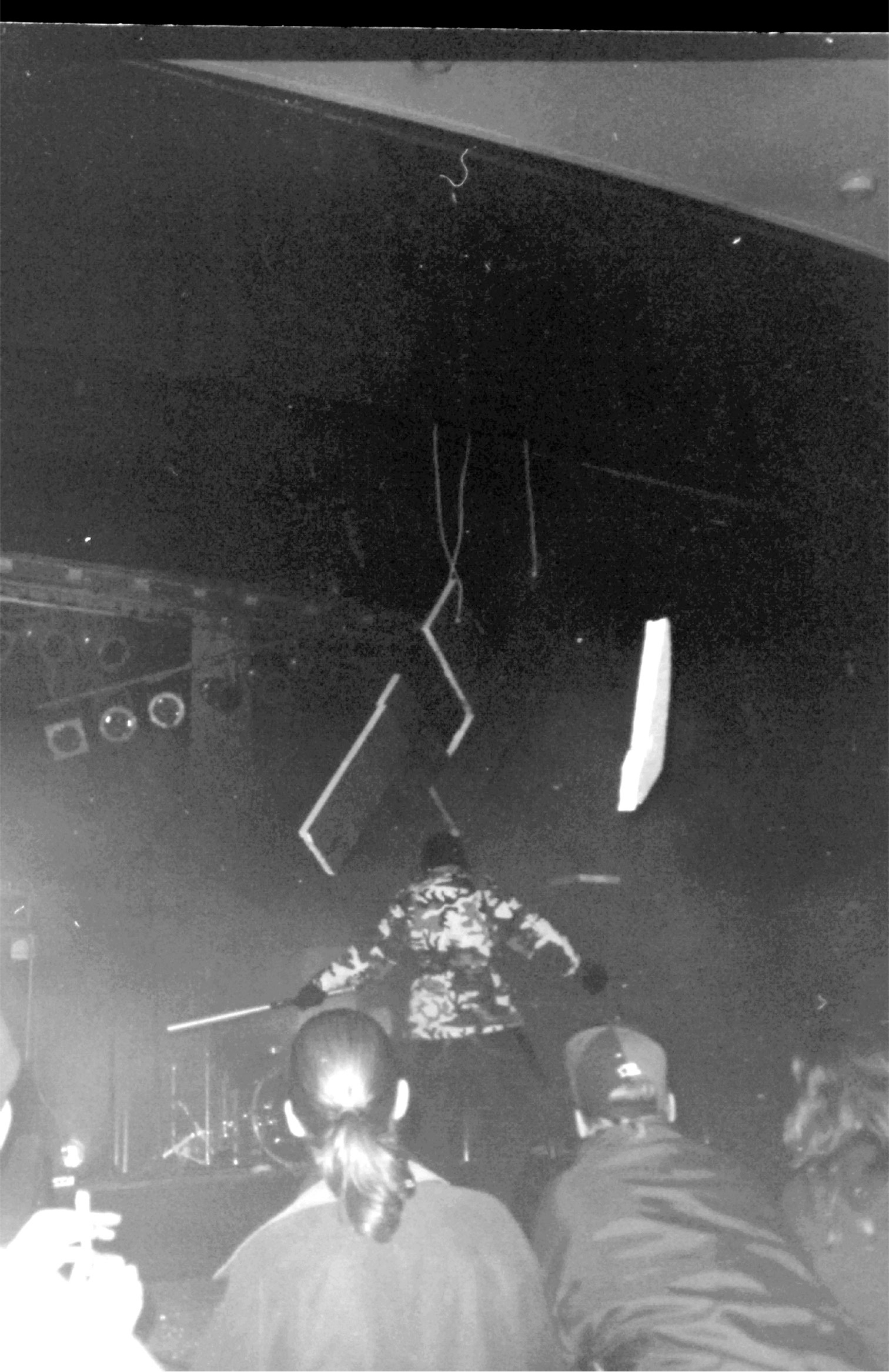
Figure 5
Zombi Squad live performance, March 6, 1993.
The rhizome/single root dichotomy is crystallised when we compare Zombi Squad with ANS. The latter takes the logic of the single root to its extreme. They historically link their community to a claim to soil. Land as territory, with a sense of who belongs and who does not. As Glissant argues: ‘The founding myth provides an obscure kind of reassurance as to the unbroken continuity of this filiation and so authorizes the community in question to consider this land that has become a territory as absolutely its own.’56 In ironic fashion, this phantasm of a single rooted, ethno-national state is the outcome of a rhizomatic process involving the aftermaths of colonialism and the triumph of Western liberal democracy in the late eighties. Furthermore, right-wing movements like ANS operate rhizomatically across nation-state borders. Zombi Squad emerged from the practice-oriented interaction in the Hip Hop scene, an expression of this creolizing culture, against the ‘backdrop of racialized living.’57 The latter challenges the former perspective of tying belonging to a rootedness to land, precisely because they find their home in the transnational ‘non-place and non-time’ that is Hip Hop.58 The practice-oriented underground Hip Hop scene they were a part of provided them with an outlet to agitate against these developments, but also a sense of home through a carefully co-constructed creolizing identity.
Hip Hop Canon
A genesis presented as the linear progression from US Hip Hop to Dutch megalopolis the Randstad, and then the country’s peripheries, obfuscate interactions that follow different routes. While commercial development is a main thread in this genealogy, the cultural relevance of ‘unsuccessful’ media is sometimes forgotten.59 As Verhoef argues: ‘Most research still tends to approach media as isolated phenomena, rather than ‘in conjunction with important historical events.’60 As such the early anglophone rap music in the Netherlands is often overlooked, when its history is actually intertwined with the Dutch-language scene that later became hegemonic.
This partly might have to do with anglophone rap being described as inauthentic before Dutch rap music came into its own, because ‘they were copying American Hip Hop’.61 Indeed, one could argue that ‘a new measure of accuracy was made possible between localised socialised experience and linguistic representation’ when more rappers chose to rap in Dutch.62 Hip Hop linguist Steven Gilbers provides an accurate synthesis of rap’s mainstream canonisation in his paper on Dutch Hip Hop history. As he states, some argue that once the Hip Hop scene moved on to rapping in Dutch, the music became more authentic because people were rapping in their “own” language.63 Nowadays, many Dutch youth draw from a diverse language reservoir that reflects their, and/or their neighbours’ cultural backgrounds. As literary scholar Aafje de Roest has documented, ‘Hip Hop specifically appeals to Dutch youth and artist with multi-ethnic backgrounds’, because ‘they code their language locally, drawing on multiple language reservoirs and creating ‘new’ distinctive, nonstandard language varieties’.64
Until the late nineties, however, rapping in English was the modus operandi and seen as a more authentic expression of Hip Hop culture by most practitioners in the scene, whereas Dutch-language rap was seen as inferior and not taken as seriously, or even as cultural appropriation when performed by indigenous-Dutch.65 The creolizing poly-ethnic linguistic varieties now part and parcel of rap music in the Netherlands had not taken hold yet. Rather, anglophone rap’s dominance in the Netherlands must be looked at within its historical conjuncture: the relatively recent postcolonial migration patterns, the resurgence of the xenophobic far right, the racism many had to contend with, and the emergence of a Black Atlantic Hip Hop culture that are dynamics ‘indicative of the conflicting notions of place and identity’.66 To those of Antillean descent, for example, the Dutch-language could have been seen as a colonial inheritance as it also was a language predominantly taught in schools, neither spoken at home or in informal settings. If you consider that Hip Hop was a home to many, especially people of colour, who felt estranged from the society they lived in, the proximity to claiming authentic Dutchness gained a layer of complexity: a transnational belonging to a Black Atlantic cultural expression like Hip Hop might have been preferential to a national or local belonging. In reporting on the early Dutch hip hop scene, Linguist Alastair Pennycook complicates the notion of authenticity in relation to language and race:
Although a local “Nederhop” movement of Dutch-language rap has emerged in Holland, for example, it features almost exclusively White Dutch youth. While this Nederhop movement can claim greater Dutch linguistic and cultural “authenticity,” it also struggles against a more American/English oriented rap movement by non-White youth (largely of Surinamese origin), who can claim greater global authenticity in terms of the discourses of marginalization and racial identification within hip-hop.67
In diminishing the impact of the anglophone Dutch Hip Hop scene, certain dynamics essential to its development, I have argued, are overlooked. Although the Dutch-language, and the anglophone rap scenes historically were separate to an extent, the latter still ended up being influential in the informal infrastructure and development of the scene as a whole. The normative Dutch Hip Hop canon often starts with Osdorp Posse, followed by Extince, and Opgezwolle. A subtle shift sometimes occurs, where the category of ‘Dutch Hip Hop’ is used to mean the same as ‘Dutch-language Hip Hop’. It creates an uncomfortable representation of Dutch Hip Hop history, where the baby is thrown out with the bathwater and most of its early pioneers suddenly seem white.
This linear genealogy muddles the contributions of earlier (and other) pioneers that paved the way. More importantly, it obfuscates how descendants of the formerly colonised and other marginalised citizens made a place for themselves in a sometimes-hostile country. It is furthermore essential to understanding how Hip Hop has become so entrenched in Dutch society. All of this happened through the rhizomatic practice of Hip Hop, in tandem with like-minded indigenous-Dutch who were also there from the start, before there ever was a real industry to speak of. Zombi Squad is just one example that does not fit the dominant narrative, but the stories of many more ‘exiles’ from the Netherlands will remain in the margins until more research is done.
Conclusion
I have offered an alternate reading of the early Dutch Hip Hop scene as rhizomatically connected, by using Zombi Squad’s career in the eighties and nineties as a case study. By rhizomatic connections I mean that practitioners through their interactions affected and inspired each other but also co-facilitated opportunities. It is a focus on the mode in which practitioners engage with each other and their surroundings, rather than looking at individual genius. Such a horizontal approach, I have tried to argue, brings into view how the conviviality of practitioners and their do-it-yourself mentality was necessary for the scene to thrive. As such, it brings areas hitherto underexplored into the fold, as Hip Hop’s canon has mostly focused on the west of the country. An appreciation of the rhizomatic character of the scene shows how the west was connected to other parts of the Netherlands as well, and that these connections played a role in Hip Hop’s rise.
I also argued that we cannot see this rhizomatic rise as separate from the postcolonial migration patterns that re-shaped the Netherlands, and that we therefore need to look at the Dutch Hip Hop scene as a creolizing cultural expression. The rhizome decentres a narrow lens of identity and community as limited within country borders. Hip Hop’s spread all over the country needs to be appreciated in relation to the postcolonial migrations from Surinam and the former Dutch Antilles. Not having proper representation in mass media, and dealing with considerable racism, Hip Hop proved to be an alternative medium through which people of colour and other marginalised citizens could find a sense of belonging. The rhizomatic character of diasporic communities in combination with the practice-oriented early Hip Hop scene, helped to facilitate the flows of people and ideas between various places that were crucial for a Hip Hop identity and community to emerge. This culture was more than the sum of its parts. These characteristics, I argue, have been overshadowed because many accounts of Dutch Hip Hop history mainly focus on Dutch-language rap. Because in its earlier phases Dutch-language rap scene was predominantly white and the Anglophone rap scene multicultural, this dominant narrative partly whitewashes the beginnings of Dutch Hip Hop history.
Endnote
[1] Sjoerd Huismans, “Hoe Werd Rappen in het Nederlands Populair?” NPO Kennis, last modified March 25, 2024, https://npokennis.nl/longread/7458/hoe-werd-rappen-in-het-nederlands-populair.
[2] “Hoe is Nederhop ontstaan?,” schooltv, March 8, 2021, https://schooltv.nl/video-item/music-on-the-map-hoe-is-nederhop-ontstaan.
[3] Original quote: ‘De meeste rappers in Nederland schreven Engelse teksten. De Amsterdamse jongens van Osdorp Posse waren in 1990 (tien jaar na Danny!) zo’n beetje de eersten die in het Nederlands begonnen te rappen,’ in Timo Pisart, “3voor12 Home Schooling les 4: Nederlandse Hiphop,” 3voor12, March 19, 2020, https://3voor12.vpro.nl/artikelen/overzicht/2020/Home-schooling/3voor12-Home-Schooling-les-4-nederhop.html.
[4] For further illustration, see: Paulus Houthuijs “Hoe Hiphop in 50 Jaar vanuit the Bronx ook Nederland veroverde,” NOS, last modified August 11, 2023, https://nos.nl/artikel/2486244-hoe-hiphop-in-50-jaar-vanuit-the-bronx-ook-nederland-veroverde; Danny Stolker, “Smoelwerk – De Ontwikkelingen van hiphop in Nederland 1999-2009,” Stichting HIJS/ Hiphop In Je Smoel documentary, 2009, posted February 14, 2011, by NPO Doc VPRO, https://www.npodoc.nl/documentaires/2011/02/smoelwerk.html
[5] Aafje de Roest, “Speaking Smibanese: hip-hop, local youth language variety, and representations of the Amsterdam Bijlmer,” Parallax 28, no. 2 (2023): 106.
[6] Gilles Deleuze and Félix Guatarri, A Thousand Plateaus: Capitalism and Schizophrenia, trans. Brian Massumi (Athlone Press, 1988).
[7] Simon O’Sullivan, “Cultural Studies as Rhizome – Rhizomes in Cultural Studies,” in Cultural Studies, ed. Stefan Herbrechter (Brill, 2002).
[8] Imani Perry, Prophets of the Hood: Politics and Poetics in Hip Hop (Duke University Press, 2004), 11–13; Paul Gilroy, The Black Atlantic: Modernity and Double Consciousness (Verso Books, 1993), 33.
[9] Kirsty Lohman, The Connected Lives of Dutch Punks: Contesting Subcultural Boundaries (Palgrave Macmillan, 2017).
[10] Édouard Glissant, Introduction to a Poetics of Diversity, trans. Celia Britton (Liverpool University Press), 16.
[11] Jesper Verhoef, “A 1980s and 1990s Media History Manifesto,” TMG Journal for Media History 26, no. 2 (2023).
[12] J. Griffith Rollefson, Flip the Script: European Hip Hop and the Politics of Postcoloniality (The University of Chicago Press, 2017), 6.
[13] Valerie Raleigh Yow, Recording Oral History: A Guide for the Humanities and Social Sciences (Globe Pequot Press, 2014).
[14] Luke Eric Lassiter, The Chicago Guide to Collaborative Ethnography (The University of Chicago Press, 2005).
[16] Sherlock Telgt, “Friesland Pop Rap Contest,” May 15, 2020, Zombi Squad Podcast, 23:27, https://open.spotify.com/episode/6kN8Why01DlqrOXyIeCzuj?si=238d4d2b22e541d5.
[22] Saul van Stapele, Van Brooklyn naar Breukelen, 20 jaar hiphop in Nederland (Nationaal Pop Instituut), 39; Eugene Voorn, “Alee Ecktuh ‘Badboyz’ & Funky Fresh ‘Scorpio’,” premiered and posted July 25, 2021, by De Doofpod 22, YouTube, 1:48:20, https://youtu.be/oDtnqiTW6x8?feature=shared.
[23] Eugene Voorn, “Blonnie B ‘Moonrunners’ & Sherlock ‘Zombi Squad’,” premiered and posted December 8, 2024, by De Doofpod, YouTube, 1:23:04, https://youtu.be/7EhHlPCUTVo?si=J8SJZNDEfnisasaA&t=2906.
[25] Eugene Voorn, “Two Outta Millions (Laquatal & DJ Mass),” premiered and posted January 8, 2023, by De Doofpod 91, YouTube, 1:55:23, https://youtu.be/IxQSOh45OGI?feature=shared.
[29] Pepijn de Groot, “Tot de Dood Geef Ik Mijn Leven Bloot Op Geluidsdragers,” (Master Thesis, Utrecht University, 2021), 42.
[30] David Novak, “Historical Dissemination of Graffiti Art,” Street Art and Urban Creativity 3, no. 1 (2017): 30.
[31] Reinier van den Hout, director, “Witte Sjors en Zwarte Sjimmie, episode 52,” November 13, 2014, Andere Tijden NPO2, https://anderetijden.nl/aflevering/52/Witte-Sjors-en-zwarte-Sjimmie.
[33] Bram van Splunteren, director, “De Wereldwijde Herontdekking van Big Fun in the Big Town,” Interview by Witflits & Onx, Hip Hop in je Smoel, July 31, 2012, https://www.hiphopinjesmoel.com/de-wereldwijde-herontdekking-van-big-fun-big-town/.
[37] Gert Oostindie and Jeannette Schoorl, “Postkoloniale Migratie,” in De Nederlandse Migratiekaart: Achtergronden en Ontwikkelingen van Verschillende Migratietypen, ed. R.P.W. Jennissen (Boom, 2011).
[39] Charlotte Laarman, “Oude Onbekenden: het Politieke en Publieke Debat over Postkoloniale Migranten, 1945-2005” (Doctoral Thesis, Leiden University, 2013), 197.
[41] Antoon Hoogveld, “Immigrants in the Netherlands, Past and Present,” in Ethnic Diversity in Europe: Challenges to the Nation State, ed. Julia Gonzales David Turton (University of Deusto Bilbao, 2000), 107.
[42] Gert Oostindie, “History Brought Home: Post-Colonial Migrations and the Dutch Rediscovery of Slavery,” in Post-Colonial Immigrants and Identity Formations in the Netherlands, ed. Ulbe Bosma (Amsterdam University Press, 2012), 156.
[43] Caryl Phillips, Color Me English: Migration and Belonging before and after 9/11 (The New Press, 2013), 16.
[45] Encarnación Gutiérrez Rodríguez and Shirley Anne Tate, “Introduction: Creolizing Europe: Legacies and Transformations,” in Creolizing Europe. Legacies and Transformations, ed. Encarnación Gutiérrez Rodríguez and Shirley Anne Tate (Liverpool University Press, 2015), 6.
[46] Francio Guadeloupe dubs this ‘Urban Blackness’ in his book Black Man in the Netherlands, an Afro-Antillean Anthropology (University Press of Mississippi, 2022).
[47] Philomena Essed and Isabel Hoving, “Innocence, Smug Ignorance, Resentment: An Introduction to Dutch Racism,” in Dutch Racism, ed. Philomena Essed and Isabel Hoving (Brill, 2014); Miguel Heilbron, “‘Not for Surinamese’: How Amsterdam Closed Entire Neighborhoods to Non-White Dutch People,” e-flux Architecture , July, 2022, https://www.e-flux.com/architecture/where-is-here/466510/not-for-surinamese-how-amsterdam-closed-entire-neighborhoods-to-non-white-dutch-people/; Hoogveld, “Immigrants,” 107; Martijn de Koning, “You Need to Present a Counter-Message,” Journal of Muslims in Europe 5, no. 2 (2016); Annelies Moors, “The Dutch and the Face-Veil: The Politics of Discomfort,” Social Anthropology 17, no. 4 (2009); Gloria Wekker, White Innocence: Paradoxes of Colonialism and Race (Duke University Press, 2016).
[50] Jaap van Donselaar, “The Extreme Right and Racist Violence in the Netherlands,” in Racist Violence in Europe, ed. Tore Björgo and Rob Witte (Palgrave Macmillan, 1993), 46; Ruud Koopmans, “Explaining the Rise of Racist and Extreme Right Violence in Western Europe: Grievances or Opportunities?,” European Journal of Political Research 30, no. 2 (1996): 192.
[51] Lydia Gunnink, “Neo-Nazi’s in Nederland,” Nederlands Dagblad, January 26, 1993; Karel ten Haaf, Het Aktiefront Nationaal Socialisten…En Morgen de Hele Wereld? (Fascisme Onderzoek Kollektief, 1992), 12.
[53] Original quote: ‘Wij zijn geen racisten, maar ieder ras heeft zijn plek, geografisch gezien. En wij denken nationaal. Op het moment heerst er werkloosheid, is er een crisis. Dan is het toch logisch dat je maatregelen neemt om de eigen mensen voorrang te geven.’ in ten Haaf, Het Aktiefront, 11.
[55] Stuart Hall, “Minimal Selves,” in Black British Cultural Studies: A Reader, ed. Houston A. Baker Jr., Manthia Diawara, and Ruth H. Lindeborg (Chicago University Press, 1996), 114.
[58] Francio Guadeloupe and Vincent de Rooij, “The Promise of a Utopian Home, or Capitalism’s Commoditization of Blackness,” Social Analysis 2, no. 58 (2014): 60-77.
[62] Andy Bennet, “Hip hop am Main: The Localization of Rap Music and Hip Hop Culture,” Media, Culture & Society 21, no. 1 (1999): 82.
[63] Steven Gilbers, “The Netherlands,” Global Hip Hop Studies, Special issue: ‘Hip Hop Atlas’ 3, no. 1 & 2 (2023): 129-135, 130.
Biography
Dastan Abdali is an anthropologist, rapper, and producer. He is a PhD candidate at Leiden University, where he is doing research on the societal impact of Hip Hop practitioners in the Netherlands. Together with Hip Hop center The Foundation, research project Re/presenting Europe, and other key players such as Groningen’s own, Sherlock Telgt, Abdali is currently setting up a national archive for Hip Hop in the Netherlands. Email: d.abdali@hum.leidenuniv.nl