
Introduction
Alternative and Augmented Communication (AAC) refers to devices and programmes used as a means of communication by people with complex communication needs (CCN). This includes a variety of electronic and non-electronic aids for people with complex and heterogeneous motor impairments, primarily in the area of spoken language.1 These aids are used in everyday life alongside other communication techniques, such as non-verbal activities and spoken language. The focus of this article is on computer-aided communication, a subsection of AAC that involves complex electronic speech-generating devices with which the user can interact, e.g. via their gaze or touch screens. In recent years, it has become possible to link such aids with other devices and media, e.g. environmental control systems, television, radio, PCs and mobile phones. While such devices are often referred to as ‘assistive technologies’, they raise the question of what this assistance entails and what this term means in the context of Augmentative and Alternative Communication.
The starting point for the collaboration between the two authors of this article is the assumption that AAC as a “disability technology” (Ashley Shew) and its implications regarding concepts of “assistance” cannot be studied in isolation from the subjective experiences of its users. We have had different experiences with this technology: Jan has an 11-year-old son with infantile cerebral palsy who has been using an eye-controlled speech computer, a tobii dynavox TD I-13 with the software TD Snap, since the age of five. Jan has therefore gained experience with this device in particular from at least three different perspectives: first, as someone who has to learn to use the hardware and software themselves to support their child in using it; second, as a conversation partner whose counterpart uses a speech computer; and third, as a ‘technical support’ person who installs software or trains teachers of his son in the use of the device. As a media historian and co-user of AAC, Jan has developed a natural interest in the history of AAC. On the other hand, Andreas became familiar with the topic of AAC in the context of his dissertation, which included numerous interviews with people who use speech computers and participant observation in a school where he took part in the everyday life of two boys who communicated with AAC. However, his first encounter with AAC was 20 years ago. During his training as a curative education nurse, he supported a young girl in her everyday life who was unable to express herself verbally. At the end of his service, Andreas was casually informed that the girl had a speech computer on which she could express herself in German, English and an Arabic language. When they used the voice computer, they talked about more complex topics for the first time; previous conversations had been reduced to yes/no questions.
Our experience with AAC shows many similarities to how AAC is described in research literature: The use of so-called ‘speech computers’ is characterised by the following experiences: the production of contributions to discussions is relatively time-consuming and sometimes described as telegram-style communication2; participating in and shaping the course of conversation represents a major challenge due to the high and exhausting demand on the body and visual senses; the expressive possibilities of the technical voice and vocabulary are limited; and the high degree of co-construction of communicative actions by other interaction partners carries the risk of loss of communicative autonomy.3 Nevertheless, many researchers in disability studies stress that using AAC results in a gain in independence and the self-confidence to communicate more than was previously possible.4
The motivation for our collaboration on this article, however, was a more fundamental insight: Disabled people who use AAC are affected by complex discursive, institutional, and technological formations from the past. How some aspects of individual usage situations in the present enable computer-aided communication, prescribe or prevent certain modes of use, and simultaneously open up access to other areas of life is contingent and dependent on highly heterogeneous factors.
In the following, we would like to shed light on the interplay between historical contingency and individual socio-technical situatedness. To achieve this, we will bring our respective disciplinary perspectives into a dialogue with each other: We combine the presentation of biographical narratives of AAC users with a media archaeological case study of some of the discursive, institutional and technological formations that those technology users are affected by. Historical contingency goes hand in hand with (occasionally delayed) effects on everyday use and associated daily practices and modes of living. Technological design favours certain modes of use and action. It creates possibilities and impossibilities for the use of technology, and these im/possibilities are reflected in how individual lives play out. By bringing both perspectives together, it is possible to illustrate contingent developments, disruptions and reasons behind change and to reconstruct the different experiences of assisted communication.
Instead of providing a comprehensive history of the use of AAC in Germany, we decided to have a regional and temporal focus on West Germany from the 1980s to the early 2000s: North Rhine-Westphalia (NRW) is the most populous federal state in Germany, with the capital of the Federal Republic of Germany (FRG) until 1990. Even more relevant for our context, however, is that NRW was and is one of the centres of various initiatives around the interests of people with disabilities in Germany. During the investigated period, the German disability movement gained momentum, with the ‘Crippel Tribunal’ in Dortmund in 1981 marking a significant milestone.5 In 1977, a trade fair for assistive devices in Germany ‘REHA-Messe für Rehabilitation’ (‘Reha-Care’ since 1999) was established in Düsseldorf and has been held there annually up until this day. In 1990 the German chapter of the International Society for Augmentative and Alternative Communications (ISAAC) was founded in Cologne with the Gesellschaft für Unterstützte Kommunikation.6 In the further course of this essay, we will devote special attention to the Forschungsinstitut Technik und Behinderung (FTB), a research centre with a focus on assistive technologies, that was founded in Wetter an der Ruhr in 1991. The interviews with AAC-users, that form one part of our empirical basis, also cover this period in order to reconstruct a historical experience from the perspective of people with disabilities in that particular region. They were born and still live in North Rhine-Westphalia, have regularly attended the trade fairs mentioned and are involved in the Gesellschaft für Unterstützte Kommunikation.
Theoretical framework: Assistive media
In addition to the historical and biographical reconstruction, this article also undertakes conceptual considerations, as we will shed some light on assistance as a term. This will provide a theoretical understanding and, by presenting different perspectives on the concept of assistance, pave the way for our own empirical approaches to the topic. We limit ourselves to considerations from our disciplines: media studies and sociology. In media studies, the term ‘medium’ implies that heterogeneous conditions affect people and act as a ‘mediator’ between the actors or actions and something else.7 In contrast, the term ‘assistance’ does not refer to such an intermediary but instead to an assistance provider who works alongside an assistance recipient. This is consistent with the etymology of the word ‘assistance’, which is derived from the Latin word assistere, meaning ‘to stand near/by’ or ‘to place next to.’8 Of relevance to our article are works that view media as a condition and result of cooperation, and thus focus on media constellations as the result of interactions between distributed collectives.9
Similarly, Peter Biniok and Eric Lettkemann introduced the term ‘assistance ensemble,’ pointing to the different constellations of actors that co-produce assistance. Such ensembles consist of (human and technological) assistance providers and assistance recipients and vary depending on the type of assistance service, the action that is being facilitated, and the type of exchange of resources, skills and agency. In another of his works, Biniok deepens his considerations and describes assistance as a shared practice and an interactive performance within triads of assistance providers, assistance recipients and assistive technology.10 The focus here is on the ‘how?’ of assistance and its various forms of implementation/provision.11
The concept of assistance has also been taken up in the course of research into technology-supported communication for people with disabilities. Imke Niediek uses the term ‘communication assistance’ to describe complex interaction structures in which assistance is provided, enabling people with little to no spoken language to participate in and shape communication.12 Building on findings from conversation analysis, she describes various techniques and strategies for communication assistance.13 In doing so, it becomes clear that a technical aid, e.g. a speech computer, does not merely enable participation in communication, but that assistance involves more than just technology. Applying certain conversation techniques and strategies, the entire assistance ensemble — i.e. the assistant recipient and assistant provider — work together to conduct a conversation.
It is important to mention that the term ‘assistive technology’ is viewed quite critically in disability studies insofar as the term distinguishes assistive from non-assistive technologies and thus suggests a need or dependency on the part of the user of assistive technologies.14 Such technologies are often provided under the assumption that the ‘right’ technological solution has been found for a physical difference, which is perceived as a ‘problem,’ ignoring the fact that the needs of each user may be completely different. It is in this context that Ashley Shew speaks of ‘technoableism.’15
To bring these conceptual considerations together, we will refer to assistive technology in the following as ‘assistive media.’ We think this is a suitable term for directing attention to how media technology has been provided as support and what dependency relationships emerge as a result. Assistive media are media provided in response to a perceived, diagnosed or claimed ‘difference’ in a person (either by themselves, another person or an institution) and are involved in the co-constitution of disability. In line with Mara Mills and Jonathan Sterne, assistive media should be understood as a constitutive dimension of disability and disability as a constitutive dimension of assistive media.16 Our approach asks: what role do assistive media play in the co-constitution of disability in conjunction with social, political, economic and legal factors? In this context, media should not be seen as a central point and a mediator for overcoming or compensating for deficient human bodies, nor should disability be seen as the driving force behind media development.17 Instead, we locate and analyse assistive media in the context of ‘particular media systems,’ each of which contributes in a specific way to turning physical, sensory or cognitive otherness into disabilities.18
Methods and material
This article combines two methodological approaches and argues for an interdisciplinary understanding of disability media studies. We create a dialogue between a history of media/technology or media archaeology perspective and a biographical analysis approach. On the one hand, the aim is to present AAC from a media-archaeological perspective, using published primary sources to examine the speech computer as an object that has received little attention in technology and media history so far. On the other hand, our paper takes a biographical-analytical perspective that puts user experiences in the centre by collecting narratives of their life stories. Our desire to bring together historical and biographical perspectives on the speech computer as a form of media stems from our conviction that the co-constitution of dis/ability occurs in the interplay of technological conditions and individual modes of use, action and thus heterogeneous ways of living. By exploring the interactions between technological development and user biographies, we can develop an empirically based and broad understanding of assistance and assistive communication.
Media archaeology combines approaches from discourse analysis and media theory and examines the origins of the objects, discourses and practices from which contemporary (digital) media have emerged. It has established itself within German-speaking media studies and recently also in an international context as a method that aims to create a ‘history of the present.’19 Yet, media archaeology is not concerned with a particular technology’s linear history or ‘origin.’ Instead, it takes an old or new technological object and pans out to investigate the contingent, multifaceted ramifications from which media emerge as a heterogeneous ensemble.20 Media-archaeological research finds its starting point primarily among the ‘neglected, misrepresented, or suppressed aspects of both media’s past(s) and their present.’21 Those objects that may not fit into established linear, chronological individual media histories, but which, despite or perhaps because of their marginality, have significantly shaped our present.22 Media archaeological approaches thus do not aim at a complete and comprehensive reconstruction of ‘historical facts’ but rather focus on the description of individual and particular practices in the sense of a “variontology” of media.23
Despite their significant role in many people’s everyday lives, assistive media belong to this group of marginalised objects of study (e.g. in historiography) and have only recently become the subject of growing interest.24 Accordingly, in our article, we argue that the media-archaeological method is predestined to contribute to a better understanding of the contingent entanglements of technology and disability throughout history and to enable a critical reflection on social forms of inclusion and exclusion that have arisen as a result of these entanglements. Concerning questions of inclusion, participation and diversity, the most promising media archaeology approaches are those that combine discourse analysis and media theory with the practical insight of hands-on investigations of concrete media-historical objects.25 For the empirical case study in this paper, we have used primary sources from the Forschungsinstitut Technik und Behinderung (FTB; since 2020, the Kompetenzzentrum Barrierefreiheit Volmarstein) and conducted interviews with contemporary witnesses.26
Social science biographical research takes as its subject life histories collected through open, narrative interviews and utilizing narrative analysis methods.27 Analysing biographical narratives serves to reconstruct similarities and differences in life courses and demonstrate how people construct their biographies, how living conditions, identities, ways of thinking, everyday practices and abilities change over time and how social structures or individual and historical events affect biographies. The aim is to identify dominant patterns, practices and structures in certain phases of life. The biographical-analytical perspective applied here enables an understanding of the biographical impacts of media technology on life-history correlations. The material was collected using narrative interviews, which allow access to the narrating subject’s world of experience from his/her perspective.28 During a dissertation research, 12 biographical-narrative interviews were conducted. The sampling of interview partners was based on the goal of ‘theoretical saturation.’ Contact with the interviewees was established through informal contacts and inquiries via websites. The interviews were recorded on tape and transcribed afterwards. Declarations of consent were not written down. All agreements were made verbally. Preliminary discussions and detailed explanations of the research project enabled a trusting relationship between interviewee and interviewer. The interviews selected in this article represent typical experiences of AAC users from West Germany who had contact with AAC resources from the mid-1990s onwards. In addition, the two interviews were selected for this article because they contained the most extensive and dense biographical narratives. The analysis focuses on the narrative depiction of life phases, transitions, factors influencing the course of events, dominant patterns of action and changes. The questions that guided the interpretation were: What causes changes to occur? What are the new requirements of each phase of life? What is made possible and made impossible by these aids?
Media archaeology and biographical research complement each other and are in a dialogue. They have common methodological characteristics: i.e. they are reconstructive and capture development processes focusing on the relationship between technical developments and forms of possible communication assistance. On the other hand, both methods also have different foci. On the one hand, they are based on technical artefacts and their historically specific environment and forms of knowledge. On the other hand, the focus is on subjective and biographical narratives, and thus on individual actors and their likewise particular life circumstances.
Stefan, Kurt and AAC
In the following section, we juxtapose user perspectives and media archaeological micro-studies. We start with a biographical narrative in each case and then supplement it with a brief historical account.29 This way, we explore both the effects of technological communication aids on the users’ biographical development and the im/possibilities that result from historical contingencies.
Stefan and the early history of AAC in Germany
We shall begin with Stefan, a relatively old AAC user. Currently Stefan is in his mid-40s and can look back on an exciting biography involving various speech computers and other communication devices. Stefan’s hands are too heavily affected by his paresis to allow him to use a keyboard to type, so he uses his eyes (an eye sensor/scanner) to operate his speech computer. For some time, Stefan has been using a Bluetooth adapter to connect his speech computer to various other devices, e.g. PC, video conference programs, TV, radio, roller shutters and a small neon light installation under his windowsills. Stefan has been a regular visitor to regional trade fairs for decades, where the latest AAC devices are presented and can be tried out.
Stefan’s first dominant biographical theme is the development of communication needs throughout childhood (in nursery and primary school) and the limited possibilities of expression offered by technological aids. Stefan describes this asymmetry as a problem dominating his biography to a certain point. For him, the problem is primarily created by the practical possibilities of the assistive media he uses.
In nursery school, I was able to express simple needs like eating, drinking, sleeping, going to the toilet and so on by pointing. But it became difficult when I wanted to talk about something I had experienced or seen. At primary school, I was given a board with Bliss symbols. (…) I could point to the symbols with a head stick. (…) With the Bliss board, I was able to recount some of my experiences. Bliss also improved things at school, but it still wasn’t ideal. The teachers often didn’t understand me properly. Also, I couldn’t call my teachers to ask questions.
Stefan describes a contrast. On the one hand, by using pointing gestures, a certain aspect of communicative actions can be carried out in an unproblematic manner: the expression of primarily physical needs. On the side of non-feasible communicative activities is the recounting of more complex issues. Communicating via the body (e.g. pointing) reaches its limits as soon as subjective perspectives and inner mental states need to be conveyed. Narration in the broader sense, cannot be realised through pointing gestures. This problem persists even after the first assistive object (a Bliss symbol board) comes into Stefan’s life. Bliss symbols were developed in the 1940s and used as a tool for AAC in Germany from the 1980s. The symbols enable the construction of sentences. Users point to a series of Bliss symbols, and the interaction partner ‘reads’ the meanings of the symbols.
Later on, Stefan requires another material item for his communication practice with the Bliss boards: a headstick. The practice of pointing remains central. However, while Stefan holds a position of primacy from which he makes pointing decisions, the main narrative role still lies with his communication partners, who interpret the symbol that is pointed to. It can also be surmised that one of the central practical requirements is that the board must be fixed in front of him, making communication less spontaneous and, to a certain extent, only able to take place within an immobile framework. Although progress is noted in terms of expressive possibilities, Stefan makes it clear that limitations in terms of narration and understanding remain dominant. The teachers ‘often’ do not understand what Stefan means, and he can never ‘call’ them, i.e. to get their attention. Stefan describes the assistive technology as having certain drawbacks. These drawbacks arise from the interaction between his communication needs and real-life-world contexts.
Stefan’s description of his first contact with AAC and the difficulties involved takes us back to the early 1980s and the beginning of the personal computer era. The research field of AAC developed primarily in the United States from 1980 onwards and was still in its infancy in Germany at the time of Stefan’s childhood. The engineer Gregg Vanderheiden, himself a protagonist of the new movement in his capacity as director of the Trace Research and Development Center on Communication, Control, and Computer Access for Handicapped Individuals at the University of Maryland, has described how AAC emerged from the fusion of three previously independent technologies or research areas: ‘electromechanical communication and writing devices (typewriters with script output), research into the general language acquisition of children, and communication and language boards’ (just like Stefan’s Bliss board).30 The interdisciplinary research field of computer-aided communication was established in 1983 at the latest with the founding of the International Society for Augmentative and Alternative Communications (ISAAC). It was based on the three areas mentioned above and incorporated disciplines from engineering sciences, behavioural cybernetics, special education and other disciplines. To use personal computers such as the APPLE II in AAC, various input and output devices and suitable software for people with motor, cognitive and sensory impairments were developed, tested and commercialised. As Elizabeth Petrick has shown, these technological developments were driven by the disability rights movement in the US and parent initiatives such as the Disabled Children’s Computer Group.31 Amid this convergence of techno-science and political activism, awareness grew throughout the 1980s that the PC was not only a promising tool for nonspeaking and minimally speaking people but that there was an urgent need to address the question of how people with disabilities, in general, could participate in computer-based forms of learning, work and leisure. In a 1982 issue of BYTE magazine devoted entirely to ‘Computers and the Disabled’, Vanderheiden described this new understanding as
the dual role of microcomputers (…) [T]hey must help disabled persons perform tasks denied to them because of their disability, and they must be physically modified to allow disabled persons to tap all the microcomputers’ computing and word-processing powers.32
Twenty years later, Vanderheiden recalled:
[I]t became clear that computers were being integrated into the classroom and into the workplace (…) It was important that access to the standard software programs be provided, in order to allow people with disabilities to be able to participate in regular education and employment settings.33
A similar development occurred in Germany. In the 1960s and 1970s, typewriters with special keyboards, communication boards and so-called patient communication aids were brought into use. These began to be phased out in the 1980s when computerised systems with natural and synthetic voice output emerged.34 In 1987, one contemporary observer wrote: ‘It can be said that the electronic aids have led to a breakthrough in the use of computers by the physically disabled. There are no applications of personal computers at school, at work or during leisure time that exclude the participation of the physically handicapped.’35
Considering Stefan’s individual case in the context of the media-historical dynamics in computer history, it becomes clear: ‘Assistance’ in Stefan’s daily life is largely determined by the technical means available at the time. New assistive media keep appearing in his life, promising to help him but also carrying the expectation that he should and will be able to participate fully in everyday life. Meanwhile, these new assistive media keep introducing new problems into his life.
Stefan’s body and a multitude of Talkers
A second dominant theme in Stefan’s narrative is the increasing mechanisation of aids, a concomitant reduction of material elements and the different ways the body is used. The heterogeneous relationship between the body and technology takes on different forms throughout his biography and places various demands on the body.36 Stefan has already referenced this with the headstick and Bliss symbols.
In November 1994, I got the TouchTalker. As I can’t use my hands, I had to operate it with the headstick. I had to use the stick to push the buttons, which gave me neck pain over time.
The TouchTalker, developed in 1984 in the USA and introduced in Germany in 1991/1992, offers more symbols, signs and options for word and sentence formations. In addition, the typed sentences are now pronounced by a synthesised voice. This increase in possibilities leads to a rise in use, and the use of the head stick that has worked up to now starts to have unintended consequences on Stefan’s physical health.
Then in 1998 I got the DeltaTalker. That was a big–. The optical sensor was attached to a glasses frame. The glasses had no lenses; they only served as a holder. That’s why I’ve always said: I don’t have glasses for seeing, but for speaking.
Four years later, Stefan received a different version of the Talker, right around the time this version of a speech computer was introduced. The interrupted sentence implies that this device offered a practical advantage in terms of neck pain. The new device — glasses with an optical sensor attached to the centre of the frame, replacing the brow bar — created a different body-technology relationship: controlling the display was now performed by the eyes alone. The necessary ‘material’ was reduced from headstick to glasses, and Stefan now had to learn how long it took for his gaze to be recognised as a selection on the monitor. However, the glasses were connected to the talker by a cable, which led to frequent complications.
In May 2006, I got the PowerTalker. I operated the PowerTalker with a gaze sensor on my forehead. That was a great relief as I no longer needed a cable. Since April 2010, I have had the EcoTalker. I can control the EcoTalker with my eyes. However, it’s not easy because the talker always has to maintain the same exact position.
Both speech computers became available at the beginning of the 2000s and exist side by side as a variant with a dynamic display. As another device enters Stefan’s world, it renders the glasses and the occasionally annoying cable obsolete. The practical means of control are reduced and become purely physical and visual. The situation is similar with the following device four years later: control has now been wholly transferred to the body, with the eyes alone activating the speech symbols. In addition to managing the time delay, which Stefan has since mastered, the issue now lies in the alignment and arrangement between the body/head, the eyes, and the monitor. In their practical use, the assistive technologies are based on specific body-technology relationships, which in turn present conditions of realisation in the form of different physical performances/abilities, including possible physical stress and potential for interference.
The TouchTalker that Stefan was given in 1994 had been commercially available for two years. It was the first fully integrated talker with synthetic speech output in Germany, and it came with the software Minspeak. To better understand how hardware and software development in AAC went hand in hand with the rapid progress in personal computing in the early 1990s, it helps to examine a research institution where research and development were carried out at precisely this intersection.
Not far from Stefan’s home in North Rhine-Westphalia (NRW), research was conducted on new assistive media to integrate people like him into the education system and labour market: The Forschungsinstitut Technik und Behinderung (FTB) was founded in 1991 on the initiative of the Evangelische Stiftung Volmarstein and financed with funds from the NRW economic development agency and the GlückSpirale lottery. The original aim of research at the FTB was to adapt (school) work environments for people with disabilities. Over the years, the institute’s attention has directed its focus to the accessibility of standard technologies in the everyday lives of people living with disabilities. For example, they have a ‘demonstration and test flat’ that presents technological solutions for the homes of disabled people (including a computer workstation). The founding members of the FTB included electrical engineer Christian Bühler, computer scientists Helmuth Heck and Dirk Clemens, and psychologist Rainer Wallbruch. While Bühler, Heck and Clemens were responsible for hardware and software development, Wallbruch liaised with the teachers and parents of children with disabilities.37 In 1996, the FTB was recognised as a scientific institute of the FernUniversität in Hagen. Shortly after Christian Bühler took up a professorship in rehabilitation technology at TU Dortmund University in 2004, the FTB became recognised as a scientific institute at TU Dortmund University. From the very beginning, one of the FTB’s central research topics was the development of hardware and software for computer-aided communication. Initially using recorded and then fully synthesised speech output, the idea was that personal computers could be used to support children with limited or no language skills in everyday school life and their future workplaces. The dual role of the computer that Vanderheiden spoke of was present in the work of the FTB from the very beginning. In 1994, a teacher involved in the projects wrote:
If a physically disabled pupil not only uses the computer as a communication aid but also as a work tool (for word processing, drawing, etc.), then, given the increasing social use of the computer as a medium in work and leisure time, vocational qualification aspects also come into play.38
If we apply the concept of ‘assistive media’ to Stefan’s narrative and the case of the FTB it draws our attention to the question of who is providing assistance in the form of a technological intervention, i.e. who decides who can and cannot participate in the beginnings of digital cultures. What is immediately apparent here is that we are dealing with a technology-based concept of access to the medium of the computer. However, the involvement of other stakeholders, such as parents and affected users, reveals moments of digital technology appropriation in the sense of ‘crip technoscience.’39
Kurt and the competition between operating systems
We shall now move on to Kurt’s biography. Kurt is in his mid-30s, has completed an apprenticeship and a degree and is involved in a wide range of activities relating to AAC. In addition to his activities as a member of an association and as a spokesperson, Kurt also programmes speech computer software. He does not use a speech computer model with a digital display but, instead, a classic keypad equipped with a grid similar to an old telephone dial. Kurt can construct long, sometimes complex sentences in a relatively short time. He would like a speech computer to help him surf the internet and for work, but acquiring funding for a suitably equipped model has so far been unsuccessful. Instead, he accesses the internet via a self-made mouse.
Kurt also tells of his experiences with a Bliss symbol board at nursery school.
Then I started using Bliss—first on a mat, then on boards that my parents had made themselves. (…) I went to a nursery school for people with multiple disabilities. Unfortunately, my Bliss board was only brought out when there was enough time. But fortunately, this didn’t affect my ability to play with the other children.
In contrast to Stefan, the discrepancy between communication needs and assistive technology is not the central aspect recounted by Kurt. Instead, he reports on two other elements. Firstly, the independent and self-determined production of a board that facilitates the use of the Bliss symbols. Secondly, the time factor, i.e. the fact that assistive technology for communicating is embedded in certain practical processes and their time structure40 — and the two may come into conflict.
Kurt’s time at school is characterised by a variety of technologies, not all of which are explicitly designed as AAC devices:
From around the age of eight onwards, I used a typewriter, had typing lessons and was able to complete tasks independently for the first time. For homework, I used our home computer. (…) The school provided me with an old computer that wasn’t capable of properly running the disability software. I later received my first notebook with an external voice output from my health insurance company. However, as it couldn’t be attached to my wheelchair as originally intended, I used it more for playing games. For the sake of simplicity, I communicated with an ABC board. Later, my school gave me a new computer.
Typewriters, computers and notebooks are not explicitly AAC devices. In a broader sense, however, they can be understood as assistive media. While the typewriter is still described as functional and characterised as having an advantage when it comes to handling options, Kurt cites compatibility problems with the other devices. The assistance ensemble does not function as a practical network; its components do not fit together. The resulting transportation problem and the difficulty of using assistive technologies ‘on the move’ will persist for several years.
In this school year, I got a laptop. My second electronic communication aid. This was finally supposed to allow me to communicate while on the move. But, like with my notebook before, the problem of transportation remained unsolved. At least I was able to take this laptop to school on the bus. Unfortunately, my form teacher was the only one who had the patience to let me to use the device.
Kurt’s narrative illustrates the persistence of certain problems, in this case, the practical networking of elements, of which the assistive technology is only one. These problems also retain a relevant role with the introduction of new assistive technologies and into new phases of life. Finally, Kurt returns to the theme of patience and, thus, time, which takes on the character of a recurring rather than temporary theme.
In the course of his further development, various versions of speech computers find their way to Kurt, similar to Stefan, and his options for action expand to include the activities and educational qualifications mentioned above. However, an interesting conflict arises in the course of his learning how to use speech computers. A teacher helping Kurt practise using the device is keen to convince him of the value of display symbols as an operating system. Kurt is opposed to this; he prefers to write on a keyboard. Spelling out words has always been a central practice for Kurt, rooted in the typing he learnt in his early childhood. This assistive technology and the practice of typing letters that go along with it have a certain permanence, partly due to the possibilities for action that are experienced. From a biographical perspective, the competition between different operating systems is evident here. Practices, habits and preferences that have evolved over time clash with innovations that appear to be more practical but that are not as well suited to the respective user and his/her abilities.
Let us revisit the FTB in Wetter an der Ruhr and have a closer look at one of their first projects called ‘Communication Aid’, or ‘CAi’ for short. The project aimed to liaise with users, teachers and occupational therapists to provide non-speaking children with suitable means of communication.41 In the course of this research, two focal points were identified: firstly, the creation of systematic methods to better understand the operating possibilities of communication aids for people with physical disabilities, and secondly, the development of teaching and training methods for the introduction and use of electronic communication aids. The project was organised in cooperation with the Oberlinschule, a special school for children with multiple disabilities, which also belongs to the Evangelische Stiftung Volmarstein. This cooperation aimed to involve pupils and teachers in the development process:
By this close cooperation of researchers and users, the quick feedback from the speech-impaired pupils and their teachers already during the development ensures that request for modification of extension of the system can be considered very early (…) On the one hand, the active cooperation of the speech-impaired guarantees a ‘user-oriented’ product development; on the other hand, the development efforts are relatively small, because possible bad mistakes in the design of the system can be detected and avoided very soon.42
At the core of the CAi project was the BASKO communication software programmed in C++, which employed a symbol system on a graphical interface to enable the user to select different words or terms: ‘BASKO (…) allows severely multiple-impaired persons, especially children, who cannot speak, to communicate. They point at or select pictures or symbols displayed on the monitor screen, and BASKO produces the corresponding speech.’43 The FTB-Win Talk programme, also developed at the FTB, allowed speech/voice output from any Windows application.44 However, the selection of various symbols on a PC’s graphical user interface was generally executed with a computer mouse, which children and adults with disabilities could not operate due to limited muscle control. As a result, the FTB later looked into the development of a computer-aided interface management system ‘that allows an assistive person to individually tailored [sic!] a human computer interface to the user’s needs and capabilities which allows the handicapped user to operate very different devices by the same principle and mechanism.’45
One by-product of this project was the UNI-FACE Mouse, an adapter that could be inserted between a standard computer mouse and a PC. This made it possible to connect various switches or sensors to simulate the operation of a mouse. From the outside, the device was a grey and black plastic box with a connector on the front and a cable with a plug coming out of the back (see figure 1). The connector and plug belonged to the nine-pin D-subminiature system and thus to the personal computer culture of the 1980s and 1990s. D-sub 9-pins were mainly used for peripheral devices such as joysticks or computer mice. Four other connections typical of the time were integrated into the top of the object: three 3.5 mm jack sockets and a PS/2 port. The word ‘Taster’ (push button) might not have been immediately obvious, even to the more experienced PC users. Nevertheless, the fact that the name of the device, a registered trademark, and the FTP logo were printed on the box indicates that this was a commercially available product. The brand name ‘UNI-FACE Mouse’ evokes associations with the term ‘interface’ and a de-facto standard device of the 1990s: the computer mouse. The device came in the original packaging of a computer mouse from the German PC retail chain ESCOM (1983-1995) (see figure 2). A label affixed to the packaging specifies the product type (‘Eingabehilfe’, or ‘input aid’), and internally assigned FTN number (‘538’) and provides the information ‘UNI-FACE mouse keys – Adapter’. The UNI-FACE Mouse could also be used independently of BASKO, providing an alternative interface for the general use of IBM PCs. This is why Bühler, Heck and Wallbruch named their device ‘UNI-FACE’, as it was an interface that enabled universal PC access.46
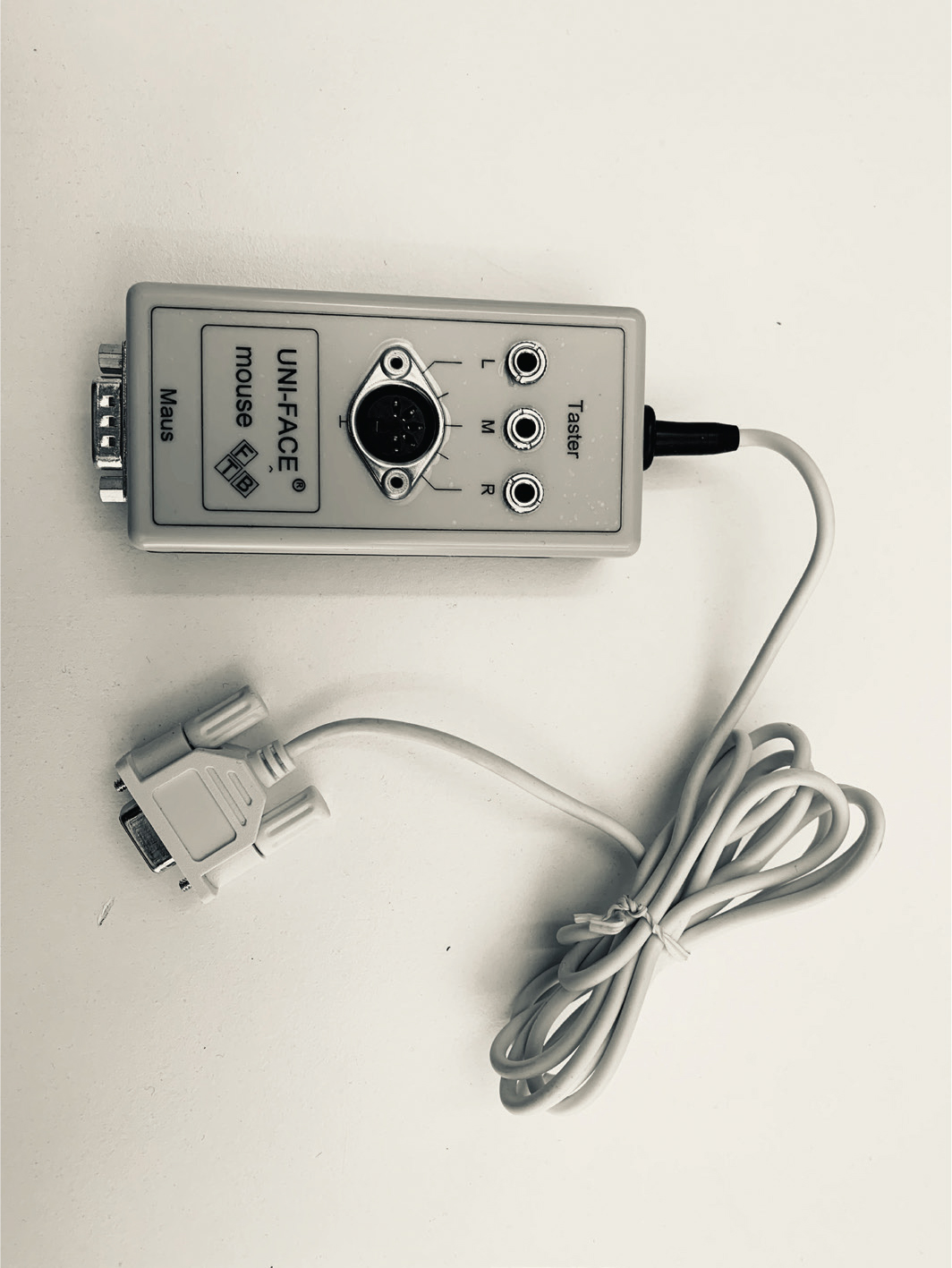
Figure 1
UNI-FACE Mouse.
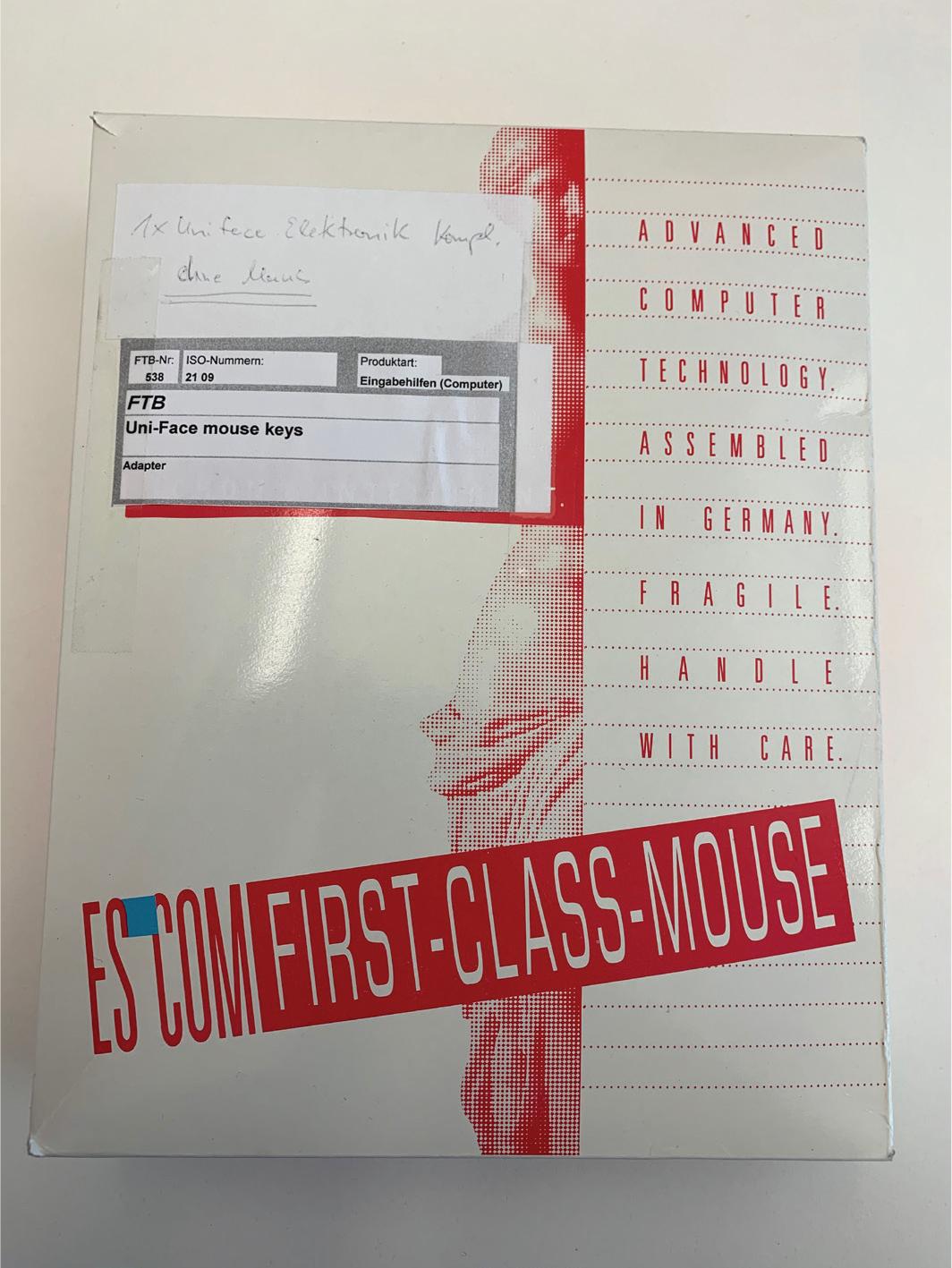
Figure 2
UNI-FACE Mouse packaging.
The following observation regarding the concept of assistance can be derived from Kurt’s narrative and the case of BASKO and the UNI-FACE Mouse: assistive media created a new form of disability between 1980 and 1990. While the difference in the lack of speech muscle control of children with cerebral palsy was initially understood as a ‘non-speaking disability’, this dis/ability complex47 shifted between 1980 and 1990 with the involvement of technological media to an understanding of the disability as ‘non-participation in the medium of the computer’.
Conclusion
This article discusses the phenomenon of AAC through the lens of assistance and two different complementary methodological perspectives. It shows how the term assistance can be understood alongside development processes and the issues that arise in the process. Rather than viewing assistance as a category of (inclusion) politics, we explore assistive media as a fundamental component of dis/ability histories. In the everyday lives of people with disabilities, assistive actions and so-called aids are often common and constitute a central component of an individual’s ability to realise self-determination and participation. From a media-archaeological point of view, AAC has been examined regarding the development of computing hardware and software. Their development is influenced by individual initiatives, and interdisciplinary and socio-political institutions on the one hand, and they have a concrete influence on the possibilities for action of individual users on the other. Through the approach of biographical narratives, it was shown to what extent such contingent devices for aiding communication are embedded in people’s biographies and the heterogeneous significance they can take on in the process. Further, we argued how complex discursive, institutional, and technical formations throughout history affect the specific situation of individual usage in the present. Some aspects of an assistance ensemble — such as peripheral devices for a personal computer — enable computer-aided communication, prescribe or prevent certain modes of use and simultaneously open up access to other areas of life.
Our article has reconstructed assistance and technologies that implement assistance in practice and enable certain forms of communication as a historically variable phenomenon. We have shown that the assistive services provided by the objects and devices enable AAC users to take different courses of action and create heterogeneous conditions of realisation. Assistance is a precarious undertaking that is constantly renegotiated by new technological developments. Each ‘development stage’ of assistive technology provides its own conditions of realisation and has consequences for everyday communication practice and providing communication assistance. For the biographical development of AAC users, assistive media also always give rise to new preconfigured constellations that, for example, pertain to the relationship between body and device and the relationship to other material elements, but also the relationship to subjective preferences and established routines. This article has shown that the category of disability and forms of assistance and participation are changing, as are the collectives that are involved in certain developments.
Notes
[1] S. Tetzchner and H. Martinsen, Einführung in die Unterstützte Kommunikation (Universitätsverlag Winter, 2000); I. Bosse and M. Feichtinger, “Menschen mit körperlichen und motorischen Beeinträchtigungen,” in E.-W. Luthe, S. V. Müller, I. Schiering, eds., Assistive Technologien im Sozial- und Gesundheitssektor (VS, 2022), 177–202; M. Scholz and J. M. Stegkemper, Unterstützte Kommunikation. Grundfragen und Strategien (Ernst Reinhardt, 2022).
[2] J. Boenisch, Kinder ohne Lautsprache. Grundlagen, Entwicklungen und Forschungsergebnisse zur Unterstützten Kommunikation (von Loeper Literaturverlag, 2009), 53.
[3] I. Hörmeyer, Der Einsatz von Körper und Maschine in der Unterstützten Kommunikation. Eine konversationsanalytische Untersuchung (Verlag für Gesprächsforschung, 2015); M. Alper, Giving Voice. Mobile Communication, Disability, and Inequality (MIT Press, 2017); M. Clarke and R. Wilkinson, “Interaction between children with cerebral palsy and their peers 1. Organizing and understanding VOCA use,” Augmentative and alternative communication 23, no. 4 (2007): 336–348; M. Clarke and R. Wilkinson, “Interaction between children with cerebral palsy and their peers 2. Understanding initiated VOCA-mediated turns,” Augmentative and alternative communication 24, no. 1 (2008): 3–15; M. Clarke and R. Wilkinson, “Communication aid use in children’s conversation. Time, timing and speaker transfer,” in ed. H. Gardner and M. Forrester, Analysing interaction in childhood. Insights from conversation analysis (Wiley, 2010), 249–266; J. Light and K. Drager, “AAC technologies for young children with complex communication needs: State of the science and future research directions,” Augmentative and Alternative Communication 23, no. 3 (2007): 204–216; S. K. Lund and J. Light, “Long-term outcomes for individuals who use augmentative and alternative communication: part I – What is a ‘good’ outcome?” Augmentative and Alternative Communication 22, no. 4 (2006): 284–299; S. K. Lund and J. Light, “Long-term outcomes for individuals who use augmentative and alternative communication: part I – What is a ‘good’ outcome?” in Augmentative and Alternative Communication 23, no. 1 (2007a): 1–15; S. K. Lund and J. Light, “Long-term outcomes for individuals who use augmentative and alternative communication: part I – What is a ‘good’ outcome?” in Augmentative and Alternative Communication 23, no. 4 (2007b): 323–335.
[4] L. H. McLeod, “How to Model AAC,” in ed. M. Mills and R. Sanchez, Crip Authorship. Disability as Method (New York University Press, 2023), 337–342.
[5] S. Köbsell, Swantje, “Towards Self-Determination and Equalization: A Short History of the German Disability Rights Movement,” Disability Studies Quarterly Vol. 26, No. 2, Spring (2006), www.dsq-sds.org/2006_spring_toc.html (2.6.2006).
[6] A. Lingen, Elektronische Kommunikationshilfen für nichtsprechende Schülerinnen und Schüler mit Infantiler Zerebralparese. Grundlagen, Ziele, Möglichkeiten (Verlag Evangelische Stiftung Volmarstein FTB, 1994), 3.
[7] S. Hoffmann, “Medienbegriff und Medienwissenschaft,” in ed. J. Schröter, Handbuch Medienwissenschaft (Verlag J.B. Metzler, 2014), 14.
[8] J. Müggenburg, “Assistenz,” in ed. M. Heßler and K. Liggieri, Technikanthropologie: Handbuch für Wissenschaft und Studium (Nomos Verlagsgesellschaft, 2020), 411–415.
[9] E. Schüttpelz and S. Gießmann, “Medien der Kooperation. Überlegungen zum Forschungsstand,” Navigationen 15 no. 1 (2015): 11.
[10] P. Biniok, “Assistenz-Triaden. Abwägungen zu Versorgungssicherheit und Entmenschlichung durch assistive Technologie,” in ed. E.-W. Luthe, S. V. Müller et al., Assistive Technologie im Sozial- und Gesundheitssektor (VS, 2022), 599–621.
[11] Other empirical studies that reconstruct in detail the micro-logic of assistance in various fields in which people with disabilities operate can be found, for example, under the headings of Interaktionsassistenz or ‘interaction assistance’ (L. Kotsch, Assistenzinteraktionen. Zur Interaktionsordnung in der persönlichen Assistenz körperbehinderter Menschen (VS, 2012)) and Mobilitätsassistenz or ‘mobility assistance’ (N. Geese, “Mobilitätsassistenzen für blinde Menschen,” in ed. A. Klettner and G. Lingelbach, Blindheit in der Gesellschaft: Historischer Wandel und interdisziplinäre Zugänge (Campus Verlag, 2018), 153–190). The studies reconstruct complex, practical, interactive, technological and organisational conditions for the realisation of self-determination through assistance (for empirically and conceptually similar research, see C. Richter and K. Mojescik, “Stille Post: Vertrauen und Aktionsmacht in der personellen Assistenzdyade,” in ed. P. Biniok and E. Lettkemann, Assistive Gesellschaft. Öffentliche Wissenschaft und gesellschaftlicher Wandel (VS, 2017), 122–143; N. Al Zidjaly, “Agency as an interactive achievement,” Language, Society 38, no. 2 (2009): 177–200).
[12] The term communication assistance is translated from the original German term Kommunikationsassistenz. I. Niediek, “Mehr als Worte – Praktiken der Kommunikationsassistenz in gemeinsamen Arbeits- und Lernsituationen,” in ed. F. Müller and C. Munsch, Jenseits der Intention – Ethnografische Einblicke in Praktiken der Partizipation (Beltz Juventa, 2020), 184–198; I. Niediek, “Kommunikationsassistenz in Gesprächssituationen mit Menschen mit komplexem Unterstützungsbedarf,” in Qualifizierung für Inklusion 4, no. 1 (2022a).
[13] For conversation analysis see: C. Goodwin, “Co-Constructing meaning in conversation with an aphasic man,” in Research on Language and Social Interaction 28, no. 3 (1995): 233–260; C. Goodwin, “A Competent Speaker Who Can’t Speak: The Social Life of Aphasia,” in Journal of Linguistic Anthropology 14, no. 2 (2004): 151–170; A. Bauer, Miteinander im Gespräch bleiben. Partizipation in aphasischen Alltagsgesprächen (Verlag für Gesprächsforschung, 2009); Hörmeyer, Körper und Maschine.
[14] M. Mills, “Technology,” in ed. R. Adams, B. Reiss and D. Serlin, Keywords for Disability Studies (New York University Press, 2015), 176–179.
[15] A. Shew, Against Technoableism. Rethinking Who Needs Improvement (W.W. Norton & Company, 2023).
[16] M. Mills and J. Sterne, “Dismediation – Three Proposals, Six Tactics,” in ed. E. Ellcessor and B. Kirkpatrick, Disability Media Studies (New York University Press, 2017), 366.
[17] Established positions in media theory, from Marshall McLuhan to Friedrich Kittler and Donna Haraway, have been heavily criticised by those in the field of disability studies for such a rhetorical instrumentalisation of disability. See S. Snyder and D. Mitchell, Cultural Locations of Disability. (University of Chicago Press, 2005); Mills et al., “Dismediation,” 368-370.
[19] Parikka, Media Archaeology, 10. See for German-speaking media studies: S. Zielinski, Archäologie der Medien. Zur Tiefenzeit des technischen Sehens und Hörens (Reinbek, 2002); W. Ernst, “Medienarchäologie. Eine Provokation der Kommunikationsgeschichte,” in ed. H. Knoch and D. Morat, Kommunikation als Beobachtung. Medienwandel und Gesellschaftsbilder 1880–1960 (Fink, 2003), 37-55. See for an international context: J. Parikka, What is Media Archaeology? (Polity, 2011); M. Goddard, “Opening up the Black Boxes: Media Archaeology, ‘Anarchaeology’ and Media Materiality,” in New Media & Society 17, no. 11 (2015): 1761–1776.
[20] J. Schröter, “Digitale Medien und Methoden. Jens Schröter zur Medienarchäologie der digitalen Medien,” in the Open Media Studies Blog of the Zeitschrift für Medienwissenschaft, online, accessed July 10, 2020, https://zfmedienwissenschaft.de/node/1532.
[21] E. Huhtamo, “Dismantling the Fairy Engine,” in ed. E. Huhtamo and J. Parikka, Media Archaeology. Approaches, Applications, and Implications (University of California Press, 2011), 27-41, p. 28
[23] S. Zielinski, Deep Time of the Media. Toward an Archaeology of Hearing and Seeing by Technical Means, trans. Gloria Custance, (The MIT Press, 2006).
[24] Mills, “Technology.”; E. Petrick, Making Computers Accessible. Disability Rights and Digital Technology (John Hopkins University Press, 2015).
[25] A. Fickers, “Hands-on! Plädoyer für eine experimentelle Medienarchäologie,” Technikgeschichte 82, no. 1 (2015): 67–85.
[26] C Bühler and H. Heck, “The versatile communication aid BASKO helps people with speech impairment,” Journal of Microcomputer Applications, no. 16 (1993): 233–241; C. Bühler, H. Heck and R. Wallbruch, “A Uniform Control Interface for Various Electronic Aids,” ICCHP 1994: Computer for Handicapped Persons (1994): 51–58; A. Lingen, Elektronische Kommunikationshilfen für nichtsprechende Schülerinnen und Schüler mit Infantiler Zerebralparese. Grundlagen, Ziele, Möglichkeiten (Verlag Evangelische Stiftung Volmarstein FTB, 1994).
[27] Y. Küsters, Narrative Interviews. Grundlagen und Anwendungen (VS, 2009); G. Rosenthal, Erlebte und erzählte Lebensgeschichte. Gestalt und Struktur biographischer Selbstbeschreibungen (Campus, 1995); F. Schütze, “Prozeßstrukturen des Lebenslaufs,” in ed. J. Matthes, A. Pfeifenberger and M. Stosberg, Biographie in handlungswissenschaftlicher Perspektive. Kolloquium am Sozialwissenschaftlichen Forschungszentrum der Universität Erlangen-Nürnberg (Verlag der Nürnberger Forschungsvereinigung, 1981), 67–156; F. Schütze, “Biographieforschung und narratives Interview,” Neue Praxis 13, no. 3 (1983): 283–293.
[28] On the practical conducting of the interviews and the different narrative techniques, see A. Wagenknecht, Mit einem Talker sprechen. Eine praxistheoretische Rekonstruktion technisch unterstützter Kommunikation (J.B. Metzler, 2024).
[29] Stefan and Karl have been anonymised. They both live with infantile cerebral palsy and have been using various types of AAC devices for several years.
[30] G. Vanderheiden, “A journey through early augmentative communication and computer access,” The Journal of Rehabilitation and Development 39, no. 6 (2002): 39–53.
[32] G. Vanderheiden, “Computers Can Play a Dual Role for Disabled Individuals,” BYTE 7, no. 9 (1982): 138.
[35] G. Lormes, “Neue Chancen durch Personalcomputer für Körperbehinderte?” Beschäftigungstherapie und Rehabilitation 26 (1987): 88. Translation of the German original.
[37] J. Müggenburg, P. Sander and A. Wiechern, “Interview with H. Heck, Wallbruch, M. Huber,” conducted on February 6, 2019 in Wetter.
[39] A. Hamraie and K. Fritsch, “Crip Technoscience Manifesto,” Catalyst. Feminism, Theory, Technoscience 5, no. 1 (2019): 1–34.
[40] On the connection between time and practices as a common AAC topic, see D. J. Higginbotham and D.P. Wilkins, “Slipping through the timestream: Social issues of time and timing in augmented interaction,” in ed. D. Kovarsky, J. Duchan and M. Maxwell, Constructing (in)competence: Disabling evaluations in clinical and social interaction (Lawrence Erlbaum, 1999), 49–82; K. L. Howery, “Out of Time: The Experience of Speech-Generating Device Users,” Communication Disorders Quarterly 40, no. 1 (2018): 40–49; I. Niediek, “Time – Timing – Out of Time? Auswirkungen temporaler Herausforderungen auf die sozialen Beziehungen unterstützt kommunizierender Jugendlicher,” Diskurs Kindheits- und Jugendforschung 3 (2022): 281–295.
Biographies
Jan Müggenburg is Professor of Digital Cultures at the Institute for Culture and Aesthetics of Digital Cultures at Leuphana University in Lüneburg and speaker of the Leuphana Center for Digital Cultures (CDC). From 2006 to 2010 he was a research assistant at the Institute of Philosophy at the University of Vienna and received his doctorate with a thesis on Heinz von Foerster’s Biological Computer Laboratory. Since 2020, Jan Müggenburg has been the program director of the Major Digital Media (MDM) bachelor’s program, which Leuphana University offers in cooperation with the Hamburg Media School. He is the editor of ‘Range Anxiety. Batteries and Accumulators as Media of the Digital Age’ (2021) and co-editor of ‘Assistive Media. Barriers and Interfaces in Digital Cultures’ (2024).
Andreas Wagenknecht is a research associate at the Institute for Medical Sociology and Rehabilitation Sciences at the Charité – Universitätsmedizin Berlin. From 2015 to 2020 he was a research assistant at the ‘Locating Media’ graduate school at the University of Siegen and received his PhD with a media ethnographic thesis on Alternative and Augmented Communication. Until 2022 he is working in the field of emergency and acute medicine at the Charité - Universitätsmedizin Berlin. He is the editor of ‘How to conduct research with Science and Technology Studies?’ (2020).