
Conventional media portrayals of dysfluency tend to depict stuttering or stammering as anxiety-inducing states, a silence purportedly denoting befuddlement, and a form of communication to be avoided at all costs.1 As disability and dysfluency scholars Daniel Martin and Maria Stuart note, fluent speech aligns with norms of productivity and excellence. In contrast, the gaps of the stutter and stammer produce ‘an often-unacknowledged anxiety and tension in the cultural, economic, and intellectual composition of modernity.’2 As such, in everyday sonic encounters, fluency is heralded as supreme and tends to align with forms of cultural capital. As a selectively dysfluent speaker, I have experienced what sometimes feels like the gaping maw of pressure to speak fluently, which often results in uncomfortable moments of silence; learning to move past the awkwardness and discomfort of normative social expectations, I find that there exists a generative sounding out between listener and the speaker where time opens up. Might we learn to get comfortable with the uncertain and non-linear temporal unfoldings of dysfluent encounters? To answer this question, and by situating my inquiries at the intersection of media studies and disability studies, I wish to highlight sound pieces that mediate dysfluent temporalities. At the threshold of sound and silence, whereby one counters normative expectations of temporal unfolding, I examine how certain experimental pieces aid in conceptualizing dysfluency otherwise. By resisting the supremacy of fluency, and building on key and emerging scholarship on dysfluency, I highlight the work of stuttering and stammering practitioners whose pieces further an anti-ableist3 media ecology. The practitioners who interest me offer a way of confronting the question of the limit or the binary of silence and sound to point instead to a generative threshold. On this threshold of the otherwise, my analysis of sound practitioners constellates on dysfluent spacetimes, troubling the distinction between sound and silence in what I have come to term (sounding) silence.
A (sounding) silence unfolds in spacetimes where sound—be it corporeally or environmentally-inflected—is mediated otherwise in what might seem like disconcerting instances of silence. Those familiar with the work of postwar experimental sound composer John Cage will recognise the gesture here to Cage’s experiments in an anechoic chamber at Harvard University in 1951, where the composer realised that his nervous system was creating a loud buzz, and where ‘[t]here is no such thing as an empty space or an empty time . . . there is always something to … hear.’4 Others might recognise an affinity with dysfluent composer JJJJJerome Ellis, whose soundings ‘open time’ in the generative space that Ellis terms ‘the clearing,’ after which they title their album and book. Moreover, I am interested in reading how stuttering lends itself to altered temporalities that align with what Alison Kafer terms ‘crip time.’5 Instead of eliding or collapsing the complex sonic envelope of dysfluency, I am interested in works that gesture instead to a reparative way of being in the world that is otherwise averse to masterful6 and efficiently fluent modes. Here, I engage with the Queer postwar soundings of Cage,7 alongside the work of experimental sound composer and stutterer Alvin Lucier, and lastly, the work of contemporary dysfluent musician Ellis. What emerges through this study constellates a dialectical conversation that troubles conventional (mis)understandings about the temporality of stuttering, pointing to forms of silence otherwise.8 Briefly, Lucier and Ellis, both American practitioners, approach their dysfluencies in differing ways; nonetheless, their dysfluent media forms destabilise Enlightenment-to-neoliberal notions of mastery and fluency. Ellis, a Black, Queer sound artist of the contemporary moment, works specifically at the intersection of Blackness and sound to further throw Enlightenment modes of being off the map. In centring the work of disabled and neurodivergent9 practitioners,10 as well as the work of Queer and Black artists, I situate the generative ways that dysfluency, when approached through reparative modes of reading and crip temporalities, not only opens the possibility of conceiving anti-ableist lifeworlds, but ‘teach[es] us about justice.’11 By tracing sound art from the postwar to the contemporary,12 I thereby limn a media genealogy between the soundings of Cage, Lucier, and Ellis, seeing how their works pivot on the concept of silence (or rather, the lack thereof), and where a (sounding) silence generatively mediates sound otherwise.
The Sounds and Unsounds of Cagean Indeterminacy
To alight on the threshold of (sounding) silence, I place the work of postwar to contemporary sound practitioners together as interlocutors. In order to sound out this conversation, I will first underscore some of Cage’s approaches to sonic experimentation as a topological hinge. Cage furthered an overall anarchism13 in his approach to the purported sound/silence binary. Coupled with his concept of indeterminacy, I find this formulation useful as a framework for getting to the heart of (sounding) silence and for later thinking of dysfluency as generative soundings otherwise. Cage’s collection of writings, Silence (1961), delineates his early explorations in experimental sound.14 At the time of Silence’s publication, Cage continued the movement away from his mentor, Arnold Schoenberg, and the latter’s notion of harmonic composition and serialism.15 Some of the chapters in Silence, such as the “Lecture on Nothing or Indeterminacy,” articulate sound forms and experimental performances that refuse Schoenberg’s serialism or the ‘masterful’ sounds of Heinrich Schenker and modes of Schenkerian analysis.16 For instance, Cage advises readers to approach “Lecture on Nothing” ‘with the rubato which one uses in everyday speech,’17 so that sounds can unfold in a chance manner without restrictions and impositions. To suggest the inherent lack of structure as a formal threshold that moves away from the twelve-tone serialism of Schoenberg, Cage writes: ‘[t]he twelve-tone/ row/ is a method;/ a/ method is control/ of each/ single/ note./ There is too much/ there there/ There is not enough/ of nothing on it/ A structure is/ like/ a bridge from nowhere/ to/ nowhere/ and/ anyone may/ go on it/ noises or tones.’18 Here, Cage suggests that structure is antithetical to his approach to sound, as Cagean indeterminacy opens ‘the possibility of a unique form, which is to say a unique morphology of the continuity, a unique expressive content.’19 By defining indeterminacy as a kind of chance encounter between sound, bodies, and the surrounding space, Cage remarked on the environmental inflection of soundings, where ‘incidental sounds from the environment, and, by extension, beings—are related.’20 Cage’s openness about what constitutes viable soundings aids in thinking about inflections of sound in space and a consideration of how sound becomes mediated corporeally.
By opening his practice to other forms of mediation through corporeality and spatiality, Cage moved further away from his mentors in serialism and embraced an alteration in what was deemed sound proper; furthermore, Cage troubled the question of where sound begins and silence ends, which bridges to how I am thinking of (sounding) silence. In parsing issues of audibility and the sometimes indistinguishable lines between sound and silence, Cage thereby subverted the binary between ‘unsound’ and ‘inaudibility.’21 In his experimental sound practice, as is made evident with the oft canonised ‘silent’ work 4’33” (1952), one year after he visited the anechoic chamber at Harvard, Cage sought ‘to undo the distinction between sound and silence.’22 4’33,” a piece that redefined sound as art, simultaneously bridged to the incorporation of sound as part of the ecology of the art world. First performed by David Tudor in New York, 4’33” was a composition that included timed intervals of opening and closing a piano’s fallboard. For Cage, what constellated the sonic registers of the piece were the timed intervals of the fallboard, coupled with the sounds and shuffling of various spectators’ bodies in the room. While 4’33” may be one of Cage’s more celebrated pieces, other works by Cage take up and theorise how the body might become a sounding instrument. As Branden W. Joseph notes of Cage’s experience with the threshold of sound and silence, ‘[f]ollowing upon his experience in an anechoic chamber (…), Cage famously redefined silence as inherently and unavoidably filled with sounds.’23 Here, I reiterate what Cage remarks in “Experimental Music,” where ‘[t]here is no such thing as an empty space or an empty time. There is always something to see, something to hear.’24 By drawing attention to the minute, whirring sounds of what he describes as the ‘nervous system in operation,’25 Cage became intimately aware of the sonic pulsation of his own body in the anechoic chamber and what he found as unavoidable soundings within purported ‘silence.’ As such, a (sounding) silence emerges.
To echo this rich threshold catalysed by Cage during the postwar, Mitchell Akiyama recounts a more recent, yet similarly uncanny experience in an anechoic chamber at the Institut de Recherche et Coordination Acoustique/Musique (better known as IRCAM) in Paris, France. During this visit, Akiyama articulates an experience not unlike Cage’s transformative encounter with ‘silence’ at Harvard:
even the quietest, most quiescent body is vibratory and vibrated. The air around you incessantly stirs itself into almost-audibility; the size and shape of the room you are in will reinforce some of these frequencies, reinforcing subtle resonances that are unique to that space. And this, of course, is if you can even discern the room’s tone, which is almost certainly masked by buzzes, whirs, drones, and clanks of a built, electrified environment. But should there be a lull, you might notice that even your ear itself produces faint sonic vibrations called otoacoustic emissions. A body constantly performs its presence, literally sounding its anatomical immediacy.26
Here, the mediated phenomenon of sound makes unclear the distinction between where sound ends and silence begins—if there is a distinction to be made at all—crucial to (sounding) silence. Sound, as it is experienced and mediated corporeally, reduces instead to the molecular and the vibrational as it is mediated in time and space, which aids in conceptualizing dysfluency otherwise.
Through Cage’s overall curiosity about the potential of sound to unfold indeterminately, coupled with his anarchistic approach to sound more broadly, he paved the way to think about sonic mediation on bodily and spatial levels. By considering how silence is mediated otherwise, or rather, dismediated27 by sounds, which constitutes (sounding) silence, Cage’s work simultaneously gestures to a practice that Ben Piekut terms ‘an experimentalism otherwise (…) [where] this restless desire to be elsewhere, this searching for an otherwise, might be the closest thing to an “essence” of experimentalism that we will ever get.’28 To follow this idea of the otherwise, and tie Cage’s work to the now highly mediated present of ubiquitous sonic/screen interference, I am interested in where an alterity in sonic experimentation necessarily centres difference. In tying the postwar to the contemporary experimental sound sphere, I wish to continue to centre Queer sound forms,29 as well as Black, disabled, and neurodivergent sound practices. Here, it is critical to point out that Cage’s queerness is intertwined with his sonic experimentation, however much a decisively Queer reading is not necessarily centralised in his oeuvre. As Jonathan D. Katz points out, Cage’s registers of silence are multi-determined, as he suggests that ‘[i]f silence was in part an expression of Cage’s identity as a closeted homosexual during the cold war, it was also much more. It was not only a symptom of oppression but also a chosen mode of resistance.’30 In noting the way that Cage’s identity was elided by the practitioner as a kind of resistance adds further weight to a consideration of (sounding) silence. While some scholars see a resistance in Cage’s approach, others articulate an overdetermined anarchism to the Cagean legacy. As Marie Thompson points out, there exists a ‘well-established, predominantly white and masculinist canon of experimental music and sound art (e.g. John Cage, Alvin Lucier, Pierre Schaeffer, Francisco López) whose formation has been heavily influenced by Cagean aesthetics and principles.’31 Thinking more intently about Cagean ‘silence,’ or what Katz astutely terms ‘queer silence’ complicates an outright ‘masculinist’ reading of Cage. Undoubtedly, though, there is an unfortunate tendency for ‘white aurality’32 to dominate historical accounts of avant-garde and experimental sound. Nevertheless, in troubling the distinction between sound and silence, Cage’s work opens a framework for considering the corporeal dimension of sound, which I see as having crucial implications for marginalised and dysfluent sound practitioners whose (sounding) silence sounds out otherwise.
Sitting Otherwise in a Room
As a contemporary of Cage, Lucier was also working under the auspices of sound experimentation otherwise, where he explored thresholds of possibility in the sonic encounter. Interrogating where silence ends and sound begins, Lucier’s work denotes a (sounding) silence germane to thinking of the dismediation of sound experimentation. It is crucial to note that Lucier had a stutter, which he incorporated into his pieces with hopes that it would reach the listener; ideally, for Lucier, his pieces would help to transform the listener’s perception of stuttering and stammering. In one of his well-known compositions, entitled I Am Sitting in a Room (1969), stuttering is centralised by Lucier, who repeats the same series of words over and over, as he re-records his repetitive utterances over the duration of forty-five-minutes. What Lucier speaks into the room builds into a thick sonic register, where he repeats the phrase:
I am sitting in a room different from the one you are in now. I am recording the sound of my speaking voice and I am going to play it back into the room again and again until the resonant frequencies of the room reinforce themselves so that any semblance of my speech, with perhaps the exception of rhythm, is destroyed. What you will hear, then, are the natural resonant frequencies of the room articulated by speech. I regard this activity not so much as a demonstration of a physical fact, but more as a way to smooth out any irregularities my speech might have.33
What happens with the dysfluent sound registers in this piece is somewhat ambivalent, albeit rich for a consideration of (sounding) silence. At the beginning of the work, Lucier stutters when mentioning the word ‘rhythm’ as a clearly demarcated instance of dysfluency. As Lucier re-records the same line and plays the sound back again, his stutter is eventually reworked sonically through repetitive layers of recording. I Am Sitting in a Room is unique for a 1960s sound piece in that the work centralises disability by intertwining Lucier’s stutter in its sonic envelope; however, Lucier deliberately aims to ‘smooth out’ his dysfluency through a series of re-recordings that become further abstracted in a fog of sonic resonance as the piece unfolds throughout the performance. I situate Lucier’s work here before turning to other dysfluent sound practitioners, as Lucier, like Cage in the anechoic chamber, gestures to how sound is phenomenologically inflected in space and time.34 By recording the same line repetitively as stuttering sounds out within space, Lucier layers his sounds in a way that renders sonicity as abstract and indecipherable. While a fog of resonance unfolds throughout the piece, which is due to Lucier’s vocality and stutter taking on a distortion through repetition and layering, there also emerges an interstitial (sounding) silence that troubles the question of where sound stops, and silence begins. As Craig Dworkin notes of the sonic registers of the piece, ‘the work gives the sense of sound heard at the wrong scale. Not just out of sync, but unequalised, too loud, too slow, simultaneously too much and not enough—the listener is left with waves washing beyond the capacity of the electronic meshes meant to capture them.’35 What makes the reading of I Am Sitting in a Room ambivalent, though, is that instead of incorporating his stutter in a way that makes dysfluency continually legible as such, Lucier tends to flatten the tones and vibrations of his otherwise generative stutter. While it seems as though the composer is minimizing his dysfluency, the piece was healing for Lucier and made with the intentions of being therapeutic to other people with similar conditions.36 Although there may be some limitations to Lucier’s work, especially in terms of how the piece flattens his stuttering, he nonetheless centres forms of care and draws attention to the intertwining of dysfluency and experimental sound practices. By doing so, Lucier’s work sounds out an otherwise about dysfluency which is critical for conceptualizing a (sounding) silence.
Sounding Through The Clearing
‘Black loops are always black loop(hole)s of retreat.’37 - JJJJJerome Ellis
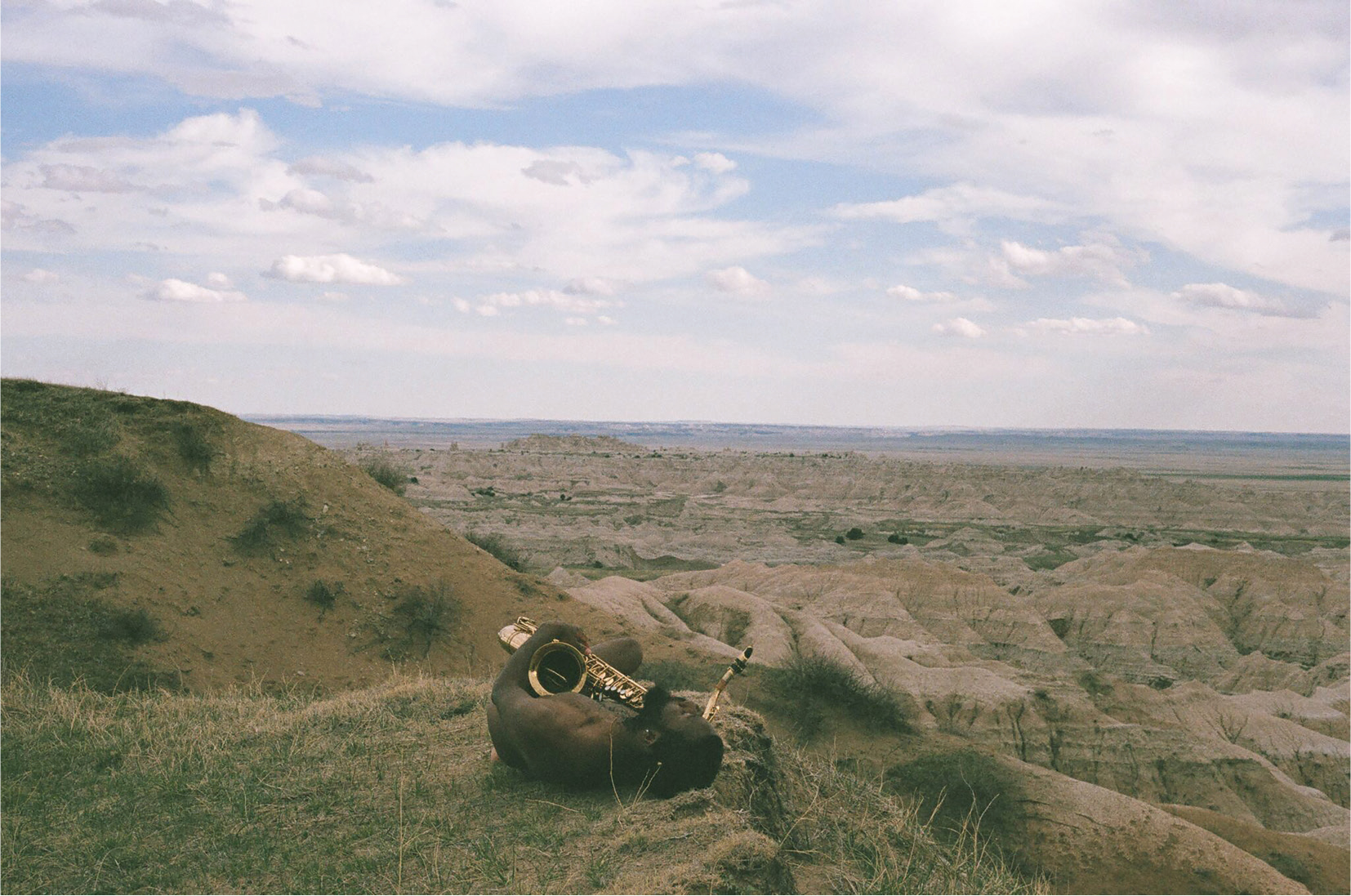
Figure 1
Image description: Image of JJJJJerome Ellis embracing a saxophone in an open expanse—a mediation otherwise. Photo courtesy of JJJJJerome Ellis (photo taken by Ellis)
A generative conversation about temporality sounds out in the encounter between the resistant anarchism of 4’33,” Lucier’s I am Sitting in a Room, and Ellis’ The Clearing. One point of connection among these works is through an indeterminacy that subverts normative spacetimes of sound. As scholars have noted, Cage’s impetus for indeterminate sound creation was chance-based, anarchistic at heart, and deeply connected to a postwar ethos that resisted any possible suggestions of dictatorial, or fascistic impulses. Fred Turner notes about Cage’s overall approach to sound that ‘chance methods of composition freed sounds from the need to obey the will of a dictatorial composer or even follow the norms of an oppressive culture,’38 which has implications for resisting norms of capitalist productivity. As Cage’s approach shows, sound is held at a threshold that upends linear or hegemonic time and normative sonic experience. Lucier’s work troubles the question of control by letting the room alter the sonic register of his utterances as the piece unfolds over time. Ellis’ work is also temporally and corporeally mediated, suggesting a kind of dismediation. As Ellis notes in the preface to the text accompaniment of their album, or what they call ‘a transcription of an album of the same title,’39 ‘the glottal block finds the silence in the syllable and enters its inner sanctum…it’s an ethos of time.’40 Thinking of the spatiotemporality and corporeality of sound, and the body as a technology of sounding, I see a generative connection between Cage, Lucier, and Ellis, the latter of whom notes the way that their vocal chords ‘(tr tr tr trtr tr tr tr tr trtr tr tr tr tr trtr tr tr tr)tremble’41 when they stutter. In such trembling sonicities, a (sounding) silence resists normative unfoldings of sound in space and time.
By placing postwar practitioners such as Cage and Lucier in dialectical conversation with Ellis, I must first note how Ellis conceptualises ‘the clearing’ and where they took inspiration for this specific temporal threshold of dysfluency, where they note, ‘when I stutter I come into a clearing where the path temporarily disappears. The clearing opens the present moment.’42 The connection between Cage and a (sounding) silence in the contemporary holds on an indeterminate threshold of time. The connection to Cage is not only temporal, but opens a consideration of cripping43 silence otherwise. Not only is temporality a central concern for Ellis, but they also wish to interrogate Blackness in their work, and what they consider an intersection of sound, Blackness, and time. In “Jede Krankheit is ein musikalisches Problem,”44 Ellis states, ‘I speak with a stutter.// I am Black (aaaaaaaaaaaaaaaaaaaaaaaaaaaaaaaaaaaaaaaaaaaaaaaaaaaaaaaaaaaaaaaaaaaaaaaaaaaaaaaaaaaaaaaaaaaaaaaaaaaaaaa) And I’m a musician.// And I’m interested// in the intersection// of these things.’45 Here, the interconnection of Blackness, sound, and time is reflected in the way the words stretch across the page through radical form, complementing how their sounds resist hegemonic forms of ‘white time.’46 Unlike Lucier’s way of flattening dysfluency, Ellis centralises their stuttering in their soundings and accompanying written work. Their oeuvre also aids in reconceptualizing the contemporary sonic avant-garde—gesturing to alternative temporalities that intersect with Black sonicity.
An interlocutor working at the same intersection as Ellis—although particularly working on the sounds of the African Diaspora—scholar Alexander Weheliye fleshes out expanded reaches of Blackness, sound, and temporality. As Weheliye notes of this threshold for theorising, a ‘sonic (Black) temporality (…) generates a genuinely “new” modality, a different groove.’47 Making germane connections to the grooves of a record, Weheliye contextualises spatiality and temporality as overlapping with sound technologies, remarking that ‘[t]he grooves of sonic Afro-modernity can be found in the spaces and times between technological change and a variety of cultural practices, and the interplay between the hard- and software poignantly encodes the competing notions of subjectivity, temporality, spatiality, and community without dissolving them.’48 Weheliye provides an alternative to the ‘white aurality’49 that tends to dominate considerations of experimental sound art. By troubling white canonicity and linear temporal unfoldings, scholars like Weheliye point instead to what Paul Gilroy notes as an ‘unsteady location simultaneously inside and outside the conventions, assumptions and aesthetic rules which distinguish and periodise modernity.’50 Instead, a sonic otherwise is one that necessarily includes Blackness and Black sound production. There is also a generative connection here with Fred Moten’s crucial text on sound and Blackness, In the Break: The Aesthetics of the Black Radical Tradition (2003). Persuasively, Moten argues, ‘what I’m after now is this: an assertion that the avant-garde is a Black thing (…) and the assertion that Blackness is an avant-garde thing.’51 The key for Moten is to not get it twisted. That is not to say that Cage’s groundwork on the threshold of sound and silence is without critical registers of resistance;52 rather, there are more complex sonic histories at play, where Black practitioners sound out the experimental sound canon otherwise. Both Weheliye and Moten53 gesture to Black practitioners whose work is under-canonised, or silenced in the spacetimes where their works should be sounding out.
Ellis’ work offers a reparative approach to forms of silencing evidenced in canonical historical accounts on sound experimentation. They note that one of the central goals of their project is to heal from ‘temporal subjection’54 that occurs in ableist and normative conceptions of how sound ‘should’ unfold over time. Instead, the (sounding) silence evidenced in their oeuvre breaks arbitrary boundaries and troubles the culturally conceived notions about where sound ends, and ‘silence’ begins. They simultaneously problematise emphases placed on fluent compositions which are expected to have a linearity in their temporal unfoldings. Here, the generative writings of Kafer, particularly her theorisations of ‘crip time,’ aids in considering the unfolding of sound in space and time as generative, expansive, and resistant to ‘temporal subjection.’55 In her formulation, Kafer notes that ‘crip time’ is ‘flex time not just expanded but exploded; it requires reimagining our notions of what can and should happen in time.’56 Kafer suggests the inextricability of temporality and crip bodyminds, and centres the refusal of normative and hegemonic conceptions of time. Taking up Kafer’s concept of crip temporality aids in the analysis of delayed, mute (selectively or otherwise), anxious, and dysfluent silences that subvert unfoldings of time that rely on capitalist forms of mastery and stereotypical notions of productivity. In short, a refusal of ableist ways of being in the world.
In healing from the subjection of normative time, Ellis finds expression through the dilation of temporality, wherein they sound out through sonic encounters. This (sounding) silence encompasses a listener in a form of relation. Such forms of encounter are also germane to Elena Backhausen in “On the Temporality of Stuttering,” who notes how ‘[s]tuttering automatically results in resonance, as it usually does not automatically concern the disabled person in isolation but is situationally bound to a present (or sometimes imaginary) listener.’57 As Backhausen notes, the dysfluent person in a communicative dynamic with a non-dysfluent listener ‘constantly fails to meet’ the social demands of the encounter, which is why there is such a deeply ‘intersubjective dimension’58 to stuttering as a disability.59 Ellis’ work lands within this encounter and transforms the ‘temporal subjection’60 that may occur in the encounter with another non-dysfluent person who abides more strictly to socially constructed norms of speaking and listening. To echo this a similar disruption in the encounter, Gilles Deleuze’s oft-cited piece on stuttering and linguistic expectations, “He Stuttered,” suggests ‘[w]e are faced here with stuttering, since every position of “a” or of “the” constitutes a vibration. Language quivers in all its limbs, and we discover at this point the principle of a poetic understanding of language itself: it is as if language were carving a line to stretch—both abstract and infinitely varied.’61 Thinking of this vibration and ‘quiver’ harkens back to Cage’s experience with the vibration of sound in the anechoic chamber at Harvard. By questioning limitations imposed on sound and silence, Deleuze also writes about literary pieces that work with dysfluency as denoting a limit to language, where ‘[w]hen the language system is so much strained, language suffers a pressure that delivers it to silence.’62 Here, Deleuze troubles the imposed limitations in a language, not unlike what may unfold in an encounter between a disabled and non-disabled speaker. What usually occurs is the discomfort of the awkward encounter, where time extends into silence. Kafer’s formulation of ‘crip time’ gives a language to consider the moment of the encounter otherwise—as a (sounding) silence. The encounter can easily transform into an instance of sonic generativity or even sonic resistance.63
Ellis’ album and transcription of The Clearing is generative through ‘crip time,’ the demonstrative tension between audibility versus inaudibility, and via a kind of indeterminacy. By sounding out through rubato, Ellis’ work is indeterminate in the way it ‘relies on some degree of unpredictability.’64 I also see a connection here with Cage’s suggestion of ‘the nervous system in operation’ in the anechoic chamber, where Cage notes of there being no such thing as ‘empty space or empty time.’65 Instead, in ‘soundscapes without linearity or structured climax,’66 there is an unfolding of non-linear time that is replete with the ongoingness of sound. Turning to the work of Ellis to read crip temporalities alongside Cagean indeterminacy and Lucier’s therapeutic sound project, further articulates the generative threshold of (sounding) silence. In a written piece which is both a poetic treatise and an explication of their work, “The Clearing: Music, Dysfluency, Blackness and Time,” Ellis situates a threshold of sound, time, Blackness, and disability. Ellis notes of their overarching project, ‘[m]y thesis is that Blackness, dysfluency, and music are shaped by forms of subjection enacted in the sphere of time—what I call temporal subjection. But because these three forces open and shape time, they create alternative temporalities that can help us heal from the wounds of that subjection.’67 Their marginalisation is key to their embodiment of space and time and signals the need for a reparative approach to being with disabled and neurodivergent others in the world. This reparative alterity sounds out, albeit at times, ‘silently.’ Throughout The Clearing, Ellis incorporates the delays caused by their glottal block, which they describe as ‘silent gaps in speech. I call these gaps clearings.’68 These ‘clearings’ emphasise where time extends and abstracts from linearity. Ellis’ words about their soundings open up time and situate a temporally mediated practice of soundings otherwise.
In terms of the formal registers of Ellis’ work, Ellis’ glottal block surfaces a consideration of what would otherwise be considered ‘undesirable’ sound registers in Schenkerian terms; instead, Ellis’ stuttering temporalities unfold as tempo rubato or the out-of-tune soundings of wolf tones. Wolf tones occur when the technologies of sound and the pitch created by the instrument unfolds into a jarring discordant sound, which happens with certain stringed sound technologies that create a feedback loop.69 As Stan Allen describes, the wolf tone suggests that ‘the emergent order of the assemblage asserts itself as something set in motion by the artists, yet not entirely subject to their control.’70 As such, wolf tones are irregular and uncontrollable modes of sonic expression that play with duration and depart from the fantasy of normative or metered musical expression in pitch and tone in time, and where a composer decides on the durational speed of a piece as inherent creative expression—a ‘difficult beauty.’71 In short, ‘undesirable’ sounds eclipse mechanical exactitude and pitch-perfect soundings that rely to some degree on technics. Anna Friz remarks that the imperfection of the wolf tone is generative, stating that ‘the wolf tone proposes that dissonance and discord are also valuable.’72 Historically, sound demonstrates a misfit between the ideal of sound and the material technologies of sonic transmission, often coming in the form of imperfect tuning devices. How might sound be generative in exactly the ways that it diverges from the ideal, the pitch-perfect, or the in-tune? As evidenced in Ellis’ work, it is much more interesting to consider pauses, gaps, blocks, or other forms of fermata, which is a pause that is held indeterminately, in a way that ‘breaks up the flow’73 of sound. As Ellis notes of their stuttering, the vibration of their glottal block creates a temporal pause where there is a form of sonic prolongation akin to fermata. As a practice of (sounding) silence, Ellis remarks that dysfluency brings forth a threshold between silence and sound:
The contra-diction/ of stuttering/ is that I am both speaking/ and not speaking. // Mid-sentence I block on a word.// Sound stops coming from my mouth,/ but I haven’t reached the end of my thought.// The current of my speech/ has just/ gone/ underground.// Or I block/ on the first word of a new sentence.// It sounds like I haven’t begun/ speaking yet, /when in fact I have. // The current (jjjjjjjjjj) just hasn’t surfaced.// I saw an image of this/ when/ an otolaryngologist/ performed a fiberoptic/ laryngoscopy on me/ and I watched my vocal chords/ at rest,/ speaking,/ and blocking.// When I blocked,/ I saw my vocal chords (tr tr tr trtr tr tr tr tr trtr tr tr tr tr trtr tr tr tr)tremble.74
Ellis’ evocation of trembling underscores the tension of sound as mediated corporeally. This constellates a generativity between Cage’s idea of the body as a sounding instrument, Lucier’s therapeutic sounding project, and Ellis’ trembling—all forms of (sounding) silence that reconfigure the spacetimes of sound.
As is evident in The Clearing, a (sounding) silence opens instances where dysfluency expands time cripply. For Ellis, as a Black and disabled practitioner, the threshold between sound and silence is simultaneously the moment wherein they can move beyond the ‘limitation of lineal white time.’75 By pivoting dialectically between the postwar and the contemporary, Ellis’ work demonstrates how ‘Blacknesses, dysfluencies, and musics open the possibility of refusal: refusal to consent to be a single being, refusal to speak fluently, refusal to move immediately to the next syllable, an ontological withdrawal, marching backwards down into the waters.’76 As water and notions of fluency are recurring motifs in The Clearing, Ellis’ suggestion of ‘marching backwards down into the waters’77 is not without significance for conceptualizing dysfluency otherwise. As Ellis notes in “Jede Krankheit,” they open their work to include many forms of dysfluency to limn a therapeutic sounding that includes folks with Tourette’s, Down’s Syndrome, ASD, and others who speak dysfluently.78 What Ellis’ tarried words about their soundings situate instead is a mediated practice that considers crip sound possibilities otherwise.
Coda
Throughout their compositions, Ellis’ reworks normative ideas about silence, dysfluency, and stuttering, and refuses linear time, highlighting ‘alternative temporalities’ to heal from what they term ‘temporal subjection.’79 In many instances in The Clearing, Ellis’ work is also mediated through technics—as with their use of the telephone to capture moments where Ellis steps into ‘the clearing’80 with another, or the fact that Ellis’ sounds are captured by recording technologies and the implications thereof—signalling generative gaps and pauses where refusal emerges. What ends up sounding out in Ellis’ work is a call for a dismediated81 sound practice, one where sound ‘slipped out the back door of time,’82 an encounter with technics of sound opens into the sensorially mediated present. By dialectically pairing the work of Cage with dysfluent practitioners Lucier and Ellis, a newly reconfigured way of approaching nuances within silence and sounding emerge that diverge from conventional sound canonisations, hegemonic productivity standards, and normative (mis)understandings about dysfluency. In a (sounding) silence, the generative work of dysfluent practitioners instead registers resistance to ableist ways of being in the world. In a space-time of silence signalling otherwise, stuttering and stammering sonic anarchisms keep sounding out. Keep. Keep, keep sounding out. Sounding out.
Notes
[1] Jeffrey K. Johnson, “The Visualization of the Twisted Tongue: Portrayals of Stuttering in Film, Television, and Comic Books,” Journal of Popular Culture 41, no. 2 (2008): 245–61, https://doi.org/10.1111/j.1540-5931.2008.00501.x.
[2] Daniel Martin and Maria Stuart, “Introduction: Metaphoric Stammers and Embodied Speakers,” Journal of Interdisciplinary Voice Studies 5, no. 2 (2020): 126, https://doi.org/10.1386/jivs_00020_2.
[3] Here I am following the work by a group of scholars and practitioners working at the Center for Global Disability Studies (CGDS) at University of Toronto Scarborough, and their overall commitment to an anti-ableist approach to critical disability studies, being as inclusive as possible of diverse bodyminds.
[5] Alison Kafer, “Time for Disability Studies and a Future for Crips,” in Feminist, Queer, Crip (Indiana University Press, 2013), 27. Also, I thank my anonymous reviewer for pointing me to the text by Elena Backhausen, where Backhausen makes this germane connection as well, noting that ‘stuttering can be seen as a moment of crip time that reminds us how deep norms and regulations are rooted in everyday life which should be transformed and not taken as given.’ See: Elena Backhausen, “On the Temporality of Stuttering,” in Out of Time?, 1st ed. (Routledge, 2024), 130.
[6] By this suggestion, I am thinking with Eve Kosofsky Sedgwick’s notion of reparative reading and trying to move away from paranoid, or masterful academic modes and strictures, as much as it is hard to avoid. See: Eve Kosofsky Sedgwick, “Paranoid Reading and Reparative Reading, or, You’re So Paranoid, You Probably Think This Essay Is About You,” in Touching Feeling: Affect, Pedagogy, Performativity (Duke University Press, 2003), 127.
[7] Here, I nod to the work of Jonathan D. Katz who examines registers of ‘queer silence’ in Cage’s oeuvre, particularly in 4’33” (1952). I thank Lesley Verbeek for gesturing to Katz’s important work. See: Jonathan D. Katz “John Cage’s Queer Silence; Or, How to Avoid Making Matters Worse,” GLQ 5, no. 2 (1999): 231–52, https://doi.org/10.1215/10642684-5-2-231.
[8] Although Cage is not dysfluent, his conceptualisation of silence is one I am building off to think otherwise about the moment of opening that unfolds through stuttering or stammering.
[9] Here, I am thinking of the expansion of the term neurodiversity, and how ‘the breadth of this expansion is captured in Kassiane Asasumasu’s coining of ‘neurodivergent’ in the early 2000s. For her, this refers to any kind of neurological functioning that is considered “divergent from typical.”’ See: Robert Chapman, “Introduction,” in Empire of Normality: Neurodiversity and Capitalism (Pluto Press, 2023), 5.
[10] The artists in this paper are working primarily in The United States. While I am situating my analysis on practitioners of the Global North, I realize that this geographical focus poses some limitations in terms of broader inclusivity.
[11] See: JJJJJerome Ellis, “About,” Artist website, Accessed May 27, 2024, https://jjjjjerome.com/about.
[12] In terms of historical context, I will anchor my piece on work from the 1950s onward, although I do see a grander narrative of experimental sound art from pre-World War II as being generative to think about as well, especially when troubling the concept of temporality.
[13] For Cage, anarchism is a means of ‘“[g]iving up control so that sounds can be sounds (they are not men: they are sounds) means for instance: the conductor of an orchestra is no longer a policeman.” This (ultimately utopian) attempt to dissolve or to eradicate all forms or effects of power was essentially an anarchist position, and it would be explicitly labelled as such by Cage.’ See: Branden W. Joseph, “The Social Turn,” in Beyond the Dream Syndicate: Tony Conrad and the Arts After Cage (A “Minor” History) (New York: Zone Books, 2008), 81.
[14] See: John Cage, “The Future of Music: Credo” and “Experimental Music: Doctrine,” in Silence: Lectures and Writings (London: Marion Boyars, 1978), 3-6 and 13-18.
[15] Branden W. Joseph remarks that Cage ‘opposed the direction of his European contemporaries, most notably [composers Karlheinz] Stockhausen and [Pierre] Boulez, who sought an aesthetic of integral serialism by which all aspects or parameters of a composition would be interrelated.’ See: Joseph, “The Social Turn,” 77.
[16] Meaning an analysis of tonal music taught in music schools based on the work of Heinrich Schenker that centralizes a masterful layering of tone to produce harmony. Furthermore, the refusal of Schenker’s approach is critical, as Schenkerian theory is an institutionalized racialized structure—a crucial part of music theory’s white racial frame.’ See: Philip A. Ewell, “Music Theory and the White Racial Frame,” Music Theory Online 26, no. 2 (2020), https://doi.org/10.30535/mto.26.2.4.
[19] John Cage, “Composition as Process; II. Indeterminacy,” in Silence: Lectures and Writings (Marion Boyars, 1978), 35.
[21] Here, it is interesting to think with Don Ihde’s formulation of a ‘postphenomenology’ of the inaudible, or sounds that escape human perception and rely on complex forms of measurement and recognition instead. See: Don Ihde, “Embodying Hearing Devices,” in Acoustic Technics (Lexington Books, 2016), 40-44. It is also productive to think with Mack Hagood’s work on tinnitus as a ‘phantom disability,’ where people suffering from tinnitus ‘complained of their disability being medically illegible and socially invisible, while feeling that both their tinnitus and their voices were largely inaudible,’ however much the sufferer of tinnitus (myself included) would certainly argue otherwise. See: Mack Hagood, “Disability and Biomediation: Tinnitus as Phantom Disability,” in Disability Media Studies, eds. Elizabeth Ellcessor and Bill Kirkpatrick (New York University Press, 2017), 311–29.
[26] Mitchell Akiyama, “World of Echo,” Canadian Theatre Review 184 (2020): 42–46, https://doi.org/10.3138/CTR.184.008.
[27] Mara Mills and Jonathan Sterne suggest that dismediation is a generative way of gesturing to how disability functions ‘as a constituting dimension of media, and media as a constituting dimension of disability.’ See: Mara Mills and Jonathan Sterne, “Afterword II: Dismediation— Three Proposals, Six Tactics,” in Disability Media Studies eds. Elizabeth Ellcessor and Bill Kirkpatrick (New York University Press, 2020), 311–29.
[28] Benjamin Piekut, “Introduction: What Was Experimentalism?,” in Experimentalism Otherwise: The New York Avant-Garde and Its Limits (University of California Press, 2011), 27.
[29] Articulating Cage’s queerness, and furthering a Queer approach to sound and silence, Ryan Dohoney notes, ‘[t]he notion of a homosexual aesthetic in the work of Cage was first articulated by art historian Caroline A. Jones, who framed Cage’s desire for self-negation as a response to what she called the “Abstract Expressionist Ego,” an ego whose closures and blockages no doubt appalled Cage for its overweening agency and pride in its supposed ability to express a tumultuous, sublime, and (probably) heterosexual interior life.’ See: Ryan Dohoney, “John Cage, Julius Eastman, and the Homosexual Ego,” in Tomorrow is the Question: New Directions in Experimental Music Studies, ed. Benjamin Piekut (University of Michigan Press, 2014), 37.
[31] I thank my anonymous reviewer for pointing me to Marie Thompson’s critical work here. See: Marie Thompson, “Whiteness and the Ontological Turn in Sound Studies,” Parallax 23, no. 3 (2017): 266–82. https://doi.org/10.1080/13534645.2017.1339967.
[33] Alvin Lucier, I am Sitting in a Room, composed by Alvin Lucier (Brandeis University, 1969), sound art, 45:24.
[34] Christoph Cox, however, notes that ‘[t]hough I Am Sitting in a Room is often taken to be an exploration of sonic space…Lucier explicitly (and, of course, repeatedly) warns against this interpretation. More than the “demonstration of a physical fact”—discovery and amplification of a room’s resonant frequencies—the piece concerns the dissolution of speech and the speaker into sound and space. What begins as a personal confession in a domestic setting gradually becomes pure, anonymous sound that overwhelms and eradicates the performer’s personality. Meaning and sense have dissolved into rhythm. Identity and self-have been absorbed into space.’ See: Christoph Cox, “The Alien Voice: Alvin Lucier’s North American Time Capsule 1967,” in Mainframe Experimentalism: Early Computing and the Foundations of the Digital Arts, eds. Hannah Higgins and Douglas Kahn (University of California Press, 2020), 177.
[35] Craig Dworkin, “The Stutter of Form,” in The Sound of Poetry / The Poetry of Sound, eds. Marjorie Perloff and Craig Dworkin (University of Chicago Press, 2020), 170.
[36] Here I am thinking of Cox’ research on Lucier’s oeuvre, particularly ‘the series of vocal works composed by Lucier in the late 1960s and early 1970s, which begin with spoken texts which are then radically altered through electronic means.’ Cox remarks how such works focus ‘attention from meaning to the voice itself, and treats electronic instruments as therapeutic prosthetics that heal by transforming vocal tics into loops of abstract sonic material.’ Cox, “The Alien Voice: Alvin Lucier’s North American Time Capsule 1967,” 176.
[37] JJJJJerome Ellis, “The Clearing: Music, Dysfluency, Blackness and Time,” Journal of Interdisciplinary Voice Studies 5, no. 2 (2020): 215–33, https://doi.org/10.1386/jivs_00026_1.
[38] Fred Turner, “The New Landscape of Sound,” in The Democratic Surround: Multimedia & American Liberalism from World War II to the Psychedelic Sixties (The University of Chicago Press, 2013), 144.
[43] I am thinking of the way J. Logan Smilges uses the term ‘crip’ as opposed to ‘disabled’ and how they ask, importantly, ‘[w]hat does the category of disability do? And for whom?’ where they consider the historical baggage the term holds in terms of medicalisation and pathologisation of crip forms of difference. See: J. Logan Smilges, “Crip Negativity,” in Crip Negativity (University of Minnesota Press, 2023), 1-39 (italics Smilges’).
[44] Translated to: every illness is a musical problem. This is also the title of the second piece on The Clearing.
[45] Ellis transcribes this piece to include their glottal block, where they are asking ‘what might glottoscript look like?.’ Their written work accompanies their album and provides the another avenue for thinking of dysfleuncy otherwise, where the transcription on the page has the effect of elongating temporality. See: Ellis, The Clearing, v (italics Ellis’).
[46] JJJerome Ellis, “Milta,” Bandcamp, track 11 on The Clearing, NNA Tapes, 2021. The piece includes recorded conversation between Ellis and activist Milta Vega-Cardona and how the two theorise a resistance to ‘white time.’
[47] Alexander G. Weheliye, “In the Mix,” in Phonographies: Grooves in Sonic Afro-Modernity (Duke University Press, 2005), 99.
[48] Alexander G. Weheliye, “Intro: It’s Beginning to Feel Like . . .,” in Phonographies: Grooves in Sonic Afro-Modernity (Duke University Press, 2005), 16-17.
[50] Paul Gilroy, “‘Jewels Brought from Bondage’: Black Music and the Politics of Authenticity,” in The Black Atlantic: Modernity and Double Consciousness (Harvard University Press, 1993), 72-110.
[51] Fred Moten, “The Sentimental Avant-Garde,” in In the Break: The Aesthetics of the Black Radical Tradition (University of Minnesota Press, 2003), 32-33.
[53] However, in the preface to their transcription of The Clearing, Ellis asks why Black scholars such as Moten are ‘invested in the stutter as a generative site.’ Ellis, The Clearing, v.
[59] Here, I wish to gesture as well to Joshua St Pierre’s suggestion that stuttering is a kind of ‘liminal oppression,’ wherein ‘stuttering also requires of disability studies a posture of uncertainty in order to appreciate the specific experience of liminal forms of oppression.’ See: Joshua St. Pierre, “The Construction of the Disabled Speaker,” in Literature, Speech Disorders, and Disability: Talking Normal, ed. Christopher Eagle (Routledge, 2014), 19.
[61] Gilles Deleuze, “He Stuttered,” in Gilles Deleuze and the Theater of Philosophy, vol. 3. (Taylor & Francis Group, 2017), 24-25.
[63] I do appreciate how Backhausen ‘provide[s] a framework of how to deal with stuttering from the perspective of the individual speaker as well as from a listenership by seeing stuttering as a crip temporality that holds the potential to resist our established norms of time. Prolongation, deferral, and repetition can change our whole conception of time during the task of speaking and listening. So these disturbances can also be used as subversive and powerful tools instead of just conveying content, as they do not get us any further in the actual conversation anyway. They can be seen as little moments of resistance that work against the normative non-disabled pace of speaking and create attentiveness for obvious and unquestioned linearity and an advance in language.’ Backhausen, “On the Temporality,” 114.
[69] See: Charles Curtis, “Wolfing Action, Wolf-Centered System, Wolf State,” in Wolf Tones, ed. Julia Klein (Soberscove Press, 2022), 13-33.
[70] Stan Allen, “Beyond the Dialectical Landscape,” in Wolf Tones, ed. Julia Klein (Soberscove Press, 2022), 48.
[71] Ann Lauterbach, “Wolf Tones: A Game of What If,” in Wolf Tones, ed. Julia Klein (Soberscove Press, 2022), 35-43.
[72] See: Anna Friz, “Uneasy Listening: Noise As Potential,” in Wolf Tones, ed. Julia Klein (Soberscove Press, 2022), 93.
[73] Timothy D. Taylor, “Moving in Decency: The Music and Radical Politics of Cornelius Cardew,” Music & Letters 79, no. 4 (1998): 564, http://www.jstor.org/stable/854626.
[74] See: JJJJJerome Ellis, “Dysfluent Waters,” Bandcamp, track 5 on The Clearing, NNA Tapes, 2021. Ellis’ transcription on the page captures a quality of expression than I cannot capture in this article, as the letters drift fluidly and expressively across the page.
[78] Here, I will add other disabilities and neurodivergent conditions, such as ADHD, OCD, complex trauma, and anxiety, among other conditions that cause dysfluencies, selectively or otherwise.
Biography
Andi Gilker is a neurodivergent artist and academic working at the intersection of critical disability studies, sound studies, and visual media. Andi has a BFA in Studio Arts from Concordia University in Montréal, after which she completed a summer residency at the School of Visual Arts in New York City and lived and worked as an expressive portrait painter for many years.
Currently, Andi is a Ph.D. candidate at the Cinema Studies Institute at the University of Toronto, where her doctoral thesis focuses on the temporalities of dysfluency. Andi’s creative work spans categories. At the present moment, she is working on an experimental documentary on 16 mm about the devastating effects/affects of posthumous taxation on the bereaved.