
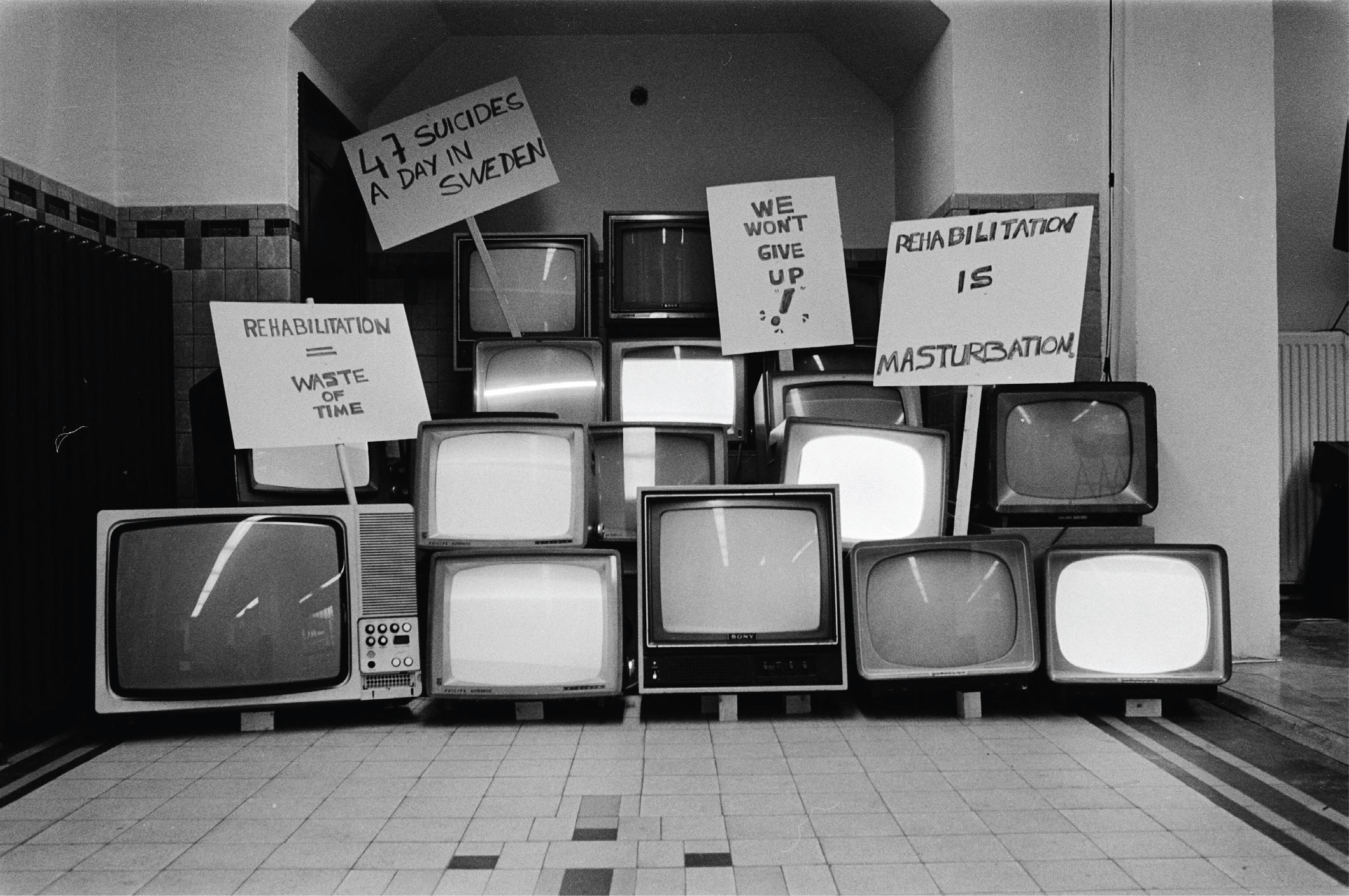
The “World’s First TV Convention” by Raul Marroquin 24 June 1980, Photograph by Fernando Pereira, Fotocollectie Anefo https://www.nationaalarchief.nl/onderzoeken/fotocollectie/ace3245c-d0b4-102d-bcf8-003048976d84?searchKey=9ff0929abdd5508b1798236299eb3179
The cover photo of this special issue on forgotten histories of television shows a group of fifteen television sets demonstrating in the hallway of The Bank, which back then, in June 1980, was a video arts centre in the Amsterdam Haarlemmerstraat. The demonstration was part of the “World’s First TV Convention,” bringing together 250 television sets to discuss ‘urgent matters.’ Some of these television sets could communicate with each other through a satellite connection. Obviously, this was not an actual convention, but a video installation by conceptual artist Raul Marroquin who used this form to explore how the technical medium of television had become an important player in the way we understand the world and its politics.1 Although hardly discussed in television studies, the “World’s First TV Convention” has not been entirely forgotten; in 2010, the event was re-enacted at the Jan van Eyck Academy in Maastricht, though with 50 rather than 250 television sets.
Four decades after the “World’s First TV Convention,” television scholars came together for the international academic conference “Television Histories in Development” hosted by the Netherlands Institute for Sound & Vision in Hilversum. Due to COVID-19 restrictions, most international speakers were online, while most Dutch speakers attended on location. The specific occasion for the conference was the commemoration of the first official Dutch television broadcast on October 2, 1951, seventy years earlier. The conference included the book launch of De televisie: Een cultuurgeschiedenis (Television: A cultural history), edited by media historian Huub Wijfjes. In the book’s introduction, Wijfjes addresses how television for a long time has been understood and studied as a national medium, as does De televisie itself with its focus on seventy years of television in the Netherlands. Referring to the work of Andreas Fickers, Wijfjes does point out the importance of a transnational approach to understanding the cultural and technological history of the medium, prompted by the technological developments of the 1980s and 1990s that allowed television to cross borders more easily, as well as the international advent of digital technologies and post-network television since the turn of the century.2
Histories of television then can be approached from both a national and a transnational perspective, with the former focusing on the specific ways in which television has been localised and institutionalised within a national context, while the latter highlights the overarching development of television as a technical and social medium. Moreover, each approach can bring different interpretations of the same phenomenon to the foreground. For example, from a national perspective, the history of the Dutch music channel The Music Factory (TMF, 1995-2011) can be presented as an exceptional case of national commercial television, whereas from an international perspective, TMF was simply another local competitor to MTV, similar to VIVA in Germany, which subsequently was taken over by the global media conglomerate and eventually lost its relevance due to technological changes in the media landscape.3 The ways in which national and transnational perspectives can highlight distinctive elements were also demonstrated by the papers presented at the “Television Histories in Development” conference at Sound & Vision.4
Although national and transnational approaches to histories of television may result in different interpretations, they still tend to focus on overarching histories of the medium, thereby leaving little room for case studies that do not fit these general narratives. De televisie, while mostly concerned with television’s overall development in the Netherlands, recognises the value of smaller histories by offering fifteen short vignettes interspersed through the chapters that each highlight a specific historical moment or person. One example is the account of The All American Show by Mieke Louwers in which she discusses the thirteen-hour marathon broadcast of American content, including interruptions by American commercials, on Dutch television in 1980, initiated by the VARA network to spark a public discussion about the rise of commercial television.5 In a recent special issue of TMG, entitled “Gone But Not To Be Forgotten,” editors Jesper Verhoef and Tom Slootweg call attention to ‘media technologies that emerged, or prospered, over the course of the 1980s and 1990s’ which in retrospect can be perceived as signifying ‘a moment of transition, or a watershed moment.’6 Both the vignettes in De televisie and the case studies of 1980s and 1990s media technologies present detailed parts of histories that tend to be excluded from the grand narratives of television, yet still can tell us about larger developments in the cultural understanding of television and related media.
We deliberately kept the call for papers for this special issue, “Pause and Rewind: Forgotten Histories of Television,” as open as possible, inviting ‘contributions that call attention to overlooked aspects of television history or voices that have been silenced in the grand narratives of the medium.’ In this way, we hoped to retrieve histories that were unknown to us, histories that had fallen in between the cracks of existing approaches to the medium’s rich and varied past. The resulting collection of essays is eclectic by default, because there are different reasons why some histories have been forgotten, and different ways in which they have been forgotten – and subsequently remembered. Some histories have been lost because they were not part of the grand narratives of television, not deemed significant enough; others have been excluded from the archives, made invisible from the archives, or otherwise not been preserved; and yet others have been lost because the voices behind those histories have been marginalised. Some of those stories are later revisited and remembered because of new technologies of preservation, or because a different cultural landscape encourages new interests. In this special issue, there are examples of several of these types of forgotten histories, recovered for various reasons – from giving a voice to marginalised groups, to histories lost in translation, to looking back at the past through the lens of the present, and to tie in with a changing focus to more attention in research to, for example, the non-anthropocentric, the queer, or the migrant experience.
The special issue opens with a contribution by Brett Mills who challenges the anthropocentric character of television history by exploring the role of animals in the early broadcasting history of the BBC in the UK. By demonstrating the centrality of animals in these early transmissions, Mills shows how animals were used to explore what television could or should be like in the early years of the medium and offers a critical account of how animals quickly became a useful resource for television – aesthetically as well as in terms of public value – only to be left out of both the BBC’s own history-making and that of television scholars.
Judith Keilbach uses the notion of ‘Instant TV’ (a termed coined by trade magazine Variety in 1961) in her case study of the television coverage of the Eichmann trial of 1961, specifically looking at the way videotaping was used to enable the immediate coverage of the trial around the world. Such a media archaeological approach helps to recover a relevant technology in the history of global television broadcasting, which very quickly became outdated (and thus easily forgotten) with the launch of the Telstar communication satellite in July 1962, just one year after the Eichmann trial.
Judith Keilbach uses the notion of ‘Instant TV’ (a termed coined by trade magazine Variety in 1961) in her case study of the television coverage of the Eichmann trial of 1961, specifically looking at the way videotaping was used to enable the immediate coverage of the trial around the world. Such a media archaeological approach helps to recover a relevant technology in the history of global television broadcasting, which very quickly became outdated (and thus easily forgotten) with the launch of the Telstar communication satellite in July 1962, just one year after the Eichmann trial.
Sarah Arnold examines how two women’s advocacy groups raised awareness to the need to improve women’s role and representation on the Irish national broadcaster RTÉ – both in terms of their employment and their representation on screen. While one of the groups was more conservative and the other more progressive, and there were limits to their success in implementing concrete changes, Arnold indicates how the groups raised public awareness of the lack of gender equality and the underappreciated role of women in Irish broadcasting, which has led to a lasting legacy of activism.
Asli Özgen uses the archives of HTKB (Hollanda Türkiye Kadınlar Birliği), a collective founded by migrant women from Turkey in the Netherlands, to look at the self-representational strategies used in intersectional feminist activism from 1975 to 1985. In her contribution, Özgen argues for including film and video material from the archives that have not made it to the screen, as well as activist films made and distributed by the collective and footage used in two documentaries broadcast on Dutch public television in the early 1980s. In this way, this specific televisual heritage can be reclaimed and made visible.
The final contribution of this special issue is by Sabrina Mittermeier, who revisits the backlash to queer representation in selected episodes from Dallas (1978-1991), Dynasty (1981-1989), Lindenstraße (1985-2020) and thirtysomething (1987-1991) in West Germany and the US. With a specific focus on the depiction of gay and bisexual male characters during the HIV/AIDS crisis, Mittermeier uses the lens of ‘unproduction studies’ to help understand ‘unmade’ queer television as a form of silencing in the archives and the production context. This reading of the episodes alongside archival research exposes how unmade queer television can be understood as a result of systemic queerphobia in the industry.
Together, these five contributions present different ways of uncovering television histories that otherwise might have been lost in the medium’s overarching grand narratives. We hope that this special issue will serve as an invitation for additional pauses and rewinds, resulting in more television histories that deserve to be remembered.
Notes
[1] Raul Marroquin, Fadangos Extra on the World’s First TV Convention (Amsterdam: Marroquin, 1980); Suzanne Piët, “Emotionele discussies verwacht op eerste TV-congres,” NRC Handelsblad, June 21, 1980; Frans Kotterer, “Televisietoestellen slaan keihard toe,” Het Parool, June 20, 1980.
[3] Jaap Kooijman, De muziekfabriek: TMF en de Nederlandse popcultuur (Amsterdam/Zutphen: Mazirel, 2024).
[4] See the conference website: https://beeldengeluid.nl/en/visit/events/television-histories-development
Biographies
Josette Wolthuis is a lecturer in visual culture at the Radboud University in Nijmegen, the Netherlands, where she teaches on a variety of topics within film and television studies, fashion studies, and media studies. She received her PhD from the University of Warwick, UK, with a dissertation on costume design and fashion in television series. As a researcher, she is also interested in other stylistic and aesthetic aspects of film and television, Dutch television history, fashion film, the oeuvre of David Lynch, gender studies, and short animation film. Before joining Radboud University, she lectured at the University of Warwick, Coventry University, the London Film School, the University of Groningen, and the University of Amsterdam.
Jaap Kooijman is an Associate Professor in Media Studies at the University of Amsterdam. He is the author of Fabricating the Absolute Fake: America in Contemporary Pop Culture (AUP, 2013) and De muziekfabriek (Mazirel, 2024), and co-editor, with Glyn Davis, of The Richard Dyer Reader (BFI, 2023). His writing on television has appeared in journals such as The Velvet Light Trap, European Journal of Cultural Studies, Critical Studies in Television, and VIEW Journal of European Television History and Culture, as well as in edited collections such as Queer TV: Theories, Histories, Politics (Routledge 2009) and Music/Video: Histories, Aesthetics, Media (Bloomsbury 2017). His audiovisual essays on television have been published in 16:9, Collateral, and zfm: Zeitschrift für Medienwissenschaft.