
At the height of her career, Bette Davis played several disabled characters. In Now, Voyager (Irving Rapper, 1942), Davis is a woman with mental illness who spends time in a sanatorium. In Mr. Skeffington (Vincent Sherman, 1944), Davis’ wealthy and beautiful heroine is ravaged by diphtheria. In Dark Victory (Edmund Goulding, 1939), Davis portrays Judith Traherne, who develops a brain tumour that leads to blindness and death.1 Superficially, these depictions of disability appear to play into stereotypes of disabled people as pitiable and isolated that have been rightly critiqued by disability studies scholars.2
However, a historically contextualised understanding of disability can complicate our perspective on disability representations and guide us to new interpretations. Exploring the social world behind Dark Victory alongside close film analysis reveals the film’s concern with the potential of care and interdependence; ideas that challenge ableist ideology stigmatising dependency. These ideas were embodied during the period by disabled public figures like Helen Keller and Franklin D. Roosevelt, and by the League of the Physically Handicapped, a group that demonstrated the political power of shared experience. In embracing interdependence, Dark Victory challenges the isolation inherent in the violent eugenic institutionalisation, sterilisation, and ‘mercy killing’ of disabled people during the 1930s. The eugenic subjugation of disabled people is linked with, among other damaging ableist ideologies, the myth of independence that conceals that fact that we are all reliant on others.3 In opposition, 1930s culture increasingly emphasised the importance of interdependence.
This complex cultural discourse surrounding disability and interdependence during Dark Victory’s release guides us to a key unstudied aspect of the film’s engagement with disability. Dark Victory’s female characters foster a vision of disability as a valuable embodiment of interdependence. This is a perspective that welcomes difference and vulnerability. The film positions a presumably nondisabled audience to understand and relate to the disabled Judith, challenging the dehumanising representations of 1930s disabled victims of mercy killings and sterilisations. However, when Judith’s symptoms are disturbing, audience investment in her experience comes via her nondisabled assistant, Ann (Geraldine Fitzgerald). By centring this relationship, Dark Victory politicises women’s intimacy, normalising unfamiliar disability and supporting social relations that value interdependence. The desirability of mutuality across difference is highlighted by the film’s one-dimensional male characters, who embody traditional heteronormativity and independence. While some popular cultural discourse, and Dark Victory’s own dénouement, maintained that disabled people were undeserving of integration and even life itself, an alternative understanding of disability discourse and the film’s disability representation reflects a more multifaceted perspective. By embracing interdependence, Dark Victory undermines traditional understandings of normalcy and disability in a culture where these categories – and the boundaries between them – were already beginning to collapse.
Because films respond to conflicting social ideas and represent coexisting value systems, this historically contextualised, disability-focused reading of Dark Victory is one perspective on the stylistically, narratively, and emotionally complex film. There is not a singular historical truth of disability or filmic meaning. I offer a new interpretation of Dark Victory’s disability representation, against the grain of traditional theoretical focus, based on 1930s public stories that expose the myth of independence and the centrality of interdependence to all our lives. In disability studies, this is called ‘cripping’ the text, a process that rethinks assumed meanings and centralises disability in analyses where disability has been marginalised.4 A cripped reading of Dark Victory exposes the film’s participation in complex, historically specific discourse around normalcy, disability, and interdependence.
‘Disability is everywhere, once you begin to look for it, but conspicuously absent in the histories we write,’ Douglas Baynton has explained.5 While disabled characters feature prominently across cinema, they rarely feature in academic accounts of cinema or popular culture. Sensitivity to disability’s neglected and changeable cultural meanings is crucial when studying disability representations. As David T. Mitchell and Sharon L. Snyder argue, disabled people’s segregation means that nondisabled people are often exposed to disability exclusively through representation.6 Filmic representations are thus powerful forces of knowledge, reflecting and informing how the disability community are treated and related to. We cannot examine how the 1939 film, so focused on Ann and Judith’s friendship, might have perpetuated or challenged audience perceptions of disability if we do not first understand the interdependence embodied by contemporaneous disabled figures like Roosevelt and Keller. By contextualising Dark Victory’s disabled heroine, I draw attention to disability’s crucial function within popular discourse of the 1930s, a world where ‘normalcy’ was exposed as a constructed myth. By celebrating interdependence, Dark Victory challenges ableist ideology and the isolating effects of the period’s eugenics discourse on disabled lives. Disability representations are never divorced from their cultural and political contexts. This paper highlights this essential role of historical contextualisation in analysis of cinematic disability representations.
Interdependence, Disability, and Sexuality
Dark Victory’s embrace of interdependence precedes discussion in disability studies. Disability studies theorists have challenged the privileging of independence and consequent discrimination against disabled people in mainstream Western society by highlighting interdependence as a defining characteristic of all life. Disability studies theorists and ethics of care proponents argue that all humans are imbricated in connections with other people, objects, environments, and systems that help us move through the world.7 Myths of independence conceal this, while disability reveals it: ‘disability demands mutuality, support and interdependence’.8 Disabled people’s reliance on family, personal assistants, government programs, technology and other prostheses, medical professionals, and support groups reflects how we are all supported by and supporters of others in our daily lives. The ethics of care is based on interdependence, transforming investment in the independent self to ‘another’s well-being’.9 While not theorised until the late twentieth century, this ethical framework echoes Dark Victory’s investment in interdependence through intimacy with Judith and Ann.10 This is the opposite of a eugenics ethos, which holds disconnection as key to maintaining able-bodied privilege and erasing disability. Critical disability studies and the ethics of care turn ableist norms on their head, marking humans as open, connected, changeable, and utterly dependent.
Importantly for my analysis of Ann and Judith’s friendship in Dark Victory, non-normative physical contact and intimacy beyond traditional heteronormative relations are important to notions of interdependence, specifically within disabled people’s caring relationships. While early ethics of care scholarship was critiqued for perpetuating heteronormative gender roles that equated care work with femininity, some disability studies scholars have highlighted the challenges to heteronormativity that arise for disabled people in interdependent relationships.11 Robert McRuer explains that disabled people are often marked ‘as somehow queer’, either ‘asexual or oversexual’.12 While these are inaccurate stereotypes, the interdependent relationships that encompass disabled people’s care often undermine ‘normal’ boundaries that limit physical intimacy to sexual partners. The relationships between disabled people and those that help them, even if these are professional relationships, enmesh both bodies: as Kelly Fritsch argues, both ‘experience a leaking of their identities, a mingling of their sexualities, and multiple intimate slippages of their bodies’ during care activities such as ‘feeding, bathing, shopping, facilitating sex’.13 While Dark Victory does not represent the bodily intimacy of these private moments – an outcome perhaps of the limitations placed on Hollywood films by the Hays Code – other aspects of Judith’s experiences highlight her rejection of gender and sexual norms. Judith’s life does not progress linearly from childhood dependency to independence and heteronormativity: Judith continues to have intimate relationships with women into adulthood and into her marriage, eschewing the traditional progression of women’s intimate connection from mother to husband. Her adult life is not defined by ‘normal’ feminine rites of passage like marriage and children. Despite her eventual marriage, she appears content as a single woman, distinguished by her relationships with other women. Judith also displays moments of bodily intimacy with Ann. My analysis of the film thus highlights Judith and Ann’s interdependence beyond the strictures of both traditional heterosexual and ableist relations.
Isolation, Independence, and 1930s Eugenics
While Dark Victory embraces interdependent relationships inclusive of disabled subjectivities, violent and isolating practices were central to popular eugenic responses to disability during this period. Eugenics understands human lives as hierarchically ordered, and practices breeding out those at the bottom of the hierarchy. Eugenics ideology marks several groups as ‘defective’, including racial and ethnic minorities and a range of disabled people.14 While some eugenicists had, by the 1930s, rejected the ‘hard-line’ stigmatising of entire communities, legislation and cultural discussion still constructed disability as an inferior biological trait.15 Compulsory sterilisation legislation, designed to prevent impairments being passed to future generations, was at its most effective during this period. Kim E. Nielsen shows that California involuntarily sterilised over twenty-thousand people up to 1937 and the practice continued into the 1940s.16 The New York Times published numerous articles on the benefits of sterilisation. In 1934, author C.C. Hurst used biological research to explain how few ‘mentally deficient persons’ would have been born in the United States that year if Nazi sterilisation laws were in effect.17 Hurst detailed the hereditary nature of various disabilities and increased his authority via his caution around the laws, which were to be ‘carefully administered and rigidly enforced.’18 In a less scientifically worded article a year later, Chapin Hall wrote in support of California’s sterilisation laws.19 The line ‘surely humanity is as much entitled to scientific breeding as a race horse or a fine dog’ suggests the strength of his belief; breeding out ‘defective’ citizens was seen as a necessary endeavour with or without the support of those being sterilised. Support for eugenics sterilisation was visible across 1930s popular media.
Some eugenicists framed sterilisation as allowing disabled people to be integrated into mainstream society without endangering ‘normal’ gene pools.20 However, sterilisation did not lead to integration. This is evident in the story of Junius Wilson, an African American deaf man who, in 1932, was ‘deemed mentally defective’, sterilised, and ‘involuntarily hospitalised for most of his life’.21 Broader eugenics rhetoric highlights this imbrication of eugenics ideology and disabled people’s isolation. A 1932 exhibition at the Third International Congress of Eugenics displayed a poster on Letchworth Village, a New York residential institution.22 The poster includes invasive photographs of the institution’s residents, some naked. The poster objectifies the residents, interrogating their bodies and taxonomizing them according to pseudo-scientific labels like ‘Cretinism’. In 1934, the Mid-Week Pictorial published a spread titled “Midget Village”, a home with everything built in miniature.23 Not only did this article play into ideas of physical disability as an objectifiable spectacle, but it proposed that life would be easier for disabled people if they were placed away from ‘normal’ people and with others ‘like them’. Eugenicists embraced the exclusion of disabled people from society.
This discourse not only advertised institutionalisation but also marked disabled people as inherently deviant and unworthy of social inclusion. Media coverage of ‘mercy killings’ reflects this isolating dehumanisation. In 1939, Dark Victory’s year of release, coverage of the murders of two disabled boys – Raymond Repouille and Jerome Greenfield – by their fathers suggested support for mercy killings, an off-shoot of euthanasia debates. Janice Brockley details the coverage’s ableist undertones, arguing that the two boys were framed as inhuman.24 Indeed, one New York Times article implied Greenfield’s death was acceptable because the boy ‘was a threat to his mother’.25 While Greenfield was described as an ‘incurable imbecile since birth’, in the Los Angeles Times his father was represented through sympathy-inducing emotion: ‘Grief shook the rugged shoulders of Louis Greenfield’.26 Similarly, Raymond Repouille was ‘blind and crippled since birth’, while his father was represented as ‘unbearably tortured for years’.27 Disability is framed as causing intolerable suffering to otherwise normal parents. The publicity these cases received communicated that disabled children were unworthy of a basic form of social inclusion – life itself. Isolation is a central feature of 1930s eugenic discourse that defined disabled people as a social danger and dehumanised, confined, and killed them.
This context is important when considering disability in Dark Victory. Based on an unsuccessful 1934 play, disability is central to the film. Bette Davis plays Judith, a socialite who is diagnosed with a brain tumour after displaying symptoms like numb hands, dizziness, and vision impairment. Neurosurgeon and love-interest Dr. Steele (George Brent) operates on Judith. He discovers, to the devastation of Judith’s friend and secretary Ann, that the tumour will re-occur and lead to blindness and death. Ann and Steele keep this news from Judith. However, Judith finds out and breaks off her engagement with Steele. They reconcile, marry, and move to the country. The film ends with Judith – having lost her sight, having sent Steele away, and having said goodbye to Ann – shutting her eyes for the final time.
Echoing eugenics discourse, Judith’s disability leads to isolation. Although her death is less violent than those of the disabled victims of 1939’s mercy killings, Judith nonetheless ends the film permanently removed from society. With this ending, the ‘problem’ of Judith’s illness and the prospect of her happy, integrated life dissipates. As many disability studies scholars have argued, ableist cultural texts often represent disability as part of an unimaginable future, resolved by cure or death.28 Furthermore, because spectators are informed early in the film that Judith’s dizziness ‘comes and goes’, Judith’s vision and perspective are always unreliable and uncomfortable. Judith is distanced from the presumably nondisabled audience when her symptoms become intense, and her non-normative embodiment highlighted. After she clutches her head at the beginning of the film, she has a spell of double vision from atop her horse. The camera cuts to her literal perspective, violently shaking and splitting into three swirling images. While this brings spectators intimately into Judith’s embodied perspective, it is a disconcerting moment; a failure of ‘normal’ sight. The camera cuts from this unsettling image to a long shot of Judith’s horse falling, punctuated by a piercing scream. Spectators get no access to Judith’s emotions to disrupt the distance created by her shocking fall. Judith is also represented as more broadly ‘abnormal’. She is extravagant, and her opulent outfits contrast with those of other characters. In her introduction to Steele, Judith wears a large bow on her head and a frilly fur coat, which is incongruous in the plain doctor’s office and conflicts with Ann and Steele’s ordinary clothes. The mise-en-scène emphasises this dichotomy: as Judith shakes Steele’s hands, the ‘normal’ characters – Steele, Ann, and Judith’s physician Dr. Parsons (Henry Travers) – stand on one side of the frame, while Judith stands alone. These distancing devices may dim the negative emotions sometimes associated with disability, but they also dim the connection to Judith. Throughout the film, Judith’s disability isolates her within the diegesis and in her connection to nondisabled spectators.
The isolation evident in the eugenic discussion of the institutionalisation, sterilisation, and mercy killing of disabled people and in Dark Victory’s initial representation of Judith reflects the broader function of ableist ideology. The dehumanisation and isolation of disabled people are fundamental aspects of ideology designed to privilege self-sufficiency and independence; those elements that most benefit a capitalist society.29 Because of the privileging of ‘physical and mental autonomy, the ability to think rationally and impartially, and interpersonal separation and distinction’, the diverse and dependent bodies encompassed by the label ‘disability’ become abnormal Others.30 This leads to exclusion from social, economic, and political spheres. Disabled people have been segregated in schools and workplaces and institutionalised in hospitals, prisons, and asylums. Public spaces are often inaccessible and engineered to exclude disabled people.31 The isolating subjugation of disabled people is inextricably linked with the societal privileging of independence. Indeed, it is only when Judith becomes permanently physically dependent, losing her vision in the film’s dénouement, that she leaves her loved ones and dies alone. In 1930s discourse and Dark Victory, disability’s dependency is linked with exclusion.
‘Us Cripples’: Disability, Dark Victory, and Interdependence
The maintenance of disabled people’s isolation in eugenics discourse and in parts of Dark Victory is evident in other contemporaneous disability representations. In 1932, attention to disability arrived in the publicity surrounding Tod Browning’s film Freaks. The film was produced to ‘capitalise on Universal’s 1931 horror bonanza’, responding to the period’s economic crisis.32 Set in a circus sideshow, many of Freaks’ characters were played by real disabled sideshow workers. Like the residents of “Letchworth Village” and “Midget Village” and the victims of sterilisation and mercy killings, the film’s actors were dehumanised, classed by horrified reviewers as ‘monstrosities’ and ‘pathetic approximations of normal beings’.33 Their appearance on celluloid was met with walkouts and deemed ‘unthinkable’.34 Stories in industry magazines highlighted their segregation in the Metro-Goldwyn-Mayer studio: ‘they ate in a private room’, so as not to disturb other employees.35
This dehumanising discourse was challenged by the presence of interdependence in the film’s disability-focused narrative. Most contemporary reviews of Freaks highlighted the film’s ending as particularly horrifying, in which the group enact revenge on two nondisabled performers who attempt to poison the disabled Hans (Harry Earles) after one marries him. However, the film’s ending also highlights the power of interdependence for disabled people; just as Hans has helped them across the film, the ‘freaks’ save their friend. This ensemble embraces their status as an interdependent community. As the opening credits explain, the freaks’ philosophy is ‘the hurt of one is the hurt of all, the joy of one is the joy of all’. The film spends time observing relationships. Angeleno, played by Angelo Rossitto, who has dwarfism, gently guides a performer with microcephaly by the hand; when the bearded lady’s (Jane Barnell) baby is born, the group crowds around her bed like family. The disabled performers consistently refer to themselves as ‘we’ and ‘us’, their identities predicting the interdependence and acceptance of difference central to contemporary disability studies.
The interdependence displayed in Freaks was a microcosm of that embodied by other public disabled figures and communities during the period. In his 1933 inauguration speech, Franklin D. Roosevelt stated, ‘If I read the temper of our people correctly, we now realise as we have never before our interdependence on each other’.36 Roosevelt anticipated the importance of interconnection to the ideological underpinnings of the New Deal. Amongst legislation designed to revive the financial system, the New Deal’s ‘second wave’ in the mid-1930s included Social Security. The government became involved in people’s lives through social welfare, promoting a culture that framed independence as unrealistic, understanding that people need support and that providing support creates a more cohesive society. 1930s discourse perpetuated a growing sense of national collectivity; a desire ‘to feel oneself part of some other’s experience’.37
The collectivity evident in the period’s social welfare policy is not synonymous with the notion of interdependence as defined by disability studies scholars: ableism can still thrive in moments that embrace collectivity. Indeed, the eugenics practices discussed above were justified partly as safeguarding the social collective.38 Yet national events of collectivity exposed independence as ‘a mere fiction’ that ‘eclipses the importance of our dependence on one another’.39 The disability-oriented idea of interdependence takes this a step further, not only challenging the myth of independence but using this challenge to undermine disabled people’s stigmatisation. If disabled people exemplify the interdependence that defines all of us, then disabled people are not deviant Others undeserving of inclusion but embodiments of a shared human truth. Valuing collectivity provides the grounding for a society that respects interdependence and disabled lives.
Roosevelt, a disabled man, embodied this valuing of interdependence. His public image emphasised his reliance on others to move through the world. A 1940 Survey Graphic article detailed Roosevelt’s everyday life.40 While the focus on his physical strength and charm constructs an image of Roosevelt as a ‘normal’, independent man, the author also highlights moments where he required assistance, dressing ‘with the aid of a valet’ and ‘pushed in a wheelchair to his desk’.41 Roosevelt was always accompanied by personal assistants who supported him, and he used ‘a variety of adaptive mobility equipment’.42 This interpersonal connection is evident in photographs from his presidency. In figure 1, a photograph from King George VI’s 1939 visit to the United States, Roosevelt is sandwiched between the King and a military officer who he holds by the arm (see figure 1). Roosevelt leans into the King, an intimate gesture. Within these interdependent relationships, Roosevelt used his influential role to advocate for a collective understanding of disability. In 1931, Roosevelt addressed the nation via radio as Governor of New York on ‘why it pays to do things for crippled children’.43 Roosevelt used this opportunity to identify himself as part of the disability community – ‘I walk around with a cane and with the aid of somebody’s arm’. Campaigning on behalf of ‘us cripples’, Roosevelt challenged the eugenic construction of disability as isolating abnormality, instead hinting at the interdependent community possible for disabled citizens.
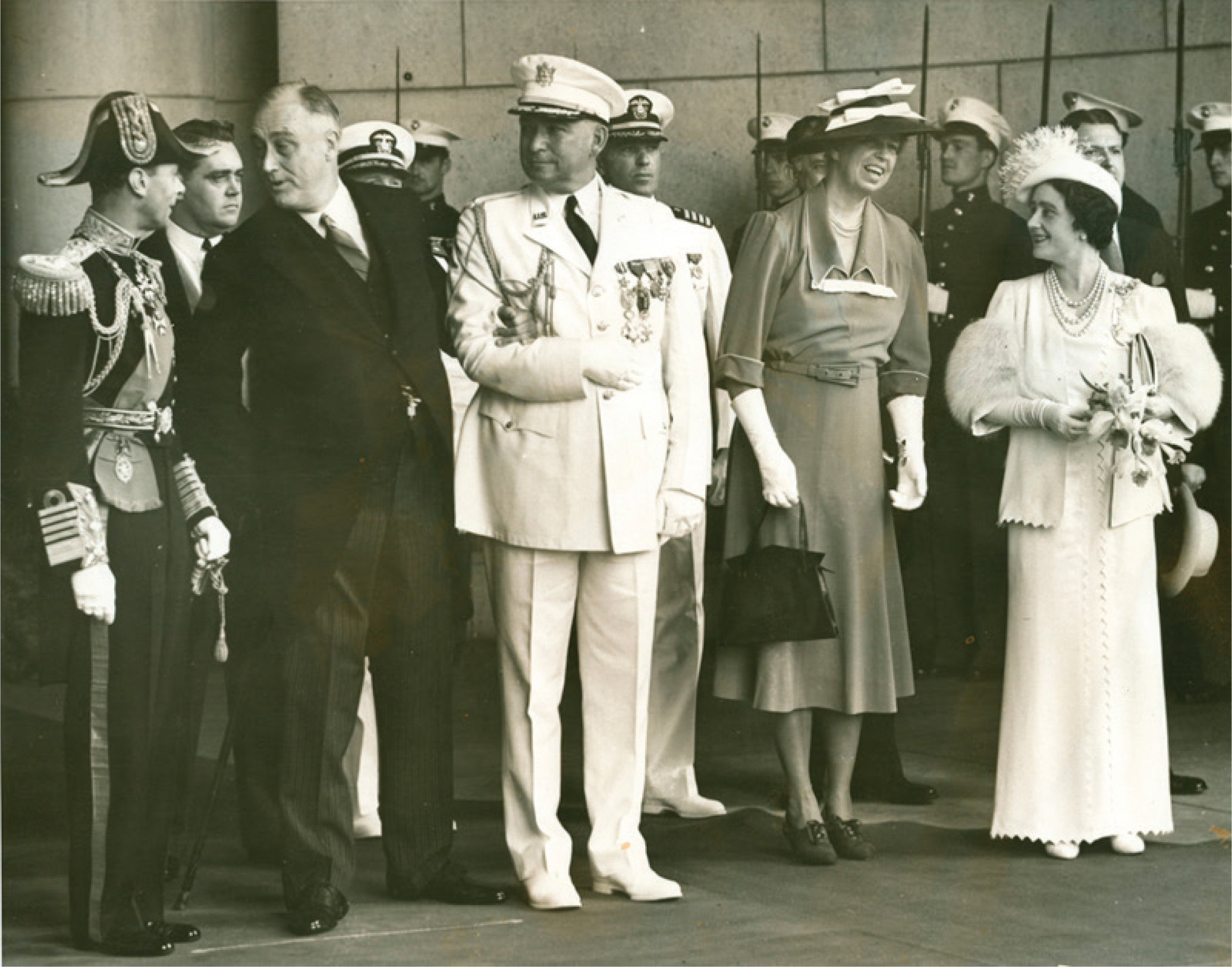
Figure 1
Photograph of President Franklin D. Roosevelt in conversation with King George VI, June 8, 1939. Franklin D. Roosevelt Presidential Library & Museum, http://www.fdrlibrary.marist.edu/archives/collections/franklin/?p=digitallibrary/digitalcontent&id=4267, Image in public domain.
Increased economic strain during this period also created space for disability activism rooted in interdependence. Echoing the growth of union-organised protests, Kim E. Nielsen describes the League of the Physically Handicapped, established in 1935 when disabled New York residents protested their exclusion from state unemployment benefits.44 Throughout 1935 and 1936, the League’s protests were covered in mainstream newspapers.45 The League challenged the isolating effects of eugenic ideology by creating a community that helped one another. Longmore and Goldberger explain that the group ‘concentrated on discrimination rather than diagnosis’, opposing individualised understanding of disability and defining disabled people as united by shared experiences.46 This communal spirit is evident in the League’s protest cry - ‘We want jobs; we want to live!’.47 A description of the protesters in the Marxist magazine New Masses frames them as a single entity – ‘the crippled body goes marching on’ – and explains how the group works interdependently: while one person ‘who is relatively able-bodied…does the bulk of the running and toting’, others ‘take turns’ resting.48 The League simultaneously embraced the political power of collectivity and the essential nature of interdependence for disabled people’s participation in everyday life.
A valuing of interdependence is an important aspect of a society equipped to provide disabled people with community, care, and rights. According to contemporary disability scholarship, a disability rights-oriented society not only creates inclusive spaces for disabled people but also judges citizenship in different ways, prizing ‘interdependence over autonomy’.49 It recognises that everyone is dependent on others, thus legitimising the support and care disabled people often require. As Rosemarie Garland-Thomson argues, ‘disability itself demands that human interdependence and the universal need for assistance be figured into our dialogues about rights and subjectivity.’50
Dark Victory models this alternative way of structuring everyday life by representing Judith as a dependent woman and undermining the traditional equation of ‘normalcy’ and social inclusion with independence. Judith’s story brims with contact and connection to the audience and other characters, particularly Ann. The film asks spectators to re-evaluate normalcy and experience human interconnection across difference, demonstrating a care ethics that perpetuates ideologies of interdependence evident in the period’s popular discourse.
Through her home, Judith is defined not by heterosexuality or autonomy but by her relationships. The first shot of Judith is in her bed as she awakens, and she is surrounded by intimate figures – her dog, her maternal housekeeper Martha (Virginia Brissac) who encourages her to ‘go back to bed’, and Ann, sitting on the bed in her dressing gown. Judith’s home is not a traditional domestic space; it merges the public and private. Women live, work, socialise, and look after loved ones here, with little division between these roles. Ann is Judith’s assistant and confidant, her desk connected to the bedroom in which she comforts Judith. Judith’s friends move through the open downstairs spaces of her home, sometimes without her knowledge. This is a public space, but it is also the space in which Steele professes his love to Judith. The home’s patios house public and private interactions, like Judith’s stable manager Michael (Humphrey Bogart) bringing her a horse and Steele explaining Judith’s terminal illness to Ann. Judith’s home is less like a traditional domestic space and more a small-scale Ledigenheim. Ledigenheime were ‘homes for single people’, particularly middle-class ‘genteel professional women’, developed in the late nineteenth and early twentieth century in Germany.51 As Sassin’s history of women’s Ledigenheime shows, these spaces gave tenants private and communal rooms and offered public spaces like libraries and taverns. Because of this merging of private and public, women’s lives in these homes were ‘far more open than those of most women of their class’.52 Even before knowledge of her disability, Judith is a modern woman who, like Roosevelt, embraces her need for connection and assistance.
‘One Person Out of Two’
The structures of audience sympathy are complex in the film, drawing investment in both Judith and her friendships. While Dr. Parsons complains that Judith is reluctant to discuss her symptoms, spectators gain access to Judith and her embodied experience through music. The first hint spectators get of her illness coincides with the film’s first use of non-diegetic music, as Judith clutches her head at the racetrack and a quietly tense orchestral piece begins. The melody is lilting, moving up and down scalically, like a wave of nausea or pain. This creates immediate intimacy with Judith. Judith’s power over the film’s non-diegetic music is demonstrated in her first trip to Steele’s office. As Steele explains Judith’s symptoms in a cold soliloquy, the music is solemn, a strings-led melody slowing down the tumbling chordal progression that becomes Judith’s leitmotif. The musical duration echoes Judith’s feelings, as she slowly realises her extensive impairments, and her embodied actions, as her eyes slowly move. Although the description of Judith’s disturbing symptoms may disrupt the relationship between spectators and Judith, spectators are led instead to focus on Judith’s extended response. The music imbues the screen with the emotions evident in the lengthy close-up of Judith, creating an atmosphere of privileged intimacy that overtakes the power of Steele’s words. Spectators’ privileged access to Judith through music creates connection despite her non-normative embodiment. This disrupts the isolation and dehumanisation of disabled people perpetuated by eugenic discourse, creating the connection-across-difference essential to a culture that prizes interdependence.
While Dark Victory represents Judith’s perspective, the audience is also positioned to invest in her experience via kinship with Ann’s perspective. Contrasting with Judith’s ambiguity, the ‘normal’ Ann is faultlessly relatable. Cognitive film theorist Murray Smith argues that films produce multiple forms of engagement with characters. While spectators might be physically ‘aligned’ with characters’ perspectives – as when the camera cuts to Judith’s literal perspective – sympathetic ‘allegiance’ requires knowledge of a character’s motivations, social position, and morality.53 The film leads spectators towards emotional allegiance with Ann because of her social familiarity: Ann is traditionally middle-class. When Judith confides in Ann about her dizzy spells, Ann wears simpler clothes than her counterpart. While Judith is surrounded by lavish furnishings and smoke plumes that occasionally conceal her face, Ann sits in a homey armchair. Ann is more like middle-class 1930s spectators, yet the disturbing story spectators hear throughout this scene is Judith’s. Ann’s chair is positioned higher than Judith’s, so as she sits forward in a gesture of concern attention is also drawn to Judith. Spectatorial allegiance to Ann becomes more diffuse as Ann’s concern colours Judith’s story. The non-diegetic music mimics Ann’s worries, moving up a minor scale, with the two lowest notes of each chord played between the higher notes to create a nervous effect. Ann takes control of the screen when the film is concerned with maintaining sympathy for Judith despite her alienating experience. In the two early moments depicting Judith’s dizziness, the camera cuts to lengthy shots of Ann worriedly watching Judith. Anchoring emotional intimacy to Ann reflects the twin structure of disability-focused melodramas, which often couple a ‘safe’ nondisabled woman with a more challenging disabled one.54 Dark Victory uses Ann’s normalcy as a space of ‘fantasies of belonging and reciprocity’, through which nondisabled spectators can begin to engage with diverse identities.55 Ann’s comforting normalcy softens Judith’s non-normativity.
Spectators are thus encouraged to invest in the relationship between Judith and Ann as the film’s core. Despite the romance between Judith and Steele, this is not really a heterosexually romantic film; Dark Victory puts more effort into representing women’s intimacy. The scene in which Judith confides in Ann highlights the interdependence between the two women and incorporates spectators into this relationship. Judith and Ann touch easily, reflecting the pair’s closeness. Judith is not just confiding in Ann but spectators too. Spectators become privy to Judith’s secret and are encouraged to feel like the third friend. Shot/reverse shots are intercut with wider shots from opposite Judith and Ann’s table, the position a third friend might sit. The spectator’s status as this friend is confirmed as the tea table seems to be set for another person. In her much-cited work on female friendship in fiction, Elizabeth Abel uses a Cicero quote – ‘as almost to create one person out of two’ – to describe the co-dependence that characterises female friendship.56 Ann and Judith often become entirely interrelated through gesture. When Steele goes to confirm Judith’s brain tumour, the women’s responses mimic each other. Judith leads Ann into the room, and they remain holding hands. Both alternate between looking at each other and glancing at Steele. Both hold their hands up. Both move past Steele into the background. When Steele confides in Ann that the operation was unsuccessful, Ann clutches her head as though experiencing one of Judith’s headaches. Despite their existence on opposite sides of the disability/normalcy binary, these characters act as a symbiotic entity. Through this unified identity, the film gives spectators permission to align themselves with both characters. Dark Victory’s spectators are encouraged to identify with both disabled and nondisabled female characters within relations of intimate intersubjectivity.
This focus on feminine intimacy is emphasised by the one-dimensionality of the film’s men. Karen Hollinger argues that 1930s women’s films emphasised heterosexual romance at the expense of women’s friendships, leading to a ‘decidedly conservative perspective’.57 Yet Dark Victory frames masculinity as an obstructive distraction. The male characters, mostly doctors, are not supported by the narrative: their expertise does not cure Judith. They also remain undeveloped. After Judith’s surgery, as the camera follows a lab technician into the surgeons’ locker room, it is difficult to pick out Steele from the crowd of similarly dressed figures. When three doctors come to study Judith, they are positioned around her as she faces away from the camera. As they walk out of the room, their bodies obscure Judith. The masculine medical institution thus denies spectators access to the film’s star. There is also a sense of separation in the male characters that opposes the interconnection of Ann and Judith. When Steele studies Judith, he keeps his hands in his pockets or clutches his suit lapels. When Steele is in the locker room after Judith’s surgery, he discusses Judith’s case yet never says her name. Unlike other women’s films of ‘the medical discourse’, Dark Victory does not sympathise with doctors or their powerfully objectifying gaze.58 Although these male characters are crucial to the narrative, they are inconsequential to spectators’ relationships with complex female characters.
This representation of Judith – and lack of focus on the film’s central heterosexual relationship – parallels the public image of disabled figure Helen Keller, also underpinned by non-normative and interdependent relationships. Keller became deaf and blind as a toddler. Her story was famous because of her relationship with teacher Anne Sullivan, who taught her how to talk, read Braille, speak through finger spelling, and understand through lip and larynx feeling. While the story of the wild girl tamed into normalcy through language followed Keller through the 1930s, many elements of her life challenged normalcy. As Paula M. Cohen and Shannon Walters argue, Keller was always connected through touch to others, blurring traditional boundaries that privilege bodily autonomy.59 Keller was rarely photographed alone; she was always with her beloved assistants or pets. Figure 2 shows a 1937 photograph of Keller with her assistant Polly Thompson and her dog (see figure 2). Keller and Thompson’s hands are intertwined, demonstrating finger spelling and modelling the intimacy involved in this non-normative communication style. It is not clear who is speaking between the two women, suggesting reciprocity rather than an active carer/passive disabled person relationship. This photograph demonstrates Keller’s valuing of interdependence not only through the bodily intimacy it depicts, but also through the nature of those around her. Keller’s family was non-traditional, undermining heteronormative gender relations – she had intimate relationships with women. This crossing of gendered boundaries is also evident in the photograph of Roosevelt, King George VI, and the military officer: in an era in which traditional masculinity was re-emphasised in the face of an economic situation that challenged men’s authority, Roosevelt’s intimacy with the two men must have been an unusual sight. Dark Victory thus represents Ann and Judith by engaging with an already circulating form of interdependence that embraced non-normativity in relation to both disability and gender.
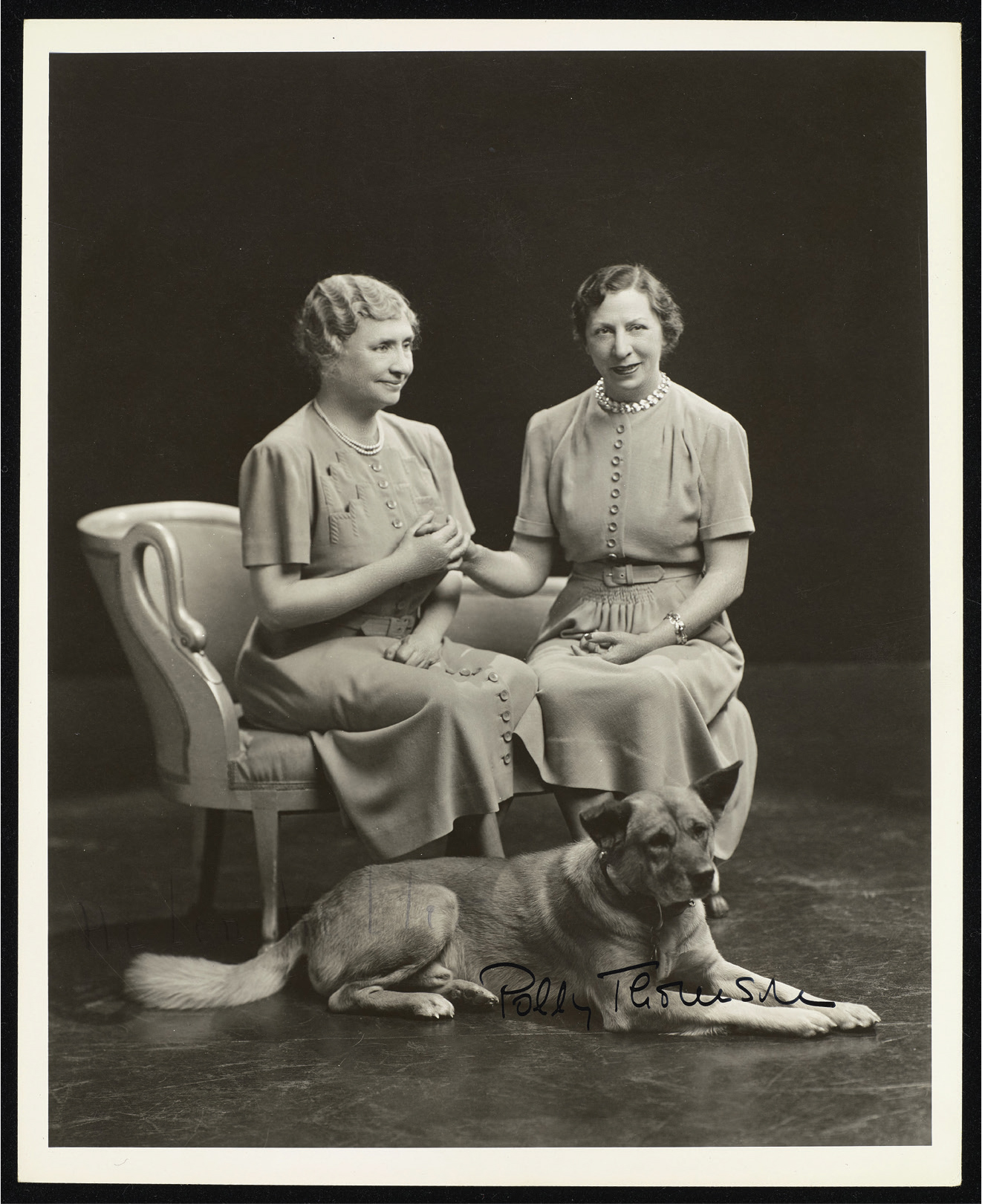
Figure 2
Photograph of Helen Keller and Polly Thompson seated on a chaise longue with a large dog, 1937, https://www.afb.org/HelenKellerArchive?a=d&d=A-HK07-01-B029-F08-004.1.1&srpos=127&e=-------en-20--121--txt--dog-Photographic+print-----------------------0-1, ©American Foundation for the Blind.
Indeed, Ann and Judith demonstrate the non-normative interdependence embodied by figures like Roosevelt and Keller. The allegiances between Ann, Judith, and Steele change throughout the film. Ann and Judith’s alignment is interrupted when Ann does not tell Judith about Judith’s terminal illness. Judith and Steele are aligned through romance, interrupted by the same unwillingness to confide in Judith. Ann and Steele become aligned as they share the disturbing news of Judith’s illness. Their dynamic triad means that the film’s romantic relationship is never monogamous – Ann is present for Judith’s most essential experiences. This is highlighted in the sequence in which Steele informs Ann of Judith’s terminal illness, and they agree not to tell Judith. As they walk back inside, Judith touches her future husband and assistant with equal intimacy, grabbing Ann and Steele by their hands while Steele guides Ann through the door by her waist. For spectators, it becomes impossible to invest in the fantasy of heterosexual romance without also making room for Ann. As she is about to go into surgery, Judith does not confess her love for Steele but for Ann – ‘I love you, Ann. I don’t know what I’d do without you’. Dark Victory’s interdependence creates space for relationships beyond the strictures of heterosexual monogamy and across the ableist binary.
These relationships are complex, and I want to emphasise that they also represent the dangers of interdependence for disabled people. Interdependence requires vulnerability. As is demonstrated by Hans’ trust in his duplicitous, nondisabled love interest in Freaks, enmeshing oneself in interdependent relations can be risky. Violent and abusive practices have been perpetrated against the disability community in the name of care. The institutionalisation of disabled people, discussed above as an isolating tactic of eugenics, was also framed as providing ‘proper’ care that could not be provided at home.60 Furthermore, disabled people are often framed as passive receivers of care.61 Judith’s intimate relationships with Ann and Steele are disrupted as they withhold crucial information about her terminal illness. Ann’s grief in this moment of withholding is juxtaposed with Judith’s joy as she believes she has been cured. While spectators experience Ann’s grief through extended shots as she is given the news by Steele, again perpetuating a connection with Judith through Ann, this privileged knowledge of her imminent death constructs Judith as passive, with control of her life ceded to Ann and Steele. Just as eugenics discourse emboldened nondisabled experts at the expense of institutionalised, sterilised, and murdered disabled people, Judith’s experience of care is, at least partially, disempowering. Dark Victory represents Judith’s rejection of independence and her embrace of the support of Ann and Steele as both desirable and dangerous.
Despite this complexity, Ann and Judith’s relationship remains essential to the film’s connection with its presumed nondisabled audience. It is thus vital to consider the political potential of female friendship. The interconnection central to Dark Victory echoes Berlant’s discussion of ‘intimate publics’. Berlant argues that texts like Dark Victory, constructed for American ‘women’s culture’, work outside economic and social problems by creating emotion-driven collective intimacy.62 For Berlant, these texts construct affective ties across diverse women, which tap into women’s desire to feel less isolated but ultimately dampen their potential status as a politicised ‘subaltern population’.63 In a discussion with Jay Prosser, Berlant describes the depoliticising nature of intimate publics and the texts they produce: ‘intimate publics usually flourish to one side of politics, referring to historical subordinations without mobilising a fundamental activism with respect to them’.64 Dark Victory is a ‘women’s film’ that addresses women’s perspectives and female spectators.65 Interpreted through Berlant’s argument, Judith and Ann may make spectators feel belonging across difference, but these affective ties are a ‘relief from the political’.66
Yet, there is political potential in Dark Victory’s representation of female friendship. To explain this, let me go back to Helen Keller’s example. Keller’s fame created an intimate community that crossed politicised categories of disability and able-bodiedness. The Helen Keller Archive holds many letters from Keller’s admirers. For instance, a woman called Lena Collier sent her a letter in 1939.67 In it, Collier speaks to Keller as if a long-time friend. She gives intimate information about her father and her husband’s death and describes her life as a widow. Furthermore, she explains that she and Keller are the same age, so she has always felt intimacy with her. This is one example of many letters sent to Keller across the decade and reflects her cultural status as part of a community of diverse women. The intimate form of women’s culture displayed in Keller’s letters reflected the growing recognition of the validity of female friendship at the time. Keller’s public persona tapped into recognising women’s intimate culture as a space of interdependence and political growth.
Susan Ware wrote about the importance of friendship in the rise of women in Roosevelt’s Washington.68 Eleanor Roosevelt, Frances Perkins, the first woman in Cabinet, Molly Dewson, Head of the Democratic Party’s Women’s Division, and other women built professional ties and pursued political concerns through the strength of personal friendship. This united population of women is highlighted in Perkins’ reflections on her 1933 appointment: ‘I have always felt that it was not I alone who was appointed to the Cabinet, but that it was all the women of America’.69 As Keller’s letter-writing fan participated in an intimate culture that connected diverse women, Perkins frames women as a politicised collective.
Dark Victory uses the familiarity of women’s relationships, belonging to the kinds of ‘intimate publics’ built by Keller and by Roosevelt’s circle of friends, to normalise unfamiliar disability. The spectatorial impact of Judith and Ann’s friendship makes Judith’s disability an acceptable aspect of a women’s culture in which care and intimacy are central. This is political when considered through disability history. Disabled women are often excluded from the intimate publics of feminine culture, which prizes bodily and cognitive normalcy. Many disabled women are excluded from friendship, experiencing ‘greater isolation and loneliness’ because of social stigmatisation and inaccessible spaces.70 In a society in which eugenic ideology was still entrenched, accepting diversity within normative feminine culture suggests an increasing willingness to recognise disabled people as human.
Dark Victory’s spectators experience the value of an interdependent identity and the potential to experience a fulfilling life through caring for – and being cared for by – others. Although Dark Victory maintains the desirability of normalcy through Ann, providing opportunities to relate to a disabled individual is a significant step towards promoting interconnection over isolation. Just as Keller and Roosevelt used their tenuous connections to normalcy to publicly embody identities of interdependence, Dark Victory uses Judith’s connection with the ‘normal’ Ann to engage with a vision of identity defined by empathetic connection, opening space for acceptable relationships between disabled and nondisabled individuals. This connecting across social boundaries is, as Ann M. Fox argues, ‘vital in order to counteract larger systemic oppression’.71 Dark Victory’s representation of feminine intimacy advocates for the idea that we are ‘in this together’. Rejecting ableist independence, the film values connection over isolation, responding to interdependence’s growing visibility within 1930s public discourse.
Death or Something More?
Dark Victory’s ending seems to undo the work it does in challenging ideas of ‘normal’ independence. The film returns to the space in which it opened. Judith lies in bed, and while Ann, her dogs and her housekeeper are nearby, she is alone. As discussed, the ‘problem’ of Judith’s illness dissipates as she dies.
Yet ambiguities are always buried within disability representations that challenge such simplistic interpretations. Spectators arrive at this ending with complex connections. Contemporaneous reviews of the film highlight its devastating ending – as Frank S. Nugent wrote of seeing the film, ‘the mascara was running freely’.72 The ending might have felt so devastating because spectators lost something when Judith died – the sense of interdependence that reflected their lives in the 1930s. In an interview, melodrama theorist Christine Gledhill described film pathos as creating a link between sorrow and human interdependence: our sorrow at characters’ losses reminds us of how connected we feel to them and maintains this connection that, without pathos, ‘would otherwise fade away’.73 This is an important challenge to disability studies’ understanding of disabled characters’ deaths as inevitably dehumanising. If spectators feel Judith’s loss strongly, then they might also find it difficult to dismiss the victims of mercy killings, institutionalisation, or compulsory sterilisation. Interdependence challenges the isolating and dehumanising effects of 1930s eugenic discourse.
Despite its ending, Dark Victory imagines a future in which disability is simply another facet of the interdependencies we all have, a notion that was becoming clear during the 1930s. Disability was marked by dehumanising and isolating eugenics rhetoric that defined normalcy as inextricably linked with independence. However, this was challenged by an increased recognition of the need for interdependence, embodied by Roosevelt and Keller and the disabled members of the League of the Physically Handicapped. The period’s engagement with ideas of interdependence suggests a society more willing to accept the non-normative and dependent bodies and minds of disabled people.
By understanding the centrality of ideas of support and interdependence to 1930s discourse surrounding disability, Dark Victory’s embrace of a politicised vision of female friendship becomes clear. While Judith is constructed as both a sympathetic and alienating character, her friendship with Ann is at the film’s heart, framed as more vital to her wellbeing than heteronormative romance. Through this depiction of feminine intimacy, the film makes space for difference, enveloping the disabled Judith in empathy from characters and spectators that undermines eugenics discourse. Judith and Ann’s friendship shows the potential of a more disability-friendly world that might embrace the kind of interdependence embodied by Keller and Roosevelt, and ultimately experienced by all of us.
Echoing the care-across-difference evident in popular discourse of the period, embodied by Dark Victory’s central relationship, and engendered in spectators, Bette Davis famously called Judith her favourite character, one that had a significant emotional impact on her.74 Despite its ending, Dark Victory contains the hope of a future based in the social inclusion all people. This is profoundly valuable to disability politics.
Acknowledgements
I sincerely thank Mark Nicholls and Gabrielle Burke for their insightful comments on drafts of this paper.
Notes
[1] The term ‘disability’ encompasses mental illness, chronic illness, and terminal illness. Susan Wendell, “Unhealthy Disabled: Treating Chronic Illnesses as Disabilities,” Hypatia 16, no.4(2001): 17-33, https://doi.org/10.1111/j.1527-2001.2001.tb00751.x.
[2] Martin Norden, The Cinema of Isolation: A History of Physical Disability in the Movies (Rutgers University Press, 1994); Paul Longmore, Why I Burned My Book and Other Essays on Disability (Temple University Press, 2003). These theorists view mainstream disability representations as damagingly ableist.
[3] Many disability studies scholars challenge the myth of independence. See: Virginia Held, The Ethics of Care: Personal, Political, and Global (Oxford University Press, 2006), 14; Kelly Fritsch, “Intimate Assemblages: Disability, Intercorporeality, and the Labour of Attendant Care,” Critical Disability Discourses 2(2010): 3, https://cdd.journals.yorku.ca/index.php/cdd/article/view/23854; Eva Feder Kittay, “The Ethics of Care, Dependence, and Disability,” Ratio Juris 24, no.1(2011): 54, https://doi.org/10.1111/j.1467-9337.2010.00473.x; Jay Dolmage, Disability Rhetoric (Syracuse University Press, 2014), 117. I discuss this myth later in the paper.
[4] Robert McRuer, “In Focus: Cripping Cinema and Media Studies: Introduction,” JCMS 58, no.4(2019): 134-135, https://doi.org/10.1353/cj.2019.0042.
[5] Douglas C. Baynton, “Disability and the Justification of Inequality in American History,” in The New Disability History: American Perspectives, eds. Lauri Umansky and Paul K. Longmore (New York University Press, 2001), 52.
[6] David T. Mitchell and Sharon L. Snyder, Cultural Locations of Disability (University of Chicago Press, 2006), 158; Michael S. Jeffress, Introduction to Disability Representation in Film, TV, and Print Media, ed. Michael S. Jeffress (Routledge, 2022), 4.
[7] Held, Ethics of Care, 14; Fritsch, “Intimate Assemblages,” 3; Kittay, “Ethics of Care,” 54; Dolmage, Disability Rhetoric, 117.
[8] Dan Goodley, Rebecca Lawthorn and Katherine Runswick Cole, “Posthuman Disability Studies,” Subjectivity 7(2014): 353, https://doi.org/10.1057/sub.2014.15.
[11] Onora O’Neill critiques care ethics’ maintenance of care as women’s work in “Justice, Gender and International Boundaries,” British Journal of Political Science 20, no.4(1990): 439-459, https://doi.org/10.1017/S0007123400005937. Care ethicist Joan Tronto frames the normative connection between care and femininity as culturally constructed. Moral Boundaries: A Political Argument for an Ethic of Care (Routledge, 1993), 63-64.
[12] Robert McRuer, “Compulsory Abe-Bodiedness and Queer/Disabled Existence,” in The Disability Studies Reader, Fifth Edition, ed. Lennard J. Davis (Routledge, 2017), 400.
[15] Angela M. Smith, Hideous Progeny: Disability, Eugenics, and Classic Horror Cinema (Columbia University Press, 2011), 325.
[17] C.C. Hurst, “Germany’s Sterilization Law: What it Might Accomplish,” New York Times, August 5, 1934, XX8, ProQuest.
[19] Chapin Hall, “New Sterilization Bill Hailed as Best of Kind,” Los Angeles Times, March 31, 1935, 6, ProQuest.
[20] The Human Betterment Foundation, Effects of Eugenic Sterilization as Practices in California (1934), Eugenics Archive, http://www.eugenicsarchive.org/eugenics/view_image.pl?id=1761.
[22] Letchworth Village “Freak Show” (Third International Eugenics Conference, 1934), Eugenics Archive, http://www.eugenicsarchive.org/html/eugenics/static/images/1087.html.
[23] “Midget Village,” Mid-Week Pictorial, August 4, 1934, 22, Eugenics Archive, http://www.eugenicsarchive.org/eugenics/view_image.pl?id=695.
[24] Janice Brockley, “Martyred Mothers and Merciful Fathers: Exploring Disability and Motherhood in the Lives of Jerome Greenfield and Raymond Repouille,” in The New Disability History: American Perspectives, eds. Lauri Umansky and Paul K. Longmore (New York University Press, 2001), 293-312.
[26] “Father Acquitted in Mercy Killing,” New York Times, May 12, 1939, 1; “Man Testifies Unknown Voice Urged Him to Slay Ailing Son,” Los Angeles Times, May 11, 1939, A, ProQuest.
[28] Norden, Cinema of Isolation, 106-107; Mitchell and Snyder, Cultural Locations, 175; Dolmage, Disability Rhetoric, 56.
[29] Rosemarie Garland-Thomson, Extraordinary Bodies: Figuring Physical Disability in American Culture and Literature (Columbia University Press, 1997), 41.
[30] Margrit Shildrick, Dangerous Discourses of Disability, Subjectivity and Sexuality (Palgrave MacMillan, 2009), 1-2.
[31] Mitchell and Snyder, Cultural Locations, 4; Tom Shakespeare, Disability Rights and Wrongs Revisited, Second Edition (Routledge, 2014), 191.
[33] Richard Watts Jr., “On The Screen – Freaks,” New York Herald Tribune, July 9, 1932, 6; Philip K. Scheuer, “‘Freaks’ Film Side Show,” Los Angeles Times, February 15, 1932, 7, ProQuest.
[34] Muriel Babcock, “Freaks” Rouse Ire and Wonder,” Los Angeles Times, February 14, 1932, 9, ProQuest; “Audience Talks Back”, Photoplay, May, 1932, 6, https://archive.org/details/sim_photoplay_1932-05_41_6.
[35] Faith Service, “The Amazing Life Stories of the Freaks!,” Motion Picture, April, 1932, 105, https://archive.org/details/motionpicture43moti/page/n211/mode/2up. Skal describes F. Scot Fitzgerald becoming nauseous after seeing the ‘freaks’ in the MGM commissary, leading to executives trying to ‘have the film shut down.’ The Monster Show, 153.
[36] Franklin D. Roosevelt, First Inaugural Address, March 4, 1933, https://avalon.law.yale.edu/20th_century/froos1.asp.
[38] Buchardi suggested that unsterilised disabled people ‘would be…a danger to the community’. “Why Hitler Says: ‘Sterilize the Unfit!’,” Los Angeles Times, August 11, 1935, 9, ProQuest.
[40] Marquis W. Childs, “Mr. Roosevelt,” Survey Graphic, May, 1940, 283-284, https://archive.org/details/surveygraphic29survrich.
[42] Kim E. Nielsen, “Memorializing FDR,” OAH Magazine of History 27, no.1(2013): 23, https://doi.org/10.1093/oahmag/oas049.
[43] Franklin D. Roosevelt, Radio Address, February 18, 1931, Disability History Museum, http://www.disabilitymuseum.org/dhm/lib/catcard.html?id=685.
[45] “WPA Program Here Assured to April 1,” New York Times, November 10, 1935, 1; “40 Cripples in Truck Set Out to See Hopkins,” New York Herald Tribune, May 9, 1936, 6; “Denied White House Parley, Cripples Leave City for N.Y.,” Washington Post, May 12, 1936, 1, ProQuest.
[46] Paul K. Longmore and David Goldberger, “The League of the Physically Handicapped and the Great Depression: A Case Study in the New Disability History,” Journal of American History 87, no.3(2000): 892, https://doi.org/10.2307/2675276.
[48] Bob Brown, “March of the Cripples,” New Masses, November 26, 1935, 11, https://www.marxists.org/history/usa/pubs/new-masses/1935/v17n09-nov-26-1935-NM.pdf.
[49] Shannon Walters, Rhetorical Touch: Disability, Identification, Haptics (University of South Carolina Press, 2014), 21.
[50] Rosemarie Garland-Thomson, “Integrating Disability, Transforming Feminist Theory,” NWSA Journal 14, no.3(2002): 17, http://doi.org/10.1353/nwsa.2003.0005.
[51] Erin E. Sassin, “Single Women, Public Space and the German Ledigenheim,” in Women, Femininity and Public Space in European Visual Culture, 1789-1914, ed. Temma Balducci and Heather B. Jensen (Ashgate Publishing, 2014), 257.
[53] Murray Smith, Engaging Characters: Fiction, Emotion, and the Cinema (Clarendon Press, 1995), 84-85.
[54] Martha Stoddard Holmes, Fictions of Affliction: Physical Disability in Victorian Culture (University of Michigan Press, 2004), 38.
[55] Lauren Berlant, The Female Complaint: The Unfinished Business of Sentimentality in American Culture (Duke University Press, 2008), 266.
[56] Elizabeth Abel, “(E)merging Identities: The Dynamics of Female Friendship in Contemporary Fiction by Women,” Signs 6, no.3(1981): 414, https://doi.org/10.1086/493815.
[57] Karen Hollinger, In the Company of Women: Contemporary Female Friendship Films (University of Minnesota Press, 1998), 246.
[58] Mary Ann Doane, The Desire to Desire: The Women’s Film of the 1940s (Indiana University Press, 1987), 67.
[59] Paula M. Cohen, “Helen Keller and the American Myth,” The Yale Review 85, no.1(1997): 16, https://doi.org/10.1111/0044-0124.00085; Walters, Rhetorical Touch, 26.
[60] Licia Carlson, The Faces of Intellectual Disability: Philosophical Reflections (Indiana University Press, 2010), 41.
[61] Jenny Morris, “Care or Empowerment? A Disability Rights Perspective,” Social Policy & Administration 31, no.1(1997): 54, https://doi.org/10.1111/1467-9515.00037.
[64] Berlant and Jay Prosser, “Life Writing and Intimate Publics: A Conversation with Lauren Berlant,” Biography 34, no.1(2011): 184, http://doi.org/10.1353/bio.2011.0008.
[65] Pam Cook, “Melodrama and the Women’s Picture,” in Imitations of Life: A Reader on Film and Television Melodrama, ed. Marcia Landy (Wayne State University Press, 1991), 248.
[67] Lena Collier, Letter to Helen Keller. July 31, 1939, Helen Keller Archive, https://www.afb.org/HelenKellerArchive?a=d&d=A-HK01-07-B115-F07-002&e=-------en-20--1--txt--------3-7-6-5-3--------------0-1.
[71] Ann M. Fox, “Staging the Complexities of Care: Martyna Majok’s ‘Cost of Living’,” Journal of Literary and Cultural Disability Studies 12, no.2(2018): 145, https://doi.org/10.3828/lcds.2018.12.
[72] Frank S. Nugent, “The Screen in Review: Bette Davis Scores New Honors in ‘Dark Victory’,” New York Times, April 21, 1939, 27, ProQuest.
Biography
Anna Debinski is a doctoral candidate and researcher in the School of Culture and Communication at the university of Melbourne. Her research lies at the intersection of screen and disability studies. She has published work on disability and documentary, disability and stardom, the ethics of disability representation, accessible film exhibition, and disabled screen workers. Anna is a disabled researcher and co-author of Disability and Screen Work in Australia: Report for Industry (2023). She is also a programmer for the Melbourne Women in Film Festival.