
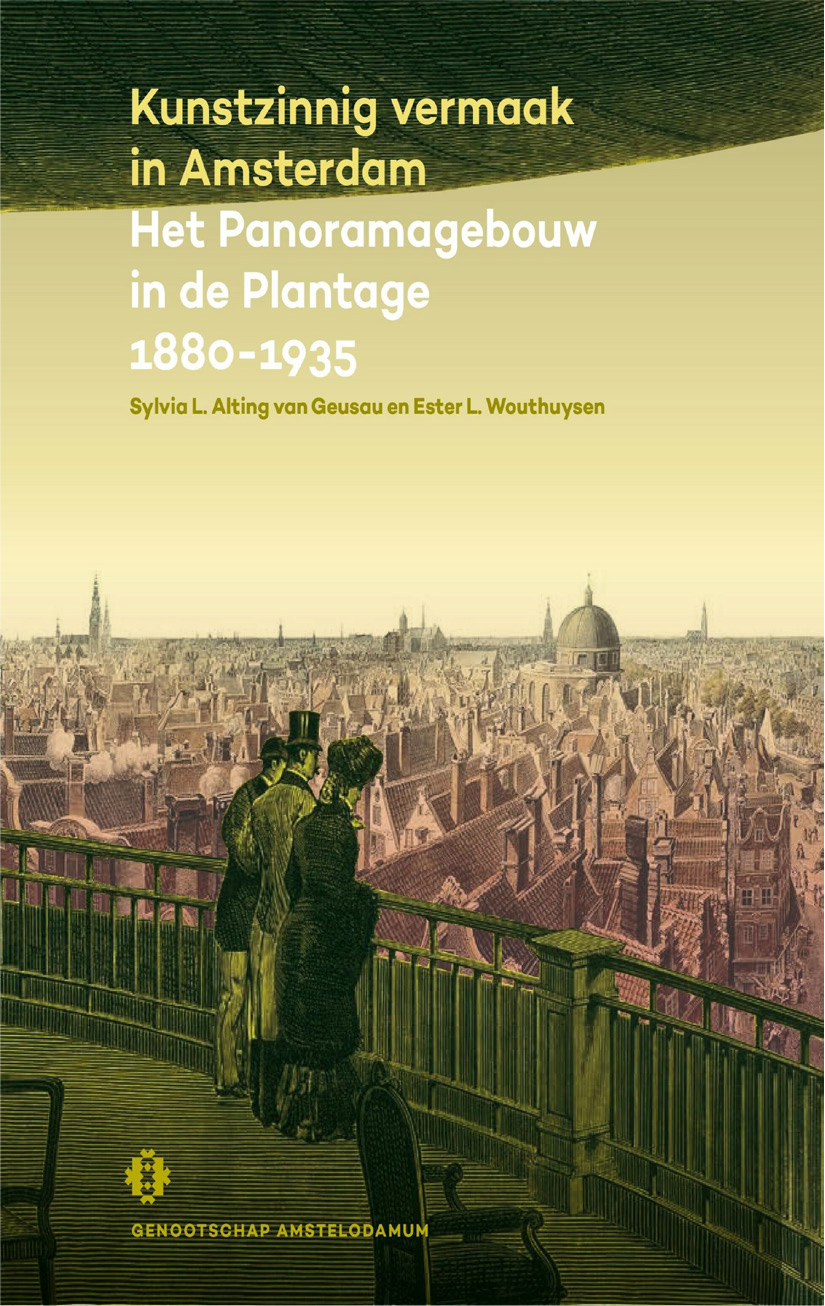
Sylvia Alting van Geusau and Ester Wouthuysen, Kunstzinnig vermaak in Amsterdam. Het Panoramagebouw in de Plantage 1880-1935 (Amsterdam: Uitgeverij Virtùmedia together with Genootschap Amstelodamum, 2021), 239 pp., ISBN 9789491141270.
Picture yourself stepping into the vibrant world of turn-of-the-century Amsterdam—an era teeming with culture and an insatiable thirst for immersive experiences. That is precisely where Kunstzinnig vermaak in Amsterdam takes you, delving deep into the exhilarating panorama craze. Think of it as the virtual reality of its time—360-degree, incredibly lifelike paintings that whisked audiences away on ‘armchair’ travel adventures. Rather than experiencing these ‘travels’ from home, however, audiences could visit buildings specifically erected to cater to the medium’s impressive size and popularity. Besides these well-known stationary panoramic paintings, moving panoramas and mareoramas were popular as well. Moving panoramas were gradually unrolled in front of audiences, taking them on a journey through various landscapes and events, often accompanied by a live lecturing performance. The mareorama further improved the reality effect by placing the audience on a moving platform. To guide their exploration, panorama visitors usually received a brochure detailing the scenes they were about to encounter. After all, the medium was often used to spread ideological messages due to its successful blend of education, national consciousness, culture, and popular entertainment. First, we will dive into the book’s content before rolling up our sleeves for a three-pronged critique. We will start by exploring the gaps in the discussion of the panorama medium itself. Then, we will hop into a time machine and address the insufficient embedding of the panorama in the contemporaneous media landscape. After that, we will turn our gaze to how this book fits into the contemporary scholarly landscape. Finally, we will cap things off with a review of how the book’s style aligns with its substance.
Kunstzinnig vermaak in Amsterdam zeroes in on the panorama’s heyday in Amsterdam, focusing particularly on the stationary panoramas displayed in the panorama building at the Plantage Middenlaan 50. The Plantage area, a bustling entertainment district that rapidly expanded in the late nineteenth century, was the ideal location for a group of visionary investors to construct this panorama mecca. Sylvia Alting van Geusau’s expertise in fin-de-siècle visual culture and Ester Wouthuysen’s deep understanding of Amsterdam’s history form the bedrock of this exhaustive study. Their collaborative effort results in a well-structured and brilliantly written exploration. While the first part of the book immerses us in the panoramic history of the Panorama building, the second half takes us on a captivating journey through the art exhibitions hosted in the very same venue. Here, we step into the contemporary art scene, including a delightful discussion of van Gogh’s work, enriching our understanding of the panorama phenomenon.1
That being said, the book unfortunately contains some remarkable absences regarding the panorama phenomenon. For instance, not much attention is paid to the moving panorama, none to the Dutch history of the phenomenon. We are left pondering whether stationary panoramas, like their moving counterparts, were ever accompanied by live performances. Even if this was not the case, the brochures, suggested by the authors to be omnipresent in panorama exhibitions, are only mentioned in passing. This is regrettable, because a deeper dive into their role in shaping the panorama experience can be highly revealing.2 The contents of the brochures are also rarely analysed.3 However, the one instance where the content of a brochure linked to a specific panorama is discussed really shows how the audience’s gaze was directed during a panorama visit.4 In my view, a more consistent analysis of brochures would have helped to contextualise the phenomenon and the experiences it generated. Another issue pertains to the assumption that fairground culture was stagnant and trumped by the ‘high(er) culture’ of the stationary panorama. This premise is debatable, as demonstrated by projects like SciFair, and results in the book’s lack of attention for non-hegemonic societal spheres.5 A more thorough exploration of travelling panoramas, and their connections to stationary panoramas, could have generated a well-rounded perspective on the phenomenon. Additionally, the comparative analysis started on page 16 should have continued throughout the book, relating the situation in Amsterdam to the national and international scene.6 These sections sparkle and hint at fruitful uncharted territories, for example when the book discusses the journeys of different panoramas.7 Finally, the book raises several interesting, but ultimately unanswered questions, such as those regarding the emotional and psychological impact of the panorama experience. These unanswered questions nevertheless open doors to future research.8
Another drawback of the book is the insufficient embedding of the panorama in the contemporaneous media landscape. Although the discussion of the art scene enriches the analysis, it makes the reader wonder about other (visual) media co-existing with the panorama. As the book wants to answer the question why the panorama phenomenon became so popular in this period, finding an answer to this question also requires an analysis of the panorama’s place within the broader media landscape of the period. This context is precisely what the books lacks. The magic lantern, for instance, only appears in the appendix, rather than in the main body of the text.9 The short passages in which the panorama is indeed embedded in broader popular culture, leave us yearning for more: a case in point being the discussion of the growing popularity of houseplants and the houseplant exhibition organised in the Panorama building.10 The discussion of the practical aspects of the moving panorama, such as the use of the lecture format and the important role of humour and poetry therein, reveal the panorama’s kinship with magic lantern performances.11 The audience probably expected this format as well and this should be considered when trying to explain the popularity of the phenomenon. Furthermore, examining first-hand experiences of panorama visitors in newspaper articles could have enhanced the analysis. This addition would have shed light on the medium’s scope, strategies, and limitations, ultimately bolstering the argument of immersion mentioned in the conclusion. Without such contextual evidence, this argument might come across as vague and unsubstantiated.12
Thirdly, the book does not adequately address the status quaestionis of the relevant fields. The main issue, from a scholarly point of view, is the descriptive and detailed rather than analytical nature of the book. This makes it trickier to foster a dialogue between this research and the broader academic field. This lack of dialogue also becomes clear more generally as only one of the 195 pages of the publication touches on historiography, primarily focusing on Dutch historical debates.13 Key publications on the topic, like Illusions in Motion by Erkki Huhtamo, are dearly missed.14 Additionally, the few historiographical debates mentioned, such as the one on the panorama’s popularity due to societal changes, remain general and disconnected from the book’s specific case studies.15 This leaves the impression that the authors may have delved deep but not wide enough, lacking adequate support from secondary literature.
Before I conclude, I would like to reflect on the book’s impressive 133 illustrations and photographs. These visuals, while delightful, are mentioned in the body of the text but are not properly analysed, mirroring the issue alluded to above. A deeper dive into the actual ‘visuality’ of panoramas would certainly have been welcome. As it stands, the illustrations make the reading experience more enjoyable but do not necessarily provide additional insights. The two appendices at the end of the publication act as a handy guide, offering a comprehensive overview of the panoramas gracing Amsterdam and the expositions, dioramas and auctions held in the Panorama building. This was arguably the publication’s mission all along, and it accomplishes this task with finesse.
All in all, this publication offers an enjoyable journey into a forgotten chapter of Amsterdam’s history, enriched by substantial research. My comments primarily revolve around the desire to expand the book’s scope, a natural craving ignited by its captivating content. Understandably, not all of these other research strands were explored because of the strong focus on the panorama phenomenon, particularly within Amsterdam’s historical context. However, this focus also brings to light some notable limitations in the publication. It leaves one longing for more engagement with historiography and its ongoing debates, which would have been both intriguing and beneficial for broadening the book’s appeal. As a result, the book could have transcended its primarily popular readership, attracting an academic audience as well. Nevertheless, it is impossible to overlook the book’s beautiful design and compelling writing, transforming it into a work of art in its own right. Its content unquestionably establishes it as a key reference work for anyone interested in Amsterdam’s panorama history.
Notes
[1] Sylvia Alting van Geusau and Ester Wouthuysen, Kunstzinnig vermaak in Amsterdam. Het Panoramagebouw in de Plantage 1880-1935 (Amsterdam: Uitgeverij Virtùmedia, 2021), 139-143.
[5] The SciFair project investigates the circulation and popularisation of science, technology and visual culture on the nineteenth-century fairground, demonstrating that this cultural space was anything but stagnant and very much worthy of research. For more information, please see: https://www.uantwerpen.be/en/projects/science-at-the-fair/
[8] Alting van Geusau and Wouthuysen, 12 and 23. For the connection to nationalism, see: Alting van Geusau and Wouthuysen, 66.
Biography
Eleonora Paklons graduated magna cum laude in History at the University of Antwerp in 2020. Later that year she became a research assistant on the B-MAGIC project, which studies the cultural impact of the magic lantern as a mass medium in Belgium (1830-1940). In September 2021, she started her PhD at the University of Antwerp. She studies historical bias in magic lantern slides through data-driven methods, focusing on the construction of place. She has published in Gender & History, Revue belge de philologie et d’histoire, De Moderne Tijd and Jaarboek De zeventiende eeuw, and presented at international conferences such as DH Benelux and IFTR. Her interests include urban history, media archaeology and history of mentalities.