
The advent of global television broadcasts was made possible by the launch of communication satellites into orbit. Shortly after the deployment of Telstar in July 1962, transatlantic live transmissions emerged on television and were soon supplemented by transpacific television exchanges, bringing together different parts of the world on a single screen.1 Marshall McLuhan described this ‘speed-up of the electronic age’ as an implosion of space, leading him to claim a ‘new world of the global village’.2
Against the backdrop of satellite television, other means of transatlantic television exchange fell into oblivion. Preceding the launch of Telstar, there existed a brief period during which television viewers could experience what Variety termed ‘Instant TV’.3 The trade magazine vividly describes the unfolding of internationally important events on U.S. television through ‘”day-&-dating” global news coverage’, highlighting the ‘fantastic and frantic drive for news’ that requires a particular combination of media.4 At the core of this media constellation lay video tape recording, interlinked with fast transportation vehicles.5
Today, video tape recording is remembered as a technology used by artists, activists and amateurs as well as for preservation and archiving purposes.6 However, in the late 1950s and early 1960s, it played a crucial role in facilitating the “instant” reporting of events occurring elsewhere in the world. Examples of this particular use of video technology include the coronation of Pope John XXIII in November 1958,7 the foreign visits of the U.S. President and the Vice President in 1959,8 the 1960 Rome Olympic Games and the wedding of Princess Margaret in May 1960.9 All of these instances are media events avant le lettre: they are pre-planned, organised outside the media, monopolistic and interrupt everyday routines.10 However, their global coverage, unlike the characteristic live transmission of media events, relied on video tape recording.
The trial against Adolf Eichmann in 1961 represents another example of Instant TV; in fact, the excitement described by Variety refers to the arrival of the first video tapes of this event. During the “Third Reich”, Eichmann has been a central figure in organising the logistics of mass deportations of European Jews to ghettos and extermination camps. Held in Jerusalem, the court case is recognised as a pivotal moment in shaping the collective memory of the Holocaust. Its global coverage raised awareness for the atrocities and brought visibility to the survivors whose testimonies were a key element of the proceedings.11 However, it is noteworthy that television service was introduced in Israel only in 1968.12 Therefore, equipment and expertise had to be brought in from other countries to facilitate instant television reporting.
This article approaches the Eichmann trial from a media archaeological perspective, focusing on the technology and media constellation that enabled the global television coverage of the event. It draws on archival research conducted at the Israel State Archives, the Special Collections & Archives at the George Eastman Museum, the BBC Written Archives Centre and the German Staatsarchiv Hamburg and describes the technological setup and institutional collaboration that made the broadcast possible. Informed by actor-network theory, the article highlights the interplay of different actors who were interested and enrolled in a short-lived actor-network of Instant TV, which soon became obsolete due to the advent of communication satellites.13 By recounting the story of the trial coverage, it not only evokes the forgotten use of a technology but also sheds light on emerging television formats and infrastructures that persisted far beyond the brief prominence of Instant TV.
Uses of video tape recording
Video tape recording was first introduced to the public in 1956.14 It was the eve of the National Association of Radio and Television Broadcasters convention in Chicago. Around 200 representatives and employees of Columbia Broadcasting System (CBS) had gathered for the network’s annual meeting. Bill Lodge, CBS vice president and head of television, reported on the achievements of the past few years. To ensure that everyone in the room could see him while delivering his speech, television monitors were placed in the auditorium. He received friendly applause for his presentation and answered a few questions when the transmission on the monitors suddenly took a leap in time.
Much to the astonishment of the audience Lodge’s speech replayed before their eyes. The stage curtain then dramatically opened, revealing the very first magnetic tape recorder, developed by the U.S. electronics company Ampex. ‘The audience went wild with shouting, screaming, and whistling,’ recall John Leslie and Ross Snyder, two Ampex employees, who were present that evening.15
When the curtains were opened to show the Ampex videotape recorder, some stood on their chairs to get a glimpse of it. These television people realised that what they were seeing for the first time was a recorder that would greatly simplify production of video programs and also be an excellent answer for recording delayed television broadcasts.16
According to the memory of Leslie and Snyder, the potential of the new technology was immediately evident to everyone in the room: It lent itself to time shifting. It allowed for the recording of an east coast broadcast to be replayed a few hours later for the west coast transmission, and it facilitated the pre-production of television shows long before their scheduled airtime. Considering the simplification of television production made possible by the video tape recorder, it is not surprising that within a week after the presentation, Ampex had already received 45 orders for their recording machine, which they called the VR-1000.17
Using magnetic tape recording for time shifting had several advantages over film, which would have been another suitable medium for this purpose.18 Magnetic tapes were more cost-efficient because they could be reused by recording over an existing recording. Furthermore, they had a much longer running time than film reels, reducing the need for frequent loading and unloading of the recording device, and were easier to handle. Finally, the recordings could be played back immediately. In contrast, film had to be developed in a laboratory and was only available with a time delay.
It is this immediate availability of the recordings that enabled instant reporting from live events taking place elsewhere in the world.19 To realise Instant TV, video tape recorders had to be combined with other media technologies, notably with vehicles such as cars or planes. Together with cameras, television transmitters, roads and airports, these elements formed the technical foundation of an emerging infrastructure for global television coverage, which also involved engineers, foreign correspondents and collaborating broadcast institutions.
The most extensive use of video recording for global instant reporting was during the Eichmann trial, that took place between April 11 and August 14, 1961.20 The event was deemed of ‘historical importance’ warranting extensive publicity.21 Consequently, four television cameras were permitted in the courtroom.22 The entire trial was recorded on video tapes, copies of which were distributed to various television stations at the end of each day, ensuring that the trial was broadcast in at least 38 countries. Thanks to the immediacy of magnetic tape recordings and the introduction of fast jet planes in the late 1950s, television viewers in New York could watch each morning the courtroom events from the day before.
Media of the Eichmann trial
On May 23, 1960, Israel’s Prime Minister David Ben-Gurion announced to the Knesset the capture of Adolf Eichmann.23 This information caused a sensation, and news outlets around the world reported on the event. The announcements that the former SS-Obersturmbannführer would be put on trial in Israel not only sparked public discussions about the jurisdiction,24 but also set activities at news departments of various media outlets in motion.
Newspaper and radio editors started to discuss how to report on the trial. They sought legal counsel to address potential ‘defamatory statements’ that could arise during the proceedings (would correspondents expose themselves to legal prosecution by incorporating these statements into their reporting?),25 and they explored additional editorial contributions to supplement courtroom reports. Following the announcement of the accreditation procedure by the Press Office of the State of Israel, correspondents completed registration and agreements were established with Kol Israel, Israel’s public radio broadcaster, concerning the technical aspects for broadcasting the trial on radio.26
For the Israeli government, the trial was an excellent opportunity to showcase the young state to the global public and to demonstrate its modernity. Consequently, they spared no expense or effort in establishing a comprehensive infrastructure for correspondents to ensure smooth and efficient by the press and radio which were the dominant news media in most part of the world. To facilitate this, a press centre was established within the courthouse (a cultural centre that was repurposed for the trial). Here, international journalists were provided with essential resources, including the courtroom transcripts that were translated into multiple languages. Within the courthouse there was also a small library catering to the research needs of foreign correspondents, along with a post office facilitating the transmission of telegrams, telexes, and international long-distance phone calls (see Figure 1).
The technical setup within the courthouse enabled journalists to directly follow the proceedings from the press room. Simultaneous translations of the hearing into multiple languages were provided,27 along with receivers and headphones for the journalists. Moreover, fifty ‘taps’ (as Kol Israel called them) were installed in the courthouse, where recording devices could be connected to capture the audio signal from the courtroom respectively the translation booth.28 Additionally, there were five small studios dedicated to transmitting radio material, each ‘with the capacity of relaying up to eight overseas transmissions an hour’.29 This infrastructure, lauded by Variety as ‘highest standard’, facilitated instant reporting on the courtroom proceedings.
The radio people have their tape-recorders in the pressroom, directly connected with the mikes in the courtroom, so that they can tape every word. They are sending mostly three-six minute tapes by air and some are using radio-telephones. The technical arrangements made here for the press are of the highest standard.30
Despite the absence of television service in Israel at that time, television images from the event were distributed globally. Prior to the trial, several newsreel companies and television stations had expressed interest in filming the proceedings for cinema and television coverage. However, an unknown American film and television producer pre-empted the internationally operating companies. Milton Fruchtman, who had previously visited Israel for film shoots, forestalled their request by directly approaching Israel’s Minister of Justice.
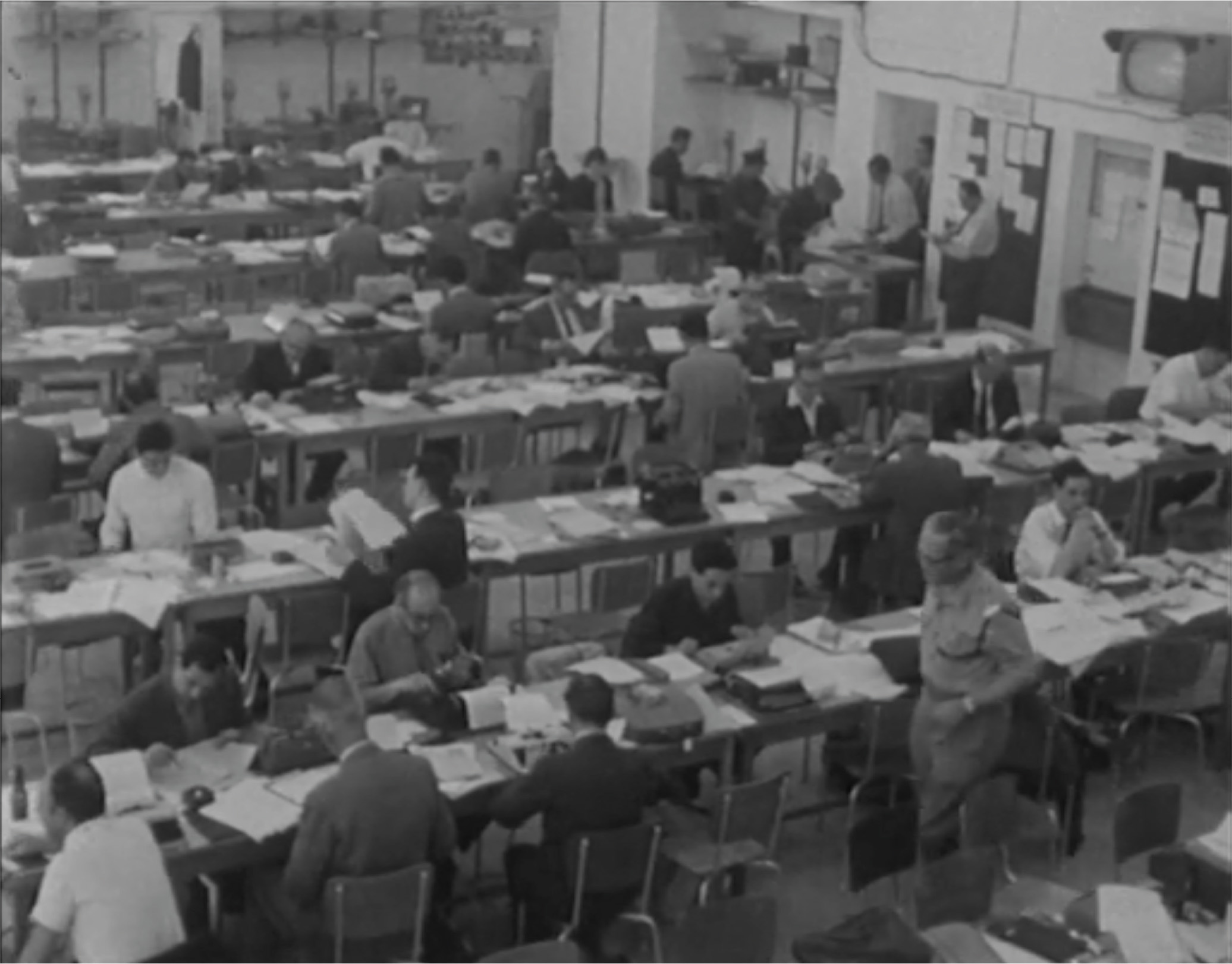
Figure 1
Press Centre, screenshot from Eine Epoche vor Gericht (April 27, 1961)
Within the network of people, technical objects and institutions that facilitated the global television coverage of the Eichmann, Fruchtman can be understood as the ‘prime mover’.31 Leveraging his familiarity with the country and language, his connections in both Israel and the US, and his profound knowledge of film and video technology, he was able to identify, at an early stage, multiple human and non-human actors essential for forming this network, and to build alliances with them. Amongst these actors were the Israeli government, aspiring to present its state as modern and independent, and Ampex’ video tape recorder.
Videotaping the Eichmann trial
Two months after Eichmann’s capture, Israel’s Minister of Justice, Pinhas Rosen, received a letter from Fruchtman proposing to ‘make a permanent historical record’ of the trial ‘to be seen by television and motion audience throughout the world’.32 Fruchtman’s letter highlighted the technical challenges posed by the more conventional use of a film camera. He mentioned the noise and disturbance caused by the need ‘to change the film magazines at frequent intervals’ and the ‘high level of electric illumination’ as an additional ‘source of annoyance in the courtroom’. Moreover, he pointed out the ‘tremendous quantity of raw film stock’ required for a complete record, describing the costs, including film stock processing in a laboratory, as ‘prohibitive’. Finally, he expressed his concerns regarding image quality, anticipating poor quality due to the shooting conditions. He emphasised that ‘when motion picture film is used for television transmission, there are appreciable losses and degeneration in image’.33
After this ‘problematization’ of filming the trial, Fruchtman continued his letter by offering a solution. To ‘overcome the[se] difficulties’, he wrote: ‘we (…) propose to use television cameras in conjunction with ‘Video Tape’ recording’.34 Amongst the reasons he listed were the complete silence of television cameras, their light sensitivity that enabled an effective functioning ‘at ‘any light level’, and the lack of ‘necessity for changing magazines on the camera’. He also mentioned that there is no quality loss when ‘electronically recorded images [are] used on television’ and emphasised their instant availability as a key advantage of video technology: ‘There is no laboratory proceeding involved and the material may be “played back” immediately after recording’.35
By addressing the Israeli government and identifying video tape recording as solution to the problem of film, Fruchtman defined, interested an enrolled two entities of the actor-world of the Eichmann trial coverage. Within a few months the actor-network would become much more expansive and mobilise further institutions, technical objects, and people as allies. However, with his first letter Fruchtman ‘determined a set of actors’ and at the same time aimed to render himself indispensable in this network of relationships.36
Fruchtman’s explanations regarding the advantages of magnetic tape recording interested Israel’s government officials. It turned out that they had been eager to bring the technology to Israel for quite some time.37 Furthermore, the immediate availability of the trial footage resonated with their aim to facilitate rapid and smooth reporting of the proceedings, which is also reflected in the setup and equipment of the trial’s press centre. However, they doubted Fruchtman’s competency and sought further information about him.38 Moreover, they contemplated whether it would be better to collaborate with a big US television network instead of contracting Fruchtman’s small company Odyssey Productions, given its financial means and ability to scale its operations for such an endeavour.39
A proposal dated September 13, 1960 and addressed to the Government Press Office of the State of Israel indicates the emergence of a new actor: Capital Cities.40 The US media company that later acquired the TV network ABC and subsequently merged with Disney was relatively unknown at that time. It owned a handful of television stations on the east coast and aspired to evolve into a major network in the long run. However, to obtain a television license, Capital Cities was required to produce public service content. To meet this requirement, the company committed to record the Eichmann trial on video tape and distribute the footage to various television stations and newsreel companies.
Unfortunately, specific details about Capital Cities’ interessement and enrolment are not documented. However, the company became an element of the actor-network and eventually, on November 8, 1960, signed a contract with the Israeli Government that granted them the ‘sole and exclusive right (…) to record (…) all public proceedings of the Eichmann trial’.41 The contract obliged Capital Cities to transport ‘adequate television and videotape facilities’ and ‘skilled personnel for the proper production of the said recording’ to Jerusalem, ‘including Milton Fruchtman’.42 While Fruchtman initiated the actor-network, he only became an indispensable element when he built an alliance with Capital Cities, which is highlighted by the clause that Fruchtman will be ‘authorised to make on behalf of Capital Cities all decisions relating to production’.43
The contract with Capital Cities sparked opposition from established media companies in various countries and their attempt to undermine the deal involved not only their executives and directors-general but also politicians and diplomats. Details are beyond the scope of this article, and it is sufficient to note that on the one hand the Israeli government preferred an independent production company, as not to have to choose between the big networks. On the other hand, tellingly, before Fruchtman’s initiative these networks had simply neglected the upcoming event. Regardless, their objection to granting exclusive rights to Capital Cities was unsuccessful, and the construction of a temporary infrastructure for global media coverage proceeded according to Fruchtman’s plans.
Two magnetic tape recorders were shipped from California to Israel for this purpose. Additionally, four television cameras from the Marconi company and their technicians, who had travelled from Great Britain, were enrolled in the network. Four cameramen, previously working for the Israeli newsreel, were trained to operate the television cameras, and Leo Hurwitz was hired as director. Hurwitz was a renowned American director known for his documentaries. He was involved in establishing the CBS news department before being blacklisted during the McCarthy era due to alleged support of the Communist Party, which rendered it impossible for him to continue working as a filmmaker or in the television industry.
In his capacity as director of the trial recordings, Hurwitz initially conducted preliminary tests to determine optimal camera positions and enhance the image quality. Throughout the trial he oversaw the camera signals from the control room, gave instructions to the cameramen, and made real-time decisions similar to a live broadcast, selecting which of the four images the television viewer could see. (see Figure 2) However, here the selected camera signal was not immediately broadcast but recorded on a magnetic tape. A direct transmission from the courtroom was only viewable on the screens in the press centre and in the nearby Ratisbonne monastery, where a television room with 700 seats had been set up for the interested public.44
Instantaneity
The production of television images of the Eichmann trial faced challenges beyond the rivalry between established media companies and a relatively unknown television company, which had even occupied Israel’s Supreme Court. On the one hand, Eichmann’s defence attorney also objected and demanded the exclusion of television cameras from the trial, expressing concerns about their potential influence on the witnesses.45 On the other hand, the television coverage was almost jeopardised when the three judges inspected the building and refused to allow four camera in their courtroom.
The judges’ intervention prompted the hasty installation of plaster walls, discretely concealing the cameras. Cleverly designed peepholes, shielded by a fine grille, allowed seamless filming of the events within the courtroom. When the judges returned a few days later to inspect the venue again, much to their surprise the cameras were nowhere to be found. They were even more astonished when, upon leaving the courtroom, they saw on a screen how they had been searching for the cameras just a minute ago.46
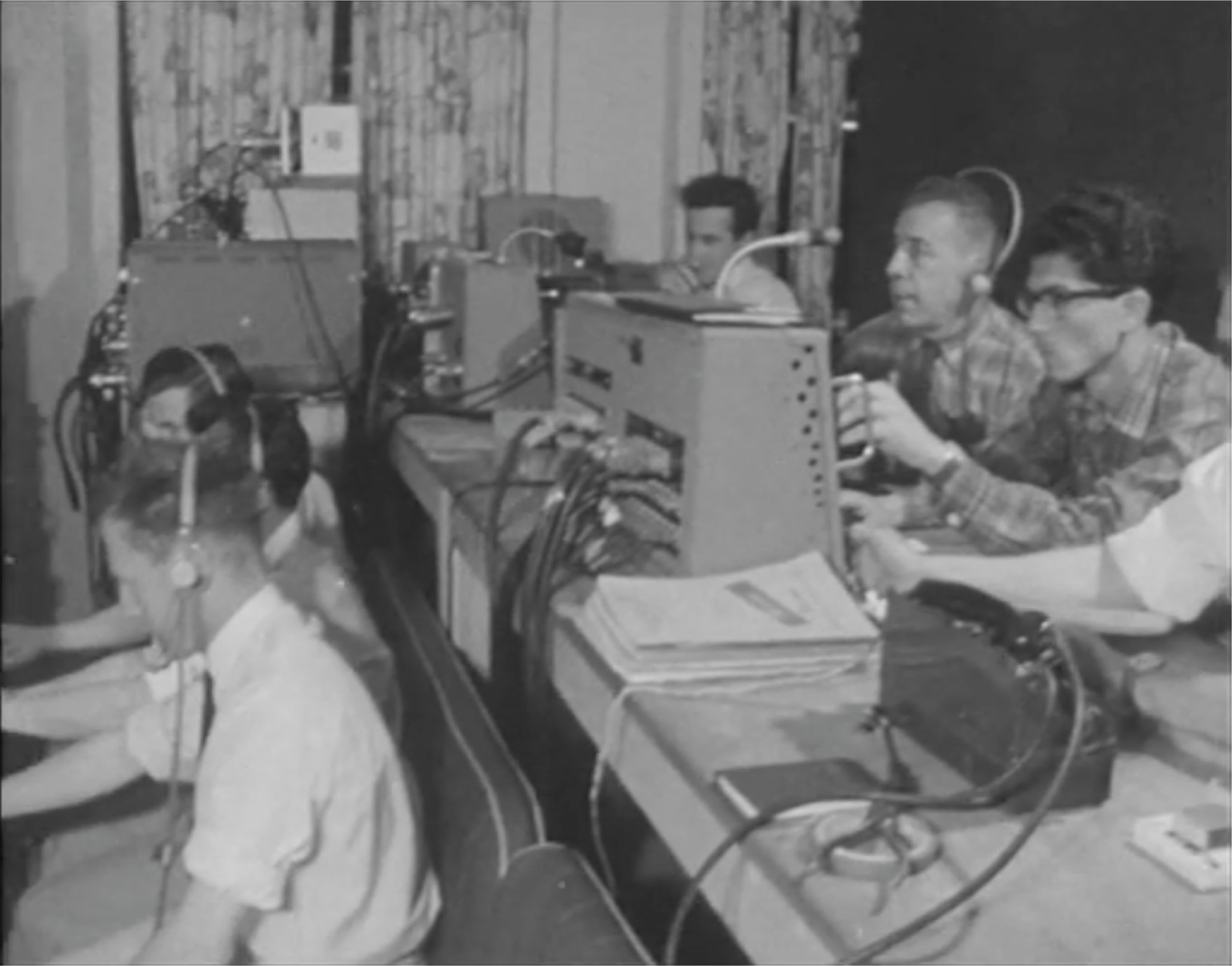
Figure 2
Control Room, screenshot from Eine Epoche vor Gericht (April 27, 1961)
To secure the judges’ approval, the television crew utilised the same ‘trick’ that had stirred excitement at the CBS meeting five years earlier.47 The immediate playback of the recording provided evidence and convinced the judges that the presence of television cameras and recording devises posed no disturbance to the hearing. In their decision to allow the recording of the proceedings, they referred to their visit, stating:
We have made an inspection and ascertained the mode of functioning of the recording machines. We have satisfied ourselves that these machines stand concealed behind netted apertures, and that the persons operating them are likewise concealed; the machines record pictures by the ordinary lighting in the room and make no noise whatsoever. In this respect, i.e., as regards the possibility of a disturbance during the proceedings, we are absolutely satisfied that there will be none.48
While the silent operation and concealed placement of the cameras contributes to the approval of recording the trial, it was the instant availability of the recorded images that emphasised the evidentiary power of the technology.
The attribution ‘Instant TV’ to the coverage of the Eichmann trial on US television resulted primarily from the rapid distribution of the video recordings. Variety emphasised the speed-up of travel time by mentioning ‘jet planes [that] skittered across the Atlantic’ and insinuating a frantic race between television station for the first images.49 However, it was not only jet planes, but an alliance of correspondents, magnetic tapes and various vehicles that enabled the fast reporting. Already during the court proceedings, journalists selected situations and statements they deemed important or intriguing for the audience of their television channel. At the end of each day’s hearing, they located these selected scenes in the recordings and the segments were copied to another video tape (see Figure 3). These copies were then transported daily to Lydda Airport near Tel Aviv, either by car or, on occasion, by helicopter.50 From there, the video tapes were flown to distribution hubs in New York and London for further distribution dissemination. Jet planes that had been in operation between Lydda and New York since January 1961 significantly accelerated transport speeds.51
In New York, assistants of the television stations received the footage from the previous day and transported it to their studios where it was immediately transmitted. For instance, on April 12, 1961, at around 8 a.m., television screens in the New York area displayed images of the opening of the trial.52 In the subsequent weeks, a one-hour compilation of highlights from the previous day’s proceedings was aired daily at lunchtime. Additionally, in the afternoon, a 30-minute programme featured a repeat broadcast of these highlights.53
In contrast to the immediate transmission of the video recordings in the U.S., the speed of their dissemination in Europe was slowed down due to the necessity of processing them upon their arrival in London.54 The U.S. 525-line standard of the Ampex devices that were transported to Jerusalem, did not align with the line standard required for television transmission in the European countries the video tapes were intended for. In a copying station that was specifically established for the tapes from the Eichmann trial, the recordings were transferred into video images suitable for the respective countries – for instance, 605 lines for British television and 625 for West German television.
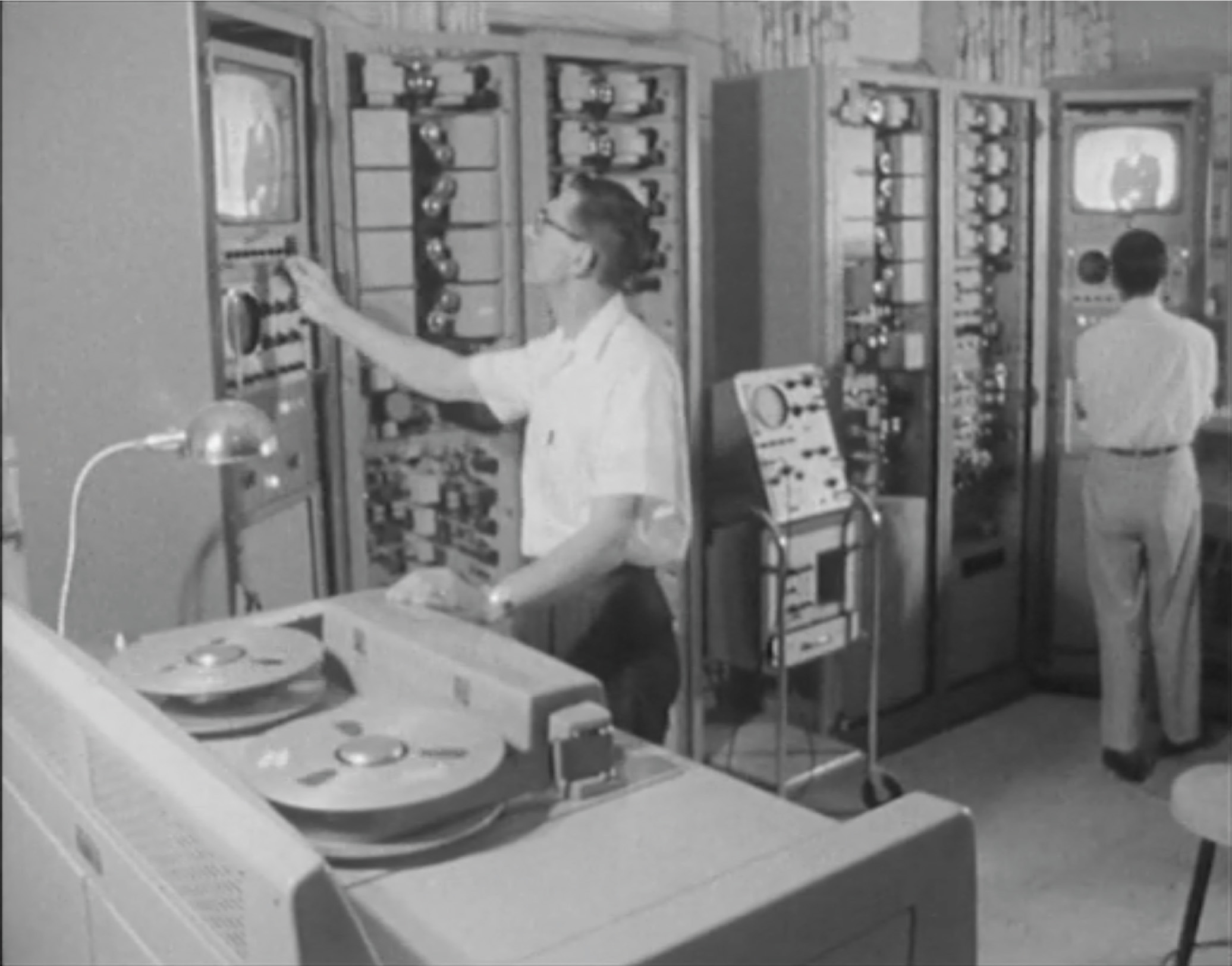
Figure 3
Copy Room, screenshot from Eine Epoche vor Gericht (April 27, 1961)
This additional copying not only led to a decline of the image quality, but also caused delays in the distribution of the tapes.55 Following this additional conversion, the video tapes had to be transported by car and plane from London to various television stations across Europe. Anticipating the additional time necessary to transfer the recordings to their line standard, at least West German television did not aim to cover the Eichmann trial in Instant TV mode. Instead, their 20- to 30-minute programmes that were broadcast twice a week, supplemented the video recordings with in-depth analyses and trial-related items about Israel, which their own camera team shot on film. This reduced not only the urge for immediacy, but also problems in case adverse weather conditions caused additional delays in delivering the video tapes to their intended station in time.56
End
While the understanding of the world as ‘global village’ that is characterised by ‘an instant implosion (…) of space’ might be inspired by satellite technology, it had a predecessor that contributed already significantly to the ‘speed-up of the electronic age’.57 In the late 1950s and early 1960s, the combination of video tape recording and fast transportation vehicles had already accelerated television reporting across continents, leading to the term Instant TV. During the Eichmann trial, this media constellation demonstrated its efficiency. Throughout the 18 weeks of the main hearing, video tapes were dispatched daily, and reached television screens all over the world. Ultimately, the video recordings of Holocaust survivors testifying in court played a crucial role in the cultural memory of the Holocaust.58
The case of the Eichmann trial illustrates how in the early 1960s organisers of globally recognised events created and met the demand for media coverage. It also demonstrates the necessity of a network of diverse actors, including Ampex video tape recorders, a television producer, the Israeli government, Capital Cities, television stations in the U.S. and Europe, as well as cars and jet planes, to enable television reporting. As predecessor of ‘media events’, the Eichmann trial and other examples of Instant TV ultimately shed light on the socio-technical infrastructure that is essential for global television coverage.
The utilisation of video tape recording for Instant TV demonstrates that every technology is part of media constellations and that its usage changes over time. Despite the effectiveness of the combination of jet planes and video recorders, it was short-lived and became outdated within a year after the Eichmann trial. Therefore, it is not surprising that media histories of video tape recording often overlook the nearly five years during which the technology was used for instant reporting. This particular usage abruptly ended when on July 10, 1962, with the launch of Telstar, the first satellite that transmitted television signals. From then on, this new communication technology ensured global instantaneity, and the video recorder formed new networks with archives, activists and artist.
Endnotes
[1] The first live satellite broadcast between the US and Europe took place on July 23, 1962. Lisa Parks analyses these transnational live-via-satellite programs, that she terms “satellite spectaculars” in her book Cultures in Orbit. Satellites and the Televisual (Durham: Duke University Press, 2005), 21-45.
[2] Marshall McLuhan, Understanding Media. The Extensions of Man (New York: McGraw-Hill, 1964), 92-93.
[5] The term media constellation indicates that all media are part of a heterogeneous and dynamic ensemble of technologies and practices. For more on this see: Markus Stauff, “Materiality, Practices, Problematizations. What Kind of Dispositif are Media?” in Materializing Memories. Dispositifs, Generations, Amateurs, eds. Susan Aasman, Andreas Fickers and Joseph Wachelder (New York: Bloomsbury, 2018), 67-83.
[6] For an overview of different uses of video technology and its history see: Susan Aasman and Tom Slootweg, “Een zeer korte videogeschiedenis,” TMG Journal for Media History 20, 1 (2017): 115–121; Michael Z. Newman, Video Revolutions. On the History of a Medium (New York: Columbia University Press, 2014).
[7] Facilitated by a merger of various television stations, the event was transmitted live across Europe. For US television, the commercial British station Granada recorded the European coverage on video tapes which were subsequently flown across the Atlantic to be broadcast there. See: “Progress report for 1958” Journal of the SMPTE 68 (May 1959): 295.
[8] In 1959 President Dwight Eisenhower visited Europe and the Far East (see: “Dwight D. Eisenhower,” Office of the Historian, accessed September 15, 2023, https://history.state.gov/departmenthistory/travels/president/eisenhower-dwight-d). Vice President Richard Nixon had his famous Kitchen Debate with Nikita Khrushchev at the American National Exhibit in Moscow.
[9] See: “Progress report for 1959” Journal of the SMPTE 69 (May 1960): 316 and “Progress report for 1960” Journal of the SMPTE 70 (May 1961): 343.
[10] For more on media events see: Daniel Dayan and Elihu Katz, Media Events. The Live Broadcasting of History (Cambridge: Harvard University Press, 1992); Nick Couldry, Andreas Hepp and Friedrich Krotz, eds., Media Events in a Global Age (London: Routledge, 2009).
[11] Annette Wieviorka argues that trial marked the advent of the witness. See: Annette Wieviorka, The Era of the Witness (Ithaca, Cornell: 2006), 57.
[12] See: Tasha G. Oren, Demon in the Box. Jews, Arabs, Politics, and Culture in the Making of Israeli Television (New Brunswick: Rutgers University Press, 2004).
[13] For more on the use of the terms interessement and enrolment in actor-network theory see: Michel Callon, “Some Elements of a Sociology of Translation. Domestication of the Scallops and the Fisherman of St Brieuc Bay,” in Power, Action, and Belief. A New Sociology of Knowledge?, ed. John Law (London: Routledge, 1986), 196–233.
[14] The technology was based on the Magnetophon, a device that used a tape coated with a magnetic material to record and replay sound. The Magnetophon was initially introduced at the 1935 Große Funkausstellung (Radio Exhibition Show) in Nazi-Germany. After the war, two of these machines were shipped to California, where the Ampex Corporation, specialised in electric motors, copied and improved them for commercial purposes. Subsequently, they also explored how the technical principle could be used to record video signals. See: Friedrich K. Engel, “The Introduction of the Magnetphon,” in Magnetic Recording. The First 100 Years, eds. Eric D. Daniel, C. Denis Mee and Mark H. Clark (New York: IEEE Press, 1999), 47–71; Finn Jorgensen, “Early Fixed-Head Video Recorders” in Magnetic Recording. The First 100 Years, eds. Eric D. Daniel, C. Denis Mee and Mark H. Clark (New York: IEEE Press, 1999), 137–152; Beverley R. Gooch, “Building on the Magnetophon,” in Magnetic Recording. The First 100 Years, eds. Eric D. Daniel, C. Denis Mee and Mark H. Clark (New York: IEEE Press, 1999), 72–91, 73.
[15] John Leslie and Ross Snyder, “History of The Early Days of Ampex Corporation,” Audio Engeneering Society, last modified December 17, 2010, http://www.aes.org/aeshc/docs/company.histories/ampex/leslie_snyder_early-days-of-ampex.pdf, 10.
[18] Many television archives hold telerecordings (or kinescopes) of live broadcast that were produced by mounting a film camera in front of a television screen. They can be identified by the rounded corners of the television screen that are often visible, and by the low image quality. Telerecordings in the collection of the Dutch television archive Beeld & Geluid (Sound & Vision) sometimes also display a number in one of the corners, which indicates which television screen was used for the telerecording.
[19] Today, the somehow ambivalent time relationship that this combination of recording and instantaneity implies, is particularly evident in sports broadcasts. Significant or decisive moments in these live broadcasts are usually replayed immediately (and often in slow motion) in ‘instant replay’ mode, without the repetition (and slowing down) diminishing the live character of the transmission. For the time effect of repetitions, see: Stephanie Marriott, Live Television. Time, Space and the Broadcast Event (London: Sage, 2007), 79-82; for more on instant replay in sports see: Markus Stauff, “The Accountability of Performance in Media Sports. Slow-Motion Replay, the ‘Phantom Punch’, and the Mediated Body,” Body Politics, 2, 3 (2014): 101-123.
[20] After the main hearing ended in August, it took until December 1961 for the verdict to be announced. The appeal hearing took place in May 1962. Eichmann was executed on the night of June 1, 1962.
[21] “Defense Opens Battle Vs. Cameras At Eichmann Trial; Govt. for Them,” Variety, March 15, 1961, 1.
[22] In their decision from March 10, 1961, Moshe Landau, Benjamin Halevi and Yitzhak Raveh, the three judges of the Eichmann trial, considered the opposition of Eichmann’s attorney Robert Servatius against the presence of television cameras. Referring to Bentham they argued that judicial justice can only operate if there is publicity, since publicity ‘keeps the judge himself while trying under trial.’ See: “Decision to Record, Eichmann Trial,” Nizkor Project, last modified June 7, 1999, https://www.nizkor.org/decision-to-record-eichmann-adolf.
[23] Israel’s secret service Mosad tracked down Eichmann in Argentina, kidnapped and brought him to Israel. The abduction was seen as a violation of Argentina’s sovereignty and an infringement of international law. Argentina lodged a formal complaint that was taken to the Security Council of the United Nations which requested form the Government of the State of Israel to ‘make appropriate reparations’ to Argentina. See: “Resolution 138 (1960) / [adopted by the Security Council at its 868th meeting], of 23 June 1960,” UN Security Council, https://digitallibrary.un.org/record/112107.
[24] Israel’s jurisdiction was questioned, amongst others, because the crimes Eichmann was accused of had not been committed on Israeli soil, even more, the State of Israel has not even existed at the time of the crimes. In addition, critics also suspected that Israeli judges might not be able in Eichmann’s case to administer justice without bias.
[25] Discussed in the correspondence between Dr. Hans Brack, in-house counsel of the West German broadcasting corporation WDR, and external legal advisor Prof. Dr. Karl Engisch. Staatsarchiv Hamburg, File 621-1 / 144 NDR 3022.
[26] EBU, Kol Israel Facilities for Sound-Radio Correspondents, December 2, 1960, Deutsches Rundfunkarchiv Frankfurt, File DRAF/A-05.
[27] For more on the simultaneous interpretation of a NS trial see Francesca Gaiba, Fracesca, The Origins of Simultaneous Interpretation. The Nuremberg Trial. (Ottawa: University of Ottawa Press, 1998).
[29] Amit Pinchevski, Tamar Liebes and Ora Herman, “Eichmann on the Air: Radio and the Making of an Historic Trial,” Historical Journal of Film, Radio and Television 27, 1 (March 2007): 1–25, 11. For more on the trial see also Sylvie Lindeperg and Annette Wieviorka, “The Two Stages of the Eichmann Trial,” in Concentratinary Memories. Totalitarian Resistance and Cultural Memories, ed. Griselda Pollock and Max Silvermann (New York: Tauris, 2013) 59–81.
[30] Joseph Lapid, “30 Miles of Videotape on Eichmann Trial During First 5 Days,” Variety, April 26, 1961: 2 and 214.
[31] Michel Callon, “The Sociology of an Actor-Network. The Case of the Electric Vehicle,” in Mapping the Dynamics of Science and Technology, ed. Michel Callon, John Law, and Arie Rip (London: Palgrave, 1986), 19–34, 22.
[36] Michel Callon, “Some Elements of a Sociology of Translation. Domestication of the Scallops and the Fisherman of St Brieuc Bay,” in Power, Action, and Belief. A New Sociology of Knowledge?, ed. John Law (London: Routledge, 1986), 196–233, 204.
[39] Correspondence between David Eldan and Aviad Yeffe, August and September 1960, Israel State Archives, File 3938/19-ג.
[41] Agreement between the Government of the State of Israel and Capital Cities Broadcasting Corporation, November 8, 1960, Israel State Archives, File 3938/19-ג.
[45] Moshe Landau, Benjamin Halevi and Yitzhak Raveh, “Decision to Record, Eichmann Trial,” March 10, 1961, Nizkor Project, https://www.nizkor.org/decision-to-record-eichmann-adolf.
[46] This is how Milton Fruchtman remembers the situation, oral information, Thousand Oaks, February 22, 2013.
[47] Different form Fruchtman’s memory, Leo Hurwitz mentions in a letter only a demonstration ‘for ALL the judges, the police and the defense council, Servatius, who didn’t show up’ at which ‘they examined the equipment from top to bottom’. Leo Hurwitz, letter to Jane, March 8, 1961, George Eastman House, Leo Hurwitz Collection, Box C007.
[51] Marving G. Goldman, El Al. Israel’s Flying Star (Sandpoint: Airways International, 2008), Chapter 5; https://www.israelairlinemuseum.org/el-al-israels-flying-star (revised edition 2020). EL AL’s first direct flight, which took place on June 15, 1961, lasted 9 hours and 33 minutes.
[53] See: Jeffrey Shandler, While America Watches. Television the Holocaust (New York: Oxford University Press, 1999), 94.
[54] Draft of the preliminary contract between Nord- und Westdeutscher Rundfunkverband and Capital Cities Broadcasting, April 6, 1961, Staatsarchiv Hamburg, File 621-1 / 144 NDR 3022.
[55] TV presenter Gert Paczensky mentioned this explicitly in the second issue of the West-German Eine Epoche vor Gericht that reported semiweekly about the trial.
[56] For more on the trial coverage on West German television see: Judith Keilbach, “Eine Epoche vor Gericht. Der Eichmann-Prozess und das bundesdeutsche Fernsehen,” in Völkermord zur Prime-Time. Der Holocaust im Fernsehen, eds. Judith Keilbach, Béla Rásky and Jana Starek (Wien: new academic press, 2019), 265-283.
Biography
Judith Keilbach is an Associate Professor in the Media and Culture Studies Department at Utrecht University. Her research interests include television history and theory, media infrastructures, and the relation of media technology and historiography. She has published books and articles about the representation of the Holocaust in film and on television and edited the DVD “Eichmann im Kalten Krieg”, a compilation of historical footage from both East and West German television coverage of the Eichmann trial.