
This issue on audio-visual, educational media focuses on their use in schools, universities, popular education or vocational training since the late-19th century. In recent years the growing body of work on the history of audio-visual educational media has intensified methodological efforts to grasp the interplay between institutional policies, screening situations, and the form, style, and content of the media employed in various educational situations. In particular, the (heuristic) concept of the dispositif has proved to be productive, because it allows to map these different elements in a large variety of performative educational situations and their pragmatic interrelations: expectations, requirements, and goals.
Frank Kessler’s essay on the educational dispositif, which occasioned this issue, describes one instance of a wide array of performative practices and configurations, the aggregate of which has been termed the performative dispositif. Kessler proposes a model that unites three constitutive, interdependent elements: textual pole, techno-pragmatic (or performance context) pole, and user-spectator pole.1
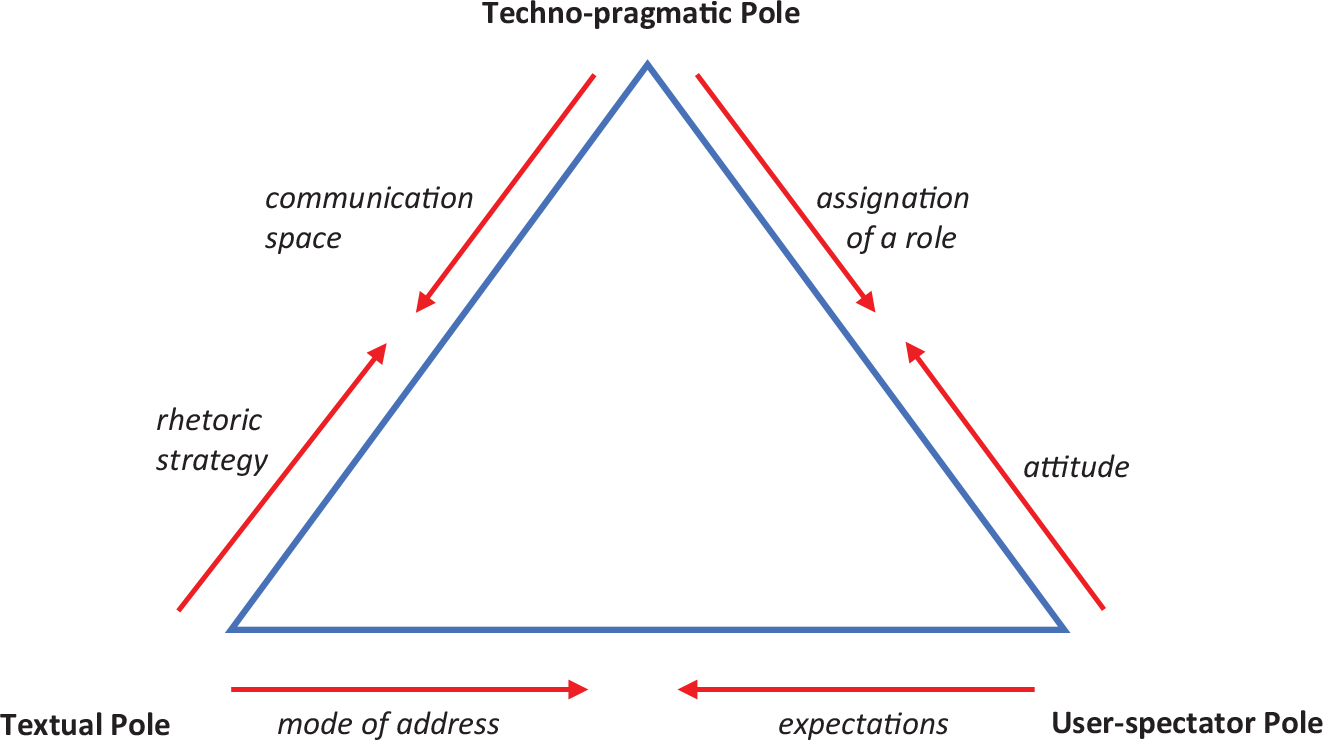
Illustration 1
General pragmatic model of the performative dispositif.
The educational dispositif, then, is one particular manifestation of these elements and the designated, functional relationships between them. It may consist of a public (illustrated) lecture, a lesson, an instructional film, etc. and their respective rhetorical and other audience-design strategies (textual pole). Its presentation may occur in a lecture hall, classroom or cinema theatre, utilising the affordances of these spaces: a stage or platform, teaching aids, lighting, projection, and/or amplifying devices, as well as ways of arranging their target audiences in accordance with the purpose of the event that brought the performance and its audience together (techno-pragmatic or performance context pole). The reputation and common practices of both the venue and the organiser—educational institutes, cultural or scientific associations, etc.—as well as the positioning of the event anticipate attendants’ attitudes and activities (user-spectator pole). The educational dispositif allows, dependent on the specific event, several ways of (spoken) interplay between lecturers, teachers or other speakers and their audiences, in the form of completing assignments, Q&A’s, discussions, etc.
A dispositif, then, can be conceived of as a transcription, or ‘keying’, of a basic social occurrence—everyday interaction—to accomplish a specific purpose.2 Besides the educational dispositif one can distinguish a number of performative configurations. For instance, an entertainment dispositif, such as the staging of a play or the line-up of a programme of music, circus, etc., in which the give and take between performers and audience is more restricted: in most cases the former are allowed to speak, sing or dance uninterruptedly during a conventional length, while in the interstices or at the end displays of appreciation by the latter are expected, displays of disapproval suffered. In a ritual dispositif response to a performer is commonly confined to standardised regular or periodical, ritual utterances, either sung or spoken, and communal acts (e.g. prayer); in its more propagandistic variants, such as political rallies or demonstrations, appreciative displays are often explicitly sought and given.3 In an official dispositif, notably court cases or parliamentary debates, interaction is rigorously regulated, substantively as well as procedurally—a function of the real-life consequences these situations have. And, finally, a mediated dispositif, as in projected, broadcast or streamed materials, the most significant aspect of which is the disconnection of the embodied co-presence of the performance and user-audience poles by separation in time and/or location. At best, measures have been taken to suggest co-presence through bodily orientation and/or linguistic markers (e.g. direct address). In some configurations this disconnection may be occasionally and briefly restored, such as phoned-in conversations in talk radio.
The overall performative dispositif is what one might call, following sociologist Howard Becker, a ‘small abstraction’. By this he meant an analogous approach that removes ‘some detail’ from distinct, even apparently disparate, cases to produce ‘a new category’ for research.4 In other words, the performative dispositif points up the resemblance between a number of events that feature a performance that—sometimes quite literally—takes centre stage yet points out the various ways in which audience participation has been accommodated.
In this issue the educational dispositif—a smaller abstraction, one might say—is discussed in case studies most of which put back ‘some detail’ in the educational settings they analyse and observe this dispositif in action. Approaching the notion of dispositif from phenomenological viewpoints, Christian Dewald and Vrääth Öhner, in their paper “Showing – Becoming Aware – Learning: on the Pedagogical Dispositif of the Kulturfilm”, discuss the concept of attention with regard to the notion of the Kulturfilm in interwar Germany. In “Dismantling the Dispositif: Social Science Experiments in the Classroom” Nico de Klerk reviews a series of in-class experiments with visual teaching aids—mostly in American schools—that faltered as a result of ignoring the performative configurations of classroom situations.
Most of the articles in this issue can be seen from the viewpoint of two phenomena that lend dynamic to the performative dispositif, phenomena that some of these case studies, more or less explicitly, address. One is diachrony, the other embedment. The abovementioned descriptions of various dispositifs have been generalised and represent recent (Western) states of affairs. But as Dulce da Rocha Gonçalves shows, in her paper “The Nutslezing and the Lantern: Public Lectures with Image Projection Organised by the Maatschappij tot Nut van ‘t Algemeen in the First Decades of the 20th Century”, their current shape is the outcome of specific and contested processes. She examines a change, prompted by concerns about a perceived lack of attractiveness in one of the main activities organised by a Dutch society devoted to popular education: the performance of public, instructive lectures.
That this change, parenthetically, occurred in the performance context pole—projecting slides during or after a lecture or causerie—was no coincidence. Other diachronic accounts, too, stress the performance context—albeit by another name—as a locus of change, besides wider social developments that affected performative events indirectly. An example is the emergence and establishment of bourgeois norms in public life since the mid-19th century and their increased civility and orderliness in both comportment and social settings, which for example transformed audience behaviour in theatres in its wake. But seen within the frame of the dispositif this change was assisted importantly by the introduction of new lighting technologies that both dimmed the houselights and highlighted the stage, forcing audience members’ attention on the performance rather than on each other.5 Similarly, recent publications on the introduction of two-way, educational formats such as videoconferencing or (private) teaching read like snapshots of the diachrony of the current digital turn. While these formats overcome the temporal and spatial dislocation of the mediated dispositif, ‘additional cognitive demands’ created by webcam technology, coupled with feelings of self-consciousness as a result of connecting private spaces, may hamper the full realisation of these events’ educational goals, at least for now.6
Embedment, secondly, is addressed in various ways in this issue. The term refers to the incorporation of one performative dispositif into another. This can take the shape of ready-made, mediated teaching aids, such as contemporary art films screened in British art schools in the 1950s, discussed in Katerina Loukopoulou’s contribution “Projecting Creative Processes: Art Films and Art Education in Post-war Britain”. It allowed the ‘importation’ of artworks into the classroom that were otherwise hard to see, as well as virtual visits to an artist’s studio. The resemblance of the films she discusses to the illustrated lecture through a series of artworks and (simulated) direct address by the narrator and/or artist, may well have eased their inclusion into the curriculum.
Embedment can also be a matter of adaptation, as the Viennese venue for popular education Urania practised for its screenings of (silent) documentary films. In her paper “Through Ice and Snow: Mountain Films as Educational Films in the 1920s and 1930s” Marie-Noëlle Yazdanpanah discusses the invasive measures that were taken to present popular themes such as alpinism in an educational way and highlight the educational qualities of these films for both general and niche audiences: by ‘cutting up’ a film in separately screened parts and combining them with slides or even making its own versions (through cuts, intertitles, etc.). Thus Urania also created a controlled mix of dispositifs by combining these screenings with the introductions and lectures that opened up the possibility of discussions.
Thirdly, embedment comes in the shape of an almost complete transformation of the educational dispositif itself into a mediated one—a keying of a keying. In her “Decentring the Broadcasting Dispositif: Educational Closed-Circuits, Military-Industrial Entanglements, and Useful TV” Anne-Katrin Weber describes how, through the introduction of open and closed-circuit educational TV in post-war U.S. formal and voluntary education, companies in cooperation with government and the military achieved a strong, centralised hold on the curriculum in a number of areas—another clear example of the effects on the dispositif of social and political phenomena.
While embedding is a common phenomenon,7 these papers reflect the educational dispositif’s ease in incorporating the arrangements of entertainment and media in particular (including, as related above, today’s two-way, digital applications). This might be an indication of the significance of, if not pressure on, education in modern societies. Not in the sense that each new technology will ‘revolutionise education’. Things certainly have changed, but not because of such claims nor merely of the technologies touted over the past century or so. Nonetheless, education does and must respond to political, economic, and technological changes in and demands of society: a matter of demographic generational change and the need to master new skills and knowledge. Mediated education is an effect of such transformations, yet one that shows that a perceived urgency can rally powerful partners to make things happen. As it does today.
Notes
[1] Frank Kessler, “The Educational Magic Lantern Dispositif,” eds. Sarah Dellmann and Frank Kessler, A Million Pictures: Magic Lantern Slides in the History of Learning (New Barnet: John Libbey, 2020), 181–191.
[2] For more about the term keying and its ‘rough musical analogy’ see the chapter “Keys and Keyings” in Erving Goffman’s Frame Analysis: an Essay on the Organization of Experience (Boston: Northeastern University Press, 1986 [1974]), 40–82.
[3] J. Maxwell Atkinson, “Public speaking and audience responses: some techniques for inviting applause,” eds. J. Maxwell Atkinson and John Heritage, Structures of Social Action: Studies in Conversation Analysis (Cambridge–Paris: Cambridge University Press – Éditions de la Maison des Sciences de l’Homme, 1984), 370–409.
[4] Howard S. Becker, What about Mozart? What about Murder?: Reasoning from Cases (Chicago–London: University of Chicago Press, 2014), 18.
[5] See for instance the chapter ‘The disciplining of spectatorship” in John F. Kasson’s Rudeness and Civility: Manners in Nineteenth-Century Urban America (New York: Hill and Wang, 1990), 215–256; Jim Davis and Victor Emeljanow, “Victorian and Edwardian audiences,” ed. Kerry Powell, The Cambridge Companion to Victorian and Edwardian Theater (Cambridge: Cambridge University Press, 2004), 93–108. See also: Ludwig Vogl-Bienek, “Performative Configurations of the Historical Art of Projection: a Media-Archaeological Approach to the History of the Magic Lantern and the Screen in Live Performance,” eLanterna Companion (2022), 1–28, https://mediarep.org/handle/doc/20001.
[6] Olga Kozar, “Perceptions of Webcam Use by Experienced Online Teachers and Learners: a Seeming Disconnect between Research and Practice,” Computer Assisted Language Learning 29, no. 4 (2016), 779–789, https://doi.org/10.1080/09588221.2015.1061021. See also: Jeremy Aroles and Wendelin Küpers, “Towards an Integral Pedagogy in the Age of ‘Digital Gestell’: Moving between Embodied Co-Presence and Telepresence in Learning and Teaching Practices,” Management Learning 53, no. 2 (2022), 757–775, https://doi.org/10.1177/13505076211053871.
Biography
Marie-Noëlle Yazdanpanah is a cultural historian. She studied in Vienna and was BTWH/IFK Visiting Scholar at the University of California at Berkeley. Since 2010 research associate at the Ludwig Boltzmann Institute for Digital History in projects that combine research and education (film and urbanism), on Red Vienna, and in the FWF project “Practices of Educational Film in Austria” (2020-2023); also exhibitions and educational projects (e.g. exhibition “Red Vienna”, Wien Museum/MUSA 2019 or at the Austrian Filmmuseum). Currently, she is researching on “Visual Culture and Consumer Culture in the Illustrated Magazine Die Bühne” and on Emancipatory Housing Models in Vienna.
Nico de Klerk has a BA in English (Leiden University, 1983) and an MA in Discourse Analysis (University of Amsterdam, 1986). In 2015 he completed his PhD at Utrecht University, published in 2017 as Showing and telling: film heritage institutes and their performance of public accountability, partly based on his experience as a film historical researcher and curator at the then Nederlands Filmmuseum. He is currently a postdoc researcher for the project “Projecting knowledge: the magic lantern as a tool for mediated science communication in the Netherlands, 1880–1940,” at Utrecht University. Recent publications: co-editor of and contributor to Films that sell: moving pictures and advertising (BFI-Palgrave, 2016) and co-author of the website Mapping Colin Ross (Ludwig Boltzmann Institute for Digital History, 2017).