
From the late twentieth century onwards, historians have started to engage with the visual aspects of the history of education. Initially, they mainly focused their attention on the use of visual materials like wall charts, textbook illustrations, and school film and television in historical educational settings.1 In the 2010s, a modest number of publications started to acknowledge the use of the optical lantern in educational practices. They analysed, for instance, the contents of slide collections owned by schools or slide lending services that catered to primary and secondary schools.2 Others analysed how lantern slides played a part in the construction and consolidation of nationalist and colonialist tropes in lessons on other cultures and global and imperial citizenship.3 Due to the scarcity of source material directly related to class practice, however, most studies of the use of lantern slides in schools were predominantly based on quantitative analyses of large collections of slides, ‘ready-made’ slide sets produced by large publishers, and small numbers of normative texts on how to use the optical lantern written by authorities and slide producers.4 As a result, these studies inadvertently highlight the top-down implementation of the new medium by national authorities, slide producers, and school boards. Due to the absence of source material – most importantly lecture texts and slides – it is remarkably difficult to reconstruct what happened in classrooms and what narratives teachers created by means of the optical lantern. Nevertheless, as has been suggested by Katie Day Good, teachers often combined high technologies such as the optical lantern with do-it-yourself approaches to media in their lessons, thus withstanding the top-down efforts to streamline their work.5
Over the past years, the Belgian EOS project B-Magic: The Magic Lantern and its Cultural Impact as a Visual Mass Medium in Belgium and its ‘sister project’, the Dutch NWO project Projecting Knowledge – The Magic Lantern as a Tool for Mediated Science Communication in the Netherlands, 1880–1940, have localised and started digitising and analysing tens of thousands of slides and other lantern related source materials in archives and other repositories all over Belgium and the Netherlands. These include slide collections that have been used in a broad spectrum of educational settings, ranging from primary education to university lectures.6 As was the case in most previous research discussed above, most of the discovered slides lack the contextual material that researchers could use to shed light on the stories that lecturers told while using them, leaving us with nothing but the slides themselves and the visual narrative that the order in which they have been arranged might – or might not – have conveyed.7
This contribution engages with one very interesting exception to this rule, which is the collection of the Catholic Heilig Graf girls’ school in the Belgian city of Turnhout. This collection contains approximately 2,100 slides, as well as 18 notebooks in at least three handwritings with notes that were probably read out loud to the class while the slides were projected.8 The school also preserves several projectors from the early twentieth century alongside other projection materials, including a small number of negative slides and more modern projection media, such as films fixes and large numbers of 35mm slides.9 The broad variety of sources preserved in the collection provides us with a fascinating view on how the canonesses teaching at this school integrated slideware into their teaching. In this contribution, I focus on a group of sources that are related to a lesson on the life and afterlife of Joan of Arc. This example provides a unique perspective on how exactly one teacher used lantern slides in her teaching practice by combining images and other materials from various sources with each other in order to create a patchwork-style new narrative that she found fitting for her class.
The origins of the slides
Founded in the seventeenth century as a part of a convent for the Canonesses Regular of the Holy Sepulchre, the Heilig Graf institute offered primary and secondary education and teacher training for girls. By the late nineteenth century, the school board undertook various initiatives to improve the quality of its education, including the acquisition of large amounts of visual teaching aids such as wall charts and maps, mounted animals, instruments, and lantern slides. Although the school’s teachers – all Canonesses – probably started using an optical lantern by the end of the nineteenth century for lessons on astronomy, most extant lantern slides date from the 1920s and were used until the 1950s.10 They depict a wide variety of subjects, ranging from geography and (art) history to various industries and religious themes.11 The slide sets are often combinations of slides from a range of professionally produced slide series with varying numbers of slides that were probably made by the teachers themselves by transferring images from handbooks or other printed media to a slide, as was common practice in the early twentieth century.12 Most of the slides contain photographic pictures, often with hand-painted colours. Unfortunately, no records or other sources relating to the acquisition and use of these slides have been preserved in the school archives.
One combination of slides in this collection presents a lesson on the life of the fifteenth-century saint Joan of Arc. Interestingly, this is the only lesson dealing with one person in particular. The teacher who was in charge of this lesson probably saw Joan as enough of a heroine and as such a positive example for her female pupils that this justified the time and effort that she put into the creation of a series of slides on the saint’s life and meaning. Nevertheless, an extensive overview of role models in Catholic Belgian education provided by Jean Pirotte does not mention Joan of Arc once.13 She was, of course, an important figure in French culture. Throughout history, both French republicans and Catholics claimed her as an important heroine: Catholics claimed that God had sent her to save not only France but also the Church, while republicans countered that she in fact fought for freedom and national independence and was burned alive by the very Church that later beatified her. The First World War united both groups, as a result of which Joan could come to represent the sentiment of the whole French nation for some years – only until both the Left and the Right laid opposing claims on her again during the 1930s and the Second World War.14 In the context of a Catholic school for girls in a country that was attacked and occupied twice during the first half of the twentieth century, the saint could probably serve as a positive example of a girl, in many ways similar to the institution’s pupils, who followed God’s plan and fought for her country.
The series contains 40 slides taken from a variety of sources. As is the case in a number of other slide sets in the Heilig Graf collection, the lesson was made up of both professionally produced slides from various ready-made sets and home-made slides.15 Most slides were professionally produced by Maison de la bonne presse, a large French publishing house led by the congregation of the Augustinians of the Assumption that created and sold tens of thousands of slides in the early twentieth century.16 Instead of simply ordering the entire set Vie de Jeanne d’Arc, which counted 40 slides – just like the final series that was compiled in Turnhout – the Heilig Graf teacher who created the lesson only ordered five of them.17 She combined them with slides from the series Sainte Jeanne d’Arc. Tableaux vivants et scènes historiques reconstituées par H. Le Sablais as well as from a series of 140 vues supplémentaires on the same subject.18 This means that the teacher made a selection of 26 slides from three different slide sets in the publisher’s catalogue.19 These slides contain various types of imagery, ranging from drawings by a certain mister Pichot to reproductions of famous paintings and a photograph of the 1920 mass during which Joan was canonised. Ten of them were taken from the ‘tableaux vivants’ produced by Honoré de Sablais, a series of photographic life model slides.20 All of the Maison de la bonne presse slides are hand-painted in bright colours.
The professionally produced slides were supplemented by another 14 slides that, judging by their relatively amateurish appearance, were not ordered from a professional producer. Since they all bear labels in the same handwriting as the notes on the lesson in which they were used, they were probably added to the Maison the la bonne presse slides by the teacher who was in charge of the lesson. Since the school archive also preserves a number of the negatives that served as the basis for these slides, it is likely that they were actually produced in the school itself. These slides depict various points in the lesson’s narrative, such as Joan tending to her flock of sheep and her sufferings in prison. The first self-produced slide in the set contains a map of France, with the names of the towns that figure most prominently in Joan’s story (figure 1). According to the notes accompanying the slide set, the teacher was to describe the political backgrounds of the Hundred Years’ war, explaining its complicated dynastical backgrounds. The slide itself only depicted important rivers, the French coast, and relevant towns. It is based on a map that appeared in the 1943 novel Een banier, een zwaard en een klein meisje (A banner, a sword, and a little girl), which was written by Thilda Deckers, a female catholic Flemish author who had graduated from Heilig Graf’s teacher training college in 1930.21 The teacher copying the slide chose to simplify the map, selecting only the most important cities and leaving out the names of most regions. She also left out the fifteenth-century border between the Holy Roman Empire and France on the original map.22 Instead, she drew the modern border between France and Belgium. To its north, she did not write ‘Belgium’, but ‘Flanders’ – the region in which the school is located, which is by no means synonymous with the entire country. Possibly, the map aimed to show the pupils that even though the story was set in France, many of the events discussed during the lesson occurred only a few hundred kilometres away from Flanders.
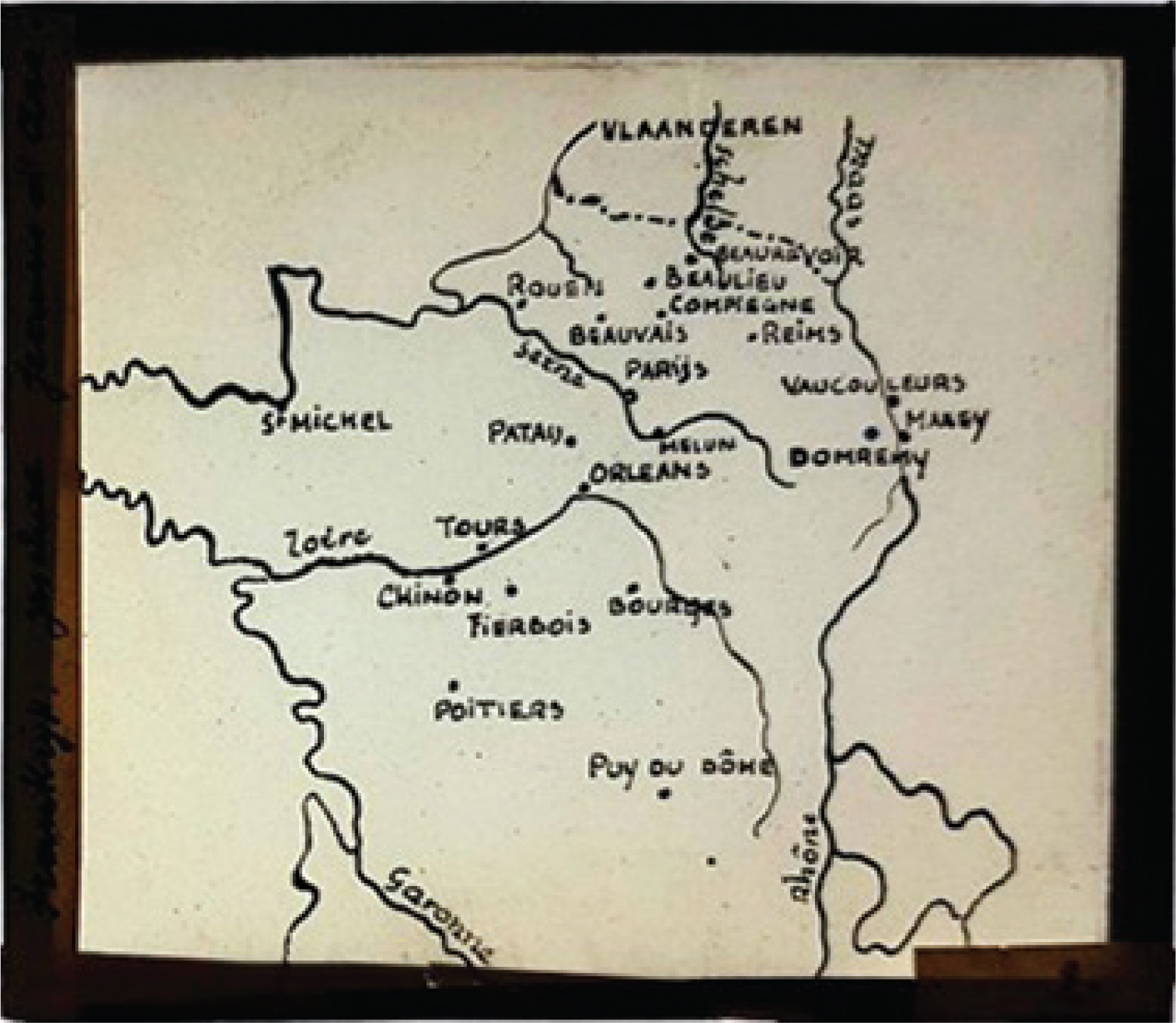
Figure 1
‘France: hist. Joan of Arc,’ slide 2 from series Jeanne d’Arc. Source: Heilig Graf Turnhout.
Most of the home-made slides have been coloured in by hand, in a similar way to the professionally produced slides. Clearly, the teacher producing these slides was not very skilled in the colouring process. While the professional slides present clear pictures in which the colours fit in with the black and white image printed on the slide, the home-made slides appear as clumsy imitations in which the paint does not necessarily make the image any clearer (see figures 2 and 3). Since the images were enlarged numerous times when projected, the difference in execution between the two types of slides must have been obvious. Apparently, the added value of colour in these slides – which probably had to do with catching the attention and striking the emotions of the pupils – nevertheless legitimised the extra effort required of the teacher who produced the slides.23
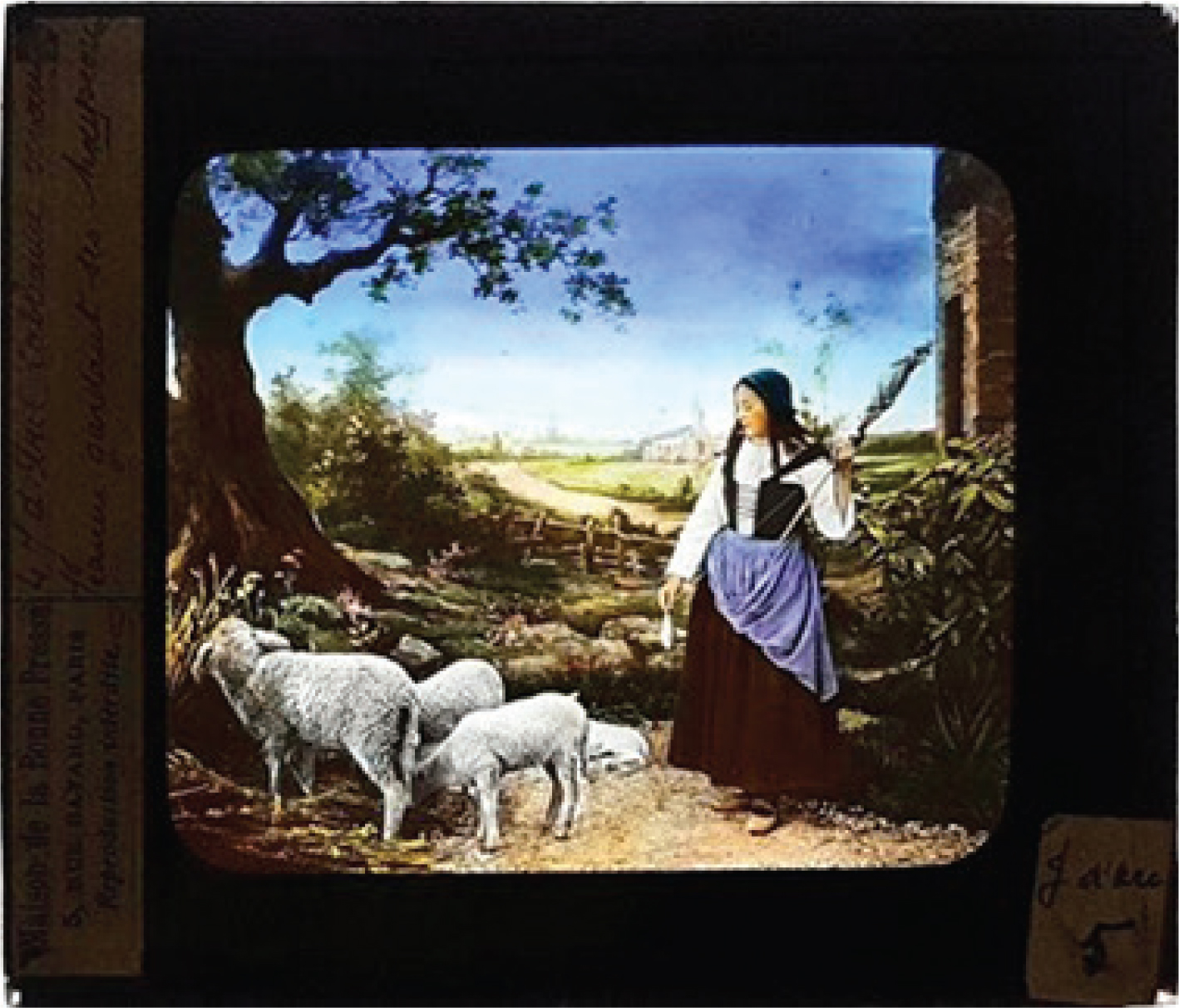
Figure 2
‘Joan tending her flock,’ slide 5 from series Jeanne d’Arc, produced by Maison de la bonne presse. Source: Heilig Graf Turnhout.
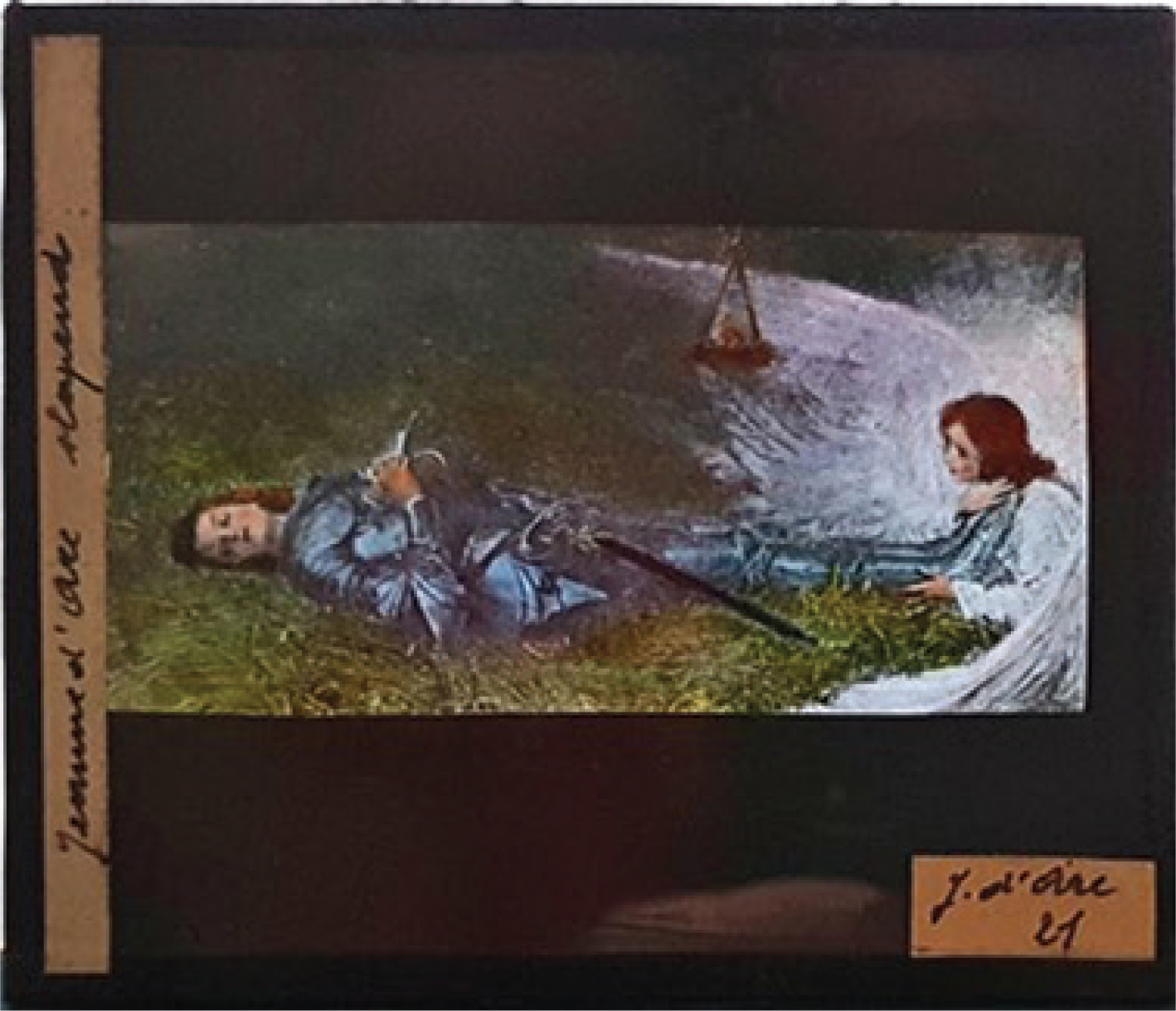
Figure 3
‘Joan of Arc sleeping,’ slide 21 from series Jeanne d’Arc. Source: Heilig Graf Turnhout.
Except for the drawn map, the images on the home-produced slides were all photographically copied from images in the printed press, as is the case in many other surviving slide collections.24 In most of these cases, it is difficult to find the original sources for the images on these slides. Because the surrounding texts were mostly covered up by black passe-partouts, they normally cannot be discerned. As a result, it is nearly impossible to connect these images to the actual publication from which they were taken. In the case of this slide set, however, the accidental discovery of a small box containing some of the negatives that were used to produce the slides enabled me to track down the original publication from which the home-made slides were taken. Amongst a collection of glass negatives of photographs depicting school plays and celebrations from the first decades of the twentieth centuries in the school archive, there is one box containing negatives as well as positive images, most of which also appear as slides in the series on Joan’s life. The box also contains a note saying ‘negatives. From: L’encyclopédie par l’image’.25 It turns out the images were copied from a 1925 illustrated encyclopaedia on Joan of Arc by the large Paris publisher Hachette, which published dozens of Encyclopédies par l’image from the 1920s until the 1960s. These were aimed at a general audience and focused on diverse popular subjects, ranging from biographies of Rembrandt, Louis XIV, and Pasteur to broader subjects such as Roman history, French castles, and ‘mythology’.
The glass plates in the box shed light on the production process behind the home-made slides. There are two versions, for instance, of the slide depicting a tower of the castle in Rouen in which Joan was reportedly imprisoned. The first one is a negative image on which one can still recognise the page in the Encyclopédie from which the image was copied (figure 4). On its left, we see one of the drawing pins with which the book page was pinned to a notice board to be photographed. The positive image that was produced based on this image no longer shows these details and presents a clear and neatly cut copy of the original image. The teacher made yet another version of the slide: the slide that made it to the actual lesson is a coloured version of the same photograph (figure 5). In this slide, and all other finished slides, the area surrounding the images has been covered by a black passe-partout to highlight the actual image. The glass plate containing the photographic film and transparent paint was protected by covering it with another glass slide which was connected to it with black tape on the slide’s sides in the same way as the professionally produced slides.
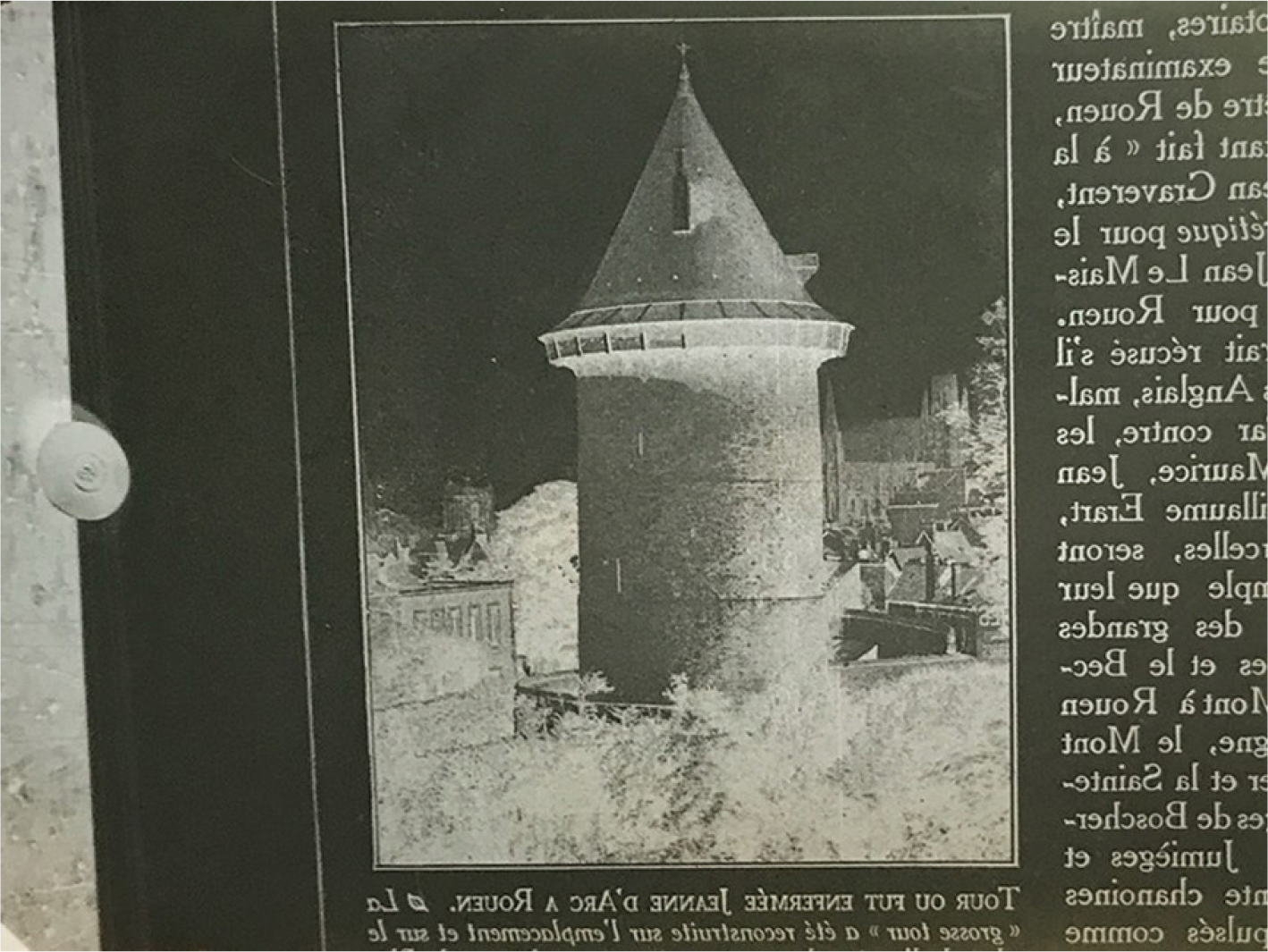
Figure 4
Negative of slide 31 from series Jeanne d’Arc. Source: Heilig Graf Turnhout.
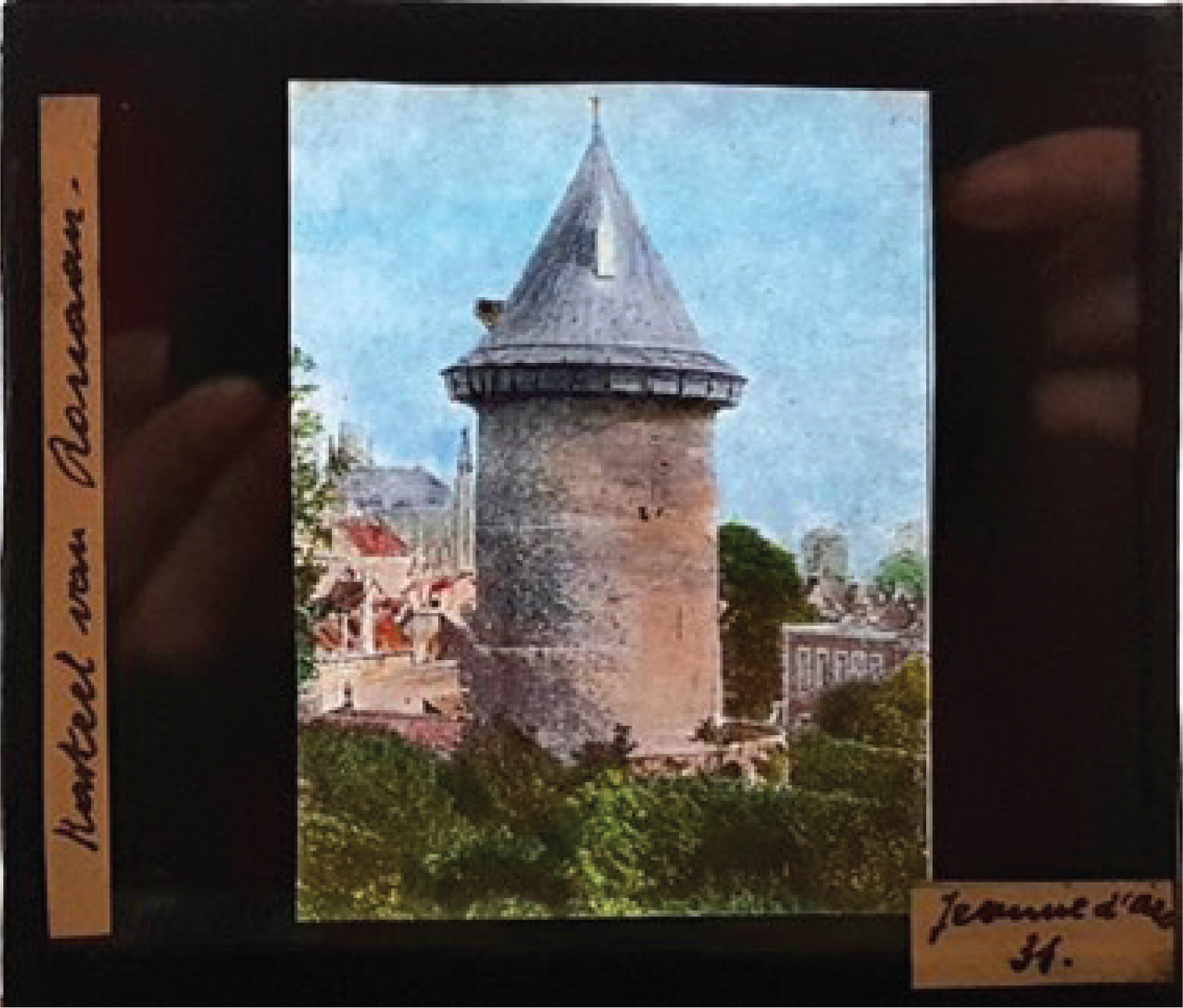
Figure 5
‘Castle of Rouen,’ slide 31 from series Jeanne d’Arc. Source: Heilig Graf Turnhout.
Because the note mentioning the title of the publication from which the images were taken, it was possible to find a copy of the original source of the images on them. The Hachette visual encyclopaedia on Joan of Arc contains 93 images on 64 pages, which means that the teacher creating the slides made a small selection of images, reproducing only 13 of them. She selected various kinds of images from all parts of the book, mostly paintings by romantic French painters such as Ingres’ depiction of Joan sleeping and two wall paintings from the Panthéon by Jules-Eugène Lenepveu. Contrasting with these paintings and the Maison de la bonne presse slides, she also copied two photographs of places that appear in Joan’s story: the forementioned castle tower and the house in which Joan was born. She also reproduced a drawing of Charles VII praying, based on a late-fifteenth century manuscript. Since the creator of the slide set picked a wide variety of images for her slides, it is hard to discern what selection criteria she applied. Most of the selected images were placed alongside slides that portrayed similar parts of Joan’s story. The home-made slide of Joan during the siege of Orléans, for instance, fits nicely before a Maison de la bonne presse slide showing the end of this siege. The only topic that is only represented on the Encyclopédie-based slides – and not on the professional ones – is Joan’s imprisonment. The teacher added four images to her visual narrative depicting how the martyr was ridiculed and harassed by her adversaries. All in all, it seems that the teacher creating the series picked those images that fit in best with her view on Joan as a simple, pious girl who remained faithful to her faith in the face of powerful adversaries.
An ideal narrative
Alongside the slides, the collection also holds the notebook containing the text that accompanied them and most probably served as the basis for the teacher’s explanations of what was to be seen on the screen. The lesson started with an introduction on the political situation in France during the Hundred Years’ War. During the projection of the third slide, which shows the house in which Joan was born, the teacher focused on the loving and pious family in which Joan grew up. It also becomes clear that Joan’s intervention in the war must have been predestined by God, since a ‘wonderfully delicate fragrance’ signalling a divine presence could be noticed in the village of Domrémy on the night of her birth.26 The teacher then showed six slides on Joan’s youth. According to the lesson’s text, Joan was a pious girl ‘who prayed a lot and with great pleasure’.27 The narrative engages in great length with the first times she heard heavenly voices, describing in detail the circumstances of their occurrence. While her class was looking at the slide depicting the archangel Michael, Saint Margaret, and Saint Catherine talking to Joan, the teacher now provided the soundtrack to the image by citing what the saints were telling Joan:
[The] H[oly] Cath[erine] and H[oly] Marg[aret] shall help you. Follow their advice. Our Lord commands it – [She] was frightened by the heavy task – [the] voices did not stop: Daughter of God, go. Go. Bring the king to Reims.28
The narrative stresses that Joan was a very normal, pious girl from the countryside who did not choose to do the rather unfeminine things that she had to undertake. She was called by God and did as he told her. The narrative approaches this question from Joan’s perspective: when the heavenly voices told her that she had to go and break the siege of Orléans, she responded ‘I am but a poor girl, that can neither wage war nor ride a horse.’29 Later, the teacher quotes her saying that ‘if I hadn’t been here in the name of Our Lord, I would not expose myself to dangers this big and tend the sheep.’30 Nevertheless, she persisted because she felt God’s guidance, even when she was ridiculed by people who did not believe her at first. The story is larded with divine signs: when Joan was wounded during the battle of Orléans, for instance, she took the arrow from the wound that it had made, after which the wound ‘healed miraculously’.31 In the battle of Patay, the teacher claims, ‘2,000 Eng[lishmen] were killed – [opposing] 3 French!!’32 After Joan’s capture by her opponents, the lesson compares her to Christ several times. After all, he was also betrayed by his friends and ‘sold for 30 pieces of silver’.33 This part of the lesson focused on the sufferings that the future saint had to endure and vividly described her last moments at the stake:
Joan’s death [became] a long, slow agony – the flames were too far from their prey – they licked and tormented the young body after the fire had eaten away her garment – suffocation failed to occur.34
Paradoxically, the slide depicting Joan at the stake does not depict her while the stake is already on fire, even though series in other collections do depict this moment. Possibly, the teacher composing the slide set thought a visual representation of the fire eating away at Joan’s body would be too gruesome for the girls at which the lesson was aimed, who had roughly the same age as Joan at the time of her execution. After the description of Joan’s death, the notebook focuses on her afterlife. The teacher even glued an additional piece of paper to the page on which she described Joan’s rehabilitation in the fifteenth century – a gap in the lesson that she might have wanted to correct in this way. The last part of the lesson notes describes Joan’s canonisation, while the four last slides show the canonisation service itself, an altarpiece depicting Joan ‘in glorious splendour’ in heaven, and two statues commemorating the saint.35
Interestingly, the lesson notes contain various corrections and additions to the narrative such as the added piece of paper, showing that the teacher continuously updated her text. The same goes for the slides, since their numbering seems to have been adapted at least once (see, for instance, figure 2). The notebook further contains two newspaper clippings that were probably added to further enrich the lesson: the lavish illustrations in a magazine article on the 1948 film Joan of Arc, for instance, might have been projected using an epidiascope that could project both opaque images and slides. A 1950 article from a catholic newspaper, without illustrations, provided additional information on ‘what has become of the enemies and the parents of Joan of Arc’.36 The parts of the article focusing on Joan’s mother have been highlighted, which means that here, the narrative might have focused on yet another strong and pious woman fighting for what was right, a second example for the young girls that were taught at Heilig Graf.
The information in the notes themselves originates from various sources. Contrary to what one might expect, the lesson’s text only occasionally corresponds with the text in the illustrated encyclopaedia from which the images on many of the slides were taken.37 Instead, the notes repeatedly refer to page numbers in the 1943 novel Een banier, een zwaard en een klein meisje mentioned earlier. Although the lesson text does not perfectly parallel the narrative of the book and also contains information that cannot be found in the novel, the sheer number of references to it – sometimes more than ten per page – does show that the book played an important part in the lesson. It seems as if it was supposed to provide extra information on the topic that might sometimes be read out loud, for instance when the teacher wrote ‘her words p 29’ or ‘how they marched into the city p. 36.’38 Since the lesson was taught in Dutch, the novel was of course easier to quote than francophone literature such as the Encyclopédie, but had yet another, probably more important advantage. Its author, Thilda Deckers, was a former pupil of the institute who went on to study literature and music history at the catholic Flemish vocational university for women. After that, she became a teacher, while she was also active as an author and journalist.39 Possibly, she could serve as yet another example for the girls taught at Heilig Graf: she studied at the same school as the pupils, further developed herself within the Flemish Catholic educational network, and became an inspiring figure.
As Deckers was also in many ways similar to the teachers working at Heilig Graf, the teacher in charge of the lesson on Joan of Arc probably found her interpretation of the saint’s story very fitting for the girls she taught. According to a Catholic Flemish newspaper, for instance, Decker’s book was an ideal Christmas gift for girls because it would ‘undoubtedly fill many young hearts with the burning desire to achieve something heroic in their lives.’40 A secular newspaper argued that the book was quite well-written, but that its religious aspect was clearly more fleshed out than the historical one.41 Another reviewer, writing for a Flemish nationalist newspaper, argued that Deckers had failed to acknowledge that Joan of Arc had unmasked a Catholic Church that was overstimulated by hedonism and straying from its eternal destiny. ‘Whoever overlooks this in Joan of Arc’s history has not been able, or willing, to fully understand it,’ according to the reviewer.42 Of all the possible interpretations of Joan of Arc’s story that were acceptable to early-twentieth century readers, then, Deckers had taken the one that foregrounded Joan’s religious development. She also backed up the Church that, according to others, should be held accountable for Joan’s death at the stake. Therefore, the book’s narrative must have fitted in very well with the teacher’s wish to present Joan as an important example to her pupils: pious, humble, and capable of great deeds to save her country in the name of the Catholic faith.
Conclusion
Due to a lack of source material, historians engaging with the use of the optical lantern in education have often focused on the top-down implementation of the medium in schools. What teachers actually did with the slides that were supplied to them has not been the subject of in-depth scholarly scrutiny. The extraordinarily rich collection of slides and other sources preserved at the Heilig Graf Institute, however, provides a rare opportunity to reconstruct how one teacher made use of the optical lantern in her lessons. It shows that even though publishers such as Maison de la bonne presse went to great lengths to produce a wide range of beautifully executed slide series on educational topics, this teacher did not integrate these into her teaching without altering them. In fact, her lesson on Joan of Arc was made up of bits and pieces of various narratives stemming from a variety of media that were combined with each other to create an entirely new entity.
The lesson discussed in this contribution shows that a teacher did not necessarily have to buy one set of ready-made educational slides and follow its narrative. Instead, she could combine professionally produced slides with ones she made herself by drawing images and copying them from printed media. She selected pictures from the illustrated press that she thought fitting, copied these, and in this case also hand-coloured them to make them more appealing. As the illustrated press cuttings that are present in a number of the Heilig Graf notebooks testify, she and her colleagues over time also added additional illustrative materials, which were probably projected by means of an epidiascope that enabled them to include the projection of images on paper to the slides that the school had already acquired and created.
This visual narrative was then combined with a verbal narrative that was equally self-constructed. Although it is difficult to pinpoint the exact sources on which it was based, it seems that in the case of the lesson on Joan of Arc, the teacher used a book by a former pupil as her main point of reference. The notebooks containing the text that served as the verbal part of the lesson further testify of a continuous urge to improve it. Teachers working at Heilig Graf institute not only added slides, the notebooks also show a remarkable number of additions, deleted or bracketed sections, re-numbered slides, and references to additional literature. This shows that the lessons were updated regularly in line with the needs of the teacher at the moment that she taught it. Even though it is difficult to say why the teacher in charge of the lesson picked exactly the visual and verbal sources that she chose, it is clear that in the lesson that she created, she recombined images and texts with each other that fitted her institution’s worldview and religious goals. In this way, she constructed an intermedial amalgam that she hoped would help her turn her young pupils into determined Catholic women.
Notes
[1] See, for example, Ulrike Mietzner, Kevin Myers, and Nick Peim, eds., Visual History. Images of Education (Bern: Peter Lang, 2005); Francesca Comàs Rubì, ed., “Photography and the History of Education,” special issue of Educació i História. Revista d’Historia de l’Educacío 15 (2010); Paul Warmington, Angelo Van Gorp, and Ian Grosvenor, eds., “Education in Motion: Uses of Documentary Film in Educational Research,” special issue of Paedagogica Historica 47, no. 4 (2011); Inés Dussel and Karin Priem, eds., “Images and Films as Objects to Think With: A Reappraisal of Visual Studies in Histories of Education,” special issue, Paedagogica Historica 53, no. 6 (2017).
[2] See, for instance: Anne Quillien, ed., Lumineuses projections! La projection fixe éducative (Rouen: Canopé éditions, 2016); Carmen López San Segundo et al., “The projection of images in the Spanish secondary school classrooms in the first third of the 20th century,” Fonseca, Journal of Communication, no. 16 (June 1, 2018): 31–45, https://doi.org/10.14201/fjc2018163145.
[3] See, for instance: Katie Day Good, Bring the World to the Child. Technologies of Global Citizenship in American Education (Massachusetts, London: The MIT Press, 2020).
[4] See, for instance: Armelle Sentilhes, “L’audio-visuel au service de l’enseignement: Projections lumineuses et cinéma scolaire, 1880-1940,” Gazette des archives 173, no. 1 (1996): 165–82, https://doi.org/10.3406/gazar.1996.3400; Victoria E.M. Cain, “Seeing the World: Media and Vision in US Geography Classrooms, 1890–1930,” Early Popular Visual Culture 13, no. 4 (October 2, 2015): 276–92, https://doi.org/10.1080/17460654.2015.1111591; V. C. Hollman, “Glass Lantern Slides and Visual Instruction for School Teachers in Early Twentieth-Century Argentina,” Early Popular Visual Culture 14, no. 1 (January 2, 2016): 1–15, https://doi.org/10.1080/17460654.2015.1092390; Katie Day Good, “Sight-Seeing in School. Visual Technology, Virtual Experience, and World Citizenship in American Education, 1900–1930,” Technology and Culture 60, no. 1 (2019): 98–131, https://doi.org/10.1353/tech.2019.0003.
[5] Katie Day Good, “Making Do with Media: Teachers, Technology, and Tactics of Media Use in American Classrooms, 1919–1946,” Communication and Critical/Cultural Studies 13, no. 1 (2 January 2016): 75, https://doi.org/10.1080/14791420.2015.1092203.
[6] A good example are the collections of the KADOC archive in Leuven. See: Sabine Lenk and Nelleke Teughels, “Spreken met licht. Magische projectieplaatjes,” Koorts. Erfgoedmagazine van Kadoc, 2020.
[7] Most slides are organised in series by means of labels containing a number. This does not mean, however, that they were necessarily shown in this order as it was quite common to combine slides from various slide sets with each other to create new narratives.
[8] I could couple at least nine of these notebooks with (parts of) surviving slide series. Others refer to slide sets that have been lost or to so-called films-fixes.
[9] On films fixes in Belgium, see: Nelleke Teughels, “Films Fixes, the Forgotten Medium of the Catholic Battle against Secularization in Interwar Belgium,” in Learning with Light & Shadows. Educational Lantern and Film Projection, 1860-1990, eds. Kaat Wils and Nelleke Teughels (Turnhout: Brepols, 2022).
[10] Nelleke Teughels, “Expectation versus Reality: How Visual Media Use in Belgian Catholic Secondary Schools Was Envisioned, Encouraged and Put into Practice (c. 1900–1940),” Paedagogica Historica 58, no. 4 (January 18, 2021): 1–18, https://doi.org/10.1080/00309230.2020.1856153.
[11] For an analysis of the school’s collection of geography slides, see: Wouter Egelmeers, “Making Pupils See. The Use of Optical Lantern Slides in Geography Teaching in Belgian Catholic Schools,” in Faith in a Beam of Light. The Magic Lantern and Belief, eds. Natalija Majsova and Sabine Lenk (Turnhout: Brepols, 2022).
[13] Jean Pirotte, “De heilige, de ridder en de ster van het moment. Veranderende rolmodellen voor jongeren,” in Katholiek onderwijs in België: identiteiten in evolutie 19de - 21ste eeuw, eds. Jan De Maeyer and Paul Wynants (Averbode: Halewijn, 2016), 355–81.
[15] A lesson on Spain, for example, is made up of a mixture of slides from six different slide series combined with home-made slides. See: Egelmeers, “Making Pupils See”.
[16] Bart G. Moens, “Composing ‘the Artistic Projection of the Future’: The Religious Life Model Slide Sets of Maison de La Bonne Presse,” Early Popular Visual Culture 18, no. 3 (July 2, 2020): 258–59, https://doi.org/10. 1080/17460654.2021.1925941; On the publisher, also see: Pierre Véronneau, “Le Fascinateur et la Bonne Presse. Des médias catholiques pour publics francophones,” 1895. Mille huit cent quatre-vingt-quinze. Revue de l’association française de recherche sur l’histoire du cinéma, no. 40 (July 1, 2003): 25–40, https://doi.org/10.4000/1895.3282.
[17] For the series, see: “La vie de sainte Jeanne d’Arc d’Après des tableaux de maîtres et des dessins de Pichot,” Le Fascinateur. Organe mensuel. Conférences - Projections 22, no. 192 (May 1924): n.p. [title page].
[18] The publisher offered a total of six series on Joan of Arc. See: “Pour la fête de sainte Jeanne d’Arc. Projections lumineuses.,” Le Fascinateur. Organe mensuel. Conférences - Projections 21, no. 180 (May 1923): 287.
[19] It is also possible that the slides were bought on various occasions and were only later combined with each other.
[20] On Le Sablais and the slides he created, see: Moens, “Composing ‘the Artistic Projection of the Future’.”
[21] Thilda Deckers, Een banier, een zwaard en een klein meisje (Brugge: De Kinkhoren, 1943); Heidy Margrit Müller, Een vrouw die schrijft!: literatuur en literatoren feministisch bekeken (Asp | Vubpress | Upa, 2007), 74–75.
[22] In fact, the teacher mistook part of the border between the Holy Roman Empire and France for a part of the Rhône, connecting it to the Meuse river to its north, thus unintionally drawing one river with two estuaries.
[23] On colour use in slides, see: Bart Moens, “The Luminous Colours of the Magic Lantern. Shedding Light on the Palette of Life Model Slides,” Documenta 37, no. 2 (December 2019): 13–43. The fifth chapter or my upcoming dissertation shall also analyse why teachers used colours in their slides.
[26] ‘Wonderbare fijne geur die nacht te Domremy,’ HGT, notebook ‘Jeanne d’Arc’, n.p. (explanation slide 3).
[28] ‘H. Cath. H. Marg. zullen u helpen. Volg hare raadgevingen. Zo beveelt het O L Heer – Schrikte terug voor de zware taak – stemmen hielden niet op: dochter v God, ga, ga – breng de koning naar Reims,’ HGT, notebook ‘Jeanne d’Arc’, n.p. (explanation slide 9).
[29] ‘Ik ben een arm meisje, dat noch oorlog voeren, noch paard rijden kan,’ HGT, notebook ‘Jeanne d’Arc’, n.p. (explanation slide 11).
[30] ‘Soms zegt ze: was ik hier niet in naam van Messire, ik zou me niet aan zoo groote gevaren blootstellen en de schapen hoeden,’ HGT, notebook ‘Jeanne d’Arc’, n.p. (explanation slide 21).
[34] ‘Jeanne’s dood [werd] een lange, trage pijn (…) – de vlammen waren te ver v hare prooi verwijderd – zij likten en sarden het jong lichaam nadat het vuur haar kleed had weggevreten – de verstikking bleef uit,’ HGT, notebook ‘Jeanne d’Arc’, n.p. (explanation slide 36).
[36] ‘Qu’est-il advenu des ennemis et des parents de Jeanne d’Arc?,’ La libre Belgique, January 7, 1950.
[37] A few sentences, however, seem to be based on the text in the Encyclopédie. One sentence explicitly referring to the photograph on the slide depicting Joan’s family home, for instance, contains a partial translation of the picture’s caption in the publication. See: HGT, notebook ‘Jeanne d’Arc’, n.p. (explanation slide 3) and Jeanne d’Arc, Encyclopédie par l’image. Histoire 55 (Paris: Hachette, 1925), 3.
[38] ‘Hare woorden p 29,’ ‘Hoe ze de stad binnentrokken bl 36.’ HGT, notebook ‘Jeanne d’Arc’, n.p. (explanation slides 14 and 16).
[39] Geraldine Reymenants, Marie Elisabeth Belpaire: gender en macht in het literaire veld, 1900-1940 ( Universitaire Pers Leuven, 2013), 215.
[40] ‘Ongetwijfeld veel jonge harten vervullen met een vurig verlangen naar het volbrengen van iets heldhaftigs in hun leven.’ ‘Een weelde van kinderboeken’, Het nieuwsblad, November 19, 1944.
[41] E., ‘Wij hebben voor u gelezen,’ Het laatste nieuws, March 19, 1943, https://uurl.kbr.be/1253817.
Biography
Wouter Egelmeers studied History at Radboud University (Nijmegen), the Free University of Berlin, and Humboldt University in Berlin. He is affiliated with KU Leuven’s Research Group Cultural History since 1750 as a PhD student in the B-Magic project, which aims to write the as-yet unwritten history of the magic lantern as a mass medium and cultural practice in Belgium. In his PhD, titled Teaching by means of light. The Optical Lantern in Belgian schools, 1880-1940, Wouter analyses the impact of the lantern on late-nineteenth and early-twentieth century Belgian education: a development that would profoundly change teaching up until our days.