
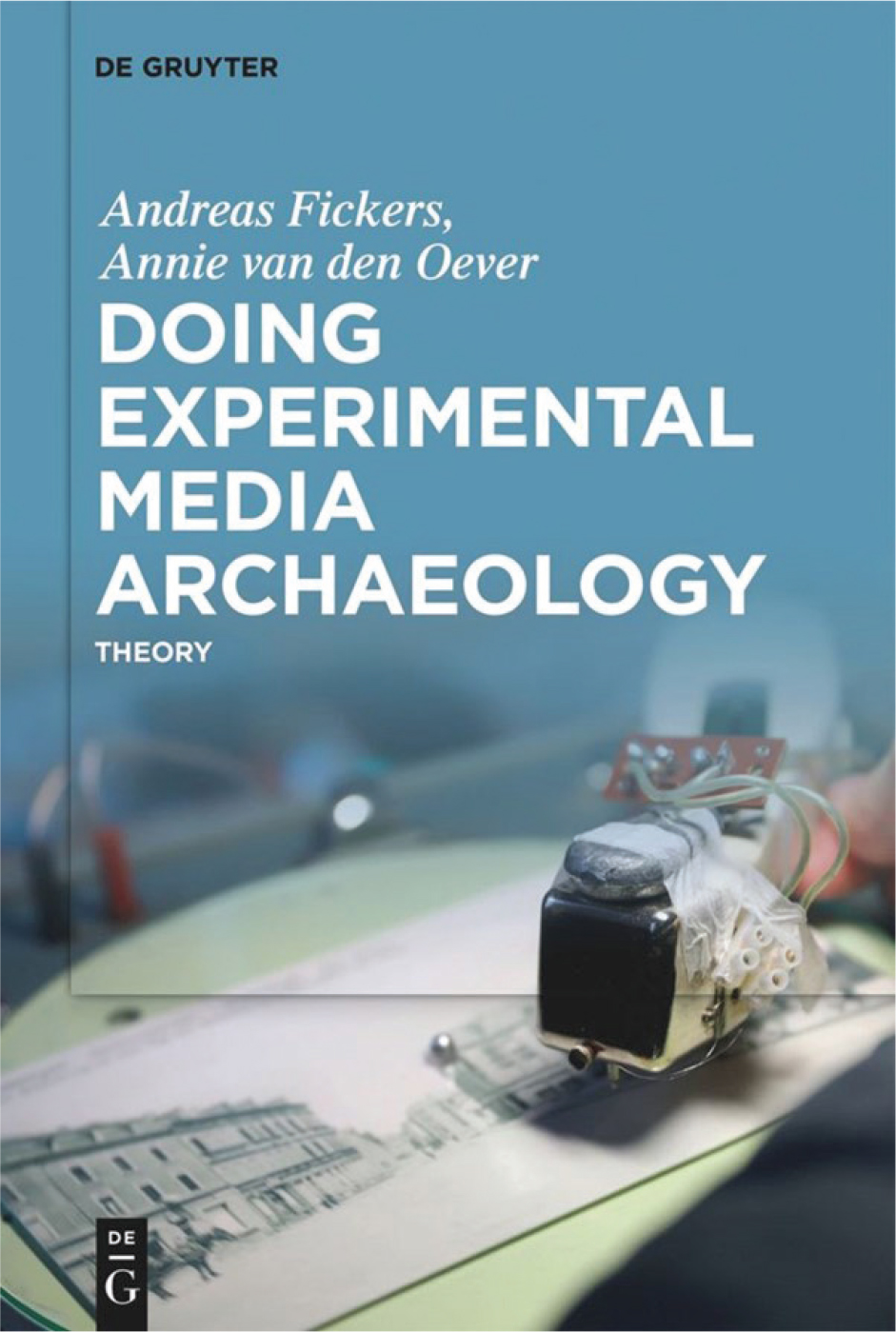
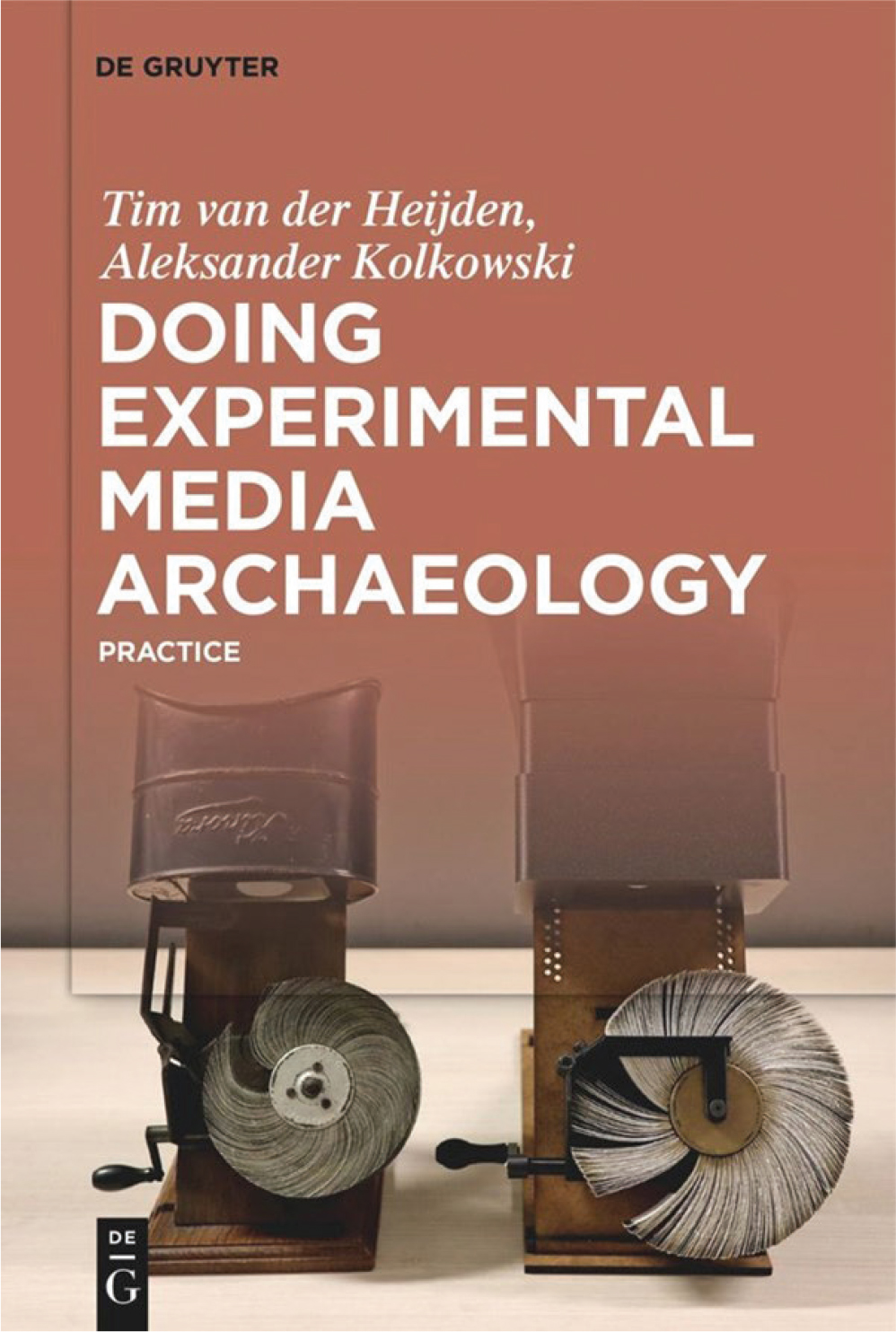
While there are countless methods, theories, and protocols for experimentation in the natural sciences, it remains relatively unclear how (and why) one should do experiments with historical media instruments. However, in this recent twin publication, the reader is provided with a good starting point for this endeavour. With one volume focusing on the theoretical background and implications of doing media archaeology (Fickers and Van den Oever, Doing Experimental Media Archaeology: Theory) and the other on the practical aspects of such experiments (Van der Heijden and Kolkowski, Doing Experimental Media Archaeology: Practice), forces are joined to paint an accurate but clear picture of this emerging field of research. Given the complementary nature of these publications, it seems only fitting to review them here in tandem.
Both volumes were published around the transition from 2022 to 2023, the writers recommend reading them together. The ambitious product is an outcome of the research project “Doing Experimental Media Archaeology: Practice and Theory” (DEMA), hosted by the University of Luxembourg and coordinated by Andreas Fickers and Annie van den Oever, the authors of the first volume. Fickers is the director of the Luxembourg Centre for Contemporary and Digital History (C2DH), and Van den Oever is the director of the Film Archive & Media Archaeology Lab at the University of Groningen, where parts of the experiments were done. The project included experiments with a Kinora (pictured on the Practice volume’s front cover), magic lanterns, phonographs, sound recording devices and early (home-)cinema devices.1
The first volume starts with a plea for new directions within media archaeology: a relatively dispersed research field that consolidated itself in the past 15 years through the efforts of thinkers like Friedrich Kittler, Siegfried Zielinski, Thomas Elsaesser and Erkki Huhtamo.2 Fickers and Van den Oever argue for a specific route, namely that of experimental media archaeology (EMA): an approach that will investigate past user practices, (re-) sensitize historians to their research objects and produce embodied knowledge about past media technologies (16-17). In 2014, the authors advocated for ‘new directions’ within media archaeology and have since tried to put this experimental research strand on the map.3 The currently published volume can thus be seen as an elaboration on earlier efforts and demonstrates their determination on this topic.
In EMA, re-enactments play a central role and help re-create knowledge about the practical handling of historical objects: implicit knowledge that has often been forgotten over time but which might be retrieved via experimentation.4 Actual engagement with historical artifacts – e.g., ‘feeling,’ ‘touching’ and ‘experiencing’ them – allows researchers another more embodied relation with the objects. The author’s explicit aim is turning ‘archives and museums into research laboratories’ (29) and consequently turning researchers from ‘observers’ into ‘experimenters.’ The ‘laboratories’ of EMA can range from university classrooms to living rooms but are ideally domestic settings and mimic the original historical conditions to enable the investigation of objects in their intended context. However, such a context is not easily established,5 resulting in a strong focus on experimental settings and documentation throughout both books. One can question how these conditional remarks relate to the advocated thinkering6 or thinking-while-doing approach. Thinkering, an idea within media archaeology introduced by Erkki Huhtamo, a key figure in the field of media archaeology, plays a central role in EMA and entails the ‘playful exploration that focuses on materiality and recreating the experience of past media’ (77). While Fickers and Van den Oever stress that observers must be transformed into these thinkering-experimenters, some conditional remarks throughout both volumes seem contradictory, such as strict experimental settings, protocols, and a strong focus on documentation. Stressing the conditional settings (i.e., laboratory environment, the subject as ‘experimenter’) might emphasize the difference between the person handling an object and the historical media object itself. One could argue that the focus on conditions and protocols might result (again) in a more dualistic object-subject viewpoint. However, this is precisely something EMA aims to overcome: by combining theory and practice, as well as cognitive and sensorial knowledge; researchers should be able to grasp more of the historical media artifact than its mere objectivity. While thinkering thus focuses on free-form and exploratory experimentation, the authors devote a big part of their work to the importance of strict guidelines, methods, and protocols.
One of the focus points in this volume is investigating the ‘newness’ or sensitivity of historical media devices. The authors argue for re-sensitizing researchers via hands-on EMA (72). In line with media studies, EMA shares the theory of popular media technologies becoming ‘transparent’ when used repetitively. Transparency here means that media devices become ‘invisible’ or reduced to their mediated contents due to habituation effects due to users’ repetitive exposure to the medium (63). For EMA, it is precisely the goal to reverse these habituation effects: re-sensitizing experimenters and participants to increase awareness of material, technical and senso-perceptual aspects of historical devices (67). The central argument in the book is that EMA creates affirmative emotions (awe, wonder) and re-sensitizes researchers and students, enriching not only the historical understanding of an object but research practices altogether.
After theoretical substantiation, reflections, and promises, Van der Heijden and Kolkowski describe in the Practice volume what happened during DEMA-related experiments and how this relates to the statements made in the Theory volume. Tim van der Heijden was related to the DEMA project as a postdoctoral researcher and is currently working as an assistant professor at the Faculty of Humanities of the Open University (the Netherlands). Aleksander Kolkowski is a musician and composer who was connected to DEMA as a research associate. The Practice volume is introduced as a guide for hands-on approaches used in EMA. It shares its aims with the Theory volume – explicating tacit knowledge and turning historians into experimenters – but focusses more on the experimental execution and illustrations of theoretical insights via several case studies related to the DEMA project.
The volume starts with a distinction between historical media devices as epistemic objects (objects of study within the experimental setting) and technical objects (instruments during an experiment), both conceptions exist naturally in EMA. Similarly, one can conduct experiments in different ways: deductive (guided by theory) or inductive (guided by practice). The key message in this volume is that choices made in methods, collaboration and documentation greatly impact the experimental process. For example, the authors argue that one could consider dividing ‘researcher’ and ‘documenter’ tasks between scholars but this will yield different results than having the documentation done by the principal investigator. Another example is material maintenance: while repairs on historical devices might alter their authenticity, it can be crucial (or necessary) for re-enactments to investigate past-user practices.
The authors stress that re-enactments do not serve to produce authentic historical experiences but rather re-sensitize experimenters and participants, thus making them more aware of sensorial aspects of historical devices. Instead of aiming for historical ‘authenticity,’ the authors propose to strive for historical accuracy, making the authenticity question relative to objects that are ‘more or less’ authentic compared to others (150). This means that devices can be altered (if this enables or improves their functioning) but that this must be done with caution to create an accurate historical context that is as authentic-as-possible.
At some points, however, the reader is left partly in the dark with these concepts, as the desirable elaboration is lacking. The primary texts in this volume are relatively short, at times copied from the Theory volume, with main descriptions of case studies. Although some crossovers between the volumes are expected and even needed, some repetition could have been avoided. For instance, the discussion of different types of research and experimentation methods in the first Practice chapter contains little new information and seems to be a mere illustration of previously made statements.7 Perhaps merging both volumes into one would have made for an even more convincing publication by directly combining insights from Theory and Practice into one compelling story.
The two volumes convincingly construct their EMA methodology and successfully illustrate its excellent research potential. Throughout both volumes, the reader is presented a broad spectrum of different approaches, practices, and case studies within the proposed field of EMA. The information and insights on (public) re-enactments and lecture-performances are especially interesting, as they present an entirely new way of appropriating, researching, and disseminating media archaeology in comparison to ‘standard’ academic practices. Public re-enactments emphasize the role of audiences within media contexts – a point often neglected in ‘laboratory’ environments – while lecture-performances add sensorial, tacit, and performative aspects in their dissemination of knowledge. This underscores the added value of EMA in combining theory and practice and transcending cognitive/sensorial or reflexive/embodied binary oppositions in knowledge production.
Overall, this twin publication provides an excellent and promising elaboration that convincingly puts a relatively young field in academic research on the map. For anyone interested in research on historical media devices or planning to carry out media-archaeological experiments, the volumes are highly recommended and easily accessible due to Open Access publication. With their multiple perspectives and comprehensible exposition, these volumes can have a pivotal role as reference work in the emerging field of Experimental Media Archaeology.
Notes
[1] See https://dema.uni.lu/ for more information on the DEMA project.
[2] Nele Wynants, Media Archaeology and Intermedial Performance: Deep Time of the Theatre (London: Palgrave Macmillan, 2019), 4.
[3] Andreas Fickers and Annie Van den Oever, “Experimental media archaeology: A plea for new directions,” in Techné/Technology: Researching Cinema and Media Technologies-Their Development, Use, and Impact, ed. A. Van den Oever (Amsterdam: Amsterdam University Press, 2014), 272–278.
[4] Other common terms for these types of implicit knowledge are for example ‘tacit’ or ‘embodied’ knowledge.
[5] For example, the claim that EMA should be done in ‘domestic’ settings is somewhat objected by the fact that most experiments are carried out in institutional settings, limiting researchers due to institutional protocols.
Biography
Tim Overkempe is PhD researcher at the University of Antwerp. He is involved in the EU-funded project Science at the Fair: Performing Knowledge and Technology in Western Europe, 1850-1914 (www.scifair.eu). In his PhD research project, Overkempe investigates the role of technology and science at the nineteenth century fair, focusing specifically on the introduction of new media instruments at the fairground (e.g. early visual media, X-ray technology and mechanical theaters) and how they played a role in the popularisation and spectacularisation of science. Overkempe has a background in History & Philosophy of Science in which he obtained his degree at Utrecht University.