
Introduction
The television drama Cartas a Harrison (Letters to Harrison), through its episode ‘La Llamada’ (The Call), introduces a group of young protagonists who navigate the communication avenues of Bogotá, Colombia’s capital, during the 1990s. One scene depicts Albeiro, a convenience store worker, receiving an unexpected international call about his friend Harrison’s accident in the United States. Meanwhile, another youth member, Lalo, calls the home of his girlfriend Mireya’s friend in a fit of jealousy one afternoon, only to learn that Mireya hasn’t been there. If described without mentioning the specific technology, these scenarios could conjure images of home landlines or personal mobile phones. However, the series highlights these interactions through the presence of semi-public phones in small businesses throughout the city.1
Produced in 1996, Cartas a Harrison captured the spirit of Bogotá at the time, weaving tales of youth marked by love, friendship, and growth. The narrative unfolds through the characters’ letters to Harrison, who is incarcerated in a New York prison, forming a tapestry of stories that connect them. The show paints a detailed picture of the era’s communication methods, from the enduring practice of letter writing amid the rise of internet adoption, to the widespread use of coin-operated telephones hosted in small businesses.
This article examines Bogotá’s socio-cultural landscape in the 1980s and 1990s through the lens of the telemonedero – a locally assembled device that symbolised the city’s move toward increased mobility and transformation. By tracing the emergence of telemonederos from intricate networks of electronic trade and local production, this article challenges the conventional leap from landline to mobile phones depicted in media histories, spotlighting the role of assemblages. An assemblage, defined as a temporal configuration that is heterogeneous, hybrid, plural, unstable, and ephemeral, provides a lens through which to view the telemonedero. Approaching the telemonedero as an assemblage reveals its transient role in promoting consumerism and embedding neoliberal practices within the fabric of society, while redefining ideas of public service.
The rise and fall of telemonederos is explored through two perspectives. The first acknowledges that media history is intertwined with the history of cities – their streets and buildings, as well as the political-economic and social networks they harbour.2 By recognising Bogotá itself as a medium, this narrative asserts that informality has historically complemented modernisation, with media technologies being assembled and adapted to meet local needs rather than being merely adopted. The second examines the portrayal of technologies in use within urban journalism during these years. Journalism at the time offered an ambiguous narrative of Bogotá’s evolving landscape, characterised by the decay of public infrastructure and the rise of local solutions like the telemonedero. This role of journalism mirrors Ravi Sundaram’s observations of New Delhi in the 1990s – a ‘crisis’ period marked by sensory overload, confusion, conflict, and the image of a city in disarray.3 Amidst reports of infrastructure failures, scandals, pollution, and accidents, this era also saw technology and urban life converge, enabling marginalised communities to access media.

Figure 1
Albeiro receiving a call from the US. Scene from Cartas a Harrison, ‘La Llamada,’ artfully reimagined by Daniela Prieto.
Therefore, this article follows telemonederos in small businesses and electronics workshops to trace the networks in which these devices are produced and used. Inspired by similar stories, like a jukebox assemblage for local bars – connecting networks of woodworkers, electronic enthusiasts, cantina owners and beer – this article approaches the telemonedero as part of a telephonic history of technology.4 In advocating for this method, this article foregrounds the transformative role of the telemonedero in Bogotá’s urban milieu. It is evidence of how such locally assembled telephonic devices made possible new spatial interactions and mobile identities, thereby anticipating the ubiquitous connectivity we now associate with mobile phones. This anticipatory shift accentuates the societal implications of locally assembled solutions, urging an evaluation of their place in the historical narrative.
Incorporating Urban Informality into Telephone History
The historiography of the telephone is often confined to national stories, dominated by mono-medial and mono-usage perspectives that obscure the diverse, multifaceted history of this technology.5 Despite significant research about telephones in media studies, extant scholarship evinces a marked lack of focus on telephony’s role in Asian, African, and Latin American contexts, with institutional histories emphasising corporate and technological advancements over the nuanced realities of everyday telephony. This approach has contributed to the neglect of transnational, regional and local histories, thereby narrowing our understanding of the telephone’s relationship with other media and its broader social impact.
A reason for this oversight is a tradition in the history of technology that often prioritises first adopters and inventors or successful businesses. Moreover, in the historiography of technological innovation, as Paul N. Edwards underlines, the discourse often skews towards the novel and the spectacular, overlooking technologies of enduring and widespread impact, such as ordinary telephony.6 This emphasis on high-tech advancements has led to a historical oversight where inventions of significant influence, including everyday telephony, are relegated to the periphery of technological narratives. Echoing this sentiment, in A History of Digital Media, Balbi and Magaudda acknowledge the critical role of pre-existing technologies in setting the stage for digital evolution. They illustrate how the conventional telephone, a cornerstone of nineteenth-century technology, facilitated the swift embrace and integration of mobile phones, thereby underlining the need to explore both historical continuities and disruptions in media evolution.7
Furthermore, a comprehensive understanding of telephony’s history must include its unconventional and hybrid uses. Gabriel Balbi’s research on the early applications of the telephone exemplifies this perspective. Rather than just focusing on point-to-point communication, these varied uses underscore the principles of the Social Construction of Technology and Actor–Network Theory. This perspective places users at the forefront as active shapers of media technologies. Balbi’s work shows the multiple meanings and uses of the telephone, advocating for a historiographical approach that embraces the full range of technological developments.8 Such an approach demonstrates that what may appear to be anomalies in one context are often indicative of wider trends in adaptive telephonic practices, thereby deepening our comprehension of the technology’s evolutionary journey.
Because these studies focused on long histories of technology and alternative uses of the telephone, they resonate with the idea of the deep time of media infrastructure.9 As Shannon Mattern observes, it is a common practice in media studies to document history specific to individual media formats, often suggesting that new technologies necessarily render older ones obsolete. Yet, as Mattern challenges, a closer look at media histories through the lens of urban development reveals a different narrative. Instead of a complete replacement, cities witness an overlapping accumulation of various media epochs. Considering this perspective, this article focuses on positioning the telemonedero within this continuum of media layers. It seeks to understand how this device has coexisted, interacted, and integrated with other media forms throughout history.
Acknowledging Mattern’s insights as a foundational inspiration, her emphasis on broadening the geographic scope of urban mediation studies effectively sets the stage for a more nuanced exploration of urban changes in the Global South during the 1980s and 1990s. In this context, Sundaram’s analysis of ‘pirate modernity’ in India offers a pertinent example of how these changes unfolded within the technological and media landscapes of cities in the Global South. Sundaram’s work delves into the complexities of a rapidly evolving urban environment, where traditional state-controlled technological infrastructures began to intertwine with emergent forms of media and communication. This intersection of old and new, formal and informal, illustrates the diverse nature of urban development during this era, especially in the context of media’s expanding role in the urban fabric of cities across Asia, Latin America, and Africa.
Therefore, Sundaram pointed to the intersection of urban crisis and the hyperstimulation of media and technology generated by rapidly expanding media technologies and infrastructural growth, creating an impression of an out-of-control urban environment. In this respect, journalists and news agencies were vital in reporting the unfolding crisis: They covered stories of infrastructure breakdowns, pollution, and road accidents, among other issues, mirroring a similar dynamic in Latin American cities like Bogotá. Such portrayals by urban journalists in Bogotá are the primary sources for this article, providing a rich and nuanced understanding of how the city’s inhabitants interacted with and transformed telephonic technology to suit their unique context. Combined with other media sources, government development plans, newspaper ads and yellow pages, the story behind telemonederos offers traces of their brief but vibrant role.
Finally, in the vein of subaltern urban studies, this article calls for a reconceptualisation of the categories used to narrate the histories of cities, modernisation, and media. Just as Ananya Roy advocates for recognising the coexistence and contributions of informality alongside modernity in urban contexts, this research highlights the telemonedero as a demonstration of local ingenuity within Bogotá’s landscape during periods of technological transition.10 Mirroring the complexities described by Sundaram in the 1980s and 1990s, the story of telemonederos reveals an ecosystem where informal practices coexist with, sustain, and redefine the modern city. Such insights challenge us to reframe our understanding of urban development and telephony, placing informal networks and their innovations at the forefront of a more nuanced and inclusive historiography.
The Evolving Telephone Infrastructure in Bogotá
Mobile phones arrived in Colombia offering the allure of modernity. Advertisements in local newspapers underscored individualism and freedom as novel ways to experience urban life while acknowledging the long-standing geographical challenges to mobility and connectivity. Business magazines celebrated the introduction of mobile phones as ‘the best way out of isolation to which state monopolies have condemned us [the country].’11 In 1993, Enrique Peñalosa, who became the mayor of Bogotá five years later, authored an article highlighting the advantages of the growing mobile phone market. In his piece, he remarked, ‘Colombia is set to embrace the introduction of mobile phones, which promise not just enhanced mobility but also a significant improvement over the current inadequate telephone services.’12
By referring to inadequate telephone services, Peñalosa singled out entities such as the Empresa de Telecomunicaciones de Bogotá (ETB) – the city company overseeing the telecommunications infrastructure. The history of the ETB mirrors a familiar narrative in Latin American telephony, with initial foreign involvement giving way to national or city management. Colombian telephony started with Bogotá’s first public exchange in 1892, and soon expanded under foreign companies like the British-owned Bogota Telephone Company. It was not until much later that a significant transition to public ownership occurred, with key cities like Medellín and Bogotá municipalising their telephone systems.13 The Bogotá government’s assumption of control in 1932 aligned with broader economic policies, emphasising a move towards self-reliance and sovereignty in economic affairs while reducing reliance on external technologies and services.14
ETB’s role in the development and distribution of public telephones became central when the local government acquired the Bogota Telephone Company, most public telephones were housed in the city’s cafés. The Bogotá Council’s 1956 mandate formalised the installation and regulation of public telephones in Bogotá. Designed to operate with two- and five-centavo coins, these phones became instrumental in the government’s plan to extend the network to working-class neighbourhoods, embodying the ideal of universal access.15
The establishment and proliferation of public phones by ETB was emblematic of a broader societal commitment to democratise access to communication. The initiative to install coin-operated public phones in working-class areas in 1956 was a practical manifestation of the principle that connectivity should be universally accessible. In 1971, Bogotá had 535 public telephones; by the end of the century, that number had risen dramatically to almost 11,000. This significant growth in public telephone services can be partly attributed to the surge in rural-to-urban migration of the 1970s, which created a heightened demand for communication services. The telephone became a vital link for these new urban residents to stay connected with their families and communities back home.16 In the context of Colombia’s geography, the telephone was a more reliable connection than sending letters via the postal service. As such, since the 1950s, governments in Latin America have pushed the expansion of telephone service to rural areas.17
Bogotá’s continued population growth in the 1980s presented significant challenges as well as opportunities for city planning and development. For a city experiencing such growth, 11,000 public phones were deemed insufficient. By 1987, the population of Bogotá had risen to four million, with government estimations projecting an additional two million inhabitants by the end of the century. In response, new planning strategies were urgently needed. In 1987, the Bogotá Chamber of Commerce highlighted this issue, noting that ‘growth rates had generated a basic demand for service and a volume of public and private investment, never foreseen by urbanists and economists.’18
As part of the immigration from rural areas, the period between the 1940s and the 1970s witnessed the emergence of informal cities in Latin America – unplanned urban areas that grew spontaneously to accommodate the influx. Expanding at annual rates of 5 to 7 per cent, these areas were characterised by self-constructed housing and community-led infrastructure development outside formal economic and regulatory frameworks. At first, governments and international agencies endeavoured to combat informality in city-building because it deviated from the traditional economic and social development concepts central to national building, particularly during the Cold War era. However, by 1980, it had become understood that informality provided a quiet solution to the scarcity of material and administrative public resources.19 Such ‘informal’ communities often took matters into their own hands, negotiating access to essential infrastructure ranging from energy and water systems to road access and public telephony.
In response to the challenges posed by rapid urban growth and informality, in 1987 the ETB embarked on an ambitious expansion plan that focused on increasing access to public phones across Bogotá, particularly for low-income populations on the city’s outskirts. This initiative included the installation of 500 free public phones, with plans to add another 3,500 in the following year. Such efforts positioned Bogotá as a pioneering city in implementing robust public policies aimed at eradicating poverty under the auspices of the Colombian government. Simultaneously, the ETB sought to enhance its competitiveness by upgrading existing public phones to accept any coins, maintaining the standard rate of one peso.20
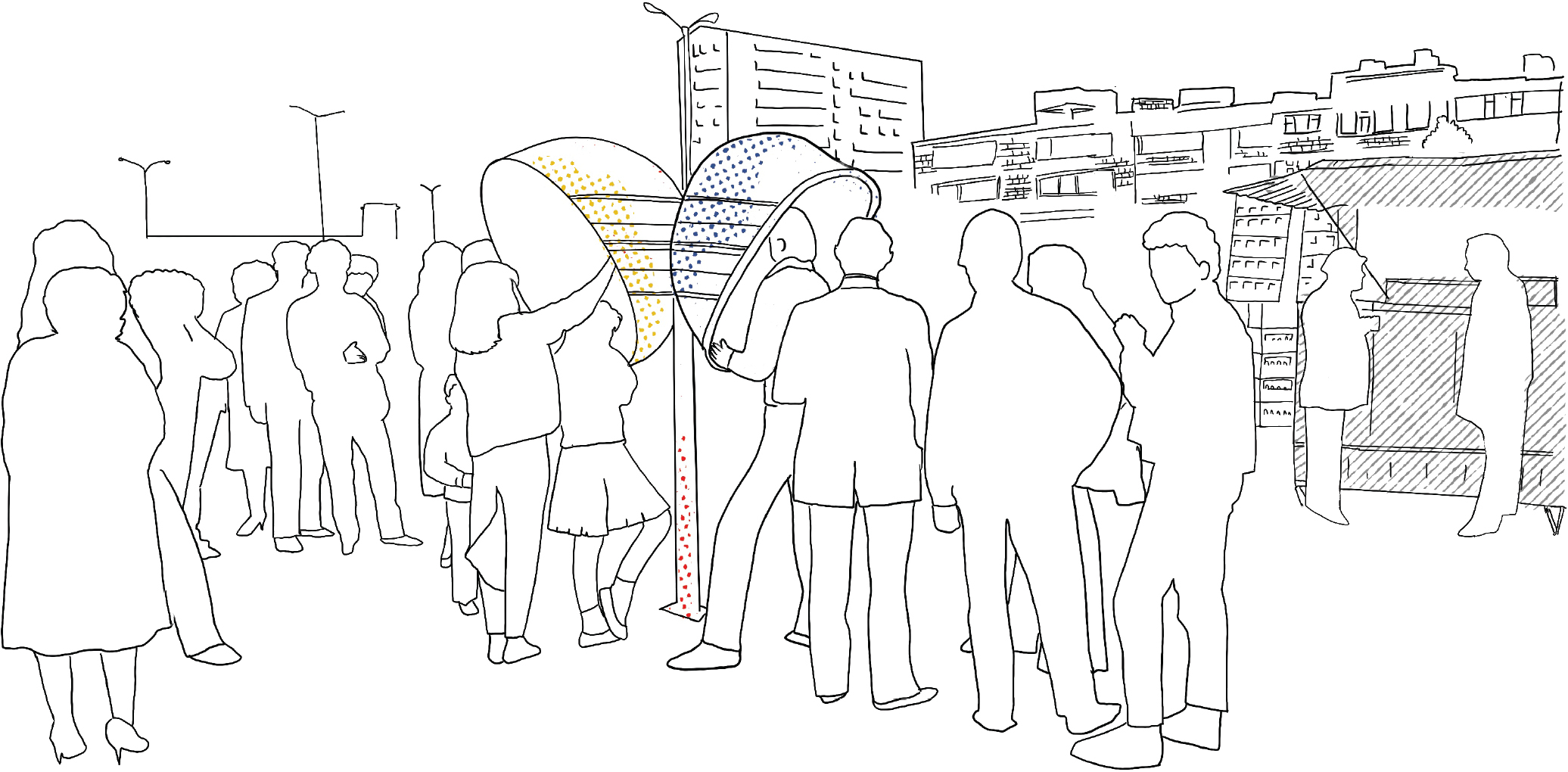
Figure 2
A detailed depiction of people queuing for public phones in Bogotá, as envisioned in ‘Bogotá Para Todos 1987-1990,’ artistically reinterpreted by Juliana Prieto.
This strategy was complemented by installing 50 long-distance telephones in shopping centres, designed to provide improved long-distance services in isolated neighbourhoods and high-traffic areas of the capital. Additionally, the ETB was venturing into new technological domains, including mobile telephony.21 These ambitious projects were part of the ETB’s broader strategy to continue its expansion and modernisation. However, the company’s increasing external debt was a significant concern, underscoring the complexity of balancing expansion for public interest and financial sustainability in the face of the evolving privatisation and competition in telecommunication markets worldwide.
Three years later, in 1990, the ETB embarked on a more aggressive strategy under the guidance of Martha Cecilia Bernal de Arrieta, a ‘young and dynamic’ executive appointed by the mayor. ETB announced a new project to install 6,000 additional public phones over the next six years. Although the company remained committed to providing unhindered public access to telephony, there was a notable shift in its operational ethos. The execution of projects, such as the public telephone expansion, began to underscore the importance of future sustainability and profitability. In adopting the language of the free market, the ETB shifted towards competitiveness and reinvention, mirroring the managerial styles of private companies, and highlighting a new direction in the company’s governance. In the case of ETB, according to its new executive, this transformation required structural changes and a paradigm shift in attitude and mentality, as well as ‘an extended will to service, and high doses of responsibility.’22
The new economic orientation was expressed in the reform known as the Colombian apertura [opening]. In 1990, under the presidency of César Gaviria, the Colombian economy began to transition from import-substitution industrialisation to export-led growth, primarily by allowing foreign companies to compete with Colombian industries.23 Opening telecommunications to the free market underlined the need for a modern telecommunications infrastructure to ensure competitiveness. In the view of a new generation of economists, before the apertura, the Colombian communication sector was a ‘low-penetration sector, technologically behind, with low-quality service and management deficiency.’24 The new strategy focused on granting novel services to private companies to push public companies, such as the ETB, into competition, and led to an increase in mobility in the city.
Changes in transportation infrastructure reflected this emphasis on mobility. In 2000, the administration of Mayor Enrique Peñalosa inaugurated TransMilenio, a new public-private company that managed an integrated bus rapid transit system with dedicated city lines for buses, designated stations, and a central station that tracked the buses. The impact on people’s everyday lives was considerable, as the system transformed existing bus services. As political scientist Stacey Hunt says, ‘The red buses became a powerful symbol invested with hopes of promoting development, improving security, reducing inequality, and facilitating mobility’.25 In fact, as Rolf Perea, a reporter for El Tiempo, wrote, the advent of TransMilenio began to subtly emerge as a hopeful solution to Bogotá’s public transport conditions. ‘From the transition from mules to buses,’ he observed, ‘and potentially from buses to the more organised TransMilenio, the system promises an orderliness that could redefine urban mobility.’26
Such an increase in mobility would require a project to expand and update the existing infrastructure. The development plan for public telephony included increasing the number of users, decentralising customer service, and introducing an integrated geographical information system. With these changes, Bogotá residents could call any city in the country or ‘schedule a business meeting while walking in the streets.’ In addition, the expansion would emphasise zones ‘where domiciliary service is efficient and in zones with high floating population or commercial type.’27 The modernised public phone, utilising pre-paid cards for national and international calls, introduced new methods for managing call credit, effectively educating users about card-based and online banking alternatives as an extension of traditional cash transactions.28
Following the modernisation of public phones to use pre-paid cards, the full promise of mobility and the convenience it brought was truly encapsulated in mobile telephony. Not only did it integrate personal communication into urban practices, but it also served as a strategic tool in the privatisation of public telecommunications companies. In Colombia, the introduction of mobile telephony played a key role in advancing the privatisation of telecommunication companies. By opening the market to mobile services, it provided a practical avenue for private investment and competition in a sector traditionally dominated by state monopolies. This strategic shift not only catalysed the modernisation of Colombia’s telecommunications infrastructure but also marked a significant advance in the broader national agenda of privatising public services and fostering economic liberalisation.29
The market for mobile telephony in Colombia, initiated through a competitive bid in 1994 and marked as the country’s largest business venture at the time, began with the licensing of three companies: Celumovil (supported by AT&), Cocelco (backed by Telefonica), and COMCEL (a partnership including Bell Canada International, ETB, and Telecom). By October of that year, there were approximately 25,000 mobile phones, with expectations of reaching 250,000 by the end of the century; however, by 2002, the count had surged to three and a half million. This swift embrace of mobile technology rendered public phones increasingly redundant – yet in Bogotá, the transition involved an intermediary phase that combined old and new infrastructures, facilitating the growing mobility of the urban populace.
The Quiet Spread of Semi-Public Phones in the City
When mobile telephones arrived in Bogotá, an existing platform for telecommunication was under development. A locally designed communication device – the telemonedero – populated the city, mainly as an emergent alternative for both public and mobile phones. In 1998, Carlos Sandoval, a news writer for El Tiempo, reported how a new business, the so-called ‘semi-public phone factories’, had emerged in the city. Sandoval described how these devices, assembled in these workshops, were regularly found in shops and convenience stores around the city. ‘Although at first look, they seem like a home telephone with a money box,’ wrote Sandoval, ‘the design ‘represents the creativity and ingenuity of national technology.’ Sandoval interviewed two manufacturers, Edgar Reyes and Samuel Vargas, who estimated that approximately 300,000 such devices existed already, as they had become ‘an alternative for the passer-by because they offer security, comfort, and peace whenever someone makes a call.’30
As with many other emergent uses of technology in urban areas, journalists narrated the everyday uses and locations of these local assemblages. Deyanira Muñoz Tibaná, an editor for El Tiempo, highlighted how in 2000, semi-public phones were everywhere, ‘in medical offices, hair salons, restaurants, supermarkets, and neighbourhood shops.’ Compared to the 12,500 available public phones, Tibaná suggested a total of approximately 80,000 telemonederos in the city. Accuracy in this number is elusive, as statistics of landline telephone use only a partial picture of a practice that expanded in the city. In a corner of downtown Bogotá, Tibaná counted six telemonederos but not one public phone. In her article, she interviewed a restaurant worker named Leonor, who explained, ‘In this part of the city, there are no public phones, and university students need to communicate. We offer phone service to them and invite new customers to come.’31
From the business owner’s perspective, using semi-public phones served as a new source of income. As students and workers navigated the changing landscape of the city, moving between workplaces, educational institutions, and urban facilities like bars, restaurants, cinemas, and shopping areas, semi-public telephone manufacturers convinced numerous business owners of the benefits of installing these devices, catering to both middle-class patrons and the low-income population who supported these services.32 As Leonor noted, the frequent use of these semi-public phones by youth and students suggests a push by broader policies toward cultivating new values of citizenship among the younger generations in a globalised Bogotá.
Recognising the appeal of semi-public telephones for a varied customer base, business owners embraced this technology, going from installation to strategic deployment. These owners, empowered by the government’s lack of regulation over these devices, had the liberty to set their own call rates.33 In Bogotá, such pricing decisions were deeply intertwined with the city’s distinctive socio-economic stratification system, which ranks neighbourhoods on a scale from 1 to 6, reflecting their relative affluence. For instance, in a middle-class, level-three zone, the standard charge for a three-minute call was 54 pesos. Capitalising on the unregulated nature of these phone rates, business owners in different strata could opt to charge a higher rate, such as 200 pesos for the same call duration, thus making a profit of 146 pesos.34

Figure 3
Scene from Cartas a Harrison episode ‘Los Cuchillos,’ artfully reimagined by Daniela Prieto.
Without the capacity to offer such services to everyone, and in the spirit of competition, the government allowed semi-public phone operators to operate under a transitional stage during which access to mobile phones would be more significant. For that reason, the recently created Agency for Telecommunications Regulation (CRT) promised to rule this new mode of landline use, although using landlines for commercial profit was restricted. In 1998, the CRT expressed its willingness to allow semi-public phones, provided the devices adhered to the correct technical specifications.35
In this scene of everyday deregulation, business owners often found themselves in a competitive landscape that produced varying approaches to pricing. For instance, although some owners charged a premium of 500 pesos for a set duration of service, consumers were free to exercise their agency and typically avoided places with such steep prices. This consumer discretion was potentiated by the scarcity of public phones, which, coupled with maintenance issues and vandalism, drove the demand for telemonederos. Although in many cases, revenue from the semi-public phones was often lower than the costs of traditional landline services, restaurants like Leonor’s identified these devices as a business advantage, tapping into the urgent communication needs while bolstering their customer base.36
How people pay for telecommunications and media services is another layer in the history of telephony that demands attention. The intermediality between telephone and coins underlines a unique socio-technological narrative in the city, where traditional cash practices coexisted and interacted with modern telecommunication methods. More importantly, they slowed down the progression towards cashless financial services. Coins, said Marshall McLuhan, are ‘the poor man’s credit card.’37 In Colombians’ everyday lives, coins are used in many transactions – from saving in piggy banks and playing arcade machines to making small purchases at local markets and church donations. This tradition contrasts the middle class’s growing preference for prepaid cards, seen as a step towards modernisation and aligning with European technological standards.38
For this reason, transactions were a central problem in the success of telemonederos, some of them similar to existing public phones. Compared to user-centred and private interaction, as well as 24-hour support systems, telemonederos often required the mediation of the business owner to relay oral instructions for their proper use despite the devices having printed instructions. Yet, problems arose when coins were inserted without connection, leading to conflicts with the store owner over the call’s cost or even escalating to damaging the device.39 This complex trust dynamic and the interplay of performance and failure in locally designed devices underlined the relationship between the consumer, the business owner, and the technology itself. It also echoes Nathan Rosenberg’s insights regarding technological transfer, which historically has hinged upon a complex communication network and contact among individuals. In Rosenberg’s view, technology production includes a shared focus on mutual challenges as well as a critical interface where the user, who understands the practical challenges of a device’s application, engages directly with the producer, who is deeply knowledgeable about the production process and keenly aware of the potential for cost reduction.40
Therefore, understanding these media interactions also points to local designers like Edgar Reyes and Samuel Vargas. On the one hand, they understood the advantage of coins and cash in everyday practices in the city and produced a tailored solution for local purposes. On the other, they had to deal with numerous issues like declining user satisfaction due to operational problems, as well as financial losses for business owners stemming from users inserting counterfeit coins or lower denominations – problems that already afflicted public phones. As Uli Beisel and Tillmann Schneider highlight, ‘Fluidity is thus ambivalent, and it is neither possible to speak of a failed technology, nor a pure success story.’41 Nevertheless, the risks associated with these devices are part of the conditions of the possibility of alternative designs.
Assembling Telemonederos: Blending Technology and Informality in Urban Bogotá
The nature of semi-public phones as informal devices – an unexpected technical agent – makes it difficult to trace their technological cycle of production and consumption. Advertisements in local newspapers featured several models of telemonederos, as various manufacturers were involved in their assembly. Telecontrol Ltda., one such company located in the Unilago zone (an ‘electronic bazaar’ famed for its assembled computers and various electronic gadgets), marketed the telemonedero as both ‘decorative and practical,’ suitable for wall installation. These companies targeted their products at both urban and rural consumers. The telemonedero was priced at 140,000 pesos (about EUR 150), a cost higher than that of standard telephones but comparable to a second-hand mobile phone. Additionally, businesses like Maas Comunicaciones provided free installation of the device and offered payment plans starting from 20,000 pesos (roughly EUR 15) for purchasing a telemonedero.
While the government planned strategies to strengthen the development of electronics industry, burgeoning small businesses like Telecontrol and Maas Comunicaciones produced re-assembled or locally assembled devices. Adolfo Mora Villate, an electrical engineering professor at Universidad Nacional in Bogotá, highlighted how in 1989, Colombia had 110 such companies with 1,751 workers, most of them located in Bogotá, Medellín, and Cali. Most production focused on control devices – from automated lighting to temperature and vehicle systems – as well as the power management and control equipment subsector, propelled by the widespread adoption of computers in Colombia. The telecommunications sector also experienced considerable expansion, with a product range extending from basic phones to advanced systems like amplifiers and coin-operated phones, indicating a heightened demand for improved communication infrastructures. The number of devices produced in the sector, according to an industry census, went from 30,906 in 1986 to 55,462 in 1987.42 Additionally, although smaller in scale, the entertainment electronics subsector enriched Colombia’s media landscape by introducing leisure devices such as jukeboxes, arcade games and vending machines, also available in convenience stores and bars, much like the telemonedero.
Although pinpointing the exact locations of these companies is challenging, many were integrated into existing bazaar economies, providing components, repair services and other related offerings. Historically, bazaars have been centres of knowledge, internal networks and long-distance trade, influencing the flow of goods and ideas. Legal ambiguity, technological innovation and extra-legal trade networks thrive in these vibrant urban settings, making them fertile grounds for both legitimate and unauthorised production and distribution activities.43 Unilago, as a modern incarnation of the traditional bazaar, stands at the intersection of legal market operations and the more informal urban media proliferation.44 Regarding knowledge, backyard tinkering in bazaars exemplifies grassroots innovation where local traders skilfully modify, repurpose and reimagine technology to meet community needs and circumvent market constraints.45
Locating a device like the telemonedero in these spaces points to well-defined existing categories like hacking or bricolage to existing economic and political histories in which these practices unfold. From a technical point of view, these devices – although not original – were a clever integration of traditional telephony with modern electronic payment systems. The core of a telemonedero’s functionality derived from its electronic coin acceptor, a mechanism capable of recognising and counting various coin denominations. This acceptor calculated the total monetary value inserted, translating it into equivalent talk time for different types of calls: local, long-distance, mobile, or incoming. The all-in-one fusion of a standard home telephone with this coin-acceptor mechanism facilitated an intuitive, user-friendly interface. As noted, users could insert cash into the telemonedero to access telecommunication services, guided by a set of printed instructions. This process made the telemonedero akin to existing public phones, thereby transforming it into a symbol of accessible technology for people in Bogotá.

Figure 4
Recreation of a telemonedero advertisement from El Tiempo. Illustration by Juliana Prieto.
This context is crucial to understanding the development of the telemonedero, not just as a technical device but also as an assemblage emerging from a complex tapestry of social, economic, and technological interactions. An assemblage, according to Gomez and Forero, is characterised by its heterogeneous, hybrid, and emergent nature. Based on their view, the telemonedero is no mere aggregation of components; rather, it is a dynamic configuration that emerges from the interplay of social practices, economic necessities, and technical ingenuity. Its existence and functionality are deeply rooted in the local context, addressing specific challenges such as limited access to banking systems or the need for accessible communication options.46
In this context, such assemblages highlight a range of practices in technology production that are typically neglected in mainstream studies of technological development – especially in Latin America – such as repurposing second-hand machinery or adapting products to local needs and materials.47 For instance, Chile pioneered the development of low-cost utility vehicles, tailored to meet the demands of a populace that required affordable transportation solutions.48 Similarly, in Argentina, women modernised their work by electrifying pedal-operated sewing machines in the 1950s.49 Both examples demonstrate the ability to reimagine and repurpose existing technologies for new, more adequate uses. This innovation method is particularly poignant in developing economies, where resources may be limited. It underscores an ingenuity where old techniques are repurposed for unique, sustainable solutions, often tied to merchant communities’ knowledge, internal credit networks, reciprocity, and confidence in long-distance trade, as exemplified by the electronics bazaar.50
For this reason, the assemblage of telemonederos goes beyond simple mechanical application; it involves a deep understanding of existing technologies, creatively adapting them to meet contemporary needs. Acknowledging this entrenched cultural relationship with coins, the designers of telemonederos tapped into the potential use of coin-operated telephones for the demands of the new urban mobility. In many ways, people like Edgar Reyes and Samuel Vargas had the technical knowledge and the understanding of how the telemonedero ‘was just another piece of equipment integrated into the various sectors of economic life’.51 One of the key innovations in this context was the widespread adoption of the pay-per-minute model for phone use; this approach spurred successful entrepreneurial ventures within the informal economy and significantly influenced how mobile services were delivered in the city. This economic transaction model not only fostered employment and income generation for numerous individuals but also impacted an essential part of the informal sector, which even today engages about 60% of the population in Latin America.52
Telemonederos and Auto-construction as Modernising Agents
After closely observing telemonederos in the operations of small businesses and their manufacturing in electronics shops linked to bazaar economies, it becomes evident that the spatial characteristics attached to these devices, in both their usage and production, revives the concept of deep mapping in media cities, offering a strategic approach to understanding media history. Moreover, understanding the spatial dimension of media can expand the idea of assemblage to pre-existing technical knowledge embedded in practices of building and maintenance in the city. In this perspective, the emergence of telemonederos in Bogotá is not just a tale of technological innovation; it is also a continuation of the city’s long-standing tradition of developing itself via engagement in creative practices. This practice, deeply rooted in the city’s history, reflects how residents have always actively shaped their environment, extending to the realm of technological assemblages.
The modernisation of transportation and communication in Bogotá was a key part of its transformation into a globalised city. This process, exemplified by the history of ETB and its privatisation, offers a comprehensive view of the city’s media evolution. However, understanding Bogotá’s development also involves recognising the interplay of formal and informal practices in various infrastructures, including water and housing.53 The era of auto-construction in Bogotá is particularly notable for showcasing the ingenuity and collaborative spirit of the city’s residents. Their community-driven construction efforts, often in response to legal and infrastructural challenges, involved using family labour and affordably acquired land to build homes. This approach addressed not only housing needs but also provided additional income, as many of these homes were later rented or used for small businesses. Although initially informal, this urban development model was eventually viewed favourably by the state, as it alleviated labour costs and mitigated housing crisis tensions.54
For many reasons, comparing public and semi-public phones tells the story of a broader transition from state-centred development to state-supported free-market policies and the privatisation of public services in Latin America. However, in understanding this transition from a set of top-down policies to a pervasive matrix within which a myriad of practices and competencies operate, allow us to consider informality. Argentinian philosopher Veronica Gago has shown how informal economies – far from being marginal – are indeed integral to neoliberalism’s reach, effectively blurring the lines between formal state-driven initiatives and the organic, often ingenious, responses of communities to the challenges posed by market forces.55
In the case of telemonederos, ideas of solidarity in the context of bazaar economies blurred ideas of authorship. Moreover, telemonederos were presented as complementary to public services – that is, as local entrepreneurs, Reyes and Vargas argued.56 Such solidarity is also frequently expressed by users who acknowledge the networks to which these assemblages belong. For these reasons, this article has aimed to study the connection between technical assemblages and the history of auto-construction in shaping urban environments, specifically in the case of Bogotá.
If we consider the practices observed in local design as part of building the city, we can expand the timeline of bazaar economies in the city to observe longer lines in which local practices have sustained many economies, even since colonial times. Yet, because assemblages are heterogenous, hybrid, plural, unstable and ephemeral, they are transient and as such difficult to trace. This transient nature often sees them excluded from formal historical narratives, despite their significant role in shaping the urban fabric and social dynamics. As such, understanding these assemblages requires a methodological approach that can account for the fluid, dynamic and often informal connections that historically have contributed to Bogotá’s continuous reinvention. In many ways, informal arrangements have been upgraded to co-create and collaborate around technological products that not only create local access to devices but also provide their service to mass consumers worldwide.57
For this reason, in the way proposed by Ravi Sundaram, it is still necessary to see how, during the 1980s media in Global South cities not only expanded existing infrastructures by broadening their material scope but also did so through a mix of imported and locally produced technologies. The lesson from the connection between technical assemblages and the history of auto-construction in shaping urban environments in Bogotá is that it reflects disputes and conflicts, further underscoring its political nature.58 By recognising the political dimensions of auto-construcción and understanding its historical roots, we gain insight into its capacity to foster alternative forms of agency and civic engagement.59 As technical practices had been integral to the emergence of a globalised Bogotá with the emergence of technologies like the telemonedero, this article follows these practices as forms of claiming rights for an electronically mediated city.
As such, histories of telephony must acknowledge these pre-existing conditions, as in the case of pre-existing technologies in setting the stage for digital evolution.60 In the case of Bogotá, examining the integration of telemonederos within the city’s fabric highlights a dynamic interplay of residual, emergent and dominant technical cultures.61 This interplay is not just a reflection of technological adaptation but is also an insight into the evolving identity of Bogotá as a media city, where formal and informal layers of technology coexist and compete.
Conclusion
This article has approached the trajectory of telemonederos in Bogotá as a complex assemblage, revealing a multifaceted interaction between technology, society, and informal economies. By studying telemonederos, this article unveils a narrative that transcends conventional technological histories, which often prioritise high-tech advancements and overlook the significance of more ubiquitous yet less celebrated technologies. This research shifts the focus from conventional telephonic histories – dominated by tales of corporate successes and technological breakthroughs – to a more inclusive narrative that acknowledges the contributions of informal sectors and local ingenuity. This approach underscores the role of telemonederos not just as mere communication devices but also as integral elements in the socio-economic composition of Bogotá. In doing so, this perspective challenges traditional techno-centric views. It offers a nuanced understanding of how technology evolves and integrates within specific urban contexts, particularly in the Global South.
In observing telemonederos in small businesses, the analysis examined the widespread articulation of these devices to everyday life in the 1990s, a decade marked by a turn to free-market policies and the privatisation of previously government-provided services like telecommunications. The adoption of telemonederos in various zones of Bogotá responded to emergent ideas of mobility for cities like Bogotá. As a product of dynamic bazaar economies, these devices emerged not merely as technological artefacts, but they represented an adaptive tactic to the changing landscape of the city. This intersection of technical practices and modern technological needs underscores the adaptability and resourcefulness inherent in urban centres like Bogotá. Moreover, it illustrates how urban spaces function as breeding grounds for innovation, particularly in contexts where formal technological solutions may not adequately address the unique challenges and needs of the population.
This article aimed to integrate the concept of assemblages and informal practices in the history of telephony, shining a light on the often-overlooked aspects of technological evolution in urban development, especially in the Global South. The study emphasises the necessity to recognise the technological aspects and the social, economic, and cultural dimensions that influence the adoption and adaptation of technologies like telemonederos. It advocates for acknowledging the pivotal role of informal economies and local initiatives in shaping technological advancements, proposing a more inclusive and comprehensive view of technological history. Concurrently, approaching the deep mapping of media cities – with a specific focus on cities in the Global South, particularly Bogotá – can illuminate the integral role of informality in urban media development. This perspective advises media historians to integrate insights from urban studies, fostering a deeper understanding of how these dynamics are theorised and experienced in the Global South. Doing so opens a window into the complex interplay of formal and informal practices that historically have shaped the media landscapes of cities worldwide.
Notes
[1] Harold Trompetero dir., “La Llamada,” Cartas a Harrison, season 1, episode 1, Canal A, 1996. https://www.youtube.com/watch?v=pDpcSc03ICs
[2] Shannon Mattern, “Deep Time of Media Infrastructure,” in Signal Traffic: Critical Studies of Media Infrastructures, eds. Lisa Parks and Nicole Starosielski (Urbana, IL: University of Illinois Press, 2015), 94–112.
[4] Gabriele Balbi and Christiane Berth, “Towards a Telephonic History of Technology,” History and Technology 35, no. 2 (2019): 105–114, DOI:10.1080/07341512.2019.1652959.
[6] Paul N. Edwards, “Infrastructure and Modernity: Force, Time, and Social Organization in the History of Sociotechnical Systems,” in Modernity and Technology, eds. Thomas J. Misa, Philip Brey and Andrew Feenberg (Cambridge, Mass: MIT Press, 2003) 185–225. For a critique of under-studied devices, see: Jesper Verhoef, “Let’s Not Be Cultural Pessimists: The Social Construction of Nintendo’s Game Boy and the Need for Console-Specific Game Studies,” Game Studies 23, no. 2 (2023), https://gamestudies.org/2302/articles/verhoef.
[7] Gabriele Balbi and Paolo Magaudda, A History of Digital Media: An Intermedia and Global Perspective (New York: Routledge, 2018), DOI:10.4324/9781315209630.
[8] Gabriele Balbi, “The Idles Mattered: The Early Italian Telephone and Its Users,” Estudos Em Comunicação, no. 14 (2013): 39–58.
[9] Mattern, “Deep Time of Media Infrastructure.” See also: Shannon Mattern, Deep Mapping the Media City (Minneapolis: University of Minnesota Press, 2015).
[10] Ananya Roy, “Slumdog Cities: Rethinking Subaltern Urbanism,” International Journal of Urban and Regional Research 35, no. 2 (2011): 223–238, DOI:10.1111/j.1468-2427.2011.01051.x.
[11] “Canasta Celular,” Dinero, May 31, 1994, https://www.semana.com/la-canasta-celular/20250/.
[12] Enrique Peñalosa, “Telefonía Celular: Un Paso Adelante, Dos Atrás,” Sintesis Económica (1993):17, 31.
[13] J. Fred Rippy, “The Development of Public Utilities in Colombia,” The Hispanic American Historical Review 25, no. 1 (1945): 132–137, DOI:10.2307/2508411.
[15] Alcaldía de Bogotá, “Acuerdo 127 de 1956: Por El Cual Se Ordena La Instalación de Teléfonos Públicos,” Régimen Legal de Bogotá § (1956), https://www.alcaldiabogota.gov.co/sisjur/normas/Norma1.jsp?i=9543.
[16] Juan Arturo Camargo Uribe and Óscar Moreno Martínez, “Popularizar la historia de la tecnologia: Reflexiones de un ejercicio,” in Ensamblando Heteroglosias: Proyecto Ensamblado en Colombia, Vol. 2, ed. Olga Restrepo Forero (Bogotá: Universidad Nacional de Colombia, Sede Bogotá, Facultad de Ciencias Humanas, Centro de Estudios Sociale, 2013), 227–238.
[17] Christiane Berth, “Bringing Communication to the Countryside: Rural Telephony in Latin America, 1900–1985,” History of Technology 34 (2019), 65–88.
[18] Chamber of Commerce Bogotá, Bogotá Para Todos 1987-1990: Plan de Desarrollo Social y Económico, Políticas y Medidas Para Sectores Prioritarios Del Distrito Especial de Bogota (Bogotá: Cámara de Comercio de Bogotá, 1987).
[19] Fischer, Brodwyn. “Urban Informality, Citizenship, and the Paradoxes of Development.” In State and Nation Making in Latin America and Spain, edited by Agustin E. Ferraro and Miguel A. Centeno, 1st ed., 372–402. Cambridge: Cambridge University Press, 2018, 389
[24] Israel Fainborn Yaker and Carlos Jorge Rodríguez Restrepo, El Desarrollo de la Infraestructura en Colombia en la Década de los Noventa. Parte I (Santiago: CEPAL, 2000), 16.
[25] Stacey L. Hunt, “Conflict and Convergence between Experts and Citizens: Bogotá’s TransMilenio,” Latin American Perspectives 44, no. 2 (2017): 91–110, specifically 92.
[28] Antina von Schnitzler, “Citizenship Prepaid: Water, Calculability, and Techno-Politics in South Africa,” Journal of Southern African Studies 34, no. 4 (2008): 899–917.
[32] For an explanation of the transactions between business owner and local manufacturers in the case of customised jukeboxes in Bogotá, see: Ángel Unfried, “Rocólas,” in Ensamblando Heteroglossias: Proyecto Ensamblado en Colombia, Vol. 2, 2, ed. Olga Restrepo Forero (Bogotá: Universidad Nacional de Colombia, Sede Bogotá, Facultad de Ciencias Humanas, Centro de Estudios Sociales, 2013), 437–450.
[33] Olga Restrepo Forero and Yuri Jack Gómez Morales, “El árbol celular y la pregunta por cómo se ensamblan ciencia, tecnología y sociedad,” Revista Colombiana de Sociología 39, no. 2 (2016): 13–27.
[37] Marshall McLuhan, Understanding Media: The Extensions of Man (Cambridge, Mass.: The MIT Press, 1964).
[39] Forero and Morales, “El árbol celular y la pregunta por cómo se ensamblan ciencia, tecnología y sociedad.”
[40] Nathan Rosenberg, “Economic Development and the Transfer of Technology: Some Historical Perspectives,” Technology and Culture 11, no. 4 (1970): 550–575, specifically 570, DOI:10.2307/3102691.
[41] Uli Beisel and Tillmann Schneider, “Provincialising Waste: The Transformation of Ambulance Car 7/83-2 to Tro-Tro Dr. Jesus,” Environment and Planning D: Society and Space 30, no. 4 (2012): 639–654, specifically 652, DOI:10.1068/d9610.
[42] Adolfo Mora Villate, “La Industria Electronica y Su Importancia Para La Economia Del País,” Ciencia, Tecnología y Desarrollo, no. 1–4 (1989): 91–104, specifically 99.
[44] For the interplay between formal and informal shopping, see: Arlene Dávila, El Mall: The Spatial and Class Politics of Shopping Malls in Latin America (Oakland: University of California Press, 2016).
[45] Maitrayee Deka, “Embodied Commons: Knowledge and Sharing in Delhi’s Electronic Bazaars,” Sociological Review 66, no. 2 (2018): 365–380, DOI:10.1177/0038026118758536.
[46] Forero and Morales, “El árbol celular y la pregunta por cómo se ensamblan ciencia, tecnología y sociedad.”
[47] Hernán Thomas, Sur-Desarrollo: Producción de Tecnología En Países Subdesarrollados (Buenos Aires: Centro Editor de América Latina, 1995).
[48] Eden Medina, “Memories of the Yagán: The Chilean Automobile for the People,” Technosphere Magazine, April 15, 2017: https://technosphere-magazine.hkw.de/p/Memories-of-the-Yagan-The-Chilean-Automobile-for-the-People-inWwLKDyxcMC4ahqPkUr1Q.
[51] Madeleine Akrich, “The De-Scription of Technical Objects,” in Shaping Technology/Building Society (Cambridge, MA: MIT Press, 1992), 213.
[52] Forero and Morales, “El árbol celular y la pregunta por cómo se ensamblan ciencia, tecnología y sociedad,” 16.
[53] Nikhil Anand, Akhil Gupta, and Hannah Appel, The Promise of Infrastructure (Duke University Press, 2018).
[54] Alfonso Torres Carrillo, La Ciudad en la Sombra: Barrios y Luchas Populares en Bogotá, 1950-1977 (Universidad Piloto de Colombia, 2013).
[55] Verónica Gago, Neoliberalism from Below: Popular Pragmatics and Baroque Economies (Durham, NC: Duke University Press, 2017).
[57] Forero and Morales, “El árbol celular y la pregunta por cómo se ensamblan ciencia, tecnología y sociedad.”
[58] James Holston and Teresa P.R. Caldeira, “Urban Peripheries and the Invention of Citizenship,” Harvard Design Magazine, Spring/Summer 2008.
Biography
Fabian Prieto-Ñañez is an Assistant Professor in the Department of Science, Technology, and Society at Virginia Tech, specializing in the study of unregulated technologies and their impact on sociotechnical systems, with a particular focus on amateur satellite dishes in the Caribbean and Central America during the 1980s. His research challenges traditional U.S.-centric narratives, emphasizing the significant, yet often overlooked, influence of these regions on technological development. As an educator, he teaches courses that fuse historical analysis with an exploration of technology’s role in societal structures and racial dynamics, enriched by diverse perspectives and guest speakers from Latin America.