
Introduction
In those dewy-eyed days viewdata promised to be all things to all people; it would revolutionize everybody’s life at home, at work and at study. It would allow all points of view to be brought to all, open up society and do virtually everything except find a cure for cancer. “Better information” was the cry; “accessible by all” was the message; and for an entry fee of some 200 pounds anybody could launch the equivalent of a national newspaper…1
Viewdata was to combine printing, broadcasting, telephony, postal, banking, calculating, advertising, shopping, researching, and voting for the first time, integrating mass communications and computers. Electronic impulses in telephone lines raced from large computer databases to modified television screens to display news and information. Britain’s Prestel was the first viewdata system in the world and its technology was sold to other countries, including the Netherlands, Sweden, Switzerland, the Federal Republic of Germany, Australia, and the United States. British Telecom consultant Joseph Roizen in 1979 characterised viewdata as a multibillion-dollar industry that would supplant other means of communications within five years.2 Prestel director Alex Reid hoped one million sets would be sold by 1984. And Britain projected it would make them a world leader in telecommunications, providing news and information to mass audiences.3 They took a ‘tidal wave’ approach to marketing Prestel.4 So, what happened next? In the words of Prestel marketing agent Yvonne Hicks: ‘We got egg on our face.’5 Targeting the residential sector, British Telecom predicted 50,000 sets sold by 1979 (actual sold: 7,000).6 Forecasters talked of 100,000 customers by 1980 (actual: 10,0007 and 18,000 by 19828). By 1984, about 24,000 sets had been sold, of which 20,000 were for businesses,9 a far cry from one million sets for mass audiences.
Prestel was a revolutionary idea backed by major government and private sector efforts. British Telecom hopes were high, but partner challenges interfered and consumer buy-in was low. Rigorous reflective research into the reasons Prestel was developed, how it was marketed, and society’s response has largely been overlooked. This study traces and analyzes the life of Prestel during the late 1970s through the early 1980s, using unpublished Prestel market studies, numerous government documents and reports, promotion pamphlets, training manuals, and other materials from Prestel offices and information providers.10 Hernan Galperin noted that we often know little about underlying forces shaping policy decisions, in which regulators and industry stakeholders participate11 and Jon Udell argued that consumers play a major role in the success or failure of all businesses—including mass media.12 In the present discussion, several theories about the adoption of new ideas and innovations, audience needs, and business economics are noted, any one of which would constitute another study about Prestel.13
This history of Prestel sheds light on the contingent nature of platforms, and relies on platform studies as a framework for describing Prestel’s development and how it existed in the context of culture and society. Platform studies investigate how individual computer systems work, their effect on the creative process, and the dyadic relationship of being developed within a culture and potentially contributing to culture.14 Atari, Commodore Amiga, Kindle, Mintel, and Nintendo’s Game Boy and Wii, for example, are subjects in a series of books in the platform studies genre. This article adds to the discourse about computing technologies and culture.
An added component enriching the study is systems theory, which emphasizes the interdependence of factors within a system instead of looking at its parts in an isolated, linear fashion. This theory has been applied in different disciplines such as human behavior, social systems, organization and management, communication, and journalism.15 A system can be ‘constituted of a number of interacting subsystems [working] together for survival’ and because they are interdependent, ‘a change in one part of the system may have substantial ramifications throughout the system.’16 A system breaks down if some elements are missing or disruptive: ‘Like a three-legged stool, it is more easily upset if one leg is broken, or shorter than the others.’17 Championing the success of Prestel were system partners British Telecom (BT), information providers (IPs), and television manufacturers. This article also adds to the literature on system thinking. Using these tools, we will find out ‘What happened next?’ and why.
Purposeful Development
Prestel resulted from a pragmatic search by British Telecom (BT),18 which owned the nation’s telephone system, to deliver its vision of becoming a leader in international telecommunications technology and to increase domestic telephone usage that would provide greater revenues for Great Britain.19 Viewdata, later renamed Prestel, was developed in the 1970s at the Great Britain Post Office (BPO) Research Centre by engineer Sam Fedida, who experimented with information retrieval systems, generically called videotex(t).20 During the 1960s, Fedida put a hotel registry in a computer database that would save time and resources for travelers and management by facilitating registration and eliminating intermediary hotel clerk(s). BT asked Fedida to develop a system that displayed data on a screen built onto the telephone. This technology went by the names of viewphone, videophone, and picturephone.21
The viewphone failed, but trials with other types of transmission and monitors continued until teletext—developed by Sir James Redmond and Peter Rainger of the British Broadcasting Company (BBC)—showed that computer data could be broadcast on television screens. Following the BBC’s example, BT turned its focus on combining the television set with telephony.22 The decision to develop viewdata, using phone lines for data transmission and television sets as monitors, appeared to be influenced by a combination of technical and economic reasons. Some of these reasons included BT’s interest in computers, its desire to be a leader in international telecommunications technology, and a need to increase its domestic revenues. While Fedida worked on integrating phone lines and computer databases, the use of telecommunications by individuals and businesses was becoming global, as were microelectronics and microprocessors. With computers, great amounts of information could be stored with relative compactness and little expense. Developed carefully, microelectronics could be used in ways that added new dimensions to the telephone network and the way data were managed.23 A report submitted in 1978 by the British Post Office Review Committee stated:
The use of telecommunications by private individuals and by business is expanding rapidly worldwide; and the technological advance is improving the range and reducing the cost of the telecommunications services available to the public. Britain, therefore, needs to be in the forefront of the technological development so that it has advanced equipment installed in its own network and also available for sale in export markets. The government has encouraged the BPO to move as rapidly as possible toward the next generation of equipment.24
The British government projected that as a global leader in telecommunications other countries would regard Britain as an authority, world-wide sales of its viewdata network would escalate, and British industries would expand. BT’s example with Prestel was one that foreign corporations would want to follow.25
But that is not all. The novel platform also would upgrade and expand the country’s domestic residential telecommunications network. Great Britain had the third largest telephone system in the world (following the United States and Japan), but only about half of British residences contained telephones.26 If viewdata succeeded, then British Telecom profited from an expanded network of additional telephone installations, increased frequency of calls, and longer duration of calls. Before WWII, the Post Office charged a flat fee covering both monthly telephone service charges and local telephone calls. Following WWII, the BPO changed its billing procedure to charge according to the duration of each call.27 Since 1969, the BPO recorded a steady 7 percent increase in annual telephone calls and connections, which translated into growth profits.28 However, in the mid-1970s the BPO wrote about its need for new revenue streams in a paper on The Future Development of the Telecommunications Services:
The next 10 years will see a continued growth in the inland telephone service. The rate of growth in the size of the system is expected to reach its peak in 1980 and the rate will then progressively decline as penetration approaches saturation. By the end of the period all households except those of the very poor will have a telephone. Growth in calls will continue but its rate too will decline as the number of additional telephones each year declines. (…) With the decline in the rate of growth expected in the latter part of the period, the marketing emphasis is moving from primarily meeting demand for the basic telephone service to stimulating greater use of the telephone and exploiting the opportunities for new products and services.29
Its answer to this dilemma was Prestel (see Fig.1). Meanwhile, Britain was not the only country with a national dilemma that required searching for entrepreneurial ideas. France had a similar situation. Its phone system transformed in the mid-1970s from the weakest to the most advanced of Europe, and it sought a return on investment. Telephone traffic was not enough. The government approved an electronic-only national directory and a computer system, in part to also compete with encroaching American manufacturers. At a Berlin Trade Fair in 1977, France showed its Antiope teletext system while Britain demonstrated its more advanced Prestel.30 After that, France moved quickly with researching and testing its Minitel videotex service. A year later in a report on computer effects and society, the French coined the term, ‘telematics,’ combining telecommunications and computers.31 By the early 1980s, national videotex experiments and limited private information retrieval systems operated in several countries.32

Figure 1
Prestel symbol. Source: Brochure folder for Student Pack, Prestel Publicity, room 31, Prestel Headquarters, Telephone House, Temple Avenue, London.
Strategy for a Mass Market
Throughout history, mass production and distribution have been the keys to economic success for mass media such as newspapers, general interest magazines, radio, and television.33 Likewise, Prestel needed to gain enough users—a critical mass—to sustain itself. BT figured the number of users would snowball as people heard about it. Prestel would naturally attract users by offering more than seventy types of services, such as interactive instructional programs, utility readings, surveys, electronic delivery of newspapers and periodicals, retail purchasing information and ordering, computer data exchange, opinion polling, electronic mail delivery, banking, messages, and calendar reminders.34 As more people depended on Prestel, then its value would increase—the network effect—attracting more users, content providers, and retailers.35 BT planned to build on economies of scale, gaining larger profits from a larger mass market. The government could pocket the profits since it had no competition. But it appeared that BT would pass the savings to users, expand its mass market, and lead to further economies of scale.36
Since an initial reason for developing viewdata was to encourage mass market use of the national telephone network, BT thought that sections of the market not using telephones were prime targets for early awareness campaigns about Prestel. Authorities found that telephone use averaged 10 minutes a day and mostly for business.37 They also discovered that half of the nation’s telephones were installed in businesses.38 Put another way, 100 percent of businesses were already connected to the telephone network whereas 40 percent of households were not.39
But how to get Prestel into homes and grow into a mass market? In 1974, a prototype of Prestel was shown to Sir Edward Fennessey, managing director of BT Research, a component of the General Post Office. He convinced the BPO marketing department to examine the possibilities of Prestel in the open marketplace40 and consider criteria attractive to the general public including: (1) user friendliness, (2) easy access, (3) convenience, (4) inexpensive technology, (5) rapid update of information, and (6) interactivity.41 The idea was that Prestel would be simple enough for anyone to use, and the only equipment needed was a telephone line for data transmission and a viewdata adaptor connected to the television to display database information. About 93 percent of households already had a television set by the 1970s and the adaptors could be inexpensive because of mass production.42 This was the crux of Prestel’s success, argued journalist St. John Sandringham, a member of the Consumerist Association involved with Prestel’s development:
The full advantages of videotex for consumers are only likely to be realized in a true mass market where the costs can be spread over large numbers of buyers and subscribers. It is vital, therefore, for consumer information providers that any videotex system in which they are involved is firmly aimed at a mass market, and does not get side-tracked into a high-cost, low-volume, specialized market backwater.43
Moreover, ‘We must believe that Prestel can become, like the telephone, a universal means of communication, used by all manner of people, in all manner of places for all manner of purposes,’ wrote Alex Reid, the first director of Prestel.44
The research firm of Mills and Allen, in an early two-year editorial study of Prestel for BT marketing, concluded that ‘it will take off simultaneously in business and residential markets because the two feed each other commercially.’45 The more people using Prestel, the lower the cost to consumers,46 in the circular economies of scale. Thus, British Telecom took a ‘tidal wave’ approach to marketing Prestel47 and targeted three areas where terminals would be placed: (1) households for general information and entertainment, such as games and puzzles, and for business purposes, (2) offices, shops, and schools, and (4) as coin-operated kiosks in public places, like pubs, hotel lobbies, airports, and railroad stations. Hoping for one million Prestel sets by 1984, Reid enthused that ‘selling the product in one market will help to sell it in others. People who have Prestel in their homes will be more inclined to use it in the businesses, and vice versa.’48 (see Fig. 2)

Figure 2
Many uses ‘for everyone’ were envisioned for Prestel in this pre-launch brochure. Source: Prestel brochure, Prestel Marketing Sub Group, room 610, Lutyens House, 1 Finsbury Circus, London. January 1979
Users and Logistics
Because British Telecom’s objective was to create mass market demand, it had to convince everyone that Prestel was of value and worth its cost.49 Several variables influence people to adopt a new idea or way of doing something. One of those is its relative advantage to the user.50 Prestel was promoted to have speed, convenience, easy use, selectivity, control, and a variety of information. Something else people consider is the satisfaction, or gratification, they derive from doing something. BT’s challenge was to persuade a whole society to change its media habits. People already read local news from newspapers, listened to sports updates on the radio, and watched weather forecasts on television, and seemed happy with these routines.51 They used their TV sets also for entertainment. With Prestel, they could now get news anytime instead of waiting for it to be delivered, and still use their TV for amusement. Still other factors in a decision are how straightforward the technology is to understand and the ability to use it easily. The platform’s process and equipment and cost to consumers are outlined below.
The system was composed of three main elements: (1) terminals to send, receive, and display information, (2) telephone lines to transmit data between the mainframe computers and subscribers’ terminals, and (3) content in the database (see Fig. 3).
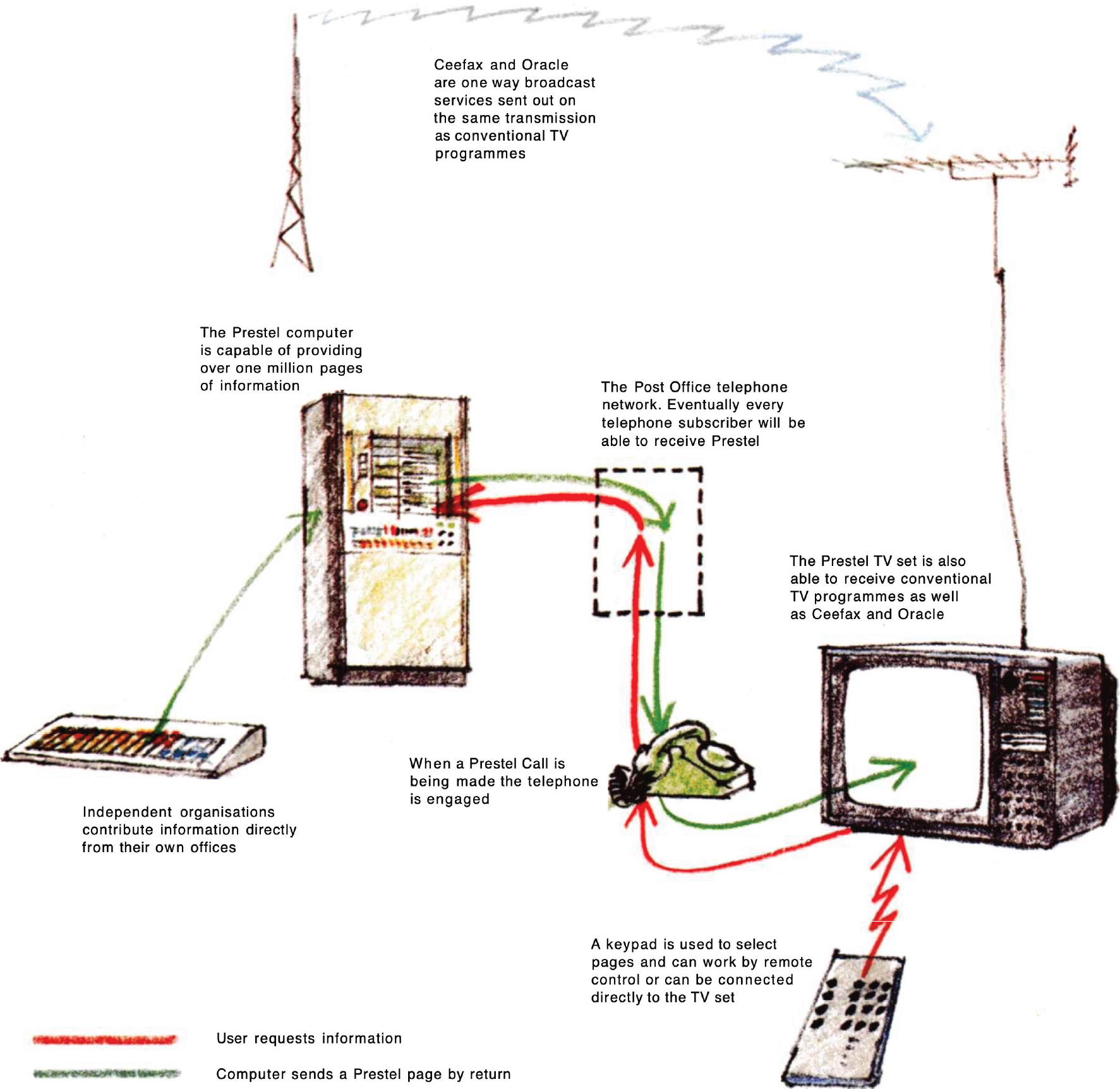
Figure 3
The process in which a Prestel subscriber requests and receives information. Source: Prestel brochure, Prestel Marketing Sub Group, room 610, Lutyens House, 1 Finsbury Circus, London. January 1979
To connect to Prestel, subscribers dialed the number of the computer and then connected the phone line (or the phone to a coupler) to the terminal. A Welcome page appeared, and users began accessing information. Using the keypad, they tapped through a series of general-to-specific navigation menu trees until they reached their desired information. All data were in separate screens of information with assigned numbers. If users knew the frame number of their information, they bypassed the menu and went straight to their page. Then they tapped the keypad again for another frame to appear.52 Each screen/page of information/frame was formatted in 24 lines of 40 characters, including spaces. The top line was reserved for the IP’s name, frame number, and price of the frame’s data; the bottom line gave directions or system guidance (see Fig. 4).
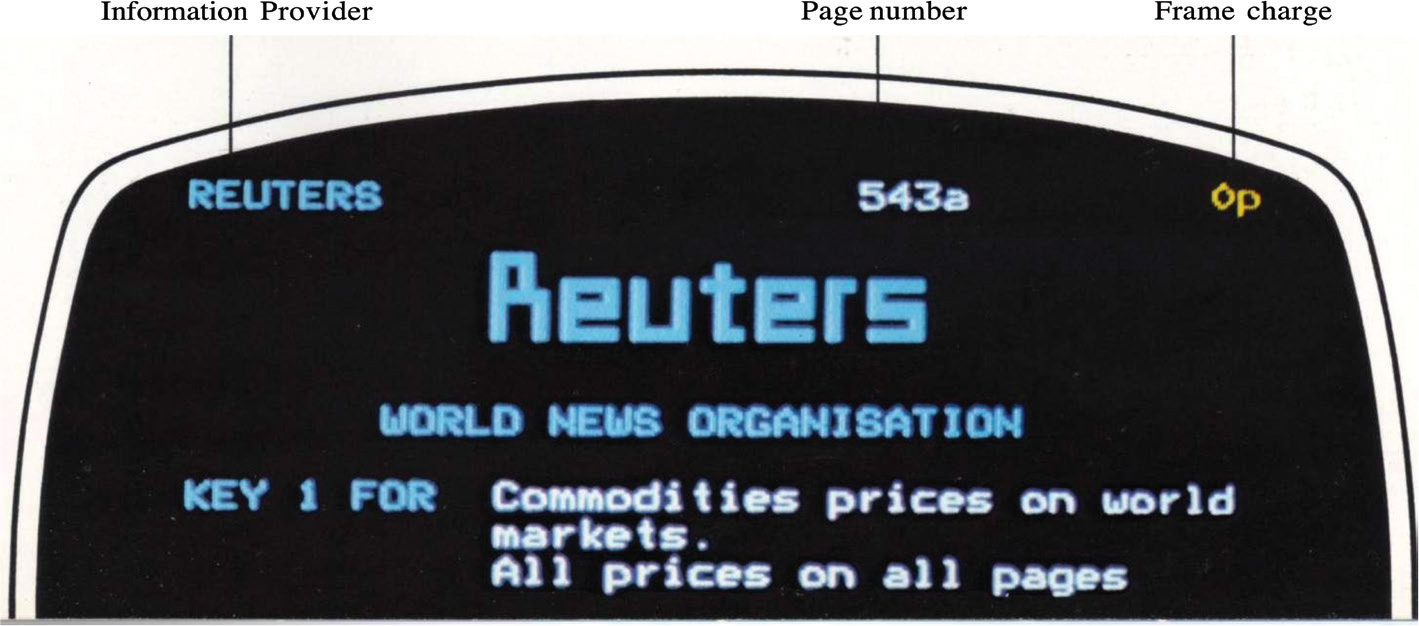
Figure 4
Reuters index information on frame numbered 543a is free - 0 pence. Source: Prestel brochure, Prestel Public Relations, Temple Ave., London., September 1982
With convenience comes a price. Consumers paid multiple bills for different purposes: (1) a one-time charge for equipment (terminal, keypad, and a special telephone line jack), (2) monthly bills that totaled transmission use (telephone service and duration of calls) and (3) a quarterly remittance reflecting computer access and time (Prestel subscription, time connected to the computer, individual frame fees). Subscribers’ actual costs in 1981 were the following:53
First, a terminal was required. Viewdata-adapted television receivers ranged from £450 monochromes to £1,500 large color sets. Another option was for consumers to keep their original TV, which cost about £275, and add an external £200 viewdata adaptor. Renting a Prestel set at £18 to £30 monthly was a third alternative. If they didn’t already, people paid annual TV licenses of £12 monochrome and £34 color and a few businesses installed computer terminals as receivers.
Second, using Prestel increased the telephone bill. In addition to regular charges of telephone time connected to the computer, installing a new line and jack was £80, whereas placing a jack on an existing one was £15. Renting a jack was less expensive, at about 15p domestic use and £21 business. About 60 percent of the population was near a local number for Prestel computers, making connection time a local call rate; otherwise, long distance was surcharged.
Computer use added a third purchase. A quarterly Prestel subscription fee was £6.50 home users and £18.50 businesses, and charges for time on the computer varied according to the hour of day (4p/1 minute peak times, 4p/4minutes evenings and weekends). Each frame cost anywhere from a high of 50p for specialized content to free for Prestel directional menus and indexes, IP advertisements, and public service announcements.
Target Launch Date(s)
BT authorities appeared confident that all parts the plan were going well. Consequently, they decided Prestel would be ready for service a full year before the original target date in 1980. BPO Telecommunications Division Managing Director Peter Benton on February 28, 1979, cited five reasons for this shift:54 The government showed a ‘high degree’ of confidence in the system by allocating £100 million over the next five years toward developing Prestel, with the goal of 800,000 Prestel terminals/subscribers online.55 The television manufacturers gave their endorsement; eight firms already promised 11 different viewdata-equipped models. IPs showed strong support, having already rented 100,000 pages before the service was public, exceeding BT’s expectations that the database would run to only 30,000 pages.56 Positive feedback from demonstrations suggested the hoped-for big consumer demand was achievable. And, finally and importantly, the early launch date seemed to assure Britain of a world-wide lead in viewdata and the early opportunity to export it to other countries.
Although high aspirations accelerated the start dates of a major market trial test and commercial launch, Prestel partners were not prepared when the new target dates approached. The market trial began four months late and the launch was six months late.57 Although this was a postponement of the second timeline, it was still ahead of schedule regarding the original launch.When the third deadline approached, Prestel appeared ready and BT seemed confident. So much so, that a (major) element of system feedback was not examined ahead of time: users. A preliminary study of the market was important to support initiatives, correct assumptions, or confirm a bit of both. Only two months before Prestel went public, a major market trial began. The study’s process, timeline, and results are summarized below.
Market Trial Findings and Analysis58
Beginning in 1974, Prestel was demonstrated mostly at shows. Then in 1976, a pilot test consisted of a few IPS and a few dozen free viewdata sets on IPs’ and BT’s premises to observe how people reacted to the platform.59 In May 1978, BPO Telecommunications hired Research Surveys of Great Britain to conduct a major market trial study and the result was 10 Technical Reports (TRs) on findings. A three-phase longitudinal interview survey began October 1978 and ended June 1979 and two non-survey parts of the market study were in late 1979 and 1980-81, respectively. Analysis of findings were printed throughout 1980 and into spring or summer 1981.
Yet, Prestel was launched months beforehand on Sept. 11, 1979. The longitudinal survey began with 1,550 volunteers recruited by BT, IPs, and TV manufacturers and who who agreed to take a free adapted set for a six-month trial period. They were interviewed in three stages: wave 1 - before installing the set, wave 2 - two months after installation, and wave 3 - six months after having the set. Interviews with the ‘head of household’ or ‘primary decision-maker’ were followed by questionnaires left for others in the household or business to be returned later. The resulting Technical Reports (TRs), confidential at the time to only BT and a few others, were the following: TR1 and TR2 explained design and schedule of the market research. TR3 reported wave 1 participant demographics. TR4 was an interim report for wave 2 interviews. TR5 cross-analyzed wave 1 demographics and wave 2 interim findings. TR7 showed preliminary wave 3 interview results. TR8 offered a wave 2 final analysis compared to the wave 3 interim findings. TR9 appeared to be the final report on wave 3 interviews. Separate from interviews, TR6 audited the general public’s Prestel bills to identify actual use of Prestel rather than participants’ recollections. And TR10, the last report, recorded and reviewed the public’s every tenth call to Prestel computers (10,000 calls total).
Two of the 10 scheduled studies were conducted after Prestel went public. And before the results of any of the market trial were known, BT promoted and marketed Prestel, IPs rented and put content into thousands of frames, and TV manufacturers produced terminals. Some noteworthy findings and analyses follow here:60
Prestel Most Frequently Accessed by Businesses. Perhaps one of the most significant research findings was that residential users accounted for only 13 percent of total people using the platform and made only 6 percent of total calls to Prestel. Business users comprised the rest (TR10). Of the residential users, most of the information requested was business and half the calls were during business hours.
Residential Users Thought Prestel Extravagant and Expensive. While many respondents said Prestel was friendly and easy to use, they also thought it was expensive and a luxury (households 78%; businesses 21%) (R7), which they would have to purchase after the free trial was over. Researchers noted that ‘The future success of the Prestel terminals for both residential and business users will depend on users being prepared to pay for the terminal’ (TR8). Residents didn’t want to spend £800 on a new set or more than £13 monthly rental fees (TR4). Furthermore, virtually none of the households liked the optional monochrome sets or small screens, even at lower prices. Businesses (38 percent), though, would invest higher prices for monochrome and some preferred small screens.
Businesses were More Likely to Keep Prestel. Another finding was the number and type of user who planned to keep Prestel after the trial was over. Wave 2 interviews showed that 25 percent of households might retain Prestel and almost 50 percent would not, while 52 percent of businesses planned to continue and 13 percent said no (TR8). Responses given four months later in wave 3 were similar, as numbers grew slightly in both categories as users became more decisive (TR7). Probably for some participants, the novelty had worn off and they decreased access. Others became comfortable with the system and used it more often.
Typical Residential User. From their interviews with the ‘head of the household,’ researchers characterized the typical resident who planned to keep Prestel after the trial as a ‘head of the household,’ affluent, active, young male of 19 to 35 years with a ‘rich’ annual household income of more than £10,000 (almost £60,000 today). Keepers owned more appliances, videocassette recorders, and television games. They averaged double the non-keepers’ phone bills pre-Prestel. They also read more newspapers, magazines, and books and accessed more facts and figures, consumer advice, national news, entertainment, travel, and dining, for example. People who didn’t want Prestel were more interested in local news, jobs and careers, and education information (TR5).
Typical Business User. Businesses likely to purchase Prestel after the trial were large companies with more than 500 employees, extensive company libraries, and a need for financial news (TR5). They had big budgets, more information sources, and more microcomputers and speakerphones. These companies required stock prices, currency, and exchange rates; government and business statistics; and business news. Their pre-Prestel telephone bills were almost twice that of the other businesses, and they looked up local news, legal advice, travel and entertainment, weather, careers and jobs, and commercial real estate.
Most Frequently Accessed Information was Business. Researchers recorded every tenth call to Prestel to find out who was connecting to Prestel, their search topics and patterns, among other variables (TR10). They found that households used Prestel primarily as a business tool, looking up mostly commodity prices along with other business information, entertainment, travel, and games. Businesses wanted rapidly changing data such as exchange rates, stocks, and commodity prices, plus travel and entertainment information.
Advantages and Disadvantages of Prestel. Participants liked best the quick access and convenience of information at their fingertips (businesses 47% and 26%; households 31% and 39%, respectively). Up-to-date information was also appreciated, mostly by businesses (26%; households 7%). Even though Prestel’s wide range of information came in fourth (businesses 14%; households 13%), more respondents noted that the database was not comprehensive enough and information lacked detail (businesses 32%; households 9%). Another disadvantage to businesses was that although information was recent, it was not fresh enough (TR7 and TR8).
Suggested Improvements to Prestel. In addition to less expensive terminals and up-to-date content, participants wanted more response pages (forms to request more information about a product or service), messaging, a calculator, and a printer (TR8). Most of these services were included in Prestel promotions, but were not yet public.
Perhaps if the findings of the market study were known before the launch, then assumptions about Prestel’s venture into the marketplace could have been corrected for a more successful debut. But we won’t know. The most important implication of the market trial was that residential participants – BT’s primary target to snowball into a mass audience – thought Prestel did not offer sufficient value over and above existing sources of information to justify expense, a linchpin for market demand.61 Based on the findings, the three partners had more work to do.
BT tried to break into a mass market where media routines had been formed and cheaper news and information resources already existed in the forms of newspapers, magazines, journals, radio and television news, libraries, and teletext. The capabilities of speed, convenience, and a variety of information from one source were nice, but did not reach consumers’ threshold of relative advantage, an important variable for the adoption of an innovation. Their time and money already competed with entertainment devices such as videodisc players, video cassettes, video games, and cable television. It appeared that residential users did not plan to change their routine, as they were satisfied with their media habits, compared to Prestel.
Justifying the expense for information was difficult for households wanting general information and entertainment already available and cheaper, than for businesses needing specialized information. The equipment was also costly for households, but some businesses had the needed equipment (phone lines and computer monitors that could be adapted to Prestel) or were predisposed to buying equipment and had larger budgets. Based on these responses, trial researchers observed that Prestel’s success depended on both residential and business users’ preparedness to pay for the terminals, a barrier that was removed for Minitel users.
Prestel’s physical appearance was important, according to households that were accustomed to entertainment from large color TVs in their living rooms and didn’t want small monochromes. However, businesses users said they preferred the small monochrome, perhaps because they were accustomed to monitors on limited desk space. Another key factor was the database content itself. Although participants appreciated the variety of content, they wished for more width and depth, and couldn’t use some information if it wasn’t recent. For example, businesses needed commodity prices, which IPs refreshed maybe three times a day. After a while, many IPs realized that detailing, updating, and adding more pages to Prestel’s database had become expensive and difficult, and two years later focused on refreshing the same business pages more frequently instead of adding more pages.
It’s important to give special mention to Prestel’s two-way service. Ads promoted the possibilities of Prestel, not what it could do at the moment. There was a problem with the word ‘interactive.’ Routing was limited. It was neither intuitive nor helpful going from one page to another. Because Prestel lacked calculating facilities, games were rather slow without processing conveniences. The only two-way service was ‘response frames,’ which were forms for users asking about a product. Two years later, Prestel featured a limited pre-formatted messaging service, but connected only those users on the same computer node; thus, not even all Prestel users could message each other. (As was the case with early U.S. telephone networks and computer systems.) If more interactivity were possible, then participants would use it for arranging travel, banking, ordering products, and paying bills. Residential users also hoped for a calculator and businesses missed printer capabilities. Business users had calculators nearby whereas households did not. Residential users connected to Prestel themselves, but business subordinates manually transcribed information requested by someone else; a printer would save time.
Prestel System Partners and Analysis
The viewdata computing system was a partnership among three principles: British Telecom furnished the computing infrastructure, information providers populated the databases, and television manufacturers engineered monitors to display information. According to systems theory, sub-systems should be studied together because their contributions are interrelated and they depend on one another. Early radio and television needed receivers, broadcast, and programming working in tandem to succeed in a mass market. Similar to a Jenga game, if a vital part is missing, then the tower comes tumbling down. Prestel partners wanted this new idea to succeed because it would help their own situations, but at times they appeared slow to act or disorganized, which circumvented progress toward offering a robust Prestel service to the public.
The cornerstone of Prestel was British Telecom. Being a government-related public corporation, it had a monopoly on Great Britain’s telecommunications networks and directed everything about the platform. It owned and operated Prestel computer databases, maintained the telephone network, marketed and promoted Prestel, advised and charged IPs, negotiated with TV manufactures and billed consumers. Although BT owned and housed the storage space for IP data and stipulated screen design and elements, it had neither the resources nor the desire to input, edit, and review every piece of information in the databases, so it adopted a common carrier policy.62 It also did not want to develop and manufacture televisions, which was already an industry.
Information providers were a second partner responsible for the success of the system. BT offered space to anyone who wanted to put content in its databases. In exchange, IPs paid British Telecom for annual fees, editing keyboards, terminal equipment, annual maintenance, frames or pages (finite screenfuls of content), staff training, and editing manuals, among other amenities.63 Umbrella IPs often turned around and subcontracted their frames of space to sub-IPs that could not afford BT’s comprehensive fees or wanted only limited space. Most IPs saw Prestel as a means to promote themselves to general audiences, while some wanted to communicate to consumers without incurring printing and distribution costs or they liked the idea of immediate consumer feedback. Still others felt they could not afford missing out on the crest of a revolutionary technology and did not expect immediate monetary returns. Commercial IPs included airlines, travel agencies, hotels, and banks. Government agencies announced general information, committee and financial reports, and event calendars. Universities similarly posted general information, events, activities, and class listings. Many publishing houses, libraries, and news outlets wanted to understand viewdata better as it was predicted to replace traditional cataloging and print media.64
The number of IPs and frames of information steadily increased through the years, although exact numbers vary among sources perhaps due to a conflagration of umbrella IPs and sub-IPs: 184 in 1978 (with 48 publishers, 28 government references, and 17 travel agencies) to 200 in 1979, to 739 (with 54 publishers, 78 government references, and 321 travel agencies) in 1983.65 Prestel’s charges to IPs grew annually from their start in 1978. By 1981 they were a fixed fee of about £5,000 a year, plus £5 per rented frame, regardless the number of viewers. In turn, IPs could decide what they wanted to charge viewers to access each frame of information. Five percent of frame commission went to BT.
In addition to British Telecom and IPs, the third partner was the television industry, which developed, manufactured, and distributed viewdata-adapted terminals (and adaptors to existing TV sets) and keypads to display content. These terminals included modems to exchange computer digital data and analog signals that ran along the telephone lines from the monitor to the computer database. From 1973 to 1976, British color television sales had fallen from a peak of 2.12 million to 1.54 million sets, and monochrome sales went from 1.01 million to 0.56 million. Sales continued to decline.66 During this period, 97 percent of households had a set—almost reaching market saturation. Caught between international (Japanese) competition and low television set demand, manufacturers sought a new product to market. Since sets could be produced with either built-in circuitry or adaptors connected to the average television set, any large-scale adoption of Prestel could revive demand for sets as well as create demand for adaptors (see Fig. 5).67
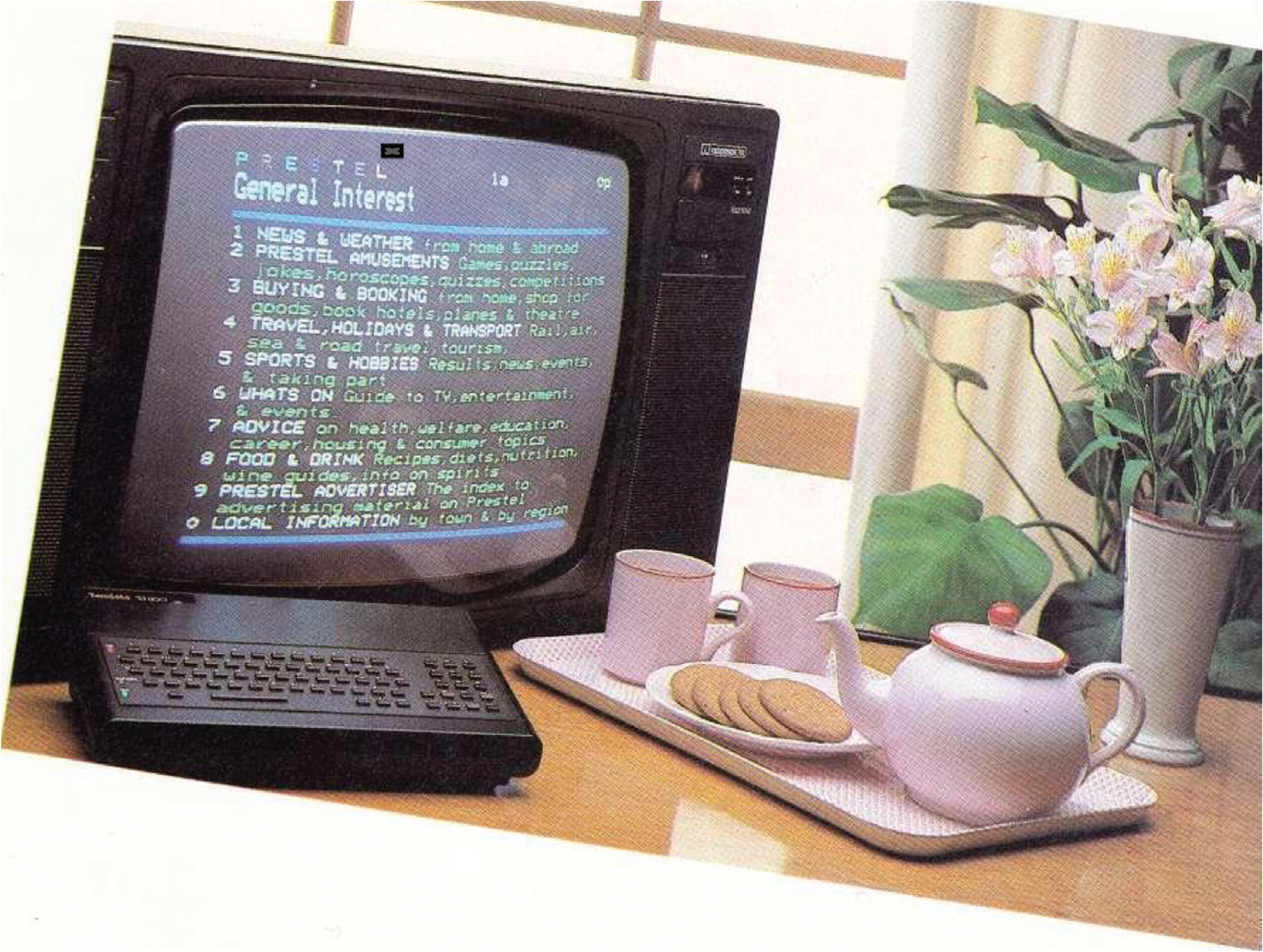
Figure 5
The various television manufacturers produced different models of the viewdata-adapted terminal and keypad. Source: Prestel In the Home brochure, Prestel British Telecommunications Plc., Temple Ave., London, September 1984.
A look backward shows that system’s partners experienced individual drawbacks that negatively affected their contributions and hindered their partners’ abilities to do their parts. By extension, their compounded challenges affected users’ reactions to the platform.
A comparison of promotional materials and the market trial findings appears that BT promised capabilities that did not exist yet. Perhaps there was just no time to incorporate the services before the system was to be debuted after multiple delays and any fruitful findings of the trial appeared secondary to rushing Prestel to market. On one hand, BT needed to posture a reliable front because a lot of high hopes and investments hinged on this new idea. On the other hand, if BT postponed Prestel’s debut again, then a lack-of-confidence domino effect might have ensued with IPs and the TV industry lingering in their responsibilities because of wait-and-see attitudes. Meanwhile, information providers lost money while waiting for the first start-up date. They hired personnel, bought special editing terminals and Prestel sets, rented frames, and learned the database structure and page design; but, because the launch was held back, no one was accessing content to give them a return on their investment. Some IPs, once recruited, made slow progress. Putting information into the database according to BT specifications was not as easy as it looked and unanticipated complications appeared. Other IPs were publishing houses that had to renegotiate with trade unions because employee job positions were displaced or changed with electronic publishing. Frames often appeared confusing because print documents were copied straight into the database without regard for a 24-line x 40-character screen, so another style of writing had to be developed.68
Although BT announced that numerous IPs signed up and thousands of information pages existed, many IPs did little while waiting for BT and the TV industry to deliver a market. Rented frames were empty or experimental pages were out of date. Promotional material rather than ‘pure’ information filled other pages,69 a pitfall France Télécom avoided by acting mostly as a network administrator and common carrier, leaving content, configuration, and design to information providers. Conversely, BT blamed the television manufacturers for delaying the market trial. BT said manufacturers promised 1,000 sets in 1978 for the market trial, plus another 50,000 the following year. By 1979 about 1,000 sets were produced, and almost 5,000 more by the end of that year. The production rate was slow because manufacturers hesitated to invest resources for special terminals, adaptors for regular sets, and keypads after they’d just done the same with teletext. They’d been told teletext was going to be revolutionary and they did not want to be disillusioned twice.70 Efforts took longer than expected to engineer modems for the terminals and ensure that malfunctions did not interfere with regular telephone line transmissions.71
Another issue for the TV manufacturers was that BT told the public the sets would be relatively inexpensive—only £50 more than a regular TV—and misjudged the price by an additional £100.72 The newly designed semiconductors and sub-assemblies, such as modems, and the completed sets needed more sales and evolutions before prices declined (economies of scale). In the year after Prestel was launched, relatively few general consumers bought the computing system because of its high cost and content, as predicted by the trial findings.73
A Change in Strategy
Harvard University sociologist Vincent Mosco commented on the Prestel situation:
We are now in the real world and the fantasies of the test service era have faded. The information provider community is polarizing, leaving in the business those who are taking a proper and commerical [sic] approach with professional application and who can invest properly in a new medium. It is a pity, perhaps, that there is no cheap and universal channel for the small and worthy, but computers and data storage cost money, and the telephone network does not operate itself, the people and indexing terminals cannot be obtained on charity. There is a price to be paid for everything.74
It is clear from the findings of the delayed market trial that households’ reaction to Prestel was not anticipated and a disappointment. Marketing campaigns usually identify the needs of a target audience, meet those needs with a product or service, and then promote it, hoping to create a consumer demand.75 But either there wasn’t interest or time to do the preliminary steps. Convenient news and entertainment on an expensive terminal was not enough for general users to change their media habits in the early 1980s surrounded by bouts of national economic stress76 and cheaper available information sources. Businesses, however, would pay to get specialized information quickly. And BT persevered, because a ‘lead-in market must be our first focus, since we need to capture this as a stepping stone to achieving the mass market.’77 Thus, ‘the strategy shifted away from a mass market and to the business sector for short-term returns on investment.’78
Sales of Prestel increased after the target audience was redefined and the partners became reliable for their contributions to the system. Growth was steady and by May 1983, Prestel averaged 500 new subscribers a month. About 85 percent were businesses. IPs bought and filled more pages with business information and updated them sometimes every 10 minutes. The television industry engineered the needed semi-conductors and modems, and manufactured several new types of terminals and built adaptors for word processors and desktop computers.79 In the midst of this, not much changed for the general user on cost and content, although it’s possible that BT hoped to circle back to a mass market and then it became too late.
Summary and Conclusions
This article adds to the literature on platform studies and systems theory by tracing the development of Prestel, Great Britain’s viewdata computing system, and analyzing conditions surrounding its viability as a mass medium, using mostly primary documents of the late 1970s and early 1980s. It relied on platform studies for its framework to discuss if Prestel’s development and evolution into a culture with established customs and habits influenced that culture’s way of thinking or doing. The interrelationship of Prestel’s partners fit with systems theory by examining their collective contributions. Finding why and how Prestel was developed and examining its evolution within the context of the times adds to our understanding of platforms and existing culture.80 The investigation begins in the mid-1970s, by delving into government documents and aspirations to capture a mass audience, and ends about five years later, after market trial reports and when Prestel appeared elusive as a mass medium. Personal interviews soon afterward and a general review of following years confirmed the findings and a campaign for the business market.
Because it was the first viewdata computing system of its kind, no maps existed to help British Telecom chart a course on development, promotion, and administration with its enthusiastic, but sometimes reticent, partners. Only about 10 years earlier, Everett Rogers published the classic diffusion of innovations theory to explain how, why and the rate that new ideas and technology spread.81 But France Télécom had a map – courtesy of British Telecom – to guide its decisions with the more successful Minitel, which thrived in a mass market almost 10 years longer than Prestel. Who knows what would have happened if roles were reversed? Britain rushed, but France took time with market studies and introduced Minitel four years after Prestel with messaging, chatrooms, and other interactive capabilities and unique services that kept people online.
Whereas Prestel users pressed keys on an expensive monitor to access pricy content that directly competed with already-handy cheap or free information, the popular French national directory was available exclusively online through a free terminal. Searching for content through a structured menu tree was tedious compared to Minitel’s quick and easy, albeit clunky, Boolean algorithm that forgave misspellings.82 And, in contrast to BT’s pre-designed, tightly-controlled, closed, and centralized system that frustrated IPs and prohibited user creativity and the free-flow of ideas, Minitel’s architecture was a ‘hybrid-network design,’ with a public-private partnership that supported new ideas and services by third-parties.83 By being encouraged to experiment and create new services over the years, entrepreneurs contributed to French culture and the organic growth of Minitel’s system with start-ups and content that later migrated to the internet. Because Prestel general users did not see a cost or unique advantage over and above their current news routines, general consumers turned away from viewdata, while a Minitel mass market embraced it.
British Telecom and its partners regrouped after it was evident that Prestel would not immediately achieve a mass market, and their new focus was successful in attracting businesses. Prestel International sold its software to many countries and their companies supplied and accessed information internationally on Prestel computers; thus, Prestel fulfilled its vision of becoming an international information provider and supplier. Micronet 800 was an adaptor for desktop or microcomputers to connect to Prestel. Private Viewdata became a popular intranet for corporations using their desktop computers for storage space and replacing memos and phone calls. Similar to Private Viewdata, but an exclusive system on the public Prestel network, was Closed User Group. Gateway allowed businesses with Prestel terminals to be connected to third party computers, such as travel agents to airlines, and order products. And Mailbox in early 1983 allowed subscribers to send local and international messages to each other.
These new Prestel applications and services attracted domestic and international subscribers, and its computing system was ranked number one in the world, with the Federal Republic of Germany and the Netherlands in second and third place—all using the Prestel platform. By now, people knew about videotex and about 50 projects existed in 16 countries in Europe, Japan, and North America using the Prestel system. The number of Minitel and other public and private computer time-sharing systems also grew.84 Numbers vary according to active Prestel terminals, subscribers, information providers, services, and pages of information domestically and internationally to measure peak success and rankings (about 150,000 subscribers and 1,300 services).85 Whereas BT initially counted terminals to define success, they now tallied subscribers and IP services because as the economy improved, consumers purchased desktop computers, which could do more than Prestel terminals. British Telecom and IPs still benefitted because personal computers connected to the database kept the phone lines busy. However, these advantages also came to pass, as the internet exponentially bypassed Prestel with its speed, Boolean algorithms, free and unlimited content, messaging and other interactivity, and ethernet transmission. The combination of personal computers and the internet eclipsed Prestel and all videotex systems eventually. Over time, Prestel was pushed further into the background and then forgotten. It was sold in 1994 and disappeared. Viewdata had not achieved viability as a mass medium. Great promises, high hopes, and huge investments were rushed into developing Prestel and although it was innovative, interesting, and convenient, that was not enough for the general public in the early 1980s. And Prestel stumbled.
We cannot use present-mindedness to judge the past by today’s standards. It was a different generation with different media habits and budgets. We don’t always know the intricate variables that go into first-time decisions. With a long view, it can be said that British Telecom achieved a different kind of success with Prestel, some of which they envisioned earlier. For a time, Britain was a leader in telecommunications with the development of viewdata and the world was an open market for British sales of Prestel technology. It was an exciting time to experiment. Prestel’s contribution to the culture in which it was born is that it opened people’s minds to new ideas, created possibilities, offered lessons, and influenced the progress of the ensuing and entrepreneurial worldwide internet.
Notes
[10] These include Parliamentary Papers, Command Papers, Report(s) of the Post Office, British Telecom “Reports and Accounts” and “Survey of Current Affairs” journals published by Her Majesty’s Stationery Office and confidential reports to British Telecom. In the early 1980s, the author gathered primary source materials when visiting Prestel, its partners’ offices, industry tradeshows, and collected news articles, journals, books, and interviewed authors at that time. Some of the same are now online.
[11] Hernan Galperin, “Beyond Interests, Ideas, and Technology: An Institutional Approach to Communication and Information Policy,” The Information Society 20, no. 3 (2004): 159-168, DOI:10.1080/01972240490456818.
[13] These theories include critical mass, network effects, economies of scale, systems theory and systems thinking, demand theory, diffusion of innovations, uses and gratifications. Platform studies are also noted. As variables are noted within the text, their theories are referenced in endnotes.
[14] See Platform Studies website by MIT Press: https://mitpress.mit.edu/series/platform-studies/
[15] As noted in Teri Finneman, Meg Heckman and Stephen Wolgast, “Examining Gaps in Journalism Curriculum to Solve the News Desert Crisis,” Journalism & Mass Communicator Educator (2023), doi: 10.1177/107769582312125.
[16] Jo Ruth Liska and Gary Cronkhite, An Ecological Perspective on Human Communication Theory (Orlando, Fla: Harcourt College Publishing, 1995).
[17] Urie Bronfenbrenner, Ecology of Human Development: Experiments by Nature and Design (Harvard University Press, 1979).
[18] British Telecom (BT) was under the British Post Office (BPO) umbrella. They formally separated in 1980/81. BT is used for consistency.
[20] Viewdata was the first interactive system for transmitting encoded information to receivers. The umbrella term “videotex” encompassed viewdata (telephone transmission to television and later desktop computer display), teletext (broadcast to television display), cabletext (cable transmission to television display), etc. Fedida named his experiment Viewdata, but since it became an international generic term, another was needed. Prestel. ‘Pre’ was the prefix for press, presentation, press, premier, etc., and ‘Tel’ for telecommunications. Alexander Reid, “Autobiographical Story,” in Lives Retold (www.livesretold.co.uk): https://static1.squarespace.com/static/5c65dd81af46834afd07e40a/t/614e475f5de10e1b7e24f272/1632520053512/lives+retold+reid+alexander+24.9.21.pdf
[21] Elizabeth Farrarini, “The Viewdata Experience,” Administrative Management 41, no. 10 (1980): 30; Susan S. Cherry, “Telereference: The New TV Information Systems,” American Library 11, no. 2 (1980): 96.
[22] Richard N. Jackson, “Home Telecommunications,” IEEE Spectrum 17, no. 3 (1980): 31: DOI:10.1109/MSPEC.1980.6330319.
[23] “Report of the Post Office Review Committee,” Reports, Accounts and Papers XXXIX (London: Her Majesty’s Stationery Office [HMSO], 1977): 107.
[25] Stephen B. Ashe et al., “A Multinational Comparison,” Business Quarterly 46, no.1 (Spring 1981): 24.
[29] “Appendix to the Report of the Post Office Review Committee,” Reports, Accounts and Papers XXXIX (London: HMSO, 1977), 375.
[30] William L. Cats-Baril and Tawfik Jelassi, “The French Videotex System Minitel: A Successful Implementation of a National Information Technology Infrastructure,” MIS Quarterly, 18, no. 1 (March 1994): 1-4, DOI:10.2307/249607; Valerie Schafer and Benjamin G. Thierry, “From the Minitel to the Internet,” in The Routledge Companion to Global Internet Histories, eds. Gerard Goggin and Mark McLelland (Routledge, 2017): 77-79; Julien Mailland and Kevin Driscoll, Minitel: Welcome to the Internet (Cambridge, Mass: The MIT Press, 2017), 4-5.
[32] Michael R. Gabriel, “Videotex and Teletex: Waiting for the 21st Century?” Educational Technology 28, no. 3 (March 1988), 27-31. For lists and descriptions of early experiments, see: Lucinda D. Davenport, “A Co-orientation Analysis of Newspaper Editors’ and Readers’ Attitudes toward Videotex, Online News and Databases: A Study of Perceptions and Opinions,” Doctoral dissertation, Ohio University. Order No. 8737302. (Ann Arbor, Michigan: University Microfilms International, 1987).
[33] Joseph Straubhaar, Robert LaRose and Lucinda Davenport, Media Now: Understanding Media, Culture, and Technology 11th ed. (Boston: Cengage, 2024), 31.
[34] Ramona A. Rush, “The Teletexts, Videotexts, Ceefax are Coming,” Journal of Organizational Communication 9, no. 3 (1980): 4.
[35] Network effect theory is discussed in “What is the Network Effect?” Wharton Online, University of Pennsylvania, January 2023, https://online.wharton.upenn.edu/blog/what-is-the-network-effect/#:~:text=The%20network%20effect%20is%20a,back%20to%20the%20internet%20itself
[36] For a discussion on economies of scale, see: Straubhaar, LaRose and Davenport, Media Now, 28-50.
[42] “Number of UK Homes with TVs Falls for First Time,” BBC News, December 9, 2014, https://www.bbc.com/news/entertainment-arts-30392654
[43] St John Sandringham, “Prestel and the Consumer,” in Viewdata in Action, ed. Rex Winsbury (London: McGraw-Hill, 1981), 131.
[45] Mills and Allen Communications Limited. Prestel the Editorial Opportunity no.1 (London, 1979), 6.
[49] According to economic demand theory. See: Adam Hayes and Michael J. Boyle, “Demand Theory: Definition in Economics and Examples,” Investopedia, August 31, 2023, https://www.investopedia.com/terms/d/demand_theory.asp#:~:text=The%20demand%20for%20a%20good,ability%20and%20willingness%20to%20pay.
[50] In 1962, Everett M. Rogers developed the Diffusion of Innovation Theory, originally for the communication discipline, and wrote five books examining the theory. Lists and descriptions of the five main characteristics that influence the adoption of an innovation can be found all over the internet. A summary can be found here: Bill Ferster, “The Diffusion of Innovations: Everett Rogers,” eLearning Industry, February 4, 2017, https://elearningindustry.com/diffusion-of-innovations-everett-rogers
[51] Uses and gratifications theory is discussed in: Straubhaar, LaRose and Davenport, Media Now, chapter 14, “Media Uses and Impacts.”
[52] Mills and Allen Communications Limited. Prestel the Editorial Opportunity no. 2 (London, 1980), 6. Also, for historical note, BT considered Boolean (keyword) searching, as used on the internet today, but reject it because of design cost and complexity. Early private videotex systems and the early internet browser Gopher also used menu trees. As the internet grew, crawler bots advanced the Boolean keyword searches on the internet today.
[53] Some prices changed in November 1981. “What Does Prestel Cost You?” Prestel Business Directory (Oct. 1981), xlii. Cf.: “What Does Prestel Cost You?” Prestel Business Directory (Jan. 1982), xxxii; Also see Prestel sales letter (endnote 40) and “Paying for Prestel” Leaflet, both at https://docs.google.com/viewer?url=http%3A%2F%2Fwww.viewdata.org.uk%2Fdownload.php%3Fcat%3D15_Prestel%26file%3DPI1984-PayingForPrestel.pdf
[57] Kieran Levis, “Towards the Public Service,” in Mills and Allen Communications Limited, Prestel the Editorial Opportunity no. 2 (London, 1980), 1.5.
[58] The reports did not make conclusions. They stated and summarised results. See also, Lucinda D. Davenport, “Developing Viewdata into a Successful Medium: A Case Study of Prestel,” thesis, University of Iowa (December 1984).
[59] Alex Reid, “Prestel Philosophy and Practice,” in Viewdata in Action, ed. Rex Winsbury (London: McGraw-Hill, 1981), 13.
[60] Data reported here is this researcher’s examination of the Technical Reports in her possession (all except TR1 and TR2 survey design, which was repeated in subsequent reports, and TR9, which assumingly did not differ substantially from the TR7 interim report). Some numbers differed slightly from report to report. Bar charts were hand-drawn and guesstimated. Results from interim and final wave interviews numbers may vary but correlate. Whatever the exact figures, the ultimate findings are realistically reflected.
[63] See BT’s brochure to IPs as context to their role, Becoming an Information Provider, n.d: https://www.viewdata.org.uk/download.php?cat=15_Prestel&ile=Becoming%20IP%20folder%20info%201983.pdf; also see 1982 prices in Prestel sales letter to IPs (1983): https://www.viewdata.org.uk/download.php?cat=15_Prestel&ile=Becoming%20IP%20cover%20letter%20prices%201983.pdf
[64] John Martyn, “Prestel and Public Libraries: An LA/ASLIB Experiment,” ASLIB Proceedings 31, no. 5 (1979): 218, DOI:10.1108/eb050679.
[65] 200 IPs are noted in the PRESTEL Business Directory Jan. 1979 (London: The Financial Times, Jan. 1979) and can be compared with Business directories in Oct. 1981 and Jan. 1982. The Prestel User Directory numbers are in Hilary Thomas, “All Changes as Revolution Steams Ahead,” Viewdata 6, no. 2 (1983): 8.
[68] Lucinda D. Davenport, “Videotex Writing Style Guide,” paper presentation, Ohio University, Athens, Ohio, 1986.
[69] “Prestel-Where are We Now,” in Mills and Allen, Prestel the Editorial Opportunity, no.2 (1980), 1.2-1.5.
[70] Rex Winsbury, Electronic Bookstall (London: International Institute of Communications, 1979), 15.
[75] Google Glass is a similar story. Google invested a lot in R & and promoting this new device directed at a mass market. It had the same capabilities as cell phones and was more expensive at $1,500. The uniqueness wore off. In addition, people didn’t like its look and felt uncomfortable not knowing if they were being recorded by someone else. The new technology failed with the general public, but was picked up by businesses that appreciated the hands-free microprocessor device.
[76] It is interesting that none of the myriad primary documents mention the country’s economy, although maybe it didn’t matter because BT needed to move forward. Yet, an implicit influence or causal effect on reactions toward Prestel’s expense may have been that the country continued to experience an economic decline. The mid-1970s saw high unemployment and the cost of living rose 26%. It eased until 1980-81, when inflation rose 20% and manufacturing took a big hit.
[80] It also adds to the discussion of innovations that appear to be ready before their time in society, such as the microwave and fax machine.
[82] Jack Kessler, The French Minitel, Is there Digital Life Outside of the “US ASCII” Internet? A Challenge or Convergence?” in d-Lib magazine: https://www.dlib.org/dlib/december95/12kessler.html
[84] Meanwhile in the U.S., large commercial videotex services, such as CompuServe, Prodigy, The Source, and American Online (AOL) with third-party IPs and accessible by telephony and personal computers, jockeyed for consumers until the internet took over. They achieved varying levels of success whereas the highly publicized experiments of media conglomerates Knight-Ridder with Viewtron and Times-Mirror with Gateway failed. In 1986, Gateway executives believed the idea was ahead of its time and perhaps may never arrive.
Biography
Lucinda D. Davenport, Ph.D., is a University Distinguished Professor, former director of the School of Journalism, and former associate dean in the College of Communication Arts and Sciences at Michigan State University, U.S.A. She is co-author of Media Now: Understanding Media, Culture and Technology 12th ed. (Boston: Cengage) and Writing and Reporting for the Media, 13th ed. (NY: Oxford Press). Her work focuses on media technologies—past and present. She instructs historical research methods and media history classes, among other journalism subjects, and would like to dedicate this article to Dr John Soloski for encouraging a University of Iowa journalism master’s student years ago to ‘do more’ during her summer study abroad in Great Britain.