
Introduction
I see no reason why the film should not become an increasingly important element in the pattern of art education. It can teach so much.
Why should the life-class still be considered the hub of art education?
[original emphasis]
“The Future for Art Schools,” The Studio, 1961.1
When and how did film projection arrive at art schools? Scholarship has hardly addressed this line of enquiry despite the now ubiquitous uses of moving images in art education and artists’ films having acquired a distinct status.2 When it comes to the role of ‘new media’ in art history pedagogies, historiography mainly focuses on the uses of photography to reproduce works of art (slides) rather than on film.3 With this article, I aim to bring film history into this interdisciplinary conversation and to locate it in the context of post-Second World War (WW2) Britain’s media ecologies and educational policies. I contend that the emergence of the newly distinct genre of ‘art films’ under the auspices of post-WW2 international organisations, like UNESCO, played a catalytic role in the educational uses of film within art school contexts. On an analytical level, I draw on the notion of the ‘dispositif’, as media historian Frank Kessler has more recently redeployed it: not as a ‘normative category’ but as a historiographic ‘heuristic tool’ that helps ‘to outline the complex interplay between the various constituents of an educational or instructive projection situation.’4 More specifically, in relation to the educational uses of magic lanterns Kessler proposes the term ‘performance dispositif’ to describe the ‘triangular’ dynamic and contingent interrelationship between: the performance context pole of the projection setting; the textual pole (what is projected); and the spectator pole (audiences and their expectations).5
By ‘art films’, I refer to the historical post-WW2 uses of this term to describe a range of nonfiction films about the visual arts: pictorial films whose main focus is the close analysis of paintings; documentary-style films about artists at work; and ‘crito-films’, a form of audio-visual art criticism and ‘instruments of learning’.6 Evidence of art films’ post-war international currency can be found in UNESCO’s journal Courier, which regularly championed films as the way to ‘bring art to the people.’7 By endorsing the genre in the campaign to overcome ‘frontier barriers’ and to ‘help educational films’ get distributed globally, UNESCO aligned art films with its wider vision of peace education through art and the democratisation of the fine arts, often perceived as elitist or museum-bound (Figure 1).

Figure 1
The logo of UNESCO’s campaign to support international distribution and exhibition of educational films, art films included. Source: Anon., “UNESCO Helps Educational Films Over Frontier Barriers,” UNESCO Courier III, no.2 (1950): 2. https://unesdoc.unesco.org/ark:/48223/pf0000074977
In terms of nomenclature, critics deployed the term ‘art films’ interchangeably with ‘films on art’ and with the advent of television in the 1950s, ‘arts documentary’ entered the lexicon to gradually become predominant from the 1960s onwards. ‘Art films,’ however, tended to encompass both films about the visual arts and experimental nonfiction films, such as painterly animations and other innovative approaches to form. I have thus opted for ‘art films’ in order to evoke the post-WW2 historical connotations of a genre that was perceived to be breaking away from the more instructional and informational modes of interwar films about culture (e.g. Kulturfilme) into new aesthetic registers. Film historiography has now acknowledged the post-war period as the ‘golden age’ of the art film genre that not only ‘brought art to the people,’ but also shaped public perceptions about the role of art and artists in the new post-war welfare societies of the West.8
The British case is of particular interest. During the 1954 International Conference of Art Films in Amsterdam, a commendation was bestowed on the Arts Council of Great Britain, a public body established in 1946 with the goal ‘to increase the accessibility of the fine arts to the public.’9 The acclamation involved the Council’s 1950 initiative of organising a mobile cinema scheme, the Art Film Tour, which became the main vehicle of distribution and exhibition of art films to nontheatrical venues in the UK, art schools included.10 Despite the growing scholarship on art films in general and on post-war visual culture in Britain in particular, we still know little about the pedagogic uses of these films. The research project ‘Art School Educated: Curriculum Change in UK Art Schools’ (Tate Britain, 2014) foregrounded how the material contexts of art education remain a relatively new field of enquiry.11 At the same time, historians of education have ventured into a cross-disciplinary research dialogue with art history, as for example The Decorated School project about the role of art as educator and the design of educational environments.12
Building on the above methodological interventions, my article sets out to discuss the role of film projection in art schools through the Arts Council scheme, featuring two landmark art films–Henry Moore (1951) and Jackson Pollock 51 (1951)–that enjoyed wide circulation in the educational sector. The Art Film Tour became a catalyst for new developments: first, the collaboration between previously unrelated institutions (such as the Arts Council and the BFI); and secondly for art film projections to enter for the first time—and for thirty years on a consistent basis—into the educational and wider nontheatrical sector: art schools, technical colleges, art societies, museums and galleries.13 When the Arts Council’s 450 art film productions (1953–1998) were digitised in 2007, documentation and research centred on the film text with little attention paid to the Council’s role as an educational distributor and exhibitor.14 Although the database of the Arts Council’s productions remains an invaluable record, the films themselves constitute only one piece of what Kessler calls the ‘multi-dimensional historical puzzle.’ The meanings of the artefact (16mm film print or a digital file) constitute part of a ‘complex interplay’ between the text, the projection and the spectators. Even more so in the case of the Art Film Tour, which circulated hundreds more films than the Council’s own productions. Its distribution catalogues and exhibition schedules attest to a rich, uncharted territory of encounters with audiences within myriad types of educational context. Compared to a screening in a central London art cinema, the very same art films, once distributed by the Arts Council, acquired the aura of an event thanks to the carefully curated programmes and conditions of projection.
The Aura of the Art Film Tour: a Controlled Performance Context
Kessler contends that the dispositif’s ‘performance context pole comprises the physical location of the performance, the technology and its affordances, as well as the pragmatic status of the communication process taking place.’15 In the case of the Arts Council’s exhibition practices, how were these dedicated performance contexts constituted and how were the projections framed within educational settings? Alongside its support for visual arts touring exhibitions to regional Arts Centres, the Council’s initiatives encompassed the entire educational sector. An example of this link was the Pictures for Schools scheme (1947–1969), initiated by artist and educationalist Nan Youngman, the aim of which was to connect schools with original works of art both in the traditional educational space of the classroom and in the potentially educational contexts of art galleries and museums.16 Organised by the newly founded Society of Education through Art and supported by the Arts Council, Pictures for Schools became the vehicle for Youngman to introduce participatory methods of engagement with original works of art through questionnaires and the design of learning activities based on close observation.17
At the same time, film as an educational tool was endorsed by the Ministry of Education with a series of commissioned ‘visual units’ packages on a specific theme (e.g. Looking at Sculpture, 1950), providing a range of material for studying the topic, including films, film strips, charts and models. This initiative had started in 1944 with a series of twelve teaching films, described as ‘an entirely new departure’ and praised for its high production values that allowed the educational films to reach wider audiences.18 The Ministry of Education’s involvement in film was part of a wider movement of visual education that comprised new societies and outlets: the Society for Education through Art with its magazine Athene; and a new association, the National Committee for Visual Aids in Education, which promoted the use of film through conferences and publications, including a new magazine, Visual Education.
These two concurrent projects (Pictures into Schools and the Ministry of Education Film Experiment) exemplify the shifting post-war media ecology, with the fine arts and film assuming new roles in education and pedagogic discourses. Against this background and bolstered by the highly positive reception of art films at the Edinburgh Festival (est. 1947), the Arts Council, in collaboration with the BFI, set up the Art Film Tour, with the initial purpose to circulate European art films, whose distribution UNESCO’s educational initiatives had supported. The Tour’s first distribution catalogue heralded the venture: ‘Film as a commentary on the visual arts is a new and exciting medium.’19 This spirit of novelty characterised the Tour’s development throughout the 1950s and its thirty years of existence thanks to a series of initiatives, such as the Council’s gradual move to producing and commissioning art films from the independent sector; endorsing an expanded notion of the art film in the late 1960s to include artists’ films; producing a wider range of visual publicity material, such as posters and illustrated pamphlets; and introducing the Filmmakers on Tour scheme with directors joining parts of the Art Film Tour to introduce their films. What remained constant was its strong connection with the educational sector: secondary and mainly post-secondary (art schools), and adult education. The Tour’s itineraries were attuned to the academic calendar (September to May). Besides art societies and galleries, the majority of bookings and shows took place within formal education settings (Figure 2).
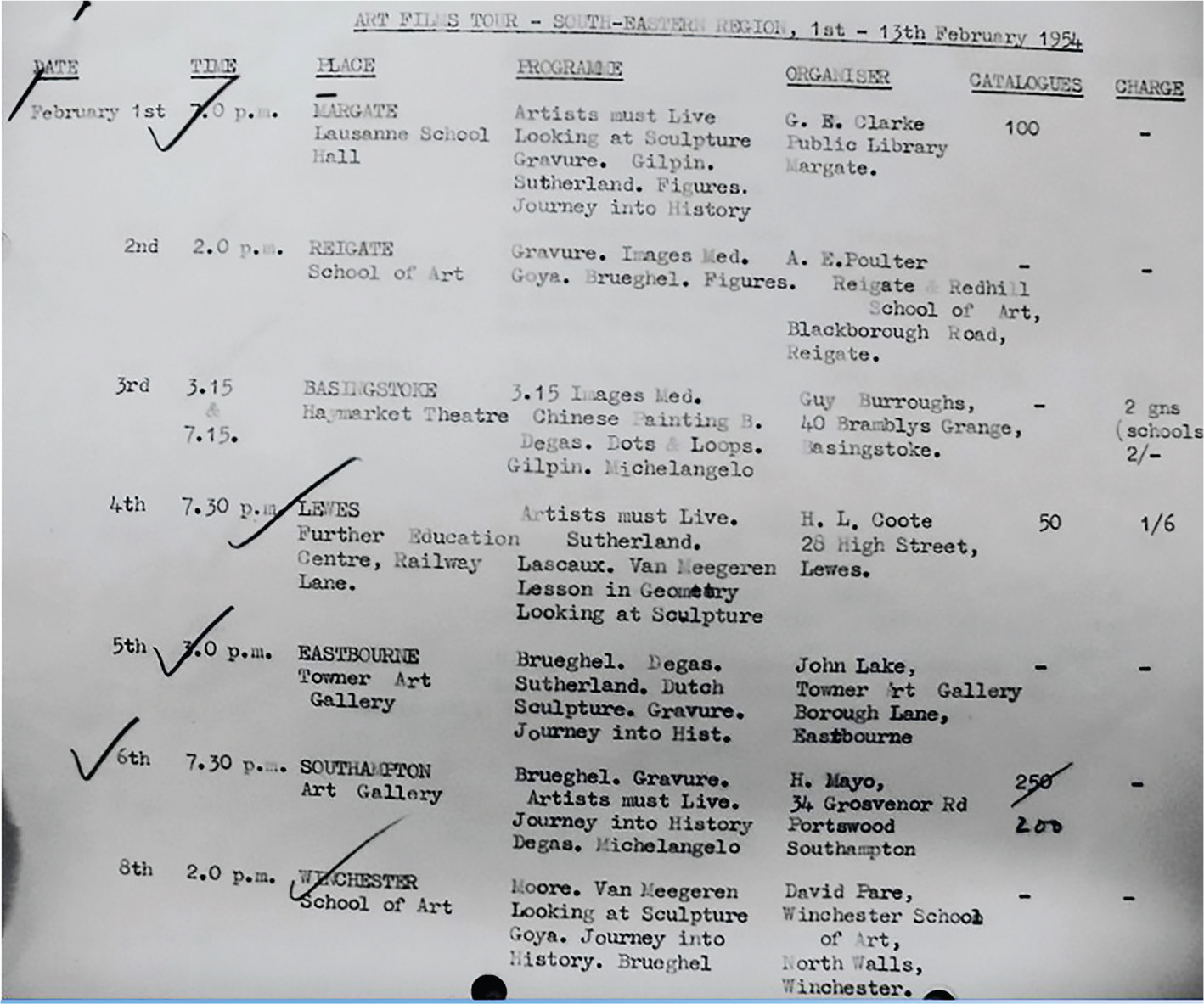
Figure 2
An example of an Art Film Tour itinerary from the first week of February 1954, with the mobile cinema alternating between educational venues (e.g. Reigate School of Art) and art galleries (e.g. Southampton) and the average curated programme consisting of five short films. Source: Arts Council of Great Britain Archive.
The initial service consisted of one mobile cinema unit, but by the late 1960s had increased to three simultaneously touring vans, driven by a projectionist, carrying a screen, a 16mm projector, sound equipment, and a typical repertory of twenty to thirty art films, ranging from films about the Great Masters to more documentary-like portrait films of contemporary artists. Many of the tour’s prints were purchased or hired from abroad, offering thus an up-to-date package of art films each year, published in specially designed catalogues with informational blurbs and illustrations. Local organisers would curate a programme that typically consisted of three to five films from each year’s catalogue, with one and a half hours as the recommended duration for most audiences.
Gradually, films about contemporary art and artists became the most popular, especially those that had already been broadcast by the public service medium of BBC Television. In an era before domestic video recorders, the Art Film Tour played a significant role in prolonging the exhibition of BBC-produced art films. Such were the cases of Henry Moore (John Read, BBC, 1951) and L. S. Lowry (John Read, BBC, 1957), both amongst the most frequently-booked films throughout the 1950s, and later Ways of Seeing (John Berger and Mike Dibb, BBC, 1972), the famous BBC arts documentary, which enjoyed popularity across the nontheatrical educational sector in the 1970s. In the case of the latter, the role of the Art Film Tour cannot be underestimated for making 16mm prints of Ways of Seeing available to art schools and colleges after its initial broadcast and entering art education’s curricula alongside Berger’s tie-in book with the same title. Other popular films with art school audiences included Jackson Pollock 51 (Hans Namuth and Paul Falkenberg, 1951, USA); Picasso (Lucianno Emmer, 1954, Italy); Francis Bacon: Paintings 1944-1962 (David Thompson, Arts Council, 1963); and Richard Hamilton (James Scott, Arts Council, 1968).
Local organisers were responsible for providing a suitable venue and doing the necessary publicity, with leaflets and posters supplied free of charge by the Arts Council’s Regional Offices. The Art Film Tour quickly acquired the ‘aura’ of uniqueness thanks to the very specific parameters of projection that it set from the early days. As described in the 1956/7 catalogue, ‘Conditions for Showing Films’:
All films are 16mm non-inflammable. They may only be shown by the Arts Council’s projectionist and through its projectors.
The films travel by road in a van, driven by the projectionist, with projector, screen and drapes.’20
The Arts Council’s control over the ‘performance context,’ down to the detail of the ‘drapes’, ensured the optimal conditions of projection, irrespective of contingencies as varied as the type and size of the venue or classroom, the portability and accurate functionality of the school’s equipment (if any), light and darkness conditions, and many more details contingent on the expertise of the staff organising the projection. The Art Film Tour thus nurtured the aura of what nowadays media theorists call ‘live cinema,’ a form of ‘experiential cinema.’21 For example, upon the final tour (1979/80), the Arts Council’s evaluation report stated that respondents to the farewell survey (that announced the end of the mobile cinema scheme) highlighted the ‘event’ nature of the Tour as the key feature that would be difficult to be replaced. This could explain its growing popularity and longevity for thirty years, even throughout the 1970s, when 16mm projection equipment had become common across the educational sector and had even started to enter the art school curriculum as a medium of artistic expression.22
The Art Film Tour coincided with the emergence of new art education policies and the construction of new art student identities. With the transition to new degree structures, the 1960s became the decade of radical reconfiguration of art school education methods in Britain. This was the result of late 1950s educational policies that dictated changes in the funding of art schools, awards and, by consequence, the curriculum. Gradually the ‘Local Authority Era’ was replaced by a new policy framework of National Academic Awards and by a concomitant and growing awareness of ‘pedagogy’, a contested concept for years to come, as the acclaimed historian of education Brian Simon later described in his polemical essay “Why no pedagogy in England?” (1981).23 In response to these policy changes and the introduction of the National Diploma of Art and Design, the well-established art magazine The Studio ran a series of articles titled “The Future for Art Schools” by artist and critic Mervyn Levy, each focusing on a specific art school and its tutors. The feature on Goldsmiths College’s School of Art (1961) includes an interview with a tutor named James Cranmer, who, as Levy explains, is in charge of the School’s ‘Experimental Film Group’, described as a ‘new departure.’ The tutor’s views are cited at length, expanding on his belief that ‘film is the most significant and dynamic medium of our time. It should be used extensively by artists and art students to help them in the study of movement, action, composition’, concluding that ‘The whole idea of life drawing and painting is a Renaissance concept anyway, and quite out of accord with the spirit of our time.’24 For an art-school tutor to pit film against life drawing suggests the growing relevance of the medium as a way of breaking away from stifling traditions, as well as new attitudes towards film’s correlation with pedagogic choices. As part of the Art School Educated project’s publications (2015), art historian Hester R. Westley included this Goldsmiths’ tutor’s views in her essay ‘The Many Lives of the Life Room,’ as a telling instance of the early 1960s debate about life drawing, which had started to be perceived as irrelevant in art school curricula.25
Texts and Spectators: the Case of ‘Showing Making’ in Art School Contexts
According to Kessler’s concept of the ‘performance dispositif’, the ‘spectator pole (…) does not refer to the experience of individual members of the audience who may have reacted in a variety of ways, but to the positioning of the audience in a specific type of performance.’26 In the case of art film’s spectatorships, there was often a direct, constructive alignment between the film, the institution’s specialism, and the positioning of the audience vis-a-vis the film. One example of receptive positioning is the case of the audience that watched the US film A New Way of Gravure (1950), about ‘Stanley William Hayter at work’ as part of the 1956 Art Film Tour.27 That year’s exhibition schedules included the Royal College of Art (RCA) and its booking of this 12-minute film for a stand-alone screening (rather than as part of curated programme of four to five films as was the norm). This indicates that its projection would have been part of a lecture or the core curriculum rather than an extracurricular projection in the evening. Considering the long-standing history of the RCA’s Printmaking Department and its distinct reputation and tradition in this field, it can be surmised that the RCA students were ideally positioned to learn from a film about Hayter’s innovative work in the legendary Atelier 17 in Paris.
In 1956, Herbert Read, the pre-eminent art critic and theorist of the time, proclaimed that ‘most instructive and inspiring are all those films that show the artist at work.’28 He did so as part of an essay “Art and Film,” published by the magazine of the Society for Education through Art, Athene, which by the late 1950s often endorsed art films for their educational values. To a large extent, Read’s view had been shaped by the BBC art films directed by his son, John Read, whose own vision aligned with the British Documentary Film tradition’s ‘creative treatment of actuality.’29 The director summed up his artistic credo in terms reminiscent of John Grierson’s pragmatism: ‘one makes films about art and artists for the same reasons that one makes films about ships and shipbuilders.’30 Apart from supporting his son’s observational art documentaries of British artists at work (Henry Moore, Graham Sutherland, John Piper), Herbert Read’s aforementioned statement was also meant as an evaluation of the expanding field of art films and its subgenres. For Read and other critics, the documentary strand of art films stood out for its simultaneously ‘instructive and inspiring’ potential inherent in the recording of an act of creation.
Documentaries about artists at work belong to a lineage of nonfiction films that art historian Ann-Sophie Lehmann has categorised according to their ‘showing making’ themes and their tropes of revealing and hiding the ‘act of making.’31 This was particularly prevalent in short Kulturfilme from the 1920s, where closeups of the artist’s hands became the dominant trope, as in the case of Creative Hands (Schaffende Hände) 1922–29, by German art historian-filmmaker Hans Cürlis, who centred the camera on what the hands of contemporary artists ‘do’ e.g. George Grosz, Wassily Kandisky, Käthe Kollwitz.32
With post-Second World War art films, ‘showing making’ developed into longer narratives, closely aligned with the artist’s vision, as in the case of one of the first feature-length art films Le mystère Picasso (Henri-Georges Clouzot, 1956), discussed by art historian Pierre Saurisse in the context of films that represent artistic creation as ‘magical revelation.’33 Alongside Picasso, the other two towering figures of postwar modernism, Henry Moore and Jackson Pollock, also became the subject of films, but with narratives that were more grounded on the materiality of the work, rather than on mystique: Henry Moore (John Read, 1951) and Jackson Pollock 51 (Hans Namuth and Paul Falkenberg, 1951).
The two films have hardly ever been discussed in tandem, let alone comparatively.34 Moore and Pollock shared similar world views about the ‘vitality’ of the work of art and their interest in becoming the subject of art films could be correlated with the medium’s unique ability to render vitality visible and almost tangible (Figure 3). At the same time, the two films revealed aspects of each artist’s creative process for the first time to art students and the wider public. I suggest that one of the multiple historical meanings of these films in post-war Britain relies on the interrelationship between their performance context (the Art Film Tour), the filmic text’s rhetoric of revelation (the attraction of the creative process), and the positioning of their spectators within the specific learning situation of art schools, even more so with art education in flux. Both films celebrate a type of ‘new artist’ who is grounded in the studio space and the materiality of their environment. Such representations would have resonated with art students of the late 1950s and 1960s, at the cusp of radical breaks against the tradition of the ‘life room’ in art school curricula.
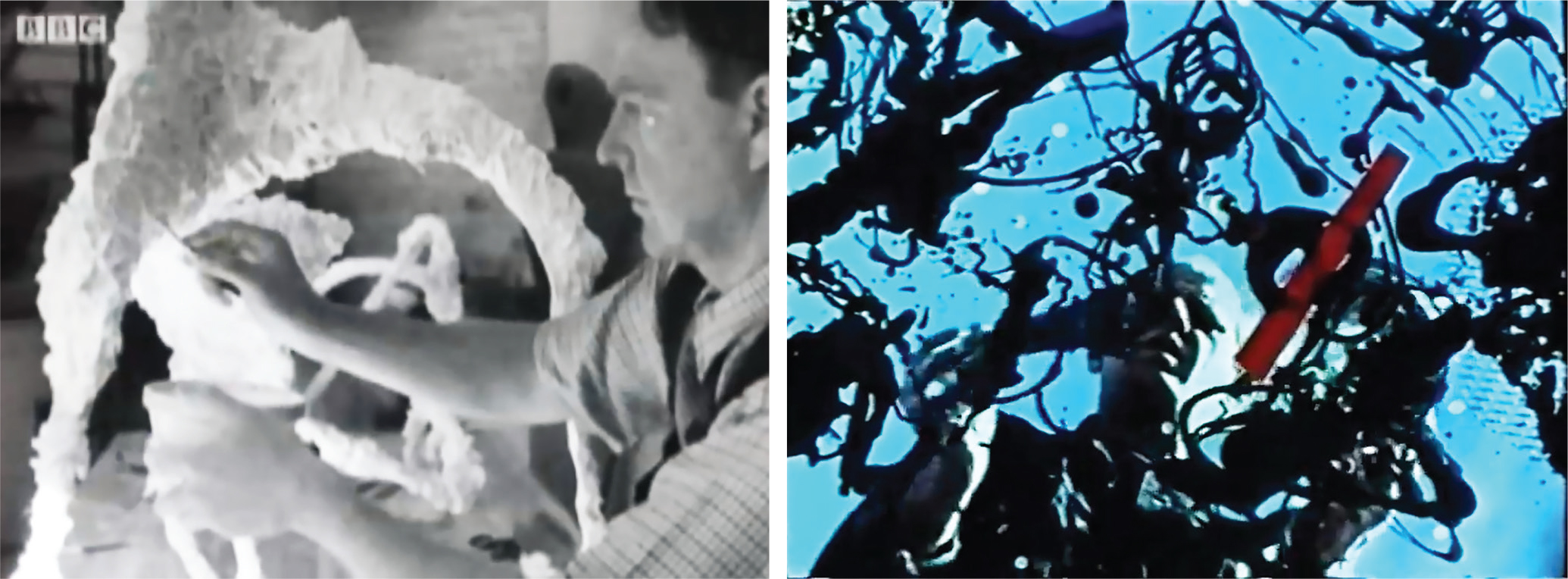
Figure 3
Rendering the invisible visible: A juxtaposition of indicative screen grabs from Jackson Pollock 51 and Henry Moore, where each artist’s body fuses into the materiality of the creative process. Both artists perform for the camera and engage in newly adopted techniques: Pollock painting on glass, making his ‘dripping’ technique visible; Moore working on the plaster model for what will become the bronze sculpture Reclining Figure Festival (1951), a work considered as emblematic for his shift from direct carving to modelling. For more information on how to access the films online, see endnote 35.
Moore’s and Pollock’s new methods, techniques, and choice of materials had attracted art-critical attention for their radical break with tradition. In the early 1940s, both artists had set up their studios away from the city, erecting the walls of their modernist laboratories in isolation. In both cases this was done for practical reasons: the need for studios big enough to accommodate their increasingly larger scale output. In the case of Moore, it was his radical break with the ‘direct carving’ tradition he had advocated throughout the 1930s and his move towards ‘modelling’ and larger scale sculpture.35
John Read, the director of Henry Moore, set the educational tone through a montage of shots of raw material, tools, and closeups of the artist’s hands. The second half of the film, though, combines master shots and analytical editing. The creative process is shown to consist of different, yet interlinked, stages. While the first part relies on the modernist aesthetics of montage, the second one builds a unified narrative. This is clearly manifested in the execution sequence, where each stage fluently leads to the next: drawing, moulding miniature models, and constructing the metallic frame of the larger-scale model. The culmination of the creative process is shown through a detailed record of the industrial conditions of casting in bronze. Here the mode is instructional, with explicit explanation of every stage of the complex wax method that changes the impermanent material of plaster into the durable medium of bronze. The filmic documentation of this method establishes the link between the artist and the world of manufacture, showing that Moore’s work in his studio is only one part of the creative process.
The Art Film Tour’s exhibition schedules show that after its first transmission on BBC Television in 1951, Henry Moore circulated widely in art schools throughout the 1950s, a period when British sculptors decisively endorsed the materials and techniques of bronze, industrial welded metal, and modelling, resulting in spiky and alienating sculptural structures that Herbert Read called ‘geometry of fear.’36 And with Henry Moore as a precedent, many more British sculptors became more open to the medium of film and showcased their new industrial processes of working with metal, such as another BBC production The Artist Speaks: Reg Butler (John Read, 1958).
In the case of Jackson Pollock 51, art historians have commented on the direct link between the film’s revelatory display of the artist’s method and subsequent generations of performance artists. Caroline Jones has even contended that the film was more influential than Pollock’s paintings: ‘in the sense that no one could copy Pollock’s dripped skeins of paint (…) without committing forgery, while the implications of his painting method were widely and consciously pursued by younger artists active in performance art, happenings, body art (…)’.37 This ten-minute film became the source of inspiration and influence on process art, performance, happenings, and artists such as Allan Kaprow, Bruce Nauman, Joseph Beuys, and Yoko Ono. The argument goes that it was Pollock’s kinetic action painting method shown on screen that fascinated critics and art students even more than his actual paintings. The film was the result of a collaboration between photographer Hans Namuth and veteran cinematographer Paul Falkenberg. With his most recent experience on educational and propaganda films, Falkenberg’s approach drew on the industrial process film conventions for shaping the materials into the staple documentary narrative of ‘a day in the life.’
Instead of reiterating myths about the ‘mystery’ of the creative process, the film utilises editing techniques and rhetoric that emphasise the materiality of the process, grounded by Pollock’s voice-over: ‘I like to use a dripping fluid paint. I also use glass, pebbles.’ The development of a painting on glass was recorded, with Namuth filming from underneath. This final sequence can be considered the most successful, as it visually elucidates Pollock’s radical decision to shift from the perpendicular to the horizontal canvas. The glass pane replacing the canvas had a clear instructive function: to demonstrate the gravity of the paint.
Jackson Pollock 51 premiered at MoMA in June 1951 and was subsequently distributed within a wide network of educational institutions. Doubtlessly, this is the first film that shows Pollock’s creative process. And its reception both in the USA and abroad was shaped by a critical discourse that foregrounded the process of action painting as a means of making sense of Pollock’s abstract expressionism. The Pollock film featured for the first time in the 1959 Art Film Tour’s repertoire. By comparison to earlier Tours, the 1959 one included an impressively wide-ranging set of art films. To name a few titles in the order listed in the catalogue: Cubism; Reclining Figure; Greek Pottery; Jackson Pollock 51; Can Art be Democratic?; Do Fakes Matter?; Two Baroque Churches in Germany; Reg Butler; Robert Breer Cartoons’38 This eclectic list manifests topicality and intention to combine tradition with modernism and new experiments.
The Pollock film was probably included in the Art Film Tour’s programming in response to two key events: the artist’s untimely death in 1956 and the first solo exhibition of his work in the UK in 1958 at the Whitechapel Gallery in London. Travelling to Europe from New York’s Museum of Modern Art, Pollock’s memorial show ‘provoked bewilderment and excitement’. It is still considered a landmark event in the reception of abstract expressionism in the UK, important enough to be remembered by David Hockney, who as a wannabe young artist hitch-hiked from the north of England to see the show.39 What a young artist, such as Hockney, would have seen on the Whitechapel Gallery’s walls, though, was merely the result of Pollock’s dynamic way of working: his huge canvasses. It was the film and its screenings in art schools that made Pollock’s kinetic method of action painting known to young artists. But only much later did art critics and historians make the connection between the film and its influence on new generations of artists.
Jackson Pollock 51 featured in innumerable educational film distribution catalogues and college libraries on both sides of the Atlantic. Its audiences were largely found in art colleges and other educational settings where the ‘studio’ was a physical reality and not only a cinematic one. The triangle of the ‘performance dispositif’ highlights the contingencies of the subject position of the ‘users-spectators,’ their ‘attitudes’ towards the performance context (differing between art school, art gallery, museum, film society, art history lecture) and ‘their expectations’ of the ‘textual pole’. If we take a hypothetical art-school spectator watching the Pollock film as part of a collective cinema experience amongst fellow classmates with whom studio spaces are shared, then the parameters of the dispositif change by comparison to a museum visitor to an exhibition of Pollock paintings, who might have stumbled across a screening of the film as part of the museum’s educational activities for the general public.40
Conclusion
By the late 1960s, the Art Film Tour had grown to an anticipated feature in many art schools. Its distribution catalogues included an increasing number of films about contemporary artists, who themselves had become art teachers, thus creating a momentum of reflexive feed. This was the case of pop artist and art-school teacher Richard Hamilton, who collaborated with filmmaker James Scott on the making of an art film about his creative process. The extensive screenings of the resulting film Richard Hamilton (1969) in art schools played a decisive role in the development of the Arts Council’s own policies of art film productions, once it set up the dedicated Committee for Film and Arts Documentaries, with a bigger budget allocated to the production alongside the circulation of art films.
At the same time, a series of conferences and publications (organised jointly by the Society for Education through Art, the BFI, and the Society of Film Teachers) reflected the urgency of the debates around film, the visual arts, and visual education at large. In 1958, the Joint Council for Education through Art published a collection of essays by key art critics and intellectual figures of the time, Artist, Critic and Teacher.41 It includes a contribution by the art critic John Berger called “The Myth of the Artist,” in which he castigates biopics, because he believed that they only offered a distorted view of artists’ position in society, portraying them as outsiders: ‘[The artist] gives us a magnifying glass in his work with which to see ourselves, to see our society. Because we dare not look through this magnifying glass at ourselves, we turn it round and goggle through it at his private life.’42 However, Berger’s aversion extended neither to nonfiction art films nor to the emerging arts television of the time, because he believed that art films turned the ‘magnifying glass’ back to the artwork and its sociological revelations. For example, Berger much admired Luciano Emmer’s documentary Picasso (1954), as he mentioned in a letter to the BBC in 1955.43 It was thanks to the Arts Council’s Art Film Tour that Emmer’s Picasso had circulated in art schools, gained popularity and featured on the Tour’s 1958-59 distribution catalogue (Figure 4). Although the films that Berger criticised—such as the biopics Lust for Life (Vincente Minnelli, 1956) and The Horse’s Mouth (Ronald Neame, 1958)—offered new types of cinematic explorations of art, his polemical tone echoes the lively debates of the time about the role of the arts in society in general and the educational paradigms that shaped artists in particular.
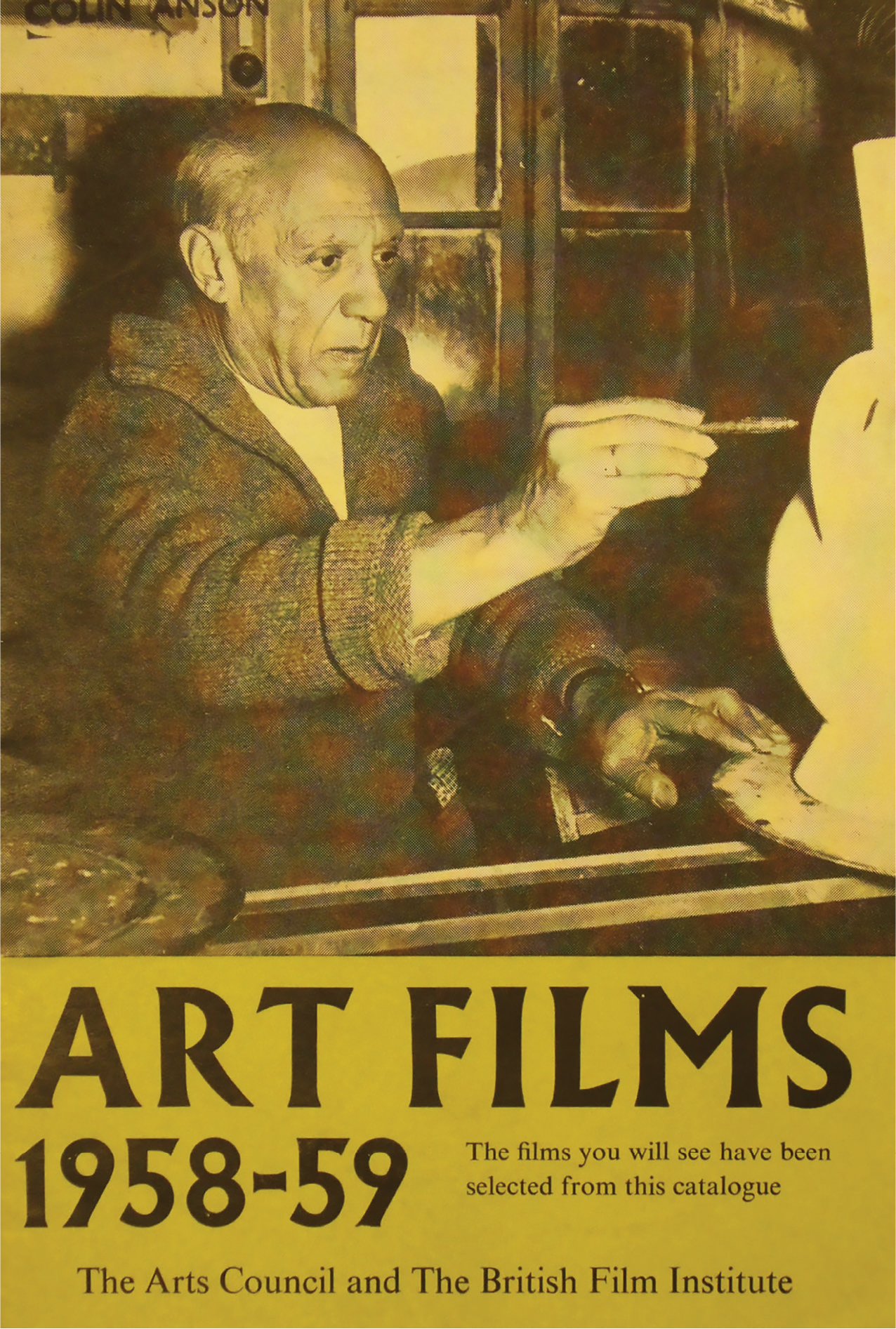
Figure 4
The Art Film Tour’s distribution catalogues became a key feature of the performance context, provided for free and carefully edited and illustrated. A still from Lucianno Emmer’s Picasso (1954) featured on the 1958-59 catalogue’s cover, because of its popularity with audiences.
A follow-up publication to Artist, Critic and Teacher was the more pedagogy-focussed book The Popular Arts (1964), co-written by Paddy Whannel and Stuart Hall, which included case studies of how to embed film and other popular media into formal secondary and post-secondary education. In the section “The Curriculum and the Popular Arts,” the authors designed seven ‘projects for teaching,’ each suggesting ‘ways of using films, records [and] reading matter linked by a particular theme.’ One of these projects was entitled ‘Portrait of the Artist,’ because the authors considered as ‘particularly important (…) the picture produced by the media of various kinds of creative artist.’44 The endorsement of art films by The Popular Arts’ authors reflects the increasing influence of this genre on a new generation of intellectuals to question the traditional barriers between the arts in educational contexts. A 2018 new edition of The Popular Arts celebrated the book’s long-term impact on the introduction of film studies in the UK’s education curricula. That art films had been included in this influential book attests both to the genre’s relevance in the early 1960s educational debates and to the fact that film projection had entered educational establishments on a regular and accessible basis, with the Art Film Tour contributing to such developments.
The aforementioned publications fit in the ‘performance’ and ‘spectator’ poles of the ‘dispositif’ triangle, in the sense that they played a role in shaping the teachers’ curatorial choices of art films and the audience’s expectations. Kessler points out that ‘the way in which the three poles of the educational dispositif are to be conceived needs to be specified on the basis of the source material. Such sources are scarce, and the available ones will generally offer only partial insights and demand to be extrapolated.’45 Film historian Tom Gunning has similarly called for a historiography that steers away from the naïve historicism of reconstructing the past ‘as it really was,’ and instead proposes to map what he calls the ‘original horizon of expectations’ of a film’s production and reception.46 Admittedly, my primary sources have been limited to the Arts Council’s archive of the Art Film Tour’s catalogues and schedules. These are the material traces of a dynamic and historically contingent mode of distribution and exhibition that my research attempted to position against the historical conjecture of novel cultural and educational practices in post-war Britain. Even if partial, the article’s scope might galvanise future investigations into the ‘multiple dispositifs’ of art education.
By positioning art films within the triangle of the educational dispositif, I attempted to reconstruct their potential creative agency, inspired by Gunning’s call for a historiography that shines a light on the ‘forgotten future’ of cinema.47 Instead of framing historical modes of film practice as an ossified past or precursor to what came after, I have endeavoured to investigate the potential these films represented then and what they stood for. The projection of the creative process in an art-school performance context projected the potential futurities of becoming a new type of artist. Even more so, in the historical context of the 1950s and 1960s when the art school curriculum was re-imagined and debated in the public sphere. This was an era when the then ‘new educational technology’ of art films was hardly confined within the walls of educational settings, but was simultaneously accessible to wider audiences, as part of the post-war new ideals for an ‘education through art’ and for films to ‘bring art to the people’.
Notes
[3] Helene E. Roberts, ed., Art History Through the Camera Lens (Amsterdam: Gordon and Breach, 1995); Robert S. Nelson, “The Slide Lecture, or the Work of Art ‘History’ in the Age of Mechanical Reproduction,” Critical Inquiry 26, no. 3 (Spring, 2000): 414–434,http://www.jstor.org/stable/1344289; Media in the Teaching of Art History, Conference, Marburg University, German Documentation Centre for Art History, November 2018, https://lehrmedien.hypotheses.org/konferenz.
[4] Frank Kessler, “The Multiple Dispositifs of (Early) Cinema,” Cinémas 29, no. 1 (2018): 55, https://doi.org/10.7202/1071098ar.
[5] Frank Kessler, “The Educational Magic Lantern Dispositif,” in A Million Pictures: Magic Lantern Slides in the History of Learning, eds. Sarah Dellmann and Frank Kessler (New Barnet: John Libbey, 2020), 182.
[6] At an international art films conference in 1957, Belgian art critic and director, Paul Haesaerts, proposed these terms as a way of categorising the increasingly varied range of art films, as reported by documentary film director John Read in his article “Artist into Film,” The Studio 155, no. 780 (1958): 65–69; see also, Steven Jacobs and Dimitrios Latsis, “Introduction: the Mid-century Celluloid Museum,” in Art in the Cinema: The Mid-century Art Documentary, eds. Steven Jacobs, Dimitrios Latsis, Birgit Cleppe (London: Bloomsbury, 2021), 10–13.
[7] J.P. Urlik, “Films Bring Art to the People,” UNESCO Courier II, no. 12 (1950): 6–7, https://unesdoc.unesco.org/ark:/48223/pf0000074946; Georges Fradier, “What Happens to Art Films?,” UNESCO Courier IV, no. 9 (1951): 16. Special Issue: The Cinema, https://unesdoc.unesco.org/ark:/48223/pf0000074696.
[8] Indicative scholarship (in chronological order) on the genre’s formative period includes: Siegfried Kracauer, “The Film on Art,” in Theory of Film: The Redemption of Physical Reality (Princeton: Princeton University Press, 1960): 195–201; Fanny Etienne, Films d’art, films sur l’art: le regard d’un cinéaste sur un artiste (Paris: L’Harmattan, 2002); parts of John Wyver, Vision On: Film, Television and the Arts in Britain (London: Wallflower Press, 2007); Katerina Loukopoulou, “A Cultural History of Films on Art in Postwar Britain” (PhD diss., Birkbeck College, University of London, 2010); Steven Jacobs, Dimitrios Latsis, and Birgit Cleppe, eds., Art in the Cinema: The Mid-century Art Documentary (London: Bloomsbury, 2021).
[10] Here and throughout the article’s references to the Arts Council and the Art Film Tour, I draw on my archival research in the Arts Council of Great Britain (ACGB) Archive, Victoria and Albert Museum Collections: ACGB/56 Major Direct Promotions, 1950–1993; ACGB/54 Policy and Information Files, 1951–1997. The ACGB archive’s description of contents can be accessed via https://www.vam.ac.uk/archives/unit/ARC34543.
[11] See: Tate Research (2009–14), Art School Educated: Curriculum Change in UK Art Schools 1960–2010, https://www.tate.org.uk/about-us/projects/art-school-educated; and this project’s major output: Nigel Llewellyn, ed., The London Art Schools, Reforming the Art World, 1960 to Now (London: Tate Publishing, 2015).
[12] Catherine Burke, “The Decorated School: Cross-disciplinary Research in the History of Art as Integral to the Design of Educational Environments,” Paedagogica Historica 49 no. 6 (2013): 813–827, https://doi.org/10.1080/00309230.2013.846924; Jeremy Howard, Catherine Burke, and Peter Cunningham, eds., The Decorated School: Essays on the Visual Culture of Schooling (London: Black Dog Publishing, 2013).
[13] For an account of the Art Film Tour’s 30-year history as an exemplar of post-war nontheatrical cinema, see Katerina Loukopoulou, “‘Films Bring Art to the People’: The Art Film Tour in Britain (1950–80),” Film History 19, no. 4 (2007): 414–422. Special Issue: “Nontheatrical Film,” eds. Dan Streible and Martina Roepke, https://muse.jhu.edu/article/231808.
[14] University of Westminster was the original host of the online database of the digitised films, available to be streamed only to ac.uk domain addresses. The website (http://artsonfilm.wmin.ac.uk) was decommissioned on 1st June 2022 and its archived version can now be accessed via the UK Web Archive: https://www.webarchive.org.uk/wayback/archive/20130412173851/http://artsonfilm.wmin.ac.uk/ The associated database records can be explored via Arts on Film in Westminster Research: https://westminsterresearch.westminster.ac.uk/repository/search?q=type%3Aarts+on+film. A large part of the Arts Council films has been absorbed to the BFI Player’s The Arts on Film Collection, but without the original meta-data records and contextual information: https://player.bfi.org.uk/free/collection/the-arts-on-film.
[16] On Youngman’s multi-faceted career as an artist and educator, see the introduction to her papers: University of Reading Special Collections, https://collections.reading.ac.uk/special-collections/collections/nan-youngman-artist-educator.
[17] Natalie Bradbury, “Pictures for Schools: Visual Education in the Classroom and the Art Gallery,” Paedagogica Historica 57, nos 1–2 (2021): 126–144, https://doi.org/10.1080/00309230.2021.1881132.
[18] Alex Southern, The Ministry of Education Film Experiment: From Post-War Visual Education to 21st Century Literacy (London: Palgrave Macmillan, 2016).
[19] Philip James, “Foreword” to Some Films on the Arts distributed by the BFI in association with the Arts Council of Great Britain, Tour Catalogue, 1950/1951 (ACGB/54).
[21] Sarah Atkinson, Helen Kennedy, Live Cinema: Cultures, Economies, Aesthetics (New York: Bloomsbury, 2018).
[23] Brian Simon, “Why no pedagogy in England?” in Education in the Eighties: the Central Issues, eds. Brian Simon and William Taylor (London: Batsford, 1981). See, also, the last chapter of Stuart McDonald, The History and Philosophy of Art Education (London: University of London Press, 1970); Brian Simon, “The Study of Education as a University Subject in Britain,” Studies in Higher Education 8, no. 1 (1983): 1–13, https://doi.org/10.1080/03075078312331379071.
[25] Hester R. Westley, “The Many Lives of the Life Room,” in The London Art Schools: Reforming the Art World, 1960 to Now, ed. Nigel Llewellyn (London: Tate Publishing, 2015), 54.
[29] For the origins of Read’s interest in the documentary see, John Read, “Is There a Documentary Art?” Sight and Sound 17, no. 68 (1948): 156–8.
[31] Ann-Sophie Lehmann, “Showing Making: On Visual Documentation and Creative Practice,” The Journal of Modern Craft 5, no 1 (2012): 9–23, https://doi.org/10.2752/174967812X13287914145398.
[32] Ann-Sophie Lehmann, Sandra Kisters, and Rachel Esner, eds., Hiding Making: Showing Creation: the Studio from Turner to Tacita Dean (Amsterdam: Amsterdam University Press, 2013), 27, 123.
[33] Pierre Saurisse, “Creative Process and Magic: Artists on Screen in the 1940s,” in The Mediatization of the Artist, eds. Rachel Esner and Sandra Kisters (Basingstoke: Palgrave, 2018), 99–114.
[34] Here, I draw on and synthesise my research on each film published in separate essays. See, Katerina Loukopoulou, “The Mobile Framing of Henry Moore’s Sculpture in Post-war Britain,” Visual Culture in Britain, 13, no. 1 (2012): 63–81. https://doi.org/10.1080/14714787.2011.641785; Katerina Loukopoulou, “Museum At Large: Aesthetic Education through Film,” in Learning with the Lights Off: Educational Film in the US, eds. Devin Orgeron, Marsha Orgeron, and Dan Streible (New York: Oxford University Press, 2012), 356–376.
[35] Henry Moore (1951): “Henry Moore,” BBC Archive, last modified June 10, 2019, https://www.bbc.co.uk/archive/henry-moore/znkkf4j; if outside the UK: “Henry Moore,” YouTube, last modified December 8, 2011, https://www.youtube.com/watch?v=BZAde-PBoD8 Jackson Pollock 51 (1951): clips are available via “Jackson Pollock 51: Short Film Captures the Painter Creating Abstract Expressionist Art,” Open Culture, last modified August 8, 2022, https://www.openculture.com/2011/08/jackson_pollock_lights_camera_paint.html. The full film is available via the YouTube channel of Fondazione Ragghianti: Fondazione Ragghianti, “Jackson Pollock,” YouTube, last modified May 31, 2021, https://www.youtube.com/watch?v=atu4uVT7bV8.
[36] Tate, “Geometry of Fear,” https://www.tate.org.uk/art/art-terms/g/geometry-fear.
[39] Michal Goldschmidt, “Chronology,” in Postwar Modern: New Art in Britain, 1945–65, ed. Jane Alison (Prestel Verlag and Barbican Art Galler, 2022), 314; Whitechapel Gallery, “Archive: Staging Jackson Pollock,” 2018–19, https://www.whitechapelgallery.org/exhibitions/staging-jackson-pollock/.
[40] Julian Hanich, The Audience Effect: On the Collective Cinema Experience (Edinburgh: Edinburgh University Press, 2018).
[41] Paddy Whannel and Alex Jacobs, eds., Artist, Critic and Teacher (London: Joint Council for Education through Art, 1958).
[42] John Berger, “The Myth of the Artist,” in Artist, Critic and Teacher, eds. Paddy Whannel and Alex Jacobs (London: Joint Council for Education through Art, 1958), 22.
[43] John Berger, Letter to Leonie Cohn (BBC Talks), May 8, 1955, BBC Written Archives Centre (WAC): John Berger File 1946–1961. Berger’s letter includes a proposal for a series of radio and television programmes (unrealised) that would compare Picasso’s paintings with Charlie Chaplin’s films.
[44] Stuart Hall and Paddy Whannel, The Popular Arts (London: Hutchinson, 1964), 419; On the book’s impact, see Terry Bolas, Screen Education (London: Intellect, 2009), 110–111 and the new edition with an appreciation by Richard Dyer: Stuart Hall and Paddy Whannel, The Popular Arts (Durham: Duke University Press, 2018).
Biography
Dr. Katerina Loukopoulou is a film and media historian, educator and researcher. She is Senior Academic Developer at Middlesex University London. Her research interests include nontheatrical and educational cinema and her writings on this topic have appeared in the journal Film History (Indiana University Press) and in the collection Learning with the Lights off: Educational Film in the United States (2012). Katerina’s current research investigates the relationship between film and public pedagogies.