
Introduction
The “Nutslezing” is such a typical Dutch phenomenon that it has passed through all different stages of appreciation, from admiration to rejection.1
Such were the words, written in 1934, of the secretary of the national administration of the Maatschappij tot Nut van ‘t Algemeen, Society for the Common Benefit, on the society’s staple activity: the organisation of public lectures, commonly known under the term Nut-lecture, Nutslezing. This type of event, an instrument of popular education introduced since the first years of the Society in the 1780s, became as pervasive a phenomenon in the Netherlands as an object of derision because of its ‘degeneration into occasions for entertainment, conviviality or mediocrity.’2 In Dutch, the term Nutslezing not only immediately identified the organiser of the lecture, the Maatschappij tot Nut van ‘t Algemeen—also known as ‘t Nut—, but the word nut also means ‘useful’, which would then translate literally to ‘useful lecture’. This seemingly straightforward connection of ideas would have been greatly appreciated by the Society’s national administration. Alas, this was not the case. In fact, content and form of the Nutslezing were the object of a long-standing discussion between the administration and the local departments of the Nut. The central issue was to what extent a lecture could be made appealing without becoming a stage for popular amusement. The discussion was complicated by the fact that board members of approximately 300 local departments across the country had different opinions, too, about suitable speakers and topics, target audiences, and strategies to make a useful and instructive lecture sufficiently ‘attractive’.3 One possible strategy was the use of image projection.4
In 1900, the Society for Common Benefit became a member and benefactor of the then recently established Vereeniging tot het houden van Voordrachten met Lichtbeelden, the Association for the Organisation of Illustrated Lectures.5 The goal of this association was to provide a centralised, national rental service of lantern slides and readings to support popular illustrated lectures by fellow organisations working in the field of popular education.6 Henceforth slide projection became an accessible media technology for the Nutslezingen.
In this article I will investigate the way in which the lantern was incorporated into this particular educational phenomenon in the first decades of the 20th century. Using media historian Frank Kessler’s educational dispositif as a lens, I will analyse how the technological and practical affordances and conditions of image projection connected with the requirements, goals, and expectations articulated by the different stakeholders, such as audiences, speakers, local board members, and the national administration. Particularly, I will examine how they regarded image projection within the ongoing discussion of what a Nutslezing should and should not be. To answer these questions I have mainly consulted archival source material such as correspondence between the national administration and the local departments, as well as their printed communication in the form of reports and periodicals.
Approach: the educational magic lantern dispositif
Frank Kessler describes the concept of the educational magic lantern dispositif as a tool which can be used to ‘outline the complex interplay between the various constituents of an educational or instructive projection situation’.7 Kessler proposes to consider these various constituents within an interactive, triangular configuration, one in which the three angles link (1) the performance context, (2) the textual elements, and (3) the audience. First, the performance context includes techno-pragmatic constraints and affordances such as the size and disposition of the room to the use of technological devices such as the magic lantern. Second, the textual elements refer to the images projected, the spoken words of the lecturer as well as sound effects or music: in short, the content of the communication itself. And third, the general attitude or position of the audience towards the educational media performance such as, but not limited to, ‘those wanting or needing to learn’.8
According to Kessler, the educational magic lantern dispositif is a ‘specific configuration where the transmission of knowledge is foregrounded, but it does not exclude other purposes which can range from entertainment to propaganda’.9 This model is a productive blueprint for historical investigation, because it provides a framework for analysis that highlights not only the particularities of different media configurations, but also the situational and relational dimensions of a mediated social event such as the public illustrated lecture.10 Considering the Nutslezing as a particular situation, I will discuss its emergence and development within the Society for the Common Benefit in the first sections of this article, as well as its membership of the Vereeniging tot het houden van Voordrachten met Lichtbeelden. Next, I will focus on the relational dimensions of the Nutslezing, in particular on how the techno-pragmatic element of image projection influenced the other two aspects—textual content and audience position—of the dispositif. Investigating the Nutslezing through the lens of the educational magic lantern dispositif provides a framework for untangling the web of institutional, technological, and performative elements at work.
The Maatschappij tot Nut van ’t Algemeen
If one were to ask a casual observer of our Society: what does ‘t Nut do, the answer will be in nine out of ten cases: it gives lectures.11
The Genootschap van Kunsten en Wetenschappen, onder de zinspreuk: Tot Nut van ‘t Algemeen, Society for Arts and Sciences under the motto For the Common Benefit, was established in Edam in 1784, following an idea of Mennonite pastor Jan Nieuwenhuyzen and implemented by his son, the Edam-based physician Martinus Nieuwenhuyzen.12 Three years later, in 1787, the Society moved its headquarters to Amsterdam and changed its name to Maatschappij tot Nut van ‘t Algemeen, Society for the Common Benefit.13 Its goal was ‘the development of the disadvantaged and poor, by persons (the members) who, due to their education and their money, are able to help others’.14 The money and time of prospective members would be devoted to finding strategies so that ‘ignorance and immorality might be either partly eliminated, or at least ameliorated, and knowledge and virtue cultivated’.15 During its first year of existence, the Society managed to recruit 345 members and establish five departments; by 1800 it counted 3,678 members and 52 departments; by 1900, 13,361 members and 299 departments; with some fluctuation, the greatest number of departments was reached in 1959 (349) and membership peaked in 1961 (47,479 members).16 Today, the Society has about 70 departments.17
Previous scholarship has outlined the profound and lasting impact the Society’s work on popular education had on the Dutch educational system.18 Its strategies to ‘cultivate knowledge and virtue’ were many throughout the years: it published user-friendly schoolbooks; compiled reports on the state of education and formulated initiatives for improvement; established Nut-primary schools; and founded what it considered was the first public lending library in Europe, in the Haarlem department in 1791.19 By 1934, it boasted hundreds of libraries (including four open-air libraries) but also savings and loan banks,20 reading rooms, nurseries, primary and vocational schools, a large range of courses, music, singing and theatre groups as well as swimming schools and even two ice skating rinks (Figure 1).21
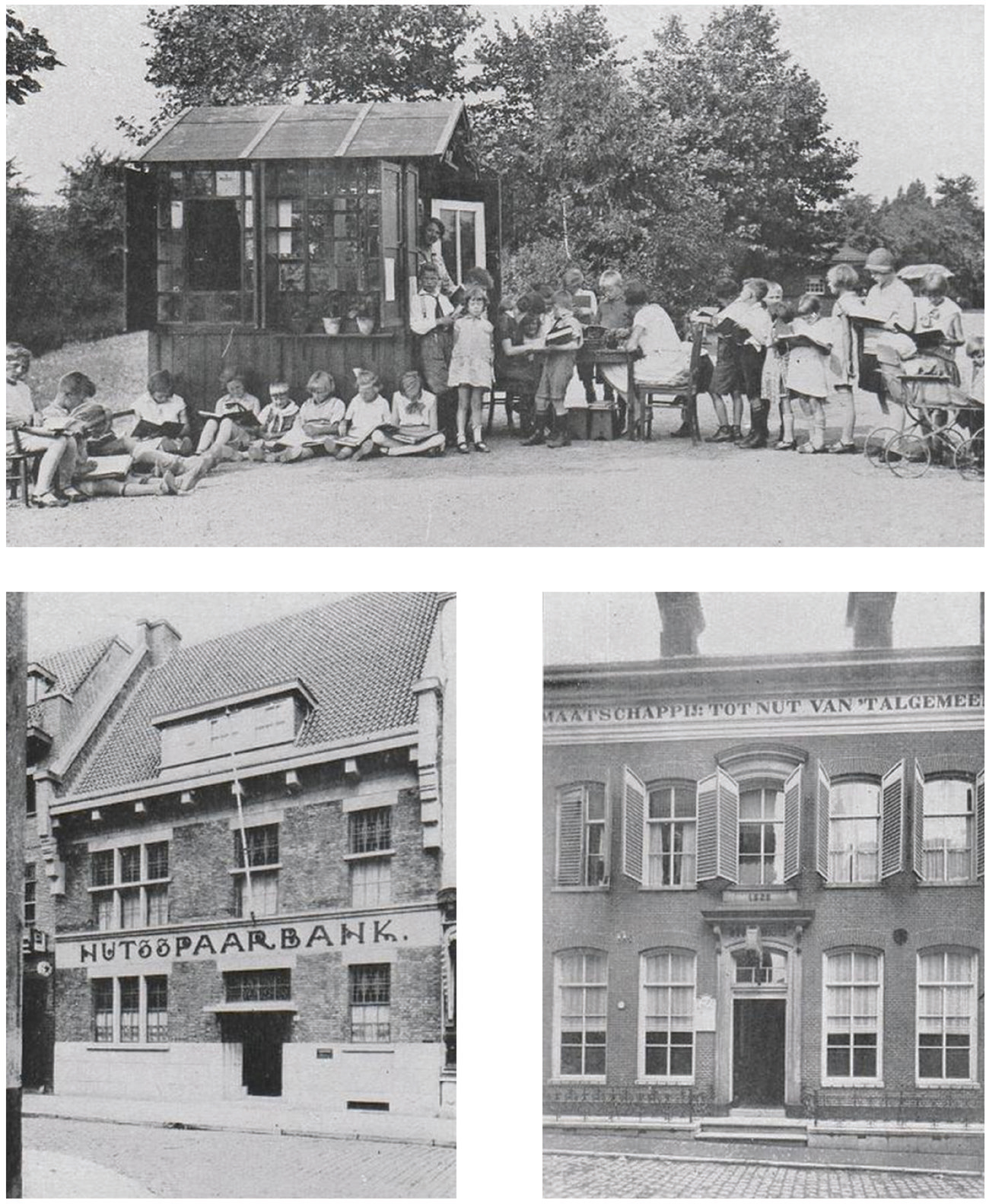
Figure 1
Some facilities of ‘t Nut in 1934: open-air library in Amsterdam, savings bank in Breda, and the Society’s building in Groningen. Source: “Prentenboek van het Nut - Nu,” in Gedenkboek Maatschappij tot Nut van ’t Algemeen 1784-1934 (Leiden: A. W. Sijthoff’s Uitgeversmaatschappij N. V., 1934), II, VI, XIV, https://resolver.kb.nl/resolve?urn=MMKB24:071674000:00285.
By 1902, the Society defined itself by three main articles: to promote ‘general happiness’ by improving intellectual, moral, and social conditions through popular education; to do so independently of any ecclesiastical or political interests; and to achieve its goals through the facilities and the activities established and organised by its departments across the country.22 The public lecture, the Nutslezing, was one of the most recognisable activities.
Dutch historian P. N. Helsloot asserts that, in addition to the entertainment and social dimensions that it has acquired over the years, the Nutslezingen must also be recognised as an enduring phenomenon in adult education, and one of the first methods for social and cultural development in the Netherlands.23 One early type of Nutslezingen were the so called Volksvoordrachten or Volksvoorlezingen, ‘popular lectures’ or ‘lectures for the people’, which were intended for the lower classes.24 The department of Rotterdam, for instance, organised about ten lectures per season since 1818: tickets were free of charge and were intended for ‘men from the less fortunate working class, of any religious affiliation, above 18 years of age’.25 Topics were varied, with such titles as Marriage is a Sacred Union, About the Useful and Pleasant Reading of Travel Descriptions, The House of Orange or Benjamin Franklin. The departmental board seemed to have chosen its topics in conjunction with its distribution of useful literature and a repertoire of ‘trusted speakers’.26 By 1825 attendance had reached 500, necessitating a move to a larger venue.
In the next decades, individual departments followed the Rotterdam example. But in 1859 a national approach was tested: aiming for a certain standardisation, the administration hired two lecturers (one for the fields of history, the nation, its population and economy, and one for the natural sciences) who would deliver three lectures per year, per department. Nevertheless, this approach failed, and the administration realised that local departments preferred to have a say in choosing their own speakers: in fact, the proposal had been under attack since the very beginning with many departments sarcastically naming the lecturers ‘priests of science’ (priesters der wetenschap), ‘itinerant stage actors who did not reach their destination’ (rondreizende toneelspelers die de plaats van bestemming niet bereikten) or ‘lecture machines’ (leesmachines). 27 During the 1870s, lectures intended for a wider popular audience became more infrequent. On the other hand, lectures for their own members gained importance within the departments’ activities.28 Attendance to these Nutslezingen was often extended to the members’ families, with invitation cards and tickets for women (Figure 2).29
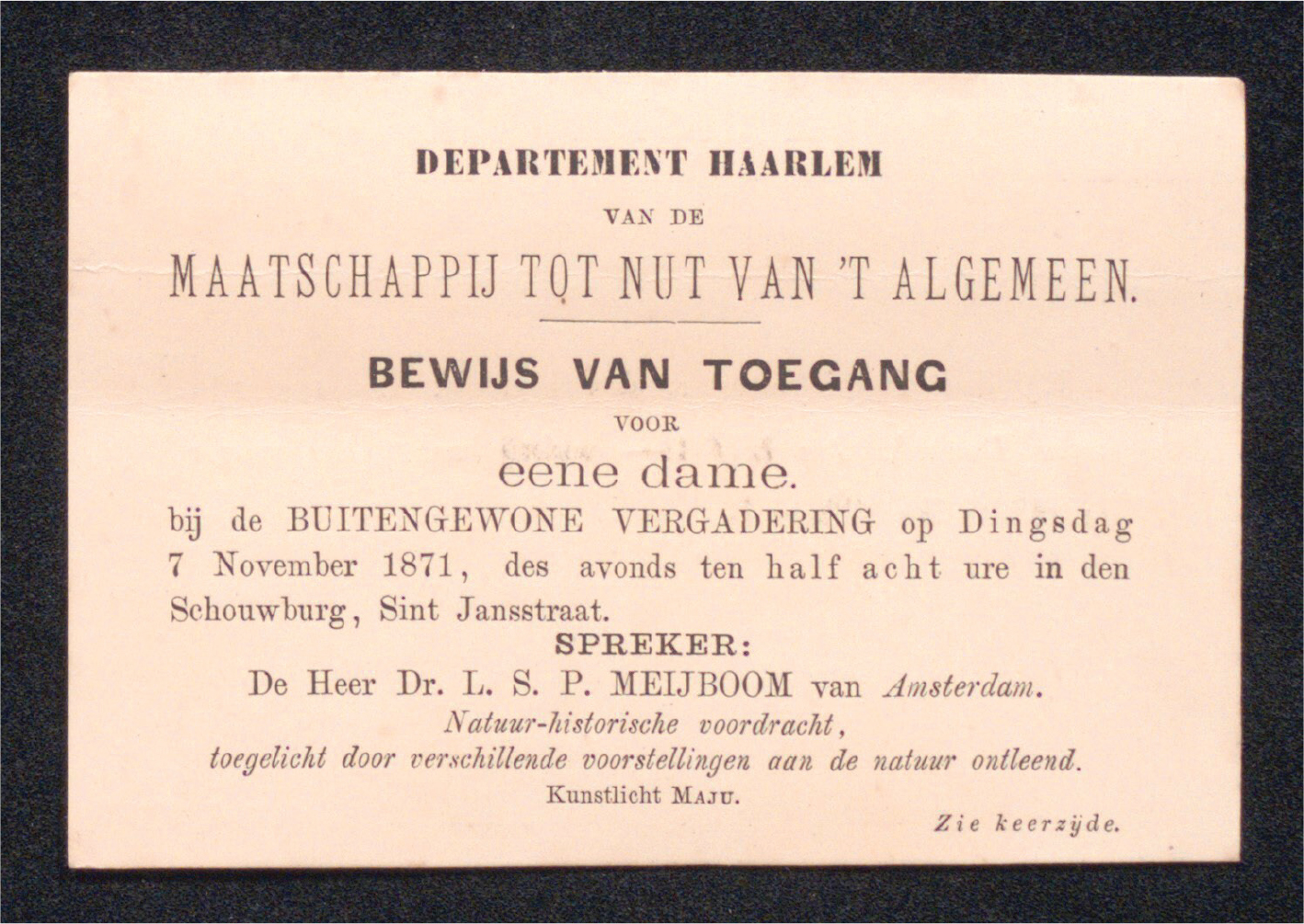
Figure 2
[recto] Invitation card November 7, 1871, Haarlem Department. The card reads ‘entry ticket for one lady.’ Source: Noord-Hollands Archief.
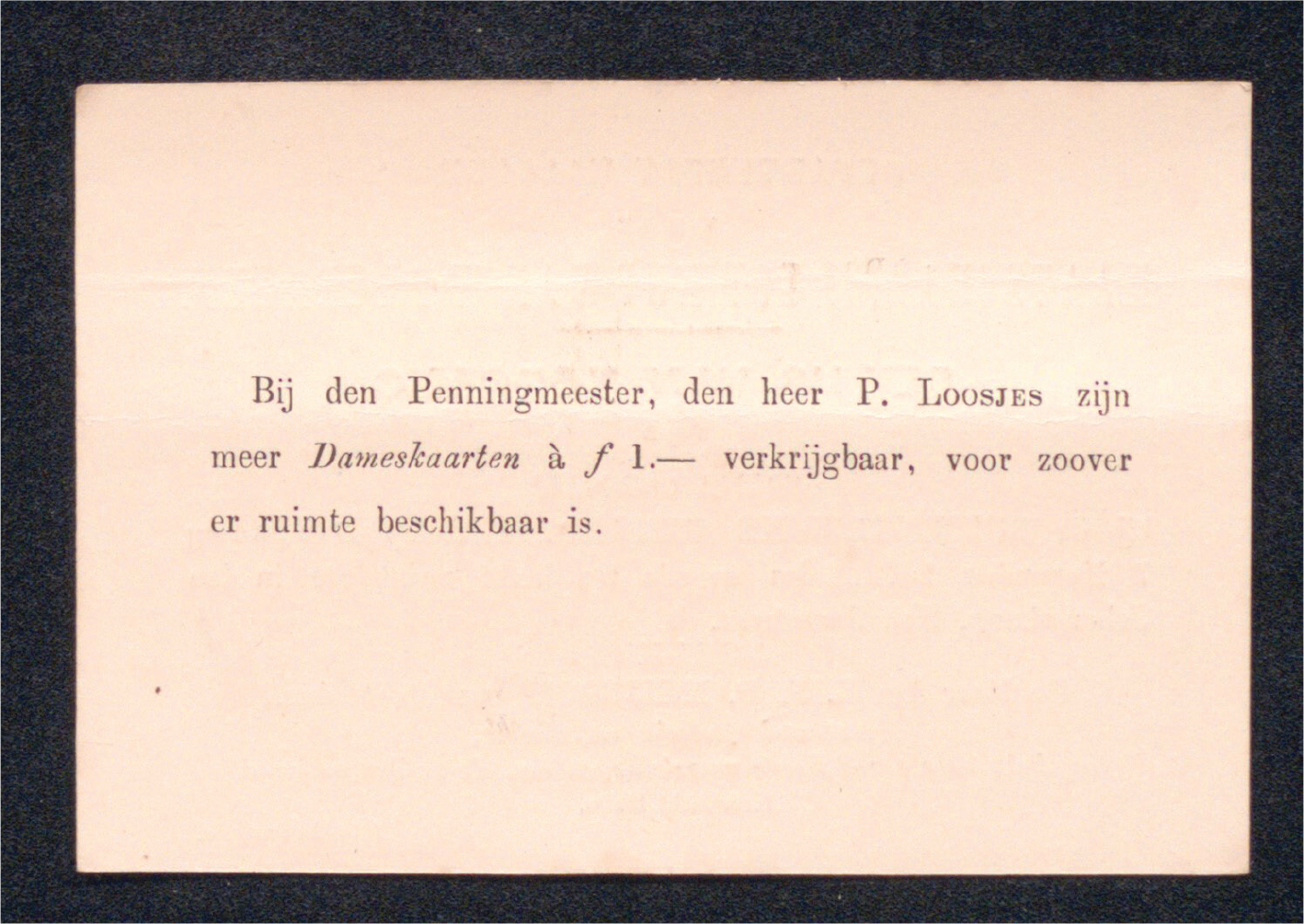
Figure 2
[verso] Invitation card November 7, 1871, Haarlem Department. The reverse side of the card reads that ‘additional Ladies’ Tickets could be acquired at the price of one guilder, whenever seats are available.’ Source: Noord-Hollands Archief.
Lectures ‘according to the national administration’
In the Society’s general meeting of 1895, a motion was passed to allocate 1,000 guilders (almost 15,000 euros today) of the national budget to ‘the compensation of travel and lodging expenses for speakers who would make themselves available to lecture in departments outside their place of residence, on subjects that are connected to the goals of the society’.30 Local departments could book a speaker of their preference through the national administration, which would directly invite the speakers and pay a 25 guilders fee per lecture. One of the conditions the administration stipulated to fund these lectures was that local departments made them accessible to non-members.
In the first lecture season under the new scheme, 1895/96, eleven approved speakers lectured in 63 departments, and in the following year 15 speakers delivered 98 lectures. The Nutslezingen held under these conditions were labelled lezingen namens het hoofdbestuur, or voordrachten vanwege het hoofdbestuur, lectures in accordance with the administration.31 The scheme proved to be quite successful, and by 1902 its annual budget had more than tripled.32
Initially, the list of speakers, predominantly male but also including female speakers, and lecture topics approved by the administration were listed in its annual reports.33 However, in 1902, a new communication channel was created: a periodical named Mededeelingen, announcements, was published about four times a year. Its first issue contained an extensive section on this lecture scheme, which would eventually become an annual feature in the summer issue, just before the start of the ‘lecture season’, which ran from October through April.34 It outlined the most recent regulations and a growing speakers list, listing their names, the topics of their lectures, their addresses (an important detail, as it allowed direct contact between department and speaker), as well as any specifics a speaker might require. These could be travelling conditions. J. W. van der Linden, for instance, who lived in Harlingen and lectured on Typologies of characters from the works of Dickens among other themes, would travel only ‘to places connected by train or tram in the provinces of Friesland, Groningen, and North and South Holland, but not on the islands’.35 A speaker’s conditions could also involve technical requirements for his lectures, such as the projection of images. This was the case of Dr. L. Bleekrode, from The Hague, whose topics included Preparation of fire, then and now, with projection of slides and demonstrations, and who wished to discuss the details of his lecture in advance with the local department’s board, as the performance depended on the availability of gaslight at the venue; or the case of D. de Clercq, from Bloemendaal, who offered topics such as The Natural Style of Life and The Exhibition of 1902 in Düsseldorf: he could lecture with or without slides, but if projection was requested, additional costs amounted to five guilders plus transport to and from the nearest station.
While in 1902 the list counted only 24 speakers, it expanded greatly, with new topics and speakers being added almost every season. The requirements became also more detailed: in 1909 for instance, Dr. Willem Vogelsang, professor of Art History at Utrecht University, who listed topics such as Sculptors of the Renaissance or The Gesture in Visual Arts, declared that all his lectures would feature the projection of ‘his own slides’ and for that he required a lantern with a strong light (limelight or electric) and an ‘impeccably, tightly stretched screen’.36 In 1917, the new periodical of ‘t Nut, Nutswerk, listed 71 speakers, including a new section on lectures with image projection about the Dutch East and West Indies colonies, with 13 speakers. By 1923, the list was published as a separate booklet and included 82 speakers (Figure 3).37 By 1935 the booklet was subdivided into themes: literature, history, geography, social-economical, philosophical, psychological, and pedagogical subjects, physics, art appreciation and the performing arts.38 A short biographical note for each speaker was added.
An enduring rule throughout the years was the requirement to submit a report to the national headquarters in Amsterdam within 14 days of each lecture: the administration provided a form to be filled out, but also welcomed more extensive reports.39 This was an important tool to measure outreach, since the administration considered these lectures, besides a vehicle for popular education, an important marketing device for recruiting new members. Admission details differed between departments: while the national administration suggested that free invitation cards, to be distributed by members to their acquaintances, would be a good approach to address non-members, 40 local department boards had full discretion to determine ticket prices (Figure 4 to 6). Additionally, to make these lectures as attractive as possible to a wider audience the administration promised to subsidise the costs of technologies ‘of illustration’ such as music or the projection of images.41
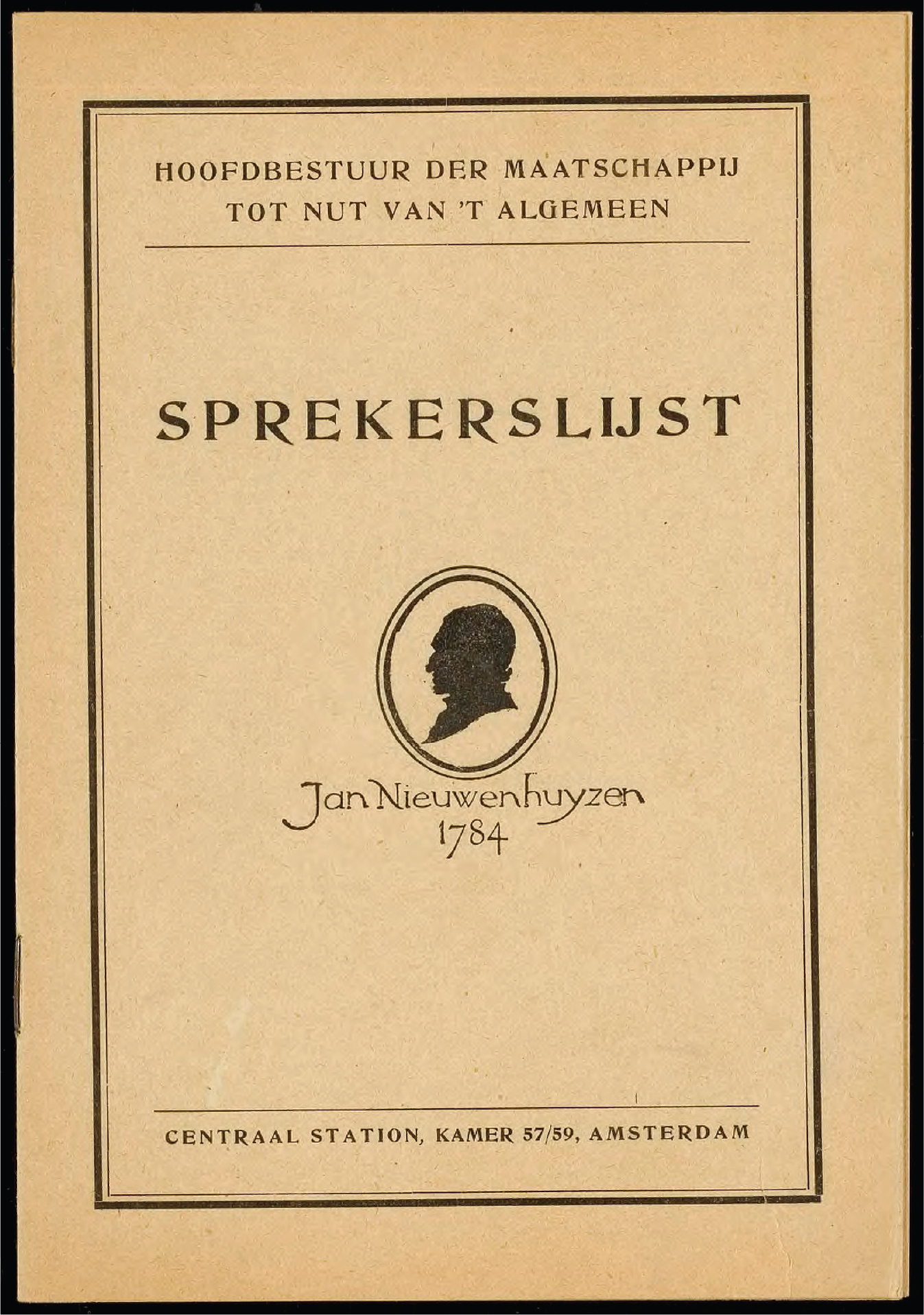
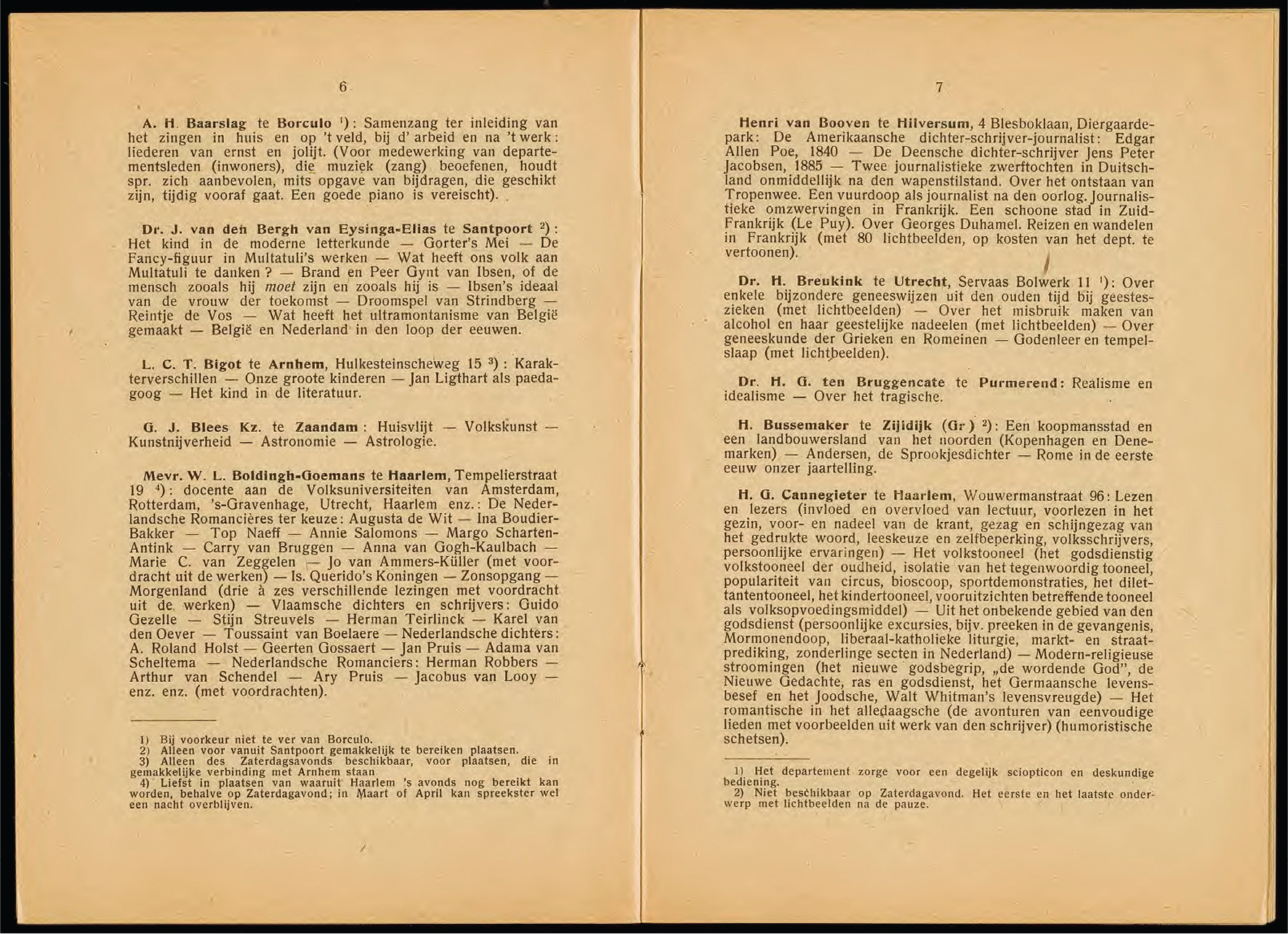
Figure 3
Cover and example of inner pages of the Speakers list of 1923. Sprekerslijst (Amsterdam: Hoofdbestuur der Maatschappij tot Nut van ’t Algemeen, 1923). Source: Stadsarchief Amsterdam.
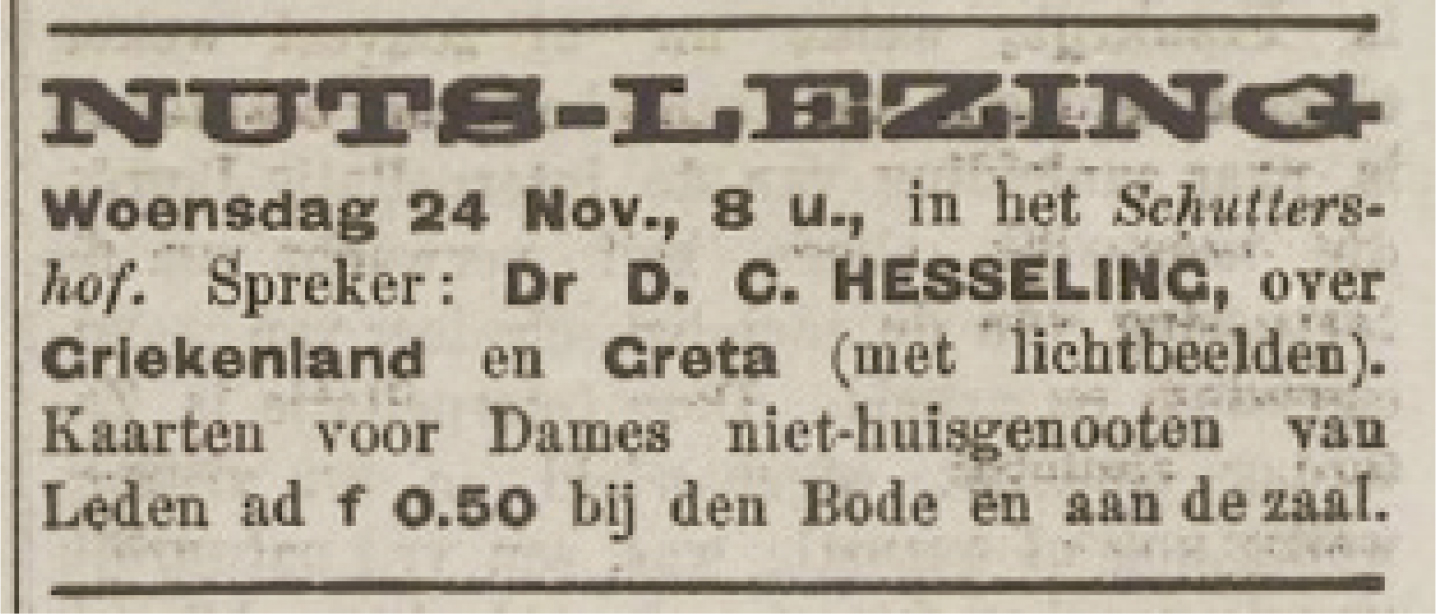
Figure 4
Advertisement in the Middelburgsche Courant of November 23, 1897, for a Nutslezing from the Middelburg department of the Maatschappij tot Nut van ‘t Algemeen. It states that ‘tickets for ladies not living in the same house as members cost 50 cents and could be acquired in the venue.’ Source: “Advertentie Nuts-lezing,” Middelburgsche Courant, November 23, 1897, 4, https://resolver.kb.nl/resolve?urn=ddd:010630075:mpeg21:p004
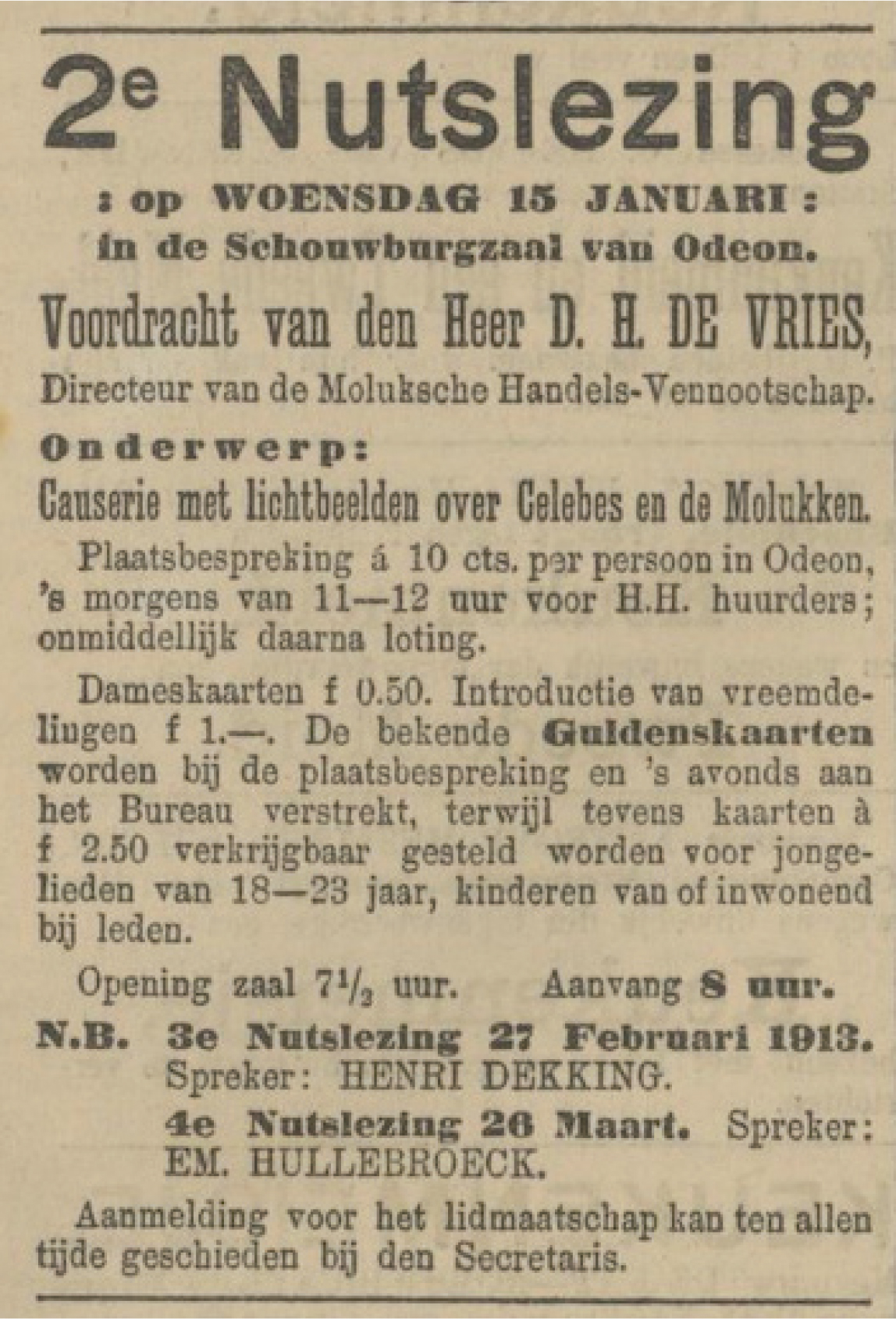
Figure 5
Advertisement in the Provinciale Overijsselsche en Zwolsche Courant of January 11, 1913, for a Nutslezing from the Zwolle department of the Maatschappij tot Nut van ‘t Algemeen. Several details are mentioned: seats could be reserved at 10 cents; tickets for ladies cost 50 cents, for ‘strangers’ fl 1,- , and fl 2.50 [season ticket] for youngsters between 18 and 23 and children of or living with members. Source: “Advertentie 2e Nutslezing,” Provinciale Overijsselsche en Zwolsche Courant, January 11, 1913, 7, https://resolver.kb.nl/resolve?urn=MMHCO01:000081946:mpeg21:p007.
The Vereeniging tot het houden van Voordrachten met Lichtbeelden (Lichtbeelden-Vereeniging)
While some speakers used their own slides, such as Prof. Vogelsang mentioned above, others could make use of the slide collection of the Vereeniging tot het houden van Voordrachten met lichtbeelden, Association for the Organisation of Illustrated Lectures.42 This association, later known also as Lichtbeelden-Vereeniging, Lantern Slides Association,43 and Lichtbeelden-Instituut, Lantern Slides Institute,44 had been founded in Amsterdam, in 1898, by a group of Toynbee-associations.45 Its mission statement was formulated as follows:
The Association for the Organisation of Illustrated Lectures aims to bring into circulation existing magic lantern slides and their accompanying readings, in order to promote and make accessible the organisation of illustrated lectures across the country.46
Its focus on popular education aligned with the mission of ‘t Nut and in 1900 the Society became a member and benefactor.47 This meant that, upon annual payment of 200 guilders by the national administration, each department could make use of the slide sets and readings of the Lichtbeelden-Vereeniging. In 1902, their brand-new periodical included a feature on the rules and possibilities of this collaboration.48 This section, Voordrachten met Lichtbeelden, Lectures with slide projection, outlined the dates by which the departments had to make their requests and where to buy or rent a lantern. The departments also had to pay the slide sets and readings’ shipping; readings were sent by mail at least ten days before the lecture date, the slides at least two days in advance. After the lecture the department had to return them to the Lichtbeelden-Vereeniging as soon as possible, as well as the completed report form to the administration. This form included questions such as: How was the lecture publicised? How did non-members gain entrance to the lecture? What special measures were deployed to make the lecture attractive?49
There were also particular directives for the performance: the administration recommended that the lantern should not be operated by the speaker, but by someone ‘trustworthy’ to give the correct flow to the projection. Additionally, the speaker should refrain from reading the text to the audience but make the text ‘his own’ as much as possible. Finally, this section provided a list of the slide sets and readings for the upcoming season: for 1902/1903, 28 sets were available with text, and 21 without. Besides the number of slides per set, the list also detailed the author of the accompanying reading, if available. A few examples are Architecture in the Netherlands, written by Dutch architect H. P. Berlage or Visit to an English Coalmine, by Dutch engineer R. A. van Sandick. The slide set on Astronomy for instance, could be used with the small manual written by Dutch education expert and politician A. H. Gerhard, which included not only an explanation for each slide but also advice for the (inexperienced) speaker (Figure 7). Sets without text included titles such as The Paris Exhibition of 1900, Harmful Insects, or China.
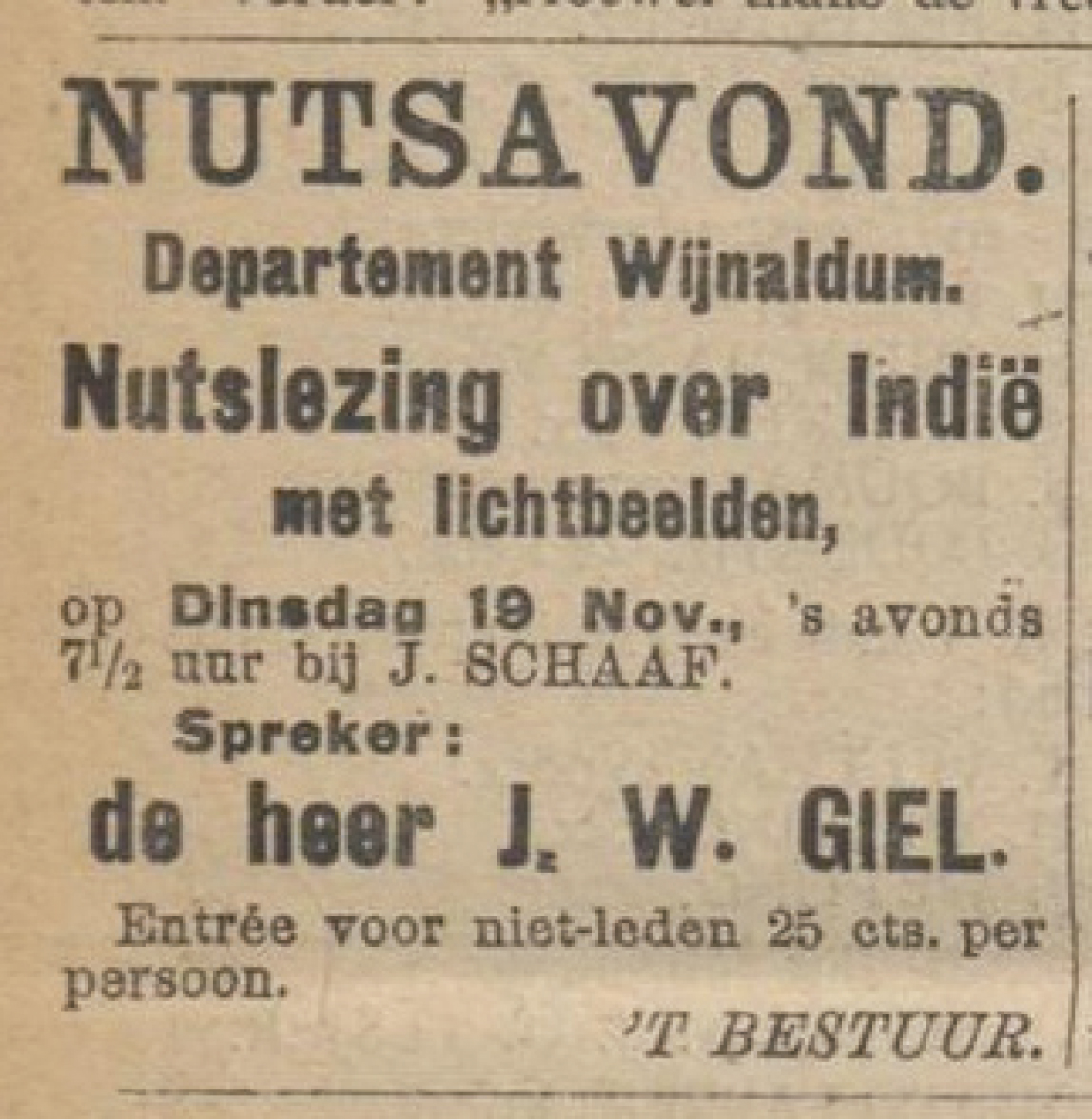
Figure 6
Advertisement in the Franeker Courant of November 17, 1918, for a Nutslezing from the Wijnaldum department of the Maatschappij tot Nut van ‘t Algemeen: ‘entrance for non-members 25 cents per person’. Source: “Advertentie Nutsavond,” Franeker Courant, November 17, 1918, 2, https://resolver.kb.nl/resolve?urn=MMTRES04:211441125:mpeg21:p00002.
In general, the national administration reported the activities resulting from the collaboration with the Lichtbeelden-Vereeniging as a success. In 1904, the lectures with projection had been received with ‘delight’ and had amounted to 20 lectures organised by 20 departments, using 34 slide sets, 14 of which without text.50 Two years later, this had increased to 30 lectures organised by 24 departments, 45 slide sets, 4 without text.51 These numbers refer to the lectures given by members, but requests to the Lichtbeelden-Vereeniging could also be made to complement a lecture organised within the administration scheme: in 1907 ten slide sets had been requested to that end.52
The Nutslezing dispositif: an ongoing discussion
Ladies and gentlemen, the theory and the administration can say “that is how it should be”, but the practice and the departments repeatedly insist “still that is how it goes”.53
As noteworthy and recognisable as the Nutslezingen may have been, they were nevertheless an ongoing point of discussion between the national administration and the local department boards. In the general meeting of 1903, the department of Middelharnis-Sommelsdijk filed a motion to ‘give a different character to the lectures according to the administration’.54 The department stated that the lack of non-members attending the lectures of ‘t Nut (as noted, an important condition for the administration) was due to either prejudice against the Nutslezingen, unattractive subjects, topics beyond the comprehension of the average citizen, or the ‘useful’ character of the lectures.
As well this department complained that the speakers list and topics were not appropriate for a countryside audience: it claimed that topics such as Marriage, in Connection with the Dramatisation of Ibsen were meant for an audience of a different intellectual level. And, finally, it stated that the ‘people’ wanted a relaxing evening, they did not want to have to ‘study’. The answer of the national administration was printed with the list of speakers of the following season:
(…) the discussion of the Middelharnis-Sommelsdijk motion at the last general meeting has shown that something should be organised to provide variety and to entice the audience, after the discussion of the chosen subject. Therefore, the departments are invited to pay attention to the possibilities and requirements present in their circles, and, either by the projection of slides, if not projected already at the time of the lecture, or by the collaboration of a musical company, to give a special attraction to these lectures, in an effective and inexpensive way.55
This interaction between the department of Middelharnis-Sommelsdijk and the national administration is of particular interest, because it clearly shows that the administration’s concerns extended to the three interdependent aspects of (1) the technologies that were used, (2) the textual content of the lectures, and (3) the audience. In other words, it shows how the three aspects of the Nutslezing dispositif were discussed within the Society. Specifically, they were concerned with how to assemble a larger and diversified audience; how some of the topics—the textual aspect—were inadequate to meet the expectations of the audience, who wanted to relax rather than ‘study’; and, finally, how the administration acquiesced to the department’s complaint and endorsed the use of complementary technologies, such as image projection, to counteract the negative perception of the lectures as being ‘useful.
In this case, image projection—the techno-pragmatic aspect of the lecture—was seen as one possible solution to the failure to capture the interest of a prospective audience. But while image projection technologies afforded different possibilities in terms of the textual and audience aspect of the Nutslezingen dispositif, it was not without its difficulties. In fact, it raised an assortment of other problems. In what follows I will trace the discussion about the affordances and the predicaments of image projection within the techno-pragmatic aspect of the performance context, and how its use affected the content of the lectures and the (re)positioning of the audience.
(1) Performance context
The interest of the Society in technologies of illustration was not new. Before 1900, when image projection became an accessible means of illustrating the Nutslezingen, other visual devices had already been sanctioned:
Every lecture must, to some extent, be clarified by making use of prints or maps, which can almost double the effect. Large drawings, even if a bit rough, preferably coloured, are sufficient to achieve this purpose. The speaker who is expected to show something has an immediate advantage, like the fairground singer, whose ghastly tunes would attract few listeners without the painted scenes of horrible crimes and the punishment suffered.56
Published in 1866, the writer of this manual used the figure of the street singer, a figure connected with popular entertainment rather than education, to convey the importance of visual aids: street singers performed with a stretched painted canvas behind them, while using a pointer to highlight each image during the course of the song (Figure 8).
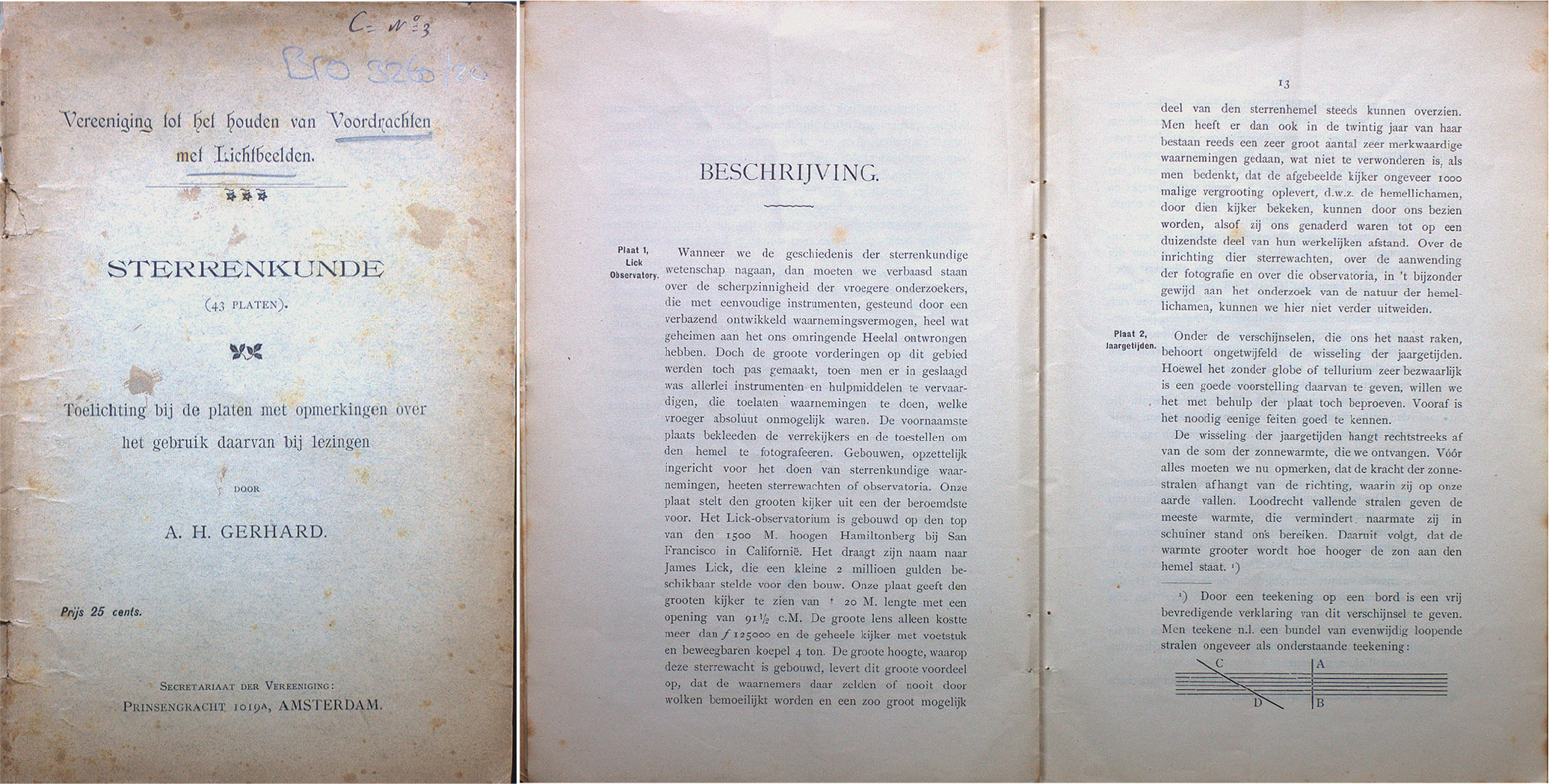
Figure 7
Cover and example of inner pages of the reading Astronomy, written by A.H. Gerhard, Sterrenkunde (Vereeniging tot het houden van Voordrachten met Lichtbeelden, n.d.). Source: IISG – International Institute of Social History.
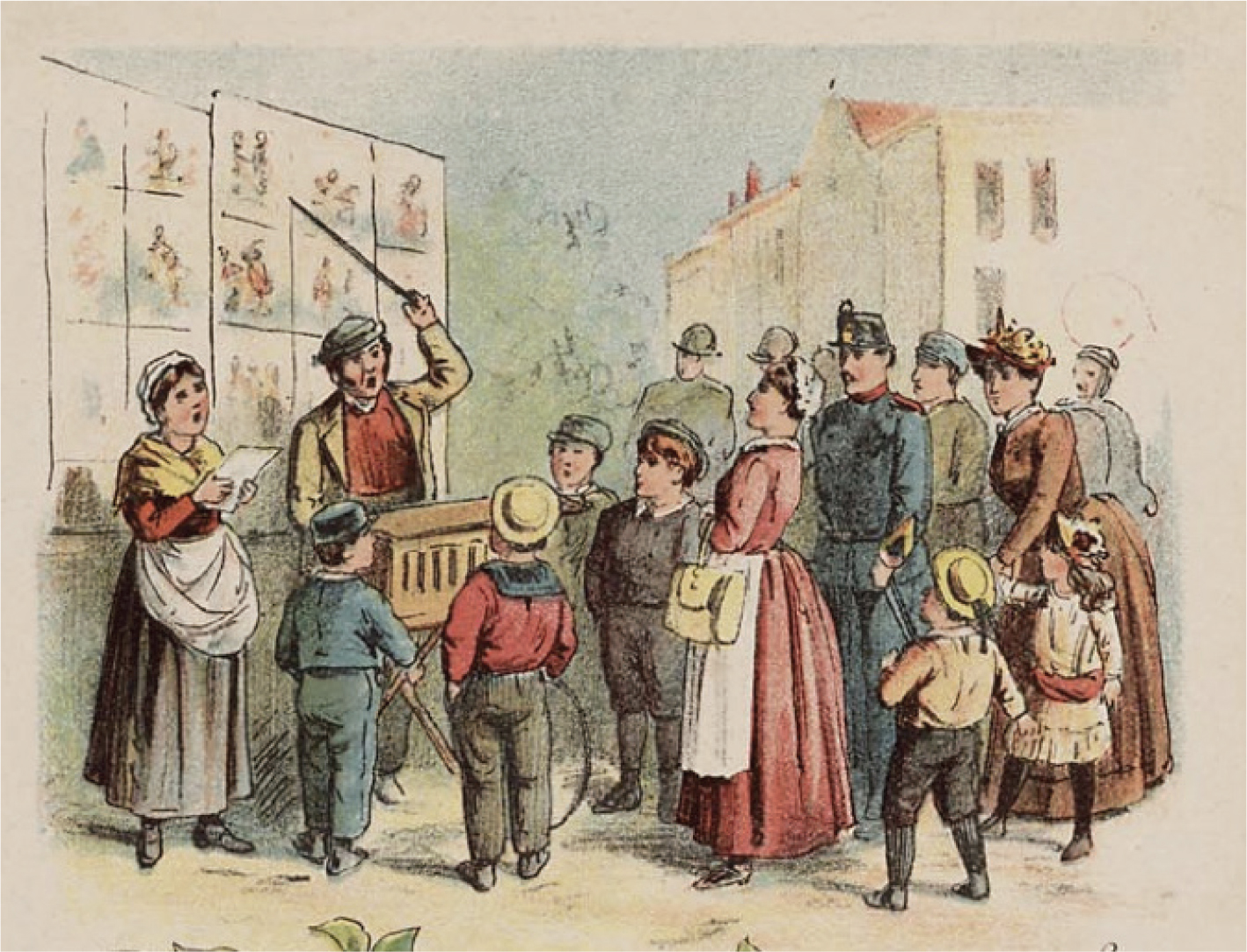
Figure 8
Illustration De Liedjeszanger, The [street]singer, in the book De kijkkast en andere vermaken. The original caption reads: ‘Of a great murder story | Sing that man and woman here | And to pictures, roughly painted, | Points the singer faithfully.’ Source: A. Gildemeester, “Volksvoordrachten in Nederland,” Het Volksblad, 1870, Tijdvragen en voornaamste tijdsbeschouwingen in Het Volksblad, van Juli 1869-December 1870 edition, X–7. This text was originally published in the Staatkundig en staathuishoudkundig jaarboekje voor 1869.
By the end of the 1860s, image projection was already used occasionally in Nutslezingen, but the costs were quite prohibitive.57 Still, it was clear for local departments that image projection or musical performance augmented their audience’s approval. An 1872 report states:
Those who know how to pair the useful and the pleasant find acclaim; and the board members understand that as well. Hence the adornment of the lecture with music and singing, with presentations of reciting artists, and with image projection with the gas microscope or dissolving views.58
However, it was not only a matter of access or costs, but also of knowing how to use the technology, an issue that was apparently underestimated, particularly in the early 1900s, according to the reports sent to the national administration.59 One speaker, for instance, complained that his lecture had been plagued by projection problems: first of all, the projection had failed to show most of his images as no one seemed to know how to use the lantern; secondly, the innkeeper of the café where the lecture took place was drunk and difficult to deal with; and finally, the audience consisted largely of fishermen who ‘in the darkness during the projection efforts had felt brave enough to hassle him with interruptions, continuous laughter and mumbling, obstructions in the form of collective coughing fits and even the threat that they should go get the harmonica’ (which they eventually did after the lecture). While certainly not all speakers would have had such a particularly challenging audience, many experienced technical problems because no professional projection service had been hired. The projection failures and delays caused by fixing the lantern had a ‘very negative influence on the audience’. Clearly, the presence of image projection technologies alone was not a foolproof strategy towards a successful Nutslezing.
(2) Media(ted) text
The use of projection technologies and the membership of the Lichtbeelden-Vereeniging enabled the departments to get access to ready-made slide sets and accompanying readings for the very particular type of lectures organised met eigen krachten (under its own steam).60 What this meant was that instead of hiring a speaker or inviting a lecturer from the speakers list, a department arranged a lecture by recruiting a speaker from its own members. As one commentator put it:
As if there were no local doctor, pharmacist, notary, minister, or teacher who, with some preparations, would be very able to give an illustrated lecture on one of the many subjects offered by the Lichtbeelden-Vereeniging.61
However, it was also clear that, especially in the hands of less experienced speakers, a lecture with projection could easily turn into an uninteresting session of plaatjes kijken:
There is a major drawback to the use of slides, namely that it may degenerate into mere picture viewing, plaatjes kijken, in which the engagement of the audience disappears completely. (…)
The cause of the evil lies in the fact that many think that projecting slides can make up for a lack of knowledge or experience; oh, they want to give a lecture, but above all don’t put in much effort and then the slides will do the work. No, the slides don’t do the work.62
The writer of the above text, published in the Nutswerk periodical, was Theodora de Gijselaar, director of the Lichtbeelden-Vereeniging since 1910.63 Her disapproval was not directed at image projection, but at the way certain speakers used the technology. The problems seemed to emerge when a speaker would become too reliant on the image projection technology to carry, almost by itself, the content of the lecture. Another critic also noted that the number of projected slides was no guarantee of expertise, since the ability to rely on fewer slides attested to the speaker’s command of his topic.64
(3) Positioning of the audience
Audiences of the Nutslezingen varied between departments, between cities, provincial towns or countryside villages. Descriptions include ‘knitting women in Frisian caps and pipe-smoking men’ to a gathering of ‘sophisticated, perfumed people in evening toilette’.65 Other characterizations are more precise, such as the one provided by the Heerlen department to a prospective speaker in 1934: ‘Our department is formed mainly by non-Catholic and non-Orthodox Protestant intellectuals and semi-intellectuals’.66 Besides their heterogeneous composition, audiences’ attitudes towards the Nutslezingen constituted a broad spectrum. Frequent Nut-speaker P. H. Ritter Jr. wrote about how to navigate this range of expectations:
Over time the speaker manages to find a classification for the different types of rooms before him and learns how to evaluate the attitude of the audience that shall fill it. According to the preference of the local department board, the venue ranges between the church and the café-chantant, just as the appreciation of this skill [of the Nut-speakers] lies somewhere between the reverence of theology and the inclination of public entertainment.67
The range that Ritter so clearly explicates is a central characteristic of the Nutslezingen and a fundamental point of discord between the national administration and the local department boards: the different perspectives on how to deal with their audiences’ expectations. While the national administration insisted on the educational and useful character of the Nutslezingen, the departments clearly and unwaveringly held that an audience wanted to be entertained. For the national administration, projection was a double-edged sword: while projection’s entertainment connotation was seen favourably as a strategy to attract an audience, at the same time, remarkably, the administration maintained that the audience should not be entertained but rather educated.
The tension between the recreational and the useful lecture, and between entertaining and educating an audience, was often the topic of opinion pieces published in the Nut-periodicals. The department of Dordrecht, for instance, wrote that usefulness ‘had done so much evil, killed public interest, and was responsible for driving away audiences and Nut-members alike’.68 According to this department, the problem was that one was only interested in one’s own field of work: ‘Just as a professor of theology will not be pleased to give a lecture about railway tracks, a technical worker will not be pleased to listen to the history of the Egyptians or the ideas of the Assyrians’.69 However, at the same time one unidentified member complained about department boards boasting about the ‘program of winter amusements [my emphasis]’: such an attitude, cautioned the writer, would turn the Nut departments into mere ‘impresarios of bourgeois entertainment’.70
In good Dutch fashion, the reality was probably somewhere in between these extremes; while the national administration’s position might have been too theoretical and removed from the reality of the local departments,71 the latter, in turn, ‘usually misjudge[d] the level of education and disposition of their own audiences’.72
Conclusion
Time and again I find the word nutslezing used in newspapers and magazines as a defamatory word, as a slogan to express something extremely boring, unimportant and petit-bourgeois. And that always annoys me personally.73
Henri Dekking, who wrote the sentences above, earnestly defended the Nutslezingen according to his own perspective as an experienced Nut-speaker: he asserted that the audience expected more than ‘humour and banality’ and credited the Nutslezingen for his ‘colourful, cheerful, almost festive winter life’. Written in 1914, and republished in Nutswerk in 1917, the text addressed (and retaliated against) the poor connotation generally attributed to the term in serials or satirical short stories, such as A Nutslezing from the letters of Rusticus Urbanus, written by H. G. Cannegieter,74 or My lecture in Boschwijk, written by Justus van Maurik.75 Later, in 1926, the national administration tried again to rehabilitate the public image of the Nutslezingen with a special issue of Nutswerk, featuring short articles by some of their best-known speakers, who had been prompted to answer the question: ‘What do you hope to achieve with your Nutslezingen?’76 This issue clearly showed that the speakers could be the most passionate supporters of the beleaguered Nutslezingen. This is relevant, because the speakers’ position was quite unique: they alone had practical insight in and experience of the spectrum of the characteristics supported and expected by local department boards, members, and audiences. But as they were in regular correspondence with the national administration at the same time,77 they were in a privileged position to witness and experience the diversity and contradictions of the Nutslezingen discussed in this article.
But how is it that despite all the internal disagreements and discussions, it was still possible to create this relatively stable and recognisable dispositif of the Nutslezing? I believe that three aspects greatly contributed to this. The first is the publication of the Nut-speakers list to lecture on topics ‘in connection with the work of the society’. This list functioned as a stable and regulatory instrument for the character of the Nutslezingen: while it grew and expanded its topics and speakers over the years, the national administration still had to approve every new addition.78 At the same time, it also became a well-known and coveted information source, even outside the network of ‘t Nut, and could function as a programme guide for the season for organisations who wished to organise public lectures.79
Secondly, and directly connected to image projection, is the membership of the Lichtbeelden-Vereeniging. It meant that all departments had access to the same lecture content, which they either used to organise a lecture ‘met eigen krachten’ or as a complementary presentation, if the main invited speaker did not make use of slide projection. In general, administration and departments agreed that the projection of lantern slides could contribute to the success of Nutslezingen: they saw it as a means to make a lecture more attractive. Already in the 1860s, they had no problem in evoking the image of the street singer, a figure connected to entertainment, to elucidate on the importance of the illustrative image. But despite this agreement, the actual practice of handling projection technology was often underestimated by department boards, which affected both the attention of the audience and the disposition of the speaker. Nevertheless, the textual materials provided by the Lichtbeelden-Vereeniging worked as a stable, constant element within the variety of departments and audiences of ‘t Nut.
Finally, and also in part enabled by the collaboration with the Lichtbeelden-Vereeniging, the Nutslezing dispositif shows a particular characteristic: its flexibility of roles and positions. The issue here is that local department members organised the lectures and formed a significant part of the audience. And sometimes even the speaker was a member as well, as in the lectures organised met eigen krachten. From the perspective of the educational dispositif this flexibility resulted in an economically independent, self-sufficient situation.
It is difficult to measure the educational reach of the Nutslezingen: some voices will fondly reminisce on how a single lecture devoted to astronomy animated the birth of a life-long interest;80others will look at it from a more critical perspective and ask what the impact was of fragmentary knowledge acquired by spending three winter evenings listening to someone talk about Java, international law, and wireless telegraphy?81
The national administration of ‘t Nut had to fulfil an almost impossible task. It had to convince hundreds of local department boards that they should not allow themselves ‘to be pulled down by the masses, but strain their muscles to lift them up’ and ask ‘did [the Nutslezing] in some way stir up something in us, deliver an element of development or edification?’82 Not a mean feat in itself, they were also expected to attract a sizable audience of both current and prospective members.
Notes
[1] J. Hovens Greve, “Het Nut - Nu,” in Gedenkboek Maatschappij tot Nut van ’t Algemeen 1784-1934 (Leiden: A. W. Sijthoff’s Uitgeversmaatschappij N. V., 1934), 224, https://resolver.kb.nl/resolve?urn=MMKB24:071674000.
[2] P. N. Helsloot, “De Nutsbeweging,” in Om het algemeen volksgeluk: twee eeuwen particulier initiatief 1784–1984: gedenkboek ter gelegenheid van het tweehonderdjarig bestaan van de Maatschappij tot Nut van ’t Algemeen, ed. W. W Mijnhardt and A. J Wichers (Edam: Maatschappij tot Nut van ’t Algemeen, 1984), 17.
[3] See for instance “Punten ter beschrijving van de algemeene vergadering, 1903,” Minutes (Maatschappij tot Nut van ’t Algemeen, 1903), no. 17, inv. 323 Inventaris van het Archief van Maatschappij tot Nut van ’t Algemeen; Departement Amsterdam, Amsterdam City Archive, https://archief.amsterdam/inventarissen/scans/323/14.5/start/80/limit/10/highlight/4; “De volksvoorlezingen te Dordrecht,” Nutswerk; Maandblad van de Maatschappij tot Nut van ’t Algemeen, July 1918, https://www.delpher.nl/nl/tijdschriften/view?coll=dts&identifier=MMKB26:000836011:00010; “‘Het programma der wintervermakelijkheden is gereed’(!),” Nutswerk; Maandblad van de Maatschappij tot Nut van ’t Algemeen, October 1928, https://resolver.kb.nl/resolve?urn=MMKB26:000833002:00005.
[4] “Voordrachten over onderwerpen welke in verband staan met het streven der Maatschappij,” Mededeelingen 1903–1904, August 1903.
[5] “Jaarverslag 1900-1901: Vereeniging tot het houden van voordrachten met lichtbeelden,” 1901, Album, Archive Rijksakademie van Beeldende Kunsten, uninventoried.
[6] “Notulen der bijeenkomst van afgevaardigden van Toynbee-vereenigingen in ‘Ons Huis’ te Amsterdam op 19 Juni 1898 ter bespreking van een plan van ruilverkeer van lantaarns,” 1898, Album, Archive Rijksakademie van Beeldende Kunsten, uninventoried.
[7] Frank Kessler, “The Educational Magic Lantern Dispositif,” in A Million Pictures: Magic Lantern Slides in the History of Learning, eds. Sarah Dellmann and Frank Kessler (New Barnet: John Libbey, 2020), 182.
[10] Iris van der Tuin and Nanna Verhoeff, Critical Concepts for the Creative Humanities (London: Rowman & Littlefield, 2022), 81.
[12] P. N. Helsloot and N. L. Dodde, Martinus Nieuwenhuyzen, 1759-1793: Pionier van onderwijs en volksontwikkeling (Amsterdam: De Bataafsche Leeuw, 1993), 34–37.
[14] Marian Schouten, “Maatschappij tot Nut van ’t Algemeen,” Instituut voor Nederlandse Geschiedenis, Verenigingen voor armenzorg en armoedepreventie in de 19e eeuw, May 2, 2016, http://resources.huygens.knaw.nl/armenzorg/gids/vereniging/1350927318.
[15] Theodoor Jorrisen, “Het Genootschap van Kunsten en Wetenschappen, onder de Zinspreuk: tot Nut van ’t Algemeen, te Edam, 1784 – 1787,” in Gedenkboek Maatschappij tot Nut van ’t Algemeen 1784-1934 (Leiden: A. W. Sijthoff’s Uitgeversmaatschappij N. V., 1934), 27, https://resolver.kb.nl/resolve?urn=MMKB24:071674000.
[16] W. W Mijnhardt and A. J Wichers, eds., Om het algemeen volksgeluk: twee eeuwen particulier initiatief 1784-1984: gedenkboek ter gelegenheid van het tweehonderdjarig bestaan van de Maatschappij tot Nut van ’t Algemeen (Edam: Maatschappij tot Nut van ’t Algemeen, 1984), 359–61.
[17] “Nutsdepartementen overzicht,” Maatschappij tot Nut van ’t Algemeen, accessed October 28, 2022, https://www.nutalgemeen.nl/lnk-departementen.
[18] Simon Schama, “Schools and Politics in the Netherlands, 1796-1814,” The Historical Journal 13, no. 4 (1970): 589–610; Bastiaan van Gent, “Government and Voluntary Organizations in the Netherlands: Two Hundred Years of Adult Education and Information (1784–1984),” International Journal of Lifelong Education 6, no. 4 (October 1987): 279–94, https://doi.org/10.1080/0260137870060402; Sjaak Braster, “The People, the Poor, and the Oppressed: The Concept of Popular Education through Time,” Paedagogica Historica 47, no. 1–2 (February 2011): 1–14, https://doi.org/10.1080/00309230.2011.566225.
[20] This initiative was inspired by the Scottish saving banks and discussed within ‘t Nut since 1816. They considered that learning how to save money was also an important aspect of social improvement and an important virtue which “practiced within reasonable limits, leads to character formation because it requires self-discipline and effort.” J. D. D. Pruissen, “De Maatschappij tot Nut van ’t Algemeen en het bijzondere spaarbankwezen,” in Gedenkboek Maatschappij tot Nut van ’t Algemeen 1784-1934 (Leiden: A. W. Sijthoff’s Uitgeversmaatschappij N. V., 1934), 175, https://resolver.kb.nl/resolve?urn=MMKB24:071674000:00285.
[21] “Instellingen der departementen,” in Gedenkboek Maatschappij tot Nut van ’t Algemeen 1784-1934 (Leiden: A. W. Sijthoff’s Uitgeversmaatschappij N. V., 1934), 245–46, https://resolver.kb.nl/resolve?urn=MMKB24:071674000.
[22] Mededeelingen 1902-1903, July 1902, inv. 3501 Departement Haarlem van de Maatschappij tot Nut van ’t Algemeen, Noord-Hollands Archief.
[25] J. E. van der Pot, Het Departement Rotterdam der Maatschappij tot Nut van ’t Algemeen 1785-1960, Historish Genootschap Roterodamum (Rotterdam: Ad. Donker, 1960), 38.
[29] Bewijs van toegang November 7, 1871, 3501 Departement Haarlem van de Maatschappij tot Nut van ’t Algemeen, no. 220, Noord-Hollands Archief, http://noord-hollandsarchief.nl/bronnen/archieven?mivast=236&mizig=210&miadt=236&miaet=185&micode=3501&minr=24805918&miview=inv2.
[30] “Handelingen van de algemeene vergadering, 1885,” Minutes (Maatschappij tot Nut van ’t Algemeen, 1885), 56–58, 323 Archief van Maatschappij tot Nut van ’t Algemeen; Departement Amsterdam, no. 413, Amsterdam City Archive, https://archief.amsterdam/inventarissen/scans/323/14.5/start/490/limit/10/highlight/5.
[32] “Voordrachten van wege het hoofdbestuur, over onderwerpen welke in verband staan met het streven der Maatschappij,” Maatschappij tot Nut van ’t Algemeen Mededeelingen 1902-1903, July 1902, 14, 3501 Departement Haarlem van de Maatschappij tot Nut van ’t Algemeen, Noord-Hollands Archief.
[33] See for instance “Jaarboekje voor het jaar 1899–1900,” Annual Report (Maatschappij tot Nut van ’t Algemeen, 1900 1899), XXXIV, 323 Archief van Maatschappij tot Nut van ’t Algemeen; Departement Amsterdam, no. 420, Amsterdam City Archive, https://archief.amsterdam/inventarissen/scans/323/14.9/start/0/limit/10/highlight/1; “Jaarboekje voor het jaar 1900-1901,” Annual Report (Maatschappij tot Nut van ’t Algemeen, 1901 1900), XL, 323 Inventaris van het Archief van Maatschappij tot Nut van ’t Algemeen; Departement Amsterdam, no. 420, Amsterdam City Archive, https://archief.amsterdam/inventarissen/scans/323/14.9/start/270/limit/10/highlight/3.
[34] The lecture season was also known as the winter (time) season, from October through April. It also aligned with what was known as the lantern season, the period in which lantern projections were more frequent. See Richard Crangle, Hybrid Texts: Modes of Representation in the Early Moving Picture and Some Related Media in Britain (Exeter: University of Exeter, 1996), 123; Steve Humphries, Victorian Britain through the Magic Lantern (London: Sidgwick & Jackson, 1989), 26.
[35] “Voordrachten van wege het hoofdbestuur, over onderwerpen welke in verband staan met het streven der Maatschappij,” 16–17.
[36] “Voordrachten van wege het hoofdbestuur, over onderwerpen welke in verband staan met het streven der Maatschappij,” Mededeelingen 1909–1910, August 1909, 19.
[37] Sprekerslijst (Amsterdam: Hoofdbestuur der Maatschappij tot Nut van ’t Algemeen, 1923), https://archief.amsterdam/inventarissen/scans/211/1.71.58/start/1230/limit/10/highlight/9.
[38] “Sprekerslijst” (Hoofdbestuur der Maatschappij tot Nut van ’t Algemeen, 1935), Collectie Ritter, Utrecht University Library Special Collections.
[40] “Voordrachten over onderwerpen welke in verband staan met het streven der Maatschappij,” Mededeelingen 1904–1905, August 1904, 18.
[41] “Voordrachten van wege het hoofdbestuur, over onderwerpen welke in verband staan met het streven der Maatschappij,” 11–14; “Verslag van het hoofdbestuur aangaande den staat der Maatschappij en zijne verrichtingen, gedurende het jaar 1909-1910,” Report (Maatschappij tot Nut van ’t Algemeen, 1910), 323 Inventaris van het Archief van Maatschappij tot Nut van ’t Algemeen; Departement Amsterdam, no. 10, Amsterdam City Archive, https://archief.amsterdam/inventarissen/scans/323/14.5/start/220/limit/10/highlight/6.
[42] For clarity and economy purposes, I will further refer to this organisation as the Lichtbeelden-Vereeniging, the designation used between 1910 and 1935.
[43] Johanna Hintzen, “De Lichtbeelden-Vereeniging te Amsterdam,” De Groene Amsterdammer, July 2, 1927, 4, http://historisch.groene.nl/nummer/1927-07-02/pagina/4#2/10.3/-94.0.
[44] “Lichtbeelden Instituut Jaarverslag 1935,” no. 200556849, 1935, RKD – Nederlands Instituut voor Kunstgeschiedenis, https://rkd.nl/explore/library/400001605.
[45] Toynbee-vereenigingen, Toynbee associations, were associations created by different sections of the Dutch bourgeoisie and engaged in initiatives to improve the lower classes. This work was known as Toynbee-werk, Toynbee work. Their activities also included the same type of initiatives of ‘t Nut, such as creating lending libraries and organising public illustrated lectures. However, these associations were only established at the end of the nineteenth century. Christianne Smit, De volksverheffers: sociaal hervormers in Nederland en de wereld, 1870–1914 (Hilversum: Verloren, 2015), 179; Bastiaan van Gent, “‘Toynbee-Work’ in the Netherlands,” in British-Dutch-German Relationships in Adult Education: 1880 - 1930; Studies in the Theory and History of Cross-Cultural Communication in Adult Education, ed. Martha Friedenthal-Haase, Barry J. Hake and Stuart Marriott, Leeds Studies in Continuing Education 1 (Leeds: Study of Continuing Education Unit, School of Education, Univ. of Leeds, 1991), 211–26.
[46] “Vereeniging tot het houden van voordrachten met lichtbeelden,” Ons Huis, December 3, 1898, 827 Archief van de Vereniging Ons Huis, no. 1195, Amsterdam City Archive, https://archief.amsterdam/inventarissen/scans/827/7.2.1/start/60/limit/10/highlight/2.
[48] “Voordrachten met lichtbeelden,” Maatschappij tot Nut van ’t Algemeen Mededeelingen 1902-1903, July 1902, 17–19, 3501 Departement Haarlem van de Maatschappij tot Nut van ’t Algemeen, Noord-Hollands Archief.
[49] Departement Middelharnis-Sommelsdijk Maatschappij tot Nut van ’t Algemeen, “Lijst van vragen,” 1924, 211 Archief van Maatschappij tot Nut van ’t Algemeen, no. 412, Amsterdam City Archive, https://archief.amsterdam/inventarissen/scans/211/1.71.42/start/1300/limit/10/highlight/5 and https://archief.amsterdam/inventarissen/scans/211/1.71.42/start/1300/limit/10/highlight/6 [verso].
[50] “Uit het jaarverslag der Maatschappij,” Maatschappij tot Nut van ’t Algemeen Mededeelingen 1904–1905, October 1904, 32, 3501 Departement Haarlem van de Maatschappij tot Nut van ’t Algemeen, Noord-Hollands Archief.
[51] “Uit het jaarverslag van het hoofdbestuur aangaande den staat der Maatschappij en zijne verrichtingen, gedurende het jaar 1905–1906,” Maatschappij tot Nut van ’t Algemeen Mededeelingen 1906–1907, August 1906, 27, 3501 Departement Haarlem van de Maatschappij tot Nut van ’t Algemeen, Noord-Hollands Archief.
[52] “Uit het jaarverslag van het hoofdbestuur aangaande den staat der Maatschappij en zijne verrichtingen, gedurende het jaar 1906–1907,” Maatschappij tot Nut van ’t Algemeen Mededeelingen 1906–1907, August 1907, 8, 3501 Departement Haarlem van de Maatschappij tot Nut van ’t Algemeen, Noord-Hollands Archief.
[53] J. Hovens Greve, “Het ontwikkelingswerk der Maatschappij tot Nut van ’t Algemeen en de samenstelling van haar besturen,” Volksontwikkeling, July 1920, 464.
[57] A. Gildemeester, “Volksvoordrachten in Nederland,” Het Volksblad, 1870, Tijdvragen en voornaamste tijdsbeschouwingen in Het Volksblad, van Juli 1869-December 1870 edition, X–7. This text was originally published in the Staatkundig en staathuishoudkundig jaarboekje voor 1869.
[58] P. H. Testas, “Volksvoordrachten in Nederland,” in Staatkundig en staathuishoudkundig jaarboekje voor 1872, ed. De Vereeniging voor de statistiek in Nederland, E.S. Witkamp (Amsterdam, 1872), 357.
[59] “Voordrachten vanwege het hoofdbestuur 1913–14,” Mededeelingen der Maatschappij tot Nut van ’t Algemeen 1914–1915, June 1914, 82, 3501 Departement Haarlem van de Maatschappij tot Nut van ’t Algemeen, Noord-Hollands Archief.
[60] “Met eigen krachten,” Nutswerk; Maandblad van de Maatschappij tot Nut van ’t Algemeen, April 1926, 1, https://resolver.kb.nl/resolve?urn=MMKB26:000836039:00001.
[61] “De Lichtbeeldenvereeniging,” Nutswerk; Maandblad van de Maatschappij tot Nut van ’t Algemeen, September 1918, 18, https://resolver.kb.nl/resolve?urn=MMKB26:000836012:00006.
[62] Theodora de Gijselaar, “Iets over het gebruik van lichtbeelden,” Nutswerk; Maandblad van de Maatschappij tot Nut van ’t Algemeen, January 1924, 30, https://resolver.kb.nl/resolve?urn=MMKB26:000836030:00006.
[64] “De Lichtbeeldenvereeniging,” Nutswerk; Maandblad van de Maatschappij tot Nut van ’t Algemeen, February 1922, 16, https://resolver.kb.nl/resolve?urn=MMKB26:000836023:00004.
[65] P. H. (Jr) Ritter, De lusten en lasten der redeneerkunst (Amsterdam: Querido, 1926), 46–47, https://resolver.kb.nl/resolve?urn=MMKB02:000119217.
[66] “Department Heerlen,” August 25, 1934, Collectie Ritter, Utrecht University Library Special Collections.
[71] Hovens Greve, “Het ontwikkelingswerk der Maatschappij tot Nut van ’t algemeen en de samenstelling van haar besturen,” 464.
[72] Ritter, De lusten en lasten der redeneerkunst, 16. Ritter goes on to specify that “too often Nut-comedians [Nut-speakers] play their comedy to straight faces.”
[73] Henri Dekking, “Nutslezingen,” Nutswerk; Maandblad van de Maatschappij tot Nut van ’t Algemeen, January 1917, 41, https://resolver.kb.nl/resolve?urn=MMKB26:000836003:00001.
[74] Published originally as a serial of “letters from the countryside” by Rusticus Urbanus in “De Nieuwe Groene” in 1917, it was later published as a book. H. G. Cannegieter, Rusticus Urbanus (Arnhem: Van Loghum Slaterus & Visser, 1920), 106, https://resolver.kb.nl/resolve?urn=MMKB02A:000030243:00120.
[75] Justus van Maurik, “Mijn lezing te Boschwijk,” in Verspreide novellen (Amsterdam: Van Holkema & Warendorf, 1885), https://www.dbnl.org/tekst/maur005vers00_01/maur005vers00_01_0009.php.
[76] “Nutslezingen,” Nutswerk; Maandblad van de Maatschappij tot Nut van ’t Algemeen, January 1926, 1, https://resolver.kb.nl/resolve?urn=MMKB26:000836038:00001.
[77] See for instance the Collectie Ritter at the Special Collections of the Utrecht University library.
[78] For an example see “Hooggeachte heer Hovens Greve,” November 22, 1935, Collectie Ritter, Utrecht University Library Special Collections.
[80] “J. J. van Meurs,” Nutswerk; Maandblad van de Maatschappij tot Nut van ’t Algemeen, January 1926, 29, https://resolver.kb.nl/resolve?urn=MMKB26:000836038:00005.
[81] J. van Dijk, “De nieuwe cursussen van het Nut; een wensch,” Volksontwikkeling, September 1922, 515.
[82] “Pakjesdragers van het geluk,” Nutswerk; Maandblad van de Maatschappij tot Nut van ’t Algemeen, July 1925, 1, https://resolver.kb.nl/resolve?urn=MMKB26:000836036:00001.
Biography
Dulce da Rocha Gonçalves has a background in visual arts, design and cinema. She obtained her first MA in Dramaturgy and Directing from the National School of Theatre and Cinema, in Lisbon. In 2018, she received her second master’s degree (cum laude) in Film and Photographic Studies from Leiden University, in the Netherlands. Her thesis focused on media archaeology and the archive. She is currently a PhD candidate at Utrecht University in the project “Projecting Knowledge – The Magic Lantern as a Tool for Mediated Science Communication in the Netherlands, 1880–1940,” funded by the Dutch national research organisation NWO. Her research is focused on the use of the magic lantern in illustrated public lectures.