
INTRODUCTION
Rice has become Nigeria’s most strategically significant food commodity, consumed across all income strata and agro-ecological zones. Ranked as Africa’s largest rice consumer, Nigeria’s annual demand now exceeds 7 million metric tons, sustained by rapid urbanization, dietary transition, and a population surpassing 220 million (USDA, 2024). What was once a preference of the urban middle class has become an indispensable household staple whose stable supply is inseparable from national food security and social stability.
The paradox defining Nigeria’s rice economy is stark and persistent. The country commands approximately 4.6 to 4.9 million hectares ecologically suited to rice cultivation, yet domestic output consistently falls short of national demand by an estimated 1.8 million metric tons (Statista, 2024). This supply gap has endured across successive development programmes – from the Agricultural Development Programmes of the 1970s through the National Special Programme for Food Security of 2002 to the Anchor Borrowers’ Programme (ABP) introduced in 2015 – each generating incremental improvements without closing the fundamental deficit.
Dominant explanations have centred on agronomic constraints: inadequate irrigation, low fertilizer adoption, and unimproved seed varieties. While real, these factors share an economic root cause that has received insufficient analytical attention. Virtually all productivity-enhancing inputs in the modern Nigerian rice sector are imported and denominated in foreign currency. When foreign exchange is scarce or accessible only at parallel market premiums, the domestic naira cost of these inputs rises independently of any farm-level variable – and production growth stalls regardless of land endowment or policy intent.
This framing repositions foreign exchange not as a peripheral macroeconomic variable but as a direct factor of production in the modern Nigerian rice sector. The growth diagnostics framework of Hausmann et al. (2008) provides the theoretical architecture: in any complex production system, output growth is constrained by the most binding bottleneck, and relieving non-binding constraints yields limited aggregate improvement. Nigeria’s naira depreciated from approximately ₦102 per US dollar in 2000 to over ₦1,500 by late 2023, a cumulative devaluation exceeding 1,370% (CBN, 2024), while foreign reserves peaked at $62.1 billion in 2008 before declining through successive oil price downturns. Despite this deterioration, the causal relationship between foreign exchange reserve availability and domestic rice output has not been formally tested using cointegration-based methods for the full post-2000 period. This study addresses that gap.
The general objective is to analyse the long-run equilibrium relationship and short-run dynamics between foreign exchange reserve availability and domestic rice production in Nigeria from 2000 to 2023. Specifically, the study aims to:
examine descriptive trends in foreign exchange reserves and domestic rice production over the study period;
test for a long-run cointegrating relationship using ARDL bounds testing;
estimate the long-run elasticity of domestic rice output with respect to foreign exchange reserves, exchange rate changes, real GDP, and lagged import volumes; and
examine short-run adjustment dynamics and equilibrium correction speed through an Error Correction Model.
The study is significant because it reframes the Nigerian rice production deficit from a primarily agronomic problem to a macroeconomic structural one, with implications for how both agricultural and monetary policies should be designed.
LITERATURE REVIEW
Theoretical Framework
Two theoretical frameworks underpin this study. The Growth Diagnostics Framework of Hausmann et al. (2008) argues that growth is constrained by the most binding bottleneck in any production system. Applied to Nigeria’s rice sector, it predicts that interventions targeting credit, extension services, or land development will underperform unless the fundamental constraint on input procurement – foreign exchange access – is simultaneously addressed. The Dual Gap Model of Chenery and Bruno (1962) established that developing countries face both a savings gap and a foreign exchange gap as structural limits on growth. In Nigeria’s context, the foreign exchange gap directly constrains importation of productivity-enhancing inputs, making reserve adequacy a prerequisite for agricultural modernization. Purchasing Power Parity theory, formalized by Cassel (1918), further establishes that naira depreciation systematically raises the domestic cost of internationally traded inputs, compressing farm-level profit margins in the input-intensive modern rice sector.
Empirical Review
The empirical literature on FX constraints and agricultural production in Nigeria consistently finds that macroeconomic conditions shape sector performance, though the specific binding constraint mechanism has been underexplored. Studies on rice production and macroeconomic linkages have progressed from early error correction approaches to ARDL cointegration methods. Nkang et al. (2006) first demonstrated long-run cointegrating relationships between macroeconomic variables, rice production, and food security in Nigeria, providing methodological precedent for this study, but their analysis precedes the major foreign exchange deterioration of the post-2014 period. Ammani (2013) documented a significant positive association between foreign exchange availability and rice production dynamics, with estimated elasticities of 0.6–0.8, providing direct antecedent evidence. Ekundayo (2023), applying ARDL methodology, confirmed long-run rice production-macroeconomy relationships but did not isolate reserve adequacy as the operative constraint. These studies converge on macroeconomic drivers of rice sector performance but leave the specific reserve channel unquantified over the full 2000–2023 period.
Research on specific constraints and policy instruments reveals further gaps. Akinsola et al. (2025) found that rice importation affects domestic production through substitution dynamics, but did not examine the foreign exchange reserve mechanism through which import capacity itself is determined. Edwards et al. (2023) identified input supply chains and macroeconomic conditions as critical system drivers through fuzzy cognitive mapping, consistent with the binding constraint hypothesis, but without econometric quantification. The resource curse and Dutch disease literature – notably Sachs and Warner (1995) – provides the mechanism through which oil revenue dependence crowds out the tradeable agricultural sector, explaining the negative GDP-production relationship observed in this study. The existing literature thus confirms that macroeconomic conditions shape Nigerian rice sector performance and that foreign exchange availability is a plausible binding constraint, but leaves unestablished the causal elasticity between reserve adequacy and production over the full post-2000 period. Table 1 summarizes the key empirical studies and the specific gaps this study addresses.
Table 1.
Summary of key empirical studies: foreign exchange, trade, and rice production in Nigeria
| Study | Period / context | Method | Key finding | Gap addressed here |
|---|---|---|---|---|
| Nkang et al. (2006) | Nigeria; pre-2006 | ECM | Long-run macro-production cointegration confirmed for rice sector | Outdated; no reserve variable; pre-depreciation era |
| Ammani (2013) | Nigeria; 1986–2010 | OLS regression | FX availability positively associated with rice output; elasticity 0.6–0.8 | No cointegration test; does not cover 2018–2023 FX crisis period |
| Ekundayo (2023) | Nigeria; time-series | ARDL | Long-run rice production-imports-GDP relationships confirmed | Reserve adequacy not isolated; no ECM adjustment speed reported |
| Edwards et al. (2023) | Nigeria; qualitative | Fuzzy cognitive mapping | Input supply chains and macroeconomic conditions identified as critical system drivers | No quantification; causal elasticity not established |
| Akinsola et al. (2025) | Nigeria; recent | Regression | Rice importation affects domestic production through substitution dynamics | FX reserve channel and cointegration not examined |
| This study | Nigeria; 2000–2023 | ARDL + ECM | Reserve elasticity = 1.684 (binding constraint confirmed); 79% annual ECM adjustment | – |
METHODOLOGY
Study Area
The study area is the Federal Republic of Nigeria. With a population exceeding 220 million and a nominal GDP of approximately $477 billion in 2023, Nigeria is the most populous nation and the largest economy in Africa (World Bank, 2024). Its macroeconomic profile is characterized by dependence on crude oil exports, which contribute approximately 80.6% of total export revenues (Nairametrics, 2024), creating structural vulnerability to commodity price cycles that directly determine foreign exchange availability. Rice is cultivated across diverse agroecological zones – irrigated fadama systems in the North-West and North-Central; rain-fed upland systems in the North-East; and swamp and upland ecologies in the South – with a common trend towards increasing input intensity and therefore greater dependence on imported, foreign-exchange-priced inputs (FAO, 2023).
Sources of Data
Secondary annual time-series data were employed, spanning 2000 to 2023 (n = 24 observations). Foreign exchange reserves (USD millions) and the official nominal exchange rate (NGN/USD) were obtained from the World Bank World Development Indicators (World Bank, 2024) and cross-validated against the Central Bank of Nigeria Statistical Bulletin (CBN, 2024). Domestic rice production and import volumes (metric tons) were sourced from the FAO Corporate Statistical Database (FAO, 2024). Real GDP in constant local currency units was sourced from World Bank WDI (World Bank, 2024). All continuous variables were transformed to natural logarithms. All estimations were conducted in EViews 12.
Table 2.
Variable definitions, data sources, and a priori expected signs
| Variable | Definition | Source | Unit | Expected sign |
|---|---|---|---|---|
| DEXRATE | Δln(EXRATEt) = ln(EXRATEt) − ln(EXRATEt−1): annual % depreciation approximation; I(0) by construction (ADF: −4.567***) | World Bank/CBN | Change | Negative (−): depreciation raises naira cost of imported inputs |
| LNRES | Natural log of foreign exchange reserves (USD millions) | World Bank/CBN | Log USD | Positive (+): reserves enable sustained input procurement |
| LNGDP | Natural log of real GDP (constant local currency units) | World Bank | Log LCU | Ambiguous (±); negative expected for oil-dependent economy per Dutch disease mechanism |
| LNIMP(−1) | Natural log of lagged rice import volumes; one-period lag reduces simultaneity bias | FAO | Log mt | Ambiguous (±) |
Analytical Techniques
Unit root tests were conducted using the Augmented Dickey-Fuller (ADF) procedure (Dickey and Fuller, 1979) under intercept-only and intercept-plus-trend specifications, with lag length determined by the Akaike Information Criterion. The ARDL bounds testing approach of Pesaran et al. (2001) was employed to test for long-run cointegration and to estimate long-run and short-run coefficients simultaneously. Three properties justified this choice: consistency in small samples; accommodation of the mixed I(0)/I(1) integration order confirmed by unit root testing; and direct generation of an Error Correction Model (ECM) quantifying adjustment speed. The domestic rice production model is specified as:
where LNPROD is the natural log of domestic rice production; DEXRATE = Δln(EXRATEt) approximates the annual percentage rate of naira depreciation and enters as I(0); LNRES is the log of foreign exchange reserves; LNGDP is the log of real GDP; LNIMPt−1 is the log of lagged rice import volumes; and ε is the error term. The AIC selected an ARDL(2,1,2,2,0) specification. Model adequacy was assessed through the Breusch-Godfrey (BG) LM test for serial correlation and the Breusch-Pagan-Godfrey (BPG) test for heteroskedasticity.This study employs the asymptotic critical values of Pesaran et al. (2001). Given the annual sample of n = 24 observations, the finite-sample adjusted critical values of Narayan (2005) were additionally applied. For Case II with k = 4 regressors and n ≈ 30, Narayan’s (2005) upper I(1) bound is approximately 5.018 at the 5% significance level. The study’s F-statistic of 5.682 exceeds this adjusted bound, confirming the robustness of the cointegration finding to small-sample correction.
A potential source of endogeneity in this framework is reverse causality between foreign exchange reserves and rice production. This concern is substantially mitigated by two features of the Nigerian context. First, Nigeria’s foreign exchange reserves are overwhelmingly driven by crude oil export revenues (Nairametrics, 2024), which are exogenous to domestic rice sector performance. Second, the ARDL-ECM framework explicitly models dynamic adjustment through lagged dependent and independent variables, which absorb feedback effects. The one-period lag on imports (LNIMPt₋₁) further reduces contemporaneous simultaneity. These features mitigate, though do not fully eliminate, endogeneity concerns, which are acknowledged as a study limitation.
RESULTS
Descriptive Statistics
Table 3 presents descriptive statistics for the study variables in log-transformed form over 2000–2023. Log domestic rice production (L_PRODUCTION) ranges from 14.52 to 16.07, corresponding to growth from approximately 2.0 million metric tons in 2000 to approximately 8.9 million metric tons at the upper bound, with a mean of 15.34. Log foreign exchange reserves (L_RESERVES) has a mean of 24.15 and a standard deviation of 0.42, reflecting oil-cycle-driven variation that provides the primary identifying variation in the empirical analysis. L_EXRATE registered the widest variation (4.62 to 7.33), reflecting accelerating naira depreciation over the study period with direct implications for input procurement costs.
Table 3.
Descriptive statistics of study variables (2000–2023)
| Variable | Mean | Std. dev. | Min. | Max. | N |
|---|---|---|---|---|---|
| L_PRODUCTION (log mt) | 15.34 | 0.48 | 14.52 | 16.07 | 24 |
| L_IMPORTS (log mt) | 13.89 | 0.62 | 12.74 | 14.82 | 24 |
| L_RESERVES (log USD) | 24.15 | 0.42 | 23.31 | 24.85 | 24 |
| L_EXRATE (log NGN/USD) | 5.42 | 0.94 | 4.62 | 7.33 | 24 |
| DEXRATE (first difference) | 0.098 | 0.174 | −0.156 | 0.514 | 23 |
| L_GDP (log constant LCU) | 25.68 | 0.32 | 25.12 | 26.19 | 24 |
Unit Root Test Results
Table 4 presents ADF unit root test results. DEXRATE is stationary at levels (I(0)) by construction. L_PRODUCTION is marginally stationary at levels (I(0)*); all remaining variables are non-stationary in levels but stationary upon first differencing (I(1)). No variable is integrated of order two, satisfying the ARDL prerequisite. The mixed I(0)/I(1) integration order validates the ARDL bounds testing approach over classical Engle-Granger or Johansen frameworks.
Table 4.
Augmented Dickey-Fuller unit root test results
| Variable | ADF (level) | Crit. (5%) | ADF (1st diff.) | Crit. (5%) | Integration |
|---|---|---|---|---|---|
| L_PRODUCTION | −1.982* | −2.998 | – | – | I(0)* |
| L_IMPORTS | −2.456 | −2.998 | −4.823*** | −2.998 | I(1) |
| L_RESERVES | −2.345 | −2.998 | −5.156*** | −2.998 | I(1) |
| L_EXRATE | −1.876 | −2.998 | −4.234*** | −2.998 | I(1); DEXRATE = I(0) |
| L_GDP | −2.123 | −2.998 | −3.987*** | −2.998 | I(1) |
| DEXRATE | −4.567*** | −2.998 | – | – | I(0) |
***, **, * denote rejection of the unit root null at 1%, 5%, and 10% levels respectively. Dickey and Fuller (1979) critical values, intercept-only specification.
ARDL Bounds Test for Cointegration
The AIC selected an ARDL(2,1,2,2,0) specification with k = 4 regressors. Table 5 and Figure 1 present the bounds test results. The F-statistic of 5.682 exceeds the Pesaran et al. (2001) upper I(1) critical values at all significance levels (10%: 3.09; 5%: 3.49; 1%: 4.37) and also exceeds Narayan’s (2005) small-sample upper bound of approximately 5.018 at the 5% level, confirming cointegration under both asymptotic and finite-sample critical values.
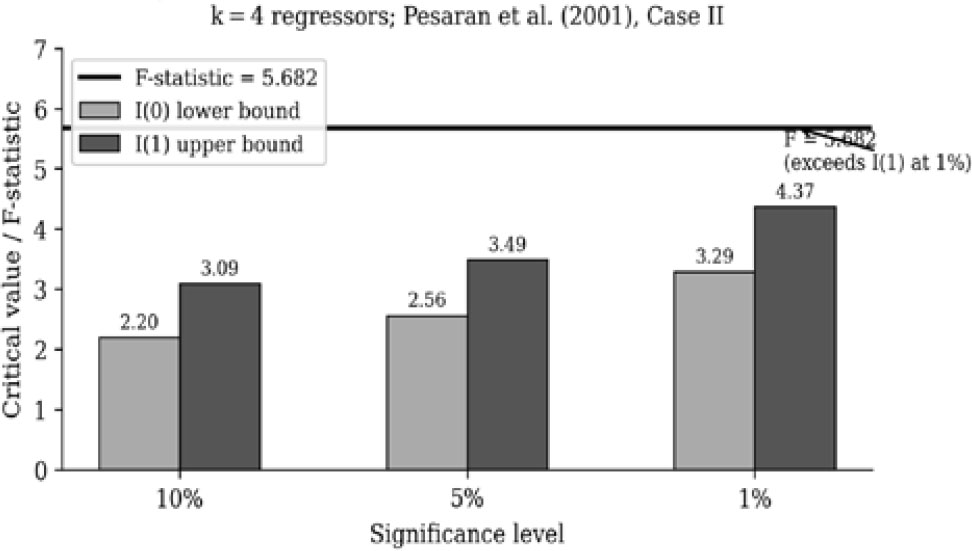
Fig. 1.
ARDL bounds test: F-statistic (5.682) vs Pesaran et al. (2001) critical values at 10%, 5%, and 1% significance levels (k = 4 regressors)
The F-statistic exceeds all I(1) upper bounds.
Source: Authors’ computation from EViews 12 (2025).
Table 5.
ARDL bounds test for cointegration – domestic production model, ARDL(2,1,2,2,0)
| Test statistic | Value | Significance | I(0) lower bound | I(1) upper bound |
|---|---|---|---|---|
| F-statistic (k = 4) | 5.682 | 1% | 3.29 | 4.37 |
| 5% | 2.56 | 3.49 | ||
| 10% | 2.20 | 3.09 | ||
| Narayan (2005) small-sample I(1) ≈ 5.018 (5%, n ≈ 30, k = 4) | Cointegration confirmed. F (5.682) exceeds Pesaran et al. (2001) 1% bound (4.37) and Narayan (2005) small-sample 5% bound (~5.018). | |||
[i] Source: researcher’s computation from EViews 12, 2025; Pesaran et al., 2001 critical values, Case II.
Long-Run Coefficient Estimates
Table 6 and Figure 2 present the long-run ARDL coefficient estimates. L_RESERVES is positive and highly significant (1.684, SE = 0.326, p < 0.001). L_GDP is negative and highly significant (−0.340, SE = 0.075, p = 0.001). DEXRATE (−0.521, p = 0.178) and L_IMPORTS(−1) (0.011, p = 0.470) are not statistically significant at conventional levels.
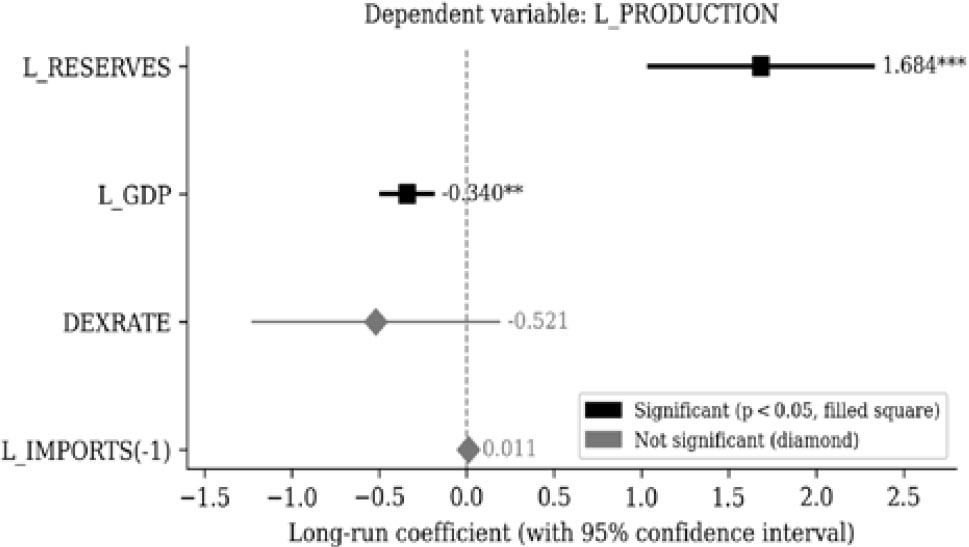
Fig. 2.
Long-run ARDL coefficient estimates with 95% confidence intervals. Filled squares: significant at p < 0.05; diamonds: not significant. Dashed vertical line at zero for reference.
Source: authors’ computation from EViews 12, 2025.
Table 6.
Long-run ARDL coefficients – domestic rice production model
| Variable | Coefficient | Std. error | t-statistic | Prob. | Decision |
|---|---|---|---|---|---|
| L_RESERVES | 1.684*** | 0.326 | 5.172 | 0.000 | Significant (+) |
| L_GDP | −0.340*** | 0.075 | −4.535 | 0.001 | Significant (−) |
| DEXRATE | −0.521 | 0.360 | −1.448 | 0.178 | Not significant |
| L_IMPORTS(−1) | 0.011 | 0.014 | 0.750 | 0.470 | Not significant |
| Constant | −14.328 | 7.701 | −1.860 | 0.093 | Marginal |
Error Correction Model and Diagnostics
Table 7 presents the ECM results. R2 = 0.861; Adjusted R2 = 0.806. The error correction term CointEq(−1) = −0.790 (t = −7.151, p < 0.001) is negative, significant, and less than one in absolute value, confirming a valid and stable adjustment process. Among short-run terms, D(L_GDP) = −0.152 (p = 0.013) and D(L_GDP(−1)) = +0.172 (p = 0.009) are statistically significant; all other short-run regressors are not. Both diagnostic tests confirm model validity: BG serial correlation F = 0.526 (p = 0.604); BPG heteroskedasticity F = 0.545 (p = 0.787).
Table 7.
Error correction model – short-run dynamics, ARDL(2,1,2,2,0)
| Variable | Coefficient | Std. error | t-statistic | Prob. |
|---|---|---|---|---|
| CointEq(−1) | −0.790*** | 0.111 | −7.151 | 0.000 |
| D(L_PRODUCTION(−1)) | −0.556*** | 0.103 | −5.383 | 0.000 |
| D(DEXRATE) | −0.077 | 0.096 | −0.804 | 0.440 |
| D(L_RESERVES) | −0.382 | 0.366 | −1.043 | 0.322 |
| D(L_RESERVES(−1)) | −0.514 | 0.468 | −1.100 | 0.297 |
| D(L_GDP) | −0.152** | 0.050 | −3.019 | 0.013 |
| D(L_GDP(−1)) | 0.172*** | 0.053 | 3.236 | 0.009 |
| R2 = 0.861 Adj. R2 = 0.806 | BG serial correlation: F = 0.526, p = 0.604 ✓ | BPG heteroskedasticity: F = 0.545, p = 0.787 ✓ | ||
DISCUSSION
The central finding – a long-run production elasticity with respect to foreign exchange reserves of 1.684 (p < 0.001) – constitutes the first cointegration-based quantification of the reserve adequacy channel for Nigerian rice output across the full post-2000 period. That the elasticity exceeds unity confirms the theoretical prediction of Hausmann et al. (2008): foreign exchange is not merely one factor among several but the primary structural leverage point, whose relaxation generates more than proportional production gains through the input procurement channel. This estimate substantially exceeds the earlier figures of 0.6–0.8 reported by Ammani (2013) for an earlier period, consistent with the hypothesis that the sector has grown more input-intensive – and therefore more foreign exchange-sensitive – as modernization has proceeded through fertilizer adoption, irrigation expansion, and mechanization. Ekundayo (2023), while confirming long-run macro-production ARDL relationships, did not isolate the reserve channel; this study provides that specific quantification for the first time.
The insignificance of DEXRATE in the long-run equation (−0.521, p = 0.178) reveals a stock-versus-flow distinction of direct policy relevance: it is reserve adequacy – the sustained capacity to procure inputs across multiple seasons – rather than the short-run price of foreign exchange that fundamentally drives production outcomes. This is consistent with the Dual Gap framework (Chenery and Bruno, 1962), which positions the foreign exchange gap as a structural, capacity-level constraint rather than a price signal. Exchange rate reforms alone, without accompanying reserve adequacy, are therefore insufficient to catalyze sustained production growth.
The negative and significant long-run L_GDP coefficient (−0.340, p = 0.001) is consistent with Dutch disease dynamics (Sachs and Warner, 1995): oil-driven growth has historically channelled foreign exchange toward non-agricultural imports and compressed agricultural labour supply through urban migration. Johnston and Mellor (1961) argued that successful agricultural development requires deliberate intersectoral coordination; Nigeria’s oil-dominated growth model has not provided this. The short-run biphasic GDP effect – immediate negative (−0.152, p = 0.013) followed by a lagged positive (+0.172, p = 0.009) – suggests that income growth eventually stimulates domestic rice market investment while initially compressing agricultural resource allocation. The ECM adjustment speed of 79% per year is notably high and reflects the annual crop cycle: input procurement decisions bind production within a single growing season, consistent with the tight input-production linkages documented in Edwards et al. (2023).
Policy Implications
The Central Bank of Nigeria should establish a dedicated, concessional foreign exchange allocation window for importers of strategic agricultural inputs – principally fertilizers, improved seed varieties, and farm mechanization equipment. The elasticity of 1.684 implies that a sustained 10% improvement in effective foreign exchange access for the sector would generate approximately a 16.8% increase in domestic rice output in long-run equilibrium. Such a window would insulate input procurement from acute scarcity episodes, stabilize input costs, and ensure that existing agricultural credit programmes are realized in actual input volumes rather than being eroded by depreciation. Complementarily, accelerating export diversification to reduce structural oil revenue dependence would address the root cause of foreign exchange volatility and provide the macroeconomic stability the sector requires.
Study Limitations
Three limitations warrant acknowledgement. First, the annual sample of n = 24 observations is small by time-series standards. The ARDL framework is designed for small samples and Narayan’s (2005) small-sample bounds correction was applied; nevertheless, results should be interpreted with appropriate caution. Second, the national-level analysis masks subnational heterogeneity: the foreign exchange constraint may bind with differential intensity across irrigated and rain-fed production systems and across geopolitical zones with varying input market integration. State-level or farm-survey panel analysis would be valuable in future research. Third, while endogeneity concerns have been substantially mitigated by the oil revenue exogeneity of Nigeria’s reserve position and the ARDL-ECM dynamic structure, they are not fully eliminated; future research employing instrumental variable approaches would provide a more formal treatment.
CONCLUSION
This study provides the first cointegration-based evidence that foreign exchange reserves constitute a binding constraint on domestic rice production in Nigeria. The long-run production elasticity of 1.684 with respect to foreign exchange reserves (p < 0.001) – exceeding unity and confirmed robust to Narayan’s (2005) small-sample correction – places reserve adequacy above exchange rate movements, import competition, and GDP growth as the primary structural determinant of long-run rice output. The 79% annual ECM adjustment speed establishes that this constraint binds rapidly, within a single growing season. These findings reframe the Nigerian rice production deficit from a primarily agronomic challenge to a macroeconomic structural one, pointing to the Central Bank’s foreign exchange allocation mandate and the country’s export diversification strategy as the first-order policy levers for sustainable rice sector development.
ACKNOWLEDGEMENTS
The authors acknowledge the data resources provided by the Food and Agriculture Organization (FAOSTAT), the World Bank World Development Indicators, and the Central Bank of Nigeria Statistical Bulletin, without which this analysis would not have been possible.