
INTRODUCTION
Regionally, agriculture provides a livelihood to approximately 70% of the Southern African Development Community (SADC) population and contributes up to 31.1% towards South Africa's Gross Domestic Product (Gosling et al., 2020). However, due to its dominance by small-scale farmers, the agricultural sector in this region has not lived up to its potential. While small-scale farming plays a significant role in society, this sector is characterised by limited resources and traditional farming practices, which often result in low yields (Oyewole, 2022). The majority of small-scale farmers' production is usually directed towards their own consumption, thus neglecting the potential to earn income and create employment (Nadapdap et al., 2025). As a result, food insecurity in the region has remained critically high, with approximately 55.7 million people classified as food-insecure by the Southern African Development Community (SADC, 2022).
Given the heavy reliance on agriculture in this region, transforming this sector is central to creating employment, ensuring food security and economic growth, thereby contributing towards Sustainable Development Goals 1, 2, 3 and 8. Agricultural entrepreneurship is considered one of the promising strategies towards the revitalisation and transformation of the agricultural sector (Raza et al., 2024). Developing entrepreneurship among farmers can serve as a solution to promote economic independence through micro-enterprises based on local resources (Sanawiri and Amrulla, 2025). Agricultural entrepreneurship plays a key role in driving economic development, food security and, ultimately, poverty reduction (Nadapdap et al., 2025; Kazungu and Kumburu, 2023). Agricultural entrepreneurship has the potential to increase agricultural productivity and reduce unemployment across all socioeconomic backgrounds. This is because it requires both skilled and unskilled labour, making it accessible even to the less educated. This is critical in developing countries where there are low educational levels (Kazungu and Kumburu, 2023) and where the majority of the population is dependent on agriculture as their main source of income and livelihood (Kazungu and Kumburu, 2023; Wale et al., 2021). The term agri-entrepreneurship refers to farmers who pursue farming for the purposes of generating income by turning their farming activities into enterprises (Kazungu and Kumburu, 2023). However, despite its widely recognised transformative potential, the uptake of entrepreneurship among smallholder farmers remains low (Maesela et al., 2024; Wale et al., 2021). As a result, most smallholder farmers are experiencing extreme levels of poverty. Research on agri-entrepreneurship is limited, particularly in the African context (Kazungu and Kumburu, 2023, Bignotti et al., 2021; Wale et al., 2021), resulting in significant gaps in knowledge relevant to enhancing entrepreneurial activities and policy formulation (Wale et al., 2021).
The existing literature highlights the lack of skills as a key barrier to agri-entrepreneurship (Nadapdap et al., 2025; Ndirangu and Bwisa, 2016), thus necessitating the implementation of skills development programmes (Gadanakis, 2024; Kazungu and Kumburu, 2023). Entrepreneurial training with practical demonstrations and effective communication skills should be used to empower and promote the development of entrepreneurial behaviour qualities among smallholder farmers (Agbolosoo and Anaman, 2021). Access to agricultural training information and communication technology significantly impacted farmers' engagement and productivity in agribusiness (Boye et al., 2024). While there is an indication that various skills development programmes that promote entrepreneurship in this sector are being implemented in most developing countries (including South Africa), research on the efficacy of these programmes is lacking (Yaseen et al., 2018). Since such programmes are viewed as key to driving entrepreneurship in agriculture, it is important to understand how farmers perceive them. Some studies have shown that not all such training programmes have yielded the desired results (Argade et al., 2023; Sharma et al., 2017; Anang and Awuni, 2018). According to Sanawiri and Amrulla (2025), farmers training and mentoring programmes cover crucial aspects of micro-enterprise development in the digital era, such as business planning, financial management, digital marketing, and product innovation. Moreover, Mthombeni et al. (2022) stated that agricultural training programmes should be stimulated to train more small-scale farmers to enable them to apply their skills, education and new technology for sustainable agricultural production. This has been attributed to their being inadequate, untargeted and not responsive to farmers' needs. Therefore, understanding farmers' perceptions will facilitate the redesign and tailoring of these programmes. This study's objective was to determine the perceptions of smallholder farmers and their impact on access to entrepreneurial skills training.
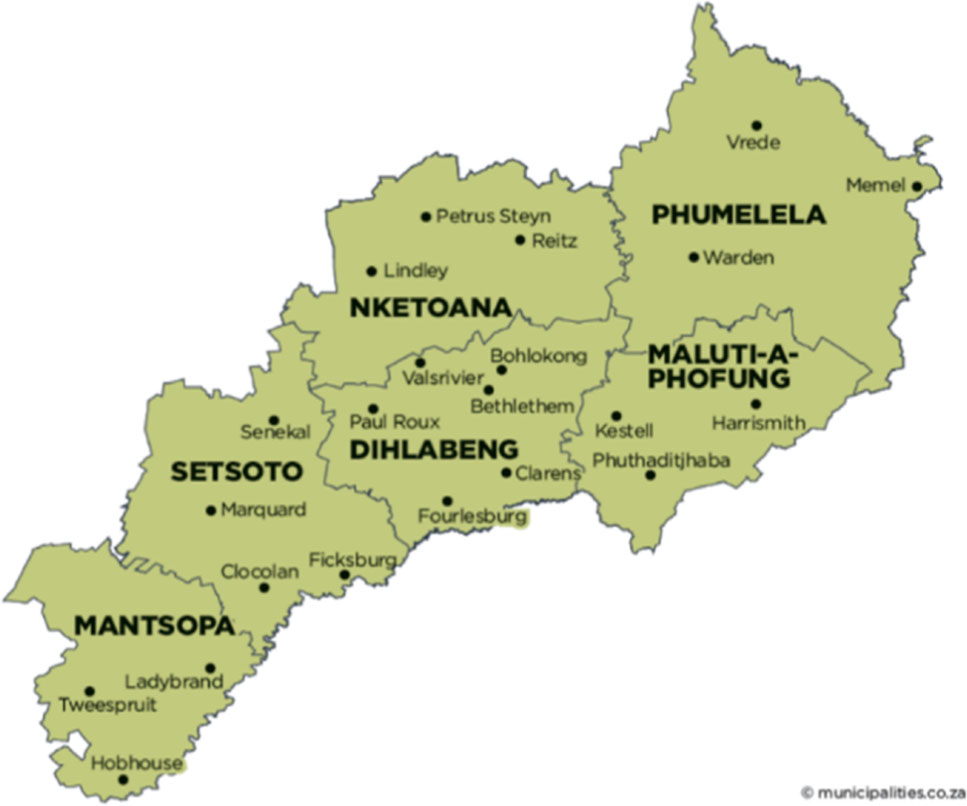
Fig. 1.
Map of Thabo Mofutsanyana District Municipality
Source: Municipalites.co.za, 2025.
METHODOLOGY
Study area
The study was conducted in the Thabo Mofutsanyana District Municipality in the Free State Province of South Africa, shown in figure 1. Being a tertiary sector leading the district's economy and contributing 72.3% to gross value added, and with community services accounting for 29.4%, the study area holds a significant comparative advantage in the agriculture sector. Agriculture, as its primary sector, contributes 11.5% in this regard (www.municipalities.co.za, 2025).
Thabo Mofutsanyana is one of the five districts in the Free State Province and is characterised by its predominantly rural landscape and small towns. The district incorporates six local municipalities, namely Dihlabeng, Maluti-a-Phofung, Mantsopa, Nketoana, Phumelela, and Setsoto. Agriculture plays a vital role in each of these, ensuring food security and contributing to the employment absorption rate.
Sample size and sampling procedure
An updated list (compiled in 2024) of 251 smallholder farmers in the study area was obtained from the Free State Department of Agriculture and Rural Development and Environmental Affairs (FSDARDEA) in the Thabo-Mofutsanyane District. A proportionate random sampling technique was used to select a representative sample of smallholder farmers in the study area. Table 1 shows the calculation of the study sample according to the local municipalities within the Thabo-Mofutsanyane District municipality. The sample determination calculation used by Krejcie and Morgan (1970) and Rahi (2017) was adopted to determine the study sample size as follows:
Table 1.
Sample size of smallholder farmers in the study area
| Local municipality | Smallholder | Sample per local municipality | |
|---|---|---|---|
| 1 | Dihlabeng Local Municipality | 21 | (21/251) × 145 = 12 |
| 2 | Setsoto Local Municipality | 06 | (6/251 × 145 = 3.5 |
| 3 | Maluti-a-Phofung Local Municipality | 183 | (183/251) × 145 = 106 |
| 4 | Phumelela Local Municipality | 23 | (23/251) × 145 = 13 |
| 5 | Mantsopa Local Municipality | 12 | (12/251) × 145 = 7 |
| 6 | Nketoana Local Municipality | 6 | (6/251) × 145 = 3.5 |
| Total | 251 | Sample size = 145 | |
Further, a random sampling technique in the form of a lottery for each local municipality was applied to sample the selected smallholder farmers.
Data collection and analysis
Primary data were collected using a semi-structured questionnaire, with smallholder farmers being inter-viewed face-to-face at their farm operations in July – August 2025. The Statistical Package for Social Science (SPSS), version 30, was used to analyse the collected primary data.
Specific models for analysis
The smallholder farmers' perceptions were measured using a five-point Likert scale. The scale questions and statements were ranked according to how the smallholder farmer perceived access to entrepreneurial skills training as follows: 1. Strongly agree, 2. Agree, 3. Do not know or neutral 4. Disagree, and 5. Strongly disagree. A mean score for each variable was constructed based on questions measuring perceptions under the following domains: (1) Access to entrepreneurial skills training opportunities; (2) Application or adoption of the entrepreneurial skills training opportunities; and (3) Credit access. A “strongly agree” score on the scale indicated a positive perception on the part of the farmer concerned regarding each dimension, while a “strongly disagree” response indicated a negative perception.
Furthermore, Principal Component Analysis (PCA) was used to reduce and rank a large set of variables by identifying a smaller number of components that explain most of the variability in the data, without including all the original variables in the analysis. This method allows for the extraction of new factors that represent the underlying or latent variables in the dataset of statements or questions. Eigen values greater than one and the cumulative variance explained by increasing the number of factors in the model were used to determine the appropriate number of factors to retain or select. In addition, the interpretability of the extracted factors guided the selection of the factor solution that best fitted the model.
The dependent variable access to entrepreneurial skills training (measured on a 5-point Likert scale) was analysed using a Multiple Linear Regression Model to determine which principal component had a significant influence on the application of skills in the farming businesses. The model was specified as follows:
where: yi – is the dependent variable, access to entrepreneurial skills training, X1, …, XK – are explanatory variables, and i – represents the n sample observations (mean scores of principal components). The error term ɛi is assumed to follow a normal distribution, and the coefficients, β1, …, βK – are parameters to be estimated.RESULTS AND DISCUSSION
Five-point Likert scale percentage rating of smallholder farmers' perceptions
Table 2 shows that 5.6% strongly agree and 11.7% agree that they have adopted and applied entrepreneurial skills in their farming business. Approximately 89% of the smallholder farmers either agreed or strongly agreed that it is important to apply entrepreneurial skills in their farming businesses. These results show that farmers in this study consider entrepreneurial skills important for their farming business. This is in line with the results of a study conducted in sub-Saharan Africa by Sennuga and Oyewole (2020), where a 3-point Likert scale (1 = less effective, 2 = effective and very effective = 3) was used to measure small-scale farmers' responses on the effect of entrepreneurial skills training. This revealed that many of the farmers (95%) found training very effective. However, the fact that fewer farmers indicated having adopted and applied entrepreneurial skills in the current study suggests that the available training opportunities in this regard are somewhat inadequate. Similar results were also reported in a systematic review which found inadequate training and support services to be critical challenges that affect engagement in agribusiness (Boye et al., 2024).
Table 2.
Five-point Likert scale percentage ratings
| No. | Questions/statement | SA | A | N | D | SD |
|---|---|---|---|---|---|---|
| X1 | Have you adopted and applied entrepreneurial skills? | 5.6% | 11.7% | 20% | 51.7% | 11% |
| X2 | Is it important to apply entrepreneurial skills? | 26.9% | 62.1% | 3.4% | 4.8% | 2.8% |
| X3 | Do you have access to entrepreneurial training? | 13.1% | 31% | 31.7% | 21.4% | 2.8% |
| X4 | Do you have access to financial skills training? | 15.2% | 26.9% | 34.5% | 19.3% | 4.1% |
| X5 | Do you have access to marketing skills training? | 13.1% | 29% | 33.8% | 24.1% | 0% |
| X6 | Do you have access to production training? | 11.7% | 33.1% | 23.4% | 24.8% | 6.9% |
| X7 | Do you have access to literacy skills training | 17.2% | 30.3% | 24.1% | 27.6% | 0.7% |
| X8 | The adoption of skills improved the farming business. | 15.2% | 22.1% | 33.8 | 29% | 0% |
| X9 | Is there a use for technology in the farming business? | 12.4% | 24.8% | 26.2% | 33.1% | 3.4% |
| X10 | Do you have access to finance? | 6.2% | 16.6% | 35.9% | 40.7% | 0.7% |
| X11 | Do you have access to high-value/commercial markets? | 6.9% | 26.2% | 25.5% | 39.3% | 2.1%% |
| X12 | Are the extension services effective for your farming business? | 24.8% | 44.8% | 15.2% | 12.4% | 2.8% |
The majority of the smallholder farmers agreed or strongly agreed (at 26.9% and 15.2%, respectively) that they had access to financial skills training. These results give cause for concern, especially considering the importance of financial skills on agricultural entrepreneurship. Previous research has demonstrated that lack of financial literacy results in poor financial management behaviour (Napu et al., 2025); and overall participation in agricultural entrepreneurship Sandhu et al. (2026). There was little variation in terms of the number of smallholder farmers who agreed (31%) or remained neutral (31.7%). Most smallholder farmers strongly agreed (13.1%) or agreed (29%) that they had access to marketing skills training, while a combined 44.8% agreed or strongly agreed that they had access to production skills training. In contrast, a combined 28.3% disagreed or strongly disagreed that they had access to literacy skills training, with 24.1% of smallholder farmers stating that they did not know if they had ever received literacy skills training.
There is also little variation amongst smallholder farmers who either strongly agreed or agreed (37.3%), disagreed (29%), and those who were neutral (33.8%) on the matter of adopting the skills acquired from the training received having improved their farming businesses and enterprises when applied. Smallholder farmers who disagreed or strongly disagreed on the use of technology in their farming businesses accounted for 33.1% and 3.4%, respectively. However, according to Sennuga and Oyewole (2020), successful engagement of farmers at the early stage of technology and innovation development can play a significant role in providing constructive advice to farmers, thereby promoting on-farm technologies.
Most smallholder farmers (a combined 41.4%) strongly disagreed and disagreed that they had access to finance, while about 35.9% were neutral on this matter. These results could be linked to the low number of farmers who firmly agreed to receiving financial skills training. In previous studies, lack of financial literacy and training has been linked to limited access to agricultural finance (Sandhu et al., 2026). Smallholder farmers who strongly agreed (6.9%) or agreed (26.2%) that they had access to high-value and commercial agricultural markets. However, those who disagreed and strongly disagreed accounted for 39.3% and 2.1%, respectively. Most smallholder farmers (24.8%) strongly agreed or agreed (44.8%) that the extension services received were effective for the farming business.
Principal component factor analysis
As shown in Table 3, the fitness of the model for the study data was assessed using the Kaiser-Meyer-Olkin (KMO) measure to evaluate sampling adequacy, while Bartlett's test of sphericity was used to assess the appropriateness of the data for factor analysis. The Chi-square value was 508.90 with 66 degrees of freedom and it was statistically significant (p < 0.001). This shows that the KMO measure of sampling adequacy was 0.821, indicating that the data were suitable for further analysis using the Principal Component Analysis method.
Table 3.
KMO and Bartlett's test
| Kaiser-Meyer-Olkin measure of sampling adequacy | 0.821 | |
|---|---|---|
| Bartlett's test of sphericity | Approx. Chi-square | 508.90 |
| df | 66 | |
| Sig. | < 0.001 | |
Table 4 shows the results of the extracted sums of squared loadings. The cumulative column indicates that extracting the three factors made it possible to explain the variation in the data, with the first factor (PC1) accounting for 35.121% of the variance, the second (PC2) for 11.943%, and the third (PC3) for 9.871%.
Table 4.
Explanatory total variance
| No. | Initial eigenvalues | Extraction sums of squared loadings | Rotation sums of squared loadings | ||||||
|---|---|---|---|---|---|---|---|---|---|
| total | % of var. | cumul. % | total | % of var. | cumul. % | total | % of var. | cumul. % | |
| X7 | 4.215 | 35.121 | 35.121 | 4.215 | 35.121 | 35.121 | 3.281 | 27.340 | 27.340 |
| X6 | 1.433 | 11.943 | 47.064 | 1.433 | 11.943 | 47.064 | 2.337 | 19.472 | 46.812 |
| X8 | 1.185 | 9.871 | 56.935 | 1.185 | 9.871 | 56.935 | 1.215 | 10.123 | 56.935 |
| X4 | 0.934 | 7.783 | 64.718 | ||||||
| X5 | 0.901 | 7.511 | 72.228 | ||||||
| X9 | 0.632 | 5.266 | 77.494 | ||||||
| X11 | 0.595 | 4.956 | 82.450 | ||||||
| X3 | 0.526 | 4.387 | 86.837 | ||||||
| X12 | 0.510 | 4.254 | 91.091 | ||||||
| X10 | 0.456 | 3.803 | 94.894 | ||||||
| X2 | 0.335 | 2.794 | 97.688 | ||||||
| X1 | 0.277 | 2.312 | 100.000 | ||||||
Figure 2 shows that PC numbers were plotted on the X-axis, while the eigenvalues were plotted on the Y-axis. The three PCs that were kept were those on the slope of the graph before the decrease in eigenvalue levels off to the right of the plot. Using this criterion, three PCs are plotted: access to literacy training; access to production skills training; and adoption of skills to improve farm business, all of which were retained in the analysis for this study. The results of the scree plot in Figure 2 and in Table 4 imply that the three factors extracted (access to literacy training; access to production skills training; and adoption of skills to improve farm business) are the crucial components perceived by the smallholder farmers regarding access to entrepreneurial skills training. According to Sanawiri and Amrulla (2025), vital aspects to be provided to farmers during training should be practical knowledge on business management, financial, planning, and digital marketing strategies relevant to current market needs.
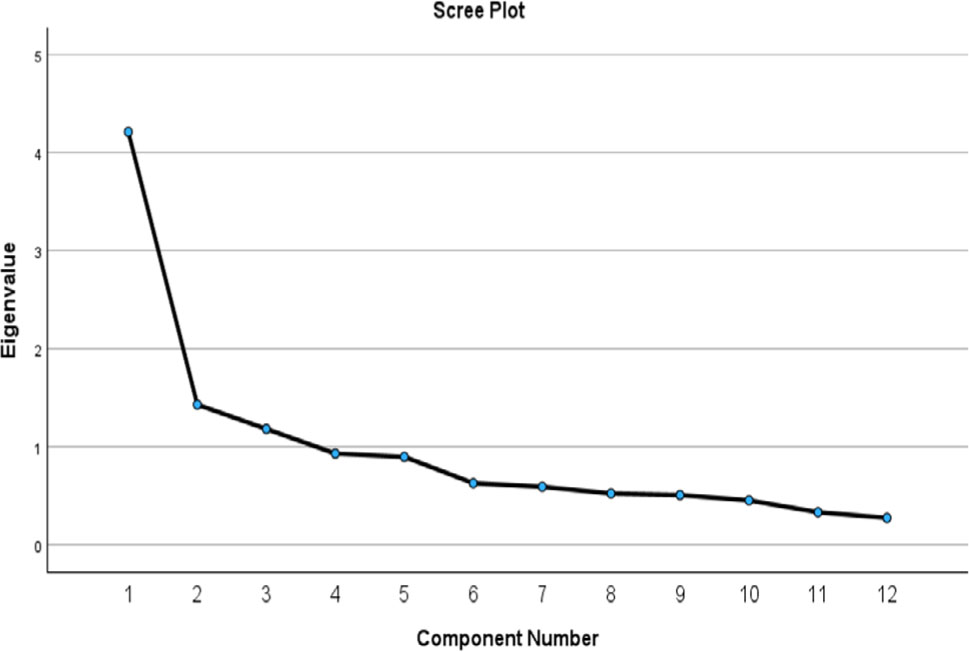
Fig. 2.
Scree plot for the rotated component matrix
Source: own elaboration.
Table 5 shows the factors included in each of the three principal components.
Table 5.
Rotated component matrix
| Questions/statement | Component 1 | Component 2 | Component 3 |
|---|---|---|---|
| Do you have access to literacy skill training? | 0.759 | 0.198 | |
| Do you have access to production training? | 0.833 | 0.137 | |
| The adoption of skills improved the farming business. | 0.593 | 0.366 | 0.270 |
| Do you have access to financial skills training? | 0.752 | 0.147 | −0.141 |
| Do you have access to marketing skills training? | 0.759 | 0.129 | |
| Is there a use for technology in the farming business? | 0.334 | 0.693 | 0.121 |
| Do you have access to high value/commercial markets? | 0.206 | 0.761 | |
| Do you have access to entrepreneurial training? | 0.507 | 0.272 | −0.309 |
| Are the extension services effective to your farming business? | −0.105 | 0.422 | 0.507 |
| Do you have access to finance? | 0.114 | 0.768 | |
| Is it important to apply entrepreneurial skills? | 0.152 | 0.750 | |
| Have you adopted and applied entrepreneurial skills? | 0.245 | 0.467 | −0.401 |
Principal component 1 (PC1) contributed 35.121% of the variation, with an eigenvalue of 35.121. PC1 included all 12 factors in the study. This implies that access to literacy training resulted in a positive relationship for all 12 factors. Therefore:
Principal component 2 (PC2) contributed 11.943% of the variation, with an eigenvalue of 47.064. PC2 included 10 factors, according to the results presented in Table 4. This implies that access to literacy training resulted in an increase in farmers' access to production skills training and that it may result in an increase in smallholder farmers' literacy skills training, adoption of skills improved the farming business, access to financial and marketing skill trainings, access to high value markets, use of technology, access to entrepreneurial training and finance, as well as adopted and applied entrepreneurial skills in the farming business. Therefore:
Principal component 3 (PC3) contributed 9.871% of the variations, with an eigenvalue of 56.935. PC3 included eight factors: farmers' access to production; entrepreneurial and financial skills training; adoption of skills improving the farming business; use of technology in the farming business; and effective extension services. Therefore:
Regression analyses of the PCA factors
A statistical significance of P < 0.001 in Table 6 shows that the overall multiple linear regression used for analysis fits well with the analysed data.
Table 6.
ANOVA
| Model | Sum of squares | df | Mean square | F | Sig. |
|---|---|---|---|---|---|
| Regression | 62.647 | 3 | 20.882 | 32.004 | < 0.001 |
| Residual | 92.002 | 141 | 0.652 | ||
| Total | 154.648 | 144 |
In Table 7, the multiple linear regression model included the mean of the three factors extracted from the factor analysis. Variable (mean access to literacy training) showed statistical significance at (P < 0.001) with a negative coefficient. This implies that small-scale farmers with access to literacy skills were less likely to have access to general entrepreneurial skills training. This may be due to small-scale farmers relying more on the literacy skills they possess to run their enterprises, and regard the other skills and training as inferior. A study by Sanawiri and Amrulla (2025) reported that low business literacy, limited access to modern agricultural technology, and difficulties in expanding the farmers' market reach due to minimal digital adoption are major challenges faced by small-scale farmers.
Table 7.
Regression analyses of the PCA factors
| Unstandardised coefficients | Standardised coefficients | ||||
|---|---|---|---|---|---|
| Variables | B | Std. error | Beta | t | Sig. |
| Constant | 0.120 | 0.393 | 0.305 | 0.761 | |
| Mean access to literacy training | −2.804 | 0.850 | −1.592 | −3.300 | 0.001* |
| Mean access to production skills training | 2.442 | 0.627 | 1.455 | 3.892 | < 0.001* |
| Mean adoption of skills to improve farm business | 1.375 | 0.354 | 0.778 | 3.886 | < 0.001* |
Variables (mean access to production skills training and mean adoption of skills to improve farm business) indicated a statistical significance at P < 0.001, with positive coefficients. This implies that small-scale farmers with access to production skills, along with those who have adopted some skills to improve their farm businesses, were more likely to have access to general entrepreneurial skills training. A study conducted by Sennuga and Oyewole (2020) in sub-Saharan Africa reported that most farmers (98%) indicated that the entrepreneurial skills training that they had received had been effective and had increased their level of agricultural production. Furthermore, Agbolosoo and Anaman (2021) stated that when smallholder farmers are provided with adult education on modern agricultural practices and technologies skills, their chance of adoption tendency increases, leading to high productivity and profitability.
CONCLUSION
Smallholder farmers' access to general entrepreneurial skills training has the potential to significantly contribute to the economic development of farming enterprises in the study area, despite their limited access to commercial or high-value agricultural markets. In this study, 62.1% of the smallholder farmers agreed and 26.9% strongly agreed that it is important to apply entrepreneurial skills in their farming business and 5.6% strongly agreed and 11.7% agreed that they have adopted and applied entrepreneurial skills in their farming business. The PCA analysis in this study extracted three factors: smallholder farmers' access to literacy and production skills training, and adoption of skills to improve farm business as the significant factors of the analysis. Multiple linear regression analyses of the extracted factors influencing the perceptions of the smallholder farmers' access to entrepreneurial skills training indicated that mean access to literacy training was statistically significant (P < 0.001) with a negative coefficient. In contrast mean access to production skills training and mean adoption of skills to improve farm business were statistically significant at with a positive coefficient (P < 0.001). This implies that small-scale farmers with access to production skills, and those who have adopted some skills to improve their farm businesses, were more likely to have access to general entrepreneurial skills training. Therefore, it is recommended that any policy aimed at improving the development of the small-scale farmers should consider the above determinants. It is also recommended that different entrepreneurial skills training should be awarded to the small-scale farmers for effective production and commercial market accessibility.
ACKNOWLEDGEMENT
UNISA Women in Research Funding.