
INTRODUCTION
Public–private partnerships (PPPs) are being promoted at a global level as viable mechanisms to enhance agricultural productivity and integrate smallholders into competitive value chains. Studies show that when institutional support and farmer organizations are involved, PPPs reduce risks, expand market access, and improve adoption of modern practices (Möhring et al., 2024). The African Union and the Food and Agriculture Organization (FAO) emphasize that PPPs are critical for agribusiness development, particularly in contexts where public investment falls short of CAADP commitments. Evidence across Africa highlights that PPPs succeed when governance structures include farmer representation, ensuring accountability and trust (FAO and AUC, 2024).
In East Africa, PPPs have been applied to strengthen supply chains and improve access to inputs, with participation often linked to the proximity to infrastructure and farmer networks (Mbonigaba et al., 2024). In Uganda, PPPs have been adopted to address persistent challenges such as limited credit, weak infrastructure, and low technology uptake. Empirical research shows that farmer attributes, including age, gender, and cooperative membership, significantly influence participation (Mugisha et al., 2023). Coffee, Uganda’s leading export crop, continues to anchor PPP initiatives, with recent reports noting rising export earnings, despite persistent yield gaps (UCDA, 2025). These observations present a critical case of the importance of strengthening PPP frameworks to improve farmer incomes and service access, situating the present study within ongoing debates on agricultural commercialization and livelihood transformation.
Over the past decade, People–Private–Public Partnerships (PPPs) have become central to Uganda’s agricultural development strategies. They emerged in response to fiscal pressures, limited public investment, and inefficiencies in state enterprises. Since 2000, Uganda has pursued a private sector–led economy under the Competitiveness and Investment Climate Strategy (CICS), which evolved from the Medium-Term Competitiveness Strategy (MTCS). The CICS is mandated to implement Uganda’s PPP framework, focusing on competitiveness and production (MOFPED, 2025).
Uganda’s PPP approach was formalized through the Public Private Partnerships Act (2015), which established the PPP Unit under MOFPED to provide technical expertise and oversight. This institutional framework was designed to attract private investment into critical sectors, including agriculture, where public funding has consistently fallen below the 10% CAADP/NEPAD target (EPRC, 2022). The PPP model has since evolved to address structural challenges such as limited access to credit, weak infrastructure, and low adoption of modern technologies (Byaruhanga & Kansiime, 2022).
Agriculture contributes over 24% to Uganda’s GDP and employs more than 70% of the population, yet productivity remains low due to fragmented markets and underinvestment (Kassie et al., 2023). PPPs provide a mechanism for pooling resources, sharing risks, and integrating smallholders into value chains. Evidence shows that PPPs in the bean, cereal and coffee sectors have improved access to inputs, stabilized markets, and enhanced resilience (Aseete et al., 2023; Kiggundu and Mutebi, 2025). By leveraging private capital and expertise, PPPs complement government efforts to modernize agriculture and promote commercialization.
Recent innovations, such as digital agriculture platforms, have expanded PPP potential by reducing transaction costs and improving logistics (Ajambo et al., 2022). However, challenges persist, including weak enforcement of contracts, side selling, and limited technological innovation. Studies highlight that PPPs succeed when farmer organizations are integrated into governance structures, ensuring accountability and trust (Birachi et al., 2023; Tumwine and Mugisha, 2023). Coffee generated US$1.72 billion between March 2024 and February 2025 (UCDA, 2025), underscoring the sector’s importance for Uganda’s exports. However, yield gaps remain significant, with Robusta averaging 1,100 kg/ha compared to a potential 4,600, and Arabica averaging 900 kg/ha versus 2,400 (Sserwanga et al., 2024). Addressing these inefficiencies requires stronger PPP frameworks and coordinated action among government, private firms, and farmer cooperatives. The goal of this study was to examine the determinants of coffee farmers’ participation in PeoplePrivatePublic Partnerships (PPPs) in Uganda, with reference to contractual marketing models.
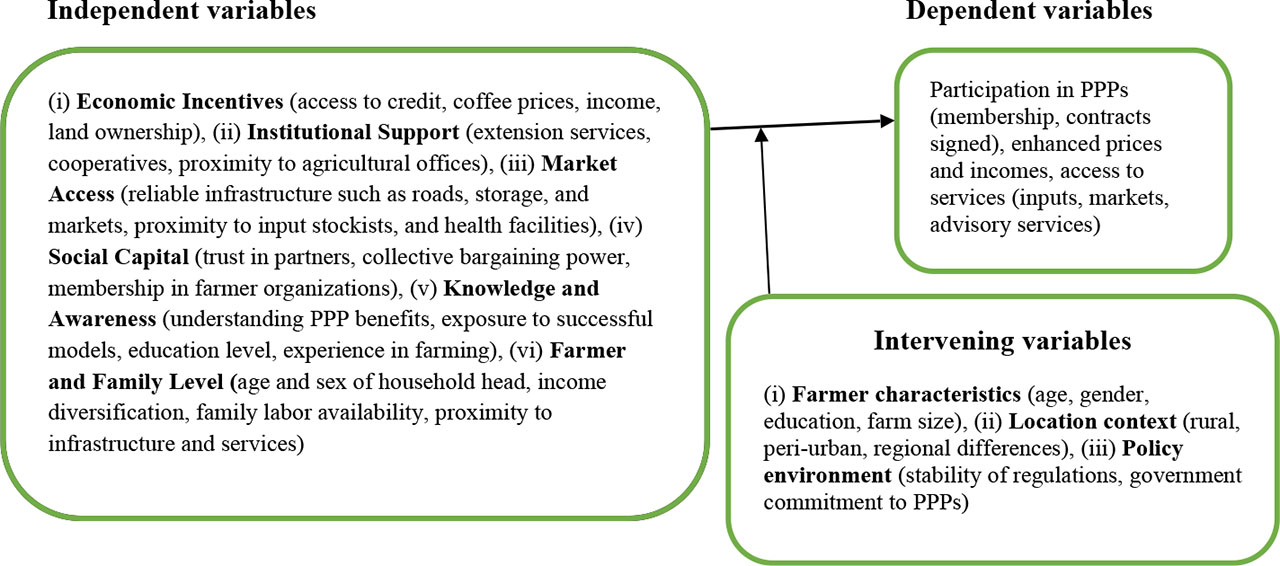
Fig. 1.
Conceptual framework that shows variables that define drivers of participation in Public-Private-Partnerships
Source: own elaboration based on PPPU, 2024.
Conceptual framework
The study envisions that coffee farmers’ participation in PPPs is influenced by economic incentives, institutional support social capital, knowledge and awareness, and social factors. These drivers collectively determine engagement in partnerships (Aseete et al., 2023). Owing to external and uncontrolled factors, some intervening factors enhance or compromise the influence of the independent variables to inform coffee farmers decisions to participate in PPP. Farmer characteristics such as age, gender, education, and farm size influence how households perceive and respond to PPP opportunities, while location context (rural, periurban, and regional differences) shapes access to markets and services. The policy environment, including regulatory stability and government commitment, mediates the effectiveness of PPP participation pathways (Mugisha et al., 2023).
By participating in PPPs through membership and contract agreements, coffee farmers secure higher prices and incomes while also improving access to inputs, markets, and advisory services that strengthen their livelihoods (Mugisha et al., 2023). The conceptual framework presents a summary of the key variables and how they relate to influencing the dependent variable, participation in PPP, which is the focus of this paper.
In this paper, according to the Food and Agriculture Organization of the United Nations (FAO), contract farming is defined as an agreement between farmers (producers) and buyers, where terms and conditions for the production and marketing of agricultural products are established in advance, specifying the rights and obligations of each party. The Food and Agriculture Organization (FAO) defines an outgrower scheme as a contractual partnership between growers or landholders and a company for the production of commercial agricultural or forest products. Though these agribusiness models differ in the strict sense, they are treated as the same, given the many similarities in their modes of operation.
METHODOLOGY
Research design
This observational study involved a household cross-sectional survey. Farmers were categorized into two cohorts, namely participants (under contractual arrangement) and nonparticipants. Participants were defined as those involved in two key PPP partnership models, namely contracts and outgrower schemes, which in practice are used interchangeably; for this study, they were aggregated as “contractual agribusiness models”. ActionAid (2015) explicitly states that outgrower schemes are often referred to as “contract farming” in the academic and policy literature, underscoring the overlap and interchangeability of the terms. This approach was also adopted by Okello and Ahaibwe (2025). Nonparticipants were those not involved in any partnership model for coffee. It is on this basis that they were compared in order to gain deep insights into reasons for and against participating. The benefits that accrue to participants in Public–Private Partnerships were then examined (Okia and Buyinza, 2022).
Study districts
The study districts were Mbale and Mubende, which were selected based on their high production levels of coffee (UCDA, 2019). Agricultural zoning further shows the potential in these areas, as agroecological conditions and farming systems strongly influence crop specialization (Chavula and Turyasingura, 2023). These areas also have existing PPP partnerships for the coffee value chain (UCDA, 2025). The buyers that have contracts with farmers and are district anchored are the Bugisu Cooperative Union and Gumutindo, while the following criss-cross the two districts: Kyagalanyi, Kawacom, Ibero and Hanns R. Neumann (Stiftung).
Socioeconomic factors, geopolitics, and infrastructure also play a role in shaping participation in PPPs (Tenywa et al., 2023). Other considerations were land tenure and the ongoing agriculture based programmes and initiatives which build capacity (EPRC, 2022). Ultimately, PPPs in Uganda’s agricultural sector have demonstrated the potential to reduce risks, enhance farmer livelihoods, and strengthen value chains when institutional frameworks are enforced (UCDA, 2025).
Types and sources of data
Both primary and secondary data were used to ensure adequate triangulation. Primary data included: (i) Socio-demographic variables centred around age of household head (in years), sex of the respondent (a dummy represented by 1 for male, 0 otherwise), education level attained (in years), coffee farming experience (in years), household size (proxy for family labour), and membership of farmer groups (dummy variable with 1 for Yes, 0 otherwise), as used by Manono et al. (2023); (ii) Economic variables, included annual on and off-farm income (converted to US dollars), asset ownership (dummy for ownership of radio, television and mobile phone, 1 for yes, 0 otherwise), land holding (in acres) and past prices received (converted to US dollars) (since farmers plans are based on past prices (Riaz, 2001); prices received and open market price (converted to US dollars). Other variables were proximity to agricultural office and weekly markets (in kilometres); (iii) Location variables were; proximity to agricultural offices and weekly markets (in kilometres); (iv) Use of hired labour (a dummy variable with 1 for yes, 0 otherwise), access to production credit (a dummy variable with 1 for yes, 0 otherwise), access to advisory services and market information (a dummy variable with 1 for yes, 0 otherwise); (v) Policy-related variables included status of rural roads (a dummy variable with 1 representing good, 0 otherwise), and favourable and unfavourable policies (a dummy variable with 1 representing favourable, 0 otherwise), and a request to propose interventions, as was also used by Byerlee and Fanzo (2023).
Secondary data were solicited from official sources including publications, journals, reports, and newsletters of districts; the Ministries of Agriculture, Animal Industry and Fisheries and Finance, Planning and Economic Development were also visited. The Ministry of Trade, Tourism and Cooperatives and the National Agricultural Research Organization provided critical information, as suggested by Nalukwago and Ssewanyana (2024). The Uganda Bureau of Statistics, Makerere University, government agencies, NGOs, and development partner programme documents were reviewed, as was the case in Dramane et al. (2022). Internet searches were conducted to fill any information gaps. Data obtained from secondary sources included time series production, price, and yield data. Other forms were export trends, and government policies and their interventions (Nanyonga and Ssewanyana, 2025).
Primary data were collected through a quantitative farmer household survey comprising structured pre-tested questionnaires administered in face-to-face interviews. These were supplemented with qualitative research methods, which included key informant interviews (Dramane et al., 2022). Observations were also made during village transect walks to supplement any data collected.
Sample size and sampling technique
A statistical sample size was obtained using a formula based on the work of Arsham (2005), which has been widely applied in agricultural research. Recent studies have further validated and adapted this approach for household survey designs in Sub-Saharan Africa (Byaruhanga and Kansiime, 2022).
The formula for obtaining sample sizes for binary data (1 depicting participation in PPP, 0 otherwise) is given as:
where: N denotes the size of the total number of available cases (farming households are the sampling units, we used the population estimates from the Uganda Bureau of Statistics for each district), n is sample size, α the expected error (maintained at 0.05), t the value taken from the t distribution corresponding to a certain confidence interval (2.000 is used in this study), and p being the probability of an event, in this case that a household will grow coffee, which is estimated at 0.9. According to UCDA (2019), N for Bunghoko was 2950 (based on the 50% of 5900 households that grow coffee) and for Madudu 3990 (based on 42% of the households that raise coffee). Substituting these figures in the above formula yielded a minimum sample size of 137 for Mbale and 139 for Mubende. This number was doubled to cater for unforeseen circumstances. Therefore, the sample size for the two districts was 560 households (280 participants and 280 non-participants).Multi-stage purposive sampling was used at the district (Mbale and Mubende) and sub-county levels. Based on coffee production figures provided by the agricultural officers and commercial officers (for Mbale district, the selected sub-county was Bunghokho; for Mubende, it was Madudu). Farmers that were on contractual arrangements were identified, through consultations with private sector buyers. These farmers were listed by gender. This list constituted the sampling frame for each district from which the respondents were randomly selected. However, given women’s household, many could not spare time for the interviews. Furthermore, some respondents did not respond comprehensively to all questions and were consequently dropped. This resulted in a smaller sample size of 489 in both districts (245 from Mbale and 244 from Mubende).
Data analysis: Data were analysed using Excel (2010), SPSS (Predictive Analytics Software version 18), and STATA (version 15) software. Analytical procedures included descriptive statistics such as frequencies, percentages, measures of central tendency (means and medians); measures of dispersion (including standard deviation) were estimated for selected socio-demographic and economic variables (Bhardwaj and Kaushik, 2024). Econometric analysis involved using the dichotomous logit model as employed by Albertson (2016) and Wawire et al. (2017), with recent applications in agricultural household decision-making, further supporting its relevance (Abdulai and Huffman, 2022).
The logit model relies on several assumptions to produce valid estimates. The dependent variable must be binary, distinguishing between two possible outcomes, such as participation or nonparticipation in PPPs. Observations are expected to be independent, ensuring that each farmer’s decision is not influenced by another’s. Predictors should relate linearly to the log odds of the outcome, and multicollinearity among explanatory variables must be minimal to avoid distortion. A sufficiently large sample is required for stable maximum likelihood estimation, while the correct model specification demands the inclusion of relevant variables and the exclusion of irrelevant ones. Finally, residuals are assumed to be independent and follow a binomial distribution, which supports the reliability of the model’s results.
A farming household that participates in the PPP was assigned a value of 1, and 0 otherwise (this defined the binary dummy as the dependent variable). If Pi is the probability that one is a participant, and 1 − Pi the probability that it is not, then the logit (L) is given by:
The underlying logit model is based on the cumulative logistic probability distribution function. The dependent variable Zi is the logarithm of odds that a particular choice will be made. It is an index reflecting the combined effects of Xi factors that promote or prevent adoption. The importance of each factor is influenced by the coefficients of the adoption equation (βi). The empirical model that was estimated was specified as:
where X1 to Xk are the explanatory socio-economic variables that the study will attempt to identify. These included socio-economic and village variables captured from farmers, with e being the disturbance term to capture other variables that influence the dependent variable other than those specified. The inclusion of an independent variable was based on recent adoption and welfare studies such as Byaruhanga and Kansiime (2022). Standard goodness-of-fit tests for logit models included t-tests for the estimated coefficients, Chi-square and likelihood ratio tests based on the hypothesis that all variables are zero, and the McFadden pseudo R2, which is an adjusted R2 to fit the nonlinear logit procedure (Byaruhanga and Kansiime, 2022). The preliminary steps of the model specification included assessing for data quality and completeness, and those with many missing values and measurement errors (including income, and land ownership) were dropped. Furthermore, tests for multicollinearity between some variables (e.g. age and experience of the household head, and distance variables) were also conducted, and choices made to drop some variables with high correlation coefficients (0.8 and above) and variance inflation factor (VIF) of > 5.RESULTS AND DISCUSSIONS
Socio-demographic characteristics
Mbale and Mubende presented an almost equal distribution of contract and non-contract farmers. This could imply that the likelihood of entering into a contractual arrangement is independent of the site’s geographical location (Meemken and Bellemare, 2023). Mbale district is in the eastern part of the country, while Mubende is in the central area. Moreover, this impacts the source of supply, which is of primary interest to private sector players, rather than other factors (Aseete et al., 2023).
Female participation in contractual arrangements is significantly lower than that of their male counterparts (Table 1). This is partly due to women constituting a smaller proportion of the overall sample in the two districts. Specifically, 71.2% of the contract farmers were male and 28.8% female. The underrepresentation of female farmers may stem from a number of factors; these include the culture in the project areas, which limits women’s representation in the public sphere, coupled with a possible lack of low self-esteem. Some women declined to be interviewed, which may be attributed to low education status, shyness, and lack of interest (Meemken and Bellemare, 2023). To strengthen future PPP arrangements, deliberate efforts must be geared towards attracting more women. Experiences in PPPs from other countries bear witness to the fact that farmers, especially women, could reap the benefits of increased production and productivity of farm enterprises even from smallholder plots. In addition to economic gains, such partnerships foster greater social recognition and enhance group dynamics (Njuki and Mbwambo, 2022). The key issue, however, remains the inability of many women to effectively exercise the rights they currently possess.
Table 1.
Composition of respondents by sex, district and status of participation in agribusiness contractual arrangements
| District | Intervention (contract) | Control (non contract) | Male | Female | Total | ||
| Mbale | 123 | 122 | 125 | 120 | 245 | ||
| Mubende | 144 | 100 | 213 | 31 | 244 | ||
| Total | 267 | 222 | 338 | 151 | 489 | ||
| Type of farmer | Male | Female | Total | ||||
| n | % | n | % | ||||
| Non-contract | 148 | 66.7 | 74 | 33.3 | 222 | ||
| Contract | 190 | 71.2 | 77 | 28.8 | 267 | ||
| Total | 338 | 69.1 | 151 | 30.9 | 489 | ||
Location of farmers to key service centres
Contract farmers are closer to key service facilities, as presented in Table 2. Firstly, tarmac roads facilitate access to transport, information, and input and output markets. Numerically, the contract farmers were closer to these roads compared to their counterparts; this has a bearing on how quickly they can access the requisite services. The relationship between adoption and distance to the nearest tarmac roads can also be premised on the propensity to produce for the market, as reported by Langyintuo and Mungoma (2008), and access to better prices.
Table 2.
Distance (km) to the nearest critical service providing points for the respondents
| Variable | n | Mean distance (kms) | Std. deviation | P |
|---|---|---|---|---|
| Nearest Tarmac road | 197 (262) | 12.3 (11.3) | 7.4 (7.2) | 0.243 |
| Nearest Agric. Office | 191 (259) | 11.1 (7.9) | 7.6 (7.0) | 0.000** |
| Nearest Market | 191 (253) | 5.0 (4.6) | 3.5 (3.5) | 0.626 |
| Nearest Govt Health Facility | 199 (261) | 5.8 (4.5) | 5.4 (4.1) | 0.000** |
| Nearest Primary School | 199 (262) | 2.0 (2.1) | 3.9 (2.4) | 0.797 |
| Nearest Input Stockist | 187 (253) | 7.7 (6.0) | 4.2 (3.8) | 0.033* |
| District Office | 188 (255) | 13.3 (12.4) | 6.5 (6.1) | 0.015* |
| Sub County | 199 (263) | 6.7 (6.1) | 6.8 (4.3) | 0.571 |
| Private Health Facility | 198 (261) | 3.2 (2.5) | 2.2 (2.3) | 0.961 |
| Secondary School | 196 (263) | 3.6 (3.2) | 4.0 (3.8) | 0.142 |
However, the difference is not significant between these two cohorts. Other service centres, whose proximity to farmers is not significantly different from the two farmer cohorts, were nearest markets, nearest primary school, sub-county, secondary school and private health facility. However, for most of these facilities, the contract farmers were in closer proximity compared to the non-contract farmers.
The nearest agricultural office is significantly closer for the contract farmers compared to the non-contract farmers (p < 0.01). This finding aligns with the proximity to district offices, implying that contract farmers benefit from technical guidance, access to technical information, and professional (Getahun et al., 2024). This support heightens their technical and professional confidence (Mbugua, 2025).
Government health facilities are also in close proximity to contract farmers (p < 0.01), which has a bearing on the speed at which health care can be accessed, and the costs incurred (Kiddu Namyalo et al., 2025). Additionally, contract farmers are in closer proximity to input stockists (p < 0.05), hence are more likely to incur lower production costs, thereby boosting their profits (McKinsey and Company, 2024).
The quantitative variables used in the regression were compared for both farmer categories. The results in Table 3 show that contract farmers were older (mean age 46.92, SD 15.63) than noncontract farmers (39.86, SD 12.20; p = 0.001) and lived closer to agricultural offices (7.63 km, SD 6.98 vs. 9.60 km, SD 8.04; p = 0.004). No significant differences appeared in distance to weekly markets (p = 0.804) or education level (p = 0.496). Assessment of the categorical variables, using chi-squared showed some differences for some variables as shown in the table. The chisquared analysis revealed notable differences between contract and noncontract farmers. Membership of farmer organisations was significantly higher among contract farmers (250 vs. 23; χ2=340.84, p = 0.001). Mobile phone ownership also differed (167 vs. 156; χ2 = 3.23, p = 0.044). No significant variation was observed in the gender of the household head (χ2 = 1.15, p = 0.165) or radio ownership (χ2 = 870.00, p = 0.222).
Table 3.
Comparison of selected quantitative and categorical variable by category of respondent
| Quantitative variable | n | Mean | Std. deviation | P |
| Age of the household age | 267 (222) | 46.920 (39.862) | 15.627 (12.197) | 0.001** |
| Education level | 267 (222) | 6.492 (6.693) | 3.297 (3.153) | 0.496 |
| Categorical variable | n | Frequency | Chi-square | P |
| Sex of the household head | 267 (222) | male =190 (148) | 1.147 | 0.165 |
| Member in farmer organisation | 267 (222) | yes = 250 (23) | 340.843 | 0.001** |
| Household owns a radio | 267 (222) | yes = 249 (202) | 870.000 | 0.222 |
| Household owns a mobile phone | 267 (222) | yes = 167 (156) | 3.225 | 0.044* |
Regression results show that the distance to the nearest agricultural office reduces the likelihood of being engaged in a contractual arrangement (p < 0.05) (Table 4). This suggests that farmers located further away from agricultural offices are less involved in coffee contracts. This may be attributed to a lack of adequate information, which prevents farmers from being attracted to entering into contracts. Consequently, they are unable to make important decisions regarding marketing their coffee through contractual arrangement. This behaviour is similar to that reported by Martey et al. (2014) on fertilizer use in Ghana (Mbugua, 2025), and Ndiritu and Kassie (2022) in Kenya.
Table 4.
Determinants of coffee farmers’ participation in agribusiness contractual arrangements
| Variable | B | Odds ratio | S.E. | P |
|---|---|---|---|---|
| Distance to agric office | –0.071 | 0.93 | 0.032 | 0.030* |
| Distance to weekly market | –0.032 | 0.97 | 0.065 | 0.617 |
| Sex of the household head | 0.060 | 1.06 | 0.439 | 0.892 |
| Age of the household age | 0.030 | 1.03 | 0.014 | 0.035* |
| Member in farmer organisation | 5.059 | 157.9 | 0.401 | 0.000** |
| Owns a radio | 0.672 | 1.96 | 0.794 | 0.397 |
| Owns a mobile Phone | –0.565 | 0.57 | 0.418 | 0.176 |
| Education level | –0.021 | 0.98 | 0.067 | 0.759 |
| Constant | –3.203 | 0.04 | 1.413 | 0.023 |
The age of the household head also had a significant and positive influence on the likelihood of farmers entering into contractual arrangements (P < 0.05). Ideally, older farmers are more experienced, and hence have a higher probability of adoption (Brown et al., 2024). On the other hand, younger farmers tend to be more innovative (Zhang and Qiao, 2025), which renders the effect of age on adoption ambiguous. The effect of age is generally location- or technology-specific, with both direct and inverse relationships with adoption being possible (Traldi and Sant’Anna, 2023).
The former could be related to experience and the ability to access an innovation much faster than the young ones (Kapari et al.; 2023). The inverse relationship is attributed to the more riskaverse nature of older farmers (Nguyen and Tran, 2024). Recent evidence also shows that generational differences in adoption patterns are widening, with younger farmers more willing to experiment with new contractual arrangements (Miller and Lobley, 2023). Similar findings have been reported by Lwasa et al. (2011) on the use of ICT among farmers, the adoption digital tools for market access and farm management (Brown et al., 2024), and the uptake of mobile-based agricultural innovations (Gouroubera et al., 2024).
The results indicate that membership of farmers’ organisations significantly (p < 0.01) increases the likelihood of participating in a contractual arrangement. This finding is consistent with those of Brown et al. (2024), and Han and Sun (2024). This is a strong indicator of social capital. Such capital leads to a better livelihood, as recent studies confirm that collective action enhances resilience and income security among smallholders (Maindi et al., 2024). Farmer cooperatives significantly bolster smallholders bargaining power and market access, reinforcing the importance of organised, collective efforts (Abebe et al., 2025). The significance of the farmer group membership variable in this study points to the need to revive or, in some areas, develop farming cooperatives in Uganda.
CONCLUSION AND POLICY IMPLICATIONS
Public–private partnerships (PPPs) are not a universal solution for agricultural challenges; their effectiveness depends on aligning complementary skills and resources to maximize collective benefits. Evidence indicates that male farmers participate more in contractual arrangements than females, highlighting the need for gender responsive policies that improve women’s access to land, finance, and advisory services. Older farmers also register higher participation, a fact likely due to stronger financial capacity and literacy, making them strategic targets for PPP engagement.
Membership of farmer organizations significantly enhances access to resources and information, underscoring the importance of reinforcing collective action in Uganda. Strengthened farmer groups can increase bargaining power, stabilize crop prices, and facilitate bulk production for contractual markets. Improved rural infrastructure, particularly roads, remains critical for reducing transaction costs and enhancing market access. While PPPs can attract private investment into weak value chains, state inefficiencies may undermine outcomes. Clear contractual frameworks, adequate public funding, and incentives for private actors are essential to enhance farmers livelihoods. Given the limited evidence on PPPs, there is an urgent need for greater transparency and empirical research to guide the design and implementation of policies that will be effective in addressing the persistent market access constraints experienced by farmers.
The study was limited by its cross-sectional design, which limits the analysis of changes over time. Reliance on selfreported data may also have introduced bias, though triangulation with qualitative data might have helped to reduce this. It is also notable that some farmers were reluctant to respond in full to all the questions; this reduced the data quality and compromised a deeper analysis. However, this was redeemed through focusing on the best reported on variables, which led to some variables being identified that have a policy connotation. While the geographic scope, Mbale and Mubende districts, further limits generalizability, replication in other regions can address this. Future studies could employ longitudinal designs to track PPP impacts over time. Moreover, comparative analyses could be conducted across other PPP models to identify the optimal approaches to implementing these agribusiness models.
ACKNOWLEDGEMENT
This article resulted from a research project funded by the National Agricultural Research Organisation (NARO) under the Competitive Grant Scheme (CGS) Number CGS/5/39/14.