
INTRODUCTION
Agriculture forms a cornerstone of Zimbabwe’s socio-economic and political landscape, underpinning livelihoods, ensuring food security, driving industrial development, and generating foreign exchange earnings. With over 70% of the population residing in rural areas, it remains the primary source of employment and income for most Zimbabweans. The sector contributes to food security by reducing dependence on imports and supports agro-industrial development through the supply of raw materials for key value chains such as tobacco, maize, and cotton.
Historically, agriculture has played a critical role in driving GDP growth and export performance. However, its contribution has declined over time due to climatic shocks, macroeconomic instability, land reform challenges, and institutional weaknesses. Although land redistribution was intended to promote equity and empowerment, it often disrupted production by displacing skilled commercial farmers and weakening both financing and extension systems. Political uncertainty and high inflation have further undermined investor confidence and constrained agricultural productivity.
Despite these setbacks, agriculture remains Zimbabwe’s most viable pathway to inclusive and sustainable economic growth. The country’s diverse agroecological zones and capacity for both food and cash crop production provide a solid foundation for recovery. Recent initiatives – such as Command Agriculture, the Presidential Inputs Scheme, and irrigation rehabilitation programmes – seek to address input shortages and infrastructure gaps. Their success, however, depends on effective government support, land access, efficient extension services, and favourable weather conditions (Moyo, 2011). Notably, tobacco contract farming has reconnected smallholders to export markets, demonstrating how private-sector partnerships can stimulate sectoral recovery.
This study explores the relationship between agricultural production – encompassing both crop and livestock output – and economic growth in Zimbabwe from 1980 to 2022. It analyses GDP trends, regional disparities, and the effectiveness of various policy responses, while drawing comparative insights from other sub-Saharan countries experiencing similar structural and institutional constraints.
Agricultural development is especially critical for Zimbabwe, given its demographic composition and abundant natural resources. Growth in this sector can generate strong multiplier effects across manufacturing, transport, and services, while reducing poverty and enhancing food security. To realise this potential, policies must promote inclusive, climate-resilient strategies.
The research adopts a multidisciplinary mixed-methods approach that integrates economic theory with policy and institutional analysis. The conceptual framework is grounded in classical, neoclassical, Keynesian, and endogenous growth theories, offering a comprehensive lens for examining the contribution of agricultural productivity to economic development. Quantitative data from ZIMSTAT, the World Bank, FAO, and IMF are complemented by qualitative insights drawn from policy documents and existing literature.
In summary, this study seeks to deepen understanding of agriculture’s evolving role in Zimbabwe’s economy and propose evidence-based policy recommendations for revitalising the sector. While focused on Zimbabwe, the findings have broader implications for agricultural-led development strategies across Sub-Saharan Africa.
RESEARCH QUESTIONS
This study aims to examine the role of agricultural production in shaping Zimbabwe’s economic trajectory. To achieve this objective, the investigation is guided by the following research questions:
What is the nature and strength of the relationship between agricultural production (both crop and livestock) and economic growth in Zimbabwe?
How have major agricultural policy interventions – such as the Land Reform Programme and Command Agriculture – affected GDP growth over time?
What regional disparities exist in agricultural output, and how do these variations influence national economic performance?
In what ways do institutional and macroeconomic factors (including inflation, foreign direct investment, and infrastructure development) mediate the relationship between agriculture and economic growth?
LITERATURE REVIEW
Agriculture remains the foundation of economic growth, development, and poverty reduction in most developing countries. It is widely regarded as both the engine and the panacea for sustainable economic prosperity (Awoyemi et al., 2017). Myrdal (1973) argued that the long-term struggle for economic growth in developing countries would be won or lost in the agricultural sector. The relationship between agricultural production and economic growth has long attracted scholarly and policy-oriented attention, particularly in developing economies where agriculture forms the backbone of rural livelihoods. This literature review presents theoretical and empirical perspectives on how agriculture influences economic growth, with a focus on Zimbabwe and relevant international comparisons.
Classical economists such as Adam Smith (1776), David Ricardo (1821), and Thomas Malthus (1798) underscored the centrality of agriculture to national economic development. Smith (1776) emphasised the productivity gains derived from specialisation and division of labour, while Ricardo’s (1821) theory of comparative advantage posited that nations should specialise in sectors where they possess an efficiency advantage – as in the case of agriculture in Zimbabwe – to maximise economic gains. Malthus (1798), however, warned that unchecked population growth could outstrip food production, potentially leading to famine and poverty.
Neoclassical growth models, such as the Solow-Swan model, introduced technological progress as a critical driver of long-term economic growth. These models contend that capital accumulation yields diminishing returns unless complemented by technological advancement (Solow, 1956; Swan, 1956). In agricultural contexts, this underscores the importance of improved seed varieties, mechanisation, and sustainable farming practices to enhance productivity.
Modern growth theories, particularly endogenous growth models advanced by Romer (1994) and Lucas (1988), place greater emphasis on human capital, innovation, and institutional quality. These frameworks argue that internal drivers such as research and development, along with agricultural policy, play a decisive role in sustaining economic growth. In the Zimbabwean context, this suggests that investment in agricultural education, innovation, and governance can generate enduring economic benefits.
Keynesian perspectives, meanwhile, emphasise the role of effective demand and government intervention in stimulating economic activity. In agriculture-dependent economies, counter-cyclical fiscal policies – such as subsidies or public investment in rural infrastructure – can boost production and stabilise rural incomes (Keynes, 1937).
Empirical studies on agriculture-led growth
A substantial body of empirical research confirms the agriculture–growth nexus in Sub-Saharan Africa (Dercon amd Gollin, 2014; Jayne et al., 2019). In the Zimbabwean context, several studies underscore the sector’s contribution to GDP and export revenues (Alexander and McGregor, 2013; Matandare, 2017; Runganga and Mhaka, 2021). According to the World Bank (2020), agriculture contributes between 12% and 18% of GDP and sustains over 70% of rural livelihoods. The sector also supplies 63% of industrial raw materials and supports 15 of the country’s 31 industrial clusters (Runganga, Mhaka, 2021). The Constas et al. (2021) further highlights agriculture’s pivotal role in ensuring food security and employment, reaffirming its strategic importance to Zimbabwe’s economy.
Nonetheless, the literature also documents considerable challenges. Scoones et al. (2010) and Moyo (2011) analysed the effects of the Fast Track Land Reform Programme and found that, although land redistribution enhanced equity, it simultaneously disrupted production by displacing skilled commercial farmers. Makina (2009) associated Zimbabwe’s economic contraction with policy inconsistency, currency volatility, and a decline in agricultural output.
Gender, technology, and institutional dimensions
Gender dynamics feature prominently in the agricultural literature. According to ZimStat (2022), women constitute approximately 60% of rural farmers in Zimbabwe, yet they continue to face limited access to land, credit, and extension services. Addressing these gender disparities is crucial to unlocking the full potential of the agricultural labour force.
Technological adoption across the sector remains uneven. The Constas et al. (2021) reports that more than 70% of Zimbabwean farmers still rely on hand tools, significantly constraining productivity. Lunduka et al. (2019) demonstrated that drought-tolerant maize varieties increase yields in arid regions, indicating that scaling such innovations could enhance both resilience and output.
Institutional quality emerges as another critical dimension. Chisango and Dzama (2013) and Mazvimavi and Twomlow (2009) emphasised the need for stronger coordination among agricultural agencies, greater investment in research, and the revitalisation of extension services. The success of contract farming in tobacco production, as highlighted by Latham (2011), illustrates how private-sector participation can effectively complement public initiatives to rejuvenate the agricultural sector.
Regional and global comparisons
A comparative analysis of peer economies offers valuable lessons for Zimbabwe’s agricultural development strategy. The experiences of Zambia and Malawi demonstrate the effectiveness of targeted investments in fertiliser subsidies and irrigation (Mason et al., 2013). These interventions have enhanced productivity and resilience, underscoring the importance of improving input access and water management to sustain agricultural growth.
South Africa’s commercial agriculture model, though structurally distinct, further illustrates the critical role of mechanisation and market integration (Vink and Van Rooyen, 2009). Its focus on modern farming technologies and efficient distribution systems suggests that adopting similar practices could strengthen productivity and competitiveness in Zimbabwe’s agricultural sector.
At the global level, studies by the IMF and World Bank emphasise that agriculture can serve as a foundation for industrialisation when value chains are effectively developed (World Bank, 2008). This underscores the need for Zimbabwe’s growth strategy to integrate agro-processing, infrastructure investment, and export promotion to fully realise the sector’s developmental potential.
Despite broad consensus on the importance of agriculture-led growth, the literature also highlights persistent constraints, including land-tenure insecurity, climate risks, and limited market access. Few studies, however, have examined the dynamic effects of agricultural policies on regional disparities within Zimbabwe or evaluated the potential of emerging climate-smart technologies. This study addresses these gaps by presenting an updated empirical analysis of the agriculture–growth nexus, with particular attention to historical trends, spatial variations, and policy outcomes.
METHODOLOGY
This study employs a mixed-methods approach, integrating quantitative and qualitative evidence to investigate the relationship between agricultural production and economic growth in Zimbabwe. By triangulating theoretical insights with empirical data, it offers a multidimensional assessment of the agriculture–growth nexus over the post-independence period (1980–2022).
The research design is both descriptive and analytical, combining historical trend analysis with econometric modelling. It aims to quantify the effects of agricultural productivity – encompassing both crop and livestock output – on economic growth, while also evaluating the influence of institutional and policy frameworks. The analysis explores several interrelated dimensions of Zimbabwe’s agricultural and economic landscape. It examines crop and livestock production trends to trace structural shifts and sectoral challenges, evaluates macroeconomic indicators such as GDP growth, inflation, and foreign direct investment (FDI), and assesses regional disparities in development, resource distribution, and productivity. In addition, it considers the impact of government policies on agricultural and economic outcomes, providing insights into how policy choices have shaped Zimbabwe’s development trajectory. Collectively, these components form a comprehensive picture of the agricultural sector and its linkages with the wider economy.
The study draws exclusively on secondary data from reputable national and international sources to ensure both reliability and analytical rigour. Core datasets were sourced from the Zimbabwe National Statistics Agency (ZIMSTAT), which provides national data on agricultural production, GDP, and employment. The Food and Agriculture Organization (FAO) supplied supplementary data on crop yields, livestock populations, and agricultural policy evaluations. Broader macroeconomic variables – including FDI flows and inflation trends – were obtained from the World Bank and the International Monetary Fund (IMF). Policy-related data were gathered from the Ministry of Agriculture, Lands, and Rural Development, including official reports, policy briefs, and budget statements that illuminate national strategies and resource allocations. To enrich the analysis, peer-reviewed literature and previous empirical studies were reviewed to establish the theoretical and contextual foundation for the research.
The analytical framework combines statistical and comparative techniques to examine the relationship between agricultural variables and economic growth. Descriptive statistics were first applied to summarise and visualise historical data on agricultural output, GDP, inflation, and employment through time-series charts and summary tables. Correlation analysis, using Pearson coefficients, was then employed to measure the strength and direction of relationships between selected agricultural indicators – such as maize production and cattle populations – and GDP growth. Subsequently, a multiple linear regression model was developed to quantify the impact of agricultural production on economic performance. In this model, the dependent variable is the annual GDP growth rate, while independent variables include crop production (e.g., maize, tobacco, wheat), livestock production (e.g., cattle, goats), and control variables such as inflation rate and FDI flows. To capture internal heterogeneity, a comparative analysis was conducted to explore regional disparities, providing a nuanced understanding of spatial variation. Zimbabwe’s agricultural performance and policy frameworks were also benchmarked against those of peer economies – Malawi, Zambia, and South Africa – to situate the findings within the regional landscape. Finally, a policy evaluation was undertaken through an extensive review of secondary literature and official documents to assess the effectiveness of major agricultural initiatives, including the Land Reform Programme, Command Agriculture, and the Presidential Inputs Scheme. This multi-layered methodological design ensures a robust, context-sensitive understanding of the drivers of agricultural and economic development in Zimbabwe.
The study period (1980–2022) was selected to capture the major political and economic transformations shaping Zimbabwe’s development trajectory:
Post-independence recovery and early growth (1980–1990)
Economic Structural Adjustment Programme and macroeconomic instability (1991–1999)
Fast Track Land Reform and hyperinflation (2000–2008)
Dollarisation and partial recovery (2009–2013),
Policy shifts and renewed challenges (2014–2022).
This extended timeframe allows for the assessment of long-term trends and the lagged impacts of agricultural reforms on economic performance.
RESULTS AND DISCUSSION
This section presents the empirical findings on the relationship between agricultural production and economic growth in Zimbabwe. The results are organised thematically to capture trends in crop and livestock production, macroeconomic dynamics, correlation and regression outcomes, regional disparities, and policy impacts.
Trends in agricultural production and GDP growth (1980–2022)
Zimbabwe’s agricultural performance has fluctuated markedly since independence, reflecting the combined influence of policy shifts, climatic variability, and institutional change. Major findings include:
crop production – maize, the country’s staple crop, performed strongly in the early post-independence years, supported by government programmes targeting smallholder farmers. However, yields declined sharply after 2000, following the land redistribution reforms. In contrast, tobacco production recovered through the introduction of contract farming schemes in the mid-2000s;
livestock production – cattle and poultry populations declined as a result of recurrent disease outbreaks, droughts, and limited access to veterinary services. In contrast, goats emerged as a resilient alternative, particularly in arid areas;
agriculture’s contribution to GDP – between 1980 and 2020, agriculture contributed 12%–18% of GDP and supported over 70% of rural livelihoods (World Bank, 2020).
Figure 1 illustrates Zimbabwe’s GDP growth trajectory from 1960 to 2022, characterised by pronounced volatility. Periods of relative stability, such as 1980–1990 and 2009–2013, coincided with coherent agricultural policies and favourable rainfall patterns. Conversely, the sharp contractions observed between 2000 and 2008 align with the hyperinflation era and the disruptions associated with the Fast-Track Land Reform Programme. These trends underscore the structural vulnerability of Zimbabwe’s economy to shocks emanating from the agricultural sector.
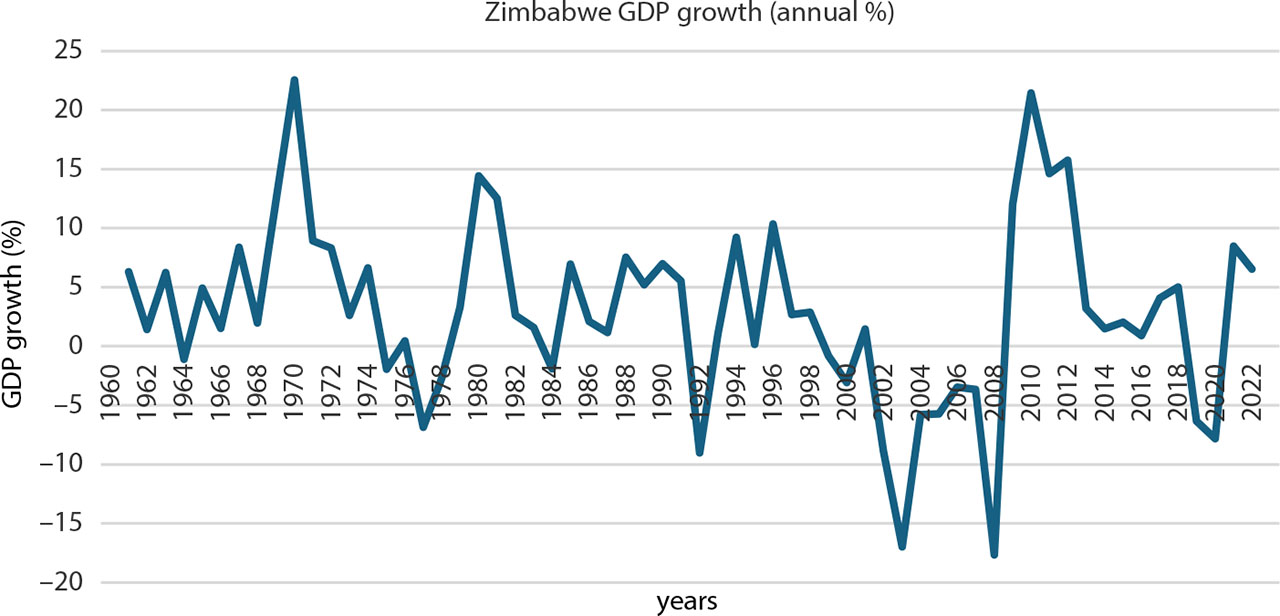
Fig. 1.
Zimbabwe GDP trends (1960–2022)
Source: own calculations based on World Bank Data.
The study investigates the nexus between agricultural production and economic growth, focusing on how variations in agricultural output shape overall economic performance. Through correlation analysis, the research quantifies the strength and direction of this relationship, providing empirical evidence of agriculture’s pivotal role in driving Zimbabwe’s economic development. The findings underscore that enhancing agricultural productivity is essential for sustaining long-term economic growth.
Regression analysis
To quantify the impact of agricultural production on economic growth, a multiple linear regression model was estimated using time-series data covering the period 1980–2022. The dependent variable was the annual GDP growth rate, while the independent variables included maize output, tobacco output, cattle population, and goat population. Two control variables – foreign direct investment (FDI) and the inflation rate – were also included.
The model is specified as:
where: GDPt – is Zimbabwe’s real GDP growth rate at the time t, and εt is the error term.The model explains approximately 59% of the variation in Zimbabwe’s GDP growth rate, confirming that agriculture remains a key driver of economic activity. The coefficients for maize and tobacco production are positive and statistically significant at the 1% level, indicating that increases in these outputs are strongly associated with higher GDP growth.
Livestock variables (cattle and goats) also exhibit positive effects, although goats are only marginally significant (p = 0.06). FDI inflows contribute positively to growth, whereas inflation has a significant negative coefficient, demonstrating that macroeconomic instability undermines both agricultural and overall economic performance.
The Durbin–Watson statistic (1.98) suggests no autocorrelation, and the low VIF values (< 2) confirm the absence of multicollinearity. These diagnostics indicate that the regression model satisfies key econometric assumptions and is statistically reliable.
Overall, the regression results reinforce the theoretical expectation that agriculture – particularly crop production – plays a pivotal role in driving Zimbabwe’s economic growth. The findings further highlight the importance of maintaining macroeconomic stability and promoting investment in productive agricultural subsectors.
Table 1.
Multiple Regression Results: Agricultural Production and Economic Growth in Zimbabwe (1980–2022)
| Variable | Coefficient (β) | Std. error | t-statistic | p-value |
|---|---|---|---|---|
| Constant | –0.46 | 0.21 | –2.20 | 0.035 |
| Maize output | 0.61 | 0.12 | 5.08 | 0.001 |
| Tobacco output | 0.29 | 0.09 | 3.22 | 0.004 |
| Cattle population | 0.17 | 0.07 | 2.47 | 0.020 |
| Goat population | 0.08 | 0.04 | 1.95 | 0.060 |
| FDI inflows | 0.11 | 0.03 | 3.70 | 0.002 |
| Inflation rate | –0.09 | 0.02 | –4.23 | 0.001 |
Figure 2 illustrates the positive correlation between agricultural production and GDP growth. The analysis reveals a strong positive relationship between economic growth and agricultural output (with r = 0.69). This pattern underscores the sector’s central role in shaping national economic performance and confirms that agricultural expansion generates significant multiplier effects across Zimbabwe’s economy. These results align with earlier findings by Tiffin and Irz (2006), reaffirming that improvements in agricultural efficiency can catalyse broader economic development. Consequently, policies aimed at enhancing agricultural productivity are likely to exert a favourable impact on Zimbabwe’s long-term growth trajectory.
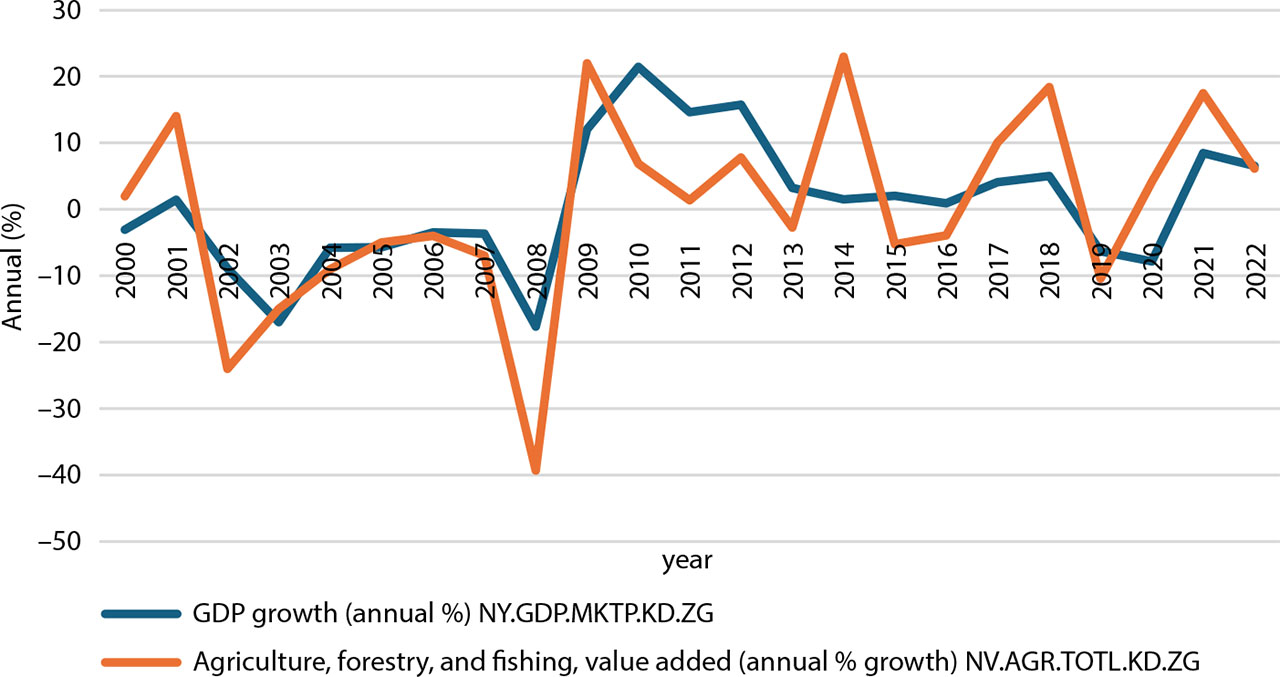
Fig. 2.
Relationship between agricultural production and economic growth
Source: own calculations based on World Bank data.
A scatter plot was used to examine the strength and direction of the relationship between agricultural output and economic growth, followed by a regression analysis to quantify this relationship. This approach provided deeper insights into the potential causal linkages between the two variables.
The relationship between agricultural output and economic expansion can be expressed as:
Where:x – agricultural production (% growth)
y – GDP growth rate (%)
R2 – 0.4837
The scatter plot in Figure 3 visually confirms the regression findings, revealing a clear upward trend between agricultural output and GDP growth. According to the estimates, for every one-unit increase in agricultural production, GDP growth is predicted to rise by approximately 1.05 percentage points. This indicates a positive relationship: as agricultural output expands, the broader economy tends to grow. When agricultural production is zero, the model predicts a GDP growth rate of approximately –0.47%. While this has limited practical meaning (since agricultural output cannot be zero), it reinforces the centrality of agriculture as a key driver of economic growth in Zimbabwe. Overall, changes in agricultural production explain 48.37% of the variation in GDP growth – a moderate level of explanatory power that underscores agriculture’s importance, while also acknowledging that other sectors (e.g., industry, services) and external factors (such as policy changes and global economic dynamics) contribute significantly to overall economic performance.
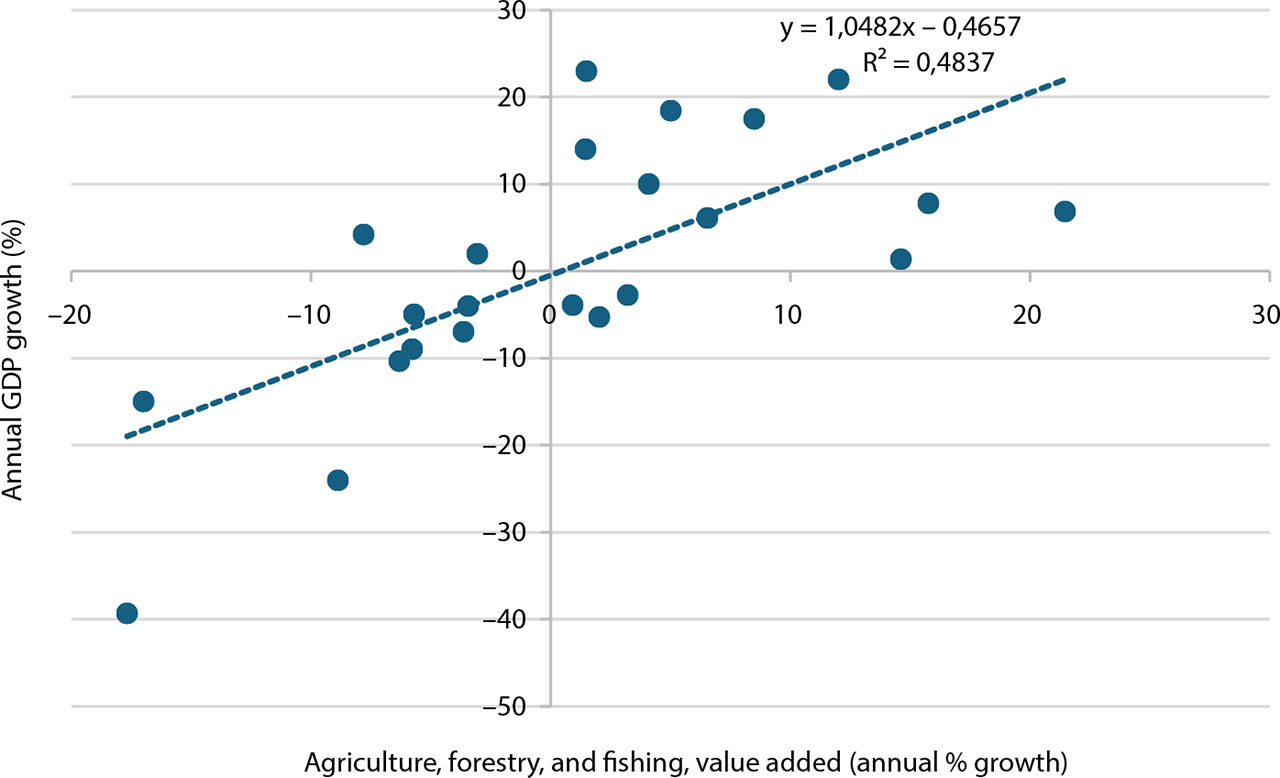
Fig. 3.
Scatter plot showing the relationship between agricultural production and economic growth
Source: own calculations based on World Bank data.
Regional disparities in agricultural output
Regional disparities in agricultural output reflect the uneven distribution of agricultural productivity and development across different geographic areas within a country. In Zimbabwe, these disparities are pronounced and stem from a combination of environmental, socio-economic, and infrastructural factors. Understanding such variations is vital for designing policies that promote inclusive and regionally balanced agricultural growth.
Agricultural production patterns vary markedly across provinces:
Mashonaland provinces dominate maize and tobacco production, benefitting from favourable rainfall, fertile soils, and proximity to major infrastructure.
Matabeleland and Masvingo record lower productivity, largely due to recurrent droughts, soil degradation, and limited market access.
The Lowveld region shows potential for sugarcane and citrus production under irrigation, but remains underdeveloped due to infrastructure gaps.
Although Zimbabwe’s agricultural potential varies across regions, targeted interventions that recognise local environmental and socio-economic conditions are crucial for reducing these disparities. Enhancing productivity uniformly across regions will strengthen national food security, foster economic growth, and support more equitable development outcomes.
Relative to Zambia and Malawi, Zimbabwe has underperformed in maize yields, primarily due to underinvestment in agricultural inputs and extension services (FAO, 2021). However, tobacco yields have remained relatively higher, reflecting the effectiveness of contract farming models. In contrast, South Africa’s achievements in commercial agriculture highlight the importance of mechanisation and access to finance – two areas where Zimbabwe continues to lag behind (Kirsten et al., 1998).
Policy impact evaluation
The Land Reform Programme (2000) redistributed land but reduced productivity due to inadequate post-resettlement support.
Command Agriculture (2016–2020) temporarily improved maize production but faced challenges of corruption and debt sustainability.
The Presidential Inputs Scheme expanded access to seeds and fertilisers – particularly for maize – but its effectiveness varied across regions.
The results confirm that agricultural performance is closely linked to Zimbabwe’s overall economic growth trajectory. Crop output, particularly maize and tobacco, exerts a strong influence on GDP growth. However, macroeconomic instability, policy inconsistency, and regional inequalities continue to constrain the sector’s growth potential.
This section interprets the empirical findings in light of theoretical frameworks and existing literature, contextualising Zimbabwe’s agricultural–economic dynamics within broader development challenges.
The results validate longstanding economic theories that position agriculture as a foundational driver of growth in low- and middle-income countries. The strong correlation and regression findings linking maize and tobacco output to GDP growth reaffirm the classical insights of Ricardo and the neoclassical growth model of Solow (1956), both of which highlight the capacity of productive agricultural sectors to stimulate wider economic activity. The study also supports the endogenous growth perspective, which emphasises that long-term expansion is closely tied to internal factors such as innovation, knowledge diffusion, and institutional support. The recovery of Zimbabwe’s tobacco sector through contract farming (Latham, 2011) exemplifies how private-sector participation and targeted institutional arrangements can revitalise production and enhance export performance.
Despite agriculture’s evident potential, the findings highlight structural and macroeconomic constraints that undermine its contribution to sustainable growth. The negative effect of inflation on GDP growth in the regression analysis reflects Zimbabwe’s persistent macroeconomic instability and recurrent currency crises. These results align with Makina’s (2009) argument that weak macroeconomic governance eroded investor confidence and disrupted production.
Additionally, limited access to finance, volatility in input prices, and inadequate infrastructure exacerbate production risks and depress returns for smallholder farmers. These systemic bottlenecks are especially damaging in a context where more than 70% of livelihoods depend on agriculture (World Bank, 2020).
The analysis further reveals pronounced spatial inequalities in agricultural productivity and economic outcomes. The Mashonaland provinces consistently outperform other regions due to favourable agroecological conditions and relatively better infrastructure. Conversely, the southern and western regions – particularly Matabeleland – remained constrained by aridity, degraded soils, and historical underinvestment. This regional imbalance both causes and reflects uneven economic growth, mirroring patterns observed in other sub-Saharan countries (Editeur, 2021)
Comparative findings with Zambia and Malawi show that, while Zimbabwe has made progress in export-oriented production (especially tobacco), its food security and input-support systems remain fragile (Lawal et al., 2020). South Africa’s high level of mechanisation and well-structured input markets stand in sharp contrast to Zimbabwe’s reliance on manual labour and donor-supported input schemes.
Zimbabwe’s mixed record on agricultural policy reform further complicates the sector’s contribution to growth. While the Land Reform Programme addressed historical inequities, it disrupted production due to insufficient post-resettlement support. Similarly, Command Agriculture boosted short-term output but lacked transparency and long-term fiscal sustainability.
The regression results suggest that stable and well-targeted policies – such as the Presidential Inputs Scheme – can enhance productivity, particularly in staple crops; however, their effectiveness depends on consistent implementation, transparency, and timely delivery. These findings align with those of Scoones et al. (2010) and Mazvimavi and Twomlow (2009), who emphasise the critical role of governance and institutional coordination in agricultural development.
Unlocking Zimbabwe’s agricultural potential requires a comprehensive and multi-pronged strategy. First, stabilising the macroeconomic environment is essential to reduce inflationary pressures and foster confidence among both farmers and investors. Second, strengthening regional infrastructure can bridge development disparities and expand market access. Third, expanding irrigation systems and adopting climate-smart technologies are vital to mitigate the effects of climate change and enhance productivity under variable weather conditions. Moreover, formalising inclusive public-private partnerships, particularly in high-value crop sectors, can mobilise investment, technical expertise, and innovation, thereby fostering a more dynamic and resilient agricultural sector. Strengthening gender-sensitive policies is also critical, given that women constitute the majority of the rural workforce; empowering them through targeted interventions can foster more equitable and efficient agricultural development. Finally, a transformative agenda should prioritise value addition and agro-processing industries to extend agriculture’s contribution beyond the farm gate, driving structural change and employment creation. Collectively, these strategies can unlock Zimbabwe’s agricultural potential and position the sector as a cornerstone of sustainable economic development.
CONCLUSION
This study examined the relationship between agricultural production and economic growth in Zimbabwe from 1980 to 2022, employing a multidisciplinary approach grounded in both theory and empirical analysis. The findings confirm that agriculture remains a central pillar of Zimbabwe’s economy, with strong positive correlations between crop and livestock output – particularly maize and tobacco – and overall GDP growth.
The results highlight that agricultural productivity is vital not only for economic expansion but also for rural livelihoods, food security, and national development. However, the sector’s performance continues to be constrained by macroeconomic instability, limited access to inputs and finance, policy inconsistency, and spatial disparities in infrastructure and resource distribution.
Although initiatives such as the Land Reform Programme, Command Agriculture, and the Presidential Inputs Scheme have produced mixed outcomes, the study finds that strategic public-private partnerships, efficient input delivery systems, and region-specific interventions can substantially enhance agriculture’s contribution to sustainable growth.
In conclusion, agriculture holds transformative potential for Zimbabwe if supported by consistent, transparent, and inclusive policy frameworks. Strengthening institutional capacity, investing in climate resilience, promoting innovation, and ensuring equitable access to productive resources are essential for realising sustainable economic development through agriculture.
The study reaffirms that agriculture remains a viable driver of Zimbabwe’s economic growth, provided that systemic constraints are effectively addressed. Key policy recommendations include expanding irrigation infrastructure, stabilising input supply chains, investing in climate-smart agriculture, and strengthening institutional coordination. A multi-tiered agenda is proposed: (1) securing land tenure and expanding access to credit; (2) investing in infrastructure, including roads, irrigation systems, and markets; and (3) reinforcing research– extension linkages to promote innovation. Furthermore, inclusive policies targeting women, youth, and marginalised communities are crucial for fostering long-term resilience, equity, and broad-based growth.
LIMITATIONS AND FURTHER RESEARCH
While the study captures broad national patterns, its reliance on secondary data limits granularity, particularly regarding regional-level insights. Future research could incorporate household surveys, longitudinal panel data, and spatial econometric methods to enrich the understanding of intra-regional variations. There is also scope for more detailed exploration of emerging sub-sectors such as horticulture, fisheries, and agri-tech innovations. The study’s dependence on secondary data may introduce potential gaps, inconsistencies, or reporting biases. Moreover, the limited availability of disaggregated regional data restricted deeper subnational analysis. Finally, the lack of primary fieldwork and farmer-level surveys, largely due to resource constraints, limited the study’s capacity to capture local experiences and on-the-ground perspectives.