
INTRODUCTION
Research on pension schemes has increasingly been shaped by demographic trends – particularly population ageing – and the growing economic and social challenges that accompany it. According to forecasts from the Central Statistical Office (GUS), by 2060, nearly 36% of the population will be of post-working age, up from 24% in 2024 (Statistics Poland, 2023). This demographic shift implies a long-term decline in the working-age population, which will significantly affect the sustainability of the pension system and the level of pension security for future generations. The pension system plays a vital role in smoothing consumption over a person’s lifetime by enabling individuals to contribute during their working years and receive benefits in retirement (Żukowski, 1997). However, demographic changes challenge the adequacy and efficiency of existing pension solutions in light of the evolving population structure.
According to projections from the Social Insurance Institution (ZUS), the replacement rate – the ratio of average pension to average wage – is expected to fall dramatically, from 67.19% in 2023 to just 24.72% in 2060. This means that by 2060, the average pension will account for only one-quarter of the average wage, posing serious threats to the adequacy of retirement income (ZUS, 2022). In this context, private savings and long-term investments are becoming increasingly important as complementary elements to the public pension system. Economic theory highlights the advantages of a long-term investment horizon, which not only mitigates the impact of short-term market fluctuations but also leverages the power of compound interest – an effect that can substantially enhance the final value of accumulated capital (Biernacki and Szulec, 2009).
Even without a specific investment objective, individuals seeking to make efficient use of their funds should aim to minimize investment costs and optimize tax burdens. Voluntary pension schemes, particularly those within the third pillar of the pension system, offer such opportunities. Individual Retirement Accounts (IKE) and Individual Retirement Security Accounts (IKZE) are especially relevant in this regard, offering both substantial tax benefits and long-term investment flexibility. These instruments play a central role in the modern architecture of retirement savings, empowering individuals to manage their capital actively through market mechanisms while taking advantage of tax incentives (Iwuć, 2024). Their relevance is growing as the responsibility for ensuring adequate retirement income gradually shifts from the state institutions to individuals (Żukowski, 1997). Therefore, every participant in the Polish pension system should consider building a private pension portfolio, and IKE and IKZE are essential tools in that process.
The need is further underscored by the composition of Polish household assets. As of 2024, Polish households hold approximately PLN 289 billion in pension entitlements, representing only 9% of their total financial assets. In contrast, liquid assets such as cash and bank deposits account for as much as PLN 1,670 billion (52%). Equities represent the second largest category at PLN 548 billion (17.1%), while debt securities amount to just PLN 20 billion (0.6%). These proportions have remained relatively constant over recent years, indicating a preference for current consumption over long-term capital accumulation. Such a saving structure may threaten the long-term financial stability of households. Redirecting even a portion of these funds from deposits or equity investments to IKE or IKZE could enhance the impact of compound interest and reduce the tax liabilities (Fig. 1).
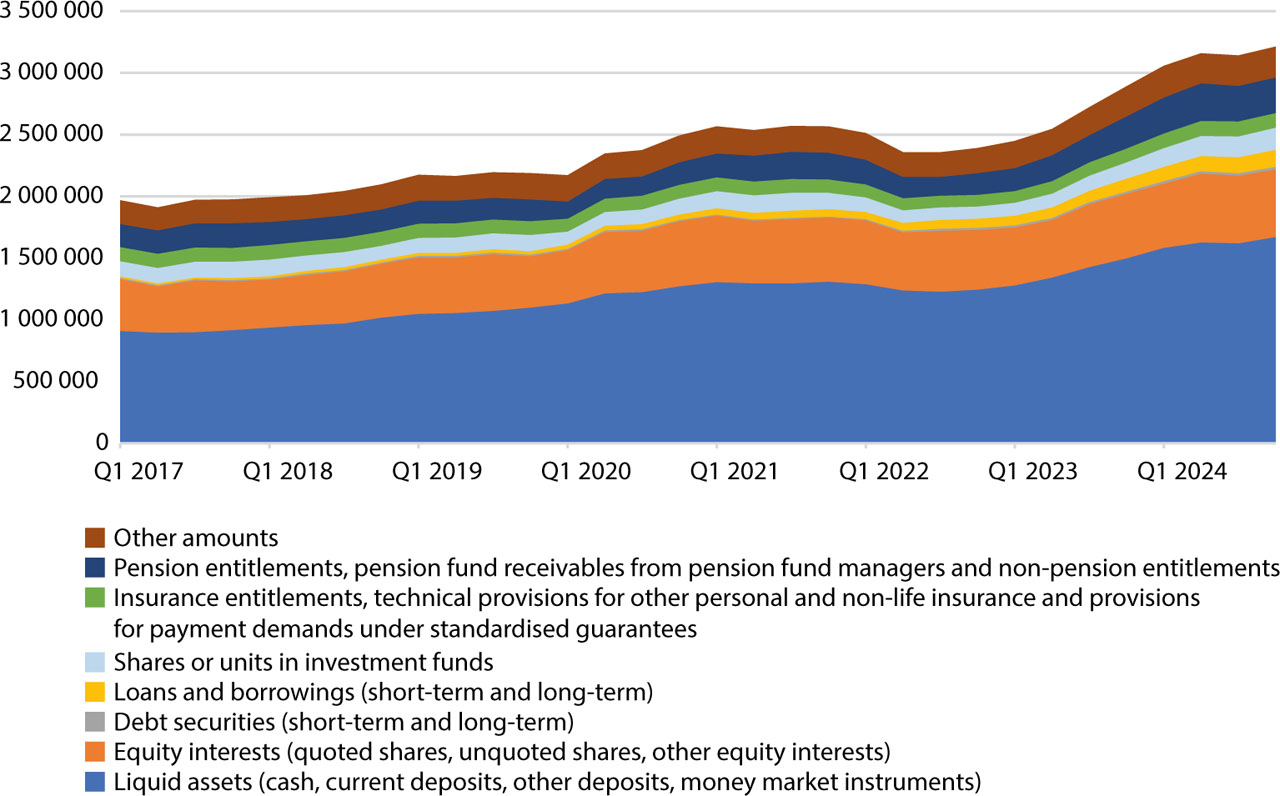
Fig. 1.
Real financial assets of households in Poland in 2017–2024
2017 = 100; quarterly data; PLN million
Source: own elaboration based on NBP data.
The main objective of this article is to present and analyze Individual Pension Accounts (IKE) and Individual Pension Security Accounts (IKZE) as key instruments for building a private pension portfolio. This is examined in the context of demographic challenges, limitations of the public system, and the increasing necessity for long-term saving and investing. It will be demonstrated how IKE and IKZE, through their tax advantages and investment flexibility, can help ensure an adequate standard of living in retirement and act as effective complements to the public pension system.
The central hypothesis of this study is that regular use of IKE and IKZE – leveraging available tax benefits and exemptions – significantly enhances the effectiveness of long-term savings and investments.
The study employs three complementary research approaches:
A comprehensive analysis of academic and industry literature on the pension system and voluntary pension schemes, with a focus on IKE and IKZE.
Evaluation of secondary data from the Central Statistical Office, the National Bank of Poland, the Warsaw Stock Exchange, and other sources for the years 2015–2024, including demographic forecasts and household asset structures.
Examination of the tax structures, early withdrawal penalties, inheritance rules, and available investment options across more than 60 financial institutions offering IKE and IKZE.
The multi-method approach enables both a macroeconomic overview and a practical assessment of these instruments’ real-world application. To fully appreciate the potential of IKE and IKZE, one must first understand the legal and institutional frameworks that shape their operation, followed by an exploration of the investment opportunities they offer.
OVERVIEW OF LEGAL CONDITIONS FOR INDIVIDUAL PENSION ACCOUNTS – CHARACTERISTICS OF IKE AND IKZE
The Individual Retirement Account (IKE) was introduced under the Act of 20 April 2004. Its primary objective is to facilitate the flexible accumulation of pension capital, tailored to the individual preferences of participants, while offering favorable tax treatment that encourages long-term savings. IKE is available to individuals aged 16 and over, with contributions from individuals aged 16–18 limited to earnings derived from employment contracts. Participation in IKE is entirely voluntary, and savers retain full autonomy in initiating, suspending, or discontinuing contributions without forfeiting their accrued funds. The annual contribution limit for IKE is capped at 300% of the projected average monthly wage in the national economy, as determined each year by the Central Statistical Office. This ensures that the scheme remains adaptable to evolving economic conditions. IKE funds can be invested across a wide range of financial instruments, such as investment funds, bank deposits, treasury bonds, insurance capital funds, and equities. Such diversification allows participants to tailor their investment strategy to their personal risk appetite and return expectations. The key tax advantage of IKE is the exemption from the 19% capital gains tax (commonly known as the “Belka tax”), provided that statutory conditions are met – specifically, withdrawal of funds at age 60 or older (or 55 in the case of early retirement eligibility), and a minimum saving period of five years. Additionally, funds accumulated within IKE are inheritable under preferential conditions – they are transferred to designated beneficiaries without incurring inheritance or gift tax, making IKE an attractive instrument for estate planning. Participants retain full control over their capital and may withdraw funds at any time; however, early withdrawals are subject to capital gains tax, as outlined in the Act (Articles 3–4 and 34, Act of 20 April 2004 on Individual Pension Accounts and Individual Retirement Security Accounts, Journal of Laws of 20 April 2004, item 707).
The Individual Retirement Security Account (IKZE), introduced by the Ustawa (2011) and now incorporated in the Act on Individual Retirement Accounts, serves a similar purpose but with distinct features. IKZE is designed to support the systematic accumulation of pension capital, while providing immediate tax benefits, making it an attractive option for both early-career savers and individuals seeking to enhance their financial security. An IKZE account can be opened by any individual, regardless of age, ensuring broad accessibility. Annual contribution limits are set to 1.2 times the projected average monthly wage for employees, and 1.8 times for the self-employed. These limits are updated annually by the Central Statistical Office. As with IKE, IKZE funds can be invested in a variety of financial instruments, including mutual funds, brokerage accounts, bank deposits, and investment policies, offering flexibility in portfolio construction based on individual financial goals and risk profiles. IKZE’s primary tax benefit lies in the ability to deduct contributions from taxable income in the annual tax return, which results in a direct reduction in the current tax burden. The extent of this benefit depends on the taxpayer’s income bracket. Upon withdrawal after the age of 65, the accumulated funds are subject to a flat income tax of 10%, which is significantly more favorable than standard income tax rates. Early withdrawals are taxed according to standard income tax rules. IKZE accounts are inheritable, with preferential tax treatment for beneficiaries. Participants can also opt for early withdrawal, but doing so negates the associated tax benefits. IKZE is characterized by its flexibility, allowing participants to adjust their contribution amount to their current financial capabilities. This makes it a universal tool accessible to a broad group of individuals interested in long-term pension security (Articles 3–4 and 34, Act of 20 April 2004 on Individual Pension Accounts and Individual Retirement Security Accounts, Journal of Laws of 2024, item 707).
Although IKE and IKZE are similar in structure, there are significant differences between them. Notably, each person may hold only one IKE account and one IKZE account. It is also not permitted to combine different types of accounts, for example, holding both IKE shares and IKE bonds. However, IKE is designed to be widely accessible, thanks to its low entry threshold and exemption from the capital gains tax of 19% on investment profits. In contrast, IKZE can serve as a valuable complement to IKE, but its effectiveness depends on the individual’s ability to benefit from tax optimization. IKZE is particularly advantageous for self-employed individuals, who typically pay lower pension contributions and can therefore expect lower retirement benefits (see Table 1).
Table 1.
Summary of key information on IKE and IKZE
| Programme | Introductory act | Form of participation | Funding | Tax benefits | Forms of investment | Inheritance |
|---|---|---|---|---|---|---|
| IKE | Ustawa…, 2004a | Voluntary, available to persons aged 16 and over | Savers: annual contributions up to 300% of average salary | Exemption from capital gains tax upon meeting age and saving period conditions | Investment funds, bank deposits, government bonds, brokerage accounts | Funds are inherited free of inheritance and gift tax |
| IKZE | Ustawa (2011) | Voluntary, available to any individual | Savers: annual contributions up to 1.2 times (or 1.8 times for entrepreneurs) average salary | Deduction of contributions from tax base, flat tax of 10% after age 65 | Investment funds, brokerage accounts, deposits, investment policies | Funds are inherited with the possibility of retaining tax benefits |
Both IKE and IKZE allow for independent investment strategy development, offering participants significant autonomy in deciding how their pension funds are managed. However, making effective use of this investment freedom requires at least a basic understanding of the financial market. This includes knowledge of available financial institutions and their products, familiarity with different asset classes, and the ability to assess potential risks. A key element in preparing for sound investment decisions is determining one’s risk tolerance, i.e. the level of capital one is willing to commit and the extent of potential losses one is prepared to accept. The availability of diverse asset classes offered by over 60 institutions within the IKE and IKZE frameworks provides very highly favorable conditions for all types of investors (KNF, 2024). This extensive range of options makes it possible to tailor investment strategies precisely to the investor’s individual needs, preferences, and financial goals (Table 2).
Table 2.
Types of institutions and available asset classes within IKE and IKZE accounts
| Financial institution | Available asset classes | Number of institutions under the scheme* | |
|---|---|---|---|
| IKE | IKZE | ||
| Bank | Bank deposits and savings accounts | 14 | 3 |
| Investment Fund Company (TFI) | Investment funds (e.g. shares, bonds, mixed) | 22 | 21 |
| Brokerage house | Shares, bonds, ETFs and other exchange-traded instruments | 9 | 9 |
| Insurance company | Insurance unit-linked funds (UFK) | 14 | 9 |
| Voluntary Pension Fund (DFE) | Pension funds (investing in shares and bonds) | 4 | 6 |
RESEARCH RESULTS AND DISCUSSION – SELECTED INVESTMENT INSTRUMENTS WITHIN THE FRAMEWORK OF IKE AND IKZE
Bank deposits and savings accounts
Bank deposits and savings accounts are among the fundamental investment instruments available within the IKE and IKZE frameworks, enabling systematic capital accumulation at relatively low levels of risk. While both products serve functions, they differ in structure and the degree of flexibility they offer regarding access to funds. A bank deposit involves placing a specified amount of money into an account for a fixed term under a contractual agreement. During this period, access to the funds is restricted, and early withdrawal typically results in the forfeiture of accrued interest. Deposits usually offer fixed interest rates, which tend to be higher than those offered by savings accounts. This allows for more precise estimation of future returns. In contrast, a savings account offers greater flexibility. It allows for regular deposits and withdrawals without the loss of accrued interest. However, the interest rate is usually variable and often lower than that of term deposits. The rates for both products are influenced primarily by the central bank’s monetary policy, the term length, the size of the deposit, and whether the interest rate is fixed or variable. Deposits are generally considered short-term instruments, while savings accounts have no fixed maturity, making them suitable for investors seeking a more flexible, indefinite investment horizon (Sierpień, 2024).
Both deposits and savings accounts held within IKE and IKZE are protected by the Bank Guarantee Fund up to the equivalent of 100,000 EUR per customer per bank. This protection enhances their appeal as safe retirement-saving tools. However, in practice, utilizing these instruments effectively requires ongoing monitoring of bank offers, analysis of promotional conditions, awareness of fees and commissions, and, at times, the transfer of accounts between financial institutions. This process can be time-consuming and does not always yield the expected benefits (Iwuć and Pielok, 2024). It is worth noting that although savings-focused IKE and IKZE products are generally regarded as secure and straightforward, their long-term effectiveness is limited by their sensitivity to interest rate fluctuations. These are closely tied to monetary policy objectives, particularly inflation targets. Consequently, interest earned on deposits often fails to keep pace with inflation, potentially eroding the real value of accumulated capital – especially during periods of elevated inflation or economic disruption, such as the COVID-19 pandemic or the war in Ukraine (see Fig. 2).
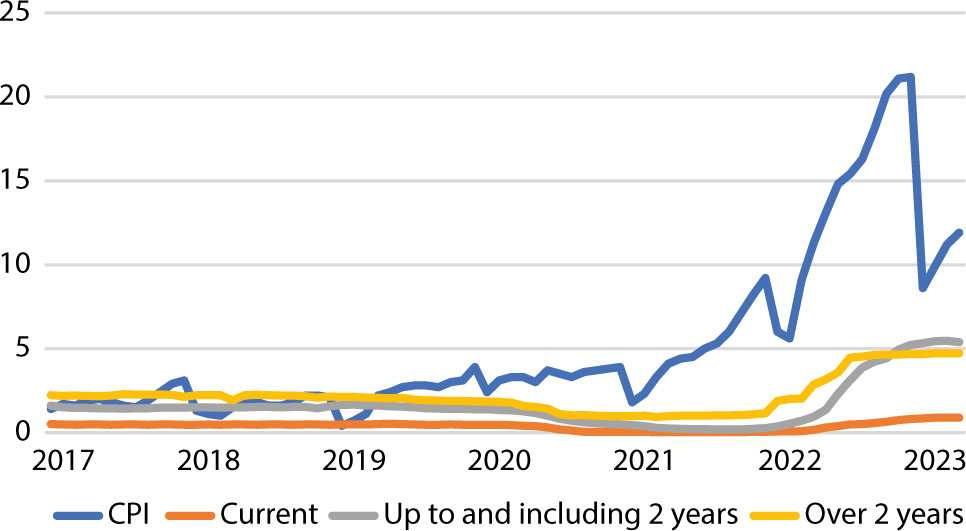
Fig. 2.
Inflation rate vs. interest rates on household deposits, 2017–2023 (%)
Source: own compilation based on CSO and NBP data.
Bonds
Utilizing IKE and IKZE through a brokerage account provides investors with broad access to capital market instruments, including equities, bonds, ETFs and derivatives. This investment route offers substantial flexibility, allowing individuals to construct portfolios aligned with their investment objectives, risk tolerance, and time horizons. Among the available financial instruments, bonds – a category of debt securities – hold particular significance. When an investor purchases a bond, they are effectively lending money to the issuer, who in turn commits to repaying the principal along with accrued interest within a predetermined time frame. Bonds can be classified by interest rate structure (fixed, variable, or zero-coupon) as well as by the maturity term (short-, medium-, or long-term). In the Polish financial system, bonds are generally categorized by the issuer (Jajuga, 2009): corporate bonds (issued by companies, and typically associated with higher credit risk), municipal bonds (issued by local government units, offering moderate risk), and treasury bonds (issued by the central government and considered the safest instruments on the domestic market due to the backing of the State Treasury).
Treasury bonds, thanks to the guarantee of the State Treasury, are particularly attractive to investors seeking capital protection and predictable returns. They often serve as a competitive alternative to bank deposits. However, within the IKE and IKZE framework, access to selected types of treasury bonds is restricted (see Table 3). Specifically, purchases are typically limited to transactions conducted through Dom Maklerski PKO BP, which holds exclusive rights to sell selected treasury bonds on the primary market for IKE bond accounts (Ministerstwo Finansów, n.d.). In contrast, corporate bonds are accessible through various brokerage houses operating on the Catalyst market (Mazurek, 2013).
Table 3.
Types of government bonds available on the market and those available only under IKE and IKZE
| Type of bond | Interest rate type | Access within IKE and IKZE accounts |
|---|---|---|
| 3-month savings (OTS) | Fixed | No |
| 1-year savings (ROR) | Variable | Yes |
| 2-year savings (DOS) | Fixed | Yes |
| 3-year savings (TOZ) | Variable | Yes |
| 4-year savings (COI) | Inflation-indexed | Yes |
| Family 6-year savings (ROS) | Inflation-indexed (for 800+ beneficiaries only) | No |
| Retirement 10-year savings (EDO) | Inflation-indexed | Yes |
| Family 12-year savings (ROD) | Inflation-indexed (for 800+ beneficiaries only) | No |
Shares
Shares represent a key component of brokerage accounts within IKE and IKZE, enabling investors to directly participate in the ownership of joint-stock companies. Acquiring shares confers co-ownership rights, including entitlements to share in profits in the form of dividends, the right to vote at general meetings, and participation in the distribution of assets in the event of liquidation of the company. The extent of benefits and influence an investor gains depends on the number of shares held – larger holdings translate to greater voting power and potentially higher returns. Income from shares may come from both dividend payments and capital appreciation, i.e., an increase in the market value of the shares. However, investing in shares carries a high level of risk. In the event of a company’s insolvency, shareholders may lose all invested capital. Additionally, the issuance of new shares can lead to share dilution, reducing the value and influence of existing holdings. Unlike bonds, shares do not offer guaranteed returns, requiring investors to adopt a strategic, risk-aware approach to portfolio management and to be prepared for market volatility (Biernacki and Szulec, 2009).
The Polish market differentiates between registered shares, which are assigned to a specific owner, and bearer shares, which can be freely transferred without registering changes in ownership. Additionally, shares can be classified as ordinary, granting equal rights to all holders, or preference shares, which may confer additional privileges such as extra voting rights or higher dividends. Shares are issued for an indefinite period, providing investors with the flexibility to tailor their investment horizon according to their individual strategies and risk tolerance (Jajuga, 2009). The volatility of share prices, exemplified by indices like the WIG20, underscores the importance of adopting a long-term and prudent investment approach in this market segment (Fig. 3).
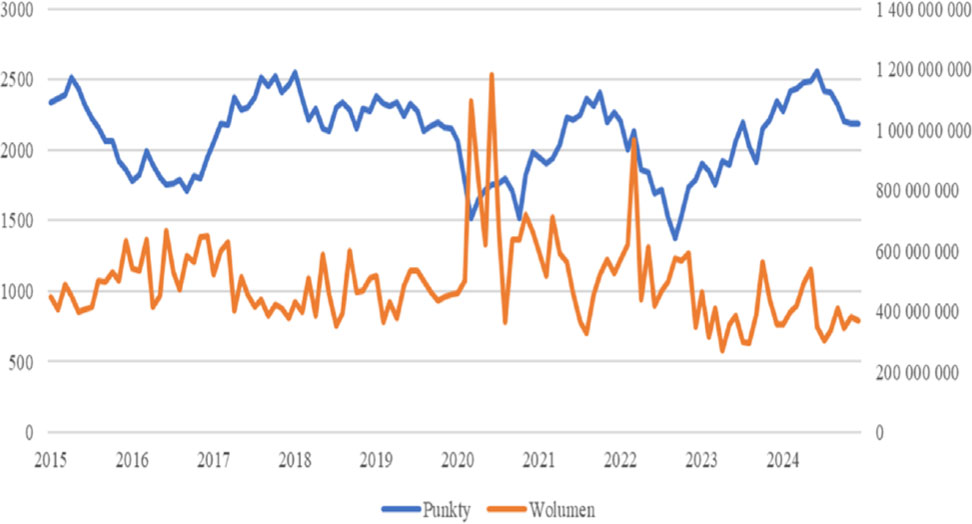
Fig. 3.
WIG20 index quotations and trading volume (PLN) between 2014 and 2024
Source: own compilation based on data from stooq.pl.
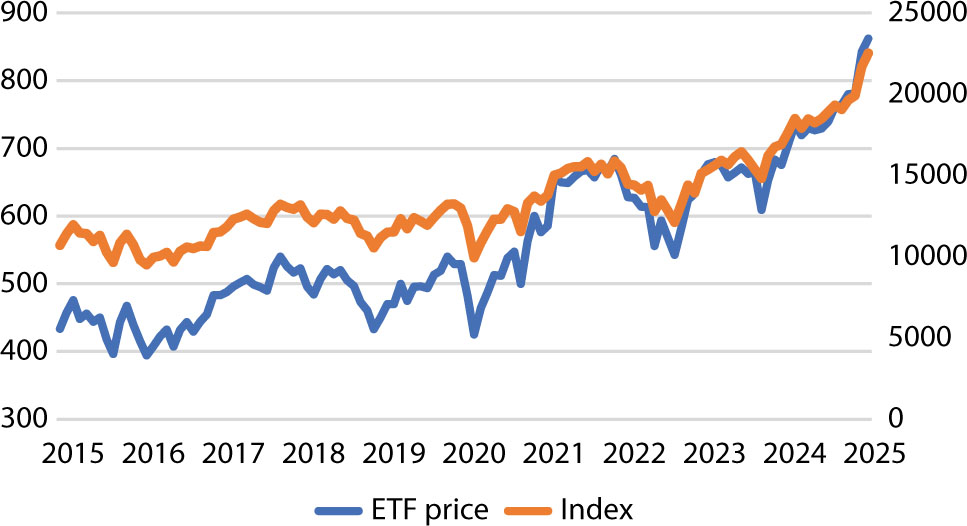
Fig. 4.
Comparison of the ETFDAX fund available on the KNF with the German companies’ index between 2015 and 2024
Source: own compilation based on data from stooq.pl.
ETFs
Exchange Traded Funds (ETFs) are a distinct category of investment funds designed to closely replicate the performance of a selected stock market index or benchmark. These instruments enable investors to gain broad exposure to a market or market segment through a single transaction, significantly simplifying the investment process and facilitating effective portfolio diversification. Traded on stock exchanges similarly to shares, EFTs offer high liquidity and the ability to respond swiftly to price movements. By purchasing ETF units, investors acquire proportional stakes in a diversified portfolio of financial instruments, thereby mitigating risk without the need to buy individual assets themselves. A major advantage of ETFs lies in their low management costs, resulting from their passive investment strategy, which entails tracking an index rather than actively seeking portfolio components. Furthermore, EFTs are characterized by transparency, as their portfolio compositions are regularly disclosed, enabling investors to monitor their holdings and make informed decisions (Iwuć, 2019).
ETFs are generally categorized based on the type of market or asset class they track. Equity ETFs replicate stock market indices such as the WIG20 or S&P 500 by investing in the shares of the constituent companies. Bond ETFs offer exposure to the debt market by investing in government, corporate or municipal bonds. Sector-specific ETFs target particular industries like technology, healthcare or energy, while commodity ETFs track the prices of physical assets such as gold, oil or industrial metals (Kondrakiewicz, 2013). On the Warsaw Stock Exchange, investors can access a variety of ETFs covering both domestic and foreign markets. For example, ETFBW20TR replicates the WIG20 index, while ETFBM40TR tracks the mWIG40TR index, which comprises medium-sized companies listed on the KNF. For exposure to foreign markets, investors may consider EFTs like ETFDAX, which tracks the German DAX index, or ETFSP500, which follows the US S&P 500 index (Fig. 3). In summary, ETFs are versatile, diversified, and cost-efficient instruments that provide access to a broad range of markets and asset classes, making them attractive options for portfolio construction within IKE and IKZE accounts (GPW, n.d.).
Investment funds and pension funds
Investment funds are a form of collective capital investment that provides access to a wide range of financial instruments such as shares, bonds or money market instruments (Stańczak-Strumiłło, 2017). Managed by Investment Fund Companies (TFIs) and supervised by the Polish Financial Supervision Authority (PFSA), these funds ensure security and transparency in their operations (Act of 27 May 2004 on investment funds and management of alternative investment funds, Journal of Laws 2025, item 146). They allow investors to entrust their capital to professional managers, which is particularly beneficial for those who lack the expertise or time to invest independently. Investment funds are categorized into open-ended (FIO), specialized open-ended (SFIO), and closed-ended (FIZ) funds. FIOs offer high liquidity and ease of purchase in redeeming units. SFIOs are available to specific groups of investors and may have additional participation conditions. FIZs issue investment certificates that can only be purchased at specific times; their portfolios often contain more complex assets, involve higher risks, and have higher entry thresholds (Perez, 2012).
Based on investment policy, funds are further distinguished as stock funds, bond funds, money market funds, mixed funds and umbrella funds, the latter allowing flexibility to transfer capital between sub-funds. Investing in funds often requires only a modest initial capital outlay, though management fees should be considered. Their main advantages include professional management, a wide range of strategies, and the ability to adjust risk according to individual needs (Jawdosiuk and Rożko, 2010). Voluntary Pension Funds (DFEs) are specialized investment funds managed by the Universal Pension Society (PTE) that focus on the long-term accumulation of participants’ savings for retirement purposes. Characterized by a simple structure, conservative investment policies, and high-quality management, DFEs offer an attractive, low-maintenance, and secure way to grow capital. However, DFEs are managed by the same institution as Open Pension Funds (OFEs – a component of Pillar II), thus they can be considered a twin alternative within Pillar III (Act of 28 August 1997 on the organisation and operation of pension funds, Journal of Laws 2024, item 1113) (Table 4).
Table 4.
Characteristics and distinctions of funds
| Type of fund | Full name | Characteristics | Participants | Unit issue | Liquidity of investments | Investment strategy |
|---|---|---|---|---|---|---|
| FIO | Open-ended investment fund | Most popular, high liquidity, possibility of free purchase and redemption of units | Natural and legal persons | Continuous, possibility to buy and redeem units at any time | High – redemption of units at any time | Diversified – equity, bond, mixed, umbrella funds |
| SFIO | Specialised open-ended investment fund | Similar to a CIF, but with participation restrictions and additional investment conditions | Selected group of investors (e.g. institutional, meeting certain criteria) | Continuous, but restrictions may apply | Restricted – redemption conditions may be set out in statute | May be more specialised than in a CIF |
| FIZ | Closed-end investment fund | Limited issuance of investment certificates, investment in more complex assets, higher entry threshold | Institutional and individual investors with more capital | Limited, issue in specific tranches | Low – redemption of certificates at specific times (e.g. quarterly) | More risky investments – real estate, receivables, currencies, derivatives |
| DFE | Voluntary pension fund | Third pillar pension fund, conservative investment policy, mandatory contributions | Individuals saving for their retirement | Continuous, but with specific conditions | Very low – withdrawal of funds at a distant date | Conservative, long-term, similar to OFEs, similar to umbrella funds |
SUMMARY AND CONCLUSIONS
The research hypothesis has been confirmed: IKE and IKZE are flexible, long-term savings tools that facilitate the accumulation of private retirement capital tailored to individual needs and risk profiles. The investment options within these accounts, ranging from deposits and savings accounts to brokerage accounts, ETFs and investment funds, offer diverse strategies that vary in risk level, potential returns, and the degree of investor involvement required. The selection of appropriate instruments depends on financial goals, investment knowledge and the saving time horizon. These saving methods are essential for ensuring a decent and stable retirement, especially given growing demographic challenges and limited public benefits. Failure to utilize their potential results in the loss of valuable financial incentives (tax relief and exemptions), which hinders retirement capital accumulation.
The key conclusions of the analysis are as follows:
Demographic projections forecast a decline in the replacement rate from 67.2% in 2023 to 24.7% in 2060, raising concerns about the adequacy of public pension benefits. Consequently, IKE and IKZE, as part of the third pillar of the pension system, are a necessary supplement to public pension provision.
In 2024, pension entitlements – including IKE and IKZE – constitute only 9% of Polish households’ financial assets. Redirecting even a portion of funds from deposits, equities or debt securities into IKE and IKZE would increase the share of pension entitlements in total financial assets, thereby enhancing long-term financial security.
Both IKE and IKZE allow investment across a broad spectrum of institutions and instruments – from deposits and government bonds, to stocks and ETFs, and mutual funds – enabling individuals to construct retirement portfolios aligned with their preferences.
Neglecting to utilize IKE and IKZE represents an economic loss, as it forfeits tax reliefs and exemptions that could significantly optimize capital accumulation and reduce pressure on the current budget.
Furthermore, IKE and IKZE have no exclusions for farmers, making them particularly suitable to compensate for the relatively low benefits paid by KRUS.
Social security policy in Poland – and internationally – should place greater emphasis on promoting voluntary pension schemes such as IKE and IKZE among the general public. This is especially crucial given projected demographic shifts. In the long term, optimizing savings accumulation and investment through programs like IKE and IKZE will positively impact the overall financial asset structure of households and increase the financial security of future pensioners.