
INTRODUCTION
Over the past few decades, several African countries have turned their attention to sectors outside agriculture. In Nigeria, the discovery of oil resulted in an overreliance on the oil sector, with the majority of the national income coming from it. To reduce poverty and unemployment, the Nigerian government has recognised opportunities in agriculture and has undertaken efforts to diversify the economy and encourage participation in agribusiness. To stimulate interest, the government has introduced various incentives at national and state levels, such as training and loans for feasible proposals. Despite this, many of these programmes remain undersubscribed because potential entrepreneurs cannot identify opportunities in agribusiness (Bello et al. 2021).
The development of information technology (IT) in Nigeria in recent decades has had both positive and negative impacts on the country’s socioeconomic structure. While many benefits have emerged in terms of job creation and enhancement of the educational sector, internet fraud and inappropriate exposure on social media platforms – such as Facebook, X (formerly Twitter), Instagram, and YouTube – have become prevalent, particularly among children and young adults. Findings by Deller et al. (2022) support the policy notion that rural entrepreneurship is becoming increasingly dependent on broadband availability.
In response, the government and other stakeholders have developed strategies to reduce the misuse of social media and leverage it for the socioeconomic development of citizens.
The socio-cultural and economic landscape in Nigeria has fostered the misconception that anything related to agriculture is rustic, outdated, and only suitable for older individuals, rather than being compatible with modern information technology (Olagunju and Dawodu, 2022). Conversely, IT can enhance agribusiness in both rural and urban areas, benefitting diverse demographics. As the most populous nation in Africa and among the highest social media users globally, Nigeria has significant potential to apply social media to agriculture – a critical sector of its economy. Social media can facilitate the exchange of ideas, opportunities, innovations and training among people in both developing and developed countries. In this study, opportunity identification encompasses key domains including innovation and creativity, market and competition understanding, networking, and risk analysis.
In this paper, we use the term nascent entrepreneurs to denote individuals who have been involved in agribusiness ventures for no more than five years, corresponding to the start-up or survival stage (Igwe et al., 2018). This five-year limit aligns with research showing that companies in their first five years of operation face significant challenges related to capital, market access, and operational stability (Igwe et al., 2021). Opportunity identification in this context entails innovation and creativity, knowledge of the market and competition, networking and risk assessment. Focusing on peri-urban areas draws attention to a unique socio-economic context, characterised by the convergence of rural production and urban demand – a topic that is rarely discussed in the literature. Although social media has been associated with negative social consequences (Ala et al., 2018; Odofin and Igabari, 2023), it can also create significant opportunities for entrepreneurial learning and business exposure (Klar et al., 2020). The contribution of this research lies in understanding how social media supports early-stage agribusiness entrepreneurs in identifying opportunities and enhancing business performance.
This study examines how social media influences opportunity identification among agricultural entrepreneurs in peri-urban communities in Nigeria who have been in business for no more than five years. The focus on this initial period is justified by evidence showing that most Nigerian businesses face the greatest challenges in their first five years, particularly regarding growth, profitability, and sustainability (Igwe et al., 2018). Studies such as Igwe et al. (2018) further highlight that the early years of agribusiness investment in Nigeria often yield limited returns. Selecting peri-urban communities provides a more comprehensive perspective on supply-demand dynamics in agricultural products, as production primarily occurs in rural areas while markets are concentrated in urban centres. While several studies have examined the adverse effects of social media on society, particularly among young people (Ala et al., 2018; Ojo, 2022), others have highlighted its potential educational, social, and economic benefits (Klar et al., 2020; Zollo, 2020). 20). Existing literature largely focuses on urban populations, with limited attention to rural or peri-urban areas (Michael et al., 2019; Bassey et al., 2023); for instance, Odofin and Igabari (2023) found that exposure to social media can facilitate drug addiction and other social vices among youth. Conversely, social media can also foster social cohesion across diverse socioeconomic backgrounds, including among adults (Ciboh, 2017). Despite these insights, little is known about the role of social media in identifying business opportunities. This study addresses this gap, particularly for new entrants in the agricultural sector, by exploring how the use of social media affects nascent entrepreneurs’ ability to identify opportunities and succeed in agribusiness.
LITERATURE REVIEW
Agriculture was a major driver of Nigeria’s economy before and immediately after independence in 1960. With the discovery of crude oil, Nigeria became a major global oil producer, but agriculture was consistently neglected by the government and its people, with disastrous consequences (Izuchukwu, 2011). These consequences include rising rates of urbanisation and deforestation, which have contributed to food shortages, poverty, unemployment and housing challenges, especially in urban areas (Idowu, 2013). Various administrations have expressed concern in recent decades about reversing the negative patterns resulting from agricultural neglect. One approach adopted by the Nigerian government has been to encourage participation in agriculture, particularly among young people in both rural and urban areas, with varying degrees of success and numerous challenges over time (Esiobu and Ibe, 2015). Key hurdles include limited access to finance, land, and equipment necessary for agribusiness (Osabohien et al., 2020), as well as difficulties in identifying opportunities, inadequate training, and low business survival rates in the early years (Enendu, 2020; Amankwah-Amoah et al., 2022). Literature consistently argues that the first few years of business – usually five years or less – are the most challenging (Garvin and Levesque, 2006), with most enterprises in developing countries, particularly in Nigeria, collapsing due to a lack of emergency support, stiff competition, inexperience, and small consumer base (Bushe, 2019; Amankwah-Amoah et al., 2022).
Challenges in Nigerian agriculture extend beyond individual farmers and entrepreneurs, encompassing supply-demand chain imbalances. Most plant and animal products are produced in rural areas, which have low local demand, leaving urban centres to absorb the majority of the supply. These issues are compounded by inadequate storage facilities and poor transportation infrastructure, which hinder the efficient movement of goods from rural to urban centres (Onokala and Olajide, 2020). Peri-urban centres, by contrast, benefit from proximity to both rural and urban centres, facilitating more balanced supply and demand relations (Mohammed et al., 2020; Abdulai et al., 2022).
Media, including social media, can serve as a tool to improve society, but if not properly managed, it can have harmful effects (Gruzd et al., 2016; Hemsley et al., 2018). Recent post-COVID-19 research highlights the widespread use of social media for marketing, exhibition, education, training, idea-sharing, and fostering social connections across diverse demographics (Cinelli et al. 2020; Mason et al., 2021).
Opportunity identification is a critical skill for aspiring entrepreneurs, which must be developed as they progress from novice to more experienced actors (Ardichvili et al. 2003; Alvarez and Barney, 2020). This process is complex and may involve leveraging networks, creating or selling new or better products, and introducing innovative techniques or technologies to enhance efficiency, growth, profitability and sustainability (Corbett, 2005; Benyam et al., 2021).
Several theories explain the role of social media in entrepreneurship, particularly in opportunity identification in agribusiness. Three relevant frameworks are social capital theory, social network theory, and the resource-based view (RBV) theory. Social capital (SC) theory, systematically developed by sociologist Pierre Bourdieu (1986), conceptualises capital as a means for individuals to access shared resources. Bourdieu identified four categories of capital: social (resources from social ties), symbolic (social status), cultural (diverse assets), and economic (property rights), arguing that all forms can be leveraged as economic capital. In this context, social media is posited as a tool for entrepreneurs to access shared resources, generating social capital through opportunity identification.
Social network theory emphasises that humans are interconnected within a social environment, where dyads (two actors) form part of a larger network, and meso-level networks serve as intermediaries between macro-level institutions and micro-level individual actions (Burt et al., 2013). Socialisation facilitated through these networks allows individuals from different backgrounds to exchange knowledge, enhancing opportunity identification among entrepreneurs.
Resource-Based Theory (RBT), originally introduced by Penrose (2009), focuses on managing a firm’s internal resources to guide diversification and improve productivity. Resource-Based Theory defines and mobilises essential resources – tangible or intangible, internal or external – to achieve business objectives and gain a competitive advantage. Social networks can help entrepreneurs identify and coordinate external resources critical to business success.
In sum, the literature demonstrates that social media, when used as a source of social capital, network-building, and resource coordination, provides nascent agribusiness entrepreneurs in Nigeria with opportunities to overcome structural challenges, identify new business prospects, and enhance sustainability, especially in peri-urban settings.
MATERIAL AND METHOD
Material
The study employed a structured questionnaire developed using a 5-point Likert scale ranging from “strongly disagree” to “strongly agree.” The questionnaire comprised several sections, including the socio-demographic of participants, business profile, indicators of digital inclusion (social media usage) over the last three months, and opportunity identification (response variable). Additionally, it contained questions on business performance across three domains: profitability, growth and sustainability. Other sections included questions on prior knowledge and social networks.
Data were collected from May to July 2024 with the assistance of trained and experienced research assistants. They administered the paper-based structured questionnaires through interviews and were supervised in the field.
Method
The study adopted a purely quantitative approach with a cross-sectional research design. The population consisted of agribusiness entrepreneurs in the Ile-Ife community who had started their business no more than 5 years prior to the survey. Ile-Ife, located in southwestern Nigeria, is a community with a significant mixture of rural and urban lifestyles. It is conventionally divided into four strata, differing in rurality, economic activities, and population composition. The region supports the cultivation of various agricultural products, including maize, cassava, yams, vegetables, as well as poultry and livestock production.
A multistage sampling approach was employed, with selections conducted in stages. Equal representation was obtained from the four strata of the Ile-Ife community. From each stratum, five Enumeration Areas (EAs) were selected, and from each EA, five eligible respondents meeting the inclusion criteria (nascent agribusiness entrepreneurs willing to participate) were chosen. Convenience sampling was used to ensure accessibility to participants fitting the inclusion criteria, including through online sources.
The study sample comprised 100 participants. This sample size was chosen to ensure sufficient statistical power and representativeness. Previous research indicates that a sample size of 30 to 60 can estimate population parameters and draw conclusions (Wolf et al., 2013). Considering variability in agribusinesses – such as demographic differences, socio-economic profiles, and agricultural products – a larger sample size reduces the margin of error. According to Krejcie and Morgan (1970), the estimated sample size for a population of 500 is 217. Cohen’s (1992) guidelines indicate that a correlational study requires at least 85 participants, and a multiple regression analysis requires 116. This suggests that the sample size may range from 85 – sufficient for correlational analysis – to 217. In addition to scientific considerations, we find the sample size adequate in light of available resources.
Data analysis was conducted using SPSS and Stata. Questionnaire responses were entered into the SPSS spreadsheet component. Descriptive statistics, including frequencies, percentages, means, and standard deviations, were computed. Multiple Linear Regression was used to examine the relationships between outcome variables (business performance and opportunity identification) and the main explanatory variable (social media usage), along with other independent variables. Multiple linear regression evaluates the model’s overall fit and the relative importance of each predictor variable (Plonsky and Ghanbar, 2018). Likert scale measures were converted to numeric composite scores, satisfying the conditions for linear multiple regression.
The linear multiple regression model is expressed as:
Where:Y – business performance (composite scoring of items under business growth, profitability and sustainability)
Xn – social media usage (main explanatory variable)
X1 – X1 – n – sets of independent variables
β0, β1, β2, β3 – coefficients
e – error term.
The model was applied in two stages: Model 1 included only social media usage as the explanatory variable, while Model 2 incorporated other possible explanatory variables, such as prior knowledge and social networks.
The methodology, combining sound sampling, validated measurement tools, and appropriate statistical techniques, enabled the study to examine how social media use influences opportunity identification and business performance among nascent agribusiness entrepreneurs in Ile-Ife.
Ethical Approval and Consideration
The study received ethical approval from the University of Southern Queensland’s Institutional Review Board (ID: ETH2023-0361). Research was conducted in strict accordance with institutional and international guidelines for human participant research. Participation was voluntary, and all respondents signed informed consent forms before interviews. Data collected were treated as confidential and anonymous.
RESULTS
The section presents the findings of the study. The respondents’ mean age was 40.2 years, with a standard deviation of 8.5. Figure 1 shows that the majority of the respondents were women (68%), compared to men (32%). This indicates that more women than men are engaged in agribusiness in the study area. Nearly 70% of respondents were married, and more than two-thirds had completed at least secondary school. Half of the respondents were Christians, two-fifths were Muslims, and the majority (80%) belonged to the Yoruba ethnic group.
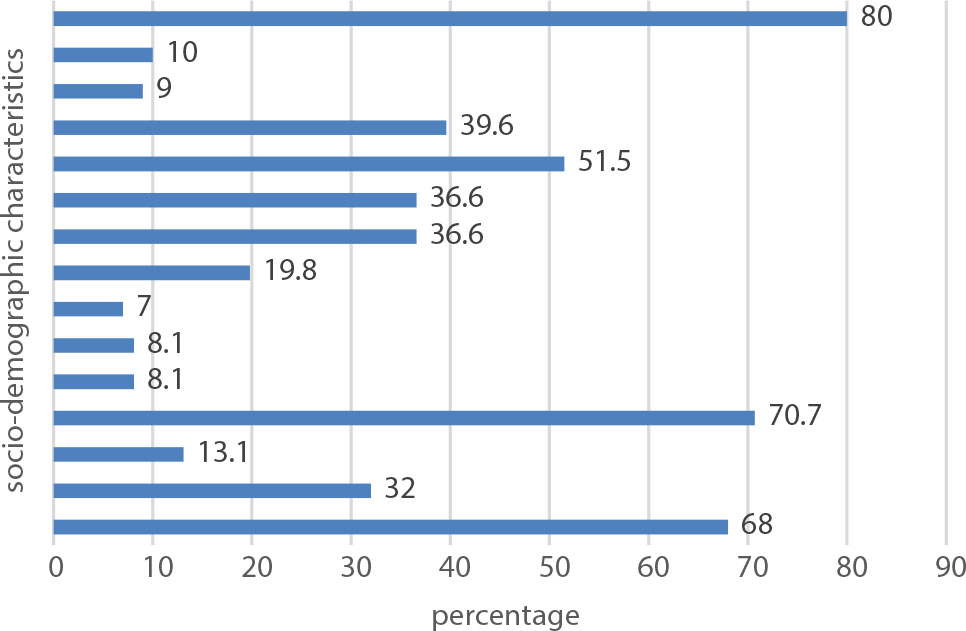
Fig. 1.
Background characteristics of the respondents
Mean Age: 40.2 years; SD: 8.3
Source: Primary data collected by authors.
Table 1 presents the association between respondents’ background characteristics, social media use, and opportunity identification. The results indicate that social media use (X2 = 46.745, p = 0.001) and marital status (X2 = 15.041, p = 0.010) were statistically significant factors influencing opportunity identification at the 5% level (p < 0.05). This implies that both marital status and the extent of social media engagement play key roles in determining whether respondents recognise agribusiness opportunities. The strong association with social media places it at the centre stage as an enabling tool for information flow, networking and exposure to the market trends – critical for emerging entrepreneurs.
Table 1.
Association between Social Media Usage, Background Characteristics, and Opportunity Identification
| Chi-square | Sig. | |
|---|---|---|
| Sex | 9.004 | .109 |
| Age | 3.161 | .675 |
| Marital status | 15.041 | .010 |
| Education | 4.932 | .424 |
| Religion | 4.005 | .549 |
| Tribe | .956 | .966 |
| Social media | 46.745 | .001 |
By contrast, sex, age, education, religion and ethnicity were not statistically significant (p > 0.05). This suggests that these socio-demographic variables may not directly influence opportunity recognition, whereas social media usage appears to transcend such background factors in shaping entrepreneurial awareness.
Figure 2 illustrates the perceived influence of social media usage on business performance. A majority of respondents agreed that business performance was positively associated with social media use. This indicates that respondents viewed social media as a strategic resource for marketing, customer interaction, and opportunity discovery – factors that ultimately enhance business performance.
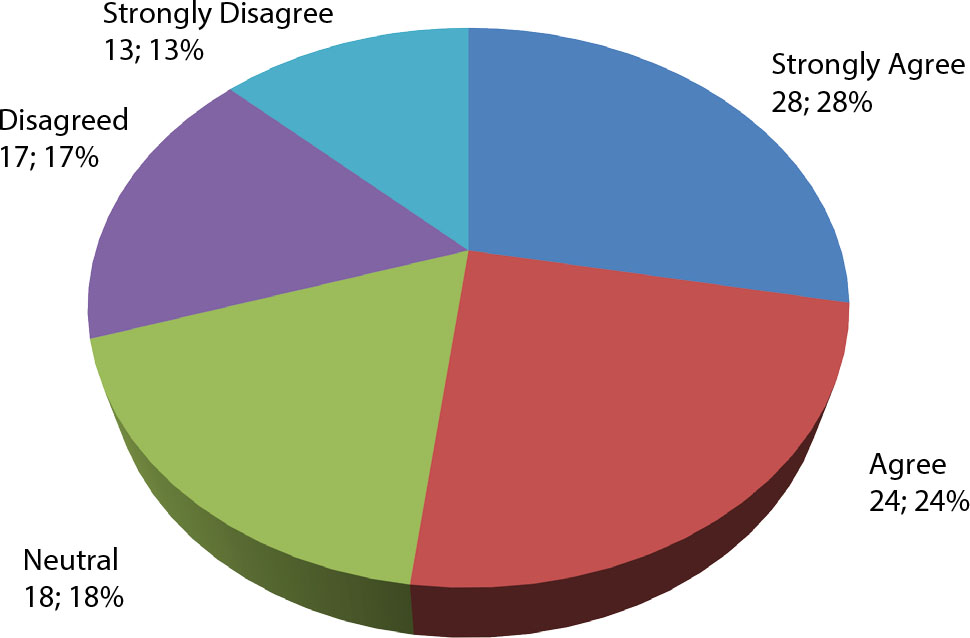
Fig. 2.
Perceived Influence of Social Media Usage on Business Performance
Source: Primary data collected by authors.
Further analysis in Table 2 confirms a statistically significant correlation between social media use and business performance (p = 0.002). The positive coefficient (Coef. = 0.288) suggests that higher levels of social media engagement correspond to better business outcomes. Specifically, a one-unit increase in social media use (e.g., moving from 1–2 hours to 2–3 hours of daily use) is associated with a 28.8% increase in business performance. This demonstrates the catalytic role of social media in supporting agribusiness growth.
Table 2.
Association between Social Media Usage and Business Performance
| Coef. | Std. Err. | t | p > |t| | 95% CI | |
|---|---|---|---|---|---|
| Social media usage | .2884615 | .0919321 | 3.14 | 0.002 | .1060253–.4708978 |
| Constant | .5 | .0662932 | 7.54 | 0.000 | .36844–.6315567 |
The confidence interval (95% CI = 0.106, 0.471) further confirms that the relationship is both statistically and practically significant. In other words, social media use has a measurable positive impact on performance. This effect may stem from the additional market exposure, networking opportunities, and direct feedback systems that social media platforms provide – factors that are essential to the success of early-stage businesses in peri-urban environments.
The multiple regression outputs (Table 3) provide further insights into the relative influence of the explanatory variables. Results show that a one-unit increase in social networks and prior knowledge is associated with 12% and 21% improvements in business performance, respectively. Similarly, a one-unit increase in social media usage contributes to a 21% increase in business performance, assuming other variables remain constant. However, when all three explanatory variables were included in the model simultaneously, only social media usage remained statistically significant (p = 0.034).
Table 3.
Multiple Regression Outputs Showing the Relationship Between Social Media Usage and Business Performance, Controlling for Prior Knowledge and Social Networks
| Coef. | Std. Err. | T | p > |t| | |
|---|---|---|---|---|
| Social media usage | .2089331 | .0971307 | 2.15 | 0.034 |
| Prior knowledge | .2119322 | .114799 | 1.85 | 0.068 |
| Social network | .118642 | .1016058 | 1.17 | 0.246 |
| Constant | .3048624 | .102758 | 2.97 | 0.004 |
Overall, the findings highlight that social media use is a strong and statistically significant predictor of both opportunity identification and business performance among emerging agribusiness entrepreneurs. Compared to other socio-demographic and experiential variables, social media stands out as the most influential tool for entrepreneurial development in the peri-urban context.
DISCUSSION
This study examined the impact of social media use on opportunity identification and business performance among new entrants in the agribusiness within a peri-urban community in southwestern Nigeria. The results indicate that individuals who have entered agribusiness within the past five years are relatively young, based on the respondents’ average age. This trend may be linked to past and ongoing government and stakeholders’ initiatives encouraging youth participation in farming and agribusiness, countering the traditional perception that agriculture is a field primarily for the older population (Olagunju and Dawodu, 2022).
The findings also show that more women than men are entering agribusiness as entrepreneurs. This may be attributed to the increasing participation of women in the labour force and traditional dominance of women in southwestern Nigeria in the marketing of agricultural products such as vegetables, fruits, and staple foods (Azeez et al, 2021). Furthermore, most of the respondents had at least a secondary education, with a significant proportion holding tertiary qualifications. This pattern may be due to the high rates of unemployment and underemployment in the formal sector (Adeosun et al., 2023; Odunlami et al., 2024), which push graduates into informal sectors such as farming and agribusiness as a viable alternative.
The conceptual basis for introducing opportunity identification is the assumption that it drives progress in business performance (Corbett, 2005; Benyam et al., 2021). Our study revealed that, in addition to social media, marital status significantly influenced opportunity identification. Existing research supports this interpretation: social media and digital inclusion expand access to new ideas and networks that enhance business performance (Gruzd et al., 2016; Hemsley et al., 2018). Likewise, marriage often signifies independence from parental support, increases financial responsibility and provides social stability, all of which may sharpen opportunity recognition among married people compared to their single counterparts (Lee and Mortimer, 2009). Our study further confirmed that new entrants into agribusiness widely recognise the importance of digital inclusion – particularly social media – for improving business performance. While most previous studies addressing social media’s impact have not been agriculture-specific (Omar et al., 2020; Shao and Kamber, 2023), our findings extend this evidence to the agribusiness context.
Prior research has documented that entrepreneurs increasingly use ICT tools such as mobile phones and laptops to explore opportunities and sell products (Karakara and Osabuohien, 2020; Igboeli and Bisallah, 2020). Consistent with this, our study found a significant association between social media use and business performance. Greater engagement with social media may enhance performance by expanding customer bases (Manzoor et al., 2020), supporting opportunity identification, and facilitating online marketing (Evans et al., 2021; Harrigan et al., 2021).
CONCLUSION
The study achieved its objective of assessing how social media use influences opportunity identification and business performance among nascent agribusiness entrepreneurs in a peri-urban Nigerian context. The findings establish social media as a critical driver of visibility, market access and growth during the formative stages of agribusiness ventures. Digital inclusion, therefore, emerges not merely as a communication tool but as a strategic resource for entrepreneurship success. Such knowledge will provide policymakers and stakeholders in the economic, information technology, and agricultural sectors with a foundation for developing policies and programmes aimed at improving agribusiness performance in peri-urban settings.
We acknowledge the limitation of self-reported data, which may be subject to recall bias. To mitigate this, the survey questions were time-specific, focusing on particular behaviours and events within the past 3 months. This approach reduced the cognitive load on participants and enhanced the reliability of the information collected. Furthermore, the outcome variable may be influenced by factors beyond social media use. To isolate the effect of social media, external and socioeconomic variables were included as control variables in the models. While the study focuses on new entrants in the agricultural sector, which may limit generalisability, it captures insights into common entrepreneurial activities that can inform researchers and practitioners in other sectors of the economy. Although the data were collected cross-sectionally, this study provides a foundation for further research, including longitudinal studies which can track trends in the influence of social media on agricultural performance over time. Future research may also involve comparative analyses across different settings – rural, urban and peri-urban – and explore variability among different types of agribusiness, such as product-specific enterprises, or businesses focusing on animal versus plant products. Given the diversity of social media platforms and their distinct features, subsequent studies could examine the impact of specific platforms – such as Facebook, X (formerly Twitter), Instagram, and WhatsApp – on opportunity identification and business performance.