
INTRODUCTION
Agriculture constitutes a fundamental sector of the Nigerian economy. As a crucial component of the national economic framework, it serves as the primary source of sustenance, employment opportunities, and foreign exchange earnings. The Nigerian agricultural industry accounts for approximately 25% of gross domestic product (GDP) and generated, on average, over 70% of export revenues between 2013 and 2021 (Oyaniran, 2023). Due to its critical importance, governmental bodies have prioritised the enhancement of agriculture, particularly food production, which had previously been neglected in favour of oil revenues. In this context, the Food and Agriculture Organisation (FAO) has identified maize, cassava, yam, beans, millet, cocoa, oil palm, cotton, groundnuts, ginger, and sesame as Nigeria’s key agricultural commodities (FAO, 2022). Although the production levels of these widely consumed crops generally meet household food requirements, the resulting marketable surpluses remain insufficient to satisfy the nation’s foreign exchange needs (Femi-Olagundoye et al., 2024). For instance, as reported by the Central Bank of Nigeria (CBN, 2022), agricultural yields declined from 1,422 kg/ha to 1,272 kg/ha between 2011 and 2020, with an average yield of 1,347 kg/ha over the period, in contrast to the West African and global averages of 1,642 kg/ha and 5,530 kg/ha, respectively. Lower yields are likely to result in reduced income levels. Data from the World Development Indicators (WDI) show a decline in Nigeria’s annual agricultural output per worker in real terms, from 5.90% in 2008 to 1.12% in 2023 (WDI, 2023).
To enhance productivity within Nigeria’s agricultural sector, sufficient financial resources must be made available to farmers. Agricultural financing refers to the procurement and utilisation of capital specifically for agricultural endeavours. Such funding may come from various sources, including personal savings, bank loans, loans from family or friends, cooperative societies, informal money lenders, government allocations, philanthropic organisations, and private enterprises. The field of “Agricultural Finance” encompasses a spectrum that ranges from the “micro concept”, which pertains to the provision of financing and liquidity services via credit, to the “macro concept’, which involves an analysis of the agricultural sector’s contribution to the broader economy. Both dimensions are significant, although the former often functions as a component of the latter. For instance, an investigation into a farm operator’s behaviour at the micro level may serve as a basis for understanding the determinants of macroeconomic outcomes within the agricultural sector. This domain studies the allocation of financial resources in agricultural activities to improve farmers’ access to and use of financial services. According to USAID (2010), agricultural finance encompasses a diverse array of financial services aimed at supporting agricultural enterprises. Afolabi et al. (2021) highlight that this includes savings, transfers, insurance, loans, input supply, processing, wholesaling, and marketing. IFAD (2010) similarly notes that agricultural finance supports both on-farm operations and various agricultural enterprises, ensuring the availability of financial resources for a broad spectrum of activities. Nevertheless, the sector faces considerable challenges, including a non-competitive agribusiness climate stemming from insecurity, insufficient investment, corruption, restricted credit access, inadequate input quality, ineffective policy implementation, and national security issues. Addressing these barriers is crucial to unlocking the full potential of Nigeria’s agricultural sector and supporting a more sustainable economy.
Finance is an essential component of the real economy and forms a crucial foundation for economic revitalisation and the development of a robust agricultural sector. Historically, financing mechanisms intended to address Nigeria’s agricultural challenges have been hindered by limited access, high costs, and delays in disbursement – factors that collectively impede sustained labour productivity in agriculture (Nuhu et al., 2022). Even though technological advancements have significantly expanded the reach and accessibility of financial services globally, the majority of agricultural activities within Nigeria occur in rural locales that face poor network connectivity and inadequate educational resources (Fowowe, 2020). As the scale of agricultural production is theoretically a positive function of finance, the correlation between financial resources and labour productivity should also be positive, ceteris paribus. Agricultural production is also influenced by the unpredictable nature of weather conditions. Adequate rainfall supports output by facilitating nutrient decomposition and providing hydration, while sunshine plays a crucial role for various reasons, including its significance in photosynthesis. However, rainwater and sunlight must be managed effectively throughout the growing season – via irrigation systems and appropriate planning – to maximise productivity. While climatic factors undoubtedly affect agricultural output, they do not lessen the importance of adequate financing in enabling farmers to respond effectively to such conditions. Regrettably, Nigeria’s persistent security challenges have further undermined the financial viability of the agricultural sector, dissuading potential investors from allocating capital to this crucial part of the economy. Figure 1 illustrates the trend in agricultural finance in Nigeria across different sources, showing that commercial bank credit and microfinance dominate agricultural funding, while government expenditure and agricultural credit schemes contribute relatively little.
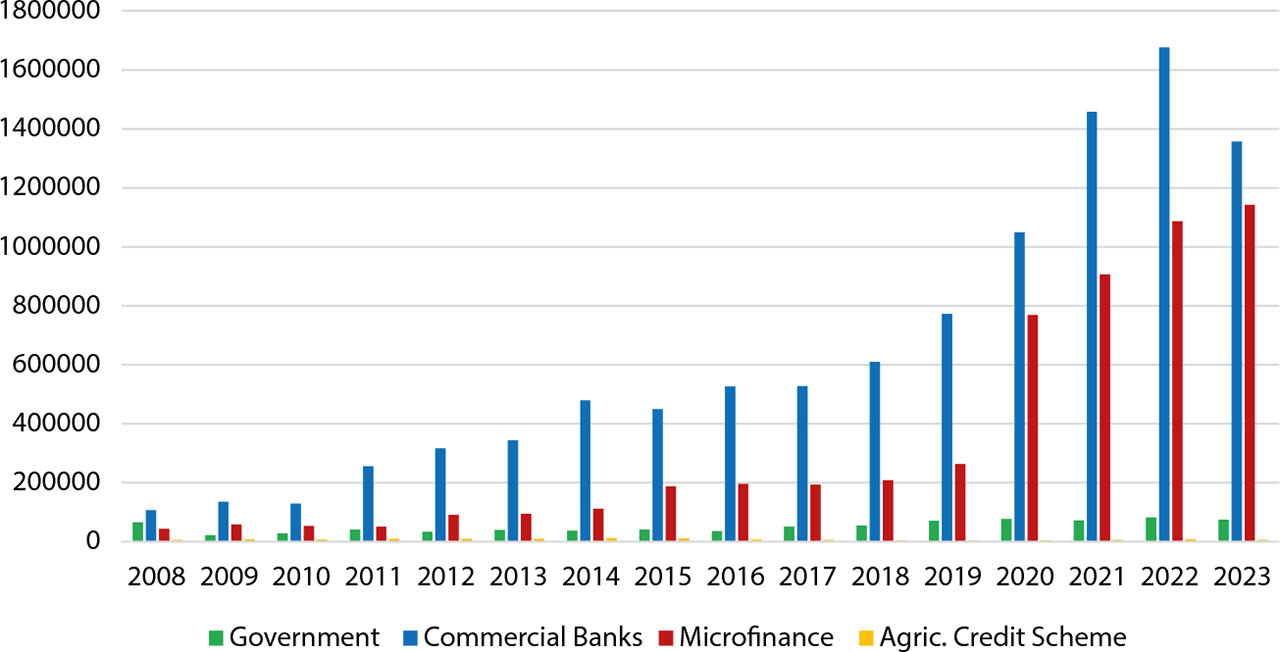
Fig. 1.
Sources of finance to the Nigerian agricultural sector
Source: CBN statistical bulletin.
With the escalation of globalisation and intensifying competition in high-technology sectors, labour productivity has become a key determinant of international competitiveness. Concurrently, fluctuations in labour productivity growth and overall economic expansion remain pressing concerns for Nigeria. Over the long term, labour productivity is of paramount importance, and the growth of labour productivity constitutes a principal contributor to an economy’s competitive edge and ascending prosperity (Heil, 2018). Acknowledging this reality, Nigeria’s national agenda is directed towards fostering a technologically sophisticated and globally competitive economy, which necessitates an amplified focus on improving labour productivity. To realise this objective, the availability of finance is essential. The theoretical relationship between finance and productivity can be traced to Bagehot’s work in the 1870s. While it is plausible that earlier theoretical deliberations existed, the literature recognises this as a documented instance of “modern” contemplation regarding the significance of the financial system concerning economic productivity (Stolbov, 2012). Bagehot’s theoretical framework elucidated the interconnectedness of financial sectors with the real economy. His theory posited that “financial capital will run as surely and instantly where it wanted, and where there is most to be made of it, as water runs to find its level” (Bagehot, 1873). This theoretical assertion aligns with the conventional neoclassical theory of demand and supply and is further reinforced by arbitrage theory. Nonetheless, it is imperative to acknowledge that this perspective relies on several assumptions, including perfect information, a frictionless economy, and resource mobility. Recent developments in new institutional economics and pioneering work in information economics have demonstrated that some of these assumptions do not consistently hold true in real-world scenarios (Stiglitz, 2001). This emergent perspective elucidates the reasons why, in certain instances, the neoclassical theory of perfect markets fails to apply, resulting in market imperfections and friction. Despite its limitations, Bagehot’s theory underscores the financial sector’s role in aggregating resources and allocating them to the most profitable enterprises, a principle that remains valid today. The broader economy benefits from the multiplicative effects stemming from the efficient allocation of capital, and successful enterprises subsequently catalyse economic productivity. Based on Bagehot’s theoretical framework, it can be concluded that finance plays a significant role in enhancing economic productivity.
Unquestionably, one of the predominant factors contributing to inadequate financing and suboptimal labour productivity within the Nigerian agricultural sector is the nation’s pervasive macro-scale security problem, characterised by tribal conflicts, insurgency, and banditry. The diminished yield in agricultural productivity can be attributed to the elevated risk of loss of life induced by insecurity (Amadi-Robert et al., 2024). Consequently, labour productivity in rural regions has experienced a significant decline, discouraging investment in agriculture, which has resulted in low agricultural productivity (Khan et al., 2024; Seven and Tumen, 2020; Alabi and Abu, 2020). The decline in agricultural productivity in Nigeria, exacerbated by escalating insecurity, has cast a formidable shadow over the potential for sustainable economic growth within the nation. Empirical evidence suggests that over the past five years, approximately 77,000 lives have been claimed by tribal conflicts, and about 2.6 million individuals from the agricultural community have been displaced, primarily due to hostilities between Fulani herdsmen and local farmers in the North-Western and North-Central regions of the country (Usman et al., 2024). In the North-Eastern region, the Boko Haram insurgency has tragically resulted in the loss of an estimated 32,000 lives, predominantly from agrarian communities in Borno State, while simultaneously reducing the state’s wheat production capacity by 420,000 tons, which constitutes 30% of the annual national consumption (Illesanmi and Odefadehan, 2022). The increase in farmer abductions represents another significant insecurity-related challenge to labour productivity within the Nigerian agricultural sector, leading to the underutilization of both human and financial resources allocated to food production. The fear of potential attacks or kidnappings, coupled with exorbitant ransoms and the substantial seasonal levies imposed by bandits on local farming communities for access to their agricultural land, has severely diminished the availability of labour for farming activities, resulting in reduced agricultural productivity and leading to food scarcity across Nigeria (Odalonu, 2022).
The rising degree of anxiety regarding the implications of insecurity for labour productivity, compounded by inadequate funding in the agricultural sector, has catalysed numerous empirical investigations aimed at elucidating the interrelationships among finance, insecurity, and agricultural productivity within Nigeria. For instance, Yola et al. (2024), Agbana and Lubo (2022), and Afolabi et al. (2021) demonstrated that financial resources obtained from banking institutions and governmental entities have a positive and significant influence on agricultural productivity in Nigeria. In contrast, Danladi et al. (2021) and Alabi and Abu (2020) showed that governmental expenditure on agriculture did not significantly improve agricultural productivity in the country. Furthermore, Amakor and Anyamaobi (2022), alongside Abdulraheem and Adeola (2015), found that a lack of access to microcredit among impoverished farmers, despite substantial governmental allocations intended for this demographic, culminated in diminished productivity within the agricultural domain, while Obialor et al. (2022) identified microfinancing as a viable financial avenue for enhancing agricultural productivity in Nigeria. In terms of insecurity, Tank et al. (2024), Falade et al. (2024), Abdulaziz et al. (2022), Babajide and Badru (2022), and Illesanmi and Odefadehan (2022) have collectively established that it has a pronounced negative effect on agricultural productivity in Nigeria. Ewubare et al. (2024) demonstrated that insecurity weakened the relationship between finance and agricultural productivity. Amadi-Robert et al. (2024) noted that the prevalence of armed robbery and military expenditure adversely impacted the agricultural sector’s contribution to gross domestic product. While a majority of studies have established a robust association between finance and agricultural productivity, as well as the negative effects of rising insecurity on agricultural sector performance, only a select few investigations, including those conducted by Ewubare et al. (2024) and Amadi-Robert et al. (2024), have elucidated the moderating influence of insecurity on the relationship between finance and agricultural productivity in Nigeria. Consequently, in light of emerging data, indicators, and analytical methodologies, there exists a pressing need to advance research in this area to ascertain whether prior findings have enduring validity.
Another notable gap in the literature is the tendency of most studies to treat agricultural finance as a single, broad measure, with little effort made to assess the distinct effects of different financial instruments on agricultural productivity. These investigations have quantified finance in terms of governmental expenditure (Yola et al., 2024; Agbana and Lubo, 2022), credit from commercial banks (Usman et al., 2024; Miftahu and Bawa, 2023; Danladi et al., 2021), loans from microfinance institutions (Amakor and Anyamaobi, 2022; Obialor et al., 2022; Adebisi, 2020; Shafique and Khan, 2020; Okafor, 2020; Girabi and Mwakaje, 2013), and funds from agricultural credit guarantee schemes (Usman et al., 2024; Akinde and Onafowokan, 2016). Insecurity was quantified by the number of fatalities recorded within the specified timeframe, while labour productivity was represented by output per labour unit in agriculture. A notable deficiency persists concerning the measurement of the moderating effect of insecurity on the relationship between finance and labour productivity within the Nigerian agricultural sector.
This study seeks to address the following research questions: What is the effect of government expenditure on labour productivity in the Nigerian agricultural sector? To what extent does credit from commercial banks influence labour productivity in the Nigerian agricultural sector? How do loans from microfinance banks affect labour productivity in the Nigerian agricultural sector? To what extent do agricultural credit guarantee scheme funds influence labour productivity in the Nigerian agricultural sector? And how does insecurity moderate the relationship between finance and labour productivity in the Nigerian agricultural sector? In response to these questions, the study aims to examine the relationship between finance and labour productivity in Nigeria’s agricultural sector, with particular attention to the ongoing security challenges. The broad objective is to investigate the moderating effect of insecurity on the relationship between finance and labour productivity. The specific objectives are to:
a) ascertain the effect of government expenditure on labour productivity in the Nigerian agricultural sector;
b) analyse the influence of commercial bank credit on labour productivity in the Nigerian agricultural sector;
c) assess the impact of microfinance bank loans on labour productivity in the Nigerian agricultural sector;
d) determine the effect of agricultural credit guarantee scheme funds on labour productivity in the Nigerian agricultural sector.
e) investigate the moderating effect of insecurity on the relationship between finance and labour productivity in the Nigerian agricultural sector.
This research endeavours to address existing research gaps by concentrating primarily on indicators related to finance and insecurity and their implications for agricultural labour productivity in Nigeria, thereby seeking to answer the question: To what extent does financial access influence labour productivity in the Nigerian agricultural sector? Following this introduction, the subsequent section will present a review of the theoretical and empirical literature. Section three will delineate the methodology employed for analysis, while section four will present and discuss the empirical findings. Section five will conclude the paper by highlighting the policy implications of the findings.
The results of this research will be crucial for both national and sub-national governmental entities in Nigeria to synchronize their policy frameworks in a manner that effectively demonstrates how critical financial resources can be optimized through investment in the agricultural sector to enhance agricultural labour productivity amidst the prevailing insecurity in Nigeria.
METHODOLOGY
Sources of Data
This study covered the period from 1992 to 2023. The temporal framework selected for this analysis is dictated by the significant fluctuations in agricultural labour productivity attributable to heightened insecurity, which has threatened investment in the sector. This study utilised annual time series data concerning the specified variables. The data were meticulously sourced from the Central Bank of Nigeria’s Statistical Bulletin and the World Development Indicators (WDI). Labour productivity (LABP) quantifies agricultural output per worker, government expenditure (GEXP) refers to total governmental allocations to agriculture, commercial bank credit (CBCR) reflects the aggregate volume of credit extended by commercial banks to the agricultural sector, microfinance bank loans (MFBL) denotes the total value of agricultural loans disbursed by microfinance institutions, and agricultural credit guarantee scheme funds (ACGSF) accounts for the cumulative amount of loans authorised under the ACGS. To quantify insecurity, the number of fatalities (DTHS) in Nigeria resulting from security-related challenges was employed.
Model Specification
This research undertook an examination of the interrelationship between financial mechanisms and labour productivity, wherein capital (finance), as a component of the endogenous growth model, served as a key factor influencing labour productivity. The endogenous growth model delineates technology, along with the accumulation of physical and human capital, as pivotal elements propelling labour productivity. An increase in the quantity of equipment and machinery allocated to a specific labour unit is anticipated to enhance the marginal productivity associated with that labour unit. In a similar vein, elements that contribute to the enhancement of labour knowledge or technical acumen—such as training, education, research, and superior healthcare facilities—are regarded as essential catalysts for labour productivity. The determinants of labour productivity, as articulated by the endogenous growth theoretical framework, can be encapsulated by equation (1):
Where:K – physical capital accumulation
H – human capital accumulation
A – technology
u – other factors affecting labour productivity
Equation 1 represents an articulation of the determinants of labour productivity. The accumulation of physical capital, the accumulation of human capital, and technological advancements exert a positive influence on labour productivity. Nevertheless, the supply-leading hypothesis concerning the relationship between finance and growth contends that the determinants of productivity identified by the endogenous growth model fail to manifest in the absence of sufficient financial resources allocated to productive activities within the economy. Consequently, this study emphasises that access to financial resources (capital) is a fundamental determinant of labour productivity within the Nigerian agricultural sector. In this context, the sources of financial resources (capital) pertinent to agricultural activities encompass government expenditures, credit from commercial banks, loans from microfinance institutions, and agricultural credit guarantee scheme funds. As a result, the finance-labour productivity model is delineated by equation (2).
In alignment with the objectives of this study, the tenets of the agricultural productivity gap theory, as posited by Gollin et al. (2013) and adapted from Usman et al. (2024), were employed to modify equation (2) by recognising the possible moderating effect of insecurity on the endogenous growth framework. The “insecurity and agricultural productivity gap theory” posits that a significant factor contributing to the disparity in agricultural productivity between developed and developing nations is the prevalence of elevated insecurity levels in numerous developing regions, which directly impedes farmers’ capacities to cultivate land, access resources, and ultimately produce crops effectively, resulting in diminished overall agricultural output. In this context, the tally of deaths (DTHS) attributable to insecurity was utilised to gauge the extent to which insecurity is undermining the effect of finance on labour productivity in Nigeria. Thus, equation (2) is revised by integrating DTHS to formulate equation (3).
To linearise equation (3), a logarithmic transformation was applied to obtain equation (4), which is the model used for the analysis.
Where:LN – denotes the natural logarithm of the variables
β0 – is the constant
β1 – β0 represent the estimated coefficient
μ – denotes the error term.
Estimation strategy
The discourse pertaining to the estimation strategy within this section is delineated into two distinct subsections. The initial subsection elucidates the methodologies employed to conduct stationarity assessments, while the concluding subsection explicates the Non-linear Autoregressive Distributed Lag (NARDL) model and the rationale underpinning the selection of this estimation strategy.
Utilising non-stationary variables in time series analysis may culminate in estimates that are inconsistent and biased. Furthermore, this practice can yield spurious regression results, which may prove unsuitable for conducting analyses and drawing inferences. For the stationarity assessment, we employed the Phillips and Perron (PP) test alongside the Augmented Dickey-Fuller (ADF) tests (Wolters and Hassler, 2005). The ADF test can be articulated as expressed in equation 5:
Where Xt is the variable under consideration at period t. The ADF and PP tests are conducted with the null hypothesis HO: δ = 0 against the alternative hypothesis H1: δ < 0. The null hypothesis states that a unit root is present, while the alternative hypothesis states that there is no unit root. The series is considered stationary when the null hypothesis is rejected.Non-linear autoregressive distributed lag (NARDL) model
The Non-linear Autoregressive Distributed Lag (NARDL) framework serves as a sophisticated tool for the examination of the asymmetric effects of financial factors on productivity. This methodology enables scholars to explore whether the influence of financial advancement (or alternative financial metrics) varies based on the directional movement of the variable, i.e., whether it is increasing or decreasing. In other terms, it can elucidate whether positive or negative fluctuations in financial metrics yield disparate outcomes for productivity (Odugbesan et al., 2021). Essentially, the NARDL model proposed by Shin et al. (2014) extends the bounds testing methodology for co-integration embedded within the Autoregressive Distributed Lag (ARDL) framework (Pesaran et al., 2001). The utilisation of such a model provides considerable flexibility, as it remains applicable regardless of the stationarity of the underlying variables. Consequently, irrespective of whether the foundational variables exhibit integration of order I(0) or I(1), or are mutually co-integrated, the NARDL model retains its applicability (Salisu and Isah, 2017). Nevertheless, this should not obviate the need for pre-testing the integration order of the variables, which is paramount to ascertain that no variables incorporated into the analysis are I(2). Furthermore, pre-testing the integration order establishes a solid foundation for validating the existence of long-term co-integration among the variables. The preference for the NARDL model over the ARDL model arises from the latter’s inability to accommodate the asymmetries inherent in the fluctuations of the variables. Nonetheless, the dynamics of agricultural finance and insecurity have demonstrated a non-linear trajectory from 1992 to 2023. Therefore, there exist intervals during which agricultural finance and insecurity escalate, alongside periods characterised by their decline. Consequently, the moderating influence of insecurity on the relationship between finance and labour productivity may be asymmetrical, potentially manifesting as detrimental when finance diminishes while insecurity escalates, and conversely, exhibiting a favourable effect when insecurity progressively declines while finance increases. Thus, the application of the ARDL model to estimate the empirical model delineated in equation (4) would likely yield spurious regression outcomes, culminating in erroneous conclusions. Similar to the ARDL model, the NARDL framework demonstrates efficiency and performs adequately with small sample sizes while concurrently accounting for endogeneity across all variables. The model incorporates both short-run and long-run asymmetries in the trajectories of the variables (specifically lending) and is applicable in the context of mixed orders of integration. The general asymmetric long-run regression model devised to scrutinise the asymmetric effects of the model is represented in equation (6).
Where, LABPt, FINANCEt and INSECURITYt are scalar (1) variables; FINANCEt is decomposed as FINANCEt = FINANCE0 + FINANCEt− + FINANCEt+ where FINANCEt− and FINANCEt+ are partial sum processes of negative and positive changes in FINANCEt. Similarly, INSECURITYt is decomposed as and INSECURITYt = INSECURITY0 + INSECURITYt− + INSECURITYt+ where INSECURITYt− + INSECURITYt+ are partial sum processes of negative and positive changes in INSECURITYt. Thus, the study filtered the positive changes in finance and insecurity (increase) from the negative changes in finance and insecurity (decrease) to be able to examine their individual effects on agricultural labour productivity in Nigeria. The partial sums are formally defined as displayed in equations 7 and 10.Note that the FINANCE components are GEXP, CBCR, MFBL and ACGS, while INSECURITY is proxied by the number of deaths (DTHS).
Where the variables in equations (6), (7) and (9) are explained in the previous equations. To obtain the estimable NARDL model, equations (6), (7) and (9) were used. Thus, equations (6), (7) and (9) were substituted into the original ARDL model to arrive at the following nonlinear ARDL model for agricultural labour productivity (Shin et al., 2014), as shown in equation (11).
Model (11) is an error-correction model (ECM) that is labelled as a nonlinear ARDL model. Nonlinearity is introduced through the partial sums variables in models (7) to (10). Shin et al. (2014) have demonstrated that Pearson et al. (2001) approach of estimating the linear ARDL and testing co-integration is equally applicable to the nonlinear ARDL model. The difference between these two models is that for the nonlinear ARDL, finance and insecurity changes would have a symmetric (linear) effect on agricultural labour productivity if the positive and negative coefficients in model (11) have the same size and sign. Any result aside from this outcome makes the model asymmetric.
RESULTS AND DISCUSSION
The empirical results from the nonlinear ARDL (NARDL) are presented in this section. First, the descriptive statistics for all the variables employed in the study are displayed. This is followed by the results from the unit roots and co-integration tests. Lastly, discussions on the long-run and short-run estimates from the NARDL as well as the diagnostic test results are presented.
Descriptive statistics
The descriptive statistics outline the fundamental characteristics of the data set employed in this study. Table 2 presents the results of the summary statistics.
Table 1.
Description of dependent and independent variables
| Variable | Description | Notation |
|---|---|---|
| Labour productivity | Dividing total agricultural output by the number of workers engaged in agricultural activities | LABP |
| Government expenditure | The amount of money a government spends on the agricultural sector | GEXP |
| Commercial banks’ credit | Amount of credit to farmers | CBCR |
| Microfinance banks’ loans | Amount of loans accessed by farmers | MFBL |
| Agricultural credit guarantee scheme funds | Sum of money accessed by farmers through the agricultural credit guarantee scheme | ACGSF |
| Number of deaths | The total number of deaths due to insecurity | DTHS |
Table 2.
Descriptive statistics
| LnLABP | LnGEXP | LnCBCR | LnMFBL | LnACGS | LnDTHS | |
|---|---|---|---|---|---|---|
| Mean | 29.879 | 9.669 | 11.760 | 7.801 | 7.603 | 10.316 |
| Median | 30.060 | 10.320 | 11.665 | 8.355 | 8.365 | 9.665 |
| Maximum | 30.590 | 11.310 | 14.330 | 10.050 | 9.470 | 13.920 |
| Minimum | 28.930 | 6.120 | 8.850 | 3.380 | 4.390 | 7.870 |
| Std. Dev. | 0.600 | 1.487 | 1.533 | 1.855 | 1.702 | 2.328 |
| Skewness | –0.413 | –0.800 | 0.054 | –0.626 | –0.699 | 0.422 |
| Kurtosis | 1.595 | 2.422 | 1.902 | 2.356 | 1.924 | 1.536 |
| Jarque-Bera | 3.543 | 3.863 | 1.623 | 2.648 | 4.151 | 3.806 |
| Probability | 0.170 | 0.144 | 0.444 | 0.266 | 0.125 | 0.149 |
| Observations | 32 | 32 | 32 | 32 | 32 | 32 |
Table 2 shows the descriptive statistics for the variables used in our study. Labour productivity had a minimum value of 28.93 and a maximum value of 30.59, with an average value of 29.87, while its deviation from the mean was 0.60. Government expenditure averaged 9.66 with a minimum value of 6.12 and a maximum value of 11.31, having a standard deviation of 1.48. For commercial bank credit, the maximum and the minimum values were 14.33 and 8.85, respectively with an average of 11.76 with a deviation from the mean of 1.53. Additionally, microfinance bank loans averaged 7.80, with values ranging from 3.38 to 10.05 and a standard deviation of 1.85. Agricultural credit guarantee scheme funds had a mean score of 7.60, with minimum and maximum values of 4.39 and 9.47, respectively, alongside a standard deviation of 1.70. The number of deaths due to insecurity averaged 10.31, with values ranging from 7.87 to 13.92, while its standard deviation was 0.42. Regarding the skewness and kurtosis, all the variables are normally skewed, with values being less than 1 with fatter tails at the end. The Jarque-Bera shows that the natural logarithm of the variables was normally distributed; thus, the null hypothesis of a normal distribution was accepted.
Unit root and co-integration test results
The results of the Philip-Perron (PP) and Augmented Dickey Fuller (ADF) tests are presented in Table 3.
Table 3.
Unit root test results
| Variables | ADF test with intercept and trend | PP test with intercept and trend | ||||
|---|---|---|---|---|---|---|
| level | 1st difference | I (d) | level | 1st difference | I(d) | |
| LnLABP | –0.759 | –5.086*** | I(1) | –0.840 | –5.082*** | I(1) |
| LnGEXP | –4.284** | –6.051*** | I(0) | –4.270** | –8.908*** | I(0) |
| LnCBCR | –3.669** | –6.195*** | I(0) | –3.673** | –7.147*** | I(0) |
| LnMFBL | –3.605** | –5.420*** | I(0) | –4.739** | –9.882*** | I(0) |
| LnACGS | –0.808 | –3.765*** | I(1) | –1.045 | –3.801** | I(1) |
| LnDTHS | –2.178 | –6.861*** | I(1) | –2.096 | –7.144*** | I(1) |
Table 3 displays the results attained. It was found that labour productivity (LABP), agricultural credit guarantee scheme funds (ACGSF) and number of deaths (DTHS) were all integrated of order one, I(1), while government expenditure (GEXP), commercial bank credit (CBCR) and microfinance loans (MFBL) were integrated of order zero, I(0). These results have two implications. First, they provide evidence in support of the choice of the NARDL model, which allows for the inclusion of I(1) and I(0) independent variables in the same empirical equation. Second they validate the application of the bounds testing procedure to examine the existence of a long-run relationship between components of finance and labour productivity in Nigeria.
The main aim of using the unit root approach of Zivot and Andrews (2002) in this section is to test for structural breaks in the series. A structural break is an unexpected change over time in the parameters of a regression model, which can lead to huge forecasting errors and undermine the reliability of the model. The results displayed in Table 4 empirically confirm the presence of a structural break in all variables included in the empirical model. However, for labour productivity (LABP), agricultural credit guarantee scheme funds (ACGSF) and the number of deaths (DTHS), stationarity is attained at level, while for government expenditure (GEXP), commercial bank credit (CBCR), and microfinance bank loans (MFBL), stationarity is attained after first differencing, which is consistent with the results of the Augmented Dickey-Fuller (ADF) and Phillips–Perron unit root tests. The presence of structural breaks and the mixed order of integration (none exceeding order one) confirms the suitability of the Nonlinear ARDL (NARDL) model for examining the nonlinear relationships among the variables under consideration.
Table 4.
Zivot and Andrews unit root structural break test
| Variables | Level | First difference | ||
|---|---|---|---|---|
| t-Statistics | time break | t-Statistics | time break | |
| LnLABP | –7.013** | 2016 | –9.181** | 2020 |
| LnGEXP | –2.021 | 1993 | –7.427** | 2015 |
| LnCBCR | –0.801 | 2008 | –9.021** | 2016 |
| LnMFBL | –1.001 | 2004 | –6.219** | 2005 |
| LnACGS | –4.027** | 1998 | –5.728** | 2001 |
| LnDTHS | –4.321** | 2013 | –4.921** | 2019 |
Bounds test
The study followed the bounds test approach to co-integration to examine the long-run relationship between the dependent and independent variables, as detailed in Table 5.
Table 5.
Bounds test co-integration test result
| F-bounds Test | Null hypothesis: No levels relationship | |||
|---|---|---|---|---|
| Test statistic | Value | Signif. | I(0) | I(1) |
| F-statistic | 13.798 | 10% | 2.080 | 3.000 |
| k | 5 | 5% | 2.390 | 3.380 |
| 1% | 3.060 | 4.150 | ||
From Table 5, the result of the bounds test suggests that the F-statistic of 13.798 is greater than the upper bound critical value of 3.000 at the 1% and 5% levels of significance. It can therefore be concluded that there is a long-run association or co-integration between the dependent and independent variables. The long-run asymmetric effect of finance on labour productivity in Nigeria was then estimated while controlling for insecurity.
Estimated long-run and short-run coefficients using NARDL
The main goal in this section is to estimate the asymmetrical effect of finance on labour productivity amidst long-run insecurity. The long-run estimates are presented in Table 6.
Table 6.
Estimated long-run results
| Variable | Coefficient | Std. Error | t-Statistic | Prob. |
|---|---|---|---|---|
| LnGEXP+ | 0.258 | 0.064 | 4.031 | 0.001*** |
| LnGEXP– | –0.391 | 0.129 | –3.031 | 0.009*** |
| LnCBCR+ | 0.410 | 0.102 | 4.020 | 0.002*** |
| LnCBCR– | –0.183 | 0.082 | –2.243 | 0.042*** |
| LnMFBL+ | 0.175 | 0.742 | 2.351 | 0.041** |
| LnMFBL– | –0.176 | 0.039 | –2.722 | 0.022** |
| LnACGS+ | 0.157 | 0.058 | 2.679 | 0.013** |
| LnACGS– | –0.278 | 0.097 | –2.866 | 0.017** |
| LnDTHS+ | –0.521 | 0.158 | –3.299 | 0.008*** |
| LnDTHS– | 0.609 | 0.179 | 3.392 | 0.003*** |
| Constant | 0.762 | 0.330 | 2.309 | 0.040** |
From the long-run estimates reported in Table 6, it was found that both positive and negative finance (lnGEXP, lnCBCR, lnMFBL, and lnACGS) variables and the moderating effect of insecurity measured by lnDTHS carry significant coefficients with different signs and sizes, which supports the presence of long-run asymmetric effects of finance components and insecurity on labour productivity in the Nigerian agricultural sector. Thus, the estimated long-run NARDL empirically confirms an asymmetric effect of finance amidst insecurity on labour productivity, because positive changes in all the finance components exerted a significant positive (increase) effect on labour productivity while negative changes (decrease) in finance components exerted a significant negative effect. Specifically, the results revealed that a one per cent increase in lnGEXP generated approximately a 0.258 increase in agricultural labour productivity, while a one per cent increase in lnCBCR generated approximately a 0.410 increase in labour productivity; a one per cent increase in lnMFBL resulted in approximately a 0.175 increase in agricultural labour productivity, while lnACGS generated approximately a 0.157 rise in agricultural labour productivity, ceteris paribus. On the other hand, all else being equal, a one per cent increase in lnDTHS led to a 0.521 decline in agricultural labour productivity in Nigeria. These findings are similar to those of Yola et al. (2024), Magaji et al. (2023), Toheeb and Dabo (2022), Agbana and Lubo (2022), Obialor et al. (2022), Afolabi et al. (2021), and Iderawumi and Ademola (2015), who examined the impact of various finance sources on agricultural productivity in Nigeria. The findings also align with those of Tank et al. (2024), Falade et al. (2024), Abdulaziz et al. (2022), Babajide and Badru (2022), and Illesanmi and Odefadehan (2022), who observed an inverse relationship between insecurity and agricultural productivity, such that the negative effect of insecurity could inhibit the potential positive effects of finance on agricultural productivity over time. On the other hand, some studies, like Nuhu et al. (2022), Amakor and Anyamaobi (2022), Danladi et al. (2021), and Ndubuaku et al. (2019), have shown that finance components such as government expenditure, bank loans and agricultural credit guarantee scheme funds failed to significantly impact agricultural productivity in Nigeria.
The economic implications of these findings are that positive changes in finance components increase the availability of investable funds, which encourages new agricultural projects, thereby increasing investment – a key component of economic productivity. Increased financing enables farmers to purchase better inputs, modernise farming practices, and expand their operations, ultimately leading to higher yields, increased incomes, reduced poverty and increased productivity in the agricultural sector. Financial resources allow farmers to invest in improved seeds, fertilisers, and irrigation systems, which can significantly boost crop yields and livestock productivity. Access to credit and loans enables farmers to purchase and use modern machinery and technologies, leading to more efficient farming practices and reduced labour costs. Through funding, higher agricultural incomes generated through increased productivity can improve the livelihoods of farmers and their families, contributing to poverty reduction in rural areas, which further contributes to overall economic growth by increasing food supply, reducing food import dependence, and generating more revenue for the country. However, insecurity can be seen to hamper the positive effect of finance on labour productivity in the Nigerian agricultural sector. Insecure environments, especially those with banditry and farmer-herder conflicts, negatively impact agricultural productivity by deterring investment, reducing capital stock, and diverting funds to security, hindering infrastructure development and job creation. This implies that the availability of funds for agriculture can be a key driver of productivity, but if the environment is insecure, it can be difficult for farmers to invest, cultivate, and reap the benefits of those funds.
Theoretically, the supply-leading hypothesis suggests that finance and productivity are intrinsically linked. Well-developed financial systems, with efficient allocation of capital and sound institutions, can significantly boost productivity growth by enabling firms to access resources for investment and innovation. The relationship between finance and productivity is observed across various sectors, including agriculture, where access to credit is vital for adopting new technologies and improving yields. Access to finance is crucial for boosting productivity, while efficient financial systems can also contribute to higher productivity. Conversely, financial friction and inefficiencies can hinder productivity growth. The findings of this study align with the supply-leading hypothesis of finance and productivity.
Short-run results
Table 7 reports the short-run estimates from the NARDL model, which empirically confirm the presence of asymmetric effects of finance and insecurity on labour productivity. This is evident from the fact that the coefficient of the independent variables differ in both sign and magnitude. Thus, the results indicate that positive and negative changes in the independent variables have differing dimensional effects on labour productivity, ceteris paribus. In addition, the short-run estimates reveal several noteworthy insights.
Table 7.
Estimated short-run results using the NARDL
| Variable | Coefficient | Std. Error | t-Statistic | Prob. |
|---|---|---|---|---|
| D(LnGEXP) | 0.118 | 0.016 | 7.213 | 0.000*** |
| D(LnGEXP(-1)) | –0.244 | 0.025 | –9.760 | 0.000*** |
| D(LnGEXP(-2)) | –0.137 | 0.045 | –3.044 | 0.003*** |
| D(LnGEXP(-3)) | 0.108 | 0.016 | 6.692 | 0.000*** |
| D(LnCBCR) | –0.286 | 0.046 | –6.217 | 0.000*** |
| D(LnCBCR(-1)) | 0.098 | 0.044 | 2.210 | 0.046** |
| D(LnMFBL) | –0.046 | 0.017 | –2.634 | 0.021** |
| LNMFBL(-1) | 0.122 | 0.014 | 8.714 | 0.000*** |
| D(LNACGS) | 0.217 | 0.094 | 2.294 | 0.031** |
| D(LNACGS(-1)) | 0.147 | 0.065 | 2.261 | 0.041** |
| D(LNACGS(-2)) | –0.212 | 0.073 | –2.927 | 0.012** |
| D(LNACGS(-3)) | 0.136 | 0.054 | 2.519 | 0.026** |
| D(LNDTHS) | –0.136 | 0.058 | –2.356 | 0.026** |
| D(LNDTHS(-1)) | 0.380 | 0.149 | 2.546 | 0.024** |
| ECM(-1) | –0.200 | 0.022 | –9.111 | 0.000*** |
| R-squared | 0.889 | |||
| Adjusted R-squared | 0.837 | |||
| F-statistic | 45.013 | |||
| Prob(F-statistic) | 0.000 | |||
| Durbin-Watson stat | 2.292 |
The error correction term [ECM (−1)] reflects the speed of adjustment and captures the endogenous response of the dependent variables to short-run shocks. The coefficient of the ECM is −0.200, indicating the existence of co-integration and stability among the variables in the model. This suggests that approximately 20% of the deviation from long-run equilibrium is corrected annually following a short-run disturbance. The coefficient is statistically significant at the 1% level. The adjusted R-squared indicates that the explanatory variables account for approximately 83.7% of the total variation in agricultural labour productivity. The Prob. (F-statistics) value of 0.000 reported in Table 7 further confirms that the estimated model is well specified and that the independent variables collectively explain a significant proportion of the variance in the dependent variable.
It can be observed that the finance components took different lag orders, supporting adjustment asymmetry. This implies that the time it takes for agricultural labour productivity to respond to positive changes in finance and insecurity is different from the time it takes to respond to negative changes in finance and insecurity. Specifically, the coefficients of lnGEXP revealed that a one per cent increase in government expenditure generates a 0.118 increase in agricultural labour productivity, while a one per cent decrease in lnGEXP generates a 0.244 decrease in agricultural labour productivity, all other things being equal. Likewise, a one per cent decrease in lnCBCR caused approximately a 0.286 fall in labour productivity, while a one per cent increase resulted in a 0.098 increase in agricultural labour productivity. Likewise, a one per cent decrease in lnMFBL caused about a 0.046 decrease in agricultural labour productivity, while a one per cent increase in lnMFBL led to a 0.122 increase in agricultural labour productivity. A one per cent increase in lnACGS led to a 0.217 increase in labour productivity, while a one per cent decrease in lnACGS caused agricultural labour productivity to decrease by 0.212. A one per cent increase in lnDTHS caused agricultural labour productivity to decrease by 0.136, while a decrease in lnDTHS resulted in a 0.380 increase in agricultural labour productivity. The economic intuition behind these estimates is that positive changes in finance led to an instantaneous increase in agricultural labour productivity, while a negative change led to an immediate reduction in agricultural labour productivity. Also, a rise in insecurity was accompanied by a significant decline in agricultural labour productivity, while a decrease brought about a spontaneous increase. Simply put, short-run increases in insecurity diminish the potential positive effect of finance on agricultural labour productivity. In the short term, insecurity significantly negatively impacts finance-led agricultural labour productivity by deterring investment, disrupting supply chains, and reducing the availability of labour. This leads to a decline in agricultural labour output, increased post-harvest losses, and further exacerbates existing food security challenges.
Testing the validity and reliability of the estimates from the NARDL Model
The study carried out a diagnostic and reliability test to ensure that our estimations from the NARDL are reliable. The results are reported in Table 8.
Table 8.
Diagnostic and reliability test results
| Diagnostic test | Test approach | Test statistics | Prob. value |
|---|---|---|---|
| Normality | Jarque-Bera test | 0.458 | 0.418 |
| Serial correlation | Breusch-Godfrey LM test | 2.153 | 0.272 |
| Heteroskedasticity | Breusch-Pagan-Godfrey test | 0.542 | 0.671 |
| Functional form | Ramsey reset test | 0.231 | 0.141 |
| Wald short run | Wald test | 6.131 | 0.012 |
| Wald long run | Wald test | 7.012 | 0.001 |
| Stability test | CUSUM test | Stable | |
| Stability test | CUSUMQ test | Stable |
Table 8 reports various statistical and econometric tests. From the diagnostics and reliability tests, it can be concluded that the long-run and short-run dynamic estimates from the NARDL model are free from econometric and statistical problems. Specifically, the estimated results from the NARDL model are free from heteroskedasticity, serial correlation, and functional form, and they are also normally distributed since all the probability values are greater than 0.05. In addition, the CUSUM and CUSUMSQ graphs (see Fig. 2 and 3) also reveal that agricultural labour productivity was stable in the period from 1992 to 2023, because the plots of the cumulative sum and cumulative sum of squares lie within the 5 per cent critical bound. However, the Wald test estimates for both the short and long runs are statistically significant, supporting the long-run and short-run asymmetric effect of finance amidst insecurity changes. Thus, the observed asymmetries between finance and labour productivity in the Nigerian agricultural sector support the analysis of insecurity as a moderating factor.
CONCLUSION AND RECOMMENDATIONS
The literature on agricultural labour productivity in developing countries continues to attract scholarly attention, mostly due to the importance policy makers attach to labour productivity. To support sound policy formulation and implementation in the agricultural sectors of these countries, researchers have examined various factors influencing labour productivity. Their findings indicate that factors such as finance and insecurity significantly affect agricultural productivity. However, studies focusing on the relationship between labour productivity and finance have often failed to account for the moderating effects of insecurity and asymmetries inherent in the modelling. While some studies have argued for – and empirically demonstrated – the presence of asymmetries in insecurity, researchers have generally neglected to consider these when examining the relationship between finance and agricultural labour productivity.
This paper makes a unique contribution to the literature by accounting for the asymmetries inherent in insecurity, examining both its asymmetric and moderating effects on the relationship between finance and labour productivity, which has not previously been studied in the Nigerian context. To this end, the study employed the nonlinear ARDL bounds testing approach, using annual time series data from 1992 to 2023 obtained from the WDI and CBN. The results confirm that components of finance such as government expenditure, commercial bank credit, microfinance loans and agricultural credit guarantee funds affect agricultural labour productivity asymmetrically. The moderating effect of insecurity was found to weaken the positive effect of finance. Specifically, positive financial changes increased agricultural labour productivity, while negative changes in finance reduced it, in both the short and the long run. Insecurity consistently exerted a negative moderating effect. The results were robust to diagnostic and reliability checks. These findings help to explain the mixed results in the existing literature, much of which overlooks the asymmetric behaviour of finance, insecurity, and agricultural labour productivity, and thus fails to reach a consensus on their interrelationships. A further major economic implication of this study is that maintaining low and stable levels of insecurity is essential for achieving high agricultural labour productivity in Nigeria. Policymakers should therefore prioritise security concerns in the formulation of agricultural policy.
In light of the principal findings, actionable policy measures can be implemented to confront prevailing challenges in Nigeria and enhance adherence to prescribed safety protocols.
a) It is imperative that governmental bodies at all levels systematically increase annual financial allocations to the agricultural sector, recognising its fundamental role in the national economy. With effective oversight, such funding would significantly enhance the sector’s contribution to economic growth.
b) The notable influence of commercial bank credit on the agricultural sector indicates that greater financial support should be channelled into the sector. The Central Bank of Nigeria could facilitate this by lowering interest rates on agricultural loans, thereby incentivising commercial banks to expand lending, which would boost agricultural productivity.
c) Private sector investment in agriculture should be actively encouraged by all tiers of government to improve the livelihoods of farmers. Financial institutions should strengthen the sector by establishing partnerships with the Central Bank of Nigeria through the Agricultural Credit Guarantee Scheme Fund (ACGSF), ensuring that farmers can access capital at reduced interest rates, enabling them to engage in large-scale production.
d) The Nigerian government should prioritise strategic investment in national security by equipping personnel with advanced technology and ensuring adequate funding for continuous training in modern intelligence and security practices. This approach would be more effective than reliance on counter-insurgency strategies.