
INTRODUCTION
Agricultural extension services play a pivotal role in enhancing agricultural productivity, fostering market integration, and promoting rural economic growth (Mapiye et al., 2021). Traditionally, public sector-led agricultural extension has been the primary channel for disseminating essential agricultural knowledge to smallholder farmers in developing countries. However, public extension systems often encounter significant challenges, such as inadequate financial resources, bureaucratic inefficiencies, and poor responsiveness to farmers’ actual needs (Anderson and Feder, 2007; Swanson and Rajalahti, 2010). These limitations have prompted shifts toward privatized agricultural extension models aimed at improving service delivery, efficiency, innovation, and accountability, particularly within agribusiness-driven rural contexts (Rivera and Sulaiman, 2009; Ragasa et al., 2016).
Privatized extension services are typically market-driven, demand-oriented, and tailored to the specialized needs of farmers, especially smallholders transitioning towards commercialization (Aker, 2011; Babu and Zhou, 2018). Unlike generalized public programs limited by government funding constraints, private providers deliver targeted, timely and responsive agricultural advisory services, enabling smallholder farmers to adopt improved farming techniques, climate-smart agriculture, and high-value cropping systems, thereby enhancing productivity and profitability (Gautam, 2000; Swanson, 2008). Furthermore, privatized extension services commonly facilitate stronger linkages to agribusiness value chains, contract farming arrangements, input supply partnerships, and expanded market access (Feder et al., 2010). Additionally, leveraging ICT-based platforms such as mobile applications and digital advisory services enhances outreach and effectiveness, particularly in remote rural areas (Ragasa and Niu, 2017). Nonetheless, privatization poses inherent risks, notably regarding affordability and equitable access, as resource-poor farmers often face significant financial barriers in accessing private extension services, potentially exacerbating existing inequalities (Rivera et al., 2001).
South Africa currently employs a pluralistic agricultural extension model combining public and private service providers, yet institutional weaknesses persist, including insufficient qualified personnel, limited government funding, and weak farmer-extension relationships (Koch and Terblanche, 2013; Lidshegu and Kabanda, 2022). In contrast, countries like Kenya and Ethiopia have successfully integrated privatized and public extension through structured public-private partnerships (PPPs), significantly improving service delivery and farmers’ economic outcomes (Muyanga and Jayne, 2008; Davis et al., 2010). South Africa, however, lacks a comprehensive policy framework to guide such integration, leading to fragmented service delivery and uneven access to advisory services. This gap has contributed to disparities whereby commercial farmers disproportionately benefit from privatized services while resource-poor smallholders remain reliant on inefficient public extension (Ortmann and Machethe, 2003; Terblanche, 2018).
In addressing these critical issues, this study explicitly aims to assess the impact of privatizing public agricultural extension services on the performance, productivity, and income levels of smallholder farmers in the Thulamela and Collins Chabane Municipalities, South Africa. The primary objective of this study is to evaluate the economic impacts of privatizing agricultural extension services on smallholder farm productivity and income in Thulamela and Collins Chabane Municipalities, South Africa. Specifically, the study seeks to compare the effectiveness of privatized and public extension services in improving smallholder farmers’ economic outcomes. By identifying key determinants influencing farm performance, this research aims to provide evidence-based recommendations for developing an integrated extension service framework that ensures equitable access to quality agricultural advisory support for smallholder farmers.
MATERIALS AND METHODS
Study area
Thulamela and Collins Chabane Municipalities serve as representative case studies of smallholder farming conditions prevalent in rural South Africa, particularly within Limpopo Province. These municipalities share common characteristics with many other rural agricultural regions in the country, including a predominance of small-scale and subsistence farming, mixed cropping systems, and reliance on rain-fed agriculture (Lidshegu and Kabanda, 2022; Mapiye et al., 2021). Socio-economic challenges such as limited access to market infrastructure, extension services, and financial resources further align these municipalities with broader trends affecting smallholder farmers across South Africa. Therefore, insights drawn from this study offer valuable implications for understanding the impact of agricultural extension service privatization in similar rural contexts nationwide (Lidshegu and Kabanda, 2022; Mapiye et al., 2021).
The study was conducted in the Vhembe District of Limpopo Province, South Africa, specifically in Thulamela and Collins Chabane Municipalities. Vhembe District, covering 21,407 square kilometers, is characterized by a subtropical climate, with temperatures ranging from 10°C in winter to 40°C in summer and an annual rainfall of approximately 500 mm, primarily occurring between October and March. The district’s soil varies from sandy in the west to loamy and clay-rich in the east, with low inherent fertility. Agriculture in the region is divided into large-scale commercial farming and smallholder farming, with smallholder farmers primarily producing vegetables, maize, and other subsistence crops on plots averaging 1.5 hectares.
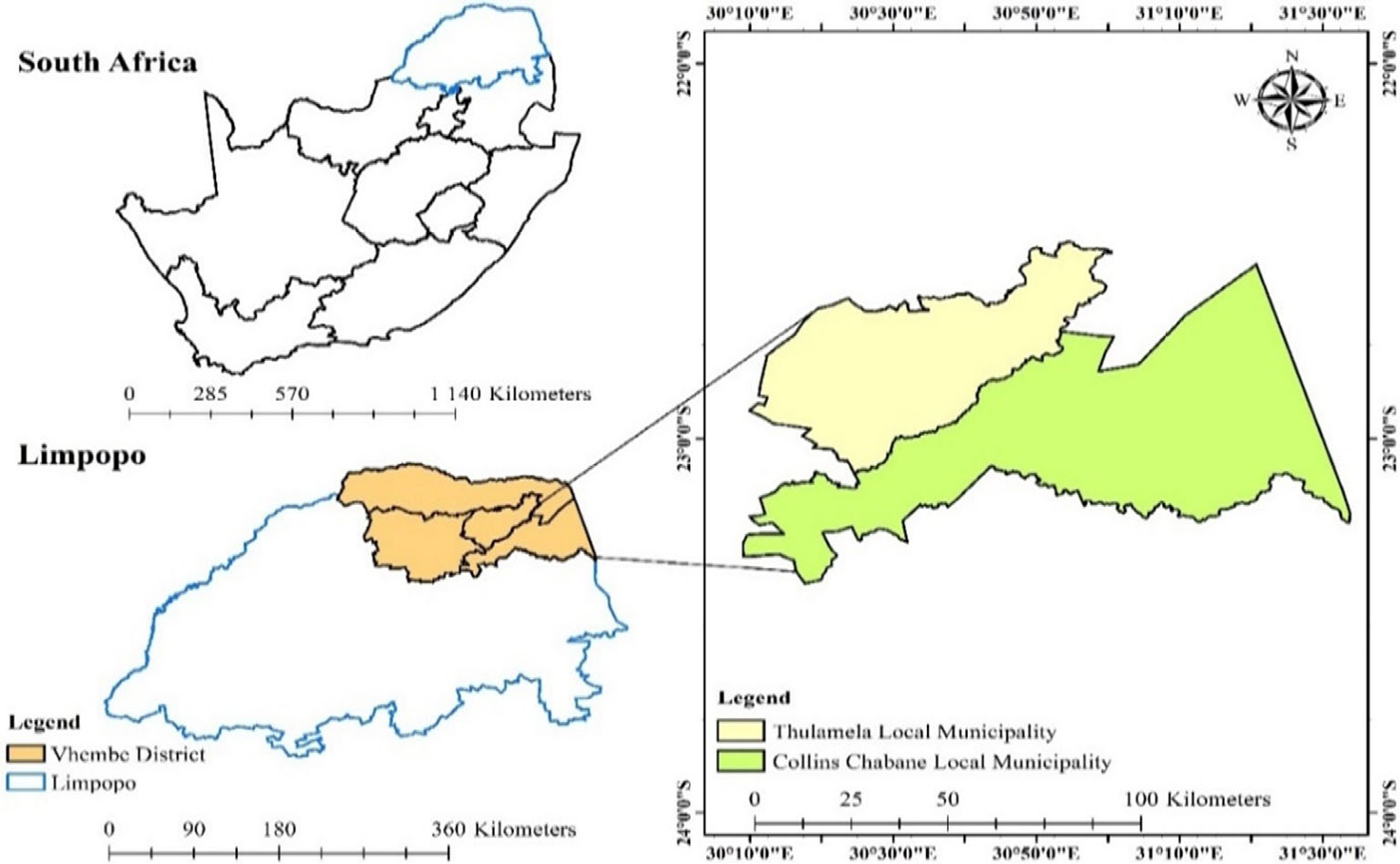
Fig. 1.
Study site, Vhembe District, Limpopo Province
Source: own elaboration, 2022.
Data collection
Data were collected from March to August 2022 using a structured questionnaire administered to a stratified random sample of 319 smallholder farmers. A pre-tested questionnaire was the primary data collection tool, administered through face-to-face interviews by trained enumerators. The questionnaire was translated into the local language spoken by the farmers to ensure comprehension and accuracy. Before data collection, a stratified random sampling approach was applied to categorize farmers based on their municipal affiliation within the Vhembe District. The population was divided into two sub-groups, with 176 farmers from Collins Chabane Municipality and 404 from Thulamela Municipality.
The sample size determination for the study was computed based on the formula:
where:n – is the desired sample size;
N – is the total target population;
e – the degree of accuracy required, normally set at 0.05 (5% of acceptable sampling error) (Kothari, 2004; Asfaw et al., 2017).
Based on this calculation, 319 smallholder farmers were randomly selected, with 121 participants from Collins Chabane Municipality and 198 from Thulamela Municipality.
Methods of analysis
The Statistical Package for Social Scientists (SPSS) version 26 and stataSE 17 software were used to collect and analyze the data, respectively. To analyze the impact of privatized agricultural extension services on smallholder farmers’ performance, this study employed a combination of descriptive statistics and econometric modeling, specifically a Multiple Linear Regression (MLR) model.
Descriptive Statistical Analysis
Mean comparisons (T-tests) were used to evaluate income differences between farmers using public vs. privatized extension services. One-way ANOVA assessed whether significant differences exist in farm income across different levels of household size, education, and market access.
Justification for Using the Multiple Linear Regression (MLR) Model
This study employs a Multiple Linear Regression (MLR) model to assess the impact of privatized agricultural extension services on smallholder farmers’ performance. MLR is widely used in agricultural economics to analyze how multiple factors such as extension services, credit access, market access, gender, and education affect farm income (Gujarati and Porter, 2009; Feder et al., 2010). It estimates marginal effects, providing insights into the economic benefits of privatized extension (Davis et al., 2010). The model accommodates both continuous and categorical variables, controls for external shocks, and directly tests whether privatized extension improves farm income more than public services (Aker, 2011)
MLR Model Specification
The regression equation used in this study is as follows:
Where:Yi – net annual income from farming (dependent variable, measured in South African Rand)
β0 – intercept
X1, X2, …, Xn – independent variables representing farmer characteristics, market factors, and extension service types
βi = estimated parameters indicating the effect of each independent variable on farm income
μi = disturbance term capturing unobserved factors
Definition of variables
Table 1.
Description of variables used in the multiple linear regression model
| Dependent variable | Description | Unit of measurement |
|---|---|---|
| 1 | 2 | 3 |
| Annual income from farmers’ production | Total income earned by the household head | Rand (R) |
| Independent variables | Description and unit of measurement | Expected sign |
| Age | Categorical: level of household head age in years | + |
| Gender | Binary: 1 if the head is male and 0 if female | +/− |
| Marital status | Categorical: marital status level of household head | + |
| Education level | Categorical: educational level of the household head | + |
| Household size | Categorical: level of family size in numbers | − |
| Land size | Categorical: level of land size in hectares | + |
| Credit access | Binary: 1 if access credit and 0 otherwise | + |
| Market access | Binary: 1 if access market and 0 otherwise | + |
| Access to public extension | Binary: 1 if has access to public extension service and 0 otherwise | + |
| Access to privatised extension | Binary: 1 if has access to privatized extension service and 0 otherwise | + |
| Farming experience | Categorical: level of farming experience of the head in years | + |
| Extension feedback | Binary: 1 Extension feedback length too long and 0 otherwise | _ |
| Climate adaptation practices | Categorical: Climate adaptation practices | + |
| Farm input | Binary: 1 has access and 0 has no access | + |
| Market price information access | Binary: 1 has access and 0 has no access | + |
| Membership in farmer cooperatives | Binary: 1 member and 0 non-member | + |
RESULTS
Socioeconomic Characteristics of Smallholder Farmers
The study surveyed 319 smallholder farmers from Collins Chabane and Thulamela Municipalities. The socioeconomic profiles of the 319 smallholder farmers who participated in the study are shown in Table 2.
The sample consisted of 59.9% female and 40.1% male farmers, indicating a significant representation of women in smallholder farming. The majority of the respondents were aged 46–55 years (27.6%), followed by those aged 66 years and older (24.5%), suggesting that smallholder farming is predominantly practiced by middle-aged and elderly individuals. Regarding education, 45.8% had completed secondary school, 23.8% had primary education, 19.4% had tertiary education, while 11% had never attended school. This suggests that a substantial proportion of smallholder farmers have at least basic literacy, which may influence their ability to adopt new agricultural technologies and practices. Additionally, 56.5% of households had between 1 to 5 members, while 41.8% had 6 to 10 members, highlighting that family labor remains a crucial component of smallholder farming in the study area.
Table 2.
Socio-economic demographic profiles of smallholder farmers
| Household characteristics | Study area | Total (n = 319) | Percentage (%) | ||
|---|---|---|---|---|---|
| Collins Chabane municipality | Thulamela municipality | ||||
| 1 | 2 | 3 | 4 | 5 | |
| Gender | Male | 64 | 64 | 128 | 40 |
| Female | 134 | 57 | 191 | 60 | |
| Age | <25 | 8 | 4 | 12 | 4 |
| 26–35 | 20 | 15 | 35 | 11 | |
| 36–45 | 36 | 18 | 54 | 17 | |
| 46–55 | 51 | 37 | 88 | 28 | |
| 56–65 | 40 | 12 | 52 | 16 | |
| 66> | 43 | 35 | 78 | 25 | |
| Marital status | Single | 60 | 30 | 90 | 28 |
| Married | 88 | 61 | 149 | 47 | |
| Divorced | 8 | 7 | 15 | 5 | |
| Widowed | 42 | 23 | 65 | 20 | |
| Educational level | Never attended | 21 | 14 | 35 | 11 |
| Primary school | 40 | 36 | 76 | 2 | |
| Secondary school | 100 | 46 | 146 | 46 | |
| Tertiary | 37 | 25 | 62 | 19 | |
| Household size | 1–5 | 115 | 65 | 180 | 57 |
| 6–0 | 81 | 52 | 133 | 42 | |
| 11–15 | 2 | 4 | 6 | 2 | |
Impact of Extension Services on Smallholder Farmers’ Performance
The t-test analysis assessed the relationship between key determinants and annual farm income. The results of the t-test analysis of the determinants of smallholder farmers’ performance are shown in Table 3.
Table 3.
T-test results for Determinants of smallholder farmers’ performance in the study area
| Variable (mean) | Measure | Annual income from farmers’ production | n | p-value |
|---|---|---|---|---|
| 1 | 2 | 3 | 4 | 5 |
| Access to public extension services | No | 11588.13 | 69 | *** |
| Yes | 19417.04 | 250 | ||
| Access to privatised extension services | No | 16906.81 | 34 | ** |
| Yes | 24570.59 | 285 | ||
| Gender | Male | 13749.13 | 128 | *** |
| Female | 20387.18 | 191 | ||
| Extension feedback length | Too long | 12610.02 | 190 | *** |
| Not too long | 21195.52 | 129 | ||
| Market access | No | 14216.49 | 211 | *** |
| Yes | 19518.77 | 108 | ||
| Credit access | No | 17498.93 | 232 | ns |
| Yes | 17807.91 | 87 | ||
| Farm input | Has access | 4178.56 | 279 | ** |
| No access | 1753.49 | 40 | ||
| Market price information access | Has access | 2222.56 | 279 | ** |
| No access | 2347.88 | 40 | ||
| Membership in farmer cooperatives | Member | 3567.02 | 280 | ** |
| Non-member | 1780.56 | 39 |
The results reveal that farmers who had access to privatized extension services earned significantly higher annual incomes (R24,570.59) compared to those relying solely on public extension services (R19,417.04) (p < 0.05). Timely extension feedback significantly influenced income levels, with farmers who received prompt advisory services earning R21,195.52, while those experiencing delays earned R12,610.02 (p < 0.01). Market access played a crucial role in improving income, with farmers having direct market linkages earning R19,518.77, compared to R14,216.49 for those lacking market access (p < 0.01). Membership in farmer cooperatives was associated with significantly higher farm incomes, suggesting that collective action strengthens farmers’ bargaining power and market participation (p < 0.05).
The one-way ANOVA results highlighted additional socioeconomic factors influencing farm performance, as shown in Table 4.
Table 4.
Parametric One-way ANOVA results between smallholder farmers’ performance and socioeconomic parameters
| Variable (Mean) | Measure | Annual income from farmers’ production | n | p-value |
|---|---|---|---|---|
| 1 | 2 | 3 | 4 | 5 |
| Age | <25 | 12175.00 | 12 | ns |
| 26–35 | 15256.74 | 35 | ||
| 36–45 | 16571.76 | 54 | ||
| 46–55 | 21631.75 | 88 | ||
| 56–65 | 15978.58 | 52 | ||
| 66> | 17235.90 | 78 | ||
| Marital status | Single | 19489.51 | 90 | |
| Married | 16543.91 | 149 | ns | |
| Divorced | 15650.67 | 15 | ||
| Widowed | 18461.26 | 65 | ||
| Never attended | 18475.03 | |||
| Educational level | Primary school | 15880.62 | 35 | |
| Secondary school | 19031.26 | 76 | ns | |
| Tertiary | 16479.42 | 146 | ||
| Household size | 1–5 | 20745.60 | 180 | *** |
| 6–10 | 29650.00 | 133 | ||
| 11–15 | 15678.57 | 6 | ||
| Farm size (hectares) | <1 hectare | 17778.58 | 57 | |
| 1 hectare | 15962.55 | 146 | ns | |
| 1–5 hectare | 20439.51 | 102 | ||
| 5> | 16078.57 | 14 | ||
| Farming experience | <10 | 20239.59 | 85 | |
| 11–20 | 15089.53 | 99 | ns | |
| 21–30 | 14876.71 | 66 | ||
| 31> | 21126.81 | 69 | ||
| Climate adaptation practices | No adaptation | 1556.34 | 55 | |
| Moderate adaptation | 1734.37 | 115 | ** | |
| High adaptation | 1876.46 | 149 |
The results revealed that household size was significantly associated with income levels (p < 0.01), with larger households (6–10 members) earning more income than smaller households. Transparency and accountability in extension services also played a role, as farmers who disagreed with claims of poor transparency had higher annual incomes (R26,946.09) compared to those who strongly agreed (R13,777.84) (p < 0.01). Climate adaptation practices were significant (p < 0.05), indicating that farmers who adopted climate-smart techniques registered higher farm incomes.
Impact of Privatized Agricultural Extension Services on Smallholder Farmers’ Performance
The results of the multiple linear regression analysis of the impact of privatized agricultural extension services on smallholder farmers’ performance are presented in Table 5.
Privatized extension services positively influenced farm income (p < 0.05), with farmers earning R7,663.78 more than those relying on public extension. Public extension access had a negative impact, reducing farm income by R3,320.07, and highlighting inefficiencies in the public sector (p < 0.05). Timely extension feedback significantly increased earnings (p < 0.01), demonstrating the importance of real-time agricultural advisory support. Farm input access and market price information access positively affected income, showing that farmers with reliable access to inputs and price intelligence had better financial outcomes (p < 0.05). Membership of farmer cooperatives increased earnings by R2,703.57, reinforcing the benefits of collective action (p < 0.10). Climate adaptation practices also had a significant impact, indicating that resilient farming strategies contribute to higher productivity and profitability (p < 0.05).
Table 5.
Parameter estimates of the multiple linear regression on smallholder farmers’ performance
| Independent variables | Coefficients | Robust std. errors | p > z | Marginal effects |
|---|---|---|---|---|
| 1 | 2 | 3 | 4 | 5 |
| Age | 798.5133 | 1415.572 | 0.573 | 1415.572 |
| Gender | 5114.013 | 2718.233 | 0.061 | 2718.233* |
| Marital status | −616.379 | 1414.943 | 0.663 | –1414.943 |
| Education level | 488.629 | 1672.531 | 0.770 | 1672.531 |
| Household size | 379.4328 | 546.6539 | 0.488 | 546.6539 |
| Land size | 895.504 | 1630.685 | 0.583 | 1630.685 |
| Credit access | –9052.274 | 4055.356 | 0.026 | –4055.356** |
| Market access | –4014.01 | 3853.336 | 0.298 | 3853.336 |
| Access to public extension | –7561.935 | 3320.066 | 0.023 | –3320.066* |
| Access to privatised extension | 24570.588 | 4185.132 | 0.033 | 7663.778** |
| Farming experience | –908.9099 | 1656.341 | 0.584 | –1656.341 |
| Extension feedback | 12641.12 | 3090.467 | 0.000 | 3090.467*** |
| Farm input | 3223.261 | 1518.573 | 0.035 | 1518.573** |
| Market price information access | 5766.113 | 3562.412 | 0.014 | 1970.345** |
| Membership in farmer cooperatives | 4689.345 | 3677.534 | 0.081 | 2703.57* |
| Climate adaptation practices | 3274.042 | 2761.336 | 0.071 | 1782.73** |
| Constant | 17426.89 | 8839.241 | 0.050 | |
| Number of observations = 319, R2 = 0.706, P > F = 0.000. |
DISCUSSION
The findings confirm that privatized extension services outperform public extension services in improving smallholder farmers’ productivity and income. The positive effect of private extension services aligns with previous studies, which suggests that market-driven advisory models provide more efficient, specialized, and demand-driven services (Rivera and Sulaiman, 2009; Davis and Heemskerk, 2012). The findings indicate that privatized agricultural extension services significantly improve smallholder farmers’ income levels, aligning with prior research that suggests market-driven extension models offer more tailored, efficient, and responsive services (Rivera and Sulaiman, 2009; Davis and Heemskerk, 2012).
The negative impact of public extension services on income corroborates studies that highlight challenges such as inadequate funding, poor service delivery, and bureaucratic inefficiencies in public agricultural extension systems (Koch and Terblanche, 2013; Terblanche, 2018). The significant positive impact of extension feedback timeliness (p < 0.01) suggests that real-time access to agricultural information plays a critical role in farm decision-making. This aligns with studies in Kenya and Ethiopia, where digital extension services and mobile-based advisory systems have enhanced farmers’ productivity and market integration (Muyanga and Jayne, 2008; Ragasa et al., 2016).
Moreover, the negative correlation between transparency concerns and farm income reinforces the importance of accountability mechanisms in privatized extension services. The results confirm that market participation significantly boosts smallholder farmers’ earnings, supporting the existing literature on the benefits of market-oriented extension models that integrate farmers into agribusiness value chains (Feder et al., 2010). Furthermore, the positive impact of cooperative membership suggests that collective action enables farmers to secure better prices, access bulk inputs, and improve bargaining power, which is consistent with the findings of previous agribusiness studies (Babu and Zhou, 2018). The significant relationship between climate adaptation practices and income (p < 0.05) highlights the growing importance of climate-smart agriculture in improving farm resilience and profitability. Similar trends have been observed in other developing countries, where drought-resistant crop varieties, conservation agriculture, and irrigation efficiency programs have led to increased farm productivity (Davis et al., 2010). These findings emphasize the need for privatized extension services to integrate climate risk management into their advisory frameworks.
CONCLUSIONS AND RECOMMENDATIONS
This study reveals critical insights into the effects of privatizing agricultural extension services on smallholder farmers’ performance in the Thulamela and Collins Chabane Municipalities. The results demonstrate that privatized extension services significantly enhance smallholder farm productivity and income. Farmers utilizing privatized services earned substantially higher incomes (R24,570.59 annually) than those dependent solely on public services (R19,417.04 annually). Key determinants positively influencing farmer performance include timely extension feedback, reliable access to farm inputs, accurate market price information, cooperative membership, and adopting climate-smart agricultural practices. However, privatization also introduces notable challenges, especially concerning accessibility and affordability for resource-poor smallholders, potentially widening existing socioeconomic disparities. The analysis indicates that the public agricultural extension service negatively impacts farmers’ incomes due to inefficiencies and delays, highlighting the urgency for reform. These findings confirm the need for a comprehensive policy framework to integrate private and public extension services effectively. A balanced, inclusive approach is essential to ensure equitable and widespread access to high-quality agricultural advisory services, thereby enhancing productivity, resilience, and sustainable development among smallholder farmers.
Based on the findings of this study, several targeted recommendations are presented to enhance smallholder farmers’ productivity and resilience through improved extension service delivery. Farmers should actively participate in cooperative organizations. Membership in cooperatives significantly increases bargaining power, market opportunities, and access to affordable inputs. Moreover, cooperatives enable smallholders to share knowledge, jointly invest in the necessary agricultural infrastructure, and better manage market fluctuations. It is also recommended that farmers proactively adopt climate-smart farming practices, including drought-tolerant crop varieties, conservation agriculture methods, and efficient irrigation techniques. These practices are crucial for increasing farm resilience, productivity, and profitability in the face of climate variability.
Agricultural consultants, particularly those operating within privatized extension services, must address affordability and inclusivity challenges. Providers should introduce flexible pricing strategies or innovative financial arrangements, such as cost-sharing, installment payments, or subsidized services targeting resource-poor smallholders. Additionally, consultants should prioritize timely and responsive communication by leveraging digital technologies and mobile platforms to provide real-time agricultural advice, market information, and ongoing technical support.