
INTRODUCTION
Household welfare is inherently vulnerable to both idiosyncratic and covariate shocks (Temesgen et al., 2022; Pradhan and Mukherjee, 2018). In some cases, extremely vulnerable households may be unable to recover from the effects of such shocks, leaving them exposed to chronic welfare losses (Mahmud and Riley, 2021). The literature identifies certain socioeconomic drivers of vulnerability (Serván-Mori et al., 2023). However, the extent to which idiosyncratic shocks impact households during significant global events such as the COVID-19 pandemic remains underexplored. This gap in research is particularly critical for fragile economies like Mozambique, which have faced multiple economic crises and political instability in recent years.
Research in this area is crucial for influencing government policies aimed at reducing welfare losses caused by idiosyncratic shocks. Such studies could also promote a more comprehensive understanding of the degree of expected vulnerability to income shocks during national crises.
Given the impacts of COVID-19 on various economic development indicators (Dhar et al., 2022), understanding how household income shocks translate into welfare deprivation is crucial for protecting vulnerable households from catastrophic expenses and long-term welfare losses. This is particularly important in Mozambique, where addressing poverty and vulnerability are central policy objectives in the pursuit of economic development.
Mozambique recorded a poverty incidence of 80% in 1990, making it one of the poorest countries globally (Santos and Salvucci, 2016). While poverty declined from 69.70% in 1996/1997 to 46.1% in 2014/2015, the absolute number of people living in poverty remained largely unchanged due to rapid population growth over the same period (Daniel, 2020). The poverty situation worsened in 2021, with international poverty incidence (defined as living on less than $2.15 per person per day) rising to 76.1%, before declining slightly to 75.6% in 2022 (World Bank, undated). Poverty reduction stagnated between 2002/2003 and 2008/2009, and while steady economic growth from 2008/09 to 2014/2015 led to a significant reduction in poverty (Santos and Salvucci, 2016), the impact on the most vulnerable was limited. Our findings show that social assistance programmes, despite being offered during the pandemic, failed to improve food security for those most in need.
This context underscores the devastating consequences income shocks can have on Mozambicans, particularly in the wake of the COVID-19 pandemic. During the pandemic, many households were highly vulnerable to idiosyncratic shocks, including income and job losses due to economic lockdowns (Dhar et al., 2022). Moreover, the economic impact of COVID-19 on the Mozambican economy was exacerbated by pre-pandemic environmental disasters such as floods, cyclones, and droughts (Thow et al., 2018; Salvucci and Santos, 2020; Brakenridge, 2016). The El Niño-Southern Oscillation (ENSO) phenomenon has been implicated in many of these disasters (Matyas, 2015).
Provinces in northern Mozambique are particularly vulnerable to transient poverty due to their geographic susceptibility to flooding (Groover et al., 2015). For example, the 2015 flood disaster in the central-northern region resulted in an 11% reduction in consumption expenditures for affected households (Salvucci and Santos, 2020).
Moreover, the Mozambican government faced significant constraints in addressing the economic impacts of the COVID-19 pandemic due to inherent structural fragility, the prevalence of high poverty rates (Santos and Salvucci, 2016), the growing problem of hunger and nutritional insecurity, low foreign exchange earnings, low economic confidence among development partners, high hidden debt burdens, poor governance, political instability, and insurgencies, among others (Presidência da República, 2020). As in other African countries, the impacts of the pandemic were manifested in the form of job losses, a reduction in sales by private businesses, and a decrease in government revenues (Nuvunga et al., 2021). It is also important to note that the country experienced four viral infection spikes: September–December (2020), January–March (2021), June–September (2021), and December 2021–January 2022 (Martínez-Martínez et al., 2023; Ismael et al., 2023).
One of the direct measures taken by the Mozambican government to mitigate the impacts of the COVID-19 pandemic was the reinvigoration of some existing social protection programmes (Nuvunga et al., 2021). Specifically, the Ministry of Economy and Finance operates a compulsory contributory social security programme through the National Institute of Social Security (INPS). A similar programme is being implemented by the Ministry of Labour, Employment and Social Security. The non-contributory Basic Social Security Programme aims to assist vulnerable and poor households. In addition, the Basic Social Subsidy Programme (PSSB) and Productive Social Action Programme (PASP) provide cash transfers, while the Direct Social Support Programme (PASD) provides in-kind transfers, food vouchers, and service payments (Nuvunga et al., 2021).
Although some research has been conducted on the determinants of food insecurity globally, very little emphasis has been placed on the impacts of income shocks. In previous studies, Obayelu (2012) demonstrated that food security was influenced by factors such as marital status, gender of household heads, household size, level of education, and social capital endowment, applying the ordered logit model. Using logistic regression, Gebre (2012) found that household size, age, education, credit access, asset possession and employment status influenced the probability of being food insecure. In Mexico, Magaña-Lemus et al. (2016) found that food insecurity was significantly influenced by age, education, marital status, disability, rural residence and low-income brackets. Mustapha et al. (2016) found that food insecurity increased with age, land size, rural residence, and credit utilisation, using the ordered probit regression model. Ibrahim et al. (2016) found that moderate and severe food insecurity statuses were influenced by the number of income sources and the dependency ratio, using the ordered logit model. Samim et al. (2021) found that education, income, group membership, dependency ratio, and exposure to flood and war significantly influenced food insecurity, using the ordered probit regression model. Kolog et al. (2023) also found that education status, farm size, household size, access to good roads, membership in cooperative societies, access to credit, access to extension services and engagement in paid jobs significantly influenced food security, using the Household Food Insecurity Access Scale (HFIAS).
Oyekale and Oyekale (2021) employed the random-effects ordered probit regression model and found that during the COVID-19 pandemic, food insecurity decreased among individuals not at risk of illness from COVID-19 or income loss, while social assistance exacerbated it. Other variables negatively affecting food insecurity included household size, age, male-headed households, and tertiary education. Akter and Basher (2014) observed that food insecurity worsened in rural Bangladesh due to food price inflation and other adverse income shocks. They reported that while the long-term impacts of welfare shocks were felt by all, the poor were disproportionately affected in the short term. Leete and Bania (2010) found that both income levels and negative shocks influenced the likelihood of food insecurity. Similarly, Vu et al. (2022) concluded that a 10% decline in income resulted in a 3.5% increase in food insecurity.
This study contributes to existing knowledge by answering a fundamental research question: Did shock exposure affect food insecurity during the COVID-19 pandemic in Mozambique? Providing an answer to this question will enhance our understanding of the responsiveness and effectiveness of social assistance programmes in reducing the impact of shock exposure and food insecurity among Mozambicans. In the remaining sections of the paper, the methods, results, discussion, and conclusion are presented.
MATERIALS AND METHODS
The data
This study utilised the data from the second and third waves of the Data in Emergencies Monitoring (DIEM) household survey, which were collected by the Food and Agriculture Organization (FAO) in 2021 and 2022, respectively. We obtained conditional approval and authorisation to use the data through an online application. The data are representative of 10 out of the 11 provinces in Mozambique. A stratified sampling method was used to select 2,206 respondents in the second wave and 1,769 respondents in the third wave. It is important to note that these two waves were not panel data. Moreover, the second wave was conducted between 26 August and 6 October 2021, while the third wave took place between 22 September and 31 October 2022. In the second wave, a total of 197 to 252 households were successfully interviewed in each province, while in the third wave, 150 to 260 households were successfully interviewed. The administration of the survey followed conventional ethical guidelines, ensuring voluntary participation, with only adult members of the households being interviewed. The data were collected using the Computer Assisted Telephone Interview (CATI) method (FAO, 2022a; 2022b). Since the data were not in panel form, they were pooled for analysis.
The estimated model
The endogenous ordered probit regression was used for data analysis. This model is applicable when the dependent variable is ordinal in nature, but some of the independent variables are suspected to exhibit some endogeneity. The dependent variable is the food insecurity experience indicator, which was computed based on the procedures of FAO (undated). The questionnaire used for data collection across the two waves explored various forms of hunger experiences through eleven overlapping questions. These questions were divided into eight categories for the reclassification of households into four classes of food insecurity experience scales (FIES). The FIES classes are as follows:
Food secure, coded as 1, for those who never answered “yes” to any of the questions.
Mildly food insecure, coded as 2, for those who worried about having enough food, were unable to eat healthy food, or ate fewer types of food.
Moderately food insecure, coded as 3 for those who responded “yes” to skipping meals or eating smaller quantities.
Severely food insecure, coded as 4 for those who answered “yes” to running out of food, being hungry but not eating, or going the entire day without food.
The estimated model can be specified as:
The maximum likelihood function of the model is stated as:
The estimated models can be simplified as:
Where: Yi – is the dependent variable, coded as 1 for food secure, 2 for mildly food insecure, 3 for moderately food insecure, and 4 for severely food insecure; I – denotes the household numbers in the pooled wave 2 and wave 3 datasets; Xi – denotes a vector of explanatory variables for Yi, Zi and Mi. Additionally, Zi and Mi – are the endogenous explanatory variables with Zi being the idiosyncratic shock exposure (coded as 1 for “yes” and 0 otherwise) and Mi representing the household’s income (in MZN). Instrumental variables were selected to estimate the endogenous regressors, with the major condition being that they should be highly correlated with the endogenous regressors (Zi or Mi, but not correlated with the dependent variable ().For the two endogenous regressors, a variable that captures some associated problems of COVID-19 was generated using Principal Component Analysis (PCA). The questionnaire investigated various COVID-19-related problems that affected each of the households. These variables were coded as 1 for those who responded “yes” and 0 otherwise. The questions examined transportation restrictions, market restrictions, border closures, lockdowns, gathering restrictions and other business process restrictions that impacted the households. The composite indicator of the COVID problem (CVD) was generated in STATA 18, after executing the conventional command for Principal Component Analysis.
The other instrumental variable, access to improved lighting (LIGHTi) (coded as 1 for improved sources and 0 otherwise) was used for households’ incomes (Mi). Moreover, idiosyncratic shock exposure was estimated with an instrumental variable for age groups (AGEi) which were coded as dummy variables, with < 35 years being the reference group. The other groups were coded as 1 = 35 < 49, 0 otherwise; 1 = 49 < 70, 0 otherwise; and 1 = ≥ 70, 0 otherwise.
The shock exposure endogenous model was estimated with probit regression, while the income model was estimated as continuous regression. Endogeneity of Zi or Mi within equation (3) will be confirmed by evaluating the level of statistical significance of the correlation coefficients between the error term in equation (3) and those in equations (4) and (5). Statistical significance (p < 0.05) will confirm the adequacy of the instrumental variables and presence of endogeneity.
RESULTS AND DISCUSSION
Respondents’ demographic and housing characteristics
Table 1 presents the distribution of the respondents’ demographic and housing characteristics. It indicates that the average income was MZN 22,277.3. The largest proportion of respondents (12.45%) resided in Maputo province, while the smallest proportion (8.48%) was from Tete province. A majority of respondents (79.37%) had attained formal education, and most households (75.97%) were headed by males.
Table 1.
Distribution of respondents’ selected demographic and housing variables
| Variables | Mean | Std. dev. | Min | Max |
|---|---|---|---|---|
| Total income (Mozambican metrical) | 22 277.30 | 34 274.52 | 0 | 465 998.3 |
| Provinces | ||||
| Cabo Delgado | 0.0898 | 0.2859 | 0 | 1 |
| Gaza | 0.1082 | 0.3106 | 0 | 1 |
| Inhambane | 0.0994 | 0.2992 | 0 | 1 |
| Manica | 0.0989 | 0.2985 | 0 | 1 |
| Maputo | 0.1245 | 0.3302 | 0 | 1 |
| Nampula | 0.1089 | 0.3116 | 0 | 1 |
| Niassa | 0.0928 | 0.2902 | 0 | 1 |
| Sofala | 0.0941 | 0.2920 | 0 | 1 |
| Tete | 0.0848 | 0.2786 | 0 | 1 |
| Zambezia | 0.0986 | 0.2982 | 0 | 1 |
| Education dummy | ||||
| Formal education | 0.7937 | 0.4047 | 0 | 1 |
| Gender of households’ heads | ||||
| Household gender | 0.7597 | 0.4273 | 0 | 1 |
| Age group (years) | ||||
| < 35 | 0.6367 | 0.4810 | 0 | 1 |
| 35 < 49 | 0.2443 | 0.4297 | 0 | 1 |
| 49 < 70 | 0.1089 | 0.3116 | 0 | 1 |
| ≥ 70 | 0.0101 | 0.0998 | 0 | 1 |
| Housing characteristics | ||||
| Improved toilet | 0.6481 | 0.4776 | 0 | 1 |
| Improved water | 0.9059 | 0.2920 | 0 | 1 |
| Improved electricity | 0.8797 | 0.3253 | 0 | 1 |
Water from improved sources was used by 90.59% of the households, and 64.81% of households had access to improved toilets. A majority of the respondents (63.67%) were under 35 years of age, while 24.42% were 35–49 years.
Respondents’ production activities, social assistance, and coping methods
Table 2 presents the distribution of respondents’ production activities, social assistance received, and coping methods adopted during the COVID-19 pandemic. It shows that 33.84% of respondents did not engage in any form of farming, while 35.95% were involved in crop farming. Livestock farming was the primary activity for 12.13% of respondents, while 18.09% engaged in a combination of crop and livestock farming. Food assistance was received by only 2.75% of households during the pandemic, and 10.06% resorted to begging for food.
Table 2.
Respondents’ production activities, social assistance, and coping methods during the COVID-19 pandemic
| Variables | Mean | Std Dev. | Min | Max |
|---|---|---|---|---|
| Agricultural Activities | ||||
| None | 0.3384 | 0.4732 | 0 | 1 |
| Both Crop and Livestock | 0.1809 | 0.3850 | 0 | 1 |
| Crop | 0.3595 | 0.4799 | 0 | 1 |
| Livestock | 0.1213 | 0.3265 | 0 | 1 |
| Social assistances received | ||||
| Food | 0.0272 | 0.1626 | 0 | 1 |
| Cash vouchers | 0.0045 | 0.0671 | 0 | 1 |
| Seeds | 0.0035 | 0.0592 | 0 | 1 |
| Extension services | 0.0030 | 0.0549 | 0 | 1 |
| Livestock feed | 0.0010 | 0.0317 | 0 | 1 |
| Other needs | 0.0206 | 0.1422 | 0 | 1 |
| Households’ coping method with food problems | ||||
| Begged food | 0.1006 | 0.3009 | 0 | 1 |
Idiosyncratic shock exposure and food insecurity experience
Figure 1 illustrates the distribution of respondents based on their exposure number to idiosyncratic shocks and their food insecurity status. The figure indicates that 48.02% were not exposed to any idiosyncratic shocks. Furthermore, 67.04% of food-secure households experienced no idiosyncratic shocks, compared to 51.26%, 49.54%, and 40.93% of households classified as mildly, moderately, and severely food insecure.
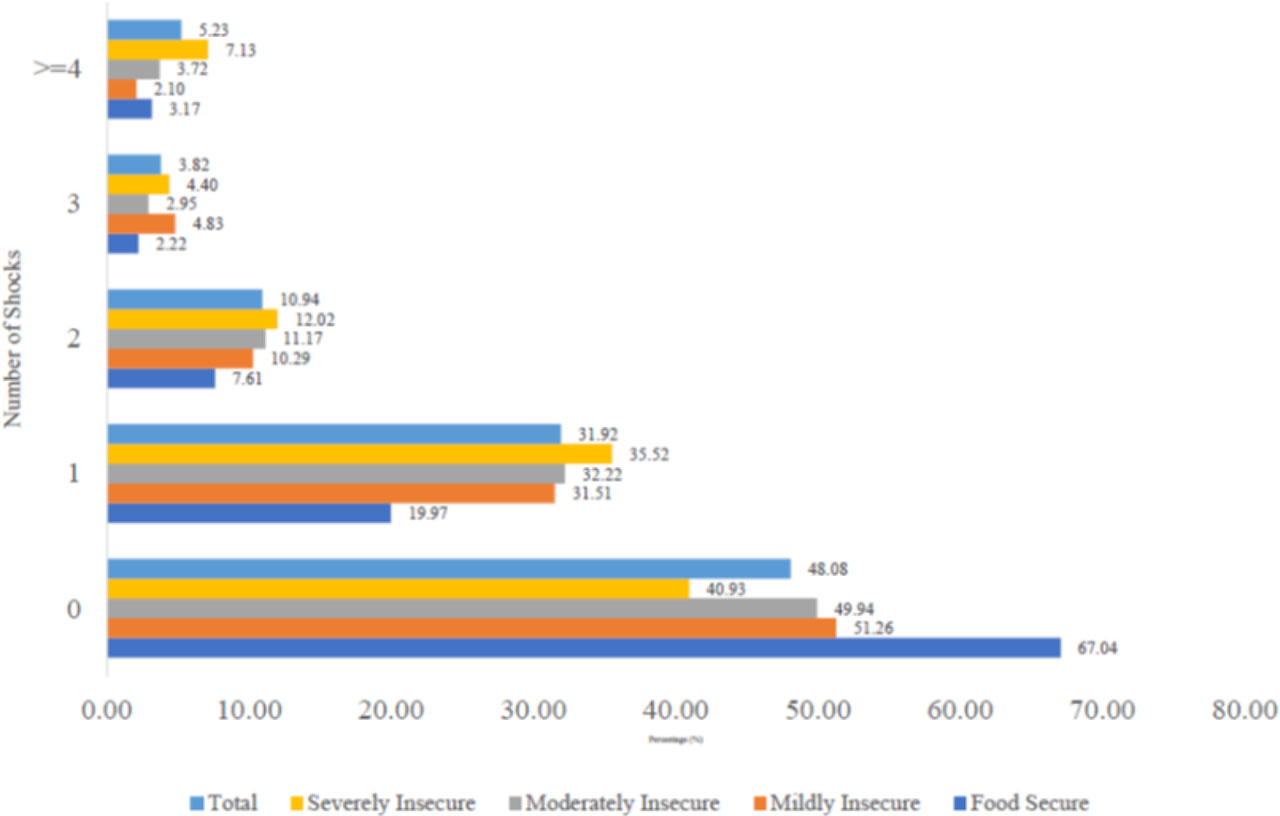
Fig. 1.
Distribution of respondents across the number of shocks and food insecurity status
Source: authors’ computations from DIEM (waves 2 and 3) data.
The figure further reveals that 19.97% of food-secure households experienced one idiosyncratic shock, 7.61% experienced two, and 2.22% faced three. Among mildly food-insecure households, the corresponding percentages were 31.51%, 10.29%, and 4.83%. For moderately food-insecure households, the figures were 49.94%, 32.22%, and 11.17%, respectively. Severely food-insecure households reported exposure rates of 35.52%, 12.02%, and 4.40%, respectively, for one, two and three shocks. It should also be noted that 7.13% of the severely food-insecure households were exposed to four or more idiosyncratic shocks.
Figure 2 shows the distribution of the respondents’ food insecurity status across the provinces. It reveals that Sofala, Nampula, and Cabo Delgado provinces had the highest proportion of respondents who were severely food-insecure, with 63.10%, 62.36% and 60.22%, respectively. Conversely, the provinces with the lowest proportions of respondents who were severely food-insecure were Niassa and Tete, with 39.57% and 43.32%, respectively. The provinces with the highest proportion of food-secure respondents were Tete, Niassa, and Inhambane, with 23.44%, 22.76% and 20.25%.
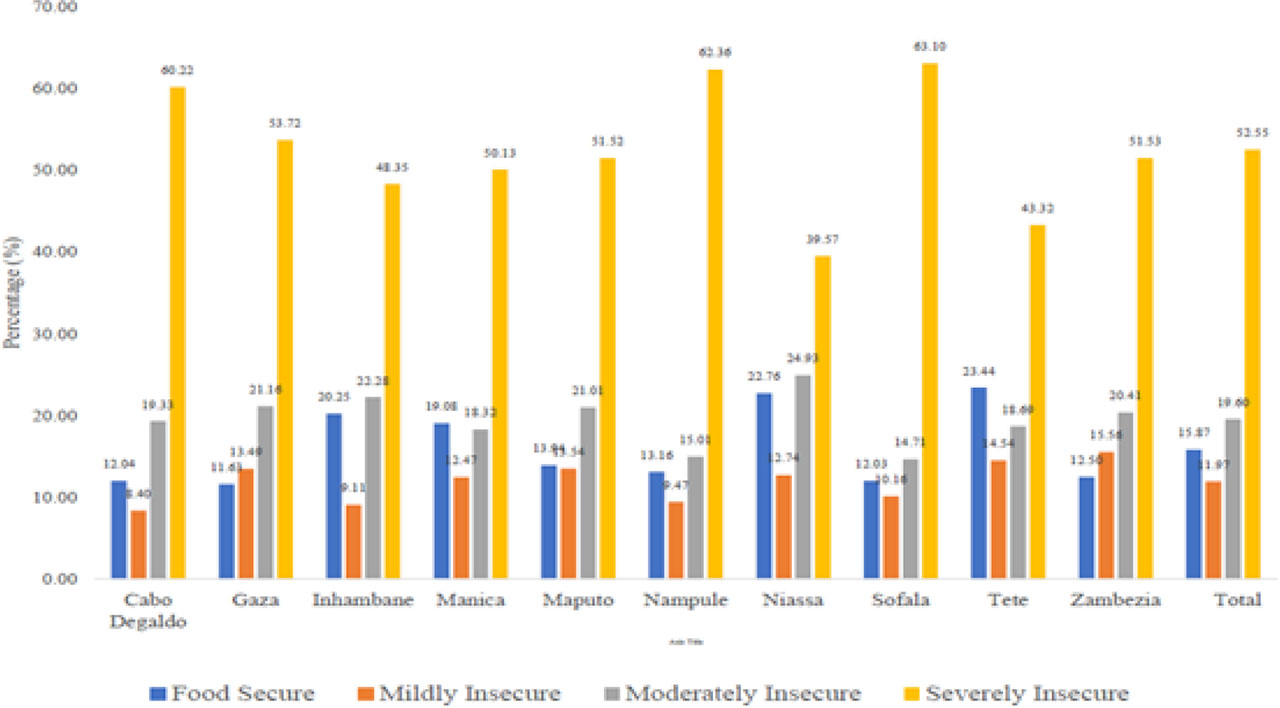
Fig. 2.
Food insecurity status across the Mozambican provinces
Source: authors’ computations from DIEM (waves 2 and 3) data.
Figure 3 shows the distribution of households’ food security status based on their primary sources of livelihood. It reveals that severe food insecurity was most prevalent among non-farming households (56.21%), followed by those engaged in crop farming (53.46%). Respondents involved in livestock farming had the highest proportion of food-secure households (20.95%), while those in crop farming had the lowest proportion of food-secure households (12.88%).
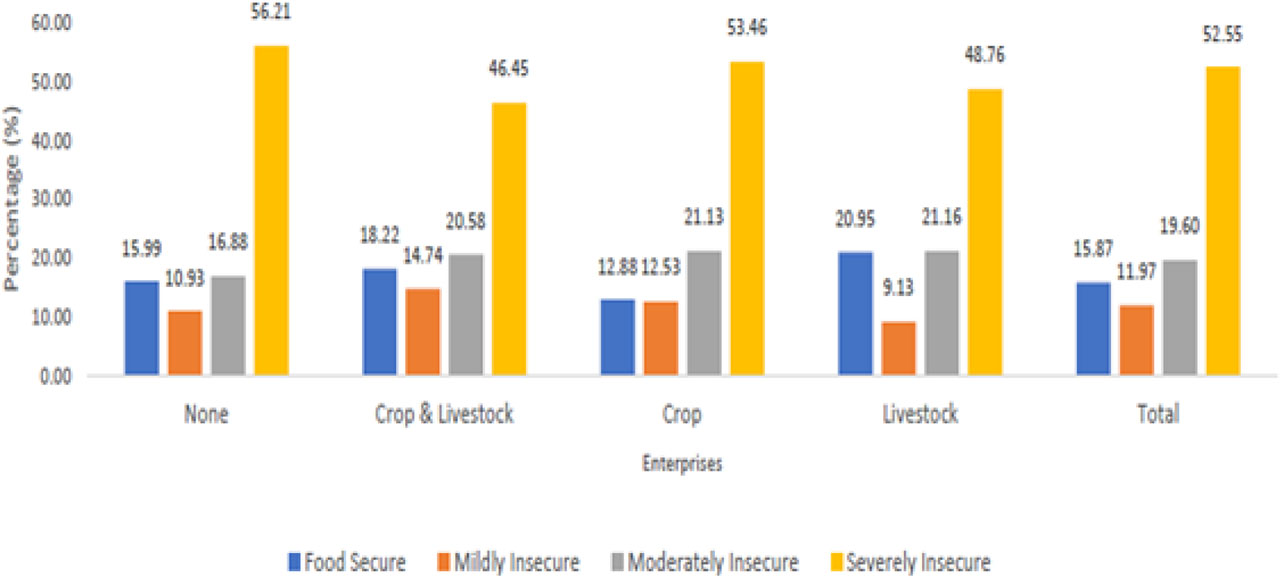
Fig. 3.
Distribution of households’ food security status across their main livelihood sources
Source: authors’ computations from DIEM (waves 2 and 3) data.
Endogenous ordered probit regression results
Table 3 presents the results of the endogenous ordered probit regression model. The model demonstrates a good fit to the data, as indicated by the statistical significance (p < 0.01) of the Wald Chi-Square statistic. The results also show that the error correlation coefficients are statistically significant (p < 0.01), suggesting that income and idiosyncratic shock exposure are endogenous. Thus, failing to address this endogeneity would lead to biased estimates of the parameters (Mustafa, 2024) and undermine their relevance for informing policy decisions. We offer a brief interpretation of the econometric results for each endogenous regressor (idiosyncratic shocks and income) as we analyse the determinants of food insecurity. Columns 1 and 2 display the determinants of idiosyncratic shocks, while columns 3 and 4 show the determinants of income. The determinants of food insecurity are presented in columns 5 and 6.
Table 3.
Determinants of Income, COVID-19 Problem and Food Insecurity
| Variables | Income shocks | Income | Food insecurity | |||
|---|---|---|---|---|---|---|
| coefficient | t stat | coefficient | t stat | coefficient | t stat | |
| Provinces (Cabo Delgado is reference) | ||||||
| Gaza | −0.1598 | −1.65* | −10310.63 | −4.19*** | −0.2990 | −3.36*** |
| Inhambane | −0.2108 | −2.19** | −4939.85 | −2.00** | −0.2875 | −3.32*** |
| Manica | −0.2435 | −2.53** | −2608.75 | −1.06 | −0.1586 | −1.85* |
| Maputo | −0.2741 | −2.95*** | −6766.97 | −2.85*** | −0.1083 | −1.26 |
| Nampule | −0.0321 | −0.34 | −4212.97 | −1.76* | −0.1039 | −1.25 |
| Niassa | −0.2360 | −2.40** | 6053.72 | 2.42** | −0.1294 | −1.08 |
| Sofala | −0.1204 | −1.24 | −7178.09 | −2.89*** | −0.1006 | −1.09 |
| Tete | −0.1565 | −1.57 | 2887.34 | 1.13 | −0.2317 | −2.07** |
| Zambezia | −0.0042 | −0.04 | −7592.77 | −3.08*** | −0.3379 | −4.07*** |
| Agric activities (none is the reference) | ||||||
| Crop and livestock | 0.1872 | 3.09*** | 8225.95 | 5.24*** | −0.1247 | −1.28 |
| Crop | 0.2380 | 4.74*** | −21.27 | −0.02 | −0.1695 | −3.47*** |
| Livestock | 0.2501 | 3.64*** | 2912.03 | 1.64* | −0.1592 | −2.15** |
| Social assistances | ||||||
| Food | 0.4789 | 3.46*** | 676.65 | 0.21 | −0.0483 | −0.41 |
| Cash vouchers | −0.0263 | −0.08 | 962.81 | 0.12 | −0.0108 | −0.04 |
| Seeds | 0.1072 | 0.31 | 3776.64 | 0.42 | −0.0972 | −0.33 |
| Extension services | −0.1871 | −0.48 | −4506.71 | −0.46 | 0.2879 | 0.87 |
| Livestock feed | −0.4909 | −0.64 | 13598.14 | 0.81 | −0.1460 | −0.26 |
| Others | 0.1496 | 1.01 | 7577.65 | 2.04** | 0.0046 | 0.03 |
| Third Wave | 0.0081 | 0.19 | −445.93 | −0.41 | −0.2001 | −4.10*** |
| Gender | −0.0698 | −1.43 | 5290.09 | 4.20*** | 0.0303 | 0.51 |
| Formal education | −0.0816 | −1.52 | 3580.52 | 2.61*** | 0.0309 | 0.56 |
| Begged for assistance | 0.2503 | 3.58*** | −9458.11 | −5.35*** | 0.4944 | 2.55** |
| Improved water | 0.0512 | 0.72 | 3352.10 | 1.82* | 0.0135 | 0.20 |
| Improved toilet | −0.1065 | −2.39** | 5897.56 | 5.05*** | −0.1251 | −1.37 |
| Shock exposure | 0.9750 | 7.28*** | ||||
| Total income | 0.0001 | −4.93*** | ||||
| Covid problem index | 0.1722 | 12.35*** | 1374.13 | 4.21*** | ||
| Improved light | 5559.19 | 3.33*** | ||||
| Age group (reference is < 35) | ||||||
| 35 < 49 | 0.1003 | 2.22** | ||||
| 49 < 70 | −0.0199 | −0.31 | ||||
| ≥ 70 | −0.0324 | −0.17 | ||||
| Constant | 0.1286 | 1.09 | 6574.52 | 2.03** | ||
| cut1 | −1.1423 | |||||
| cut2 | −0.8053 | |||||
| cut3 | −0.3742 | |||||
| var(e.tot_income) | 1090000000 | |||||
| corr(e.shock,e.efis) | −0.4877 | −5.99*** | ||||
| corr(e.tot_income,e.efis) | 0.5906 | 3.5*** | ||||
| corr(e.tot_income,e.shock) | −0.0739 | −3.59*** | ||||
The results revealed that compared to households from Cabo Delgado province, those from Inhambane, Manica, Maputo, and Niassa had a lower probability of being exposed to idiosyncratic shocks. In addition, relative to households from Cabo Delgado, respondents from Gaza, Inhambane, Maputo, Sofala, and Zambezia had significantly lower autonomous incomes (p < 0.05), amounting to MZN 10,310.68, MZN 4,939.85, MZN 6,766.97, MZN 7,178.09 and MZN 7,592.77 less, respectively. However, respondents from Niassa province had significantly higher autonomous incomes (p < 0.05) by MZN 6,053.73. Furthermore, in comparison to households from Cabo Delgado, respondents from Gaza, Inhambane, Tete and Zambezia were significantly more likely to be food-secure (p < 0.05).
Maputo city, which was not included in this survey due to its fully urbanised structure, is the wealthiest province in Mozambique (Baez Ramirez et al., 2018). However, the devastating impacts of COVID-19 affected many households in all provinces. It should be noted that the northern parts of Mozambique, especially Cabo Delgado, are among the poorest provinces due to prevailing political insurgencies and climatic shocks (Gomes and Schmidt, 2021; Maviza et al., 2024). This explains why provinces with significantly lower levels of food insecurity were located in southern and central Mozambique. Additionally, the economic impacts of COVID-19 on households in five northern and central provinces would have been compounded by the outbreak of measles (Mausse et al., 2022).
Households engaged in crop farming, livestock farming, or both had significantly higher probabilities (p < 0.01) of being exposed to idiosyncratic shocks, compared to non-farming households. Additionally, the income of households involved in crop and livestock activities was significantly higher (p < 0.01) by MZN 8,225.95. Similarly, relative to non-farming households, respondents engaged in crop and livestock enterprises had significantly lower levels of food insecurity (p < 0.05). Understanding the effect of livelihood sources on the COVID-19 problem indicator, income, and food insecurity is crucial for policy information. The results revealed that households involved in farming activities, regardless of the type of enterprise, were more affected by COVID-19. The impact of COVID-19 on farming could have been amplified by movement restrictions and other structural changes in economic activities. This finding contradicts the results of Salvucci and Tarp (2023), who found that the consumption levels of urban households were more affected by the pandemic.
Among the variables included to capture the social assistance, only the parameters for food assistance and other forms of assistance showed statistical significance (p < 0.05) in the estimated models for idiosyncratic shock exposure and income, respectively. These results indicate that individuals who received food assistance had a higher probability of being exposed to idiosyncratic shocks. This is expected, as COVID-19 assistance was generally targeted at the most vulnerable segments of the population (Tan et al., 2023). It is important to note that food assistance is a key component of initiatives aimed at addressing growing poverty and vulnerability in Mozambique (Foley, 2007; HelpAge International, 2022). However, respondents who received other forms of assistance had an average income that was MZN 7,577.65 higher. These forms of assistance may include foreign remittances from relatives abroad.
Furthermore, due to persistent economic challenges in Mozambique over the past few decades, international migration has increased, with South Africa being one of the primary destinations (Mercandalli et al., 2017; Brochmann, 1985). The parameters for begging for assistance in all the estimated models were statistically significant (p < 0.05). These results suggest that individuals who reported having begged for assistance had a higher probability of being exposed to idiosyncratic shocks. This is expected, as begging for assistance is closely linked to poverty and deprivation. People who resort to begging to survive an economic downturn are typically the most vulnerable segment of the population (Debnath and Saha, 2024). However, the extent of begging during the pandemic reflects the degree of marginalisation in society, with the serious implication that some households are unable to afford even basic social services (Gupta, 2013; 2020).
In the estimated models, the gender variable showed statistical significance (p < 0.01) in the income model. This result implies that male-headed households had an average income higher by MZN 5,290.09, compared to their female counterparts. This finding reflects the persistent gender inequality in access to financial and capital resources in Mozambique (Gotschi et al., 2009; Gotschi et al., 2008; Tvedten et al., 2009). Additionally, the time variable, captured by the data waves, showed that compared to wave two, food insecurity declined in wave three. This is expected due to the interventions and policies implemented between October 2021 and September 2022 to kickstart economic recovery and growth following the initial decline and job losses (Betho et al., 2021, 2022). Respondents with formal education had an average income significantly higher by MZN 3,580.52. This finding aligns with expectations, as formally educated households are likely better positioned to secure and retain jobs, even during the pandemic (Kundu et al., 2021). Additionally, many of these individuals may have been able to work from home and maintain their full wages, even during lockdowns (Blundell et al., 2020).
The variables representing households’ access to basic social services were improved water and toilets. The parameter for improved water showed statistical significance (p < 0.10) and indicates that households with access to improved water had an average income higher by MZN 3,352.10. Additionally, households with improved toilets had a significantly lower (p < 0.05) probability of being exposed to idiosyncratic shocks. Moreover, respondents with improved toilets had an average income that was significantly higher by MZN 5,897.56 (p < 0.01). These results are consistent with expectations, as households with access to improved basic social services such as water and sanitation are generally in higher-income brackets (Mulenga et al., 2017; Hutton and Chase, 2016).
Turning to the endogenous regressors, the parameter for exposure to idiosyncratic shocks was statistically significant (p < 0.01). This indicates that households exposed to such shocks had a higher level of food insecurity. This outcome is expected, as the COVID-19 pandemic was a significant shock that adversely impacted the food security of many households (d’Errico et al., 2018; Kasie et al., 2017; Temesgen et al., 2022). Additionally, the income parameter was also statistically significant (p < 0.01), suggesting that an increase in household income was associated with a reduction in food insecurity. This is in line with expectations, as higher incomes allow households to meet their food needs, especially as demand for basic food items increases (Cirera and Masset, 2010; Aromolaran, 2010; Quinn et al., 1990).
The parameters of the instrumental variables are also presented in Table 3. They reveal that an increase in the COVID-19 problem indicator significantly increased the probability of being exposed to idiosyncratic shocks. This is expected because COVID-19 was also a form of shock that exacerbated the vulnerability of many households to several idiosyncratic shocks (Tian, 2024; Swinnen and Vos, 2021). However, contrary to expectations, an increase in the COVID-19 problem indicator significantly boosted households’ income, while access to improved lighting significantly increased income as well. Although many households struggled with income loss at the onset of the pandemic, the majority adapted over time and found themselves on a path to economic recovery (Pinkovetskaia, 2022; Almeida et al., 2021).
The parameter for household heads aged 35–49 years is statistically significant among the estimated parameters for age groups. This implies that, compared to those under 35 years of age, respondents aged 35 to 49 had a significantly higher probability of being exposed to idiosyncratic shocks. Although elderly people exhibited a high level of vulnerability to idiosyncratic shocks, in some contexts, young people were more vulnerable during the COVID-19 pandemic (Favara et al., 2022).
CONCLUSION
Before the emergence of the COVID-19 pandemic, idiosyncratic shocks were key drivers of income losses, poverty vulnerability and food insecurity in many developing countries. In the case of Mozambique, COVID-19 brought significant economic disruption, with multidimensional impacts on its fragile economy. Although some studies have examined the effects of the pandemic on poverty and vulnerability in Mozambique, limited attention has been given to the relationship between idiosyncratic shock exposure, household income and food insecurity. Using a comprehensive and highly representative dataset and a rigorous econometric methodology, this study investigated the effects of idiosyncratic shocks and household income on food insecurity during the COVID-19 pandemic. By addressing the endogeneity of shock exposure and income, our analysis attempted to eliminate potential econometric biases and inconsistencies that could compromise the reliability of economic policies formulated from these findings.
The results revealed that income and idiosyncratic shock exposure exert opposing impacts on food insecurity levels. Specifically, income shocks significantly worsen household food security, with many households falling into chronic hunger. This is particularly pronounced among those living close to the food poverty line, underscoring their heightened vulnerability. Given Mozambique’s persistent susceptibility to environmental shocks and its economic fragility, it is imperative to conduct in-depth analyses of the populations living near the food poverty line to inform targeted reforms and interventions.
Our findings demonstrate that initiatives aimed at enhancing household incomes – such as through job creation and human capital development – could play a pivotal role in fostering pro-poor economic growth. Likewise, efforts to mitigate the impacts of idiosyncratic shocks should focus on strengthening savings mechanisms, expanding investment opportunities, and improving institutional frameworks to manage income shocks more effectively. Notably, none of the current social assistance programmes in Mozambique showed a significant impact on reducing food insecurity. This raises critical concerns for policy makers, calling for a thorough evaluation of these programmes’ efficiency and their contributions to poverty reduction initiatives. Our findings highlight an urgent need for a comprehensive review of the targeting mechanisms and outcomes of existing social assistance efforts in Mozambique. Specifically, policymakers must determine the extent of assistance required by the poor and ensure that intended beneficiaries receive the necessary support. Synchronising social assistance programmes in Mozambique is essential to address the needs of the most vulnerable, as our findings reveal that these initiatives failed to improve food security during the pandemic.
The study also identified significant regional disparities in vulnerability to idiosyncratic shocks and food insecurity, indicating that economic vulnerability varies across Mozambique’s provinces. This underscores the importance of localised province-specific strategies to reduce poverty and foster economic development. Provincial governments in economically vulnerable areas must intensify efforts to implement pro-poor development initiatives tailored to the unique challenges of their regions. In particular, addressing the fragility of northern provinces requires targeted developmental approaches that account for specific vulnerabilities and needs.
Moreover, the study found that farming households are disproportionately vulnerable to idiosyncratic shocks. This highlights the compounding effects of climatic variability on farmers’ livelihoods, which exacerbate welfare losses during crises like the COVID-19 pandemic. To address this, targeted interventions – such as insurance programmes – are needed to cushion farming households against income shocks. At the same time, the study revealed that farming activities have a protective effect on food insecurity, emphasising the importance of promoting agriculture among households, regardless of their primary occupation. Initiatives like backyard and urban farming could serve as viable strategies to enhance household food security while fostering resilience during economic and environmental disruptions.