
INTRODUCTION
Street trade is rampant and serves as a source of employment and income for many urban dwellers. A street vendor is a key player in the supply chain, making goods and services available to consumers (Gamieldien and van Niekerk, 2017). Indigenous vegetables are a diverse group of plants consumed across South Africa as a staple in traditional diets (Muhanji et al., 2011). Indigenous vegetables such as bambara groundnut, cleome, jute mallow, amaranthus, nightshade, spider plant, cowpea, and crotalaria are primarily sold by street vendors in the study area. Street vending survives not only because it is an important source of employment in the informal sector but also because of the services it provides to the urban population (Rahman et al., 2020). In the study area, the vendors' markets are homogeneous, with each indigenous vegetable vendor operating from a fixed stall and offering comparable varieties at the same price. Depending on the availability of different indigenous vegetables, vendors occasionally sell them during specific seasons.
Various barriers hinder value chain actors, such as street vendors, from reaping the benefits of selling indigenous vegetables. These include poor infrastructure and a lack of financial assistance. According to Boateng et al. (2022), the absence of storage facilities is a key constraint in marketing indigenous vegetables. This forces most vendors to purchase indigenous vegetables in smaller quantities to be sold within a day or a few days. Indigenous vegetables are highly perishable, particularly at the retail point. The lack of suitable infrastructure, such as shade, for publicly showcasing produce in the marketplace increases spoilage, ultimately decreasing prices and sales. The excessive perishability of indigenous vegetables is a serious challenge in their marketing and distribution, as they lose quality drastically after harvest and before consumption (Chagomoka et al., 2014).
Indigenous vegetable vendors perceive government policy and practices as the main market barriers, as these policies hinder the flexibility and dynamism that enable informal economic activities, such as street vending, to thrive. Without trading licences, vendors face harassment from municipal authorities and police, who raid their stalls to confiscate their goods. They also view the lack of access to finance as another barrier, as they need capital to develop their businesses. According to Fourie (2022), the lack of bookkeeping skills and the threat of crime are additional barriers that hinder informal enterprises from growing or accessing higher-value markets. Despite the market barriers faced by indigenous vegetable vendors, limited research has focused on the role of informal trade and the barriers preventing vendors from accessing the indigenous vegetable market and expanding their businesses. This also reduces the availability and accessibility of indigenous vegetables for consumers. Thus, this study aims to determine the factors influencing indigenous vegetable vendors' perceptions of market barriers in the study area.
METHODOLOGY
Study area
The study was conducted in the City of Tshwane in Gauteng Province, South Africa. The City of Tshwane is one of the major metropolitan municipalities in South Africa, with a population of 2.9 million and a land area of 6,368 km2 (Maserumule, 2020).
Sampling Technique and Procedure
A consultation with the Tshwane Municipality revealed that the municipality had recorded 458 indigenous vegetable vendors in 2022. A standardised system of sample determination developed by Krejcie and Morgan (1970), was used, where the population size of 458 was represented by a sample size of 210. Furthermore, a proportional stratified sampling technique was used to determine the sample size for each market in the study area (Marabastad, Sunnyside, and Tshwane Central) of the Tshwane Municipality, as shown in Table 1.
Table 1.
Population and sample framework
| Vendors' markets | Total population | Sample size |
|---|---|---|
| Marabastad market | 165 | (165/458) × 210 = 76 |
| City of Tshwane central market | 152 | (152/458) × 210 = 70 |
| Sunnyside market | 141 | (141/458) × 210 = 64 |
| Total | 458 | 210 |
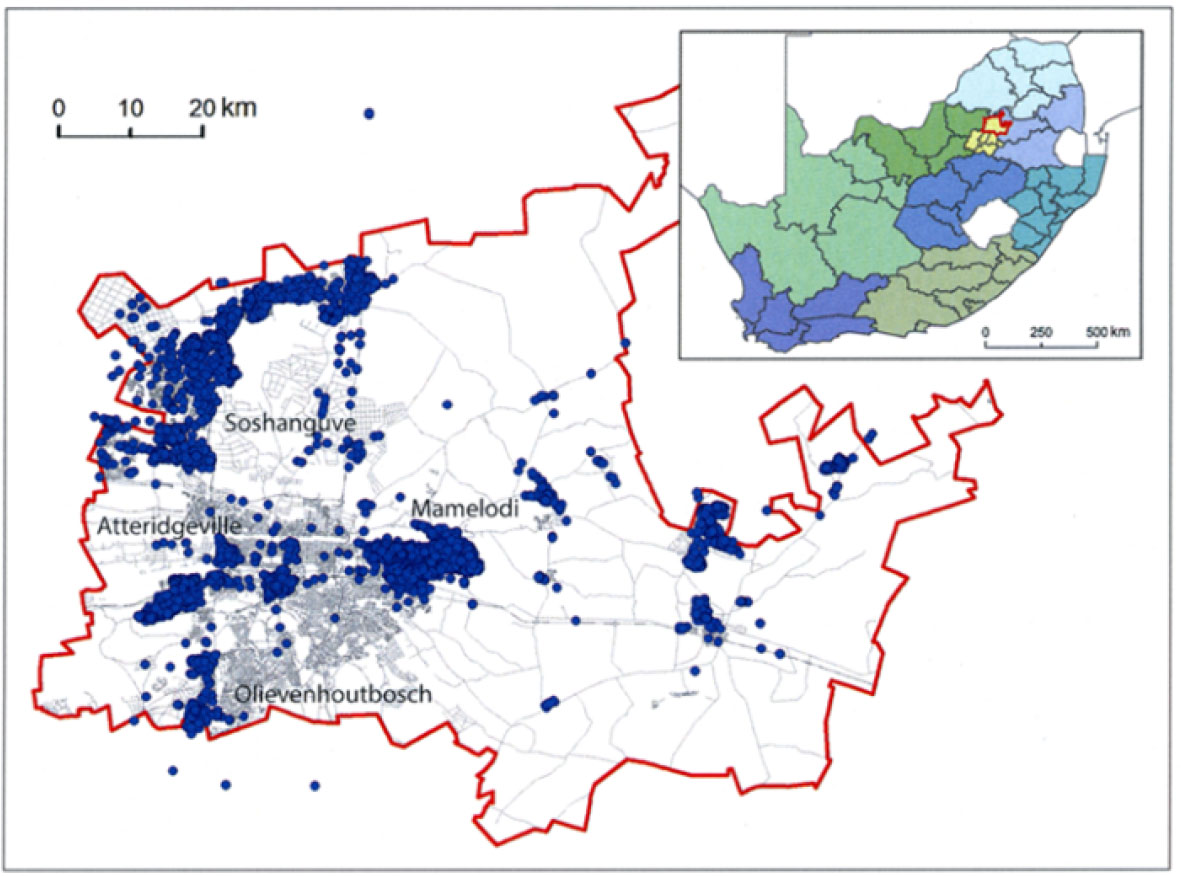
Fig. 1.
Map of the City of Tshwane, Gauteng Province, South Africa
Source: Friesen et al., 2018.
A random sampling technique was used to select the participants who constituted the samples for the three study areas. Fully completed questionnaires were collected; the data was coded and captured using the Statistical Package for Social Sciences (SPSS), version 28, and then analysed.
MODEL OF ANALYSIS
Principal component analysis (PCA) was used to rank a limited set of variables that could account for the variability found in a relatively large number of variables, without including all the original variables in the analysis. This method allowed the researcher to identify new variables representing the underlying or latent variables of the data set of statements, referred to as the factors that best describe the indigenous vegetable vendors' perceptions of the market barriers they faced. Criteria, such as eigenvalues greater than one and cumulative variance, were explained by increasing the number of factors included in the factor model. The interpretability of the extracted factors was used to guide the choice of the appropriate number of factors to be included in the model of choice, or best-fit model. Varimax rotation with Kaiser's normalisation was used to improve the relationship between the initial variables and the extracted components.
Therefore, this study adopted the principal component formula used by Kisaka-Lwayo and Obi (2012) as follows.
The first principal component (PCn) is computed as:
Where: PC – represents the principal component, is the number of principal components greater than 1, a1k – is the regression coefficient for the kth variable and is known as the eigenvector of the covariance matrix between variables, and Xk – represents the value of the kth.If the number of principal components, is greater than 1, then each principal component will take the form of a continuous variable or quantity related to the products of the values of the constituent variables and their respective weightings or component loading (Kisaka-Lwayo and Obi, 2012; Kibirige et al., 2016). Thus, the formula for the principal component obtained by adding the products is expressed as:
Where: PC1 – represents the first component, X1 and X2 – are the first and second independent variables until Xk, and a11 and a12 – are the component loadings of the variables X1 and X2.The eigenvalues are used to determine the number of principal components. Thus, this study considered eigenvalues that were equal to or greater than 1.
PRINCIPAL COMPONENT REGRESSION
Furthermore, market barriers (1 = major barrier, 2 = minor barrier, 3 = not a barrier) faced by the indigenous vegetable vendors were analysed using the Multiple Linear Regression Model to determine which principal component had a significant influence on the indigenous vegetable vendors' market barriers. In this case, the model is specified as:
Where: yi – is the dependent variable, market barriers, x1, …, xk – are the explanatory variables, and i represents the n sample observations (principal components). The error term ɛi – is assumed to follow a normal distribution, and the coefficients, β1, …, βK are parameters to be estimated.RESULTS AND DISCUSSIONS
Five-point Likert scale percentage ratings
The five-point Likert scale percentage ratings in Table 2 show that 41% of the street vendors disagreed, and 19% strongly disagreed that the indigenous vegetable market was easily accessible, while 15.7% strongly agreed, and 24.3% agreed that the indigenous vegetable market was easily accessible. About 56% of the indigenous vegetable vendors strongly disagreed, and 44% disagreed that they had good storage facilities. Customers achieved a major monetary gain, as they purchased fresh products at a low price when buying from street vendors compared to the supermarket price (Rahman et al., 2020). Furthermore, a study conducted by Mthombeni et al. (2014) in the Limpopo Province of South Africa showed that fresh and locally produced agricultural produce, such as vegetables, were mostly accessible and sold by street vendors at municipal markets, schools, commuter or mass transit terminals, hospitals, and traffic junctions, as well as in commercially congested areas. The results of the study revealed that 56% of the indigenous vegetable vendors strongly disagreed, and 44% disagreed that packing materials such as plastics were easily accessible; 83% of the indigenous vegetable vendors strongly agreed, and 16.7% agreed that they had access to clean water. Also, the study revealed that 66.7% of the indigenous vegetable vendors agreed, and 16.7% strongly disagreed that there was competition in the indigenous vegetable market.
Table 2.
Five-point Likert scale percentage ratings (N = 210)
| Question/Statement | SA | A | DNK | D | SD |
|---|---|---|---|---|---|
| (%) | |||||
| Are the indigenous vegetable market easily accessible? | 15.7 | 24.3 | 0 | 41.0 | 19.0 |
| Do you have good storage facilities for indigenous vegetables? | 0 | 0 | 0 | 44.0 | 56.0 |
| Are packing plastics for indigenous vegetables easily accessible? | 0 | 0 | 0 | 44.0 | 56.0 |
| Do you have access to clean water for indigenous vegetables? | 83.0 | 16.7 | 0 | 0 | 0 |
| Is there competition in the indigenous vegetable market? | 16.7 | 66.7 | 0 | 0 | 16.7 |
| Do you have a skilled workforce? | 44.3 | 55.7 | 0 | 0 | 0 |
| Do you make enough profit each month? | 15.2 | 23.8 | 0 | 41.4 | 19.5 |
| Do you own a vehicle to transport vegetables to/from the market? | 0 | 39 | 0 | 39.0 | 22 |
| Do you have enough experience in selling indigenous vegetables? | 34.3 | 10.5 | 0 | 31.9 | 23.3 |
| Are you educated enough to market indigenous vegetables? | 33.8 | 11.0 | 0 | 31.4 | 23.8 |
| Are indigenous vegetables easily accessible to be stocked? | 0 | 0 | 0 | 58.1 | 41.9 |
| Do you have access to credit facilities? | 0 | 0 | 0 | 28.6 | 71.4 |
| Is there a huge demand for indigenous vegetables rather than other vegetables? | 16.7 | 83.3 | 0 | 0 | 0 |
| Is selling indigenous vegetables the main source of income? | 38.6 | 14.8 | 0 | 29.5 | 16.7 |
| Is selling vegetables the only source of income? | 35.2 | 18.1 | 0 | 30.0 | 15.7 |
| Do you have good infrastructure? | 0 | 0 | 0 | 41.4 | 58.6 |
| Do you receive any support from NGOs? | 0 | 0 | 0 | 44.3 | 55.7 |
| Do you sell indigenous vegetables when it is raining heavily? | 0 | 0 | 0 | 65.2 | 34.8 |
| Are you subjected to any harassment from the authorities? | 0 | 16.7 | 0 | 83.3 | 0 |
| Do you receive any funding from the government? | 0 | 0 | 0 | 83.3 | 16.7 |
In this study, 55.7% of the indigenous vegetable vendors agreed, and 44.3% strongly agreed that they had a skilled workforce. According to Rahman et al. (2020), vegetable street vendors suffer from inefficient managerial skills and have transportation problems. In this study, 41.1% of the indigenous vegetable vendors disagreed, and 15.2% strongly agreed that they made enough profit each month. The study further revealed that 39% of the indigenous vegetable vendors disagreed, and 39% agreed that they owned a vehicle to transport vegetables to/from the market. About 34.3% of them strongly agreed, 31.9% disagreed, and 23.3% strongly disagreed that they had enough experience in selling indigenous vegetables. Furthermore, 33.8% of the indigenous vegetable vendors strongly agreed, 31.4% disagreed, and 23.8% strongly disagreed that they were educated enough to market indigenous vegetables.
The study also revealed that 58.1% of the indigenous vegetable vendors disagreed, and 41.9% strongly disagreed that indigenous vegetables were easily accessible to be stocked, and 71.4% strongly disagreed, and the other 28.6% disagreed that they had access to credit facilities. A lack of capital was the main hindrance in setting up a vending business. Lacking adequate funding, vendors were unable to purchase products to meet their own daily needs (Rahman et al., 2020). Furthermore, 83.3% of the indigenous vegetable vendors agreed, and 16.7% strongly agreed that there was a huge demand for indigenous vegetables rather than other vegetables. Furthermore, 38.5% of the indigenous vegetable vendors strongly agreed, and 14.8% agreed that selling indigenous vegetables was their main source of income; however, 29.5% disagreed, and 16.7% strongly disagreed that selling indigenous vegetables was their main source of income. Also, 35.2% of the indigenous vegetable vendors strongly agreed, and 18.1% agreed that selling indigenous vegetables was their only source of income; however, 30% disagreed, and 15.7% strongly disagreed that selling indigenous vegetables was their only source of income. Similar findings were reported by Tigari and Anushree (2020), who showed that street vending of vegetables provided an income to unemployed people in urban areas, and the main aim of most street vendors was to earn a higher income for their households or families and improve their standard of living.
The results showed that 58.6% of the indigenous vegetable vendors strongly disagreed, and 41.4% disagreed that they had good infrastructure; 55.7% strongly disagreed, and the other 44.3% disagreed that they received any support from non-governmental organisations (NGOs). Also, 65.2% of the vendors disagreed, and the other 34.8% strongly disagreed that they sold indigenous vegetables when it rained heavily. Furthermore, 83% of the indigenous vegetable vendors disagreed that they were subjected to harassment from the government, and 17% agreed that they had been harassed by the government. 83.3% of the indigenous vegetable vendors disagreed, and 16.7% strongly disagreed that they received any funding from the government. In a study conducted in Dhaka City in Bangladesh, Rahman et al. (2020) reported that vegetable street vendors were harassed by municipal authorities, police and local bodies.
VARIANCE OF THE CUMULATIVE COLUMN
Table 3 shows the results of the extracted sums of squared loadings. The cumulative column indicates that extracting the three factors allowed for an explanation of the variation in the data, with the first factor (PC1) accounting for 32.828% of the variance, the second (PC2) for 27.582%, the third (PC3) for 11.239%, the fourth (PC4) for 7.091% and the fifth (PC5) for 5.471%.
Table 3.
Variance of the cumulative column
| Initial eigenvalues | Extracted sums of square | Rotation sums of square | ||||||
|---|---|---|---|---|---|---|---|---|
| 6.568 | 32.838 | 32.838 | 6.568 | 32.838 | 32.838 | 6.269 | 31.343 | 31.343 |
| 5.516 | 27.582 | 60.420 | 5.516 | 27.582 | 60.420 | 5.387 | 26.934 | 58.277 |
| 2.248 | 11.239 | 71.659 | 2.248 | 11.239 | 71.659 | 2.037 | 10.184 | 68.461 |
| 1.418 | 7.091 | 78.750 | 1.418 | 7.091 | 78.750 | 1.640 | 8.198 | 76.658 |
| 1.094 | 5.471 | 84.22 | 1.094 | 5.471 | 84.222 | 1.513 | 7.563 | 84.222 |
| 0.962 | 4.812 | 89.033 | ||||||
| 0.717 | 3.585 | 92.618 | ||||||
| 0.596 | 2.981 | 95.599 | ||||||
| 0.466 | 2.330 | 97.929 | ||||||
| 0.252 | 1.261 | 99.189 | ||||||
| 0.098 | 0.491 | 99.680 | ||||||
| 0.042 | 0.211 | 99.891 | ||||||
| 0.022 | 0.109 | 100.000 | ||||||
| 3.760 | 1.880 | 100.000 | ||||||
| 6.470 | 3.240 | 100.000 | ||||||
| 3.670 | 1.830 | 100.000 | ||||||
| 1.940 | 9.680 | 100.000 | ||||||
| 2.440 | 1.220 | 100.000 | ||||||
| 3.010 | 1.510 | 100.000 | ||||||
| 2.090 | −1.050 | 100.000 | ||||||
Principal component factor analysis
Principal component 1 (PC1) accounted for 32.838% of the variations, with an eigenvalue of 32.838. The variables included were storage facilities, packaging, skilled workforce, support from NGOs, vegetable access, profit, infrastructure, transport, and credit facilities (in Table 4). Five coefficients were positive, indicating a positive correlation among the significant variables. This implies that increased support from NGOs meant that storage facilities, availability of plastics for packaging, a skilled workforce, and access to indigenous vegetables were more likely to increase. Four coefficients were negative, indicating a negative correlation among the significant variables. This suggests that as vendors' access to credit increased, their profits decreased, while their infrastructure and transport challenges grew.
Table 4.
PCA factors rotated component matrix (N = 210)
| 1 | 1 | 3 | 4 | 5 | |
|---|---|---|---|---|---|
| Storage facilities (X2) | 0.968 | ||||
| Packaging (X3) | 0.968 | ||||
| Skilled workforce (X6) | 0.968 | ||||
| Support from NGOs (X17) | 0.968 | ||||
| Vegetables access (X11) | 0.521 | −0.420 | |||
| Profit (X7) | −0.802 | 0.482 | |||
| Infrastructure (X16) | −0.798 | −0.431 | |||
| Transport (X8) | −0.638 | 0.744 | |||
| Credit facilities (X12) | −0.559 | ||||
| Funding (X20) | 0.963 | ||||
| Clean water (X4) | 0.963 | ||||
| Demand (X13) | −0.963 | ||||
| Competition (X5) | −0.496 | 0.671 | |||
| Harassment (X19) | −0.963 | ||||
| Experience (X9) | 0.974 | ||||
| Education (X10) | 0.976 | ||||
| Bad weather (X18) | 0.912 | ||||
| Main source of income (X14) | 0.763 | ||||
| Vegetables as only source of income | 0.846 |
The PC1 equation is presented below:
Principal component 2 (PC2) accounted for 27.582% of the variations, with an eigenvalue of 60.42. The variables included were vegetable access, profit, infrastructure, transport, funding, clean water, demand, competition, and harassment. The results of the PC2 in Table 4 show that the five coefficients were negative, indicating a negative correlation among the significant variables. This implies that as access to indigenous vegetables increased, the demand for these vegetables decreased, alongside greater damage to infrastructure, high levels of competition, and increased harassment of vendors. However, the results of the PC2 in Table 4 show that the four coefficients were positive, indicating a positive correlation among the significant variables. This indicates that increased funding from NGOs could result in higher profits and better access to clean water, while also enabling indigenous vegetable vendors to more easily acquire vehicles, thereby improving transportation access.
The PC2 equation is presented below:
Principal component 3 (PC3) accounted for 11.239% of the variations, with an eigenvalue of 71.659. The analysis highlighted two variables: education and experience. Both coefficients were positive, indicating a positive correlation between these significant variables. This suggests that as indigenous vegetable vendors' education levels rose, their experience also tended to rise.
The PC3 equation is presented below:
Principal component 4 (PC4) accounted for 7.091% of the variations, with an eigenvalue of 78.75. The results showed two variables: competition and bad weather. The two coefficients were positive, indicating a positive correlation between these significant variables. This implies that when the weather was good, the competition among indigenous vegetable vendors was likely to increase.
The PC4 equation is presented as:
Principal component 5 (PC5) accounted for 5.471% of the variations, with an eigenvalue of 84.222. The results showed two variables: main source of income and vegetables as the only source of income. The two coefficients of these variables were positive, indicating a positive correlation between these significant variables. This suggests that as the vegetable income increased, the main source of income also increased.
The PC5 equation is presented below:
Regression analyses of the PCA factors
Table 5 presents the multiple linear regression model, which includes the five factors extracted from the factor analysis. The variables that were statistically significant at the 95% level were bad weather conditions and service provision. Bad weather was significant, with a positive value of 0.551, implying that good weather conditions were associated with increased competition among indigenous vegetable vendors, thus positioning bad weather as a market barrier. Additionally, service provision was significant with a negative value of −1.052, suggesting that lack of support from the municipality reduced vendors' ability to sell their produce in the markets. According to Tigari and Anushree (2020), when street vendors offer high-quality vegetables and maintain strong relationships with customers, they increase their income, contributing to their livelihood and future savings.
Table 5.
Coefficient of the PCA factors
| Variable | B | Std. error | Beta | T | Sig |
|---|---|---|---|---|---|
| Constant | 9.530 | 2.258 | −4.221 | 0.000 | |
| Mean of service provision | −1.052 | 0.181 | −0.398 | −5.811 | 0.001*** |
| Mean of access to good services factor | −1.040 | 0.742 | −0.101 | −1.401 | 0.163 |
| Mean of education and experience factor | −0.025 | 0.037 | −0.043 | −0.676 | 0.500 |
| Mean of bad weather condition factor | 0.551 | 0.133 | 0.274 | 4.153 | 0.001*** |
| Mean of source of income factor | −0.015 | 0.026 | −0.036 | −0.568 | 0.571 |
CONCLUSION
The sale of indigenous vegetables has the potential to significantly contribute to local economic development in the study area, despite challenges related to limited commercial accessibility. In this study, 40% of vendors reported having access to stocks of indigenous vegetables and sold exotic vegetables when indigenous vegetables were unavailable. Vendors also noted having access to clean water in their markets, and only 16.17% mentioned experiencing harassment by local authorities for selling in restricted areas. The PCA analysis retained the variables of service provision, access to good services, education, bad weather conditions, and source of income. The results of the multiple linear regression analyses on factors influencing indigenous vegetable vendors' perceptions of market barriers revealed that service provision and bad weather conditions had a significant positive impact on these barriers. Therefore, any policy aimed at alleviating market barriers for indigenous vegetable vendors should address these key factors. Additionally, it is recommended that vendors establish shelters (e.g., portable gazebos or waterproof tents) at their selling points to protect themselves and their produce from harsh weather conditions.