
Introduction
Work occupies a central place in adult life, accounting for approximately one-third of waking hours. Accordingly, characteristics of the work environment are recognized as important determinants of workers’ health (Frank et al., 2023; WHO, 2021). Among these, psychosocial risks at work (PRW)—frequent and modifiable factors stemming from work organization, job characteristics, management practices, employment conditions, and interpersonal relationships (Niedhammer, 2011)—have been the focus of decades of research (Leka & Jain, 2025). Recent systematic reviews and meta-analyses, synthesizing data from thousands of workers worldwide, consistently demonstrate that PRW significantly increase the risk of developing or exacerbating mental health problems, cardiovascular problems, and musculoskeletal symptoms (Aronsson et al., 2017; Bezzina et al., 2023; Duchaine et al., 2020; Kivimaki et al., 2012; Theorell et al., 2015), among other adverse outcomes. These health conditions are among the leading causes of morbidity and mortality globally (IHME, 2021; NCHS, 2022; WHO, 2020). In Canada, their annual costs were last estimated at $33.998 billion in 2010, representing 26% of the total economic burden of illness (ASPC, 2017), a figure that likely underestimates today’s reality.
As the importance of PRW is increasingly acknowledged, several countries (Chirico et al., 2019; STPS, 2018), including Canada (ANQ, 2021; BNQ, CSA, & CSMC, 2022; CSA, 2013), have introduced policies and laws encouraging or requiring workplaces to implement strategies for their prevention. For example, the National Standard of Canada for Psychological Health and Safety in the Workplace (CSA, 2013) provides organizations with voluntary guidelines to promote mental health and prevent psychological harm. In Québec, a Canadian province, recent legislative changes require all employers, by 2025–2026, to assess PRW and include them as part of their occupational health and safety practices (ANQ, 2021). These legislative developments illustrate a paradigm shift in occupational health and safety. Historically, legally recognized occupational risks were almost exclusively tangible hazards, such as physical, chemical, or ergonomical exposures. Today however, workplaces are increasingly invited to contend with PRW, which tend to be more complex to assess and manage.
To assess these risks, reliable and valid measurement tools are required. Among available methods, individual self-reported questionnaires are widely used to assess PRW. Existing questionnaires range from those measuring specific PRW rooted in well-established theoretical models, such as the demand-control model (Karasek et al., 1998) and the effort-reward imbalance model (Siegrist, 1996), to tools measuring a broader range of PRW like the Copenhagen Psychosocial Questionnaire (COPSOQ, 2019). Broader instruments are particularly valuable for workplaces seeking an integrated view of their psychosocial environment. This is especially important given that multiple PRW frequently co-occur and interact (Bjaalid, Menichelli, & Liu, 2022; Mikkelsen et al., 2021). Consequently, targeted interventions on a given PRW may produce positive spillover effects across others.
Despite the availability of several PRW questionnaires at the time this work was initiated (e.g. CCOHS, 2022; Dupret et al., 2012; Pejtersen et al., 2010), some important limitations remained—and continue to persist. First, many questionnaires are not designed for autonomous use by workplaces, often requiring external expertise for administration, scoring, or interpretation, which increases costs and limits their usability in organizational settings. Second, while certain questionnaires include items that broadly suggest areas for improvement, few were explicitly designed to integrate ‘actionable’ items; that is, items formulated in a way that directly informs the development of concrete, targeted interventions. This reduces their practical usefulness for organizations aiming to translate questionnaire results into actionable strategies. Third, the evolving nature of work underscores the importance of assessing emerging and increasingly relevant PRW (Siegrist & Li, 2024), such as digital stressors (e.g. information overload, availability stress), which are not consistently captured by existing questionnaires. Finally, the psychometric properties of several existing instruments were either limited or insufficiently documented. For example, Guarding Minds at Work (Smith & Oudyk, 2022), a well-known Canadian tool, includes several items that conceptually and psychometrically overlap across theoretical dimensions, raising concerns about discriminant validity. This overlap can complicate the interpretation of results and reduce the tool’s usefulness in identifying precise intervention targets (Smith & Oudyk, 2022). To address these gaps, we previously developed the French-language Occupational Health and Well-being Questionnaire (OHWQ; Truchon et al., 2022), a tool measuring 16 PRW alongside indicators of worker health, well-being, and productivity. The OHWQ was validated in Québec and France and published in 2022 (Truchon et al., 2022).
Later that same year, major legislative changes were introduced in Québec under the Act to Modernize the Occupational Health and Safety Regime (ANQ, 2021), requiring workplaces to autonomously assess and manage PRW. The law prioritized specific PRW related to workplace violence and harassment, that, although addressed in voluntary standards and policy frameworks elsewhere (BNQ, CSA & CSMC, 2022; Chirico et al., 2019; CSA, 2013; ISO, 2018; ISO, 2021), were not fully covered by existing PRW questionnaires, including the OHWQ. In addition to these newly prioritized risks, five PRW that are well-documented for their negative effects on health were also integrated into this legislation: high workload, low job control, low social support, low recognition, and organizational injustice.
Given this expanded legal scope, the OHWQ needed to be updated. First, to adequately capture the different forms of violence and harassment covered by the new law. Second, to overcome a common barrier to PRW questionnaires: their proprietary nature requiring licensing fees, which can pose a significant obstacle to widespread adoption, especially for smaller organizations. To address this limitation, we chose to develop an open-access questionnaire. While rooted in the Québec context and its legislation, the PRW covered by the updated OHWQ are likewise reflected, in whole or in part, across several international frameworks (e.g., ISO, 45001 (ISO 2018)) and policy standards (e.g., NOM-035-STPS-2018 (STPS, 2018)), highlighting a growing global consensus on the importance of addressing them.
The updated OHWQ was renamed the QRBEST to better align the name with the content of the questionnaire and also for mnemonic value: Questionnaire on Psychosocial Risks, Well-Being, and Health at Work (QRBEST; Questionnaire sur les Risques psychosociaux, le Bien-Être et la Santé au Travail). Designed to be an open access and user-friendly questionnaire, the QRBEST aims to support both organizational interventions and research efforts by linking PRW assessment with outcomes related to worker well-being, health, and productivity and activity impairment.
The overall aim of this study is to describe the development of the QRBEST and to test the psychometric properties of its French version among 4,413 workers. The study was conducted in three successive phases, each addressing specific objectives, listed in Figure 1.
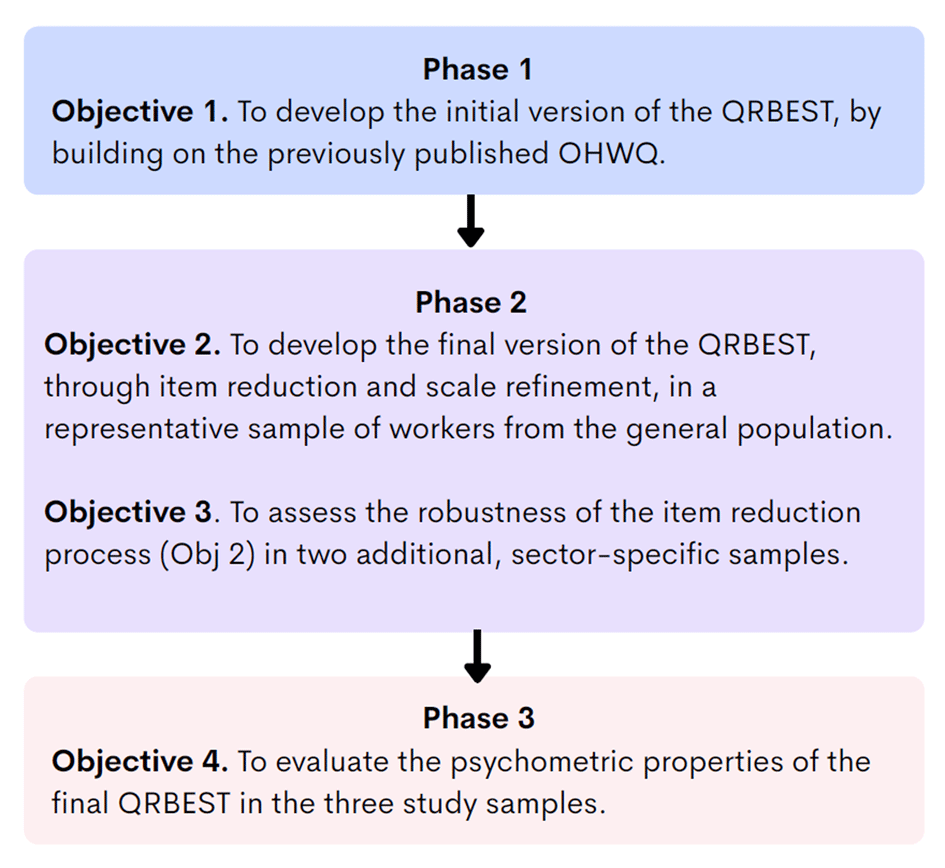
Figure 1
Objectives of the current study.
Methods
Study design
This study used a cross-sectional design and followed a three-phase process (Table 1): Phase 1) Development of the initial QRBEST; Phase 2) Item reduction to create the final QRBEST; Phase 3) Psychometric evaluation of the final QRBEST.
Table 1
Overview of the three-phase development and validation process leading to the QRBEST.
| PHASE | OBJECTIVE | MAIN ACTIVITIES | OUTPUT |
|---|---|---|---|
| Phase 1 | Obj 1. Questionnaire development |
| Initial version of the QRBEST |
| Phase 2 | Obj 2 & 3. Item reduction and scale refinement |
| Final version of the QRBEST |
| Phase 3 | Obj 4. Evaluation of psychometric properties |
| Psychometric properties of the QRBEST |
Participants
Sample 1 consisted of 3,000 participants recruited from a proprietary online panel managed by Léger, a well-recognized Canadian market research firm specializing in populational surveys. A stratified sampling strategy was used, based on sectors of activity, age, and sex, aiming to reflect the distribution of these factors in the Québec general working population. Inclusion criteria included living in Québec, being French-speaking, aged 18 or older, employed, and member of the firm’s panel. Exclusion criteria included being a full-time student or self-employed. Panelists were invited to complete the questionnaire online by email or via the panel’s mobile application between October and November 2024. Three quality control questions, co-developed by the research team and Léger, were included in the QRBEST at pre-determined intervals. Participants who failed these checks were excluded from the final dataset. To assess test-retest reliability, consenting participants were recontacted 2–3 weeks later to complete the QRBEST a second time until a subsample of 300 (10%) was reached.
Sample 2 included 708 healthcare workers employed in 14 long-term care centers and related services (e.g., psychiatric care and intermediate management) and Sample 3 included 705 workers from eight small and medium-sized enterprises in Québec. For both samples, a non-probability convenience sampling strategy was used. Recruitment was facilitated by human resources or management teams, who invited all employees to complete the QRBEST during separate data collection periods lasting 2 to 3 weeks between: February–September 2024 for Sample 2 and September 2024–January 2025 for Sample 3. Participation was voluntary and no exclusion criteria were applied in either sample. Participation rates ranged from 10% to 86% in Sample 2 (55% average) and 42% to 100% in Sample 3 (72% average). Data were collected online, except for 23 paper-based completions (3%) in Sample 2. No missing values were observed in the final dataset. For online administrations, all questionnaire items were mandatory, and all paper questionnaires were completed in full.
This study was approved by the Ethics Committee of the Centre intégré universitaire de santé et de services sociaux de la Capitale-Nationale (#2023–2829_RIS) as well as the Ethics Committee of the Université du Québec à Rimouski (#2025–622). All participants provided their informed consent.
Phase 1: Development of the initial QRBEST
The first phase was guided by the research team’s commitment to meeting evolving legislative requirements and improving the accessibility of PRW assessments for workplaces. The development of the initial QRBEST was informed by multiple sources, supporting content validity. The first step was to revise the OHWQ (Truchon et al., 2022) with these two main objectives: 1) to integrate additional PRW prioritized by Québec’s new occupational health and safety legislation and 2) to replace all proprietary items with open-access, validated instruments, ensuring the questionnaire could be freely used by both organizations and researchers.
Drawing on the OHWQ as a foundation, a multidisciplinary research team with expertise in PRW, organizational psychology, psychometrics, intervention research, and occupational health, in partnership with organizational stakeholders in the healthcare, education, and technological sectors, conducted an iterative, stakeholder-informed process to define an initial list of constructs (scales) to be included in the QRBEST. This process combined a structured deliberative workshop with key stakeholders (Gilbert-Ouimet, 2025), and targeted consultations with specific partners throughout the development process. This expert and stakeholder input contributed to the content validity of the tool, favoring the relevance and comprehensiveness of the selected constructs.
A broad review of existing questionnaires was then conducted to identify 1) validated and freely accessible instruments covering the identified constructs that were not originally present in the OHWQ, and 2) potential replacements for items and scales requiring licensed use. Where applicable, permissions were sought for all licensed material retained from the OHWQ. Items and scales for which permissions could not be obtained were flagged for replacement within this review process. Each instrument was assessed for conceptual alignment with the targeted constructs, psychometric quality (including evidence of reliability and validity), and applicability to workplace settings (e.g., relevance and feasibility for organizational action). Retained instruments and items were integrated into the initial version of the QRBEST.
To favor consistency and ease of interpretation across dimensions, most PRW items were standardized to a five-point Likert scale ranging from Strongly Agree to Strongly Disagree. This uniform scale was chosen to simplify and facilitate administration, comparability, and data aggregation. As such, some items were adapted to fit this response scale while preserving their original meaning. In contrast, the items and response scales used to assess indicators of well-being, health, and productivity and activity impairment were sourced from widely recognized and validated instruments. In accordance with licensing or open-access requirements, they were used in their original form. Items not originally available in French were translated using Vallerand’s back-translation method (Vallerand, 1989) by three bilingual team members, complemented by independent double back-translation by a professional translator. This Phase led to the development of the initial QRBEST, detailed below.
Phase 2: Item reduction to create the final QRBEST
Measures
The initial version of the QRBEST was administered to all samples. This version consisted of 145 items, across 32 scales: 104 items across 20 PRW scales and 41 items across 12 indicators of well-being, health, and productivity and activity impairment. The items and scales were sourced from several validated instruments, listed in Table 2. Most PRW scales (19) and three indicators of well-being were rated on a 5-point Likert scale from Strongly Agree to Strongly Disagree, with nine reverse-coded items. Items pertaining to the violence and harassment scales and two indicators of mental health were assessed on a 5-point Likert-type frequency scale from Yes, every day to No, never. Scale scores were computed as the mean of their constituent items, with a higher score indicating greater level of exposure to a PRW or a poorer outcome on an indicator. In addition, 15 (Samples 1 and 3) and 11 items (Sample 2) were included to document participants’ sociodemographic characteristics.
Table 2
Structure of the final QRBEST: Domains, scales, number of items, and reference sources used in item development.
| DOMAIN | SCALE | N ITEMS | ITEMS AND THEIR SOURCES |
|---|---|---|---|
| Macro-level Psychosocial Risks at Work – Organizational Culture and Factors | Organizational Justice* | 4 | Q1–3 (Developed by research team); Q4 (Burr et al., 2019) |
| Culture of Psychological Safety | 1 | Q1 (Developed by research team) | |
| Psychosocial Safety Climatea | 4 | Q1–4 (Dollard, 2019) | |
| Change Management | 4 | Q1–4 (Askenazy et al., 2011) | |
| Ethical Culture | 3 | Q1–6 (Langlois, Lapointe & Valois, 2018; Truchon et al., 2022) | |
| Perceived Organizational Non-Tolerance and Prevention of Harassment and Violence | 6 | Q1–6 (Developed by research team) | |
| Measures to Facilitate Work-Life Balance | 1 | Q1 (Vézina et al., 2011) | |
| Psychosocial Risks at Work – Occupational Demands | Workload* | 9 | Q1–2 (Burr et al., 2019; Dupret et al., 2012); Q3–7 (Siegrist et al., 2004); Q8–9 (Developed by research team) |
| Emotional Demands | 3 | Q1, 2 (Burr et al., 2019); Q3 (Developed by research team) | |
| Hindered Work Quality | 4 | Q1–4 (Askenazy et al., 2011) | |
| Work-Life Conflict | 2 | Q1–2 (Burr et al., 2019) | |
| Digital Communication Overload | 3 | Q1–3 (Developed by research team) | |
| Digital Availability Stress | 2 | Q1–2 (Developed by research team) | |
| Job Insecurity | 2 | Q1–2 (Truchon et al., 2022) | |
| Long Working Hours | 3 | Q1–3 (Developed by research team) | |
| Ethical Dilemma | 1 | Q1 (Pelletier et al., 2021) | |
| Psychosocial Risks at Work – Occupational Resources | Decision Authority* | 4 | Q1–4 (Burr et al., 2019; Dupret et al., 2012) |
| Opportunities for Development* | 4 | Q1–3 (Burr et al., 2019; Dupret et al., 2012); Q4 (Developed by research team) | |
| Social Support from Colleagues* | 3 | Q1–3 (Burr et al., 2019; Dupret et al., 2012) | |
| Social Support from Supervisor* | 4 | Q1, 3 (Burr et al., 2019; Dupret et al., 2012); Q2,4 (Developed by research team) | |
| Recognition* | 4 | Q1–3 (Niedhammer et al., 2000; Siegrist et al., 2004); Q4 (Developed by research team) | |
| Harassment and Violence in the Workplace | Psychological Harassment* | 3 | Q1 (Vézina et al., 2011); Q2–3 (Burr et al., 2019) |
| Sexual Harassment* | 5 | Q1, 2 (Vézina et al., 2011); Q3–5 (Developed by research team) | |
| Workplace Violence* | 4 | Q1, 3, 4 (Developed by research team); Q2 (Burr et al., 2019) | |
| Domestic or Family Violence in the Workplace* | 1 | Q1 (Developed by research team) | |
| Exposure to a Potentially Traumatic Event at Work* | 5 | Q1,5 (Prins et al., 2016); Q2–4 (Developed by research team) | |
| Indicators of Well-being at Work | Meaningfulness of Work | 3 | Q1–3 (May, Gilson & Harter, 2004) |
| Job Satisfaction | 3 | Q1,2 (Burr et al., 2019); Q3 (Developed by research team) | |
| Organizational Commitment | 3 | Q1–3 (Burr et al., 2019) | |
| Indicators of Mental Health | Well-Being | 5 | Q1–5 (Bech, 2004) |
| Psychological Distress | 6 | Q1–6 (Kessler et al., 2002) | |
| Burnout | 4 | Q1–4 (Hadžibajramović et al., 2024) | |
| Symptoms of Post-Traumatic Stress | 5 | Q1, 6–10 (Prins et al., 2016) | |
| Indicators of Physical Health | Self-Rated Health | 1 | Q1 (Burr et al., 2019) |
| Musculoskeletal Disorders | 3 | Q1, 3 (Descatha et al., 2007; Kuorinka et al., 1987); Q2 (Developed by research team) | |
| Cardiometabolic Disorders | 4 | Q1–4 (Developed by research team) | |
| Indicators of Work Productivity and Activity Impairment | Absenteeism | 1 | Q1 (Reilly, Arthur, & Dukes, 1993) |
| Presenteeism | 3 | Q2 (Developed by research team); Q3–4 (Reilly, Arthur, & Dukes, 1993) | |
| Employee Suggestions to Improve the Work Environment | Two formats available: a) Open-ended questions (2 items) b) Priority ranking system (3 items) | 2 / 3 | Q1–2 (Developed by research team) Q1–3 (Developed by research team) |
[i] *Denotes the psychosocial risks at work that are targeted by Québec’s legislation under the Act to Modernize the Occupational Health and Safety Regime (ANQ, 2021).
a To use this scale (PSC-4), please contact Dr Maureen Dollard.
Three additional established instruments were administered alongside the open-access QRBEST. The Psychological Demands scale (5 items) from the Job Content Questionnaire (Brisson et al., 1998) and the Interactional Justice subscale (9 items) from Moorman’s framework (Askenazy et al., 2011) were used to assess convergent validity. Although the Psychosocial Safety Climate (PSC-4; Dollard, 2019) is included in the QRBEST, it differs from the other QRBEST scales in that it requires authorization for use. Therefore, a single-item Culture of Psychological Safety was also included in the QRBEST and compared with the PSC-4 to assess convergent validity. All three instruments were administered in Sample 2, while the PSC-4 was also included in Samples 1 and 3.
Analysis
The internal consistency of all multi-item scales in the initial QRBEST was assessed using Cronbach’s alpha coefficient (α), with values ≥ 0.70 considered acceptable (Nunnally, 1978). Item-total correlations and Cronbach’s alpha if item deleted were calculated for each item in the multi-item scales. Scales with weak α coefficients and items with values below 0.40 were flagged for closer examination and potential elimination, considering the full set of refinement criteria.
The construct validity of each scale was evaluated by factor analyses. First, exploratory factor analyses (EFA) using unweighted least squares method with varimax rotation were conducted on a randomly selected half of each sample. These aimed to examine the underlying factor structure of each scale; specifically, to determine whether multiple factors emerged per scale and what these were, whether any a priori subscales were supported, and to evaluate the rotated factor loadings of each item and potential cross-loading. Next, confirmatory factor analyses (CFA) were conducted on the remaining half of each sample pool to test the structure revealed by the EFAs and evaluate model fit using multiple fit indices. Additional CFAs were conducted on each full sample to assess the overall model fit of the theoretical structure of the QRBEST scales and to examine item factor loadings. Values below 0.08 on the Standardized Root Mean Square Residual (SRMR) and greater than 0.90 on the Goodness of Fit Index (GFI) indicate good model fit.
Given that questionnaire length was an important concern raised by stakeholders, the aim was to construct brief, multi-item scales with three or four items each. To guide item reduction, a combination of psychometric and conceptual criteria was systematically applied. All items were examined and discussed by three research team members with extensive experience in PRW, organizational intervention research, and psychometrics. Disagreements were resolved through discussion; no item was removed without consensus.
Each item was evaluated for retention according to three criteria: psychometric quality, face validity, and actionability. These criteria were operationalized as follows:
Criteria 1—Psychometric quality: Items were screened using statistical indicators of psychometric performance. Internal consistency was assessed using Cronbach’s alpha (scales with α < 0.70 were flagged for further review). Corrected item-total correlations were examined to identify items contributing weakly (<0.30) or redundantly (>0.80) to the total score. EFAs and CFAs further guided refinement: items were examined for weak factor loadings (<0.30), cross-loadings, and unexpected factor emergence. Items failing to load cleanly onto their intended construct were considered for removal.
Criteria 2—Face validity: Items were evaluated for conceptual consistency during two 2-hour workshops. Each item was reviewed considering its psychometric performance (criteria 1) and theoretical relevance, to ensure that each item contributed meaningfully to the intended scale. Employer partner input was also incorporated, based on qualitative data from initial testing sites and feedback from approximately 20 key informants consulted during a related project (Gilbert-Ouimet et al., 2026) regarding the questionnaire’s relevance and clarity.
Criteria 3—Actionability: Items were evaluated based on their practical relevance for workplace interventions. An item was considered actionable if it could inform concrete intervention strategies. For example, items from the QRBEST Social Support from Supervisor scale (e.g., support in difficult situations, work planning, team coordination, and conflict resolution) are considered actionable, as they can guide interventions such as management training, the implementation of structured supervision practices, or initiatives to strengthen communication and leadership skills among supervisors.
As detailed above, items assessing indicators of well-being, health, and productivity and activity impairment were not modified during this phase. This item reduction process was first applied in Sample 1, then repeated in Samples 2 and 3 to examine consistency.
Phase 3: Psychometric evaluation of the final QRBEST
Measures
Participants from all three samples completed the QRBEST and only the items and scales of the final QRBEST (see Results) were used for this Phase.
Analysis
The internal consistency of multi-item scales was assessed using Cronbach’s alpha and factorial validity was evaluated through a new series of CFAs conducted separately for each scale. Test-retest reliability was assessed in a subsample of 300 participants from Sample 1, using intra-class correlations (Russo et al., 2019). The time interval between the two data collections averaged 27.1 days (median = 25 days), with a range of 13 to 66 days. An ICC of >0.70 was considered satisfactory (Koo & Li, 2016).
To evaluate concurrent criterion-related validity, associations between the PRW scales and two outcomes known to be associated with PRW (psychological distress and burnout) were examined in Sample 1. Spearman correlations were computed for unadjusted models and partial Spearman correlations were computed for models adjusted for sex, age, education, professional experience, and minority group membership. Sensitivity analyses were conducted, adjusting for other potential confounders (e.g., physical health conditions).
To provide preliminary support for the factorial distinctiveness of the scales within each overall domain of the QRBEST, which constitutes a prerequisite for discriminant validity, single and multi-factor CFAs were conducted per domain. In each case, the fit of a single-factor model (all items loading onto one latent construct) was compared to a multi-factor model (items loading onto separate latent constructs corresponding to their original scales). Two domains were excluded from these analyses: Harassment and Violence in the Workplace and Indicators of Physical Health. These scales are not intended to represent a single latent construct, and their binary measurement formats (rather than continuous) further render them unsuitable for factor analyses. The Long Working Hours scale was excluded from its respective domain given its categorical nature. Moreover, the Symptoms of Post-Traumatic Stress scale was also excluded from its respective domain (Indicators of Mental Health) given the low number of cases, which limited the ability to estimate the model reliably.
Convergent validity was examined through a series of Spearman’s rank correlation analyses (ρ). Correlations were tested between 1) QRBEST’s Workload scale and the Psychological Demands scale from the Job Content Questionnaire (Sample 2); 2) QRBEST’s Social Support from Supervisor scale and the Interactional Justice subscale from Moorman’s framework (Sample 2); and 3) QRBEST’s single-item Culture of Psychological Safety scale and the PSC-4 (all samples). In addition, the factor loading of the QRBEST item was compared to those of the PSC-4 items when grouped together as a factor.
All statistical analyses were conducted separately for each sample using SAS 9.4 (SAS Institute Inc).
Results
The descriptive characteristics of the participants from the three samples are provided in Appendix C (Supplementary Materials). Sample 1 (N = 3000), originating from a panel representative of the Quebec working population, included diverse sectors and job types. There was an equal distribution of women and men, with a mean age of 45 years; most participants worked full-time (91%), during the day (90%) and on weekdays (78%) only. Sample 2 (N = 708), a healthcare worker sample, was predominantly composed of women (84%), with a mean age of 43 years; most worked full-time (84%) across both weekdays and weekends (59%). Sample 3 (N = 705), from eight small and medium-sized enterprises across various industries, had slightly more women (58%) than men, with a mean age of 43 years; most worked full-time (88%), during the day (92%) and on weekdays (78%) only.
Phase 2: Item reduction to create the final QRBEST
The item reduction process applied to the initial QRBEST in Sample 1 was replicated in Samples 2 and 3 and yielded consistent results across the three samples. In total, 18 items were removed across nine PRW scales of the initial QRBEST: Organizational Justice, Workload, Emotional Demands, Hindered Work Quality, Availability Stress, Decision Authority, Opportunities for Development, Social Support from Supervisor, and Recognition. A table summarizing all removed items and the evaluation criteria applied is provided in Appendix D (Supplementary Materials).
Two items from the initial QRBEST were retained as standalone single-item scales, as they did not psychometrically align with their original multi-item scales. The first item assesses workers’ access to organizational measures that support work-life balance (e.g., telework, flexible scheduling). Although originally part of the Work-Life Conflict scale, this item did not load adequately (λ = 0.20 in Sample 1) with the two other items which focused on personal time and energy. It was therefore retained as a stand-alone scale, labeled Measures of Work-Life Balance, to capture organizational-level resources that support the achievement and/or maintenance of work-life balance. The second item retained as a single-item scale assesses perceived pressure to act against one’s professional values. It was initially included in the Ethical Culture scale but did not conceptually or psychometrically align (λ = 0.31 in Sample 1) with the other items, which focused on broader organizational culture. Given its actionable nature from an organizational perspective, this item was retained as a standalone scale labeled Ethical Dilemma.
Phase 3: Psychometric evaluation of the final QRBEST
The final QRBEST contains 127 items operationalized into 26 PRW scales as well as 12 indicators of well-being, health, and productivity and activity impairment (Table 2). For the final version of the QRBEST, please refer to Appendices A and B (Supplementary Materials).
The psychometric properties of the final multi-item scales of the QRBEST across the three samples are presented in Table 3. Most multi-item scales demonstrated excellent (α > 0.80) or satisfactory (α > 0.70) internal consistency. Cronbach’s alpha coefficients ranged from 0.75–0.92 in Sample 1, 0.71–0.94 in Sample 2, and 0.69–0.93 in Sample 3. The only exception was the Opportunities for Development scale in Sample 3, which had a Cronbach’s alpha coefficient of 0.69—slightly below the satisfactory threshold—while showing satisfactory internal consistency in the other two samples (α = 0.77 and 0.73 in Samples 1 and 2, respectively).
Table 3
Overview of the psychometric properties of the final multi-item scales of the QRBEST, by sample.
| SCALES | ITEMS | INTERNAL CONSISTENCY | SUMMARY OF MODEL FIT INDICES (CFA) | TEST-RETEST | CONCURRENT CRITERION-RELATED VALIDITY (S1) | ||||||||
|---|---|---|---|---|---|---|---|---|---|---|---|---|---|
| S1 | S2 | S3 | S1 | S2 | S3 | S1 | PSYCH. DISTRESS | BURNOUT | |||||
| N | α | α | α | SRMR | GFI | SRMR | GFI | SRMR | GFI | ICC4 | ρ | ρ | |
| Organizational Justice | 4 | 0.79 | 0.77 | 0.76 | 0.013 | 0.999 | 0.028 | 0.998 | 0.019 | 0.999 | 0.74 | 0.27* | 0.38* |
| Change Management | 4 | 0.90 | 0.90 | 0.91 | 0.029 | 0.998 | 0.037 | 0.997 | 0.026 | 0.999 | 0.74 | 0.29* | 0.41* |
| Ethical Culture | 3 | 0.91 | 0.89 | 0.90 | – | – | – | – | – | – | 0.69 | 0.27* | 0.34* |
| Workload | 9 | 0.87 | 0.87 | 0.89 | 0.043 | 0.995 | 0.046 | 0.993 | 0.041 | 0.995 | 0.78 | 0.34* | 0.45 |
| Emotional Demands | 3 | 0.81 | 0.78 | 0.80 | – | – | – | – | – | – | 0.79 | 0.48* | 0.57* |
| Hindered Work Quality | 4 | 0.86 | 0.84 | 0.85 | 0.023 | 0.999 | 0.023 | 0.999 | 0.020 | 0.999 | 0.71 | 0.39* | 0.51* |
| Work-Life Conflict | 2 | 0.88 | 0.87 | 0.88 | – | – | – | – | – | – | 0.66 | 0.51* | 0.59* |
| Digital Communication Overload | 3 | 0.75 | 0.74 | 0.71 | – | – | – | – | – | – | 0.59 | 0.34* | 0.37* |
| Digital Availability Stress | 2 | 0.80 | 0.73 | 0.81 | – | – | – | – | – | – | 0.69 | 0.26* | 0.28* |
| Job Insecurity | 2 | 0.86 | 0.82 | 0.80 | – | – | – | – | – | – | 0.69 | 0.31* | 0.36* |
| Decision Authority | 4 | 0.83 | 0.77 | 0.79 | 0.014 | 0.999 | 0.035 | 0.996 | 0.025 | 0.998 | 0.75 | 0.24* | 0.30* |
| Opportunities for Development | 4 | 0.77 | 0.73 | 0.69 | 0.021 | 0.999 | 0.018 | 0.999 | 0.035 | 0.996 | 0.73 | 0.15* | 0.18* |
| Social Support from Colleagues | 3 | 0.87 | 0.87 | 0.86 | – | – | – | – | – | – | 0.65 | 0.27* | 0.31* |
| Social Support from Supervisor | 4 | 0.91 | 0.94 | 0.93 | 0.006 | 0.999 | 0.004 | 1.000 | 0.007 | 0.999 | 0.80 | 0.29* | 0.39* |
| Recognition | 4 | 0.85 | 0.71 | 0.81 | 0.033 | 0.997 | – | – | 0.047 | 0.994 | 0.79 | 0.38* | 0.46* |
| Meaningfulness of Work | 3 | 0.92 | 0.88 | 0.90 | – | – | – | – | – | – | 0.79 | – | – |
| Job Satisfaction | 3 | 0.92 | 0.87 | 0.89 | – | – | – | – | – | – | 0.82 | – | – |
| Organizational Commitment | 3 | 0.81 | – | 0.80 | – | – | – | – | – | – | 0.82 | – | – |
| Well-Being | 5 | 0.91 | 0.89 | 0.90 | 0.027 | 0.999 | 0.032 | 0.998 | 0.027 | 0.999 | 0.73 | – | – |
| Psychological Distress | 6 | 0.89 | 0.87 | 0.86 | 0.045 | 0.995 | 0.051 | 0.993 | 0.058 | 0.990 | 0.82 | – | – |
| Burnout | 4 | 0.83 | 0.81 | 0.83 | 0.006 | 0.999 | 0.014 | 0.999 | 0.016 | 0.999 | 0.81 | – | – |
[i] S1 = General working population of Québec (N = 3,000); S2 = Healthcare workers (N = 708); S3 = Workers of small and medium-sized enterprises (N = 705).
α = Cronbach’s Alpha; values > 0.70 indicate good internal consistency.
Confirmatory factor analyses can only be computed if the scale has four or more items.
SRMR = Standardized Root Mean Square Residual; values < 0.08 indicate a good fit.
GFI = Goodness of Fit Index; values greater than 0.90 indicate a good fit.
ICC = Intraclass Correlation Coefficient; values < 0.50 indicate poor test-retest reliability, 0.50–0.75 moderate, 0.75–0.90 good, and >0.90 excellent.
ρ = Spearman’s rank correlation coefficient; values between 0.10–0.29 indicate a weak association, 0.30–0.49 moderate, and ≥ 0.50 strong.
*p < 0.0001.
Differences in the QRBEST administered in Sample 2: Q04 of the Recognition scale and the Organizational Commitment scale were omitted, and the Sexual Harassment scale included only a single general question.
Table 3 also presents the results of the confirmatory factor analyses (CFAs) conducted separately for each sample on the 13 QRBEST scales composed of at least four items (the minimum number of items required for a CFA). Across all samples, the results supported the proposed factor structures; all scales demonstrated good model fit, with SRMR values well below the recommended threshold of 0.08 and GFI values close to 1. Moreover, an overview of the item-level psychometric properties of the PRW scales is also presented in Appendix E (Supplementary Materials). Overall, item performance was strong, with most corrected item-total correlations exceeding 0.40 (median = 0.70) and factor loadings generally above 0.60 (median = 0.78).
The results of the test-retest reliability conducted on a subsample of 300 participants from Sample 1 are also presented in Table 3. According to the interpretation guidelines by Koo & Li (2016), intraclass correlation coefficients indicated moderate reliability (ICC = 0.50–0.75) for 11 scales and good reliability (ICC = 0.75–0.90) for 10 scales. Additional analyses showed no significant association between time elapsed between T1–T2 and score differences for most scales, suggesting that test-retest variability was not influenced by the length of the T1–T2 interval. An exception was the Hindered Work Quality scale, which showed a weak but statistically significant correlation (p = 0.0462); however, this isolated result may reflect random variation and should be interpreted with caution.
Results of the concurrent criterion-related validity analyses showed that all PRW scales were significantly associated with psychological distress and burnout (p < 0.0001), in both unadjusted (not shown) and adjusted models (coefficients between 0.15 and 0.59, Table 3). Sensitivity analyses adjusting for other potential confounders (e.g., physical health conditions) yielded similar results (available upon request).
Regarding the factorial distinctiveness of the QRBEST scales, the fits of single-factor and multi-factor CFA models were compared across the five domains appropriate for analysis. In all cases, the multi-factor models demonstrated substantially better fit (with lower SRMR values and higher GFI values) compared to models in which all items within a domain were constrained to load onto a single latent factor (Table 4). These findings support the discriminant validity of the QRBEST scales, indicating that constructs within each domain are empirically distinct and better represented as separate variables rather than a single overarching construct.
Table 4
Test of model fit of one-factor vs multi-factor models within each domain of the QRBEST in Sample 1 (general working population of Québec, N = 3,000).
| ONE-FACTOR MODEL | MULTI-FACTOR MODEL | |||
|---|---|---|---|---|
| DOMAIN | SRMR | GFI | SRMR | GFI |
| Organizational Culture and Factors (1 factor vs. 6 factors) | 0.0753 | 0.9780 | 0.0251 | 0.9974 |
| Occupational Demands (1 factor vs. 8 factors) | 0.0864 | 0.9521 | 0.0428 | 0.9891 |
| Occupational Resources (1 factor vs. 5 factors) | 0.1121 | 0.9403 | 0.0350 | 0.9939 |
| Indicators of Well-being at Work (1 factor vs. 3 factors) | 0.0916 | 0.9826 | 0.0305 | 0.9975 |
| Indicators of Mental Health* (1 factor vs. 3 factors) | 0.0707 | 0.9840 | 0.0351 | 0.9962 |
[i] *The Symptoms of Post-Traumatic Stress scale was excluded from these analyses given the low number of cases.
Finally, strong convergent validity was observed between 1) QRBEST’s Workload scale and the Psychological Demands scale of Karasek’s JCQ (Sample 2, ρ = 0.85, p < 0.0001); 2) QRBEST’s Social Support from Supervisor scale and Interactional Justice (Sample 2, ρ = 0.77, p < 0.000); and 3) QRBEST’s single-item Culture of Psychological Safety scale and the PSC-4 (Sample 1 ρ = 0.83; Sample 2 ρ = 0.88; and Sample 3 ρ = 0.86 (all p < 0.0001)). In each sample, this item also showed the highest factor loading when included in a joint factor analysis with the PSC-4: Sample 1 λ = 0.92 (compared to λ = 0.85–0.91 for PSC-4 items); Sample 2 λ = 0.90 (vs. λ = 0.74–0.86); and Sample 3 λ = 0.91 (vs. λ = 0.82–0.89).
Discussion
This study aimed to describe the development of the QRBEST (Questionnaire on Psychosocial Risks, Well-being, and Health at Work) and to test the psychometric properties of its French version across three working samples in Québec, Canada. The QRBEST was developed to provide an open-access, comprehensive, and user-friendly instrument that aligns with the priorities outlined in Québec’s recent legislative reform (ANQ, 2021) mandating that workplaces autonomously assess and manage PRW as part of their occupational health and safety obligations. Although the development of the questionnaire was guided by provincial regulatory changes, the PRW it assesses are reflected, either in whole or in part, in several international frameworks and policy standards. This broad alignment reinforces the relevance of the QRBEST, positioning it for use in diverse jurisdictions where psychosocial risk prevention is gaining momentum. A key aim was thus to provide a questionnaire that organizations could administer, score, and interpret independently. The instrument is composed of 127 items and encompasses 26 PRW scales alongside 12 indicators of workers’ well-being, health, and productivity and activity impairment, making it suitable for both research and workplace intervention purposes. To our knowledge, it offers one of the most exhaustive assessments of PRW currently available. The results of this study provide strong support for the reliability and validity of the QRBEST.
Psychometric properties of the QRBEST
All multi-item scales of the QRBEST demonstrated good to excellent internal consistency and factorial validity across the three samples, consistent with conventional psychometric guidelines (Koo & Li, 2016; Nunnally, 1978). The observed psychometric characteristics of the QRBEST are comparable or superior to those reported for other validated PRW instruments (Burr et al., 2019; Clausen et al., 2019). Confirmatory factor analyses supported the expected multidimensional structure of the QRBEST across samples. Test-retest analyses also supported the temporal stability of the QRBEST scales, a property that is not often evaluated in multidimensional PRW instruments. Concurrent criterion-related validity was supported by consistent and theoretically coherent associations between QRBEST’s PRW scales and two mental health outcomes (psychological distress and burnout), aligning with existing epidemiological evidence linking psychosocial exposures to mental health outcomes (Duchaine et al., 2020; Shahidi et al., 2022; Stansfeld & Candy, 2006). The consistency and overall strength of item-level psychometric indices across three heterogeneous samples provide preliminary support for the stability and robustness of the QRBEST measurement model. Lastly, results also offer evidence of the discriminant validity of the QRBEST’s scales.
Comparison with other PRW questionnaires
Like other validated instruments such as the COPSOQ-III (Burr et al., 2019; not yet validated in French) and the Danish Psychosocial Work Environment Questionnaire (Clausen et al., 2019; available in Danish only), the QRBEST was developed to serve both etiological and interventional purposes. While it shares common grounds with these tools by assessing the PRW most documented for their adverse health effects, the QRBEST also introduces distinct features: First, the QRBEST includes broader coverage of violence- and harassment-related PRW. It includes an expanded assessment of several forms of violence and harassment, uniquely capturing exposure to potentially traumatic events as well as domestic or family violence occurring in the workplace—two PRW now mandated in Québec under new legislation (ANQ, 2021). This scope aligns with national (Government of Alberta, 2021) and international (STPS, 2018) efforts, including Mexico’s NOM-035, in detecting trauma-related occupational exposures. Second, it integrates less-studied but emerging PRW constructs that are rarely covered in existing PRW questionnaires, such as ethical organizational culture and digital stressors, reflecting evolving challenges associated with the changing nature of work (Siegrist & Li, 2024). Third, it adopts a different conceptualization of work quality. Very few PRW questionnaires include a measure of work quality; the COPSOQ (Burr et al., 2019) is one notable exception. However, the QRBEST and COPSOQ differ in how they conceptualize this construct. The QRBEST operationalizes it as Hindered Work Quality, focusing on situations where workers are constrained from maintaining standards (e.g., due to time pressure), whereas the COPSOQ emphasizes satisfaction with quality of work performed, which is arguably less actionable. Fourth, the QRBEST captures a continuum of mental health indicators by adopting a continuum-based approach to psychological health, integrating four validated indicators—general well-being (Bech, 2004), psychological distress (Kessler et al., 2002; widely used in public health surveillance), burnout (Hadžibajramović et al., 2024), and PTSD symptoms (Prins, 2016)—thus enabling the identification of both early distress and more severe outcomes, particularly in high-risk settings. Fifth, the QRBEST enables the measurement of productivity losses related to absenteeism and presenteeism by including the Work Productivity and Activity Impairment questionnaire (Reilly, Arthur, & Dukes, 1993). This facilitates both the monitoring of changes over time and the economic evaluation of interventions. Sixth, the QRBEST supports a participatory approach to inform interventions by including two question formats that elicit workers’ suggestions for improving their work environment, offering organizations participatory and context-specific input to guide the development of targeted interventions.
Limitations and strengths
The current study has limitations. First, although the QRBEST was validated in three distinct samples, including a population-based panel, a healthcare workforce, and workers from eight small and medium-sized enterprises, all participants were drawn from the province of Québec. While these findings support the applicability of the questionnaire across different sectors and occupations, its generalizability to other cultural or linguistic contexts remains to be established. Accordingly, cross-cultural validation is warranted prior to broader application to examine the equivalence of item interpretation, factor structure, and psychometric properties across different cultural and linguistic contexts. However, it is important to note that most items included in the QRBEST were drawn or adapted from well-established, validated instruments (e.g., COPSOQ, Effort–Reward Imbalance questionnaire), for which validity evidence has been documented across multiple countries and occupational settings. This provides preliminary support for the potential transferability of the constructs, although formal validation in new contexts remains necessary.
In addition, the non-probability convenience sampling strategy used to obtain Samples 2 and 3 may have introduced a selection bias and limited the representativeness of these samples. However, these samples were primarily intended to examine the stability of the item reduction process and to document the psychometric properties of the QRBEST across distinct occupational contexts. Nevertheless, the sampling strategy used does not ensure the representativeness of healthcare workers or workers in small and medium-sized enterprises.
Moreover, although measurement invariance was not formally tested in the present study, the psychometric properties of the QRBEST were examined separately across three independent samples. The general consistency of item- and scale-level indices across these heterogeneous samples provides preliminary evidence of the stability of the QRBEST. Measurement invariance will nevertheless be formally examined in future work.
Second, all analyses relied on cross-sectional data, which precludes causal inferences and limits the assessment of predictive validity. Longitudinal studies are needed to determine whether QRBEST PRW scores are associated with subsequent outcomes in health, well-being, presenteeism, or absenteeism, and whether these outcomes vary in response to workplace interventions (responsiveness).
Finally, the choice to prioritize scale brevity, while intended to enhance feasibility and adoption in real-world settings, may have led to the exclusion of relevant items within complex PRW scales. For instance, while QRBEST’s Workload scale covers time pressure, contradictory demands, interruptions, and overtime, its limited number of items may not fully reflect the multidimensional nature of workload in some occupations. Similarly, the final version includes two single-item scales which, although conceptually justified and retained for their practical relevance, do not allow for internal consistency assessment and offer limited possibilities for psychometric validation. Future work will aim to strengthen the validity evidence for these constructs, including by examining their predictive validity through longitudinal evaluations.
This study also presents important strengths. It introduces the QRBEST, a questionnaire developed to support workplaces in assessing PRW based on well-established occupational health theories (Bakker & Demerouti, 2014; Dollard & Bakker, 2010; Karasek et al., 1998; Siegrist, 1996; Siegrist, 2001). The QRBEST builds on the OHWQ (Truchon et al., 2022), with items either sourced from validated instruments or developed by the research team (Table 2). The items were specifically selected and formulated to target modifiable aspects of the work environment, making the QRBEST both an assessment and action-oriented tool.
The strong psychometric qualities observed across the three distinct samples show a consistent pattern of results, providing preliminary evidence of the stability and robustness of the QRBEST, and supporting its potential generalizability across a wide range of job types and sectors. A complete psychometric evaluation—including analyses of internal consistency, factorial validity, test-retest reliability, concurrent criterion-related validity, and discriminant validity—indicated that all assessed properties ranged from adequate to excellent, supporting the overall reliability and validity of the QRBEST. Moreover, in Phase 2, the same items were flagged for removal across all three samples, demonstrating consistent item selection across diverse samples. Additionally, evidence of strong convergent validity was observed for three pre-selected scales. QRBEST’s Workload scale correlated highly with Karasek’s Psychological Demands scale, supporting its use as an accessible alternative to this widely used but proprietary measure. The Social Support from Supervisor scale also showed a strong association with the Interactional Justice subscale from Moorman’s framework; the QRBEST scale was retained to reduce redundancy and respondent burden. Finally, QRBEST’s single-item Culture of Psychological Safety scale correlated strongly with the PSC-4, suggesting it may serve as a proxy for Psychosocial Safety Climate, although the use of the full PSC-4 (Dollard, 2019) is strongly encouraged.
Beyond the specific strengths of this psychometric study, QRBEST’s short completion time (≈20 minutes) and intentionally generic questions support its feasibility and applicability across diverse organizational contexts. It also includes two question formats that elicit workers’ perspectives in improving their work environment, providing valuable input for organizations seeking participatory, context-specific avenues to develop targeted interventions. Moreover, to facilitate implementation and foster organizational autonomy, the QRBEST is accompanied by a detailed User Manual and an evidence-based Guide of Organizational Practices to Reduce Psychosocial Risks at Work (Gilbert-Ouimet et al., 2024) to support workplaces through every step of the process: pre-assessment, questionnaire administration, scoring, interpretation, intervention planning and implementation, and follow-up.
Ongoing developments and perspectives
Several initiatives are underway to expand the reach of the QRBEST. Given that a key aim in its development was to support organizational PRW interventions, the responsiveness of QRBEST’s scales (i.e., the ability to detect changes in PRW over time) will be examined in ongoing longitudinal intervention studies. Additional analyses will also examine whether changes in QRBEST PRW scores are associated with subsequent variations in health, well-being, presenteeism, or absenteeism outcomes.
Further, measurement invariance will be examined in future work to assess the equivalence of the QRBEST scales across groups (e.g., work sectors, gender, language versions) using multi-group CFAs. In this context, English and Spanish versions of the QRBEST have been developed and are currently being validated as part of ongoing efforts to assess the cross-cultural applicability of the questionnaire and support its use across diverse settings. A shorter version of the QRBEST is also in preparation to enhance feasibility in time-constrained settings. In addition, the questionnaire is being integrated into digital platforms that offer automated result summaries and action planning support. A centralized database (BD-BEST) is also being established to consolidate data from workplaces and research, supporting advanced analyses such as predictive modelling and productivity cost estimations to further guide prevention efforts.
Conclusion
The QRBEST is an open-access, comprehensive questionnaire designed to assess PRW alongside indicators of worker well-being, health, as well as productivity and activity impairment. This study provides evidence for the psychometric soundness of the QRBEST across three distinct working populations. Beyond measurement, the QRBEST is intended to support prevention efforts by helping users translate PRW assessments into targeted action. As such, it is designed to serve as a validated and practical reference tool for diverse stakeholders (including workplaces, researchers, public health agencies, technological partners, and consulting firms) seeking to assess and manage PRW.
Additional File
The additional file for this article can be found as follows:
Ethics and Consent
This study was approved by the Ethics Committee of the Centre intégré universitaire de santé et de services sociaux de la Capitale-Nationale (#2023–2829_RIS) as well as the Ethics Committee of the Université du Québec à Rimouski (#2025–622). All participants provided their informed consent.
Acknowledgements
This project was funded by the New Frontiers in Research Fund’s Special Call for Research for Postpandemic Recovery (NFRFR-2022-00149) and Mitacs (IT38322).
Author Contributions
M. Gilbert-Ouimet, M. Truchon, and K. Aubé created and made ongoing contributions to the development of the questionnaire as well as conducting and interpreting the psychometric analyses. V. Hervieux, C. Biron, L. Langlois, M. Pelletier contributed to questionnaire development according to their areas of expertise. L. Lerouge contributed expertise on aspects of labor law. The first draft of the manuscript was written by K. Aubé, Gilbert-Ouimet M, and M. Truchon. All authors provided critical feedback at various stages of manuscript preparation and approved the final version for publication.