
Introduction
The workplace is one of the most important social communities in a person’s life, making workplace relationships significant. As social beings with a fundamental need to belong (Baumeister & Leary, 1995), employees benefit from a sense of inclusion, which fosters equality and involvement at work (Filstad et al., 2019). This sense of belonging and cohesion is compromised if ostracism occurs at work. Workplace ostracism is defined as being ignored or excluded from social interactions at work (Ferris et al., 2008). According to Williams’ (2009) temporal need-threat model, ostracism threatens four fundamental needs (belonging, self-esteem, control, meaningful existence) and triggers strong emotional and behavioral reactions, such as unethical behavior (Qi et al., 2020) and interpersonal conflicts (Chung, 2015).
Workplace ostracism is a pervasive social stressor in organizations, and research indicates that experiences of exclusion and being ignored are common across workplaces worldwide (Li et al., 2021). Evidence from healthcare contexts indicates that 50–80 percent of employees report experiencing ostracism (e.g., Ali et al., 2025; Manninen et al., 2024). These findings suggest that workplace ostracism in healthcare is not an isolated or exceptional phenomenon but rather a pervasive and often normalized aspect of social dynamics in interdependent work environments. Understanding workplace ostracism is especially critical in healthcare, where collaboration, inclusion, and team cohesion directly affect both employee retention (e.g., Chung, 2015) and quality of care (Elhanafy & Ebrahim, 2022). With a projected global shortfall of approximately 10–11 million healthcare workers by 2030 (World Health Organization, 2026), factors that undermine inclusion and teamwork pose serious organizational and societal concerns.
Despite extensive research on workplace ostracism, important gaps remain. First, most studies examine ostracism from a single-actor perspective, usually the target (e.g., Ng, 2017; Quade et al., 2017), and less often the perpetrator (e.g., Hales et al., 2016; Nezlek et al., 2015). Studies incorporating observers remain scarce and context-specific, such as nurses’ helping behavior toward the target when they observe ostracism (Liu et al., 2025). Second, studies in healthcare contexts tend to focus on a single professional group, such as nurses’ attitudes (Elliethey et al., 2024) or the relationship between doctors’ resilience and ostracism (Oberai & Anand, 2023). Third, although prior research has predominantly examined workplace ostracism in healthcare using quantitative designs (e.g., Ali et al., 2025; Manninen et al., 2024; Özi̇Şli̇, 2026), qualitative insights into how employees explain and interpret exclusion remain scarce. Fourth, existing studies mainly examine attribution as a mediator or moderator of outcomes (e.g., Muhammad & Soumyaja, 2026), rather than as a framework for understanding the multi-actor and relational dynamics of ostracism.
These gaps matter because existing research has largely relied on individual-level, variable-centered approaches, offering limited insight into how organizational actors experience, interpret, and justify ostracism. As a fundamentally relational and interpretive phenomenon, ostracism elicits different attributions across roles and professions, potentially leading to conflict (Chung, 2015) and weakened team functioning in healthcare, with implications for patient care (Elhanafy & Ebrahim, 2022). Alongside quantitative research, qualitative research deepens understanding of a phenomenon’s experiential and contextual dimensions, strengthening both theoretical development and practical responses. Consequently, research is needed that captures the triadic, relational, and contextually embedded nature of ostracism and integrates need-based and attributional processes to explain how exclusion is constructed and sustained in complex healthcare work environments.
To address these gaps, this study makes three key contributions. First, it advances theory by conceptualizing ostracism as a triadic phenomenon that integrates the perspectives of targets, observers, and perpetrators and combines Need-Threat Theory (Williams, 2009) with attribution theory (Kelley, 1967). Attribution theory helps explain the causal accounts employees develop for exclusionary events, while Need-Threat Theory offers insight into the underlying needs these experiences may threaten. This moves beyond actor-specific explanations by showing how need-based reactions and attribution processes co-evolve in social interactions. Second, it extends workplace ostracism research through a multi-professional healthcare context, capturing dynamics in interdependent settings and how attributions are shaped within them. Third, qualitative research lets us examine diverse interpretations and show how ostracism is embedded in social, cultural, and normative practices. Collectively, this integrative framework advances multi-level theorizing and offers practical insights into how organizations interpret and justify exclusion and how they can address it more effectively.
Workplace Ostracism and Attribution Processes
Ostracism has long functioned as a social regulation mechanism through which groups maintain cohesion by excluding those perceived as deviating from norms. Workplace ostracism is typically subtle, ambiguous, and non-verbal, unlike overt mistreatment (Robinson et al., 2013). Ostracism can occur occasionally or repeatedly, with its duration and frequency shaping individuals’ responses. Prolonged exposure typically produces more severe psychological consequences, such as resignation, alienation, helplessness, and depression. (Williams, 1997; Williams, 2002). Because it lacks clear signals, targets often cannot identify its cause and must infer its meaning (Jahanzeb et al., 2018). Williams’ (2009) Need-Threat Theory offers a useful lens for understanding how employees interpret workplace ostracism. The theory suggests that being ignored or excluded threatens fundamental needs for belonging, self-esteem, control, and meaningful existence, shaping how employees make sense of exclusionary experiences and the meanings they attach to them (Williams, 2009).
Antecedents and interpretive ambiguity of ostracism
Both individual dispositions and contextual conditions shape workplace ostracism. At the individual level, personality traits such as low agreeableness, low extraversion, and high neuroticism increase vulnerability to exclusion (Wu et al., 2011). At the contextual level, factors such as high work pressure (Bedi, 2021), competitive climates, and organizational norms that tolerate exclusionary behavior contribute to ostracism (Robinson et al., 2013). Social dynamics, including envy (Ng, 2017), leadership behavior, and group norms, further reinforce or legitimize exclusion (Robinson et al., 2013). Notably, individuals with a strong need to belong may ostracize others to protect or enhance their social standing (Yang & Treadway, 2018). By reducing a colleague’s attention, they seek a more visible, central position.
Individuals differ in how they experience and interpret ostracism. Factors such as self-esteem, attachment style, and sensitivity to rejection shape reactions. For example, anxiously attached individuals are more likely to internalize exclusion, whereas avoidantly attached individuals may downplay its impact (Dong et al., 2024). These differences underscore that ostracism is not only a behavioral phenomenon but also a subjectively constructed experience. Workplace ostracism is inherently ambiguous because it often involves omitting expected social interaction rather than overt negative acts. Consequently, the same event, such as being left out of a conversation, meeting, or social gathering, may be interpreted as intentional exclusion, accidental oversight, or a response to situational constraints, depending on the context and the attributions made by those involved (Robinson et al., 2013). This ambiguity increases the likelihood of both over- and under-attribution of exclusionary intent (Bernstein et al., 2018).
Attribution theory as a lens for understanding ostracism
To make sense of ambiguous social experiences, individuals rely on attribution processes, cognitive mechanisms for inferring the causes of events (e.g., Kelley, 1967; Martinko & Thomson, 1998). Attribution theory holds that people interpret events along dimensions such as locus (internal, external, vs. relational) and context (e.g., workplace ostracism), and that individuals may see it as stable (‘they exclude me no matter what’) or unstable (‘things could improve if I try harder’). Likewise, individuals may judge ostracism as controllable (changeable through behavior) or uncontrollable (persisting despite one’s efforts). These interpretations significantly shape emotional and behavioral responses.
Because workplace ostracism is ambiguous, individuals often must make sense of exclusion by identifying its perceived source (Williams, 2007). Therefore, attributional locus represents a particularly salient dimension of ostracism experiences. After experiencing ostracism, individuals tend to assign causes to internal (self), external (others or the organization), or relational (relationships) factors (Eberly et al., 2011). People make internal attributions when they believe their personal traits or actions contribute to workplace ostracism (Martinko & Thomson, 1998). Conversely, external attributions occur when people attribute responsibility to someone else, such as a colleague who excludes multiple people rather than just one individual (Eberly et al., 2011; Kelley, 1967). Relational attributions occur when people perceive the cause as stemming from interaction within a specific relationship rather than from an individual alone (Eberly et al., 2011).
These attributional patterns matter because they shape outcomes such as self-esteem and coping responses. Internal attributions can lead to self-blame and reduced well-being, whereas external attributions may evoke anger or withdrawal (Martinko & Thomson, 1998). Despite this, research on ostracism has largely focused on targets’ reactions and overlooked how different actors construct explanations. Yet ostracism is inherently relational, involving targets, perpetrators, and observers.
The role of social actors in attribution processes
Attribution theory suggests that workplace ostracism is not interpreted uniformly. Targets, observers, and perpetrators differ in how they explain exclusion, drawing on role-specific experiences, social positions, and available information (e.g., Peretz-Lange et al., 2024). Observers’ interpretations matter because observers can determine whether exclusion is challenged, tolerated, or reinforced (Arpin et al., 2017; Rudert & Greifeneder, 2019; Wesselmann et al., 2013). Need-Threat Theory complements this perspective by highlighting that ostracism threatens fundamental needs for belonging, self-esteem, control, and meaningful existence (Williams, 2009), but the extent and nature of these threats depend on how people understand exclusion. For example, targets who attribute ostracism to their own characteristics may experience more serious threats to belonging and self-worth, whereas perpetrators may reduce the perceived harm of exclusion by attributing their behavior to situational demands. Together, the two theories suggest that workplace ostracism is a relational process in which causal explanations and need-based reactions continuously shape one another across targets, observers, and perpetrators.
Research questions
This study investigates how healthcare workers explain and interpret workplace ostracism across different actor roles. Specifically, we examine 1) how healthcare workers attribute the causes of workplace ostracism and 2) how ostracism is experienced and interpreted from the perspectives of the target, observer, and perpetrator. These questions focus on identifying attribution patterns that explain workplace ostracism and on how role-based perspectives shape the interpretation of exclusion and its implications for fundamental psychological needs. Accordingly, we conceptualize workplace ostracism as a relationally constructed phenomenon in which employees’ attributions about exclusion and their experiences of threatened psychological needs mutually shape one another through social interaction.
Methods
Data
In spring 2020, the COVID-19 pandemic significantly disrupted healthcare organizations’ activities and operations worldwide. In January 2021, hospitals were still limiting visits, but routines had stabilized enough to allow data collection via questionnaire. Because vaccination coverage was low, we did not conduct interviews. We collected data through a semi-structured, web-based questionnaire from two Finnish university hospitals. We prepared a research invitation that included a research bulletin and a link to the online survey. The hospitals’ research coordinators sent this message to unit heads, who then forwarded it as a group message to employees and managers in their clinics (outpatient clinics, emergency departments, surgical units, inpatient wards, and intensive care units). We excluded obstetrics and gynecology clinics due to commitments. Participation was voluntary, and respondents gave their informed consent after reading the cover letter at the beginning of the questionnaire. We sent a reminder after two weeks, and the questionnaire closed after three weeks. Responses remained anonymous. The Research Ethics Committee of the University of Eastern Finland approved the study in November 2019.
In this study, we analyzed responses to two open-ended questionnaire questions about participants’ personal and/or observed experiences of workplace ostracism. The questions were: ‘If you have a) personally experienced and b) observed workplace ostracism, please describe what happened at that moment. You can use the help questions below to guide your response, but you are also free to write exactly as you wish. Your experience is valuable and important. Help questions: How did the situation arise? Who was present? What was the mood like? How did others react? What were the consequences? How do you feel about the experience now?’ The open-ended nature of these questions allowed for a wide range of interpretations from different perspectives. We did not directly ask participants whether they had ostracized anyone; instead, participants raised the issue themselves. This approach helped us understand the various interpretations and explanations based on who was interpreting the situation. Additionally, we defined ostracism for respondents as follows: Ostracism is a wordless phenomenon in which someone is completely ignored. Ostracism is therefore both rejection and complete exclusion.
We translated the citation examples from Finnish into English, ensuring the main message stayed as close as possible to the original. The data consisted of 34 pages of text in total (18 pages of personal experiences and 16 pages of observed experiences), set in Times New Roman, 12-point font, single-spaced. The study had many participants for qualitative research; however, some responses were only one sentence long. The number of words in the responses ranged from 10 to 304. So, the sample size does not directly reflect the volume of data.
Participants
The study included registered nurses, practical nurses, social workers, doctors, head nurses, and managers. We also received responses from some secretaries, as they worked in the unit and were informed about the study. Employees answered the open-ended questions (n = 267; n = 214 working in inpatient settings and n = 53 in management roles). Most of the sample were females (90.2%). Participants ranged in age from 22 to 66 years, with an average age of 45.2 years. They had worked in healthcare for an average of 19.6 years and in their current roles for 8.5 years. Table 1 shows demographic details.
Table 1
Demographic characteristics of the sample.
| N | % | |
|---|---|---|
| PARTICIPANTS | ||
| female | 241 | 90.2% |
| male | 25 | 9.4% |
| Non-binary/Not Reported | 1 | 0.4% |
| Education | ||
| Registered nurse | 181 | 67.8 |
| Doctor | 44 | 16.5 |
| Practical nurse | 31 | 11.6 |
| Social worker | 11 | 4.1 |
| Work unit | ||
| Policlinic | 100 | 37.5 |
| Ward | 83 | 31.1 |
| Operational unit | 59 | 22.1 |
| Government | 16 | 5.9 |
| Emergency | 7 | 2.6 |
| Social care | 2 | 0.8 |
| Total | 267 | 100 |
Analyses
We analyzed the data using content analysis, applying aspects of attribution theory to examine employees’ perceptions of workplace ostracism. We used the ATLAS.ti (v. 22.1.0) program for the analysis. The method moves from specific cases to general conclusions. As research suggests people make multiple attributions for workplace issues (Martinko & Thomson, 1998), we identified different attributions within the same response. Most analysis units included multiple sentences that formed narrative descriptions. Following Keaveney (1995), we examined individual phrases rather than full narratives, while accounting for situational context. First, in line with attribution theory, we separated personal and observed experiences from the data. We read these as separate datasets (see Table 2) and identified internal (e.g., personality, skills), external (e.g., colleagues, organization), and relative attributes (e.g., group dynamics). Second, we searched for descriptions in which individuals explained why they rejected someone. To ensure coding consistency, all three authors participated. We compared each other’s attributions and found that, with a few exceptions, they were consistent.
Table 2
Examples of the data analysis process.
| ORIGINAL TEXT | SIMPLIFIED EXPRESSION | SUBCATEGORY | MAIN CATEGORY |
|---|---|---|---|
| Sometimes my opinions are not to listened to, or not considered. I’m perceived as too kind, even though I try to express my opinion. | Opinions are not listened to or considered. Seems as too kind, despite trying to express (his/her) opinions. | Personality traits | Internal attribution |
| My different job is probably part of the reason. | Different job is probably part of the reason. | Professional status | External attribution |
| On the previous ward, there was one nurse who on “a bad day”, for example, would only greet colleagues she considered friends. Then communication was almost terse and mean to both colleagues and patients. I did not take the behavior personally but in this work community the behavior had been tolerated for years. | Nurse only greets colleagues s/he considered friends when having a bad day. Communication was almost terse and mean to both colleagues and patients. In this work community, the behavior had been tolerated for years. | Organizational culture | Relational attribution |
According to Weiner’s (1985) attribution theory, attributions have three dimensions: locus (internal, external, relational), stability (stable vs. unstable), and controllability. We focused on locus and stability because control is a core need that is threatened by ostracism (Williams, 2009), and including controllability could distort the results. Stable attributions suggest unchanging causes (e.g., personality), while unstable ones can change over time (e.g., being a newcomer).
Results
Respondents reported experiences and interpretations of workplace ostracism as targets, observers, and/or perpetrators; thus, a single respondent could represent multiple roles (see Table 3).
Table 3
Quantitative distribution of interpreter.
| INTERPRETER | PERSONAL ONLY (N) | ONLY OBSERVED (N) | BOTH PERSONAL AND OBSERVED (N) | BEEN A PERPETRATOR (N) |
|---|---|---|---|---|
| Manager | 13 | 22 | 10 | 3 |
| Worker | 72 | 60 | 41 | 27 |
| Total | 85 | 82 | 51 | 30 |
Ostracism occurred in various settings, including break rooms, social situations, and online environments, with similar reasons cited across them. Narratives described psychological (e.g., silence), physical (e.g., excluding someone), and cyber ostracism (e.g., removal from message groups). Ostracism was observed across all professional groups, both within and between them, regardless of educational level.
Attributions by the targets
This subsection presents respondents’ interpretations and explanations of why they believe they were targeted.
Internal attributions of ostracism, related to the target. Participants most often attributed ostracism to personal characteristics and shortcomings. Self-blame was common, with individuals questioning whether being too quiet, withdrawn, young, old, or otherwise different made them vulnerable to exclusion. Some viewed ostracism as reflecting their professional value, while others doubted that: ‘I must be such an incompetent, stupid, and unskilled worker’.
At the same time, participants noted that both passive and dominant personalities could become targets: quiet individuals were seen as easier to ignore, whereas outspoken or reform-oriented employees risked rejection when challenging established norms. Some situations were so confusing that the employee could not believe what was happening:
During a lunch break, an older coworker went to the company canteen to eat. I asked if I could sit at the same table, and they told me I could. When I sat down, everyone else turned away from me and refused to speak or make eye contact. It was as if I were invisible, as if I weren’t there at all. I felt sadness and anger, but what struck me first was disbelief that people could be so rude.
Internal explanations extended beyond personality traits to encompass personal choices, values, and social behaviors. Participants linked ostracism to not using social media, not smoking, lacking workplace friendships, religious differences, and health conditions perceived to affect work performance. The COVID-19 pandemic also introduced new sources of exclusion, with one employee reporting ostracism after coming to work with mild cold symptoms despite testing negative for COVID-19. These accounts suggest that workers viewed ostracism as arising not only from who individuals are but also from choices and characteristics that deviate from group expectations regarding social participation, health, and conformity.
Internal attributions of ostracism, related to the perpetrator. Targets also described perpetrators’ internal attributions, emphasizing personality traits as stable determinants of exclusionary behavior. Targets described perpetrators as strong-willed, loud, and ambitious, portraying them as individuals who ‘gain power and get their way through ostracism and are also followed by others’. These accounts suggest that targets interpreted ostracism as intentional and purposeful behavior motivated by concerns about status and influence. Because targets perceived these traits, values, and behaviors as enduring, they often regarded internal attributions as stable.
External attributions of ostracism. Targets attributed ostracism to structural and status differences within the workplace. Hierarchical boundaries were described as exclusionary, with those in different roles or positions perceiving themselves as ‘not on the same level’ as colleagues. Promotions, distinct job descriptions, or professional divides, such as doctors disregarding nurses in informal spaces, were considered sources of exclusion. Interestingly, targets also linked external attributions to perpetrators in the same way: ‘S/he doesn’t talk or give any answers, because I’m a nurse, s/he’s a doctor’. These accounts underscore how organizational stratification shapes social dynamics, reinforcing divisions in both status and voice.
Competition and jealousy often reinforced ostracism, especially when employees competed for competence, status, or recognition. Nurses described information withholding as a form of exclusion, and managers also contributed to climates of silence. Ostracism crossed professional boundaries: secretaries reported being excluded from social events, reinforcing perceptions of lower status compared with nurses and physicians. These accounts suggest that ostracism helps maintain organizational hierarchies and defines who belongs. Physical arrangements could also trigger exclusion, as relocation away from a team was experienced as symbolic marginalization: ‘out of sight, out of mind’. As one respondent described: ‘My workstation was relocated away from the rest of our team. I was shocked that this was approved without consulting me. The work community’s reaction was the same as with other uncomfortable issues: silence. So, the matter was not discussed’.
The lack of open discussion about these decisions reinforced the idea that silence itself acted as a form of collective ostracism. Meanwhile, students and newcomers often experienced exclusion through inside jokes, indifference, or limited inclusion. While some viewed these incidents as harmless or unintentional, others interpreted them as signals of outsider status, highlighting the ambiguity of ostracism during the early stages of workplace integration.
Overall, external attributions linked ostracism to organizational hierarchies, competition, and workplace practices that determine inclusion or exclusion. While many of these attributions reflected stable conditions, such as status differences and professional hierarchies, others, including newcomer status and relocation, were viewed as more temporary and likely to change over time.
Relational attributions of ostracism. Targets linked ostracism to group dynamics and informal hierarchies, where belonging depended on alignment with dominant subgroups. Informal leaders were viewed as gatekeepers: ‘Some members of our work community are in their private message groups, where they share work and leisure topics and coordinate time off to see each other without inviting everyone else’. Such practices signaled who belonged to the in-group and who remained on the periphery. Newcomers described being excluded without explicit justification, reinforcing the idea that relational positioning, rather than personal traits, determined inclusion. Digital communication tools amplified these dynamics. Private chats and social media created parallel spaces that strengthened in-group ties while also fostering gossip and hostility.
Attributions also emphasized that ostracism had become normalized within organizational culture. The organization tolerated behaviors such as silence, avoidance, and managerial favoritism despite their harmful consequences. One employee described how ‘one of the experienced colleagues is our supervisor’s advisor, and together they decide who will do which shifts. The wishes of the rest of us are completely ignored’. Such practices reinforced perceptions of unequal treatment and demonstrated how exclusion was embedded in everyday organizational routines.
Some participants recognized the ambiguity of intent. Colleagues sometimes perceived others as excluding them, not out of hostility but for self-preservation. For example: ‘My manager blacklisted me, and I became a target of her bullying. As a result, I believe my colleagues gradually started avoiding me because they were terrified of ending up in my situation’. This highlights the relational and reciprocal nature of ostracism: employees may exclude others to protect their own position.
Relational attributions of ostracism, related to the perpetrators. Targets interpreted perpetrators’ behavior as stemming from weak mental health or poor social skills, as in, ‘It’s challenging to work with him/her because communication is so difficult… I’ve concluded that the person does not have a good feeling with him/herself’. Although the experience was initially framed as an interpersonal communication problem, the target ultimately attributed the ostracism to the perpetrator’s underlying personal characteristics. The account therefore represents a relational attribution that culminates in an internal attribution concerning the perpetrator.
Taken together, relational attributions suggest that workplace ostracism is perceived more through group boundaries, informal leadership, and organizational cultures of silence and favoritism than through individual traits. Digital communication has further reinforced these divisions, while fear of secondary exclusion emphasizes the complex reciprocity involved in daily workplace relationships. Relational attributions are seen as stable because they connect to social structures such as informal leadership, cliques, favoritism, and the norm of silence.
Attributions by observers
This subsection presents observers’ interpretations and explanations of ostracism, as well as why they believed someone had been targeted.
Internal attributions of ostracism, related to the target. Observers frequently interpreted ostracism as resulting from the target’s personal characteristics or behavior, attributing exclusion to traits perceived as disruptive to workplace harmony. Employees described those who were ‘slow, loud, arrogant, emotionally intense, insecure, or incompetent’ as more likely to be marginalized, suggesting they understood ostracism as a corrective response to individual shortcomings. Similarly, colleagues who were ‘inflexible’, ‘too personal’, or otherwise ‘peculiar’ were considered difficult to integrate and thus became easy targets for ostracism.
Attributions also highlighted behavioral triggers for exclusion. Strong opinions, insistence on high work standards, or challenges to managerial authority were often described as causes of ostracism. One respondent explained that ‘Workers try to avoid a manager. They don’t want to be with him or her at the same time during a coffee break, so some workers wait for him or her to leave before they go themselves’. Here, ostracism was seen as a collective tactic to avoid tension rather than an arbitrary act of exclusion. Conflict situations were another recurring theme. When interpersonal disputes disrupted team functioning, observers tended to attribute ostracism to one party’s annoying or provocative behavior. For example, in a case between two nurses, ‘occupational health advised one nurse to steer clear of the other’, which observers interpreted as exclusion justified by the colleague’s conduct.
Observers’ internal attributions reveal a tendency to see ostracism as reactive and somewhat legitimate, grounded in the belief that individuals who failed to adapt, cooperate, or conform to group expectations ‘brought it upon themselves’. This perspective contrasts with targets’ own accounts, where internal attributions often reflected self-blame and feelings of inadequacy rather than evaluations of disruptive behavior.
Internal attributions of ostracism, related to the perpetrator. Observers’ interpretations about the perpetrator were quite similar to the targets’. Beyond the targets’ interpretations, observers thought the perpetrators were ‘gaining power and being followed by others’; they expanded on the subjects’ perspective by noting that the perpetrators may also have been insecure, suggesting that ostracism may have been a strategy to improve social status or control.
Most trait-based internal attributions are perceived as stable (e.g., personality, incompetence, passivity), whereas behavior- and conflict-based attributions are perceived as unstable and tied to specific situations or actions.
External attributions of ostracism. Observers also associated ostracism with professional status and structural hierarchies. Doctors ignored nurses, and nurses overlooked cleaners, but skilled doctors’ exclusionary behavior was tolerated. Managers also reported that subordinates avoided them, suggesting ostracism was not limited to lower-status groups but could also be directed upward. Attitudes toward age-related ostracism varied: both young and older employees rejected each other, although some viewed this as a natural aspect of workplace dynamics. ‘A clique has formed over the years and is visible to the outside. It is difficult to get my job done if I think I have to be friends with everybody’. The respondent attributes exclusion to longstanding clique dynamics and frames social distance as pragmatic rather than problematic in workplace relationships.
Summer workers, part-time employees, reserve staff, students, trainees, and a nurse with a permanent position all faced some level of ostracism. ‘It’s more difficult for a new employee to stand out or fit into the workplace’s rhythm’. However, exclusion wasn’t limited to less experienced workers: even highly educated or skilled workers could be isolated, especially when their expertise or role set them apart from most others. Misconceptions about work roles also contributed to ostracism. One manager observed that ‘nursing assistants may have misconceptions about the demands of tasks in areas they are unfamiliar with’, suggesting that a lack of mutual understanding fostered suspicion and, ultimately, ostracism. This observer’s view was also linked to the perpetrators: ‘Ostracism occurs more frequently between nurses… it is not a major problem among doctors’. This account represents an external, group-level attribution in which the source of ostracism is in the norms and social dynamics of a professional community rather than in individual actors or specific relationships.
Taken together, these external attributions highlight how observers interpreted ostracism as embedded in status hierarchies, generational divides, employment contracts, and role misunderstandings, emphasizing structural rather than personal causes. Most external attributions identified by observers are stable, rooted in enduring structural and hierarchical features of the workplace. A smaller subset is unstable, tied to situational misunderstandings or transient group dynamics.
Relational attributions of ostracism. Observers interpreted workplace ostracism as embedded in organizational culture and group practices, where deviations from accepted norms or majority viewpoints triggered exclusion. For example, one nurse, following a doctor’s orders, was actively blocked by peers and then ignored, showing how adherence to formal protocols can conflict with informal group expectations. Such cases illustrate that ostracism was not always linked to individual failings but to misalignment with prevailing group norms.
Small-group dynamics and managerial favoritism were repeatedly identified as mechanisms that create clear insider–outsider distinctions. Observers described behaviors such as avoiding eye contact, withholding conversation, and selectively inviting people, which reinforced social hierarchies and group boundaries. Differences in opinions could further strengthen subgroup formation, making those aligned with the majority feel more accepted. Structural practices, including autonomous shift planning, also contributed to ostracism by letting employees choose who to work with and who to avoid. Managerial favoritism intensified these dynamics: ‘When assigning new responsibilities, the manager chooses someone from her favorites, even if another team member is more qualified’. Managers were perceived to allocate opportunities and responsibilities to preferred employees, reinforcing unequal inclusion and exclusion within teams.
At the same time, some observers questioned whether ostracism was intentional, attributing it to situational factors or benign neglect. They suggested fatigue, irregular shifts, or inattention as alternative explanations: ‘When tired, you just don’t always notice to say hello’. These accounts show both a desire to view colleagues positively and the ambiguity of interpreting relational ostracism, which may also reflect the view that someone might unintentionally ostracize another.
Observers’ relational attributions varied, encompassing both stable elements, such as group norms and organizational culture, and unstable factors, including newcomers’ abilities or lapses in social engagement. This suggests that observers saw ostracism as resulting from a mix of enduring social structures, informal group dynamics, and situational factors.
Attributions by perpetrators
This subsection presents respondents’ interpretations and explanations of ostracism, including why they ostracized someone.
Internal attributions of ostracism, related to the target. Perpetrators framed their exclusionary behavior by explaining it in terms of others’ challenging personal traits or difficult personalities. One explained, ‘A few people are more or less “difficult”…you’d rather avoid people like that than get involved’. Avoidance helped maintain personal peace, reduce exposure to negative moods, and minimize engagement with irritants: ‘I got a bit tired of one colleague’s ranting. Her/his rants are never-ending. I must get on with my work’. Ostracism is presented not as a choice made by the perpetrator but as an understandable reaction to the target’s perceived shortcomings. ‘If a colleague fails to assess a situation correctly, I’m sometimes forced to ignore their talking because of time constraints or inappropriate conversations. Working time is important, and therefore, I must prioritize it’. Rather than accepting responsibility for excluding a colleague, the perpetrator self-justifies by portraying ostracism as an appropriate response to the target’s poor situational awareness. By emphasizing that s/he (perpetrator) prioritizes work over idle chatter, s/he reinforces the impression that s/he is a good employee.
Internal attributions of ostracism, related to the perpetrator. The perpetrators also frame ostracism in terms of self-related traits, as a personal choice, and a situational need, for example, the need to be alone. ‘I don’t know if silence, not saying anything, disables or hinders anyone… silence is very welcome, at least for me’. By emphasizing a personal preference for silence, the perpetrator normalizes ostracism and reduces responsibility for its potential negative effects. One perpetrator also frames ostracism as self-protection: ‘I need my peace to stay away from quarrels, and therefore, I withdraw from the work community’. The account reflects a self-focused internal attribution in which the perpetrator justifies exclusionary behavior by citing her/his character traits, such as a desire for tranquility and conflict avoidance.
Overall, perpetrators’ internal attributions portray ostracism as a defensive, adaptive strategy, influenced by interpersonal tension and situational constraints. Perpetrators’ internal attributions combine stable aspects (perceived long-lasting traits of others) with unstable aspects (temporary avoidance and situational strategies). Ostracism is thus seen as both persistent and flexible, responding to immediate circumstances.
External attributions of ostracism, related to the target/colleagues/organization. Exclusion was often justified as voluntary and situational, with perpetrators emphasizing choice and autonomy: ‘I don’t necessarily have the time and energy to pay attention to a newcomer or student who no one introduces’. This suggests that ostracism is others’ fault, either colleagues who do not introduce the new employee or the new employee who does not introduce themselves. Rather than acknowledging exclusion as a choice, respondents shift responsibility to external actors and circumstances, such as colleagues who fail to introduce newcomers or organizational practices that do not facilitate social integration.
In addition, perpetrators emphasized contextual constraints, such as workload and stressful working conditions, as well as others’ behavior. ‘I don’t need to look at or listen to the unpleasant and rejecting behavior of others or react in certain ways if there has been a very busy day’. Here, perpetrators located the causes of ostracizing behavior in environmental conditions and others’ actions rather than in their own characteristics or intentions. Attributions also emphasized personal autonomy, highlighting the right to control one’s interactions with others in line with individual needs. Perpetrators often justified their actions as self-protective or pragmatic. Some accounts also reflected sensitivity to managerial favoritism, suggesting that avoidance could be a strategic response to relational concerns.
These accounts suggest that perpetrators viewed ostracism as context-dependent rather than driven by personal hostility. Perpetrators commonly justified ostracism by workload demands, organizational constraints, and professional expectations, portraying it as a pragmatic strategy for managing workplace challenges. As a result, perpetrators often rationalized ostracism as sensible, protective, or professionally appropriate rather than deliberately harmful.
Relational attributions of ostracism. Perpetrators often framed ostracism in terms of group dynamics and social pressures, emphasizing the expectation to align with a side, either by participating in exclusion or by protecting the target. Silence and inaction were frequently interpreted as tacit acceptance, allowing ostracism to persist: ‘We have a culture where no one needs to answer questions…this is an approach that accepts social exclusion in the workgroup’. This highlights how organizational culture and peer conformity reinforce exclusionary behaviors. On the other hand, the perpetrator attributes withdrawal and silence to perceived complexities in interpersonal communication:
‘The experience silences you and makes you think about hidden communication and the real meaning of your statements. Whether we are discussing the issue at hand or something completely different (position, power)’.
Rather than locating the cause within a particular individual, the account emphasizes ambiguity, hidden meanings, and power dynamics emerging within workplace relationships.
Overall, relational attributions indicate that ostracism is both socially rooted and selectively carried out, influenced by group norms, peer pressure, and individual choice. Perpetrators’ relational attributions are primarily stable, grounded in long-standing organizational norms and social structures, but also include unstable aspects shaped by context-dependent personal decisions. Ostracism is therefore both a socially embedded practice and a behavior enacted selectively. Figure 1 summarizes the attributions of ostracism by targets, observers, and perpetrators.
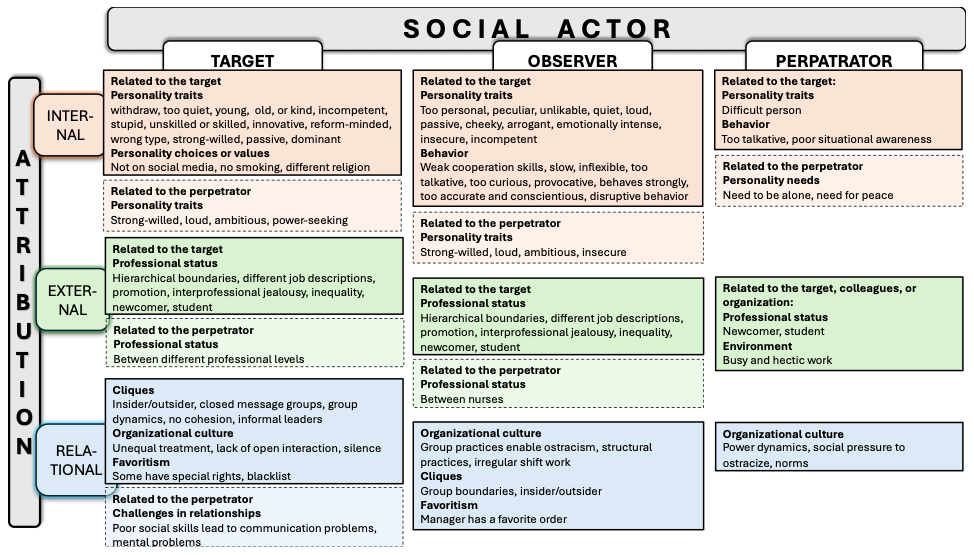
Figure 1
Summary of attributions by the target, observer, and perpetrator (in order of magnitude).
Discussion
This study examined how healthcare workers attribute the causes of workplace ostracism and how targets, observers, and perpetrators experience and interpret it. The results suggest that, regardless of who made the attributions, workers did not simply explain the causes of ostracism; instead, their narratives served as meaningful resources that protected, restored, or justified the psychological needs of those threatened. Building on these findings, the study makes three contributions to workplace ostracism research.
Workplace ostracism as a triadic process: Integrating Need-Threat Theory and attribution theory
Our first contribution is theoretical. Previous workplace ostracism research has primarily focused on individual actors, particularly targets’ experiences of exclusion and their psychological needs (e.g., Ng, 2017; Quade et al., 2017). We therefore asked how interpretations appear across roles. Our findings suggest that workplace ostracism is better understood as a triadic phenomenon involving targets, observers, and perpetrators. Rather than forming independent interpretations, these actors developed interconnected explanations that together shaped how the workplace understood, justified, and maintained ostracism.
A key finding was that attribution processes varied systematically across actor roles. Consistent with prior research (e.g., Krivacek et al., 2024), targets predominantly blame themselves for their exclusion. From a Need-Threat Theory perspective (Williams, 2009), these self-blaming attributions may represent attempts to restore belonging and meaning by creating a sense of control over the exclusion experience. Thus, targets’ explanations reflected not only causal reasoning but also efforts to cope with threatened social needs. In contrast, observers and perpetrators largely converged in attributing responsibility to the target. Consistent with prior findings (Rudert & Greifeneder, 2019; Wang & Lai, 2023), observers frequently reproduced explanations that framed the target as responsible for exclusion. Perpetrators similarly justified ostracism as a response to undesirable behavior or violations of group norms. These accounts can be interpreted as forms of moral disengagement (Bandura, 1999), allowing perpetrators to preserve a positive self-image while legitimizing exclusionary behavior. Observers occupied a more ambiguous position. Some expressed empathy toward ostracized colleagues, whereas others aligned with prevailing group norms, reflecting the tension between moral concerns and the desire for self-protection identified in previous research (Spoelma et al., 2021).
Taken together, these findings suggest that attribution processes (Eberly et al., 2011; Kelley, 1967) and need-based (Williams, 2009) reactions are mutually reinforcing rather than separate mechanisms. Targets’ self-blame, observers’ conformity, and perpetrators’ justifications formed an interconnected attributional system that normalized exclusion. While attribution theory explains how employees develop causal interpretations of exclusion (Kelley, 1967; Eberly et al., 2011), Need-Threat Theory explains why certain interpretations become psychologically meaningful (Williams, 2009). Our findings therefore extend workplace ostracism research by demonstrating how attributional reasoning and threatened needs co-evolve across actor roles in everyday workplace interactions.
Understanding workplace ostracism in a multi-professional healthcare context
Our second contribution extends workplace ostracism research to a multi-professional healthcare setting. While previous studies have documented ostracism across various organizational contexts (e.g., Liu et al., 2025), they have paid less attention to how attributional processes unfold in highly interdependent work environments characterized by professional hierarchies, strong occupational identities, and continuous collaboration.
Our findings indicate that employees explained ostracism through a combination of internal, external, and relational attributions. Internal explanations frequently focused on personal characteristics, with ostracized individuals described as somehow ‘different’ or as the ‘wrong type’ of person. Interestingly, these characteristics were often contradictory (e.g., too talkative vs. too quiet), suggesting that exclusion was not based on stable criteria but on socially constructed interpretations of deviance. Unlike Arpin et al. (2017), our results emphasize individual responsibility for following and overseeing group norms, suggesting a preference for individual-level explanations. This finding extends attribution theory by highlighting the situational and relational nature of judgments about who belongs within workplace groups.
At the same time, ostracism was strongly linked to professional dynamics, including occupational status, expertise, competition, and educational background. Unlike previous research emphasizing appearance-related factors (Rudert et al., 2017), ethnic background, economic factors, cognitive disabilities (Rudert & Greifeneder, 2019), or gender (cf., Howard et al., 2020), our respondents rarely associated exclusion with these characteristics. Instead, generational positioning (North & Fiske, 2016), healthcare-specific hierarchies, and competence expectations emerged as particularly salient. This suggests that professional positioning may serve as a more important basis for inclusion and exclusion in healthcare settings than demographic differences alone (Nishii, 2013).
Furthermore, participants frequently explained ostracism through workplace relationships and broader work-community dynamics, describing cliques, favoritism, hidden meanings in communication, and struggles over influence and status. These findings suggest that ostracism is embedded in informal norms and group boundaries rather than residing solely in individuals or situations. Consequently, the traditional distinction between internal and external attributions may be insufficient for understanding workplace ostracism, as employees often drew on relational explanations that located exclusion within ongoing social interactions.
Revealing the socially embedded nature of workplace ostracism
The third contribution stems from this study’s qualitative approach. The qualitative data revealed how ostracism is embedded within the social, cultural, and normative practices of work communities. Employees did not simply describe exclusionary incidents; they actively interpreted, justified, challenged, and negotiated their meaning. Through these interpretive processes, employees legitimized, normalized, or resisted ostracism. Explanations were therefore not neutral descriptions of events but social constructions that shaped organizational realities and influenced how responsibility for exclusion was assigned (see Rousseau, 2026).
Although workplace ostracism is often characterized as ambiguous (e.g., Ferris et al., 2008; Robinson et al., 2013), employees frequently described exclusionary acts that were highly visible and readily identifiable, such as being excluded from message groups or lunch discussions. This finding suggests that ostracism may vary in perceived ambiguity and that some forms of exclusion are experienced as clear rather than uncertain. Accordingly, the defining feature of ostracism may not be ambiguity itself, but how those involved interpret and experience exclusion (e.g., Williams, 2009).
The prominence of relational explanations further suggests that ostracism cannot be fully understood as either an individual characteristic or a situational event. Rather, exclusion emerged through ongoing interactions, informal norms, power relations, and group boundaries. Participants’ accounts of cliques, favoritism, hidden meanings in communication, and ‘us versus them’ dynamics indicate that ostracism is embedded within broader relational processes. This observation aligns with social identity theory (Richman & Leary, 2009) and relational models of belonging and exclusion (Baumeister & Leary, 1995), which emphasize that social relationships and group membership fundamentally shape acceptance and rejection.
By capturing these diverse interpretations across actor roles, the study shows that workplace ostracism is a collective, meaning-making process rather than merely an interpersonal event. This insight would have been difficult to uncover through approaches focused solely on measuring the frequency or consequences of ostracism. The findings therefore highlight the value of qualitative research for understanding how exclusion becomes embedded in everyday organizational practices and maintained through shared interpretations, cultural expectations, and normative judgments (Robinson et al., 2013). In doing so, this qualitative study extends workplace ostracism research by showing how employees actively construct the meanings through which they understand, justify, and challenge exclusion.
Practical implications
Understanding factors behind workplace ostracism is essential. While some attributions are unstable, most are perceived as stable and rooted in organizational culture. This suggests that explanations of ostracism are closely tied to interaction and cultural practices, which can reinforce exclusion. Organizations should address passive and normalized forms of ostracism, as silence around ostracism can intensify harm. Organizations can address it through prevention and management strategies (Sharma & Dhar, 2024). Essential measures include addressing group divisions, clarifying roles, improving onboarding, and fostering respect. Finally, as our study found, personal differences often trigger ostracism. Leaders should actively cultivate inclusive team norms that value diversity of thought and behavior. This includes recognizing diverse contributions, encouraging respectful disagreement, and ensuring that all employees have opportunities to participate in social and professional interactions.
Limitations and direction for future research
Like all research, this study has limitations. The web-based survey allowed broad participation but limited opportunities for follow-up, which can be challenging for exploring sensitive topics such as ostracism. Although the data were diverse, differing understandings of ostracism, a relatively unfamiliar concept in Finland, may have influenced responses, and its subjective nature may have led to differing interpretations. We also did not assess external stressors, such as COVID-19, which may have shaped perceptions. Finally, the hospital context and lack of prior cross-professional healthcare studies limit generalizability.
Building on these limitations, future research should examine organizational factors contributing to exclusionary behavior. Given ostracism’s subjectivity and cultural unfamiliarity, studies should also explore how cultural contexts shape interpretations. Further, researchers should consider external stressors such as pandemics, and comparative studies across sectors are needed to improve generalizability. More qualitative research is needed, particularly with observers and perpetrators, as well as mixed-methods and intervention studies. Finally, given the topic’s sensitivity, future research could benefit from creative, nonverbal methods to support participants’ expression.
Conclusion
We examine how targets, observers, and perpetrators interpret workplace ostracism and whether their roles influence this phenomenon. To do so, we consider multiple respondent roles and the perspectives from which they interpret and explain workplace ostracism. This study advances workplace ostracism research by showing that interconnected attributional processes sustain ostracism, not individual perceptions or behaviors alone. By integrating targets, observers, and perpetrators, it introduces an attributional system in which self-blame, justification, and conformity mutually reinforce exclusion. Based on these results, we recommend further research on workplace ostracism that considers both individuals’ and organizations’ values and cultures to better understand the mechanisms underlying this unfortunate yet partially accepted phenomenon.
Acknowledgements
Thank you to Dr. Lukas Kerschbaumer at MCI (Innsbruck, Austria) and senior university lecturer Kaarina Mönkkönen at UEF (Kuopio, Finland) for methodological discussions that clarified the nature and validity of the analysis method in this study. We wish to express our deepest appreciation to the healthcare workers who shared their experiences and observations with openness and courage. Their narratives were often profoundly moving, and their willingness to speak about difficult experiences has generated knowledge we hope will contribute to more respectful and inclusive workplaces.
Author Contributions
SMM: Responsible for the study’s conceptual development, theoretical content, data collection, analysis, methodological content, drafting the manuscript, and revising it for critically important content.
SL: Responsible for drafting and data analysis, revising the manuscript’s methodological and theoretical content, and revising it for critically important content.
TS: Responsible for drafting and data analysis, the manuscript’s methodological content, and revising it for critically important content.