
Introduction
In municipal organizations, employees work within the boundaries set by the priorities and financial objectives established at the strategic level—that is, above the operations. The priorities and financial objectives create conditions that may indirectly influence the quality of occupational health and safety (OHS) in a municipal organization (Schmidt & Sjöström 2015). In Sweden, the risk of long-term sickness absence is 30% higher in municipalities compared to the private sector—22.2 and 17.2 cases per 1,000 employees, respectively (AFA Försäkring 2024). In comparison to employees in the private sector, those in municipalities find work more mentally stressful and physically exhausting (Swedish Association of Local Authorities and Regions 2021). As municipalities account for almost 20% of total employment in Sweden (Swedish Association of Local Authorities and Regions 2023), the way in which they manage employee OHS has a significant impact on working population health. Municipal committees and the boards of directors in municipally owned companies (MOCs) are strategic bodies in the Swedish municipal context with influence over organizational priorities and financial objectives. Against the backdrop of long-term sickness absence and the increasing need for competence provision (Swedish Association of Local Authorities and Regions 2021), OHS can be considered a strategically important part of these board meetings’ agendas. However, little is known about whether OHS is discussed at board meetings in municipalities or the conditions that facilitate such discussions. The internal working processes of boards of directors have been described as opaque or difficult to understand from the outside (Guerra 2021). This study opens this ‘black box’ of board OHS governance in municipalities by making several contributions to the literature. First, it provides insights into the facilitating conditions for board OHS discussions at the individual, group, and organizational levels. These insights are derived from the reflections of the MOC board and municipal committee chairs and vice-chairs on the factors that lead to OHS discussions in the boardroom. Second, the study sheds light on boardrooms as arenas for social relationships, encompassing interactions within the board and with organizational representatives. Although the significance of an open discussion climate for effective boards has previously been demonstrated (Veltrop et al. 2017), the present study elucidates how the quality of the discussion climate relates to OHS. Finally, it highlights potential differences between MOC boards and municipal committees when it comes to obtaining and sharing OHS information.
The roles of MOCs and municipal committees in a Swedish municipality
A Swedish municipality is a local government entity that is commonly organized in several administrations and MOCs. The administrations and MOCs specialize in various public services, such as education, social services, elderly care, urban planning, rescue services, and energy and water management. Each administration and MOC is governed by a board with politically appointed members. The board for an administration is called a ‘committee’. An MOC is a limited company, and its board’s role is to represent the owner—the municipality. As with any limited company, an MOC board shoulders the responsibility for governing the business in line with the owner’s interests. In a private limited company, this interest is normally financial value creation, whereas in an MOC, the profit motive is replaced with the motive of public benefit (SFS 2017:725) even though an MOC is allowed to make a profit. The key tasks for boards in limited companies are to establish a strategic direction, set standards and objectives for operations, oversee internal controls, and hold management accountable. A board is also responsible for top management’s organizational priorities and the organization’s legal compliance. According to the Swedish Work Environment Act (SFS 1977:1160), these key tasks also include OHS. In a limited company with at least 25 employees, the employees have the right to have representatives on the board (SFS 1987:1245), which is not the case for municipal committees. Although an MOC board enacts its influence through the CEO, the equivalent role in relation to municipal committees is that of the administrative director. The municipal committee in each administration breaks down the overall goals and allocates the financial resources established by the municipal council. A municipal committee is also responsible for the value that its administration provides in terms of service to the municipal residents. In municipalities, the board with the ultimate OHS responsibility is the municipality council; however, in this study, the focus is on the boards closest to the operations—the MOC boards and municipal committees—to whom the OHS responsibility for the operative employees is normally delegated.
The board and OHS
Research on boards’ influence on OHS is still new (Ebbevi et al. 2021), which reflects the fact that OHS in many organizations has traditionally been viewed as an operational concern (Boardman & Lyon 2006). Common OHS activities for boards of companies with more than 250 employees are to annually review OHS policies, set objectives for health and safety, and use OHS audit reports (Wright et al. 2003). It has been suggested that the board’s role is not to initiate or drive safety efforts but, rather, to ensure managerial accountability for them (Locke & Cross 2009). However, there is an increasing trend toward stricter sustainability reporting requirements, including working conditions (e.g., the European Union’s Corporate Sustainability Reporting Directive), which has previously been shown to be a driving force for board engagement (Lornudd et al. 2020). The existing empirical data suggest that board engagement does indeed have a positive association with organizational safety outcomes (Bunn et al. 2001; Joss et al. 2017; Schrover 2008; Thompson & Tan 2016; Ebbevi et al. 2021), which lends support to the rationale for increasing the requirements placed on boards. In addition, some studies indicate that the quality of OHS in an organization is related to its overall financial performance. For example, Strömberg et al. (2017) showed that suboptimal OHS has major indirect costs in terms of productivity loss. On a more positive note, listed companies with a high level of employee well-being (e.g., less stress at work) have been found to outperform standard benchmarks in the stock market (De Neve et al. 2023). These studies indicate that the quality of OHS may be related to an organization’s long-term value creation, which is at the core of a board’s responsibilities. Hinsz et al. (1997) conceptualized a board as an information-processing group, and in conformity with this, a massive amount of research has focused on the significance of information for a board’s effectiveness. For the present study, we identify two relevant streams of research. One is the significance of the board’s competencies for its effectiveness (Coulson-Thomas 2021; Ruigrok et al. 2007). This research suggests that individual directors’ competence can impact the kind of information being shared and discussed. However, the extent to which this applies to OHS is still unknown. The second stream of research concerns the quality of information from the operations for a board’s effectiveness (Ainsley 2019; Brennan et al. 2016; Roy et al. 2017). To our knowledge, no previous study has investigated how the quality of OHS information provided to a board is related to the prevalence of OHS discussions. The existing literature on both streams of research is summarized below.
Influence of board member competence on board discussions
Empirical research has demonstrated that boards have the capacity to significantly influence various organizational processes and outcomes (Korac-Kakabadse et al. 2001; Stiles 2001). The existing literature has mainly concentrated on the relationship between board characteristics and organizational performance. One of these characteristics is board members’ competence. For instance, the presence of legal experts on a board has been linked to improved environmental performance in external investment indices (De Villiers et al. 2011), boards that include medically trained members have been shown to positively affect clinical quality in hospitals (Veronesi et al. 2013), and members’ experience serving on multiple boards has been associated with firm growth (Kor & Sundaramurthy 2009). One way to understand such relationships is that competence impacts what subject is discussed, how, and, ultimately, the decisions made. Bezemer et al.’s (2014) observational study found that the interests, expertise, and skills of individual board members had a significant impact on their participation in specific agenda item discussions. Thus, when a board member experienced a lack of interest, expertise, or skill, participation in this agenda item decreased. In accordance with this, Lornudd et al. (2020) reported that in large private companies, board member OHS competence was perceived as vital for boards’ OHS engagement. Director OHS competence has been identified as one of seven principles for best OHS board practice (Boardman & Lyon 2006), which further demonstrates the importance of such competence. However, whether OHS competence is perceived as a facilitating condition for OHS discussions in the municipality context remains to be investigated.
Importance of overcoming information asymmetry in board OHS discussions
Information asymmetry occurs when some actors have more information than others, leading to an information advantage (Akerlof et al. 2001). Although the concept originated in economic sciences, it has also been applied in management research—for example, in corporate governance with a focus on organizational behavior (e.g., Boivie et al. 2016). In a review of management research on information asymmetry, Bergh et al. (2019) outlined three groups of antecedent conditions that may lead to information asymmetry. One group is strategic and behavioral barriers to sharing information—that is, actors hiding information for the strategic benefit of themselves or their businesses. In line with this, Lornudd et al. (2021) indicated that boards in the private construction and manufacturing sectors are aware of this antecedent condition and therefore actively encourage risk reporting by employees. The extent to which overcoming this group of antecedent conditions is related to boards in municipalities and their perception of facilitating conditions for discussing OHS remains to be investigated.
A second kind of antecedent condition to information asymmetry is structural and reduces actors’ access to or possibility of disseminating information. The structural distance between the board and the management creates a gap, which may cause the board to have reduced access to information about the organization compared to managers running daily operations. The management, for their part, may have a challenge disseminating relevant information to the board. The board members in a municipal context are usually local residents, which may shorten the information paths to the employees. Whether boards in a municipality context perceive such a structural gap in relation to OHS is unknown. A third antecedent condition that may lead to information asymmetry is unobservable or uncertain factors in work processes—for example, a complex service that is difficult to capture and measure. In relation to OHS, one potential translation of this antecedent condition may be the challenge of measuring causal links between variables such as work environment, engagement, turnover rates, service quality, and value creation. These causal relationships are often multifactorial and delayed over time, sometimes for years (Arbetsmiljöverket 2023). This obstructs insight into the impact of OHS on organizational outcomes, which, for a board, may be relevant to its willingness to invest time in discussing OHS.
In summary, based on the view of a board as an information-processing group (Hinsz et al. 1997), director competence and information provision may be deemed valuable perspectives for elucidating facilitating conditions for board OHS discussions. To better understand the perspectives of boards in a municipality context, the aim of the study is to investigate vice chairs’ and chairs’ perceptions of the conditions that facilitate OHS discussions in the boardroom. Furthermore, we address the following research questions:
Research Question 1: What are (vice-)chairs’ views on the role that board OHS competence plays in relation to board OHS discussions?
Research Question 2: What are (vice-)chairs’ perspectives on the conditions that facilitate the provision of OHS information to the board, and how does such provision influence OHS discussions?
Methods
Setting
Sweden is divided into 290 local government entities known as municipalities. These municipalities are funded primarily through taxes, fees for specific services, and government subsidies. They possess significant autonomy and taxation power and employ approximately 1.2 million people (Statistics Sweden 2024). MOCs have emerged as significant contributors to the Swedish economy. They serve as vital revenue streams for municipalities, especially in major urban centers (Swedish Government’s Official Reports 2015). In 2021, 1,854 companies, most of which were owned by municipalities, employed around 62,000 people. This accounts for slightly over 6.5% of all individuals employed across Sweden’s 290 municipalities (Bergh & Erlingsson 2024). The primary domain in which Swedish MOCs are active is public housing and real estate, constituting 43% of all MOCs. This is followed by technical activities, such as electricity, gas, heating, cooling, water, and sewage, which make up 25% of all MOCs. Companies in health and social care constitute 0.6% of municipality-owned companies, according to the employer organization Sobona (Personal communication, November 2021). In Sweden, municipalities and MOCs operate under public law (Swedish Local Government Act), while MOCs are also governed by private law (Swedish Companies Act) (Bergh & Erlingsson 2023).
Participants
The study involved chairs and vice-chairs on MOC or municipal committees in Swedish municipalities. It is part of a larger research project that aims to compare MOC boards and municipal committees as well as municipal committees in technical and social administrations. Thus, all participants were either responsible for technical or caring services and were elected as vice-chairs or chairs on MOC or municipal committees. Both full-time and part-time politicians were represented in the sample. The aim of the recruitment strategy was to ensure diverse representation of municipalities of different sizes across various geographical areas of Sweden. To achieve this, a random stratified sampling method was employed based on the classification of Swedish municipalities provided by the Swedish Association of Local Authorities and Regions (2023), which categorizes municipalities into three groups: large cities and municipalities near large cities, medium-sized towns and municipalities near medium-sized towns, and smaller towns/urban areas and rural municipalities. From each of these municipal group classifications, four municipalities, along with their corresponding MOCs, were randomly selected, totaling 12 municipalities. In total, there were 34 participants (Table 1). The respondents had to be at least 18 years old and proficient in Swedish (speaking, reading, and understanding).
Data collection
Data collection commenced in autumn 2022 and concluded in spring 2023. A semi-structured interview guide featuring open-ended questions was used to align with the study’s objectives. Initially, the interview questions were intentionally broad and open-ended to mitigate the influence of the researchers’ assumptions and theories. The interview guide was employed flexibly, allowing for probes and sub-questions based on the information received. The participants were encouraged to provide factual and personal responses rather than political ones. The interview guide underwent testing with an advisory board comprising employers and representatives from municipal sector unions and the Swedish Work Environment Authority. Two pilot interviews were conducted (not included in the analysis), resulting in minor adjustments. Potential participants were identified from municipality websites, contacted via email, and provided with study information. If they agreed to participate or requested further details, additional information was provided via email or phone. Upon agreement to participate, the participants were scheduled for individual video meetings (via Teams), preceded by verbal information before the interview. Two interviews were conducted face-to-face. All interviews were digitally audio recorded and lasted between 40 and 90 minutes.
Data analysis
The study was conducted from a contextualist and interpretivist epistemological position (Braun & Clarke 2022), viewing OHS governance as socially constructed through the meanings and experiences of municipal committee and MOC board vice-chairs and chairs. The participants’ accounts were understood as shaped both by individual perspectives and broader organizational, political, and legislative contexts. This perspective informed both data collection and analysis, emphasizing rich, nuanced accounts over single, ‘objective’ descriptions.
We employed a template approach to thematic analysis (King 2004; 2012; Braun & Clarke 2022), supported by QSR NVivo software. NVivo was used to store, organize, and retrieve coded data systematically, enabling transparency and traceability. All interpretive decisions, including code definition, merging, and theme development, were made by us in the research team. We began the process by extracting the dataset relevant to this sub-study from the broader project. We first read the same three transcripts, focusing on the overarching concept of ‘facilitators of and barriers to OHS governance’. We compared and discussed interpretations to ensure a shared understanding of the data’s scope, not to enforce mechanical coding uniformity. This collaborative phase reflected our interpretivist stance and entailed using discussion to enrich analysis through diverse disciplinary perspectives (psychology, work environment studies, and public administration). The initial coding template applied a priori categories—individual, group, and organizational system levels—derived from the existing OHS governance literature (e.g., King 2004; Nielsen et al. 2017). These served as organizing ‘parent nodes’ in NVivo, structuring the analysis without constraining the emergence of new ideas. Within each system level, inductive subcoding was used to identify patterns in the data. Through iterative reading and rereading, these subcodes were developed into themes capturing shared meanings and interpretive stories. Themes were refined through repeated merging and splitting (e.g., recognizing that ‘conducting field visits’ and ‘dialogue with trade unions’ reflected the broader theme of ‘active OHS information gathering’). The term ‘theme’ is used throughout to refer to these final analytic constructs. The analysis continued until all the authors agreed that the themes provided a coherent and comprehensive response to the research questions.
Ethics
The study was approved by the Swedish Ethical Review Authority (Reference number 2022-01778-01). All the participants gave informed consent, including for digital recordings. We assured the participants of confidentiality and that they had the right to withdraw from the study without providing a reason. The research procedures strictly followed the ethical guidelines for human research laid out in the Declaration of Helsinki (World Medical Association 2013).
Results
We set out to investigate facilitating conditions for boards in a municipality context to discuss OHS in board meetings and generated seven themes at the individual, group, and organizational levels.
Figure 1 presents a graphical summary of the seven themes and how they are related. The individual (vice-)chair’s general interest in OHS is related to an active approach to OHS information gathering and to how the chair creates an open discussion climate in the boardroom for OHS perspectives. Simultaneously, a psychologically safe climate for group discussions in the boardroom facilitates the discussion of OHS and the possibility of obtaining candid OHS information from the organization. Finally, high-quality OHS information from the organization and high-quality OHS training for boards support the (vice-)chair’s level of OHS interest. The themes are summarized in Table 2. In the following section, we describe the themes.
Table 2
Theme levels (individual, group, and organizational) and descriptions.
| THEME LEVEL | THEME | DESCRIPTION |
|---|---|---|
| Individual | General interest in OHS | The significance of a (vice-)chair’s individual interest in OHS for effort that they invest in OHS |
| Individual | Active OHS information gathering | Active OHS information gathering is facilitated by the (vice-)chair’s interest |
| Individual | Positive influence on board OHS discussion climate | The positive influence of the chair’s leadership on the board discussion climate for OHS |
| Group | Psychological safety in the board | The significance of psychological safety on the board for speaking one’s mind, including OHS |
| Group | Psychological safety for organizational representatives | Discussion climate’s impact on provision of OHS information from organizational representatives not belonging to the board |
| Organization | High-quality OHS information from the organization | OHS information distributed to the board enables discussions when sufficiently granular and not idealized |
| Organization | High-quality OHS training for boards | OHS training that can strengthen board’s competence and engagement |
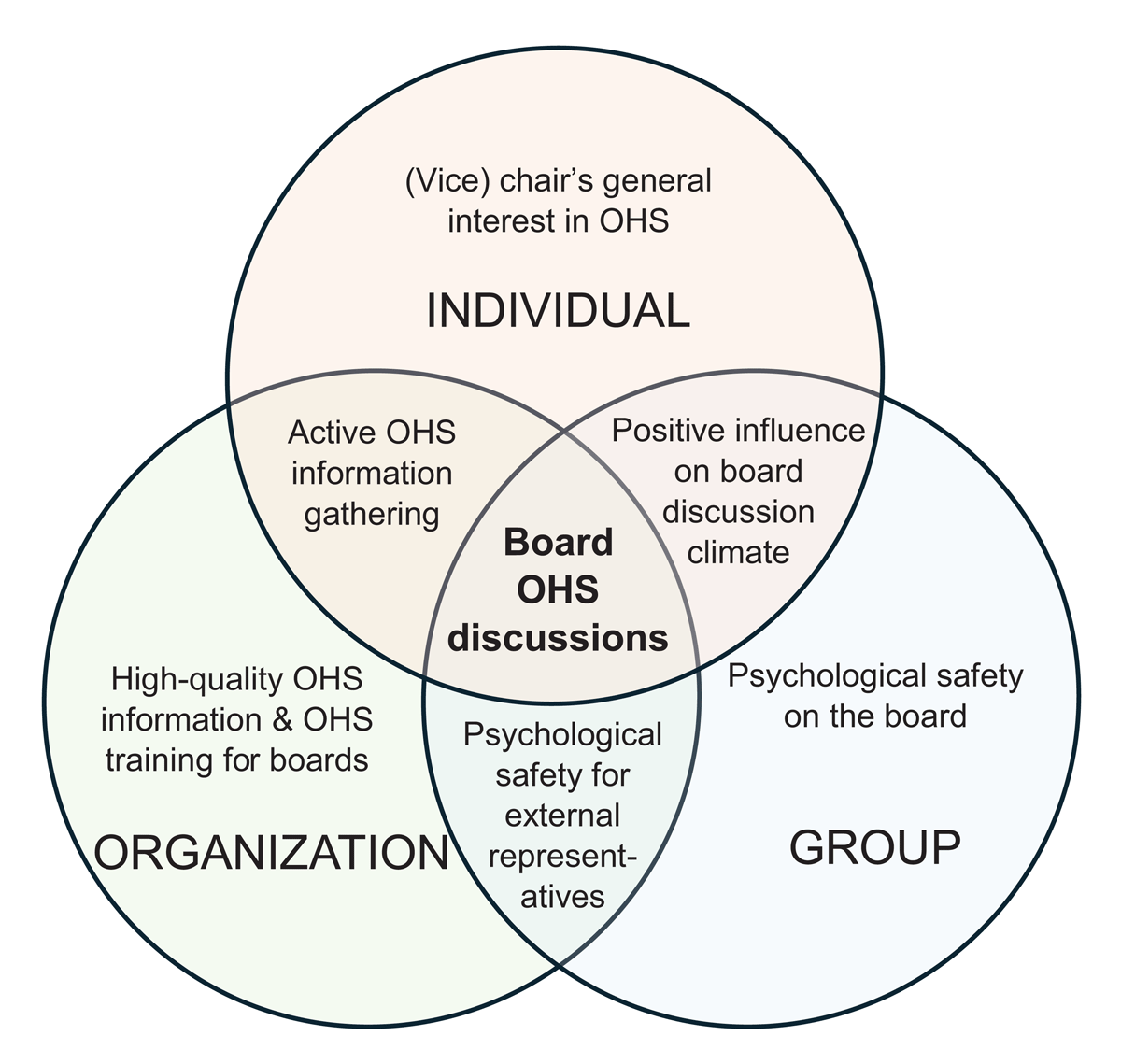
Figure 1
A graphical summary of the themes that constitute facilitating conditions for board OHS discussions and how they are related.
Facilitating conditions at the individual level for board OHS discussion
General interest in OHS
At the core of this theme are statements highlighting the importance of a (vice-)chair’s individual interest in OHS in shaping how it is discussed in the boardroom. A (vice-)chair’s personal belief that OHS is an important responsibility could follow from previous competence in the human resource area or from personal experience of the importance of OHS in an operative leadership role or as an employee. It could also be tied to political values or follow from a previous role as a union or safety representative. Individual interest was described as having a larger impact than the (vice-)chair role’s formal responsibility or structural processes regarding how OHS was prioritized:
But then, you know, people are interested in it to varying degrees. Some approach it somewhat halfheartedly. And for others, it’s incredibly important. It’s probably more about the individual than the role. What I, as an individual, bring to the table, so to speak. And how I’ve thought about the work environment. (Vice-chair 8, social MOC)
While competence, experience, or values were viewed as the foundation for individual interest, up-to-date OHS knowledge was considered less important for board OHS discussions and could instead be provided by management:
I think attitude is the most important thing, and if you have that attitude, you have the possibility to question, and then there is always someone who can produce the actual documentation that shows what conditions and opportunities you have. (Chair 19, technical MOC)
Active OHS information gathering
This theme concerns how (vice-)chairs’ active information-seeking regarding the organization’s OHS status appeared to be facilitated by their own interests while at the same time enhancing their and their board’s knowledge. This empowered the board:
It’s like this: Knowledge is power in these situations. The more you know, the more you can act based on that. So, there aren’t really any bad approaches; it’s again about having the interest to try to gather as much information as possible before making a decision. This brings us back to the idea of commitment—putting in the time and being present in these various places—and eventually, the information will surface. (Chair 2, technical committee)
Several descriptions showed that some respondents, in contrast with standard procedures or their predecessors’ priorities, had initiated an active approach to capturing OHS information. One example concerned field visits for MOC boards. Although several respondents from MOCs referred to the Swedish Companies Act’s paragraph about the board’s strategic role as a constraint for field visits, some chairs had another interpretation and encouraged field visits to pick up on OHS signals. Respondents from municipal committees described field visits as uncontroversial. However, several of them had experienced large variations in priority among (vice-)chairs:
My predecessors never went out in the field; they only listened to the civil servants and didn’t join them when they were out inspecting cases. It’s something I’ve introduced—that we should be involved in this. So, it makes a big difference. With a different chairperson, things could be completely different. (Chair 4, technical committee)
Several positive consequences following field visits were mentioned, such as lowering the threshold for employees to contact board members or the board becoming aware of employee working conditions that would not have otherwise reached the board. One example, which ultimately led to a decision about investment in new premises, was given by the following chair:
Early on, I visited one of our units, where staff were changing in a space without any basic heating. They had put in a construction heater just so they wouldn’t freeze to death while changing into their work clothes. And I immediately felt, I found out about this when I got there. Why didn’t I know about it before? (Chair 1, social committee)
Most respondents from the MOC boards referred to the board’s union employee representative in an uncontroversial manner, likely because employees are entitled by law to representation on company boards. This was not the case with the committee respondents. Some had actively initiated a dialogue with the unions based on their individual initiative rather than on standard procedures. Different unions were described as varied in their receptiveness to such dialogues, which indicates that dialogue was not the norm. However, through such dialogues, a (vice-)chair could obtain information that had been excluded from formal reports.
Positive influence on board OHS discussion climate
This theme centers on the impact of the chair’s leadership on the quality of the OHS discussion climate. A chair’s interest in OHS could spark an OHS perspective on boardroom discussions:
I’m genuinely interested in HR issues. So, of course, that has played a role in this. If I weren’t, neither I nor the municipal committee would probably have delved as deeply into these matters as we had. (Chair 1, social committee)
However, a chair who is not specifically engaged in the OHS perspective can also encourage this perspective in discussions. If a chair has a leadership style that fosters plurality and recognizes collective competence in the boardroom, OHS can become one of the perspectives that shed light on an issue:
I usually say that we should be as diverse as possible because the more heterogeneous we are, the better work we can do. On the board, I know that someone is an HR manager in their day-to-day job. So, when we get to a relevant issue, I’ll say, “Well, you, as an HR manager, what do you think? How would you handle this?” (Chair 7, social MOC)
In contrast, a chair who reacts negatively to OHS issues risks creating a board with a discussion climate that has a low tolerance for OHS perspectives, which was this respondent’s perception:
I don’t think the chairperson has it high on their list of priorities. The only time they criticized a report was the HR report. “Why is this needed?” That’s what they said, so they are not interested in this. (Vice-chair 9, technical MOC)
Facilitating conditions at the group level for board OHS discussion
Psychological safety on the board
At the core of this theme is the significance of an open discussion climate for raising OHS perspectives on the board. Negative reactions from other board members, such as indignation, criticism, silence, or disengagement, were highlighted as barriers to sharing one’s opinion. Some respondents perceived the boardroom discussion climate as rough. In fear of not being accepted and welcomed, they silenced themselves:
Sometimes, I choose not to bring things up on the board, like suggesting field visits, because I know that no, the others won’t understand or agree with me. Doing so would only harm my social standing on the board. (Vice-chair 12, technical MOC)
However, some respondents described a discussion climate in which board members showed curiosity about one another’s perspectives and uncomfortable truths could be expressed, indicating a high level of psychological safety:
The employee union representative isn’t afraid to speak his mind, which is quite good. On the other hand, he sometimes says things that some might not want to hear, but that’s another matter. He is a very valuable source of information, and people listen to him. (Vice-chair 11, technical MOC)
Psychological safety for organizational representatives
This theme captures how the perceived quality of the boardroom discussion climate as experienced by organizational representatives (i.e., nonboard members) influenced the provision of information. Several respondents highlighted the importance of a board that signals interest and adopts a solution-oriented approach for receiving candid OHS information from organizational representatives. One example of a respondent who seemingly nurtured an open discussion climate was the vice-chair, who shared the following view:
You shouldn’t see it as a sign of weakness to ask your board for input… When my sector manager comes in to discuss work environment issues with us within their sector, I see that as a strength. That we talk about it because then we can find a solution […]. The worst thing we can do is try to ignore these kinds of issues. (Vice-chair 8, social MOC)
Thus, help-seeking was recognized as a positive quality, as was the importance of the board not turning a blind eye to OHS issues. By creating a psychologically safe climate in which problems can be raised, boards are more likely to be informed. Some of the respondents who had experienced negative discussion climates reflected on the potential consequences that a psychologically unsafe discussion climate may have for OHS in a broader sense. In addition to indicating that some individuals may be reluctant to meet with politicians and therefore share less information, it was emphasized that boards that routinely invite organizational representatives can influence the quality of OHS through the way in which they discuss issues with them:
There are some politicians who can be rude and unpleasant to civil servants when they come to the municipal committee to explain what they’ve done or provide updates. If a culture develops where people don’t feel good about coming to meet politicians, we’ve already created a poor work environment. Because word about this spreads. (Chair 2, technical committee)
Facilitating conditions of the organization for board OHS discussion
High-quality OHS information from the organization
Central to this theme are descriptions of the ways in which OHS information reaches the board and how more detailed OHS metrics facilitate OHS discussions. The interviews show that the boards and committees regularly receive information from their organizations to varying degrees. The full list of examples included risk analysis reports, sick leave rates, information about incidents/accidents, turnover rates, employee survey results, the number of employees undergoing competence development, civil servant-/manager-informing at board meetings, CEO and top management reports (MOC boards), internal revisions, and information through collaboration with chief security officers and trade unions (municipal committees). Some respondents considered OHS metrics, such as employee surveys and sick leave rates, crucial for the board to fulfill its OHS responsibilities.
I would probably say that the sickness statistics are the most important, because at the overall level, that’s what you kind of react to. (Chair 1, social committee)
Others took a more critical stance toward OHS metrics, reflecting on the rationale for presenting them to the board:
They’re pushing the teachers to the brink, and employee surveys reveal very alarming figures of stress in many schools. This is glossed over by merging the data into some sort of average figures that are passed up the chain. And by the time that’s done, there’s really nothing to argue about because it falls somewhere around the average, and that’s that. […] If we’re being blunt, this might be what helps cover your back. However, the question remains: Does it help the employees get a better work environment? (Chair 3, technical committee)
Highly aggregated OHS metrics may not stimulate boardroom discussion—‘There’s really nothing to argue about’—when overall averages look satisfactory. More granular OHS metrics may enable the board to discuss and engage proactively rather than reacting only when averages clearly deteriorate or after adverse events. However, the provision of granular metrics and other types of OHS information is facilitated by high levels of perceived psychological safety among organizational representatives. Several respondents shared clear examples of low-quality OHS information, such as overly idealized reports to the board or committee or the identification of OHS deficiencies by internal audits. This may indicate a reluctance to or fear of disclosing OHS problems.
High-quality OHS training for boards
This theme highlights the gap between the current rudimentary OHS training provided to boards and training that could strengthen board members’ competence and engagement. The respondents described introductory courses for newly elected officials, provided by the municipality, in which OHS was addressed. The respondents described varied experiences with such introductions: Some could not recall receiving any, whereas others had participated in introduction programs. In these programs, OHS was largely confined to the formal aspects of board responsibilities and legislation:
When we have training for politicians, you go through what the Local Government Act means, how you make decisions, issues of conflict of interest, and so on. And then there are a few paragraphs about work environment and delegation and such. (Vice-chair 30, social MOC)
One notable exception to such rudimentary OHS training was the chair who attended an extended course in OHS, which seemed to have raised the competence in a way that fostered engagement:
When I was new as chair of the municipal committee, we had a three-day training course on work environment issues. It focused a lot on what responsibilities you have, how to fulfill them, and what to do in various processes, like how a rehabilitation process works. It was incredibly valuable and useful. (Chair 29, social committee)
Opinions about what OHS competence boards should have included being aware of the responsibility and legislation and balancing a strategic role in relation to operations. The view that being aware of responsibility is not enough was also raised; board members also need to know how health is affected by the work environment and the significance of making OHS a priority at the board level. Thus, there appears to be a gap between the current rudimentary OHS training provided by municipalities and that which respondents believe they need, training that would be more likely to promote board OHS engagement.
Discussion
This study aimed to investigate vice-chairs’ and chairs’ perceptions of the conditions that facilitate OHS discussions in the boardroom. The results show that facilitating conditions can be linked to the individual, group, and organizational levels, which interplay. The most prominent finding is perhaps the significance of the individual (vice-)chair’s general interest in OHS, which creates ripple effects throughout the board and affects its interaction with the organization and ultimately impacts the extent to which OHS is discussed.
Our first research question considered the (vice-)chairs’ views of what role board OHS competence plays in relation to board OHS discussions. The results show that the (vice-)chair’s personal interest in OHS, rather than the responsibility tied to the (vice-)chair’s role, is a driver of the investment of time and effort in OHS. Respondents described their general interest in OHS as linked to previous formal competence or personal experiences its importance. The analysis showed that such general interest, in a dynamic interplay, seemed to both enable and be strengthened by actively seeking information about OHS; this is well captured by the adage ‘The more you know, the more you realize you don’t know’. Thus, a board with a (vice-)chair holding a general interest in OHS is more competent than a board without such a (vice-)chair and becomes increasingly competent as this individual takes action to learn more. A chair with a general interest in OHS also actively encourages discussions that would not otherwise have taken place. This is in line with research reports on the influence of the chair’s leadership style on a board’s involvement in discussions (Nahum & Carmeli 2020; Veltrop et al. 2017).
In addition to the influence of individual (vice-)chairs on board OHS discussions, high-quality OHS board training was shown to be a facilitating organizational condition. Respondents voiced a need for deeper knowledge of OHS and of the board’s role, knowledge that is not included in the predominant rudimentary training. Politically appointed board members can come from very different backgrounds, with a large variation in experience and education. Moreover, political parties in Sweden have different traditions in relation to worker rights. Therefore, OHS risks being viewed as a political issue rather than as a question of an employer’s legal responsibility. Given that board members’ OHS competence is one of the key principles for governing OHS in general (Boardman & Lyon 2006) and for how they engage in discussions in particular (Bezemer et al. 2014), offering training to ensure sufficient OHS understanding may be particularly important in this context. High-quality training for OHS board members may underline the employer’s responsibility and increase their inclination to initiate and participate in OHS discussions. Considering the relatively high risk of long-term sickness or absence in municipalities (AFA 2024) and the challenges in attracting employees, OHS may encompass business-critical competence at the board level.
Our second research question considered (vice-)chairs’ perspectives on the conditions that facilitate the provision of OHS information to the board and how such provision influences OHS discussions. Information is a central resource used by decision-makers (March 1994), and our results suggest that the (vice-)chair’s general interest in OHS helps OHS information become such a resource. Our respondents provided several examples of information gathering that contradicted standard procedures, which varied between MOCs and committees: While MOC respondents described making field visits in contradiction to the traditional interpretation of the Swedish Companies Act, committee respondents referred to union dialogue as running counter to convention. Such deviations from standard procedures appeared to be facilitated by a personal interest in OHS. Thus, at the individual level, the results indicate that an interested (vice-)chair may find ways to overcome the structural antecedent conditions of information asymmetry described by Bergh et al. (2019).
At the group level, the present study suggests that a low degree of psychological safety on the board may be a barrier to discussing OHS. The significance of creating an open discussion climate is underpinned by the rapidly growing body of research on psychological safety (Edmondson 1999). Psychological safety is defined as a discussion climate in which group members are willing to take the interpersonal risk of sharing their perspectives without fearing negative reactions from others (Edmondson 1999). This also happens in groups of high status and power, such as boards (Forbes & Milliken 1999; Lornudd et al. 2021). In the interviews, there were examples of vice-chairs silencing themselves about OHS to avoid negative personal and social consequences on the board. This is a common strategy for being accepted in a group with low psychological safety (Edmondson 1999). High psychological safety facilitates cognitive dissonance, which is crucial for effective board processes (Forbes & Milliken 1999). Psychological safety in the boardroom therefore comes forth as a facilitating condition for discussing OHS on the board. A psychologically safe discussion climate also had an impact on the transparency of organizational representatives. Communicating a problem may entail interpersonal risks (e.g., criticism and loss of status or career opportunities), which Bergh et al. (2019) defined as strategic/behavioral antecedent conditions of information asymmetry. Several studies support the significance of psychological safety for candid upward communication (Edmondson & Lei 2014). Although a board can request any information it deems fit, the way it responds to the information—and to the persons delivering it—may impact the representatives’ future willingness to deliver information. In summary, our findings at the group level indicate that the quality and quantity of OHS information provided by the organization or shared among board members increases with a higher degree of psychological safety in the boardroom.
At the organizational level, high-quality OHS information, in the form of more granular OHS metrics rather than highly aggregated averages, was shown to be a facilitating condition for board OHS discussions. An overall figure from an employee survey may obscure important differences between working units and impede necessary OHS discussions, whereas more granular information enables proactive engagement on the part of the board. One underlying reason for the use of aggregated OHS metrics that was highlighted was a wish to conceal problems and ‘cover one’s back’. This underlines the significance of creating a solution-focused and psychologically safe discussion climate in the boardroom to overcome what Bergh et al. (2019) defined as a strategic and behavioral barrier to sharing information.
Bergh et al.’s (2019) third antecedent condition to information asymmetry—factors that are unobservable or uncertain in the work processes—was not mentioned in the interviews as a barrier to having OHS discussions. Because the causal links between OHS and value creation are multifactorial and time delayed, making them both unobservable and uncertain, this could have been highlighted as a barrier (i.e., a lack of facilitating conditions). One potential explanation for this not being addressed is that the respondents may have assumed such causal relationships, despite limited research, with Strömberg et al. (2017) being one notable exception.
Practical implications
The finding that the individual (vice-)chair’s interest is so influential for OHS to be discussed on the board implies that the governance structure, such as stipulated practices and processes for a board, allows for a large degree of individual freedom. From this, it follows that various municipal administrations and companies within the same municipality may have different ‘tones from the top’. A recent study suggests that one of the board’s roles is to set the agenda for the organization’s priorities (Lornudd et al. 2021). If a board focuses on OHS, the civil servants of the administration or the MOC’s managers are likely to do so as well. A board’s requests, inquiries, and follow-ups receive more attention in the organization than matters that are neither requested nor followed up. Moreover, as members of municipal committees or MOC boards, politicians play a symbolic key role in conveying decisions, values, and norms to both managers and employees (Härenstam et al. 2024). The significance of having a chair that encourages OHS discussions in the boardroom is thus extended to the whole organization. Based on the volume of research correlating OHS to well-being (Bakker et al. 2023; Barnay 2016), our results indicate an individual-dependent reality that underscores the significance of building an organizational context that also supports OHS at the board level. The MOC board and municipal committee members are elected officials, many of whom are part-time politicians. Like other employees, they fulfill their mission within the boundaries set by the organizational context. Intensifying the municipal OHS governance structure and providing extended board OHS training may be one way to support and underline the employer’s responsibility toward OHS and decrease the dependence on the (vice-)chair’s individual interest.
Methodological limitations
Despite the contributions outlined above, the study has some limitations. One of these is the selection of participants. To adjust for biases, we used stratified sampling based on municipality size and geographical location and randomized a list of municipalities within each stratum. Among the municipality (vice-)chairs we invited, several declined to participate for unknown reasons. It can be assumed that the study attracted vice-chairs and chairs with an interest in OHS, which had an impact on the results. It could also be argued that a highly interested group is well-positioned to reflect on the topic and provide rich data.
A second limitation in qualitative inquiry is the risk of social desirability—that is, respondents presenting answers that are more socially acceptable than their true opinions. Politicians—the majority of our respondents—are generally unafraid to express their opinions. However, politics is also very much about convincing people of the positive side of their views, and politicians can be media trained. To mitigate the risk of social desirability, we took several measures. In addition to guaranteeing strict confidentiality for both respondents and their municipalities, we adopted a curious and nonjudgmental approach in the interviews. The interviews were also conducted by researchers with degrees in psychology and experience in conducting interviews, including with politicians. Our perception is that most respondents were comfortable enough to speak their minds, which is supported by the fact that they offered several less flattering examples of OHS in their organizations. Several respondents expressed insights into personal knowledge gaps during the interviews, and examples of discrediting other political parties were scarce, which suggests that they did not use the interview as an opportunity to talk about politics.
The transferability of the findings within Sweden was strengthened by our sampling method, which included multiple municipalities of different sizes located all across Sweden. However, it should be noted that the participants were limited to vice-chairs or chairs. Thus, it is their voices that constitute the data. The relationship between municipal committees and their administrations varies significantly across municipalities in terms of how closely politicians are connected to operations. These variations were not captured in this study. Moreover, the relevance of our findings from an international perspective is more difficult to assess. Governance structures in the public sector differ between countries. Yet, the significance of a participative leadership style, psychological safety, and the mitigation of information asymmetry for board governance has been supported in a multitude of international studies, which speaks to the relevance of the results of this study for board OHS governance across settings. Future research could investigate strategies to enhance the quality and transparency of OHS information shared with boards, with particular attention paid to mitigating the effects of window dressing and overly aggregated metrics. Another avenue for future research could involve conducting longitudinal studies to assess the impact of boards that prioritize OHS discussions on organizational outcomes, such as employee health, productivity, and overall performance.
Conclusion
Previous research has highlighted the positive association between board engagement and organizational safety outcomes, yet little is known about the conditions that enable boards to actively engage in OHS discussions in the boardroom. The current study contributes to understanding the facilitating conditions at the individual, group, and organizational levels for boards in the municipality context to discuss OHS. Our results show that (vice-)chairs’ general interest in OHS has a significant influence on whether and how it is discussed on the board, both in terms of influencing psychological safety and how actively OHS information is gathered. High levels of psychological safety further facilitate the acquisition of candid OHS information from the organization. Our findings suggest that OHS governance in municipality administrations and companies is individual dependent and that the governance structure for OHS is insufficient to ensure that OHS is discussed at the board level when warranted.
Appendices
Appendix 1. Interview guide
Background questions
What is your political role?
Which political party do you represent?
View of work and health
Briefly – what do you think of when I say ‘work and health’? Do they fit together for you, and if so, how?
If you consider your administration/company – what is your perception of work and health there? What do you think makes employees feel good or bad at work? Or become ill because of their job if/when they do?
Have you noticed anything that officials/managers perceive as a challenge in achieving a good working environment? What?
How would you characterise what the work environment looks like in male-dominated municipal organisations compared to female-dominated organisations?
Practices related to OHS
If you consider what your committee/board does in practice when working with the work environment based on your responsibilities and roles – how would you describe it?
How are work environment issues taken into account when planning, evaluating and developing your organisation?
Do you have targets, key figures or similar for the work environment and work environment management? How are the targets set and how do you work to achieve them? How helpful are the key figures in achieving the targets?
Is the issue of strategic risks/opportunities related to a substandard/good working environment on the agenda? How is it on the agenda? Should it be on the agenda?
Information
How does it work when a work environment issue reaches your committee/board, to the extent that it does? How often does it happen? What kinds of questions are they? Where does the question come from (operations, personal initiative, other?)
To what extent do you feel confident that you know what is going on in terms of the work environment in your organisation?
To what extent do you feel confident that you have enough and the “right” information from the organisations in terms work environment?
What are the best sources of information? (e.g. key figures, site visits)
Influence
What do you see as your importance, role and responsibility in “the way things are”? Do you take work and health into consideration when making decisions?
If we think about the conditions that you provide through the resources and the assignment given to the organisations – does this play a role in the work environment that is then actually created in the organisation? What role?
What possibilities would you say you have to make a real impact? How?
Will there be any impact on the current work environment of organisations in next year’s target and budget process?
To what extent can your committee/board influence the resources allocated to your particular unit?
Does how much and in what way your board members talk about the work environment matter for how much attention it gets in the organisation? The attitude from the top, how important is it?
What would you say the civil servants focus on delivering? How can that be understood?
Are there any incentives for them to prioritize the work environment (e.g., key figures, appreciation)?
Knowledge
What knowledge about the work environment do you think is needed in your role?
Are you expected to know how the municipality works with the work environment when you take on such a role, or did you receive an introduction?
To what extent do you feel that you have sufficient knowledge?
Prioritizations
What major areas of responsibility and interests would you say you have in your role?
If you were to briefly prioritise your areas of responsibility, based on where you spend your time, what would it look like?
As a politician, you don’t just have employees – you have the party, the voters and the citizens. How does it work to be accountable to these different stakeholders? How much space do work environment issues get alongside other responsibilities and issues? Hand-in-hand or conflicting?
Acknowledgements
The authors would like to thank AFA Försäkring who financed the study and the respondents who participated in the study.
Competing Interests
The authors have no competing interests to declare.